
Crypto World
Dogecoin Eyes Breakout as Macro Cycle Pattern Aligns With Key Market Levels


TLDR:
- Dogecoin remains within Cycle 3 structure, reflecting past patterns of accumulation before major breakout phases
- Traders watch $0.10 resistance and $0.09 support levels as price nears a key directional decision zone
- Open interest near $1.3B and whale accumulation signal active positioning across derivatives markets
- Historical cycles suggest potential expansion phase could emerge between 2025 and 2026 timeframe
Dogecoin is drawing fresh market attention as traders assess its long-term cycle structure and current positioning. Recent technical commentary points to a potential turning point, with price behavior aligning with patterns observed in previous expansion phases.
Macro cycle structure signals a pivotal phase
A long-term analysis shared by Bitcoinsensus outlines the evolving structure of Dogecoin across three market cycles since 2014.
The chart maps repeating phases of accumulation, breakout, and consolidation, offering a structured view of price development over time.
In the tweet, Bitcoinsensus states that Dogecoin remains within a macro Cycle 3 structure that mirrors earlier setups.
The post notes that past cycles delivered strong expansions after similar bases, while also clarifying that historical comparison does not confirm future performance.
The chart shows Cycle 1 and Cycle 2 followed similar paths, each producing sharp rallies after long accumulation periods.
Cycle 2 recorded gains exceeding 5,500 percent before entering a cooling phase. Cycle 3, which followed the 2021 peak, reflects a larger expansion and a slower consolidation range.
Current price levels remain within a mid-range band, forming a structure with two possible paths. A bullish scenario suggests gradual upward movement toward prior highs.
A neutral path indicates extended sideways trading. As a result, Dogecoin continues to trade within a decisive range.
Short-term positioning adds to Dogecoin outlook
Another tweet from Cryptoman98 adds context to the near-term setup for Dogecoin. The post notes that open interest has reached about $1.3 billion, reflecting active participation across derivatives markets.
The same update states that large holders accumulated roughly 330 million coins, while top traders maintain a strong long bias. This positioning suggests preparation for upward movement, though price confirmation remains necessary.
Key technical levels are also in focus. The tweet points to repeated support around $0.09, supported by Ichimoku cloud structure.
A move above $0.10 could trigger upward pressure, while a drop below $0.09 may lead to further downside movement.
Meanwhile, the broader macro structure continues to frame expectations. The ongoing consolidation phase aligns with previous cycle behavior, where extended ranges preceded large price moves. Timing estimates from the chart suggest a potential shift between 2025 and 2026.
Across both analyses, Dogecoin remains in a phase where historical patterns and current positioning intersect. Market participants continue to monitor key levels as price approaches a potential breakout zone.


TLDR:
- XRP Ledger led all major blockchains with approximately $1.1 billion in net inflows over 30 days.
- Ethereum trailed XRP Ledger with $879 million in net inflows, followed by Stellar and BNB Chain.
- Solana posted the steepest outflows at -$111 million, signaling a clear capital rotation in the market.
- Around $333 million in U.S. Treasury debt has been tokenized on the XRP Ledger, reflecting institutional interest.
XRP Ledger has overtaken Ethereum in net capital inflows over the past 30 days, according to new on-chain data. Figures from RWA.xyz show the XRP Ledger leading all major blockchains, excluding stablecoins, with approximately $1.1 billion in net inflows.
Ethereum followed at roughly $879 million, then Stellar at $643 million, and BNB Chain at around $539 million. The data is drawing renewed attention to where liquidity is consolidating across the broader blockchain market.
Capital Rotation Favors XRP Ledger Over Competing Networks
The latest figures reveal a clear divide in capital movement across major blockchain ecosystems. While some networks attracted strong inflows, others recorded notable outflows during the same period.
Solana posted the steepest decline at -$111 million, followed by Base at -$101 million, Mantle at -$25 million, and Arbitrum at -$19 million.
This contrast has reignited debate among market observers about where sustained demand is actually forming. Analysts tracking on-chain activity argue the XRP Ledger’s lead reflects more than short-term speculation. Rather, the inflows appear tied to real utility, including payments, tokenization, and settlement infrastructure.
Ripple’s ongoing push into cross-border payments continues to anchor this narrative. Legacy systems like SWIFT still face criticism over settlement delays and last-mile inefficiencies in global transactions.
The XRP Ledger is being positioned as a faster, infrastructure-grade alternative for near-instant international value transfer.
The goal, as supporters frame it, is to reduce friction in cross-border payments and streamline settlement for financial institutions. That positioning appears to be resonating with capital allocators watching the 30-day flow data closely.
Institutional Demand and RWA Tokenization Drive Ecosystem Growth
Beyond payments, real-world asset tokenization is emerging as another driver of inflows into the XRP Ledger. Recent data shows approximately $333 million in U.S. Treasury debt has already been tokenized on the network.
For a traditionally conservative segment of finance, that figure marks a notable early step toward broader blockchain adoption.
The movement toward tokenized assets on distributed ledgers reflects a wider institutional shift in how assets are issued and settled.
Financial institutions are increasingly exploring blockchain infrastructure to improve efficiency in traditionally slow processes. The XRP Ledger’s early traction in this space adds weight to the inflow data being observed.
Competition among major blockchains, however, remains intense. Ethereum continues to attract significant capital and developer activity despite trailing in 30-day net inflows. Other networks are also investing in infrastructure improvements to attract institutional participants.
Even so, the XRP Ledger’s current position at the top of capital flow rankings is drawing attention from analysts and institutions alike.
Whether this momentum sustains over the coming months will depend on continued ecosystem development and real-world adoption.

Bitcoin advocate Matthew Kratter said US Navy Admiral Samuel Paparo’s Senate testimony on Tuesday sounded like it was written by an “intern.”
Crypto World
Next Crypto to Explode in 2026: Pepeto Tops the Board as Solana Hosts Tokenized SpaceX Stock and XRP ETF Inflows Break $55 Million
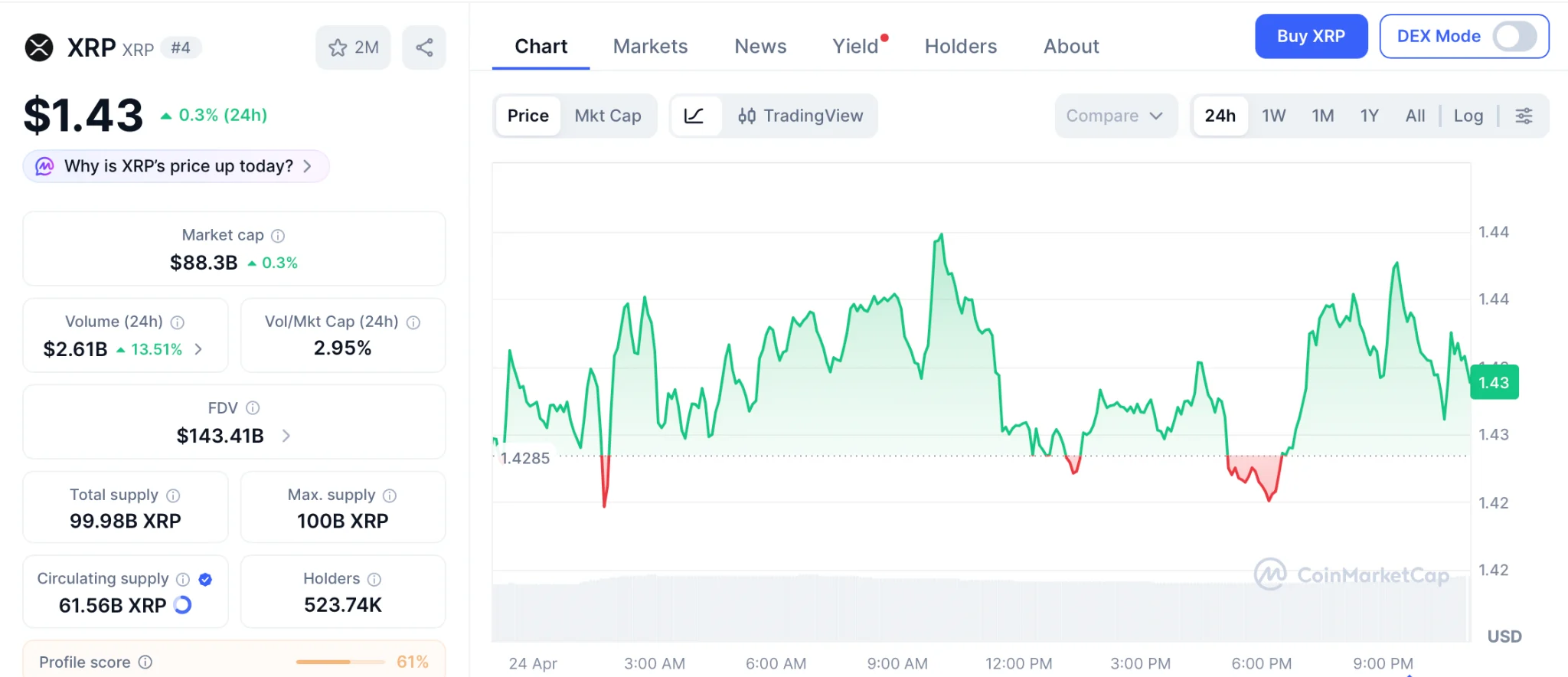
The next crypto to explode in 2026 is narrowing fast as the April board tightens around two developments, with Bitget launching a SpaceX-linked preSPAX token on Solana April 21 to deliver the first tokenized pre-IPO product on the network per Blockchain Magazine, while spot XRP ETFs posted a seven-day inflow above $55 million per 24/7 Wall St, and Hex Trust’s wXRP wrapper now runs on Solana per U.Today.
SOL holds $87.38 and XRP trades at $1.43, yet neither carries the math presale pricing prints, because Pepeto raised $9.45 million at $0.0000001866 ahead of an approaching Binance listing.
Solana Powers Tokenized Stocks While XRP Logs Its Best ETF Week of the Year
Solana processed 41% of Q1 2026 DEX volume per Artemis and led every blockchain in dApp revenue for five straight weeks, while Bitget’s preSPAX token puts structured equity exposure on chain for the first time and the Alpenglow upgrade targeting 150-millisecond finality stays on schedule per CoinGabbar, as spot SOL ETFs pulled $35.17 million across five sessions per CoinDesk.
XRP ETFs added more than $55 million over seven days and the seven-fund family now holds $1.24 billion in cumulative assets per 24/7 Wall St., with Hex Trust’s wXRP wrapper widening distribution to a second chain, so the next crypto to explode in 2026 needs real fundamentals and an entry price with room to multiply, and that combination lives at presale level.
Solana, XRP, Pepeto, and the Presale Built for the Next Crypto to Explode in 2026
Solana (SOL) Price at $87.38 as Tokenized SpaceX Stock Goes Live on Chain
Solana (SOL) prints $87.38 on April 24 per Coinbase with a 24-hour high of $89.24 and a market cap near $50.3 billion, and Bitget’s preSPAX launched on the chain April 21 per Blockchain Magazine, while weekly DEX volume crossed Ethereum for the first time this year and stablecoin supply has grown 15 times since January 2025 to $3.8 billion.
Spot SOL ETF inflows reached $35.17 million for the week per CoinDesk, with resistance at $97 and $250 as the next breakout target per OpenPR, roughly 3x, real money on a $50 billion asset yet inside large-cap math.
XRP Price at $1.43 as Spot ETFs Print the Strongest Inflow Week of 2026
XRP trades at $1.43 with an $88 billion market cap and a 1.22% 24-hour gain per CoinMarketCap, while spot XRP ETFs added over $55 million across seven days per 24/7 Wall St. as GraniteShares pushed its 3x XRP ETF launch to May 7.
Hex Trust’s wXRP wrapper extends XRP utility onto the tokenized stocks chain, and Weex models a 2026 average near $1.65 with a $2.05 high if quantum upgrades hold, roughly 45% upside, a respectable return for a $88 billion cap yet far from the multiples presale pricing delivers.
Pepeto Presale Raised $9.45 Million With Three Products Already Running
The cleanest 2026 setup continues to sit at presale level while SOL and XRP run their own catalysts, because Pepeto raised $9.45 million with three products solving three pain points, where the zero-fee exchange clears trades across Ethereum, BNB Chain, and Solana without a platform cut, while the bridge carries tokens at zero gas and the AI scanner checks every token’s code for hidden risk.
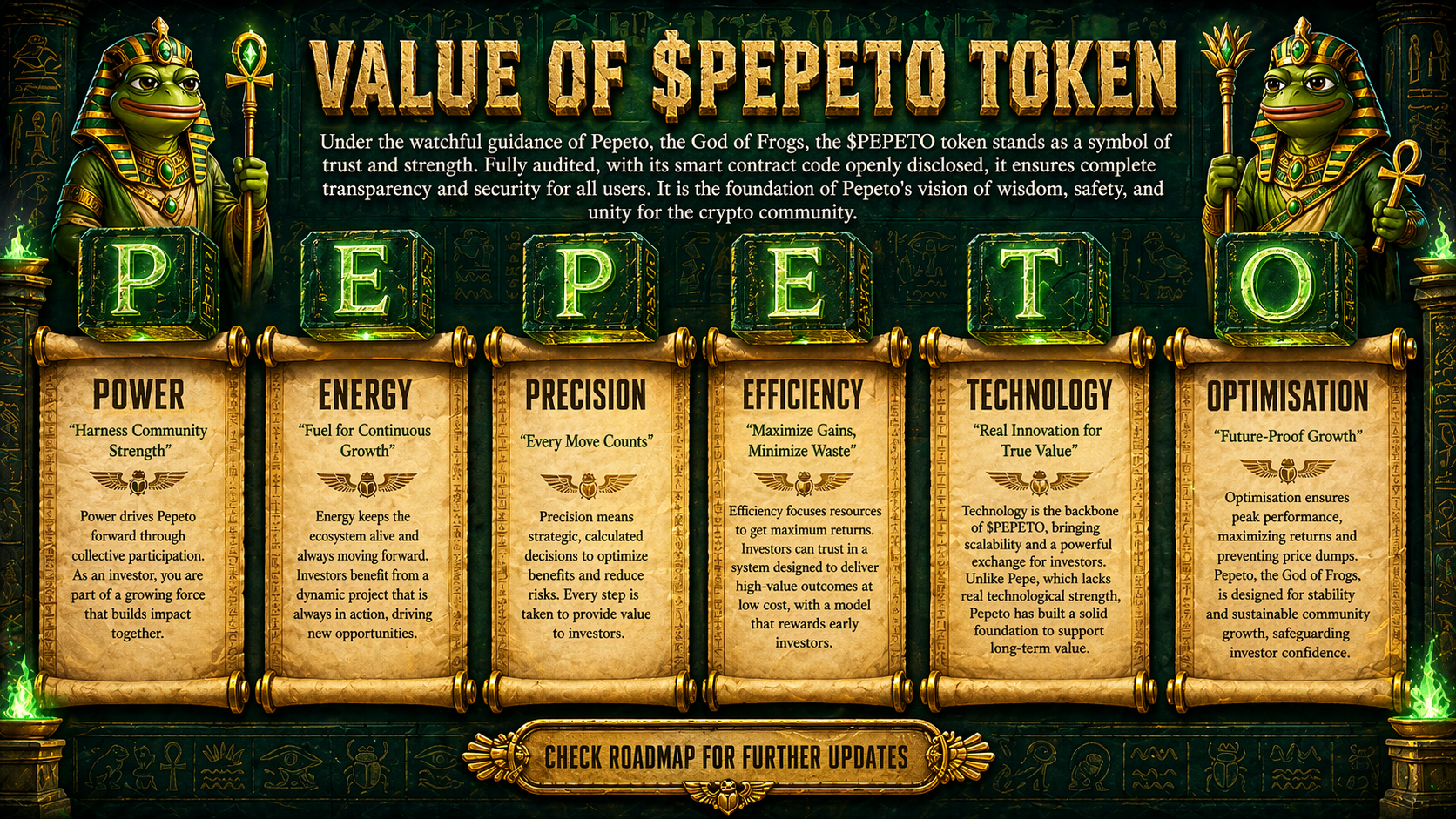
SolidProof signed off on every smart contract, and a Pepe cofounder leads the roadmap alongside a former Binance executive, while staking pays 178% APY and compounds daily, and the CoinMarketCap preview page went live weeks ago, the signal that has preceded every major listing of the past three years.
With a $3,000 entry at $0.0000001866 matching the shape that delivered DOGE holders life-changing numbers from sub-cent per CNN, which places Pepeto the next crypto to explode with a Binance listing approaching inside that pattern.
Conclusion
Solana and XRP both belong in any 2026 portfolio that takes institutional adoption seriously, with Bitget tokenizing SpaceX on one side and XRP ETFs printing a record week on the other, yet every cycle produces one entry that outperforms the rest by a wide margin and it always lives at presale pricing before a listing resets the chart,
Which is why Pepeto at $0.0000001866 with $9.45 million raised, 178% staking, and a Binance listing expected is the setup DOGE and SHIB wallets had before the market caught on, which ranks Pepeto as the next crypto to explode in 2026.
Click To Visit Pepeto Website To Enter The Presale

FAQs
What is the Solana (SOL) price prediction as the next crypto to explode in 2026 conversation narrows?
Solana trades at $87.38 on April 24 after Bitget launched a SpaceX-linked preSPAX token on the chain April 21 per Blockchain Magazine. OpenPR analysts map a $250 target on a confirmed break of $97 resistance, a 3x outcome supported by $35.17 million in weekly spot ETF inflows.
What is Pepeto and why does it rank as the next crypto to explode in 2026?
Pepeto is the presale meme coin at $0.0000001866 that raised $9.45 million with a zero-fee exchange, bridge, AI scanner, and 178% APY staking. A Pepe cofounder and a former Binance executive lead the team with a SolidProof audit completed and a Binance listing approaching, the clearest asymmetric setup of the cycle.
Disclaimer: This is a Press Release provided by a third party who is responsible for the content. Please conduct your own research before taking any action based on the content.
TLDR:
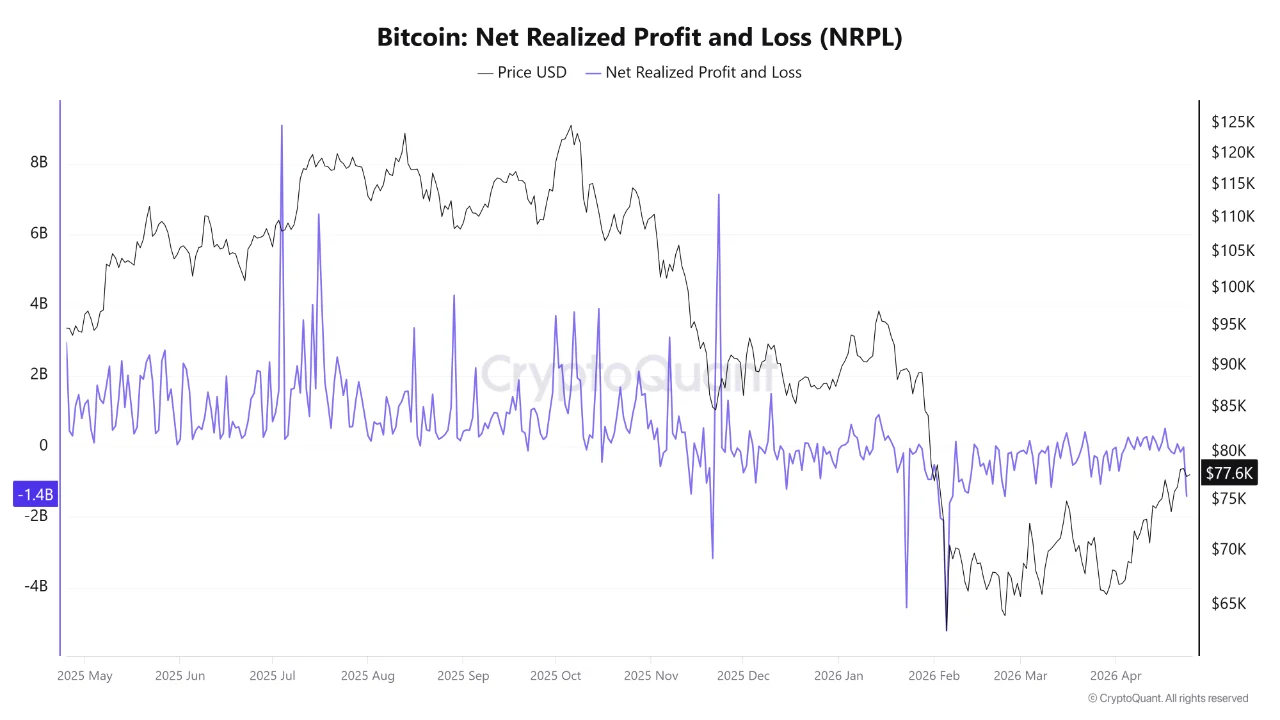
- Bitcoin NRPL has moved out of deeply negative territory, showing that panic-driven selling has largely come to an end.
- NUPL currently sits in the 0.25–0.30 range, reflecting investor caution despite the majority still holding unrealized profits.
- Investors are selling into price rallies due to a “let it rise a bit more” mindset, creating consistent overhead resistance.
- On-chain data places Bitcoin in a slow recovery stage, positioned between a bear market bottom and a confirmed bull market trend.
Bitcoin’s on-chain metrics are sending mixed but cautiously optimistic signals to the market. Net Realized Profit and Loss (NRPL) has moved away from deeply negative territory.
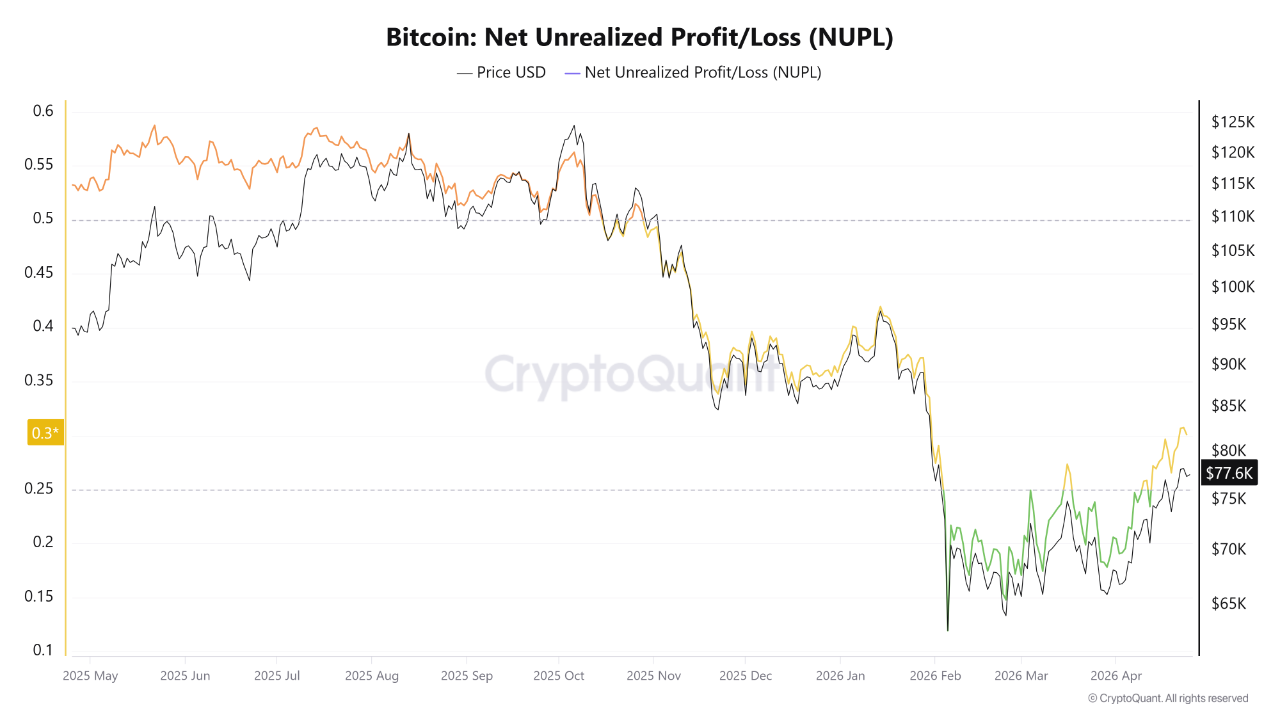
Meanwhile, Net Unrealized Profit and Loss (NUPL) currently sits in the 0.25–0.30 range. Together, these two indicators suggest that panic selling has largely ended.
However, buyers have not yet stepped in with full conviction. The data points toward a slow recovery phase rather than a confirmed bull or bear trend.
Selling Pressure Fades as Bitcoin NRPL Trends Neutral
During mid-2025, Bitcoin’s NRPL recorded strongly positive values across the market. Investors were actively realizing profits throughout that period.
This behavior is commonly associated with distribution phases and potential top formations. The market was clearly moving through a profit-taking cycle at that stage.
As 2025 progressed, NRPL gradually weakened and moved into negative territory. The sharp price decline at the start of 2026 caused a noticeable rise in loss realization.
Weak hands in the market were being flushed out during this period. Selling pressure from panicked investors began to ease over time.
Currently, NRPL is moving with only a slightly negative tendency. There is no large-scale profit taking occurring at this point.
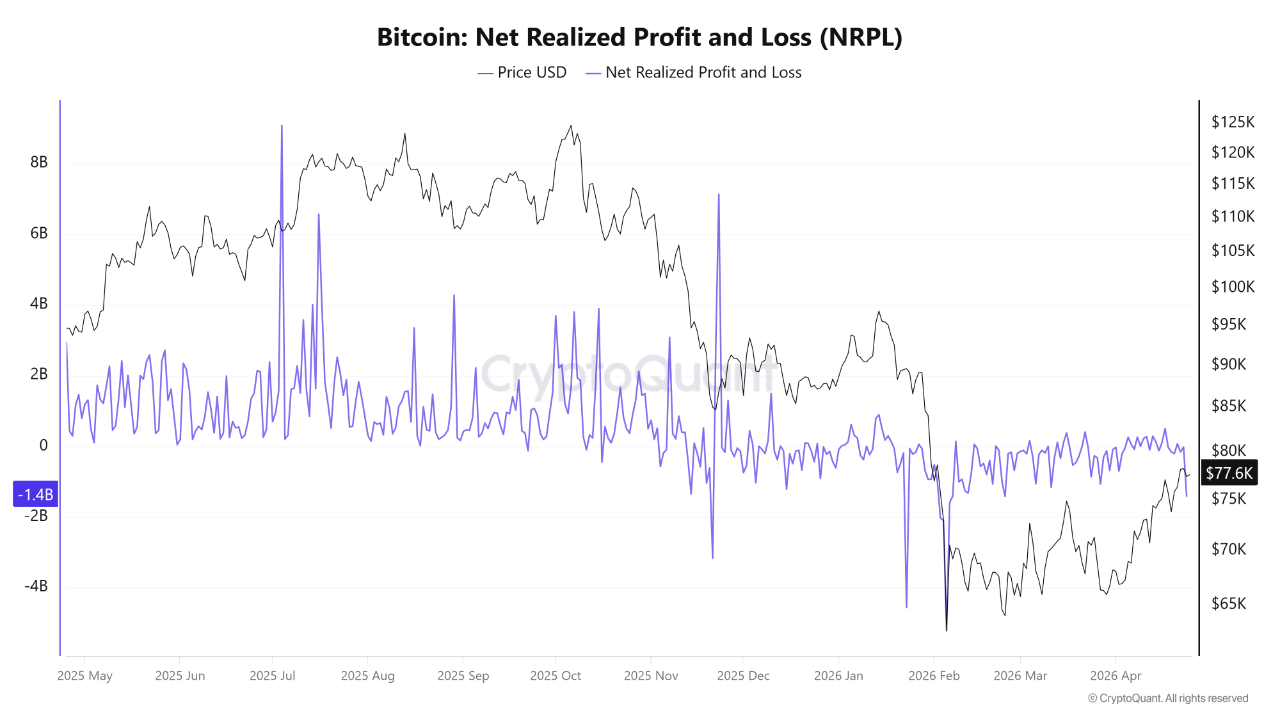
At the same time, aggressive capitulation selling has also largely subsided. This combination suggests the market is transitioning away from a fear-driven phase.
Analyst PelinayPA shared that NRPL shows realized selling pressure has ended. NUPL data, meanwhile, shows the market remains in profit but acting cautiously.
The market appears to be entering a slow and gradual recovery phase. Buyers have yet to take an active and decisive role in the market.
Bitcoin NUPL Data Reflects Caution Despite Early Recovery Signs
Throughout 2025, NUPL consistently remained above the 0.5 level. That level is associated with strong investor confidence and widespread unrealized profits.
However, NUPL later declined sharply and dropped to around 0.2. The fall reflected a clear reduction in overall market optimism.
At present, NUPL sits in the 0.25–0.30 range. This zone is neither historically cheap nor particularly expensive. Investors still hold unrealized profits on average, but confidence has reduced. The strong bullish conviction seen throughout 2025 is no longer present in the market.
PelinayPA further noted that investors currently hold a “let it rise a bit more so I can exit” mindset. This approach leads directly to selling into price rallies rather than holding.
As a result, recovery attempts face consistent resistance from overhead sellers. The market struggles to maintain upward momentum under these conditions.
Since NUPL remains relatively low, the “buy every dip” mentality has not returned. Buyers remain cautious during pullbacks rather than actively accumulating positions.
Based on both NRPL and NUPL readings, Bitcoin is in a recovery stage. It is neither in a bear market nor near a bull market peak.


The modern financial system was never designed for machines. It was built around the constraints of human life: geography, sleep cycles, paperwork, and physical presence. But as AI agents begin to act as economic participants, that human-centric design is starting to look less like a feature, and more like a bottleneck, said the co-founder of crypto firm Alchemy.
“You can argue that crypto was built for AI agents, not humans,” said Alchemy CEO and co-founder Nikil Viswanathan.
The mismatch is everywhere. Banks have operating hours because humans do. Payments are tied to countries because people live in them. Credit cards assume physical identity and presence, he said.
AI agents operate differently. They don’t sleep. They don’t live anywhere. They don’t walk into banks or carry cards. And increasingly, they don’t just assist with tasks, they transact.
“All transactions for agents are online. They’re inherently global,” Viswanathan, who will be speaking at Consensus Miami next month, told CoinDesk in an interview.
That’s where crypto starts to look less like an alternative financial system and more like the native infrastructure for a new kind of economic actor, he said.
Alchemy is a crypto infrastructure company that provides the underlying tools and services developers need to build blockchain-based applications. It offers APIs, node infrastructure, and data services that power everything from financial apps to non-fungible tokens (NFTs) and games, enabling companies to build and scale onchain products without managing the complexity of blockchain systems themselves.
Built for the wrong user
Traditional finance assumes friction. Paying someone in another country involves currency exchanges, intermediaries, delays and fees. For humans, that’s normal. But for AI agents, it’s unusable.
Agents need to transact seamlessly across borders, at any time, often in tiny increments. They need programmability, direct control over money via code, and systems that don’t depend on physical infrastructure or identity.
Crypto offers exactly that: a global, always-on financial layer where value moves as easily as data, he said.
“Crypto is the global infrastructure for money that agents need,” Viswanathan said.
Complexity flips
What has long made crypto difficult for humans, including seed phrases, private keys and interacting directly with code, is exactly what makes it powerful for machines, Viswanathan said.
Unlike humans, agents operate natively in code.
“Agents read in zeros and ones. That’s their native language,” he said. “That’s also the language of crypto.”
For years, crypto has tried to abstract itself into something more human-friendly. But its underlying architecture was never really built for humans in the first place.
Viswanathan compared the shift from crypto tools being built primarily for humans to crypto tools being used by AI agents to an earlier epochal shift from the postal system to the internet. While people once had to physically write out a letter, buy a stamp and mail it to share messages across the globe, communication in the modern era is much faster.
“Email is far more powerful than the postal system because it’s designed for computers,” Viswanathan said. “Crypto is similar.”
Agent-run financial system
Viswanathan said that moving forward, AI agents will sit on top of crypto infrastructure, handling complexity automatically, managing wallets, executing transactions and optimizing flows of capital in real time, letting people control their own funds more easily.
“You can write code to manage a crypto wallet,” Viswanathan said. “You can’t write code to manage a bank account in the same way.”
The result would be a financial system that is more global, more programmable, and more autonomous.
Viswanathan said he sees a layered future: traditional finance and crypto as the base, an agent layer operating on top and a human interface above that.
“Just like computers operate the internet and humans use it, agents will operate finance,” he said.
Read more: Sam Altman’s World project launches major upgrade to fight deepfakes and bots
TLDR:
- $HYPE holds near $41 as traders watch resistance, with breakout signals pointing toward further upside momentum.
- Whale positions exceed $3.66 billion on Hyperliquid, reflecting strong participation from large market players.
- Analysts project higher long-term targets for $HYPE, driven by platform growth and sustained trading demand.
- AI focus shifts in 2026 toward real-world use, with DeepSeek V4 advancing large context capabilities.
Hyperliquid’s native token $HYPE is drawing strong market attention after a sharp upward move linked to a key technical breakout.
Market activity remains elevated as traders track resistance levels, while broader discussions also shift toward practical developments in artificial intelligence.
Hyperliquid Rally Gains Momentum Amid Breakout Signals
The recent price movement in $HYPE has followed what traders describe as a breakout from a long-standing resistance trend. This shift has fueled expectations of further upside, supported by rising participation across the platform.
A widely shared post from market analyst JAVONMARKS on X noted that the breakout could push the token toward $0.5497 on a different trading pair. The tweet framed the move as part of a broader bullish structure forming after sustained resistance pressure.
At the same time, $HYPE trades near $41.18, holding relatively steady after recent volatility. Traders continue to monitor the $41.75 resistance level closely. A move above this point may open the path toward $50 in the near term.
Meanwhile, support remains firm around the $40 level. This range has acted as a key buffer during recent price swings. As a result, short-term positioning appears to depend heavily on how price reacts within this narrow band.
Large holders have also increased their exposure. Data shows whale positions exceeding $3.66 billion in open interest on the platform. This level of activity points to strong confidence among major participants.
In parallel, public forecasts from figures such as Arthur Hayes have added to market attention. Some projections suggest long-term targets near $150, based on platform revenue and user growth trends.
AI Sector Moves Toward Practical Adoption Phase
While crypto markets remain active, attention is also shifting toward developments in artificial intelligence. The narrative around AI is evolving as 2026 progresses, with more focus on real-world applications.
The release of DeepSeek V4 has drawn attention due to its expanded capabilities. The model features a 1-million token context window, marking a technical improvement over earlier versions.
This advancement reflects a broader transition within the sector. Industry discussions now center less on novelty and more on measurable outcomes. As a result, companies are expected to show clear use cases for AI deployment.
At the same time, the concept of autonomous agents is gaining traction. These systems aim to perform tasks rather than only generate content. This shift signals a move toward more functional and integrated AI tools.
However, caution is also emerging from policymakers. U.S. senators have warned financial leaders against relying too heavily on AI-driven projections. These concerns relate to economic decisions, including interest rate strategies.
Consequently, 2026 is often described as a testing phase for AI adoption. The focus is now on execution, reliability, and measurable performance. This approach contrasts with earlier periods driven by rapid innovation and market excitement.
Across both sectors, activity remains high, though narratives are becoming more grounded. Crypto markets respond to technical signals and liquidity flows, while AI development continues toward practical implementation.
Crypto World
Trump defends crypto legislation at private event featuring boxer Mike Tyson, Tether CEO
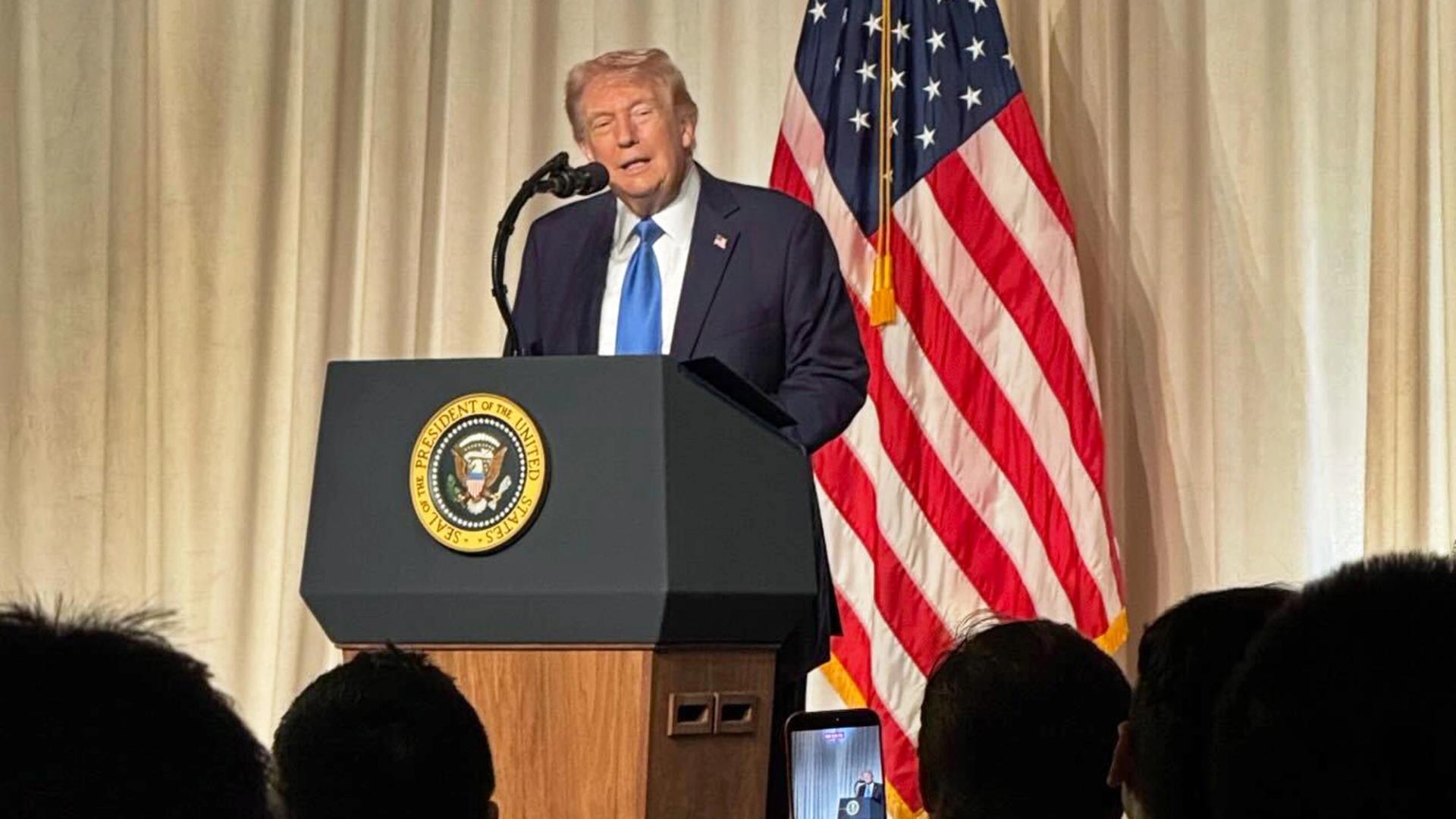
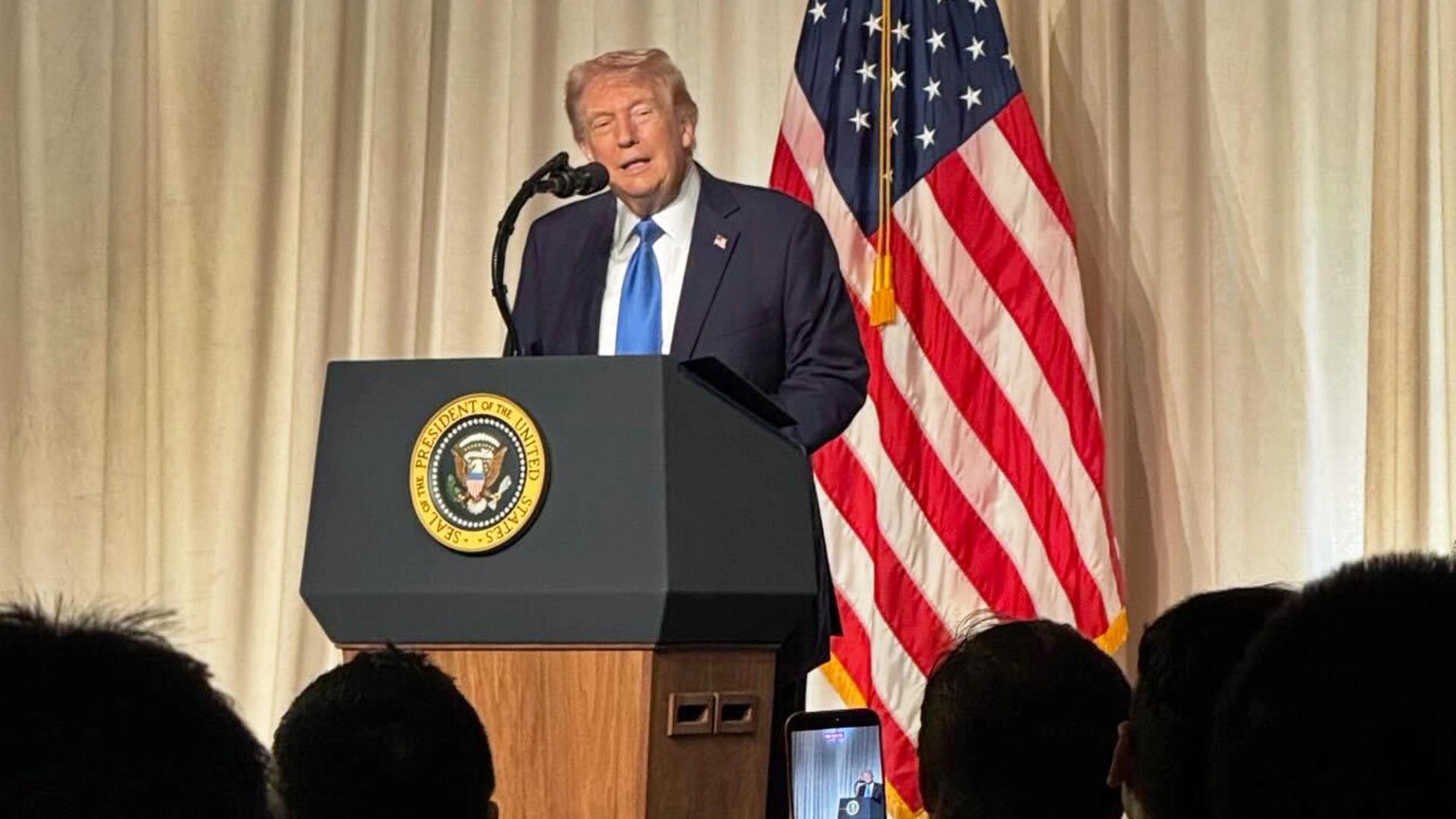
A few hundred of the top $TRUMP memecoin holders were treated to some personal time with U.S. President Donald Trump and his high-profile guests on Saturday at an event at his Florida club in which Trump warned bankers against getting in the way of crypto legislation.
Speaking at the private Mar-a-Lago gathering in Palm Beach, Florida, Trump took up the stance his White House crypto advisers had occupied on the Digital Asset Market Clarity Act, according to a person attending the conference. He pushed back against the bank lobbyists who’d stalled the legislation — the crypto industry’s primary policy aim.
The White House won’t let the banks ruin the crypto market structure legislation, Trump said at the event, a finance-focused gathering billed as “the most exclusive conference in the world.”
In negotiations over recent months, banking groups had won over some senators over their concerns about how U.S. regulations would pave the way for stablecoin rewards programs that the bankers argued could threaten their traditional deposit accounts. The objection derailed Senate progress on the effort to win a new U.S. regulatory regime for crypto, though recent discussions suggest the bill could still get back on track and has a potential path to survive a tightening lawmaking calendar this year. Trump has signaled that’s a priority.
The president’s event featured a roster of crypto executives and investors, including Tether CEO Paolo Ardoino, Ark Invest’s Cathie Wood and Anchorage Digital CEO Nathan McCauley. Boxer Mike Tyson was also in attendance.
Beyond crypto, Trump touched on foreign policy issues including Iran, Venezuela and NATO, which he described as a “paper tiger” that is “never there for us.”
As for the digital asset industry, Trump stuck to his usual script: “We are the leader in crypto. It’s become mainstream,” he said.
The conference comes as Trump continues to back crypto ventures tied to his name, drawing both industry support and political scrutiny. His close personal connections to digital assets businesses has been among the other sticking points on passing the Clarity Act, as Democratic negotiators have insisted that senior government officials, including the president, be banned from profiting off of the industry.
A previous event he appeared at for his memecoin investors last year touched off protests and Democratic criticism that his policy aims benefit his own business interests in an example of government corruption that needs to cease. He was also criticized for meeting privately with unnamed foreign business figures who’d effectively paid for their attendance.
Crypto World
TRUMP Token Insiders Allegedly Dump $46M Worth of Tokens Amid Supply Concentration Concerns
TLDR:
- Over 15.54M TRUMP tokens worth roughly $46M were sent to OKX by team-linked wallets over three weeks.
- A splitter wallet broke large token chunks into smaller transfers within seconds to obscure the fund flow.
- One wallet handled 8.25M TRUMP tokens worth $23M, routing them directly to the OKX exchange hot wallet.
- A single wallet controls 76.75% of TRUMP’s total supply, leaving retail traders exposed to insider-driven price swings
On-chain data has revealed a systematic token offloading pattern tied to wallets linked to the TRUMP memecoin team.
Over three weeks, approximately 15,540,000 TRUMP tokens, valued at around $46 million, were sent to OKX. The activity traces back to a primary team wallet, moving through intermediary addresses before reaching the exchange.
One wallet alone controls 76.75% of the total supply, raising serious concerns about market stability and insider behavior.
Coordinated Wallet Activity Points to Structured Token Offloading
Blockchain analysts flagged a series of transactions originating from a known team wallet. The address 8bHec5JeptUGTwsbC3ycdXrK6uhR7w6hzuPnmzmxJMnv serves as the primary source of the funds.
From there, tokens move to a so-called “splitter” wallet at xcHFnzWgaw6YG3ZQsoDpEE7hVMChGQKv3paPfaxCPWG.
The splitter wallet breaks large token amounts into smaller chunks within seconds. This method distributes funds quickly across multiple addresses before they reach an exchange. The pattern appears structured rather than organic trading activity.
After splitting, tokens flow to a main dumping wallet at Hv1hqPhX3CG6jNu3MzRnfoEV6owPw1mhogtCyY16jPCZ. This address alone handled 8.25 million TRUMP tokens, worth roughly $23 million, sent directly to the OKX hot wallet.
Crypto analyst StarPlatinum flagged the activity on X, stating: “Wallets linked to the team have been systematically offloading tokens into exchanges sending a total of 15,540,000 TRUMP directly to OKX.” The analyst described the pattern as coordinated and deliberate.
Secondary Wallets and Supply Concentration Add to Market Risk
Two additional wallets were identified as part of the same offloading pattern. Addresses 9aiqyEUmwb63yUjwPHwY4jR68Pj5QsCQBGhYWRJEwXZA and C68a6RCGLiPskbPYtAcsCjhG8tfTWYcoB4JjCrXFdqyo consistently sent large TRUMP amounts to OKX. One of these wallets moved over one billion TRUMP tokens within just a few days.
All token flows eventually converge at 64CuV85HHCydAwxQMoXwZ9HXoyw5qE65NkiJxCtuFErF, identified as the OKX hot wallet.
Its outgoing distribution to thousands of smaller addresses confirms its exchange role. Once tokens arrive there, they become liquid and available for open-market sale.
Beyond the selling activity, supply concentration remains a core concern. A single wallet, HkykUVWTctptXZmRTWearMsH4SaQNmE4Ku3tMJe5v2mH, holds 76.75% of the entire TRUMP token supply. That level of concentration gives insiders near-total control over market conditions.
StarPlatinum concluded: “The market is entirely dependent on insider behavior. Don’t trust this chart token.” Retail participants remain exposed to price movements driven entirely by a small group of wallet holders.
Crypto World
Why investors are flocking to BlackRock’s bitcoin options to hedge against a wild global economy
Something notable happened on Friday, indicating the accelerating institutionalization of the bitcoin market, which has been pioneered by everyday people for years.
This is because options, or hedging instruments, linked to BlackRock’s bitcoin exchange-traded fund (ETF), IBIT, have grown slightly larger on Nasdaq than total bitcoin options trading on the offshore giant Deribit. It is particularly striking that IBIT options have, in just two years, closed the gap with Deribit’s bitcoin options market, which has been operating since 2016.
On Friday, the dollar value of open or active IBIT options contracts on Nasdaq, the so-called open interest (OI), was $27.61 billion, slightly higher than the $26.90 billion in Deribit’s bitcoin options, according to data tracked by decentralized crypto volatility protocol Volmex.
This milestone indicates that the regulated, institutional-grade bitcoin investment and derivatives infrastructure in the U.S. is no longer second fiddle to the offshore market. Moreover, a booming, regulated market in the U.S. could embolden more Wall Street institutions to explore digital assets, ultimately leading to more mature price discovery.
Deribit’s Global Head of Retail Sales and Business, Sidrah Fariq, described IBIT’s rise as a net positive for the broader crypto derivatives ecosystem.
“US retail can’t onboard platforms like Deribit, so iShares Bitcoin Trust (IBIT) options give them direct access to regulated leverage and options exposure. This is further supported by the current macro environment with supply chain uncertainty, energy shocks, and broader geopolitical risks, which naturally drives demand for hedging and options strategies,” Fariq told CoinDesk.
What are options?
Options are derivative contracts that give the purchaser the right to buy or sell the underlying asset at a predetermined price at a later date. Think of it as paying a token price to reserve the right to buy or sell the property at a pre-agreed specific price in the future. A call option gives the right to buy and represents a bullish bet, while a put option gives the right to sell.
Analysts use open interest as the measure of market size and participation – the higher the open interest, the deeper and more liquid the market.
Traders use options to hedge existing positions in the spot and futures markets, speculate on price direction, and generate additional income on coin/ETF holdings.
One of the most preferred income-generating strategies involving IBIT ETF and IBIT options is the covered call strategy. It allows investors to profit from BTC’s implied volatility by simultaneously holding the ETF and shorting IBIT calls at levels well above the ETF’s current market price.
Traders holding actual BTC have been doing this via Deribit for years.
Same in size but different in shape
The two markets, though, now match each other in scale but are positioned differently, revealing a lot about trader sentiment in each.

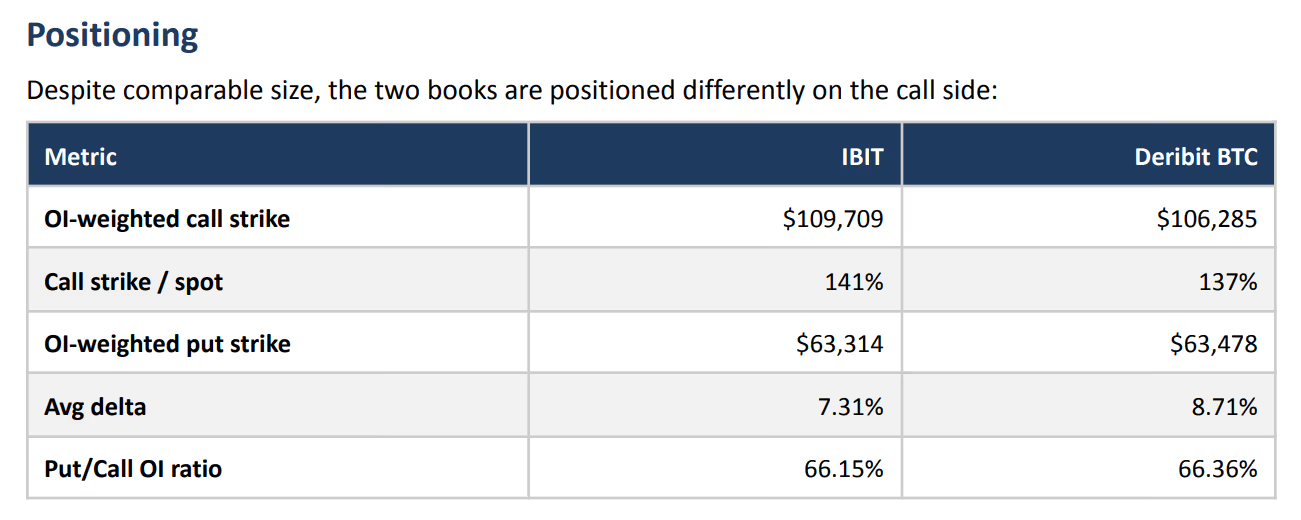
According to Volmex, the bulk of open interest in IBIT call options points to expectations of an ETF rallying to levels equivalent to BTC trading at $109,709 in the near-term. That’s roughly 41% higher than the current market price of $77,400.
Positioning in Deribit options is bullish but slightly measured, suggesting expectations of a rally to $106,000.
“Onshore call OI is concentrated roughly 4 percentage points further out-of-the-money than offshore, and the onshore average delta is slightly lower. This is consistent with onshore flow being dominated by retail upside speculation and systematic call overwriting programs, both of which concentrate OI in further-OTM strikes,” Volmex said in a report shared with CoinDesk.
ETF holders are more patient
Options have expiry dates – the point at which contracts are settled, depending on where IBIT or spot BTC is trading at that time.
Analysis of activity across both markets suggests that, on average, October 2026 expiries are preferred in IBIT, while August expiries dominate on Deribit.
“IBIT options are approximately two months longer-dated on an OI-weighted basis. The gap is roughly symmetric across puts and calls, suggesting it reflects the underlying holder base, longer-horizon ETF investors onshore versus more tactical positioning offshore, rather than asymmetric demand for protection or upside,” Volmex noted.
Lastly, IBIT’s implied volatility – a metric that measures expected swings in the BTC-linked ETF over the next four weeks – is higher than the implied volatility derived from Deribit’s BTC options.
Volmex attributes this premium to a structural quirk: Because ETF holders cannot easily short (express a bearish view) bitcoin directly, they buy put options as their only available hedge. This demand for put options is keeping IBIT’s implied volatility slightly elevated.
All things considered, IBIT’s rapid rise in the options market is striking and, in many ways, now appears to rival Deribit in scale. However, the two are not direct substitutes, as IBIT options primarily cater to regulated, onshore investors accessing bitcoin exposure through traditional brokerage channels, while Deribit remains the go-to place for global investors.
“I don’t see this as competition. If anything, it expands the market. As more participants get comfortable trading options via IBIT, it ultimately feeds into the broader ecosystem, and venues like Deribit benefit from increased sophistication and flow,” Fariq said.
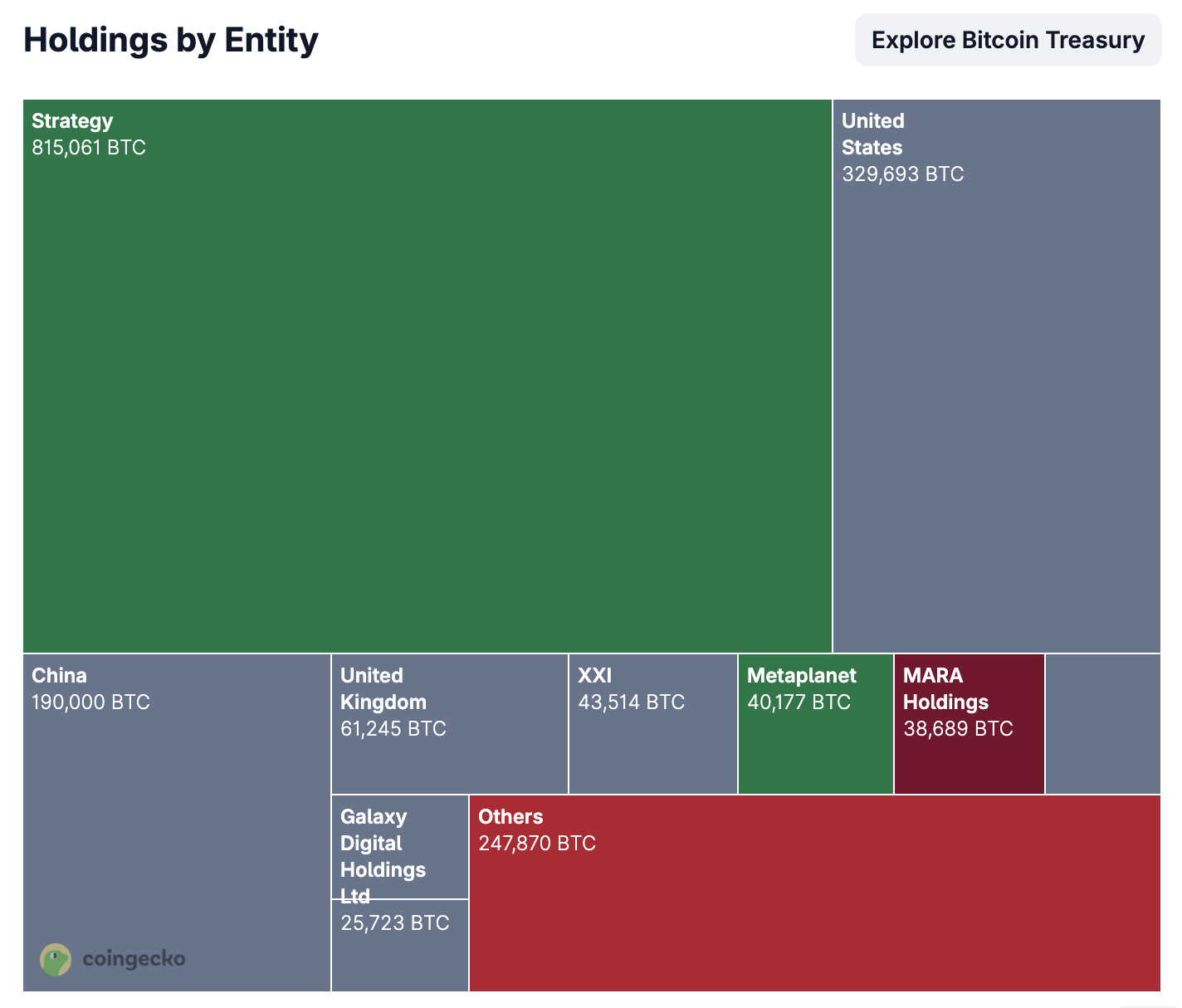
Metaplanet just doubled down again, believing in its Bitcoin price prediction. The Japanese Bitcoin treasury firm announced its 20th bond issuance on Friday, raising ¥8 billion ($50 million) in zero-interest debt to fund further Bitcoin purchases, even as BTC trades near $77,800.
According to a Friday filing, EVO Fund, the Cayman Islands-based investor that has anchored every prior offering, fully subscribed to the latest issuance. The bonds carry zero interest, zero collateral, and zero guarantee, an unusual structure that functions as a rolling credit line, with each bond auto-redeemed as EVO exercises stock warrants in subsequent financing rounds.
Metaplanet now holds 40,177 BTC, valued at $3.11 billion at the current price, making it the third-largest listed Bitcoin treasury globally. That stack came with a cost as the firm reported a $619 million net loss for fiscal 2025, driven almost entirely by unrealized Bitcoin markdowns.
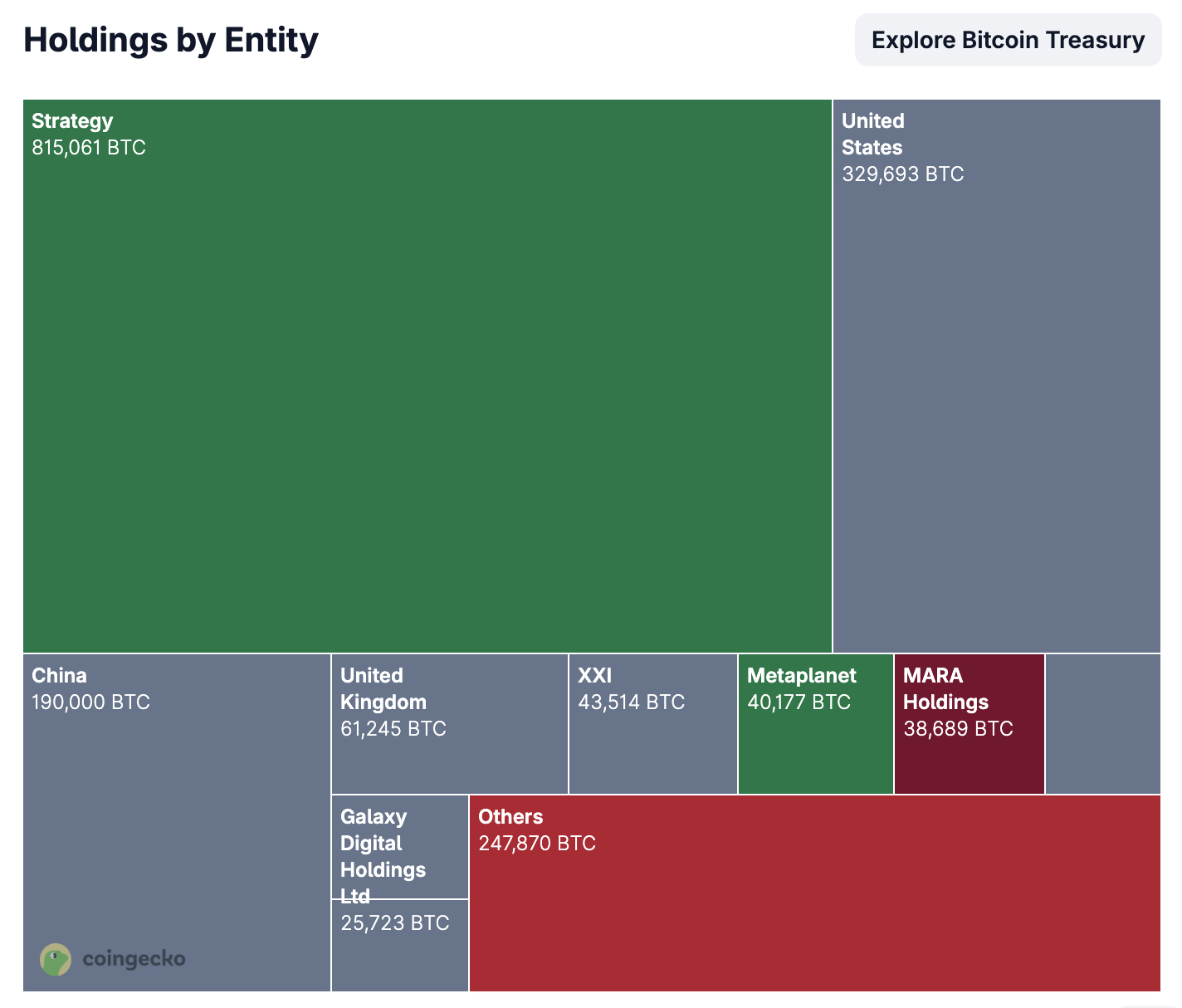
Metaplanet’s aggressive accumulation, 5,075 BTC added in Q1 alone, lands against a backdrop of recovering macro sentiment and renewed institutional interest.
Discover: The best crypto to diversify your portfolio with
Bitcoin Price Prediction: Reclaim $80,000 Next Week as Corporate Buying Pressure Builds?
Bitcoin’s 10% monthly gain to current levels $77,800 marks a meaningful recovery from the pressure tied to geopolitical tensions earlier this quarter, with analysts tracking a critical support band around $68,000 as the floor that needs to hold for any sustained rally thesis.
The technical setup is cautiously constructive. Price is recovering from a multi-month drawdown, and corporate accumulation events like Metaplanet’s bond issuance have historically reinforced institutional demand narratives, much as the BlackRock and Strategy accumulation cycles that preceded previous rallies.
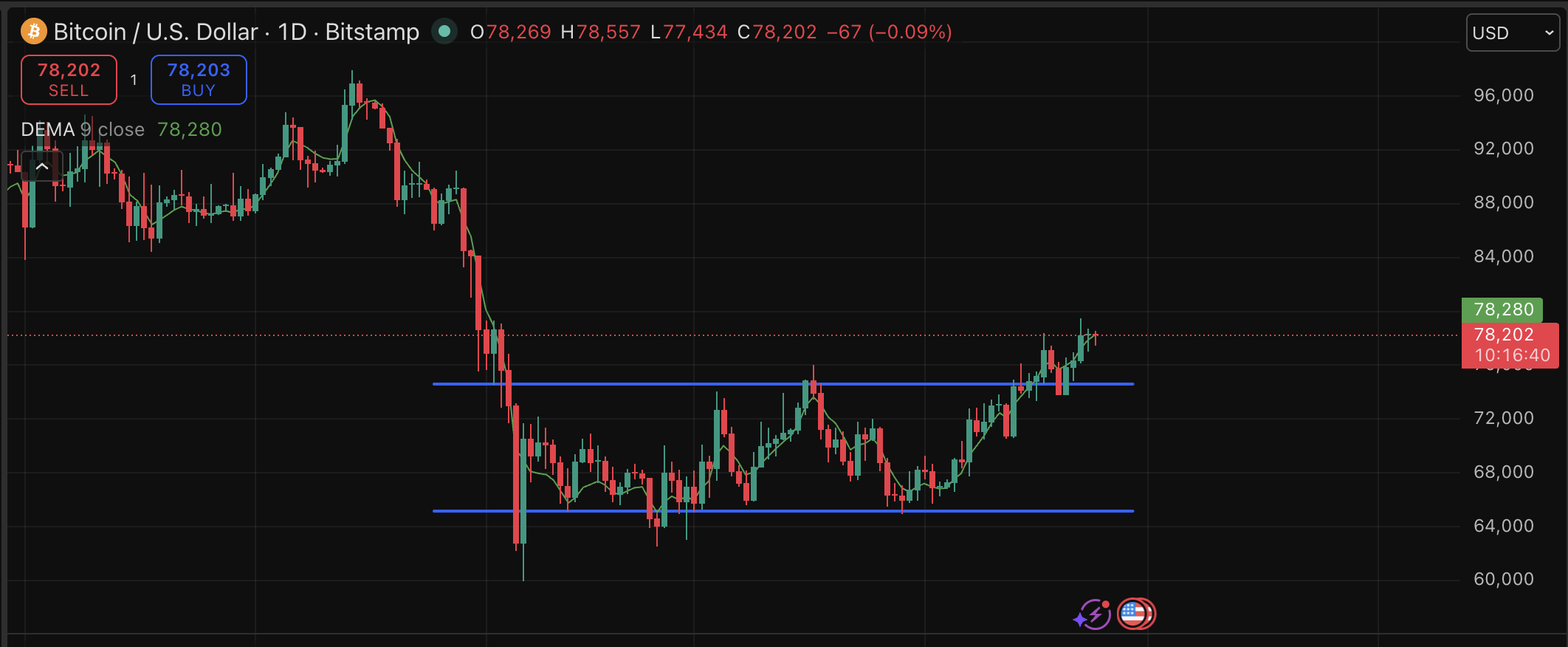
For next week, BTC needs to hold the $75,000 support, with accelerated institutional flows, for its price to retest $80,000 next week.
Macro catalysts, including policy signals from Washington, remain a wildcard that could accelerate any of these scenarios without warning. Metaplanet itself is targeting 100,000 BTC by 2026, which implies sustained buying pressure regardless of short-term price action.
Discover: The best pre-launch token sales
Bitcoin Hyper Targets Early Mover Upside as Bitcoin Tests Key Levels
Bitcoin here is a recovery story, but at a market cap measured in the trillions, the explosive percentage gains belong to an earlier chapter. Traders looking for asymmetric exposure to Bitcoin’s momentum are increasingly looking one layer down: at the infrastructure being built on top of it.
Bitcoin Hyper ($HYPER) positions itself at exactly that intersection. The project claims the title of the first-ever Bitcoin Layer 2 with Solana Virtual Machine (SVM) integration, a combination designed to bring sub-second finality and low-cost smart contract execution to the Bitcoin ecosystem without sacrificing Bitcoin’s underlying security.
Hyper is a project that grafts Solana’s speed onto Bitcoin’s trust layer, a combination that solves three of Bitcoin’s most persistent limitations: slow transactions, high fees, and limited programmability.
The presale has raised $32 million at a current price of $0.0136, with staking available at a high 30% APY for early participants. Feature highlights include a Decentralized Canonical Bridge for BTC transfers and high-speed SVM-powered smart contracts.
For traders who want to go beyond BTC spot exposure, research Bitcoin Hyper here.
The post Bitcoin Price Prediction: Metaplanet Raises $50 Million to Buy More BTC appeared first on Cryptonews.

How the 6-Jar Technique Can Help You Save More Money Than Ever

Whitby Goth Weekend itinerary for May 2026 festival

Errol Spence Jr’s comeback opponent and date finally confirmed

Manchester United reach agreement with Casemiro over contract clause amid transfer speculation

US brings back mandatory military draft registration

Steven Gerrard disagrees with Gary Neville over ‘shock’ Chelsea and Arsenal claim | Football


-

 Business6 days ago
Powerball Result April 18, 2026: No Jackpot Winner in Powerball Draw: $75 Million Rolls Over
-

 Politics6 days ago
Zack Polanski demands ‘council homes not luxury flats for foreign investors’
-

 Fashion1 day ago
Weekend Open Thread – Corporette.com
-

 Tech7 days ago
Auto Enthusiast Scores Running Tesla Model 3 for Two Grand and Turns It Into Bare-Bones Go-Kart
-
Entertainment6 days ago
NBA Analyst Charles Barkley Chimes in on Ice Spice McDonald’s Fiasco
-

 Politics5 days ago
Gary Stevenson delivers timely reminder to register to vote as deadline TODAY
-
Crypto World5 days ago
Bank of Hawai’i (BOH) Q1 2026: Net Income Drops to $57.4M as Net Interest Margin Expands
-

 Politics3 days ago
Making troops accountable for war crimes threatens US alliance, ex-SAS colonel warns
-
Crypto World1 hour ago
Hyperliquid $HYPE Rally Builds Momentum as AI Sector Enters Prove-It Phase
-

 Business3 days ago
Rolls-Royce Voted UK’s Most Iconic Trade Mark as IPO Register Hits 150
-

 Politics3 days ago
Disabled people challenge government SEND proposals over segregation concerns
-

 Politics3 days ago
Zack Polanski responds to home secretary’s taser threat
-

 Politics3 days ago
Starmer handler McSweeney to be dragged from shadows by Foreign Affairs Committee
-
Politics3 days ago
Wings Over Scotland | How To Get Away With Crimes
-
Crypto World7 days ago
Kelp DAO rsETH Bridge Hack Drains $292M as DeFi Losses Top $600M in Two Weeks
-

 Politics3 days ago
‘Iran is still a nuclear threat’
-

 Crypto World4 days ago
New York sues Coinbase, Gemini over prediction market offerings
-
 Crypto World4 days ago
Five Value Stocks with Recovery Potential in 2026: PayPal (PYPL), Nike (NKE), and More
-

 Business4 days ago
The Job Benefits Most Men Don’t Know to Negotiate
-

 Crypto World1 day ago
Michael Saylor says BTC winter is over. Market analyst disagrees, says bitcoin was in a pullback
You must be logged in to post a comment Login