
Crypto World
Dolly Parton Was the Real-Life Buffy the Vampire Slayer


Well, of course Buffy resonated with Dolly. In many ways, she was the real-life equivalent of Buffy Summers. Creator Joss Whedon (a man whose relationship to feminism is notoriously complicated at best) conceived the character as an empowered antidote to the hot, scantily clad victim types of 1980s slasher flicks. He has said that he intended the original Buffy to be “one of these crappy, low-budget movies,” but one that “had a feminist agenda, had females in it who were people.” Instead of being saved by some heroic boyfriend, the busty, blonde cheerleader lead (played by Kristy Swanson in the film) “would have to get her own back.” Maybe Buffy looked like the stereotypical high school bimbo. But, especially in a TV series that paired the character’s battles against supernatural baddies with mundane teenage rites of passage, she also had intelligence, resourcefulness, depth, and, of course, a once-in-a-generation gift for slaying vampires. Being underestimated based on her beauty often put her at an advantage.

After what feels like a lifetime in the making, the SEC’s proposed new Regulation Crypto Assets rules could finally make public token sales easier in the United States.
The proposal would allow qualifying issuers to raise up to $75 million during any 12-month period, and potentially allow projects to return to investors to raise more funds year after year as they build out their networks.
That could create a new, staged model for token fundraising, and potentially make early allocations more attractive to investors betting on higher valuations later.
But before you put the champagne on ice, it’s unlikely to bring back the freewheeling initial coin offering mania of 2017, according to Lee Reiners, a Duke University lecturing fellow and financial regulation expert. He tells Magazine:
“My initial view is that the $75 million exemption could make public token offerings more feasible, but it is unlikely to produce a return to the ICO boom.”
Could projects raise $75M every year?
The Securities and Exchange Commission’s proposal, unveiled Aug. 18, creates two exemptions for certain investment contracts involving crypto assets.
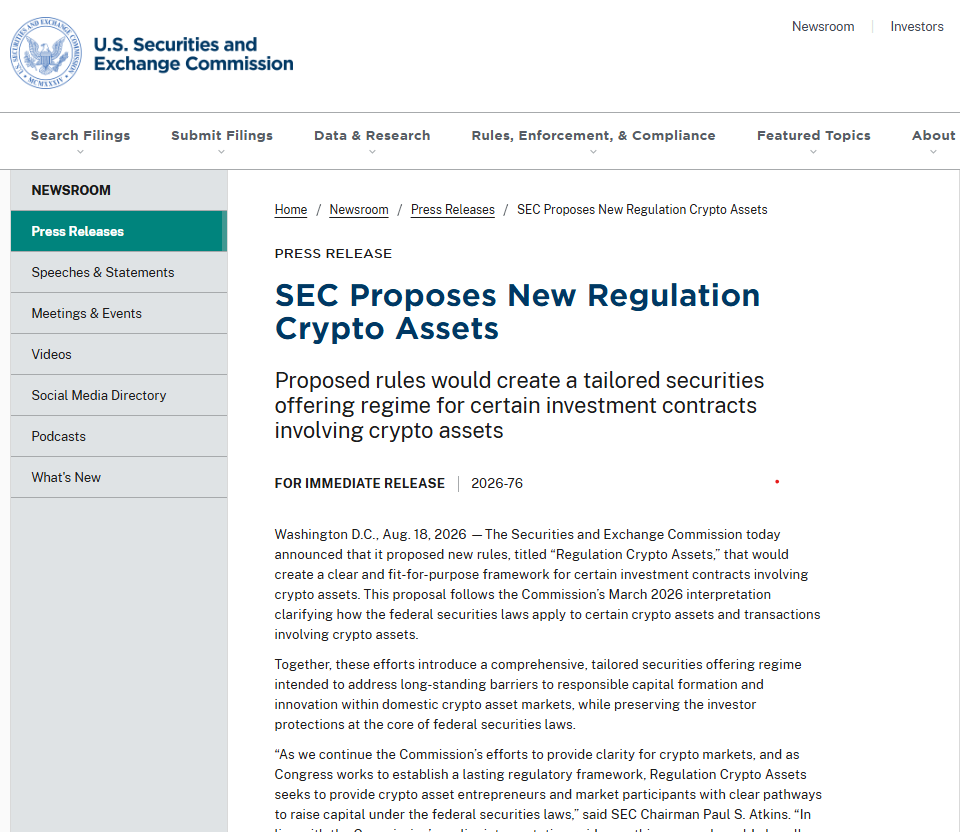
SEC Proposes New Regulation Crypto Assets. Source: SEC
The first is a one-time exemption for startups for offerings of up to $5 million over four years, and the second is a larger fundraising exemption allowing up to $75 million in each 12-month period.
Related: MiCA cracks down on USDT in Europe… but no one else cares
The latter is modeled in part on Regulation A and comes with disclosure and ongoing reporting requirements.
Does the rolling nature of the $75 million limit mean a project could simply raise $75 million, build for a year, then come back for another $75 million?
The answer appears to be yes.
Drew Hinkes, partner at Winston & Strawn, tells Magazine the 12-month limitation would allow for “serial raises” of $75 million every 12 months, “provided they are actually distinct offerings.”
So what’s the catch?
Lilya Tessler, partner and leader of Sidley’s Global FinTech and Blockchain group, says that while “nothing prevents an issuer from relying on the exemption more than once,” each raise “isn’t automatic.”
Subsequent raises would require filing a new offering statement and undergoing an SEC staff review, and issuers would have to keep filing annual and semiannual reports. They would also need to “disclose what the issuer raised under the exemption in the prior 12 months so the cap can be verified,” Tessler says.
Still, the proposed rules offer a substantial upgrade from the status quo. A project seeking $225 million in total, for example, could potentially raise the funds in chunks and return to investors later with a more developed network — and a higher valuation.
Could a cap create ICO-style FOMO?
That raises another obvious question. Could the $75 million ceiling make early token allocations more sought-after, unleashing a frenzy of get-rich-quick-induced FOMO in the first round?
Possibly. Reiners says that’s one potential outcome:
“If investors expect a successful issuer to conduct later offerings at a higher valuation, an initial allocation may become more attractive precisely because it is limited.”
However, that’s not dissimilar to how many token and equity sales are currently structured. SpaceX sold fewer than 5% of its total equity during the recent IPO. “Scarcity in both token sales and exempt securities offerings of traditional securities long predate this proposal — issuers have always been able to limit round sizes and can continue to do so,” says Tessler.
Non accredited investors also won’t be able to go “all in” on any one token sale like they have in the past. Tessler says the SEC’s proposal limits them to buying “10% of the greater of their income or net worth,” regardless of which round they participate in.
Related: White hat hacker recovers $2M from faulty 2016 ICO smart contract
Why this probably won’t be 2017 all over again
There are other reasons not to expect 2017 to return — not least because a generation of crypto investors have been burned by the extravagant promises and terrible tokenomics of previous ICOs. Up to 90% of projects funded via ICOs between 2017 and 2019 ended up failing. Reiners points out that fundraising markets are “shaped by investor appetite, token economics, liquidity, custody, and the reputational damage left by the last ICO cycle.”
The SEC estimates that around 130 offerings would use the two new exemptions each year, and around 475 issuers will potentially use the broader investment contract safe harbor. That’s less of a tsunami and more of a steady trickle.
SEC proposed long-awaited regulation for primary token issuance. Source: Galaxy.
But the SEC proposal is still very positive for token issuers trying to navigate a legal minefield around securities laws in the US — the kind Tezos and Telegram would have chewed their right arms off after their multimillion-dollar US securities-law battles.
Rather than force issuers to self-evaluate whether their offerings fit within existing securities law frameworks, the SEC is proposing an explicit regulatory pathway for raising capital. As crypto lawyer Jake Chervinsky says, “not one day too soon.”
What happens when the token starts trading?
There are some potential minefield though. The SEC’s proposal says the investment contract associated with a crypto asset can continue to transfer to subsequent purchasers in secondary market transactions until the crypto asset separates from the issuer’s representations or promises.
In other words, if the team selling a non-security token suggest that investors in the secondary market can reasonably expect to profit from essential managerial team efforts, then it could become subject to an investment contract.
Related: ‘We refused to do an ICO’: The truth behind Canton’s tokenomics
Hinkes sees that creating a potential problem:
“If a transaction of a non-security covered crypto asset causes the transfer of the investment contract from cryptoasset seller to cryptoasset buyer, there is a risk that the sale of the crypto asset would be viewed as a securities transaction.”
That could become a problem for exchanges and other trading venues.
A new route for fundraising — but old risks remain
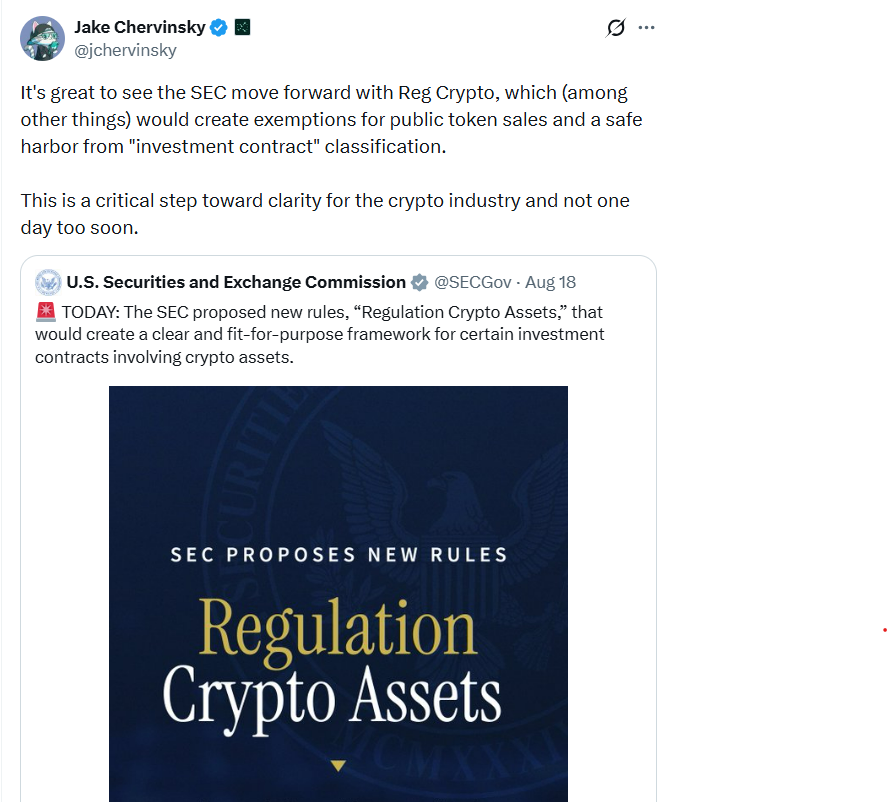
SEC moves forward with Reg Crypto. Source: Jake Chervinsky
The potential for tokens to fall into a no man land between security and non-security also worries Reiners. He says that projects could learn how to operate within the new framework without addressing the underlying investor protection concerns:
“A public offering exemption could become a vehicle for regulatory arbitrage […] A token issuer may satisfy the formal conditions for an exempt sale while continuing to market an asset whose value depends heavily on the issuer’s managerial efforts.”
That would leave retail investors in the same grey area as a decade prior, exposed to “opaque disclosures, concentrated insider holdings, and aggressive promotion.”
Magazine: Bitget CEO isn’t buying the Bitcoin rally — She’s waiting for $50K
Cointelegraph publishes long-form journalism, analysis and narrative reporting produced by Cointelegraph’s in-house editorial team with subject-matter expertise. All articles are edited and reviewed by Cointelegraph editors in line with our editorial standards. Some articles contain affiliate links, from which Cointelegraph may earn a commission. These relationships do not influence which products we review or our editorial conclusions. Content published in here does not constitute financial, legal or investment advice. Readers should conduct their own research and consult qualified professionals where appropriate. Cointelegraph maintains full editorial independence.


High-performance blockchains often run into the same architectural limit, where the execution sits directly in the path of consensus. In a conventional synchronous model, validators must first execute the transactions inside that block to confirm the resulting state transitions are valid.
The design keeps the network deterministic, but it also turns computation into a shared bottleneck. Whether they involve richer smart contract logic, cross-system coordination, or heavier state updates, the more complex the transactions are, the more the network’s speed depends on how quickly validators can process them.
The slowest computation on that path can end up constraining the pace of the entire system. Many networks have already spent years improving finality, networking efficiency and block propagation.
Execution has become the next architectural constraint. Rather than only optimizing how quickly validators reach agreement, newer designs are starting to ask whether execution needs to remain inside the consensus loop at all.
Shifting to an asynchronous computation pipeline
CTDG Dev Hub participant MultiversX removes that constraint with Supernova, now live on testnet, by decoupling consensus from execution so the network can agree on blocks before processing their transactions.
Before Supernova, block production followed a sequential pattern. A proposer selected transactions, executed them locally and proposed a block with those results. Validators then had to re-execute the same transactions before voting, which placed execution squarely on the consensus-critical path.
Supernova changes that order: The proposer selects transactions and proposes the block without executing them first. Validators verify that the proposal follows protocol rules and can vote immediately, while execution continues asynchronously in the background. The resulting execution output is normally referenced and notarized in the next block header, so execution trails consensus by roughly one block, or about 600 milliseconds.
Decoupling execution from consensus creates an immediate validity problem: The network must still determine whether a proposed transaction is likely to remain valid before execution catches up. Supernova addresses that with a virtual mempool state.
The mempool looks beyond the latest executed chain state and tracks pending nonces, expected balance consumption and transactions that have already been proposed but whose execution results have not yet passed consensus. Proposers get a forward-looking view of account activity and can select transactions that should still execute successfully once their turn arrives.
MultiversX also adds two safeguards around the new pipeline. The Execution-Result Inclusion Estimator, or EIE, caps how many execution results can be referenced in a block based on what minimum-spec nodes can safely process. Meanwhile, automatic backpressure reduces block capacity if execution falls too far behind, giving the system time to catch up.
Collaborative growth within the decentralized ecosystem
The upgrade also fits into Cointelegraph Decentralization Guardians’ broader work with MultiversX. Cointelegraph joined the network as a validator through the CTDG program in March 2026, extending the relationship into infrastructure participation.
MultiversX is also an official CTDG Dev Hub partner, connecting the protocol to a broader community of developers and blockchain users. The relationship already has practical depth as the MultiversX Foundation delegated to the CTDG validator, and the Dev Hub team built a dedicated validator dashboard on MultiversX.
From a builder perspective, in-shard finality lands as soon as the proof is available, usually within the same round at around 100–250 milliseconds, alongside more predictable execution conditions. These conditions matter most for applications that depend on tight feedback loops, such as high-frequency DeFi primitives, onchain order books and other systems that begin to break down when latency enters the user experience.
Supernova has already been producing 600-millisecond blocks on the live testnet and devnet since Aug. 20, with the broader goal of making onchain interactions feel immediate. Mainnet activation is expected to follow on Sept. 10, 2026. The transition reflects a wider push toward blockchains that behave more like responsive application infrastructure than delayed settlement engines.
Better Mortgage and Coinbase have made their Bitcoin-backed mortgage product generally available, allowing US homebuyers to pledge Bitcoin as collateral for a down payment without selling it, the companies announced Wednesday.
According to Coinbase’s Help Center, the product pairs a Fannie Mae-backed home loan with a separate down payment loan secured by Bitcoin (BTC). Borrowers must pledge BTC worth at least 250% of the down payment loan, with the pledged BTC transferred to Better’s custodial account on Coinbase Prime.
The two loans carry the same interest rate and amortization term and are repaid through a single monthly payment, Coinbase said. The pledged BTC is returned once the mortgage is fully repaid or refinanced, subject to the loan terms.
Bitcoin price declines alone do not trigger margin calls or changes to the mortgage terms. However, Better can liquidate the pledged BTC if a borrower becomes 60 days delinquent on payments, according to Coinbase.
Borrowers must be US residents with a verified Coinbase account, and remain subject to Better’s credit, income and other underwriting requirements. Coinbase One members are also eligible for a 1% rebate from Better, subject to a $10,000 cap, that can be used toward closing costs and fees.
Better and Coinbase first announced the token-backed mortgage in March, initially opening it through an early-access program.
Related: 77% of Americans see crypto in retirement plans as risky: Survey
Crypto gains ground in US mortgage market
The Better-Coinbase product comes amid broader efforts to incorporate digital assets into US mortgage underwriting.
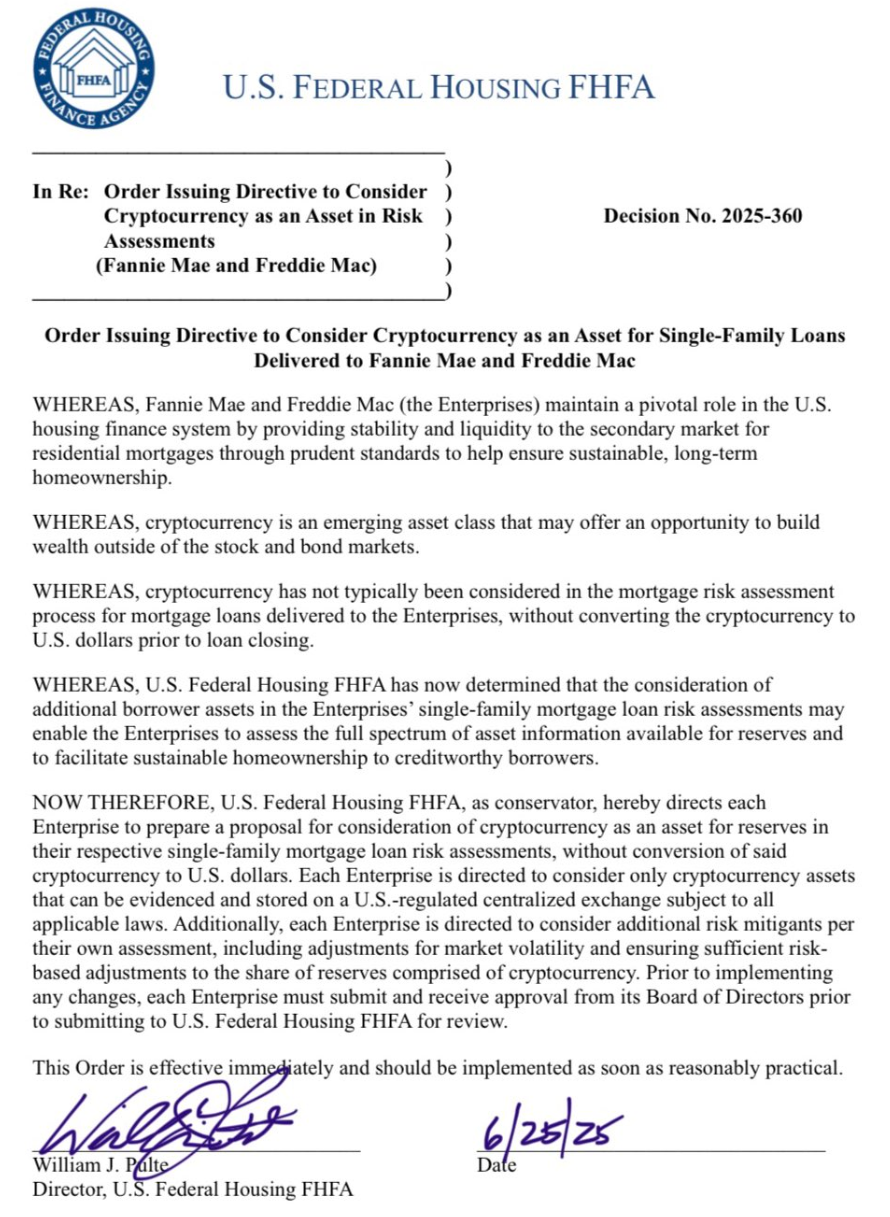
In June 2025, the Federal Housing Finance Agency directed Fannie Mae and Freddie Mac to develop proposals to consider cryptocurrency held on US-regulated centralized exchanges as an asset in single-family mortgage risk assessments, without requiring conversion to US dollars.
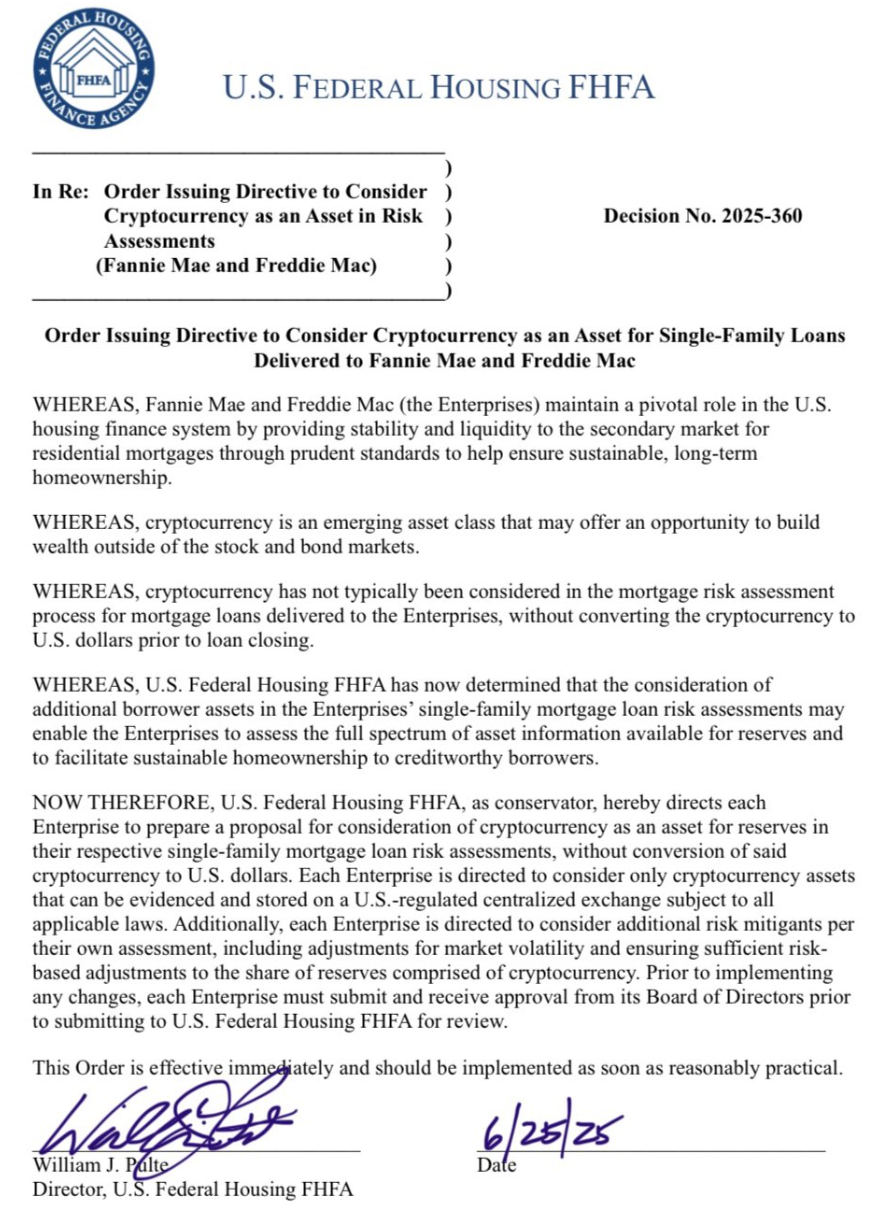
FHFA directive ordering Fannie Mae and Freddie Mac to consider cryptocurrency in mortgage risk assessments. Source: William Pulte
The directive also required the two government-sponsored enterprises to consider risk-mitigation measures for crypto’s volatility and submit any proposed changes to their boards for approval before FHFA review.
Other US lenders have also begun moving in that direction. Mortgage lender and servicer Newrez announced in January that it would recognize certain cryptocurrency holdings when evaluating mortgage applications beginning in February, including for home purchases and refinancing.
The expansion of Bitcoin-backed home financing comes as US housing prices remain near historic highs. The median sales price of a new US home was about $400,000 in 2026, according to data from the US Census Bureau and Department of Housing and Urban Development compiled by the Federal Reserve Bank of St. Louis.
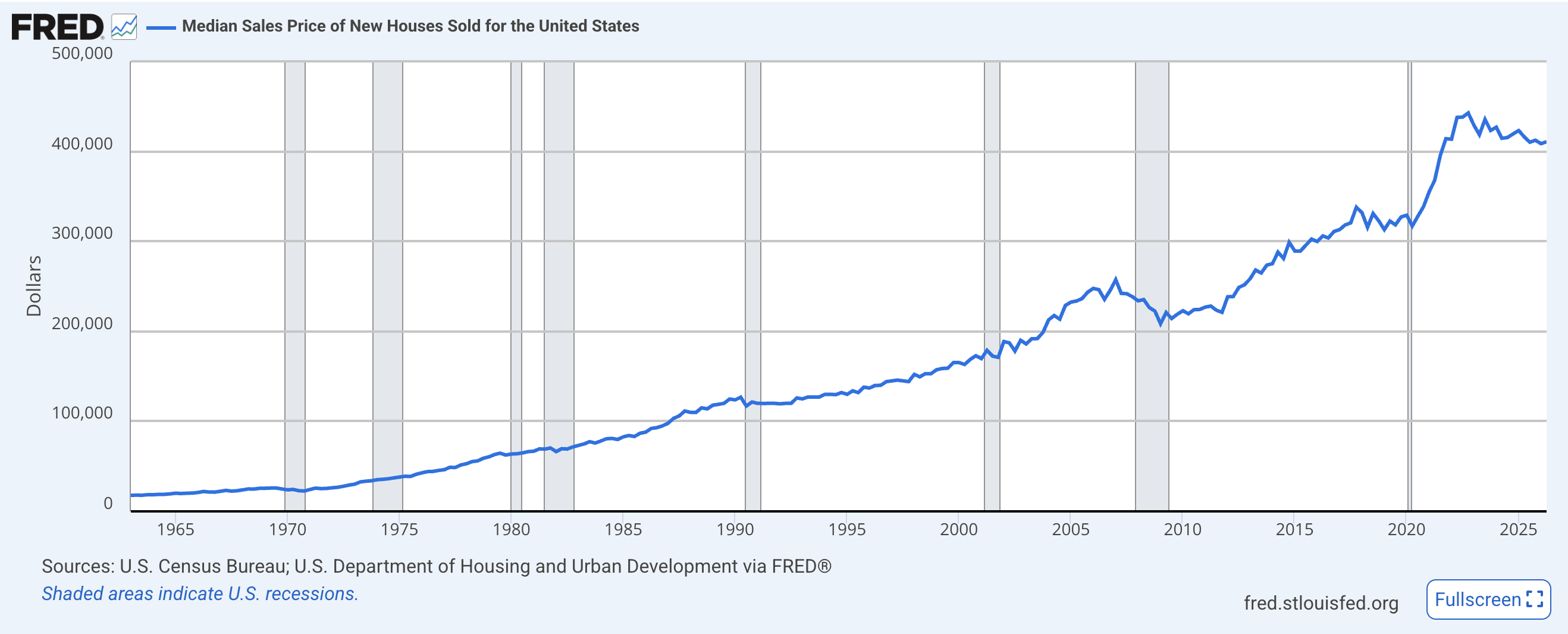
US median new home prices have fallen since 2022, but remain historically elevated. Source: Federal Reserve Bank of St. Louis
Magazine: Hugging Face hack exposes the open-weight AI cybersecurity paradox


The tech bellwether reported fiscal second-quarter results after the bell on Wednesday.

Better Mortgage and Coinbase have expanded their Bitcoin-backed mortgage option, moving it into general availability for eligible US homebuyers. The product is designed to let borrowers use Bitcoin as collateral for a down payment while keeping the primary home loan tied to a Fannie Mae-backed mortgage.
Announced Wednesday, the offering combines two linked loans: a Fannie Mae-backed home loan from Better and a separate down payment loan secured by Bitcoin. According to Coinbase’s Help Center, borrowers must pledge BTC worth at least 250% of the down payment loan amount, with the pledged Bitcoin transferred to Better’s custodial account on Coinbase Prime.
Key takeaways
- Better and Coinbase’s token-backed mortgage is now generally available to qualifying US borrowers.
- Borrowers pledge Bitcoin to secure the down payment loan, without having to sell BTC.
- Coinbase states Bitcoin price declines alone do not automatically trigger margin calls or mortgage term changes.
- Better may liquidate pledged BTC if a borrower is 60 days delinquent on payments.
- Eligible Coinbase One members can receive a Better rebate, subject to a $10,000 cap.
How the Bitcoin-collateral mortgage works
The structure is built around two synchronized components with shared repayment timing. Coinbase said both loans use the same interest rate and amortization term, and repayment occurs through a single monthly payment.
Once the mortgage is fully repaid or refinanced, the pledged BTC is returned, provided the loan terms are satisfied. Coinbase emphasized that the mortgage is not designed to reprice automatically based purely on Bitcoin volatility.
Specifically, Coinbase notes that declines in the BTC price by themselves do not trigger margin calls or change mortgage terms. The key exception is delinquency: if a borrower becomes 60 days past due on payments, Better has the ability to liquidate the pledged Bitcoin, according to Coinbase.
Eligibility and incentives for borrowers
Participation is limited to US residents with a verified Coinbase account, and borrowers remain subject to Better’s standard credit, income, and underwriting requirements. Coinbase also said the product is delivered through Better’s mortgage process, with BTC held in Better’s custody via Coinbase Prime.
Coinbase One members are eligible for a 1% rebate from Better, subject to a $10,000 cap. The rebate can be applied toward closing costs and fees, which may reduce upfront transaction expenses for qualifying borrowers.
Regulatory momentum behind crypto in mortgage underwriting
The rollout arrives during a period of increasing institutional attention to how digital assets could be treated within US mortgage risk models. In June 2025, the Federal Housing Finance Agency (FHFA) directed Fannie Mae and Freddie Mac to develop proposals to consider cryptocurrency held on US-regulated centralized exchanges as an asset in single-family mortgage risk assessments—without requiring that the crypto be converted to US dollars.
The FHFA directive also asked the enterprises to consider risk-mitigation measures tied to crypto’s volatility and to submit proposed changes to their boards for approval before the FHFA review process.
That direction is part of a broader shift in how lenders and regulators approach collateral quality and volatility. Rather than forcing borrowers to exit exposure to digital assets at origination, the emerging framework aims to evaluate crypto holdings directly, provided that volatility controls and governance are in place.
Other lenders moving—and what comes next for borrowers
Coinbase and Better are not the only players testing this approach. Mortgage lender and servicer Newrez announced in January that it would recognize certain cryptocurrency holdings in its mortgage application evaluations beginning in February, covering both home purchases and refinancing. The movement suggests that, while the specifics vary by lender, the market is increasingly experimenting with practical pathways for incorporating regulated crypto holdings into underwriting.
Housing affordability remains constrained even as crypto-linked collateral options expand. US housing price levels have stayed elevated by historical standards, even after some pullbacks: data compiled by the Federal Reserve Bank of St. Louis indicates the median sales price of a new US home was about $400,000 in 2026, using figures from the US Census Bureau and the US Department of Housing and Urban Development.
For investors and borrowers alike, the Better-Coinbase expansion is likely to be watched as an early test case for whether “hold-to-borrow” models can scale in mainstream mortgage workflows. Key uncertainties remain around how different volatility scenarios are handled across lenders, how regulators will evaluate risk-mitigation proposals, and whether more mortgage originators will follow Fannie Mae and Freddie Mac’s evolving guidance.

Switching to low-flow faucets, which use less water than older models, are “a low-hanging fruit,” says Helen Dahlke, professor of integrated hydrologic sciences at the University of California, Davis. “You can save several hundreds of gallons of water per year, and that will also show up on your water bill as a benefit.” When looking for a newer model, keep an eye out for products which have a WaterSense label, which meet EPA standards and can save up to 700 gallons per year.
Another tip: Check around your home for leaks, which can add up to a lot of wasted water over time.
“People would be surprised by how much water gets wasted due to leaks,” says Atkinson.
According to the EPA, household leaks waste more than 1 trillion gallons annually nationwide. That’s equal to the annual household water use of more than 11 million homes.
Where households use the most water
One of the biggest ways to save water is outside the home. The average homeowner uses 30% to 70% of their water outdoors—watering lawns, flowers and vegetables, the EPA estimates.
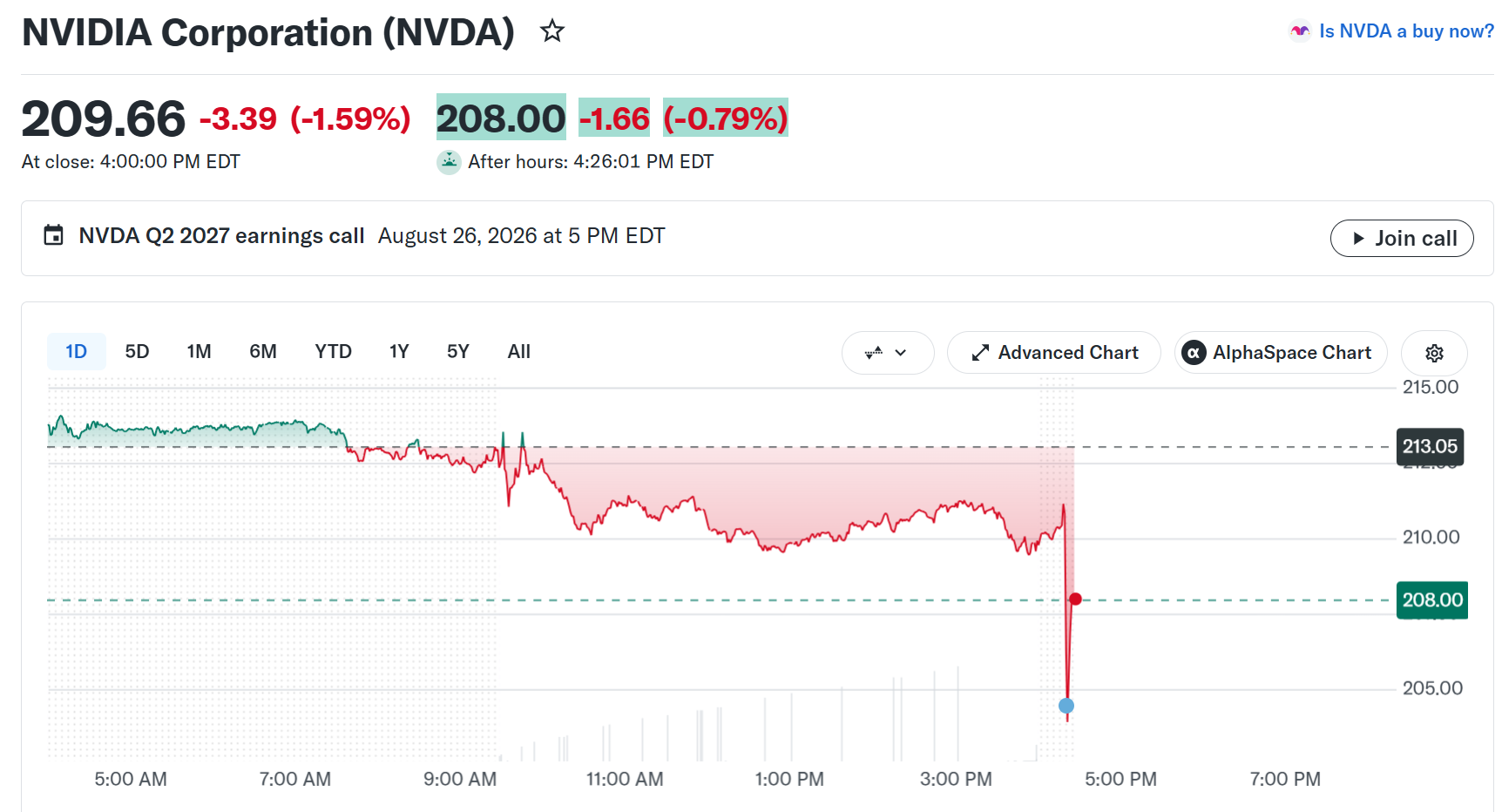
Nvidia’s Q2 earnings topped expectations on August 26, with revenue of $96.2 billion beating the $92.2 billion Wall Street estimate. The chipmaker guided the current quarter to $108 billion, yet Nvidia (NVDA) stock slipped in after-hours trading.
The company more than doubled its sales from a year earlier. Shares closed at $209.66, down 1.59%, then dipped toward $205 once the numbers landed, per Yahoo Finance data.

Nvidia Q2 Earnings Show a 106% Revenue Jump
Wall Street had braced for a monumental trading day with consensus near $92 billion. Nvidia cleared that bar by roughly $4 billion, while adjusted earnings per share (EPS) of $2.22 topped the $2.10 estimate.
Data Center revenue reached $89.0 billion against an $85.8 billion forecast, climbing 117% from a year earlier. Sales to hyperscalers, the largest cloud providers, hit $48.71 billion versus a $43.55 billion estimate.
That breadth eases concerns raised in the AI bubble debate over spending concentration among a few buyers.
Adjusted gross margin held at 75%, matching guidance. Adjusted net income climbed 118% to $54 billion, while free cash flow came in at $21.3 billion.
Q3 Guidance Clears the Whisper Bar
For the October quarter, Nvidia guided revenue to $108 billion, plus or minus 2%. That tops the $104.2 billion consensus. It also matches whisper numbers of $107 to $110 billion, the unofficial targets circulating among trading desks.
The outlook again assumes no Data Center compute revenue from China. Meanwhile, purchase commitments jumped from $119 billion to $279 billion, mostly tied to memory procurement. Gross margin guidance eased to 74%.
Nvidia also confirmed Vera Rubin, the successor to its Blackwell AI systems, is in full production. Racks are already running at partner sites.
“AI has reached its inflection point. It’s doing useful work. Its tokens are productive and profitable. Now, compute is revenue,” CEO Jensen Huang framed the demand backdrop in the company’s earnings statement.
Follow us on X to get the latest news as it happens
Why NVDA Stock Fell After the Beat
Despite the results, shares traded near $208 in extended hours, down about 0.8% from the close. Traders had warned of an earnings trap heading into the print. NVDA fell after each of its last four reports, even when results beat estimates.
Positioning had also turned cautious. The stock entered the report after a seven-session losing streak, while chipmakers showed matching triangle patterns that signaled indecision before the release.
Capital returns may cushion the reaction. Nvidia returned about $26 billion to shareholders during the quarter and still holds roughly $99 billion in buyback authorization.
The stakes stretch beyond one stock, as Nvidia and Micron together drive a third of Wall Street’s earnings growth. The earnings call will now decide whether the after-hours dip deepens or reverses. Commentary on memory costs and the Rubin ramp could set the tone for AI-linked assets into Thursday’s open.
The post Nvidia Q2 Earnings Reveal $96.2 Billion Beat, So Why Is NVDA Falling? appeared first on BeInCrypto.
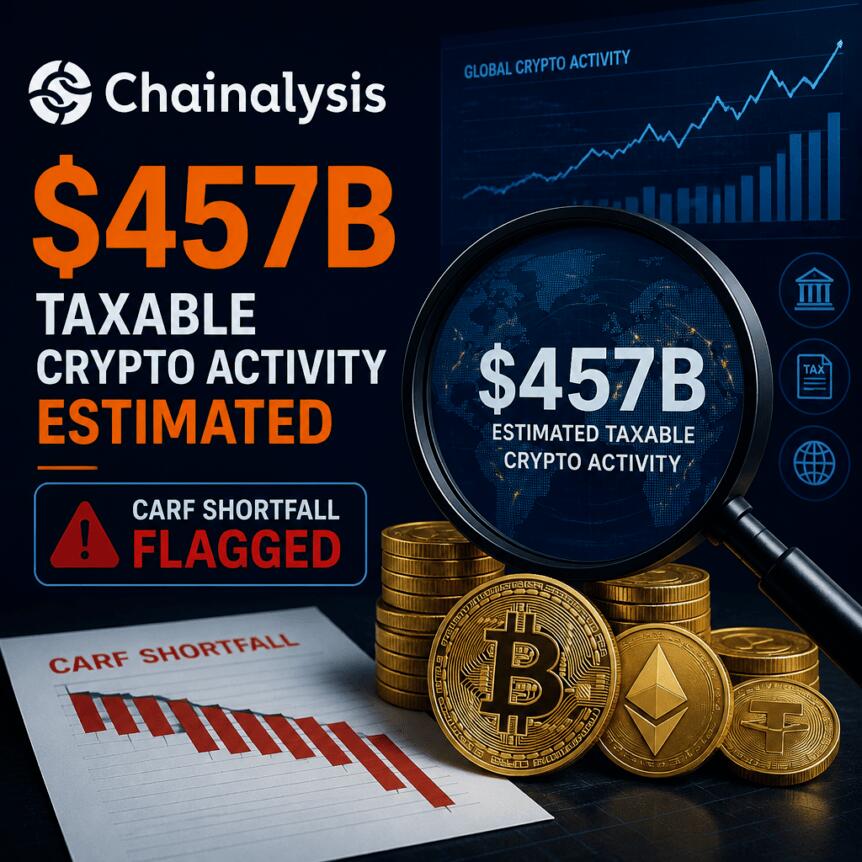
Crypto activity that could be taxable on-chain reached at least $457 billion worldwide in 2025, but the share likely captured by international tax reporting rules appears relatively small, according to a Chainalysis report on the OECD’s Crypto-Asset Reporting Framework (CARF).
Chainalysis estimates the United States accounted for $112.6 billion of that total, while North America led regions with $134.6 billion, followed by the European Union at $125.1 billion. The report also highlights a structural mismatch: CARF may cover only a limited portion of activity that taxpayers could potentially report.
Key takeaways
- $457 billion of potentially taxable on-chain crypto activity was identified globally in 2025, but CARF reportedly covers only 14% of it.
- CARF coverage begins in 2026, with reporting phased in across 48 jurisdictions.
- Chainalysis’ estimates include realized gains, crypto income (such as mining, staking, and lending), and crypto-denominated payments, but exclude trading on centralized exchanges.
- The gaps largely stem from CARF’s focus on centralized intermediaries—meaning much of DeFi may remain outside the reporting perimeter.
How much crypto activity could be taxable—and where it happens
Chainalysis’ analysis frames “potentially taxable” activity as on-chain events that can fall into common tax categories, including realized gains and income derived from blockchain activity. It also includes crypto-denominated payments—transactions where users may need to consider tax consequences even without traditional “trading” behavior.
Importantly, the report’s scope is not all crypto activity. Chainalysis states that its estimates cover activity across six major blockchains, but exclude trading and other activity performed within centralized exchanges. That means the $457 billion figure reflects an on-chain picture rather than a complete accounting of crypto taxation exposure.
Regionally, the data points to uneven concentration of taxable activity. The US estimate of $112.6 billion sits within North America’s higher total of $134.6 billion, and the European Union’s estimate of $125.1 billion underscores that the issue is cross-border rather than confined to a single market.
Why CARF may miss most of the taxable picture
Chainalysis says that transactions covered by CARF account for just 14% of the potentially taxable on-chain activity it identified, leaving an 86% gap. The report describes the uncovered portion as including activity on decentralized exchanges, peer-to-peer transfers, on-chain income streams, and crypto payments.
CARF itself was developed by the OECD and designed to reduce cross-border tax evasion by standardizing reporting obligations. Under the framework, covered crypto service providers gather customer-related information and report relevant transaction data to domestic tax authorities, which can then exchange that information internationally.
For investors, traders, and builders, the takeaway is not that taxes won’t apply outside CARF. Rather, it’s that the administrative mechanism to identify taxable activity—at least as implemented in CARF—likely won’t reach most on-chain behavior by default.
CARF coverage kicks in during 2026—48 jurisdictions included
Chainalysis reports that CARF data collection began on Jan. 1, 2026 across 48 jurisdictions, including major markets such as the United Kingdom and the European Union. As part of its onboarding requirements, covered platforms must collect additional information, including details about customers and their tax residency.
In practical terms, the framework is built around regulated intermediaries: crypto providers that operate within a compliance framework for customer due diligence and reporting. Tax authorities can then use those reports to identify potential liabilities and share relevant information across borders.
Still, Chainalysis’ estimates suggest that even with expanding CARF adoption, much of what users do on public blockchains—especially outside traditional custody and brokerage models—may not be captured.
DeFi’s structural problem: intermediaries are often absent
One reason CARF’s coverage is limited, according to Chainalysis, is that it focuses on crypto intermediaries. A key explanation came earlier from Colby Mangels, a former OECD adviser who worked on CARF. In January, Mangels told Cointelegraph that CARF was designed around the types of intermediaries that facilitate crypto transactions “as a business.”
Decentralized finance often lacks the centralized operator, custodial relationship, or clear business entity through which reporting requirements typically attach. In the absence of a responsible intermediary that regulators can compel to submit transaction reports, much DeFi activity may fall outside CARF’s reporting perimeter.
Mangels also pointed to a possible path forward: regulators may increasingly look to how DeFi platforms interact with anti-money laundering regimes and when DeFi operators could be treated as regulated crypto service providers. If that happens, the reporting boundary could expand over time—though it remains uncertain exactly when and how such rules will be applied in different jurisdictions.
For market participants, this evolving regulatory question matters because the current gap suggests that taxation compliance will remain uneven. Users interacting heavily through decentralized routes may face more reliance on self-reporting, while activity routed through covered centralized providers is more likely to be documented through standardized reporting channels.
Readers should watch how enforcement and rulemaking develop after CARF’s 2026 rollout: the biggest uncertainty is whether regulators will extend reporting obligations further into DeFi ecosystems, and whether AML-linked approaches will effectively bring more on-chain activity under a comparable reporting umbrella.

XRP is trading at a $1.40 price range after a run that saw the token outperform every other top-10 crypto asset by a wide prediction margin. A 50% surge, driven largely by Korean exchange turnover and heavy Binance positioning, put XRP back on trader radars this week.
However, overbought signals are flashing now, and the question now isn’t whether XRP rallied, but if it has anything left in the tank.
— Xaif Crypto (@Xaif_Crypto) August 21, 2026
 South Korean traders are coming back and $XRP is dominating the flow.
XRP/KRW is sitting at 623M in 24H volume, The volume surge across Upbit is being heavily driven by #1 XRP.  https://t.co/4Lkn3s3y7M pic.twitter.com/S8iSLddFTa
The move came on the back of a spike in exchange volume out of South Korea, paired with notable accumulation on Binance order books. One widely circulated chart this week showed XRP’s 14-day RSI pressing toward 87, a level that historically precedes a cooldown.
Zoom out, and the altcoin market is still digesting mixed signals: ETF flow data, regulatory clarity efforts under the CLARITY Act, and choppy macro liquidity are all fighting for influence over near-term price direction. XRP’s rally happened inside that noisy backdrop, which raises the stakes for what comes next.
Discover: The Best Crypto to Diversify Your Portfolio
XRP Price Prediction: Hit $1.60 This Week?
XRP sits at a tight range in the $1.40 area with intraday prints between $1.40 and $1.45. Volume remains elevated relative to XRP’s monthly average, a residual effect of the Korea/Binance-driven surge, though it’s cooling.
The token is testing a dense technical zone: $1.42 support (the 38.2% Fibonacci retracement) sits directly beneath the current price, with $1.36 as the next line of defense below that.
On the upside, $1.52 is the level bulls need to reclaim, a 23.6% Fib retracement that, if held, opens a path toward $1.64. Fail there, and the setup flips: a break below $1.42 risks a slide toward $1.36, then $1.31–$1.30.

- Bull case: XRP holds $1.42, reclaims $1.52, retests $1.64.
- Base case: Consolidation between $1.36–$1.52 as the RSI cools from overbought.
- Bear case: Loss of $1.42 sends price back toward the $1.00–$1.03 structural floor.
Traders watching the network activity data alongside these levels will get a clearer read on whether this rally has real legs or is running on exchange-driven momentum alone.
Trade XRP on Bybit and Get a Chance to Win Our $1,000 USDT Airdrop
LiquidChain Targets Early Mover Upside as XRP Tests Key Levels
XRP holders riding this rally are sitting on solid short-term gains, but a token already up over 40% with resistance stacked overhead at $1.52 and $1.64 isn’t exactly offering asymmetric upside from here.
The math gets less attractive the closer price creeps toward the top of its range, which is exactly when rotation capital starts hunting earlier-stage plays.
Writing the next layer into existence. — LiquidChain (@getliquidchain) August 14, 2026
 https://t.co/vqvBcdSQYC pic.twitter.com/nOCpXbl30D
LiquidChain ($LIQUID) is positioning itself as the connective tissue for a market that’s still fractured across chains. Its pitch: a Layer 3 infrastructure that fuses Bitcoin, Ethereum, and Solana liquidity into one execution environment, letting developers deploy once and reach all three ecosystems instead of building separate integrations.
The presale is currently priced at $0.01494, with $950K raised so far. Standout features include Single-Step Execution and Verifiable Settlement, both aimed at cutting the friction that’s plagued cross-chain liquidity for years.
Research LiquidChain directly before the presale closes.
Discover: The Best Token Presales
The post XRP Price Prediction: Korea and Binance Power the Rally, But Can XRP Keep Going? appeared first on Cryptonews.
Crypto World
TxFlow L1 Strengthens Its Infrastructure with OpenZeppelin Audit as Its On-chain Ecosystem Expands

Independent OpenZeppelin review of TxFlow’s bridge contract marks another step in TxFlow’s approach to security as its L1, DEX, and builder ecosystem continue to develop.
TxFlow announces the completion of an independent security audit by OpenZeppelin, one of the world’s most established blockchain security firms, trusted by major organizations and protocols including Coinbase, the Ethereum Foundation, Uniswap, Aave, Arbitrum, ZKsync, Compound, and others.
OpenZeppelin’s review covered TxFlow’s bridge contract, a critical component of the infrastructure supporting the movement of capital between external networks and TxFlow L1. OpenZeppelin’s review identified zero critical and zero high-severity findings. One medium-severity finding was identified and resolved during the audit process.
The independent review forms part of TxFlow’s broader approach to incorporating external security expertise as its financial infrastructure and ecosystem continue to develop. Alongside TxFlow DEX and continued L1 development, TxFlow is also building Builder Code, with additional details to be announced as both initiatives move closer to release. Together, these developments support TxFlow’s broader objective: to build a Layer 1 designed specifically for financial markets, bringing trading, liquidity, and financial applications onto one blockchain where all finance happens.
Security at TxFlow L1 is a continuous responsibility: An Independent Review by OpenZeppelin
As part of this commitment, we work with leading independent security experts to rigorously assess our infrastructure. In 2026, OpenZeppelin completed a security audit of Bridge2, the USDC bridge connecting Arbitrum One to TxFlow L1. TxFlow aims to continue to strengthen its security architecture, monitoring, and operational safeguards as the network evolves. The audit report provides the technical scope, findings, and assessment from OpenZeppelin and is available for the community to review directly.
TxFlow’s broader bridge infrastructure supports deposits and withdrawals across Arbitrum One, Ethereum, Base, Polygon PoS, and Solana. TxFlow’s documented bridge flow includes controls around the movement of funds, including validator-approved withdrawals and a built-in safety wait before withdrawals are completed.
These controls form part of TxFlow’s approach to protecting one of the most important functions of financial infrastructure: the movement of capital between networks.
Global-Grade Security from the Ground Up
TxFlow is building its security program with the standards expected of serious financial infrastructure in mind. To support that approach, TxFlow engaged OpenZeppelin, one of the world’s most established blockchain security firms. OpenZeppelin has completed more than 900 security audits, identifying more than 10,000 issues, including 700+ critical and high-severity vulnerabilities, across blockchain protocols and financial infrastructure.
Its security work spans major crypto organizations and ecosystems including Coinbase, the Ethereum Foundation, Uniswap, Aave, Arbitrum, ZKsync, Optimism, and Compound, as well as established financial institutions and infrastructure providers including DTCC, Fidelity Digital Assets, WisdomTree, ANZ, and CACEIS.
For TxFlow, working with globally recognized security specialists at an early stage establishes a clear approach: independently review critical infrastructure as the network and ecosystem grow. Security is not an add-on to financial infrastructure. It is part of the infrastructure itself.
Building Infrastructure for On-chain Finance
TxFlow L1 is designed specifically for financial markets and applications.
TxFlow DEX, a fully on-chain central limit order book for perpetual markets, is the first application built on TxFlow L1. The DEX is the first product operating on a broader infrastructure layer. TxFlow L1 is designed to support multiple financial applications and markets on the same network, including perpetuals, spot markets, prediction markets, and new categories of on-chain financial products. Through TxFlow Improvement Protocol (TIP) Liquidity Standards, Channels can connect to common execution, settlement, and liquidity infrastructure rather than operating as isolated applications.
For traders, that means infrastructure designed around markets from the start.
For builders, it creates a foundation for developing new financial applications on a network designed for trading, liquidity, and settlement.
What’s Next: Builder Code
Alongside continued development of TxFlow L1 and TxFlow DEX, the team is building two new ecosystem initiatives: TxFlow Builder Code.
Builder Code is being developed to expand how builders and ecosystem participants can contribute to and grow alongside the network. For the TxFlow community, these initiatives represent the next stage of ecosystem growth: more ways for traders to participate, more ways for builders to contribute, and more activity across the TxFlow network.
About TxFlow L1
TxFlow L1 is a high-performance blockchain built for on-chain financial infrastructure, organized around TIP Liquidity Standards that define how financial products are built, composed, and settled on-chain. TxFlow DEX is the first Channel on TxFlow L1, a CLOB orderbook DEX for perpetual trading, processing over 250,000 TPS with one-block finality. Through its TxFlow Improvement Protocol standards and Channel architecture, TxFlow enables spot markets, derivatives, prediction markets and future financial products to operate on the same chain while connecting to shared execution and settlement infrastructure where all finance happens. TxFlow L1 is building an open, composable and community-owned financial ecosystem in which each new application can strengthen the infrastructure available to those that follow.
About OpenZeppelin
OpenZeppelin is a leading security partner for on-chain finance, trusted by organizations including DTCC, Fidelity Digital Assets, WisdomTree, Coinbase, Uniswap, Aave, and the Ethereum Foundation. Since 2015, OpenZeppelin has secured more than $35 trillion in value transferred and delivered 900+ security engagements, surfacing more than 10,000 vulnerabilities across critical on-chain infrastructure. Its open-source smart contract libraries are an industry standard used across leading stablecoins, tokenized assets, and blockchain applications.
Learn more about TxFlow:
The post TxFlow L1 Strengthens Its Infrastructure with OpenZeppelin Audit as Its On-chain Ecosystem Expands appeared first on BeInCrypto.

SEC’s Proposed Crypto Cules Probably Won’t Spark New ICO Boom

Kelly Reilly’s 10/10 Detective Thriller Officially Returns With Major Season 2 Change

I JUST CHANGED MY XRP PRICE PREDICTION FOR 2026!





-

 Fashion5 days ago
Weekend Open Thread: Madewell – Corporette.com
-

 Crypto World22 hours ago
SpaceX stock could rise 75% to $240, JPMorgan says
-

 Business4 days ago
Musk’s Tesla, SpaceX Confirm $16.8 Billion ‘Terafab’ Chip Plant as World’s Largest Building in Texas
-

 Crypto World5 days ago
anatomy of crypto’s biggest liquidation event since 2021
-

 Crypto World2 days ago
A $30 Billion AI Fund Implodes, Now the SEC Is Investigating Wall Street’s Role
-

 Politics4 days ago
6 months on, Irish renters crushed by effects of government housing bill
-
 NewsBeat5 days ago
The ‘Lucky Dip Gang’ causing carnage for clicks: After five thugs were killed speeding in the wrong direction on a motorway, GUY ADAMS investigates a sick new trend… and why police aren’t even allowed to pursue them
-

 Business3 days ago
Mystery AI Model ‘Ox Alpha’ Draws Developers With Free Access as Chinese Lab Origins Remain Debated
-

 News Videos7 days ago
Don’t Leave Your Financial Future To Chance | August 19, 2026
-

 Business6 days ago
Five Below: Kids Discount Retailer Reaps Rich Rewards
-

 Business2 days ago
Moderna CEO warns China is pouring state money into mRNA technology
-

 Crypto World18 hours ago
Did Trump Just Move SpaceX Stock With One Truth Social Post?
-

 Business5 days ago
UK firms in critical financial distress rise 9% to 53,756
-

 Business2 days ago
NVIDIA Stock Drops Nearly 2 Percent to $210 on Seventh Losing Day Ahead of Critical AI Earnings
-

 Sports4 days ago
Deshaun Watson fires back at Browns fans after being booed: ‘It’s a disrespectful thing’
-
 Entertainment7 days ago
10 Most Perfect Fantasy Shows of the Last 25 Years
-

 Crypto World6 days ago
Optimism-funded team's deciding vote shifts $49 million in OP tokens away from users
-

 Tech7 days ago
OpenAI confirms ChatGPT is down as logins and signups fail
-
 Crypto World3 days ago
Google Gemini AI Predicts Ethereum Could Become the Trade Retail Misses in 2026
-

 Business7 days ago
PayPal and Venmo now accepted for tuition at several universities
You must be logged in to post a comment Login