

Crypto World
Elon Musk Cheers NVIDIA’s Vera Launch After SpaceX Gets First Units


NVIDIA has tapped SpaceX as one of the first customers to deploy its new Vera CPU, the chipmaker’s debut processor designed specifically for agentic artificial intelligence (AI) workloads.
The collaboration drew quick public backing from SpaceX chief executive Elon Musk, who reposted the announcement on X and joked that the chip lived up to its name.
NVIDIA Ships First Vera Units to SpaceX
NVIDIA confirmed that early Vera silicon went directly to SpaceX, OpenAI, Anthropic, and Oracle Cloud Infrastructure. The chipmaker’s hyperscale division hand-delivered the first units, framing the rollout as the start of a wider commercial deployment.
The Vera CPU houses 88 custom NVIDIA-designed Olympus cores and supports up to 1.2 TB/s of memory bandwidth using LPDDR5X memory. NVIDIA claims the chip runs agentic sandbox workloads up to 50% faster than competing rack-scale CPUs while doubling efficiency.
A new 256-CPU rack configuration sustains more than 22,500 concurrent agent environments at full performance, according to NVIDIA. The system is part of the broader Rubin platform revealed at GTC in March 2026.
Musk Reacts on X
Musk posted his reaction shortly after NVIDIA’s official AI Infrastructure account thanked SpaceX for testing the chip.
His enthusiasm follows the recent folding of xAI into SpaceX, which now operates the merged AI division under the SpaceXAI brand. The unit already runs the Colossus 1 and Colossus 2 supercomputers in Memphis.
Why Vera Matters for Agentic AI
Vera signals NVIDIA’s first serious push into CPUs aimed at AI agents rather than the GPU products that dominate its revenue. The launch coincides with rising enterprise demand for agent-based workloads that orchestrate many smaller models. NVIDIA chief executive Jensen Huang has called agent-based services the company’s next multi-trillion-dollar opportunity.
Customers lined up for deployment include Alibaba Cloud, ByteDance, Meta, CoreWeave, Lambda, and Nscale, alongside SpaceX. The breadth of early adopters suggests NVIDIA intends to extend its AI infrastructure dominance well beyond training silicon.
Whether Vera meaningfully shifts CPU market share will depend on how quickly customers like SpaceX move from testing to full production. Several rivals, including AMD, are also working on competing chips aimed at the same workloads.
The post Elon Musk Cheers NVIDIA’s Vera Launch After SpaceX Gets First Units appeared first on BeInCrypto.



A stock buyback is a company spending its own cash to buy back its own shares. In crypto, it has become the move Bitcoin treasury companies reach for when the premium that powered them runs out.
Summary
- A stock buyback, or share repurchase, is when a public company uses cash to buy its own shares on the open market, reducing the number of shares outstanding.
- Fewer shares means each remaining share represents a larger claim on the company’s earnings and assets, which mechanically lifts earnings per share and can support the stock price.
- Companies buy back stock to return capital to shareholders, to signal that they see the shares as undervalued, and to offset the dilution created by issuing stock to employees.
- In crypto, buybacks have become central to Bitcoin treasury companies: when their shares stop trading at a premium to their coins, issuing new stock no longer works, so they turn to repurchasing instead.
- Buybacks differ from crypto token burns in one key way: repurchased shares are usually held in the treasury and can be reissued, while burned tokens are destroyed forever.
A stock buyback is one of the most common tools in corporate finance, and it has quietly become one of the most important levers in crypto. The basic idea is simple: a company uses its own cash to buy back its own shares from the market, shrinking the number of shares that exist. That reduction changes the math for every remaining shareholder. In the crypto world, buybacks have moved from a background technicality to a front-page issue because the Bitcoin treasury companies that dominate corporate crypto now lean on them when their main growth engine stalls. This guide explains how buybacks work, why companies use them, how they affect the price, why crypto treasuries have embraced them, and how they differ from the token burns they are often compared to.
What a stock buyback is
A stock buyback, also called a share repurchase, happens when a company that issued stock uses its cash to buy those shares back on the open market at the prevailing price. The purchased shares are absorbed by the company, which reduces the count of shares outstanding, the total number of shares held by all investors. There is no obligation for any shareholder to sell; the company simply buys from whoever is willing to sell at market, so a buyback is open to the market rather than targeted at specific holders.
The effect is a transfer of value expressed through arithmetic. A company’s ownership is divided into shares, and its earnings and assets are spread across those shares. Remove some shares from existence, and everything the company owns and earns is now divided among fewer of them. Each surviving share represents a slightly larger slice of the whole. That is the mechanical heart of a buyback, and everything else, the price effect, the signaling, the criticism, flows from it.
A buyback is one of two main ways a company returns cash to shareholders, the other being a dividend. A dividend pays cash directly to shareholders. A buyback returns value indirectly by increasing each holder’s proportional stake instead of sending them money. The choice between them shapes how the market reads a company’s use of its cash.
How buybacks are carried out
Companies repurchase shares through a few standard methods, and the method affects the pace and signal. The most common is an open-market repurchase, where the company buys its shares gradually over time on the exchange, just like any other buyer, often under a board-authorized program with a maximum dollar amount. This is flexible: the company can buy more when the price is attractive and pause when it is not, and the authorization is a ceiling, not a commitment to spend the full amount.
A tender offer is more direct: the company offers to buy a set number of shares from existing holders at a specified price, usually at a premium to the market, within a fixed window. Shareholders choose whether to accept. An accelerated share repurchase is faster still, with the company buying a large block of shares immediately through an investment bank and settling the details later. For most crypto treasury companies, the relevant form is the open-market program, authorized by the board up to a dollar cap, which the company then executes at its discretion depending on conditions.
The authorization is worth understanding clearly, because it is often misread. When a board authorizes a buyback of, say, up to $1 billion, it is granting permission to spend up to that amount, not promising to spend it. The company may buy the full amount, a fraction, or none, depending on the share price and its capital needs. A buyback authorization is a tool the company has armed, not a check it has written.
Why companies buy back stock
The motivations cluster into three main groups. The first is returning capital. A profitable company that generates more cash than it needs to run and grow the business has to do something with the surplus, and a buyback is one way to hand that value back to owners, as an alternative or complement to dividends. Rather than let cash sit idle, the company uses it to concentrate ownership among remaining shareholders.
The second is signaling. When a company buys back its own shares, especially aggressively, it communicates that management believes the stock is undervalued, worth more than the market is paying. A buyback is management putting the company’s money where its conviction is, and markets often read it as a vote of confidence. The signal is strongest when the company buys into weakness, purchasing shares while they trade below what leadership judges to be fair value.
The third is offsetting dilution. Companies routinely issue new shares to employees as compensation, which increases the share count and dilutes existing holders. Buybacks can counteract that, mopping up the newly issued shares to keep the total roughly stable. In this use, the buyback is less about returning capital and more about maintenance, preventing the slow erosion of each shareholder’s stake that stock-based pay would otherwise cause.
How buybacks affect the price
The price effect works through several channels at once. The most direct is supply and demand: a buyback removes shares from the market and adds a large, steady buyer, which can support the price simply through the purchasing itself. When a company is buying its own stock in size, it is one more source of demand competing for a now-smaller supply of shares.
The second channel is earnings per share. Because a company’s profit is divided across its shares, cutting the share count raises earnings per share even if total profit is unchanged. Since many investors value a stock as a multiple of its earnings per share, a higher figure can support a higher price. This is the arithmetic that makes buybacks attractive to management, though it is worth noting the improvement comes from a smaller denominator, not from the business earning more.
The third channel is sentiment. The signal of confidence a buyback sends can lift how investors feel about a stock, independent of the mechanical effects. Put together, reduced supply, higher earnings per share, and improved sentiment tend to support the price, which is why buybacks are generally received as shareholder-friendly. But the effect is not guaranteed. A buyback cannot rescue a company whose business is deteriorating, and a poorly timed one, buying shares at inflated prices, can destroy value rather than create it.
A worked example
Concrete numbers show the mechanism. Imagine a company with 100 million shares trading at $10, giving a market capitalization of $1 billion, and suppose it earns $100 million a year, which is earnings per share of $1. The company has surplus cash and authorizes a buyback, then repurchases 10 million shares at around $10 each, spending roughly $100 million.
After the buyback, the share count falls from 100 million to 90 million. If the company still earns $100 million, earnings per share rises from $1.00 to about $1.11, an increase of roughly 11%, without the business earning a single extra dollar. If investors keep valuing the stock at the same multiple of earnings, the price rises in step. And during the repurchase itself, the company’s buying supported the share price by adding demand. Every remaining shareholder now owns a slightly larger fraction of the same company.
The example also shows the catch. The company spent $100 million of real cash to achieve that arithmetic. If it had a more valuable use for the money, investing in growth, paying down expensive debt, the buyback might be the worse choice. And if the shares were overvalued at $10, the company overpaid to retire them, transferring value from the company to the shareholders who sold. The math always works; whether it creates value depends on price and alternatives.
Buybacks in Bitcoin treasury companies
This is where buybacks have become a live crypto issue. Bitcoin treasury companies are public companies whose main purpose is to hold Bitcoin or another crypto on their balance sheet, letting investors gain exposure through a stock. Their growth engine is issuing new shares at a premium to the value of their coins and using the proceeds to buy more crypto, which increases crypto per share. That engine works only while the stock trades above the value of its holdings, a condition often measured by a ratio called mNAV.
When the premium compresses toward the value of the coins, issuing new shares stops being accretive, because selling stock at or below the worth of the underlying crypto dilutes existing holders instead of enriching them. At that point, the growth lever jams, and the companies turn to the opposite move: buying back their own shares. A buyback becomes most attractive precisely when the stock trades near or below the value of its assets, because the company can retire shares cheaply and increase the crypto backing of each remaining share. The largest treasury companies have authorized buyback programs measured in billions, and some smaller ones have said they would repurchase shares if their stock kept trading below the value of its coins.
The signal is double-edged. A treasury company turning to buybacks is defending its stock and using capital sensibly at a discount, which is constructive. But it is also a tacit admission that the premium-issuance model that powered its rise has stopped working. When a company that grew by selling shares starts buying them back, the market reads it as the accretive era ending, which is why buybacks in this corner of crypto carry more meaning than a routine corporate repurchase.
Stock buyback versus crypto buyback-and-burn
Because crypto projects run their own version of buybacks, the comparison is worth drawing carefully. A crypto buyback-and-burn has a project purchase its own token on the market and then destroy it by sending it to a burn address, permanently removing it from supply. A stock buyback purchases shares and absorbs them into the company treasury, where they are removed from the trading float but not necessarily destroyed.
The difference is permanence and reissuance. Treasury shares from a buyback can be brought back later, reissued for acquisitions, compensation, or fresh capital, so the supply reduction can be undone. Burned tokens are gone for good, with no path back into circulation. There is also a difference in certainty: many crypto burns run automatically on smart contracts with fixed rules, while corporate buybacks are discretionary decisions management can start, pause, or stop. In short, both shrink supply to support value, but the token burn is absolute and often automatic, while the stock buyback is reversible and always discretionary. Understanding that distinction keeps the two mechanisms, which look similar on the surface, from being confused.
The case against buybacks
For balance, buybacks draw real criticism, and the objections are worth knowing. The first is that they can be financial engineering: lifting earnings per share by shrinking the share count rather than by growing the business creates the appearance of improvement without the substance. A company can report rising earnings per share while its actual profit stagnates, purely because there are fewer shares.
The second objection is timing. Companies have a poor track record of buying their own shares at the right price, often repurchasing heavily when the stock is high and flush times make cash plentiful, then stopping when the stock is cheap, and cash is tight, the opposite of buying low. Debt-funded buybacks sharpen the concern because borrowing money to retire shares adds leverage and risk in pursuit of a higher share price. Critics also argue that buybacks can enrich executives whose pay is tied to earnings per share or the stock price, and that money spent on repurchases is money not invested in research, wages, or growth.
None of this makes buybacks inherently bad. A well-timed buyback of an undervalued stock, funded from genuine surplus cash, can be an excellent use of capital. The critique is really about discipline: buybacks reward companies that repurchase cheaply from real surplus and punish those that overpay with borrowed money to flatter a metric. As with the crypto version, the mechanics are neutral; the judgment lies in the price, the funding, and the alternatives.
Buybacks, dilution, and the share-count treadmill
A detail that often gets lost in buyback coverage is how much of the activity simply offsets dilution instead of shrinking the share count on net. Many companies, especially in technology, pay employees heavily in stock, which issues new shares every year and dilutes existing holders. A large share of corporate buybacks goes toward mopping up those newly issued shares just to hold the total roughly flat. The buyback is real, but the net reduction is far smaller than the gross amount spent suggests.
This is the share-count treadmill. A company can announce billions in repurchases and still see its share count barely fall, because stock-based compensation is issuing shares out the other side at nearly the same pace. For shareholders, the important number is not how much a company spent on buybacks but how much the diluted share count actually changed. A buyback that only neutralizes dilution keeps ownership from eroding, which has value, but it is not the same as a buyback that genuinely concentrates ownership by cutting the count on net.
The distinction matters for how you read a company’s capital return. Gross buyback figures can look impressive while net share count is flat or even rising, if compensation-driven issuance outruns the repurchases. The honest way to judge is to track the diluted share count over several years and see whether it is falling, holding, or climbing. A steadily falling count shows buybacks are outpacing dilution and returning real value. A flat count shows the buyback is running on the treadmill, spending cash to stand still.
For Bitcoin treasury companies, this interacts with the model in a specific way. Their whole pitch is increasing crypto per share, so anything that quietly increases the share count works against that goal. A treasury company issuing stock for compensation while buying back shares needs the buybacks to more than offset the issuance, or crypto per share stalls even as the company appears to be returning capital. Watching net share count, not just the buyback headline, is how holders tell whether crypto backing per share is actually growing.
None of this makes buybacks that offset dilution pointless. Preventing erosion is a legitimate use of cash, and a company that did not repurchase would see its holders diluted year after year. The point is to read buybacks and issuance together. A repurchase program means little in isolation; paired against the shares a company is handing out, it reveals whether ownership is concentrating, holding, or slowly leaking away. The treadmill is invisible if you look only at the buyback side of the ledger.
Frequently Asked Questions
What is a stock buyback in simple terms?
A stock buyback is when a public company uses its own cash to buy back its own shares from the market. The repurchased shares are absorbed by the company, reducing the total number of shares outstanding. With fewer shares, each remaining share represents a larger portion of the company’s earnings and assets, which is the core effect a buyback produces.
How does a buyback affect the share price?
A buyback can support the price through three channels. It removes shares from the market while adding a large buyer, which is demand pressure. It raises earnings per share by dividing profit across fewer shares. And it signals management confidence that the stock is undervalued. These effects tend to support the price, but they are not guaranteed and cannot offset a deteriorating business.
Is a buyback the same as a dividend?
No. Both return value to shareholders, but differently. A dividend pays cash directly to shareholders. A buyback returns value indirectly by reducing the share count, so each remaining share represents a larger stake. Buybacks are more flexible, since a company can adjust or pause them, whereas cutting a dividend sends a strongly negative signal, so companies treat dividends as more of a commitment.
Why do Bitcoin treasury companies use buybacks?
Because their growth model depends on issuing shares at a premium to the value of their crypto. When that premium disappears and the stock trades near or below the worth of its coins, issuing new shares dilutes holders instead of helping them. Buybacks become attractive at that point, letting the company retire cheap shares and increase the crypto backing of each remaining share.
Does a buyback authorization mean the company will spend the money?
No. When a board authorizes a buyback of up to a certain amount, it is granting permission to spend up to that ceiling, not promising to spend it. The company may repurchase the full amount, a portion, or none, depending on the share price and its capital needs. An authorization is a tool the company has armed, not a guaranteed expenditure.
How is a stock buyback different from a crypto token burn?
A stock buyback absorbs repurchased shares into the company treasury, where they can be reissued later, so the reduction can be reversed. A crypto buyback-and-burn destroys the purchased tokens permanently at a burn address, so the cut is absolute. Many crypto burns also run automatically on smart contracts, while stock buybacks are discretionary decisions management can change.
Are buybacks good or bad for investors?
It depends on execution. A buyback of an undervalued stock, funded from genuine surplus cash, can be an excellent use of capital that benefits remaining shareholders. A poorly timed buyback that overpays for shares, or one funded with borrowed money, can destroy value. The mechanics are neutral; the outcome hinges on the price paid, the funding source, and whether the cash had a better use.
Can a buyback raise earnings per share without more profit?
Yes, and this is a common criticism. Because earnings per share divides profit by the share count, reducing the share count raises earnings per share even if total profit is unchanged. A company can report a higher figure purely from a smaller denominator. That is why analysts look at whether the underlying business is actually growing, not just at the reported per-share number.
Disclaimer: This article is for information and educational purposes only and does not constitute financial, investment, or trading advice. Company share prices and crypto assets are volatile, and buybacks do not guarantee any price outcome. Nothing here is a recommendation to buy or sell any security or asset. Always do your own research and consider consulting a licensed professional before making financial decisions. Information is accurate as of July 1, 2026, and may change.
Anchorage Digital has integrated its off-exchange settlement platform with Binance, allowing institutional clients to trade on the exchange while keeping their crypto and cash in qualified custody at the federally chartered US crypto bank rather than depositing assets directly onto Binance.
Under the arrangement, institutions can use crypto assets or US dollar deposits held with Anchorage as collateral to meet Binance’s margin requirements without first transferring those assets onto the exchange. The companies said the model separates custody from trade execution, allowing assets to remain with an independent custodian until settlement.
The service is initially available to select institutional clients and marks the first off-exchange settlement implementation for Anchorage Digital’s Atlas platform, which the company said is designed to support institutional trading, settlement, lending and collateral management through custody-based infrastructure.
The collaboration addresses one of the biggest obstacles keeping institutional capital on the sidelines of crypto markets: exchange counterparty risk. By eliminating the traditional requirement to pre-fund trades, this could bring crypto trading closer to the custody-and-execution model long used in traditional financial markets.
Financial terms of the partnership were not disclosed.
Related: ESMA MiCA warning puts Binance EU service changes under scrutiny
Crypto exchanges expand off-exchange settlement offerings
Off-exchange settlement has gained traction among institutional crypto trading platforms in 2026.
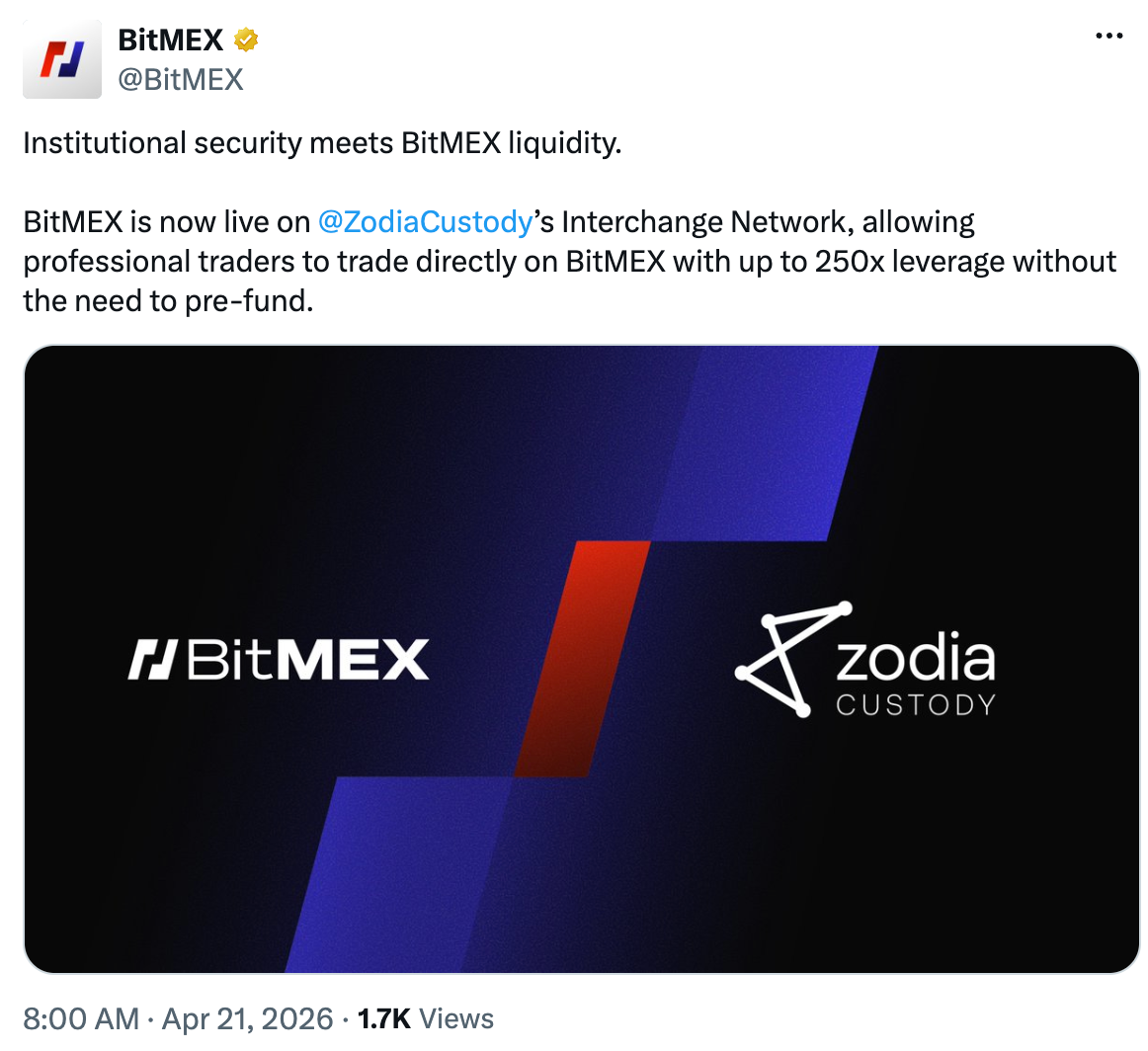
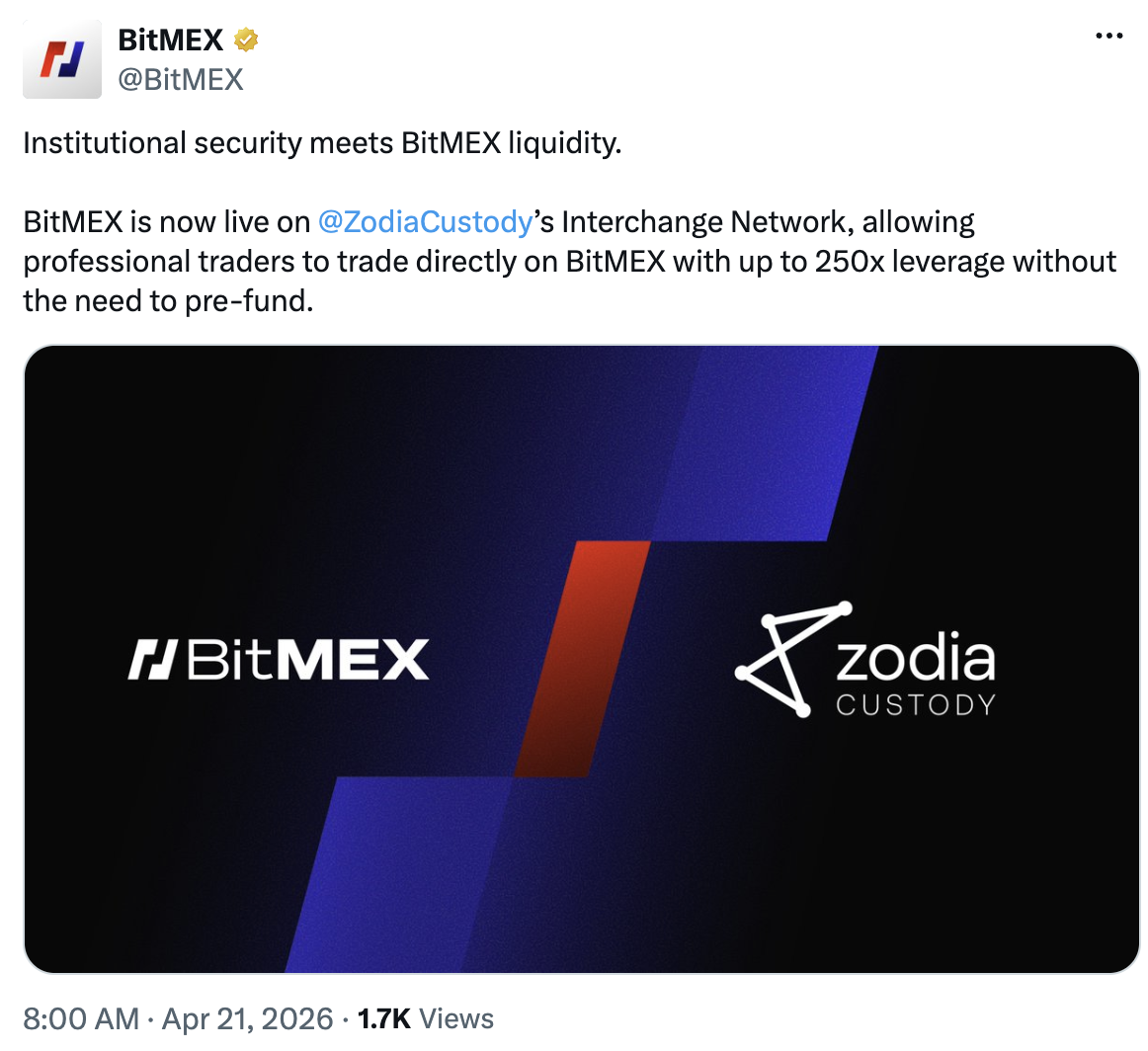
In April, BitMEX partnered with Zodia Custody to let institutional clients trade derivatives while keeping collateral in segregated custody rather than on the exchange. Under the BitMEX integration, traders can access perpetual swaps and futures while collateral remained in Zodia’s custody and was mirrored for trading.
BitMEX said the structure eliminated the need to prefund exchange accounts while improving capital efficiency and reducing operational risks associated with moving assets between custody and trading venues.
Source: BitMEX
Bitget adopted a similar model in June by integrating Fireblocks Off Exchange. The integration allows institutional clients to execute trades from MPC-based wallets while keeping assets in trader-controlled collateral vaults rather than transferring them onto the exchange. According to Bitget, the platform can verify that trading accounts are fully collateralized in real time without taking custody of client assets.
KuCoin Institutional also expanded its institutional custody offering earlier in the year, integrating Ceffu’s MirrorX platform in January. The system allows institutional clients to trade while keeping digital assets in third-party custody, with funds mirrored for trading and settled offchain every four hours.
Magazine: Bitcoin slides to $58K, XRP hits $1 but onchain data promising: Market Moves


You can now buy gold with yield, straight from a normal brokerage account.
Investors now have a way to own gold that pays them to hold it, and the ability to buy it through an ordinary brokerage account. Streamex Corp. (NASDAQ: STEX) said on June 29 that GLDY, its gold-backed, yield-bearing security, can be purchased through a standard brokerage relationship, in a collaboration with FINRA-member broker Siebert Financial and the regulated digital-securities platform tZERO.
Ask your broker for it like any other investment. No crypto knowledge needed.
The arrangement lets a Siebert broker offer digital gold ($GLDY) to a client the same way they would any stock or bond, with no crypto onboarding and no wallet required. Siebert, which oversees roughly $20 billion in client assets, handles distribution; tZERO custodies the asset on a regulated platform and is expected to provide secondary-market trading. For investors, the experience is meant to feel like adding any other instrument to a portfolio.
Hold the gold, and you get paid in more gold every month.
What sets $GLDY apart from a conventional gold holding is the payout. Most ways of owning gold cost the holder money, whether that is storage and insurance on physical bars or management fees on a fund. $GLDY pays a yield of up to roughly 3.5% per year, distributed monthly, and pays it in additional gold. The yield comes from lending the underlying metal to commercial users such as jewellers, mints and refiners, an established practice in the professional bullion market that individual investors have rarely been able to access.
“Gold has always been the asset you buy and forget. The point of $GLDY is that your gold can finally work for you, and now you can get it through the same broker you already use. That combination of a productive asset and a familiar way to buy it is what brings new investors in.” Henry McPhie, Co-Founder & CEO, Streamex
Today it is for accredited investors.
$GLDY is a regulated security offered to verified accredited investors, and the new channel reaches Siebert’s wealth-management and institutional clients. Investors interested in GLDY should visit the Streamex platform directly, or use a Siebert brokerage account and speak with a licensed representative to determine whether it suits their goals.
Soon anyone, anywhere, will be able to buy yield-bearing digital gold.
For Streamex, the brokerage launch is one step in a larger plan to bring digital commodities to a global audience. The company is building a tokenization platform for real-world assets, starting with commodities, and has said it intends to follow $GLDY with a retail version in the coming months that won’t require investor accreditation. That retail product is expected to pay the same yield as the accredited version, up to roughly 3.5% per year, so everyday buyers get the same compounding benefit that institutions do.
Gold that earns is catching on, and big-name finance is now on board.
The backdrop helps explain the timing. Tokenized gold has been one of the fastest-growing corners of the digital-asset market, and the idea of gold that earns a return for its holder has drawn growing interest from investors who want a hard-asset hedge that also compounds. Distributing the new brokerage channel through a FINRA-member firm is a signal that the category is going mainstream.
Bottom line: gold that pays you, available now, with an everyday version coming.
For now, the takeaway for commodities investors and traders: there is a regulated, brokerage-accessible way to hold gold that adds to itself month after month, with a retail equivalent on the way.
For full information on digital gold with yield, visit Streamex
This article is for general information only and is not investment, financial, legal or tax advice. GLDY is offered as a security to verified accredited investors under Rule 506(c) of Regulation D and is a restricted security; availability and suitability depend on an investor’s circumstances. Stated yields are variable, not guaranteed, and may change. References to a future retail product describe plans that are not yet available and are subject to change. Products may not be available in all jurisdictions. Streamex Corp. is a publicly traded company (NASDAQ: STEX); statements about future products are forward-looking and involve risk.
The post Streamex Brings Gold with Yield Directly Into Your Brokerage Account appeared first on BeInCrypto.

Key Takeaways
- Lockheed Martin received a massive $35.5 billion Pentagon contract spanning seven years for THAAD missile interceptor manufacturing.
- A separate $2.9 billion US Army deal was awarded to produce Sentinel A4 radar systems through 2031.
- Shares have declined 23% since the Iran conflict began, currently hovering around $518 per share.
- Citi’s John Godyn elevated his rating to Buy from Hold, increasing the price target from $571 to $582.
- The defense contractor will deploy more than $9 billion toward constructing and modernizing 20 munitions facilities before 2030.
Lockheed Martin (LMT) experienced a triple boost on July 1st, securing dual Pentagon contracts while receiving an analyst upgrade. Shares climbed 1.8% during early Wednesday session, reaching $518.28.
Lockheed Martin Corporation, LMT
The centerpiece announcement involves a $35.5 billion THAAD interceptor agreement. This seven-year “undefinitized” arrangement permits immediate commencement of operations while final pricing details and exact missile quantities remain under negotiation.
THAAD represents America’s premier anti-ballistic missile defense platform. The system destroys incoming threats through pure kinetic impact—both within and beyond Earth’s atmosphere—without requiring explosive payloads. These interceptors achieve speeds of Mach 8.2.
This marks the inaugural large-scale multiyear procurement under the Pentagon’s “Arsenal of Freedom” program, designed to accelerate weapons manufacturing and expedite delivery to military personnel.
Meeting production requirements necessitates Lockheed constructing or upgrading 20 munitions manufacturing sites nationwide before 2030. Investment projections for this expansion surpass $9 billion.
“This innovative approach accelerates our mission to fortify the defense industrial base, scale production capacity, and provide warfighter capabilities with unparalleled velocity and magnitude,” stated Tim Cahill, who leads Lockheed’s Missiles and Fire Control business unit.
The THAAD agreement also supports President Trump’s proposed “Golden Dome” initiative—an ambitious nationwide missile defense architecture.
Additional Army Contract Secured
Simultaneously, Lockheed obtained another $2.9 billion contract from the US Army for Sentinel A4 radar production, extending through June 2031.
The Sentinel A4 employs digital signal processing alongside solid-state gallium nitride antenna technology. Capable of fixed or mobile deployment, it identifies aircraft, unmanned aerial vehicles, rockets, artillery shells, and mortar rounds—determining both launch sites and impact coordinates.
Lockheed originally secured the Sentinel A4 development contract in 2019, with initial production units delivered this year.
Citi Analyst Elevates Rating
Notwithstanding these contract victories, LMT shares have struggled recently. The 23% decline since Iran hostilities commenced has prompted Citi analyst John Godyn to identify a potential entry point.
Godyn elevated his recommendation from Hold to Buy while adjusting his price target upward to $582 from $571.
Shares currently trade at approximately 17 times forward earnings estimates. This represents a compression from roughly 22 times valuation at the conflict’s outset—a multiple previously comparable to the broader S&P 500.
Godyn highlighted strengthening business fundamentals, especially Lockheed’s missile production capabilities, which align with military procurement priorities. He referenced historical precedent: since 2009, LMT experienced nine quarterly declines exceeding 10%, recovering seven times—with six recoveries delivering double-digit percentage gains.
Currently, just 36% of Wall Street analysts assign LMT a Buy rating, significantly trailing the S&P 500’s typical 55%–60% range. Consensus analyst price targets average approximately $618.
Lockheed’s second quarter 2026 earnings report is slated for July 23.

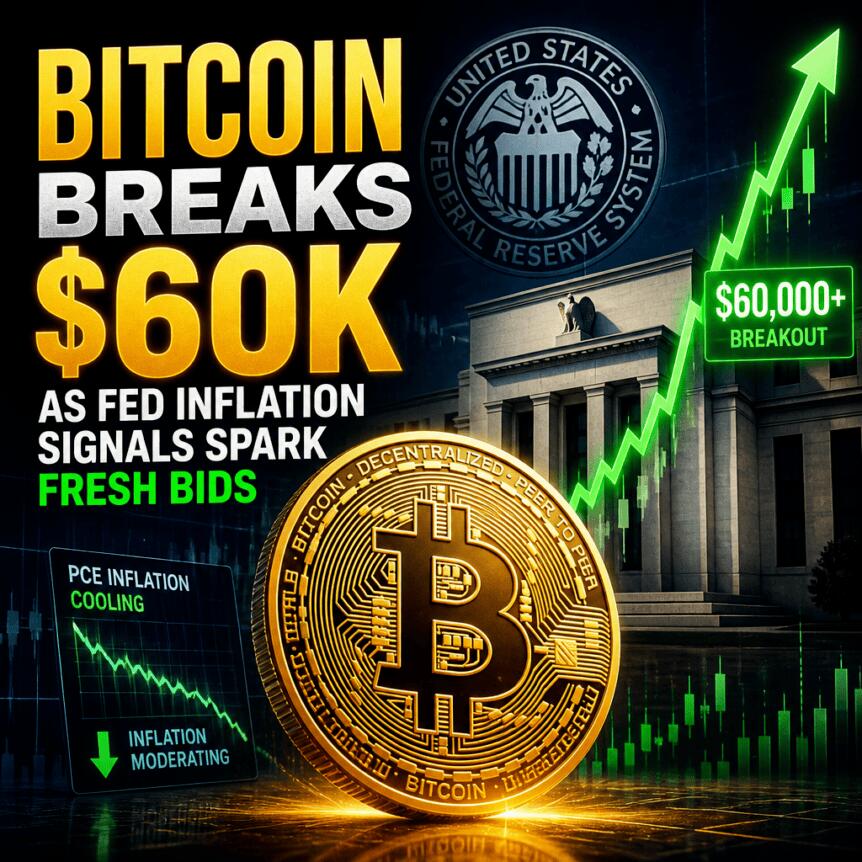
Bitcoin’s recovery hit a familiar wall as macro tailwinds weakened. The largest cryptocurrency rose on Wednesday after US Federal Reserve Chair Kevin Warsh signaled concern about stubborn inflation, a backdrop that can briefly lift risk assets. But traders are increasingly cautious that the same environment will also keep pressure on non-yielding assets like crypto.
The immediate setup remains complicated by two linked forces: persistent outflows from spot Bitcoin ETFs and a market shift toward higher returns in fixed income, amplified by a strengthening US dollar. In practice, that combination tends to make investors less inclined to park money in assets that don’t generate yield.
Key takeaways
- Spot Bitcoin ETF outflows, combined with rising Treasury yields, lower the odds of a quick rebound toward $65,000.
- Higher fixed-income returns and a stronger US dollar typically disadvantage non-yielding assets such as Bitcoin and gold.
- US government bond futures implied a significantly greater likelihood of rate hikes by September, up sharply from a month earlier.
- AI-led equity momentum has supported broader risk appetite, but sector-specific semiconductor weakness could still change the tone.
Treasury yields rise as “real” competition for capital returns
While Bitcoin reacted positively to Warsh’s remarks, the broader trading backdrop turned less forgiving. The US 5-year Treasury yield jumped to 4.22%, signaling that investors demanded higher compensation to hold government debt. That matters for Bitcoin because the yield cycle is a direct competitor for fresh capital: when risk-free yields move higher, the opportunity cost of holding assets without a cash yield typically increases.
At the same time, WTI crude oil fell to a four-month low, and market expectations still anticipate changes to monetary policy as inflation eventually cools. However, traders are also paying close attention to the mechanics of US Treasury issuance, which helps shape how debt markets price interest rates—regardless of how the Federal Reserve balances policy tools over time.
According to CME’s FedWatch tool, US government bond futures implied roughly 64% odds of interest rate hikes by September. That compares with about 23% one month prior, suggesting the market has already repriced the near-term rate path toward tightening.
Meanwhile, the US dollar strengthened against other major fiat currencies. The effect can be particularly uncomfortable for global hedges priced in dollars—an issue that has also weighed on gold in recent months. TradingView charts highlighted the contrast between gold/USD weakness and rising DXY strength, with gold down about 12% over two months.
Why ETF flows still matter more than the “one-day” bounce
Bitcoin’s Wednesday gains didn’t fix the bigger positioning problem. Ongoing outflows from US-listed spot Bitcoin ETFs continue to undercut the bullish case, according to earlier coverage from Cointelegraph that cited ETF flow deterioration.
In Wednesday’s broader narrative, the sales appear persistent rather than isolated. SoSoValue data referenced in the source shows daily net flows remaining pressured, and the article’s framing emphasized how negative headlines tend to amplify selling while positive developments struggle to attract fresh buying. For traders, this creates a classic asymmetry: rallies can fade quickly if incremental buyers are not replacing sellers in size.
Bitcoin is also trading materially below its all-time high—about 53% down, per the source—leaving traders cautious about the reliability of nearby support levels around the $60,000 region. Without a clear shift in ETF demand or macro conditions, the market can struggle to sustain the momentum needed for higher price targets.
AI enthusiasm is helping equities—yet semiconductors signal risk
One reason investors remain active is that parts of the equity market have been strong. The source pointed to about 25% gains in the Nasdaq 100 index, attributing some resilience to AI sector earnings momentum. That’s important because Bitcoin often benefits when investors seek higher-beta exposure during periods of improved growth confidence.
However, the story isn’t uniformly bullish. The source highlighted that Micron (MU) and SanDisk (SNDK) shares fell sharply intraday after competitors SK Hynix and Samsung announced plans to expand capacity. While that single move is not presented as a full reversal, it does underscore how quickly expectations can change for AI-adjacent hardware—especially when capacity expansion raises concerns about supply and pricing dynamics.
Even so, the article noted that the iShares SOX Semiconductor Index ETF (SOXX) was still up strongly over the last three months, suggesting that any weakness may be more sector-specific than a broad collapse in chip sentiment.
For Bitcoin, the implication is nuanced: AI-driven equity momentum may continue to provide a floor for risk appetite, but sector-level disappointments can still become catalysts that shift traders back toward “safer” positioning—particularly when rates expectations are rising.
Can Bitcoin reach $65,000 without changing the rate narrative?
The question for the market is not whether Bitcoin can bounce at all, but whether it can do so sustainably. The source argues that the temporary lift tied to Warsh’s inflation concerns may not be enough if expectations for higher interest rates remain elevated and fixed-income competition continues to intensify.
That view aligns with how the market has repriced the odds of policy changes. With FedWatch indicating a much higher probability of rate hikes by September than a month earlier, investors may be less willing to chase a rally in assets like Bitcoin that do not provide yield.
In this environment, the $65,000 area becomes a tougher target: it likely requires either a meaningful shift in ETF flow dynamics or a clearer easing in the rate-and-dollar backdrop. Until then, the source suggests that any rebound may take longer than bulls would prefer, even if periodic positive news sparks short-lived optimism.
Going forward, traders should watch two signals closely: whether spot Bitcoin ETF flows improve enough to counterbalance broader macro pressure, and whether Treasury yields and the US dollar begin to cool. If both stay firm, rallies may remain vulnerable; if either breaks, Bitcoin’s odds of sustaining higher levels improve.
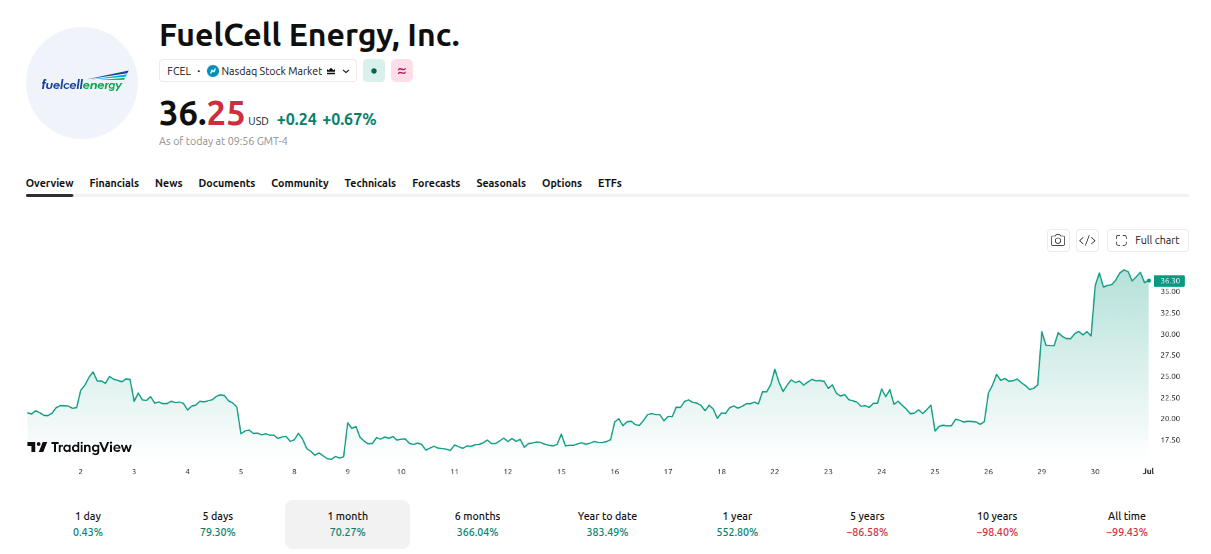
FuelCell Energy stock skyrocketed nearly 70% in June. Shares now trade near $36.25, powered by a decisive pivot toward the AI data center power market. The move made FCEL one of the best-performing US stocks of the month.
The rally reshaped how Wall Street values fuel-cell companies serving the booming buildout of AI infrastructure.

Why FCEL Stock Jumped 70% in June on the AI Data Center Push
FuelCell Energy (FCEL) is a Nasdaq-listed clean energy company that develops high-temperature fuel cell systems for stationary power generation.
The stock has emerged as a top play on the AI data center power crunch. Furthermore, shares now trade at $36.25 after the historic June rally.
The one-month move was remarkable in scale. FCEL delivered a 70% gain across June, according to TradingView data. Moreover, the past 5 trading days alone added another 79%, showing how much of the rally concentrated into the final week of the month.
The broader picture is even more striking. FCEL is now up 383% year-to-date in 2026. Furthermore, the stock has surged 552% across the past 12 months. Consequently, the June performance capped the company’s best quarter in more than 5 years of trading.
Follow us on X to get the latest news as it happens.
Trading volume also confirmed the shift in sentiment. Retail attention exploded, with Stocktwits message volume up 1,056% in 24 hours during the peak of the rally.
Moreover, the stock was included in the Russell 3000 index as of June 26, unlocking passive index-tracking flows.
What the AI Data Center Power Pivot Really Delivered
The AI data center pivot is the strategic shift where FCEL now targets hyperscaler power demand as its main growth engine. Over 80% of its commercial pipeline is now tied to data centers. Furthermore, the total pipeline has grown by 275% year-over-year across recent quarters.
The centerpiece deal is the Fit Energy agreement announced in June. FCEL will supply up to 380 MW of clean baseload on-site power for AI data centers. Moreover, the deal includes a deposit-backed initial order for 30 MW, with delivery slated to begin in late 2026.
Additional catalysts stacked up throughout June. The Export-Import Bank of the United States (EXIM) approved a $49 million financing package to support FCEL’s South Korea expansion. Moreover, management outlined plans to increase Torrington’s manufacturing capacity to 500 megawatts annually, with an investment of $200 to $275 million.
“$FCEL just received what I believe is the most important piece of news in the company’s history, and the stock sold off. I added. I believe this can be a 2x+ from here by EOY ($50+) The risks are obvious: • Ramp execution • Management’s ability to reach its long-term product gross margin targets (>20%) But once those questions are answered, the demand side of the story becomes very hard to ignore,” one analyst said on X.
The company reported its fiscal first quarter 2026 results in March 2026, delivering strong year-over-year revenue growth. Revenue reached $30.5 million, a 61% increase from $19.0 million in the same period last year, driven by progress on its power generation projects and its advancing data center power strategy.

Despite the top-line improvement, the company continued to face operating challenges, posting a gross loss of $5.9 million, an operating loss of $26.3 million, and a net loss per share of $0.49.
The backlog stood at $1.17 billion, slightly down from the prior year, as the company focuses on commercial momentum in carbon capture and high-efficiency fuel cell solutions to meet the growing demand for clean energy and data centers.
Subscribe to our YouTube channel to watch leaders and journalists provide expert insights.
The post This US Stock Skyrocketed 70% in June Amid the AI Data Center Pivot appeared first on BeInCrypto.
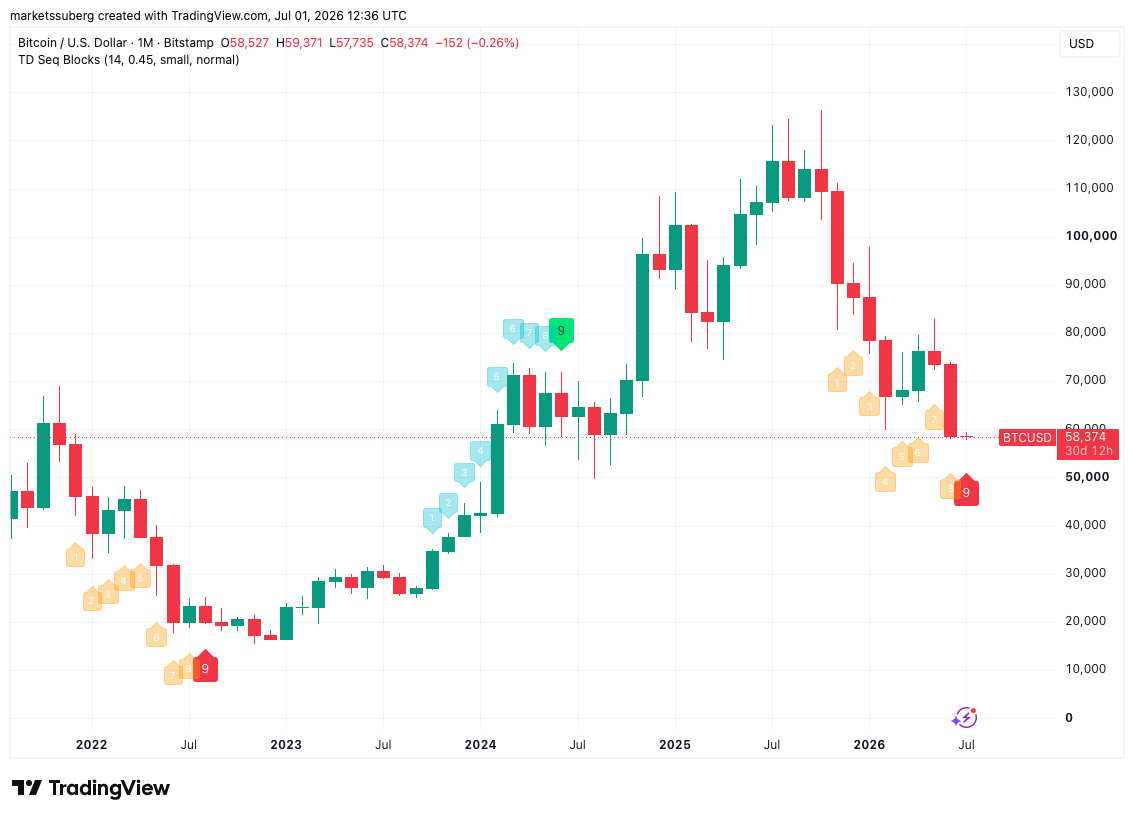
Bitcoin (BTC) has delivered a key trend change setup in the latest sign that the macro downtrend could soon reverse.
Key points:
- Bitcoin is seeing its first “perfected” TD9 indicator downtrend setup on monthly time frames since mid-2022.
- While not a “buy signal” on its own, the move marks a key inflection phase in the bear market, analysis suggests.
- RSI divergences continue to gain sway among those eyeing the final stages of the 2026 market downturn.
BTC price “perfected” TD9 setup echoes final bear-market stages
In an X post on Tuesday, analyst Tony Severino flagged a “perfected” buy signal on the TD9 indicator.
TD9 is a derivative of the Tom DeMark Sequential market timing indicator, which alerts traders to potential trend changes. Here, price triggers a notable signal when nine candles in a row close higher (in an uptrend) or lower (in a downtrend) than the closing price four candles prior.
“Bitcoin has ‘perfected’ a TD9 buy setup on the monthly,” Severino commented alongside data from TradingView.
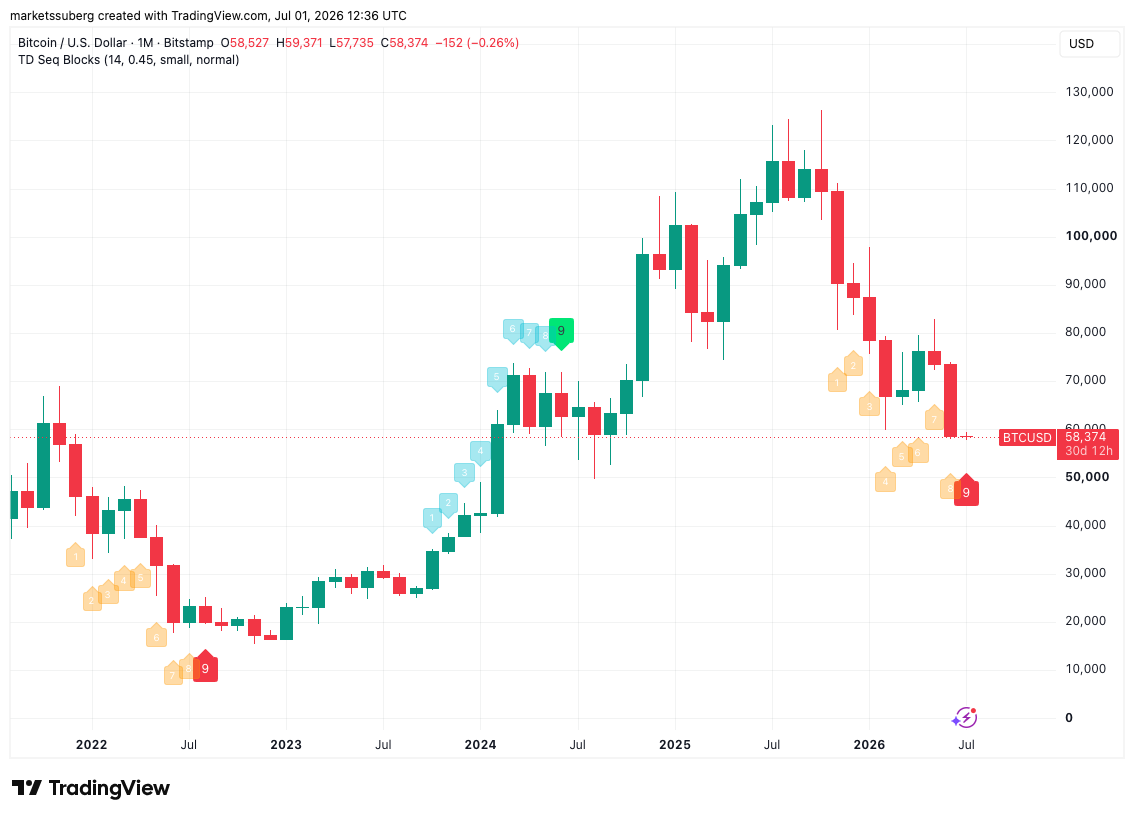
BTC/USD one-month chart with TD9 indicator data. Source: Cointelegraph/TradingView
The setup is Bitcoin’s first in several years on monthly time frames, with the last TD9 downtrend signal coming in July 2022.
At the time, BTC/USD spent another five months ironing out its bear-market bottom, and as Severino notes, a completed TD9 setup does not “necessarily mean that the bottom is in.”
“Not a buy signal by itself. But if it holds into the close, it’s the kind of thing you pay attention to,” Tony Carrera, host of the Proof of Pain podcast, wrote in a further X post.
“TD 9s are where you stop chasing fear, zoom out, and ask: Is this where $BTC reminds everyone what happens when they think it’s dead?”
RSI divergences spark “good odds” for Bitcoin’s bullish comeback
As Cointelegraph reported, consensus among market participants still favors new macro lows coming before the bear market truly reverses.
Related: Bitcoin just $5K away from ‘best investment opportunity’ of bear market
Targets differ, with $55,000 now popular, while BTC price cycle comparisons put the current bear market at just over two-thirds complete.
By contrast, bullish divergences across multiple time frames are locking in on the relative strength index (RSI) — a classic hint that trend change is due.
“Not sure I have ever seen more confirmed and potential bullish divergence with oversold RSI on more time frames, ever,” trader, analyst and podcast host Scott Melker told X followers on Wednesday.
“Divs building over multiple time frames is my favorite signal. Good odds.”
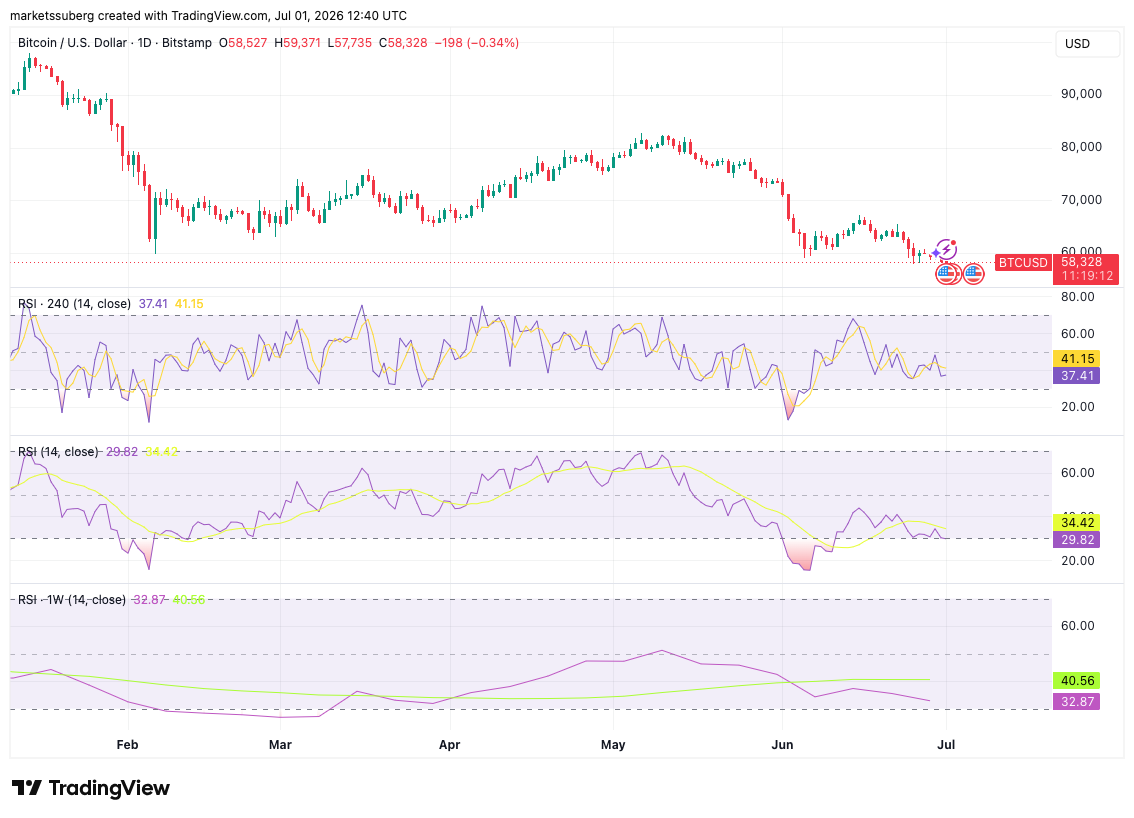
BTC/USD one-day chart with four-hour, one-day, one-week RSI data. Source: Cointelegraph/TradingView

Robinhood has moved its blockchain testing effort into the public spotlight, announcing that its Robinhood Chain layer 2 network has launched its public mainnet. The rollout follows an earlier testnet launch in February, meaning the company ran roughly four months of testing before going live.
In its announcement on Wednesday, Robinhood said the chain—built on Arbitrum—positions itself as “AI-native” and designed to support tokenized real-world assets. The move comes as the brokerage and crypto platform broadens its on-chain ambitions alongside new and existing offerings for crypto, tokenized stocks, and decentralized finance within its wallet ecosystem.
Key takeaways
- Robinhood Chain’s public mainnet launched after testnet activity began in February, following about four months of preparation.
- The layer 2 network is built on Arbitrum and is marketed as “AI-native” and intended for real-world asset tokenization.
- Robinhood says tokenized stock products are already live in its wallet app across more than 120 countries, and it plans to add crypto trading in the UK soon.
- New decentralized lending functionality, Robinhood Earn, lets users lend USDG stablecoins from a self-custody wallet at an estimated ~7% annual yield.
- Competition among Ethereum layer 2 networks remains intense, with major ecosystems such as Base drawing attention for recent reliability incidents.
From testnet to public mainnet for Robinhood Chain
Robinhood’s blockchain strategy is now taking a concrete form with the mainnet launch of Robinhood Chain. According to the company, the network went live on testnet in February and has now been promoted to a public mainnet stage.
The chain is an Arbitrum-based L2, an architectural choice that links Robinhood’s development to a well-established ecosystem for scaling and on-chain throughput. Robinhood’s messaging around the network centers on its intended use for tokenized real-world assets, a theme that continues to anchor much of the platform’s tokenization efforts.
Notably, the mainnet launch is happening as Robinhood pushes further into both tokenized securities and DeFi products—two areas that require careful execution because they touch user protections, custody models, and compliance requirements.
Tokenized stocks, wallet access, and a UK crypto push
Alongside the mainnet news, Robinhood reiterated that its tokenized stock products are already operational. The company said these products are available through its wallet app to users in more than 120 countries.
Robinhood also disclosed plans to launch crypto trading in the United Kingdom “soon.” While the announcement does not provide an additional timeline beyond that phrasing, it signals that Robinhood’s on-chain expansion is not only about infrastructure, but also about expanding the accessibility of crypto services geographically.
Earlier this year, Robinhood CEO Vlad Tenev argued that tokenized stocks are “inevitable,” and he tied the rationale to potential market-structure benefits—specifically, the idea that tokenization could help reduce the risk of trading freezes that can occur on traditional exchanges. That perspective sets a clear policy narrative for the company’s product direction, even as regulators and market operators continue to shape the rules around tokenized assets.
Robinhood Earn: lending USDG from self-custody
Robinhood also introduced a decentralized product called Robinhood Earn. The feature is designed to let users lend USDG, a dollar-backed stablecoin, via a self-custody wallet experience.
Robinhood’s announcement places an estimated annual percentage yield of around 7% on the lending activity. For users, the practical change is the shift from keeping assets entirely within custodial frameworks toward a model that emphasizes self-custody while still providing access to yield through on-chain lending mechanics.
For builders and traders watching Robinhood’s L2 ambitions, the key point is that the mainnet launch is paired with a DeFi component rather than being purely infrastructural. This could influence how quickly liquidity and user activity form around the chain, especially if tokenized stock rails and stablecoin lending become tightly integrated.
A crowded L2 landscape—and a reminder on reliability
Robinhood Chain is entering an increasingly competitive layer 2 market. One of the most prominent incumbents in the segment is Base, the Coinbase-backed blockchain, which has expanded rapidly in recent periods.
Reliability has become a major differentiator across L2 networks. In June, Cointelegraph reported that Base suffered two outages within hours of each other. The engineering team later said a sequencer bug caused the incidents. Cointelegraph also noted that Base is the second-largest layer 2 network by total value secured, at about $11 billion, underscoring how large networks can still face operational issues.
Against that backdrop, Robinhood’s decision to launch a public mainnet after a testnet period may be interpreted as an attempt to ensure readiness before broadening usage. Still, the real test for any L2 network is post-mainnet stability—especially if Robinhood’s tokenized stocks and DeFi products rely on uninterrupted chain performance.
Robinhood shares rose about 8% on Wednesday following the announcement. For crypto participants and investors, the next watch item is straightforward: whether Robinhood Chain can sustain stable operation under real user load, and how quickly usage grows as tokenized stock rails, USDG lending via Robinhood Earn, and broader regional availability (including the planned UK crypto trading) come online.
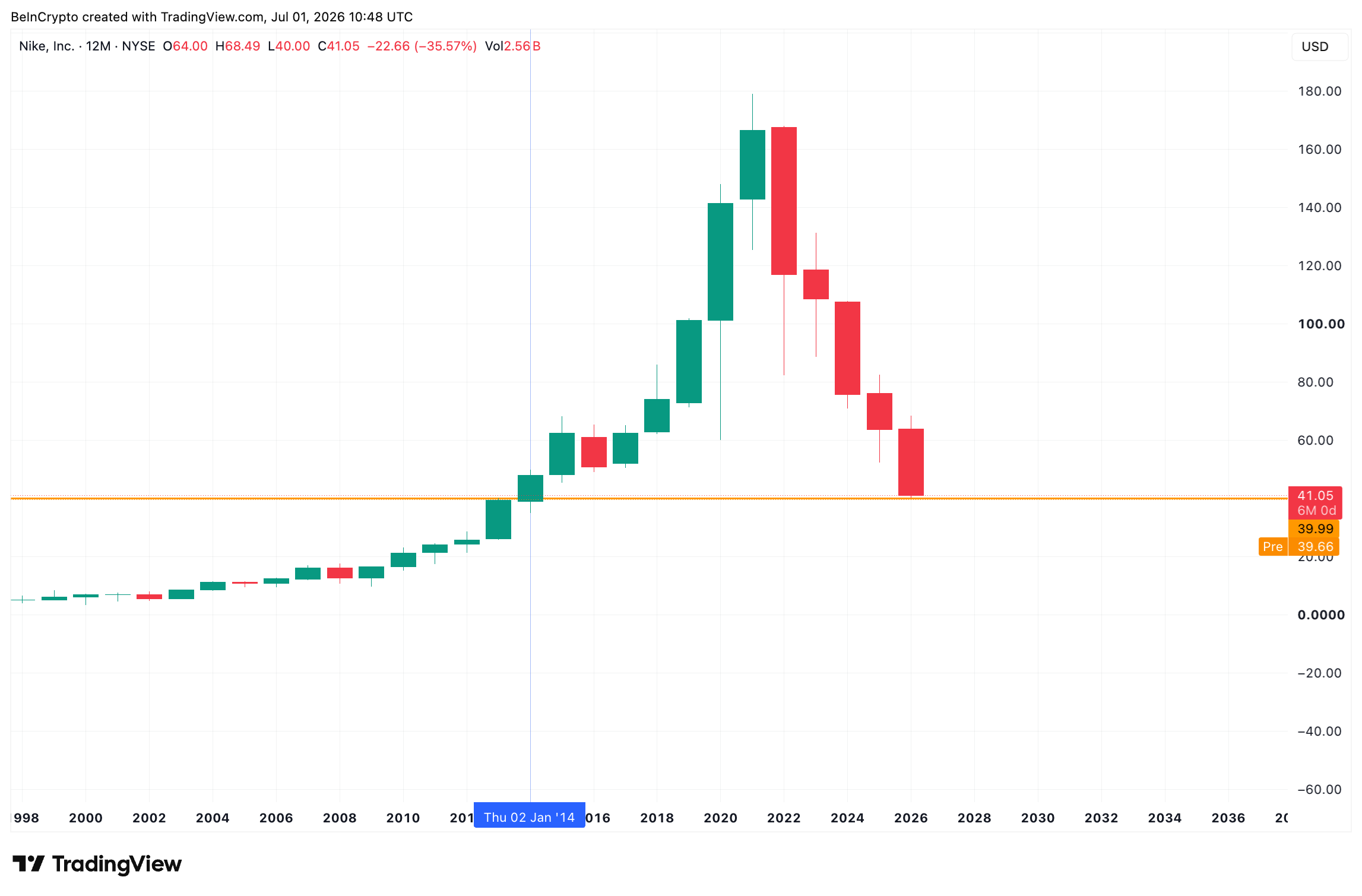
Nike (NKE) stock slid about 1% on Wednesday, briefly trading at $40, its lowest level in about 12 years. The fall came despite an earnings beat, because most of the profit came from a one-time tariff refund.
That refund flattered the headline number and did nothing to fix Nike’s shrinking sales. Wall Street responded by trimming price targets, and the charts now point to more downside.

Why the Earnings Beat Triggered Target Cuts
Here is the earnings loophole the title promised. Nike reported a profit of $0.20 per share and beat the $0.13 that Wall Street expected. But most of that profit did not come from selling shoes.
About $0.52 per share (a large part of the $0.72 EPS) came from a $986 million tariff refund, money the government returned after the Supreme Court struck down many of the levies. That is a one-time payment, not a recurring business model.
Take the refund away, and Nike still looks weak. Sales slipped to $10.97 billion, and sales in China fell 12%.
Want more insights like this? Sign up for Editor Harsh Notariya’s Daily Newsletter here.
The market response shows how little faith investors have. A monthly chart from earlier shows Nike has now given back its entire pandemic-era run and sits back at prices last seen in early 2014.
Because the profit was a one-off, analysts cut their price targets instead of raising them. Goldman Sachs trimmed its target to $42 from $46 post-results, and JPMorgan cut to $47 from $52.
UBS stayed the most constructive at $48. Jefferies remains the lone bull among these analysts at $90.

Even so, most reduced targets sit only slightly above the last close near $41. In other words, the Nike stock price upside is not what analysts are betting on right now.
The soft outlook has therefore shifted attention to traders’ positioning.
Bearish Bets Are Building Against Nike Stock
Options traders turned defensive fast. The put-call ratio, which compares bearish put bets to bullish call bets, jumped to 1.14 on June 30 from 0.53 on June 26.
A ratio above 1 means puts now outnumber calls. That marks a sharp swing toward hedging and downside bets around nike earnings.

Meanwhile, volume tells the same story. Nike traded 73.89 million shares, its second-heaviest session since early April, and it came on a down day.
Additionally, Chaikin Money Flow (CMF), a proxy for institutional buying and selling pressure, sits at -0.29. The deep negative reading suggests big money is not stepping in to catch the fall.
More so when the Nike price chart clearly shows a bearish head-and-shoulders pattern with a 14% potential dip.

With flows and positioning aligned bearishly, the price chart becomes the decider.
Nike Stock Price Levels to Watch
The daily chart shows a head-and-shoulders pattern. Nike’s head formed near $47, with a right shoulder around $42.
The neckline now sits near $39, roughly 3% below the last close. A clean break there would confirm the pattern and open the door toward $38 as the first bearish target.
Below that, the measured move points to about $34, with $33 as the deeper extension target. That path frames the dramatic downside now in play.
The bulls still have a case, but it needs work. Nike must reclaim $41 quickly, and a daily close above $42 would signal real strength, the same level analysts already expect the stock to prove.

A push over $43 would improve the tone, while a move above $46 would weaken the bearish setup. Moreover, a clean daily break above $47 cancels the pattern entirely. Traders should note that head-and-shoulders patterns only confirm once the neckline breaks on volume, and failed breakdowns are common.
For now, the $39 neckline separates a slow base-building recovery from a deeper slide toward $34.
The post Nike Stock Hits a 12-Year Low as an Earnings Loophole Masks Weak Sales appeared first on BeInCrypto.


Disclosure: This article does not represent investment advice. The content and materials featured on this page are for educational purposes only.
Venga obtains a MiCA license from Spain’s CNMV, which lets the Barcelona crypto firm operate under the EU’s new regulatory framework.
Summary
- Venga secures MiCA authorization from Spain’s CNMV before Europe’s crypto transition period reaches its deadline.
- MiCA requires crypto providers to meet stronger standards for governance, security, reporting, and customer protection.
- Industry data cited shows only about 194 firms secured MiCA approval by May 2026 overall.
Venga has received authorization from Spain’s Comisión Nacional del Mercado de Valores to operate as a Crypto-Asset Service Provider under the European Union’s Markets in Crypto-Assets Regulation. The Barcelona-based company announced the approval on July 1, 2026. The Venga MiCA license allows the firm to provide regulated crypto-asset services under the EU’s new framework.
Venga MiCA license marks regulatory milestone
The authorization places Venga among a limited group of crypto firms approved under MiCA. The company, founded in Barcelona in 2023, said the approval follows nearly two years of work across its business.
“Obtaining the MiCA license is a major milestone for Venga and the result of nearly two years of work across every area of the business,” said Michael Stroev, co-founder and CEO of Venga. He said the process required investment in governance, compliance, security, reporting systems, and operational processes.
Spain’s CNMV granted the authorization as the European crypto market moves into a new phase of oversight. MiCA sets common rules for crypto-asset service providers. These rules cover governance, capital adequacy, operational resilience, cybersecurity, risk management, customer protection, and internal controls.
The license also gives Venga a route to passport its services across the European Union. The company can expand beyond Spain while operating under one regulatory framework.
MiCA authorization changes market standards
MiCA represents a broad regulatory reset for crypto assets in the European Union. The framework moves the sector away from earlier national registration systems. It requires companies to meet operating and supervision standards.
The transition period is ending on July 1. Crypto companies that relied on older national registrations must secure MiCA authorization or stop offering regulated crypto-asset services within the European Union. The change may force some providers to suspend activities, transfer clients, or leave certain European markets.
A report by crypto.news showed that more than 3,000 crypto firms were registered across the European Union before MiCA took effect. About 194 firms had secured MiCA authorization as of May 2026. That gap points to a smaller authorized market under the new rules.
The approval comes during consolidation in the European crypto sector. Firms that meet MiCA standards can operate under ongoing supervision. Firms that do not receive approval face limits on their ability to serve EU customers.
oversight expands for crypto-asset service providers
Authorized providers under MiCA face continuous regulatory duties. These include supervisory obligations, periodic reporting, annual audits, and oversight by national authorities. Those authorities apply standards coordinated by the European Securities and Markets Authority.
“For users, MiCA introduces a level of regulatory accountability that has not previously existed across much of the European crypto sector,” Stroev said. He added that authorization is not a one-time event and that licensed firms must continue to meet operational, financial, and customer protection requirements.
The new structure may change how users assess crypto platforms. Under MiCA, users can check whether a provider has authorization under the EU framework. That status shows whether the firm must follow the required safeguards and reporting rules.
Venga said the authorization confirms that it has built its business for the regulatory framework that will define the future of crypto services in Europe. The company aims to make digital assets accessible through a regulated platform available in Spanish, Catalan, and English.
Disclosure: This content is provided by a third party. Neither crypto.news nor the author of this article endorses any product mentioned on this page. Users should conduct their own research before taking any action related to the company.

World Cup LIVE: USA vs Bosnia & Herzegovina updates, Rice injury update and Senegal fury

FBI Confirms All Three Nancy Guthrie Ransom Notes Are Fake, Upending the Case’s Central Kidnapping Narrative

What is a stock buyback? How repurchases affect price


-

 Fashion5 days ago
Weekend Open Thread: Staud – Corporette.com
-

 Politics6 days ago
The House | Manchesterism won’t survive the painful trade-offs unless it gets citizens on board
-

 Crypto World2 days ago
Strategy authorizes up to $1.25B in Bitcoin sales under new capital plan
-

 Politics6 days ago
Potential 2028er World Cup attendee leaderboard
-

 Business6 days ago
Asia stock markets slide as tech shares slump
-

 News Videos3 days ago
MAJOR BITCOIN & MARKET UPDATE!!!! (MUST WATCH ASAP!!!)
-

 Tech6 days ago
A Look At A Gaggle Of Transputer Boards
-
 Crypto World6 days ago
Dell (DELL) Shares Tumble Over 5% Following Analyst Downgrade to Hold
-

 Crypto World4 days ago
Coinbase, Circle Deepen Crypto Stock Losses Despite Resilient S&P 500
-

 Business2 days ago
Australia treasurer says alleged access of prime minister’s bank data ’incredibly concerning’
-

 Crypto World5 days ago
Kraken's xStocks Opens Bending Spoons IPO Registration to EEA Retail
-

 Sports5 days ago
FIH Pro League: India defeat Pakistan 7-1, register biggest win of campaign | Other Sports News
-

 Crypto World6 days ago
Bitcoin Sparks $600M Hourly Liquidations With $65,000 Set To Become Resistance
-

 Tech4 days ago
Bluekit phishing kit adopts browser-in-the-middle for login theft
-

 Tech5 days ago
Russian hackers now target Signal backup recovery keys
-
 Crypto World5 days ago
Hyperliquid Named on Singapore MAS Investor Alert Register
-

 Crypto World5 days ago
RTX holders must register wallets before token distribution begins
-

 Crypto World7 days ago
Ripple and SBI launch RLUSD in Japan after JFSA approval
-

 Tech2 days ago
Anonymous researcher drops 0-day ‘exploitarium’ repo
-

 Sports12 hours ago
Broncos roster: OL Ben Powers (No. 74) entering final year of contract
You must be logged in to post a comment Login