

Crypto World
Elon Musk Grok AI Predicts Shocking XRP Price by End of 2026

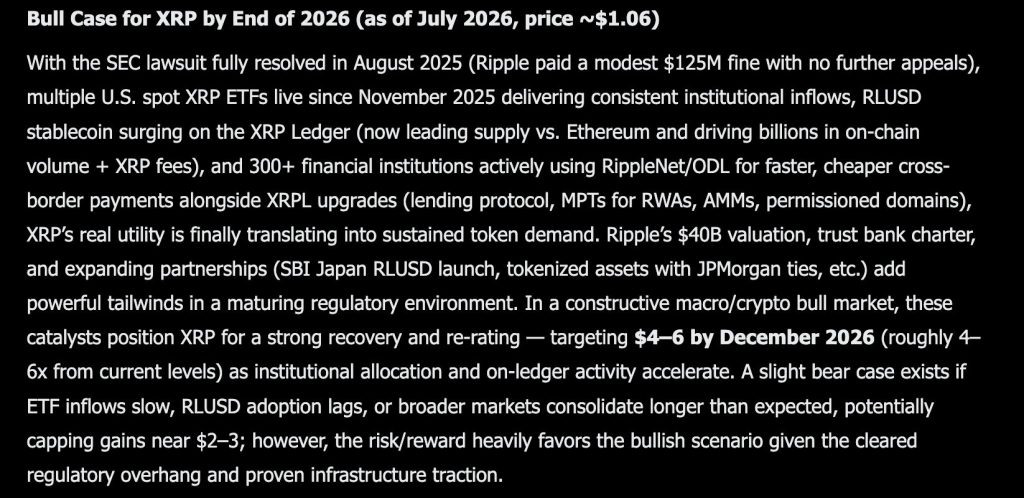
Elon Musk Grok AI just put together what might be the most detail rich XRP price prediction bull case in this entire series. The model predicts $4 to $6 by December 2026, roughly four to six times where the coin sits right now.
The bull case treats XRP as an asset whose actual utility has finally started translating into real sustained token demand, even while price refuses to acknowledge it.
XRP sits near $1.06 today, and the foundation of this thesis is a full legal clean slate, with the SEC lawsuit completely resolved in August 2025 after Ripple paid a modest $125 million fine with no further appeals.
That outcome unlocked multiple US spot XRP ETFs which have been live since November 2025 and delivering consistent institutional inflows ever since.
RLUSD stablecoin is surging on the XRP Ledger and has actually pulled ahead of Ethereum in supply, driving billions in on chain volume and XRP fee generation at the same time.
Over 300 financial institutions are now actively using RippleNet and On Demand Liquidity for faster and cheaper cross border payments, while the XRPL itself keeps adding infrastructure through a lending protocol, multi purpose tokens for real world assets, automated market makers, and permissioned domains.
Ripple itself carries a $40 billion valuation, has secured a trust bank charter, and keeps expanding partnerships including an SBI Japan RLUSD launch and tokenized asset work with JPMorgan ties.
If a constructive macro and crypto bull market materializes alongside all of that, Grok sees institutional allocation and on ledger activity accelerating together toward that $4 to $6 target by year end.
The bear case is narrow compared to the weight of the bull thesis. If ETF inflows slow, RLUSD adoption lags, or broader markets consolidate longer than expected, gains could end up capped near $2 to $3 instead.
Even under that scenario the model still frames the risk reward as heavily tilted toward the bull case given cleared regulatory overhang and proven infrastructure traction that now exists beneath the price surface.

XRP Price Prediction: XRP Carries A Year Of Cleared Catalysts Into A Chart That Has Not Moved Yet
The daily chart shows XRP at $1.06010 after a long, grinding decline from highs above $3.65 set back in early August of last year.
That drop has been almost entirely one directional, interrupted only briefly by a bounce near $2.40 in November before sellers regained control completely.
The most recent leg lower in June pushed price to a fresh low below $1.03 before a modest recovery brought it back to current levels. That kind of late stage capitulation after such an extended downtrend often signals sellers running out of ammunition rather than a healthy pause on the way lower.
Resistance sits first near $1.20, the level that has capped every recent bounce attempt, then a heavier ceiling near $1.60 where price stalled out multiple times earlier this year.
Support is being tested right at current levels near $1.04 to $1.06, the exact zone the chart has been grinding along for the past several days. The overall structure remains a clean descending staircase stretching back nearly a full year, with every relief rally setting a lower high than the one before it.
Momentum on the daily candles looks cautiously stabilizing rather than reversing right now, with slightly more green candles visible in the most recent sessions compared to the weeks prior.
That is a thin read but worth noting after such a long stretch of one sided selling. Given how far XRP would need to travel just to reach the low end of this prediction, the chart tells you this is entirely a story about the next five months rather than the last five, and a decisive close back above $1.60 would be the first real technical signal that Grok’s re-rating scenario has actually started.
Don’t Miss Out on Our $1,000 USDT Airdrop on ByBit
Discover: The best crypto to diversify your portfolio with
Here is What Grok AI Predicts For LiquidChain Near Future, Very Bullish
Sitting at resistance waiting for a breakout is not positioning. It is standing in line.
Bitcoin, Ethereum, and XRP have been pressing against the same ceilings for weeks. The catalyst that unlocks the next leg is perpetually one data print away.
The institutional inflows are perpetually next quarter. Every large-cap trader waiting for a breakout is waiting on a decision that belongs to someone else’s balance sheet.
Early-stage infrastructure plays by completely different rules, Copilot AI predicts. Capital that would vanish as statistical noise at Bitcoin’s scale moves a small undiscovered project by multiples.
The asymmetric return lives in one place only: the gap between what something is genuinely worth and what the market currently thinks it is worth. That gap exists because the project has not been found yet. The moment it gets found, the gap is gone.
Cross-chain fragmentation has been extracting value from DeFi participants since the first bridge went live and nobody has eliminated it. Bitcoin, Ethereum, and Solana were engineered as independent systems with no shared architecture and no intent to interoperate.
Every transaction that crosses those boundaries pays the price of that design in fees, slippage, and execution failures. Bridges were supposed to be the solution. They became the mechanism through which the problem collects its fee.
LiquidChain eliminates the fee entirely. Three networks inside a single execution layer. One deployment reaches all of them. No cross-chain tax on any interaction anywhere.
ChatGPT AI flagged it as worth watching. The presale is at $0.01454 with just over $860,000 raised.
Execution is unproven. Adoption is unknown. Established assets offer a predictable ride toward a ceiling that is already fully visible. LiquidChain is an entry point that disappears once the market finds it.
The post Elon Musk Grok AI Predicts Shocking XRP Price by End of 2026 appeared first on Cryptonews.


Robinhood has moved its blockchain testing effort into the public spotlight, announcing that its Robinhood Chain layer 2 network has launched its public mainnet. The rollout follows an earlier testnet launch in February, meaning the company ran roughly four months of testing before going live.
In its announcement on Wednesday, Robinhood said the chain—built on Arbitrum—positions itself as “AI-native” and designed to support tokenized real-world assets. The move comes as the brokerage and crypto platform broadens its on-chain ambitions alongside new and existing offerings for crypto, tokenized stocks, and decentralized finance within its wallet ecosystem.
Key takeaways
- Robinhood Chain’s public mainnet launched after testnet activity began in February, following about four months of preparation.
- The layer 2 network is built on Arbitrum and is marketed as “AI-native” and intended for real-world asset tokenization.
- Robinhood says tokenized stock products are already live in its wallet app across more than 120 countries, and it plans to add crypto trading in the UK soon.
- New decentralized lending functionality, Robinhood Earn, lets users lend USDG stablecoins from a self-custody wallet at an estimated ~7% annual yield.
- Competition among Ethereum layer 2 networks remains intense, with major ecosystems such as Base drawing attention for recent reliability incidents.
From testnet to public mainnet for Robinhood Chain
Robinhood’s blockchain strategy is now taking a concrete form with the mainnet launch of Robinhood Chain. According to the company, the network went live on testnet in February and has now been promoted to a public mainnet stage.
The chain is an Arbitrum-based L2, an architectural choice that links Robinhood’s development to a well-established ecosystem for scaling and on-chain throughput. Robinhood’s messaging around the network centers on its intended use for tokenized real-world assets, a theme that continues to anchor much of the platform’s tokenization efforts.
Notably, the mainnet launch is happening as Robinhood pushes further into both tokenized securities and DeFi products—two areas that require careful execution because they touch user protections, custody models, and compliance requirements.
Tokenized stocks, wallet access, and a UK crypto push
Alongside the mainnet news, Robinhood reiterated that its tokenized stock products are already operational. The company said these products are available through its wallet app to users in more than 120 countries.
Robinhood also disclosed plans to launch crypto trading in the United Kingdom “soon.” While the announcement does not provide an additional timeline beyond that phrasing, it signals that Robinhood’s on-chain expansion is not only about infrastructure, but also about expanding the accessibility of crypto services geographically.
Earlier this year, Robinhood CEO Vlad Tenev argued that tokenized stocks are “inevitable,” and he tied the rationale to potential market-structure benefits—specifically, the idea that tokenization could help reduce the risk of trading freezes that can occur on traditional exchanges. That perspective sets a clear policy narrative for the company’s product direction, even as regulators and market operators continue to shape the rules around tokenized assets.
Robinhood Earn: lending USDG from self-custody
Robinhood also introduced a decentralized product called Robinhood Earn. The feature is designed to let users lend USDG, a dollar-backed stablecoin, via a self-custody wallet experience.
Robinhood’s announcement places an estimated annual percentage yield of around 7% on the lending activity. For users, the practical change is the shift from keeping assets entirely within custodial frameworks toward a model that emphasizes self-custody while still providing access to yield through on-chain lending mechanics.
For builders and traders watching Robinhood’s L2 ambitions, the key point is that the mainnet launch is paired with a DeFi component rather than being purely infrastructural. This could influence how quickly liquidity and user activity form around the chain, especially if tokenized stock rails and stablecoin lending become tightly integrated.
A crowded L2 landscape—and a reminder on reliability
Robinhood Chain is entering an increasingly competitive layer 2 market. One of the most prominent incumbents in the segment is Base, the Coinbase-backed blockchain, which has expanded rapidly in recent periods.
Reliability has become a major differentiator across L2 networks. In June, Cointelegraph reported that Base suffered two outages within hours of each other. The engineering team later said a sequencer bug caused the incidents. Cointelegraph also noted that Base is the second-largest layer 2 network by total value secured, at about $11 billion, underscoring how large networks can still face operational issues.
Against that backdrop, Robinhood’s decision to launch a public mainnet after a testnet period may be interpreted as an attempt to ensure readiness before broadening usage. Still, the real test for any L2 network is post-mainnet stability—especially if Robinhood’s tokenized stocks and DeFi products rely on uninterrupted chain performance.
Robinhood shares rose about 8% on Wednesday following the announcement. For crypto participants and investors, the next watch item is straightforward: whether Robinhood Chain can sustain stable operation under real user load, and how quickly usage grows as tokenized stock rails, USDG lending via Robinhood Earn, and broader regional availability (including the planned UK crypto trading) come online.
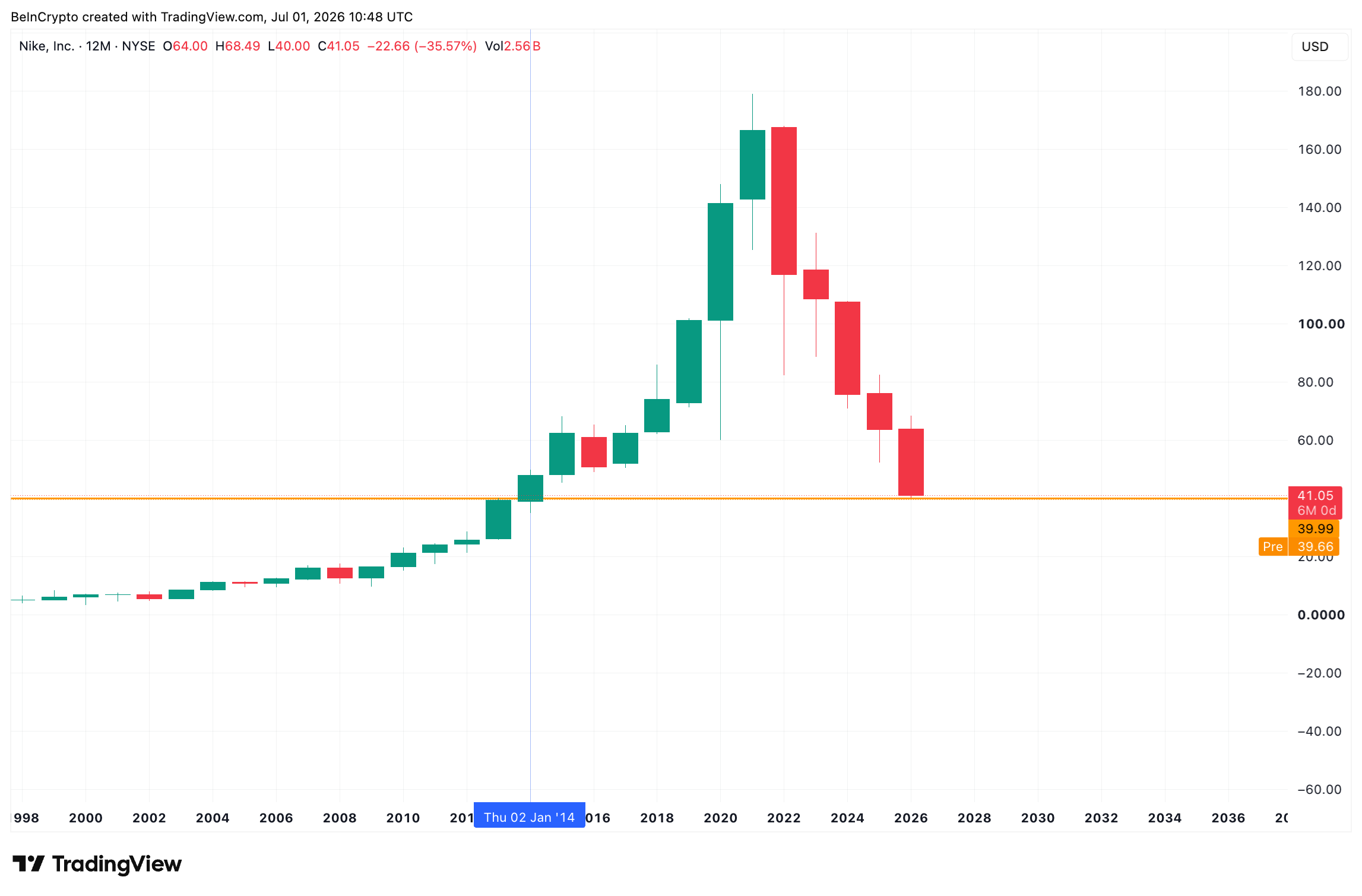
Nike (NKE) stock slid about 1% on Wednesday, briefly trading at $40, its lowest level in about 12 years. The fall came despite an earnings beat, because most of the profit came from a one-time tariff refund.
That refund flattered the headline number and did nothing to fix Nike’s shrinking sales. Wall Street responded by trimming price targets, and the charts now point to more downside.

Why the Earnings Beat Triggered Target Cuts
Here is the earnings loophole the title promised. Nike reported a profit of $0.20 per share and beat the $0.13 that Wall Street expected. But most of that profit did not come from selling shoes.
About $0.52 per share (a large part of the $0.72 EPS) came from a $986 million tariff refund, money the government returned after the Supreme Court struck down many of the levies. That is a one-time payment, not a recurring business model.
Take the refund away, and Nike still looks weak. Sales slipped to $10.97 billion, and sales in China fell 12%.
Want more insights like this? Sign up for Editor Harsh Notariya’s Daily Newsletter here.
The market response shows how little faith investors have. A monthly chart from earlier shows Nike has now given back its entire pandemic-era run and sits back at prices last seen in early 2014.
Because the profit was a one-off, analysts cut their price targets instead of raising them. Goldman Sachs trimmed its target to $42 from $46 post-results, and JPMorgan cut to $47 from $52.
UBS stayed the most constructive at $48. Jefferies remains the lone bull among these analysts at $90.

Even so, most reduced targets sit only slightly above the last close near $41. In other words, the Nike stock price upside is not what analysts are betting on right now.
The soft outlook has therefore shifted attention to traders’ positioning.
Bearish Bets Are Building Against Nike Stock
Options traders turned defensive fast. The put-call ratio, which compares bearish put bets to bullish call bets, jumped to 1.14 on June 30 from 0.53 on June 26.
A ratio above 1 means puts now outnumber calls. That marks a sharp swing toward hedging and downside bets around nike earnings.

Meanwhile, volume tells the same story. Nike traded 73.89 million shares, its second-heaviest session since early April, and it came on a down day.
Additionally, Chaikin Money Flow (CMF), a proxy for institutional buying and selling pressure, sits at -0.29. The deep negative reading suggests big money is not stepping in to catch the fall.
More so when the Nike price chart clearly shows a bearish head-and-shoulders pattern with a 14% potential dip.

With flows and positioning aligned bearishly, the price chart becomes the decider.
Nike Stock Price Levels to Watch
The daily chart shows a head-and-shoulders pattern. Nike’s head formed near $47, with a right shoulder around $42.
The neckline now sits near $39, roughly 3% below the last close. A clean break there would confirm the pattern and open the door toward $38 as the first bearish target.
Below that, the measured move points to about $34, with $33 as the deeper extension target. That path frames the dramatic downside now in play.
The bulls still have a case, but it needs work. Nike must reclaim $41 quickly, and a daily close above $42 would signal real strength, the same level analysts already expect the stock to prove.

A push over $43 would improve the tone, while a move above $46 would weaken the bearish setup. Moreover, a clean daily break above $47 cancels the pattern entirely. Traders should note that head-and-shoulders patterns only confirm once the neckline breaks on volume, and failed breakdowns are common.
For now, the $39 neckline separates a slow base-building recovery from a deeper slide toward $34.
The post Nike Stock Hits a 12-Year Low as an Earnings Loophole Masks Weak Sales appeared first on BeInCrypto.


Disclosure: This article does not represent investment advice. The content and materials featured on this page are for educational purposes only.
Venga obtains a MiCA license from Spain’s CNMV, which lets the Barcelona crypto firm operate under the EU’s new regulatory framework.
Summary
- Venga secures MiCA authorization from Spain’s CNMV before Europe’s crypto transition period reaches its deadline.
- MiCA requires crypto providers to meet stronger standards for governance, security, reporting, and customer protection.
- Industry data cited shows only about 194 firms secured MiCA approval by May 2026 overall.
Venga has received authorization from Spain’s Comisión Nacional del Mercado de Valores to operate as a Crypto-Asset Service Provider under the European Union’s Markets in Crypto-Assets Regulation. The Barcelona-based company announced the approval on July 1, 2026. The Venga MiCA license allows the firm to provide regulated crypto-asset services under the EU’s new framework.
Venga MiCA license marks regulatory milestone
The authorization places Venga among a limited group of crypto firms approved under MiCA. The company, founded in Barcelona in 2023, said the approval follows nearly two years of work across its business.
“Obtaining the MiCA license is a major milestone for Venga and the result of nearly two years of work across every area of the business,” said Michael Stroev, co-founder and CEO of Venga. He said the process required investment in governance, compliance, security, reporting systems, and operational processes.
Spain’s CNMV granted the authorization as the European crypto market moves into a new phase of oversight. MiCA sets common rules for crypto-asset service providers. These rules cover governance, capital adequacy, operational resilience, cybersecurity, risk management, customer protection, and internal controls.
The license also gives Venga a route to passport its services across the European Union. The company can expand beyond Spain while operating under one regulatory framework.
MiCA authorization changes market standards
MiCA represents a broad regulatory reset for crypto assets in the European Union. The framework moves the sector away from earlier national registration systems. It requires companies to meet operating and supervision standards.
The transition period is ending on July 1. Crypto companies that relied on older national registrations must secure MiCA authorization or stop offering regulated crypto-asset services within the European Union. The change may force some providers to suspend activities, transfer clients, or leave certain European markets.
A report by crypto.news showed that more than 3,000 crypto firms were registered across the European Union before MiCA took effect. About 194 firms had secured MiCA authorization as of May 2026. That gap points to a smaller authorized market under the new rules.
The approval comes during consolidation in the European crypto sector. Firms that meet MiCA standards can operate under ongoing supervision. Firms that do not receive approval face limits on their ability to serve EU customers.
oversight expands for crypto-asset service providers
Authorized providers under MiCA face continuous regulatory duties. These include supervisory obligations, periodic reporting, annual audits, and oversight by national authorities. Those authorities apply standards coordinated by the European Securities and Markets Authority.
“For users, MiCA introduces a level of regulatory accountability that has not previously existed across much of the European crypto sector,” Stroev said. He added that authorization is not a one-time event and that licensed firms must continue to meet operational, financial, and customer protection requirements.
The new structure may change how users assess crypto platforms. Under MiCA, users can check whether a provider has authorization under the EU framework. That status shows whether the firm must follow the required safeguards and reporting rules.
Venga said the authorization confirms that it has built its business for the regulatory framework that will define the future of crypto services in Europe. The company aims to make digital assets accessible through a regulated platform available in Spanish, Catalan, and English.
Disclosure: This content is provided by a third party. Neither crypto.news nor the author of this article endorses any product mentioned on this page. Users should conduct their own research before taking any action related to the company.
Crypto World
Supreme Court Overturns Humphrey's Executor, Clearing Trump to Fire SEC and CFTC Commissioners


The Supreme Court ruled Monday that President Trump can fire commissioners at the Federal Trade Commission and other independent agencies without cause, overturning a 91-year-old precedent that shielded regulators including the SEC and CFTC from at-will removal. The 6-3 decision in Trump v…. Read the full story at The Defiant
Avalanche Treasury Corp, the largest publicly traded company holding AVAX as a corporate treasury asset, told regulators its ability to continue as a going concern is in doubt after its stock collapsed 93% over the past month. The Nasdaq-listed company, ticker AVAT, disclosed the warning in a 10-Q… Read the full story at The Defiant
The second-largest cryptocurrency has been severely damaged by the prolonged bear market, closing Q2 firmly in the red. Even more striking is that this marks the third consecutive quarter of losses for ETH – something unseen in the asset’s history and a clear signal of how persistent the current downturn has become.
Analysts speculate that bulls might have to endure more pain in the near future, with some projecting a price crash to as low as $1,000.
The Bears Take Total Control
It was last August that ETH climbed to a new all-time high of almost $5,000. Since then, it has headed south and currently trades at around $1,560 (per CoinGecko), representing a whopping 70% decline from the historic peak.
Weak market conditions and seasonal factors suggest the asset may experience a further short-term plunge. One should keep in mind that July has rarely been a favorable month for Ethereum, as it has finished the period in the red six out of the last ten times.

The analyst who uses the X moniker Ted noted that ETH has been holding up better than BTC lately, but warned that the former isn’t out of the woods yet. He paid special attention to the $1,700 level, arguing that if the asset fails to reclaim it, the probability of setting a new low will rise significantly.
Crypto with Haris ₿ addressed the increasingly popular predictions that ETH could plunge to $1,000 during this cycle, adding that such an extreme downside scenario is far less plausible than many fear.
“Ethereum has already been one of the hardest-hit major coins this cycle and is now building a strong base around the $1,500-$1,600 zone. Even with another Bitcoin flush, I think the realistic downside is around $1,200-$1,300. Could we go below $1,200? Maybe. But I think the risk of trying to catch that exact level is much higher than people realize,” he stated.
Meanwhile, the recent whale behavior strengthens the bearish outlook. Ali Martinez revealed that large investors sold around $900 million in ETH over a single week, while the analytics platform Lookonchain reported that an anonymous market participant cashed out almost 2,500 coins, incurring a major $4.33 million loss.
Some Bullish Signals
Still, it is not all doom and gloom for Ethereum. The number of coins stored on crypto exchanges remains quite close to the ten-year low recorded in June: a development that reduces selling pressure.

Moreover, ETH’s Relative Strength Index (RSI) continues to hover around 30, indicating that the asset has entered oversold territory and could be due for a rebound. The technical analysis indicator ranges from 0 to 100; anything above 70 is considered a warning of an impending pullback.

The post Ethereum (ETH) Sets a Historic Negative Record: More Pain Ahead? appeared first on CryptoPotato.
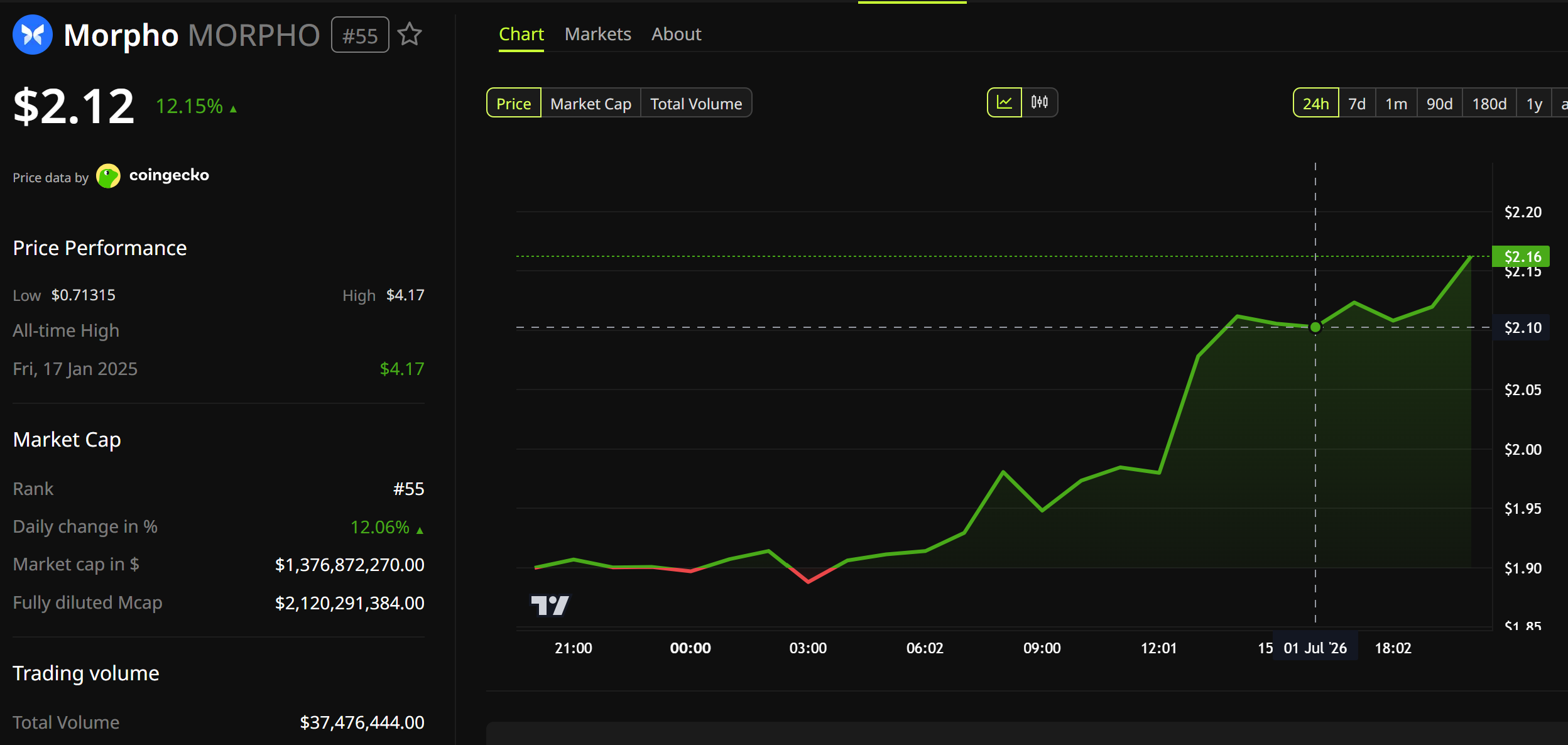
Morpho received two major institutional endorsements in a single day after Standard Chartered initiated coverage of the DeFi lending protocol and Robinhood unveiled a new Crypto Earn product powered by Morpho’s infrastructure.
The back-to-back developments strengthen Morpho’s position as one of the fastest-growing decentralized lending platforms competing alongside Aave. The MORPHO token’s price is up over 12% on the day.

Robinhood Brings Morpho to Mainstream Users
Robinhood has begun rolling out its Crypto Earn product, a decentralized lending service powered by Morpho, to eligible users through the Robinhood app and Robinhood Chain.
Follow us on X to get the latest news as it happens
The first lending vault is curated by Steakhouse Financial and incorporates Maple Finance’s newly launched syrupUSDG, an institutional credit product backed by the regulated Global Dollar (USDG) stablecoin issued by Paxos on behalf of the Global Dollar Network.
According to Maple, the company has originated more than $22 billion in institutional loans since 2022. Through the new integration, Robinhood users will gain access to on-chain credit strategies built on Morpho’s open lending infrastructure.
“Morpho provides the open credit network that enables specialized credit strategies to reach users at scale,” Morpho CEO and co-founder Paul Frambot said in the announcement.
Standard Chartered Strengthens the Bullish Narrative
The Robinhood announcement follows Standard Chartered’s decision to initiate coverage on MORPHO, calling the protocol one of the strongest long-term plays in decentralized finance.
The bank highlighted Morpho’s Vaults architecture as a key differentiator, arguing that its modular design makes it well suited for institutional asset managers, fintech platforms, and tokenized real-world assets. Analysts also pointed to the protocol’s rapid growth and expanding integrations across the digital asset ecosystem.
Together, the research note and Robinhood integration suggest growing institutional confidence in Morpho’s infrastructure rather than simply its token.
What’s Next for Morpho?
Robinhood said access to Crypto Earn will expand gradually over the coming weeks, while Maple plans to extend syrupUSDG to additional blockchain networks beyond Ethereum and Robinhood Chain.
For investors, the latest announcements suggest Morpho is evolving from a leading DeFi lending protocol into critical financial infrastructure for regulated stablecoins, institutional credit, and mainstream fintech platforms, a trend that could further accelerate adoption as tokenized finance continues to grow.
The post Standard Chartered Backs Morpho, Then Robinhood Puts It to Work appeared first on BeInCrypto.
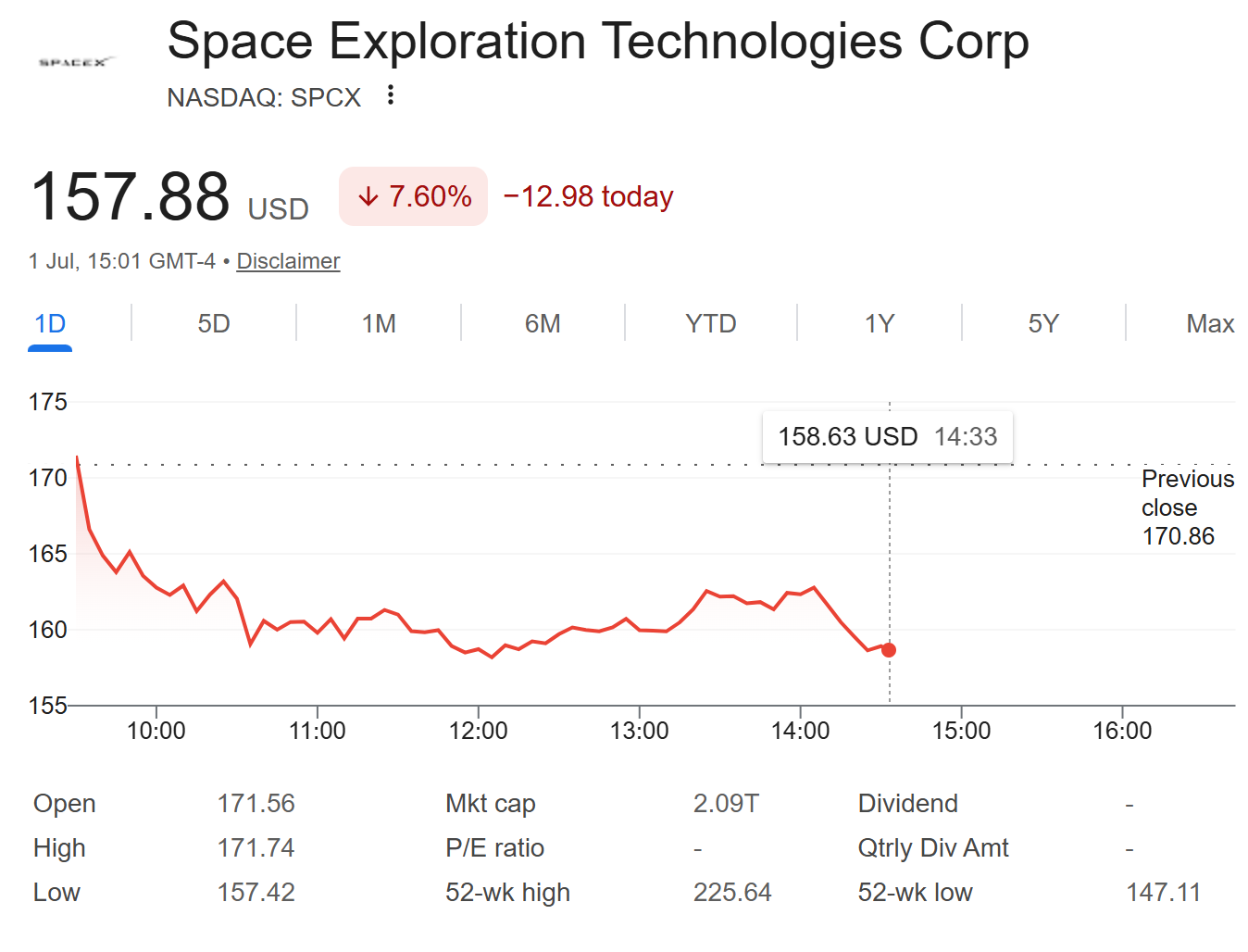
Elon Musk dismissed a Wall Street Journal report that SpaceX built a prototype AI device, calling it “utterly false”. SpaceX stock (SPCX) fell about 7% on Wednesday as investors weighed the conflicting accounts.
The report said the company privately showed investors a handset-like device before its public listing. The denial gave traders little clarity on a stock already prone to sharp swings.

Musk Rejects the AI Device Report
The Wall Street Journal reported that SpaceX showed investors a device slimmer than an iPhone before its June listing. The prototype reportedly ran a proprietary operating system on a Qualcomm (QCOM) Snapdragon chipset.
It also drew on technology from Musk’s xAI unit, now folded into SpaceX. Sources described the project as early-stage, with a design that could still change. Elon Musk has however refuted the claims. The post has since been deleted.

Follow us on X to get the latest news as it happens
No filing, image, or product demonstration has backed the report, and SpaceX has stayed publicly silent. The denial echoes February, when Musk rejected a Reuters report that SpaceX was building a Starlink phone.
Still, the report fits how SpaceX sells itself. The company spans rockets, satellite internet, and AI. Its broader AI push, though, has favored data centers and satellites over consumer gadgets.
SpaceX Stock Extends Its Post-IPO Slide
SPCX fell to $157.88, down about 7% from Tuesday’s close of $170.86. As of this writing, it was trading for $158.33, with the drop leaving the stock roughly 30% below its June peak of $225.64. It has deepened a retreat that began soon after the stock’s record IPO debut.

SpaceX priced that June offering at $135 a share, raising about $75 billion. That gave it a valuation near $2.09 trillion.
Qualcomm shares edged higher as some traders read the report as a new chip partnership. That split reaction captured the market’s uncertainty. SpaceX now trades near a make-or-break support level that analysts have flagged for weeks.

The muted company response leaves investors waiting for clarification. Musk’s denials have not always ended speculation. Continued silence from SpaceX could keep pressure on SPCX in the coming sessions.
The post Elon Musk Sends SpaceX Shares Lower With Two-Word AI Device Denial appeared first on BeInCrypto.

Key Takeaways
- Tesla shares have climbed 10.8% this week in advance of Thursday’s Q2 delivery figures
- Analyst projections for Q2 deliveries span from 400,000 to 466,000 vehicles
- Last year’s Q2 saw 384,000 vehicles sold, meaning all current forecasts indicate positive year-over-year growth
- The elimination of the $7,500 federal EV subsidy has created headwinds, though rising gasoline prices have provided some relief
- Deutsche Bank maintained its Buy recommendation; overall analyst sentiment remains Hold with a $403.07 mean price objective
Tesla shares are changing hands at $427.74 as of Wednesday, marking a 1.7% daily increase and a robust 10.8% weekly advance, with market participants strategically positioning themselves before Thursday’s Q2 delivery announcement.
The delivery figure represents the critical data point. Analyst expectations display an unusually wide range — FactSet’s consensus hovers around 409,000 units, Bloomberg’s compilation averages closer to 400,000, and Tesla’s aggregated consensus settles near 406,000. On the optimistic extreme, forecaster Troy Teslike anticipates 466,000 deliveries. Future Fund’s Gary Black projects 420,000.
Last year’s Q2 saw Tesla deliver 384,000 vehicles, meaning every current projection indicates positive year-over-year expansion.
Should these estimates prove accurate, Tesla would achieve its second consecutive quarter of year-over-year delivery increases. The automaker hasn’t recorded consecutive quarterly delivery growth since 2024. Annual deliveries reached their zenith at approximately 1.8 million in 2023, before contracting in both 2024 and 2025.
Headwinds and Tailwinds
The September elimination of the $7,500 federal EV purchase subsidy reduced affordability for American consumers and created demand challenges. Tesla additionally opted against introducing a more affordable mass-market electric vehicle, concentrating resources on the Cybercab autonomous taxi initiative instead.
Conversely, gasoline prices surged to approximately $4.60 per gallon in May — an increase of roughly $1.60 — following conflict in Iran that disrupted worldwide oil markets. Elevated fuel costs typically incentivize consumers toward electric vehicle adoption.
The stock’s 10.8% weekly surge indicates the market has already incorporated expectations of a favorable outcome. Industry watchers suggest Tesla would probably require deliveries around 420,000 or above to sustain this upward trajectory. A figure approaching 466,000 would likely propel shares even higher.
Entering 2026, Tesla remains approximately 6% lower year-to-date, notwithstanding the recent rally.
Wall Street Ratings and Financial Performance
Deutsche Bank reaffirmed its Buy stance on Tesla this Tuesday. The broader analyst community displays more reserved sentiment — 21 analysts assign it Buy ratings, 20 assign Hold ratings, and four maintain Sell recommendations. The consensus price objective stands at $403.07, modestly beneath current trading levels.
In its latest quarterly financial release, Tesla reported earnings per share of $0.41, surpassing the $0.39 consensus forecast. Revenue totaled $22.39 billion, marginally below the $22.96 billion projection but representing a 15.8% year-over-year increase.
Wedbush maintains the Street’s most bullish price target at $600.
Insider activity has trended toward selling. CFO Vaibhav Taneja divested approximately 2,600 shares in early June at $402.20 per share. Director Kathleen Wilson-Thompson decreased her holdings by 35% in late April. Collectively, insiders have liquidated approximately $12.4 million in stock during the past 90 days.
Institutional ownership comprises 66.2%, with multiple funds expanding their positions in recent quarters.
The Q2 delivery announcement arrives Thursday morning.

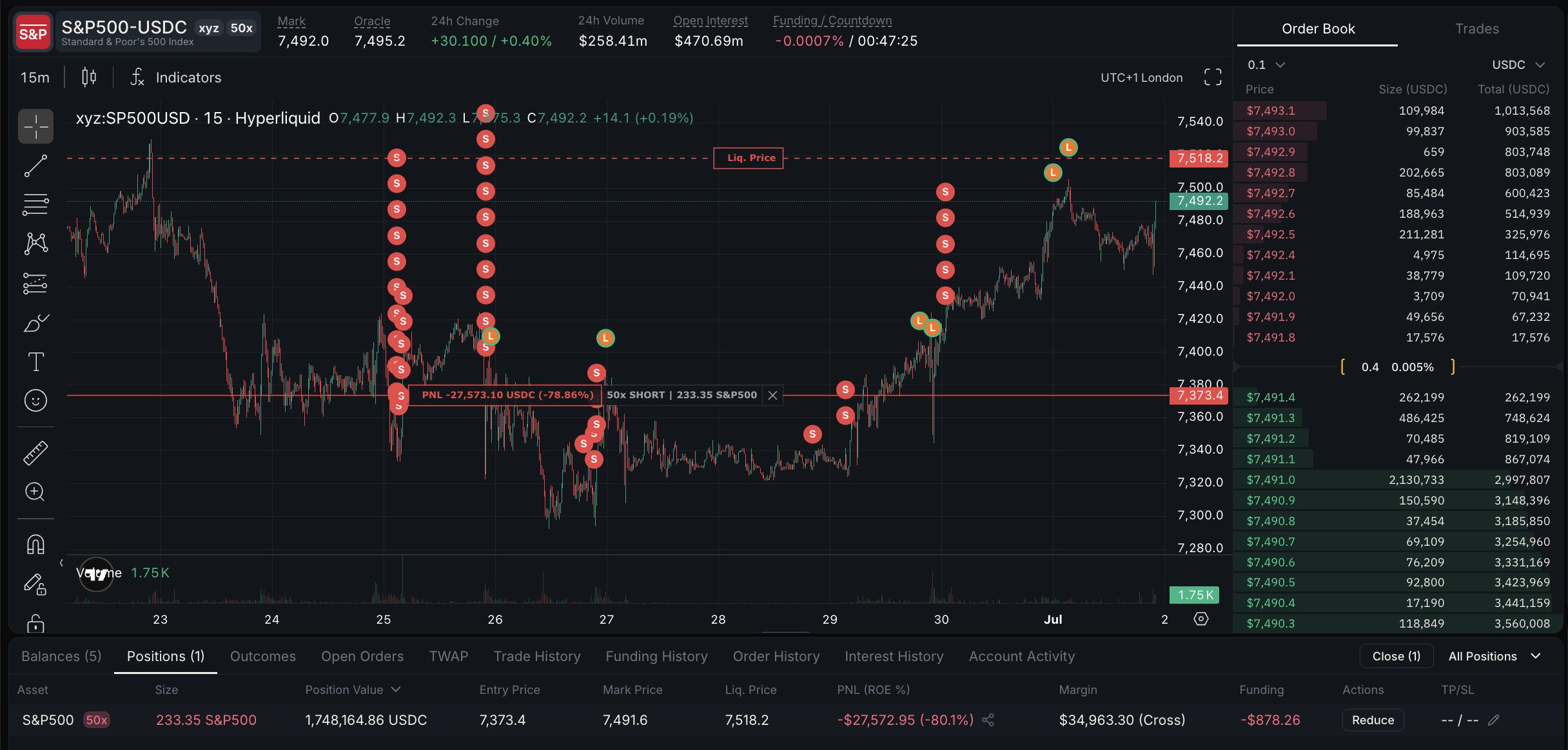
James Wynn has been liquidated twice in 24 hours for $982,000, this time shorting S&P 500 perpetual futures. The losses push his career tally past 200 liquidations.
On-chain intelligence firm Arkham flagged the losses on July 1. Another 0.35% rise in the index would end his remaining position.
From Crypto Blowups to S&P 500 Shorts
Wynn has not left Hyperliquid. Instead, his shift into traditional finance (TradFi) swaps Bitcoin (BTC) and meme coin bets for leveraged index perpetuals on the same exchange.
“JAMES WYNN LIQUIDATED FOR $1M IN TRADFI. James Wynn appears to have moved on from trading crypto, and is now shorting the S&P500 instead. He has been liquidated twice in the last 24 hours for a total of $982K. If the S&P500 rises 0.35% from here, he will be liquidated again,” Arkham indicated.
Follow us on X to get the latest news as it happens
The equity shorts extend a bearish stance from April. Back then, he outlined a defensive multi-asset strategy that included shorting US stocks.
Days later, a Bitcoin rally liquidated his 40x short. The blowup collapsed an account that once held $100 million to roughly $900.
A 2.5% rise was all it took. His new S&P 500 short leaves even less room for error.

James Wynn Liquidations Keep Climbing
Wynn entered April with 194 liquidations on record. Six more in two weeks pushed him past 200. One earlier streak, logged by Arkham, packed nine liquidations into two days and left his balance at $500.
The trader built his reputation by turning $7,600 into $25 million on the meme coin PEPE. From there, he moved to high-leverage perpetuals, where his profile remains publicly tracked.
He is not alone on Hyperliquid. Jeffrey Huang, known as Machi Big Brother, has logged 335 recorded liquidations. Meanwhile, Andrew Tate returned with a fresh 40x Bitcoin bet after 107 wipeouts of his own.
The pattern now travels across asset classes. In April, Bitcoin needed a 2.5% move to erase Wynn’s account. The S&P 500 needs just 0.35%.
The post After 200+ Crypto Liquidations, James Wynn Tries TradFi and Falls Flat appeared first on BeInCrypto.

USA vs Bosnia LIVE: Latest score and updates as Pulisic starts for World Cup co-hosts who seek rare knockout win

Apple Is Reportedly Planning A Visual Refresh Of The Entry-Level MacBook Pro Next Year

Lake District walk named the best in the North West


-

 Fashion5 days ago
Weekend Open Thread: Staud – Corporette.com
-

 Politics6 days ago
The House | Manchesterism won’t survive the painful trade-offs unless it gets citizens on board
-

 Crypto World2 days ago
Strategy authorizes up to $1.25B in Bitcoin sales under new capital plan
-

 Politics6 days ago
Potential 2028er World Cup attendee leaderboard
-

 Business6 days ago
Asia stock markets slide as tech shares slump
-

 News Videos3 days ago
MAJOR BITCOIN & MARKET UPDATE!!!! (MUST WATCH ASAP!!!)
-

 Tech6 days ago
A Look At A Gaggle Of Transputer Boards
-
 Crypto World6 days ago
Dell (DELL) Shares Tumble Over 5% Following Analyst Downgrade to Hold
-

 Crypto World4 days ago
Coinbase, Circle Deepen Crypto Stock Losses Despite Resilient S&P 500
-

 Business2 days ago
Australia treasurer says alleged access of prime minister’s bank data ’incredibly concerning’
-

 Crypto World5 days ago
Kraken's xStocks Opens Bending Spoons IPO Registration to EEA Retail
-

 Sports5 days ago
FIH Pro League: India defeat Pakistan 7-1, register biggest win of campaign | Other Sports News
-

 Crypto World6 days ago
Bitcoin Sparks $600M Hourly Liquidations With $65,000 Set To Become Resistance
-

 Tech4 days ago
Bluekit phishing kit adopts browser-in-the-middle for login theft
-

 Tech4 days ago
Russian hackers now target Signal backup recovery keys
-
 Crypto World5 days ago
Hyperliquid Named on Singapore MAS Investor Alert Register
-

 Crypto World5 days ago
RTX holders must register wallets before token distribution begins
-

 Crypto World7 days ago
Ripple and SBI launch RLUSD in Japan after JFSA approval
-

 Tech2 days ago
Anonymous researcher drops 0-day ‘exploitarium’ repo
-

 Sports11 hours ago
Broncos roster: OL Ben Powers (No. 74) entering final year of contract
You must be logged in to post a comment Login