

Crypto World
Elon Musk Grok AI Predicts XRP Will Do This by Next 30 Days, and Nobody Is Ready

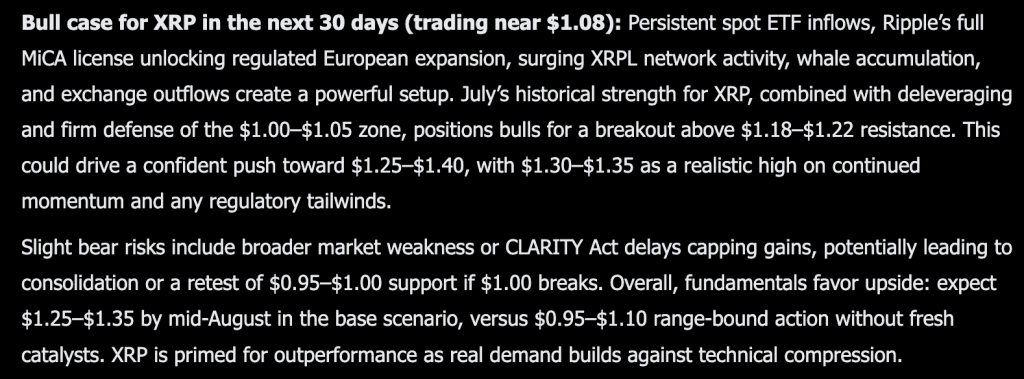
Thirty days is a short window to ask for anything, which makes Grok AI predicts that XRP is almost restrained by comparison to the usual end-of-year moonshots. From $1.08, it wants $1.25 to $1.35 by mid August.
The setup leans on five things happening together rather than one big catalyst. Spot ETF inflows keep showing up. Ripple’s full MiCA license opens the door to regulated European expansion.
XRPL network activity is surging in the background. Whales are accumulating instead of distributing. Exchange balances are dropping as coins move into cold storage.
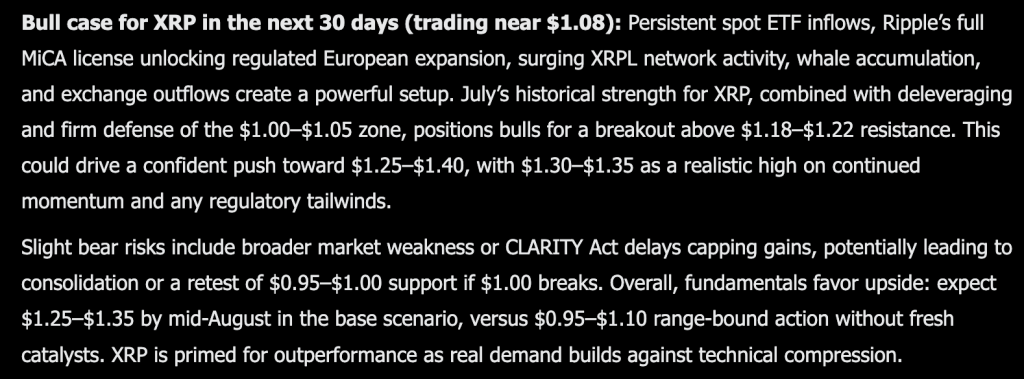
Grok also points to something almost calendar-based. July has historically been a strong month for XRP, and that seasonal pattern is landing right on top of a market that just deleveraged hard.
The $1.00 to $1.05 zone has held firm through that deleveraging, which Grok reads as buyers defending a line rather than just drifting sideways. Clear resistance at $1.18 to $1.22, and Grok sees a confident push toward $1.25 to $1.40, with $1.30 to $1.35 as the realistic high if momentum and any regulatory tailwind cooperate.
The bear case stays narrow here, too. Broader market weakness or delays to the CLARITY Act could cap gains and force consolidation, with a retest of $0.95 to $1.00 support if the round number breaks.
Grok’s own base scenario without fresh catalysts is a flat $0.95 to $1.10, basically where XRP sits right now. The whole prediction hinges on new news arriving, not on existing momentum carrying itself.

Discover: The Best Token Presales
XRP Price Prediction: Has Traded In A Shrinking Box For Six Months And Grok Wants The Top Broken
The chart tells a quieter story than the prediction does. XRP closed at $1.08468, down 0.14%, in a session ranging between $1.07840 and $1.09495.
Zoom out from February, and this is not a downtrend anymore; it is a fading range. The February crash from above $2.30 down toward $1.20 was the violent part, and everything since has been a series of lower highs inside a slowly compressing box.
April topped near $1.55. May topped near $1.55 again. July’s bounce topped near $1.20 and already rolled over.
That is three failed attempts at reclaiming higher ground, each one weaker than the last. Support sits at $1.00, the level Grok specifically flagged as defended, then $0.95 below that.
Resistance stacks at $1.12, then $1.18, then the stubborn $1.20 ceiling that keeps rejecting every bounce. The RSI panel shows momentum at 44.55 with the signal line at 47.03, a small negative gap that has been narrowing over the past week.
That narrowing gap is the one mildly encouraging detail on this chart. It suggests selling pressure is easing rather than building, even if it has not flipped positive yet.
For Grok’s $1.25 target to happen in 30 days, XRP needs to do something it has failed to do three times since February, actually clear $1.20 and hold above it. Until that happens, this range keeps compressing rather than breaking.
Discover: The best crypto to diversify your portfolio with
Here is what Grok AI Predicts For LiquidChain’s Near Future
Every cycle has a moment where waiting becomes the most expensive decision you can make. That moment is now.
Bitcoin, Ethereum, and XRP are all pinned under the same resistance they have been testing for weeks. The macro unlock is perpetually one data point away. The institutional money keeps arriving next quarter. Large-cap traders waiting for a breakout are queuing for a decision that belongs to someone else entirely.
Grok AI has identified what experienced cycle traders already act on. Capital that registers as statistical background noise at Bitcoin’s market cap can completely reprice a small, undiscovered project.
The asymmetry is not complicated. It lives in the distance between what something is genuinely worth and what the market has currently assigned it. The moment that distance gets noticed, it collapses. Before that moment, it is fully open.
Cross-chain fragmentation has been quietly taxing every DeFi participant since the first bridge went live. Bitcoin, Ethereum, and Solana were engineered independently with zero shared infrastructure and no design intent to communicate. Every transaction crossing those ecosystem boundaries absorbs the cost of that decision in fees, failed execution, and slippage that hits before settlement even begins. The bridge industry did not fix this problem. It built a business model on top of it.
LiquidChain removes the business model entirely. Three networks unified inside a single execution layer. One deployment reaches all of them simultaneously. No cross-chain tax is extracted from any interaction anywhere.
Grok AI predicts it as a worth watching coin. The presale sits at $0.01454 with just over $860,000 raised.
Execution is unproven. Adoption is an open question. Established assets offer a smoother path toward a ceiling that the entire market can already see. LiquidChain is the entry point that stops existing once the market finds it.
Don’t Miss Out on Our $1,000 USDT Airdrop on ByBit
The post Elon Musk Grok AI Predicts XRP Will Do This by Next 30 Days, and Nobody Is Ready appeared first on Cryptonews.



South Korean financial authorities investigated more than 40 cases of unfair crypto trading during the first two years of the Virtual Asset User Protection Act, according to Financial Services Commission Chair Lee Eog-won.
Summary
- Korean regulators investigated over 40 unfair crypto trading cases during the law’s first two years.
- Authorities referred more than 30 cases for investigation and identified 25 suspects linked to misconduct.
- Regulators plan stronger AI-based surveillance as South Korea expands oversight of high-risk crypto market activity.
The cases covered suspected market manipulation and other fraudulent trading activity.
Authorities reported or referred more than 30 cases to investigative agencies and identified 25 suspects. Lee said average unlawful gains reached about 1.4 billion Korean won, or roughly $940,000, per case. He published the figures as the law marked two years since taking effect in July 2024.
“Today marks the second anniversary of the enactment of the Virtual Asset User Protection Act,” Lee wrote.
He said the law brought the crypto market into a formal legal framework and created a system aimed at protecting users.
Regulators plan wider market surveillance
The Virtual Asset User Protection Act sets rules for how virtual asset service providers handle customer funds and assets. It requires providers to separate customer holdings from company assets and keep user deposits with banks. The law also gives regulators powers to inspect service providers and act against practices such as insider trading, wash trading and market manipulation.
South Korea has used those powers in several recent cases. As crypto.news reported earlier this month, the FSC referred two suspected market manipulation cases to prosecutors. One case involved a trader accused of buying close to half of a token’s circulating supply before selling into rising demand. The regulator warned users about sharp price and volume moves linked to low-liquidity tokens.
The latest two-year figures show that enforcement has moved beyond individual cases. The FSC said authorities have targeted short-term price manipulation and other trading patterns that can distort markets. Lee added that regulators plan to improve surveillance, investigation and monitoring systems with artificial intelligence and focus more closely on high-risk areas.
“We will continue to enhance market surveillance, investigation and monitoring systems based on AI,” Lee said. The regulator has not disclosed a full public list of the 40-plus cases or detailed the status of every referral.
Meanwhile, South Korea continues to expand its digital asset rules.The government is moving to bring cryptocurrencies and other digital assets under a new state asset management framework. The proposal would extend state asset rules beyond traditional holdings such as real estate.
Authorities have also increased scrutiny of unregistered crypto operators. Crypto.news reported in June that the Financial Intelligence Unit had referred about 40 unregistered operators to law enforcement and warned users about risks tied to platforms operating outside the country’s registration system.
The Virtual Asset User Protection Act took effect on July 19, 2024, as South Korea’s first dedicated law focused on crypto user protection and unfair trading. Two years later, regulators are using the framework to pursue alleged market abuse while preparing wider digital asset rules and new monitoring tools.


Equities and technology bets are still recovering from Friday. Moonshot AI’s Kimi K3, a Chinese open-weight model that took the top spot in a widely watched coding benchmark, triggered a semiconductor selloff that dragged crypto down with it to close last week.
The aftershock ran through Asia on Monday, with South Korea’s Kospi falling 3.5% as traders returned from their own holiday. U.S. futures steadied, with the Nasdaq 100 up 0.5%, but the question the release raised has not gone away.
For crypto the two forces roughly cancel. War-driven oil is inflationary, which is bad for risk assets and for the case that the Federal Reserve holds rates steady. Meanwhile, a Chinese model undercutting the AI trade pressures the chip stocks that bitcoin has tended to track all month.
The week’s test is corporate, not macro. There are no major U.S. economic releases, so the read on the AI trade comes from earnings, with Alphabet reporting Tuesday, Tesla Wednesday and Intel Thursday.
After last week’s wobble in AI and semiconductor shares, those results will set whether the capital spending underwriting the sector, and the miner-to-AI pivot riding on it, still has a floor.


That interpretation is intuitive given that ETFs, which let investors gain exposure to the cryptocurrency without owning it directly, are widely seen as a cleaner crypto market gateway for institutions. As a result, positive ETF inflows are taken to mean BTC is receiving institutional support, while outflows suggest the opposite.
Bitcoin’s price too has stabilized between $64,000 and $65,000 lately, offering hope that a bottom may be in. Prices peaked above $126,000 in October last year.
On the surface, it looks like the tide has turned. However, there is a massive caveat that makes these ETF inflows look like statistical noise rather than a structural shift.
The peanuts reality check
The hype surrounding this $273 million inflow quickly evaporates when compared to the carnage of the preceding eight weeks. During that two-month outflow streak, the market watched billions of dollars walk out the door.
To put the current “recovery” in perspective: the total amount of money that has entered the market over the last 14 days ($273 million) is barely more than the smallest single-week outflow recorded during that eight-week slump, which was $226.84 million in the week ended June 18.
In other words, it took two full weeks of “renewed optimism” just to offset the quietest week of the recent sell-off.


Cardano has activated the van Rossem hard fork, moving its mainnet to Protocol Version 11 after the upgrade took effect at the epoch boundary on July 18.
Summary
- Cardano activated Protocol Version 11 after governance approval moved the van Rossem hard fork forward.
- The upgrade improves Plutus costs while preparing Cardano for Ouroboros Leios and higher future throughput.
- Van Rossem is Cardano’s first hard fork ratified through onchain governance, marking a governance milestone.
Intersect confirmed that the hard fork had been successfully enacted after weeks of testing, infrastructure updates, and governance voting.
The upgrade follows its ratification on July 13 by Cardano’s delegated representatives, stake pool operators, and Constitutional Committee. The Cardanoscan governance record shows that the proposal called for Protocol Version 11. Intersect reported 77.63% DRep support and 52.7% SPO support when the required thresholds were met.
Van Rossem is an intra-era hard fork, so Cardano remains within the Conway era while updating parts of its protocol. The upgrade introduces new Plutus capabilities and cost model changes designed to make some smart contract operations cheaper. It also includes technical updates aimed at improving Plutus performance and other parts of the network.
The mainnet activation followed earlier testing on the Preview and Preprod networks. Preview moved to Protocol Version 11 in May, while the Preprod upgrade followed in June after developers addressed tooling compatibility issues. As previously reported by crypto.news, the mainnet proposal arrived in June after those testing and preparation stages.
Dijkstra and Ouroboros Leios come next
The van Rossem hard fork also prepares Cardano for its next planned protocol upgrade. Input Output said, “As well as Plutus improvements and Plutus Cost Model enhancements, this upgrade lays the foundation for the next upgrade, the Dijkstra era hard fork, which will introduce Ouroboros Leios to Cardano.”
Leios is a proposed upgrade to Cardano’s Ouroboros proof-of-stake system that aims to raise transaction throughput while keeping its existing security model. Development remains underway. According to the latest Cardano weekly report, the consensus team has continued stabilizing the Leios testnet, released two new prototype builds, and worked on changes intended to improve block certification rates. Crypto.news previously reported that Leios forms part of Cardano’s wider protocol development roadmap.
Onchain governance takes control of the upgrade process
Van Rossem also marks the first Cardano hard fork to move through the network’s Voltaire onchain governance system rather than relying on the earlier coordination model led by founding development groups. Cardano said the final decision to ratify and execute the upgrade rested with DReps, SPOs, and the Constitutional Committee after technical teams completed the required preparation.
The process follows Cardano’s broader move toward community-led decisions. The same system has also produced different outcomes for funding proposals. As crypto.news reported earlier, the community rejected a 7.8 million ADA request for the 2026 Cardano Summit, leading to its cancellation. Meanwhile, other treasury funding has supported protocol work that includes Leios, Hydra, and Mithril.
With van Rossem now active, Cardano is operating on Protocol Version 11 while development continues on Dijkstra and Ouroboros Leios. The network has not announced a final mainnet launch date for Leios, although recent ecosystem coverage has placed the planned scaling upgrade later in 2026.


South Korea’s financial authorities have investigated 40 crypto market manipulation cases since the country’s user-protection law took effect in 2024, referring more than 30 to investigative agencies.
The Financial Services Commission’s Chairman shared the figures to mark the law’s second anniversary. The cases exposed 25 suspects across two years of enforcement.
Korea’s Virtual Asset User Protection Act Marks 2 Years of Enforcement
South Korea passed the Virtual Asset User Protection Act on July 19, 2024. The measure gave regulators dedicated tools to punish abuse in the crypto market.
The Financial Services Commission then built a specialized investigation unit. It later added digital forensics and refined the operation of the penalty surcharge system.
That buildout produced roughly 40 completed investigations. Regulators also referred more than 30 confirmed cases to investigative agencies for prosecution.
“Financial authorities plan to keep strengthening efforts to stamp out unfair trading in the virtual asset market, including using AI to improve the efficiency of market surveillance and investigations,” the notice read.
Follow us on X to get the latest news as it happens
Average illicit gains reached about 1.4 billion won per case. Meanwhile, eight cases ranged from 500 million to 5 billion won, and one exceeded 5 billion won.
Regulators also imposed penalties of 125% to 165% of illicit gains in two cases. The authorities framed the results as a base for rebuilding market trust.
However, regulators signaled the work is far from finished. They plan to introduce account and bank-account payment suspension powers to block hidden proceeds.
A reporting and reward system for unfair trading is also under review for the second-phase legislation. Authorities intend to expand AI-based market surveillance alongside these measures.
Subscribe to our YouTube channel to watch leaders and journalists provide expert insights
The post South Korea Cracks Down on 40 Crypto Manipulation Cases Since the 2024 Law appeared first on BeInCrypto.


Allbridge Core has paused its cross-chain stablecoin protocol after a security incident on Solana that PeckShield estimated at about $1.65 million.
Summary
- Allbridge paused Core after a Solana exploit drained about $1.65 million, according to PeckShield estimates.
- The attacker used a $1.12 million USDC flash loan to quickly distort stablecoin pool rates.
- Allbridge urged liquidity providers to withdraw while investigators traced funds moved from Solana to Ethereum.
The protocol told users with funds in affected liquidity pools to withdraw while its team investigates. PeckShield also said the attacker moved the stolen assets from Solana to Ethereum.
The incident appears to involve manipulation of Allbridge Core’s USDC/USDT liquidity pool. Onchain Lens said the attacker used a $1.12 million USDC flash loan from Kamino, changed the pool balance through rapid swaps and withdrew liquidity at distorted rates. The exact loss figure remains under review, with Onchain Lens describing more than $1.1 million extracted and PeckShield estimating the broader exploit at about $1.65 million.
Allbridge pauses Core and warns liquidity providers
“Allbridge Core is experiencing a security incident,” the team said in its public notice. It added that the protocol had been paused as a precaution while the investigation continued. The project also issued a direct warning: “If you have liquidity in affected pools, please withdraw now.”
Allbridge said the attack left some pools temporarily out of balance. That imbalance created an arbitrage window that allowed some traders to profit from unusual pricing. The team asked anyone who benefited to consider returning funds to a recovery address. It said returned assets would go toward compensating affected liquidity providers. At the time of writing, the notice did not give a reopening date or publish a technical report.
In addition, according to Onchain Lens, the attacker borrowed $1.12 million in USDC through a flash loan from Kamino. The attacker then carried out rapid USDC and USDT swaps that changed the ratio inside the Allbridge stablecoin pool. After the pool price moved, the attacker withdrew liquidity using the distorted rate and repaid the flash loan within the same transaction.
Flash loans allow users to borrow and repay funds in one blockchain transaction without posting normal collateral. In this case, the loan itself was not described as the vulnerability. Instead, the borrowed liquidity allegedly gave the attacker enough capital to move the pool ratio and extract value before the transaction ended. PeckShield later said the stolen funds were bridged from Solana to Ethereum.
Allbridge faces another bridge security incident
The latest Allbridge Core exploit follows an earlier attack against the project. As crypto.news previously reported, Allbridge suffered a separate exploit in April 2023 after an attacker manipulated the swap price of a BNB Chain pool. The loss was estimated at about $573,000, and the project later recovered roughly $465,000 after offering the attacker a white-hat reward.
The new incident also comes during another active period for cross-chain security breaches. In May,the Verus-Ethereum bridge lost more than $11.5 million in an attack linked by researchers to missing validation checks. A separate crypto.news report said Transit Finance lost about $1.88 million in another cross-chain protocol exploit. Allbridge has not said whether the Solana incident shares technical similarities with those attacks.
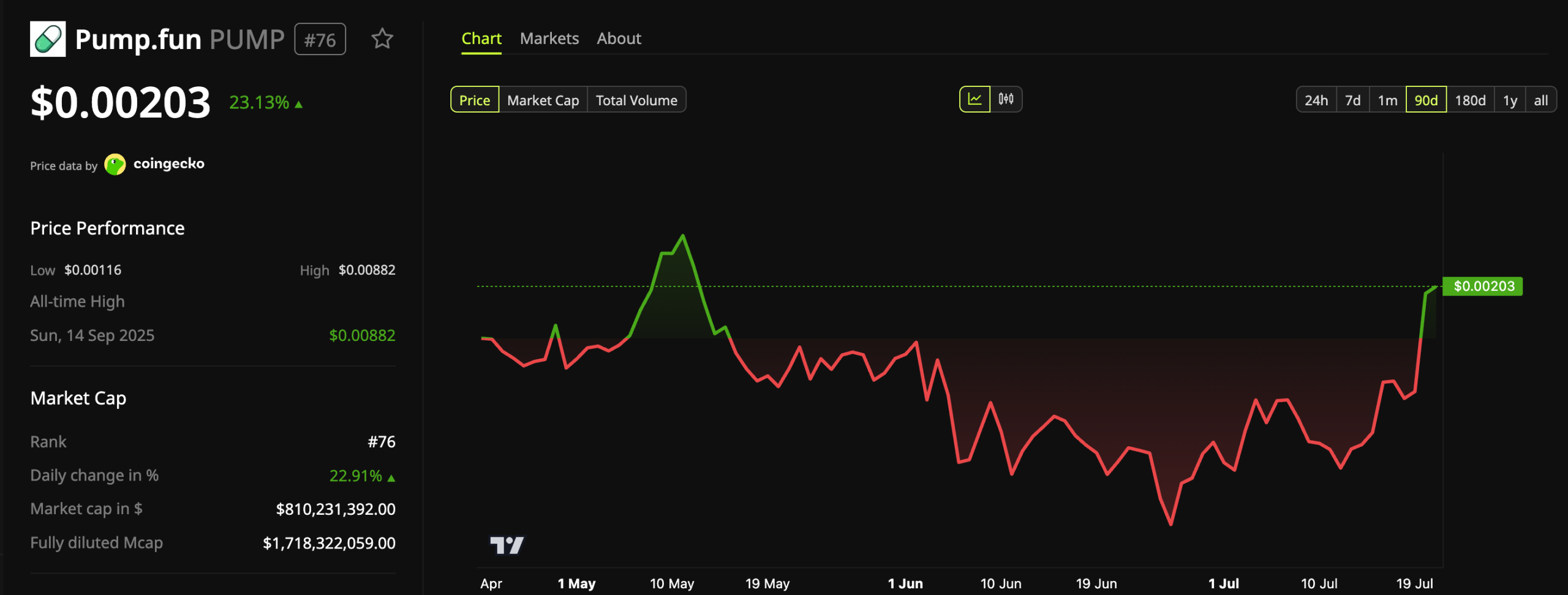
Pump.fun (PUMP) token’s price climbed to a two-month high on Monday as crypto trader Ansem disclosed a new position in the token and laid out a bullish case for the Solana (SOL) launchpad.
The move extended a rally that began Sunday, when PUMP jumped from about $0.0016 to $0.0019 as a viral meme coin drove attention towards the platform.
PUMP Rally Rolls Into Second Day After Top Trader Ansem Buys In
Sunday’s gains coincided with a meme coin frenzy around Jimothy The Raccoon (JIMOTHY). The token climbed 186% in 24 hours to a market cap of nearly $11 million.
The rally carried into Monday. PUMP jumped more than 23% and ranked as the top gainer among the 100 largest cryptocurrencies on CoinGecko.
The token reached an intraday high of $0.00207, its strongest level since May 12. It traded at $0.00203 at press time.

The surge came after Ansem said he bought PUMP on the reclaim of former support near $0.001675.
Follow us on X to get the latest news as it happens
The trader tied his bullish thesis to Solana reclaiming retail activity this cycle.
“thesis: making 30-40M a month during bear market for onchain, believe that SOL will dominate retail activity again this cycle and Pump.fun will be most likely beneficiary of this activity if that happens,” he said.
Ansem also suggested a large token airdrop could reignite on-chain activity, drawing comparisons with Jito (JTO) and Jupiter’s (JUP) distributions in late 2023, which helped drive trading volumes across the Solana ecosystem.
“also just hard for me to believe that they don’t want the token to do well as they own a meaningful amount of it which just started unlocking & their entire business is centered around allowing retail to speculate on tokenization,” Ansem added.
Lastly, he identified that a drop to $0.0014 as the point at which his thesis would be invalidated.
Subscribe to our YouTube channel to watch leaders and journalists provide expert insights
The post Pump.fun Token Hits 2-Month High as Ansem Reveals PUMP Buy appeared first on BeInCrypto.

Crypto markets remained relatively flat over the weekend with low volatility and total capitalization hovering around $2.3 trillion.
Nevertheless, military action in the Middle East has continued with the US Central Command reporting on Sunday that it was conducting a new wave of strikes against Iran for the ninth consecutive night.
“The strikes will continue degrading Iranian military capabilities used to attack commercial vessels and civilian mariners transiting the Strait of Hormuz,” it stated.
Meanwhile, crude oil prices jumped again, with WTI hitting $85 and Brent topping $90, and US stocks continued to cool last week as inflationary pressures returned.
Economic Events July 20 to 24
There are no economic reports due on Monday or Tuesday, and weekly jobless claims are out on Thursday. Friday sees the release of the S&P Purchasing Manager’s Index (PMI) reports for manufacturing and services, which generally reflect changes in economic growth conditions.
This week’s data will signal whether the economy remains as robust as some recent figures have shown, following last week’s below-forecast CPI inflation reports.
“It appears that the disinflationary trend that began in 2023 has indeed remained intact,” Elmar Voelker, analyst at LBBW, said in a note, according to the WSJ. “Given this context, there is little to suggest that US monetary policymakers will decide to raise the benchmark interest rate at their next meeting.”
The CME Fed Watch Tool currently predicts an 85.6% probability that rates will remain unchanged during the central bank’s next meeting on July 29.
Key Events This Week:
1. ADP Employment Change data – Tuesday
2. Tesla, $TSLA, Alphabet, $GOOGL, Report Earnings – Wednesday
3. Initial Jobless Claims data – Thursday
4. Intel, $INTC, Reports Earnings – Thursday
5. July S&P Global Manufacturing PMI data – Friday
6. July…
— The Kobeissi Letter (@KobeissiLetter) July 19, 2026
This week also has some big tech earnings reports with Alphabet (Google) and Tesla releasing second-quarter figures.
Crypto Market Outlook
Crypto markets have moved very little over the past 24 hours, with Bitcoin hovering around $64,700. The asset remains tightly range-bound between support at $62,000 and resistance just above $65,000.
Ethereum prices have also done very little, hovering around $1,870 but not giving up recent gains. BTC closed another weekly candle above the 200-week moving average, its long-term trend indicator.
“To really get this interesting, you want to see a strong push higher now to retrace that last leg down and get back above the Weekly 200 EMA,” said analyst ‘Daan’. “Until then, we’re just caught in this $60K choppy price range.”
The post 3 Macro Events That Could Shake Crypto Markets This Week appeared first on CryptoPotato.
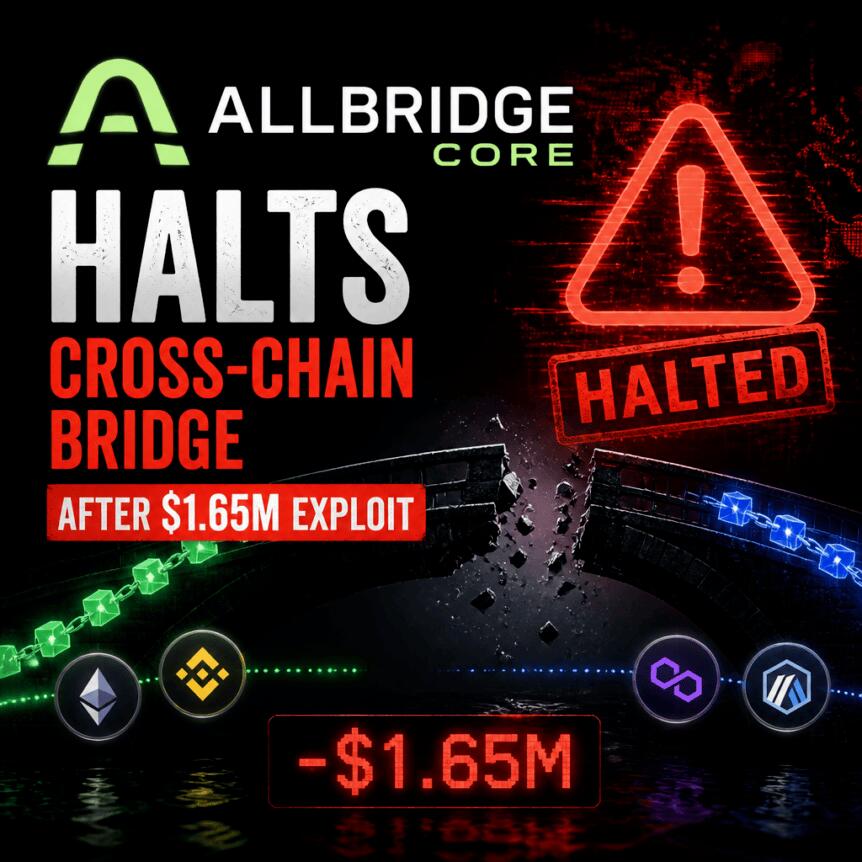
Allbridge, the firm behind the cross-chain stablecoin bridge Allbridge Core, has paused its protocol after a reported security incident on Sunday that investigators and on-chain analysts say resulted in roughly $1.65 million being drained. The company said the pause is a precaution while it investigates, and it urged users with liquidity in impacted pools to withdraw.
According to Allbridge Core’s own announcement on X, the exploit affected Allbridge Core’s deployment on Solana. Monitoring accounts cited in the incident also claim the attacker moved funds from Solana to Ethereum and then funneled proceeds into privacy-related pools, illustrating how quickly bridge exploits can turn into multi-chain extraction events.
Key takeaways
- Allbridge Core has paused its protocol following a reported cross-chain stablecoin bridge incident affecting its Solana deployment.
- The incident reportedly involved ~$1.65 million drained, with on-chain monitoring suggesting the attacker bridged funds from Solana to Ethereum.
- Liquidity providers were urged to withdraw from affected pools to limit exposure while the team investigates.
- On-chain analysis points to a flash-loan and rate-manipulation pattern that allowed the attacker to profit from a temporary pool imbalance.
- Bridge exploits are recurring: multiple reported attacks have hit different bridge systems since May, highlighting structural risk across the sector.
Allbridge Core pauses after Sunday incident
Allbridge said in a Sunday post on X that Allbridge Core was “experiencing a security incident” and that it had paused the protocol while it investigates. The firm added a direct instruction to users: if they have liquidity in affected pools, they should withdraw immediately.
The breach was reported to involve Allbridge Core’s Solana deployment. CertiKAlert later posted that the stolen funds had already been bridged from Solana to Ethereum before moving into privacy pools, according to the monitoring thread referenced by reporting shared on social media.
While the company did not provide additional technical details in the initial communication, the operational response—pausing the protocol and prompting LP withdrawals—suggests that Allbridge recognized ongoing risk rather than treating the event as a fully contained, already-resolved failure.
What on-chain reports say happened
On-chain analytics highlighted a specific mechanism consistent with recent DeFi bridge exploitation patterns. According to Onchain Lens, the attacker made a $1.12 million USDC flash loan from Kamino. The attacker then used rapid USDC/USDT swaps to distort the exchange rate inside the Allbridge Core stablecoin pool.
The same reporting indicates the attacker took advantage of the manipulated pricing by withdrawing liquidity at unfavorable-to-others rates. After extracting the difference created by the temporary imbalance, the attacker reportedly repaid the flash loan and retained the profit from the rate disruption.
Allbridge Core’s own follow-up language, as reflected in the incident discussion, referenced a “pool imbalance” that created a “temporary positive arbitrage window.” The company also suggested that if anyone took advantage of the window, they should consider returning funds, with any returned amounts intended to support compensation for affected liquidity providers.
Why this kind of bridge attack keeps repeating
This incident did not occur in isolation. The reporting notes that it is at least the sixth attack targeting a cross-chain bridge since May. Bridges are frequently attacked because they manage large pools of assets across networks—assets that back bridged tokens on the destination chain. If an attacker can manipulate pricing, liquidity, or settlement logic, the bridge’s pooled reserves can amplify losses.
In practice, these attacks often combine speed (to exploit temporary state changes) with cross-chain movement (to break the attacker’s funds away from any single environment). Sunday’s event appears to align with that playbook: on-chain monitoring suggested stolen value moved from Solana to Ethereum before being moved into privacy pools, underscoring the challenge for recovery once funds change hands across chains.
The case also highlights a persistent tension for investors and LPs: even when bridge designs rely on liquidity pools and token accounting rather than direct custodian control, attackers can still reach profit by exploiting assumptions around swap paths, price discovery, and pool invariants—especially when flash loans are available.
Allbridge Core isn’t new to flash-loan style exploits
Allbridge Core’s Sunday incident is not the company’s first exposure to flash-loan-driven manipulation. Earlier coverage and related documentation indicate that in April 2023 Allbridge was exploited for about $573,000 through a flash loan attack on Allbridge’s pool on BNB Chain.
That earlier event, as described in an analysis of the hack, involved an attacker acting as both liquidity provider and swapper, exploiting a flaw in smart contract logic that allowed them to manipulate swap prices. The outcome included drains denominated in BUSD and USDt, totaling roughly $573,000 based on the figures cited in the underlying analysis.
With Sunday’s report pointing to a similar exploitation pattern—flash loan funding, fast swaps, pool imbalance, then liquidity withdrawals—the renewed incident raises a practical question for LPs: even if a team responds by pausing the protocol, what controls exist to prevent the same class of risk from reappearing under different market conditions or on different deployments?
Cross-chain bridge attacks remain a sector-wide problem
Broader reporting shows that cross-chain bridges have faced repeated pressure from exploits across multiple ecosystems in recent months. In June, for example, Taiko urged users to withdraw assets from its bridges after a $1.7 million exploit, later reopening its bridge 11 days after completing a recovery plan. Weeks earlier, Secret Network was reportedly exploited through an “infinite mint” bug that created unbacked versions of Axelar-wrapped assets, resulting in a $4.67 million incident. Other widely reported bridge failures included Gravity Bridge, Verus Bridge, and Butter Network.
Together, these cases reinforce an important takeaway for anyone using or providing liquidity to bridge-related systems: cross-chain infrastructure concentrates both technical complexity and financial value, and the attack surface expands as protocols integrate multiple chains, wallets, swap venues, and liquidity mechanisms.
Readers should watch closely for two things next: whether Allbridge Core can determine the full scope of the impacted liquidity pools on Solana and any related deployments, and whether the team’s investigation leads to specific changes that reduce the likelihood of similar flash-loan-driven pool imbalances recurring.
The upgrade reduces smart contract execution costs while laying the groundwork for Ouroboros Leios, a major scalability upgrade expected later this year.

Spain wins second World Cup after beating Argentina in final

ASUS Pad T3201 Launched in India With OLED Display: Price, Features, and Availability

The #1 Key to Financial Freedom | John Mackey


-
 NewsBeat4 days ago
London Mayor Sadiq Khan handed a peerage by Keir Starmer alongside 15 other Labour figures… just days before the PM leaves No10
-

 Fashion3 days ago
Weekend Open Thread – Corporette.com
-

 Politics2 days ago
The House | The City of London can help the new chancellor deliver growth in every postcode
-

 Politics5 days ago
Young campaigners urge incoming PM to act on outdoor junk food ads
-

 Crypto World4 days ago
CFTC blocks Kalshi from unwinding Michigan trades after court order
-

 Business4 days ago
Nvidia Stock Slips After Big Tuesday Rally as Huang Confirms Vera Rubin Chip Is Now in Production Today
-
 Crypto World3 days ago
Two July Windows Left: The CLARITY Act’s Senate Fight and What Failure Means
-

 Crypto World2 days ago
Ripple Payments Joins MiCA With 14 Firms, Does It Mean Anything For XRP?
-

 Politics17 hours ago
Democrats look to World Cup watch parties to register thousands of voters
-

 Crypto World2 days ago
Ripple wins EU-wide access as ESMA adds it to MiCA register
-
 Entertainment5 days ago
Disney’s Most Ambitious Failed Star Wars Attraction Is Coming to SDCC
-

 Business4 days ago
Palantir Shares Rise After Expanded Nvidia Partnership and Fresh Analyst Upgrades Ahead of Earnings Day
-

 Crypto World3 days ago
Injective Submits SEC Transfer-Agent Registration to Onchain Ownership Records
-

 Tech6 days ago
Get Your ESP32 Sunny Side Up With This Solar Dev Board
-

 News Videos5 days ago
XRP BOMBSHELL… XRP OMBOARDED FOR TRANSACTIONS!!!
-

 NewsBeat3 days ago
Registration is now open for March for Men with Kev 2026
-

 Tech5 days ago
Dark Secrets Emerge When Jailbreaking LLMs
-
 Sports4 days ago
New Cornerback Enters Vikings Trade Rumor Mill
-

 News Videos3 days ago
Money | Class 12 Economics | CBSE Board Exam 2026-27
-

 Business3 days ago
Banco Bilbao Vizcaya Argentaria, S.A. (BBVA) Discusses Global Macro Environment and Economic Outlook for Core Markets Transcript
You must be logged in to post a comment Login