
Crypto World
Elon Musk’s Grok AI Predicts the Next XRP Price, Solana and Ethereum Moves

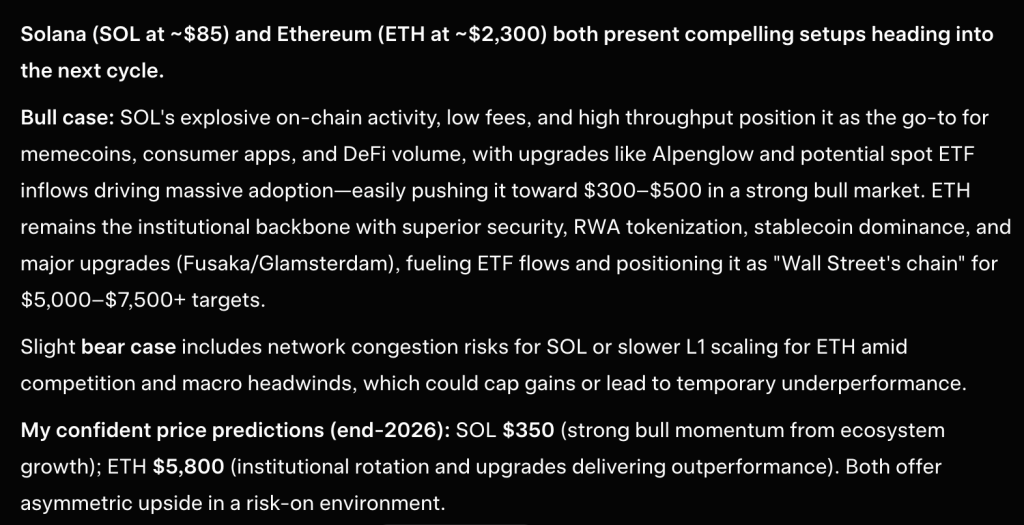
Elon Musk’s Grok AI predicts has issued sweeping 2026 price targets for Solana and Ethereum, and the crypto community is paying attention.
SOL currently trades around $85, while ETH sits near $2,300, both consolidating amid macro headwinds and growing institutional demand. The forecasts are bold enough to warrant a closer look at what’s actually driving them.
Grok’s projections place Solana between $210 and $290 by December 2026, a 2.4x to 3.3x move from current levels, citing catalysts including Goldman Sachs’ $108M SOL ETF stake and the Zepz remittance partnership as structural demand drivers.
For Ethereum, Grok’s base case lands between $4,900 and $6,700, with a higher-conviction $7,500 target circulating across Binance Square analysis, implying a 2.6x gain from present prices.
XRP sits in a similar position, trading near $1.43 while quietly benefiting from one of the clearest regulatory narratives in the market.
Grok projection would reasonably place XRP in the $3.80 to $5.20 range by December 2026, implying a 2.6x to 3.6x move, driven by potential legislative clarity around digital assets, renewed institutional flows through RippleNet and ODL corridors, and expanding relevance in tokenization and cross-border settlement.
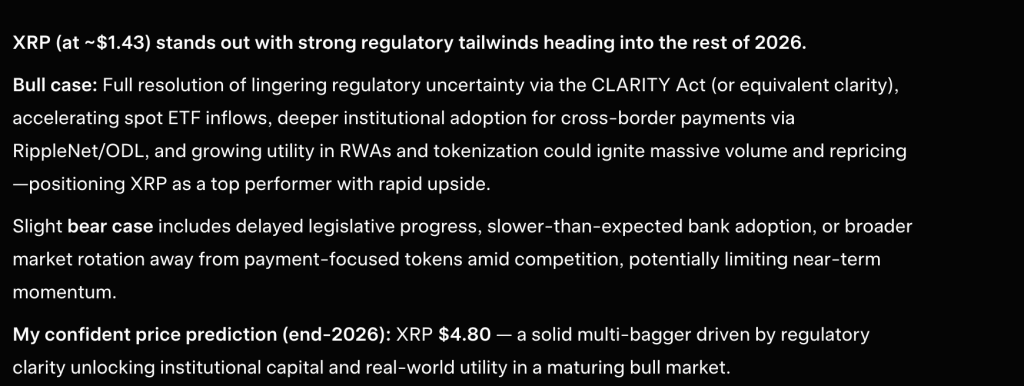
The setup is less about hype and more about regulatory unlock acting as a delayed catalyst, meaning upside likely hinges on policy timing aligning with broader market strength.
Whale accumulation data and potential U.S. strategic Bitcoin reserve proposals are amplifying bullish sentiment across both assets. Whether those targets are realistic depends heavily on one question: does macro cooperate?
Can Solana Hit $350 and Ethereum Reach $5,800 by Late 2026?
SOL price looks like it is done falling for now and is starting to build a base around the $80–$88 zone, which is usually how reversals begin, quiet, low volatility, and no hype.
As long as $80 holds, the structure stays intact, and this looks more like accumulation than weakness, with the real upside only unlocking once it pushes back toward the $120–$140 resistance range.
ETH price is in a similar spot, just on a bigger scale. It is not breaking out yet, but it is holding key support and compressing, which often comes before a larger move. The key level to flip things is a break toward the upper resistance zones, where momentum can accelerate quickly.
The bigger picture is still constructive. If institutional flows keep building and macro conditions stabilize, both assets have room to move higher over time, but it is likely a grind first, not an instant breakout.
The risk is clear, though. If SOL loses $80 or ETH drops below its key support, the whole bullish structure weakens, and the timeline for any recovery gets pushed back.
Why GROK AI Predicts XRP Could Have High Odds Of Hitting Its Target First
XRP price is showing a much heavier structure than SOL or ETH right now, still in a clear downtrend on the higher timeframe, but starting to stabilize around the $1.30–$1.45 range.
That zone is acting as a base after the sharp February flush, with price moving sideways and volatility cooling off, which is typically where accumulation begins if sellers are exhausted.
The key level to watch is reclaiming $1.60–$1.70, because that is where the last lower high sits, and breaking it would be the first real signal that structure is shifting.
Until then, this is more of a range than a confirmed reversal. If $1.30 breaks, the downside likely opens again toward $1.10, but if it holds and builds, this could quietly turn into a bottoming phase before any larger move.
Grok Prefer New Launches Because It Could Give Higher Returns, Bitcoin Hyper Is Next?
Even if those larger targets play out, SOL and ETH remain large-cap assets, meaning the upside is real but not explosive. The asymmetry just isn’t the same once a project is this big.
That is why some traders look earlier in the cycle, where the market cap is still forming, and the upside is not fully priced in.
Bitcoin Hyper is trying to sit right in that gap, building a Layer 2 on Bitcoin with SVM integration to bring faster execution and smart contracts into the BTC ecosystem. The idea is to combine Bitcoin’s security with the speed and flexibility usually found on chains like Solana.
The presale has already raised over $32.5M at $0.0136792, suggesting steady demand and growing interest. Features like staking and the bridge design aim to make it functional, not just narrative-driven.
But it is still early, and that comes with trade-offs. Liquidity is unproven; execution matters, and how it performs post-launch remains uncertain.
So the setup is clear, large caps offer more stability with limited upside, while something like Bitcoin Hyper offers earlier positioning with higher potential, but also higher risk.
The post Elon Musk’s Grok AI Predicts the Next XRP Price, Solana and Ethereum Moves appeared first on Cryptonews.

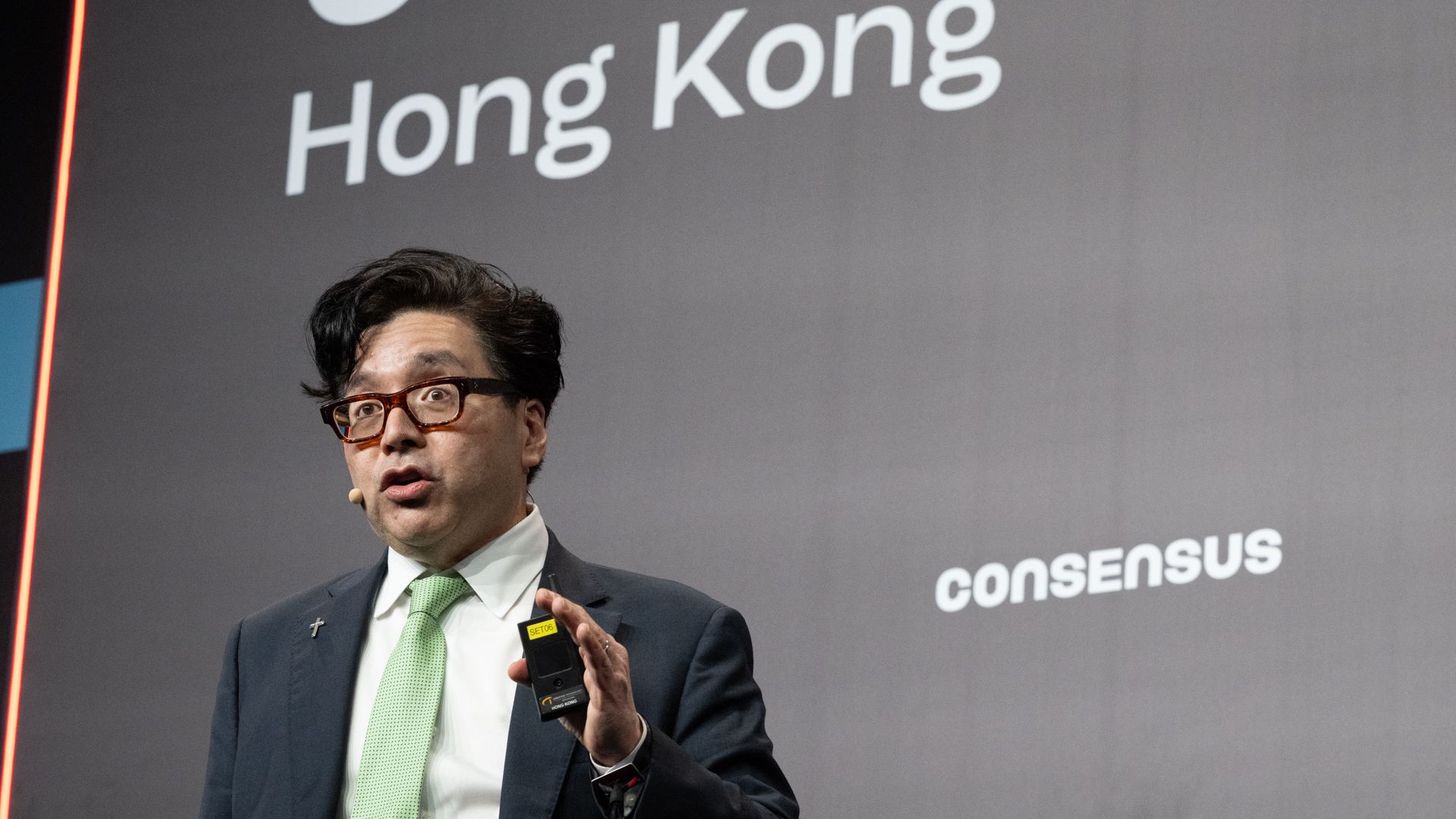
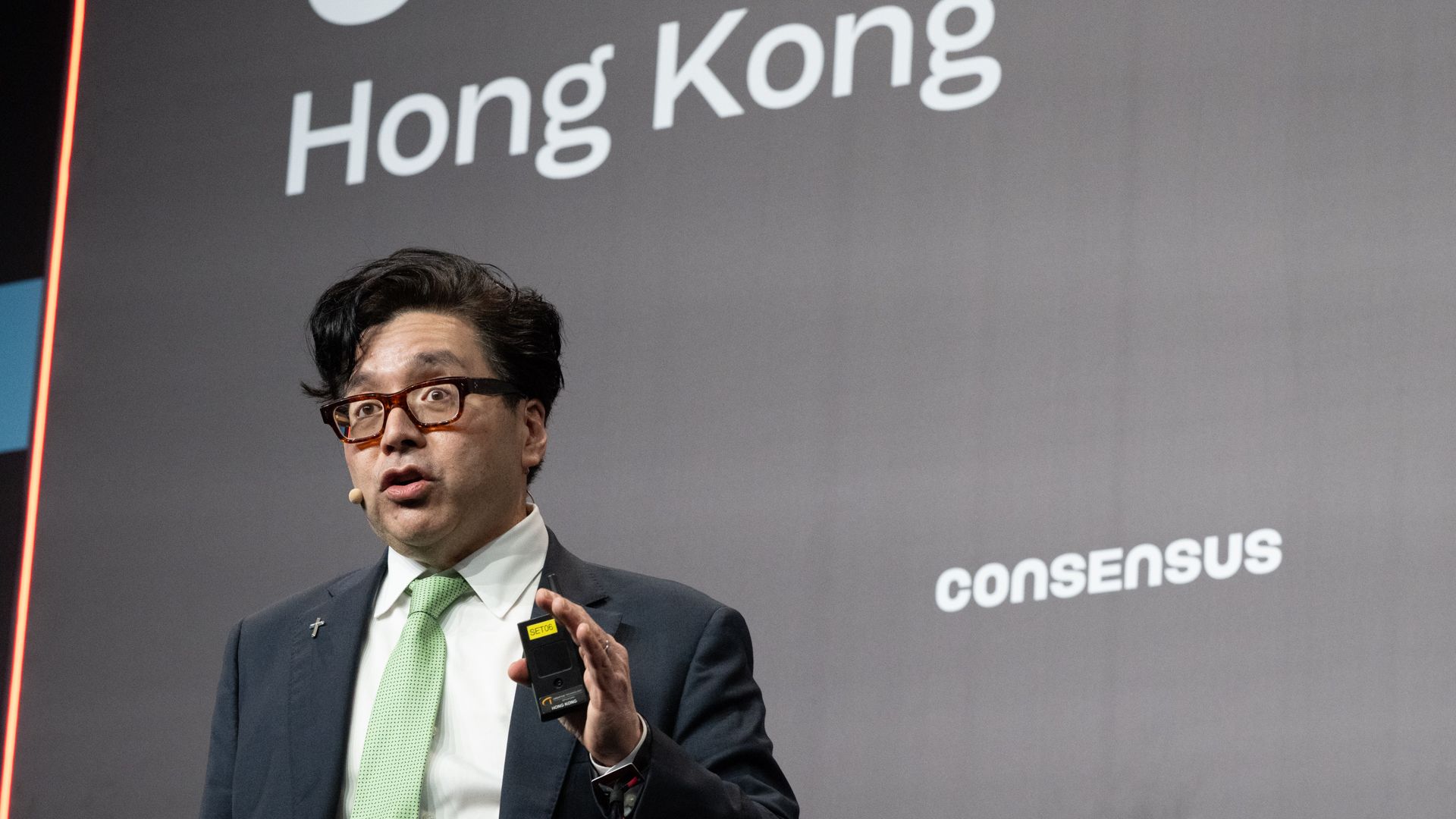
Bitmine Immersion Technologies (BMNR), the ether (ETH) treasury firm helmed by Chairman Thomas “Tom” Lee, bought 101,901 ETH through last week, pushing its total holdings above 5 million tokens of the second-largest cryptocurrency.
The purchase lifted the firm’s ETH treasury to 5,078,386 tokens, or about 4.21% of ether’s circulating supply, according to a Monday update. Bitmine reached that milestone in roughly 10 months, since it pivoted to a digital asset treasury strategy company from a bitcoin miner in June.
“Bitmine ETH holdings crossed 5 million this past week,” Lee said. “This is a major milestone as the company moves towards acquiring 5% of the ETH supply.”
The latest purchase, worth roughly $236 million at current ETH prices, extends a streak of larger weekly purchases as Bitmine adds to its position while most digital asset treasuries remain on the sidelines.
The firm’s total crypto and cash holdings stand at $13.3 billion. Alongside its ETH position, the firm holds 200 bitcoin , $940 million in cash and equity stakes including investments in Beast Industries and Worldcoin-focused Eightco Holdings.
The company has also expanded its staking operations to generate yield on its ETH stash. About 3.7 million tokens — roughly 73% of its holdings — are now staked, generating around $264 million in annualized revenue. The firm debuted its Mavan staking platform in March to attract institutional clients alongside supporting its own treasury operations.
BMNR shares were unchanged in pre-market trading following the update.
Ether as ‘wartime store of value’
Lee framed ether’s role as shifting beyond a speculative asset. Citing recent research by Etherealize, he said ETH is increasingly being treated as a “store of value” and collateral as digital assets gain traction in financial transactions.
He also added that ETH has outperformed the S&P 500 since the start of the Iran conflict and pointed to growing use cases such as tokenization and AI systems relying on public blockchains as a long-term tailwind for the asset.
“There is a lot of meaning to ETH being the best ‘war-time store of value’ and to ETH being the asset leading since the war started,” said Lee.


Onchain IP turns static, illiquid rights into transparent, tradable assets, letting games like My Pet Hooligan convert fans from passive consumers into real economic stakeholders
Summary
- Traditional IP is illiquid, opaque, and structurally misaligned with fans and creators.
- Putting IP on-chain makes rights transparent, tradable, and programmable for global markets.
- Projects like AMGI Studios’ My Pet Hooligan show how NFT-based IP can turn audiences into owners.
The entertainment industry has long treated intellectual property like the paranoid owner of a rare painting, locked away in a private vault. It is extremely valuable, but static, illiquid, and accessible only to whoever holds the key.
The traditional framework for registering IP such as movie franchises, songs, and video games is broken, especially in a world where virtually all entertainment has gone digital. Yet the underlying legal infrastructure that records ownership is still stuck in the 20th century.
The problems with IP
The structural issues of traditional IP start with inaccessibility. Access to high-value IP investments is generally restricted to a small circle of institutions that can afford to hire lawyers to search registries, negotiate licenses, and structure sales, effectively excluding the people who prize the IP most – the fans and creators who generate its value and drive its growth.
Take the Star Wars movie franchise. Licensing the likeness of a character like Chewbacca is eye‑wateringly expensive, yet that image would be worth nothing without the movie’s loyal, fanatical audience keeping it relevant across decades.
Entertainment IP is also extremely illiquid. Trademarks and similar rights are “lumpy” assets that are hard to price and even harder to sell, with transactions that can take weeks or months to close. The model suffers from weak alignment too, because brands rarely reward communities for their role in making a property successful; the most dedicated players of a video game, for example, earn nothing from its global breakout beyond the privilege of continuing to play, and pay, inside a closed system.
Blockchain offers a better way
Bringing IP on-chain is the obvious upgrade. Instead of being locked in a vault, rights can live in a transparent, liquid, global market where success and value are measured by real engagement rather than opaque internal accounting.
On-chain IP enables immutable, verifiable ownership. If someone holds an NFT granting defined rights to a piece of IP, no one can quietly strip those rights away, and anyone can verify who owns what, see what revenue it generates, and bid to acquire or license it through open, decentralized mechanisms. Because these rights are on programmable infrastructure, they can be traded in real time, split among multiple parties, or wrapped into new financial and creative products.
Proof that this model works is already here in projects like AMGI Studios’ My Pet Hooligan, a blockchain game built around 8,888 unique 3D characters that live as NFTs on Ethereum. AMGI has transformed dozens of characters, weapons, and accessories into player‑owned assets, moving beyond the dominant free‑to‑play model where users effectively lease “skins” from a closed server.
AMGI’s approach effectively turns its My Pet Hooligan IP into a new kind of real‑world asset. If the game goes viral and more people start playing, demand for those NFTs should increase, rewarding early adopters who took the risk of backing the ecosystem before it was mainstream. The assets provide in‑game utility, and their scarcity and desirability are visible on-chain through price, volume, and engagement metrics on marketplaces and analytics dashboards.
Music, film, and beyond
The same logic extends far beyond gaming. Musicians can bypass traditional labels by issuing NFTs or tokens that encode royalty rights, enforce revenue splits through smart contracts, and allow fans to buy into future streaming income directly. Independent filmmakers can sell tokens that entitle supporters to a share of box office, streaming, and licensing revenue, turning their communities into both financiers and evangelists.
Such systems create an entirely new asset class where discoverability becomes meritocratic, and value is easier to assess simply by looking at on-chain engagement and cash flow. Compared with today’s black‑box IP regime, on-chain IP is more open, transparent, and accessible to anyone with an internet connection and a wallet.
For entertainment, the logic is hard to ignore. Blockchain‑based IP protects creators, empowers consumers, and provides a standardized framework for participation, turning audiences from passive consumers into active stakeholders. As adoption grows, expect the walls of today’s media empires to erode, replaced by open ecosystems where every song, film, and video game character has a fair shot at finding its market.
Crypto World
CFTC Chairman Endorses Prediction Markets as Valuable for Hedging and Information Discovery: Selig


CFTC Chairman Rostin Behnam said prediction markets provide measurable value to participants and the public, committing the agency to setting regulatory standards for the sector.
CFTC Chairman Rostin Behnam stated that prediction markets deliver measurable value to market participants who use them to hedge and speculate on event outcomes, as well as to the broader public through improved information reliability about current events. The CFTC said it is committed to establishing the gold standard for regulation of prediction markets, signaling the regulator’s framework-building approach to the growing sector.
The statement comes as prediction markets—blockchain-based platforms allowing users to trade on the outcomes of real-world events—have grown in prominence as a crypto use case. Platforms like Polymarket have expanded significantly, creating regulatory questions about how U.S. authorities will oversee these markets. The CFTC’s public positioning suggests the agency views prediction markets as legitimate financial instruments worthy of thoughtful regulation rather than prohibition.
Sources: CFTC Chairman Rostin Behnam (@ChairmanSelig)
This article was generated automatically by The Defiant’s AI news system from publicly available sources.


Michael Saylor, the executive chairman of Strategy (MSTR), the largest publicly traded corporate holder of bitcoin, announced Monday on X the purchase of 3,273 bitcoin for roughly $255 million.
The purchase at an average price of $77,906 per bitcoin puts Strategy’s bitcoin treasury at 818.334, said Saylor.
“As of 4/26/2026, we ‘hodl’ 818,334 $BTC acquired for ~$61.81 billion at ~$75,537 per bitcoin,” the MSTR chair said.
Saylor also said Strategy “has achieved BTC Yield of 9.6%” year-to-date in 2026. YTD 2026.
Matt Cole, the CEO and chairman of Strive, also announced on Monday that his firm acquired 789 BTC for $61.43 million at an average cost of $77,890 per bitcoin.
Cole said that as of April 24th, Strive holds 14,557 BTC valued at nearly $1.13 billion.
Crypto World
As the BTC price rises, perpetual futures may look bearish. They’re not, analyst 10x says.


Bitcoin has rallied roughly 14% this month, its best monthly performance in a year, and the consensus is that the price could soon push past $80,000, a level not seen since January.
Yet the perpetual futures market, which is typically in sync with spot price action, is behaving as if the opposite is true. Specifically, the funding rate — a figure that’s positive when the futures are positioned for a bitcoin price increase and negative when positioned for a drop — is currently below zero.
That has left market participants searching for an explanation. While many read the divergence as a signal that traders lack confidence in bitcoin’s recent performance and are positioned for a drop, that’s not the only explanation.
According to 10x Research’s Founder Markus Thielen, who predicted a rally to $125,000 way back in early 2023, the situation is, in fact, being driven by hedging activity from institutions. Instead of the shots being called by retail traders, the negative funding rate represents a structural change in the market brought on by the increasing participation of sophisticated players.
Why the funding rate matters
Perpetual futures are contracts that track bitcoin’s price without ever expiring, unlike standard futures listed on an exchange like the CME. To keep futures prices tethered to spot prices, exchanges charge a periodic fee, the funding rate.
When the futures prices are higher than spot, meaning buyers are more aggressive in the futures market, longs (investors who own the futures) pay shorts (who’ve sold contracts they didn’t own in expectation they will be able to buy them back at a lower price). In that case, the funding rate is positive.
When futures trade below spot, it’s a sign short pressure is dragging futures down relative to actual bitcoin, shorts pay longs and the rate goes negative.
The funding-rate mechanism acts as a real-time gauge of market sentiment.
In recent weeks, funding rates have been consistently negative, meaning the shorts are in charge and perpetual futures have traded at a discount to spot price.
Bitcoin’s 30-day average funding rate is negative 5%, compared with the historical norm of positive 8%, according to 10x Research. That is a 13 percentage point discount to baseline, and it is getting more negative even as the price climbs.
“The Bitcoin funding rate is sending an unusual signal,” Thielen wrote in a note to clients on Saturday. “At minus 5% on a 30-day average against a historical norm of plus 8%, and turning more negative even as Bitcoin rallies 15% and the options skew recovers, something structural is happening in the futures market, not a sentiment shift.”
Structural pressures
Thielen identified three sources for the short pressure in the futures market.
The first is hedge fund redemptions. Crypto hedge funds have underperformed bitcoin by 140% over five years, and investors have been pulling money out. That takes time, and during redemption notice periods, funds have been shorting bitcoin futures to neutralize their price exposure while they wait for their capital to return to their bank or trading accounts. These are mechanical risk-management trades, not bearish bets, Thielen said.
The second involves two separate institutional trades, both of which require shorting bitcoin futures as a hedge. One bets that shares of Strategy (MSTR), the largest publicly traded bitcoin treasury company, will outperform bitcoin directly while shorting futures. The other is aimed at capturing the 11% yield on MSTR preferred shares (STRC) while shorting futures to strip out crypto price volatility risk. Strategy raised $3.5 billion in April alone, scaling both trades simultaneously.
The third is the growing trend of bitcoin miners to pivot to artificial intelligence. Miners like Hut 8, up 48% since April 6, are reducing their bitcoin production and adding to their support for AI computing. Funds buying these stocks are simultaneously shorting bitcoin futures to remove crypto correlation from the trade. Again, this is risk management, not an outright bearish play in bitcoin futures.


The amount of analysis available to you right now is greater than at any point in human history.
And yet most people have less clarity on what is actually happening than they did five years ago.
What changed is the scale. When analysis was expensive to produce, there was a natural filter. The people producing it had to know something because the cost of being wrong was reputational and financial. Now that cost is basically zero. Anyone can generate a macro take that sounds like it came from a Goldman desk in five minutes. The noise is growing exponentially while real signal stays roughly constant.
The insidious part is that the noise does not look like noise anymore. It looks like signal. Bad analysis used to be obviously bad. Now it is polished, structured, uses the right terminology, cites the right data. The tools most people are using to produce it are optimized to sound right. Whether the output is actually right is a different question entirely.
Telling the two apart is the whole game now. The same systems flooding markets with noise can be used to cut through it. That is what I have spent the past two years proving – publicly, on X, with every call timestamped and nothing deleted, across geopolitics, energy, macro, crypto, and broader markets simultaneously.
The account grew from nothing to over 140,000 followers organically, with no paid promotion and no name attached. Signal Core on Substack, the home of the full forecasting operation, became the #3 best–selling crypto publication on the platform within nine months. In a market drowning in noise, the signal alone was enough.
The moment
The signal-vs-noise problem has arrived at the worst possible time.
The next twelve months will reshape more of the financial, technological, and geopolitical order than the past decade combined. Digital assets are integrating with the traditional financial system at a pace that would have seemed impossible eighteen months ago. Regulatory frameworks stalled for years are being rewritten in real time. AI is transforming how capital gets allocated. Geopolitical orders are realigning. Monetary policy is at an inflection point. The labor market is being restructured in front of us.
These are foundational shifts, arriving simultaneously, and compounding on each other. And this is exactly the moment when the ability to see clearly has collapsed. There has never been more at stake and never less clarity on what is actually going on.
The convergence problem
It is actually worse than a noise problem.
AI is converging everyone toward the same wrong answers simultaneously. When a thousand people use these tools to analyze the same event, they do not get a thousand different perspectives. They get minor variations of the same default output. The tools do not just fail to produce signal – they manufacture false agreement.
Before AI, if five analysts said the same thing, that meant something. Now if five hundred accounts say the same thing, it might just mean they all used the same tool.
What this looks like in practice
In January of this year, the prevailing view was that a direct U.S.–Iran confrontation was unlikely. The diplomatic channels were still open. The market was not pricing meaningful conflict risk. Oil was trading like nothing was coming.
The structural picture told a different story.
More than a month before the strikes began, the indicators were already pointing to a confrontation that was more likely than not. We flagged this publicly on X on January 13 while the crowd was still dismissing the risk. When the strikes hit, and oil nearly doubled, the move caught most of the market off guard. The signal was there. The crowd just was not looking at it.
The inputs we were watching were not exotic. Public statements, internal economic pressure inside Iran, and the absence of certain de–escalation patterns. Anyone with access to the open internet could see the same things. The edge was in synthesis – reading those inputs as a single converging system rather than as separate news streams. That synthesis is the hard part. The inputs are just the inputs. The bottleneck has never been technology. It has been how the technology gets used.
This is the pattern. The information was available. The tools to process it were available. What was missing was the ability to read the signal before the crowd formed around the wrong interpretation.
The scarce resource
Most people use AI to generate. Very few use it to see.
Signal is when you can look at a situation that has the entire market confused and see the structure underneath. It is when you can hold a position that every feed is telling you to abandon, and hold it anyway, because you can see something they cannot.
The challenge for most people is not generating signal themselves. It is recognizing who actually has it. Most analysis is hedged to the point of meaninglessness – strategies for avoiding accountability dressed up as analysis.
The old filter for getting past this was credentials. It no longer predicts who is seeing clearly. Plenty of the biggest calls in recent years have been missed by traditional institutions and caught by people working outside them. What matters now is whether someone is actually seeing what is happening – recognizing patterns the crowd is missing, naming what is real before it is obvious, and being right about it often enough that it holds up over time. Once you can see clearly, you start operating on a different timeline than the rest of the market.
What comes next
We are entering an era where signal is the most valuable and least understood asset in the market. The investors, builders, and allocators who figure this out first will have a structural advantage that compounds over years. The ones who keep consuming the flood without questioning it will keep agreeing with the crowd. And the crowd will keep being wrong at the moments that matter most.
Finding rooms where real signal still shows up is getting harder. Most of the venues that claim to aggregate market intelligence are just amplifying whatever the models already spit out.
Consensus 2026 in Miami is one of the few that still functions as a filter rather than an amplifier. The people who show up have skin in the game. Their disagreements are real. Their agreements were not manufactured by the same five models everyone else is using. That kind of room is getting harder to find anywhere else. Which is why I will be there – hosting a small invite–only session about what signal extraction at scale actually looks like.
The edge will not belong to whoever has the most information, the fastest tools, or the loudest platform.
It will belong to whoever can see clearly when everyone else is drowning in noise.
That is the scarcest resource in markets right now.
And it is only getting scarcer.

Strategy, the vehicle launching and managing Bitcoin purchases for Michael Saylor’s empire, added more BTC last week as the market hovered above $77,000. An 8-K filing with the U.S. Securities and Exchange Commission shows that Strategy acquired 3,273 bitcoin between April 20 and 26 for about $255 million, at an average price of $77,906 per coin. The move lifts Strategy’s total holdings to 818,334 BTC, purchased for roughly $61.8 billion. At the time of writing, CoinGecko values the stash at around $63.6 billion.
The latest purchases occurred without the use of STRC, Strategy’s perpetual preferred security. In a separate note, the SEC filing confirms the funding came entirely from Strategy’s Class A common stock (MSTR), with the company selling 1.45 million shares to raise $255 million. This diverges from the prior week’s activity, when Strategy disclosed a 34,164-BTC buy—the third-largest acquisition on record—that did rely on STRC involvement.
On the timing and trajectory of Strategy’s buying, Saylor has publicly signaled that the company would continue expanding its BTC reserve. He previously shared a chart cataloguing Strategy’s Bitcoin purchases—spanning 107 distinct buy events since 2020—hinting at a long-term accumulation plan even as the market fluctuates.
Source: SEC
Key takeaways
- New acquisition details: Strategy bought 3,273 BTC for $255 million between April 20–26, at an average of $77,906 per coin, lifting its total to 818,334 BTC with a cost basis around $61.8 billion.
- Funding method: The purchase was funded entirely by a sale of Strategy’s Class A common stock (MSTR), which raised $255 million by divesting about 1.45 million shares.
- STRC involvement: There were no STRC-linked purchases in the latest week, marking a deviation from the prior week’s action when STRC supported a large BTC buy.
- Market position in context: Strategy now holds more BTC than BlackRock’s roughly 812,300 BTC, though it trails the combined holdings of crypto fund issuers (about 1.32 million BTC), according to trackers.
- Future trajectory: A Bitcoin advocate and Strategy investor suggests Strategy could reach 1.2 million BTC by the end of 2026, implying an ongoing, sizable accumulation over the next few years.
Strategy’s growing ledger and its implications
With the latest purchase, Strategy’s total BTC stash stands at 818,334, a scale that positions the firm as the largest publicly disclosed Bitcoin holder. The position is spread across purchases since 2020, a period during which Saylor has consistently framed BTC as a long-duration treasury asset. The current market value surpasses the $63 billion mark according to CoinGecko, underscoring a substantial paper gain relative to the recorded cost basis of around $61.8 billion.
The decision to fund the April buy entirely through a stock sale underscores Strategy’s willingness to leverage equity markets to secure more Bitcoin without dipping into cash reserves. The sale of 1.45 million MSTR shares provided the capital needed for the acquisition, aligning with previous disclosures that Strategy often deploys equity financing to fund further purchases. This approach contrasts with the earlier week’s action, where STRC was involved in a $ amount of BTC purchasing, an arrangement that did not recur in the most recent filing.
In this context, STRC Live, a data tracker that monitors STRC-linked activity, reported no Bitcoin purchases tied to STRC in the latest period. The absence of STRC involvement suggests Strategy is continuing to fund acquisitions through equity raises rather than via its perpetual security, at least for the week in question.
Even as Strategy compounds its holdings, the landscape of public and private BTC exposure offers a useful lens into corporate treasury behavior. Strategy’s 818,334 BTC sits ahead of BlackRock’s 812,300 BTC in public offerings and ETF-style vehicles but remains behind the combined holdings of crypto fund issuers, which Wallet Pilot tracks at roughly 1.32 million BTC. That disparity highlights two realities: (a) the largest public holders are still concentrated among single-entity programs, and (b) the broader ecosystem of funds and trusts continues to accumulate Bitcoin on behalf of clients, contributing to an ever-expanding available supply for market participants to trade against.
Beyond current figures, industry observers are watching the pace of Strategy’s accumulation. Through the first part of this year, the firm has added approximately 144,551 BTC, which translates to about 36,137 BTC per month on a run rate. If that cadence persisted, projections from some market watchers suggest Strategy could approach 1.2 million BTC by the end of 2026, a scale that would represent a more than threefold increase over today’s holdings. The calculation hinges on continued capital inflows and favorable macro conditions, but it also underscores the risk/return calculus corporate buyers weigh when committing to a long-horizon strategy for Bitcoin as a treasury asset.
Observers and investors continue to contrast Strategy’s posture with other institutional actors. BlackRock’s BTC exposure—though substantial—remains a different kind of story, given the firm’s client-focused and diversified product lineup. Meanwhile, the broader ecosystem of crypto fund issuers’ holdings remains a meaningful counterpoint in the market’s long-term dynamics. The tension between a handful of megaholders and a larger cohort of institutional-grade vehicles shaping price and liquidity is increasingly a defining feature of Bitcoin’s on-chain and off-chain narrative.
As always with Strategy, central questions linger: Will the equity-funded approach continue to dominate its deployment strategy, or will shifts in market sentiment push the program toward alternative financing paths? How will price movements around key macro events affect the pace of new purchases? And how will the evolving regulatory environment influence the viability of large, centralized accumulation programs like Strategy in the years ahead?
The company’s own communications, along with the SEC filing and independent trackers, offer a consistent thread: Strategy remains committed to expanding its Bitcoin hoard, while maintaining transparency about the sources of funding and the timing of purchases. The next steps for investors will be to watch whether the pace sustains, accelerates, or moderates in response to market volatility, and to assess how such accumulation interacts with Bitcoin’s broader adoption and price cycles.
Readers should keep an eye on any further updates from Strategy and commentary from market participants who track corporate BTC purchases, as new data points will shape expectations for the sector’s ongoing experiment in treasury management through digital assets.
Additional context and data referenced: SEC 8-K filing; CoinGecko valuation; STRC Live tracker; Wallet Pilot data; industry commentary from Adam Livingston.
Source references in brief: an 8-K filing with the U.S. Securities and Exchange Commission detailing the 3,273-BTC purchase for $255 million; CoinGecko valuation of Strategy’s BTC; STRC Live’s note on STRC activity; public reporting on Strategy’s prior week buy and Saylor’s broader purchase history; BlackRock and Wallet Pilot data providing comparative benchmarks; and social commentary from BTC advocate Adam Livingston.


TL;DR
- BTC briefly touched the $79k level during the late hours of Sunday.
- US-listed spot BTC ETFs recorded inflows of over $820 million last week, marking the fourth straight week of positive flows.
Bitcoin (BTC) edges slightly lower on Monday, trading around $77,873 after securing its fourth consecutive weekly gain since late March. Despite the mild pullback, the broader bullish structure remains intact, underpinned by steady institutional demand.
However, as BTC approaches the critical $80,000 resistance zone, rising geopolitical uncertainty tied to US-Iran tensions and the Strait of Hormuz is tempering near-term risk appetite.
Institutional demand remains a key factor
Institutional flows continue to provide strong support for Bitcoin’s upward trajectory. According to SoSoValue data, spot Bitcoin ETFs recorded $823.7 million in net inflows last week, following $996.38 million the week prior.
This marks four straight weeks of positive inflows, reinforcing sustained institutional interest. If the trend persists or accelerates, it could fuel another leg higher for BTC in the near term.
While fundamentals remain supportive, macro uncertainty is capping momentum. Reports suggest Iran has submitted a proposal to reopen the Strait of Hormuz and extend the current ceasefire, aiming to move toward a longer-term resolution. However, the outcome remains uncertain.
US President Donald Trump reportedly dismissed the proposal as insufficient, while Iranian President Masoud Pezeshkian rejected negotiations under pressure. This backdrop has dampened risk sentiment, prompting a pause in Bitcoin’s recent rally.
Bitcoin price outlook: Bullish bias intact despite resistance
The BTC/USD 4-hour chart remains bearish and efficient. Technically, Bitcoin maintains a constructive outlook despite facing rejection near $80,000. Last week’s 6% gain pushed BTC above the 61.8% Fibonacci retracement level at $78,490, a key resistance zone.
A sustained move higher could see BTC retest $80,000, with further upside targeting the 200-week EMA at $82,488.
Momentum indicators support the bullish case. On the 4-hour chart, the RSI sits at 54, above the neutral territory, signaling weakening bearish pressure. Meanwhile, the MACD shows a bullish crossover from mid-April, with a rising histogram reinforcing upside potential.
On the upside, immediate resistance lies at $78,962 (50% retracement), followed by the psychological $80,000 level. A breakout above this zone could open the door toward $83,437 (61.8% retracement) and $84,410.

However, if the bears regain control, initial support sits near $75,680, followed closely by the 100-day EMA at $75,619 and the 38.2% retracement at $74,487.
A deeper pullback could test the 50-day EMA at $73,363, with further support at $68,950 and the lower channel boundary near $63,033, ahead of the major structural floor at $60,000.


Whale pulls 72K HYPE off Gate.io, expanding a $168M stash as spot buyers face off against crowded leveraged shorts around the key $40 support zone.
Summary
- Whale address 0xEe0…b71C pulled 72,264 HYPE from Gate.io, worth about $30.6 million.
- The wallet now holds 396,820 HYPE valued near $168 million, tightening liquid supply.
- The move comes as whales ramp long exposure on Hyperliquid despite elevated volatility.
A crypto whale controlling the address 0xEe0A18B394ecE1D7bE81Be15d6cEc3Ac7707b71C has withdrawn 72,264 HYPE from centralized exchange Gate.io, a haul worth roughly $30.6 million at recent prices, pushing its total holdings to 396,820 HYPE or about $168 million. On-chain monitors have flagged the address repeatedly over the past month as one of the most aggressive accumulators of Hyperliquid’s native token during bouts of market stress.
Earlier in March, on-chain analytics outlet PANews reported that the same wallet, labeled “0xee0,” pulled 55,000 HYPE worth approximately $2.1 million from Gate.io, taking its stash to 194,557 HYPE valued near $7.44 million at the time, signaling an early conviction bid into weakness. A separate report from Phemex noted that a newly created wallet, again tied to 0xee0, had already withdrawn 139,557 HYPE—then worth about $5.49 million—from Gate.io, underscoring how quickly the position has scaled.
Whale stacking into ETF narrative
The latest accumulation wave lands as HYPE has traded in the $40 area after rebounding from a February low near $28 where large buyers, including high-profile trader Arthur Hayes, stepped in and helped defend key support, according to a February crypto.news story on Hyperliquid price action. On April 14, exchange KuCoin reported that HYPE jumped 4.61% to $44.38 with 24‑hour volume of roughly $454 million as spot ETF filings from Bitwise, Grayscale, and 21Shares injected new speculative flow into the market.
Derivatives positioning shows whales are increasingly willing to express directional views on Hyperliquid. On April 22, a BlockBeats-linked on-chain analyst cited by Binance Square highlighted whale address 0xec8 opening a 5x leveraged HYPE short at an average entry of $40.04, size around $3.38 million and liquidation near $46.60, while another whale at 0x4a8 hovered just below its liquidation line if HYPE pushed to $41.60. Separately, trader Loracle disclosed via OnchainLens a $14 million short on HYPE with 5x leverage initiated around $41.02, illustrating a crowded battlefield between leveraged bears and spot accumulators.
Broader on-chain data suggests that, despite these sizable short positions, large holders are net adding to longs on the Hyperliquid DEX, a trend analytics firm AMBCrypto says “signals a strong bullish sentiment among whales trading on perp DEXs” as they eye a potential move toward $50 if $40 holds as support. A recent crypto.news story on Hyperliquid’s whale-led defense of $28 support also pointed to rising open interest and tightening free float as catalysts that could amplify volatility as positions reach critical liquidation thresholds.
Robinhood confirmed that fraudulent emails sent from noreply@robinhood.com were a phishing attempt. The company said attackers abused its account creation flow without compromising customer accounts or company systems.
The falsified message, with the subject line “Your recent login to Robinhood,” prompted recipients to delete it. Customer balances and personal data remained untouched, the company’s help account stated on X.
Phishing Email Bypasses Robinhood Authentication
A Robinhood customer who analyzed the raw .eml file said the message passed SPF, DKIM, and DMARC checks. The email originated from Robinhood’s own infrastructure.
Attackers injected HTML into the legitimate email body. The injection embedded a “Review Activity” button that redirected to a domain called tinzio.net via googletagmanager.com.
David Schwartz, CTO emeritus at Ripple, also flagged the campaign, highlighting that the messages may actually be coming from Robinhood’s email system.
“I’m not sure exactly what’s going on, but it seems (at least from a quick look) like these emails were somehow injected into Robinhood’s actual email infrastructure at some point,” he warned.
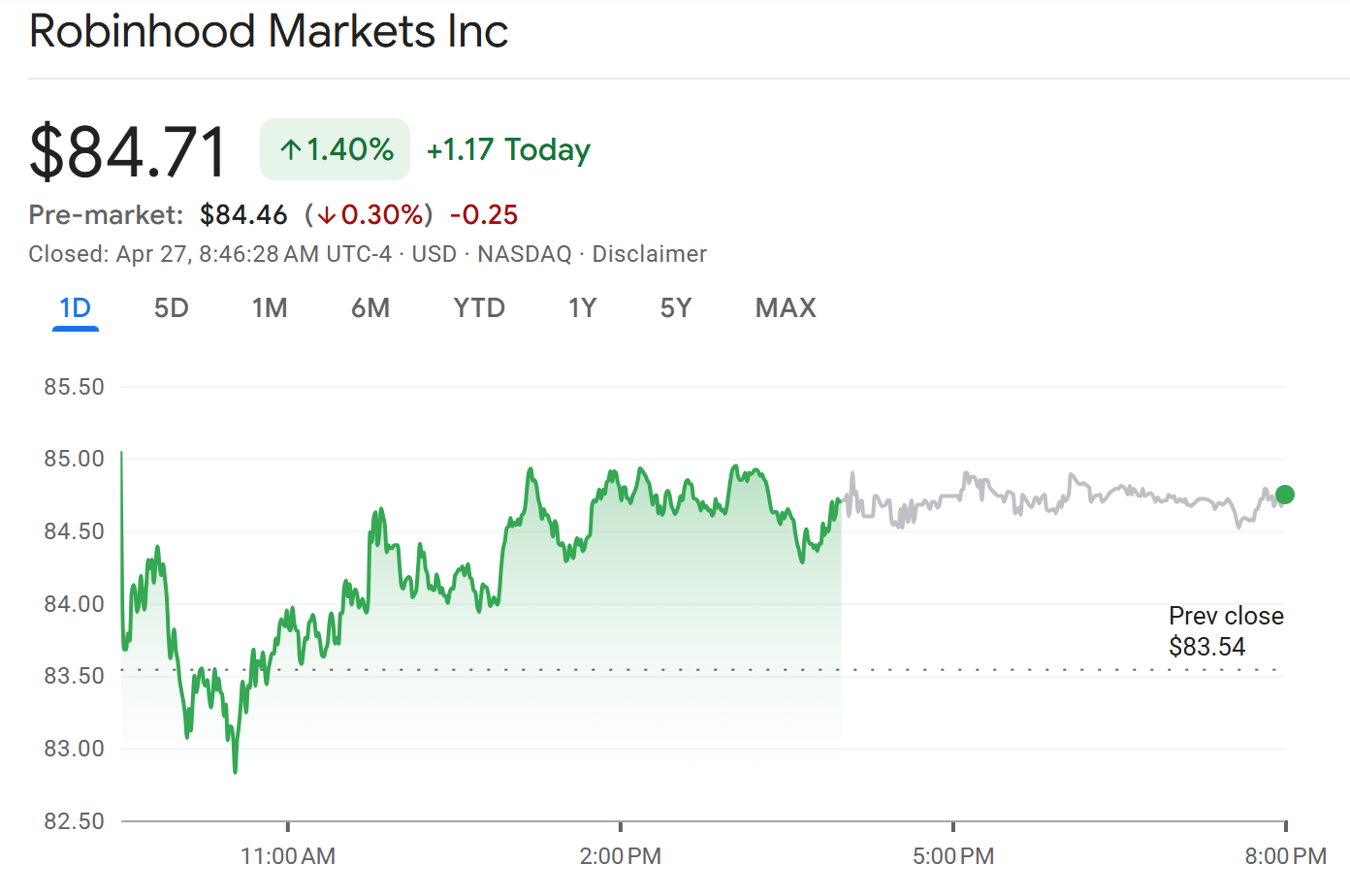
Robinhood (HOOD) traded near $84.71 on Monday morning, up 1.40% on the day, but recorded pre-market losses of up to 0.3% despite the phishing incident on Sunday evening.
What Robinhood Customers Should Do
Robinhood Help advised affected customers to contact support through the app or website rather than click any links.
The brokerage encouraged anyone who interacted with the email to change passwords, rotate two-factor authentication (2FA), and review recent device activity.
The pattern points to attacks in which authentication standards pass even as the email payload itself becomes malicious.
Robinhood has not detailed how attackers gained access to the account creation flow. It also has not said whether other customers received similar messages.
The post Robinhood Stock Could Suffer After Users Report Phishing Incident appeared first on BeInCrypto.

BBC The Night Manager season 3 update as Tom Hiddleston shares excitement

Bubble Robotics Raises $5M Pre-Seed to Deploy Autonomous Ocean Robots

Tom Lee touts ETH as ‘wartime store of value’ as Bitmine (BMNR) buys more

Manchester United reach agreement with Casemiro over contract clause amid transfer speculation

US brings back mandatory military draft registration

Steven Gerrard disagrees with Gary Neville over ‘shock’ Chelsea and Arsenal claim | Football


-

 Politics7 days ago
Gary Stevenson delivers timely reminder to register to vote as deadline TODAY
-

 Fashion3 days ago
Weekend Open Thread – Corporette.com
-
 Crypto World2 days ago
Hyperliquid $HYPE Rally Builds Momentum as AI Sector Enters Prove-It Phase
-
Crypto World7 days ago
Bank of Hawai’i (BOH) Q1 2026: Net Income Drops to $57.4M as Net Interest Margin Expands
-

 Politics5 days ago
Making troops accountable for war crimes threatens US alliance, ex-SAS colonel warns
-

 Politics5 days ago
Disabled people challenge government SEND proposals over segregation concerns
-

 Business5 days ago
Rolls-Royce Voted UK’s Most Iconic Trade Mark as IPO Register Hits 150
-

 Business4 days ago
Patterson-UTI Energy, Inc. (PTEN) Q1 2026 Earnings Call Transcript
-

 Politics5 days ago
Zack Polanski responds to home secretary’s taser threat
-
 Crypto World6 days ago
Five Value Stocks with Recovery Potential in 2026: PayPal (PYPL), Nike (NKE), and More
-

 Politics5 days ago
Starmer handler McSweeney to be dragged from shadows by Foreign Affairs Committee
-
 Sports1 day ago
IPL 2026: Ruturaj Gaikwad registers slowest fifty of the season, enters all-time unwanted list | Cricket News
-
Politics5 days ago
Wings Over Scotland | How To Get Away With Crimes
-

 Crypto World6 days ago
New York sues Coinbase, Gemini over prediction market offerings
-
 Business5 days ago
HCL Tech share price tank over 9% after weak Q4. JPMorgan, HSBC & 3 others cut target price
-

 Politics5 days ago
‘Iran is still a nuclear threat’
-
Entertainment6 days ago
Sydney Sweeney cameo cut from “The Devil Wears Prada 2”, source explains why (exclusive)
-

 Crypto World6 days ago
Crypto’s great hope in Senate’s Clarity Act still has a path to survive tight calendar
-
 Sports4 days ago
Tim Bradley names the current best in the world: “Better than Inoue and Usyk”
-

 NewsBeat1 day ago
LK Bennett closes all stores after entering administration
You must be logged in to post a comment Login