
Crypto World
ENA Jumps 10% as Ethena Seeks Approval for Revenue-Funded Buybacks

Ethena’s native token ENA surged after the Ethena Foundation announced a package of governance and treasury updates aimed at changing how the protocol’s revenue is handled and how certain investor token schedules unwind.
In an ecosystem update posted Thursday, the foundation detailed four changes, including a vote on a “fee-switch” mechanism that would direct a large share of net revenue toward ENA buybacks once Ethena’s synthetic dollar supply (USDe) reaches a specified milestone.
Key takeaways
- The Ethena Foundation opened a governance vote on a fee-switch proposal tied to USDe reaching a $7.5 billion milestone.
- Under the proposal, 95% of the foundation’s net revenue from Ethena’s core business lines would be used to buy ENA after the threshold is met.
- Tokenholders have until Sept. 2 to vote; at the time of publication, Snapshot showed 65 votes representing about 14.4 million ENA voting power, all in favor.
- The foundation also said it completed a buyout of locked ENA held by certain early investors and agreed to adjust remaining investor unlock timing to Oct. 5.
Fee-switch proposal links buybacks to USDe scale
The center of the announcement is a governance vote on whether to switch Ethena’s fee handling toward token repurchases. According to the Ethena Foundation’s blog post, 95% of the net revenue paid to the foundation from Ethena’s core business lines would be allocated to purchase ENA once the circulating supply of USDe reaches the first milestone of $7.5 billion.
Voting runs until Sept. 2. Data from Snapshot shows all cast votes so far have supported the proposal. At the time of writing, 65 votes accounting for roughly 14.4 million ENA in voting power were recorded, with every one of them in favor.
For ENA holders, the significance is practical: if implemented, the buyback program would effectively transform a portion of protocol revenue into recurring demand for the token—though the trigger is conditional on USDe growth, which means timing depends on how quickly supply climbs to the milestone.
ENA reacts as governance activity accelerates
Market pricing reflected the renewed focus on treasury policy. CoinGecko data shows ENA rose 10.7% over 24 hours and gained 27% over the past week, trading above $0.17 as of 8:11 am UTC on Friday.
Even without assuming the vote’s outcome, the governance framing itself can matter to traders: buyback mechanisms are often viewed as a direct link between protocol economics and token supply dynamics. Here, the foundation’s proposal is explicit about how revenue would be used after the USDe threshold is reached.
Locked token buyout and changes to investor unlock timing
Beyond the fee-switch idea, the Ethena Foundation outlined steps affecting locked ENA held by early participants. The foundation said it had bought locked ENA from certain major seed investors who reduced some holdings during the previous nine months.
In a separate development, the foundation stated it agreed with lead investors to release remaining unvested investor allocations on Oct. 5, replacing the existing monthly unlock schedule. The foundation emphasized that team tokens remain subject to their original vesting schedules.
Importantly, the change described in the update accelerates remaining investor unlocks rather than canceling the tokens. For market watchers, that distinction is notable: faster unlocks can increase near-term supply pressure if demand does not keep pace, even if buyback plans later aim to offset supply effects through repurchases.
Where Ethena’s stablecoin ranks and why it matters for ENA
Ethena’s synthetic dollar, USDe, is listed by DefiLlama as the sixth-largest stablecoin by market capitalization, with roughly $4 billion at the time referenced in the update. A protocol’s stablecoin scale can be consequential because governance proposals and revenue flows are often tied to activity that grows with circulating supply.
In this case, the foundation’s fee-switch vote is explicitly tied to USDe reaching $7.5 billion in circulating supply—meaning the token’s economics are positioned to change as the synthetic dollar expands. Investors should therefore track not only ENA’s price, but also USDe’s growth rate toward the milestone.
Strategic investor interest remains part of the backdrop
Ethena’s ecosystem update comes amid ongoing institutional attention. Earlier coverage cited an investment by M2 Capital, the investment arm of UAE-based M2 Holdings, which put $20 million into ENA as a strategic holding in September 2025 while total value locked neared $15 billion. The conglomerate had previously invested in the Sui Foundation.
While that investment does not determine the outcome of the new vote or the timing of unlocks, it underscores that ENA is being treated as a strategic position by at least some larger investors—precisely the group that is likely to weigh governance and supply-schedule changes closely.
With the fee-switch vote still open until Sept. 2 and the remaining unvested allocation timing now set for Oct. 5, the next key question for ENA holders is whether USDe’s path toward the $7.5 billion milestone keeps pace—while also monitoring how accelerated unlocks might affect supply in the interim.

Crypto World
Same Election Question, Two Different Odds: Predictions.io Launches Free Cross-Venue Comparison Tools

[PRESS RELEASE – Washington, United States, August 28th, 2026]
As prediction-market volume hits record highs and regulators circle, identically worded midterm questions are trading several points apart depending on the venue. Predictions.io now tracks 9,700+ markets across Kalshi, Polymarket and Manifold in one place – with free fee and odds calculators so traders can see what a price actually costs them.
Prediction markets have never been bigger, or more contested. Kalshi, Polymarket and Polymarket US together posted a record $50.59 billion in combined volume in July, with Kalshi accounting for roughly 74.5% of the total. In the same month, New York City opened a probe into both leading venues, a Washington judge ordered Kalshi to halt most wagers in the state, and the CFTC began an internal review of so-called “mention markets.”
Amid that scrutiny, a simpler question has gone largely unexamined: when two venues list the same question, do they agree on the answer?
Often, they do not. On identically worded midterm markets tracked by Predictions.io, “Blue tsunami in 2026?” was priced at 44.5% on Polymarket and 36.0% on Kalshi. “Blue wave in 2026?” showed 82.5% against 74.0%. Both gaps are 8.5 percentage points — on questions whose wording is identical on the two venues. Across a sample of directly comparable binary markets live on more than one venue, the median gap was more than four points, and nearly half of the pairs differed by five points or more. (Prices as of 05:08 UTC on 28 August 2026; both venues’ live prices are shown side by side on Predictions.io.)
Those gaps matter to anyone quoting a single number. A market priced at 44.5% on one venue and 36.0% on another does not have one “market-implied probability” – it has two, and which one gets cited is arbitrary unless the reader is told both.
“A single venue’s price is a data point. The spread between venues is the information. When the two biggest markets in the world disagree by seven points on the same sentence, that disagreement is the story – and nobody who runs one of those markets is in a position to report it.” said spokesperson of Predictions.io
Predictions.io aggregates markets from Kalshi, Polymarket and Manifold, matching equivalent questions across venues so the same event can be compared directly. The platform currently tracks more than 9,700 event pages across 23 categories including US politics, economics, crypto, sport and geopolitics.
Alongside the comparison pages, Predictions.io publishes two free tools:
● Fee Calculator — enter any trade and see the fee, total outlay and effective all-in price on each venue, including Kalshi’s 0.07 × P × (1−P) taker formula and maker discount against Polymarket’s zero-fee standard markets.
https://predictions.io/tools/fee-calculator
● Odds Converter — convert American, decimal and fractional odds into implied probability and prediction-market prices, and see the vig-free line.
https://predictions.io/tools/odds-converter
A direct venue comparison is available at https://predictions.io/compare/polymarket-vs-kalshi, and live midterms markets at https://predictions.io/lobby/us-politics.
Predictions.io operates no market and takes no position in any contract. It is a data and comparison service, not an exchange, broker or investment adviser.
About Predictions.io
Predictions.io is an independent aggregator of prediction markets, bringing prices from Kalshi, Polymarket and Manifold into a single view so the same question can be compared across venues. It publishes free tools for traders and journalists, including a cross-venue fee calculator and odds converter.
Users can learn more about Predictions.io here: https://predictions.io/
Predictions.io socials: https://bio.site/predictions.io
The post Same Election Question, Two Different Odds: Predictions.io Launches Free Cross-Venue Comparison Tools appeared first on CryptoPotato.
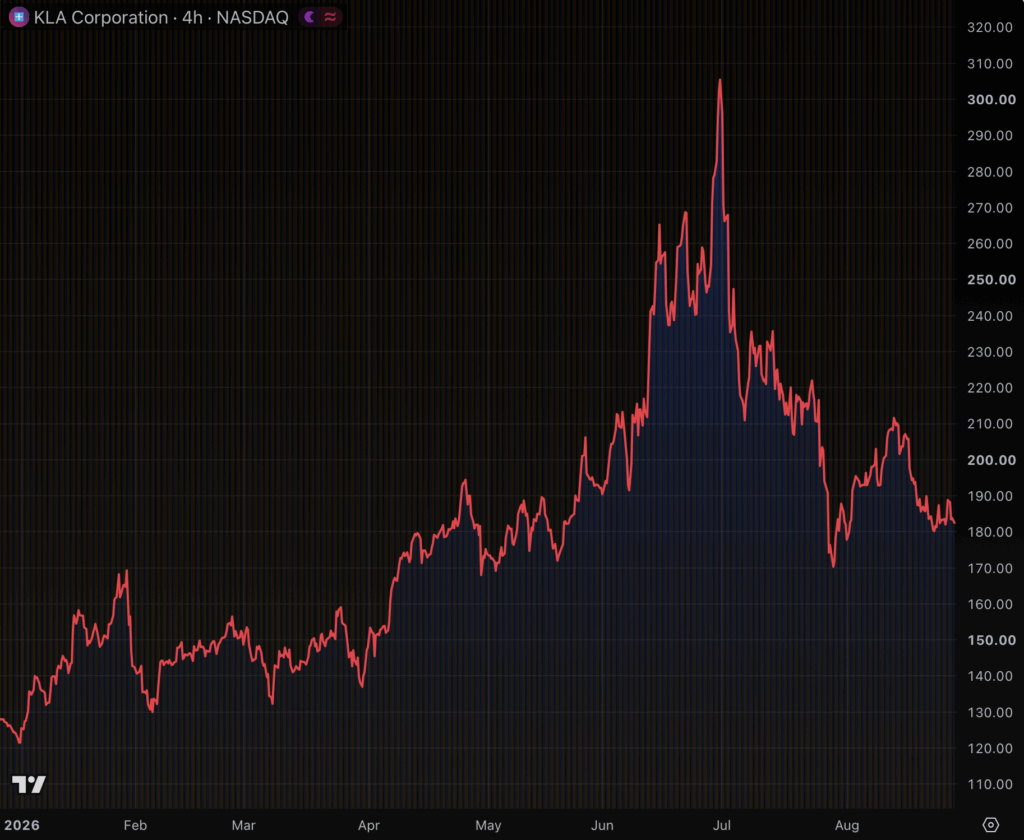
AI semiconductor company KLA Corporation has slid 40% since June 30, shedding $160 billion in market capitalization, as its executives and other insiders have disclosed over $64 million worth of sales in SEC filings.
Although the company claims that most of these sales followed regularly scheduled trading plans as part of executive compensation packages, no insiders decided to make any open market purchases during that time.
- President Richard Wallace led the selling at $17.4 million
- CFO Bren Higgins sold $13.9 million
- Executive Vice President Brian Lorig and Officer Mary Beth Wilkinson each sold more than $12 million
- President of Semiconductor Products Ahmad Khan sold $6.6 million
- Senior Vice President Virendra Kirloskar sold $1.8 million
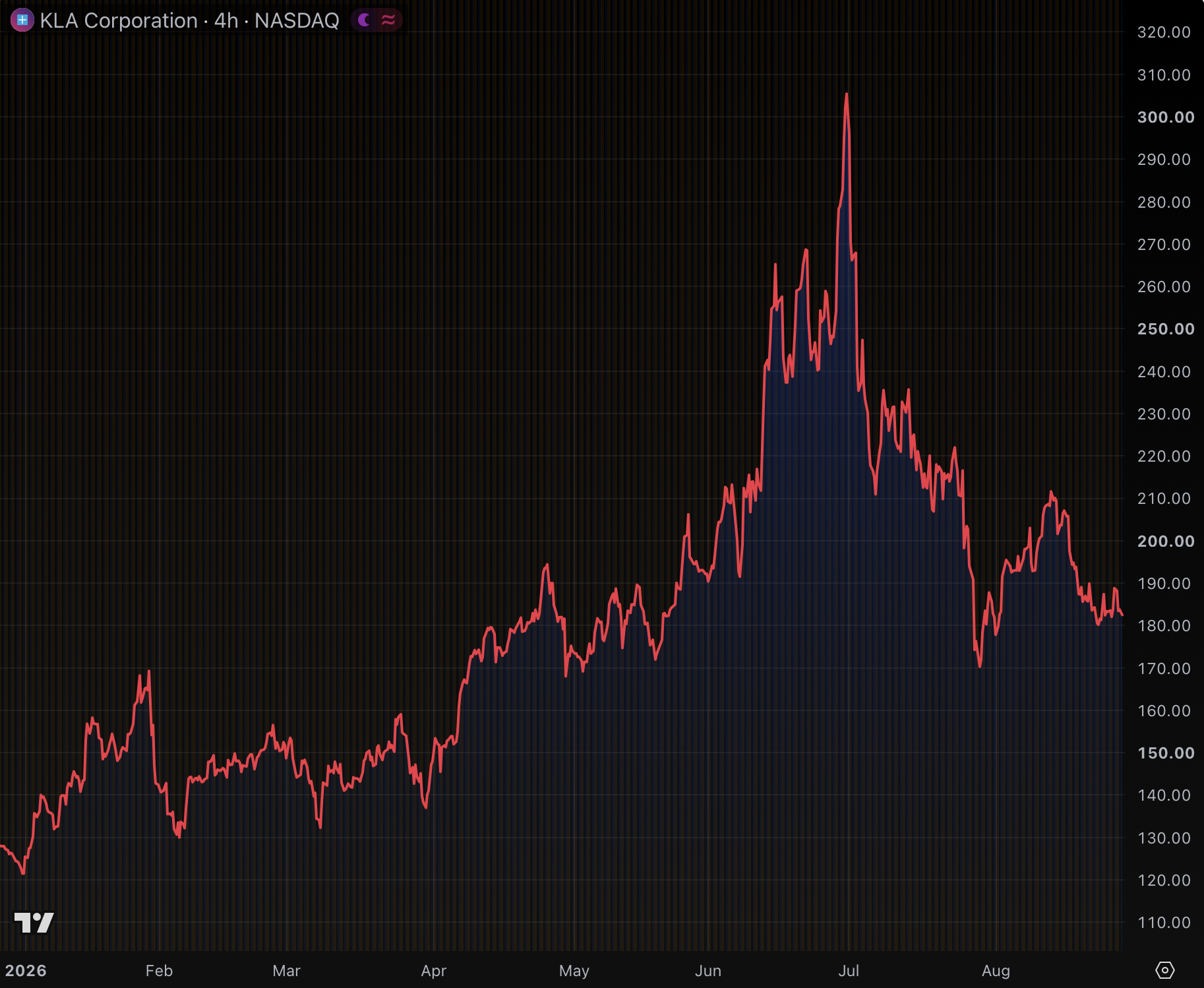
KLA’s stock hit an all-time high of $307.37 on June 30. It closed at $183.77 yesterday.
The corresponding market cap loss was over $160 billion: $401 billion to yesterday’s $240 billion.
Each insider sale occurred on a distinct date and price, so the above transactions did not occur altogether after, but rather during the 40% stock slide.
Buyers who chased KLA during the summer frenzy of AI stocks are now experiencing deep pain. Any $10,000 investment at that June 30 high is now worth less than $6,000.
KLA insiders sell for many reasons, haven’t bought for any reason
Of the sale transactions, the vast majority carried a Rule 10b5-1 representation. Such qualifying trading plans provide a defense to any potential insider trading liability.
These trading plans must be established in advance and operated under the rule’s conditions. These filings do not prove KLA’s insiders foresaw any price decline.
Read more: Meta insiders sold 150 times and bought zero in the last six months
To be fair, the absence of buying isn’t proof that KLA is overvalued. Planned selling isn’t proof of a bearish forecast by insiders, either.
Still, pure selling with $0 of buying certainly could leave some investors uncomfortable.
The newest insider trading filing reached the SEC’s EDGAR system on August 14 and covered an August 13 sale.
Later August trades might not yet have reached EDGAR, although public companies are required to promptly disclose insider transactions.
An SEC Form 4 of a qualifying insider trade is due before the end of the second business day after the trade date.
Got a tip? Send us an email securely via Protos Leaks. For more informed news and investigations, follow us on X, Bluesky, and Google News, or subscribe to our YouTube channel.
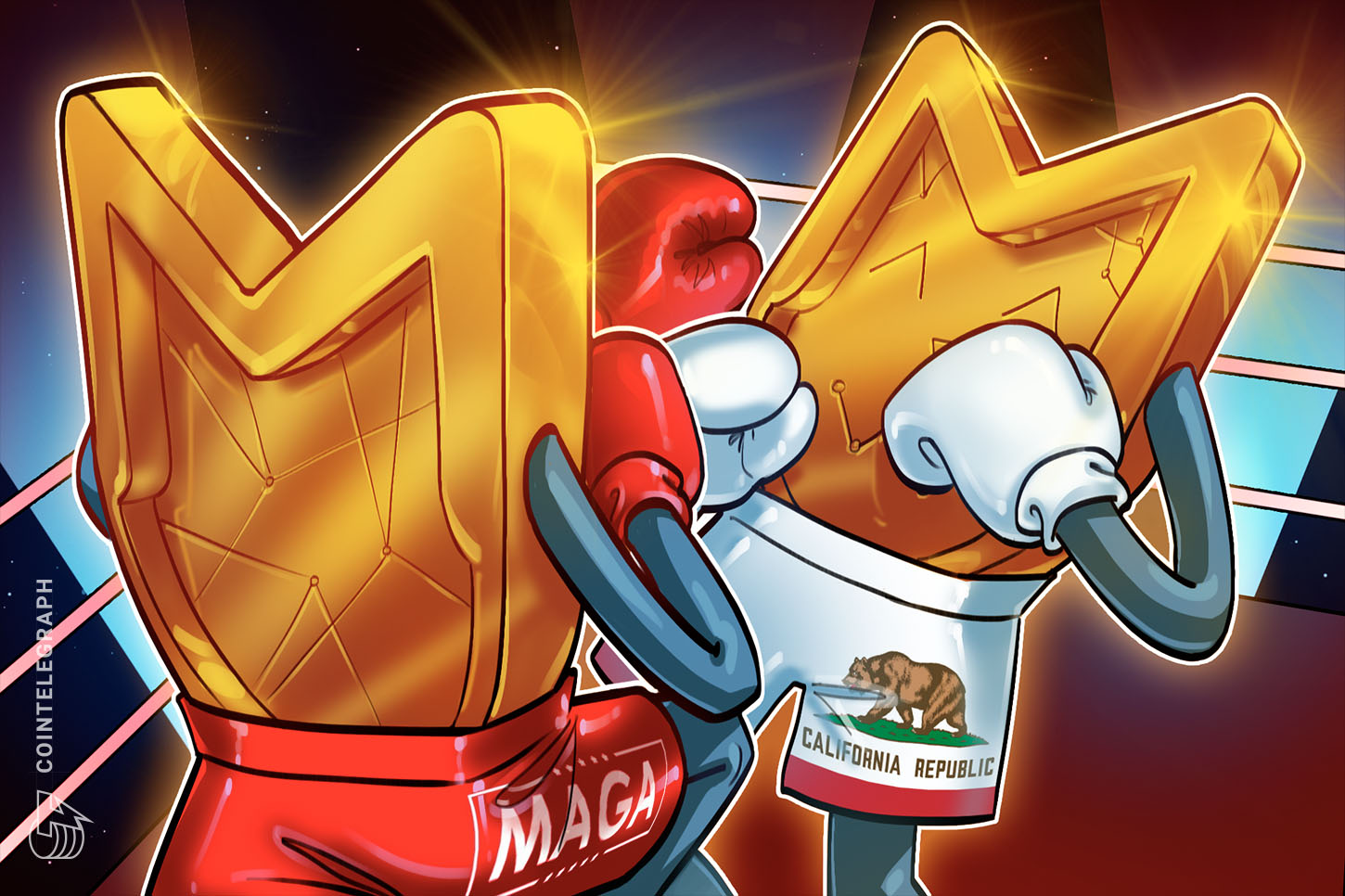
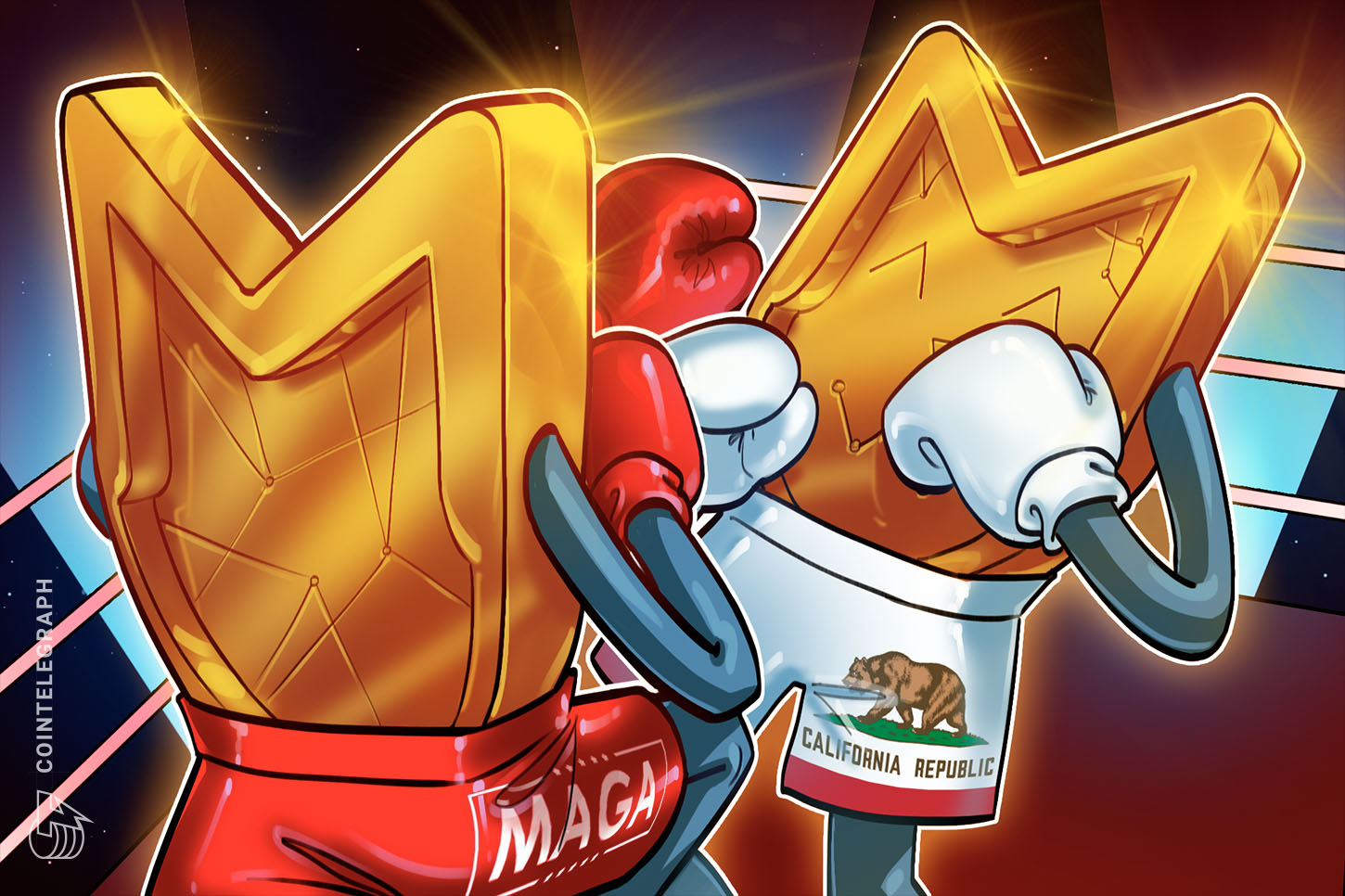
The bill seeks to prohibit the listing of memecoins issued by federal public officials to California residents, citing conflicts of interest and “pay-to-play arrangements.”


Your day-ahead look for Aug. 28, 2026


The issuer of the $4 billion USDe token said it expects real-world asset perpetuals to eclipse crypto derivatives in its backing within 12 to 24 months.

About $6.44 billion in Bitcoin options covering 81,700 contracts settle on Deribit just now, and the same day, Federal Reserve Chair Kevin Warsh delivers his first keynote as chief at the Jackson Hole Economic Policy Symposium. Now, does a call-heavy derivatives reset plus a closely watched policy speech amplify Bitcoin’s next move, or does it just generate noise that fades by Monday?
Neither event guarantees direction on its own. What matters is how dealer hedging around specific strikes interacts with whatever tone Warsh strikes, and history suggests expiries this size have underwhelmed before.
Friday’s book splits into 44,639 calls against 37,061 puts, a put-to-call ratio of 0.83. That leans bullish in structure, but it doesn’t function as a forecast, as plenty of options traders build spreads and covered positions that have nothing to do with a directional bet on spot price.
— Coin Bureau (@coinbureau) August 27, 2026
 VOLATILITY ALERT: A massive $6.36 BILLION Bitcoin options expiry hits Deribit this Friday at 8 AM UTC.
Around 81,000 bitcoin:native contracts will expire, with max pain at $69,000 and a put/call ratio of 0.85, setting the stage for sharp price swings as traders reposition. pic.twitter.com/3trwC3ACU7
The $6.44 billion figure is notional, not cash changing hands. It’s the contract count multiplied by Bitcoin’s spot price, and most of Friday’s contracts sit far out of the money, meaning they’ll expire without any settlement at all.
The part that actually moves markets is the hedging: firms that sold these options have to buy or sell real Bitcoin as price shifts to stay balanced, and a book this size can generate enough flow to swing price independent of any headline.
The $75,000-$80,000 Bitcoin Strikes
The heaviest open-interest concentrations sit at $75,000 and $80,000. That marks where option writers hold their largest positions, not where Bitcoin is destined to land, but where dealer hedging is likely to get more active as expiry approaches.
Max pain for the August 28 expiry is reported near $70,000, or $9,000 to $11,000 below Bitcoin’s price at publication. That’s a wide gap, and the wider it is, the more hedging tends to intensify heading into settlement. With most call buyers currently holding paper profits, pulling the price toward max pain would require a sharp decline.

Size alone hasn’t reliably moved Bitcoin before. A $15 billion Deribit expiry in June 2025 carried a max pain near $102,000 with implied volatility at its lowest since October 2023, and Bitcoin barely budged. December’s $13.3 billion expiry, with max pain near $100,000-$102,000, produced a similarly muted reaction.
Friday’s setup differs mainly in where the pressure sits. Bitcoin is trading close enough to the $75,000 and $80,000 strikes to keep dealer hedging active, unlike those prior expiries where spot sat far from the action.
Trade Bitcoin on Bybit and Get a Chance to Win Our $1,000 USDT Airdrop
The Jackson Hole Variable
Warsh’s keynote lands the same Friday as the Deribit settlement, marking his debut major address as Fed chair. CNBC has reported he is scheduled to deliver the speech on Friday, and Reuters has flagged elevated bond-market anxiety heading into it, a signal that fixed-income desks are treating this appearance as more than ceremonial.

Warsh’s speech arrives alongside an already-live options settlement. Deribit’s contracts settle at 08:00 UTC Friday, roughly the same window as Warsh takes the podium at Jackson Hole, leaving Bitcoin exposed to a second catalyst on the same day.
Discover: The Best Crypto to Diversify Your Portfolio
The post Bitcoin Faces a Dual Test From Dealer Hedging and the Fed appeared first on Cryptonews.

Today’s Bitcoin price prediction has BTC trading at $79,500, up around +1.1% over the past 24 hours, as the coin’s late-August grind between $78,000 and $81,000 stretches into another week.
That sideways chop is the entire story right now, and according to BitMEX co-founder Arthur Hayes, it’s not just a mid-cycle pause; it’s a structural problem for the largest corporate bitcoin holder on the planet.
Hayes argues on Laura Shin’s Unchained Podcast that Strategy Inc.’s decade-old playbook, sell shares at a premium to net asset value, buy more bitcoin, repeat, breaks down the moment BTC stops accelerating, even without a price crash.
With Strategy’s enterprise mNAV compressed to roughly 1.01x and diluted mNAV near 0.74x as of August 27, the company now trades close to the raw value of its 840,447 BTC holdings, leaving almost no premium to fund another buying cycle.
Bitcoin briefly topped $81,000 on August 25 before easing back, a pattern that’s reviving debate over whether this rally still has legs. Recent technical coverage suggests the answer hinges on a handful of key levels playing out over the next few sessions.
Bitcoin Price Prediction: Can BTC USD Hit $83K This Week?
At $79,649.68, Bitcoin sits in a tight band that’s defined the past several sessions, with seven-day gains still running near 9.7% despite Thursday’s pullback.
Resistance stacks up at $81,121 first, then a heavier shelf at $82,500–$84,700, with $87,500 marking the next major ceiling if momentum resumes. Support sits at $78,720, then $75,604, with a broader moving-average cluster at $65,800–$68,300 forming the base of the summer breakout.
The bull case: a clean break above $81,121 opens the door to a run toward $84,700, especially if dollar weakness persists and Treasury actions keep bond yields contained.
The base case: continued consolidation between $78,000 and $81,000 while the market digests Strategy’s mNAV squeeze and broader macro data.
The bear case: a breakdown below $75,604 support, which would invalidate the current bullish structure and likely trigger a retest of the $68,000 zone.
Options positioning around key strikes, detailed in recent Deribit expiry analysis, adds another layer of near-term volatility to watch.
Supercharge Your Trading in 2026 With BloFin AI Trading Bots
Bitcoin Hyper Targets Early Mover Upside as Bitcoin Tests Key Levels
Holders sitting on positions from the summer breakout are still up double digits over the month, no complaint there. But buying Bitcoin at $79,649 for outsized returns is a different bet than it was a year ago; the asset’s $1.5 trillion-plus market cap means even a run to $100,000 is “only” 25% upside from here.
That math is exactly why traders scanning for asymmetric exposure keep circling back to Bitcoin’s own infrastructure layer, where the growth curve looks nothing like the base chain’s.
Bitcoin Hyper ($HYPER) is building the first Bitcoin Layer 2 with Solana Virtual Machine integration, aiming to deliver smart contract execution faster than Solana itself while settling back to Bitcoin’s base-layer security.
The presale has raised $33,087,186.94 at a current token price of $0.0136853, with staking APY available for early participants. Its Decentralized Canonical Bridge targets one of Bitcoin’s oldest complaints: capital stuck earning nothing because the base chain can’t run smart contracts.
Gain Access to New Bitcoin Layer 2 Early Here Make Your Prediction Count With $25 For Free on Kalshi
Not financial advice. Crypto markets are highly volatile and presale tokens carry elevated risk. Always do your own research before investing.
The post Bitcoin Price Prediction: Can BTC Get Back Over $80,000? appeared first on Cryptonews.
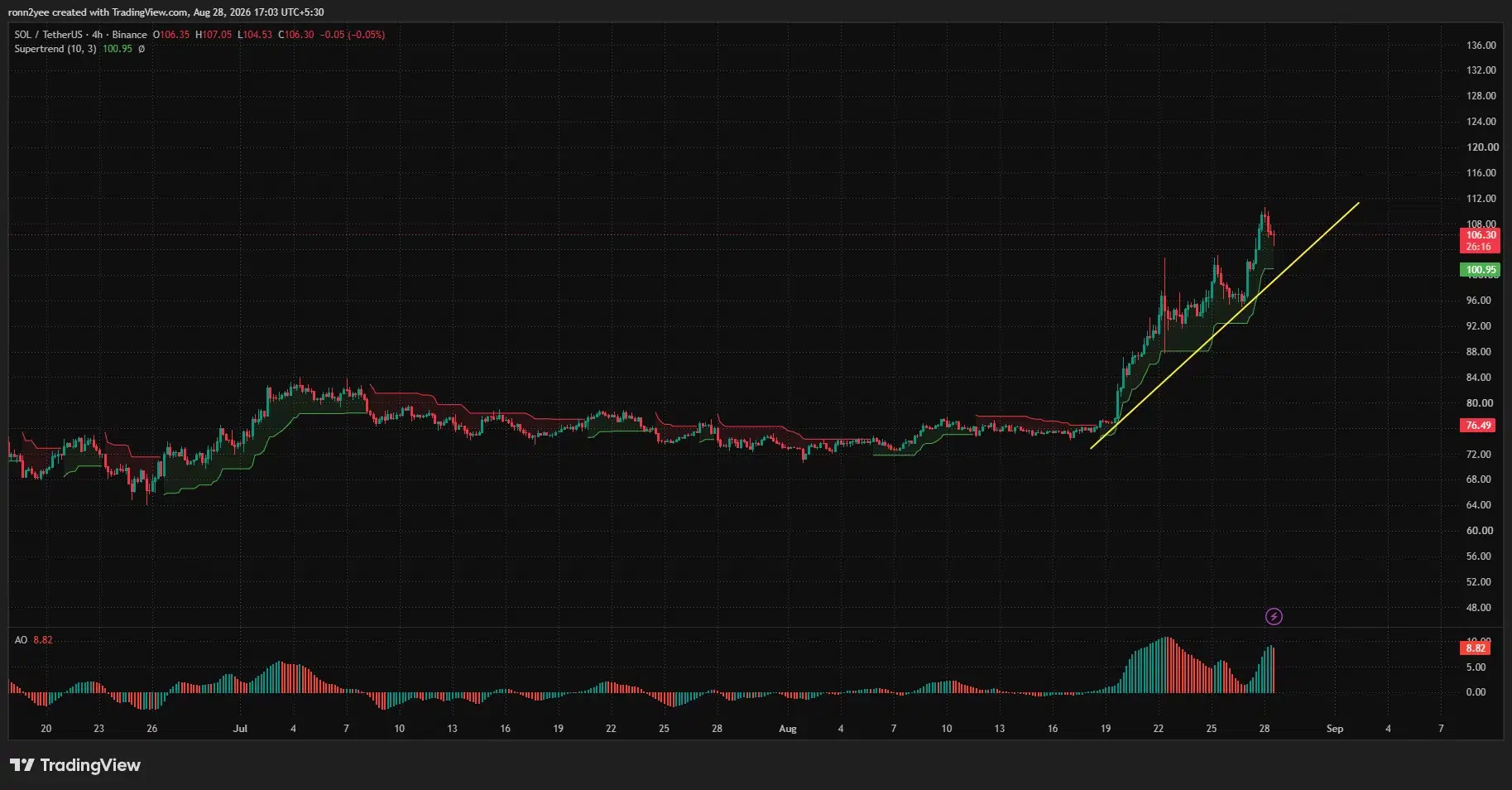
Solana price traded near $106 on Aug. 28 after reaching $110, as strong US ETF inflows and network activity helped SOL defend its breakout despite hotter inflation data.
Summary
- Solana price climbed from $96.60 on Aug. 26 to an intraday high of $110.
- The daily chart shows $104.41 turning into the first important support level.
- US spot Solana ETF inflows reached $1.22 billion after five consecutive positive sessions.
- A break above $110 could open the way toward $114.88 and $127.83.
Solana price retreats after reaching $110
According to data from crypto.news, Solana (SOL) price rose as high as $110 on Aug. 28 before retreating to around $106.25, leaving it approximately 10% above its Aug. 26 opening price of $96.60. SOL briefly fell to $95.23 earlier in the period before buyers restored the uptrend.
The recovery followed a strong advance that began around Aug. 19, when SOL broke out of a prolonged range near $75–$80. The token subsequently cleared $88, $94, and the psychological $100 level as buying pressure accelerated.
Friday’s pullback started after SOL tested the $109–$110 area, where the 4-hour chart shows its latest local high. The decline of about 3.4% from that peak points to profit-taking after the rapid advance rather than a confirmed reversal.
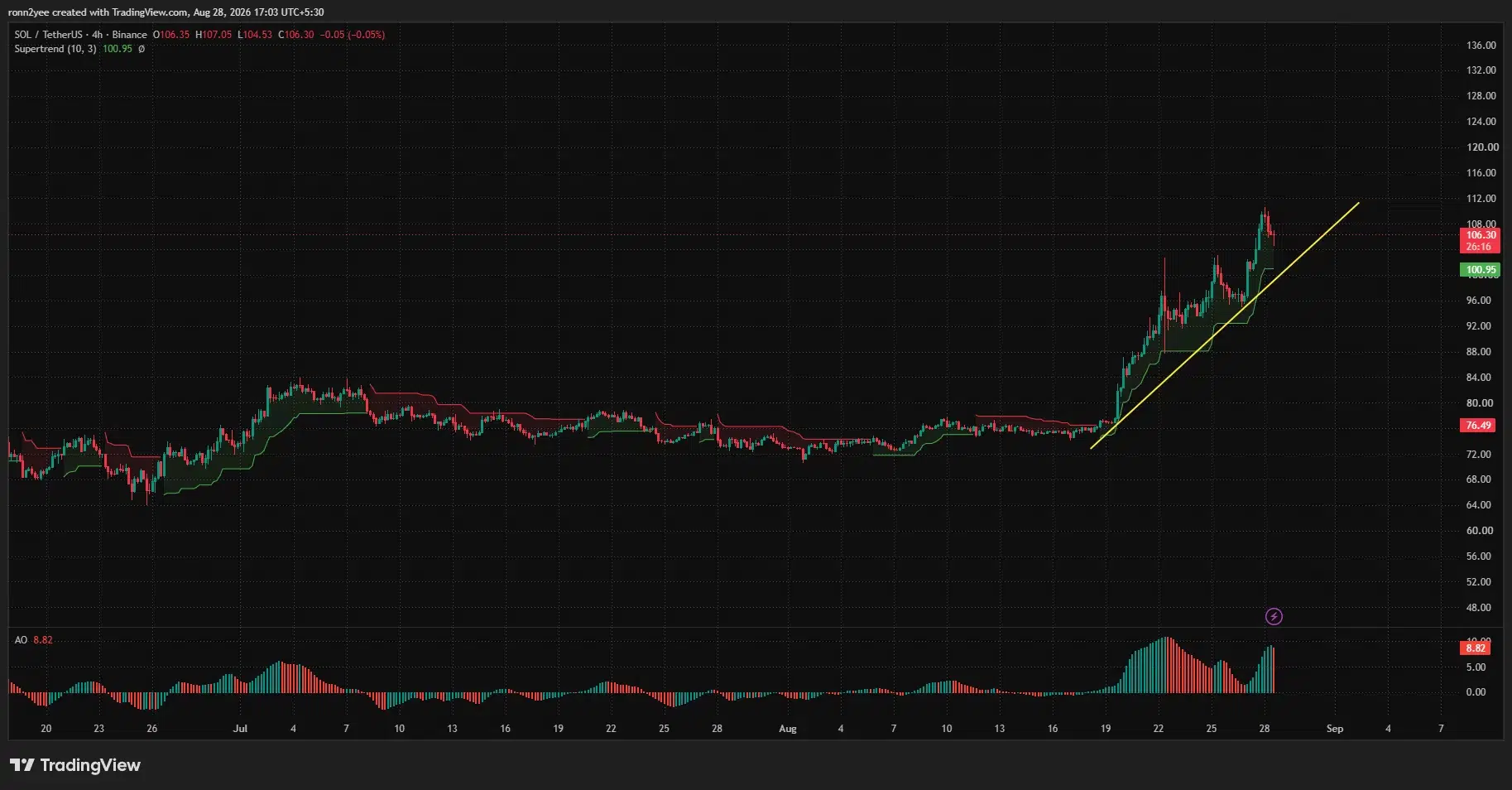
SOL remains above an ascending trendline connecting the higher lows formed since Aug. 19. Its 4-hour Supertrend also remains bullish, with dynamic support at approximately $100.95. A drop below both levels would provide the first warning that the short-term structure is weakening.
The Awesome Oscillator stands at 8.82, well above its neutral line. Its positive reading shows that recent upward momentum remains stronger than the preceding downswings, although the latest red bar suggests the pace has started to cool.
ETF inflows help SOL absorb inflation pressure
Solana’s rebound developed despite US inflation data creating a more difficult backdrop for risk assets. The Bureau of Economic Analysis said the headline Personal Consumption Expenditures price index rose 3.7% annually in July, compared with a 3.6% consensus estimate.
Core PCE increased 0.2% monthly and 3.3% annually, matching forecasts. The slightly hotter headline reading initially pushed bond yields and the US dollar higher as traders reduced expectations for easier Federal Reserve policy. The BEA released the figures on Aug. 26.
SOL fell to $95.23 after the report but recovered quickly as spot demand offset the initial de-risking. US spot Solana exchange-traded funds extended their inflow streak to five sessions through Aug. 24, when they attracted $33.5 million, their largest daily intake of 2026.
The inflow took cumulative net subscriptions to approximately $1.22 billion. Later data reported by CryptoRank placed the streak at seven sessions and cumulative inflows near $1.26 billion.
The reported $126 million figure relates to single-day trading volume for Bitwise’s BSOL fund, rather than net inflows. Separating volume from subscriptions is important because high turnover does not necessarily show that an equal amount of new capital entered the product.
Growing ETF demand gives US investors regulated exposure to SOL without requiring direct token custody. It may also strengthen spot-market demand when fund issuers acquire the underlying asset to create new ETF shares.
Solana network activity strengthens the rally
Network activity has provided a second source of support. Solana processed more than 1.01 billion transactions during one week in August, according to figures reported earlier in the month. The milestone points to high chain usage, although transaction totals can include automated activity and should not be treated as an exact measure of unique users.
Tokenized-equity trading has also expanded. Solana processed $1.298 billion of the $1.324 billion in global onchain equity volume during the week of June 15–21, representing about 95% of the market, according to Solana Compass.
First-half tokenized-stock volume reached a reported $4.9 billion, more than six times the $775 million recorded in the second half of 2025. The comparison shows longer-term growth rather than a sixfold increase during the latest price rally.
SOL’s supply outlook has attracted additional attention as validators consider the Double Disinflation proposal. The plan would increase the annual rate at which inflation declines from 15% to 30%.
Helius said the proposal would move Solana toward its terminal inflation rate of 1.5% by the first half of 2029, compared with 2032 under the existing schedule. Any supply effect remains conditional on the proposal’s approval and implementation.
SOL needs to hold $104 to target $115
The daily chart places SOL just above the 50% Fibonacci retracement level at $104.41. Holding that former resistance as support would preserve the breakout and give buyers another opportunity to challenge $110.
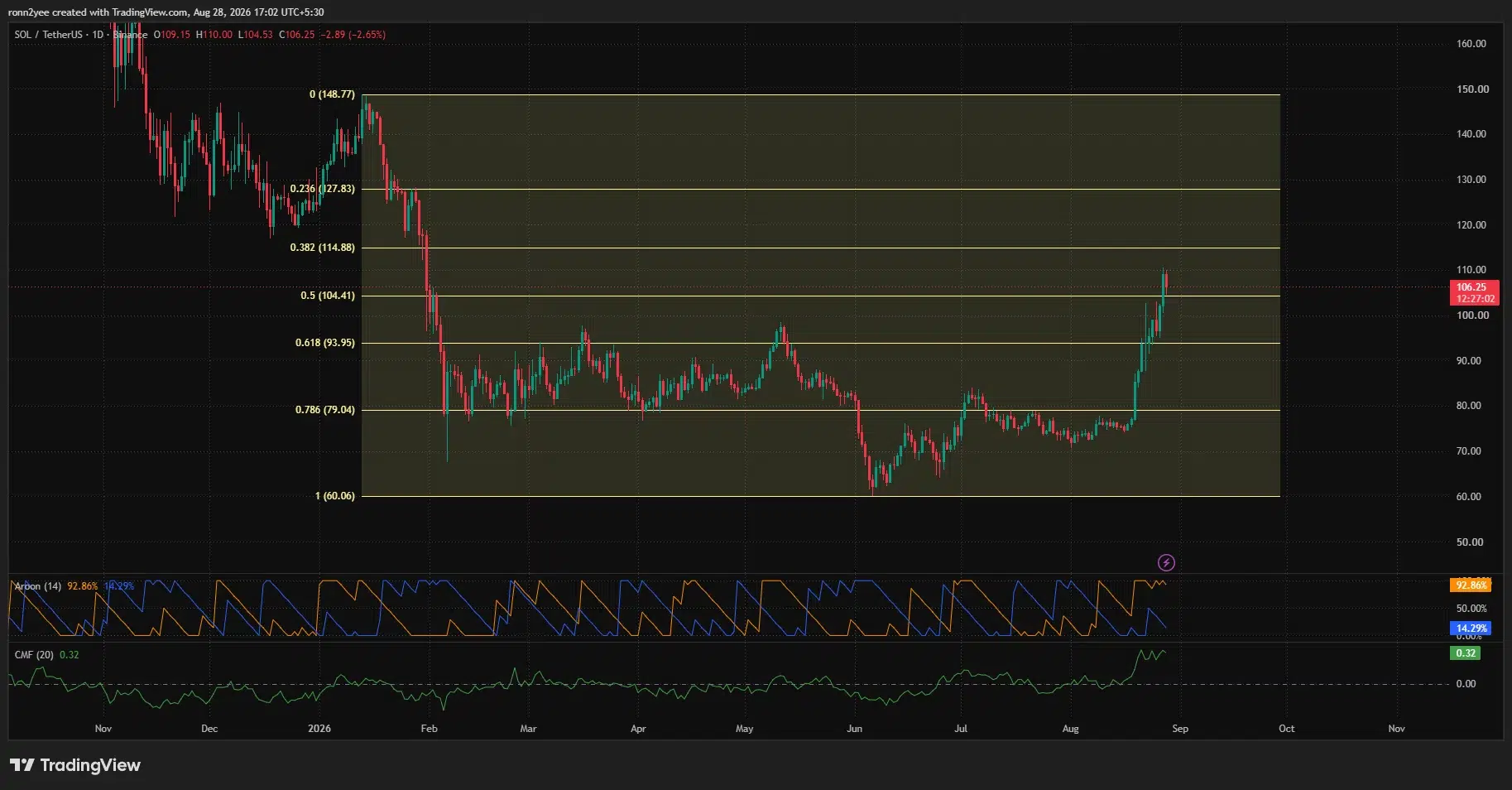
Momentum remains bullish but stretched. The Aroon Up indicator stands at 92.86%, while Aroon Down is 14.29%, confirming that the most recent high is much newer than the latest major low. Chaikin Money Flow is also positive at 0.32, showing that accumulation has outweighed distribution during the measured period.
A confirmed daily close above $110 would expose the 38.2% Fibonacci retracement at $114.88. Clearing that level could extend the rally toward $127.83, while the 4-hour rising trendline points toward the $111–$112 area in early September.
The 24-hour liquidation heatmap shows the closest major overhead liquidity concentrated around $108.50–$109 and near $110.50–$111.50. A move through those zones could force leveraged short positions to close and add momentum to a breakout.
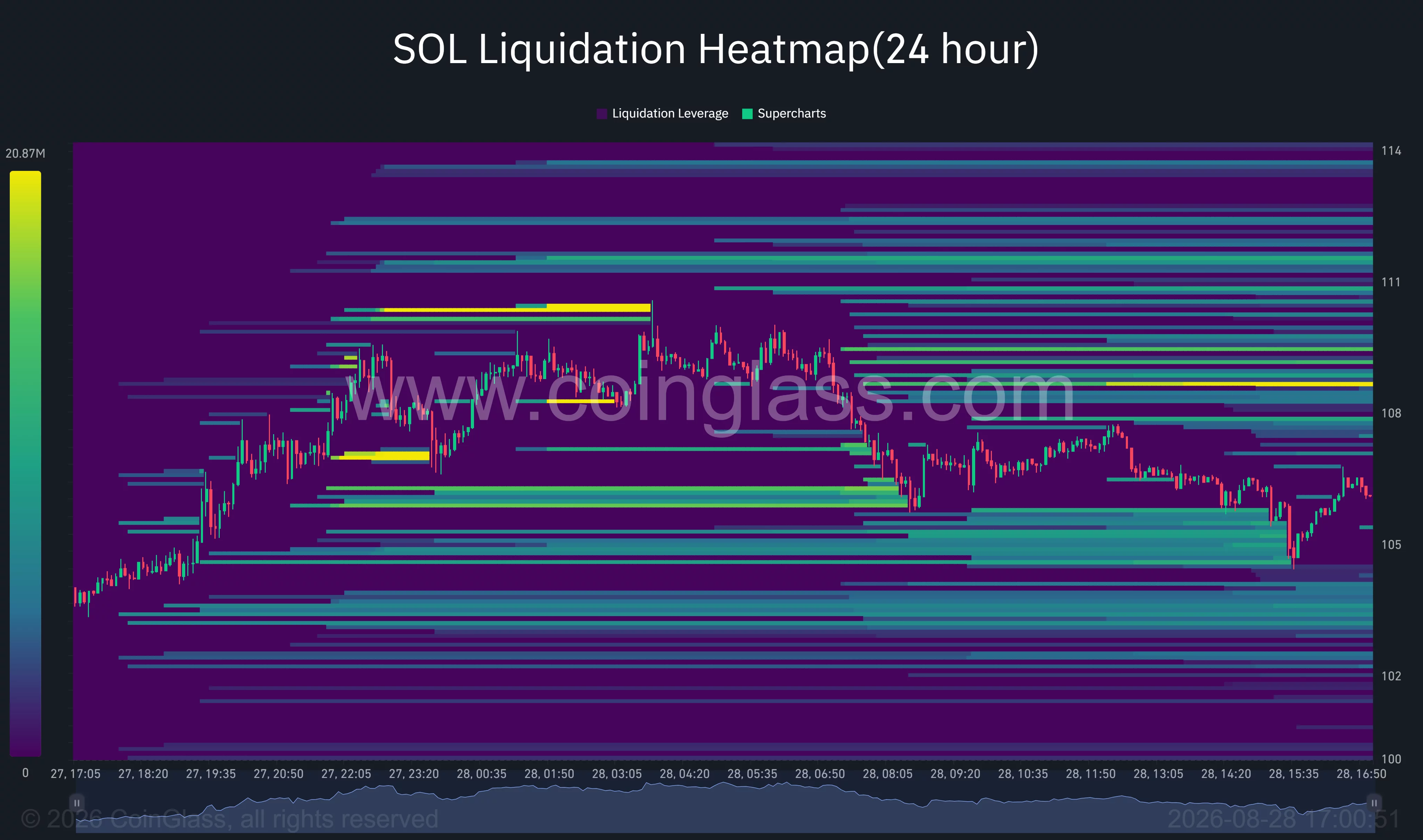
Liquidity is also visible below the market around $104–$105, with deeper concentrations near $102–$103. A loss of $104.41 could therefore pull SOL toward $100.95, followed by the 61.8% Fibonacci level at $93.95.
SOL’s broader setup remains bullish while price holds above $100–$104. However, rejection at $110, stretched daily momentum, and nearby downside liquidity leave the token vulnerable to a deeper reset before any attempt at $114.88 or $127.83.
Disclosure: This article does not represent investment advice. The content and materials featured on this page are for educational purposes only.
Crypto World
SBI buys 20% stake in Indonesia's Ajaib for $270 million to expand yen stablecoin in Southeast Asia


The Japanese financial giant is acquiring a 20% stake in the Indonesian online brokerage to build a cross-border, blockchain-based settlement network.


Brazil’s central bank has developed a real-time crypto threat alert system with Hypernative that will connect banks and domestic exchanges after attackers moved part of an estimated $180 million theft into cryptocurrency.
Summary
- Brazil’s central bank has developed a crypto threat alert system with Hypernative that will connect banks and domestic exchanges.
- Integration is expected to begin within two weeks, with Foxbit and Mercado Bitcoin participating after the system underwent testing.
- The project gained urgency after attackers stole up to $180 million through C&M infrastructure in 2025 and converted part of the funds into crypto.
- Brazil will separately require a 24 hour preventive hold on qualifying crypto transfers above $10,000 from January 2027.
Valor Econômico reported that the Central Bank of Brazil developed the monitoring and alert-sharing system with blockchain security company Hypernative and has already tested the tool with market participants. The system is designed to help financial institutions identify attacks, respond to suspicious activity and track funds when stolen money moves from the banking system into crypto markets.
Brazil crypto alert system moves toward integration
Regina Pedroso, executive director of the Brazilian Tokenization Association, or ABToken, said integration is expected to begin within the next two weeks. Foxbit and Mercado Bitcoin are among the crypto companies participating in the implementation.
The system is expected to distribute threat information between participating institutions, allowing alerts generated in one part of the financial system to reach companies that may encounter the funds later.
Discussions around the project began late last year, when the central bank approached industry associations and market participants about creating a working group focused on monitoring cyberattacks and sharing warnings. ABToken participated in those discussions.
Testing has since been completed with a group that included banks and crypto companies, while some alerts have already been issued. The next stage requires participating associations and companies to adapt their systems so they can receive and redistribute the warnings.
“The challenge now is to implement the tool,” Pedroso said, according to Valor Econômico. “It has already been tested by the Central Bank, some bulletins have already been issued, and now associations have to adapt to receive and distribute the alert.”
Hypernative specializes in detecting onchain threats and responding to suspicious activity before or during attacks. Its work with the Brazilian regulator covers monitoring patterns that could indicate stolen funds are moving toward crypto exchanges, where assets can be converted or transferred to other wallets.
The central bank’s project focuses in part on maintaining traceability when illicit funds leave traditional financial channels and enter cryptocurrency infrastructure. Banks and exchanges operating separately can see different stages of the same movement, making information sharing part of the system being developed.
$180 million C&M attack accelerated the project
Work on the system gained urgency following the attack involving financial software provider C&M Software in 2025.
Attackers compromised infrastructure connected to Brazilian financial institutions and siphoned funds from reserve accounts before converting part of the stolen money into cryptocurrencies. Estimates placed the total amount taken between $140 million and $180 million.
Crypto.news previously reported in July 2025 that blockchain investigator ZachXBT helped Brazilian authorities trace between $30 million and $40 million connected to the attack. Some of the stolen funds were converted into Bitcoin, Ether and USDT through Brazilian exchanges and over-the-counter trading platforms.
ZachXBT worked with Binance, Bitso, Bybit and Tether to freeze roughly $5 million linked to the stolen funds. Brazilian authorities had separately frozen about $50 million by early July while investigators continued pursuing people suspected of participating in the operation.
The breach involved C&M, which provides technology connecting financial institutions to infrastructure used by Brazil’s financial system. Authorities arrested an employee accused of selling login credentials that were subsequently used by the attackers.
Movement of the proceeds into crypto demonstrated the problem the new alert network is designed to address: a cyberattack can originate inside conventional financial infrastructure while some of the proceeds later pass through exchanges, stablecoins and blockchain wallets.
Brazilian authorities have used blockchain tracking in other investigations. Days after the C&M case, Tether assisted authorities with Operation Magna Fraus, an investigation into a network accused of moving funds stolen through Brazil’s Pix payment system into USDT.
Authorities seized R$5.5 million in cryptocurrency during that operation and froze another R$32 million, worth about $5.7 million at the time. Investigators recovered a private key connected to illicit assets, allowing the funds to be transferred into state custody.
Brazil adds 24-hour hold for some crypto transfers
The alert network is being prepared as Brazil introduces separate safeguards governing how crypto service providers process certain transactions.
Starting Jan. 1, 2027, virtual asset service providers will be required to impose a 24-hour preventive hold on qualifying transfers above $10,000 under rules published by the Central Bank on Aug. 7.
The threshold can apply to a single transaction or a customer’s combined transactions during the same day. The measure covers qualifying transfers involving foreign crypto providers and self-custody wallets, while smaller transactions may face closer examination when providers identify elevated risk.
Providers can release transactions before the full 24-hour period expires after completing required risk checks. They must notify customers when the safeguard is applied and retain records covering attempted fraud and actions taken in response.
The central bank said the measure addresses the use of virtual assets, including stablecoins, to move proceeds from financial fraud rapidly, particularly when funds are transferred outside Brazil or into wallets directly controlled by users.
The transaction hold and threat-alert network operate at different stages. The alert system is intended to distribute information about potential attacks and suspicious fund movements, while the transfer rule gives regulated providers additional time to review certain transactions before assets leave their platforms.
Central bank tightens requirements for crypto providers
Brazil has introduced several other requirements for virtual asset service providers ahead of the country’s licensing framework taking fuller effect in 2027.
In July, the central bank approved new prudential requirements covering capital, risk management and disclosure standards for crypto service providers.
Virtual asset firms are set to move into Brazil’s S4 regulatory segment by mid-2028, placing them under requirements closer to those applied to securities brokers and distributors. Institutions operating under the lighter S5 framework will not be permitted to provide virtual asset services.
Crypto companies applying for authorization or renewing licenses must submit independent audit reports examining anti-money laundering controls, customer asset segregation, internal risk management and employee compliance programs.
Licensed exchanges will face another reporting requirement from Jan. 1, 2027, when they must prove asset sufficiency daily. The framework requires customer and company assets to be segregated and introduces accounting requirements for crypto holdings.
Brazil has separately restricted the use of virtual assets inside regulated cross-border payment channels. Resolution BCB No. 561 prevents regulated electronic foreign exchange providers from settling covered international transactions using crypto assets, although cryptocurrency trading and transfers remain permitted outside those supervised payment rails.
For the threat-monitoring project, participating banks, exchanges and industry associations are now moving from testing into implementation. Pedroso said Foxbit and Mercado Bitcoin will participate as the system begins integration, while associations prepare to receive and distribute alerts generated through the network.

Who Was Dolly Parton’s Husband? Inside The Singer’s Love Story With Carl Dean

NFL DFS: Picks, lineups for the preseason action on Friday, Aug. 28

AI Can Help One of K-12’s Biggest Challenges: Middle School Reading





-

 Fashion7 days ago
Weekend Open Thread: Madewell – Corporette.com
-

 Crypto World3 days ago
SpaceX stock could rise 75% to $240, JPMorgan says
-

 Business6 days ago
Musk’s Tesla, SpaceX Confirm $16.8 Billion ‘Terafab’ Chip Plant as World’s Largest Building in Texas
-

 Crypto World6 days ago
anatomy of crypto’s biggest liquidation event since 2021
-

 Crypto World4 days ago
A $30 Billion AI Fund Implodes, Now the SEC Is Investigating Wall Street’s Role
-

 Crypto World2 days ago
Warsh Jackson Hole keynote puts financial innovation first
-

 Politics6 days ago
6 months on, Irish renters crushed by effects of government housing bill
-

 Crypto World2 days ago
Did Trump Just Move SpaceX Stock With One Truth Social Post?
-

 Business5 days ago
Mystery AI Model ‘Ox Alpha’ Draws Developers With Free Access as Chinese Lab Origins Remain Debated
-
 NewsBeat6 days ago
The ‘Lucky Dip Gang’ causing carnage for clicks: After five thugs were killed speeding in the wrong direction on a motorway, GUY ADAMS investigates a sick new trend… and why police aren’t even allowed to pursue them
-

 Business12 hours ago
Salesforce Stock Soars 19% as Blowout Earnings and Agentforce AI Growth Silence Software Skeptics
-

 Crypto World7 days ago
Nvidia Stock Suffers Longest Losing Streak Since 2022: Will Q2 Earnings End It?
-

 Business2 days ago
Walmart takes aim at younger shoppers with new fashion brand
-

 Business4 days ago
Moderna CEO warns China is pouring state money into mRNA technology
-

 Business4 days ago
NVIDIA Stock Drops Nearly 2 Percent to $210 on Seventh Losing Day Ahead of Critical AI Earnings
-

 Tech7 days ago
Unitree’s New Superman Robot Claims to Outjump and Outrun Every Human, Usain Bolt Included
-

 Business6 days ago
Will Tesla Stock Be Higher or Lower a Year From Now? Here’s What Wall Street Analysts Are Saying
-

 Business7 days ago
UK firms in critical financial distress rise 9% to 53,756
-

 Sports5 days ago
Deshaun Watson fires back at Browns fans after being booed: ‘It’s a disrespectful thing’
-
 Crypto World4 days ago
$92 Billion Nvidia Earnings Could Make or Break the AI Trade
You must be logged in to post a comment Login