
Crypto World
ETH Leads the RWA Boom, But Can It Break Its Last Cycle High?

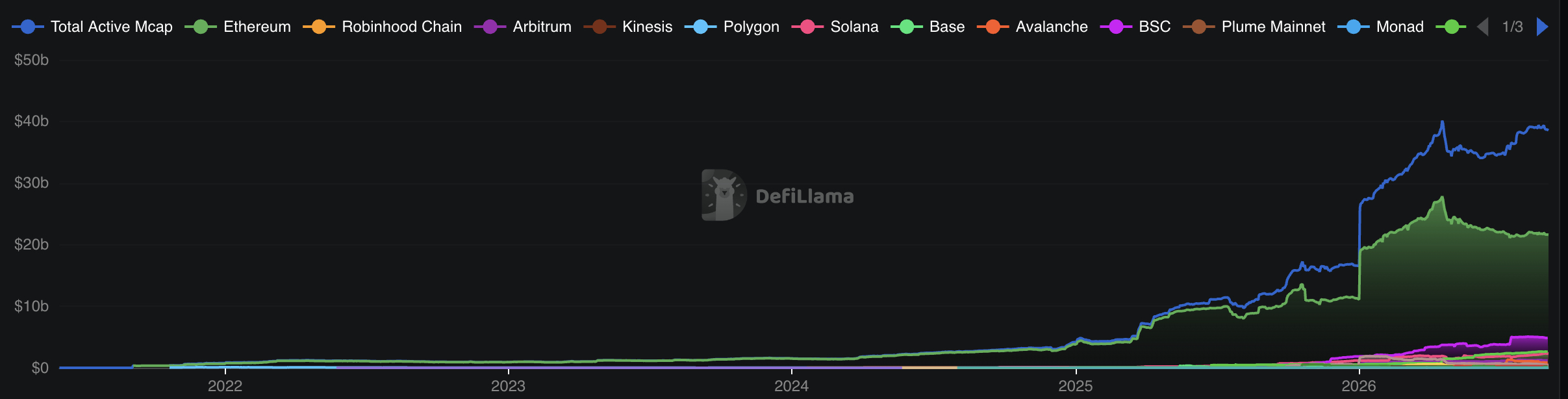
Ethereum might be down by 3% today, but the news that actually matters isn’t the price; it’s the $17.5 billion sitting on its rails. But dominance in tokenized assets hasn’t translated into dominance in price momentum.
Tokenized real-world assets crossed $38.69 billion in distributed value as of late August 2026, with Ethereum controlling nearly 45% of that market. It’s more than triple BNB Chain’s $5.8 billion and quadruple Solana’s $4.0 billion.

Securitize and Ondo, the two largest tokenization platforms, are both built primarily on Ethereum. BlackRock’s BUIDL fund launched there before expanding to seven other chains. The institutional trust layer is Ethereum’s, full stop.
But institutional trust and chart momentum are different games. ETH has spent the last 48 hours grinding inside a tight range, and the question traders are actually asking isn’t about RWA share.
Discover: The Best Token Presales
Can Ethereum Price Hit $2,800 This Week on This RWA News?
ETH is trading at $2,360, down 3% in the past 24 hours, with intraday action bouncing between $2,362 and $2,428. That’s a narrow band for an asset carrying this much macro attention. Institutional accumulation patterns continue even as spot price cools, which is the kind of divergence that usually resolves loudly in one direction.

The key technical marker is $2,550, described across multiple analyst notes as the ceiling standing between current consolidation and a real breakout attempt. Support layers sit at $2,438, then $2,383, then $2,350. A weekly close above $2,438 keeps the bullish September setup intact and opens a path toward $2,800–$2,920. Lose $2,350, though, and the chart likely exposes the $2,200–$2,000 zone next.
ETH’s relative strength against BTC will probably decide which scenario wins.
Trade Ethereum on Bybit and Get a Chance to Win Our $1,000 USDT Airdrop
Maxi Doge Targets Early Mover Upside as ETH Price Tests Key Levels
ETH holders staring at a fourth straight day of range-bound chop have earned the right to feel a little restless. Consolidation below $2,550 isn’t a collapse, but it isn’t conviction either.
At Ethereum’s size, even a clean breakout to $2,800 is a modest percentage move compared to what early-stage tokens can offer. That’s the rotation logic pushing traders toward presale plays right now.
Enter Maxi Doge ($MAXI), an ERC-20 meme token built around gym-bro trading culture and, appropriately enough, 1000x leverage energy. Priced at $0.0002836 with $4.8 million raised so far, the project has pulled in real presale volume without a single major exchange listing yet.
Standout features include holder-only trading competitions with leaderboard rewards and a dedicated Maxi Fund treasury for liquidity and partnerships. Dynamic APY of 65% for staking is now live for early buyers.
Research Maxi Doge before committing capital.
Discover: The Best Crypto to Diversify Your Portfolio
The post ETH Leads the RWA Boom, But Can It Break Its Last Cycle High? appeared first on Cryptonews.



After multiple appeals courts ruled differently about whether states can crack down on prediction markets’ sports products, New Jersey asked SCOTUS to step in.


OpenSea has added Solana NFT trading to OS2, giving users access to collections such as Mad Lads and Claynosaurz through its multichain marketplace.
Summary
- OpenSea now allows users to browse, buy, sell, and bid on supported Solana NFT collections.
- The Aug. 31 release extends OS2’s existing Solana services beyond fungible-token trading.
- Mad Lads, Claynosaurz, Collector Crypt, and Phygitals were available during the initial rollout.
- OS2 now competes more directly with Solana-focused marketplaces such as Magic Eden and Tensor.
OpenSea brings Solana NFT trading to OS2
OpenSea said in an Aug. 31 announcement that collectors can now browse, purchase, sell, and place bids on supported Solana NFTs through OS2. The launch includes Mad Lads, Claynosaurz, Collector Crypt, and Phygitals, among other collections built on the network.
Within the same interface, collectors can manage Solana NFTs without changing wallets or visiting a separate marketplace, according to the company. Creators using Solana can also list their work for OpenSea users who may already trade assets issued on other blockchains.
Solana token trading was already available through OS2 before the latest release. Adding NFT functions fills a gap in the platform’s support for the network, as users can now trade both fungible and non-fungible Solana assets through one account.
Released publicly in May 2025 after a testing period, OS2 initially offered token trading across 19 chains. The rebuilt platform also introduced cross-chain features, marketplace aggregation and support for tokens alongside the NFT products associated with OpenSea’s original business.
By Aug. 27, OpenSea said its market data covered more than 25 networks. Four days before the Solana NFT announcement, the company connected its market data to Perplexity Computer, allowing the AI service to answer questions about tokens, collectibles and onchain trading activity.
OpenSea co-founder and CEO Devin Finzer described the data used by AI agents as “open, live, and verifiable” when announcing the Perplexity integration. The service can identify heavily traded assets and collections by drawing from current OpenSea activity rather than relying only on token price feeds.
Solana support adds competition for NFT marketplaces
For Solana collectors, OpenSea’s release adds another place to trade collections that have largely depended on marketplaces with an established presence on the network. Magic Eden began as a Solana-focused platform before adding support for other ecosystems, while Tensor has built products around professional Solana NFT traders.
OpenSea’s entry creates more overlap among the marketplaces, though the company did not provide trading-volume targets, user projections or market-share estimates for its Solana product. Its announcement focused on access to collections and the ability to use existing wallets across supported networks.
The release also restores a service that OpenSea had tested several years earlier. In April 2022, the marketplace introduced Solana NFT support in beta, making Solana its first supported non-Ethereum Virtual Machine network. The new OS2 implementation brings Solana collections back into the platform more than four years after that initial test.
Competition now extends beyond individual NFT listings because the largest marketplaces have added networks, wallets, and token products to retain users. OpenSea has followed that model through OS2, combining its NFT marketplace with fungible-token trading and products that can pull liquidity from several chains.
Its July 2025 acquisition of Rally Wallet added a mobile-first wallet business focused on NFTs and tokens. OpenSea planned to place Rally’s technology within its product range, while Rally co-founder Chris Maddern joined the company as chief technology officer.
OS2 had launched two months before the Rally transaction with real-time liquidity aggregation and cross-chain functions. The wallet purchase gave OpenSea another route to develop mobile trading without separating token activity from NFT portfolio management.
OpenSea continues adding products beyond NFTs
While restoring Solana NFT trading, OpenSea has continued developing services outside its original collectibles market. In June, product executive Zack Brenner asked users about early access to perpetual futures and later indicated that Hyperliquid could supply the infrastructure.
The planned perpetual futures product would place OpenSea closer to crypto platforms that combine spot tokens, derivatives, and rewards. However, the company had not announced a release date or provided final product terms at the time of the report.
Product releases have moved ahead while OpenSea’s SEA token remains delayed. The company introduced SEA in February 2025 and initially expected to release it around March 30, 2026, with proposed uses including governance, reduced trading fees and staking linked to NFT collections.
In March, Finzer postponed the SEA launch and cited difficult market conditions. OpenSea did not provide a replacement date, while users who joined parts of its Waves rewards campaign received an option to recover certain platform fees by giving up associated Treasure Chest rewards.
The token was intended to support OpenSea’s plan for an application covering NFTs, fungible assets and other forms of crypto trading. Solana NFT support advances the product side of that plan without changing the unresolved schedule for SEA.
US regulatory questions remain relevant to OpenSea
For US users, access to Solana NFTs comes after the Securities and Exchange Commission ended an investigation into OpenSea without filing charges. The agency had issued a Wells notice in August 2024, indicating that its staff could recommend enforcement action based on the view that some NFTs traded through the marketplace might qualify as securities.
OpenSea said in February 2025 that the SEC had closed the investigation. Finzer called the decision a victory for NFT creators and argued that treating NFTs as securities would misinterpret existing law.
No enforcement case followed the Wells notice, but the closure did not create a general exemption for every NFT or marketplace operating in the United States. The legal status of an individual digital collectible can still depend on how it is issued, marketed, and sold under US securities law.
In April 2025, crypto.news previously reported that OpenSea had asked the SEC to clarify that NFT marketplaces should not be treated as securities exchanges or brokers. The company’s legal team argued that platforms such as OpenSea do not execute transactions, hold customer assets, or act as intermediaries in the same way as traditional securities firms.
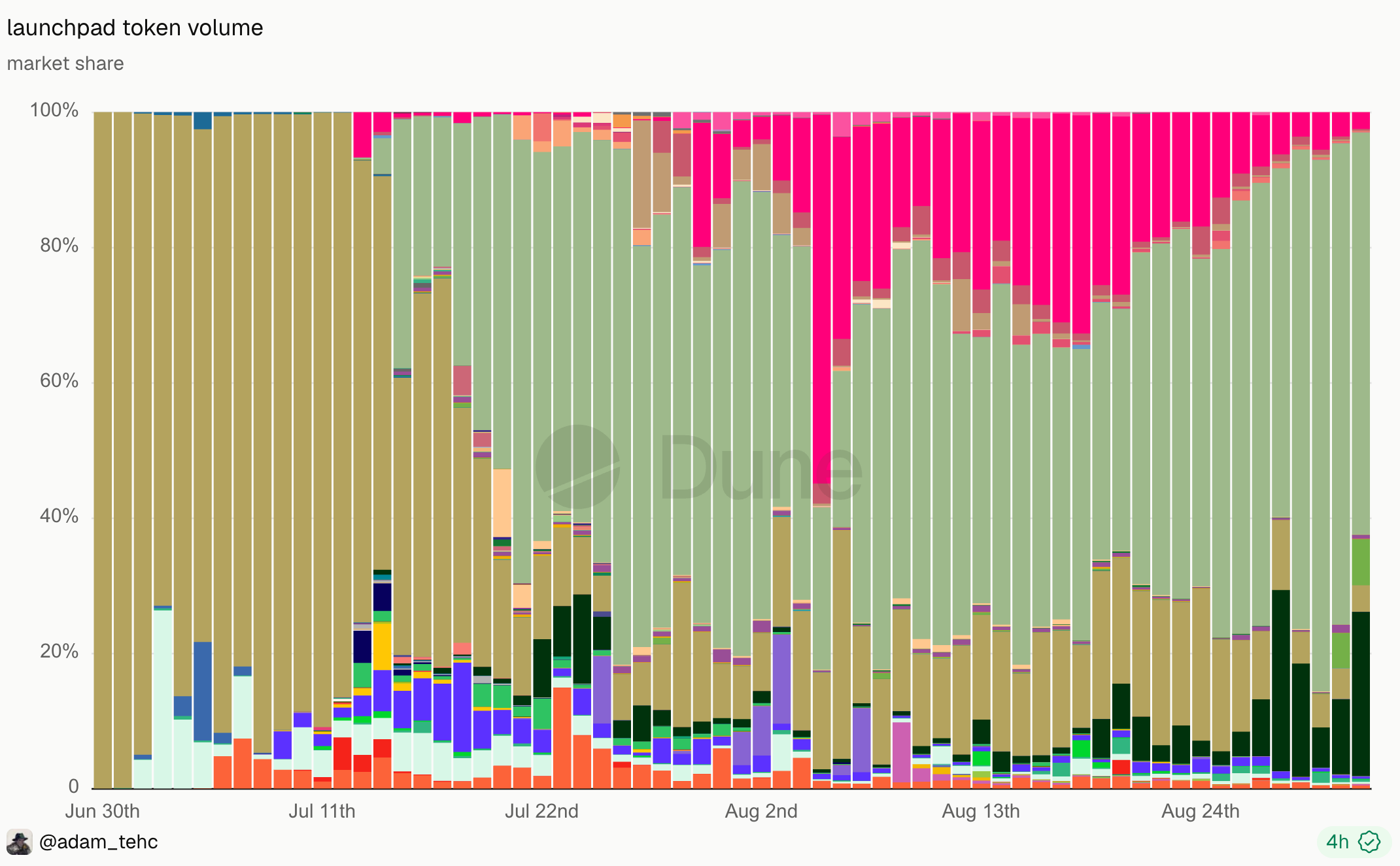
Robinhood built a chain for tokenized stocks. Meme coin traders took it over, and a launchpad called Pons says it has cleared $4.54 billion in volume in under 2 months.
Pons now runs most token launches on the network. Its own token reached a record high on September 1 and leads the chain by market value.
How Pons Took Over Robinhood Chain Launches
The $4.54 billion figure came from Pons’ post on X. The launchpad handled $370.2 million in volume on September 1, according to a Dune dashboard. Launchpads on the network processed $623.1 million combined that day.
That gave Pons 59% of all launch activity on the chain. Rival platform long.xyz placed second with $151.4 million. The lead is not new.
Pons overtook Noxa in mid-July and has held the largest share of daily launchpad volume nearly every day since. Only pools. trade has briefly passed it, in early August.

Token creation is more concentrated still. Launchpads minted 27,802 tokens on August 31, and Pons produced 17,909 of them. The platform counted 106,488 active wallets on September 1.
Fee generation has followed. Bubblemaps put Pons at $4.73 million in fees over 24 hours, citing DefiLlama. That total beat Hyperliquid, Polymarket, and Fomo combined, which reached $4.65 million.
It also topped the combined network fees of Robinhood Chain, BNB Smart Chain, and Solana at $3.46 million. Bubblemaps counted only base network fees for the chains.
Follow us on X to get the latest news as it happens
PONS Token Sets Record High
The volume story has a price story attached. PONS traded at $0.42436 early Wednesday, down 9.82% on the day. Its market capitalization stands at $301.9 million, ranking it 134th.
The token reached a record $0.49328 on September 1. It has gained 1,297.8% over the past month.

Dune data ranks PONS above AI and Cash Cat (CASHCAT) by market value. The token’s lead extends beyond that. PONS was also the most traded asset on the chain over the past 24 hours.
PONS drew $62.46 million in volume over 24 hours across 110,827 trades and 9,063 unique wallets.
Subscribe to our YouTube channel to watch leaders and journalists provide expert insights
The post Pons Earned More Fees in 24 Hours Than Hyperliquid, Polymarket, and Fomo Combined appeared first on BeInCrypto.
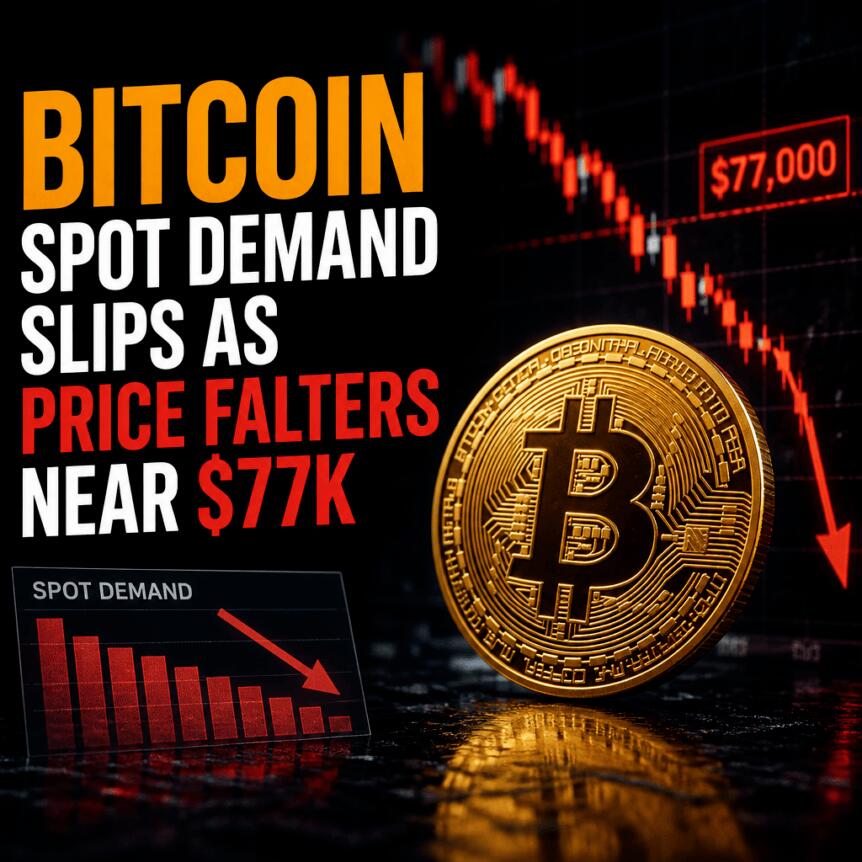
Bitcoin slipped lower in early Wednesday European trading, posting local lows near $76,400 before recovering to around $77,000, according to CoinGecko. The retreat came as broader risk assets weakened in Asia and as the US fixed-income backdrop remained fragile.
CryptoQuant data suggests the selloff wasn’t solely a momentum move—Bitcoin’s “apparent demand” indicator turned negative again following outflows from US spot Bitcoin exchange-traded funds (ETFs) reported the day prior.
Key takeaways
- Bitcoin sold off to roughly $76,400 before reclaiming the $77,000 area, but remains capped by a previously reported resistance cluster.
- According to CryptoQuant, Bitcoin’s apparent demand has flipped negative again after a short improvement during the August rally.
- US spot Bitcoin ETF flows showed $236 million in net outflows the previous day, aligning with the softer on-chain demand read.
- A sharp drop in USD/JPY to about 158.5 reignited speculation about another yen intervention, with no official confirmation at the time of writing.
- Asian equities fell broadly—South Korea’s KOSPI -4.0% and Japan’s Nikkei 225 -2.9%—with tech and chip names among the biggest drags.
CryptoQuant: apparent demand turns negative again
The latest leg down in BTC followed US spot Bitcoin ETF outflows of $236 million reported for the prior day. In parallel, CryptoQuant data indicates Bitcoin’s apparent demand measure has moved back into negative territory after a brief reprieve during the August rally.
The “apparent demand” concept is designed to infer whether market participants are actively absorbing newly created supply and previously dormant coins. It draws inspiration from commodity-market-style issuance versus inventory changes and attempts to capture the gap between newly mined issuance and changes in inactive supply.
In this framework, positive readings are generally interpreted as older coins waking up and the market absorbing both existing supply and new issuance—often viewed as a sign of active spot demand. Negative readings imply that coins are aging into dormancy faster than miners are creating new ones, which is typically treated as weaker spot demand conditions.
While BTC had regained the $77,000 level by the time of writing, it was still described as pinned under a nearby resistance cluster that Cointelegraph previously highlighted. The immediate question for traders is whether the bounce can break through that overhead supply or whether renewed negative demand readings will keep BTC confined.
Macro pressure: yields, USD/JPY, and possible yen intervention
Outside crypto, a broader risk-off mood was building. Earlier in the week, Cointelegraph reported on a global bond selloff that was weighing on markets; on Wednesday, the pressure appeared to ease slightly as the US 10-year yield briefly dipped below 4.8%.
However, FX markets added another layer of uncertainty. Commentators pointed to “inorganic” price movement in the USD/JPY pair around 13:00 UTC, interpreting it as a possible sign of another central bank action. USD/JPY fell to about 158.5, pulling away from the psychologically important 160 level that market participants widely expect the Bank of Japan (BOJ) to defend. At the time of writing, no official statement had confirmed whether intervention occurred.
This matters for crypto indirectly: rapid shifts in USD/JPY often reflect changing expectations for global liquidity and interest-rate differentials—conditions that can influence both risk appetite and the availability of capital for higher-beta assets like cryptocurrencies.
Asian equities slide, tech and chips lead the losses
Equities in Asia traded sharply lower, with multiple factors likely contributing, including rising oil prices and renewed profit-taking in parts of the AI complex. South Korea’s KOSPI led the decline, dropping 4.0% to close at 6,562.72. Among the largest detractors were chipmakers SK Hynix and Samsung Electronics, which fell about 4% and 4.7%, respectively.
Japan’s Nikkei 225 slid 2.9% to 64,325.64, with technology heavyweights contributing to the weakness. SoftBank Group—which has been an investor in OpenAI—was among the names weighed by the broader risk-off tape. The Taiwan index also declined, with the TAIEX down roughly 1.7%.
Earlier coverage from Cointelegraph had already raised concerns about the US side of the AI trade, including signs that credit stress was building via rising credit spreads for hyperscalers. While Wednesday’s equity weakness wasn’t explicitly attributed to any single catalyst in the source, the connection to credit sensitivity is a key reason investors often watch these developments alongside crypto—because a broad deleveraging cycle tends to pressure leveraged positions across markets.
What to watch next: demand signals and the macro backdrop
Bitcoin’s near-term direction may hinge on whether apparent demand continues to recover from the negative reading highlighted by CryptoQuant, or whether the market slips back into a pattern of dormant-supply growth. At the same time, watch USD/JPY for clearer confirmation around intervention expectations and monitor whether US yields stabilize—both can quickly change risk sentiment across crypto and traditional markets.


Commerce Secretary Howard Lutnick said the Trump administration now trusts Anthropic. His words end months of conflict with the maker of Claude. The artificial intelligence (AI) firm could go public soon.
Lutnick spoke to Axios on Tuesday. A day later, he shared a stage with Anthropic co-founder Tom Brown. The venue was a G20 technology meeting in North Carolina.
What Ended the Anthropic Feud With Washington
Asked in an interview whether he trusts Anthropic CEO Dario Amodei, Lutnick did not hedge.
“They’ve done what we asked. They’re back on the right side. So the answer is: Yes.”
The fight was real, seeing as in June, Commerce demanded licenses for foreign users of Anthropic’s strongest models. The company pulled Claude Fable 5 and Mythos 5 for everyone instead.
Regulators lifted the export restrictions on June 30. Access returned the next day. Weeks earlier, Trump had called Anthropic a threat to national security.
The courts moved too, and on August 28, US District Judge Rita Lin voided the Pentagon’s supply-chain risk label, calling the measures illegal and baseless. A second Pentagon designation is still live in the D.C. Circuit.
The Numbers Behind the Political Risk
Court filings show what the feud threatened. Chief Financial Officer Krishna Rao said the Pentagon label could cut 2026 revenue by multiple billions of dollars.
Public sector head Thiyagu Ramasamy put more than $150 million of recurring revenue at immediate risk. He projected public sector revenue above $500 million for 2026.
Anthropic’s revenue run rate reached $65 billion in August, Bloomberg reported. Government work is therefore worth well under 1% of the total.
So the damage was never mainly financial. It was the story. No company can sell itself as core infrastructure while Washington can switch it off.
“One question is in what ways besides supply chain risk the Trump admin could try to undermine Anthropic if this feud continues Some possibilities: Interfering with mergers, an IPO, other securities law stuff Denying federal permits for data centers,” one user said in February.
Anthropic filed confidentially in June. BeInCrypto reported in August that it could list as soon as late September or early October. Backers told the Financial Times they expect $2 trillion or more, though executives have fixed no target.
SpaceX set the bar in June with an $85.7 billion raise. Anthropic wants to beat that record haul.
Lutnick has cleared the political overhang. Investors must still decide whether Claude is worth double the $965 billion it fetched in May.
The post Anthropic Finally Repairs Trump Administration Ties as IPO Spotlight Grows appeared first on BeInCrypto.
Ondo Finance is urging US regulators to bring perpetual futures tied to individual stocks onshore, arguing that the products can already operate under the country’s existing security futures framework without new rules.
In three Aug. 24 comment letters to the Securities and Exchange Commission (SEC) and Commodity Futures Trading Commission (CFTC), Ondo argued that existing rules can accommodate perpetual stock futures while also accounting for modern margining practices and onchain market data.
Ondo said its Panama-based affiliate already offers stablecoin-settled perpetual futures on individual US-listed stocks outside the United States, with the platform recording $8 billion in cumulative trading volume as of Aug. 14, around six weeks after its launch.
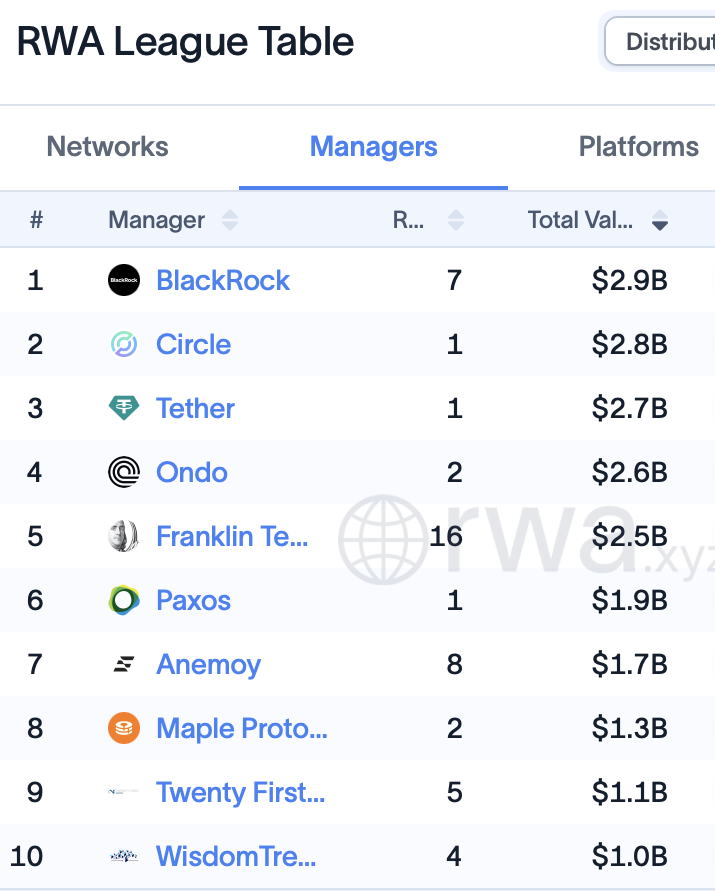
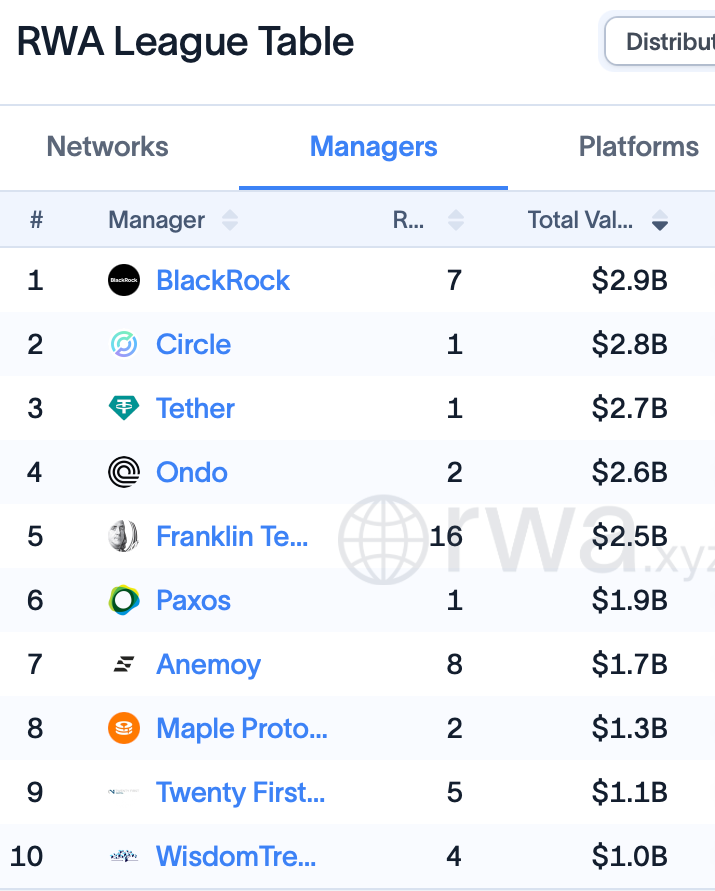
Ondo ranks fourth among tokenized RWA managers by distributed value. Source: RWA.xyz
The company argued that scheduled funding payments can keep perpetual contracts aligned with the price of their underlying stocks, performing a similar function to expiration in traditional futures.
“Nothing in the statutory definition of a security futures product requires a fixed expiration date,” Ondo said in its product-classification letter.
Ondo also noted that many of the stocks underlying offshore perpetuals are principally traded on US exchanges. “Bringing that activity back to the U.S. should not be an open question; it’s something both agencies should actively pursue,” the company said.
Ondo is among the largest managers of tokenized real-world assets, ranking fourth with about $2.6 billion in distributed value as of Wednesday, according to RWA.xyz data.
Related: Ondo shifts from layer-1 blockchain plan to offchain execution network
US regulators look to modernize market rules
Ondo’s proposal comes as US regulators reconsider how existing market rules apply to onchain products, including perpetual futures and tokenized securities.
President Donald Trump said in August that CFTC Chair Michael Selig was working to bring Hyperliquid into the United States in a “fully compliant and legal fashion.” Hyperliquid is best known for its onchain perpetual futures market, though neither the CFTC nor Hyperliquid has publicly detailed how US access would work.
HYPE, the native token of Hyperliquid, jumped more than 20% following Trump’s comments and has gained nearly 49% over the past month to trade around $81 on Wednesday, according to CoinGecko data.
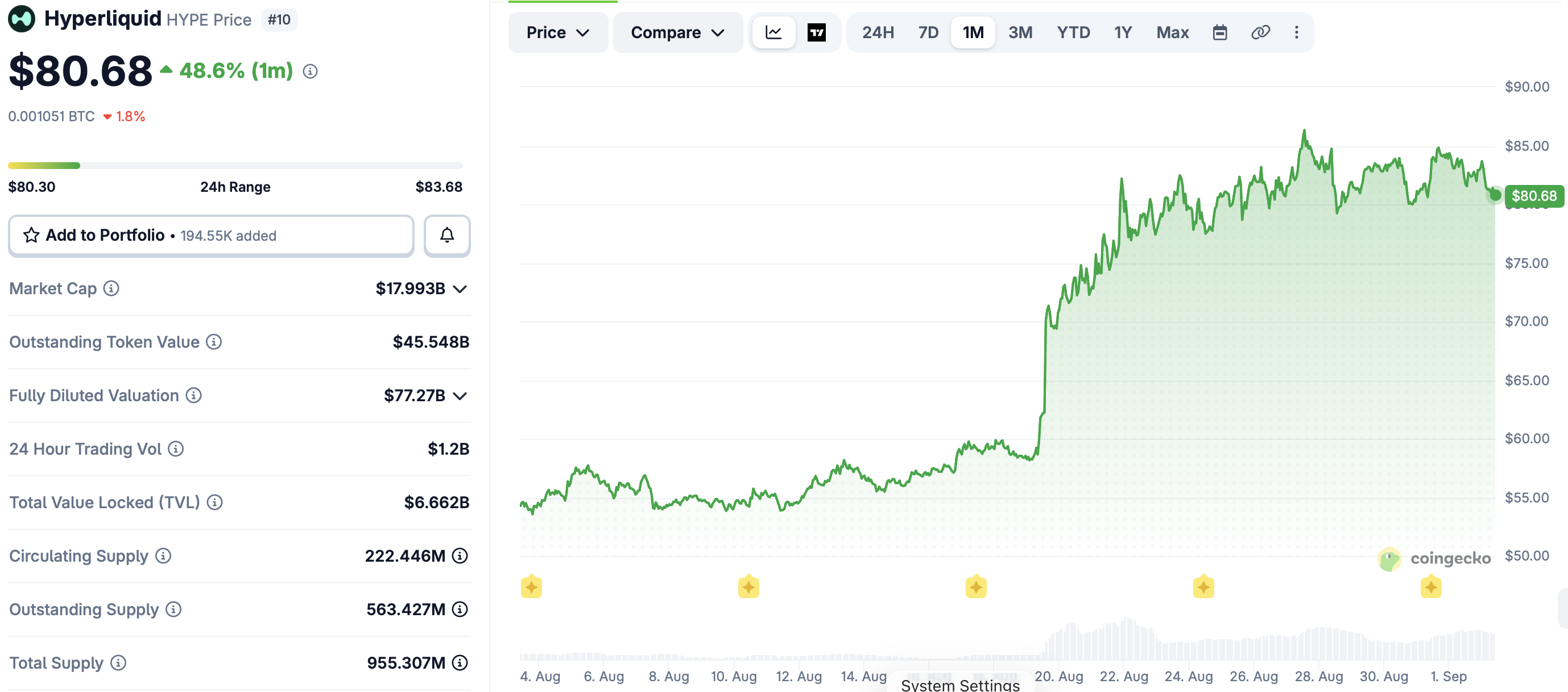
HYPE has gained nearly 49% over the past month. Source: CoinGecko
The SEC, which oversees securities markets, and the CFTC, which regulates US derivatives markets, have also stepped up coordination this year, signing a memorandum of understanding in March to harmonize oversight in areas where their jurisdictions overlap.
On Tuesday, the SEC proposed overhauling its decades-old transfer agent framework, citing growing demand for blockchain-native recordkeeping and tokenized securities in US markets as the agency reexamines rules built for older market infrastructure.
Magazine: BTC will hit $1M by 2030… but Arthur Hayes is buying ETH instead


What do we mean when we say a filmmaker has returned to form? Danny Boyle has made Oscar-winning movies (Slumdog Millionaire), great movies that people will remember forever (Trainspotting, 28 Days Later), and superb, expressive movies that not many people think about anymore (Sunshine, A Life Less Ordinary). Boyle has been making movies for so long now—and has been making them in such varied textures—that it’s hard to say what form, exactly, there is for him to return to. But Ink, which opens the Venice Film Festival, somehow feels both old-school—in the brash, Trainspotting way—and invigorating and modern; it’s almost as if Boyle were taking inspiration from himself, revisiting his catalog of ideas and revamping rather than repeating them. This is a bold, entertaining piece of filmmaking that also brings us back, perhaps to the precise year, when newspapers and other media organizations began veering away from serious news and toward the on-ramp of nonstop entertainment and stimulation. For that, we have news mogul Rupert Murdoch to thank. But as Ink tells it, Murdoch learned how to be Murdoch from a lesser-known player you may never have heard of: who the hell was Larry Lamb?
Ink, adapted from James Graham’s stage play and drawn from real life, opens in 1969 London on Fleet Street, the heart of the city’s newspaper business. The young, Australia-born Rupert Murdoch—played, with almost alarming charisma, by Guy Pearce—isn’t yet a mover and shaker in the news business. But he has a proposition for a brash Yorkshire newspaperman whose career has taken a nosedive. Would this guy, Larry Lamb—Jack O’Connell, crackling with roguish charm—like to spearhead the relaunch of a paper Murdoch has just purchased? The two meet in a tony London restaurant where newspaper deals are made, tussling like bulls as they outline their ideas of what news should be. Then they stride out into the night, and as they pass the paper’s offices, they drop down on all fours to feel the rumble of the printing presses belowground. Newspapers are in their blood; they can’t differentiate between their own heartbeat and the clanking of tomorrow’s edition rolling off the cylinders.

That image may sound corny, but as movie language, it works. Boyle and cinematographer Alwin H. Küchler (who also shot Sunshine) give the movie a zig-zagging, simmering energy. If Trainspotting mapped the euphoria and careless self-destruction of heroin addicts, Ink is the story of another kind of obsessive: guys in thrall to the big story, to power, and to money, maybe not even necessarily in that order. By 1969, London was already swinging, but not for these guys: In their trim but conventional Savile Row suits, they’re aware of the style revolution around them, yet they stay happily outside it, like gods smirking from Mount Olympus. It’s as if they’d long ago decided that their main job was to observe and reflect the world rather than actually live in it.
The first half of Ink tells the story of the Sun’s ascension, from its lagging position behind its hugely successful rival, the Daily Mirror, to a tabloid that seduced readers with new kinds of coverage. What, exactly, were working-class Londoners interested in reading about, Lamb would ask his assembled staff, including a starchily old-school deputy editor imported from Liverpool (Patrick Kennedy), a possibly over-the-hill sports editor (Christopher Fulford), and, most notably, the crackerjack newswoman Jules (Claire Foy, fierce as a firecracker), who’s been sleeping with the married Lamb for years in an arrangement that suits them both. He’s now given her the luxury of editing a “woman’s page,” which she’s free to fill with whatever she likes, including the radical feminist ideas that drive her. (She ends up printing an excerpt of the banned-in-Britain book The Sensuous Woman, a manual written to help women navigate and understand their own sexuality—though she makes it clear that it’s the guys who really ought to be reading it.)
.png?branch=production)
In revamping the paper’s coverage, the list of key categories Lamb and his staff come up with includes the usual suspects (sport, the weather) but also some surprises. Everyone, the staff concluded, loves watching television, but newspapers weren’t covering it—why not? And the men, of course, loved looking at naked women, and thus the “Page 3 Girl”—basically, a tasteful nudie image—was born. That’s how Lamb remade the Sun, and made his name. In the movie’s second half, in a gracefully executed tone shift, Lamb’s newly forged reputation as a wonder boy is tested; suddenly, Ink becomes a mildly grim true-crime thriller, based on a real-life case. (The principals involved are played by Jonathan Hyde and Lucy Russell.) Boyle presents the details as if he were splashing paint on canvas, not carelessly but with controlled strokes of energy.
Does Lamb want to help solve the mystery at the heart of this crime, or is his job to stay out of it and let the police do their job? He’s too addicted to sensationalism to know when to stop. In the story Ink tells, Murdoch is in thrall to Lamb and his instincts, even as he frequently recoils from them. He sees what’s unsavory about Lamb’s approach and, more than once, moves to restrain him; then he sees the uptick in the Sun’s sales figures and zips his lip. If you’d prefer to think of Murdoch as an individual wholly devoid of sex appeal, Pearce’s performance might rattle you; his Murdoch is shrewd but not inhuman—even monsters were young once. Foy’s character is a composite and not based on a specific individual, but she avoids all the pitfalls of playing a symbol. Jules is a woman in an overwhelmingly masculine world, so devoted to her work she doesn’t want to be anywhere else, but she never makes it look easy. Foy plays Jules’ moments of doubt with piercing clarity—she sees the moral cracks in her boss-and-lover’s ambitious strategies, and she voices them, but there are no moments of obvious triumph. Jules lives and works in a space where standing your ground can only make you exceedingly lonely.
And still, O’Connell’s Larry Lamb is a guy you want to root for, even if, as a modern person with a reasonable awareness of what’s happened to the news media in the internet age, you can see he’s making the snowball that starts the avalanche. O’Connell plays Lamb as somehow disreputable and principled at once; it’s simply that he’d rather be right than do right. He’s the kind of brazen, disreputable showman you want to creep closer to—even the young Murdoch feels it. Ink works as both a fictionalized snapshot of a lost world and a forensic exploration of what happens when you give the people what they want, instead of what they don’t know they want. It’s a movie about the beginning of an end, brought about by enterprising men who just wanted to sell papers. So thrilled by the lede they were writing, they gave zero forethought to the kicker.
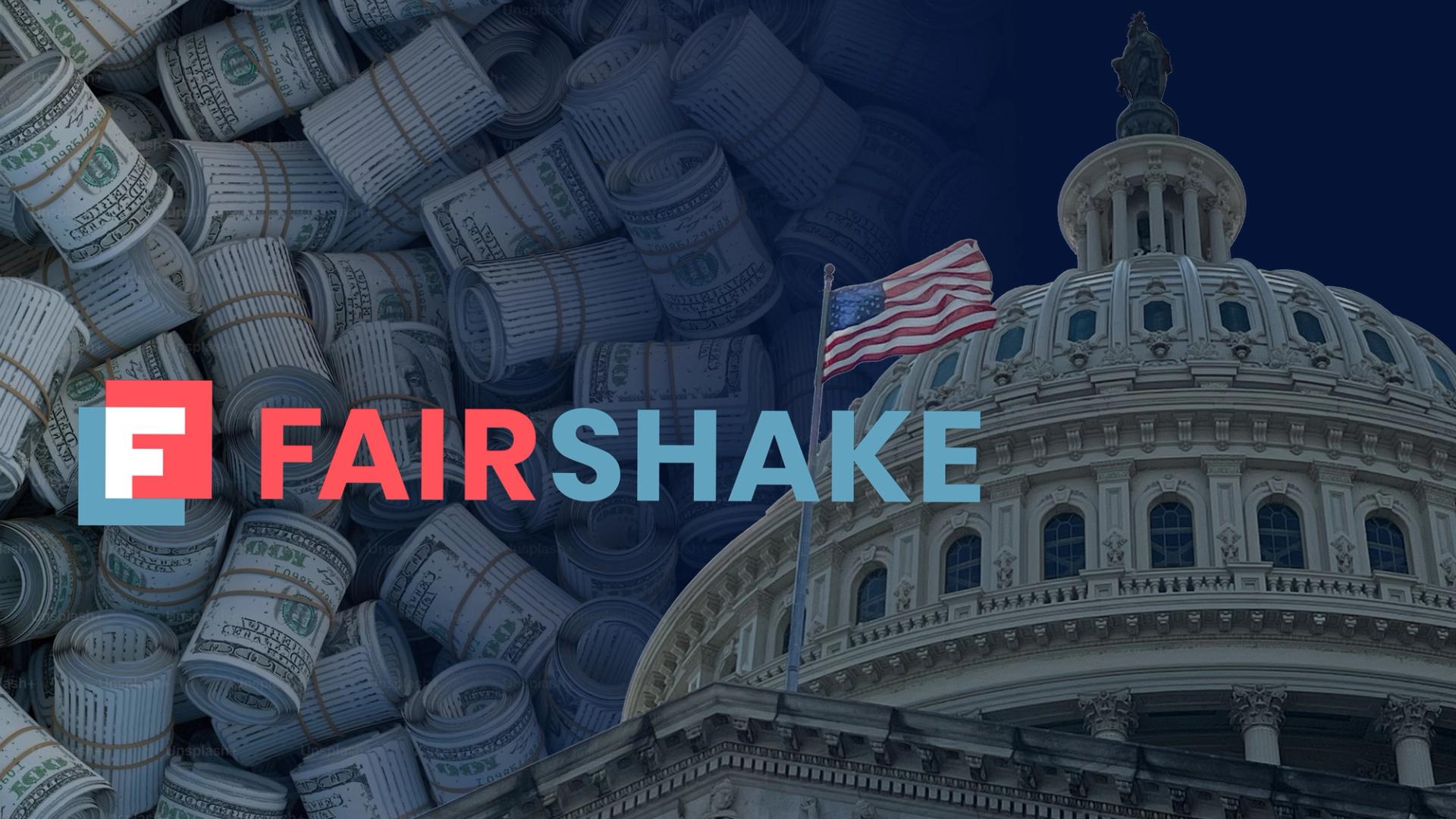
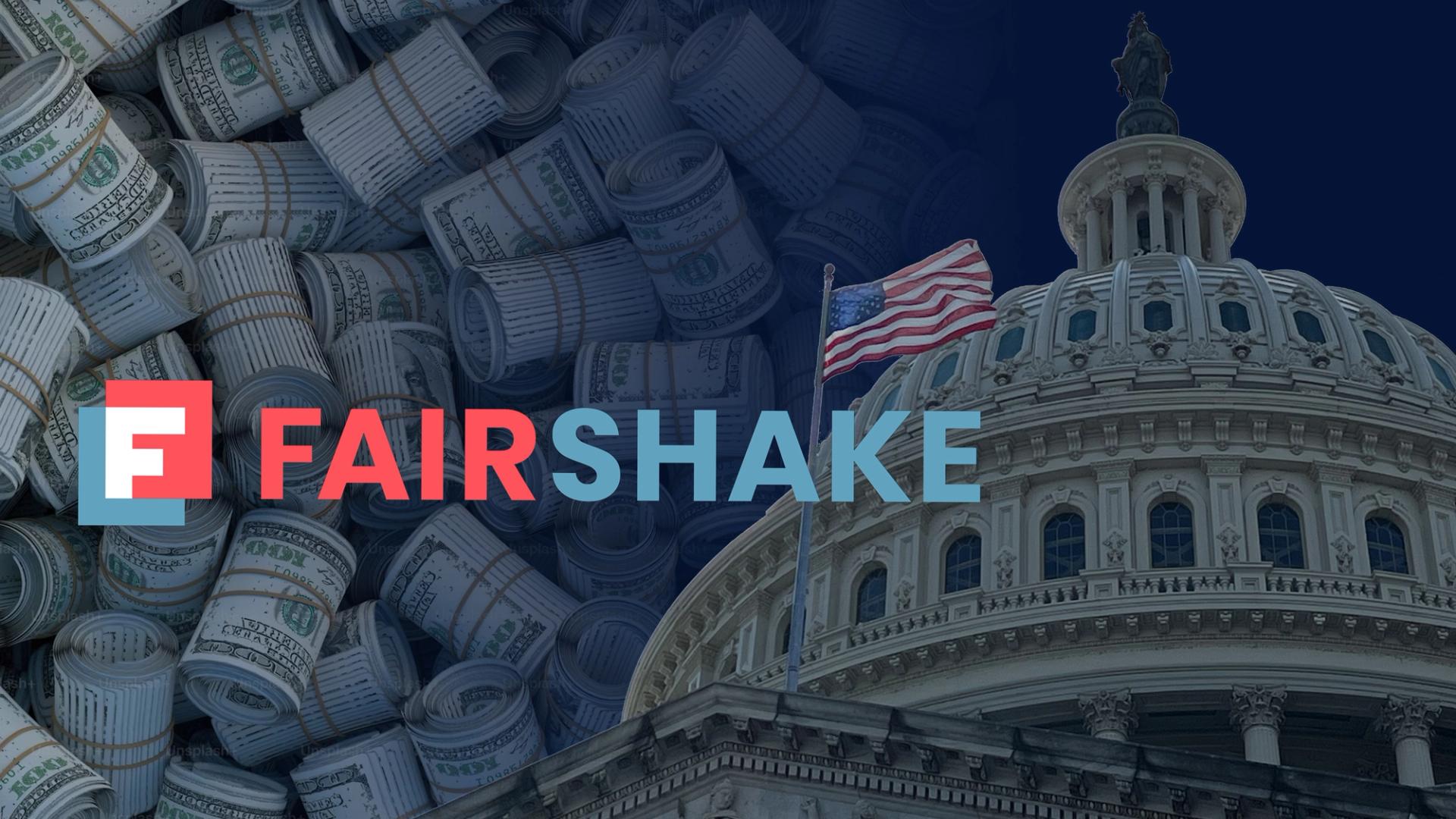
Adding Massachusetts incumbent Auchincloss to the list of winning primary candidates Fairshake supported, the industry’s influence moves on to November.
Crypto World
Two Thai Businessmen Sue Tether Over $42.4M USDT Freeze as Issuer Calls Case ‘Baseless’

Tether is facing a lawsuit in the Southern District of New York over the freeze of $42.4 million in USDT belonging to two Thai businessmen, Nutthawat Rukthammachalern and Natthawat Kasamvilas.
The plaintiffs allege that Tether blacklisted their Ethereum addresses in late October 2025 after receiving an informal request from an agent with the US Department of Homeland Security (HSI). A total of 42.4 million USDT was frozen. According to the businessmen, the stablecoin issuer took the action without a warrant, court order, or notice to them.
Funds Linked to Pig-Butchering Investigation
According to an update from Attorney Ariel Givner, the funds appear to be connected to an HSI Raleigh investigation into a pig-butchering case. The investigation began after a victim tip involving romance and investment fraud, a fake trading platform, and the movement of stolen USDT through multiple wallets in an effort to make the funds appear clean.
One of the wallets linked to the plaintiffs held about $26.1 million and had already been identified as a consolidation address in an “accumulate, layer, integrate” flow.
A warrant came later. On February 19, 2026, the Eastern District of North Carolina issued warrant 5:26-MJ-1267-JG, directing Tether to burn the frozen USDT and remint the tokens to a government wallet. Five days later, EDNC and HSI announced a $61 million USDT seizure traced to addresses allegedly associated with laundering proceeds stolen from pig-butchering victims. Tether was publicly thanked for carrying out the transfer.
The lawsuit, however, does not dispute the government’s claim that the funds are connected to scam proceeds. Instead, the plaintiffs have challenged Tether’s authority to freeze, burn, and reissue USDT that they say was purchased on the secondary market. The duo argued,
“Defendants are profiting directly from the freeze itself. Defendants use the actual U.S. dollars they receive when they mint USDT to purchase interest-bearing financial instruments, predominantly United States Treasury securities custodied in New York.”
Their claims include declaratory judgment, conversion, trespass to chattels, unjust enrichment, and injunctive relief. The duo is seeking to lift the freeze, damages if the tokens are destroyed, repayment of reserve interest earned during the freeze, and punitive damages.
Tether Defends Law Enforcement Role
The stablecoin issuer has defended the freeze. In a statement to CryptoPotato, the stablecoin issuer said,
“The new lawsuit against Tether is a baseless attempt to interfere with Tether’s important work with global law enforcement, including the Department of Justice, to prevent the unlawful use of USDT.”
The post Two Thai Businessmen Sue Tether Over $42.4M USDT Freeze as Issuer Calls Case ‘Baseless’ appeared first on CryptoPotato.
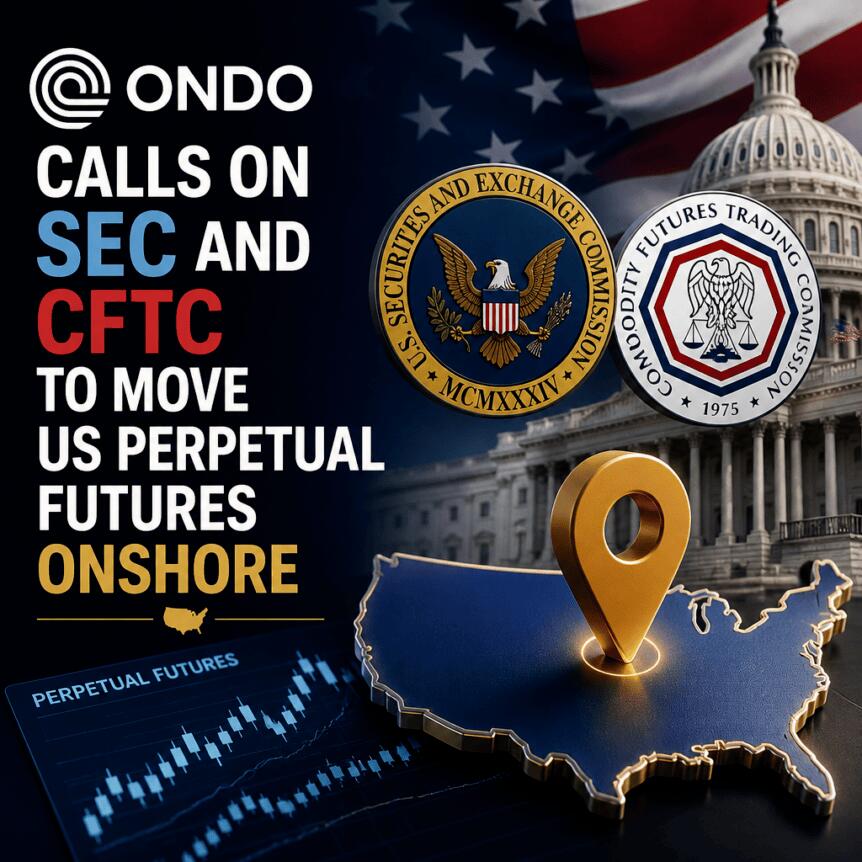
Ondo Finance is asking US regulators to bring perpetual futures tied to individual stocks onshore, arguing that the products can already fit within the country’s existing “security futures” framework rather than requiring new rulemaking. In comment letters submitted on Aug. 24 to both the Securities and Exchange Commission (SEC) and the Commodity Futures Trading Commission (CFTC), the company said that perpetual stock exposure can be structured to account for modern margining practices and the realities of onchain trading.
The proposal targets a persistent question for tokenized markets: whether crypto-linked perpetual instruments—without a traditional fixed expiration date—can still be treated as security futures products under current US definitions. Ondo’s filing also points to offshore activity as evidence that the market model is already functioning.
Key takeaways
- Ondo argues that perpetual stock futures do not need a fixed expiration date to fall under the statutory definition of a security futures product.
- According to Ondo’s filings, its stablecoin-settled perpetuals for individual US-listed stocks have already logged $8 billion in cumulative trading volume as of Aug. 14.
- Ondo says scheduled funding payments can keep perpetual contract pricing aligned with the underlying stock, serving a role comparable to expiration in traditional futures.
- The SEC and CFTC have been increasing coordination and revisiting older market rules that may not fit blockchain-native recordkeeping and tokenized securities.
Ondo’s argument: existing security futures rules can cover perpetuals
Ondo’s Aug. 24 comments were directed to the SEC and CFTC, with the company maintaining that regulators already have the tools to oversee perpetual futures tied to individual stocks within current security futures guidance. The letters argue that, with the right risk controls and market structure, the absence of a fixed expiration date should not disqualify the product from being classified as a security futures instrument.
Central to Ondo’s position is the idea that regulatory definitions for security futures do not inherently require a fixed maturity. “Nothing in the statutory definition of a security futures product requires a fixed expiration date,” Ondo wrote in its product-classification letter submitted to the SEC. The company’s filings also emphasize how margining and settlement mechanics can be adapted to modern trading environments.
Ondo further contends that funding mechanics can mimic the economic function that expiration provides in conventional futures. Instead of a contract rolling off on a specific date, scheduled funding payments are used to keep the perpetual contract’s price tied to the underlying stock—an approach commonly used in perpetual derivatives markets.
The company also highlights the operational reality that the underlying stocks for many offshore perpetual offerings are “principally traded on US exchanges.” In its view, US regulators should not treat domestic market participation as a barrier to bringing these products to regulated venues. “Bringing that activity back to the U.S. should not be an open question,” Ondo said, urging both agencies to pursue that shift.
Offshore track record is part of the compliance case
In its filings, Ondo pointed to live trading activity from a Panama-based affiliate that offers stablecoin-settled perpetual futures tied to individual US-listed stocks outside the US. Ondo said the platform recorded $8 billion in cumulative trading volume as of Aug. 14—about six weeks after the launch.
While offshore activity is not a substitute for US authorization, Ondo appears to use it as an evidentiary support for its claim that the product design can run at scale and with margining and pricing mechanisms that investors rely on. The company also provided information on its standing in tokenized real-world assets (RWA), noting that it ranks fourth among tokenized RWA managers by distributed value. According to RWA.xyz data cited in the filing, Ondo had about $2.6 billion in distributed value as of Wednesday.
Why the definition of “security futures” matters now
Ondo’s filing lands at a time when US regulators are increasingly re-examining how old market frameworks apply to onchain derivatives and tokenized securities. The SEC and CFTC have also increased public coordination on overlapping areas of oversight, including a memorandum of understanding signed in March to harmonize aspects of jurisdiction where responsibilities intersect.
On the securities side, the SEC has moved to modernize mechanisms related to tokenized markets. The agency recently proposed overhauling its transfer agent framework, citing growing demand for blockchain-native recordkeeping and tokenized securities in US markets—an acknowledgment that parts of the current infrastructure were built for traditional forms of ownership and recordkeeping.
Meanwhile, the derivatives conversation is actively evolving. In August, President Donald Trump said that CFTC Chair Michael Selig was working to bring Hyperliquid into the United States in a “fully compliant and legal fashion.” Hyperliquid is known for onchain perpetual futures, although details about how US access would be handled have not been publicly specified by the CFTC or Hyperliquid.
For Ondo, this regulatory backdrop makes its core request—bringing perpetual stock futures under a recognized oversight umbrella—more than a niche classification debate. If regulators accept Ondo’s interpretation that perpetuals can meet the statutory requirements for security futures, it could open a clearer path for other tokenized derivatives strategies to seek regulated access in the US.
What to watch next: regulatory posture and product design constraints
Ondo’s letters argue that no fundamental rewrite is required—only the application of existing security futures definitions to modern perpetual structures, including funding-based alignment to underlying assets and updated margining workflows. Still, the question for the market is whether the SEC and CFTC agree with that interpretation, and—if they do—what implementation details they will require.
Investors and builders should watch for whether regulators respond with guidance or enforcement signals that clarify classification boundaries for perpetual instruments tied to individual securities, and whether US venues will replicate or supersede offshore trading models like Ondo’s stablecoin-settled setup.

Oregon Coast’s strong form suggests success at Ipswich in 2026

What the Great Fire of London can teach us about modern climate change
European diesel margins hold steady despite US inventory rise





-

 Fashion5 days ago
Weekend Open Thread: Maeve – Corporette.com
-

 Crypto World6 days ago
Bitcoin’s 22% rally now needs real demand to outlast Treasury liquidity boost
-

 Business6 days ago
Apple Confirms September 9 Keynote and Reveals Its Full Pre-Order Schedule
-

 Crypto World7 days ago
Elon Musk Grok Bot Promise: We Will Make You Whole if AI Loses Your Money
-

 Business6 days ago
Salesforce Stock Soars 19% as Blowout Earnings and Agentforce AI Growth Silence Software Skeptics
-

 Business5 days ago
Onto Innovation Stock: AI’s Next Bottleneck Is Yield (NYSE:ONTO)
-
 NewsBeat7 days ago
Lindsay Clancy jury braces for closing arguments as judge tells court: ‘You’ve heard all the evidence’ – Live updates
-

 Crypto World7 days ago
NVIDIA revenue hits $96.2B as AI demand doubles
-

 Crypto World5 days ago
Bitcoin price tests $82K resistance as Brandt stays long
-
 Tech4 days ago
Hugging Face built a $4.5 billion empire on free AI models. Now Nvidia is buying it for $12.9 billion
-

 Crypto World7 days ago
Nvidia Q2 Earnings Reveal $96.2 Billion Beat, So Why Is NVDA Falling?
-

 Business5 days ago
iPhone 18 Pro Pre-Orders Could Shift to Saturday as Apple Reportedly Avoids September 11 Anniversary
-
 Tech7 days ago
Claude Cowork gets its own browser that doesn’t touch your tabs, bookmarks, or saved passwords
-
 Crypto World6 days ago
Truflation calls for Fed rate cut after PCE forecast
-

 Crypto World7 days ago
GENIUS Act missed its deadline as OCC writes rules anyway
-

 Tech5 days ago
PaperCut releases second emergency patch for exploited flaws
-

 News Videos3 days ago
Charlie Munger on Robinhood: No one should believe that Robinhood’s trades are free
-

 Tech7 days ago
Apple’s iPhone 18 Pro event is on September 9
-

 Tech6 days ago
The fix for the AI agent that hijacked a company’s DNS: it can propose the change, but it can’t approve it
-
 Entertainment5 days ago
‘Adults’ Creators Break Down Season 2’s Most Shocking Moments and Tease a Potential Season 3
You must be logged in to post a comment Login