
Crypto World
Ethereum Bullish Divergence Signals Strong Buyer Demand as ETH Holds Near $2,300


TLDR:
- Ethereum’s Taker Buy Sell Ratio has reached its highest level since late January 2023 on all exchanges.
- ETH prices dropped from $4,700 in October to $2,300, while aggressive buyer pressure rose sharply.
- Buy orders are outpacing sell orders, showing that demand is absorbing available supply at $2,300.
- Consistent data across Binance and all exchanges strengthens the bullish divergence signal for ETH.
Ethereum’s bullish divergence has emerged as a closely tracked signal in cryptocurrency markets. ETH prices have declined from roughly $4,700 in October to approximately $2,300 as of writing.
The Taker Buy Sell Ratio on Binance and across all major exchanges has risen sharply during this time. This contrast between a declining price and growing buy pressure points to strong demand building at current levels.
Aggressive Buyers Step In as Ethereum Trades Around $2,300
The 30-day simple moving average of the Taker Buy Sell Ratio has reached its highest reading since late January 2023. This pattern is consistent across both Binance and all major exchange data combined.
The ratio crossing above 1.0 shows that buy orders are currently outpacing sell orders in the market. At this level, demand is proving stronger than supply among active Ethereum traders.
Crypto analyst CryptoOnchain flagged this development on social media approximately seven hours ago. The post noted that aggressive traders, referred to as takers, view the $2,300 level as a key accumulation zone.
This type of buying at lower price points often reflects a degree of confidence from larger market participants. It also shows that experienced buyers are actively entering positions at these price levels.
When buy orders consistently outpace sell orders, available supply gets absorbed by demand over time. This process tends to reduce overall selling pressure as it continues. Consequently, the $2,300 range appears to be functioning as an active demand zone for Ethereum.
Taker Buy Sell Ratio Data Suggests Possible Seller Exhaustion in ETH
The Taker Buy Sell Ratio reaching multi-year highs during a price decline is a pattern worth examining. Historically, such readings have appeared near the later stages of downtrends in crypto markets.
This type of pattern has often preceded a shift in overall market momentum in past cycles. Still, historical data alone cannot confirm future price direction with any certainty.
CryptoOnchain’s post described what analysts call seller exhaustion in the Ethereum market. This condition occurs when sellers lose momentum and buy orders begin to dominate overall order flow.
A ratio rising to these levels during a bearish period adds important context to current conditions. It suggests that the selling pressure driving ETH lower may be gradually running its course.
Both Binance and all-exchange data align on this reading, adding consistency to the signal. When two separate data sources produce the same pattern, the likelihood of a false signal drops considerably.
As a result, market participants continue to monitor the Taker Buy Sell Ratio closely. Ethereum holds near the $2,300 level as this order flow data draws attention from active traders.




Western Union plans to launch its USDPT stablecoin next month as part of a wider move into digital assets.
Summary
- Western Union expects USDPT to go live in May for faster settlement across payment corridors.
- The Digital Asset Network will connect crypto wallets with Western Union’s large global cash-out network.
- A planned Stable Card will let consumers hold and spend dollar-backed stablecoins later this year.
The company said the token is in its final stage of readiness after months of preparation.
CEO Devin McGranahan said during the firm’s first-quarter earnings call that Western Union has moved past the planning stage. He said, “It is no longer a question of if Western Union will be active in digital assets; it is now how fast we can scale.”
USDPT will support settlement, not retail users
USDPT will be a U.S. dollar-backed stablecoin built on Solana and issued by Anchorage Digital Bank. Western Union first announced the stablecoin in October as part of its plan to modernize money movement.
McGranahan said USDPT will not launch as a direct consumer-facing stablecoin. Instead, the company plans to use it as an alternative settlement tool with agents, including in select countries and core payment corridors.
Additionally, Western Union is also launching its Digital Asset Network, known as DAN. The platform will connect crypto wallets with Western Union’s retail and agent network, helping users convert digital assets into local currency.
The company said the first DAN partner is expected to go live this week. McGranahan said, “Millions of wallet users will be able to move from digital assets into local currency using Western Union’s retail network.”
Stable Card planned for global consumers
Western Union also plans to launch a U.S. dollar Stable Card later this year. The card will allow users to hold value in stablecoins and spend across dozens of markets.
The company said the product may serve customers in inflation-sensitive markets who want dollar-denominated value for daily use. McGranahan added that Western Union now aims to scale adoption and embed digital assets into its core money movement platform.
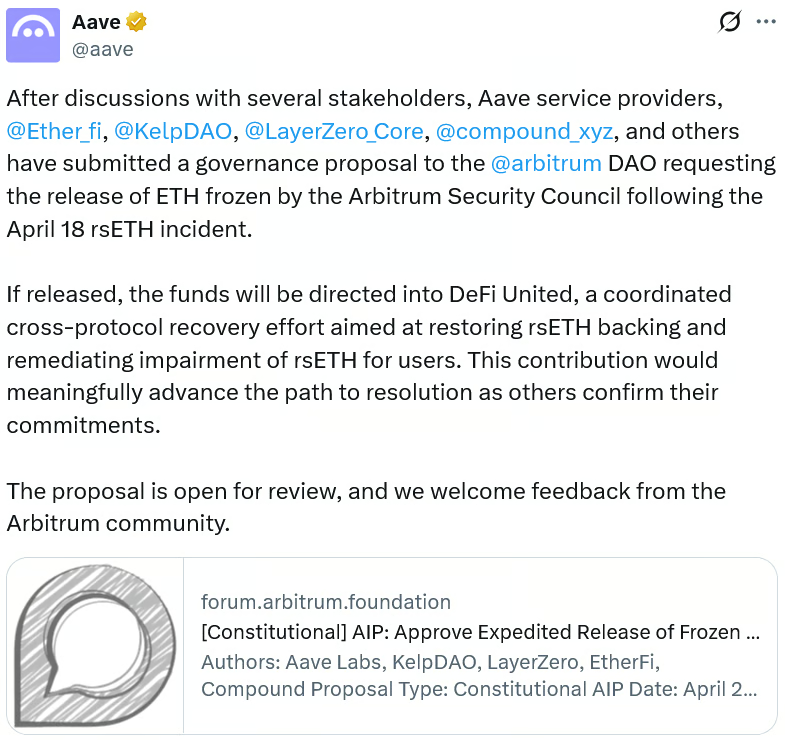
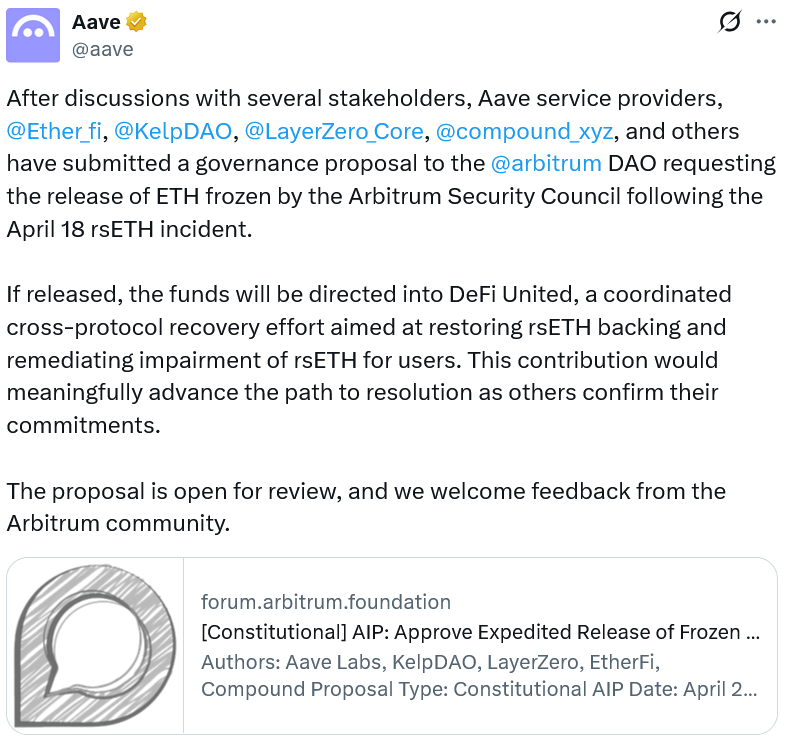
Aave Labs has proposed that the decentralized autonomous organization behind Arbitrum unfreeze $73.5 million in Ether tied to the Kelp DAO attack and to direct those funds to “DeFi United,” a fund aimed at restoring rsETH and compensating its holders.
Last week, the Arbitrum Security Council moved to freeze 30,765 Ether (ETH) held in a wallet connected to the $293 million Kelp exploit.
In a proposal posted Saturday on the Arbitrum governance forum, Aave Labs said directing those funds to a planned remediation effort would “restore normal conditions for Arbitrum users” and the wider ecosystem and that the Ether on Arbitrum “represents a material contribution” toward restoring the Kelp DAO restaked ETH (rsETH) token.
The submission was made with the support of Kelp DAO, LayerZero, Ether.fi and Compound, four of the several crypto protocols affected by the hack.
DeFi United sees $21 million in contributions
The proposal comes days after Aave Labs and others set up the “DeFi United” on Friday in an effort to fully restore the backing of rsETH.
Dune Analytics data shows that about $21 million in contributions has already been made, with contributions including those from Aave Labs CEO Stani Kulechov, Aave Labs head of contracts Emilio Frangella, Kelp DAO, Golem Foundation, Web3 development platform BGD Labs and Babylon, a Bitcoin-native DeFi protocol.
Another $215 million has been pledged by Arbitrum, Mantle, Ether.fi and Lido to assist the recovery effort, which are subject to governance votes.
LayerZero, Ethena, Ink Foundation and Frax Finance have also signaled their intention to help.
Source: Aave
Aave was hit hard by the Kelp DAO exploit, with its total value locked falling nearly $12 billion in a week after the hacker put the stolen rsETH tokens up as collateral on its lending platform to borrow wrapped Ether, leaving more than $190 million in bad debt and triggering a wave of withdrawals.
Aave sets a seven-week timeline for the recovery plan
In the Arbitrum proposal, Aave Labs said a full recovery would not only restore rsETH’s backing but also normalize conditions for its holders, liquidity providers and borrowers on Arbitrum and across the broader DeFi ecosystem.
Related: Coinbase says capital access beats income in wealth creation
Even a “partial recovery would still meaningfully reduce the shortfall,” Aave Labs added.
Aave Labs has specifically asked for the 30,765 Ether to be sent to a recovery address controlled by Aave, Kelp DAO and blockchain security platform Certora.
Aave Labs said it expects the effort to restore rsETH and compensate its holders to take about 49 days and that it would return the funds if the recovery effort falls through.
Magazine: Singapore isn’t a ‘crypto hub’ — it’s something better: StraitsX CEO


Spending by major tech firms on artificial intelligence (AI) infrastructure has surpassed investment in oil and natural gas production.
The shift comes as these companies drive an unprecedented surge in data centre funding in 2025, according to the International Energy Agency.
AI Becomes a Bigger Capital Story Than Oil and Gas
Combined capital expenditure of five tech firms topped $400 billion last year. Moreover, the IEA estimates that this could climb another 75% in 2026, signaling that AI infrastructure has become a dominant force in global capital flows.
Follow us on X to get the latest news as it happens
On the demand side, the expansion appears equally strong. Major AI model providers reported a 3x increase in active users and a 5x surge in revenue over the past year, metrics that help explain the investor positioning around the sector.
However, the scale of investment is beginning to outpace what companies can fund internally. Data centre development has grown too capital-intensive to rely solely on corporate balance sheets, making external financing from capital markets increasingly essential.
Debt markets are already reflecting this shift. AI-related debt has climbed to $1.4 trillion, making it the largest segment within US investment-grade credit markets.
Nonetheless, this reliance means that the pace of data centre expansion and the corresponding rise in energy consumption are expected to remain highly sensitive to market sentiment.
Investor expectations around returns on AI infrastructure, alongside broader macroeconomic and financing conditions, will likely determine how quickly the sector continues to scale.
“Understanding the energy implications of AI therefore, also means following closely the technology’s economic trajectory,” the IEA added.
The influence of AI is also becoming more pronounced in equities. BeInCrypto recently reported that AI-linked companies now account for a record 45% of the S&P 500’s total market capitalization.
Together, the capex surge, debt market footprint, and equity concentration suggest AI has become not just a technology story but a defining force in global capital allocation.
Subscribe to our YouTube channel to watch leaders and journalists provide expert insights
The post Big Tech’s AI Spending Eclipses Global Oil and Gas Production Investment appeared first on BeInCrypto.

Aave Labs has proposed that Arbitrum’s decentralized autonomous organization unfreeze 30,765 Ether — roughly $73.5 million in value at current prices — tied to the Kelp DAO attack and redirect those funds to a remediation vehicle named DeFi United. The Ether in question sits in a wallet linked to the exploited Kelp platform, and last week the Arbitrum Security Council moved to freeze the asset as investigators assessed the breach.
In a governance proposal posted on Saturday, Aave Labs argued that releasing the frozen Ether to DeFi United would “restore normal conditions for Arbitrum users” and the broader ecosystem, noting that rsETH’s backing represents a meaningful contribution toward stabilizing the stablecoin’s value after the incident.
The submission is supported by Kelp DAO, LayerZero, Ether.fi and Compound, among other protocols affected by the hack.
DeFi United contributions reach $21 million
Days after DeFi United’s launch, data from Dune Analytics shows roughly $21 million in commitments has already been pledged. Among the early contributors are Aave Labs chief executive Stani Kulechov, Aave Labs head of contracts Emilio Frangella, Kelp DAO, the Golem Foundation, Web3 development outfit BGD Labs, and Babylon, a Bitcoin-native DeFi project.
The effort to pool resources for rsETH restoration has drawn broad participation from across the DeFi and Layer-2 ecosystems, signaling a coordinated response to the incident that dented trust in the Arbitrum environment.
Broad pledge wave extends beyond DeFi United
In parallel with DeFi United’s fundraising, Arbitrum, Mantle, Ether.fi and Lido have committed an additional $215 million to support the rsETH recovery effort. These pledges are counted as contingent on governance approvals, underscoring the role of token holders in determining how resources are allocated in response to the attack.
Support has continued to surface from other major players in the ecosystem, including LayerZero, Ethena, Ink Foundation and Frax Finance, all signaling willingness to contribute to the remediation push as governance votes move forward.
Overall, the coordinated response reflects a broader industry push to stabilize rsETH and reassure users after the vulnerability was exploited and collateral was rehypothecated across DeFi protocols.
Recovery plan timeline and governance safeguards
Aave Labs frames the proposal as a path to not only restore rsETH’s backing but also to normalize conditions for rsETH holders, liquidity providers and borrowers on Arbitrum and across the DeFi stack. The team describes a recovery window of about 49 days (roughly seven weeks) and notes that even a partial recovery would meaningfully reduce the shortfall.
Crucially, the plan calls for the 30,765 Ether to be transmitted to a recovery address controlled by a coalition of actors—Aave, Kelp DAO and the Certora security platform—to manage the process and oversee the restoration work. Aave also indicated that funds would be returned if the remediation effort does not materialize as planned, placing governance safeguards at the center of the operation.
The governance process surrounding these proposals remains pivotal. While DeFi United and the broader pledges push toward an accelerated remediation, final approvals hinge on Arbitrum’s community votes, which will determine whether the funds flow into the recovery pipeline and how oversight is structured during the process.
The unfolding efforts come amid a difficult period for Arbitrum’s ecosystem, with the Kelp incident highlighting the fragility of cross-chain finance and the interdependence of DeFi protocols. As the community weighs the proposal and the wider commitments, observers will be watching not only for the timeline’s adherence but also for how effectively the recovery architecture can restore confidence in rsETH and the health of Arbitrum’s DeFi liquidity.
Watch next as Arbitrum’s governance process progresses, and as DeFi United’s fundraising translates into operational steps for rsETH restoration. The outcome will influence expectations for coordinated, multi-party responses to security incidents and may set a precedent for how similar crises are handled across Layer-2 ecosystems.


Justin Sun stated that TRON aims to become the “world’s first quantum-resistant network,” outlining plans to roll out quantum-secure infrastructure by 2026.
While quantum computing continues to advance, its real-world threat to cryptographic systems remains largely theoretical for now. Nevertheless, leading blockchain networks are already taking early steps to mitigate potential risks posed by future quantum capabilities.
Justin Sun Bets on Quantum Resistance to Future-Proof TRON in the AI Era
In a post on X, Sun said TRON will activate a quantum-resistant network on the testnet during Q2 2026. The mainnet rollout is set for Q3 2026. He described the planned upgrade as the “world’s first quantum-resistant network.”
“As the founder of a major cryptocurrency, we should, while focusing on the benefits of AI applications, pay close attention to the risks brought by AI development, with quantum computing’s decryption being the most core key,” he said.
Sun framed quantum-resistant infrastructure as a prerequisite for the AI era, arguing that decryption risks make post-quantum security the “primary demand.” He also affirmed that user funds on the network would remain secure in the AI-driven era.
Subscribe to our YouTube channel to watch leaders and journalists provide expert insights
The TRON announcement arrives as several major chains have moved on parallel tracks. In March, Ethereum Foundation developers launched a Post-Quantum Ethereum website.
The team projects that Layer 1 (L1) protocol upgrades could finish by 2029. However, full migration of the execution layer is expected to take additional years. The Solana Foundation has gone further by deploying post-quantum digital signatures on a testnet.
Outside the chain layer, Coinbase’s CEO, Brian Armstrong, announced an independent advisory board in January 2026 dedicated to quantum computing and blockchain security.
Meanwhile, search giant Google has outlined its own schedule last month, setting a 2029 target to migrate to post-quantum cryptography (PQC).
Whether TRON meets its Q3 target will shape how seriously rival networks take the threat this year. For now, the race is taking place across multiple chains.
The post Justin Sun Sets 2026 Timeline for TRON’s Quantum-Resistant Transition appeared first on BeInCrypto.
The next crypto to explode just received a signal from the corporate treasury front. Strategy added 34,160 Bitcoin to reach 815,061 total coins and passed BlackRock as the largest corporate holder according to Yahoo Finance. When the biggest funds on Wall Street treat Bitcoin companies as core holdings, fresh capital is already moving toward tokens that have not been priced yet.
That institutional wave kept Solana (SOL) at $85.73 and Cardano (ADA) at $0.2512. But large caps at these levels cannot deliver the return that a presale entry offers before exchange listings. Pepeto has collected $9.45 million and the Binance listing is approaching. Pepeto is where the real return builds.
Strategy disclosed its latest purchase of 34,160 BTC for $2.54 billion on April 24, pushing its total holdings to 815,061 coins and overtaking BlackRock’s iShares Bitcoin Trust according to Yahoo Finance.
Solana (SOL) trades at $85.73 according to CoinMarketCap with a weekly MACD bullish crossover forming for the first time since the 2022 cycle low. Cardano (ADA) sits at $0.2512 with the Van Rossem Hard Fork scheduled for late April.
When the world’s largest corporate Bitcoin buyer doubles down at $77,000, the institutional floor under crypto tightens for every token on the board.
Top 3 Next Crypto to Explode
Pepeto: The Presale Where $9.45 Million Shows That Informed Capital Already Found Its Entry
The reason presale entries beat large caps like Solana and Cardano on returns is direct: entry price controls the outcome.
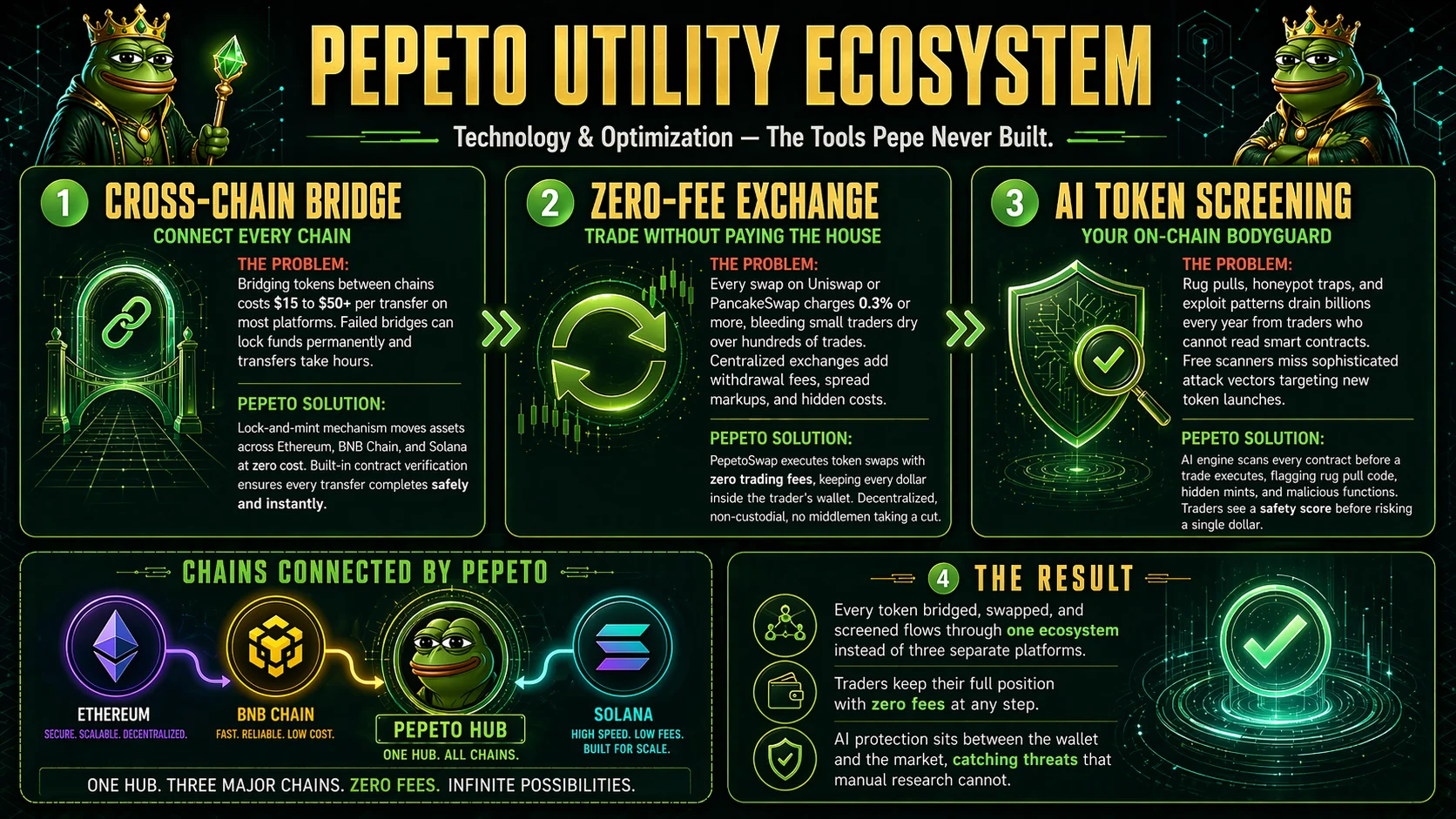
Timing decides results in crypto. Prices shift in seconds, and if a buyer is moving between platforms to bridge, swap, and check a token, the trade is already gone. Pepeto, considered the next crypto to explode, brings every tool into one platform.
The team created PepetoSwap for instant swaps across chains, Pepeto Bridge for zero-cost transfers, and a full exchange with a token scanner that reviews every contract before capital touches it.
The presale gathered $9.45 million at $0.0000001866, SolidProof completed a full audit of every contract, and staking at 178% APY rewards holders on a daily basis. The creator of PEPE’s $11 billion market cap leads this project with a former Binance listing specialist on the team. The Binance listing is days away, and once it opens this entry price is gone for good.
Solana (SOL) Price at $85.73 as Weekly MACD Bullish Crossover Forms and Institutional Staking Opens
Solana (SOL) trades at $85.73 according to CoinMarketCap, up 0.92% after Anchorage Digital opened institutional staking through Marinade and the weekly MACD printed its first bullish crossover since the 2022 cycle bottom.
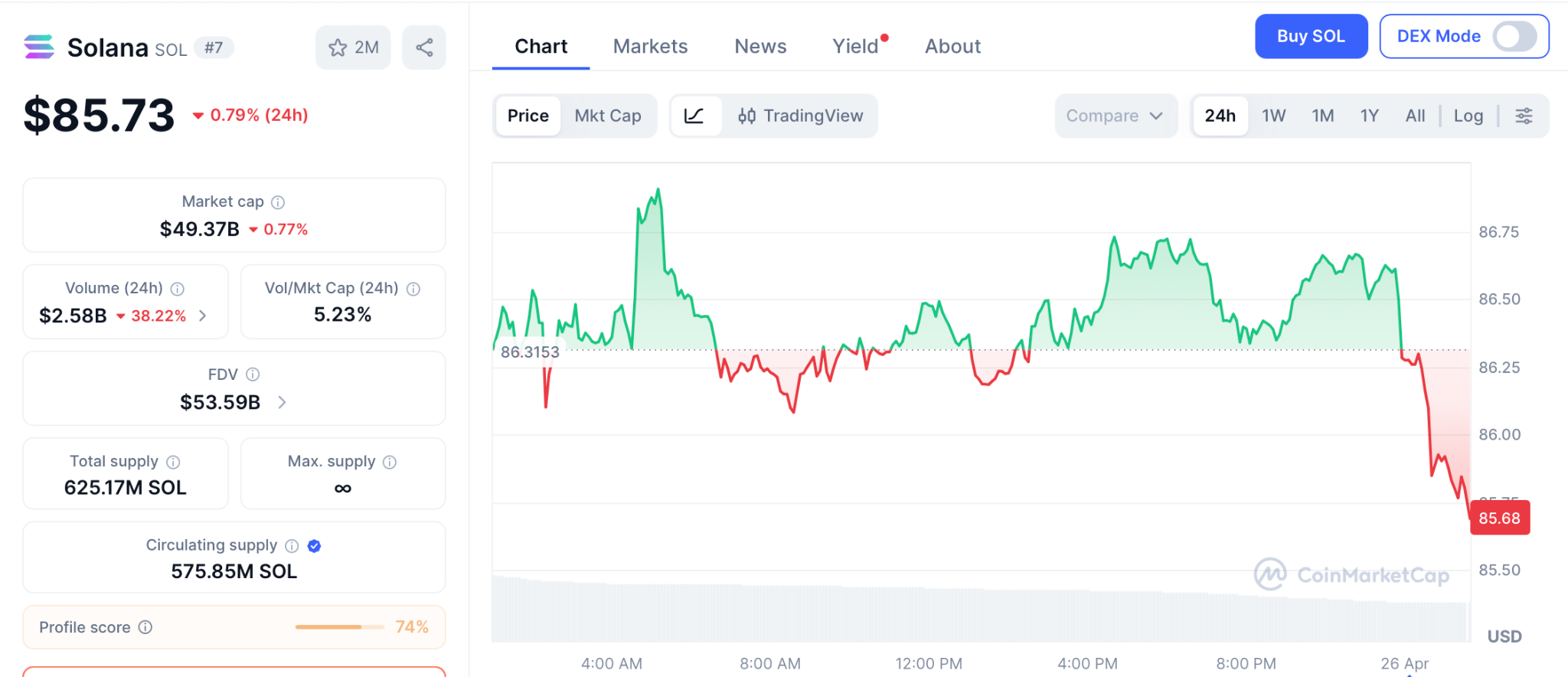
Support holds at $80 with resistance at $90. But Solana at a $44.7 billion market cap does not offer the type of return that presale pricing delivers. A move from $85 to $110 is 28% over months, nowhere near the multiples that one listing event can produce. SOL remains 70.6% below its $294.87 all-time high from January 2025.
Cardano (ADA) Price at $0.2512 as Van Rossem Hard Fork Nears and Treasury Request Drops to $46.8 Million
Cardano (ADA) sits at $0.2512 according to CoinMarketCap, up 1.0% as Input Output cut its 2026 treasury request from $97.5 million to $46.8 million for scaling projects. The Van Rossem Hard Fork targets late April to improve node security.
Analyst targets range from $0.248 to $0.303 by June according to Changelly. But ADA sits 91.9% below its $3.10 all-time high from September 2021, and even a return to $1.00 is only a 4x, while Pepeto at $0.0000001866 carries return potential no large cap can reach.
Conclusion:
It took Strategy passing BlackRock as the top corporate Bitcoin holder for the market to see that institutional capital is still buying. Saying Pepeto is a stronger entry than SOL and ADA sounds direct, but those two tokens top out at 3x to 4x this year based on current forecasts.
Presale entries have delivered at least 10x after exchange listings in previous cycles, and projects with working products return far more. Pepeto combines a live exchange with meme coin reach that alone created returns no large cap token ever matched.
The presale is gaining attention fast, rounds are closing faster than any meme coin this cycle, and entering now through the Pepeto official website is how buyers take their position before the Binance listing prices everyone else out.
Click To Visit Pepeto Website To Enter The Presale

FAQs
What is the next crypto to explode in April 2026?
Pepeto holds the top position with a working exchange, cross-chain bridge, and token scanner all completed before listing day. The presale raised $9.45 million at $0.0000001866 with a PEPE architect and SolidProof audit covering every contract.
Is Solana (SOL) a good buy at $85.73 after the weekly MACD bullish crossover?
Solana (SOL) trades at $85.73 with institutional staking access now open through Anchorage Digital and a bullish MACD crossover forming on the weekly chart. Pepeto through the Pepeto official website offers presale pricing and listing returns that SOL at its current $44.7 billion market cap cannot match.
Disclaimer: This is a Press Release provided by a third party who is responsible for the content. Please conduct your own research before taking any action based on the content.
TLDR:
- The 2025 altcoin cohort holds approximately +5% while 2020–2024 assets sit between -18% and -23% losses.
- Binance outperforms all major exchanges at +6.58%, while Deribit leads losses among new listings at -40.1%.
- Altcoin seasons no longer lift all assets equally — capital now flows selectively toward new, liquid, and socially amplified tokens.
- Whether 2025 listings hold positive ground through the next Bitcoin volatility event will test if this structural edge lasts.
Altcoin cycle patterns in 2025 reveal a clear shift in how capital moves across cryptocurrency markets. Recent data shows that newly listed altcoins are outperforming older cohorts by a measurable margin.
Assets from the 2020–2024 era are trading between -18% and -23% over the last 90 days. The 2025 cohort, however, holds approximately +5%, pointing to a market that rewards recency over longevity.
New Listings Reflect a Market That Chases Immediacy, Not History
Across every altcoin cohort from 2020 to 2024, assets are structurally underwater over the past 90 days. The losses cluster tightly between roughly -18% and -23%, regardless of project age or prior market cycles. This pattern holds consistently, suggesting it is not isolated to any single asset class.
The 2025 cohort breaks that trend. Newly listed altcoins are holding positive ground at around +5% over the same period. The contrast between the two groups draws a clear line between what the market currently rewards and what it does not.
Cryptoquant analyst MorenoDV_ framed it plainly: “The market doesn’t reward persistence but rewards immediacy.” That observation captures the broader dynamic playing out across exchanges right now. Capital is not rotating into established names — it is chasing what is fresh, liquid, and socially amplified.
This reframes the traditional idea of an altcoin season. Rather than a broad-based rally lifting all assets, the current structure points to a selective, forward-looking process. Survivorship from older cohorts exists, but data shows it remains the exception, not the rule.
Binance Leads Exchange Performance for Newly Listed Altcoins
Exchange-level data adds further context to where attention and capital are concentrating. Among all major platforms tracking new altcoin listings over the last 90 days, most are in negative territory. Deribit sits at -40.1%, BitMEX at -23%, OKX at -22.4%, Coinbase at -16.8%, and Bybit at -6.1%.
Binance stands apart, closing at +6.58% across new listings in the same window. That performance gap is not coincidental.
Binance combines the deepest liquidity, the fastest listing pipeline, and the highest concentration of active traders among all major exchanges.
When an asset lists on Binance, it gains more than market access. It gains narrative velocity, immediate visibility, and participation from a concentrated base of active capital. That combination accelerates price discovery faster than any other platform currently operating in the space.
Whether the 2025 cohort can hold positive territory through the next Bitcoin volatility event remains to be seen. If it does, the structural edge Binance and new listings currently hold may prove durable.
If it does not, the attention cycle could simply reset, leaving another cohort behind as markets move forward.
TLDR:
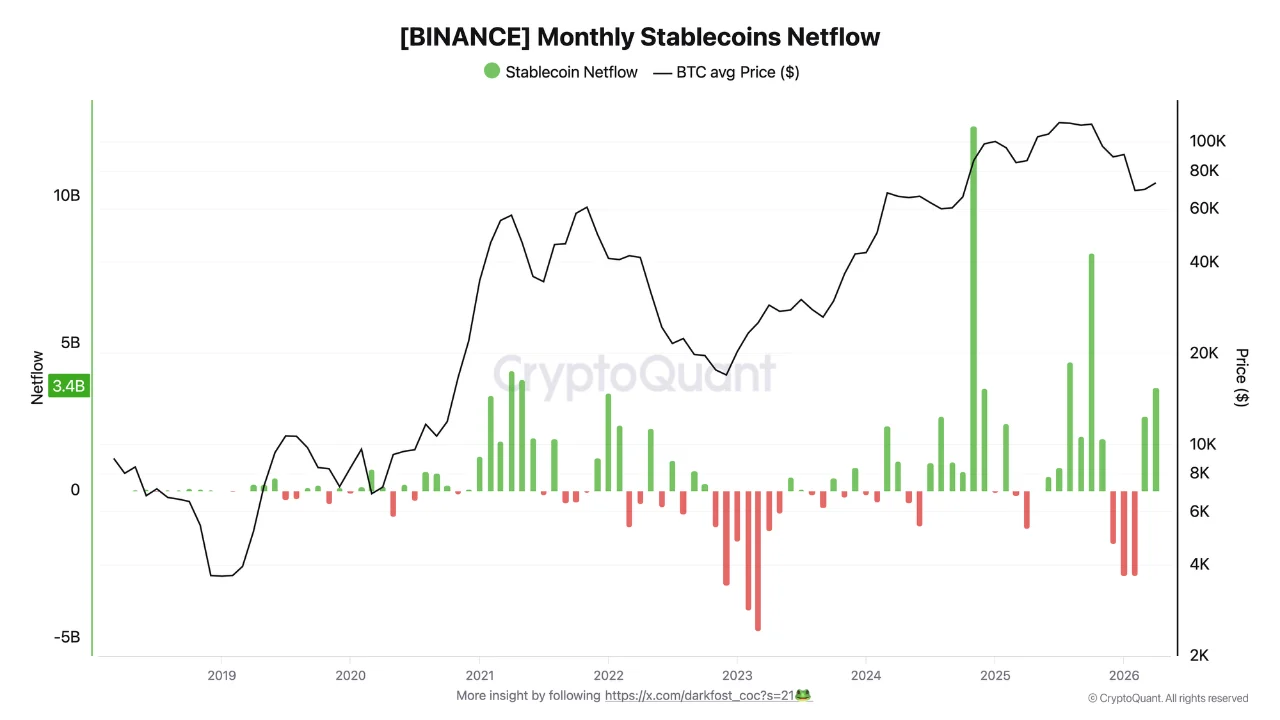
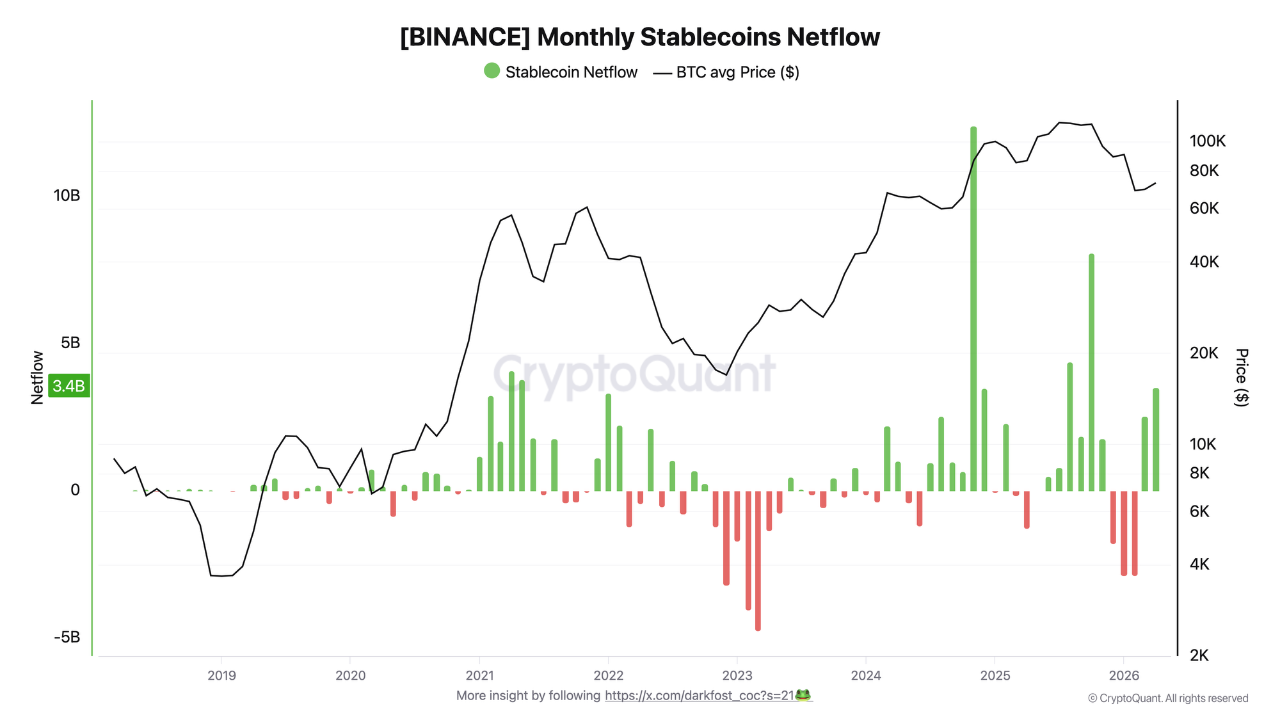
- Binance attracted close to $6B in stablecoin inflows across March and April, reversing prior outflow trends.
- April alone recorded $3.5B in net stablecoin inflows despite US-Iran tensions and rising inflation fears.
- The ERC20 Stablecoin Exchange Supply Ratio on Binance holds near 0.30, reflecting abundant waiting capital.
- Elevated stablecoin reserves on Binance suggest dry powder remains, though immediate buying is not yet confirmed.
Binance stablecoin inflows have surged to nearly $6 billion across March and April, marking a notable shift in market behavior. This reversal comes after a prolonged period of outflows totaling roughly $7.6 billion.
Despite geopolitical turbulence and inflation concerns, capital appears to be returning to the exchange. The trend points to growing interest in repositioning ahead of a potential market recovery.
Capital Builds Up on Binance After Months of Outflows
March served as an early signal that stablecoin movement was beginning to change direction. April then confirmed this shift, recording close to $3.5 billion in net stablecoin inflows alone.
Together, the two months represent a combined $6 billion in potential liquidity entering the platform. That reversal stands in sharp contrast to the heavy outflows seen in the preceding months.
April came with added pressure from rising tensions between the United States and Iran. Multiple episodes of escalation during the month stirred concern over energy prices and a possible return of inflation.
Such conditions are typically unfavorable for risk assets, including cryptocurrencies. Despite this backdrop, stablecoin inflows continued to build steadily throughout the month.
When inflows outpace outflows on a major exchange, it reflects early repositioning by parts of the market. Some participants appear to be staging capital in preparation for a gradual recovery now underway for nearly two months.
Source: Cryptoquant
This behavior does not guarantee immediate buying pressure, but it does reflect a shift in sentiment. The movement of funds onto an exchange is often a precursor to renewed market participation.
If this inflow trend holds through the coming weeks, it could provide continued support to a market that is turning more constructive.
Historically, large stablecoin reserves sitting on exchanges indicate available dry powder. That liquidity has the potential to translate into buy pressure when clarity on direction improves. For now, the trend remains a cautious but notable positive.
Stablecoin Exchange Supply Ratio Stays Elevated at 0.30
On-chain analyst Rei Researcher noted on X that the All Stablecoins ERC20 Exchange Supply Ratio on Binance is holding around 0.30 or above.
This reading reflects a large amount of stablecoin capital remaining on the exchange. According to the analyst, the market still carries capital that is waiting for buying opportunities. However, this level alone does not confirm an immediate bullish move.
Not all stablecoins sitting on an exchange are positioned for spot purchases. Some of that capital may serve as collateral for futures or margin trading.
Other portions could be moving internally or simply waiting for a clearer price trend. These distinctions matter when interpreting what elevated supply ratios actually mean.
The analyst further noted that the current setup leans slightly positive without being definitively bullish. Historically, market crises tend to occur when prices fall alongside declining stablecoin exchange balances.
That combination signals capital leaving the market entirely, which is not what current data reflects. At present, capital appears to be holding steady and watching for a clearer signal.
The situation described is not one of alarm but rather of caution and patience. Liquidity remains abundant on the platform, which keeps conditions from turning outright negative.
As long as stablecoin reserves remain elevated, the market retains a buffer of potential demand. Whether that demand activates will depend on how broader conditions evolve in the near term.
TLDR:
- The DOJ froze $701 million and seized 503 fake crypto investment websites in a coordinated global operation.
- Pig butchering scams build weeks of trust before introducing platforms engineered to steal victim deposits.
- Withdrawal friction after your first deposit is the clearest single signal that a platform is fraudulent.
- Singapore police blocked $2.86 million in losses by partnering with Coinbase, Gemini, and blockchain analytics firms.
The U.S. Department of Justice has frozen $701 million in cryptocurrency linked to fraudulent investment platforms. The Scam Center Strike Force coordinated with major crypto exchanges to carry out the seizures.
Investigators took down 503 fake investment websites in the process. These platforms used professional dashboards and scripted support teams to deceive victims. The operation also dismantled a Telegram recruitment channel connected to a scam compound in Cambodia.
How Fraudulent Crypto Platforms Operate and Attract Victims
Court filings name two Chinese nationals accused of running fraud operations from the Shunda compound in Burma.
A separate facility called Tai Chang was linked to platforms mimicking legitimate trading services. Workers inside these compounds were often trafficked through fake job postings. They followed scripted playbooks to build trust with targets over several weeks before requesting funds.
The fraud method is known as pig butchering. Operators first establish personal contact through Telegram, WhatsApp, or social media.
They spend days building familiarity before introducing any investment platform. The goal during this phase is trust, not money.
Once trust is established, victims are directed to professional-looking platforms. These sites feature live price charts, portfolio dashboards, and responsive customer support. A small initial deposit is encouraged, and early withdrawals are permitted to build confidence further.
As victims increase their deposits, the platform begins showing larger fabricated gains. Withdrawal attempts then trigger sudden obstacles — tax requirements, verification fees, or minimum balance thresholds. By the time victims recognise the scheme, the platform has disappeared entirely.
Key Warning Signs That Separate Legitimate Platforms From Scams
Consistent daily profits with no losses are a clear red flag. Real markets move in both directions, so any platform showing only gains has a fabricated dashboard.
Withdrawal friction appearing after an initial deposit is another warning. Legitimate platforms process withdrawals freely without sudden fee requirements.
Regulatory registration is also a reliable filter. Every legitimate platform operating in a major jurisdiction is registered with a financial authority.
The SEC EDGAR database covers U.S.-registered entities, while the FCA register applies to UK-based platforms. A platform absent from these databases should not receive any funds.
Singapore’s Police Force ran a one-month operation between March and April 2026. It prevented more than $2.86 million in losses by working with Coinbase, Gemini, TRM Labs, and Chainalysis. The effort identified victims early and intervened before funds were extracted.
Anyone who recognises these warning signs should stop all deposits immediately. Reports can be filed with the FBI’s Internet Crime Complaint Center at ic3.gov.
In the UK, Action Fraud handles such cases. Documenting all communications and transaction records supports investigators tracing stolen funds.
TLDR:
-
- Polymarket will go offline for roughly one hour on April 28 at 11 a.m. UTC for exchange upgrades.
- The new pUSD stablecoin is backed 1:1 by USDC and will replace direct USDC use across the platform.
- All open limit orders on the v1 orderbook will be cancelled at cutover, requiring users to re-place them.
- API developers must update to the latest Polymarket SDK before cutover, as v1 clients will stop working.
- Polymarket will go offline for roughly one hour on April 28 at 11 a.m. UTC for exchange upgrades.
Polymarket is set to roll out a sweeping infrastructure upgrade on April 28, introducing its native stablecoin pUSD and a revamped order-matching engine.
The exchange will go offline for roughly one hour starting at 11 a.m. UTC. All open limit orders placed on the v1 orderbook will be cancelled at cutover.
User funds and existing positions, however, will remain fully intact throughout the transition period.
pUSD Launch Marks a New Chapter for Polymarket
On April 27, Polymarket Developers posted on X that exchange upgrades go live on April 28 at 11 a.m. UTC. The announcement confirmed roughly one hour of downtime, with the v1 orderbook cleared and all open limit orders cancelled. Funds and existing positions were noted as safe throughout the process.
Polymarket’s new stablecoin, pUSD, will be backed 1:1 by USDC, keeping it pegged at par with the dollar. The token is designed to serve as the native settlement currency across the platform going forward. Users holding USDC balances will need to approve a conversion to pUSD before the upgrade completes.
The shift to a native stablecoin is part of a broader effort to tighten Polymarket’s internal liquidity framework. By anchoring pUSD to USDC reserves, the platform aims to reduce friction in fund flows between markets. This structure also gives the team more control over how capital moves within the exchange.
CLOB V2 Brings a Rebuilt Orderbook and Matching Engine
The CLOB V2 upgrade replaces the existing central limit orderbook with an entirely new architecture. The v1 orderbook will be cleared at cutover, and all open limit orders will be cancelled at that point. Market participants will need to re-enter their positions after the system comes back online.
The new matching engine is built to handle higher throughput and more efficient order processing. Accordingly, API users must update to the latest Polymarket SDK before April 28 at 11 a.m. UTC. V1 API clients will stop functioning entirely once the cutover takes effect.
Developers integrating with Polymarket should treat this deadline seriously. Any system still running v1 client code after the transition will lose connectivity to the exchange. The team has urged all API-dependent participants to test updated SDK versions ahead of the scheduled maintenance window.

Western Union’s USDPT stablecoin is ready for a May launch

How Arsenal turned Lyon battle around to stand on brink of another Champions League final

'Pluribus' & 'Come See Me In The Good Light' win Peabody awards for Apple TV

Manchester United reach agreement with Casemiro over contract clause amid transfer speculation

US brings back mandatory military draft registration

Steven Gerrard disagrees with Gary Neville over ‘shock’ Chelsea and Arsenal claim | Football

WOW.. Ripple/DTCC/SWIFT Are On The SAME Panel! XRP Holders’ Patience Is About To Pay OFF BIG TIME!

#antique #goldcollector #reseller #business #gold #money #jewelry #coins #fake #ytshorts

Justin Sun Accused Trumps Crypto Exchange Of Fraud (WLFI)
-

 Politics6 days ago
Gary Stevenson delivers timely reminder to register to vote as deadline TODAY
-

 Fashion2 days ago
Weekend Open Thread – Corporette.com
-
Crypto World1 day ago
Hyperliquid $HYPE Rally Builds Momentum as AI Sector Enters Prove-It Phase
-
Crypto World6 days ago
Bank of Hawai’i (BOH) Q1 2026: Net Income Drops to $57.4M as Net Interest Margin Expands
-

 Politics4 days ago
Making troops accountable for war crimes threatens US alliance, ex-SAS colonel warns
-

 Politics4 days ago
Disabled people challenge government SEND proposals over segregation concerns
-

 Business5 days ago
Rolls-Royce Voted UK’s Most Iconic Trade Mark as IPO Register Hits 150
-

 Business3 days ago
Patterson-UTI Energy, Inc. (PTEN) Q1 2026 Earnings Call Transcript
-

 Politics4 days ago
Zack Polanski responds to home secretary’s taser threat
-
 Sports16 hours ago
IPL 2026: Ruturaj Gaikwad registers slowest fifty of the season, enters all-time unwanted list | Cricket News
-
 Crypto World6 days ago
Five Value Stocks with Recovery Potential in 2026: PayPal (PYPL), Nike (NKE), and More
-
Politics4 days ago
Wings Over Scotland | How To Get Away With Crimes
-

 Politics4 days ago
Starmer handler McSweeney to be dragged from shadows by Foreign Affairs Committee
-

 Crypto World5 days ago
New York sues Coinbase, Gemini over prediction market offerings
-

 Politics4 days ago
‘Iran is still a nuclear threat’
-
 Business5 days ago
HCL Tech share price tank over 9% after weak Q4. JPMorgan, HSBC & 3 others cut target price
-
 Sports4 days ago
Tim Bradley names the current best in the world: “Better than Inoue and Usyk”
-

 NewsBeat20 hours ago
LK Bennett closes all stores after entering administration
-

 Fashion6 days ago
Kilkenny Design New Beauty Arrivals for Spring 2026
-

 Crypto World5 days ago
Crypto’s great hope in Senate’s Clarity Act still has a path to survive tight calendar
You must be logged in to post a comment Login