

Crypto World
Ethereum ETFs Break 5-Day Inflow Streak With Weekly Outflows

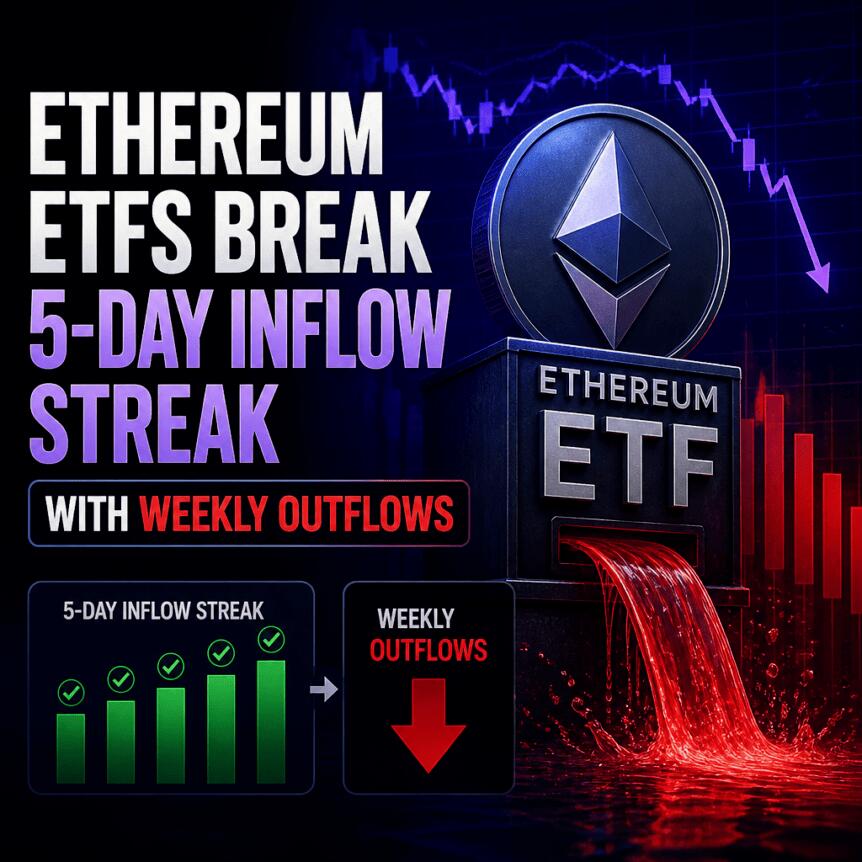
US-listed spot Ethereum exchange-traded funds (ETFs) pulled back after a run of steady demand, recording $70.62 million in net outflows on Friday and ending a five-day inflow streak.
SoSoValue data shows US Ether funds brought in $211.25 million over the prior five sessions from July 17 through Thursday. Despite Friday’s reversal, the funds also logged $103.9 million in net inflows for the week ended Friday. Overall, Ethereum spot ETFs have now extended their weekly inflow streak to three straight weeks and have attracted $337.74 million in net inflows so far in July.
Key takeaways
- Ethereum spot ETFs saw $70.62 million in net outflows on Friday after five consecutive inflow sessions.
- SoSoValue reports $211.25 million of net inflows from July 17 through Thursday, with $103.9 million added for the week ended Friday.
- ETH ETFs still maintain a three-week weekly inflow streak and have pulled in $337.74 million net so far in July.
- Bitcoin spot ETFs followed a similar pattern, ending a seven-day inflow streak and posting $240.08 million in net outflows on Friday.
- Japan’s evolving crypto framework has renewed discussion about the potential size of a future Japanese spot Bitcoin ETF market, with one estimate placing it around $18.4 billion.
Ethereum ETF flows pause after a strong mid-July stretch
Ethereum’s ETF flow picture remains constructive even with Friday’s outflows. According to SoSoValue, the funds accumulated $211.25 million in net inflows across five sessions leading into Thursday, suggesting that the demand seen earlier in the week was not immediately erased. For the week ended Friday, net inflows still totaled $103.9 million, meaning the reversal did not translate into a weekly loss for product flows.
That distinction matters for investors tracking ETF demand as a relatively timely signal of how traditional market participants are positioning in Ether. While daily outflows can reflect routine rebalancing, profit-taking, or broader risk-off moves, the persistence of weekly inflows over three consecutive weeks points to continued interest rather than a one-off event.
Ethereum ETFs have also drawn $337.74 million in net inflows so far in July, reinforcing that the overall monthly trend remains positive despite Friday’s dip.
Bitcoin ETFs also reverse, ending another inflow run
Friday’s turn in Ethereum flows came alongside weakness in US spot Bitcoin ETFs. Coin-telemetry on demand indicators shows that Bitcoin funds ended a seven-day inflow streak on Thursday and recorded another $240.08 million in net outflows on Friday, according to the same weekly flow tracking referenced in this report.
Even with the Friday reversal, Bitcoin ETFs are still showing a multi-week accumulation trend. The week ended Friday added $103.90 million in net inflows, bringing the total net inflow so far in July to $233.96 million. The funds also extended their net inflow streak to three consecutive weeks.
The report also highlights how sharply sentiment shifted earlier in the cycle: after a record June in which $4.5 billion flowed out of the funds, July’s inflows suggest investors are gradually rebuilding exposure through these regulated products.
Crypto ETF demand remains a key proxy for institutional access
Spot crypto ETFs have become one of the most closely watched gauges for market demand through traditional channels. In the US, ETFs are especially influential because they represent the overwhelming majority of assets and trading activity compared with similar products in other jurisdictions.
While other markets, including Hong Kong, have moved toward ETF-style products, the US remains the primary venue where flow data is both abundant and liquid. As a result, daily net inflow and outflow figures can quickly influence how traders interpret near-term positioning, even when they don’t fully dictate price direction.
At the time of writing, the report notes that Bitcoin was trading just under $64,000, down from Tuesday’s week high of $66,892, and Ether was around $1,837, below the weekly high of $1,954. These snapshot levels illustrate that ETF flow reversals can coincide with broader market volatility, even if the longer weekly pattern still looks supportive.
Japan reforms revive estimates for a future spot Bitcoin ETF market
Beyond ETF flow numbers in the US, attention is also shifting to regulatory groundwork elsewhere. Following Japan’s recent overhaul of its crypto regulations—seen by the market as laying the groundwork for future spot Bitcoin ETFs—crypto management platform XWIN estimated what a “mature” Japanese spot Bitcoin ETF market could look like.
In an analysis referenced via CryptoQuant, XWIN projected an upper-end scenario of about $18.4 billion for a Japanese spot Bitcoin ETF market. The figure is framed as roughly 0.13% of Japan’s reported $14.6 trillion in household financial assets.
The estimate also defines assumptions about where demand would originate: existing crypto holders, new retail investors entering through brokerage accounts, and institutional allocators. XWIN’s reasoning suggests that regulated ETF structures—paired with familiar brokerage access and custody arrangements—could reduce friction for investors who want exposure without handling assets directly.
To make the case, the analysis points to the US market as an example of how spot Bitcoin ETFs can translate into meaningful accumulated exposure over time, noting that spot Bitcoin ETFs excluding Grayscale’s GBTC have accumulated roughly 1 million Bitcoin. XWIN characterized the $18.4 billion number as an “achievable upper-end market scenario,” emphasizing it is not a guaranteed outcome.
In that framing, the key variable is access—how easily Japanese investors can reach Bitcoin exposure through institutions they already use. That focus aligns with why ETF demand in the US has remained closely tracked: flows can reflect the conversion of investor intent into a product wrapper that fits mainstream portfolio practices.
For investors, the immediate question is whether Friday’s outflows in both Ethereum and Bitcoin ETFs mark the start of a more sustained pullback or simply a brief rebalancing pause. Watching subsequent daily flow prints—and whether weekly inflow streaks hold—will help clarify how much of the recent strength persists, while regulatory developments in Japan could reshape longer-term expectations for where ETF-style demand might expand next.

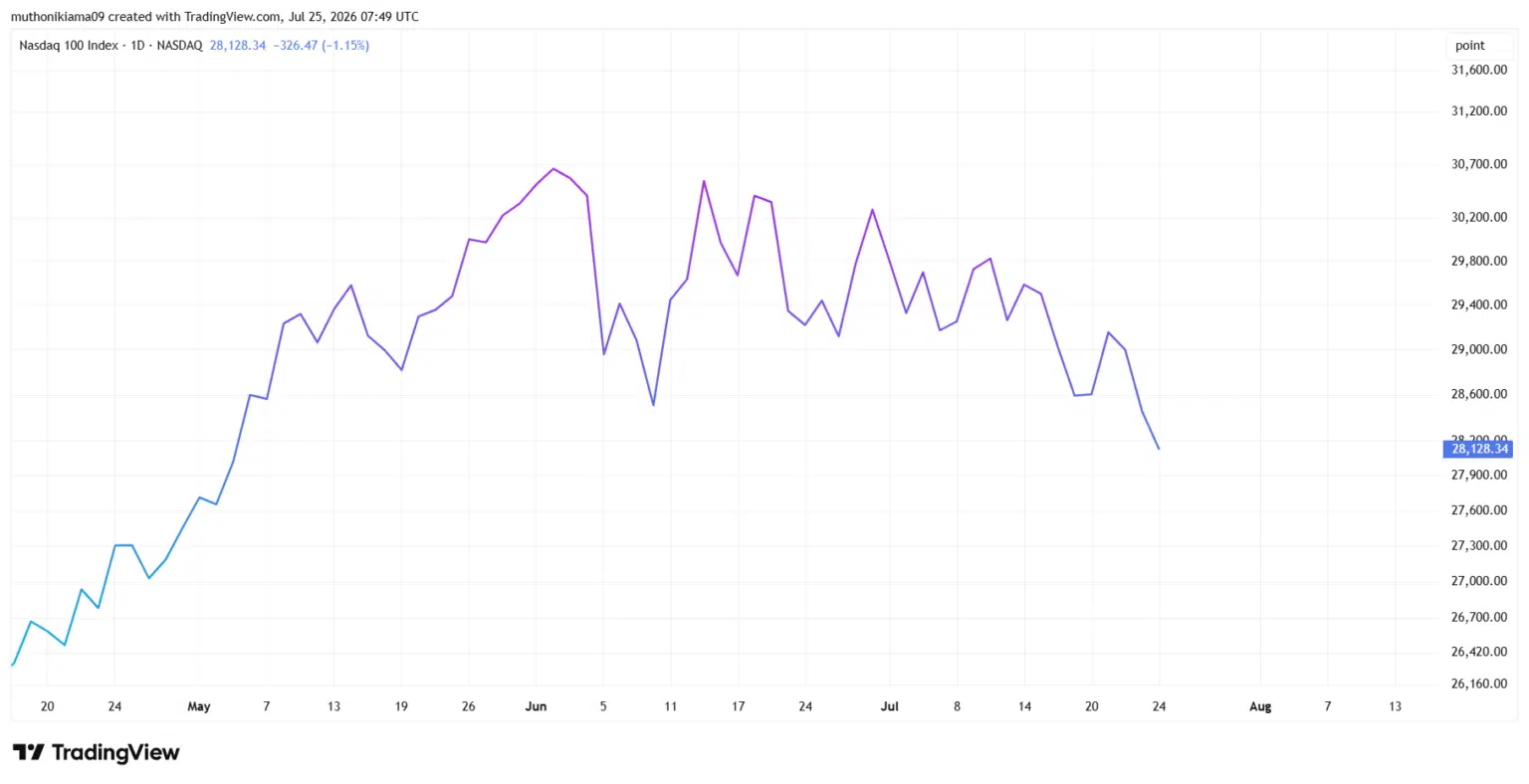
Bitcoin price has dipped under intense macro headwinds today, July 25, as the Nasdaq-100 index plunged to its lowest level since May 5 over escalating concerns regarding heavy artificial intelligence spending by tech giants.
Summary
- Bitcoin price slid 2.49% to $64,017 as tech-driven Nasdaq liquidations and 4.71% Treasury yields triggered defensive profit-taking.
- Spot BTC ETFs posted their worst inflows in three weeks, drawing just $33 million as buyers pivoted to bonds.
- BTC is actively testing vital 4-hour ascending trendline support; losing this slope exposes the psychological $60,000 floor.
At the time of writing, the leading cryptocurrency trades at $64,017.51, representing a 2.49% decline over the last 24 hours. Daily trading volumes reached $22.84 billion according to CoinMarketCap data, representing rising selling pressure after BTC recently touched an intraday high near $66,900 on July 21.
Market sentiment has turned cautious because Bitcoin increasingly correlates with high-growth technology shares.
Tech equity liquidation triggers crypto selloff
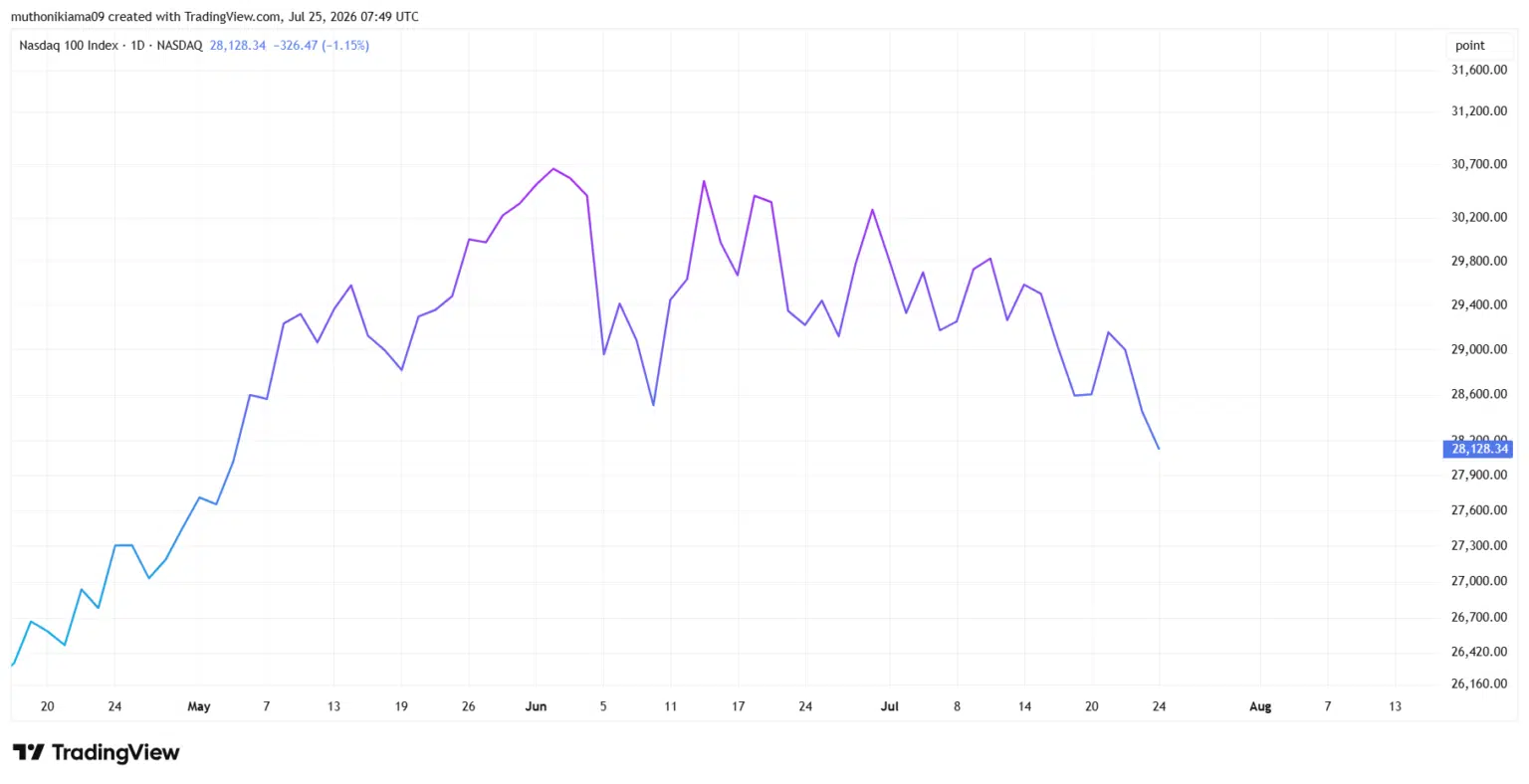
Data from TradingView shows that the Nasdaq-100 index closed its previous trading session at 28,128 points, establishing an eleven-week low. This equity drawdown stems from investor anxiety that massive capital expenditures toward AI infrastructure will reduce immediate corporate cash flows and increase corporate debt burdens.
For example, Alphabet purchased $94 billion worth of SpaceX stock during a June initial public offering, highlighting the scale of tech-sector capital allocation.
Commenting on the move, Peter Andersen, Chief Executive Officer of Andersen Capital Management, noted:
“People are thinking, how do we make sense of all this spending, and how much more patient do we have to be before we actually see it translate to actual profits?”
This capital preservation mindset in traditional finance has prompted defensive positioning within digital asset markets, where traders are taking profits rather than risking capital on volatile assets.
Why Bitcoin institutional demand channels are stalling
In tandem with the equity contraction, institutional demand channels for digital assets show signs of constraints. Data from SoSoValue shows that spot Bitcoin exchange-traded funds registered a mere $33 million in net inflows during the week ending July 24. This cumulative figure marks the weakest weekly capital intake for the investment vehicles in three weeks.
The reduction in capital allocation develops alongside a notable shift in the broader fixed-income landscape. Specifically, the US Treasury 10-year yield advanced to 4.71%, which represents its highest level since January 2025.
Higher yields on risk-free government bonds change the opportunity cost of holding volatile crypto assets. When government debt instruments present guaranteed yields at these levels, institutional allocators frequently pivot away from high-beta risk assets like Bitcoin.
Such a macro reallocation pattern cuts the baseline liquidity available to support crypto spot prices during equity market drawdowns. The drop from the July 21 peak of $66,900 reveals that market participants are opting for cash or fixed-income safety rather than defending local support levels. Consequently, the combination of tech stock liquidations and rising yields has forced a tactical retreat.
Key Bitcoin price technical levels to watch
On the 1-day chart, the daily candle prints at $64,017.51, positioning the asset just under its yellow moving average ribbon line of $64,266.14. Long-term overhead resistance remains defined by a higher red trendline sitting at $77,301.64.
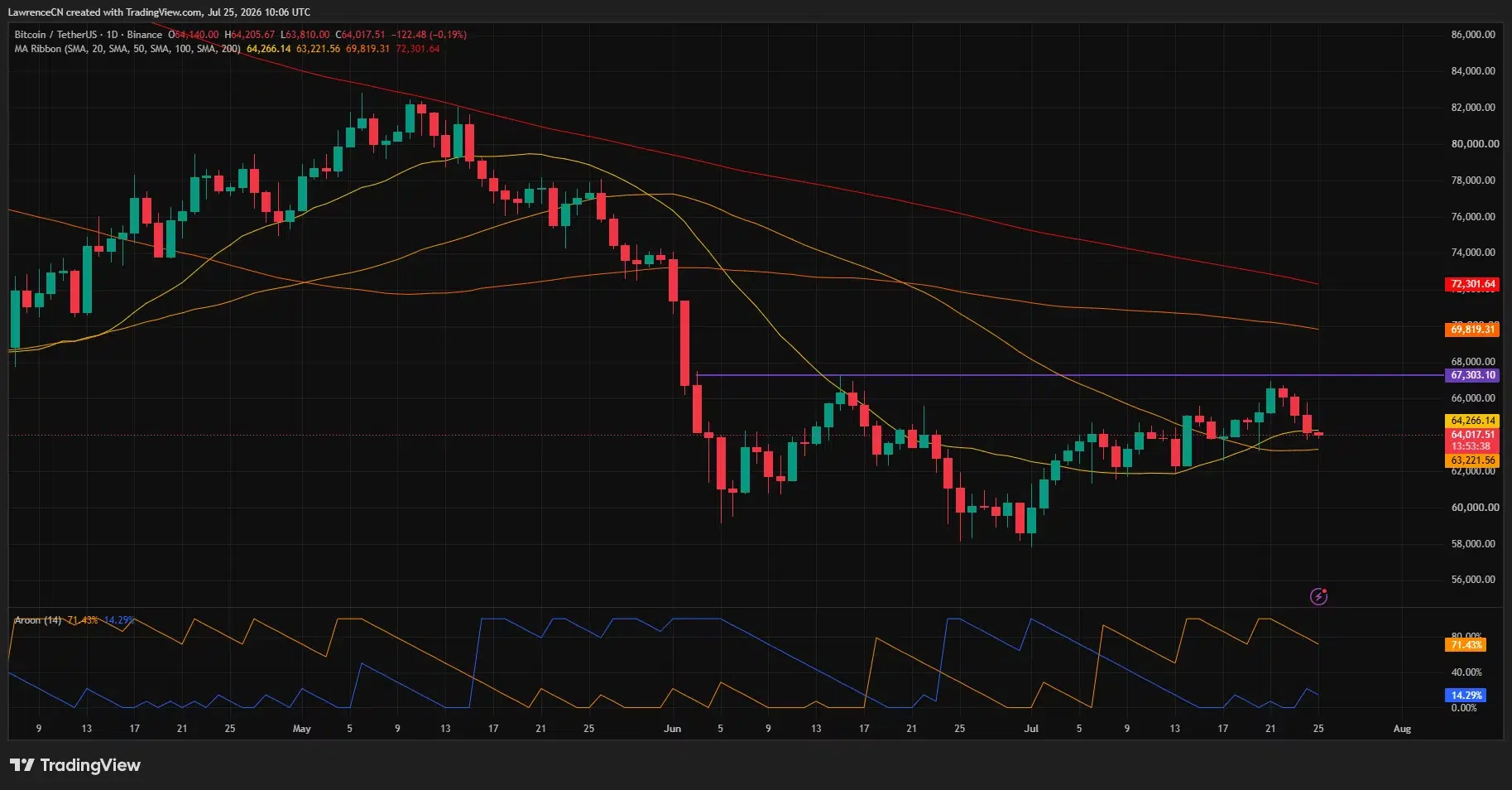
The Aroon indicator on the daily timeframe provides a mixed outlook for long-term momentum; the Aroon Up line measures 71.43%, while the Aroon Down line hovers at 14.29%. A crucial horizontal resistance line is established at $67,303.10, which matches structural distribution zones from early June.
Shorter-timeframe data on the 4-hour chart reveals that Bitcoin is currently testing a vital upward-sloping purple trendline that has served as dynamic support since early July. The 4-hour Relative Strength Index has slid to 35.85, tracking below its yellow moving average line of 42.67, which places the asset near oversold territory.
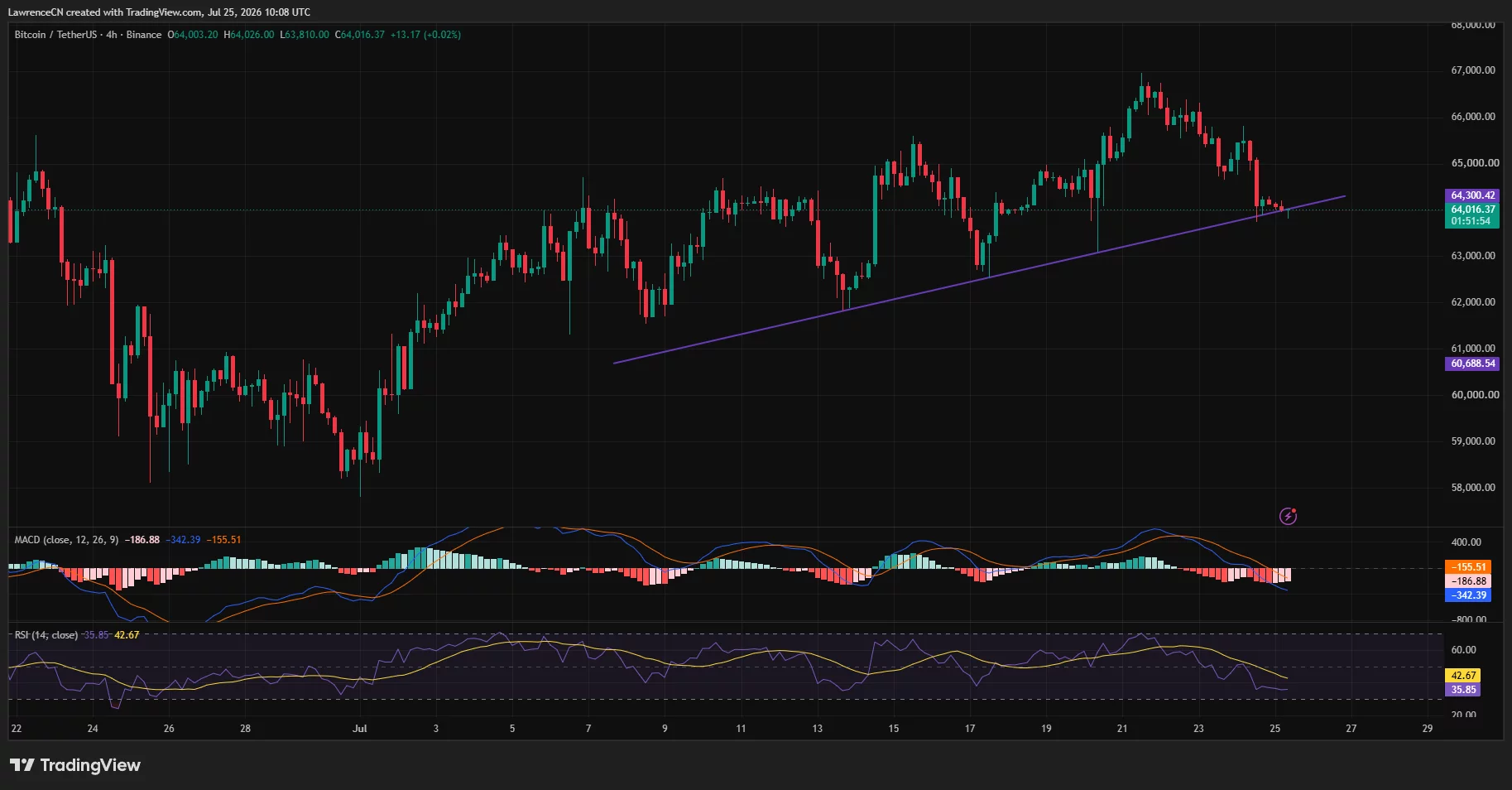
Concurrently, the Moving Average Convergence Divergence indicator registers a bearish configuration, with the blue MACD line crossing below the orange signal line at -342.39 versus -155.51 amid expanding red histogram bars.
The immediate price action shows a direct cluster of sell orders around the 4-hour trendline, indicating that short-term speculators are actively hedging their spot exposures. Volume bars on shorter intervals have increased during down-swings, validating that the breakdown attempt is backed by active distribution rather than low-liquidity drift.
This alignment between the negative MACD crossover and the breakdown of the short-term moving average suggests that sellers hold the immediate tactical advantage. If the daily close finishes below this slope, the structure transitions from a standard corrective pullback into a broader structural reversal.
Downside risks that invalidate the bullish outlook
If this ascending 4-hour trendline breaks conclusively on a daily closing basis, the primary bullish setup will face invalidation. Under this scenario, a breakdown would expose the psychological support floor at $60,000, with a secondary structural horizontal support level waiting lower at $60,688.54.
Additional downside risks stem from the potential for cascaded long liquidations in the derivatives market if the $63,000 level fails to hold. A breach of these key horizontal baselines would open the path toward deeper retests of May lows, entirely erasing the recovery momentum built over the past three weeks.
Disclosure: This article does not represent investment advice. The content and materials featured on this page are for educational purposes only.

The world’s largest cryptocurrency exchange continues to update its product line, introducing new ways to keep users on the platform as investor interest has shifted elsewhere.
In the latest move, the CZ-founded company outlined the significant APR provided to certain holders and traders of Ripple’s stablecoin.
Recall that Binance first listed RLUSD at the start of the year, which included a popular zero-trading-fee promotion for a certain period. Naturally, some of the trading pairs available in January were against XRP.
Although the stablecoin was initially available only on Ethereum, it added support for Ripple’s XRP Ledger less than a month later.
The updates continued in the following months, including Binance adding the stablecoin to its Earn program, allowing holders to earn some rewards.
The latest post from the exchange provided more details on what investors can actually earn. It reads that the APR has remained variable in the past week, but it was an impressive figure of 22.25%.
Binance explained that users holding and trading the stablecoin can continue to earn weekly XRP rewards, and the asset has been added on the exchange’s Margin/Earn program.
22.25% APR (variable) in the last 7 days.
Hold RLUSD, trade, and earn weekly XRP rewards, it’s live now on Binance Margin/Earn.
More info → https://t.co/LmdiRKIG7w pic.twitter.com/PmTM87BU7b
— Binance (@binance) July 25, 2026
RLUSD saw the light of day at the end of 2024, even before the legal issues concerning the company behind it were resolved. Although it’s generally aimed at institutional usage, it continues to attract retail participants as well.
Its market capitalization has grown to almost $1.6 billion as of press time, making it the 9th largest stablecoin by that metric.
Earlier this year, RLUSD was included in Mastercard’s stablecoin initiative, alongside other major names such as USDC, PYUSD, USDP, and SoFiUSD.
More recently, Ripple launched a new platform called Ripple Mint, which aims to enhance institutional access to RLUSD for easier minting, redemption, and management.
The post Major Binance Update for Ripple (XRP) Investors: Details appeared first on CryptoPotato.
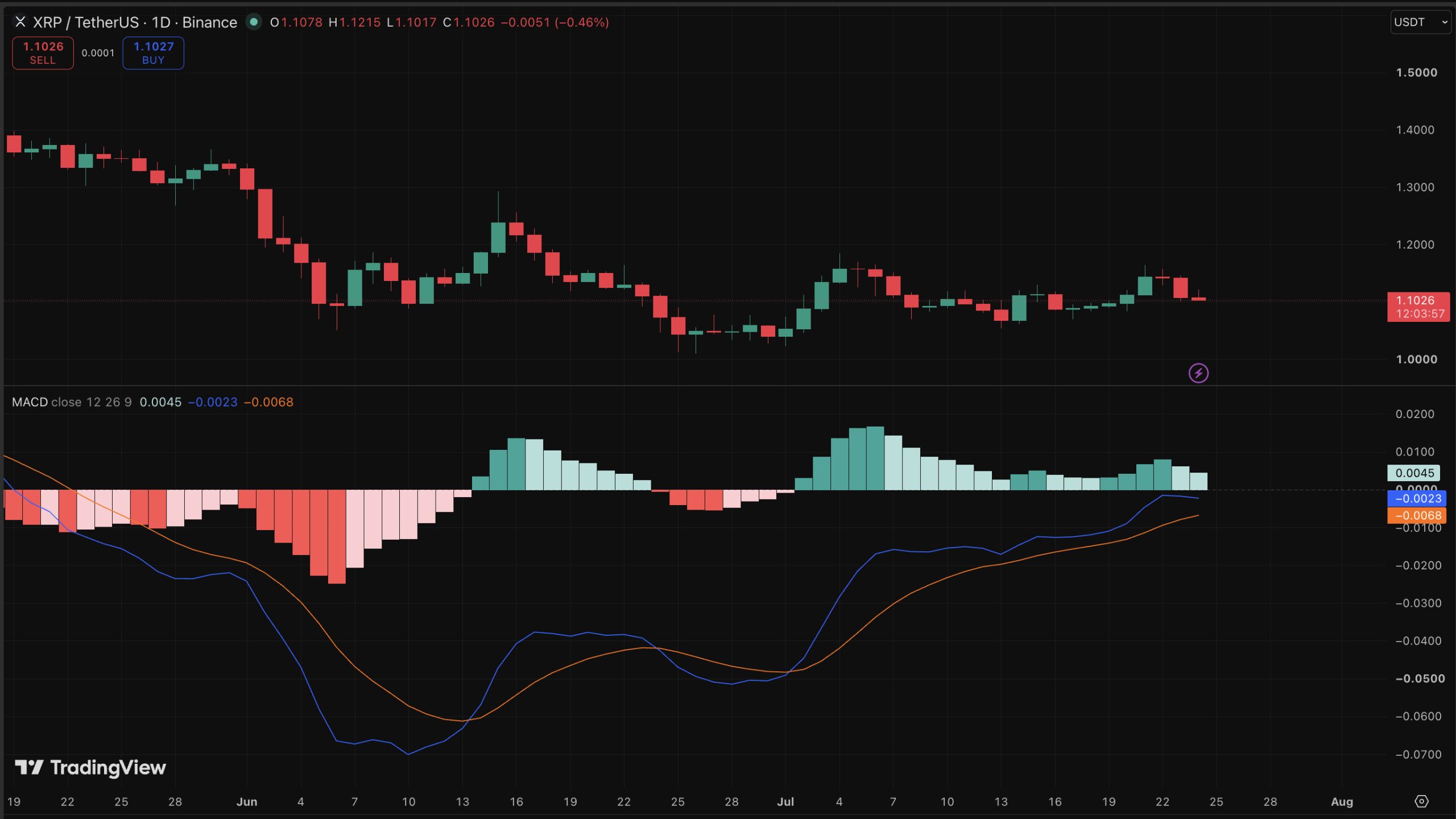
XRP price is trading around the $1.10 to $1.12 range after slipping 2% over the past day. This XRP prediction comes as price action softens despite steady spot buying. The more interesting story is not the decline, but what is happening underneath it. Spot demand has climbed to its strongest levels since June, while derivatives traders remain cautious.
That divergence matters because it often appears before a decisive move. Buyers continue absorbing supply, yet leveraged traders remain hesitant. As a result, XRP could either reclaim recent highs or face another round of selling if support gives way.
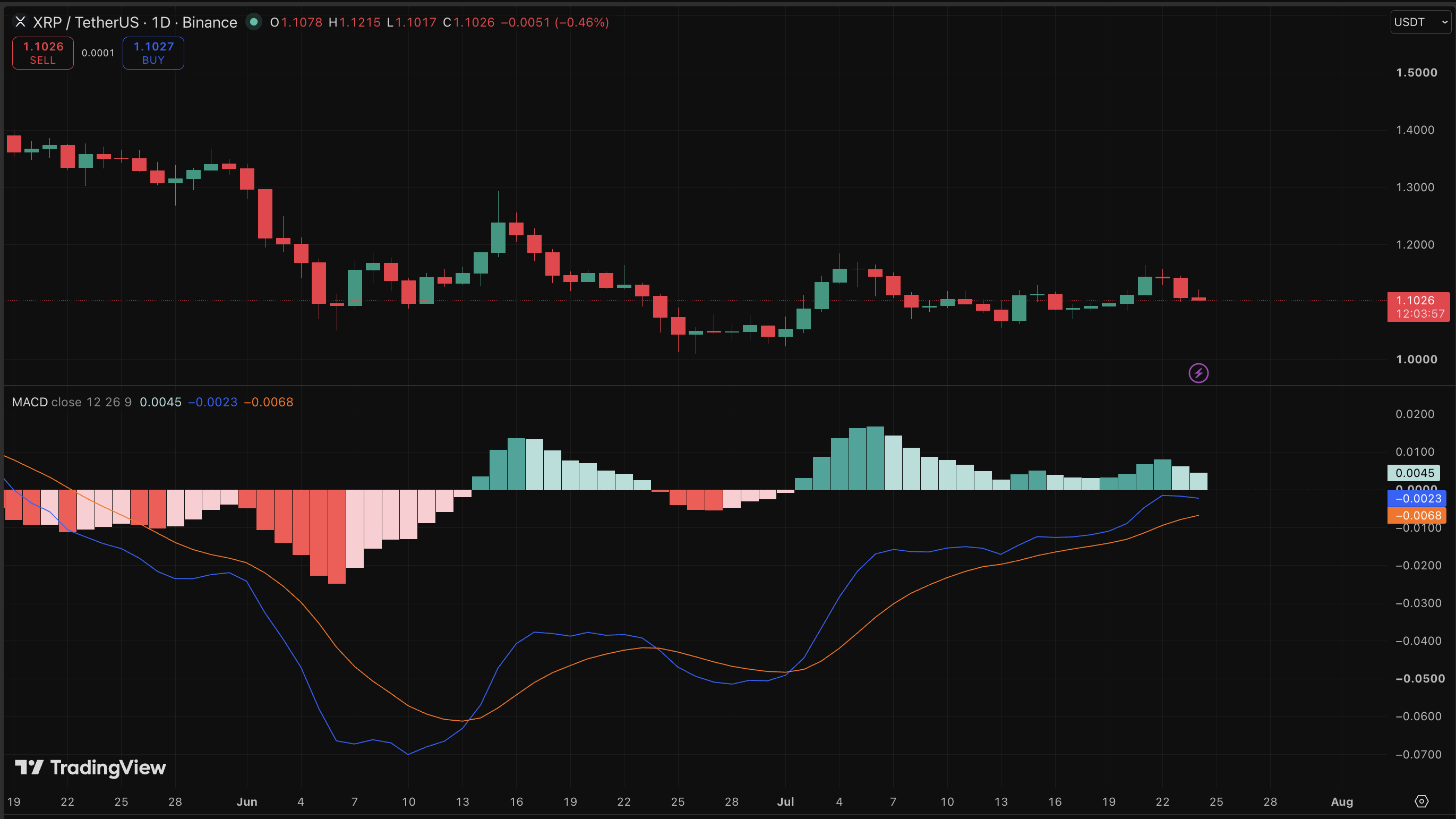
Recent technical signals show XRP struggling to hold above the $1.14 area after its weekly advance. Short-term momentum cooled as profit-taking emerged, although the MACD still favors buyers. Meanwhile, the Relative Strength Index recently reached overbought territory, suggesting upside could remain limited without fresh demand.
Market sentiment remains cautious even with stronger spot accumulation. That disconnect is worth watching because pessimistic positioning sometimes fuels sharp rebounds. However, if buyers fail to defend the current range, sellers could regain control before another recovery attempt develops.
Institutional adoption narratives and ETF-related speculation continue supporting the medium-term outlook for XRP. At the same time, Ripple developments add another fundamental layer alongside the technical picture. Even so, resistance near recent highs remains the level to beat before bulls can regain full control.
Discover: The Best Crypto to Diversify Your Portfolio
XRP Price Prediction: Reclaim $1.20 Before the Next Major Resistance at $1.48?
XRP price is trading around the $1.10 to $1.12 range after slipping roughly 2% over the past day. This XRP prediction comes as price action softens despite steady spot buying. The more interesting story is not the decline, but what is happening underneath it. Spot demand has climbed to its strongest levels since June, while derivatives traders remain cautious.
That divergence matters because it often appears before a decisive move. Buyers continue absorbing supply, yet leveraged traders remain hesitant. As a result, XRP could either reclaim recent highs or face another round of selling if support gives way.

Recent technical signals show XRP struggling to hold above the $1.14 area after its weekly advance. Short-term momentum cooled as profit-taking emerged, although the MACD still favors buyers. Meanwhile, the Relative Strength Index recently reached overbought territory, suggesting upside could remain limited without fresh demand.
Market sentiment remains cautious even with stronger spot accumulation. That disconnect is worth watching because pessimistic positioning sometimes fuels sharp rebounds. However, if buyers fail to defend the current range, sellers could regain control before another recovery attempt develops.
Institutional adoption narratives and ETF-related speculation continue supporting the medium-term outlook for XRP. At the same time, Ripple developments add another fundamental layer alongside the technical picture. Even so, resistance near recent highs remains the level to beat before bulls can regain full control.
Trade XRP on Bybit and Get a Chance to Win Our $1,000 USDT Airdrop
LiquidChain Targets Early-Mover Positioning as XRP Tests Key Resistance
XRP’s spot demand spike is a legitimate signal, but at $1.14, the risk/reward on a near-term trade is compressed between a stubborn resistance ceiling and an overbought oscillator. Traders looking for asymmetric exposure in this environment are increasingly eyeing early-stage infrastructure plays where price discovery hasn’t happened yet.
LiquidChain ($LIQUID) is a Layer 3 infrastructure project building what it calls a unified cross-chain execution environment. It is fusing Bitcoin, Ethereum, and Solana liquidity into a single settlement layer.
The Order builds. — LiquidChain (@getliquidchain) July 15, 2026
Brick by brick. Layer by layer.  ⟁https://t.co/vqvBcdSQYC pic.twitter.com/tcfMNP4lNq
Liquid’s architecture centers on a Deploy-Once model: developers ship once, access all three ecosystems simultaneously, with verifiable settlement and single-step execution across chains.
The presale is currently priced at $0.01483, with $917K raised to date. That figure is climbing, and early-stage pricing at this level won’t persist indefinitely as the round progresses. Institutional demand signals tracked alongside this raise add context,too.
Research LiquidChain before making any allocation decision.
Discover: The Best Token Presales
The post XRP Price Prediction: Ripple Token Spot Demand Hits Highest Since June appeared first on Cryptonews.


Payment firm Triple-A’s hot wallets have lost more than $9.7 million spanning multiple blockchains.
On-chain analyst Specter flagged the outflows on X (formerly Twitter) earlier today. This comes amid a streak of exploits hitting crypto protocols this month.
Analyst Flags $9.7 Million Triple-A Wallet Drain
The drain spanned across TRON (TRX), Ethereum (ETH), Polygon (POL), and Arbitrum (ARB). Attackers swapped the assets and bridged them to Ethereum.
The funds now sit in one wallet, 0x01F83B5d4fb30E8AA3daC1681B4048D9135253b1. That address holds roughly 5,227 ETH, worth about $9.7 million.
“It looks like the team are not aware as deposit are not disabled and every new deposit is being drained,” Specter posted earlier today.
Follow us on X to get the latest news as it happens
Triple-A has not addressed the wallet outflows as of press time. BeInCrypto has reached out for comment.
Meanwhile, the drain adds to a difficult stretch for crypto security. On-chain trackers have logged a string of thefts across platforms in recent days. Lookonchain counted three separate attacks on July 23 worth $35.55 million.
Those hits included AFX Trade at $24.15 million, the Verus Ethereum bridge at $7.55 million, and B2 Network at $3.86 million. This marked Verus’ second exploit since May. Attackers drained roughly $11.58 million in digital assets on May 18.
Subscribe to our YouTube channel to watch leaders and journalists provide expert insights
The post Crypto Payments Firm Triple-A Hit by $9.7 Million Wallet Drain appeared first on BeInCrypto.
Crypto World
Robinhood Chain’s real-world assets jump fivefold as tokenized stocks start trading in size
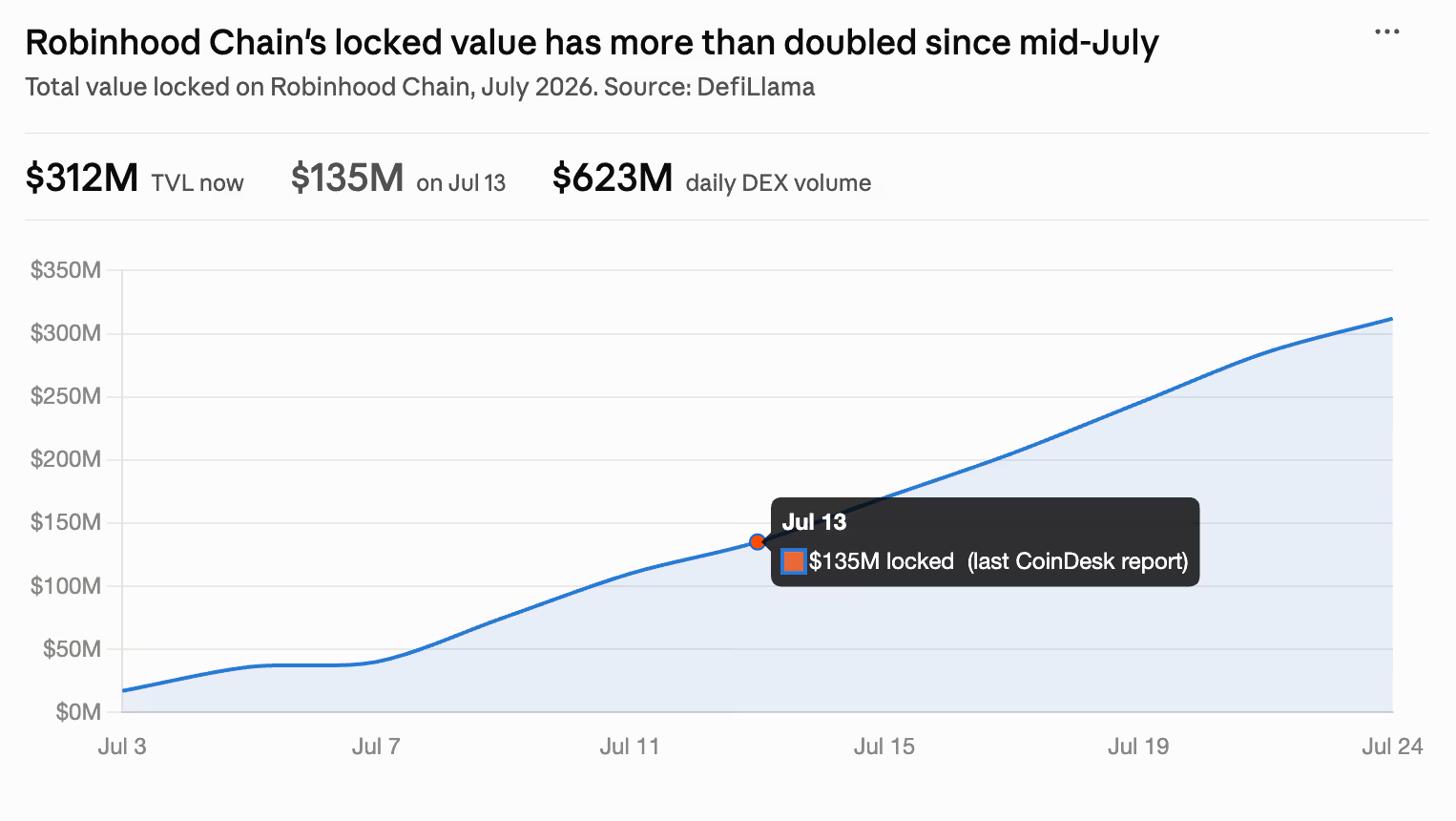
Total value locked has roughly tripled since mid-July to about $312 million, according to DefiLlama, and Robinhood Chain is now clearing more than $600 million in daily decentralized-exchange volume, putting it among the more active networks in crypto.

Its transaction count has also drawn attention, with more than 138 million in 30 days, per Token Terminal. But the chain’s most-traded tokens are still overwhelmingly memecoins.
On DEX Screener, the top of Robinhood Chain’s trending list is filled with tokens like “Hoodrat,” “Vladhood” and “Swole Doge,” not the tokenized equities the network was built for, which trade on Uniswap but rank well down the volume rankings.

The tokenized stocks generate roughly $55 million in daily volume, under a tenth of the chain’s nearly $600 million in total DEX trading, the data shows. The rest is dominated by memecoins.
Stablecoins remain the single largest presence on the chain, with a combined market value in the hundreds of millions of dollars, and memecoins, such as the Robinhood mascot-themed CASHCAT, that defined the chain’s first weeks, are still active and heavily traded.
The critique three weeks ago was that Robinhood had built expensive infrastructure and attracted only speculation, with little sign that the tokenized-stock business it pitched would materialize.


Global cryptocurrency exchange WEEX has been named Most Secure Crypto Exchange at the CoinGape Web3 Innovation Awards 2026, recognizing the platform’s Proof of Reserves system, 1,000 BTC Protection Fund, and broader approach to safeguarding user assets.
WEEX’s security framework centers on public verifiability rather than institutional trust alone — publishing on-chain wallet addresses, reserve ratios, and fund allocations that users and third parties can independently confirm at any time.
A 1,000 BTC Protection Fund, Fully Backed and Publicly Verifiable
At the core of WEEX’s security model is its Protection Fund, a 1,000 BTC reserve set aside to cover user losses in the event of a security incident that is not the user’s fault. The fund’s wallet addresses are public, allowing anyone to verify its holdings on-chain. It is fully backed by WEEX and kept strictly segregated from operational funds, allowing the exchange to cover eligible losses directly rather than relying on external processes.
Proof of Reserves: Independently Verifiable, Asset by Asset
WEEX maintains a Proof of Reserves system covering its major holdings, with the latest published reserve ratios of approximately 102% for USDT, 115% for ETH, 122% for BTC — each figure independently verifiable through WEEX’s public wallet addresses. Reserve ratios above 100% indicate that WEEX holds more of a given asset than is owed to users on the platform.
Cold Storage and Account-Level Protections
Over 95% of client assets are held in multi-signature cold storage, offline and inaccessible to remote attackers. At the account level, WEEX offers two-factor authentication, withdrawal-specific passwords, email and SMS verification codes, and wallet whitelisting, giving users multiple layers of control over how their funds move.
Recognition From the Industry
The CoinGape Web3 Innovation Awards recognized WEEX specifically for combining Proof of Reserves with its 1,000 BTC Protection Fund — a combination the awards noted as distinct from the industry norm, where robust security typically comes bundled with mandatory identity verification.
Trust isn’t something WEEX asks for. It’s something WEEX proves — one verifiable block at a time.
Disclaimer: Cryptocurrency trading carries significant market risk, including potential loss of principal. Proof of Reserves and Protection Fund figures are subject to change; users should refer to WEEX’s official Protection Fund page for current, real-time data. This release is for informational purposes only and does not constitute financial or investment advice.
About WEEX
Founded in 2018, WEEX has developed into a global crypto exchange with over 6.2 million users across more than 150 countries. The platform emphasizes security, liquidity, and usability, providing over 1,200 spot trading pairs and offering up to 400x leverage in crypto futures trading. In addition to the traditional spot and derivatives markets, WEEX is expanding rapidly in the AI era delivering real time AI news, empowering users with AI trading tools, and exploring innovative trade to earn models that make intelligent trading more accessible to everyone.
Its 1,000 BTC Protection Fund further strengthens asset safety and transparency, while features such as copy trading and advanced trading tools allow users to follow professional traders and experience a more efficient, intelligent trading journey.
Follow WEEX on social media
X | Instagram | Tiktok | Youtube | Discord | Telegram
The post WEEX Named Most Secure Crypto Exchange at CoinGape Web3 Innovation Awards 2026 appeared first on BeInCrypto.
Layer-1 blockchain Dango will wind down operations by halting trading on its perpetual decentralized exchange (DEX) on Wednesday and shutting down its network on Aug. 13.
“Despite our best effort, various reasons have led us to conclude there is no viable path to a lasting commercial success,” Dango said in a Friday X announcement.
Dango founder Larry Liu added that the team faced cash shortages, legal challenges that slowed momentum, the loss of team members, and broader market conditions.
Dango launched its mainnet in January after raising $3.6 million in a 2024 seed round led by Hack VC and Lemniscap. It rolled out its perpetual DEX in April, only to suffer a roughly $410,000 exploit days after launch. The attacker later returned the funds in exchange for a bug bounty.
Related: BitMEX hit with 623 BTC lawsuit on day it announces shutdown
Dango’s open interest dwarfed by Hyperliquid, Aster
According to DefiLlama, Dango’s total value locked fell from a peak of roughly $4.5 million in early May to about $1.6 million before the announcement.
The perp DEX market is increasingly competitive and dominated by a handful of platforms.
Hyperliquid held more than $11 billion in open interest on Saturday, which represents the value of outstanding perpetual futures contracts that haven’t been closed.
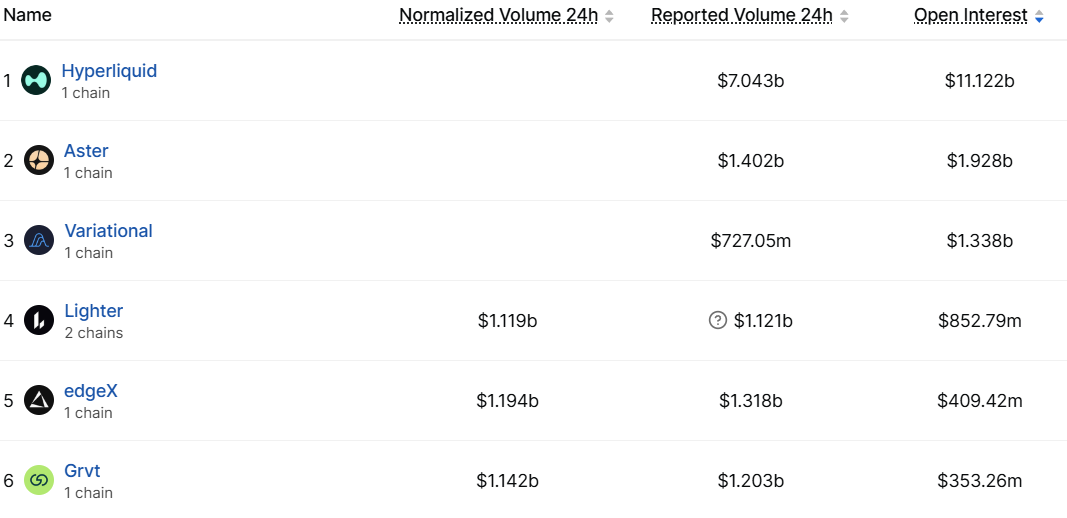
Perp DEX ranking by open interest. Source: DefiLlama
Only Aster and Variational also hold more than $1 billion in open interest. Dango held just under $391,000 in open interest.
CoinGecko said in its second quarter industry report that Hyperliquid became the second-largest perpetual exchange by open interest on July 1, behind only Binance.
A summer of crypto shutdowns
Dango’s shutdown adds to a growing list of crypto platform closures in July, including 11-year-old perpetual futures pioneer BitMEX.
Restructuring adviser Roshan Dharia told Cointelegraph that BitMEX’s shutdown reflects structural pressures facing mid-sized centralized exchanges, where liquidity has increasingly concentrated among the industry’s largest players and regulatory compliance costs continue to rise.
“The top five platforms now control an estimated 80% of global spot volume, leaving mid-tier and regional exchanges with shrinking margins and no viable path to scale,” Dharia said.
Other recent closures include DEX aggregator Odos Protocol and perp DEX Satori Finance.
Magazine: A quantum roadmap would push Bitcoin much higher: Charles Edwards
World Foundation raised $52.5 million in a Worldcoin (WLD) token sale, and every token sold carries a 12-month lockup. Pantera Capital led the first close.
The nonprofit will spend the capital pushing World ID into enterprise platforms, consumer apps, and AI agents.
Why the Foundation Sold Locked Tokens
The Foundation sold new tokens into sustained WLD price pressure. Supply is the reason that concession matters. World had unlocked 4.9 billion of 10 billion WLD as of April 10, per its own tokenomics disclosure.
Daily emissions then fell 43% on July 24, dropping from roughly 5.1 million tokens to 2.9 million. Despite this, WLD has struggled.
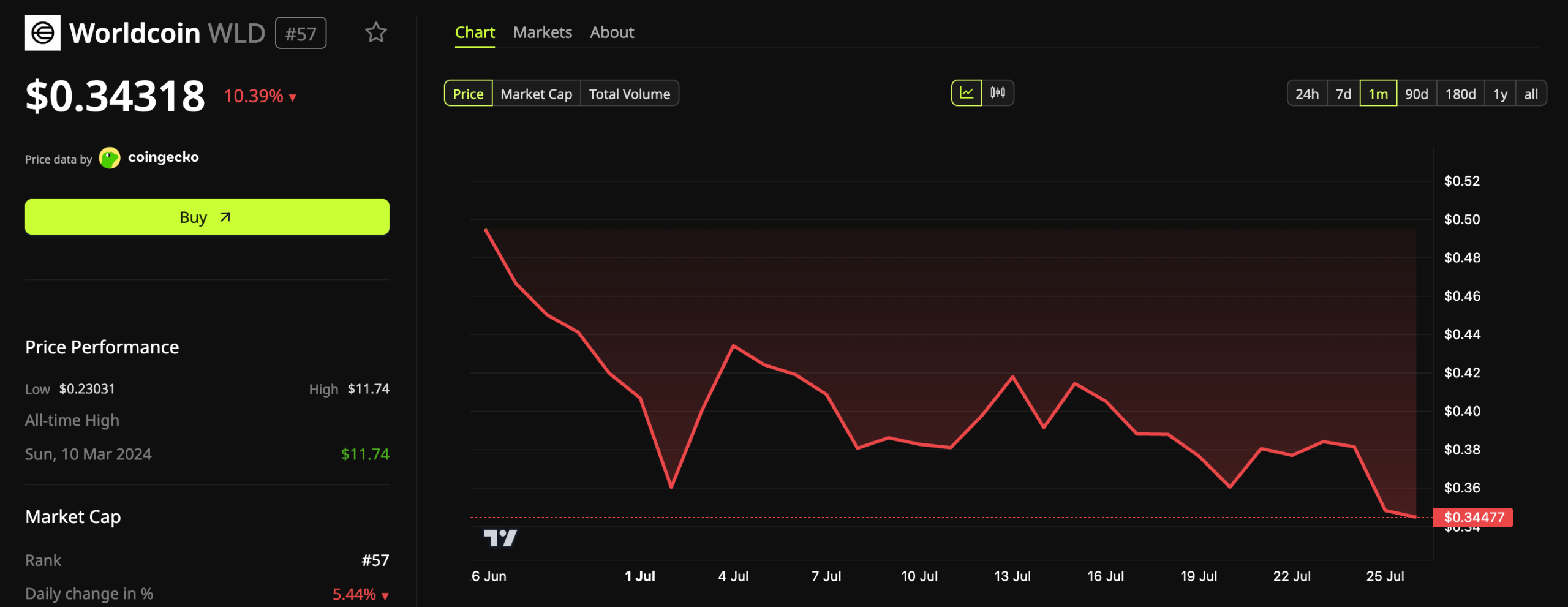
The altcoin trades near $0.34, down more than 10% in 24 hours and 32.8% over the past 30 days. Large caps have fared better over the same stretch.
Follow us on X to get the latest news as it happens

Bitcoin (BTC) gained 5.4% across 30 days, while Ethereum (ETH) added 14.9%, leaving WLD’s decline an outlier rather than a sector move. Against the downtrend, the 12-month lockup takes further immediate sell pressure off the table.
Investors Buy Into the Proof of Human Case
Bain Capital Crypto, Eightco Holdings, Selini Capital, and Susquehanna Crypto also joined the round. Eightco arrives as both buyer and incumbent. The Nasdaq-listed firm reported 283 million WLD in its treasury as of July 8, making it the largest publicly disclosed institutional holder.
This raise comes after Andreessen Horowitz and Bain Capital Crypto bought $135 million of WLD in May 2025. The Foundation also sold roughly $65 million over the counter at around $0.27 per token in March 2026.
Pantera framed the round as a bet on business demand rather than retail speculation.
“The need for Proof of Human is becoming acutely clear with the acceleration of AI development, and we see this in the influx of enterprise traction. We’re excited to continue supporting World’s mission at this inflection point in its growth.” Cosmo Jiang, Pantera Capital General Partner, said.
The Foundation also presented proof of human as infrastructure that the wider internet now needs.
“As AI agents and agentic tools proliferate, the internet, and the multibillion-dollar industries that depend on it, will need a reliable way to distinguish humans from machines. Without it, advertising models built on genuine views and engagement become unreliable, dating platforms are flooded with synthetic profiles, voting systems become more difficult to validate, creative marketplaces struggle to identify original work, and video calls become vulnerable to deepfakes and impersonation,” it explained.
Meanwhile, World Foundation said more than 39 million people have joined World Network. Over 18 million completed Orb verification. The network has also utilized more than 475 million World ID proofs. Still, the markets have not rewarded any of it.
The lockup expires in July 2027. Whether the enterprise pipeline has materialized by then will determine what these buyers do next.
Subscribe to our YouTube channel to watch leaders and journalists provide expert insights
The post Worldcoin Crashes 10% After the Project Sells 217 Million Tokens for Funding appeared first on BeInCrypto.
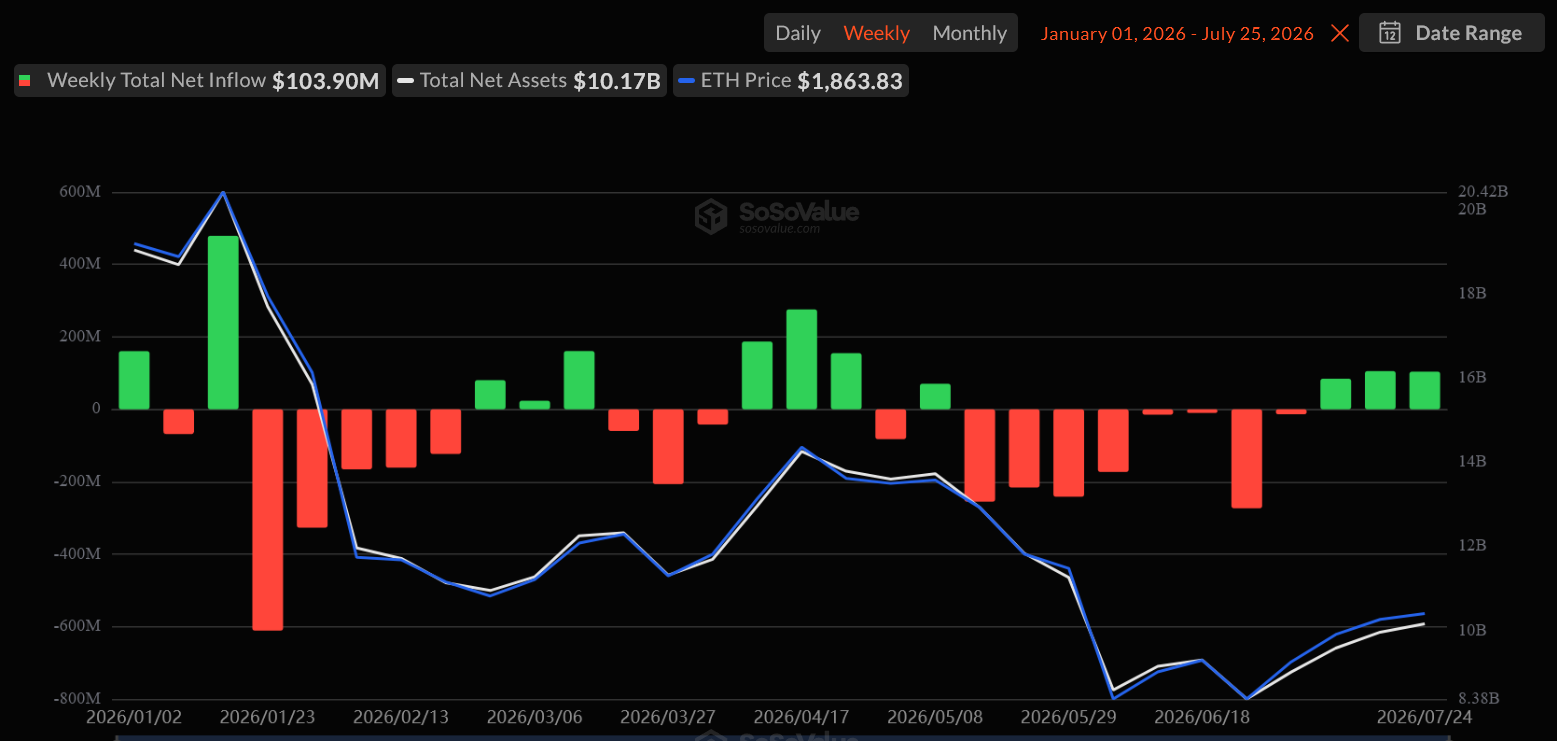
Ethereum (ETH) exchange-traded funds pulled in $103.9 million in the week ending July 24, the most of any spot crypto ETF and a third straight positive week for the product.
Other major spot crypto ETFs drew fresh cash over the same five trading days. The inflows were broad but mostly small, and Ethereum outpaced every rival by a wide margin.

Ethereum ETFs Hold a Steady Recovery
According to SoSoValue data, Ethereum ETFs recorded weekly inflows of $84 million, $105 million, and $103.9 million across the past three weeks. The pace stayed firm rather than fading. Bitcoin ETFs, by contrast, saw their streak shrink from $197 million to $75.6 million to $33.79 million.
The shrinking figure came as the funds logged two negative daily prints, losing $225 million on July 23 and $240 million on July 24. Weekly trading volume fell to about $8 billion, the lowest since mid-April 2025.
Ethereum showed a similar late-week dip, with a $70.6 million outflow on July 24. However, the weekly total stayed positive and led the group.
Follow us on X to get the latest news as it happens
HYPE Breaks From the Pack
Smaller altcoin funds each posted their own gains. XRP (XRP) led the group with $8 million in inflows, its largest in three weeks. Solana (SOL) drew $7 million, a nine-week high.
Chainlink (LINK) took in $3 million, its best week since June. Dogecoin (DOGE) added a fractional sum, its first inflow in five weeks.
Hyperliquid (HYPE) ETFs stood alone. The funds shed $8.6 million, a second straight weekly outflow, and assets fell about 18% from a July 10 peak. Weekly volume dropped to roughly $62.7 million, the lowest since the May launch.

The pattern points to steady demand for Ethereum and caution toward the newest product on the market. The coming weeks will show whether Ethereum’s lead widens or Bitcoin regains its footing.
Subscribe to our YouTube channel to watch leaders and journalists provide expert insights
The post Wall Street Money is Flowing into Ethereum ETFs and Out of Hyperliquid appeared first on BeInCrypto.


Triple-A’s hot wallets appear to have lost more than $9.7 million across several blockchains, with the suspected attacker swapping the assets and consolidating the proceeds on Ethereum.
Summary
- More than $9.7 million was reportedly removed from Triple-A-controlled hot wallets.
- Suspicious outflows affected at least four networks, including Ethereum, Solana, TRON and TON.
- The suspected attacker consolidated the proceeds into approximately 5,226.66 ETH on Ethereum.
- Triple-A has not confirmed the breach or disclosed whether customer funds were affected.
What happened to Triple-A’s hot wallets
On-chain analyst Specter first identified suspicious transactions involving hot wallets linked to Triple-A, a Singapore-based provider of stablecoin payment infrastructure.
Specter initially estimated that more than $9.3 million had been removed, swapped, and transferred across chains to Ethereum. Blockchain security firm PeckShield later amplified the alert, while subsequent estimates placed the suspected loss above $9.7 million.
The activity reportedly affected Triple-A wallets operating on Ethereum, Solana, TRON and TON. Some reports also identified transactions involving Polygon and Arbitrum, potentially expanding the incident to six networks.
Triple-A had not publicly confirmed the exploit at the time of writing. The company has also not disclosed when the suspicious activity began, how its wallets were accessed, or whether the affected assets belonged to Triple-A, its business customers, or payment recipients.
Without a company statement or technical investigation, the incident remains a suspected hot-wallet compromise rather than a confirmed protocol exploit.
Stolen assets were consolidated into Ethereum
On-chain data cited by security researchers showed that the transferred assets were exchanged and bridged to Ethereum after leaving the affected wallets.
The receiving address reportedly held about 5,226.66 ETH, worth approximately $9.7 million at the time of the alert. Consolidating assets into Ether can make a collection of stablecoins and network-specific tokens easier to move from one address.
Researchers have not publicly identified the suspected attacker or established whether the address has links to previous exploits. No report has confirmed that the funds entered an exchange, mixer, or other service after reaching Ethereum.
The difference between Specter’s initial $9.3 million estimate and later figures above $9.7 million may reflect additional transfers or changes in Ether’s market value. A verified loss total will depend on Triple-A identifying every affected wallet and transaction.
Why the Triple-A incident matters in the US
Triple-A provides infrastructure that allows companies to collect, convert and send payments through stablecoins and traditional banking networks. Its services include merchant checkout, business payments, local payouts and cross-border settlement.
The company states that it operates as a licensed financial institution in the United States, Europe and Singapore. Triple-A also holds a Major Payment Institution licence from the Monetary Authority of Singapore and joined Circle Payments Network in March to support stablecoin-to-local-currency settlement.
Its US presence gives the incident a potential regulatory and counterparty angle, although there is no evidence that American customers or companies suffered losses. Any US impact will depend on which entity controlled the wallets, who owned the assets, and whether regulated payment operations were involved.
Triple-A uses Fireblocks as part of its digital-asset infrastructure. However, neither on-chain researchers nor Triple-A have attributed the suspected breach to Fireblocks, and no available evidence indicates that the custody technology provider was compromised.
Triple-A faces questions after another cross-chain attack
The suspected breach follows another recent incident involving cross-chain infrastructure. As crypto.news reported, an attacker fabricated 1,627 Solana deposit events targeting Across Protocol’s Risk Labs-operated relayer on July 17.
Those false deposits requested $41.7 million in payments across 18 destination chains. Risk Labs’ relayer filled 581 requests before Across stopped its Solana operations, limiting the realized loss to less than $4 million, according to the protocol’s post-incident report.
The Across and Triple-A incidents do not appear to be connected. However, both cases involved activity spanning several networks, increasing the number of wallets, transaction systems and monitoring processes involved in detecting suspicious transfers.
Triple-A has yet to explain whether it has suspended deposits, withdrawals or cross-chain operations. The company’s next statement will need to clarify the final loss, the affected assets, the source of the breach and whether customers will receive compensation.

LeBron James Joins Philadelphia 76ers on Two-Year Deal

QUAD Elegan 1 and Elegan 2 Speakers Bring British Hi-Fi Back to Earth From $995

Bolton runners set off on 50k Wigan Road crash fundraiser


-

 Fashion17 hours ago
Weekend Open Thread: Brooks Brothers
-

 Politics6 days ago
Democrats look to World Cup watch parties to register thousands of voters
-

 Crypto World4 days ago
Grayscale Files For Worldcoin ETF, WLD Registers Sharp Rise
-

 Tech4 days ago
Sail Virtually Aboard The “Itanic” With IA-64 Emulator
-

 NewsBeat5 days ago
Unregistered fitter used Gas Safe logo on business flyers
-
 Tech4 days ago
Turtle Beach Command Series KB7 review: a nifty screen-equipped gaming keyboard
-

 News Videos6 days ago
Big Money Is Entering XRP
-
 Business3 days ago
New Jersey voter registration controversy explained: How 6,600 noncitizens got on the rolls, and what happens next
-

 Crypto World7 days ago
Kaspersky exposes OkoBot’s 20-module crypto wallet attack
-
 Entertainment4 days ago
Johnny Depp’s R-Rated Gothic Cult Classic Gets New Release Ahead of Sydney Sweeney Remake
-

 Crypto World2 days ago
Ethics, other provisions in crypto Clarity Act to be further discussed
-

 Tech5 days ago
Watch Flock Safety CEO Garrett Langley discuss the future of surveillance at TechCrunch Disrupt 2026
-
 NewsBeat4 days ago
Shanghai science forum photos show China’s AI and robotics advances in rivalry with US
-

 Crypto World5 days ago
Circle’s President Sold Over 360,000 Shares, The Filings Explain Why
-

 Tech5 days ago
Subway Sandwich Computers Get a Second Life as Gaming Machines
-

 News Videos2 days ago
The Peugeot Family: How 200 Years of an “Old Money” Dynasty Died in A Boardroom
-

 Sports1 day ago
2026 3M Open leaderboard: Scottie Scheffler finds putter in Round 1, sits three back
-

 Tech5 days ago
The 35 Best Board Games for Family Game Night
-

 Fashion1 day ago
16 Dresses for the High Summer Event
-

 Tech6 days ago
How To Use Claude’s Reflect Dashboard And Learn When It’s Time To Touch Grass
You must be logged in to post a comment Login