
Crypto World
Ethereum Has 3x More Holders Than Bitcoin Despite a Brutal Price Decline: Analyst


Ethereum has emerged as the blockchain with the largest number of holders, far ahead of Bitcoin.
Data on non-empty wallets shows that Ethereum has around 189.49 million holders, which is more than three times Bitcoin’s 59.08 million.
Network Growth vs Market Performance
The figures, shared by the head of research at Lisk, analyst Leon Waidmann, indicate Ethereum’s significantly large user base even as the asset’s price remained in a bearish zone. After Ethereum and Bitcoin, Tether ranks third with 13.61 million holders, followed by XRP with 7.8 million and USDC with 6.76 million non-empty wallets.
Even with such strong network adoption, ETH has been on a steady decline over the past month, losing more than 30% during the period. The crypto asset was trading near $1,620 at the time of writing.
The weakness in its price has also affected companies that built large treasury positions in the asset. One example is Nasdaq-listed FG Nexus, which has reportedly accumulated losses of more than $85 million on its Ethereum strategy after selling a substantial portion of its holdings below its purchase price.
The company had made ETH its main treasury reserve asset and started building its position around Ethereum’s 10th anniversary, with plans to become a major holder. However, the broader market downturn forced it to reduce its exposure.
Meanwhile, crypto analyst Michaël van de Poppe noted that ETH’s daily Relative Strength Index (RSI) has dropped to the lowest level ever recorded. He believes this extremely oversold condition could mean the crypto market is getting close to the end of the current bear market and that a turnaround may not be far away.
ETFs Reverse Outflow Streak
The market pressure has also been visible in spot Ethereum ETF activity. However, after 17 straight trading days of outflows, these funds recorded net inflows of $19.3 million on June 4. The inflows were driven entirely by ETHA, while the remaining nine ETFs saw no activity.
Overall, Ethereum ETFs still posted $168 million in net outflows for the week. SoSoValue said the latest figures could mean that ETF flows are starting to stabilize, although a meaningful recovery will depend on whether inflows continue across Ethereum and the other major crypto assets.
The post Ethereum Has 3x More Holders Than Bitcoin Despite a Brutal Price Decline: Analyst appeared first on CryptoPotato.



Exchanges advertise leverage the way carriers advertise data speeds, as a capability offered for your benefit. The arithmetic says something else. A venue earns on notional, so the slider that multiplies your position multiplies its revenue identically while collapsing your survival odds, and the deleveraging queue ranks you first for forced closure because the venue knows exactly which accounts are fragile.
Summary
- Trading fees are charged on notional value, meaning the size of the position, not the collateral behind it, so a 50-times position generates 50 times the fee revenue from the same deposit.
- The trader’s outcome moves in the opposite direction: at 10 times leverage, roughly a 10% adverse move eliminates the position; at 50 times, roughly 2% does, and 2% moves occur in crypto several times a day.
- Funding payments in perpetual futures also apply to notional and not margin, so leverage multiplies the recurring holding cost identically.
- Auto-deleveraging queues rank candidates for forced closure by unrealised profit and effective leverage, which means high leverage raises your position in the queue even when you are winning.
- Every element of that structure is disclosed in exchange documentation; what is absent is the connection between them, because the party best positioned to explain it earns more when it is not explained.
Open any major derivatives venue and the leverage control is presented as a capability. A slider, a dropdown, a set of preset multipliers running from 2 times up to 100 or beyond, framed in the marketing as capital efficiency and in the tooltips as a tool for experienced traders. The framing is not false. Leverage is a legitimate instrument; professionals use it, and its existence is not evidence of bad faith.
But the framing omits an arithmetic relationship that determines almost everything about outcomes on these platforms, and the omission is not random: a venue earning fees on notional value collects more from a leveraged position than from an unleveraged one funded with identical collateral, while the leveraged position is substantially likelier to be liquidated. The interests are not aligned; the misalignment is mechanical, not conspiratorial, and it is visible to anyone who does the multiplication. This guide does the multiplication.
The fee arithmetic
Start with how trading fees are actually assessed, because this is the fact the whole argument rests on and it is not hidden anywhere.
Fees on derivatives venues are charged as a percentage of notional value, which is the full size of the position, not the margin posted to open it. A trader depositing $1,000 and opening an unleveraged position pays fees on $1,000 of notional. The same trader using 50 times leverage opens a $50,000 position and pays fees on $50,000 of notional, from the same deposit.
Fee rates vary by venue and by whether an order adds or removes liquidity, but the structure is uniform: the multiplier applied to the position is applied identically to the fee. At a taker rate of a few basis points, a round trip on a $50,000 notional position costs a meaningful fraction of a $1,000 deposit before the market has moved at all.
The same multiplication applies to funding. In perpetual futures, the periodic payment flowing between longs and shorts is calculated on notional, a detail one major wallet provider’s documentation flags explicitly as mattering for true holding costs. A leveraged position pays leveraged funding, so a persistently crowded side becomes expensive at a rate proportional to the multiplier chosen.
Nothing here is concealed. It is in every fee schedule. What is rarely stated in the same place is the consequence: for the venue, the leverage slider is a revenue multiplier applied to the same customer deposit, and its effect on revenue is linear and certain while its effect on the trader’s outcome is negative and probabilistic.
What leverage does to survival
Now the other side of the same multiplication, stated as plainly as the fee side.
Leverage compresses the distance between your entry price and the point at which your collateral no longer supports the position. At 10 times, roughly a 10% adverse move exhausts the margin. At 25 times, roughly 4%. At 50 times, roughly 2%. At 100 times, the margin for error falls below 1%, and one industry glossary states the position bluntly: a 1% market movement can result in a total loss of capital.
Those figures are approximations before fees, funding, and maintenance-margin buffers, all of which move the liquidation point closer, not further. They also assume the reference price behaves smoothly, which in stressed conditions it does not.
Set that against how crypto actually trades. 2% intraday moves are routine, occurring on most assets multiple times in a typical week and repeatedly within single days during volatility. A 50-times position is therefore not a bet on direction; it is a bet that ordinary noise does not arrive before your thesis plays out, and ordinary noise arrives constantly. Being correct about direction and wrong about sequence produces the same result as being wrong about everything.
One further asymmetry deserves stating. Stop-loss orders do not reliably protect high-leverage positions, because in fast markets the gap between the trigger and the fill can exceed the entire remaining margin. The tool most often recommended alongside leverage is least effective at exactly the leverage levels where it is most needed.
The deleveraging queue ranks you
Here is the element almost nobody connects to the rest, and it is the clearest evidence that venues understand the relationship perfectly.
When a liquidation cannot be cleared in the market, and a venue’s backstop fund or protocol vault is exhausted, the exchange reduces positions on the profitable side to keep its books balanced. That mechanism is auto-deleveraging, and this publication covers it in detail in a dedicated guide. The relevant point here is how the venue chooses whose positions to close.
Selection is formulaic and published. Venues rank candidates by a combination of unrealised profit and effective leverage, closing the most profitable and most leveraged positions first, and many display each trader’s rank as a live indicator on the interface.
Read that ranking as what it is: the venue’s own statement about which accounts are fragile. An exchange that sorts by leverage when deciding whose winning positions to terminate has encoded, in its risk engine, the judgment that high leverage marks a position as expendable. The marketing presents the slider as a feature. The risk engine treats the same setting as a liability marker.
The practical consequence is that leverage costs you twice on the same position: it shortens the distance to liquidation when you are losing, and it raises your rank for forced closure when you are winning.
Why the slider exists at all
The uncharitable reading is that venues offer extreme leverage to harvest fees from accounts that will not survive. The charitable reading is that leverage is a legitimate tool and competitive pressure forces every venue to match the maximum its rivals advertise. Both are partly true, and the second explains the escalation better than the first.
Maximum leverage functions as a marketing number in this industry the way megapixels once did in cameras. It appears in comparison tables, it differentiates venues that are otherwise similar, and no exchange wants to be the one advertising a lower ceiling. That dynamic ratchets upward regardless of whether anyone believes high leverage serves customers, which is why the figures have climbed steadily while the arithmetic behind them has not changed.
It is worth noting who does not permit this. Most regulatory regimes restrict or prohibit extreme leverage for retail participants in traditional markets, and that restriction was not arrived at casually. Retail leverage limits exist because supervisors examined outcome data and concluded the products were unsuitable at those levels. Crypto venues operating outside those perimeters are not evading a rule so much as operating where the rule was never written.
What experienced traders actually do
The gap between advertised maximums and professional practice is the most useful thing a new participant can know.
Professionals use leverage, and they use far less of it than platforms permit. The reason is not caution as a personality trait; it is that position sizing is the variable with the largest effect on long-run outcomes, and high leverage removes the ability to be early. A trader with a correct thesis and low leverage survives being wrong about timing. The same trader at 50 times does not, and being right eventually is worth nothing once the position is closed.
The second practice is treating leverage as a cost input instead of a capability. Before entering, calculate the fee on the intended notional, add the expected funding over the intended holding period, and compare that total against the edge the trade is supposed to capture. Strategies that require high leverage to be worth executing are strategies whose edge is too small to survive their own costs, and the calculation reveals it in under a minute.
The third is watching the deleveraging indicator where a venue provides one. A rising rank during a favourable move is the venue telling you, in advance, that it considers your position a candidate for termination.
The honest use cases
None of this argues that leverage should never be used, and a guide that concluded otherwise would be ignoring why the instrument exists.
Hedging: A holder with substantial spot exposure can use a small leveraged short to reduce net risk without selling the underlying. Here leverage is capital efficiency in the genuine sense: the alternative is tying up equivalent capital to achieve the same protection.
Defined-risk short-term positions: A trader with a specific thesis, a predetermined invalidation point, and a position sized so that reaching that point costs an acceptable fraction of capital is using leverage as intended, and the leverage figure is an output of the sizing, not an input.
Capital efficiency for market makers: Professionals quoting both sides need leverage to run inventory without locking up disproportionate collateral, and their risk is managed through hedging, not through directional conviction.
What connects all three is that the leverage number falls out of the risk decision rather than driving it. The failure mode the interface encourages is the reverse: choosing a multiplier first, sizing to it, and discovering the risk afterwards.
The summary worth carrying is that everything in this guide is disclosed. Fee schedules state that fees apply to notional. Documentation states that funding applies to notional. Deleveraging pages state the ranking formula. Risk warnings state that a 1% move can end a 100-times position. What no venue publishes is the paragraph connecting them, because the connection is that the setting generating the most revenue is the setting most likely to end the account generating it.
The traditional-market comparison
The clearest way to see how unusual crypto leverage is comes from looking at what other markets permit, because the limits elsewhere were set deliberately after examining outcomes.
Retail participants in most regulated markets face leverage caps well below what crypto venues advertise, and the caps exist because supervisors studied client outcome data and concluded that higher levels produced consistent losses across the retail population. The details vary by jurisdiction and instrument, and the direction is uniform: where a regulator has examined retail leverage empirically, the response has been to restrict it. Crypto venues offering multiples several times higher are not evading those rules so much as operating in a space where the rules were never written.
There is a second structural difference worth naming. Regulated futures markets sit behind a clearinghouse with a layered default waterfall: the defaulting member’s margin, then their guaranty fund contribution, then the clearinghouse’s own capital, then mutualised contributions from surviving members. Losses reach ordinary participants only after several institutional layers absorb them, which is why retail futures traders essentially never experience anything resembling auto-deleveraging.
Crypto venues compressed that structure into a single insurance fund or protocol vault. The compression is what makes leverage instantly available to anyone with a wallet, and it is also why the loss-allocation mechanism reaches ordinary traders in conditions where a traditional market would never expose them.
Neither design is simply better: one buys accessibility with tail risk, the other buys insulation with cost and gatekeeping. But a trader comparing a crypto venue’s 100-times offering to a regulated broker’s much lower cap should understand that the difference reflects a deliberate judgment somewhere, and it is not the venue offering the higher number that made it.
A closing note on the one number that would settle this debate and that no venue publishes.
Every exchange knows, precisely, what percentage of accounts using each leverage tier are profitable over a given period. The data sits in their systems; it requires no research to produce, and it would answer the question this guide approaches through arithmetic: whether high leverage works for the people using it. Some regulated brokers in other markets are required to disclose exactly that figure, and where they do, the published numbers have been consistently unflattering.
No major crypto derivatives venue publishes it voluntarily. That absence is not proof of anything, and there are defensible reasons a venue might not want to advertise client outcome statistics, including that the figure varies enormously with how it is defined. But the absence is conspicuous in a sector that publishes volume, open interest, insurance fund balances, liquidation feeds, and deleveraging rankings in real time.
A venue willing to show you your own position in the deleveraging queue is a venue with the data infrastructure to show you the survival rate at your chosen leverage tier, and it does not.
Until someone does, the honest position for a trader is the one the arithmetic supports: leverage is a cost multiplier with certain effect and a return multiplier with probabilistic effect, the venue collects the first regardless of the second, and the setting that generates the most revenue is the setting the venue’s own risk engine flags as most fragile. That is enough to size positions by, without needing anyone’s disclosure.
Frequently Asked Questions
How does leverage affect trading fees?
Directly and proportionally. Fees are charged on notional value, the full size of the position, not on the margin posted. A $1,000 deposit at 50 times leverage opens a $50,000 position and pays fees on $50,000, so the venue earns 50 times more from the same customer deposit than it would unleveraged.
Does funding also scale with leverage?
Yes. Funding payments in perpetual futures are calculated on the position’s notional value rather than the deposited margin, which means a leveraged position pays leveraged funding. Over multi-day holds in persistently crowded markets, that recurring cost can exceed the profit from a correct directional call.
How much can the price move before I am liquidated?
Approximately the inverse of your leverage, before costs. 10 times leverage gives roughly 10% of room, 25 times roughly 4%, 50 times roughly 2%, and 100 times under 1%. Fees, funding, and maintenance margin requirements move the liquidation point closer, and 2% intraday moves are routine in crypto.
Do stop-losses protect a high-leverage position?
Not reliably. In fast markets, the gap between a stop trigger and the actual fill can exceed the remaining margin on a highly leveraged position, meaning the stop executes after liquidation would already have occurred. The tool most often recommended alongside leverage is least effective at the leverage levels where it matters most.
What is the deleveraging queue and why does leverage matter for it?
When a liquidation cannot clear, and the venue’s backstop is exhausted, the exchange force-closes profitable positions on the opposite side to balance its books. Venues rank candidates by unrealised profit and effective leverage, closing the most profitable and most leveraged first, and many display each trader’s rank live. High leverage raises your position in that queue even when you are winning.
Why do exchanges offer leverage they know most traders cannot handle?
Partly fee economics, since notional-based fees make leveraged accounts more valuable per dollar deposited, and partly competitive dynamics, since maximum leverage functions as a comparison-table marketing number that ratchets upward regardless of suitability. Most regulatory regimes restrict comparable leverage for retail participants in traditional markets, having examined the outcome data.
Is leverage ever the right tool?
Yes, in three cases: hedging existing spot exposure without selling it, defined-risk short-term positions sized so that reaching the invalidation point costs an acceptable fraction of capital, and professional market making that requires inventory without disproportionate collateral. What these share is that the leverage figure is an output of the risk decision rather than the starting point.
What should a beginner actually do?
Use far less leverage than the platform permits, calculate fees on intended notional plus expected funding before entering, and compare that to the edge you expect; size positions on the assumption that ordinary volatility will test them, and watch the deleveraging indicator if the venue provides one. The traders who last in these markets use a fraction of what is offered. This is educational information, not investment advice.
Disclaimer: This article is for information and educational purposes only and does not constitute financial or investment advice. Leveraged derivatives trading carries substantial risk of loss, including total loss of collateral; fee structures and mechanisms vary by venue, and products described may be restricted in your jurisdiction. Always do your own research. Information is accurate as of July 29, 2026.
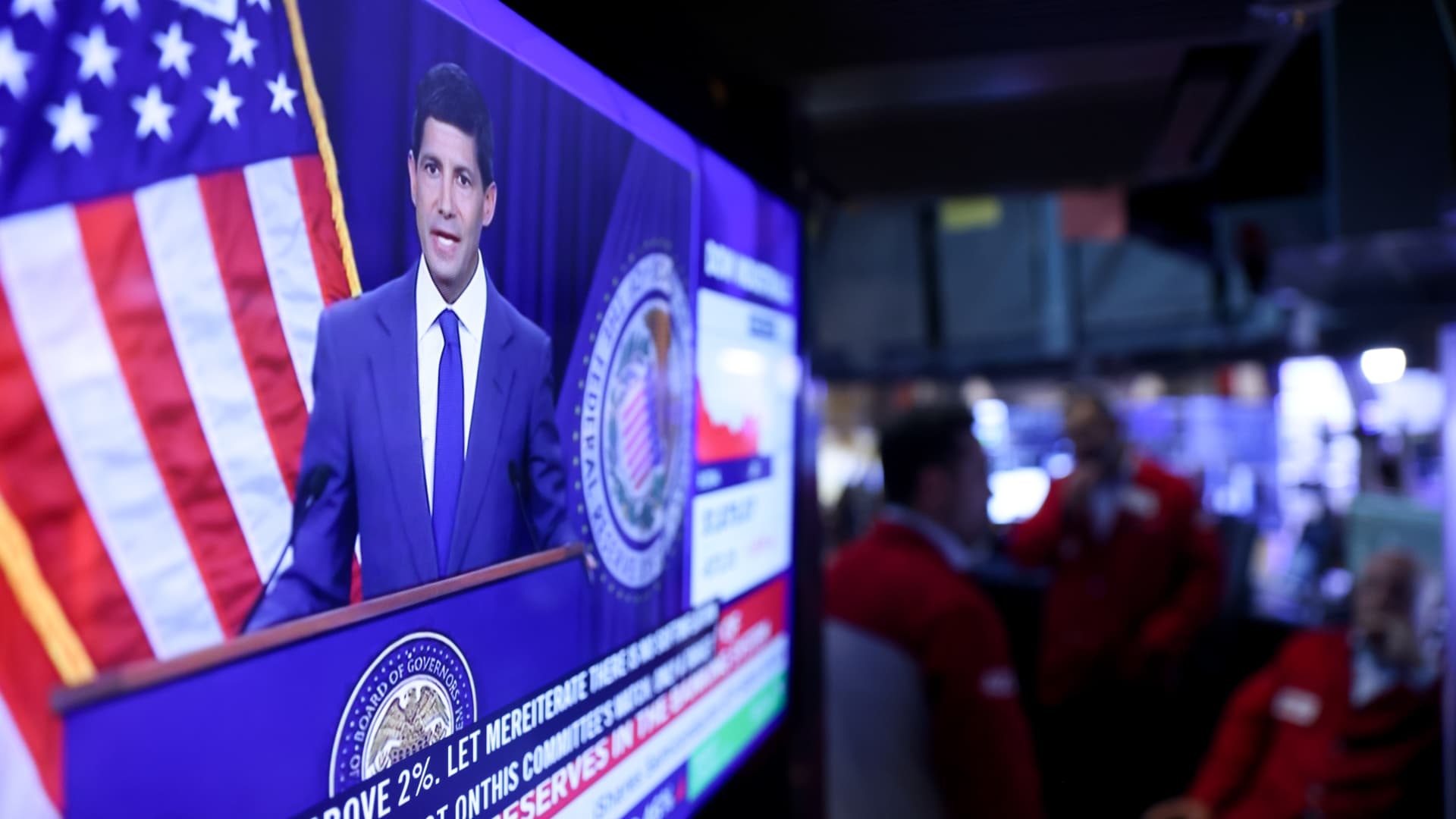
A television station broadcasts Kevin Warsh, chairman of the US Federal Reserve, speaking after a Federal Open Market Committee (FOMC) meeting on the floor of the New York Stock Exchange (NYSE) in New York, US, on Wednesday, July 29, 2026.
Michael Nagle | Bloomberg | Getty Images
Economists and investors got their latest look at the Federal Reserve‘s new era of communication with Wednesday’s Federal Open Market Committee statement.
Below is a comparison of Wednesday’s FOMC statement with the one issued after the Fed’s previous policymaking meeting in June.
Text removed from the June statement is in red with a horizontal line through the middle. Text appearing for the first time in the new statement is in red and underlined. Black text appears in both statements.
Wednesday’s release marked the second such statement under Chairman Kevin Warsh, who has promised a significant shakeup of how they Fed projects its expectations for monetary policy to the public.
The prior Fed statement in June offered one of the first glimpses into how different communication will look with Warsh at the helm.
June’s statement contained around 130 words, down from figures above 300 recorded in recent meetings, according to a CNBC analysis of the releases. It contained no forward guidance or information about how FOMC members voted, both of which were fixtures of releases under predecessor Jerome Powell.
Warsh acknowledged a “difference” in the statement early in his first press conference as chair in June. He said forward guidance was “not well suited for the current policy conjuncture.”
“It’s a bit shorter, a bit simpler and it dispenses with some older language,” Warsh said in June. “That statement just gives you the facts, as best we can judge it.”
Investors had previously scoured the formulaic release for edits in language that could indicate a change in policy views within the central bank. But since last month’s release, traders have been wondering if the Fed would now use a new, shorter template — or if the statement will look substantially different each meeting.
Some on Wall Street have turned to artificial intelligence-powered tools to parse communication from a Warsh-led central bank.
Warsh announced in June that he was forming task forces to review key aspects of the Fed’s operations. He said earlier this month that University of Washington professor Peter Fisher and former Bank of England Governor Mervin King are among the members of the communication-focused group.


Cointelegraph is committed to providing independent, high-quality journalism across the crypto, blockchain, AI, and fintech industries.
All news, reviews, and analyses are produced with full journalistic independence and integrity. For more details on our standards and processes, please read our Editorial Policy.
When will the Bitcoin bear market conclude, allowing the cryptocurrency to finally shift back into a sustained uptrend? The answer to this question is perhaps one of the most debated topics in the space.
And while investors are eager to see the return of the bulls, some analysts warn that they may have to endure more downside pressure throughout the summer and wait for better days by year-end.
When Exactly?
In October last year, BTC exploded to a new all-time high of over $126,000. Since then, though, the market has entered a bearish phase that briefly dragged the asset below $60K, and it now trades around $64,000.
Fear is running high, investor morale is shattered, and interest has slipped to a very low level. Yet this is far from the first bear market to sweep through crypto, and many analysts believe the bottom will be reached later in 2026.
Ali Martinez claimed that if the 4-year cycle theory holds, BTC’s final floor could arrive between October 6 and October 16. The recurring pattern is mainly centered on Bitcoin’s halving, which occurs precisely every 210,000 blocks, or about 4 years. The concept is that the peak of the bull run arrives 12 to 18 months after the event and is followed by a sharp decline due to selling pressure and loss of momentum.
Eventually, the sell-off transitions into an accumulation phase prior to the next halving, with the upcoming one scheduled for the spring of 2028. Not long ago, CryptoPotato reported that BTC’s past behavior across different stages signals a potential bottom between October 4 and October 17 – a window which aligns almost perfectly to Martinez’s forecast.
But How Low?
Before the cycle bottoms, BTC holders may have to withstand a harsh final move south. According to X user Pepesso, BTC might fall to $49,000 before entering an accumulation phase.
“The real move higher likely won’t start until early 2027, once that bottom is fully in,” they added.
Crypto Lens issued an even more skeptical prediction, envisioning an “inevitable final capitulation” to $39,000 by October. After that, though, the analyst expects that the price could skyrocket to $150K by February next year.
For their part, BATMAN noted a striking parallel between Bitcoin’s current market structure and that seen in the autumn of 2022, which was followed by a meltdown to around $16,000.
Of course, one must keep in mind that the collapse was driven largely by the demise of the once-prominent crypto exchange FTX. Over the past several weeks, leading platforms like BitMEX and BitMart announced they would shut down operations, yet the disclosures have had little to no impact on the price of the primary cryptocurrency.
The post Mark Your Calendar: This Could Be the Exact Date Bitcoin Finally Bottoms appeared first on CryptoPotato.
The Digital Asset Market Clarity Act will not receive a Senate floor vote before the August 7 recess, with Senate Majority Leader John Thune acknowledging the chamber lacks time to complete debate, amendments, and a cloture vote before lawmakers leave Washington.
The admission is not merely a scheduling inconvenience, it compresses an already tight legislative calendar and forces the market-structure bill into a September session that carries far less political momentum, while prediction markets are pricing in a sharply diminished probability of enactment this year.
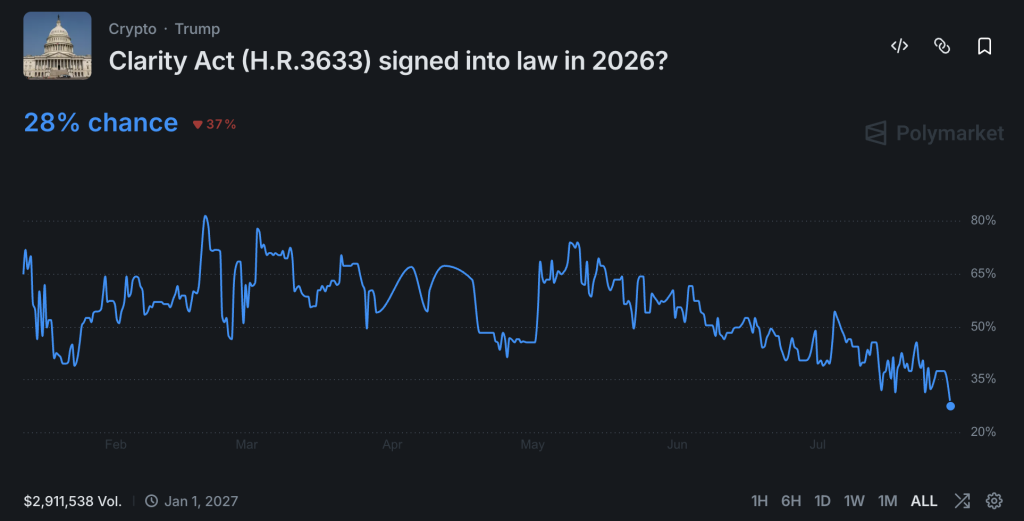
Polymarket odds on the CLARITY Act becoming law in 2026 have fallen to approximately 28%, down from a peak of 82% in February.
Each missed deadline, a White House-floated July 4 signing ceremony, a late-July practical window, and now the August recess, has eroded confidence that Congress can deliver a comprehensive crypto regulation framework before election-cycle gridlock takes hold.
Discover: The Best Crypto to Diversify Your Portfolio
Competing Priorities Crowd Out Floor Time
The Senate’s pre-recess schedule has been consumed by a Russia sanctions package and a backlog of executive, intelligence, and judicial nominations, leaving no viable window for the multi-step procedural requirements the CLARITY Act demands.
The bill requires floor debate, a potential amendment process, and a 60-vote cloture threshold before any final passage vote, a sequence that cannot realistically be compressed into the days remaining before August 7.
Republicans currently hold enough seats to bring the bill forward but need approximately 10 Democratic senators to clear the filibuster threshold.
JUST IN:
SEC says it is ready to create crypto rules if Congress fails to pass the Clarity Act.
— Watcher.Guru (@WatcherGuru) July 28, 2026
That math alone made a late-July push difficult; the displaced floor calendar makes it impossible. Thune previously indicated he hoped to at least begin consideration of the legislation before recess, a formulation that itself signals how far expectations have receded from outright passage.
The CLARITY Act cleared the House on July 17, 2025, with a 294–134 vote and now sits on the Senate Legislative Calendar as Calendar No. 423 with no cloture motion filed and no floor time formally allocated. That means all remaining execution risk sits entirely on the Senate side, and it is substantial.
Ethics Language and Enforcement Authority Remain Unresolved
Senator Cynthia Lummis introduced amended legislation designed to merge the versions approved by the Senate Banking and Agriculture committees, and the updated text includes ethics clauses targeting digital asset transactions by public officials.
Under the amendment, public officials and the president would be prohibited from issuing or sponsoring digital assets, with existing holdings subject to blind trusts, divestment, or equivalent procedures. Those restrictions would expire on January 20, 2029.
The ethics language was a direct response to concerns over cryptocurrency business ventures linked to President Trump and his family, but seven Democratic senators, Catherine Cortez Masto, Angela Alsobrooks, Cory Booker, Ruben Gallego, John Hickenlooper, Mark Warner, and Raphael Warnock, said the revised provisions do not go far enough.

Their demands cover stronger consumer protection, illicit finance safeguards, and market integrity measures, and none of those objections has been resolved ahead of the recess.
Enforcement authority presents a separate but equally intractable dispute. The updated bill centralizes enforcement responsibility with federal agencies – primarily the SEC and CFTC – rather than preserving parallel state-level authority.
New York Attorney General Letitia James warned that the framework could restrict states from applying their own investor protection laws to digital asset fraud cases, a concern that resonates particularly in states with aggressive securities enforcement traditions. The core disagreement is whether federal jurisdiction would preempt or merely supplement state enforcement schemes, and neither side has moved significantly toward the other.
Stablecoin yield provisions and the treatment of decentralized finance protocols remain open as well. These technical sections carry direct commercial implications for exchanges, stablecoin issuers, and DeFi protocols, making rapid compromise unlikely.
The scale of industry lobbying behind the CLARITY Act, including significant political spending from crypto-aligned PACs, reflects how much is at stake commercially, but lobbying intensity has not translated into the bipartisan vote count supporters need.
Trade Ripple XRP on Bybit and Get a Chance to Win Our $1,000 USDT Airdrop
The post Polymarket Odds on CLARITY Act Crash to 28% as Senate Misses August Deadline appeared first on Cryptonews.
Google’s display at APEC Digital Weeks in Chengdu on July 23, 2026 did not focus on Gemini.
Evelyn Cheng | CNBC
BEIJING — The artificial intelligence race between the U.S. and China is heating up in the world’s largest continent: Asia.
“The American strategy is to stop China from becoming the leading AI supplier for the rest of Asia … and frankly the whole world,” said Gary Dvorchak, managing director at The Blueshirt Group. While China’s alternatives are cheaper, he pointed out the U.S. currently offers a more complete solution from chips to AI models.
But the U.S. sales challenge was apparent at the Asia-Pacific Economic Cooperation “Digital Weeks” in the southwestern Chinese city of Chengdu this month.
The U.S. left few public traces of its involvement in the event, despite a U.S. official and a U.S. business representative to APEC both highlighting AI in promoting the Chengdu event earlier this year. The subdued U.S. presence comes after Anthropic flip-flopped on its Fable AI model release due to abrupt U.S. policy changes, and new Chinese AI models have recently launched similar capabilities for far less.
In contrast, last summer at the first APEC AI meeting in South Korea, Michael Kratsios, President Donald Trump’s chief science and technology policy advisor, highlighted the U.S. AI Action Plan and the establishment of the American AI Exports Program, according to a White House transcript of his remarks.

However, earlier this month Politico cited three former officials in reporting the Commerce Department has so far received a less-than-expected 78 applications for the American AI Exports Program.
And on July 24 at an APEC High-level Forum on AI organized by China’s cybersecurity regulator, Bill Guidera, deputy under secretary for innovation and engagement at the U.S. Department of Commerce, still focused on the AI exports program, according to materials reviewed by CNBC.
He called broadly for Asia-Pacific partnerships, noting buyers can acquire a full U.S. tech stack or just portions through the exports program. “It is the brilliant design that shows the strength, security and capability of U.S. AI,” Guidera said.
The Commerce Department’s International Trade Administration confirmed in a July 29 social media post that Guidera spoke in Chengdu. When asked about the Politico report, an ITA spokesperson said the volume of applications “exceeded our expectations.” The White House did not respond to a CNBC request for comment.
American business showcases were also limited. Google and Meta were the only U.S. companies that CNBC noted had booths at APEC as of July 23, among booths for Thailand and China, which were mostly Chengdu-based companies. The two U.S. companies respectively emphasized molecular AI system AlphaFold and AI applications for small businesses, rather than large language models.
Google’s government affairs vice president, Wilson L. White, only made passing references to Gemini in a speech on July 24, while Tencent Vice President Cai Guangzhong took the stage after White to emphasize growing adoption of its Hunyuan LLM and a cloud project in Thailand.
Beijing’s AI diplomacy
China is hosting APEC this year, which comes at a critical moment of U.S.-China tensions and tech rivalry.
Beijing has doubled down on the opportunity to emphasize its AI capabilities, which are mostly open-source versus largely closed U.S. models.
Chinese President Xi Jinping announced at the World AI Conference in Shanghai on July 17 that China would provide developing countries with 5,000 opportunities in AI training and seminars, while developing AI application cooperation centers with Southeast Asia and other regions.
Beijing then sent a high-ranking official, Vice Premier Zhang Guoqing, to advocate for developing tech standards with other Asia Pacific nations at the minister-level APEC Digital Weeks on July 23. Later that day, the 21 member economies, including the U.S., agreed to back open-source AI with “strong security.”
“The ‘endorsement’ of open-source models with strong security assurance gives China’s open-weight strategy greater regional legitimacy, especially across emerging Asian economies where deployment cost and technological sovereignty are major considerations,” said Wei Sun, principal analyst, artificial intelligence, Counterpoint Research.
Forced integration
But rather than a world divided into spheres of U.S. and Chinese AI, Sun expects a combination of the tech, especially in Asia.
With more than 1,300 living languages in Southeast Asia alone, just using a U.S. or Chinese AI model isn’t as straightforward as it looks.
Governments in Asia and elsewhere are spending “billions” on AI systems tailored to local languages, according to privately funded startup Votee AI. CEO Pak-Sun Ting said he is working with at least five governments, including two in Southeast Asia, and that the startup is already making well over $10 million in revenue a year.
Ting said entities in Southeast Asia tend to use Nvidia chips, especially for AI training, but may use other chips for running models. He noted Votee’s open-source model for Cantonese speakers was developed partly using Alibaba’s open-source Qwen model.
AI’s ability to generate economic returns remains critical regardless of origin.
“While the U.S. and China are fiercely competing in AI technology and diplomacy through distinct approaches, they ultimately cannot fully decouple from one another,” said Yue Su, principal economist at the Economist Intelligence Unit.
She pointed out the light U.S. presence at APEC wasn’t that surprising given other events, such as a San Francisco AI Summit on July 24.
South Korea’s tech ministry organized the event, where President Lee Jae-myung sought to build on Korean chip and AI megaprojects by meeting with U.S. frontier AI model leaders Sam Altman of OpenAI, Dario Amodei of Anthropic and Jensen Huang of Nvidia.
—CNBC’s Jenny Lee contributed to this report.

Traders works on the floor of the New York Stock Exchange (NYSE) at the opening bell on March 5, 2026 in New York City.
Angela Weiss | Afp | Getty Images
The Dow Jones Industrial Average fell more than 1,000 points on Wednesday after the Federal Reserve decided to keep interest rates steady while U.S. oil neared $85 per barrel.
In the last five years, the blue-chip index has closed down more than 1,000 points nine times. Typically, the index tends to fall in the week after the large decline, but then performs well in the one-month and three- month periods that follow.
The Dow is flat on a median basis a day after falling 1,000 points in one session. One week after, its performance worsens with a loss of 1.14%. One month after the fact, however, the Dow sees a median gain of nearly 2%. Three months after, that gain balloons to 9.1%.
Three of the nine 1,000 point drops happened amid the fallout after President Donald Trump’s “liberation day” in April 2025, when he announced sweeping reciprocal tariffs on countries across the globe. The Dow and the broader market rebounded after their initial two-day dramatic fall once Trump announced a 90-day pause on the tariff plan, though the blue-chip average fell again on April 10 as high tariffs on China remained.
U.S. equities began to recover later in April after Trump and China signaled trade tensions were easing.
Four other drops happened in 2022. Inflation was surging that year, and the Federal Reserve hiked its overnight rate multiple times to contain it. Investors worried that higher rates could lead to an economic slowdown and potentially a recession, pushing the Dow and the other major averages to fall into bear market territory.
Markets bottomed in October 2022 and the current bull market began.
The other two big drops for the Dow were in August and December 2024. The former was driven by concerns over the U.S. labor market after a weaker-than-expected jobs report and a sharp fall in the Japanese stock market, while the latter was caused by the Federal Reserve indicating it would take a cautious approach on cutting interest rates.

Dow, 1-day
Currently, investors are worried about the Fed’s decision to stay on the sidelines at the conclusion of its July 2026 meeting amid above-target inflation. It came while oil prices rose again after Trump promised to hit Iran in retaliation for a surprise attack on American forces. While the central bank decided to maintain rates at the current range of 3.5% to 3.75% for now, three members dissented in favor of a hike, indicating rising rates may be on the horizon.
Going by history, the fallout from this one-day decline may linger further.
— CNBC’s Fred Imbert contributed reporting


Prediction market guides explain how contracts resolve and pay. Almost none explain what happens when a market never gets that far, because it was voided, suspended by a court, renamed mid-life, or pulled by the exchange. The answers live in rulebooks and incident history, and they differ enough to matter.
Summary
- A prediction market can end without a normal resolution in at least four ways: the exchange voids it, a regulator or court forces suspension, the contract’s terms are altered mid-life, or the venue withdraws a self-certified product under pressure.
- Voiding is the cleanest outcome and generally means positions are cancelled and trades refunded, though the treatment of fees already paid varies by venue.
- Regulatory suspension is the messiest, because a state order can stop trading in a market that still has months to run, leaving positions frozen instead of settled.
- Contract terms are not immutable. Exchanges can and do clarify or rename markets after trading begins, which changes what you are holding without cancelling it.
- The one most useful habit is reading a venue’s rules on voiding, suspension, and settlement disputes before trading, because those clauses are where every one of these outcomes is defined.
Most explanations of prediction markets follow the same path: a contract opens, you buy shares priced between $0.01 and $0.99, the event occurs, the winning side receives $1, and settlement lands in your account within hours. That description covers the overwhelming majority of contracts, and the guides that stop there are not being careless. But a growing share of the interesting cases never reach that path. Markets get voided when their wording turns out not to describe reality.
They get suspended when a state court orders an exchange to stop offering a category. They get renamed when the exchange decides the original title was ambiguous. And they get withdrawn when a regulator opens a review, and the venue pulls the product instead of fighting. In each case, a trader is holding something, and what happens to it depends on clauses almost nobody reads. This guide covers those clauses, what the incident record shows, and what to check before you put money into a contract that might not finish.
Four ways a market ends early
The outcomes differ enough that lumping them together is the first mistake.
Voiding: The exchange determines the contract cannot be resolved fairly under its stated criteria and cancels it. Typical triggers: the underlying event becomes impossible to adjudicate, the resolution source stops publishing, the criteria turn out to be ambiguous in a way trading has exposed, or the market was listed in error. This is the most orderly failure mode.
Regulatory suspension: An external authority forces the exchange to stop offering a market or a category of markets to some or all users. Recent examples have involved state gaming regulators ordering venues to halt sports contracts in their jurisdiction, and enacted state bans with effective dates. The exchange remains solvent, and the market may remain open elsewhere, but affected users lose access.
Modification: The contract survives but its terms change. An exchange clarifies wording, renames a market, or publishes an interpretive note about how it will read the criteria. Nothing is cancelled, and nobody is refunded, but the thing you bought is not quite the thing you now hold.
Withdrawal: The venue itself pulls a product, often after a regulator opens a review. Historically, exchanges facing scrutiny over specific event contracts have withdrawn their certification instead of awaiting an order, which ends the market without any formal decision being issued.
Voiding and refunds
The orderly case is worth understanding first, because it is the outcome traders should generally want when a market has gone wrong.
The principle is straightforward: if the contract cannot be settled fairly, the exchange unwinds it and returns participants to their starting position. Positions are cancelled, and the collateral committed to them is released. The argument for this treatment is that a market whose terms do not describe reality never functioned as a market, so allowing it to pay out would reward whoever read the ambiguity best instead of whoever forecast the event correctly.
Where venues differ, and where the rulebook matters, is in three details. Whether trading fees already paid are refunded alongside the collateral, which is not universal. Whether the refund reflects your entry price or a mid-market value at cancellation, which matters if you traded in and out. And how the exchange handles a market that has partially resolved, where some component of a multi-outcome event has settled, and others have not.
The disputed cases usually involve wording, not events. Commentary on one episode, in which an exchange renamed a market whose title had become confusing, argued that best practice is simply to void and refund whenever the terms need altering, because if the trading desk understands the confusion well enough to rewrite the title, participants have already been trading something ambiguous. That is a reasonable standard, and it is not the universal practice, which is exactly why the clause is worth reading.
Regulatory suspension
This is the outcome with the least satisfying answers, and the one most likely to affect a large number of traders at once.
The prediction market industry is in active legal conflict across multiple US states over whether sports event contracts constitute gambling requiring state licensing. That conflict has produced cease-and-desist orders, litigation in several federal circuits, at least one enacted state ban with an effective date, and venues complying with court orders while appealing them. 12 or more states have taken some action. Availability changes month to month.
For a trader in an affected state, the practical questions are what happens to positions already open, whether new trades are blocked while existing positions can be closed, and whether funds can be withdrawn. Venues have generally handled this by restricting new trading for affected users while allowing existing positions to be closed or to run to settlement, which is the least disruptive approach available. But that is a policy choice, not a guarantee, and the mechanism differs from voiding in an important way: the market itself is not defective; it is simply unavailable to you.
Two consequences follow. Your position may continue to exist and settle normally while you cannot manage it, which is a materially different exposure than the one you took on. And where the venue is compelled to halt a market entirely, the treatment falls back on the voiding provisions above.
The instruction that follows is unglamorous: verify current availability in your own jurisdiction at the moment you intend to trade, from the venue’s own disclosures, and treat any published state list as potentially out of date, including one in a guide like this.
Modification, and why it is the sneakiest case
The outcome that produces the least noise and the most quiet damage is the one where nothing is cancelled.
Exchanges publish clarifications: They rename markets whose titles have become misleading. They issue interpretive notes explaining how ambiguous criteria will be read. On blockchain-based venues, the operator can publish clarifications that shape how the decentralized resolution process reads the rules, even where the operator cannot decide the outcome itself.
None of this refunds anyone: A trader who bought a contract on one reading of its title and finds the title changed is holding a different instrument at the same cost basis, with no cancellation and no recourse beyond the dispute mechanisms the venue provides. The argument for allowing modification is practical: voiding every market that needs a clarification would be enormously disruptive and would itself become a manipulation vector. The argument against is that it makes the contract’s terms mutable after the trade, which is not a property most participants assume they are accepting.
The defence is to read the rules and important-information sections at entry, not the headline, and to treat any market whose title carries obvious ambiguity as carrying modification risk on top of everything else.
Regulated exchanges versus on-chain venues
The two architectures handle all of this differently, and the difference is structural, not a matter of policy quality.
On a federally licensed exchange, the rulebook governs, and the exchange is accountable for enforcing it. There is a named entity, a regulator supervising it, a complaints path, and, for a designated contract market, obligations under the core principles to list contracts that are not readily susceptible to manipulation. Voiding, suspension, and modification decisions are made by an identifiable party that can be asked to justify them. Our guide to the designated contract market licence covers that structure.
On a blockchain venue, resolution runs through a decentralized process with proposal, challenge, and token-holder voting stages, which this publication examines in its guide to how prediction markets resolve. Once a resolution finalizes on-chain, it is locked, and there is no operator with the authority to reverse it. That is a genuine guarantee against arbitrary reversal, and it is also a guarantee against correction: a resolution that a reasonable observer considers wrong is nonetheless final.
Neither model is uniformly better. The regulated venue can fix mistakes and can therefore also make discretionary decisions you may dislike. The on-chain venue cannot make discretionary decisions and can therefore also not fix mistakes. Knowing which you are on determines what kind of failure you are exposed to, and our guide to Polymarket’s 2 venues explains why a one brand can be both.
Two incidents worth knowing
Abstract categories are less useful than cases, and two episodes illustrate the range between the orderly and the messy versions of a market ending early.
The first involved wording. An exchange listed a market on whether a named executive would leave her role within a stated period, and the contract’s terms turned out to be ambiguous enough that the exchange altered the market’s title mid-life. Commentary at the time argued the correct response was to void and refund instead of renaming, on the reasoning that an operator who understands the confusion well enough to rewrite the title has already conceded that participants were trading something unclear. The counterargument is that voiding every ambiguous market would itself be disruptive and gameable. Neither position is obviously wrong, which is precisely why this belongs in a rulebook, not in a judgment call, and why reading that rulebook before trading is the only protection available.
The second involved subject matter, not wording. Venues have adopted explicit policies against markets that settle directly on a person’s death, a line drawn after contracts touching geopolitical events and named individuals generated substantial controversy. That is a listing standard, not an early-ending mechanism, but it points at the same underlying reality: what a venue will and will not carry is a policy that can change, and contracts near the edges of those policies carry a risk of removal that has nothing to do with their subject matter being resolved.
The generalisable lesson from both is that the risk concentrates where the wording is loose, or the subject is sensitive. Objective criteria resolved by a single authoritative source almost never produce these outcomes. Markets whose terms invite argument, or whose subject matter invites institutional discomfort, produce them regularly.
What to check before trading
Five items, ordered by how often skipping them causes losses.
The voiding clause: Find it in the venue’s rules. It defines what happens in the orderly failure case, including whether fees are refunded and how partial resolutions are treated. If you cannot find it, that is itself information.
The resolution source and criteria: Read the rules and important-information sections, not the market title. Ambiguity between them is the raw material of every voiding and modification event.
Current availability in your jurisdiction: Legal status by state is contested, moving, and specific to product categories. Check at the moment you trade.
The settlement timeline in the rules: Some markets specify a determination date later than the point at which the event appears to conclude, which means a position you consider settled is still open.
Whether the venue can modify terms: If the rulebook permits clarification or renaming after trading begins, you are accepting mutable terms. That may be fine. It should be a decision, not a discovery.
The theme across all five is that the answers exist, in documents the venues publish and almost nobody reads, and that the small number of traders who read them before entering are the ones not surprised when a market ends in an unusual way.
The self-certification connection
One structural fact explains why early-ending markets happen more often in this category than in most regulated products, and it is worth knowing because it also predicts where the risk concentrates.
American event contracts reach the market through self-certification: a licensed exchange files a submission stating that a product complies with the law and begins listing it, without waiting for approval. Our guide to that mechanism covers it in full.
The consequence for this discussion is that no regulator vetted the contract’s wording before trading began. The exchange’s own compliance judgment is the only filter, and every ambiguity that later forces a void or a clarification passed through that filter first.
The same procedure creates the withdrawal risk. Where a submission touches activities the statute enumerates, including gaming and conduct unlawful under state law, the regulator may open a review and request that the exchange suspend listing or trading while it proceeds. Historically, exchanges facing such reviews have sometimes withdrawn certifications rather than await a decision, which ends a market with no order ever issuing and no formal ruling to appeal.
Read together, the two halves explain the distribution of risk. Markets whose subject matter sits near the enumerated activities carry regulatory-ending risk on top of their ordinary market risk, and that category is not obscure: it is sports, politics, and anything touching conduct that states regulate as gambling, which is where most retail volume concentrates. A trader who wants to minimise exposure to early endings should prefer contracts whose resolution criteria are objective, whose subject matter is remote from gaming, and whose venue has a track record of certification decisions that have not been reviewed.
A final observation on why this question deserves more attention than it receives. Prediction market coverage has concentrated overwhelmingly on two subjects: whether these venues are legal, and whether their prices are accurate. Both are legitimate, and both are extensively covered. What has been almost entirely absent is the operational question of what a position actually is, contractually, once you hold it.
That gap has a structural cause. The parties best positioned to explain voiding, suspension, and modification are the venues themselves, and none of them has a commercial reason to lead with the circumstances in which your position does not resolve normally. The affiliate-driven guides that dominate search on these terms have less reason still, since their revenue depends on account signups, not on informed participants. So the material stays in rulebooks, where it is accurate, complete, and read by almost nobody.
The consequence is a category where a substantial number of participants hold instruments whose failure modes they have never considered, in a regulatory environment producing suspensions and withdrawals at a steady rate. Reading the rules before trading is not a sophisticated practice. It is the minimum, and in this category it puts you ahead of most of the order book.
Frequently Asked Questions
What happens if a prediction market is voided?
Generally, the exchange cancels the contract and returns participants to their starting position, releasing the collateral committed to open positions. The rationale is that a market whose terms do not describe reality never functioned properly, so paying out would reward whoever read the ambiguity best. Whether fees already paid are also refunded, and how partial resolutions are handled, varies by venue and is defined in the rulebook.
Why would an exchange void a market?
Because the contract cannot be settled fairly under its stated criteria. Common triggers include an underlying event becoming impossible to adjudicate, a resolution source ceasing publication, criteria turning out to be ambiguous in ways trading has exposed, or a market being listed in error. Voiding is the most orderly of the early-ending outcomes.
What happens to my position if my state bans prediction markets?
It depends on the venue’s policy and the scope of the order. Exchanges have typically restricted new trading for affected users while allowing existing positions to be closed or to run to settlement. The market itself is not defective, so the voiding provisions do not automatically apply; you may hold a position that settles normally while you cannot manage it.
Can an exchange change a market’s terms after I have bought?
Yes, on regulated venues. Exchanges publish clarifications, rename markets, and issue interpretive notes about ambiguous criteria. Nothing is cancelled, and nobody is refunded, which means you can end up holding a different instrument than the 1 you bought. Reading the rules and important-information sections at entry, and not the market title, is the defence.
Is a resolution ever reversed?
On regulated exchanges, decisions can be reviewed through the venue’s dispute procedures. On blockchain venues using decentralized oracles, once a resolution finalizes on-chain, it is locked, whether it arrived through an uncontested challenge window or a token-holder vote. That finality protects against arbitrary reversal and also prevents correction of outcomes many observers consider wrong.
Which venue type handles this better?
Neither uniformly. A regulated exchange has an accountable operator that can fix errors and can therefore also exercise discretion you may dislike. An on-chain venue removes discretion entirely and therefore also removes the ability to correct mistakes. The relevant question is which failure mode you prefer to be exposed to.
Do I get my trading fees back?
Not necessarily. Collateral release on a voided market is standard; fee treatment is not, and it is defined in each venue’s rules. On contracts priced in cents, fees represent a meaningful share of the position, so this clause is worth locating specifically rather than assuming.
What is the single most useful precaution?
Reading the venue’s rules on voiding, suspension, and settlement disputes before you trade, and reading each market’s own rules and important-information sections rather than its headline. Every outcome described in this guide is defined in documents the venues publish, and the traders who are not surprised are the ones who read them 1st. This is educational information, not investment or legal advice.
Disclaimer: This article is for information and educational purposes only and does not constitute financial, investment, or legal advice. Venue policies, availability, and the legal status of event contracts vary by jurisdiction and change frequently. Always verify current rules and terms with the venue directly. Always do your own research. Information is accurate as of July 29, 2026.
Hackers briefly took over Senator Cynthia Lummis’ verified X (Twitter) account on Wednesday. The account pushed a fake Solana meme coin called $USA Token before the posts disappeared within roughly five minutes.
The Wyoming Republican is the Senate’s most persistent advocate for the Digital Asset Market Clarity Act, a bill that would divide crypto oversight between two federal regulators. Few lawmakers post about digital assets more often.
Inside the Lummis Crypto Scam Hack
The message claimed the token was “officially created by our team” and tagged Solana. It carried an American flag image and a link to pump.fun. That platform lets anyone mint a Solana meme coin in minutes.
A screenshot captured by Bitcoin Archive shows the post reached about 5,600 views and 37 replies before it vanished. Several near-identical versions appeared in quick succession. Each pointed to a different token page.
Follow us on X to get the latest news as it happens
Verified political accounts make attractive targets. Followers rarely expect a token promotion from a sitting senator, so the first few minutes carry the most weight.
Crypto users flagged the account within minutes and warned followers not to buy. However, Lummis’ office had issued no statement confirming the breach at the time of publication.
No proceeds have been tied to the tokens so far. That marks a sharp contrast with the Robinhood CEO’s X account takeover six days earlier, where the attacker cleared roughly $1.2 million.
Account Takeovers Keep Hitting Crypto’s Biggest Names
Vlad Tenev lost control of his account on July 23 after attackers socially engineered X customer support. They promoted a token called Vladhood and extracted about 650 ETH.
Earlier in July, the SpaceX and Starlink accounts were used to push a rug pull called SCATMAN, netting around $125,000. X (Twitter) began locking first-time crypto posts in April to slow the pattern. It has not stopped.
The playbook rarely changes. Attackers seize a verified account, post a freshly minted token, then delete the evidence before the owner regains control.
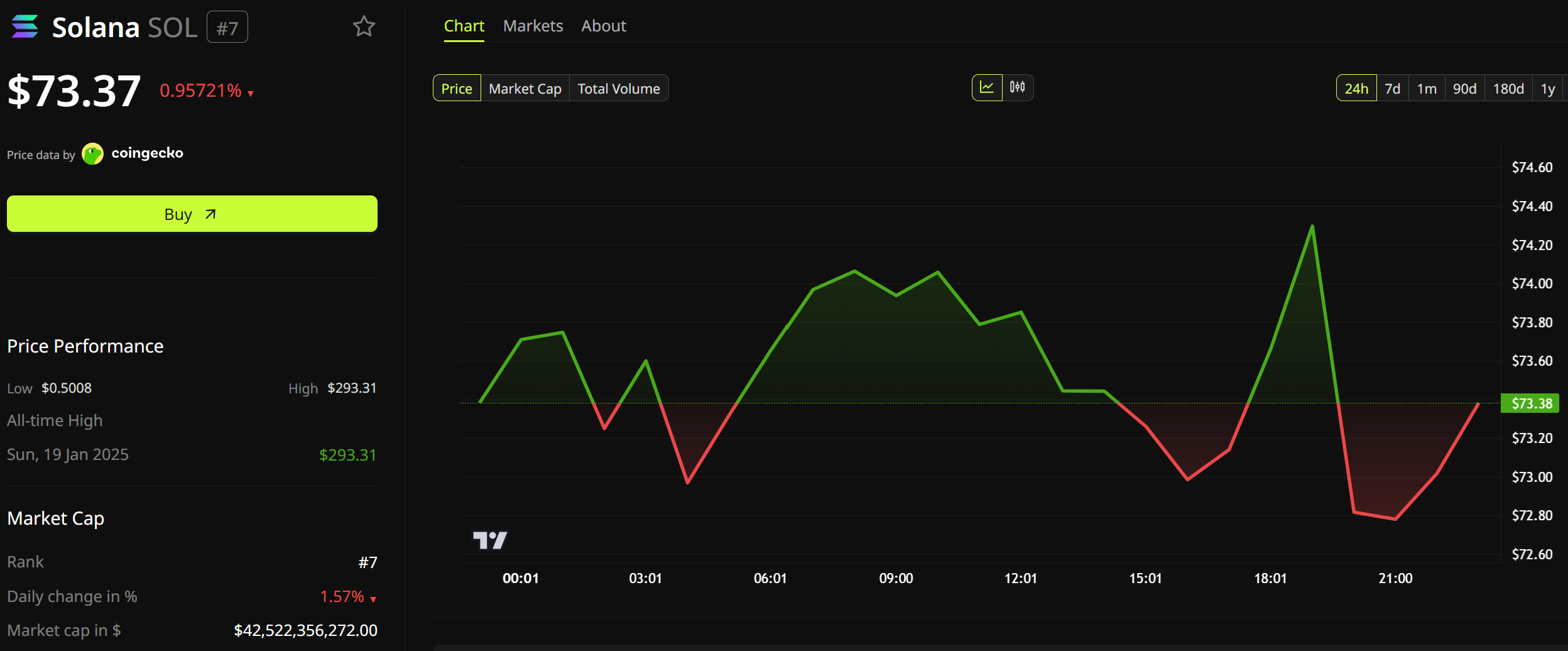
SOL traded around $73 on Thursday, down almost 1% over 24 hours and roughly 60% below its level a year ago. The scam token itself carried no real liquidity.

Meanwhile, the timing lands awkwardly for Lummis. Her bill stalled before the recess after Senate leaders conceded there was no time for a floor vote. How the account was accessed may end up mattering more than the token ever did.
The post Lummis, CLARITY Act’s Fiercest Proponent, Hit by Crypto Scam Hack appeared first on BeInCrypto.

MoonPay has introduced PayBox, a “payment vault” designed to let users authorize AI assistants such as ChatGPT and Claude to carry out crypto actions directly from a conversation. The tool is positioned as a safer way for AI agents to handle tasks like token swaps, cross-chain transfers, and DeFi interactions—while keeping users in control of their funds.
Alongside PayBox, the launch highlights the growing role of x402, an open payments protocol developed by Coinbase for internet-native payments by AI agents. x402 has been moving toward wider industry standardization, including governance under the Linux Foundation and integration across cloud and custody infrastructure.
Key takeaways
- MoonPay’s PayBox aims to enable AI assistants to execute crypto transactions from chat, with user approvals supported via passkeys or spending limits.
- MoonPay says PayBox protects wallet keys using multi-party computation and trusted execution environments to prevent unilateral access by either the AI or MoonPay.
- PayBox supports multiple chains and payment rails, including debit cards, bank accounts, Apple Pay, and PayPal.
- x402 is expanding beyond Coinbase, including Linux Foundation governance and reported usage growth on Coinbase’s Base network.
- Public x402 ecosystem data (via x402scan) shows more than 12.7 million transactions over the past 30 days across participating services.
MoonPay’s PayBox: AI-initiated crypto with guardrails
PayBox is built to connect a user’s crypto wallet and payment methods to AI assistants, allowing those assistants to prepare on-chain actions after receiving natural-language prompts. According to MoonPay, the system can generate transaction flows such as token swaps, cross-chain transfers, and DeFi interactions.
A key design element is transaction authorization. MoonPay says users can approve each action using a passkey, or they can set spending limits that let the AI perform certain permitted operations automatically. Alternatively, users can require approval for every transaction, effectively keeping the assistant from executing any spend without explicit confirmation.
MoonPay also emphasized security around key custody. The company states PayBox uses multi-party computation and trusted execution environments to protect wallet keys, aiming to ensure neither the AI assistant nor MoonPay can independently access user funds. For users, that distinction matters because AI-driven payments introduce an obvious risk: the assistant might be capable of generating transactions, but should not be able to control the underlying assets without authorization.
Beyond consumer use, MoonPay says developers can integrate the payment vault into their own AI applications via its software development kit, positioning PayBox as infrastructure rather than only an end-user feature.
Why this matters: reducing friction without surrendering control
AI payments are often discussed in terms of convenience—an assistant handling purchasing, swapping, or settlement without requiring users to manually navigate wallets. PayBox takes a more security-forward angle by focusing on approval mechanisms and constraining what an AI can do.
For investors and builders, the most important question is where the “automation boundary” should be: how far should an assistant go before a user must sign off, and how should spending permissions be scoped. MoonPay’s approach—passkey-based approvals, optional per-transaction confirmation, and predefined spending limits—suggests an attempt to make that boundary explicit.
It also signals that AI payment systems may converge on user-consent patterns that resemble modern financial authorization workflows, rather than “fully autonomous” agent behavior. The market is already seeing demand for agentic capabilities, but the trust layer—especially key security and transaction approval—often determines whether mainstream users adopt these tools.
x402 traction and standardization under the Linux Foundation
PayBox also supports x402, an open payment protocol intended to let AI agents make internet-native payments. x402 was originally developed by Coinbase, and the protocol is now being governed as an open, vendor-neutral industry standard, following a contribution to the Linux Foundation in April 2026. The Linux Foundation announced the creation of a governance structure for x402 after welcoming the protocol contribution, and described it as an industry standard.
Coinbase has continued expanding the x402 ecosystem this year. In June, the exchange launched tools that reportedly enable AI agents to accept USDC payments, trade crypto, discover paid services through an AI marketplace, and handle high-frequency micropayments more efficiently. Earlier in the year, cloud provider Amazon Web Services integrated x402 into its Bedrock AgentCore Payments service, and Fireblocks introduced an x402-compatible payments framework for AI agents while joining the x402 Foundation.
These moves matter because x402 is not just a single integration—it’s aimed at enabling interoperability between AI services and payment execution layers. When multiple categories of infrastructure (cloud services, custody and tooling, and payment frameworks) adopt a common protocol, it can reduce fragmentation and speed up development of agent payment features across platforms.
On-chain activity signals growing usage—alongside uncertainty
Data cited by Cointelegraph’s earlier coverage suggests that agentic payments tied to Coinbase’s Base network have grown rapidly. In a June 3 report, blockchain analytics firm Chainalysis said agentic payments on Base surpassed 100 million transactions within roughly nine months. The report also noted that early usage was driven in part by speculative applications, highlighting that adoption metrics can include experimentation as well as sustained real-world demand.
At the time of writing, the x402 public dashboard hosted at x402scan shows more than 12.7 million transactions over the past 30 days across participating services. The continuing presence of large transaction counts on a short rolling window suggests activity is not confined to one-off launches, though it still leaves open how much of that volume reflects long-term utility versus short-cycle testing.
For readers tracking the broader “agent economy,” the practical takeaway is that payment protocols and execution frameworks are moving from concept to operational tooling. However, transaction volume alone doesn’t fully answer how many agents are used by real businesses, what percentage of payments are high-value versus micropayments, or how often transaction flows are gated by user permissions—questions that will likely become clearer as more product deployments mature.
Next, watch how PayBox’s authorization controls perform in real user workflows—especially whether per-transaction approvals become the default for mainstream use—and whether x402 ecosystem growth continues to translate into consistent, non-speculative payments across more services and chains.

Spire of Fenland church compared to leaning tower of Pisa to be removed

Perdue Farms launches protein-packed poultry

Why maximum leverage is a fee, not a feature


-

 Fashion5 days ago
Weekend Open Thread: Brooks Brothers
-
 Sports3 days ago
Commonwealth Games boxing: Jadumani Singh seals dominant 5-0 win over Pakistan’s Sumama Rehman to enter quarter-finals | Commonwealth Games News
-

 Tech3 days ago
Intel is reversing course and bringing hyper-threading back to its server chips
-

 Crypto World7 days ago
Ethics, other provisions in crypto Clarity Act to be further discussed
-

 Politics3 days ago
Luke Littler dismantles Gerwyn Price to retain title in Blackpool
-

 Business3 hours ago
Why Trees Belong on the Risk Register
-

 Crypto World4 days ago
Ripple bought a bank in pieces. The $4 billion audit
-
 Entertainment5 days ago
A New Post-Apocalyptic Gundam Anime Series Blasts Into SDCC
-

 News Videos3 days ago
BITCOIN JUST ENTERED THIS CRITICAL ZONE…
-

 Politics2 days ago
The Part of the Electric Transition Nobody Wants to Discuss
-

 Sports6 days ago
2026 3M Open leaderboard: Scottie Scheffler finds putter in Round 1, sits three back
-

 Fashion6 days ago
16 Dresses for the High Summer Event
-

 News Videos6 days ago
The Peugeot Family: How 200 Years of an “Old Money” Dynasty Died in A Boardroom
-

 Business19 hours ago
Major shareholder moves on Canyon
-

 Crypto World4 days ago
XRP Ledger adds $2.6B as RWA inflows rank second
-

 Politics3 days ago
Spain sweeps the board at 2026 World Cup with individual awards
-

 Crypto World6 days ago
Uniswap (UNI) pushes deeper into tokenized RWAs with permissioned trading pools
-
 Entertainment1 day ago
‘Stargate’ Creator’s New Sci-Fi Series Returns for Season 3 Tomorrow
-
Crypto World7 days ago
SEC Agrees to Overhaul Recordkeeping After Settling Coinbase Lawsuit Over Gensler’s Lost Texts
-

 Tech5 days ago
Anthropic launches Claude Opus 5, a cheaper AI model for coding, agents and enterprise workflows
You must be logged in to post a comment Login