
Crypto World
Ethereum Layer 2 Taiko Urges Users to Withdraw Funds From Bridges, Confirms Security Breach


Taiko, the Ethereum layer 2 blockchain, has urged users to withdraw their funds from all bridges deployed on the network immediately.
This follows a confirmation of a security breach involving the network’s chain state verification mechanism.
We have confirmed a compromise of Taiko’s chain state verification mechanism. As a result, the security assumptions of all bridges deployed on Taiko can no longer be relied upon.
The team confirmed they are actively working with the Security Council and various ecosystem partners to contain the incident, pause the affected system wherever possible, and take both technical and legal actions.
So far, there’s no information on the amount of funds in jeopardy or if something has been stolen.
According to data from PeckShield, the exploit resulted in a loss of $1.7 million, while the attacker has already transferred 1.99 million TAIKO tokens, worth slightly less than $200K, to MEXC.
#PeckShieldAlert @taikoxyz has been exploited for ~$1.7M.
The exploiter has already transferred 1.99M $TAIKO (~$189.12K) to #MEXChttps://t.co/uJhqTYrqHH pic.twitter.com/Sl9kesSSUM
— PeckShieldAlert (@PeckShieldAlert) June 22, 2026
The post Ethereum Layer 2 Taiko Urges Users to Withdraw Funds From Bridges, Confirms Security Breach appeared first on CryptoPotato.

Crypto World
Roblox Stock Sinks Nearly 14% After-Hours as New Child Safety Measures Weigh on Outlook
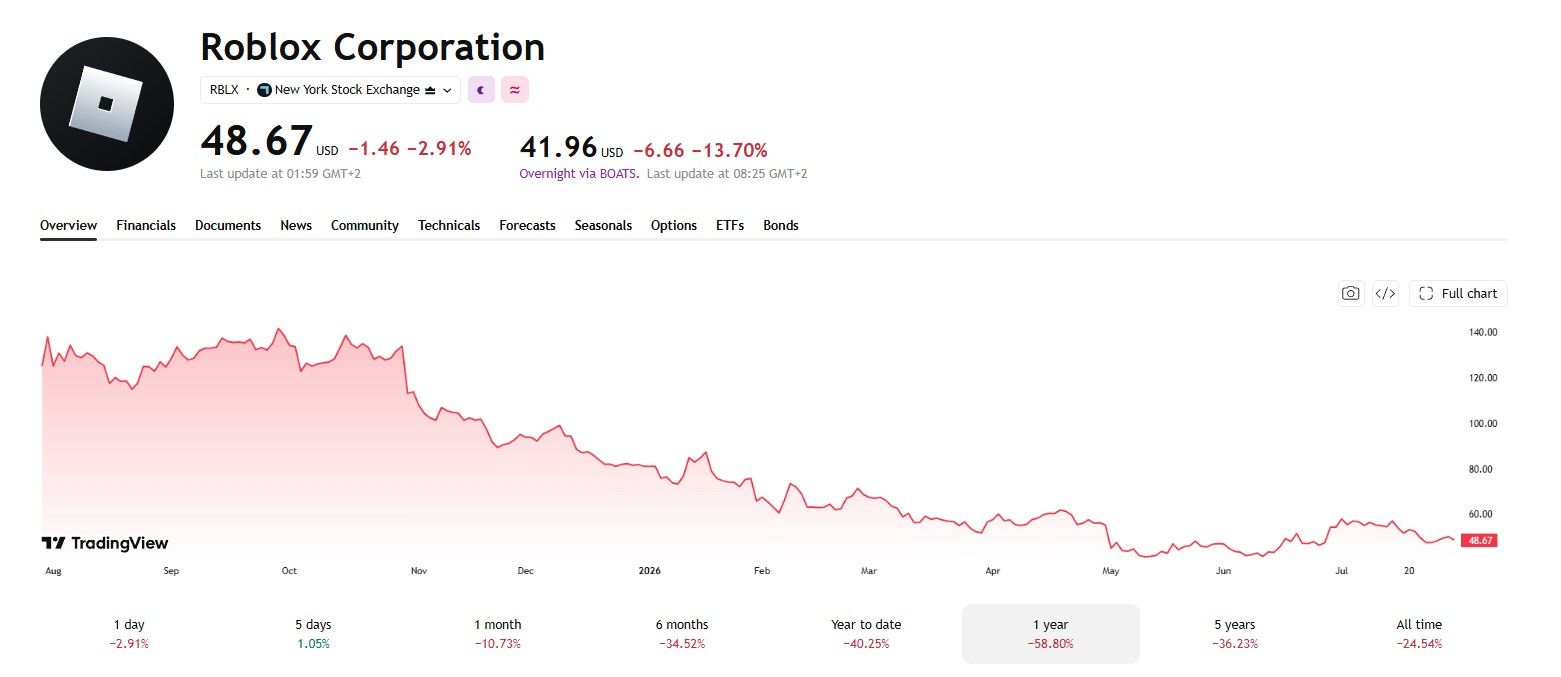
Roblox stock tumbled nearly 14% in after-hours trading on Thursday, sliding toward $41.80. The gaming platform missed Wall Street revenue targets and issued weak guidance for the third quarter.
The drop erased optimism from a 36% year-over-year revenue increase. Investors instead focused on slowing user growth and a bookings forecast far below consensus.
Child Safety Rules Slow Roblox’s Growth Engine
Roblox reported average daily active users of 123 million, up 10% year-over-year. That fell short of the roughly 128 million analysts expected. Average monthly unique payers reached 27 million, also up 15% year-over-year, per the company’s supplemental materials.

That payer growth marks a sharp deceleration, however. Monthly unique payer growth ran as high as 94% year-over-year just two quarters earlier.
Mandatory age verification and new parental control tiers have since taken hold. Average bookings per payer held steady near $19.25, so the slowdown shows up in new payer counts, not in existing spending habits.
Executives linked the slowdown directly to those safety changes. Age-check penetration reached 57% of users globally, with Australia near 80% and the United States and United Kingdom around 70%. The rollout coincided with a discovery algorithm shift that favors long-term retention over immediate spending. That change hit monetization hardest among players under 13.
The pattern mirrors a wider trend this year, as big tech selloffs periodically dragged crypto sentiment lower. Meanwhile, the Nasdaq’s rising correlation with risk assets keeps growing. A stumble at a platform this large rarely stays contained to one sector.

Weak Bookings Guidance Overshadows the Beat
Bookings, Roblox’s preferred spending measure, grew just 8% year-over-year to $1.6 billion. That growth rate ran as high as 63% just two quarters earlier and 70% the quarter before that. The deceleration landed bookings at the low end of guidance. For the third quarter, Roblox forecast bookings between $1.58 billion and $1.65 billion. That trails the roughly $1.87 billion analysts had modeled.

Adjusted losses of 26 cents per share nonetheless beat estimates, and free cash flow rose 66% to $294 million. Founder and chief executive David Baszucki framed the results as part of a longer transition.
We remain steadfast in our goal to capture 10% of the global gaming market.
Baszucki said on the earnings call.
Roblox’s report lands amid a broader wave of disappointing Big Tech guidance this earnings season. Meta stock tumbled sharply last quarter despite beating estimates, after its spending outlook rattled investors. Regulators are tightening the same age verification rules that pressured Roblox. The European Union is also closing a VPN age verification loophole that lets minors bypass similar checks elsewhere. Roblox now joins a growing list of earnings reports to watch this season as guidance cuts outweigh headline beats.
Whether Roblox’s safety-first bet pays off with steadier long-term monetization remains unclear. As a result, shareholders will watch the September quarter closely for signs that bookings have stopped sliding.
The post Roblox Stock Sinks Nearly 14% After-Hours as New Child Safety Measures Weigh on Outlook appeared first on BeInCrypto.
The largest BTC wallets, aka the Bitcoin whales, started buying in late July. And a $233 million institutional inflow followed days later, a sequence that put big money on the bid just as Bitcoin entered the weakest month on its calendar.
The turn stands out because August has closed red for four straight years. Whale wallets and exchange-traded fund desks are wading in anyway, and the timing of who moved first is the real story.
Bitcoin Whales Moved First, and the Timestamps Show It
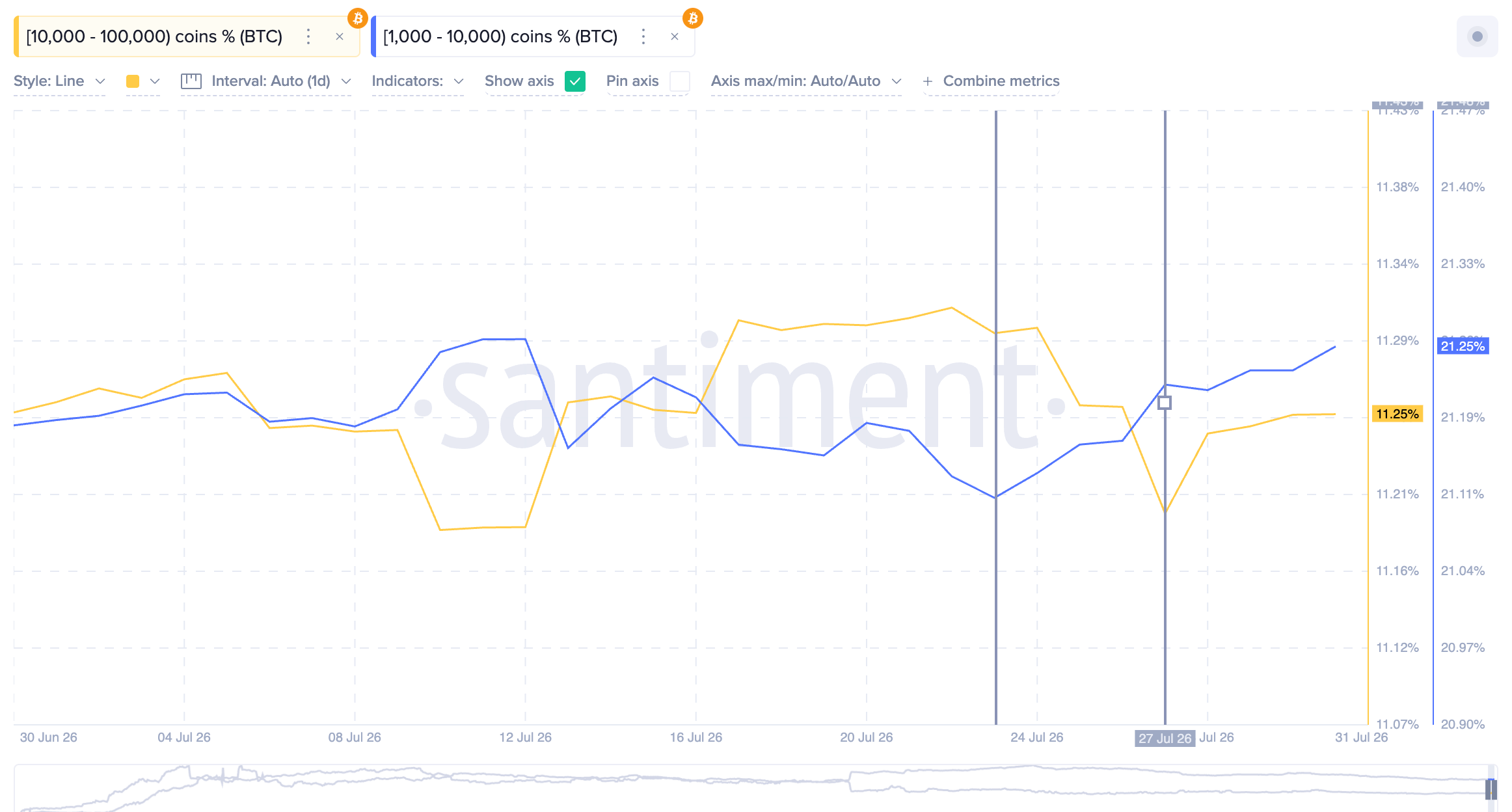
Bitcoin (BTC) whales started adding before Wall Street did. Wallets holding 1,000 to 10,000 BTC lifted their share of supply from about 21.11% on July 23 to 21.25% by month-end, according to Santiment data supplied for this analysis.
Want more token insights like this? Sign up for Editor Harsh Notariya’s Daily Crypto Newsletter here.
The larger 10,000 to 100,000 BTC cohort had been trimming since July 22. It bottomed near 11.19% on July 27, then turned back up to 11.25% into the close of the month.

Those shifts read as small in percentage terms. Yet the combined 0.20% gain across both cohorts, applied to Bitcoin’s roughly 20.06 million circulating supply, works out to about 40,100 BTC, worth close to $2.6 billion.
Derivatives positioning leaned the same way, which gives more weight to Santiment’s data. A whale-retail divergence reading of +21.8 on the daily timeframe flagged large traders as far more tilted toward long exposure than retail, a setup the dashboard labeled bullish divergence. The score reflects Binance Futures positioning, so it signals conviction rather than confirmed spot buying.

If whales were the first movers, the open question was whether institutions would follow, and the ETF tape answered within days.
Then a $233 Million Institutional Day Followed
US spot Bitcoin ETFs had been bleeding. The funds posted four straight negative sessions, including outflows of $225.18 million on July 23 and $240.08 million on July 24, before flows turned modestly positive at $32.11 million on July 29.
Then July 30 delivered $233.13 million in net inflows. BlackRock’s IBIT accounted for $183.4 million of the total, or about 79% of the day. The single session pulled spot Bitcoin ETF demand back to life after a run of redemptions.

The size matters less than the timing. July 30 was the second-largest single-day inflow of the month, behind the $265.69 million recorded on July 6, and it landed at the very end of July. It also arrived while the market was still digesting a corporate bitcoin buying freeze among some large treasury holders.

Institutions did not lead this turn. They stepped in after the on-chain cohorts had already started buying. What makes that sequence uncomfortable is the calendar it runs into.
Into Bitcoin’s Worst Month on Record
August is the problem. It carries a median return near negative 8%, the weakest of any month, and it has closed red every year since 2022. That record anchors the cautious Bitcoin August price prediction now facing the market.
July, by contrast, is on track to close green for a third straight year, a rare streak. That makes the late-month buying a bet against strong seasonal odds rather than a confirmation of them. Big money is possibly positioning for a rebound, though the data cannot rule out hedging or short-dated trades.

Yet, the convergence is real. Whale cohorts, futures positioning, and ETF cash all turned higher at once, in that order. Whether that marks accumulation before a bounce or a crowded bet into Bitcoin’s cruelest month is the wager August will settle.
The post Bitcoin Whales Scooped 40,100 BTC Worth $2.6 Billion in Nine Days appeared first on BeInCrypto.
Pump.fun reportedly dismissed employees shortly before their PUMP token grants were scheduled to vest, leaving at least one former worker without an allocation now valued at seven figures.
Summary
- Employees were reportedly dismissed weeks before 25% of their PUMP grants vested.
- One former employee allegedly lost a token allocation now worth seven figures.
- Separate claims said 40 workers were cut one day before another vesting date.
- PUMP trades near $0.002, about 77% below its September 2025 peak.
Pump.fun layoffs preceded employee token vesting
Pump.fun reduced its workforce in late March and early April after rapidly expanding its operations, according to an investigation by Sandmark.
Documents, emails, and internal recordings reviewed by the publication showed that some employees lost their jobs shortly before their PUMP allocations were due to begin vesting. At least one former employee allegedly forfeited tokens now worth seven figures.
Workers had reportedly signed token grant agreements in June 2025. Under those arrangements, the first 25% of their allocations would vest after one year, followed by additional releases over time.
Sandmark obtained a termination email showing that Pump.fun head of talent Lloyd McCarthy called affected employees into a group meeting in late March. During the recorded meeting, co-founder Noah Tweedale said the company had “grew too quickly,” limiting its ability to operate “fast and rough.”
Contracts were terminated in early April, according to the report. Affected workers received severance payments based on how long they had worked for the company, but their unvested PUMP allocations were reportedly canceled.
Pump.fun has not publicly addressed the findings.
Former workers allege a second round of cuts
New allegations surfaced after former workers claimed that Baton Corp., the company behind Pump.fun, conducted another round of layoffs in mid-July.
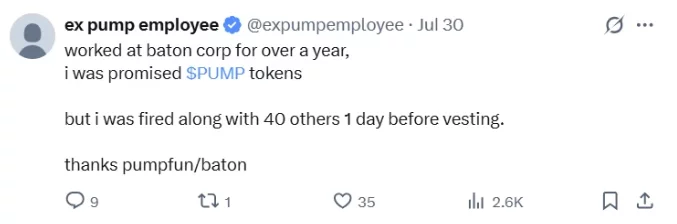
A newly created X account named “ex pump employee” alleged that Baton dismissed about 40 employees one day before their PUMP grants were scheduled to vest. The account owner claimed to have worked for the company for more than a year.
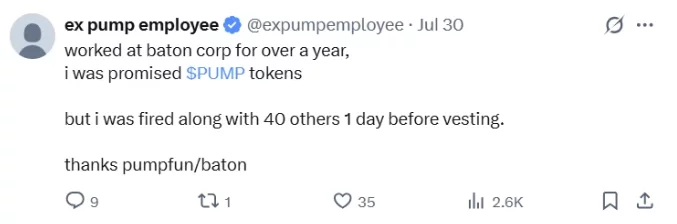
The account also alleged that Pump.fun never intended to conduct a public PUMP airdrop because the company opposed “giving free money” to users. Pump.fun has not responded publicly to that claim.
However, Sandmark said it could not independently verify the allegation that 40 workers were dismissed immediately before the July vesting event. The claim therefore remains based on the former employee’s account rather than independently reviewed employment records.
The dispute centers on employee compensation rather than tokens already held by public investors. Still, the allegations could increase scrutiny of how crypto companies structure token grants and whether employment termination clauses allow firms to cancel large allocations shortly before vesting.
PUMP distribution moved $86.49M to 121 wallets
The allegations follow Pump.fun’s first major team and investor token distribution after a one-year lockup expired.
As crypto.news previously reported, on-chain tracking showed that 57.279 billion PUMP tokens, valued at approximately $86.49 million at the time, moved to 121 wallets on July 15.
Wu Blockchain said the distribution marked the start of a three-year vesting period for team and investor allocations. The transfers made previously restricted tokens available to recipients, although wallet movements alone do not prove that any of the tokens were sold.
For US token holders, the employment allegations do not change their ownership rights. The broader concern is market-related: continued insider distributions could increase transferable supply and create selling pressure if recipients move tokens to exchanges.
PUMP remains 77% below its record high
PUMP traded around $0.002 at press time, gaining nearly 5% over the previous 24 hours, according to CoinGecko. Despite the daily rise, the token remained roughly 77% below its September 2025 all-time high.
The decline comes as Pump.fun continues to generate large numbers of short-lived meme coins. A June CoinGecko study examined 18.67 million tokens created through the launchpad between January 2024 and June 2026.
Researchers found that 12.8 million tokens, or 68.67%, recorded their final Pump.fun bonding-curve trade on the day they launched. Tokens that never traded were excluded because they had no measurable trading lifespan.
CoinGecko linked the high failure rate to the platform’s low barriers to token creation, which allow users to abandon launches quickly when early demand fails to appear.

Bond market investors may want to shift their focus toward the front of the yield curve, according to Allspring Global Investments’ Noah Wise.
The bottom line: Focus exposure on short-term Treasurys over long duration.
Wise, the firm’s head of global macro strategy and a senior portfolio manager, sees the strategy as part of a diversified portfolio to deliver profits due to the monetary policy backdrop.
“You see a market that’s pricing in a couple of hikes for the Fed here over the next couple of years,” he told CNBC’s “ETF Edge” this week ahead of Wednesday’s Fed decision on interest rates. “That type of yield north of 4% with relatively low risk is, in our view, pretty attractive.”
Allspring primarily focuses on fixed income, money markets and stocks. According to the firm’s website, clients range from consultants and financial advisors to corporations and financial institutions.
Wise also sees opportunity in the U.S. credit market, citing strong macro fundamentals.
“We like [U.S.] credit, whether that’s investment grade or high yield, more than we like European credit at this time,” he said.
But credit is not the only avenue to diversification. Wise is also seeing opportunities in emerging markets, and he’s heading south.
“Particularly in Latin America, you can find yields that are at [double digits] so there’s a lot of opportunities,” he said. “I think even with the challenges and risks that we see geopolitically, you can still generate pretty attractive yield and income in a really diversified manner.”
In a special note to CNBC, Wise wrote that this week’s Fed decision to leave rates unchanged has not changed his investment strategy.
“Opportunity always lurks where uncertainty is found. The market [moving] in short-term Treasury yields between these two Fed meetings is a good example of this, and our strategies have been tactically adjusting our exposure to this part of the curve in an effort to take advantage of that volatility,” he wrote.
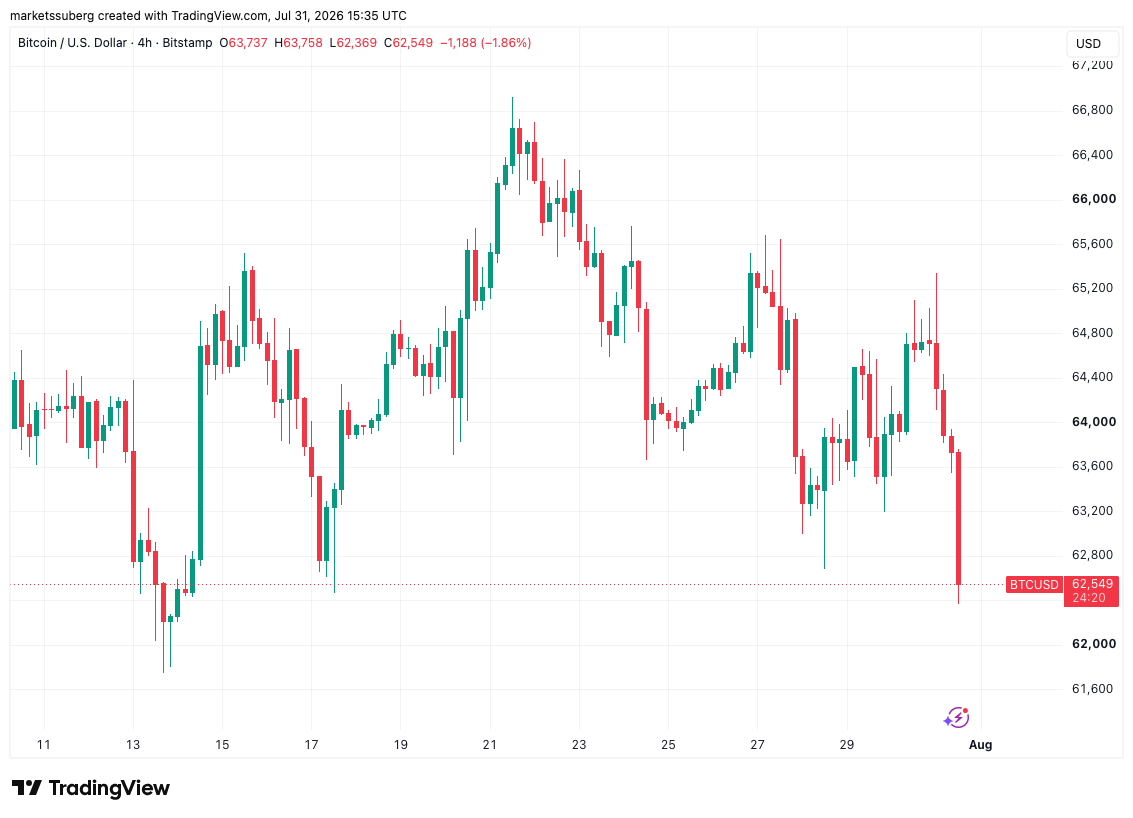
Bitcoin (BTC) fell to its lowest levels in over two weeks on Friday as US stocks saw pressure into the monthly close.
Key points:
- Bitcoin approaches $62,000 as daily losses hit 3.5%.
- US stocks saw no positive reactions to relief in Asia, where stocks rebounded after the semiconductor sell-off.
- Analysis warns that Bitcoin bear-market history should continue to repeat in August.
Bitcoin price targets $62,000 in month-end volatility
Data from TradingView showed BTC/USD falling 3.5% to reach $62,369 on Bitstamp, a level last seen on July 14.
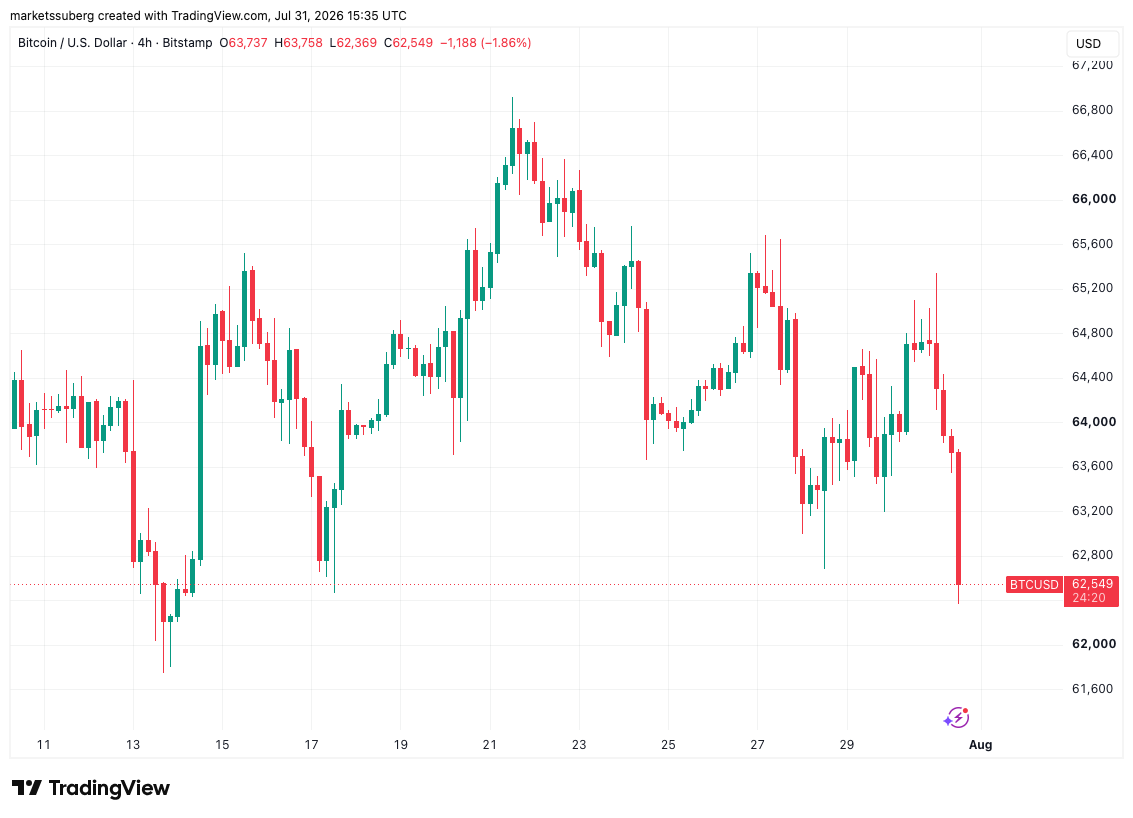
BTC/USD one-hour chart. Source: Cointelegraph/TradingView
US stocks turned red at the open before treading water, diverging from a major relief bounce seen in Asia. There, South Korea’s KOSPI index ended the day up 17.9%, its largest single-day gain on record.
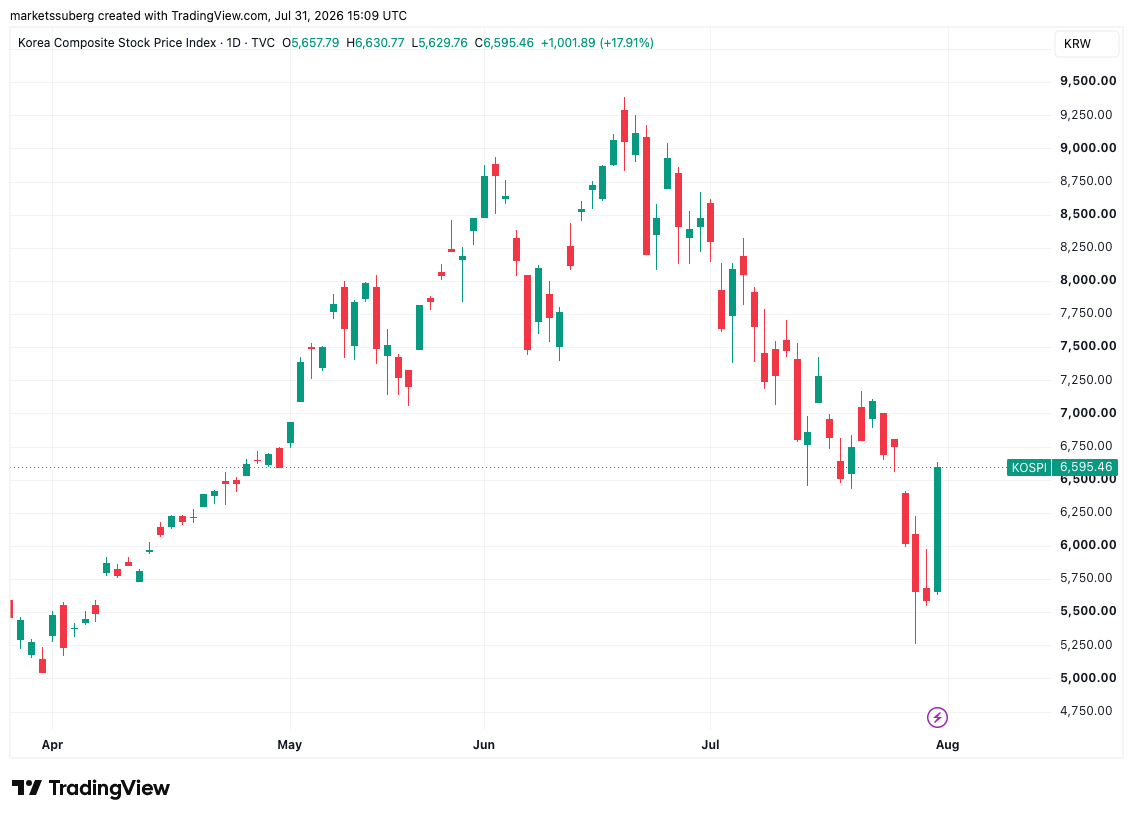
KOSPI index one-day chart. Source: Cointelegraph/TradingView
“Semiconductor shares led both the sell-off and the subsequent recovery, reflecting the index’s high exposure to the global AI and memory-chip cycle,” trading company QCP Capital wrote in commentary on the latest macro market moves.
QCP noted that crypto market trading activity increased around the KOSPI gyrations, something it said “highlighted the growing relationship between crypto liquidity, regional equity positioning and broader technology-sector sentiment.”
Both Japan and Korea reportedly engaged in currency interventions on Thursday, while Japan’s central bank kept benchmark interest rates at 1.0%, following the US Federal Reserve’s decision to stand pat on Wednesday.
Bitcoin traders see bear-market history repeating in August
BTC/USD approached the end of the monthly candle up 8.5%, marking its strongest July performance since 2022, per data from CoinGlass.
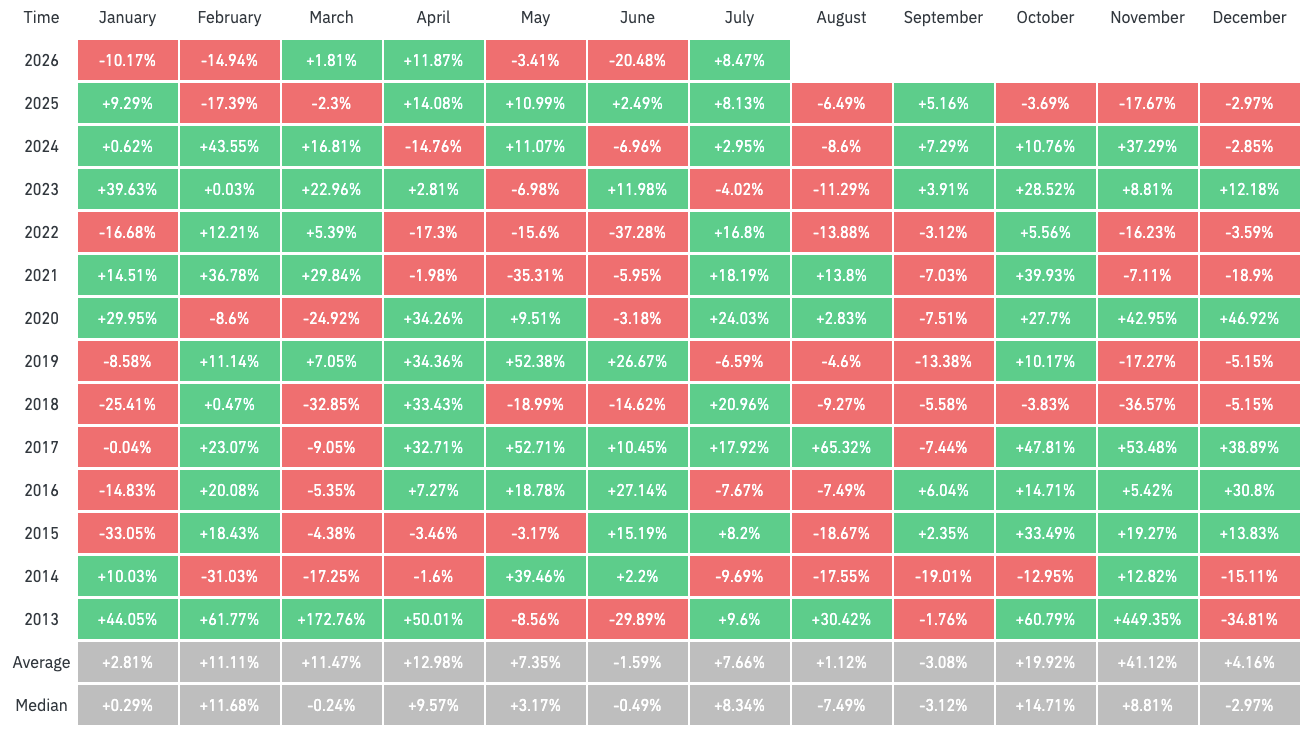
BTC/USD monthly returns (screenshot). Source: CoinGlass
Related: Here’s what happened in crypto today
Previously, traders had anticipated a relief bounce for the pair lasting until August, mirroring the 2022 bear market and ultimately reaching its next long-term bottom.
Trader and analyst Rekt Capital, among those seeing BTC price action copying bear-market moves from four years ago, forecast that the tide might not turn immediately.
“It’s likely price will try to maintain these highs in the early stages of August but history suggests price could rollover just like it did in 2022,” he wrote in a post on X on Friday.
Rekt Capital reiterated that Bitcoin’s 50-month exponential moving average (EMA), currently at $65,820, continued to act as resistance after two failed breakouts since mid-June.
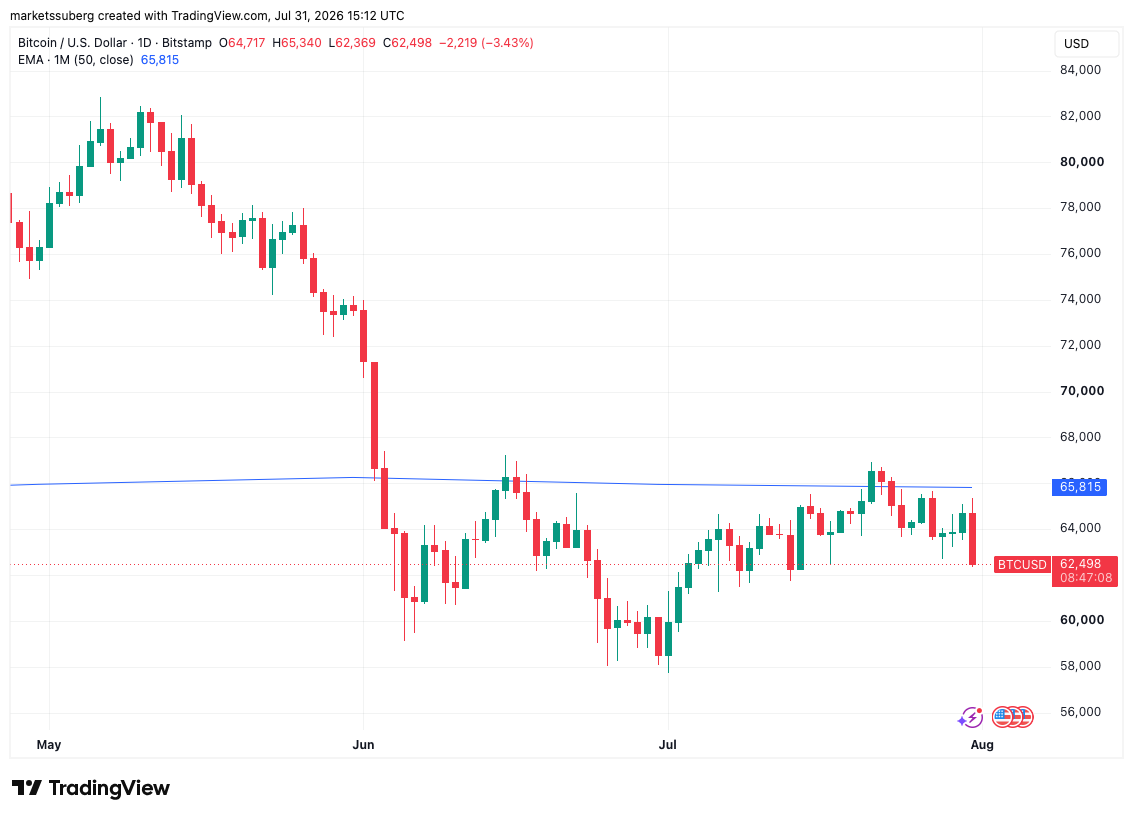
BTC/USD one-day chart with 50-month EMA. Source: Cointelegraph/TradingView


Bitcoin price fell below $63,000 on Friday as a short-lived rebound in Asian semiconductor stocks faded, adding pressure as the cryptocurrency entered its historically weak August trading period.
Summary
- Bitcoin price dropped 3% in 24 hours, extending its weekly loss to about 2%.
- Samsung and SK Hynix surrendered momentum after surging roughly 25% on Thursday.
- Bitcoin’s median August return stands near negative 8%, placing $58,000 in focus.
- The Crypto Fear & Greed Index fell to 25, signaling “Extreme Fear.”
Bitcoin price falls below $63K as risk assets weaken
Bitcoin traded below $63,000 after losing approximately 3% over the previous 24 hours. The decline followed renewed weakness in Asian technology shares, particularly companies tied to the artificial intelligence and semiconductor sectors.
Ethereum fell 2.8% to around $1,860, while Solana declined 2% to approximately $73. XRP traded near $1.06 as selling spread across large-cap cryptocurrencies.
The pullback came one day after Samsung Electronics and SK Hynix rallied roughly 25%, helping South Korea’s KOSPI recover from a steep multiweek decline. That rebound initially suggested investors were returning to semiconductor stocks following heavy selling.
Momentum failed to carry into Friday, however, raising concerns that Thursday’s advance was a temporary relief rally rather than the start of a sustained recovery.
Why faltering AI stocks are weighing on crypto
Crypto assets and AI-related equities have increasingly traded as part of the same risk-sensitive market. Both sectors rely heavily on speculative capital and tend to weaken when investors reduce exposure to high-valuation assets.
Recent pressure on semiconductor stocks has centered on questions about whether AI infrastructure spending can continue at its current pace. Investors are also examining whether future demand for memory chips and computing hardware can support valuations reached during the AI investment boom.
Those concerns are not directly related to Bitcoin’s network or adoption. However, broad risk reduction can still affect crypto as institutional traders rebalance portfolios, reduce leverage and move funds into cash or defensive assets.
For US investors, the next moves in Nvidia and other AI-linked shares could provide an important signal for crypto sentiment. Continued losses across the Nasdaq and semiconductor sector may limit Bitcoin’s ability to recover even without a crypto-specific negative catalyst.
Extreme fear compounds Bitcoin’s August risk
Market sentiment has deteriorated alongside prices. Alternative’s Crypto Fear & Greed Index stood at 25, placing the market in the “Extreme Fear” category. The index was at 28 one week earlier.
CoinGecko category data also showed limited strength across the crypto market. Decentralized finance showed limited relative resilience, but the sector remained under pressure alongside the broader crypto market.
That flat performance suggests investors may be favoring yield-generating or market-neutral DeFi strategies over directional exposure. It does not necessarily indicate that traders expect an immediate market recovery.
Bitcoin’s entry into August adds another risk. Historical data over the past 4 years places its average return for the month near negative 10%, making August one of the cryptocurrency’s weakest calendar periods.
Thin summer liquidity can magnify price swings as participation falls. Traders may also reduce exposure ahead of a month associated with repeated losses, creating additional selling pressure through a self-reinforcing seasonal pattern.
Bitcoin price could test $58K if weakness persists
An 8% decline from Bitcoin’s current level near $63,000 would place the asset around $58,000. That area is likely to attract attention as a possible support zone if selling continues.
A break below $58,000 could expose Bitcoin to a deeper correction, particularly if weak liquidity combines with leveraged long liquidations. Conversely, a recovery above $63,000 would be an early sign that buyers are absorbing supply.
The more important test may come from outside the crypto market. A sustainable floor in AI and semiconductor shares could help restore broader risk appetite, while another sharp decline would increase the likelihood of further pressure on Bitcoin.
Extreme fear has historically appeared near favorable medium-term entry points, but it does not identify an exact market bottom. Bitcoin’s August seasonality, weak technology shares and cautious investor positioning leave the near-term setup tilted toward volatility.

But, with higher fuel prices eating into airline profits, companies are now poorly positioned to take advantage of the moment. To facilitate SAF production, airlines typically agree to long-term agreements to purchase the fuel. With high levels of geopolitical uncertainty, this is not the moment for executives to commit to a price premium without a regulatory mandate. SAF may sound nice, but it remains unaffordable.
The refiners who make SAF, on the other hand, are enjoying record profit margins. But they, too, see too much uncertainty as prices fluctuate wildly. On earnings calls this summer they say they are more focused on improving operations and executing existing plans than investing in new projects.
At a national level, the thinking should be different. SAF is more expensive, but a government can now clearly see the differential as an energy security premium as well as a sustainability advantage. It’s well worth paying to protect the country’s economy in the event of a Hormuz-like situation.
Tether generated approximately $1.5 billion in net operating profit during the second quarter of 2026 as returns from US Treasury holdings and repo operations supported its earnings.
Summary
- Tether recorded about $1.5 billion in quarterly operating profit, according to its BDO attestation.
- USDT supply reached approximately $184.6 billion, representing over 60% of the stablecoin market.
- The company reported $187.7 billion in assets and about $4.1 billion in excess reserves.
- Tether reduced secured loans by $2.4 billion while adding 14 tons to its gold holdings.
Tether reports $4.1B in excess reserves
Tether’s total assets stood at approximately $187.7 billion at the end of June, while its reported liabilities totaled $183.6 billion. The difference left the stablecoin issuer with roughly $4.1 billion in excess reserves.
The figures appeared in Tether’s latest reserve attestation, prepared by accounting firm BDO and released Friday. US government-backed securities continued to account for the largest portion of the company’s reserve portfolio.
Interest earned from that portfolio, along with returns from repo operations, provided the main source of Tether’s second-quarter profit. The company’s exposure to short-term US debt has made its earnings sensitive to Federal Reserve policy and changes in Treasury yields.
Tether also reported that the circulating supply of USDT reached approximately $184.6 billion by the end of June. Based on the company’s figures, the token controlled more than 60% of the global stablecoin market.
Gold holdings rise as secured lending declines
Tether adjusted the composition of its reserves during the quarter by reducing secured lending and increasing its holdings of physical gold.
Outstanding secured loans fell by about $2.4 billion. Tether did not provide a full breakdown of the borrowers or collateral involved in the lending reduction in the information accompanying the results.
Meanwhile, the company purchased another 14 tons of physical gold, bringing its total holdings to more than 146 tons. The increase continued Tether’s move beyond cash-equivalent reserves and into assets such as gold and Bitcoin.
Tether said its portfolio remained resilient despite sharp price swings affecting both assets during the quarter. Its Bitcoin holdings were valued at approximately $5.8 billion at the end of June.
Those positions may provide additional returns when prices rise, but they also expose part of Tether’s balance sheet to greater market volatility than short-dated US government debt.
US Treasury holdings keep Tether tied to US markets
Tether’s reserve structure gives the company a substantial connection to US financial markets even though USDT operates globally.
The company’s earnings remain heavily influenced by income from US Treasury securities and related repo transactions. Any change in US interest rates could therefore affect future profitability, even if the number of USDT tokens in circulation continues to grow.
Tether is also expanding a separate US-focused stablecoin, USAT. The token recently launched on Celo, its second supported mainnet following Ethereum.
USAT users can mint and redeem the token natively on Celo without relying on third-party bridges. Celo’s CIP-64 upgrade also allows approved ERC-20 tokens to pay network transaction fees, meaning users can use USAT for gas instead of holding a separate token.
The deployment extends Tether’s US-oriented product to a blockchain commonly used for digital-dollar payments. It also separates USAT’s expansion from the company’s larger offshore USDT business.
Tether expands infrastructure beyond stablecoins
Tether said it added more than 30 million users globally during the second quarter while continuing preparations for a full audit by a Big Four accounting firm. It did not provide a completion date for that process.
The company is also exploring tokenized capital-market infrastructure in Africa. Tether and the Nairobi Securities Exchange signed a memorandum of understanding on July 28 covering tokenized securities, blockchain-based market systems and digital asset education in Kenya.
The parties will assess whether USDT could support settlement infrastructure where Kenyan regulations allow. However, the memorandum does not authorize a tokenized security, launch a trading venue or commit the exchange to using USDT.
No pilot date, budget, or binding implementation schedule was disclosed. Future developments will depend on regulatory approval, technical assessments, and whether the exploratory agreement advances into a formal project.
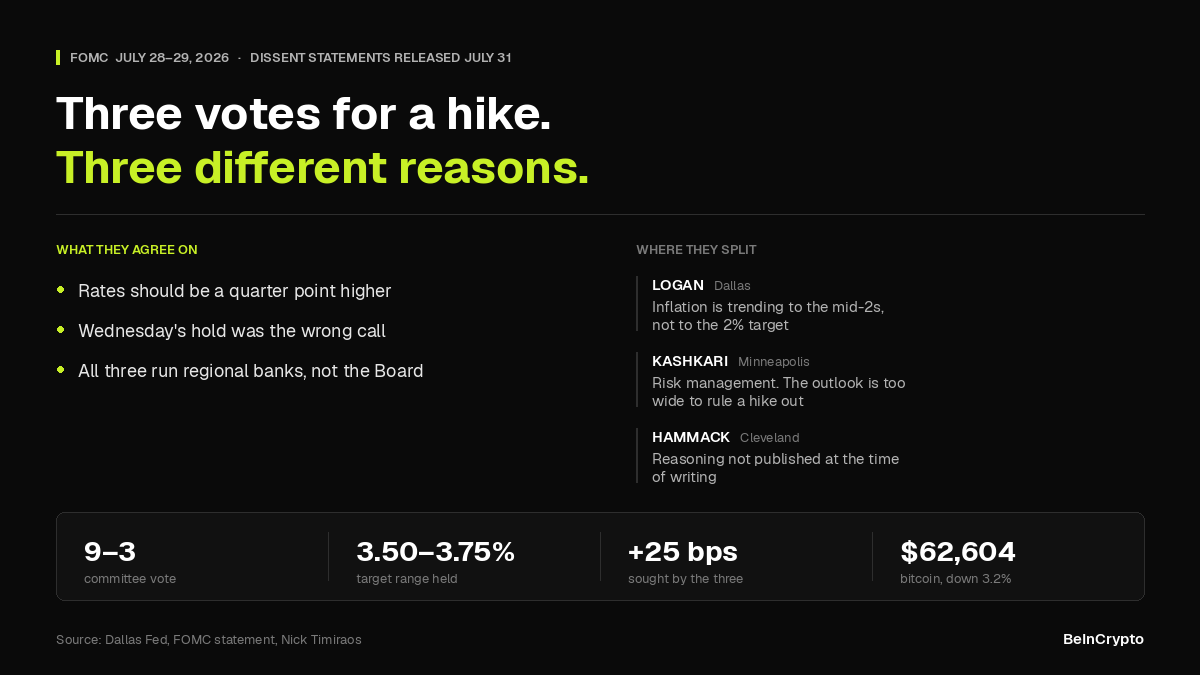
Three Fed officials voted for a rate hike on Wednesday. On Friday, they finally said why.
Their answers do not match. Each one wants higher rates for a different reason. That gap is the real story.
Why the Fed Rate Hike Vote Split 9 to 3
The Fed left rates alone on Wednesday. The target range stayed at 3.50% to 3.75%.
Three people on the committee said no. Lorie Logan of Dallas, Neel Kashkari of Minneapolis and Beth Hammack of Cleveland all wanted a quarter point rise. That made it a 9 to 3 split vote.
The vote was public straight away. The thinking behind it was not.
Chair Kevin Warsh told reporters to play the ball, not the referee. He listed what the committee had argued about. He never explained why the majority chose to hold.
The three who lost the vote have now said more than the nine who won it.
Follow us on X to get the latest news as it happens
Bond traders had already picked a side. The 30-year Treasury yield closed at its highest level since 2007 on Thursday.
Logan Says Inflation Is Stuck Near 2.5%
Logan’s case is simple. Prices have risen too fast for more than five years. Inflation is not on track to reach 2%.
Strip out one-off supply shocks and better productivity, she says, and inflation still lands in the mid-2s. The risk is that it drifts higher, not lower.
She also thinks today’s rates are not slowing anything down. Jobs look solid. So does spending.
“Without any policy restraint, inflation will likely continue to trend above target until there’s an unanticipated shock. The FOMC cannot count on unanticipated shocks to achieve its goals and can always adjust policy if unanticipated shocks occur,” Logan, statement.
Her fix is small and early. A quarter point now beats a bigger move later.
Same Vote, 3 Different Reasons
Kashkari is not making Logan’s argument. Instead, BeInCrypto reads him as a risk manager. He wants tighter policy because the outlook is so uncertain, not because inflation is proven to be stuck.
Hammack is the third vote. Her own reasoning had not been published at the time of writing.

Here is why that matters. One shared argument is easy to answer. Three separate arguments are much harder. It looks like the Fed family feud Warsh once said he wanted.
Crypto has already turned. Bitcoin (BTC) rose after Wednesday’s hold. It has since dropped back, trading near $62,600 on Friday, down 3.2% in a day.

September brings the next meeting. If oil climbs again, the three may not need to win the argument. They may just need one more vote.
The post 3 Fed Officials Just Explained Their Rate Hike Vote: Is Inflation Winning? appeared first on BeInCrypto.
Quantum computers could one day break Bitcoin (BTC), yet the same physics could also build money that is impossible to forge. Two experts argue that quantum money, not the blockchain, may be the final form of digital cash.
Stefano Gogioso and Daniela Herrmann made the argument during the latest BeInCrypto Experts Council. Their case rests on an idea older than crypto itself, and on a single law of physics.
Money Has Always Been a Story About Trust
A companion analysis asked when quantum computers might break Bitcoin. This piece asks the opposite question. What if the same technology builds something better than the money we use today?
The answer begins with a line from Gogioso that reframes the debate. Consensus, he says, is “the last middleman.”
To see why, it helps to trace how money lost its trust in the first place.
Physical cash needs no middleman. A gold coin proves itself, and a buyer does not have to trust a bank, a ledger, or a network to accept it. Cash, however, cannot travel down a wire.
Digital money solved distance, but it brought the middlemen back. Every online payment now trusts an intermediary to confirm that the same unit is not spent twice.
Bitcoin answered that problem by replacing institutions with math and consensus. Thousands of computers agree on one shared history, so no central party is needed.
The idea of using physics instead of trust, however, is older than Bitcoin. It is older than the modern internet.

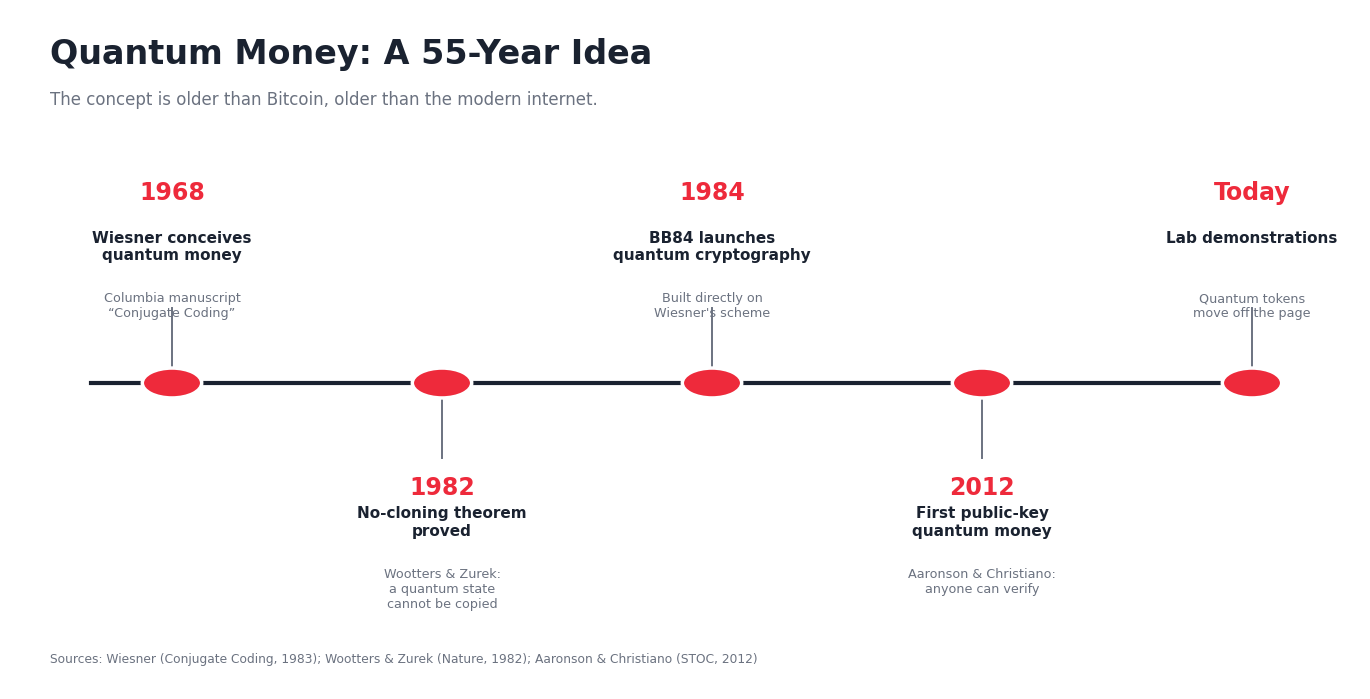
In the late 1960s, a Columbia University graduate student named Stephen Wiesner wrote a manuscript called “Conjugate Coding.” Journals rejected it, and it stayed unpublished until 1983.
Wiesner proposed money that could not be counterfeited, protected by physics rather than by a bank. It was the first real use anyone had imagined for quantum information.
That work later inspired the 1984 protocol known as BB84, which launched quantum cryptography. In effect, the whole field grew out of an attempt to make unforgeable money.
Security From Physics, Not Secrecy
Classical cryptography rests on hard math problems. A code stays safe because solving it would take too long. Quantum cryptography works on a different footing.
Its guarantee comes from a physical law called the no-cloning theorem. Physicists William Wootters and Wojciech Zurek proved it in 1982. An unknown quantum state cannot be perfectly copied.
The mechanism is elegant. Any attempt to copy the state disturbs it. The forgery fails, and the tampering shows.
Gogioso has spent years turning that law into working tools. At an earlier BeInCrypto interview in Naples, he described keys that defend themselves. If someone intercepts a quantum key, it is destroyed in transit, and the receiver sees the protocol break.
On the Council panel, he pushed the idea to its limit.
“You can build applications that do not need to trust the very hardware they run on. You can literally commission the hardware from your attacker, and as long as the application passes its self-testing, you are guaranteed security. Worst case, it simply refuses to run. And this is provably impossible classically.”
Specialists call this device-independent cryptography. The security holds even if the manufacturer is hostile. That property matters because complex hardware is exactly where backdoors tend to hide.
Why Unforgeable Keys Become Money
The step from security to money is short. Cheating and forgery are the same problem in different words.
If you cannot copy a quantum state, you cannot counterfeit it. And a thing that cannot be counterfeited can serve as money.
Gogioso drew the line directly.
“A different way of saying you cannot cheat is saying you cannot copy or forge. From the very same family of techniques, you get quantum money, or quantum financial instruments. New ways of doing digital finance with far fewer trust assumptions on intermediaries, networks, and counterparties.”
His team has already built the smallest version of the concept. In Naples, he demonstrated keys that work only once. To spend one, you have to destroy it, which stops an attacker from replaying an old payment.
A single-use key is a tiny piece of unforgeable value. Scale that principle up, and you reach what researchers call quantum money.
The theory is not new. In 2012, Scott Aaronson and Paul Christiano proposed the first public-key quantum money scheme. It lets anyone verify a note, not only the bank that issued it. Their framing echoed Wiesner almost exactly, describing money that cannot be counterfeited according to the laws of physics.
Quantum Money and the Last Middleman
Now the pieces meet. Bitcoin removed the banks, but it did not remove trust. It shifted that trust onto a network and a shared ledger. Something still has to agree on which payments are real.
Gogioso views that agreement as the final intermediary. Web3 and zero-knowledge tools clawed back some of the trust that digital money gave away, he says, yet consensus still does the last job of preventing forgery.
That job carries a cost. Consensus demands coordination, energy, and a crowd of participants who must broadly agree. A physical guarantee needs none of those things.
Quantum money, in his telling, removes the middleman completely.
“Quantum money is the next and final evolution of that story. You recover something digital that you can transact at a distance, but without trusting intermediaries, global ledgers, or someone deciding which transactions go into an Ethereum (ETH) block. The physics gives you the unforgeability directly. In that sense, consensus is truly the last middleman.”
The claim is large, so it is worth stating plainly. If it holds, quantum money would be to Bitcoin what Bitcoin was to the bank.

There is a symmetry worth noting. The physics that threatens Bitcoin’s signatures is the same physics that could retire the need for consensus altogether.
The One Defense That Survives Smarter Attackers
There is a further reason the timing matters. Artificial intelligence is getting better at breaking things.
Most security today assumes the attacker is not clever enough, or that a problem is simply too hard to solve in time. Gogioso argues that this assumption looks fragile in an age of capable AI.
Physics offers a different kind of promise.
“What quantum really buys you is security based on the laws of the universe. It doesn’t matter how smart the AI is. You can’t break it. Worst case, you can stop it from happening, but you cannot forge it.”
That is the deeper appeal of the approach. A quantum guarantee does not depend on the attacker’s limits. It depends on the structure of reality, which no amount of intelligence can rewrite.
Quantum Money: Not Here Yet, but Within Reach
Both guests were careful not to oversell the idea. Herrmann, whose firm builds commercial quantum tools, marked the boundary clearly.
“Quantum money is the vision, once this all plays out. Right now, quantum money as such isn’t available yet. But as soon as the chips advance, these things have to be handled with real responsibility.”
The main obstacle is quantum memory. Holding a fragile quantum state is difficult, and today the best systems keep one for only seconds. Gogioso has said that the limit still puts full quantum money out of reach, though the same hardware already suits short-lived tasks.
Even so, the direction is set. Laboratory experiments have begun to demonstrate quantum tokens and related schemes, moving the idea off the page.
Gogioso closed the panel on that note.
“Within five, six, seven years we could live in a world where we use quantum resources to do things that are provably impossible today. Not just hard, not just slow, actually impossible. And this is software we can start building today, not in five years. The future is absolutely within reach.”
More than half a century after Wiesner sketched money that physics itself would guard, the idea is finally leaving the whiteboard. If Gogioso and Herrmann are right, the last middleman may not survive the decade.
The post Consensus Is the Last Middleman: The Case for Quantum Money appeared first on BeInCrypto.

Commonwealth Games 2026: Georgia Hunter Bell eyes golden sweep after Glasgow win

Cavco Industries, Inc. (CVCO) Q1 2027 Earnings Call Transcript

Roblox Stock Sinks Nearly 14% After-Hours as New Child Safety Measures Weigh on Outlook


-
 Sports5 days ago
Commonwealth Games boxing: Jadumani Singh seals dominant 5-0 win over Pakistan’s Sumama Rehman to enter quarter-finals | Commonwealth Games News
-

 Business2 days ago
Why Trees Belong on the Risk Register
-

 Tech5 days ago
Intel is reversing course and bringing hyper-threading back to its server chips
-

 Fashion5 hours ago
Weekend Open Thread: Wit & Wisdom
-

 Crypto World6 days ago
Ripple bought a bank in pieces. The $4 billion audit
-

 Politics4 days ago
Luke Littler dismantles Gerwyn Price to retain title in Blackpool
-

 Politics4 days ago
The Part of the Electric Transition Nobody Wants to Discuss
-

 News Videos5 days ago
BITCOIN JUST ENTERED THIS CRITICAL ZONE…
-
 Entertainment3 days ago
‘Stargate’ Creator’s New Sci-Fi Series Returns for Season 3 Tomorrow
-

 Crypto World6 days ago
XRP Ledger adds $2.6B as RWA inflows rank second
-

 Business3 days ago
Major shareholder moves on Canyon
-

 Politics5 days ago
Spain sweeps the board at 2026 World Cup with individual awards
-

 News Videos1 day ago
Bitcoin Enters the 3rd Stage of the Bear Market
-

 Politics1 hour ago
Meta enters AI-training agreement with far-right ‘propaganda rag’ Newsmax
-

 Entertainment6 days ago
Sara Gilson Killed By Husband After Viral “Pedophile” TikTok Video
-

 Crypto World3 days ago
Kraken Enables Retail Access to Jersey Mike’s IPO via Tokenized Shares
-

 Tech7 days ago
Anthropic launches Claude Opus 5, a cheaper AI model for coding, agents and enterprise workflows
-

 Tech4 days ago
New macOS Sequoia & Sonoma security updates for older Macs
-

 News Videos3 days ago
Claude: Build Financial Dashboards in Minutes (2026)
-

 Politics1 day ago
Luke Littler’s dominance sparks GOAT debate
You must be logged in to post a comment Login