
Crypto World
Ethereum Price Coiling: The Network Hit $8 Billion Tokenized U.S. Treasuries Milestone

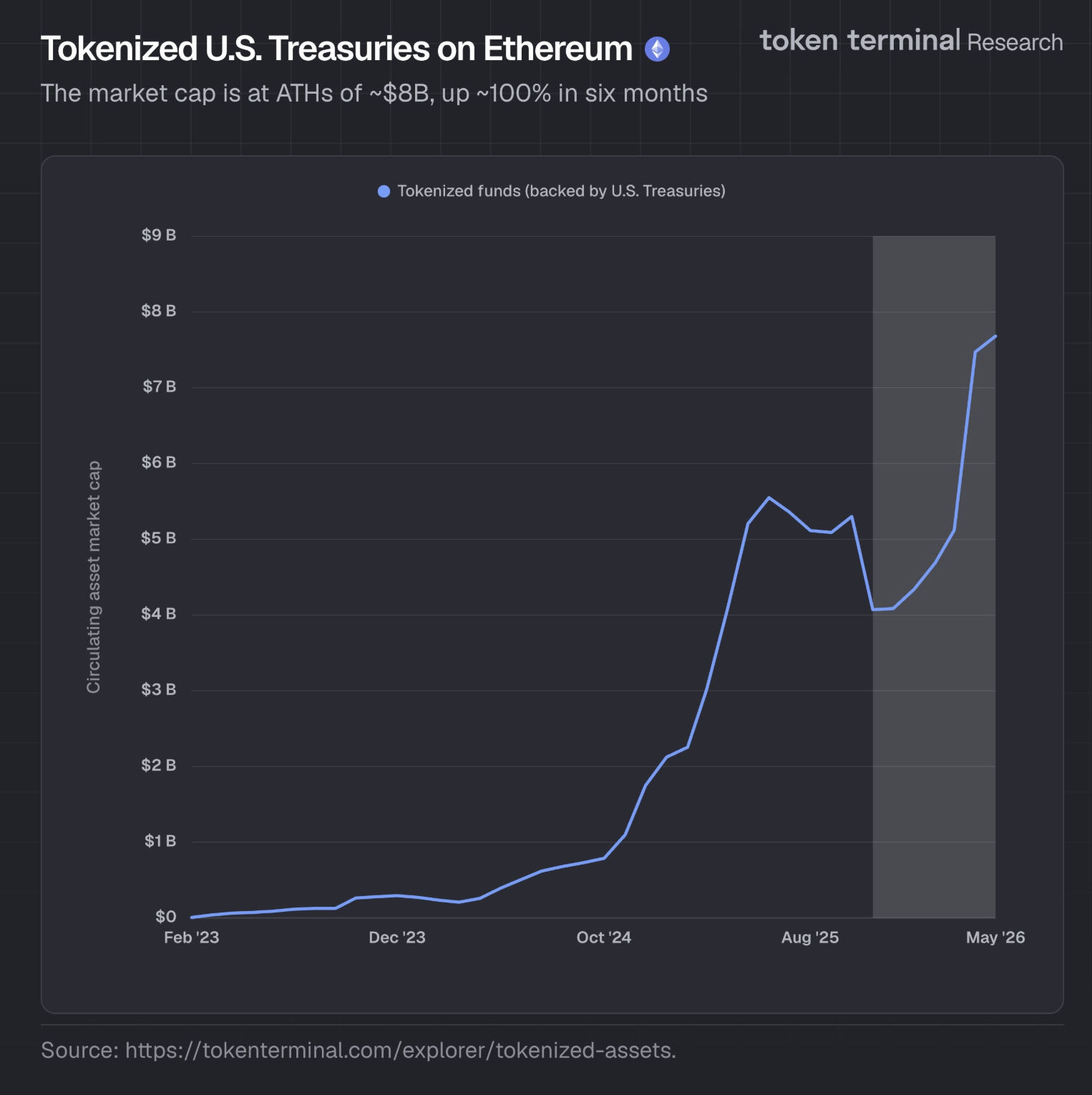
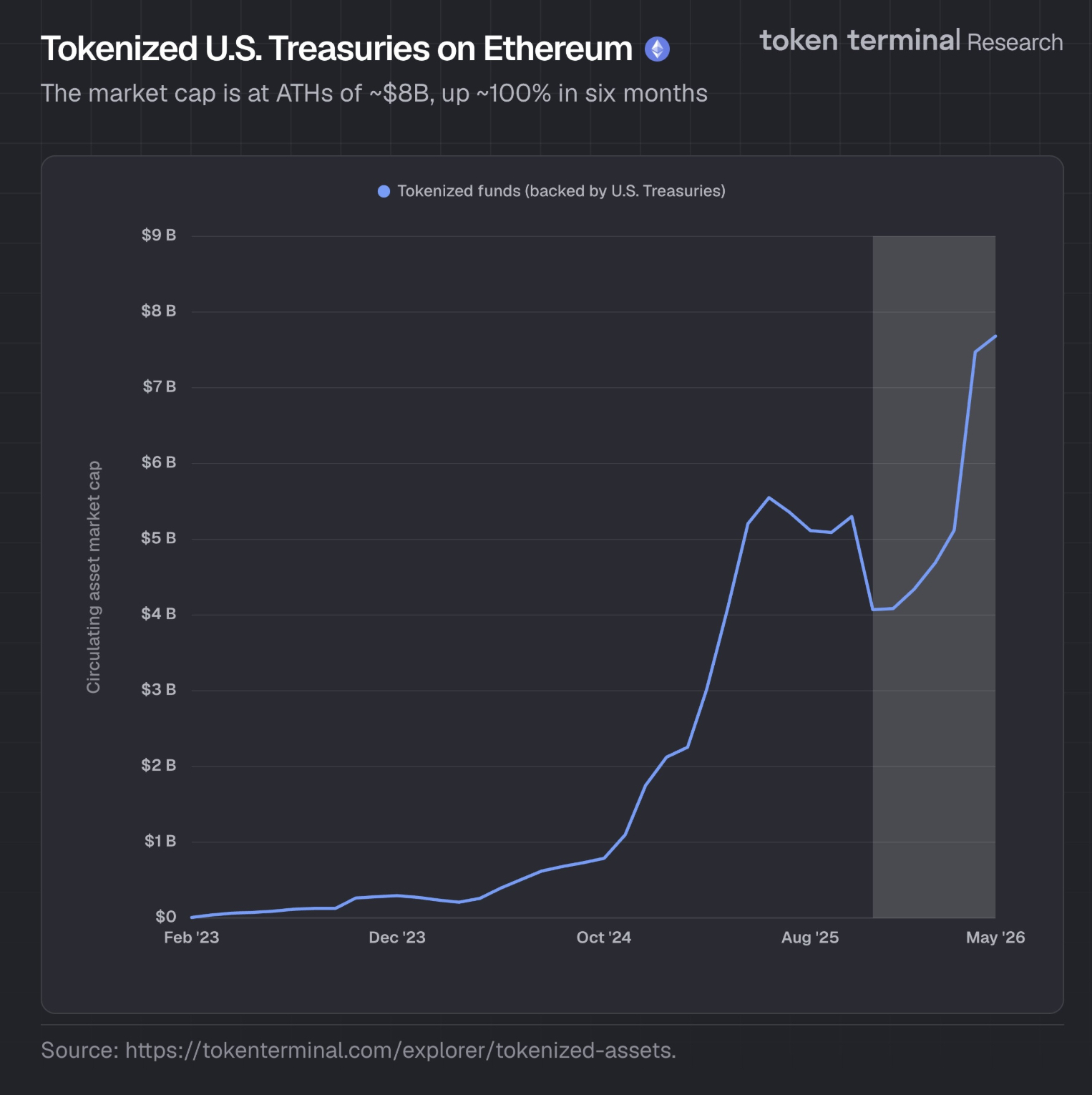
Ethereum price is coiling. Trading above $2,300, ETH is holding above recent support as tokenized U.S. Treasuries on the network just crossed $8 billion for the first time in history. This is a milestone that reframes the story.
Token Terminal data confirms the figure doubled within six months. For context, the same asset class crossed $1 billion as recently as Q4 2024. So, this is an 8x expansion in just 18 months.
Ethereum isn’t just a trading vehicle; it’s becoming core financial infrastructure. The Bridge stablecoin also launched on Ethereum this week, adding another liquidity layer to a network that has been accumulating stablecoins at a pace that’s frankly difficult to overstate. Institutional accumulation signals have been building quietly behind the headline volatility, too.
Discover: The best crypto to diversify your portfolio with
Can Ethereum Price Reclaim $2,500?
CoinGecko data shows ETH’s daily volume contracted to the $20 billion area with a weekly recovery of 3%, showing that buyers are testing the range floor with intent. Year-over-year, ETH is up 26% from its May 2025 level of $1,700-$1,800, which puts the current price in a structurally stronger position than the charts imply.
The immediate support sits at $2,200, the April 29 low. Resistance clusters near $2,400, then the psychologically significant $3,000 zone. The all-time high of $4,950 represents a -39% drawdown from the current price as a gap that looms large on any longer-term chart.

When, not if, volume returns, ETH could easily clear $2,500 resistance and target $3,000, driven by institutional flows tied to the tokenization narrative. But a close below $2,200 could reopen downside toward the $2,000 handle.
The tokenized Treasury milestone doesn’t guarantee a price move. But it does suggest the floor is better-supported than raw price action implies.
Discover: The best pre-launch token sales
Bitcoin Hyper Targets Early-Mover Upside as Ethereum Tests Key Levels
Ethereum at $2,300 is a recovery play, but recovery from a -39% drawdown to ATH means even a strong bull run leaves substantial time and capital at work before significant gains materialize. Traders sizing up risk-reward ratios are increasingly looking at earlier-stage infrastructure plays where the upside math looks different.
Bitcoin Hyper ($HYPER) is one project drawing serious presale volume in that context. It’s positioning as the first-ever Bitcoin Layer 2 with Solana Virtual Machine (SVM) integration. Hyper targets Bitcoin’s core limitations like slow transactions, high fees, and no programmability, while preserving Bitcoin’s security model.
The performance is aggressive: faster execution than Solana itself, via extremely low-latency Layer 2 processing paired with a Decentralized Canonical Bridge for BTC transfers.
The presale numbers are concrete. $32.6 million raised at a current price of $0.0136, with staking rewards available for early participants.
Research Bitcoin Hyper before the presale stage concludes.
The post Ethereum Price Coiling: The Network Hit $8 Billion Tokenized U.S. Treasuries Milestone appeared first on Cryptonews.

Toncoin price went parabolic this week, surging more than 100% after Telegram founder Pavel Durov announced a major strategic overhaul that places Telegram directly at the center of The Open Network ecosystem.
Summary
- Toncoin price surged more than 100% this week after Telegram founder Pavel Durov announced that Telegram would take direct control of TON ecosystem development.
- Telegram became the network’s largest validator and introduced the “Make TON Great Again” roadmap focused on scaling, faster transactions, and deeper Telegram integration.
- TON rallied after transaction fees were reduced to near-zero levels and the Catchain 2.0 upgrade improved block times to roughly 400 milliseconds.
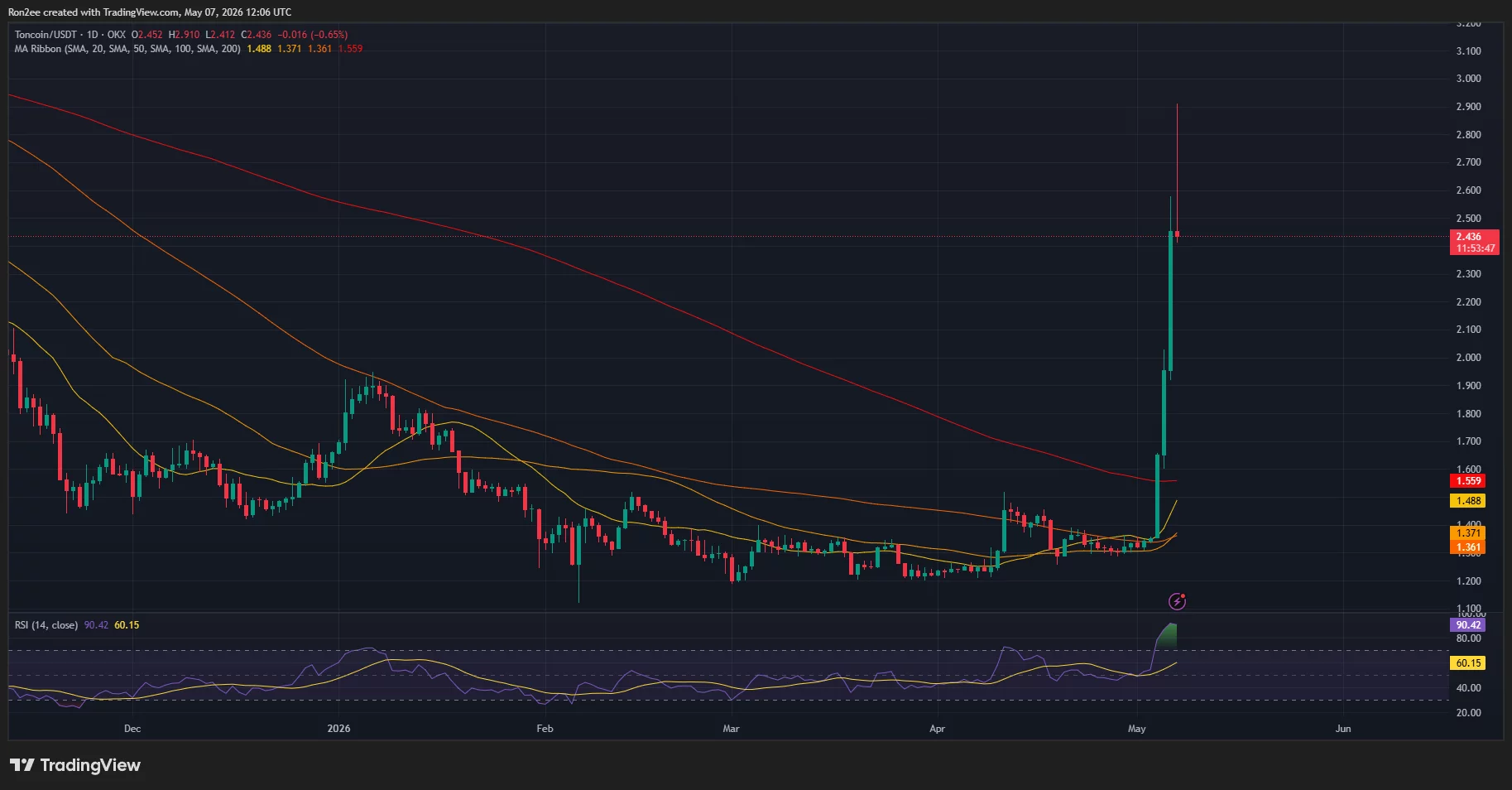
According to data from crypto.news, Toncoin (TON) climbed from below $1.20 earlier this week to as high as $2.90 on Wednesday before stabilizing near $2.43 at press time. The explosive move made TON one of the best-performing large-cap cryptocurrencies over the past seven days.
The primary catalyst behind the rally came after Durov revealed on May 4 that Telegram would replace the TON Foundation as the main force driving network development and adoption.
As part of the shift, Telegram has reportedly become the largest validator on the network after staking millions of TON tokens, aligning the company’s interests more directly with the blockchain’s long-term growth and stability.
Durov also introduced a new roadmap dubbed “Make TON Great Again,” or MTONGA, which outlines a seven-step strategy focused on scaling infrastructure, improving transaction speeds, and expanding TON’s integration across Telegram’s ecosystem of over 1 billion users.
Investor sentiment strengthened further after the network sharply reduced transaction fees by nearly sixfold to around $0.0005, a move aimed at making TON more attractive for microtransactions, mini-apps, and consumer payments.
At the same time, TON’s recent Catchain 2.0 infrastructure upgrade significantly improved network performance by lowering block times to roughly 400 milliseconds, allowing near-instant transaction finality.
The combination of deeper Telegram integration, faster infrastructure, and lower transaction costs triggered aggressive buying activity across spot and derivatives markets, while short liquidations accelerated upside momentum.
On the daily chart, Toncoin price confirmed a powerful breakout from a prolonged accumulation range after exploding above the key $1.60 resistance zone.
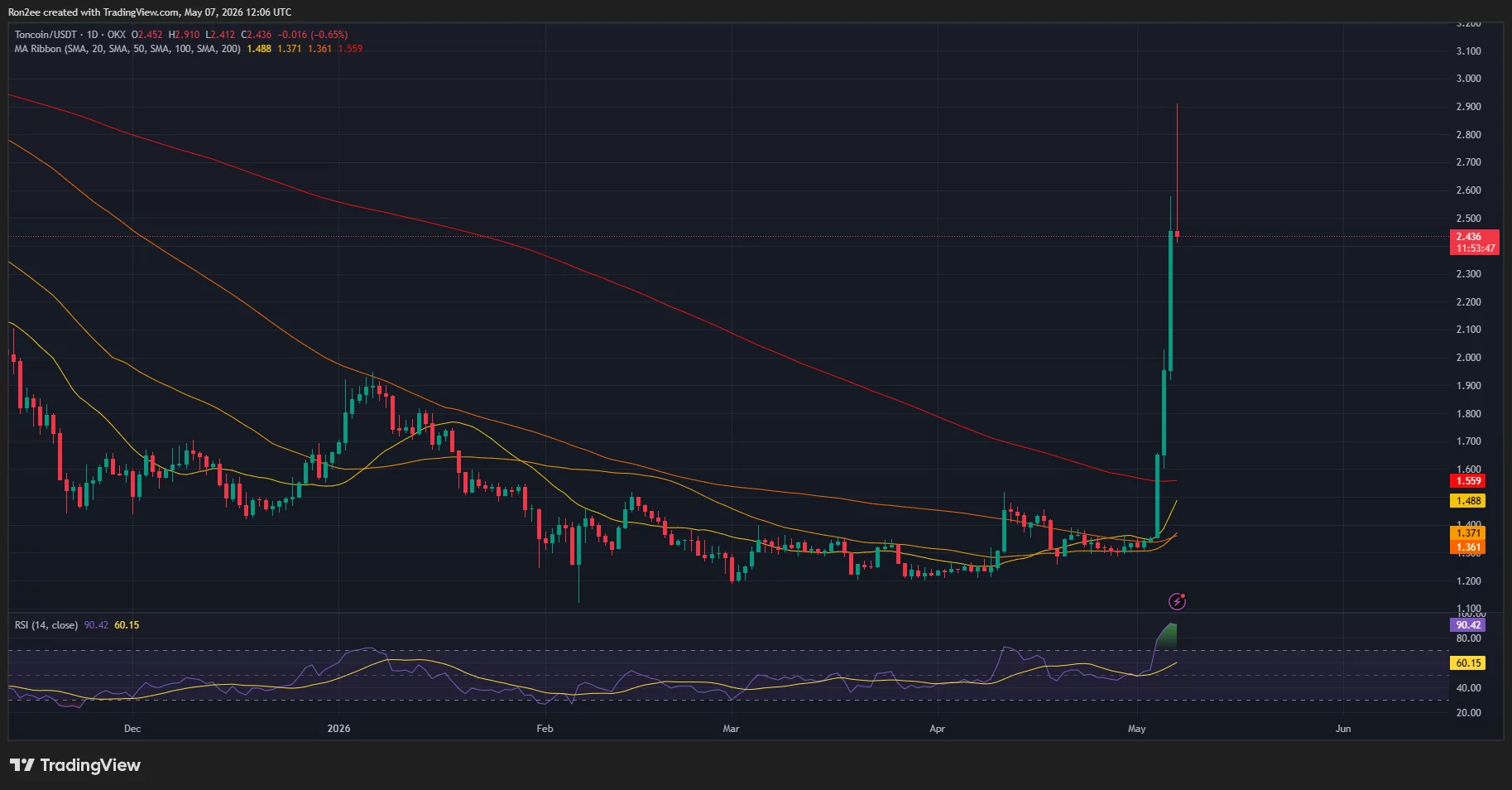
The rally also pushed TON above its 200-day moving average near $1.55, reinforcing bullish momentum and signaling a possible shift in long-term trend direction.
Momentum indicators suggest buyers remain firmly in control despite signs of short-term overheating.
The RSI surged above 90, reflecting extremely strong buying pressure, though such elevated levels could also signal a temporary cooling-off period or near-term volatility ahead.
At the same time, the moving average ribbon has started turning bullish, with shorter-term moving averages crossing back above longer-term averages following weeks of sideways consolidation.
If bullish momentum continues, traders could next target the psychological $3 level, followed by the broader resistance region near $3.20.
On the downside, failure to hold above the $2.00 breakout zone could trigger profit-taking and a retest of support near the $1.60–$1.70 range before another upward move.
Disclosure: This article does not represent investment advice. The content and materials featured on this page are for educational purposes only.
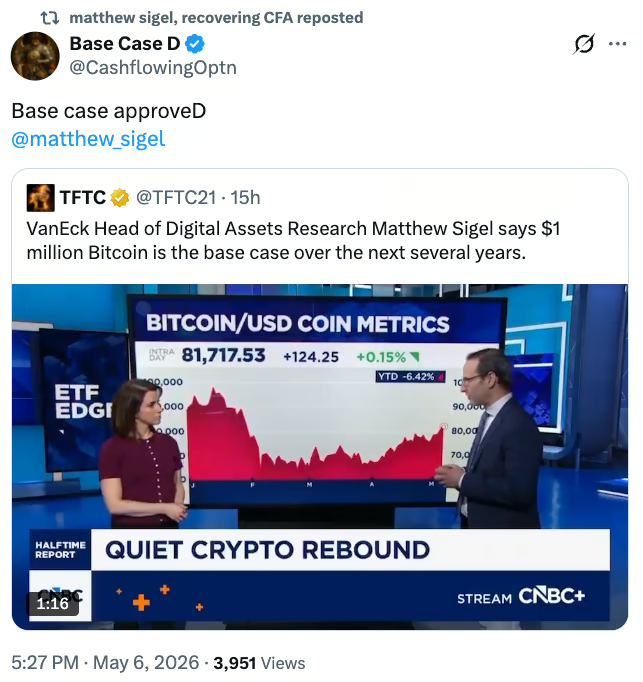
Matthew Sigel, head of digital assets research at investment manager VanEck, said he sees Bitcoin (BTC) reaching seven figures within the next five years.
“Bitcoin going up for us is the base case. We think this asset is going to reach a million dollars over the next several years,” Sigel said on CNBC’s Halftime Report on Wednesday.
Sigel later clarified that BTC is likely to reach that threshold in “half a decade,” comparing Bitcoin’s adoption to the video game industry’s, where usage has expanded across age groups after initially being limited to younger users.
“It’s going to be like the video game industry, where 30 years ago it was just kids playing video games, now Elon Musk plays video games,” he said.
Sigel’s latest projection aligns with VanEck’s base-case model, which estimates Bitcoin could reach $2.9 million by 2050, underscoring a longer-term bullish outlook despite periods of market volatility.
Bitcoin is a “mega trend,” but marked by volatility
Despite a highly bullish outlook, VanEck’s Sigel emphasized that Bitcoin is a “very cyclical asset,” saying its path toward $1 million would not be a steady upward move.
“There are no bailouts in Bitcoin, so it’s going to be cycles along the way,” Sigel said, hinting at the absence of a central authority to stabilize prices during market downturns.
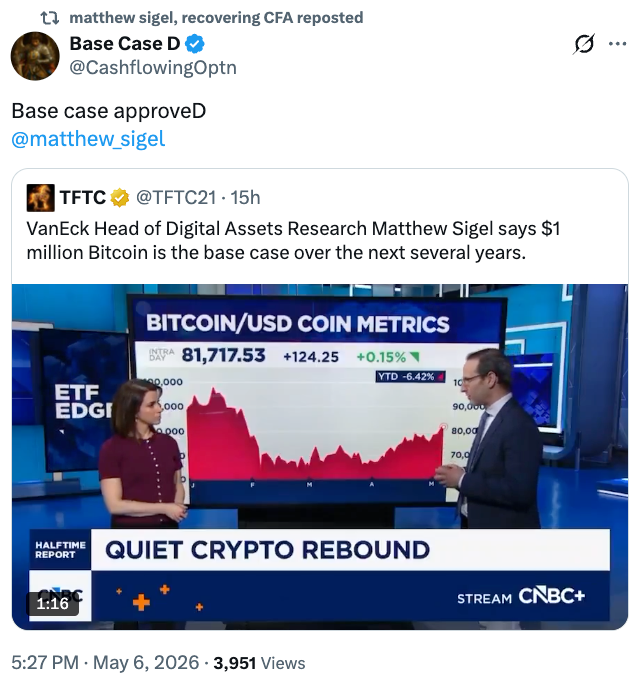
Source: Matthew Sigel
“We have the first central bank buying Bitcoin for its reserves, so this is a mega trend, but it will be very volatile along the way,” Sigel added.
Near-term market positioning is negative
Addressing Bitcoin’s near-term price action, Sigel pointed to the asset’s correlation with the Nasdaq reaching its highest level in five years, suggesting the current rally is largely driven by broader macroeconomic trends.
“What keeps us encouraged even at the current levels is that we’re not seeing the froth in the derivatives markets,” he said, adding that the move appears to be driven primarily by short covering, indicating that overall positioning remains relatively bearish.
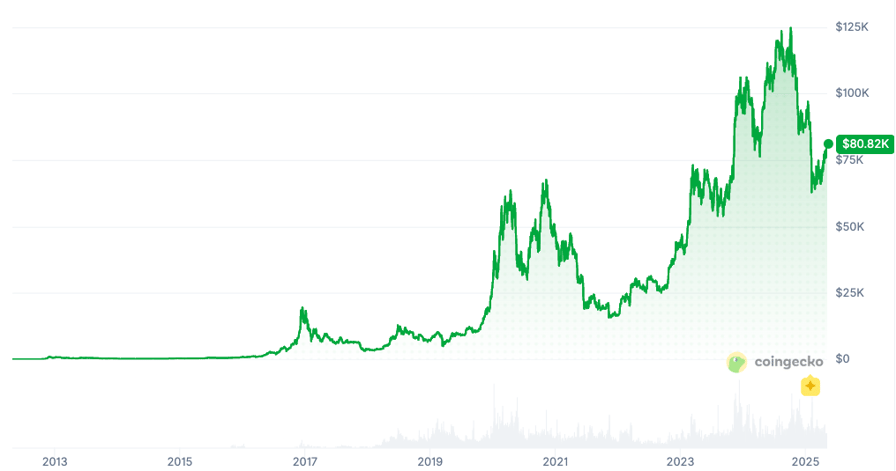
Bitcoin’s (BTC) all-time price chart. Source: CoinGecko
Sigel’s take joins several similar views on Bitcoin’s price trajectory in the coming years, including predictions from Bernstein, Bitwise chief investment officer Matt Hougan, Jan3 CEO Samson Mow and Twitter co-founder Jack Dorsey, among others.
Cathie Wood’s ARK Invest’s 2030 Bitcoin price targets range from about $300,000 in a bear case to $710,000 in a base case and $1.5 million in a bull case, according to its Big Ideas 2025 model.
Related: Bitmine’s Tom Lee says ‘crypto spring’ has already begun
Some investors are more skeptical about Bitcoin’s adoption, though. Ray Dalio has said Bitcoin could act as a store of value but questioned its ability to scale into a global reserve asset amid regulatory and sovereign currency risks. Others, including gold advocate Peter Schiff, have argued Bitcoin lacks intrinsic value and is unlikely to displace traditional safe-haven assets like gold, casting doubt on seven-figure price forecasts.
Magazine: Adam Back says current demand is ‘almost’ enough to send Bitcoin to $1M


Crypto conference attendees in Miami apparently have a deodorant problem, prompting disgusted fellow event goers to take to social media to complain about the smell.
CEO of Solana infrastructure firm Helius Labs, Mert Mumtaz, who was in Miami for Consensus 2026, one of the largest crypto summits, asked on X, “what is it with crypto mfers and not knowing what deodorant is.”
Read more: Dubai flood leaves TOKEN2049 conference goers feeling ‘liquidated’
Meanwhile, a crypto influencer known as “Liv,” who was also in Miami for events hosted by Solana, Pengu, and Tessera Lab noted, “I swear some of the men don’t use deodorant and they have like a 5 feet radius around them.”
Other crypto users echoed this sentiment, claiming that girls often complain that the “men at crypto conferences stink.”
The problem appears to be so bad that another influencer, “Bangerz,” actually praised the events held by Tessera Lab and Sophie Maxx for being free of bad odours.
“You wouldn’t believe it but i went to a web3 event and everyone was wearing deodorant and it smelt like italian pasta,” Bangerz posted.
Read more: Bitcoin 2026 opens to empty seats, protests, awkward moments
Crypto influencer “Gigi,” who has complained previously about the lack of deodorant at crypto events, attempted to nip the problem in the bud, posting, “please remember to wear deodorant.”
Some users suggested that crypto summits should offer gift packages with blockchain-themed mints and deodorant, while others joked that event bouncers should be “checking how you smell” instead of looking for weapons or contraband.
These confrences are hot
It’s no surprise that some are struggling to stay sweat-free, with temperatures in Miami already hitting over 30 degrees Celsius. In 2025, temperatures at Token2049 in Dubai reached over 40 degrees.
Many crypto users sarcastically warned attendees at the time not to wear deodorant and just enjoy the nights out deodorant-free.
Mumtaz, however, wasn’t among them, taking to X at the time to complain about deodorant use.
He jokingly asked attendees to wear deodorant, or else he would “call the police and tell them you’re in possession of several hard drugs,” adding that it’s “nothing personal.”
Got a tip? Send us an email securely via Protos Leaks. For more informed news and investigations, follow us on X, Bluesky, and Google News, or subscribe to our YouTube channel.


Crypto asset manager Bitwise is entering the fast-growing tokenized fund market for the first time through a planned takeover of Superstate’s crypto carry fund.
Bitwise intends to assume investment management responsibilities for the Superstate Crypto Carry Fund, known by its ticker USCC, on June 1, the firms said on Thursday.
The fund will be renamed the Bitwise Crypto Carry Fund while continuing to run on Superstate’s blockchain infrastructure.
USCC manages more than $267 million in assets and gives qualified investors exposure to a crypto “cash-and-carry” strategy. The trade seeks to profit from the gap between spot crypto prices and futures contracts, which often trade at a premium during bullish market conditions. More than $100 million of the fund’s assets are actively used as collateral in decentralized finance (DeFi) protocols such as Aave and Kamino.
The move gives Bitwise, which oversees $11 billion in crypto assets across ETFs and private funds, its first foothold in the growing market for tokenized investment products.
Tokenized funds have become one of the fastest-growing areas of digital assets as global asset managers look to modernize how funds operate. Firms including BlackRock, Franklin Templeton and Fidelity have launched tokenized Treasury and money-market products, while crypto-native firms are experimenting with onchain versions of hedge fund and yield strategies.
Through tokenization, investors can hold blockchain-based ownership tokens in the fund that can move and settle around the clock. Supporters say the structure can reduce settlement delays and make funds easier to transfer or use in decentralized finance applications.
The market has expanded quickly over the past two years. Data from RWA.xyz shows tokenized real-world assets have surpassed $30 billion globally, with tokenized U.S. Treasury products accounting for more than $15 billion.
The transition also reflects a shift in strategy for Superstate, the tokenization startup founded by Compound creator Robert Leshner. Rather than managing funds directly, Superstate plans to focus on FundOS, its infrastructure platform for tokenized investment products. Last month, $2.2 trillion asset manager Invesco took over Superstate’s onchain money market fund that gives investors U.S. Treasury yield.
“Capital markets are moving onchain,” Bitwise CEO Hunter Horsley said in a statement. “Traditional and crypto-native institutions are increasingly using tokenized funds.”
The structure of the fund itself will remain largely unchanged after the handoff. Existing investors will keep the same USCC ticker, token contracts and blockchain address while Superstate continues to handle token issuance and transfer services.

Thursday 7 May 2026 – Rising tensions between the US and Iran pushed oil prices higher on Thursday, sharpening market focus on the Strait of Hormuz and keeping crypto trading subdued. The broader digital asset market remained near $2.7 trillion, while Bitcoin hovered around $81,500 after a strong seven-day run.
Brent crude futures rose 0.67% to $101.95 a barrel, and West Texas Intermediate gained 0.65% to $95.70 in early trading. The move followed President Trump’s statement that Iran would face bombing “at a much higher level” if it rejected his administration’s new peace deal. He also said the US naval blockade of Iranian ports would end once an agreement is signed, reopening the Strait of Hormuz to all traffic.
Against that backdrop, crypto price action was muted. Most major assets posted only fractional 24-hour changes, and the Fear and Greed Index stayed neutral at 51, underscoring a cautious tone across risk markets.
Uncertainty around the Strait of Hormuz, a key artery for global oil flows, has revived concern over inflation, growth, and the Federal Reserve’s next steps. That macro backdrop helps explain why crypto has struggled to extend recent gains despite Bitcoin’s relative resilience.
On X, crypto analyst CW said Bitcoin appears to have completed an important retest after a recent breakout pattern, suggesting the prior corrective phase may be ending and that momentum could improve if broader conditions stabilize.
LiquidChain Draws Attention as Broader Market Treads Water
While the wider market remains in a holding pattern, the LiquidChain (LIQUID) presale has continued to advance and is on track to reach the $750,000 milestone within the next few weeks.
LiquidChain (LIQUID) is building a Layer 3 blockchain designed to bring together Bitcoin liquidity, Ethereum’s DeFi infrastructure, and Solana’s transaction speed in one execution layer. The project says its high-performance virtual machine and trust-minimized cross-chain proofs allow assets from the three networks to interact without wrapping, with the goal of improving liquidity depth and execution speed for traders and developers.
Low light… — LiquidChain (@getliquidchain) May 4, 2026

Clear direction  ⟁https://t.co/vqvBcdSQYC pic.twitter.com/1ZzWdMQgET
The LIQUID token is allocated across development, growth, rewards, listings, and protocol operations. Tokenomics assign 35% to development, 32.5% to LiquidLabs growth initiatives, 15% to the AquaVault for activations, 10% to rewards, and 7.5% to exchange listings.
In a market dominated by macro headlines, the project’s pitch is centered on fragmented cross-chain liquidity rather than short-term trading narratives. That has helped keep buyer interest intact even as broader crypto markets remain largely flat.
Presale Access, Payment Options, and Staking Terms
Users looking to join the sale can go to LiquidChain’s official website, connect to Best Wallet or another compatible wallet, choose an allocation, and confirm the purchase. Buyers can also stake a claim in the same transaction.
Payment options include ETH, BNB, SOL, USDT, USDC, and a bank card. The Best Wallet app also supports the LIQUID presale through its “Upcoming Tokens” tab and is available on the Apple App Store and Google Play.
The current presale price is $0.01457, and staking is available at an APY of 1,513% during this phase.
For ongoing updates, users can follow LiquidChain on X and join its Telegram channel.
The post Oil Jumps on US-Iran Tensions as Crypto Stalls: LiquidChain Presale Nears $750,000 appeared first on Cryptonews.

Key Highlights
- January 2027 launch date officially confirmed for South Korea’s 22% cryptocurrency tax
- Digital asset profits exceeding 2.5 million won threshold subject to 22% combined taxation
- Tax authorities developing reporting framework in collaboration with cryptocurrency platforms
- Leading Korean trading platforms preparing infrastructure for tax documentation support
- Implementation proceeds despite ongoing legislative discussions and party opposition
South Korea has officially announced the implementation timeline for its postponed cryptocurrency taxation framework, targeting a January 2027 effective date. The announcement came during a National Assembly policy discussion where the Finance Ministry articulated its definitive stance. Additionally, government agencies are working closely with cryptocurrency trading platforms to establish reporting mechanisms ahead of the tax system launch.
Government Finalizes Digital Asset Taxation Timeline
South Korea will implement taxation on virtual asset income beginning January 1, 2027. The Ministry of Economy and Finance made this declaration during a parliamentary policy session in the capital. Additionally, this statement represents the ministry’s most explicit public commitment regarding the previously postponed tax program.
The cryptocurrency taxation framework covers gains from disposal transactions, active trading, and lending operations involving digital currencies. Yearly earnings surpassing the 2.5 million won exemption level will incur a total 22% tax burden. This rate comprises a 20% national income levy plus a supplementary 2% municipal income charge.
Moon Kyung-ho, who heads the ministry’s income tax department, detailed the administration’s execution strategy at the parliamentary session. In addition, ministry representatives dismissed claims connecting the virtual asset tax timeline to pending financial investment income tax modifications. Government officials emphasized that cryptocurrency taxation maintains independent statutory authority through the 2020 Income Tax Act revision.
Tax Authority Develops Platform Reporting Infrastructure
The National Tax Service is advancing preparations for operational directives related to the cryptocurrency taxation system. Tax officials anticipate publishing comprehensive guidelines before the conclusion of 2026. Regulators maintain ongoing technical consultations with prominent domestic cryptocurrency exchanges concerning reporting specifications.
The revenue agency is currently engaging with Dunamu, Bithumb, Coinone, Korbit, and Gopax to formulate transaction disclosure protocols. These platforms will presumably facilitate taxable profit computations and documentation authentication procedures. Domestic trading venues may assume substantial responsibilities in upcoming tax enforcement activities.
South Korea is simultaneously advancing infrastructure designed to aggregate cryptocurrency transaction information from local exchanges. Officials project the initial comprehensive filing cycle will occur in May 2028 for earnings accumulated during 2027. The virtual asset taxation architecture will depend significantly on uniform transaction documentation and platform-generated information.
Legislative Tensions Over Crypto Taxation Persist
South Korea has repeatedly postponed the virtual asset taxation system due to parliamentary disputes and sector objections. Previous schedules aimed for a 2025 rollout before legislators authorized a two-year deferral. Officials contended that trading platforms and oversight bodies needed supplementary preparation time before enforcement implementation.
Discussions also centered on the 2.5 million won exemption threshold and the compliance workload facing market stakeholders. Most recently, the People Power Party introduced proposed legislation seeking full elimination of the planned cryptocurrency gains levy. The Finance Ministry’s current declaration indicates authorities plan to advance implementation unless parliament modifies existing legislation.
The virtual asset taxation policy could impact a substantial segment of South Korea’s digital currency marketplace. Domestic analyses suggested roughly 13.26 million participants based on aggregate Upbit platform registrations through December 2025. Concurrently, government agencies continue navigating between revenue objectives and implementation capacity throughout the national cryptocurrency industry.


A California man linked to a nationwide crypto-theft ring has been sentenced to six and a half years in federal prison after pleading guilty to a RICO conspiracy that prosecutors say defrauded victims of more than $250 million.
Marlon Ferro, known online as “GothFerrari,” received 78 months in prison, plus three years of supervised release and $2.5 million in restitution, according to the U.S. Attorney’s Office for the District of Columbia. Ferro pleaded guilty in October 2025 and was described by the U.S. Attorney as the criminal enterprise’s “instrument of last resort” for break-ins when co-conspirators could not persuade victims to surrender crypto or hack into accounts remotely.
According to the filing, Ferro’s co-conspirators operated across California, Connecticut, New York, Florida and overseas, conducting a mix of hacking, social engineering and physical burglaries to seize funds stored on hardware wallets that could not be accessed remotely. In one February 2024 incident, Ferro traveled to Winnsboro, Texas, broke into a home and walked out with a hardware wallet containing about 100 Bitcoin, valued at more than $5 million at the time. Months later, he traveled to New Mexico, spending days staking out a residence and using a brick to smash his way inside while accomplices monitored the victim’s location via iCloud. A home surveillance camera captured him in the act.
Related: U.S. Attorney’s Office press release
Key takeaways
- Ferro was sentenced to 78 months in prison, 3 years of supervised release and $2.5 million in restitution for his role in a RICO conspiracy tied to a crypto-heist operation that prosecutors say defrauded victims of over $250 million.
- The ring operated from late 2023 to early 2025 across multiple states with international links, combining hacking, social engineering and targeted burglaries to access hardware wallets that could not be reached remotely.
- Physical break-ins were used as a last resort when remote access to wallets or cloud-based accounts failed, illustrating a hybrid attack model that blends cyber and on‑site theft.
- Investigators credit the FBI and IRS Criminal Investigation with leading the case, which documented a wide network and varied roles, from targeting and laundering to the seizure of illicit proceeds spent on luxury goods and high-end travel.
- Separately, April 2025 marked a record month for crypto hacks, with losses totaling about $629.7 million, driven largely by high-profile exploits such as KelpDAO’s $293 million breach and Drift Protocol’s $280 million incident, according to DeFi analytics tracker DefiLlama.
Hybrid attacks and a sprawling operation
The court documents lay out a cross‑state network that relied on a diverse set of skills: hacking databases to identify victims, social‑engineered calls to extract information, and money laundering schemes to disguise proceeds. When the group faced hardware wallets stored offline or in cold storage, they pivoted to physical theft. The scheme’s geographic footprint—California, Connecticut, New York, Florida and overseas—highlights the challenge for enforcement as criminals exploit both digital and physical pathways to access crypto assets.
Ferro’s leadership role, described by prosecutors as the “instrument of last resort,” underscores a coercive tactic that adds a tangible danger layer to crypto crime. The defendants’ ability to follow through on physical intrusions demonstrates a willingness to employ force to recover inaccessible assets, a stark reminder that custody arrangements remain a critical risk factor for hardware wallets.
According to the DOJ filing, the group/directorate funneled funds into conspicuous purchases: Hermès Birkin bags, watches valued up to $500,000, private jets and exotic cars reaching as high as $3.8 million. Nightclub tabs alone could reach $500,000 in a single evening. The money was laundered using fake identities, and proceeds helped cover legal fees for a jailed conspirator, among other expenses.
The FBI and IRS Criminal Investigation led the inquiry, with authorities tracing the flow of stolen assets and identifying the network’s operational nodes. The sentencing outcome, while focused on Ferro, closes only one chapter in a larger, evolving picture of crypto-crime where physical access to devices can be as decisive as a remote breach.
April’s hack surge and what it signals for the crypto security landscape
Parallel to the court case, the broader security environment faced a brutal month in April, when crypto hacks totaled about $629.7 million—the largest monthly tally in more than a year, according to DefiLlama. The bulk of the losses came from two major incidents: KelpDAO’s $293 million exploit and Drift Protocol’s $280 million breach, which together accounted for more than 90% of the monthly total.
Yaniv Nissenboim, head of security at Chainalysis, attributed the spike to attackers shifting toward more sophisticated techniques that target the infrastructure connecting on-chain protocols to off-chain systems. The evolving threat landscape underlines the risk that attackers pose not just to wallets and exchanges, but to the broader bridge and integration layers that enable cross-chain or off-chain data interactions.
As the industry digests these incidents, security teams and policymakers face a dual challenge: strengthening custody solutions for users and fortifying the protocols and bridges that connect different parts of the ecosystem. The April surge, juxtaposed with Ferro’s case, shows how both criminal networks and defensive strategies are pushing in parallel toward more robust, auditable security postures.
Overall, the month’s losses contrast with an improving trend in crypto-safety tooling and best practices, yet they also remind market participants that risk remains highly context-dependent—ranging from remote exchange breaches to the physical theft of hardware wallets, and from on-chain exploit vectors to the security of off-chain infrastructure.
The combination of a high-profile RICO case centered on physical theft and the broader April hack wave underscores a critical point for readers: custody, hardware wallet resilience, and secure multi‑party computation approaches remain central to protecting value in an increasingly interconnected crypto space. As enforcement actions unfold and security practices mature, market participants should monitor how custody providers and protocol developers adapt to the shifting risk landscape.
Readers should watch for further policy updates and industry-led security standards that address both on-chain and off-chain vulnerabilities, particularly around device storage, identity verification, and the integrity of cross-chain bridges as attack surfaces continue to evolve.
Crypto World
Bitcoin treasury firms outline $3 trillion opportunity in BTC-backed digital credit at Consensus


$3 trillion. That’s the scale of the opportunity bitcoin treasury executives see in digital credit, a fast-growing class of bitcoin-backed debt instruments designed to generate yield on bitcoin holdings.
The market has already grown to about $10 billion in less than a year, participants say.
“What we’re seeing with digital credit right now is exponential adoption,” Matt Cole, Chairman and CEO of Strive, said during a panel discussion at the ongoing Consensus Miami about the evolution of Bitcoin Treasury companies.
“We’re just about $10 billion of adoption in less than one year, and after the launch of Strive and outside of the bitcoin ETFs, that’s the second fastest product launch in capital markets history.”
Cole added that the global credit market is worth $300 trillion, and bitcoin-backed credit capturing 1% of that would represent $3 trillion in demand. “I don’t think that’s crazy,” he said.
Digital credit is a new type of income-generating security backed by bitcoin, designed to let investors earn yield while reducing exposure to bitcoin’s price swings. The concept borrows from traditional credit markets, but instead of being backed by a company’s revenue or cash flows, the debt is backed by bitcoin held on the balance sheet.
These instruments are typically structured as perpetual preferred stocks, meaning they pay a regular yield with no fixed repayment date. Strategy, the world’s largest publicly-listed bitcoin holding firm, pioneered the category last year, paving the way for others. Strive was the second public issuer of digital credit, with a product called SATA.
Strive is not the only one optimistic about digital credit. At the same panel, Katherine Dowling, president of Bitcoin Standard Treasury Company, which is preparing to bring roughly 30,000 bitcoin onto its balance sheet along, said her firm is actively looking at digital credit as the next step.
“We too will be looking at digital credit as well,” Dowling said. “I think it’s tremendously important.” She noted that her firm’s CIO brings a structured finance background to evaluate these products, and that the firm will be looking at diverse product offerings to meet the needs of different people.
“So you have to create that balance and listen to what the market wants, and also see what the market can bear and can offer for you,” she said.
Amanda Fabiano, COO of Nakamoto, said her firm saw the structured credit trend early and built a fund on top of it, giving institutional investors access to digital credit in a wrapper that works for all, including those who cannot buy the instruments directly.
Nakamoto does not have its own preferred stock product, and is still weighing whether having one makes sense given its structure as an operating company with a treasury underneath, she explained.
“I do think there will be additional treasury companies that issue these, and we will assess which ones go in the fund and which ones don’t,” Fabiano said. Early this year, Nakamoto acquired BTC Inc. and UTXO Management, a firm managing Bitcoin investments and advisory for 210k Capital, LP.
Speaking of additional treasury companies entering the space, Kwasi Kwarteng, executive chairman of Stack and former U.K. Chancellor of the Exchequer, said the scope for growth is enormous. There are roughly 200 bitcoin treasury companies, he said, quoting Blockstream’s CEO Adam Back, compared to 5,000 banks in the U.S. alone.
“If bitcoin does become a global financial currency, which I think it will, there’s room for a lot more bitcoin treasury companies,” he said, framing the digital credit opportunity in the starkest terms of the panel.
“It’s a binary choice,” Kwarteng said. “Either you believe bitcoin is going to the moon or you believe it’s a Ponzi scheme. There’s no middle ground.”
For those in the first camp, the prize is not incremental.
Kwarteng explained that one percent of the $300 trillion global credit market would represent roughly $3 trillion, almost double bitcoin’s current market capitalization of around $2 trillion.
“You’re going to have digital credit, you’re going to have the full gamut of opportunities. You’re essentially going to create or recreate the financial system, the global financial system, based around bitcoin,” he noted.

Bitcoin (BTC) and several cryptocurrencies took a break from the recent rally on Thursday. The seven-day push saw the flagship cryptocurrency reclaim the $80,000 level for the first time since the beginning of February.
However, global equities rallied to new highs over optimism about a US-Iran ceasefire and record corporate earnings.
Crypto Market Rally Stalls
Bitcoin (BTC) reached an intraday high of $82,814 on Wednesday before retreating and ending the day at $81,438. It dipped to a low of $80,724 on Thursday but held above $80,000 as sellers attempted to gain control following the recent rally. According to Alex Kuptsikevich, chief market analyst at FXPro, Bitcoin faces its next test at the 200-day moving average, around $83,300. Kuptsikevich believes a consolidation above this level will indicate bullish dominance. However, he warned that short-term profit-taking could dent some of the gains.
Meanwhile, total liquidations crossed $500 million over the past 24 hours, with $224 million in long liquidations and $291 million in short liquidations, according to CoinGlass.
Other major tokens, including Ethereum (ETH), also retreated as market sentiment turned indecisive. The world’s second-largest cryptocurrency reached an intraday high of $2,419 on Wednesday before losing momentum and dropping to a low of $2,315 on Thursday. ETH is currently trading around $2,345, down over 1% in the past 24 hours.
Ripple (XRP) is down nearly 1%, while Dogecoin (DOGE) registered a substantial decline of almost 4% to $0.111 over the past 24 hours. Other tokens registered strong weekly gains, with Solana (SOL) up 8.50% and Cardano (ADA) up nearly 9%. Meanwhile, Toncoin (TON) is up 30% in the past 24 hours, and 112% over the past week, primarily due to a series of announcements linked to Telegram and its blockchain ecosystem.
Thursday’s pause came as global markets rallied to record levels as hopes of a US-Iran ceasefire increased. Several reports have indicated that the two countries are working on a proposal to end the ongoing conflict. Despite the breather, the crypto market cap remains marginally up at $2.7 trillion.
Equities Surge
The MSCI All Country World Index rose 0.3% and its Asia gauge reached record levels after a 1.9% jump as Japan’s 225 Nikkei jumped to intraday highs and South Korea surpassed Canada to become the world’s seventh-largest equity market by value. Wall Street gauges also closed at record levels on Wednesday, with most S&P 500 companies beating earnings estimates. Meanwhile, Brent crude remains under $102 with markets hopeful an agreement between the US and Iran would help reopen the Strait of Hormuz.
Disclaimer: This article is provided for informational purposes only. It is not offered or intended to be used as legal, tax, investment, financial, or other advice.
Crypto World
Purge of millions of crypto tokens underway, BTC needs it for sustainable bull cycle: Ben Cowen
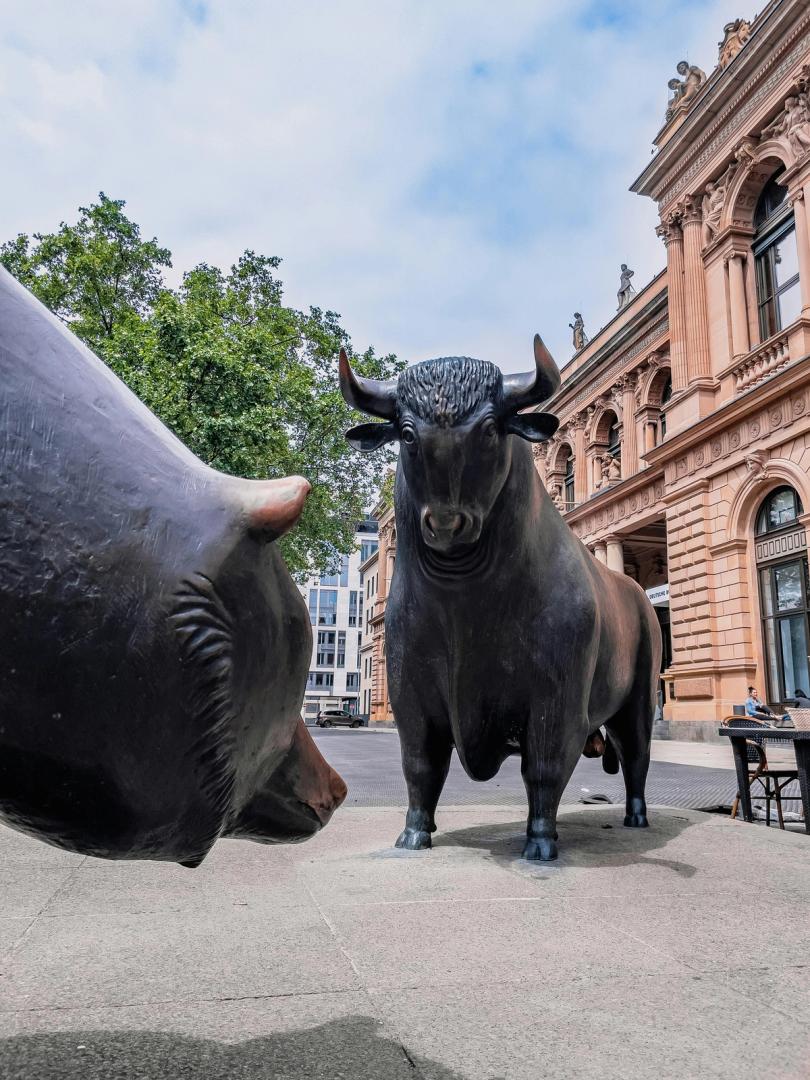
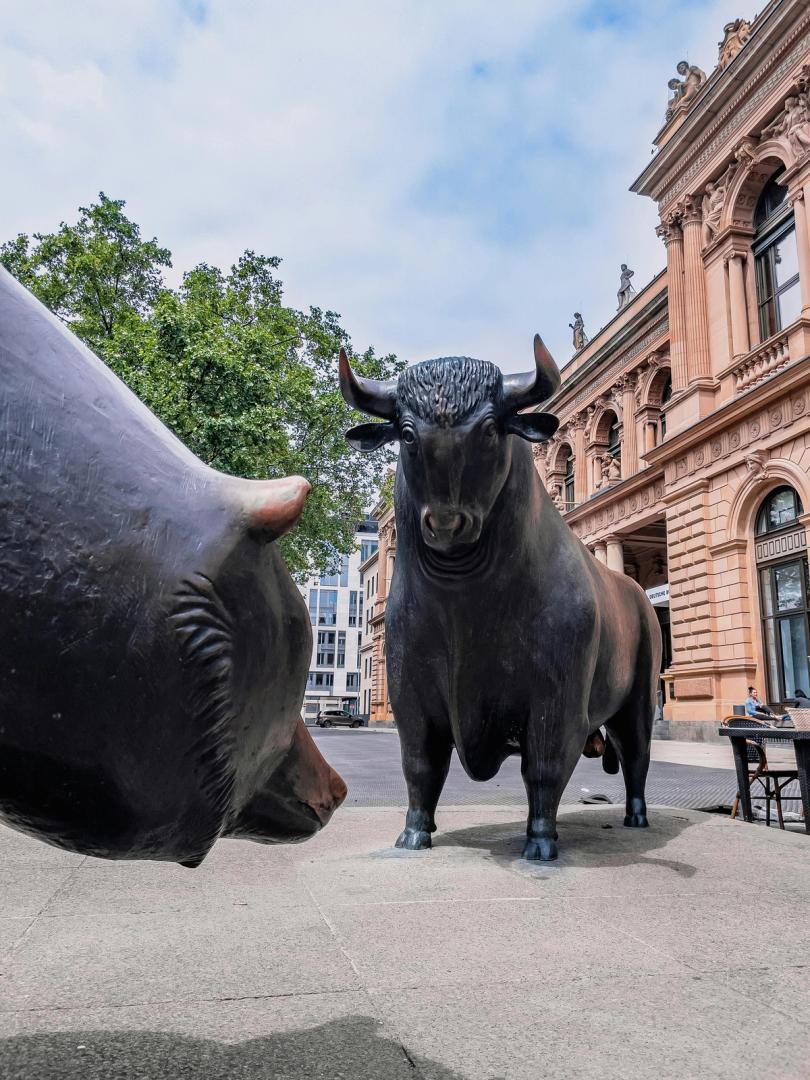
The urgent need for a “mass extinction” of “junk coins” from the crypto market is not at all a new topic. Cardano Founder Charles Hoskinson and Ethereum co-founder Vitalik Buterin predicted that over 90% of the initial coin offering (ICO) era would fail. Ripple CEO Brad Garlinghouse in 2019 agreed 99% of all cryptocurrencies would vanish.
The sentiment remains unchanged. Arthur Hayes said in his keynote at Consensus Miami 2026 that “99% of altcoins could eventually go to zero,” citing a shift in fiat liquidity as the only real driver for the few that survive.
Ben Cowen, a market analyst and founder of Into the Cryptoverse, told CoinDesk the purge has been underway since 2021, but a more meaningful “junk-coin cleansing” is necessary before bitcoin can enter a sustainable bull cycle.
With bitcoin hovering over $81,000 on Thursday for the first time since late January, many might believe the crypto winter is over, as Michael Saylor recently suggested. However, a growing chorus of analysts warns this might be a “relief rally” built on apathy rather than euphoria. They point to untouched liquidity sitting below $60,000 and the 200-day hurdle.
The junk coin purge must occur
Bitcoin is currently bumping up against its 200-day moving average of roughly $82,300. Historically, failing to settle above these lines leads to a sharp “drawdown” as buyers lose confidence. If bitcoin fails to flip $88,880 into support in the coming days, a pullback toward $58,000–$62,000 is the most probable outcome, according to Cohen?
“For the bottom to be confirmed, price needs to clear 88,880 and hold—not wick through, not retest and fail. That puts the most recent cohort back in profit and removes the first layer of sell pressure,” technical analysts at CryptoQuant posted on X Thursday,
“For the global cryptocurrency market to achieve a genuine, sustainable bull run, a painful but necessary purge of thousands of speculative ‘junk coins’ must occur first,” said Cowen.
That shift is reflected in capital concentrating into bitcoin as weaker projects disappear. While GeckoTerminal has seen more than 25 million token deployments, the “mortality rate” has reached record highs. According to its data, over 11.6 million failed in 2025 alone, largely due to the collapse of the over-saturated memecoin sector.
“A clear indication of that is bitcoin’s dominance, which has been increasing since then,” Cowen said.
While bitcoin dominance gradually fell with the rise of altcoins from over 99% in 2013 to roughly 33% in 2018, it has since trended higher, reclaiming 60% in late April. Ark Invest recently suggested it could reach 70% by 2030.
“Bitcoin dominance when seen with stablecoins included is misleading,” Cowen said. When stablecoins are excluded, his firm estimates dominance is already above 67%, reflecting capital rotating out of weaker tokens. “Capital is not rotating into higher-risk assets, but instead consolidating into Bitcoin or moving to the sidelines,” Cowen wrote in his April 2026 Crypto Risk Memo.
The data of decay
Cowen’s report added that “the current cycle has been defined by a persistent downtrend in participation since 2021,” with bitcoin dominance rising while the advance-decline index for the top 100 cryptocurrencies trends lower
Matthew Pinnock, COO at Altura DeFi, noted that the explosive growth of automated launchpads like Pump.fun has ballooned the number of weak tokens, leading to an 86% failure rate among 2025’s new launches.
Luke Nolan, senior researcher at CoinShares, said the token-level purge has “already largely happened,” pointing to a collapse in memecoin market capitalization from about $150 billion in December 2024 to under $50 billion. “Ninety-five percent of tokens being worthless is fair,” Nolan said.
A gloomy short-term bitcoin outlook
Despite the $81,000 milestone, Cowen remains cautious. “I think BTC is in a bear market and will likely drift lower as the year goes on, with headwinds like geopolitical tensions and the Fed delaying rate cuts,” Cowen doubts “bitcoin will see an ATH in 2026. This is more of a reset year with time-based capitulation.”
Veteran trader Peter Brandt said Monday he believes bitcoin will rise to $250,000 in 2029, but only after a prolonged bottoming phase that may last until September and October. Michael Terpin, known as the “Crypto Godfather”, said bitcoin needs to fall to roughly $57,000 in the next four to five months before entering a bull phase. He dismissed a BTC ATH this year.
“I think this business cycle is a tough one as in order for the higher risk assets – like bitcoin and ether – to do well, we would need a crisis to justify much looser monetary policy,” Cowen stated. “But until that crisis happens, crypto will likely bleed to other asset classes.”
Bitcoin has already declined from a cycle high near $126,000 to a low near $60,000, a drawdown of over 50%, consistent with prior late-cycle environments, Cowen concluded.

Garmin Launches JL Audio Primacy Luxury Home Audio System with Streaming, DSP, and Speakers from $50,000

UK wildlife knowledge gap exposed as Brits struggle to identify garden birds

Bel Group acquires Ingenuity Foods’ brands

Manchester United reach agreement with Casemiro over contract clause amid transfer speculation

US brings back mandatory military draft registration

Steven Gerrard disagrees with Gary Neville over ‘shock’ Chelsea and Arsenal claim | Football

XRP BABACUGS WARNING !!!! ONLY XRP AND XLM !!!! BANKING COLLAPSE NOW !!!! DEMS HATE US 2028-2030 !!!

CLARITY ACT RED ALERT: Ripple XRP Federal Reserve Breakthrough? – Bitcoin Monster Month!

How I Pick Stocks: Investing for Beginners (Financial Advisor Explains)
-

 NewsBeat4 days ago
Channel 5 – All Creatures Great and Small series 7 new post
-

 Crypto World5 hours ago
Upbit adds B3 Korean won pair as Base token gains Korea access
-
 Tech6 days ago
Trump’s 25% EU auto tariff breaches Turnberry Agreement that also covers semiconductors and digital trade
-
 NewsBeat6 hours ago
NCP car park operator enters administration putting 340 UK sites at risk of closure
-
 Sports6 days ago
Paul Scholes issues Marcus Rashford reality check as agreement emerges over Man United star
-

 Entertainment6 days ago
Met Gala 2026 Rumored Guest List Is Turning Heads
-

 Business6 days ago
Strait of Hormuz Blockade Persists Amid US-Iran Standoff, Sending Oil Prices Soaring
-
Entertainment6 days ago
New on Prime Video in May 2026 — Full List of Movies and Shows
-

 Sports6 days ago
Cavaliers vs. Raptors Game 6 live score, updates, highlights from 2026 NBA playoffs first-round series
-

 Tech6 days ago
Meta ends Sama contract after Kenyan workers report seeing intimate footage from Ray-Ban smart glasses users
-
 Sports6 days ago
David Benavidez responds to team Canelo saying the fight will never happen
-

 Entertainment6 days ago
Kylie Jenner Hit With Second Lawsuit From Ex-Housekeeper
-

 Entertainment6 days ago
Young and the Restless Next Week: Cane Arrested & Matt’s Deadly New Scheme!
-
Entertainment5 days ago
New Netflix Movies in May 2026 — My Top 3 Picks to Stream
-

 Business4 days ago
Luka Doncic Injury Update: Doncic’s Hamstring Recovery Slows Lakers’ Hopes Against Thunder: Can He Run Yet?
-
 Sports6 days ago
IPL 2026: ‘Love you darling’- Hardik Pandya’s reaction to MS Dhoni steals the show |Watch | Cricket News
-
Crypto World5 days ago
Pi Network Mandates Protocol 23 Upgrade for All Mainnet Nodes Before May 15 Deadline
-

 Sports6 days ago
Bayern won’t hand bottom side Heidenheim ‘gifts’ despite PSG game
-

 Entertainment4 days ago
Melissa Joan Hart and More Stars Attend 2026 Kentucky Derby
-

 Sports6 days ago
What Preity Zinta Said After Punjab Kings’ First Defeat Of IPL 2026
You must be logged in to post a comment Login