
Crypto World
Ethereum price forms double top as market reacts to Iran tensions, will it crash?

Ethereum price retraced some of its gains from Monday after U.S. President Donald Trump brushed off an Iranian proposal to end the war and warned that strikes would target key infrastructure if Tehran fails to reopen the Strait of Hormuz by the deadline.
Summary
- Ethereum price fell 3.4% below $2,100 as Trump rejected Iran’s proposal and warned of strikes if the Strait of Hormuz is not reopened.
- Risk sentiment weakened across crypto and equities, with Asian markets flat to lower and investors pulling capital amid geopolitical uncertainty.
- A confirmed breakdown below $2,000 could trigger a double top pattern and liquidations of up to $1.41B in long positions.
According to data from crypto.news, Ethereum (ETH) price fell 3.4% below the $2,100 support after reports emerged that Trump will not call off the strikes at Iranian infrastructure unless Tehran commits to reopening the Strait of Hormuz, a key maritime corridor that handles 20% of all the global oil trade. This came after the U.S. President dismissed a proposal from the Iranian leadership to end the war while keeping the Strait closed.
Fears of a very aggressive strike on Iran are likely causing investors to withdraw capital as they await the conclusion of this geopolitical standoff. Investors are withdrawing from both crypto and traditionally safe-haven assets such as gold and silver, a sign of broader derisking across global markets as uncertainty intensifies.
Asian tech stocks such as Japan’s Nikkei 225, Hong Kong’s Hang Seng, and the Shanghai Composite all remained either still or dropped as uncertainty weighed on the region.
Besides these factors lowering risk sentiment, retail investors are also likely panicking as they potentially face liquidation of $1.41 billion worth of long positions being erased from the market should Ethereum price slide further down to $2,040.
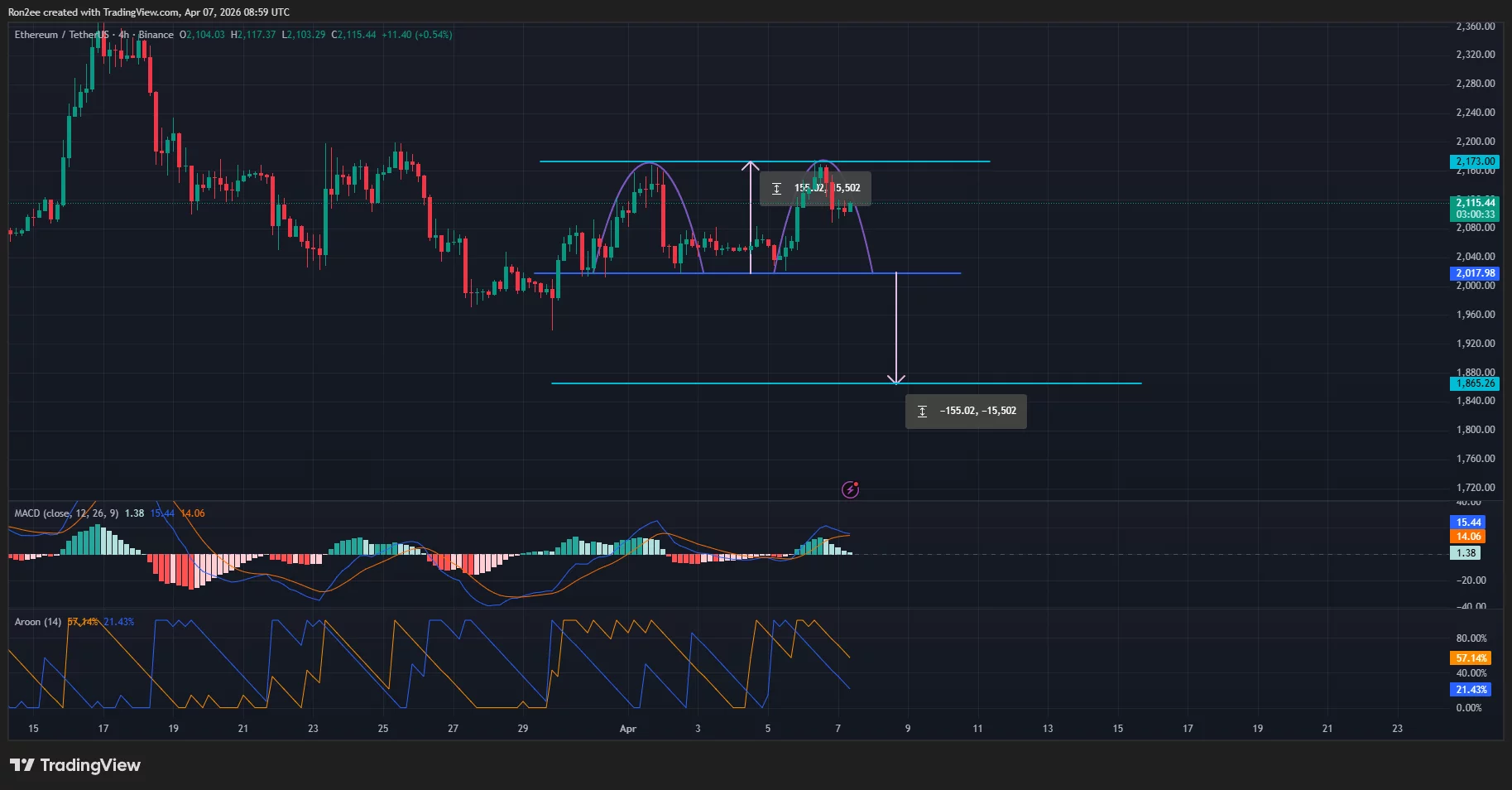
On the daily chart, Ethereum price has been forming a double top pattern on the 4-hour chart. Double top patterns are some of the most common bearish signals in technical analysis. The neckline of the pattern lies at around $2,017.
If Ethereum price falls below the $2,000 support, it would confirm the double top pattern and will continue to drop lower to under $1,900 as calculated by subtracting the height of the double tops formed from the point at which the neckline stands.
Technical indicators show that bears are starting to take control. Notably, the Aroon Up and Down lines have pointed sharply downwards, suggesting a strong downtrend. The MACD lines are close to forming a bearish crossover, a sign that selling pressure is mounting.
For now, the immediate support level that decides the trend lies at $2,000. Failure to hold this level would confirm both the double top pattern and the long liquidation cascade.
Disclosure: This article does not represent investment advice. The content and materials featured on this page are for educational purposes only.

Crypto World
South Korean Bank Partnered With Ripple for Cross-Border Payments: Is XRP About to Get Its Biggest Banking Endorsement Yet?

South Korea just handed Ripple XRP its biggest institutional endorsement in months. Whether the market has priced that in yet is the question traders need to answer fast.
KBank, South Korea’s internet-only bank and the sole banking partner of crypto exchange Upbit, announced Monday it has entered a strategic partnership with Ripple to conduct a proof-of-concept for cross-border remittances.
Local media reports confirm the two companies have already completed Phase 1, verifying a wallet app-based remittance system.

Phase 2 is now underway, testing on-chain transfers to the UAE and Thailand using Ripple’s Palisade SaaS wallet, a product Ripple acquired and which meets international security standards.
KBank’s reach is substantial: its Upbit partnership drove user growth from 2 million in 2020 to 15 million by the end of 2024.
This deal doesn’t exist in isolation. Ripple also partnered with Kyobo Life Insurance earlier this month for tokenized government bond transactions, and South Korea’s Digital Asset Basic Act is approaching fast, accelerating every major institution’s urgency to establish blockchain infrastructure now, not later.
Can Ripple XRP Price Break $1.52 This Week?
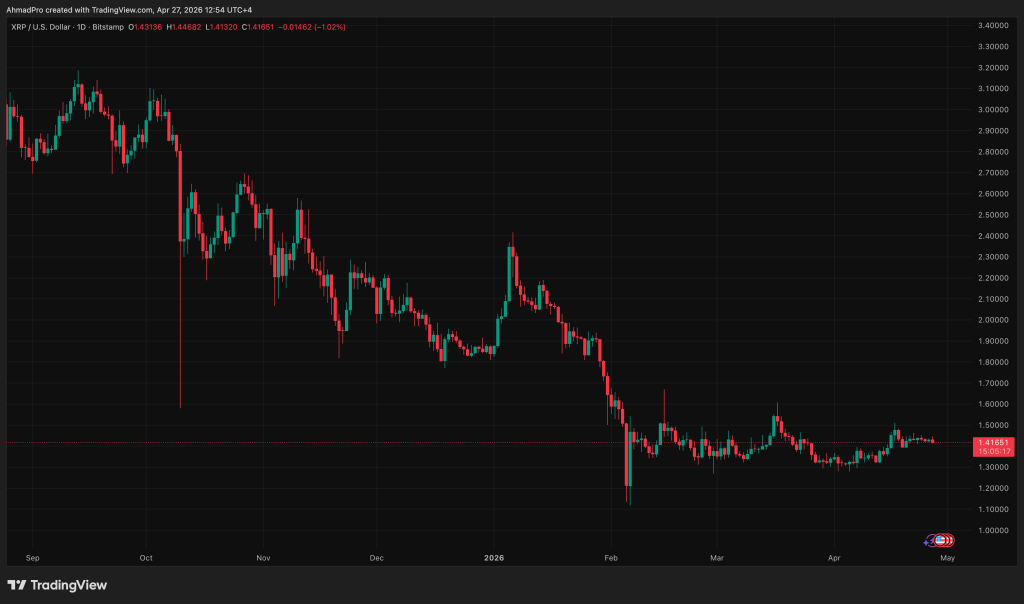
Ripple XRP price is stuck in a tight range, moving between roughly $1.35 and $1.50 after the bounce, but it has not broken out, so this is still consolidation, not a trend shift.
Support sits around $1.33–$1.38, and that zone is doing the heavy lifting right now, with $1.40 acting as the short-term floor where selling is starting to slow down. Resistance is stacked above at $1.46–$1.52, and that is the level that needs to break to unlock any real momentum.
If XRP can reclaim $1.52 with strong volume, that is where the structure flips and opens the door to a move higher, especially with institutional flows building in the background.
More realistically, though, it keeps chopping between $1.38 and $1.50 while the market waits for a catalyst, likely tied to ETF timing or broader sentiment.
The risk is simple: if $1.33 breaks on volume, the setup fails and downside opens quickly.
So this is a classic compression phase, hold support and break resistance, it runs, lose support, and it unwinds.
New Shiny Memecoins Like MAXI DOGE Could Outperform Most Of The Crypto Market Next
Maxi Doge is positioning right in that space, leaning into the high-risk, high-reward trader narrative and targeting the same crowd that chases fast moves.
The presale is sitting around $0.0002815, with roughly $4.75M raised, indicating steady demand as it approaches the $5M mark, a level that often attracts more visibility.
The setup is built for engagement, with staking, trading competitions, and a treasury aimed at supporting liquidity and growth, all wrapped in aggressive, viral branding that fits the current meme cycle.
But it is still early, and that comes with the trade-off: liquidity is limited until listing, and execution matters a lot.
So the idea is simple: XRP offers stability with limited upside, while Maxi Doge offers earlier positioning with higher potential, but also higher risk.
Visit Maxi Doge before the next price tier activates.
The post South Korean Bank Partnered With Ripple for Cross-Border Payments: Is XRP About to Get Its Biggest Banking Endorsement Yet? appeared first on Cryptonews.


The Block taps ex‑Azuki COO Steve Chung as CEO and takes another $10M from Foresight Ventures, doubling down on an institutional data, research, and AI‑driven media pivot.
Summary
- Foresight Ventures’ majority stake sets stage for The Block’s institutional era
- Majority owner Foresight Ventures is adding $10 million on top of its prior $60 million, signaling a push to build a “Bloomberg for digital assets” targeting funds and corporates.
- The move raises fresh questions about independence as a venture fund tightens its grip on a crypto newsroom, even as Cermak’s continued control of research is seen as a partial safeguard.
The Block’s decision to install former Azuki COO Steve Chung as CEO, backed by an extra $10 million from Foresight Ventures, is a clear signal: crypto media is going fully institutional, with AI and TradFi squarely in the frame. It is a sharp pivot from surviving crypto winters and ownership scandals to competing head‑on with Bloomberg‑style data and research platforms for hedge funds, banks, and asset managers.
Chung steps into the role after a career that runs directly through Wall Street, legacy media, and Web3 IP.
He started at Goldman Sachs in New York, moved on to become Chief Growth Officer at Fox Corporation and Chief Digital Officer at Fox Television Stations, served as CEO of CJ ENM America, and most recently ran operations at Azuki, a blue‑chip NFT brand built around anime‑style decentralized IP. That mix of capital markets, media distribution, and crypto culture is exactly what The Block’s owners appear to be buying.
Larry Cermak, who became CEO in 2023 after Foresight Ventures acquired roughly 80% of The Block in a $60 million deal, will slide into a President role focused on research, data, and product rather than day‑to‑day operations. “Steve is the right operator to take The Block from category leader to global market leader,” Cermak said in the official release, framing the move as a scale‑up moment rather than a handover forced by stress.
Foresight’s new $10 million injection, announced alongside the hire, is meant to fund exactly that scale‑up.
Since 2022, the Singapore‑based firm has been deploying successive $10 million accelerators and strategic investments across Web3 infrastructure, AI, and Bitcoin Ordinals, and media is part of the stack: The Block is supposed to be the distribution and data layer that institutional LPs and portfolio companies lean on for market intelligence. PR copy is explicit about where this goes: using the fresh capital to “scale institutional research and data offerings, expand its enterprise business, and deepen its role as a critical information and data provider within the global digital asset ecosystem.”
On X, sentiment over the past day has been cautious but curious rather than euphoric.
Foresight‑aligned news account @WuBlockchain summarized the move in Chinese, emphasizing that Chung “曾任Fox、CJ ENM America 等公司高管,并担任NFT 项目Azuki COO,” and highlighting that Cermak will stay on to lead research and product, which calmed some concerns about editorial continuity. Another industry account amplified the PR line that The Block will now sit “at the intersection of crypto, finance, and AI,” positioning Chung as the operator who understands all three cultures. Binance’s @BinanceSquare news feed echoed Foresight’s framing, calling the move a push to “accelerate institutional expansion” rather than a simple leadership reshuffle.
The deeper question is what kind of media product emerges when a crypto‑native newsroom becomes a line item on a venture portfolio whose strategy is explicitly geared toward institutional monetization.
Foresight already controls the cap table and is now writing another $10 million check; Chung’s mandate is to build a global enterprise business on top of that. That almost certainly means more paywalled research, richer datasets, and bespoke products for funds and corporates—and less emphasis on chasing retail clicks. From a market‑structure point of view, that’s rational: crypto is institutionalizing, the big fees sit with professional clients, and the most valuable content is data‑driven, time‑sensitive research, not explainers.
But it also raises familiar concerns about independence and conflict of interest.
The Block is still working through reputational scars from its earlier exposure to Alameda/FTX money, which led to a change of ownership and Cermak’s initial appointment as CEO. Now, with a single venture firm doubling down financially and strategically, critics on X are already asking whether coverage of Foresight portfolio companies and themes—like AI‑crypto convergence or specific accelerator projects—can stay arm’s‑length. The fact that Cermak remains in charge of research and product is widely seen as a partial safeguard, but institutional clients will likely demand stricter governance around disclosures and firewalls than retail readers ever did.
From Chung’s side, his track record suggests he will lean into IP, brand, and distribution as much as data.
At Fox and CJ ENM America, his remit was to build digital businesses and global reach across traditional and streaming channels. At Azuki, he worked at the frontier of NFT‑based media franchises and decentralized IP, where community and liquidity matter as much as content. Bringing that playbook to The Block means you can expect more cross‑format output—video, events, B2B education—designed around institutional buyers but powered by crypto‑native culture. It is the media equivalent of moving IP on‑chain: trying to wrap research, data, and brand into a single, leverageable asset.
In the short term, the move is a bet that there is room for at least one fully crypto‑native “Bloomberg for digital assets,” and that the window to build it is now, before banks and legacy data vendors completely capture the category.
If Chung executes, The Block could become the default terminal for funds trading liquid tokens, stablecoins, and eventually tokenized real‑world assets. If he does not, the platform risks being squeezed between free on‑chain data dashboards and heavyweight incumbents who are already feeding crypto price and derivatives data into existing terminals. Either way, the appointment and the $10 million check confirm what the market already knows: crypto media is no longer just about news; it is infrastructure.
Crypto World
XRP News: Ripple’s CTO Is Being Accused of a Price Promise He Made in 2017: Did He Actually Say XRP Would Hit $1 Million?

Ripple CTO is the main man for XRP news this week. David Schwartz finds himself defending a seven-year-old post that a vocal segment of the community insists was a price promise.
The timing matters, sentiment is fragile, and the conspiracy theories surrounding Ripple leadership never fully go quiet. What Schwartz said in 2017 and what XRP holders heard are apparently two very different things.
The controversy resurfaced on X after a user accused Schwartz of deliberately misleading XRP holders.
The debate centered on a 2017 thread in which Schwartz argued XRP could not be “dirt cheap” if it handled large global transaction volumes, using a straightforward liquidity example: at $1 per XRP, moving $1 million requires one million tokens; at $1 million per XRP, a single token does the same work.

Schwartz was explicit this week: the post explained market mechanics, not a price target. He said deleting the thread would strip useful context and deepen the confusion rather than resolve it.
The episode adds pressure to an asset already navigating choppy technicals, with 21 of 28 tracked indicators flashing bearish as of late April 2026.
Whether the market cares about old forum posts is debatable, but XRP holders clearly do.
Can XRP Price Pump Above $1.61 This Week, or is the News Holding it Back?
XRP is stuck in a tight range around $1.43, and that low volatility usually means a move is coming, but right now the setup leans slightly bearish.
Short-term momentum is still holding, which is why XRP price has not broken down, but the bigger trend is weakening, with longer-term indicators pointing lower.
The levels are clear.
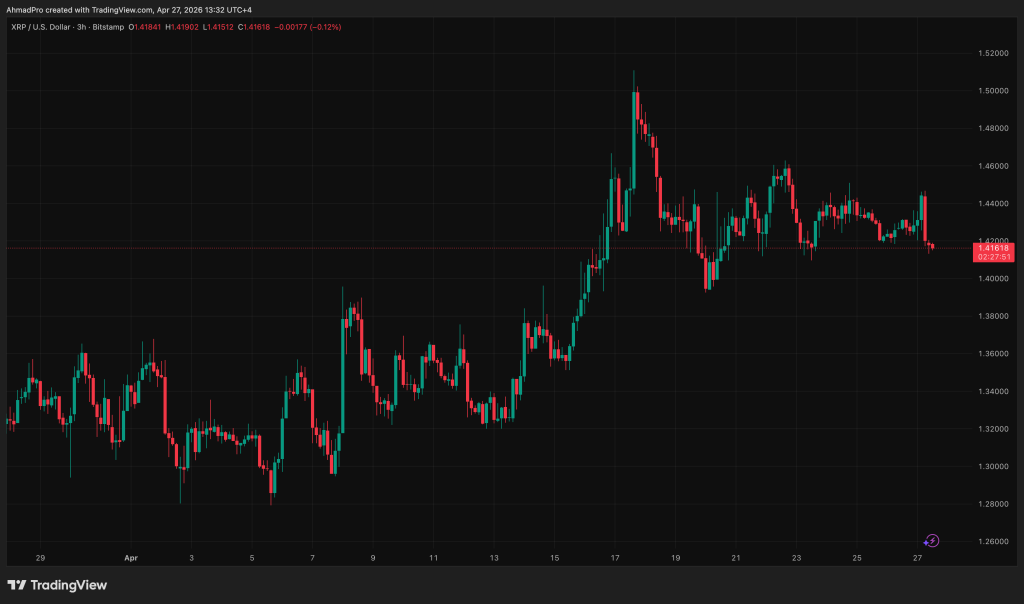
Support sits at $1.39, and that is the line holding everything together. Resistance is at $1.61, the first real barrier if buyers step in.
If XRP can hold $1.43 and push with volume, a move toward $1.61 is possible.
More likely, though, it just drifts sideways around $1.41 to $1.43 while the market waits for direction.
The risk is a break below $1.39, because once that goes, there is not much support immediately underneath, and downside can open quickly.
So this is a compression phase with a slight bearish tilt, and the next move will likely be sharp rather than gradual.
LiquidChain (LIQUID): Is This the “XRP” of This Cycle?
XRP around $1.43 is basically capped in the short term, with limited upside unless a real catalyst shows up, and that is the reality of a large market cap; moves get smaller and slower.
That is why some traders look toward earlier-stage infrastructure, where the upside is still forming, even if the risk is higher.
LiquidChain is targeting that angle, focusing on cross-chain liquidity by connecting Bitcoin, Ethereum, and Solana into a single execution layer. The idea is to reduce fragmentation so developers and users can access multiple ecosystems without rebuilding.
The presale is still early, around $0.01453 with just over $700K raised, which means it is not widely priced yet and still in the accumulation phase.
But it is also unproven. Execution, adoption, and real usage are still unknown, which is the trade-off with early-stage projects.
So the contrast is simple, XRP offers stability with limited upside, while something like LiquidChain offers higher potential, but with higher uncertainty.
The post XRP News: Ripple’s CTO Is Being Accused of a Price Promise He Made in 2017: Did He Actually Say XRP Would Hit $1 Million? appeared first on Cryptonews.
Maple Finance announced it has crossed $7 billion in total bridge volume, signaling growing cross-chain demand for yield-bearing dollar assets.
Maple Finance announced Monday that its cross-chain bridge has processed over $7 billion in total volume. The milestone reflects increased adoption of Maple’s dollar yield assets moving across multiple blockchain ecosystems, demonstrating demand for yield-bearing dollar products beyond single-chain deployments.
The announcement underscores the broader trend of DeFi users seeking yield opportunities on stablecoin assets across fragmented blockchain networks. Maple’s bridge infrastructure enables users to access its fixed-income products on different chains, reducing friction in cross-chain asset movement.
Sources: Maple Finance
This article was generated automatically by The Defiant’s AI news system from publicly available sources.
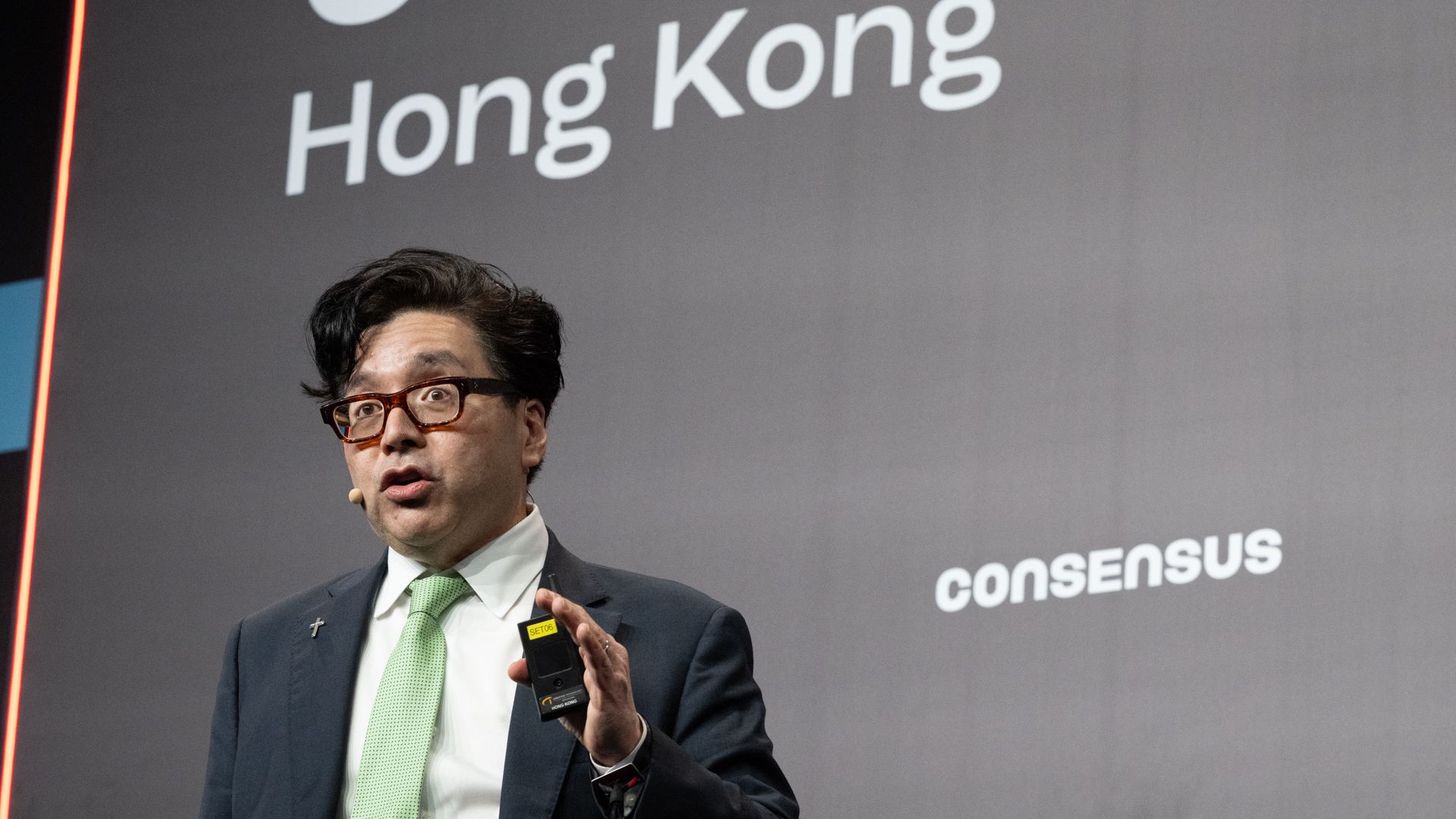
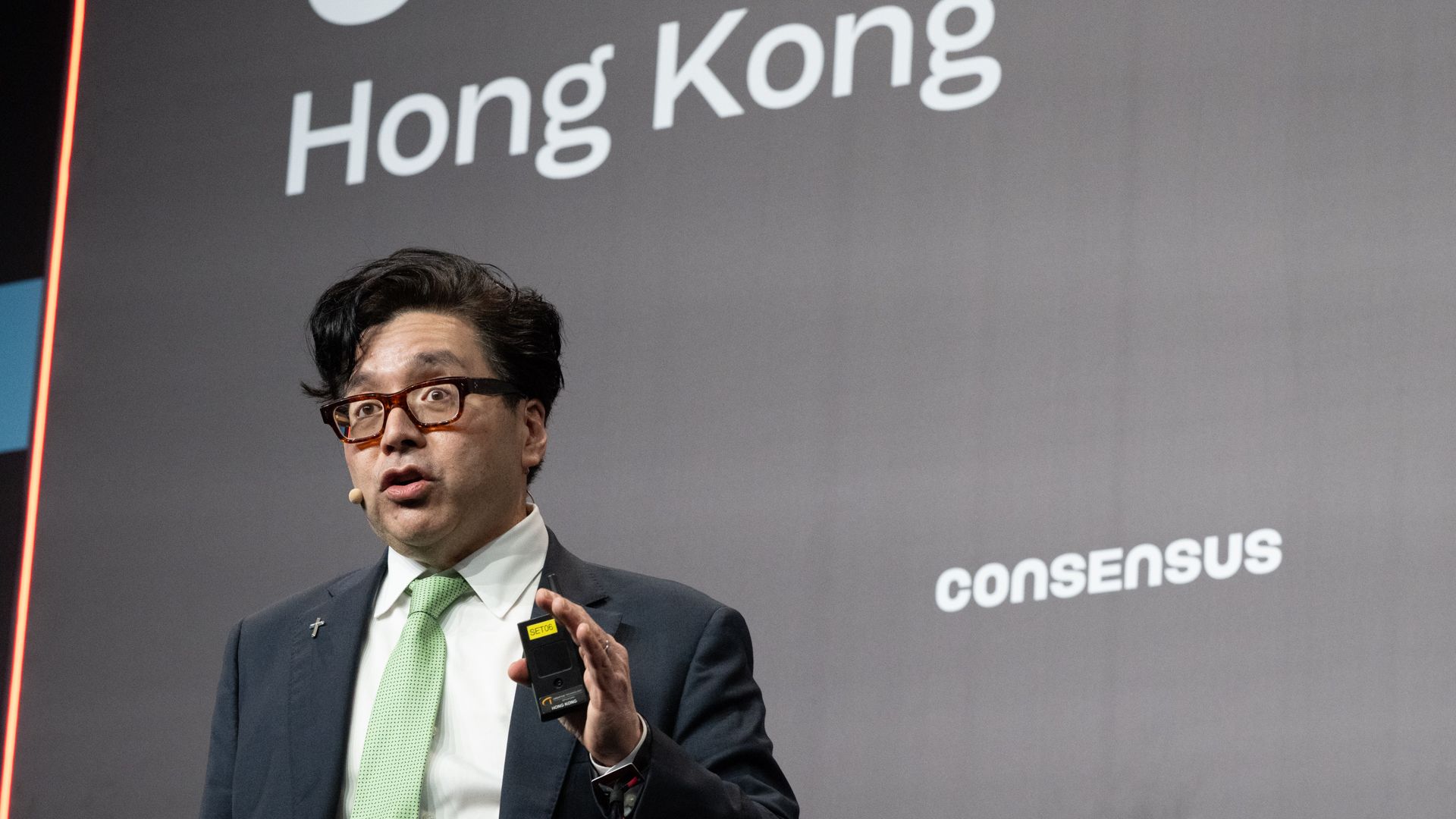
Bitmine Immersion Technologies (BMNR), the ether (ETH) treasury firm helmed by Chairman Thomas “Tom” Lee, bought 101,901 ETH through last week, pushing its total holdings above 5 million tokens of the second-largest cryptocurrency.
The purchase lifted the firm’s ETH treasury to 5,078,386 tokens, or about 4.21% of ether’s circulating supply, according to a Monday update. Bitmine reached that milestone in roughly 10 months, since it pivoted to a digital asset treasury strategy company from a bitcoin miner in June.
“Bitmine ETH holdings crossed 5 million this past week,” Lee said. “This is a major milestone as the company moves towards acquiring 5% of the ETH supply.”
The latest purchase, worth roughly $236 million at current ETH prices, extends a streak of larger weekly purchases as Bitmine adds to its position while most digital asset treasuries remain on the sidelines.
The firm’s total crypto and cash holdings stand at $13.3 billion. Alongside its ETH position, the firm holds 200 bitcoin , $940 million in cash and equity stakes including investments in Beast Industries and Worldcoin-focused Eightco Holdings.
The company has also expanded its staking operations to generate yield on its ETH stash. About 3.7 million tokens — roughly 73% of its holdings — are now staked, generating around $264 million in annualized revenue. The firm debuted its Mavan staking platform in March to attract institutional clients alongside supporting its own treasury operations.
BMNR shares were unchanged in pre-market trading following the update.
Ether as ‘wartime store of value’
Lee framed ether’s role as shifting beyond a speculative asset. Citing recent research by Etherealize, he said ETH is increasingly being treated as a “store of value” and collateral as digital assets gain traction in financial transactions.
He also added that ETH has outperformed the S&P 500 since the start of the Iran conflict and pointed to growing use cases such as tokenization and AI systems relying on public blockchains as a long-term tailwind for the asset.
“There is a lot of meaning to ETH being the best ‘war-time store of value’ and to ETH being the asset leading since the war started,” said Lee.


Onchain IP turns static, illiquid rights into transparent, tradable assets, letting games like My Pet Hooligan convert fans from passive consumers into real economic stakeholders
Summary
- Traditional IP is illiquid, opaque, and structurally misaligned with fans and creators.
- Putting IP on-chain makes rights transparent, tradable, and programmable for global markets.
- Projects like AMGI Studios’ My Pet Hooligan show how NFT-based IP can turn audiences into owners.
The entertainment industry has long treated intellectual property like the paranoid owner of a rare painting, locked away in a private vault. It is extremely valuable, but static, illiquid, and accessible only to whoever holds the key.
The traditional framework for registering IP such as movie franchises, songs, and video games is broken, especially in a world where virtually all entertainment has gone digital. Yet the underlying legal infrastructure that records ownership is still stuck in the 20th century.
The problems with IP
The structural issues of traditional IP start with inaccessibility. Access to high-value IP investments is generally restricted to a small circle of institutions that can afford to hire lawyers to search registries, negotiate licenses, and structure sales, effectively excluding the people who prize the IP most – the fans and creators who generate its value and drive its growth.
Take the Star Wars movie franchise. Licensing the likeness of a character like Chewbacca is eye‑wateringly expensive, yet that image would be worth nothing without the movie’s loyal, fanatical audience keeping it relevant across decades.
Entertainment IP is also extremely illiquid. Trademarks and similar rights are “lumpy” assets that are hard to price and even harder to sell, with transactions that can take weeks or months to close. The model suffers from weak alignment too, because brands rarely reward communities for their role in making a property successful; the most dedicated players of a video game, for example, earn nothing from its global breakout beyond the privilege of continuing to play, and pay, inside a closed system.
Blockchain offers a better way
Bringing IP on-chain is the obvious upgrade. Instead of being locked in a vault, rights can live in a transparent, liquid, global market where success and value are measured by real engagement rather than opaque internal accounting.
On-chain IP enables immutable, verifiable ownership. If someone holds an NFT granting defined rights to a piece of IP, no one can quietly strip those rights away, and anyone can verify who owns what, see what revenue it generates, and bid to acquire or license it through open, decentralized mechanisms. Because these rights are on programmable infrastructure, they can be traded in real time, split among multiple parties, or wrapped into new financial and creative products.
Proof that this model works is already here in projects like AMGI Studios’ My Pet Hooligan, a blockchain game built around 8,888 unique 3D characters that live as NFTs on Ethereum. AMGI has transformed dozens of characters, weapons, and accessories into player‑owned assets, moving beyond the dominant free‑to‑play model where users effectively lease “skins” from a closed server.
AMGI’s approach effectively turns its My Pet Hooligan IP into a new kind of real‑world asset. If the game goes viral and more people start playing, demand for those NFTs should increase, rewarding early adopters who took the risk of backing the ecosystem before it was mainstream. The assets provide in‑game utility, and their scarcity and desirability are visible on-chain through price, volume, and engagement metrics on marketplaces and analytics dashboards.
Music, film, and beyond
The same logic extends far beyond gaming. Musicians can bypass traditional labels by issuing NFTs or tokens that encode royalty rights, enforce revenue splits through smart contracts, and allow fans to buy into future streaming income directly. Independent filmmakers can sell tokens that entitle supporters to a share of box office, streaming, and licensing revenue, turning their communities into both financiers and evangelists.
Such systems create an entirely new asset class where discoverability becomes meritocratic, and value is easier to assess simply by looking at on-chain engagement and cash flow. Compared with today’s black‑box IP regime, on-chain IP is more open, transparent, and accessible to anyone with an internet connection and a wallet.
For entertainment, the logic is hard to ignore. Blockchain‑based IP protects creators, empowers consumers, and provides a standardized framework for participation, turning audiences from passive consumers into active stakeholders. As adoption grows, expect the walls of today’s media empires to erode, replaced by open ecosystems where every song, film, and video game character has a fair shot at finding its market.
Crypto World
CFTC Chairman Endorses Prediction Markets as Valuable for Hedging and Information Discovery: Selig


CFTC Chairman Rostin Behnam said prediction markets provide measurable value to participants and the public, committing the agency to setting regulatory standards for the sector.
CFTC Chairman Rostin Behnam stated that prediction markets deliver measurable value to market participants who use them to hedge and speculate on event outcomes, as well as to the broader public through improved information reliability about current events. The CFTC said it is committed to establishing the gold standard for regulation of prediction markets, signaling the regulator’s framework-building approach to the growing sector.
The statement comes as prediction markets—blockchain-based platforms allowing users to trade on the outcomes of real-world events—have grown in prominence as a crypto use case. Platforms like Polymarket have expanded significantly, creating regulatory questions about how U.S. authorities will oversee these markets. The CFTC’s public positioning suggests the agency views prediction markets as legitimate financial instruments worthy of thoughtful regulation rather than prohibition.
Sources: CFTC Chairman Rostin Behnam (@ChairmanSelig)
This article was generated automatically by The Defiant’s AI news system from publicly available sources.


Michael Saylor, the executive chairman of Strategy (MSTR), the largest publicly traded corporate holder of bitcoin, announced Monday on X the purchase of 3,273 bitcoin for roughly $255 million.
The purchase at an average price of $77,906 per bitcoin puts Strategy’s bitcoin treasury at 818.334, said Saylor.
“As of 4/26/2026, we ‘hodl’ 818,334 $BTC acquired for ~$61.81 billion at ~$75,537 per bitcoin,” the MSTR chair said.
Saylor also said Strategy “has achieved BTC Yield of 9.6%” year-to-date in 2026. YTD 2026.
Matt Cole, the CEO and chairman of Strive, also announced on Monday that his firm acquired 789 BTC for $61.43 million at an average cost of $77,890 per bitcoin.
Cole said that as of April 24th, Strive holds 14,557 BTC valued at nearly $1.13 billion.
Crypto World
As the BTC price rises, perpetual futures may look bearish. They’re not, analyst 10x says.


Bitcoin has rallied roughly 14% this month, its best monthly performance in a year, and the consensus is that the price could soon push past $80,000, a level not seen since January.
Yet the perpetual futures market, which is typically in sync with spot price action, is behaving as if the opposite is true. Specifically, the funding rate — a figure that’s positive when the futures are positioned for a bitcoin price increase and negative when positioned for a drop — is currently below zero.
That has left market participants searching for an explanation. While many read the divergence as a signal that traders lack confidence in bitcoin’s recent performance and are positioned for a drop, that’s not the only explanation.
According to 10x Research’s Founder Markus Thielen, who predicted a rally to $125,000 way back in early 2023, the situation is, in fact, being driven by hedging activity from institutions. Instead of the shots being called by retail traders, the negative funding rate represents a structural change in the market brought on by the increasing participation of sophisticated players.
Why the funding rate matters
Perpetual futures are contracts that track bitcoin’s price without ever expiring, unlike standard futures listed on an exchange like the CME. To keep futures prices tethered to spot prices, exchanges charge a periodic fee, the funding rate.
When the futures prices are higher than spot, meaning buyers are more aggressive in the futures market, longs (investors who own the futures) pay shorts (who’ve sold contracts they didn’t own in expectation they will be able to buy them back at a lower price). In that case, the funding rate is positive.
When futures trade below spot, it’s a sign short pressure is dragging futures down relative to actual bitcoin, shorts pay longs and the rate goes negative.
The funding-rate mechanism acts as a real-time gauge of market sentiment.
In recent weeks, funding rates have been consistently negative, meaning the shorts are in charge and perpetual futures have traded at a discount to spot price.
Bitcoin’s 30-day average funding rate is negative 5%, compared with the historical norm of positive 8%, according to 10x Research. That is a 13 percentage point discount to baseline, and it is getting more negative even as the price climbs.
“The Bitcoin funding rate is sending an unusual signal,” Thielen wrote in a note to clients on Saturday. “At minus 5% on a 30-day average against a historical norm of plus 8%, and turning more negative even as Bitcoin rallies 15% and the options skew recovers, something structural is happening in the futures market, not a sentiment shift.”
Structural pressures
Thielen identified three sources for the short pressure in the futures market.
The first is hedge fund redemptions. Crypto hedge funds have underperformed bitcoin by 140% over five years, and investors have been pulling money out. That takes time, and during redemption notice periods, funds have been shorting bitcoin futures to neutralize their price exposure while they wait for their capital to return to their bank or trading accounts. These are mechanical risk-management trades, not bearish bets, Thielen said.
The second involves two separate institutional trades, both of which require shorting bitcoin futures as a hedge. One bets that shares of Strategy (MSTR), the largest publicly traded bitcoin treasury company, will outperform bitcoin directly while shorting futures. The other is aimed at capturing the 11% yield on MSTR preferred shares (STRC) while shorting futures to strip out crypto price volatility risk. Strategy raised $3.5 billion in April alone, scaling both trades simultaneously.
The third is the growing trend of bitcoin miners to pivot to artificial intelligence. Miners like Hut 8, up 48% since April 6, are reducing their bitcoin production and adding to their support for AI computing. Funds buying these stocks are simultaneously shorting bitcoin futures to remove crypto correlation from the trade. Again, this is risk management, not an outright bearish play in bitcoin futures.


The amount of analysis available to you right now is greater than at any point in human history.
And yet most people have less clarity on what is actually happening than they did five years ago.
What changed is the scale. When analysis was expensive to produce, there was a natural filter. The people producing it had to know something because the cost of being wrong was reputational and financial. Now that cost is basically zero. Anyone can generate a macro take that sounds like it came from a Goldman desk in five minutes. The noise is growing exponentially while real signal stays roughly constant.
The insidious part is that the noise does not look like noise anymore. It looks like signal. Bad analysis used to be obviously bad. Now it is polished, structured, uses the right terminology, cites the right data. The tools most people are using to produce it are optimized to sound right. Whether the output is actually right is a different question entirely.
Telling the two apart is the whole game now. The same systems flooding markets with noise can be used to cut through it. That is what I have spent the past two years proving – publicly, on X, with every call timestamped and nothing deleted, across geopolitics, energy, macro, crypto, and broader markets simultaneously.
The account grew from nothing to over 140,000 followers organically, with no paid promotion and no name attached. Signal Core on Substack, the home of the full forecasting operation, became the #3 best–selling crypto publication on the platform within nine months. In a market drowning in noise, the signal alone was enough.
The moment
The signal-vs-noise problem has arrived at the worst possible time.
The next twelve months will reshape more of the financial, technological, and geopolitical order than the past decade combined. Digital assets are integrating with the traditional financial system at a pace that would have seemed impossible eighteen months ago. Regulatory frameworks stalled for years are being rewritten in real time. AI is transforming how capital gets allocated. Geopolitical orders are realigning. Monetary policy is at an inflection point. The labor market is being restructured in front of us.
These are foundational shifts, arriving simultaneously, and compounding on each other. And this is exactly the moment when the ability to see clearly has collapsed. There has never been more at stake and never less clarity on what is actually going on.
The convergence problem
It is actually worse than a noise problem.
AI is converging everyone toward the same wrong answers simultaneously. When a thousand people use these tools to analyze the same event, they do not get a thousand different perspectives. They get minor variations of the same default output. The tools do not just fail to produce signal – they manufacture false agreement.
Before AI, if five analysts said the same thing, that meant something. Now if five hundred accounts say the same thing, it might just mean they all used the same tool.
What this looks like in practice
In January of this year, the prevailing view was that a direct U.S.–Iran confrontation was unlikely. The diplomatic channels were still open. The market was not pricing meaningful conflict risk. Oil was trading like nothing was coming.
The structural picture told a different story.
More than a month before the strikes began, the indicators were already pointing to a confrontation that was more likely than not. We flagged this publicly on X on January 13 while the crowd was still dismissing the risk. When the strikes hit, and oil nearly doubled, the move caught most of the market off guard. The signal was there. The crowd just was not looking at it.
The inputs we were watching were not exotic. Public statements, internal economic pressure inside Iran, and the absence of certain de–escalation patterns. Anyone with access to the open internet could see the same things. The edge was in synthesis – reading those inputs as a single converging system rather than as separate news streams. That synthesis is the hard part. The inputs are just the inputs. The bottleneck has never been technology. It has been how the technology gets used.
This is the pattern. The information was available. The tools to process it were available. What was missing was the ability to read the signal before the crowd formed around the wrong interpretation.
The scarce resource
Most people use AI to generate. Very few use it to see.
Signal is when you can look at a situation that has the entire market confused and see the structure underneath. It is when you can hold a position that every feed is telling you to abandon, and hold it anyway, because you can see something they cannot.
The challenge for most people is not generating signal themselves. It is recognizing who actually has it. Most analysis is hedged to the point of meaninglessness – strategies for avoiding accountability dressed up as analysis.
The old filter for getting past this was credentials. It no longer predicts who is seeing clearly. Plenty of the biggest calls in recent years have been missed by traditional institutions and caught by people working outside them. What matters now is whether someone is actually seeing what is happening – recognizing patterns the crowd is missing, naming what is real before it is obvious, and being right about it often enough that it holds up over time. Once you can see clearly, you start operating on a different timeline than the rest of the market.
What comes next
We are entering an era where signal is the most valuable and least understood asset in the market. The investors, builders, and allocators who figure this out first will have a structural advantage that compounds over years. The ones who keep consuming the flood without questioning it will keep agreeing with the crowd. And the crowd will keep being wrong at the moments that matter most.
Finding rooms where real signal still shows up is getting harder. Most of the venues that claim to aggregate market intelligence are just amplifying whatever the models already spit out.
Consensus 2026 in Miami is one of the few that still functions as a filter rather than an amplifier. The people who show up have skin in the game. Their disagreements are real. Their agreements were not manufactured by the same five models everyone else is using. That kind of room is getting harder to find anywhere else. Which is why I will be there – hosting a small invite–only session about what signal extraction at scale actually looks like.
The edge will not belong to whoever has the most information, the fastest tools, or the loudest platform.
It will belong to whoever can see clearly when everyone else is drowning in noise.
That is the scarcest resource in markets right now.
And it is only getting scarcer.
Form 144 SCHWAB CHARLES CORP For: 27 April

South Korean Bank Partnered With Ripple for Cross-Border Payments: Is XRP About to Get Its Biggest Banking Endorsement Yet?
5 Movies Turning 20 That We’d Rather Forget About

Manchester United reach agreement with Casemiro over contract clause amid transfer speculation

US brings back mandatory military draft registration

Steven Gerrard disagrees with Gary Neville over ‘shock’ Chelsea and Arsenal claim | Football


-

 Politics7 days ago
Gary Stevenson delivers timely reminder to register to vote as deadline TODAY
-

 Fashion3 days ago
Weekend Open Thread – Corporette.com
-
 Crypto World2 days ago
Hyperliquid $HYPE Rally Builds Momentum as AI Sector Enters Prove-It Phase
-
Crypto World7 days ago
Bank of Hawai’i (BOH) Q1 2026: Net Income Drops to $57.4M as Net Interest Margin Expands
-

 Politics5 days ago
Making troops accountable for war crimes threatens US alliance, ex-SAS colonel warns
-

 Politics5 days ago
Disabled people challenge government SEND proposals over segregation concerns
-

 Business5 days ago
Rolls-Royce Voted UK’s Most Iconic Trade Mark as IPO Register Hits 150
-

 Business4 days ago
Patterson-UTI Energy, Inc. (PTEN) Q1 2026 Earnings Call Transcript
-

 Politics5 days ago
Zack Polanski responds to home secretary’s taser threat
-
 Crypto World6 days ago
Five Value Stocks with Recovery Potential in 2026: PayPal (PYPL), Nike (NKE), and More
-

 Politics5 days ago
Starmer handler McSweeney to be dragged from shadows by Foreign Affairs Committee
-
 Sports1 day ago
IPL 2026: Ruturaj Gaikwad registers slowest fifty of the season, enters all-time unwanted list | Cricket News
-
Politics5 days ago
Wings Over Scotland | How To Get Away With Crimes
-

 Crypto World6 days ago
New York sues Coinbase, Gemini over prediction market offerings
-
Entertainment6 days ago
Sydney Sweeney cameo cut from “The Devil Wears Prada 2”, source explains why (exclusive)
-
 Business5 days ago
HCL Tech share price tank over 9% after weak Q4. JPMorgan, HSBC & 3 others cut target price
-

 Politics5 days ago
‘Iran is still a nuclear threat’
-
 Crypto World6 days ago
Crypto’s great hope in Senate’s Clarity Act still has a path to survive tight calendar
-
 Sports5 days ago
Tim Bradley names the current best in the world: “Better than Inoue and Usyk”
-

 NewsBeat1 day ago
LK Bennett closes all stores after entering administration
You must be logged in to post a comment Login