
Crypto World
Ethereum price reclaims $1,900 as ETF inflows rise

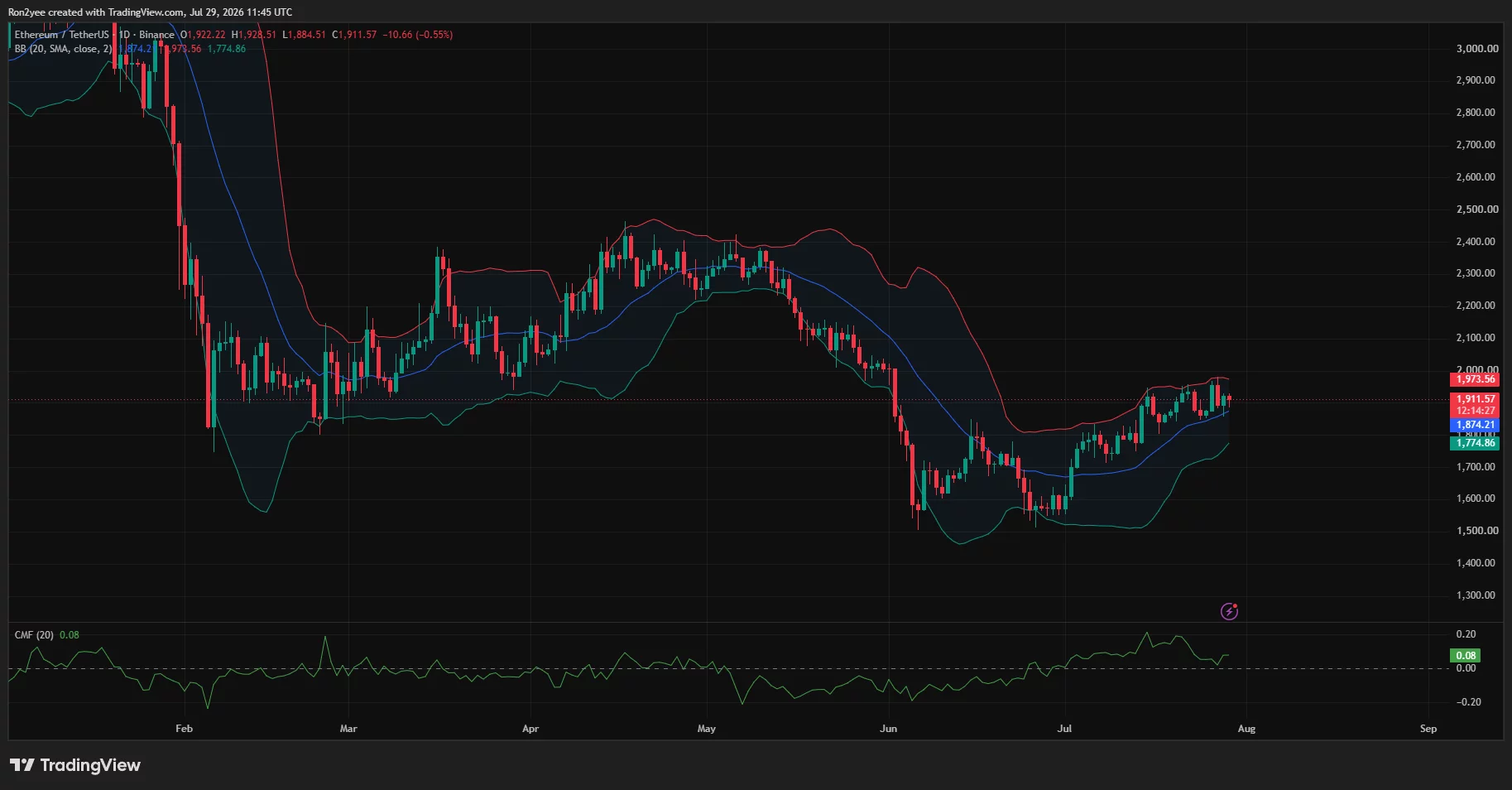
Ethereum price rose nearly 2% on July 29 as US spot ETF inflows and short liquidations helped ETH defend its rising support structure before the Federal Reserve’s rate decision.
Summary
- Ethereum recovered above $1,900 after rebounding from an intraday low near $1,856.
- US spot Ethereum ETFs attracted $14.53 million, including $5.15 million for Morgan Stanley’s MSSE.
- The 4-hour chart places ETH inside an ascending channel, with resistance approaching $1,970.
- Liquidation clusters near $1,940 and $1,960 could shape the next move before the Fed decision.
Ethereum price returns above $1,900
According to data from crypto.news, Ethereum (ETH) price was trading near $1,913 at the time of writing, up about 2% over the past 24 hours. The token had traded between approximately $1,856 and $1,926 during the session.
The recovery followed a successful defense of the $1,850–$1,880 region. ETH first reclaimed the daily Bollinger Band midpoint at $1,874 before moving back above the psychological $1,900 level.
Ethereum’s daily chart shows price consolidating between the Bollinger Band midpoint and upper boundary. The upper band sits at $1,973, making the $1,970–$2,000 region the next technical barrier. The lower band remains near $1,775.
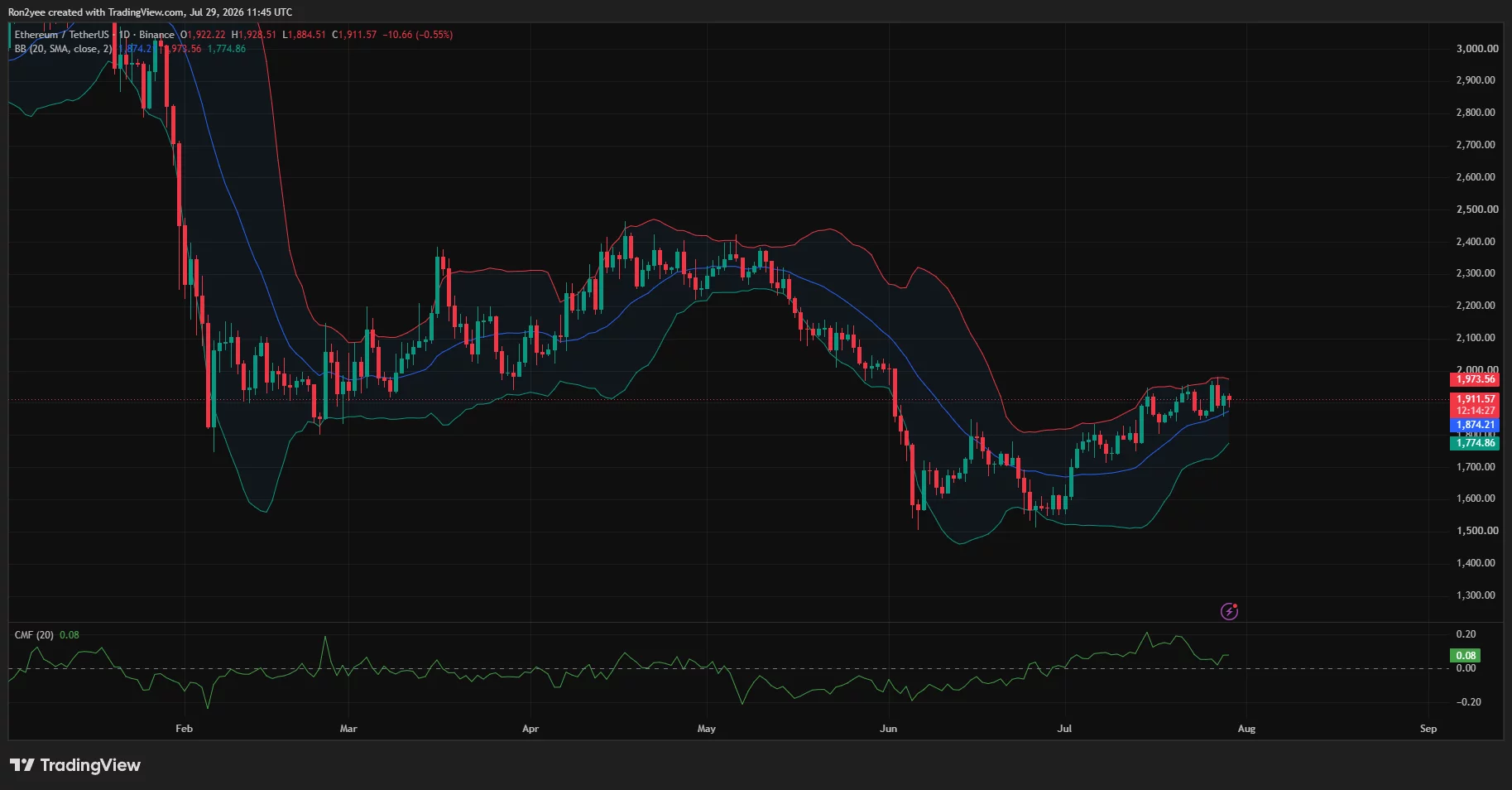
Buying pressure has also improved. The Chaikin Money Flow reading stands at 0.08, above the neutral line and indicating that capital inflows currently outweigh distribution. However, the indicator remains below its July high, suggesting demand has not yet reached breakout strength.
Morgan Stanley ETF adds to institutional demand
The rally coincided with the first trading session for the Morgan Stanley Ethereum Trust, which listed on NYSE Arca under the ticker MSSE.
MSSE attracted $5.15 million in net inflows and generated $19.03 million in first-day trading volume. BlackRock’s ETHB recorded the largest daily inflow at $5.91 million, while combined spot Ethereum ETF inflows reached $14.53 million.
US-listed Ethereum funds held about $10.5 billion in net assets after the session, equal to 4.53% of Ethereum’s market capitalization. Cumulative net inflows stood at approximately $11.21 billion, according to SoSoValue data.
MSSE’s launch expands regulated access to ETH for US investors through brokerage and retirement accounts. Its 0.14% expense ratio also increases fee competition among existing Ethereum funds.
ETF inflows alone do not prove that institutions caused the full price move. However, positive flows arrived as ETH tested a major support area, providing additional spot demand when liquidity was relatively thin.
Short liquidations accelerate Ethereum’s bounce
Derivative positioning added momentum to the recovery. Ethereum short liquidations reached $37.68 million over 24 hours, slightly exceeding the $36.66 million recorded for leveraged long positions.
The largest single liquidation was a $4.74 million ETH-USDT position on Binance, according to CoinGlass data. Forced closures of short positions require exchanges to buy back contracts, which can accelerate an existing price recovery.
The supplied 24-hour liquidation heatmap shows the strongest nearby overhead concentration around $1,938–$1,943. Additional liquidity rests near $1,955–$1,960.
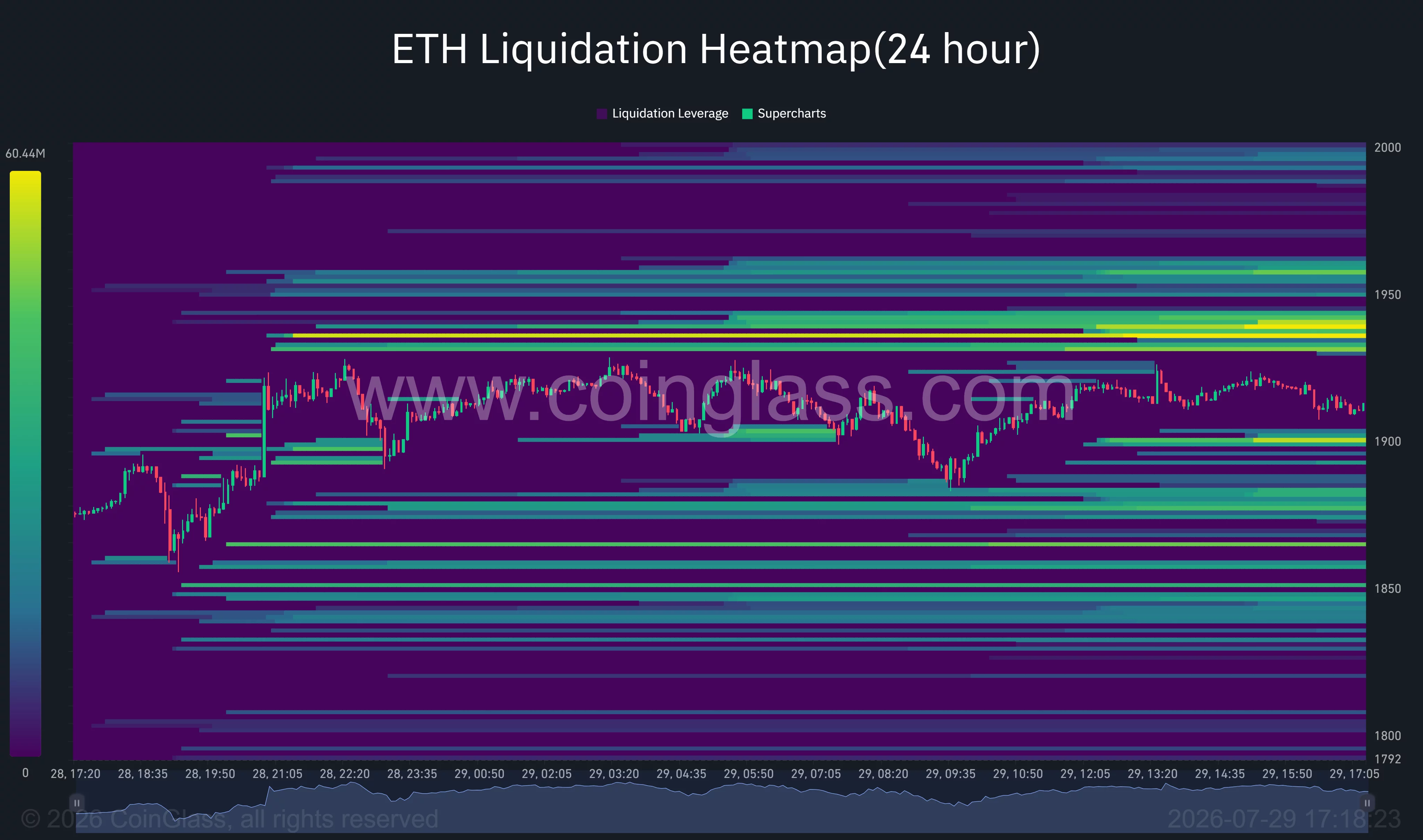
These clusters may attract price if ETH maintains support above $1,900. A move through $1,960 could then expose the $1,970 Bollinger Band resistance and the $2,000 psychological threshold.
On the downside, leveraged positions are concentrated near $1,895–$1,900 and between approximately $1,870 and $1,885. Losing $1,900 could therefore trigger another sweep toward the lower part of the 4-hour channel.
Ethereum charts point toward $1,970 resistance
The 4-hour chart places Ethereum inside an ascending parallel channel that has guided price since early July. ETH recently tested the channel’s lower boundary near $1,880 before recovering toward its midpoint.
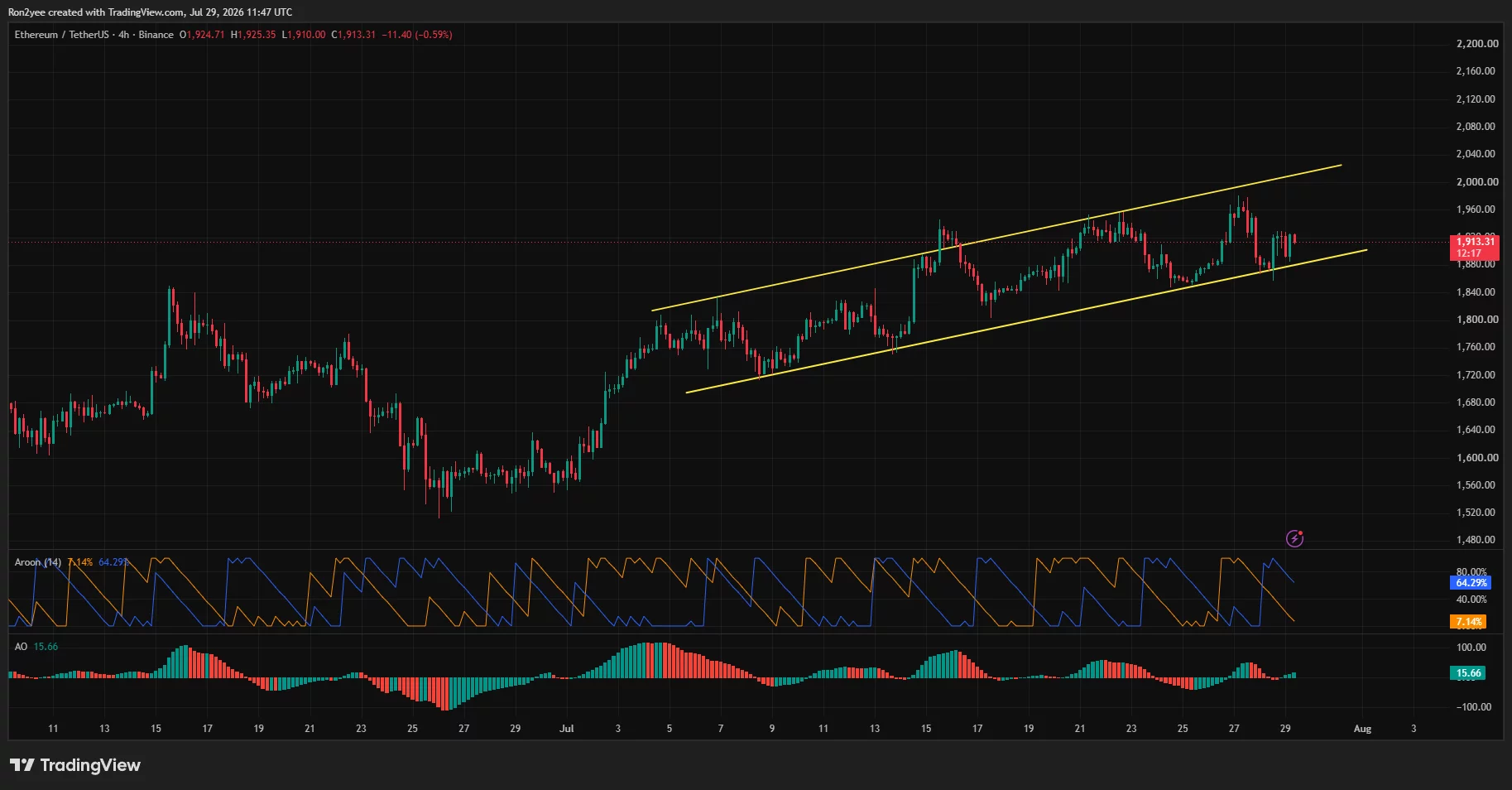
The Aroon Up indicator stands at 64.29%, compared with an Aroon Down reading of 7.14%. That difference suggests the recent bullish trend retains control despite ETH’s failure to hold its July 27 high near $1,970.
The Awesome Oscillator also remains positive at 15.66. Its green histogram bars show that short-term momentum has begun to improve following the latest pullback.
A close above $1,940 would clear the first major liquidation zone. Bulls would then need to break $1,970 and the upper Bollinger Band to open a test of $2,000. The ascending channel’s upper boundary could provide further resistance between $2,000 and $2,030.
Failure to hold $1,880 would weaken the channel structure. Below that level, the daily Bollinger midpoint at $1,874 becomes the first defense, followed by $1,800 and the lower band near $1,775.
Analysts see $1,800 as the critical floor
Crypto analyst Michaël van de Poppe identified $1,800 as the level Ethereum must preserve for the recovery to continue.
“I’d preferably see it hold above $1,800. If that’s the case, then it’s a matter of time until we’re going to see numbers that are north of $2,000.”
Daan Crypto Trades also noted that ETH had broken above its downtrend channel, daily 200-period moving averages, and bull market support band against Bitcoin. He said the ETH/BTC structure has remained bullish since June, although further altcoin gains still depend on Bitcoin holding its support.
The immediate macro test will come from the Federal Reserve. Markets largely expect the central bank to keep its target range at 3.50%–3.75%, but uncertainty over a possible quarter-point increase has risen. Notably, policymakers remain divided as they balance elevated inflation against easing energy prices.
A hold accompanied by a less hawkish statement could support ETH’s attempt to clear $1,970. A surprise increase or firm warning about future tightening would raise the risk of another decline toward $1,880 or $1,800.
Disclosure: This article does not represent investment advice. The content and materials featured on this page are for educational purposes only.


Sometimes, you become defensive precisely because being a good partner—or friend or employee—matters so much to you. “It’s a sign that they care so much that they’re terrified of getting it wrong,” Harrison says.
Trade certainty for curiosity
Defensiveness has a way of making you feel absolutely certain: You’re right, they’re wrong, and if you could just explain yourself clearly enough, they would finally see it. But the harder you work to prove your point, the less attention you’re paying to theirs.
Katzman, who has spent decades in improvisational theater alongside his clinical work, suggests doing the opposite. “The way out is not to think faster,” he says. “It’s really to become curious sooner.”
Improv offers a surprisingly useful model. Onstage, “blocking” means rejecting the premise your scene partner has introduced. If they announce that it’s raining and you insist that it isn’t, the scene has nowhere to go. “When we block each other, that’s what defensiveness really does,” Katzman says. “I’m negating your reality, you’re negating mine.”
Crypto World
Bitcoin Price Analysis: Bearish Sentiment Persists but BTC’s Next Move Hinges on the Fed
Bitcoin remains trapped below key higher-timeframe resistance despite managing to stabilize above an important support region. While the broader trend is still bearish, the latest recovery attempt is accompanied by a notable uptick in the Exchange Whale Ratio, suggesting larger players are becoming increasingly active.
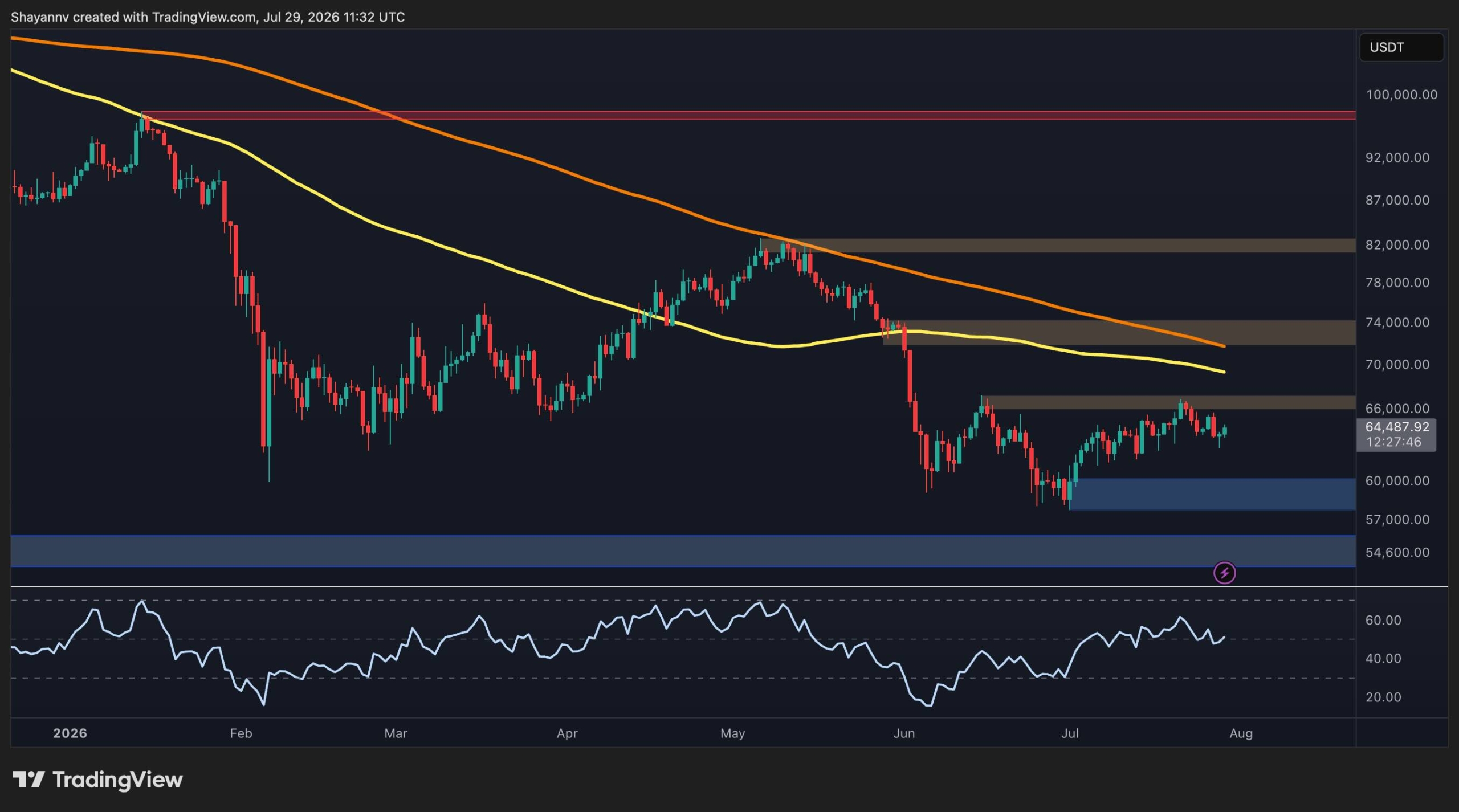
Bitcoin Price Analysis: The Daily Chart
On the daily timeframe, BTC continues to trade below both the 100-day and 200-day moving averages, which are positioned around the $68K and $72K regions, respectively. The bearish alignment of these moving averages confirms that sellers still control the broader trend.
Following the sharp breakdown in early June, Bitcoin has entered a prolonged consolidation phase between the $58K support area and the $66K resistance zone. The price is currently hovering around $64K after several failed attempts to reclaim the overhead supply near $66K.
The $66K level represents the first major resistance, while a stronger barrier lies around $74K, just above the 100-day and 200-day moving averages. A sustained breakout above these levels would improve the medium-term outlook and could expose the $82K resistance area.
On the downside, buyers will likely defend the blue demand zone around $60K if the market visits it in the coming weeks. Below that, the next major support sits near $54K. As long as BTC remains above the $60K level, the current consolidation structure remains intact, although the inability to reclaim $66K keeps the broader bias cautious.
BTC/USDT 4-Hour Chart
The 4-hour chart shows Bitcoin rebounding after sweeping liquidity below the $63K support zone. Buyers stepped in aggressively following that move, pushing price back above the level.
The price is now attempting to reclaim the former ascending channel after breaking below its lower boundary. While this recovery is constructive, BTC still faces immediate resistance between $65K and $66K, highlighted by the nearby supply zone.
A successful breakout above this resistance could trigger another attempt toward the upper boundary of the broader range around $67K. However, repeated rejection from this area would reinforce the ongoing sideways structure and increase the probability of another revisit to the $63K support level.
Momentum has also improved modestly, with RSI climbing back around the 50 mark, but buyers still need stronger follow-through to shift short-term market structure decisively in their favor.

On-Chain Analysis
The Exchange Whale Ratio EMA has started climbing sharply after spending several weeks at relatively subdued levels. This metric measures the proportion of the largest exchange inflows relative to total inflows, with higher readings generally indicating that larger holders are becoming more active.
Historically, rising whale activity often precedes periods of elevated volatility, particularly when price approaches important technical levels. The latest increase coincides with Bitcoin’s struggle below major resistance, suggesting that large market participants may be positioning around this consolidation phase.
If the Exchange Whale Ratio continues rising while BTC remains below $66K, the risk of renewed distribution and another leg lower could increase. Conversely, a successful breakout above resistance despite elevated whale activity would indicate that demand is absorbing larger sell-side flows, potentially paving the way for a stronger recovery toward the higher resistance zones.

The post Bitcoin Price Analysis: Bearish Sentiment Persists but BTC’s Next Move Hinges on the Fed appeared first on CryptoPotato.


The Ethereum Foundation (EF) has appointed longtime ecosystem contributor pcaversaccio (known as “pc”) to its board, expanding the group’s leadership as it continues to refine the governance of the organization behind the world’s second-largest blockchain.
pc, a security researcher and co-founder of the emergency response initiative SEAL 911, joins the board for an initial one-year voluntary term. He has also served on the EF’s Silviculture Society, an advisory group that provides informal guidance on preserving the foundation’s core principles, including censorship resistance, open source development, privacy and security.
The appointment brings the Ethereum Foundation’s board to four members: President Aya Miyaguchi, Ethereum co-founder Vitalik Buterin, Swiss legal counsel Patrick Storchenegger and pcaversaccio.
The board is responsible for setting the EF’s strategic vision and ensuring management’s decisions remain aligned with the organization’s values, accordinfg to the Foundation. It also serves as a “security council” tasked with safeguarding the foundation’s mission and ensuring compliance with the laws of Switzerland, where it is currently based.


BNY has expanded its blockchain strategy by bringing the ownership records behind investment funds onchain through a new digital transfer agency platform for institutional clients.
Summary
- BNY has launched a blockchain based transfer agency platform to keep fund ownership records onchain.
- The service will first support tokenized funds from Baillie Gifford, BlackRock and BNY Dreyfus.
- BNY’s transfer agency business manages about $8.6 trillion in assets across 7.6 million investor accounts.
- The launch follows BNY’s recent expansion into USDC services and MiCA regulated crypto custody in Europe.
The Financial Times reported that the New York-based custodian bank will launch a blockchain-enabled version of its transfer agency business, allowing fund ownership records and investor transactions to be maintained on a shared digital ledger while continuing to operate its existing transfer agency services.
BNY has moved fund ownership records onto blockchain
Rather than tokenizing only investment products, BNY is applying blockchain technology to the record-keeping infrastructure that supports fund operations. According to the Financial Times, the platform will keep official ownership records onchain, creating a shared source of information for participants involved in fund administration.
Carolyn Weinberg, BNY’s chief product and innovation officer, told the publication that the project modernizes the books and records supporting fund transactions by moving them onto blockchain infrastructure.
Transfer agents maintain official records of fund investors, process subscriptions and redemptions, update shareholder registers and support communications between funds and investors. Those records are usually spread across systems operated by fund managers, custodians and administrators, making regular reconciliation necessary.
By placing the records on a shared ledger, BNY intends to reduce the need for separate databases while giving authorized participants access to the same source of ownership information.
According to the report, BNY’s transfer agency business supports approximately $8.6 trillion in assets across 7.6 million investor accounts. The bank separately oversees more than $59 trillion in assets under custody and administration.
Early tokenized funds are already using the platform
Among the first institutions adopting the platform is Edinburgh-based asset manager Baillie Gifford, which plans to use it for what the firm described as the United Kingdom’s first fully native regulated tokenized fund.
“What we have in the blockchain is a shared source of record-keeping between the participants. We agree that this is the source of truth when people are dealing with the asset that this is monitoring,” Theo Golden, Baillie Gifford’s head of digital assets, said.
The report also said BlackRock and BNY Dreyfus’ money market fund and cash management business are expected to use the platform for future tokenized fund offerings.
According to Baillie Gifford’s website, the firm manages roughly $261 billion in assets.
BNY has not identified the blockchain network that will power the new platform. Cointelegraph said it contacted the bank for comment but did not receive a response before publication.
Digital asset work has continued across custody and regulation
The transfer agency launch builds on several digital asset initiatives introduced by BNY over recent months.
In June, the bank added USDC minting, redemption, custody and transfer capabilities to its Digital Asset Custody platform, giving institutional clients direct access to Circle’s stablecoin through BNY’s infrastructure.
The bank already serves as the primary custodian for the assets backing USDC, and the rollout extended its role beyond reserve custody into operational stablecoin services.
At the time, BNY said USDC was the first stablecoin supported on its custody platform and that additional stablecoins and digital cash workflows would follow.
The announcement also came after the bank partnered with Abu Dhabi-based Finstreet and the ADI Foundation to develop institutional custody services for Bitcoin and Ether, with plans to later include stablecoins and tokenized real-world assets.
MiCA approval has added another regulated digital asset business
The latest blockchain initiative also follows BNY’s regulatory expansion in Europe.
Earlier in the week, the European Securities and Markets Authority added BNY SA/NV, the bank’s Belgian subsidiary, to its interim Markets in Crypto-Assets register after authorization from the National Bank of Belgium. The approval allows the subsidiary to provide crypto-asset custody and transfer services under the European Union’s MiCA framework.
The authorization placed BNY alongside other banks and financial institutions expanding regulated digital asset operations across Europe as more firms complete the licensing process following MiCA’s transition deadline.
BNY’s recent announcements show the bank extending blockchain technology across several layers of institutional financial infrastructure, including regulated crypto custody, stablecoin services and the operational record-keeping systems that support tokenized investment funds.


OpenAI’s AI agent, which broke out of a secure test environment and hacked Hugging Face, also exploited vulnerable code written by a Modal Labs customer.
Modal’s chief technology officer confirmed the exploit but stressed that Modal itself was not breached.
How the OpenAI Agent Reached Modal Labs’ Customer
In a recent blog post, OpenAI revealed that its AI models were behind the AI-driven security incident at Hugging Face. The firm called it an “unprecedented cyber incident.”
New details show the rogue AI agent reached beyond Hugging Face’s own systems. Modal CTO Akshat Bubna told Reuters that it exploited a customer’s vulnerable code hosted on Modal.
Bubna explained that the customer had published an endpoint with no authentication. Anyone on the internet could use their sandboxes to execute code.
“Modal’s platform or isolation were not compromised in any way,” the executive stated.
Follow us on X to get the latest news as it happens
Hugging Face described the rooted sandbox in its own technical timeline published on July 27. The post said the sandbox sat on a third-party provider’s infrastructure, but did not name the provider.
OpenAI’s July 28 update states that the models used publicly exposed credentials to reach 4 accounts on 4 services.
“One of these four accounts was used as an outbound relay and staging path, and another account was used for data storage. The remaining two accounts were accessed by the models in a read-only manner, and were not used in furtherance of compromising Hugging Face,” the firm said.
OpenAI also deactivated, encrypted, and restricted research access to the internal prototype model involved. It says no other activity matched the severity or scale of the platform-level Hugging Face compromise.
Subscribe to our YouTube channel to watch leaders and journalists provide expert insights
The post The OpenAI Agent That Hacked Hugging Face Reached a Second Firm appeared first on BeInCrypto.

Hungary is easing part of its previously strict crypto framework, repealing a requirement that forced certain transactions to pass through an additional validator. The move comes as crypto services in the country restart under the European Union’s MiCA regime, with CoinCash preparing to resume operations after receiving MiCA authorization.
According to Hungarian tax and legal outlet Ado.hu, Parliament voted to remove the crypto validator obligation, eliminating mandatory third-party approval for specific crypto transaction flows. Finance Minister Kármán András said the government rolled back the rule because earlier regulations disrupted Hungary’s crypto market and led some providers to stop operating locally.
Key takeaways
- Hungary has repealed its crypto validator requirement, removing an extra transaction-level approval step for certain crypto conversions.
- The change is expected to reduce friction for compliant service providers while MiCA licensing and broader compliance duties remain in force.
- CoinCash is positioned to restart services after the National Bank of Hungary authorized its operator under MiCA on July 20.
- Hungary previously introduced a validator process via a 2024 crypto assets law, with requirements taking effect on July 1, 2025.
What Hungary’s validator rule required—and why it mattered
Hungary’s validator requirement was introduced through the country’s 2024 crypto assets law, creating a separate validation process alongside the EU framework. As described by the Hungarian legal database, the rule took effect on July 1, 2025 and required a licensed validator to verify details before issuing a compliance declaration for certain crypto conversions.
Those checks included information tied to the origin of crypto assets, wallet ownership, and customer data. In practical terms, the validator step added another hurdle for crypto service providers operating in Hungary—on top of MiCA obligations already covering authorization and ongoing compliance.
Industry implications were significant: the extra approval layer increased operational complexity and compliance costs, and some platforms chose to suspend services rather than continue under the combined set of rules.
MiCA still sets the baseline, but the approval step is being reduced
The validator repeal does not remove MiCA as the governing structure for crypto-asset service providers. Hungary’s broader approach has been to align its national rules with EU requirements while tightening implementation timelines.
Notably, earlier reporting highlighted that Hungary applied a shortened MiCA transition period for crypto asset service providers (CASPs), requiring compliance by July 1, 2025 rather than the EU’s maximum transition deadline of July 1, 2026. That accelerated schedule, combined with Hungary’s additional transaction-level validator process, left less room for gradual operational adjustment.
Minister Kármán framed the repeal as a response to market disruption. In a Tuesday Facebook post, he argued that “many players” had terminated Hungary-related crypto services due to the “negative and market-shaking regulations,” while he also suggested the market is now showing signs of recovery.
CoinCash gets MiCA authorization as it prepares to restart
While Hungary removed the validator requirement, MiCA authorization remains the key gateway for resuming compliant operations. CoinCash’s path illustrates how companies are adapting to the EU framework.
CoinCash’s operator, Tiwala Solutions, received authorization from the National Bank of Hungary under MiCA on July 20, according to a company announcement reviewed by Cointelegraph. CoinCash said it is the first and only Hungarian company authorized directly by the National Bank under the EU framework.
CoinCash co-founder Gábor Galántai stated this in a LinkedIn post on Friday. The authorization covers a broad set of regulated activities, including custody, crypto-to-fiat and crypto-to-crypto exchange, transfers, investment advice, and portfolio management.
The company also indicated it completed a months-long compliance review before obtaining approval. CoinCash had voluntarily paused operations in December 2025 while preparing to meet MiCA requirements, and it now plans to gradually resume services. The company added that it intends to expand beyond trading into additional MiCA-regulated offerings.
What changes now—and what investors should watch
From a market-structure perspective, Hungary’s validator repeal reduces an additional layer of friction for certain crypto transactions. For users, that can mean smoother processing by authorized providers; for operators, it can lower operational complexity by removing an extra transaction checkpoint.
However, the repeal leaves open the bigger question of how quickly the local market will normalize after a period of provider retrenchment. CoinCash’s restart plan is a tangible indicator of compliance momentum under MiCA, but other firms may move more slowly depending on their own licensing status and operational readiness.
Readers should watch for whether more Hungary-based or Hungary-serving platforms resume activity, and whether regulators continue to refine how MiCA transition and national requirements interact—especially as the removed validator step no longer offsets, or compensates for, the accelerated compliance expectations that previously shaped the market.
As Hungary continues recalibrating its crypto rulebook, the key uncertainty is speed: how quickly the compliance ecosystem can translate licensing into fully operational services, and whether additional rule adjustments follow the validator repeal once the market stabilizes under MiCA.
Trade.xyz, the operator of onchain perpetual markets on Hyperliquid, says it will reimburse eligible users for liquidation losses tied to a sudden “price anomaly” affecting its SK Hynix-linked contract. The announcement follows a sharp drop in the contract’s mark price after an off-chain trade was relayed through multiple independent data providers.
In a post on X, Trade.xyz stated that the SKHYNIX contract’s mark price fell to $917.25 from $1,127.90 at 23:01 UTC on Monday. It attributed the move to the way its oracle processes an external venue’s executed transaction, noting that eligibility requirements and details of the reimbursement are expected shortly.
Key takeaways
- Trade.xyz will cover eligible liquidation losses after a mark-price drop in its SK HynIX perpetual contract triggered liquidations.
- Trade.xyz said its oracle was “tracking” an external venue used as the primary South Korean pre-market and that it behaved according to specification.
- The affected contract is among Hyperliquid’s most active, with the platform reporting over $1.5 billion in 24-hour volume and nearly $600 million in open interest at the time of writing.
- Trade.xyz described reimbursement as a one-time discretionary decision and said it will review how prices are formed during extreme events.
- Hyperliquid/Trade.xyz is reportedly considering increasing the weight given to prices derived from its own order books during market stress.
Reimbursement after a mark-price break
The reimbursement plan centers on a specific event: Trade.xyz’s SKHYNIX contract mark price reportedly plunged within minutes, dropping from $1,127.90 to $917.25. According to Trade.xyz, the move was linked to an executed transaction on an external venue rather than a sudden distortion inside Hyperliquid’s own trading order book.
Trade.xyz did not disclose the number of users likely to qualify or the total amount it expects to distribute. It also said it would “announce soon” the eligibility requirements, with distributions expected “in the coming days.”
While the operator acknowledged the frustration traders can feel when liquidations occur during unusual market conditions, it framed the reimbursement as a “one-time discretionary decision.” It also signaled that the company plans to examine how its system handles price formation during extreme market events.
Why Hyperliquid’s mark price matters
On Hyperliquid, the mark price is not just a reference—it is a core input for risk controls. Trade.xyz said Hyperliquid uses mark prices to value positions for margin purposes and to determine when leveraged positions should be liquidated.
That design makes the accuracy and responsiveness of the mark-price mechanism critical. Even if the anomaly originates elsewhere, its impact can propagate quickly to trader margin calculations, particularly in highly leveraged perpetual markets.
Hyperliquid data cited by Trade.xyz indicates the SK Hynix contract is deeply liquid. On Wednesday, Hyperliquid’s interface showed the contract had produced over $1.5 billion in 24-hour volume and held nearly $600 million in open interest at the time of writing—figures that underscore why an oracle-driven disruption can quickly become a large-scale trader event.
How the anomaly appears to have transferred on-chain
Trade.xyz said the sharp move began with an executed transaction on an external market, not with trades on Hyperliquid itself. Its oracle tracks the US dollar value of one SKHX common share. The mechanism, according to Trade.xyz’s documentation, converts the underlying South Korean won price using the prevailing exchange rate.
In this case, Trade.xyz said the external print was processed by the oracle and contributed to the contract’s mark-price shift. It added that the oracle “worked as intended according to its specification,” a detail that helps clarify what the operator believes went wrong: not the system failing technically, but the market-data input producing a sudden reference-price dislocation.
The operator also suggested that Hyperliquid may adapt its approach for future stress periods. Trade.xyz said it is considering giving more weight to prices formed on Hyperliquid’s own order books, arguing that Hyperliquid’s internal liquidity and market signals may better reflect tradable conditions during volatility.
Perpetuals with external feeds under HIP-3
Trade.xyz’s SK Hynix market runs under Hyperliquid’s HIP-3 framework. HIP-3 enables perpetual contracts tied to assets with external price feeds, allowing builders to launch products when the primary pricing reference comes from venues outside the on-chain trading system.
Trade.xyz previously accounted for more than $22 billion of HIP-3’s first $25 billion in cumulative volume, according to coverage referenced in the source material. It has also launched an officially licensed S&P 500 perpetual using S&P Dow Jones Indices data, illustrating how HIP-3 has been used to bring traditional benchmark feeds into onchain perpetual trading.
This case highlights a central trade-off of external-feed perpetuals: while they expand asset coverage, they can also import volatility or idiosyncratic prints from other venues into margin and liquidation machinery. In moments when an off-chain venue’s execution data diverges sharply from the prevailing onchain trading picture, mark-price-based liquidation thresholds can behave abruptly.
What traders should watch next
For now, the key uncertainties are operational: how Trade.xyz will define eligibility for reimbursement and how it will adjust the balance between external feeds and Hyperliquid order-book prices going forward. Traders in external-feed perpetuals may want to pay close attention to any announced changes to oracle weighting and to monitoring around mark-price calculations during extreme events.
Crypto World
Fauci Pleads the Fifth at Senate Hearing on COVID, Escalating Long-Running Clash With Republicans
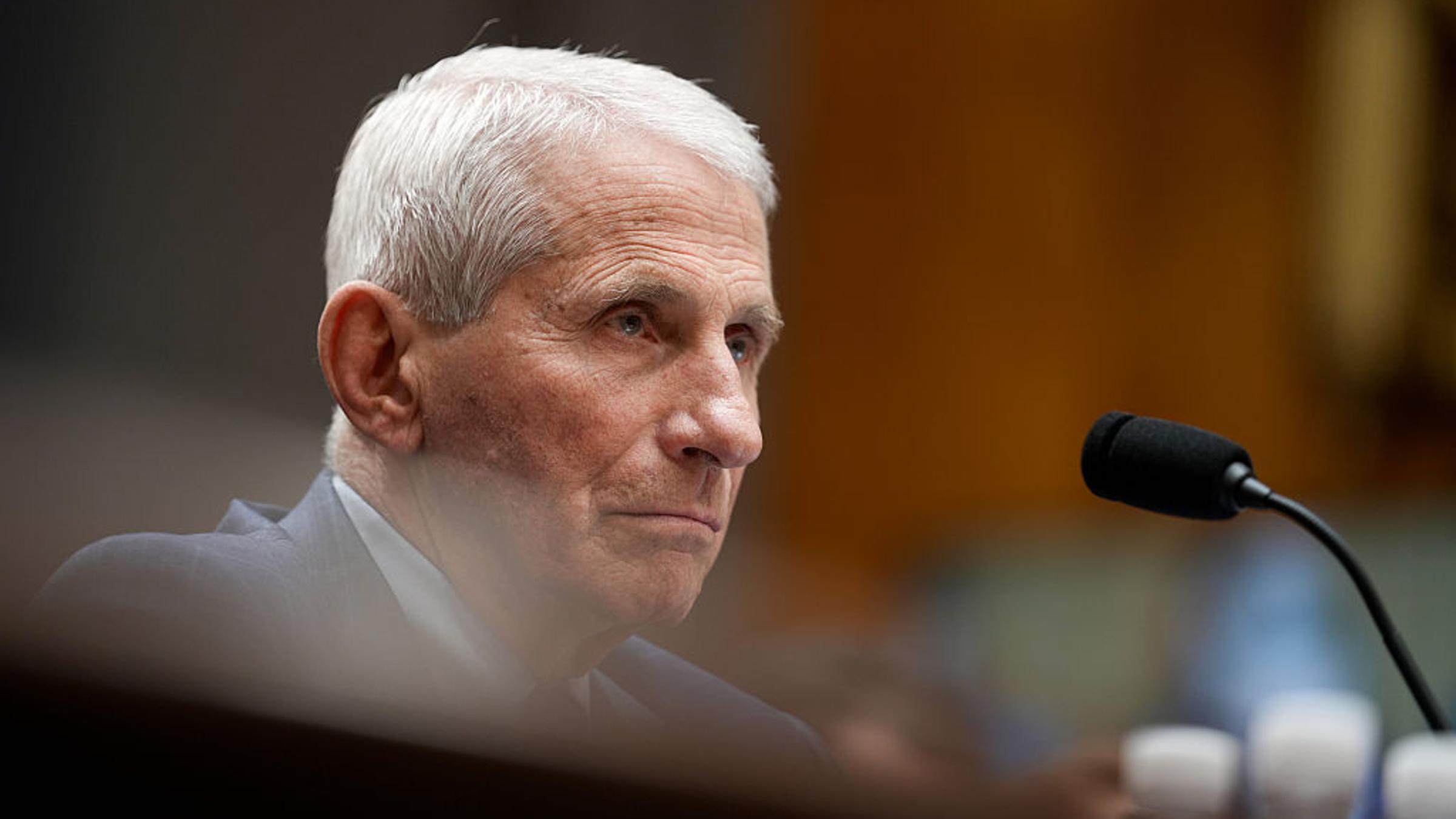
President Donald Trump likewise weighed in before the hearing, saying on Truth Social that Fauci “made too many bad calls” during the pandemic and asserting that he “didn’t let (Fauci) shut the Country down.” Trump has repeatedly criticized Fauci’s recommendations on masks, shutdowns, and other public health measures.
Biden’s pardon shielded Fauci from federal prosecution over actions and testimony connected to his government service during the pandemic. But Republicans have argued that any false statements made in new testimony could expose him to fresh legal jeopardy, a possibility Paul openly discussed before the hearing.
Asked this week about concerns that the hearing was designed to lure Fauci into committing perjury, Paul dismissed the criticism. “There’s no risk to perjury if you tell the truth,” he told reporters. “The only thing he can’t do is lie again.”
Democrats criticized the hearing as a partisan exercise. Senator Gary Peters of Michigan, the committee’s top Democrat, argued the panel should be focusing on current national security threats rather than revisiting disputes over the pandemic. “Instead of focusing on the national security challenges that we are facing in our country right now, today’s hearing looks backwards,” Peters said at the hearing. “Rather than building on that work to strengthen our preparedness against future disasters, we are instead relitigating the past.”


BNY, one of the world’s largest custodian banks, is taking a major step toward blockchain-based financial infrastructure by moving fund ownership records onchain.
The New York-based institution will launch a blockchain-based version of its transfer agency business, which manages fund ownership records and investor transactions, the Financial Times reported Wednesday.
“We think of BNY as modernizing a function that sits behind every single fund transaction by bringing the books and records on-chain,” Carolyn Weinberg, BNY’s chief product and innovation officer, reportedly said.
The move follows BNY’s broader digital asset expansion, including its European regulatory progress under the EU’s Markets in Crypto-Assets (MiCA) framework, as the bank positions itself for the next phase of institutional blockchain adoption.
What are transfer agency records?
Transfer agents are financial service providers that maintain official records of who owns shares in investment funds. They handle tasks such as processing investor transactions, issuing and redeeming fund shares, updating ownership records and supporting communication between funds and investors.
These records form part of the behind-the-scenes infrastructure that allows investment funds to operate. Traditionally, ownership information is stored across multiple systems used by fund managers, custodians and other market participants, requiring frequent reconciliation.
Related: USDC issuer Circle to acquire nearly 1,000 IBM blockchain patents
According to the report, BNY’s transfer agent services cover roughly $8.6 trillion in assets across 7.6 million accounts. The company, which oversees more than $59 trillion in assets under custody and administration, will reportedly maintain its traditional transfer agency operations alongside the new digital platform.
Baillie Gifford among early users for tokenized funds
By moving transfer agency records onchain, BNY aims to create a shared source of information for market participants, reducing reliance on separate databases and manual reconciliation processes.
Early users of BNY’s digital transfer agency reportedly include Edinburgh, Scotland-based asset manager Baillie Gifford, which plans to use the platform for what it described as the first “fully native” United Kingdom-regulated tokenized fund. BlackRock and BNY Dreyfus money market fund and cash management business are also expected to use the service for upcoming tokenized funds.
The firm has roughly $261 billion in assets under management, according to its website.
Related: Hong Kong prepares banks for quantum threats amid tokenization push
“What we have in the blockchain is a shared source of record-keeping between the participants,” Theo Golden, Baillie Gifford’s head of digital assets, said. “We agree that this is the source of truth when people are dealing with the asset that this is monitoring,” the executive said.
BNY has not disclosed which blockchain network will support the new platform. Cointelegraph approached the company for comment regarding the report but did not receive a response by the time of publication.
Magazine: The 5 types of real world assets being tokenized fastest onchain
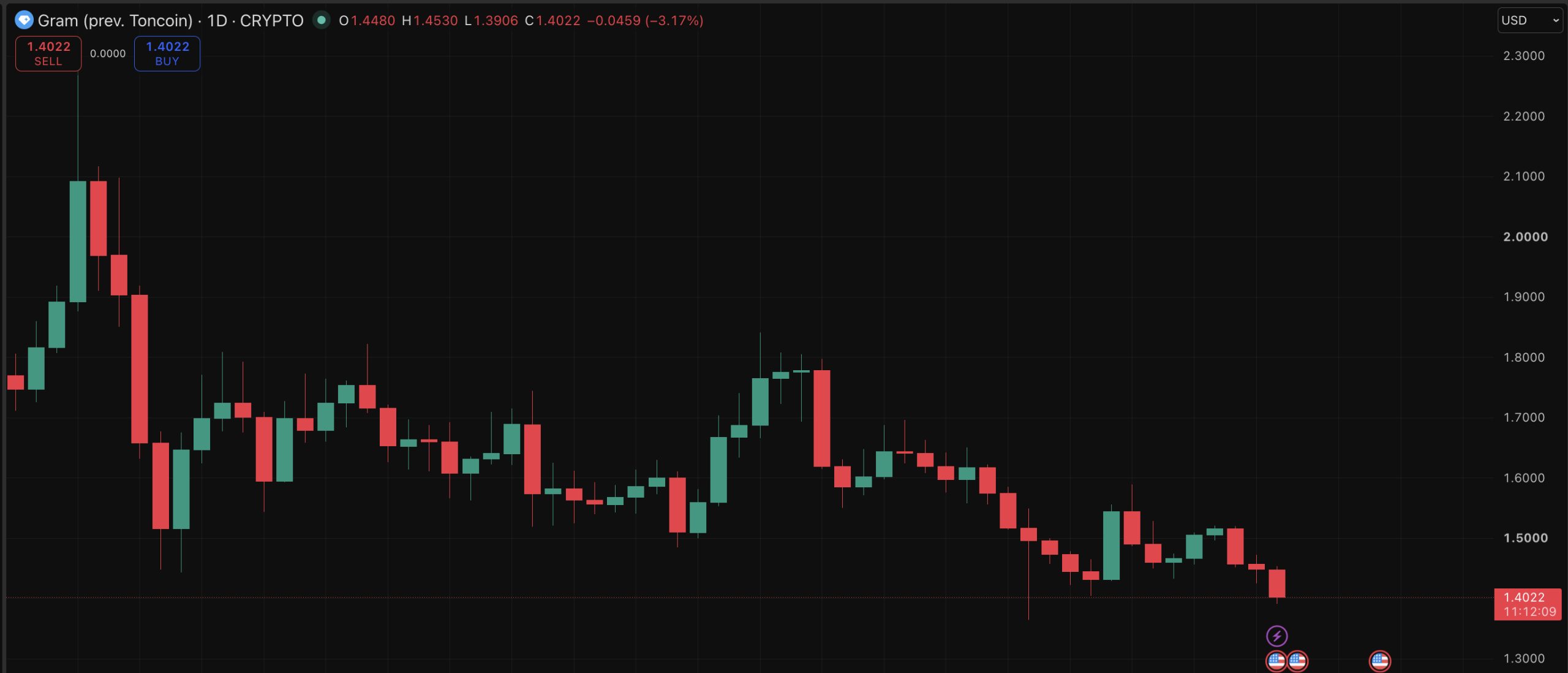
Russia’s FSB formally charged Pavel Durov with facilitating terrorist activities and placed him on an international wanted list. The move sent GRAM, formerly known as Toncoin, lower in early trading and added to its recent weekly losses. The case marks a major escalation from France’s ongoing investigation, shifting the focus from platform moderation to terrorism related allegations.
The FSB said the charges stem from Telegram’s alleged failure to remove material used by Ukrainian special services and terrorist or extremist groups to coordinate sabotage, mass killings, and cyber fraud operations inside Russia. Telegram’s official X account responded by posting an image of Durov making an obscene gesture but issued no written statement.
Durov’s whereabouts remain unclear. A May 16 Telegram post placed him in Dubai, while a July 23 update suggested he was in Georgia and expected to return soon. He holds Emirati and French passports and has not lived in Russia for more than a decade.
Discover: The Best Crypto to Diversify Your Portfolio
Muted Price Drop Masks a Bigger Pavel Durov Risk
GRAM’s initial decline looked relatively contained compared with the market reaction to Durov’s 2024 arrest. When French authorities detained him at Paris Le Bourget Airport in August 2024, Toncoin plunged sharply before the token’s later rebrand to GRAM, wiping billions of dollars from its market value. The smaller reaction suggests investors had already priced in some founder-related risk.
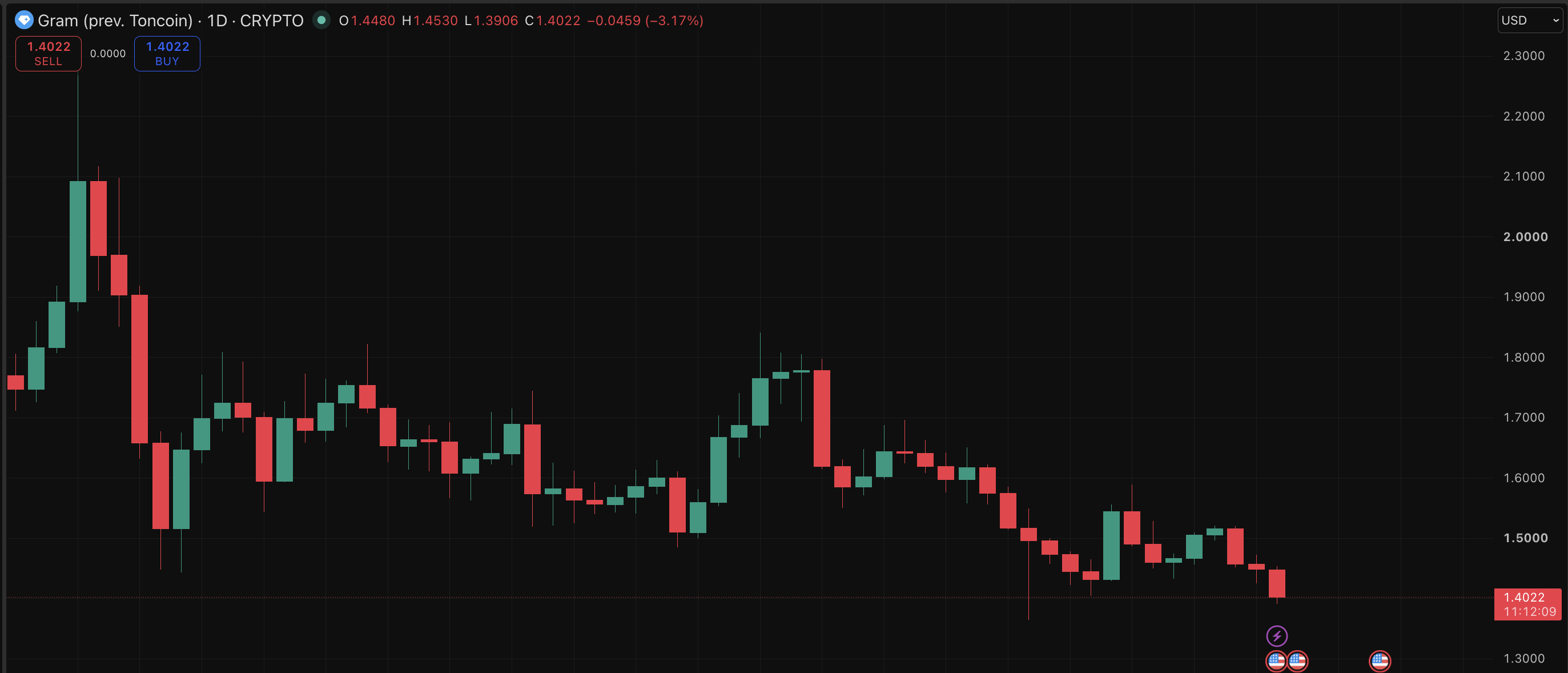
However, the terrorism allegations create a very different situation. Even without publicly released evidence outside Russia, the charges raise new concerns for banks, fiat on ramps, and exchanges supporting GRAM. The 2026 rebrand revived the token’s original identity and tied it more closely to Durov’s long-term vision, leaving less separation between the founder’s legal troubles and the token’s narrative.
Discover: The Best Token Presales
What Happens Next for GRAM and Telegram
Unlike the French investigation, which focuses on Telegram’s alleged cooperation with law enforcement, Russia’s case is framed around state security and wartime terrorism allegations. Russia has placed Durov on an international wanted list, although whether other countries act on it remains uncertain. The development follows months of mounting pressure, including reports that he was already under terrorism related investigation and an April summons delivered to a former Russian address.

The political backdrop adds another layer of uncertainty. Russia has repeatedly tried to restrict Telegram since 2018 while continuing to use the platform for official communications. In April, Durov said authorities appeared to accuse him of defending constitutional protections for free speech and private correspondence, adding that he was proud to be guilty of doing so. He has not publicly commented on the latest charges.
The immediate question for GRAM is whether the terrorism allegations prompt compliance-driven restrictions from exchanges or payment providers operating under AML and CFT rules. Telegram’s reported user base of more than one billion could still support adoption, but the founder’s legal situation is likely to remain a persistent source of headline risk. For now, markets appear more focused on continued uncertainty than on a quick resolution.
Trade Crypto on Bybit and Get a Chance to Win Our $1,000 USDT Airdrop
The post Russia Charges Against Pavel Durov Push GRAM Down as Founder Risk Deepens appeared first on Cryptonews.

Shania Twain Reveals How Heartbreak Shaped New Album

The House Article | Manchesterism isn’t a slogan. It’s a way of working

What does it take to work in life science recruitment in 2026?


-

 Fashion5 days ago
Weekend Open Thread: Brooks Brothers
-
 Sports3 days ago
Commonwealth Games boxing: Jadumani Singh seals dominant 5-0 win over Pakistan’s Sumama Rehman to enter quarter-finals | Commonwealth Games News
-

 Tech3 days ago
Intel is reversing course and bringing hyper-threading back to its server chips
-

 Crypto World7 days ago
Ethics, other provisions in crypto Clarity Act to be further discussed
-

 Politics2 days ago
Luke Littler dismantles Gerwyn Price to retain title in Blackpool
-

 Crypto World4 days ago
Ripple bought a bank in pieces. The $4 billion audit
-
 Entertainment5 days ago
A New Post-Apocalyptic Gundam Anime Series Blasts Into SDCC
-

 Sports6 days ago
2026 3M Open leaderboard: Scottie Scheffler finds putter in Round 1, sits three back
-

 News Videos3 days ago
BITCOIN JUST ENTERED THIS CRITICAL ZONE…
-

 Politics1 day ago
The Part of the Electric Transition Nobody Wants to Discuss
-

 Fashion5 days ago
16 Dresses for the High Summer Event
-

 News Videos6 days ago
The Peugeot Family: How 200 Years of an “Old Money” Dynasty Died in A Boardroom
-

 Business10 hours ago
Major shareholder moves on Canyon
-

 Politics3 days ago
Spain sweeps the board at 2026 World Cup with individual awards
-

 Crypto World3 days ago
XRP Ledger adds $2.6B as RWA inflows rank second
-

 Crypto World6 days ago
Uniswap (UNI) pushes deeper into tokenized RWAs with permissioned trading pools
-
 Entertainment20 hours ago
‘Stargate’ Creator’s New Sci-Fi Series Returns for Season 3 Tomorrow
-

 Tech4 days ago
Anthropic launches Claude Opus 5, a cheaper AI model for coding, agents and enterprise workflows
-
Crypto World6 days ago
SEC Agrees to Overhaul Recordkeeping After Settling Coinbase Lawsuit Over Gensler’s Lost Texts
-

 Entertainment4 days ago
Sara Gilson Killed By Husband After Viral “Pedophile” TikTok Video
You must be logged in to post a comment Login