
Crypto World
Ethereum price stalls as retail selling offsets whale accumulation



Key takeaways
- Ethereum traded sideways as mixed on-chain activity reflected uncertainty among investors.
- Whale wallets holding 10,000–100,000 ETH accumulated a net 130,000 ETH over the past week.
- Smaller wallet cohorts collectively reduced their holdings by approximately 360,000 ETH.
Ethereum (ETH) continued trading sideways on Tuesday as whale accumulation was offset by selling among smaller wallet cohorts and subdued institutional demand.
On-chain indicators reflect mixed sentiment, with larger investors returning to accumulation while other holders reduce their exposure near break-even prices.
Ethereum whales accumulate 130,000 ETH
Wallets holding between 10,000 and 100,000 ETH added a net 130,000 ETH over the past week. The increase marked the cohort’s first significant inflow in almost three weeks.
The renewed whale accumulation suggests that some large investors view Ethereum’s current price range as an opportunity to increase their holdings.
However, selling among smaller investors outweighed those purchases, limiting ETH’s ability to establish a clear upward trend.
Wallets holding between 1,000 and 10,000 ETH reduced their combined balance by approximately 230,000 ETH after remaining relatively stable during the previous two weeks.
Investors holding between 100 and 1,000 ETH also sold roughly 130,000 ETH. This cohort has steadily reduced its Ethereum holdings throughout the year.
Together, the two groups recorded net outflows of approximately 360,000 ETH over the past week—nearly three times the amount accumulated by whale wallets.
Ethereum’s Spent Output Profit Ratio hovered between 0.98 and 1.01 during the past week.
SOPR measures whether recently transferred assets were moved at a profit or loss. A reading near one indicates that most investors sold close to their acquisition price.
The data suggests that many holders may be exiting Ethereum positions once prices return to break-even levels rather than waiting for a sustained recovery.
Ongoing geopolitical uncertainty and the Federal Reserve’s moderately hawkish position may be contributing to the cautious sentiment across financial markets.
Ethereum’s Exchange Netflow remains negative, meaning more ETH is still leaving exchanges than entering them. However, the indicator has risen from approximately -34,000 ETH to -4,000 ETH since mid-July.
Negative exchange flows are typically viewed as constructive because withdrawals reduce the amount of ETH immediately available for sale. The movement toward zero suggests that this bullish spot-market pressure is weakening, although only gradually.
The slowdown comes amid reports that the wider cryptocurrency market is experiencing some of its lowest trading volumes since November 2023. Weak activity indicates that investors remain reluctant to take a strong directional position.
Net Realized Losses also increased on Monday, suggesting that most ETH moved at the start of the week was transferred at a loss.ins Weak
Institutional demand for Ethereum remains subdued. US spot ETH exchange-traded funds attracted $27.42 million in net inflows last week.
However, the products returned to negative territory on Monday, recording combined net outflows of $11.42 million.
The reversal highlights inconsistent institutional demand and provides limited support for a sustained ETH price recovery.
Ethereum trapped between key moving averages
Ethereum recorded $17.77 million in liquidations over the past 24 hours, including $11.77 million in short positions.
On the daily chart, ETH remains trapped between the 50-day Exponential Moving Average at $1,851 and the 20-day EMA at $1,869. This narrow range reinforces the neutral short-term outlook.
The 100-day EMA at $1,931 and a previously broken ascending trend line near $1,948 present additional resistance.
The Relative Strength Index stands near 51, reflecting balanced momentum between buyers and sellers. Meanwhile, the Stochastic oscillator near 29 suggests momentum is stabilizing following the recent pullback rather than developing a decisive trend.
A daily close above the 20-day EMA at $1,869 could allow ETH to challenge the 100-day EMA at $1,931 and the former trend-line support near $1,948.
Further buying pressure could bring resistance at $1,961 into focus. A sustained breakout above this area would expose higher targets at $2,172 and $2,431.

On the downside, immediate support lies at the 50-day EMA of $1,851, followed by the horizontal level at $1,809.
A decisive break below $1,809 would weaken the neutral structure and could send ETH toward $1,701. More substantial selling pressure could expose the deeper support level at $1,507.


Binance-linked entities have filed a lawsuit in Hong Kong alleging that RedotPay, a Hong Kong-based cryptocurrency payments firm, diverted more than 470,000 users away from the Binance Card through activities they say were outside a commercial agreement. The plaintiffs are seeking nearly $473 million in damages.
The case, detailed in a Hong Kong court filing obtained by Bloomberg, is part of a broader push by Binance-affiliated companies to enforce terms tied to their card offering. Bloomberg reported the litigation may also intersect with RedotPay’s plans as it weighs a potential initial public offering.
Key takeaways
- Binance-affiliated plaintiffs say RedotPay enabled users to load RedotPay payment cards using Binance Pay outside the scope of their agreement.
- The complaint alleges diversion of more than 470,000 users from Binance Card and seeks about $472.8 million in damages.
- RedotPay says the lawsuit will not affect operations and plans to contest the claims.
- A related legal action is also underway in Singapore, where a hearing has been scheduled for Friday.
Hong Kong lawsuit targets alleged diversion of Binance Card users
According to Bloomberg’s report, Binance Holdings affiliates Nest Trading, DistributedTechnologies and Chaintecs Consulting Singapore filed the petition against RedotPay co-founders Gao Zhangpeng, Chan Wa Choi and Yao Chao. The filing centers on alleged breach of a commercial agreement governing RedotPay’s relationship with Binance Card.
The plaintiffs’ core allegation is that RedotPay permitted users to fund RedotPay stablecoin payment cards with Binance Pay in ways they claim were not authorized under the parties’ contract. In their lawsuit, Binance-affiliated entities argue this conduct resulted in substantial customer movement away from Binance Card and toward RedotPay’s own offering.
Damages claim hinges on lifetime customer value
The lawsuit seeks nearly $473 million. In Bloomberg’s account of the filing, the damages calculation is tied to Binance’s estimated lifetime customer value of $925 per user multiplied by the alleged user diversion figure of more than 470,000.
That approach suggests the plaintiffs are not merely pursuing damages for discrete transactions, but for the expected long-term value of a customer base they say was taken from their card product. For investors and market participants tracking crypto payments, the case signals how vigorously major counterparties are now quantifying commercial harm in custody- and payments-adjacent relationships.
Parallel litigation in Singapore adds pressure
Bloomberg further reports that Chaintecs filed a related lawsuit in Singapore. A hearing is scheduled for Friday, according to the court’s published hearing list.
Multiple jurisdictions can matter in crypto-related disputes because different courts may have varying views on contract interpretation, evidence standards, and the enforceability of certain remedies. For parties involved in cross-border payment ecosystems, the existence of parallel proceedings also raises the likelihood that the dispute will stay in the public spotlight longer than a single-country filing.
RedotPay pushes back, says operations will continue
In a statement posted on its website, RedotPay said the legal proceedings would not affect its operations and that it intends to contest the allegations. The company also indicated it would refrain from further comment while the matter is before the court.
“We are confident in our legal position, and are vigorously defending all claims. As the matter is currently before the court, RedotPay will not be commenting further on the allegations, the ongoing proceedings, or matters that will be addressed through the judicial process,” RedotPay said in its published response.
Binance did not provide operational commentary but, according to a spokesperson speaking to Cointelegraph, it would pursue legal options where necessary. The spokesperson said, “While Binance does not comment on ongoing litigation, where necessary we will use courts and other forums to pursue what is right.”
Why this dispute matters for card and payments users
This lawsuit is not just a contractual fight; it highlights the growing importance of compliance and channel controls in crypto card ecosystems. Allegations involving how users load funds—particularly through payment rails like Binance Pay—can directly affect user access, onboarding flows, and which provider ultimately captures transaction-driven value.
Even if the underlying contract is eventually interpreted narrowly, cases like this can influence how payment partners structure permissions, settle revenue-sharing, and document user attribution. Traders and builders watching crypto payments may also take note of how disputes are increasingly tied to quantified customer metrics, signaling a shift away from purely reputational arguments toward measurable economic damages.
As proceedings move forward in Hong Kong and Singapore, the key questions for readers will be what the courts find about the parties’ contract scope—especially whether Binance Pay funding to RedotPay cards fell within agreed boundaries—and how damages, if any, are calculated once the facts are established.

Leopold Aschenbrenner (L) and Bank of America CEO Brian Moynihan.
Photo: Josh Edelson (L) | Oscar Molina (R)
Bank of America CEO Brian Moynihan on Wednesday called the recent near-collapse of high-flying AI hedge fund Situational Awareness a warning shot for financial markets that are being fueled by elevated valuations and borrowed money.
Last week, Situational Awareness, led by Leopold Aschenbrenner, was forced to offload most of its public equities to Citadel in a fire sale as its bets on artificial intelligence soured. Bank of America was among the firm’s prime brokers, executing trades and providing leverage to the fund, along with Goldman Sachs and JPMorgan Chase.
“These are all warning shots,” Moynihan told CNBC’s Andrew Ross Sorkin. “Valuations get out, leverage in the system gets there. You have to be careful.”
Moynihan’s comments suggest Wall Street’s largest prime brokers are reexamining exposure to highly leveraged investment firms after the AI trade has fueled surging markets over the last several years, even as they continue competing aggressively to finance hedge funds.
“You always look and say, ‘OK, what happened? Should we learn from it? Should it change?’” Moynihan said. “And so the tendency is to tighten the underwriting standards, just a hair, to adjust — especially with big run-ups in stocks.”
Still, Bank of America would have been “fine” even absent the Citadel deal, which provided capital for Situational Awareness to pay off its banks, Moynihan said.

Senate Democrats have reached a clear internal consensus to vote against cloture on the CLARITY Act unless Republicans make visible progress on three unresolved disputes: ethics enforcement, illicit finance provisions, and stablecoin yield.
With the August recess beginning on August 7, Friday represents the last realistic window for a procedural vote, and the bill does not currently have the 60 votes required to advance.
Punchbowl News reporter Brendan Pedersen reported on August 4 that Democrats have coalesced around a firm position: without movement on ethics, illicit finance, and stablecoin yield, a Senate cloture vote this week on the CLARITY Act will fail.
Pedersen added that Democrats are not persuadable by crypto industry spending at this stage, a pointed signal that lobbying pressure has hit diminishing returns.
Republicans hold 53 Senate seats, but at least two GOP members are expected to oppose the bill on substantive grounds, narrowing the reliable base. That math forces leadership to find seven to nine Democratic crossover votes, a target that looks increasingly out of reach given where the caucus stands heading into the recess deadline.

Discover: Everyone’s Got a Take. Get Free $25 to Actually Trade Yours
Three Disputes Blocking the Clarity ACT 60-Vote Threshold
The ethics dispute centers on enforcement design: Democrats want state attorneys general empowered to sue the Department of Justice if it fails to enforce new conflict-of-interest rules covering the President, Vice President, Congress, and the federal judiciary.
Senators Thom Tillis and Ruben Gallego put forward a bipartisan counter-proposal along those lines, but as of August 3 the White House had not responded to it, leaving the compromise in limbo. Gallego has publicly framed Republican inaction as evidence that the majority may not actually want the bill to pass.
On illicit finance, critics – including the Wall Street Journal editorial board, argue that certain DeFi and innovation-exemption provisions could allow decentralized protocols to route payments outside standard Bank Secrecy Act coverage. The National Sheriffs’ Association has separately raised concerns about the BRCA developer-protection clause.
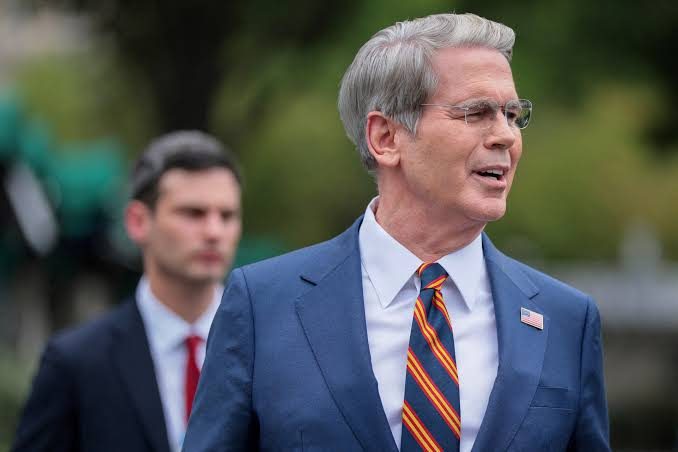
Treasury Secretary Scott Bessent has pushed back, arguing the bill simply codifies existing DOJ and Treasury policy on non-custodial builders, but that rebuttal has not moved Democratic vote-counters.
The stablecoin yield question adds a third friction point. Democrats and the WSJ editorial board have both flagged that certain bill language could allow stablecoin issuers to offer yield through exchange-reward structures, effectively circumventing the yield prohibition embedded in the GENIUS Act. That reads as a material financial-stability loophole to Democratic negotiators, not a technical drafting artifact.
For a detailed breakdown of how the 60-vote threshold and these three disputes interact procedurally, the arithmetic is unforgiving: even if cloture is filed on Wednesday, the earliest a formal floor vote occurs is Friday, and a successful cloture vote on the motion to proceed would still require additional procedural steps before any final passage vote, leaving almost no buffer before recess begins.
Discover: Your Market Calls Are Worth Something. Start With Free $25 on Kalshi
Market Implications if Cloture Fails
Bernstein analysts said in a note that a Senate failure to act before recess would likely produce a sharp knee-jerk selloff in Bitcoin and higher-risk altcoins as the market reprices the regulatory timeline.
The firm still holds a constructive medium-term view, expecting crypto market structure momentum to build toward late Q3 and early Q4 ahead of the midterms. Year-end Bitcoin targets among analysts range from $100,000 to $150,000, while a persistent regulatory stall raises the probability of a $55,000–$60,000 floor test.
Coinbase CEO Brian Armstrong and Grayscale have both publicly pressed for an immediate Senate floor vote. Industry backers, including BlackRock, Fidelity, and Goldman Sachs, have characterized the CLARITY Act as the most significant crypto regulation and market-structure legislation in U.S. history.
That coalition has not been sufficient to bridge the Democratic caucus’s three-point objection set.
Treasury Secretary Bessent has also applied public pressure, urging the Senate to vote on the CLARITY Act immediately and defending the developer-protection provisions against law-enforcement pushback.
Even so, the procedural math and Democratic position have not shifted materially since the 616-page merged text was released on July 22.
What Happens Next
The immediate trigger to watch is whether Thune files a cloture motion on Wednesday. If he does, a Friday vote becomes the last viable pre-recess opportunity; if he does not, the bill is effectively shelved until September at the earliest. Any movement on the ethics counter-proposal, specifically a White House sign-off on the Tillis-Gallego enforcement mechanism, would be the clearest signal that a deal is within reach before the August recess deadline closes.
If the bill is punted to the fall, attention shifts to whether aggressive crypto-backed PAC spending during August targeting competitive Senate seats poisons the bipartisan negotiating environment entirely, a scenario Democratic aides have explicitly flagged as a deal-killer for post-recess talks.
Discover: Get Paid to Be Right, $25 to Start on Kalshi
Don’t Miss Out on Our $1,000 USDT Airdrop on ByBit
The post Senate Democrats Block Path to 60 Votes on CLARITY Act Before August Recess appeared first on Cryptonews.
The Aussie and the Kiwi are telling two very different monetary policy stories right now, and the divergence is starting to show up clearly in the cross. The RBA held its cash rate at 4.35% in August, but the hawkish tone that once dominated has faded fast: Q2 inflation cooled to 3.9% from 4.1%, prompting Goldman Sachs to abandon its call for one final hike this year. Markets now price next to no chance of an August move, with only roughly even odds of a hike by November.
Across the Tasman, the RBNZ is playing a different game entirely. Having already hiked to 2.50% in June, the central bank has kept its guidance firmly hawkish, and markets are now almost fully pricing a further 25bp increase in September. Wednesday’s employment data added an interesting twist: employment change q/q beat expectations sharply at 0.5% against 0.1% forecast, yet the unemployment rate also rose to 5.6% from 5.4%, above forecasts—a genuinely mixed print that complicates the otherwise hawkish RBNZ narrative.
The result: a Reserve Bank stepping back from further tightening against one still leaning hawkish, though now facing a labor market sending conflicting signals of its own.
Technical Analysis of AUD/NZD
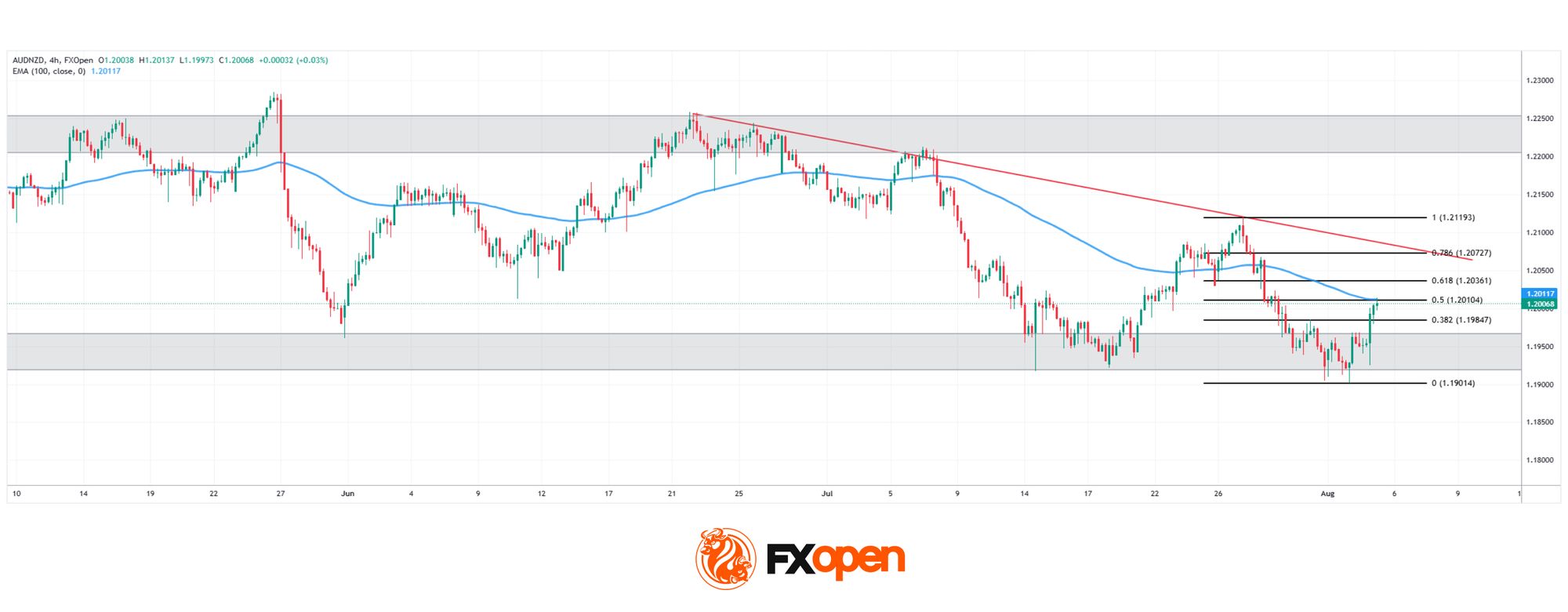
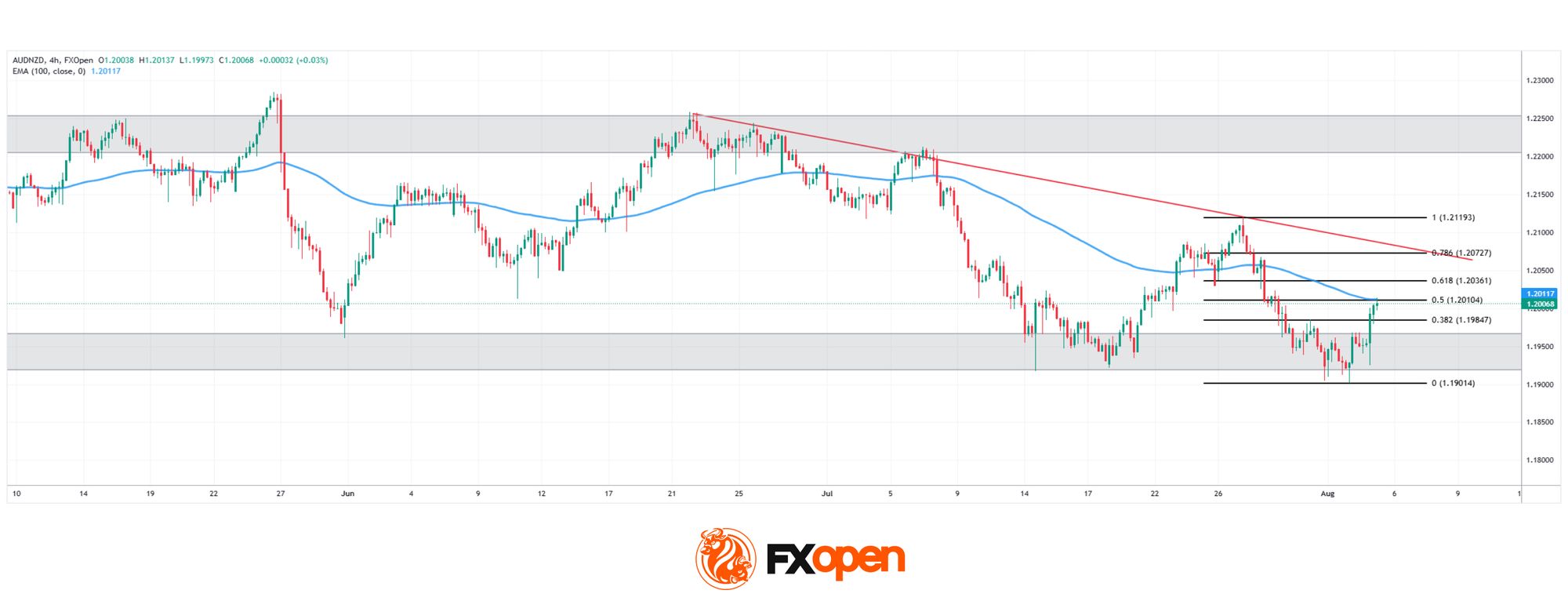
As AUD/NZD chart shows, the pair broke above the 100-period EMA back in July and is now testing this level again, right where it converges with the 0.5 Fibonacci retracement near 1.2011-1.2013. This confluence marks a critical juncture after weeks of steady decline.
Bullish Scenario
Should buyers break this EMA-Fibonacci confluence decisively, the path would open toward the 0.618 retracement near 1.2037, followed by the descending trendline, which itself converges with the 0.786 level around 1.2073. A break above this second confluence would leave room to retest the 1.2200-1.2250 resistance, the upper boundary of the broader range that has trapped price since April..
Bearish Scenario
Conversely, a rejection at the EMA-0.5 confluence would send price back down to retest the 1.1900-1.1950 support, the level that has held since March.. This is the real test: a confirmed break below it would open the door to a more sustained and decisive downtrend.
With price wedged right at this pivotal confluence, and the broader March-to-August range still very much intact, AUD/NZD looks ready to decide whether it’s building toward a genuine breakout, or simply setting up for another rejection within its months-long range.
Trade over 50 forex markets 24 hours a day with FXOpen. Take advantage of low commissions, deep liquidity, and spreads from 0.0 pips (additional fees may apply). Open your FXOpen account now or learn more about trading forex with FXOpen.
This article represents the opinion of the Companies operating under the FXOpen brand only. It is not to be construed as an offer, solicitation, or recommendation with respect to products and services provided by the Companies operating under the FXOpen brand, nor is it to be considered financial advice.

Donald Trump should follow our lead in California. The path we’ve taken is proven to work. Climate action goes hand in hand with economic dominance. California is the fourth largest economy in the world because of our work to move away from fossil fuels, not in spite of it. Greenhouse gas emissions in California are down 20% since 2000, even as the state’s GDP increased 78% in that same time period.
The most expensive and dangerous option before us is doing nothing. The costs of climate change far exceed the costs of transitioning to a green, resilient economy. And not only is the Trump Administration doing nothing, it is actively working to turn the clock back on decades of progress of cleaning the air and protecting public health.
In 2023 alone, the U.S. saw 28 separate natural disasters—fires, floods, hurricanes—each made more devastating by climate change. Those claimed more than 400 lives and cost more than $92 billion in damages. In the face of all that, the Trump Administration wants to suggest that climate change doesn’t endanger us all. Seriously? Trump is siding with polluters over science, and telling fire victims to ignore the flames, flood victims to ignore the rising water, and parents of asthmatic children to ignore their kids choking.
That is not leadership. That is a betrayal of the American people that the federal government is duty-bound to protect. California will not stand by. We will continue to lead, because we have no choice: The lives and livelihoods of our people depend on it.
What gives you hope about the future of the planet?
California is a state of dreamers, doers, entrepreneurs, and innovators. At our best, we pride ourselves on being on the leading and cutting edge of new ideas. We’re a state where 27% of the population is foreign-born. A majority minority state. A state that’s proud to be home to the founding papers of the United Nations. We’re a pluralistic state that practices pluralism.
And we believe that our state can show the world that it’s possible to live and progress together across many imaginable differences. And that is absolutely true when it comes to tackling the defining crisis of our time: climate change.
We’re transforming our economy to run on 100% clean electricity, use 94% less oil, cut air pollution by 71%, all by 2045. At the same time, we’re reimagining transportation, leading the charge to zero-emission vehicles and building the nation’s first true high-speed rail system. And we’ve done all this while becoming the fourth largest economy in the world. We have seven times more clean energy jobs than fossil fuel jobs, and more clean energy jobs than any other state.
Simply put: California is a model for climate action, and when we succeed, the rest of our planet succeeds.
If you could stand up and talk to world leaders at the next COP, what would you say?
California is your stable and reliable partner. California and other climate-leading states are with you in the commitment to achieving global climate goals.
We have been committed to building a clean and resilient future for decades. But we aren’t just making commitments anymore. This year, we ran the fourth largest economy in the world on 100% clean energy at least part of the day almost every day. We’re showing that you can do all of this while reducing carbon pollution, growing the economy, advancing water and food security, and safeguarding a livable future for our children and grandchildren.
Our policies have increased innovation and consumer choices for clean energy and fuel; reduced risks to our economy associated with volatile global oil markets; and generated nearly $33 billion from polluters to fund climate solutions and lower clean energy costs across California. Achieving net-zero carbon emissions by 2045 will create 4 million new jobs and save Californians $200 billion in avoided health care costs.
We are a trusted and credible climate partner that has consistently shown up on the world stage, worked with countries across the globe to reduce carbon pollution, and led coalitions of climate leaders across our country committed to achieving the goals of the Paris Agreement. Let’s do this.


The Trump Administration is likely to extend a waiver of a century-old shipping law in an effort to keep energy prices down, officials said.
After Iran militarized the Strait of Hormuz in retaliation for the U.S. and Israel launching the war on Feb. 28, disrupting global energy supplies and sending oil prices skyrocketing, the Trump Administration temporarily suspended the Jones Act. The law requires that cargo moving between U.S. ports be carried on ships built in the U.S., owned by American companies, and predominantly crewed by Americans. By allowing foreign ships to transport cargo in the U.S., the waiver made domestic shipping more flexible, although estimates suggest the waiver would reduce oil prices by only a few cents per gallon.
The waiver has been extended once before and could be extended again as recent flare-ups between the U.S. and Iran dim hopes of a quick return to normal shipping through the Strait of Hormuz and lower energy prices.
“I think another extension, temporary extension, of the Jones Act waivers is quite likely to happen,” Energy Secretary Chris Wright said at a media briefing in Texas on Tuesday. “These temporary suspensions of the Jones Act have been quite helpful for moving energy around our country.”
The current suspension will expire on Aug. 16, and the oil industry had reportedly expected a decision on an extension by the end of July. But the waiver has faced criticism from American maritime companies that argue it weakens the domestic shipping industry and does little to meaningfully lower fuel prices. Trump officials are reportedly still deciding whether to extend the waiver.
Still, Trump is facing increasing pressure to bring down U.S. petrol prices—currently averaging more than $4 a gallon—while the war’s economic and human costs have become a political liability for Republicans ahead of the midterm elections in November.
By Aug. 16, the waiver will reach 150 days, making this the longest suspension of Jones Act shipping restrictions in the program’s history. The waiver was first issued for a 60-day period on March 17, then extended for a 90-day period beginning May 18.
President Donald Trump and his officials have also explored other avenues to lower fuel costs as the war against Iran has threatened to spillover into new shipping routes and prolong economic pain for Americans and the rest of the world. On Monday, Trump called on ExxonMobil and Chevron—the two biggest U.S. oil companies—to return their surging profits to customers at the pump.
“President Trump believes in markets and he believes in capitalism. But he’ll use every tool he has, including the bully pulpit, to try to encourage and put pressure to lower energy prices for Americans,” Wright said.
To waiver or not to waiver
The Jones Act, part of the Merchant Marine Act of 1920, was initially enacted to strengthen the U.S. shipping industry after World War I. The policy was rooted in an 1817 law that restricted domestic maritime trade to U.S.-owned vessels and a 1789 law that encouraged U.S.-built and -owned ships through preferential tax treatment.
Since the Jones Act rules were first waived till the end of July, there have been 196 voyages conducted under the waiver, according to government data. The waiver covers hundreds of commodities, including crude oil, refined petroleum products, natural gas, coal, ammonia, and fertilizers. It has increased the availability of tankers to move critical fuel supplies around the country, Wright said, noting that it has kept energy prices in California and on the East Coast “lower than they would otherwise be.” He said fuel prices should come down in the coming weeks.
The Administration appears likely to extend the waiver, although an extension is not confirmed and may have restrictions. Trump officials have reportedly met with industry representatives and lawmakers about potentially narrowing the scope of the waiver to be more targeted and friendlier to the domestic shipping industry.
The Maritime Trades Department, which represents U.S. and Canadian maritime workers, argued that the waiver threatens American vessel operators, mariners and shipyards by upending a law that is “the backbone to the American industrial workforce.” Without the law’s protections for American-owned and -operated vessels, the influx of foreign vessels could potentially lead to losses for U.S. shipyards, ultimately hurting the broader economy, the union said.
Maritime firms have also said that the waiver produces minimal savings for consumers and urged the U.S. government to pursue more effective cost-saving measures. In an article published by the Center for Maritime Strategy, non-resident senior fellow John McCown argued that the Jones Act’s benefits far outweigh its costs.
“The waiver was justified as an emergency measure to lower fuel prices. It should be judged on whether it achieved that objective. And despite more than 130 foreign voyages under the waiver, consumers have seen little measurable relief at the pump,” William Doyle, a former Federal Maritime Commission member, wrote in a letter to the Washington Post in July.
And both maritime firms and some lawmakers have raised concerns about the waiver’s potential impact on national security.
In a June 30 letter to Trump, Republican House Speaker Mike Johnson and House Majority leader Steve Scalise, as well as 50 other House Republicans, called the waiver “a loophole exploited by adversarial countries to erode America’s maritime dominance.” The group of lawmakers urged the Administration to let the waiver expire on Aug. 16.
Two Democratic lawmakers separately penned a letter opposing the waiver and calling for greater scrutiny of its use.
Maritime companies and unions argue the waiver has opened protected U.S. domestic trade up to vessels linked to China, a major maritime rival of the U.S., while diverting business away from U.S. carriers. In June, American maritime groups raised concern about one such vessel, Jin Zhou Wan, whose operator is a subsidiary of state-owned China COSCO Shipping Corporation, which appears on the Pentagon’s list of Chinese military-linked companies. Voyages by Jin Zhou Wan carried asphalt—which is covered by the waiver—rather than fuel, which critics cited as evidence that the waiver is overly broad.
Extended waivers could weaken demand for U.S.-built and -crewed vessels, groups say, potentially discouraging investment in domestic maritime capacity and undermining the Trump Administration’s goal of rebuilding the American shipbuilding industry.
Pressure to lower gas prices
The Trump Administration has already taken other measures aimed at lowering energy prices. In March, the Administration authorized the release of 172 million barrels of crude oil from the country’s national stockpile. Also in March, it temporarily eased sanctions on some oil supplies from Russia and Iran.
Trump has also called out the biggest U.S. oil companies for “making too much money” amid the energy crisis. ExxonMobil recorded a $14.5 billion profit in the second quarter of 2026—105% more than the same period last year—and Chevron recorded a $12.1 billion profit—385% higher year over year.
“When you look at one company where they made 12 times what they made the year before, they ought to give some of that back to the public,” Trump told reporters in the Oval Office on Monday. “And they better cut the retail price, the consumer price.”
Oil prices initially fell after the U.S. and Iran signed a memorandum of understanding in mid-June, but climbed again after the agreement broke down and fighting resumed. Prices have fallen again this week on hopes for a diplomatic breakthrough as mediators reported progress towards an agreement, but it could still take some time for global energy prices to stabilize. Wright previously said it could take “many months to get back to normal flows of energy” after the crisis in the Strait of Hormuz ends. Analysts previously told TIME it could take months for shipping through the Strait to return to prewar levels, and further fighting between the U.S. and Iran or a breakdown of negotiations could prolong that recovery.

Mastercard and stablecoin orchestration network Borderless are launching a pilot focused on improving cross-border stablecoin payments using Mastercard’s Crypto Credential standards-based framework.
The initiative, announced in coordination with Cointelegraph, will test whether Mastercard’s approach can generate assurance signals that market participants can plug into their own approval, compliance, and risk workflows—potentially reducing friction where verification responsibilities often become fragmented across counterparties.
Key takeaways
- Mastercard and Borderless will trial how Crypto Credential standards can produce governance and verification signals for cross-border stablecoin payments.
- The pilot is designed to help participants incorporate assurance signals into their internal approval, compliance, and risk processes.
- Borderless frames compliance and trust between parties as the key bottleneck, comparing it to how correspondent banking historically handled assurance.
- Mastercard will not process or settle funds as part of the pilot; the project centers on the credential layer rather than payment execution.
Why “assurance signals” matter for stablecoin payments
Stablecoins can move value quickly, but cross-border usage often runs into a problem that looks less like a technology challenge and more like a governance and compliance workflow issue. According to Borderless CEO and co-founder Kevin Lehtiniitty, the main source of friction is providing the right kind of assurance across a chain of counterparties.
Lehtiniitty compares the situation to correspondent banking, which “solved this decades ago” by making trust upstream and avoiding repeated re-execution of compliance checks at each step with downstream parties. In his view, Mastercard’s Crypto Credential framework aims to apply a similar idea to digital-asset payments: instead of every participant building their own end-to-end verification logic from scratch, the system provides standardized signals that can be interpreted and used across the network.
Mastercard’s Crypto Credential framework, as described in the announcement, relies on common standards and assurance signals intended to add certainty to blockchain-related transactions. In the pilot, the partners will look specifically for governance signals that can lower operational friction in cross-border stablecoin flows.
A pilot focused on governance, not settlement
While the partnership is positioned within the broader stablecoin payments ecosystem, the pilot itself is intentionally narrower. Lehtiniitty told Cointelegraph that Mastercard’s role would be limited to the Crypto Credential governance and verification layer; Mastercard will not process or settle funds as part of this test.
That distinction matters for how investors and builders might interpret the trial. It suggests the project is primarily about interoperability—how credentialed assurance can be communicated and reused—rather than about replacing payment rails or directly competing with settlement providers in the near term.
For Borderless, the value proposition is tied to workflow integration: participants would be able to take the signals produced under Mastercard’s framework and incorporate them into their existing approval, compliance, and risk processes. The pilot therefore aims at practical adoption challenges, not just a theoretical standard.
How Mastercard’s stablecoin push is evolving
The pilot builds on Mastercard’s recent expansion in the stablecoin industry. Cointelegraph previously reported that Mastercard completed its acquisition of stablecoin infrastructure company BVNK on Monday, a deal valued at $1.8 billion.
In June, Mastercard also announced plans to expand settlement capabilities to include intraday, weekend, and holiday card settlement. That proposal included settlement through stablecoins such as Circle’s USDC, Paxos-issued PYUSD, and other dollar-linked tokens, including USDG and USDP, as well as Ripple’s RLUSD and SoFi’s SoFiUSD.
Taken together, the new pilot indicates Mastercard is pursuing a dual-track strategy: expanding where stablecoins can be used in settlement while also working on how trust and verification can be communicated in a way that fits traditional compliance expectations.
Still, the pilot’s scope leaves open some important questions. The partners have emphasized credentialing and governance signals, but they have not indicated how quickly these signals could standardize cross-border approvals across different jurisdictions, nor whether the pilot will extend beyond specific participants or networks. Those details will determine whether the program becomes a scalable template or remains a proof-of-concept.
What to watch next in the pilot
Because Mastercard and Borderless have framed the work around assurance signals that can be incorporated into compliance and risk processes, observers should watch for outcomes that reflect real operational integration—not just technical compatibility. Key areas include how participants interpret the governance signals, whether the framework meaningfully reduces the need for repeated due diligence steps, and what governance standards emerge as most effective in lowering cross-border friction.
Another practical factor is whether the credential layer can maintain consistency across counterparties without requiring each party to recreate verification logic. If the pilot succeeds, it could offer a clearer path for stablecoins to fit into existing payment and compliance infrastructures—where trust models are typically built around accountable intermediaries.
For now, the next step is the pilot’s results: how well the assurance and governance signals translate into reduced friction for cross-border stablecoin payments, and whether the approach can be expanded from a controlled test into a broader standard that participants can adopt with confidence.
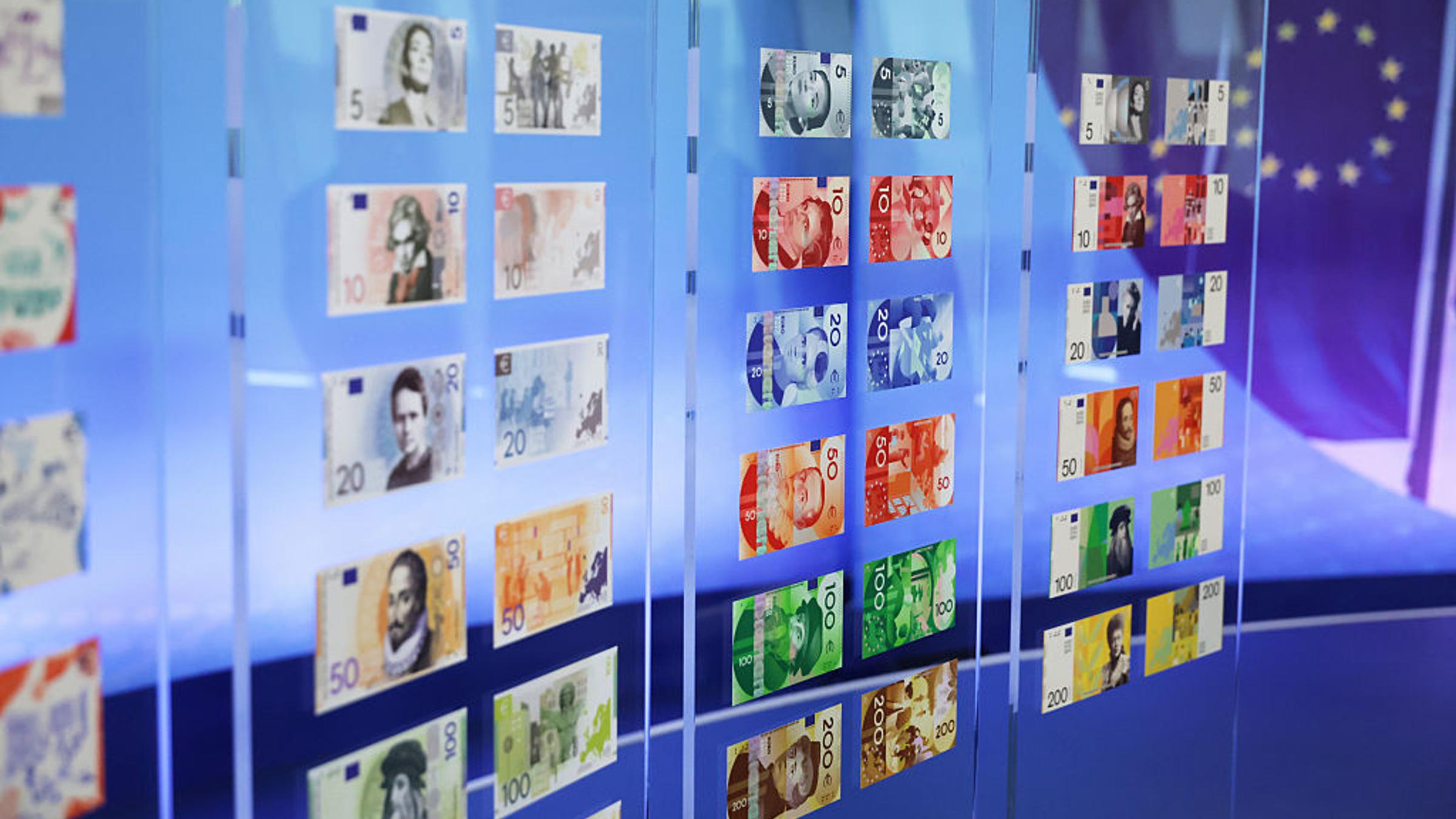
Europeans have been invited to give their views on the final selection through an online survey which closes Sept. 21. The results will be considered by the Governing Council of the ECB, along with independent jury conclusions and a technical review, before the final design is selected toward the end of 2026.
The new banknotes would then undergo testing before entering circulation, while remaining interchangeable with the current series of euro notes.
According to the ECB, the redesign aims to better reflect Europe’s identity and values, introduce enhanced security features, improve environmental sustainability, and make the banknotes more accessible and easier to use.
As it’s the first major redesign of the euro banknotes since the currency notes were introduced in 2002, the stakes are high.
“Talk to friends, colleagues, family members, and ask them to participate, because we want as many Europeans as possible to express their views about our future banknotes,” said ECB president Christine Lagarde.


When Strategy sold a tiny 32 Bitcoin for the first time since 2022, the market treated it as the top. But a single balance-sheet decision is not necessarily reflecting long-term demand data. The subsequent much larger sale of bitcoin by Strategy was digested more as treasury management than capitulation, interpreting the step as Strategy evolving its long-term treasury strategy from passively HODLing collateral to actively managing it over time. The market initially spent its energy reacting to a press release while the real long-term relevant picture was being written somewhere it was not looking at directly.
Fabian Dori is Chief Investment Officer at Sygnum Bank.
When spot Bitcoin ETFs had their worst month on record for outflows, the coverage read like a wake. Yet at the very same time, long-term holders, the wallets that have held through previous cycles and rarely sell, started buying again, adding into the weakness. The cohort with the best record of timing entries was doing the exact opposite of the institutional money that was selling. The headline audience saw capitulation. The positioning audience saw something closer to opportunity. They were looking at the same market.
Derivatives told the same story earlier in the year. One of the clearest, least ambiguous signals I track is simple: of the 50 largest perpetual futures contracts, how many carry a positive funding rate, the recurring fee traders pay to keep a position open. When that fee is positive, it is the bulls paying to stay long; when it is negative, the bears are paying to stay short. Bitcoin’s funding rate stayed negative for its longest stretch since the aftermath of FTX, yet a meaningful share of those top 50 contracts had quietly flipped positive. Risk appetite was turning up before the price confirmed it. The headline was still “record short streak.” The positioning was already less bearish.
Bitcoin (BTC) price is stalling near $64,000 after two failed pushes at the same ceiling, and both large wallets and long-term holders have started selling into the weakness.
The rollover lands just as two US events with a track record of moving crypto return to the calendar, and history says both tend to hit Bitcoin when it is already soft.
Bitcoin Enters a Weak Month With a Double Top in Play
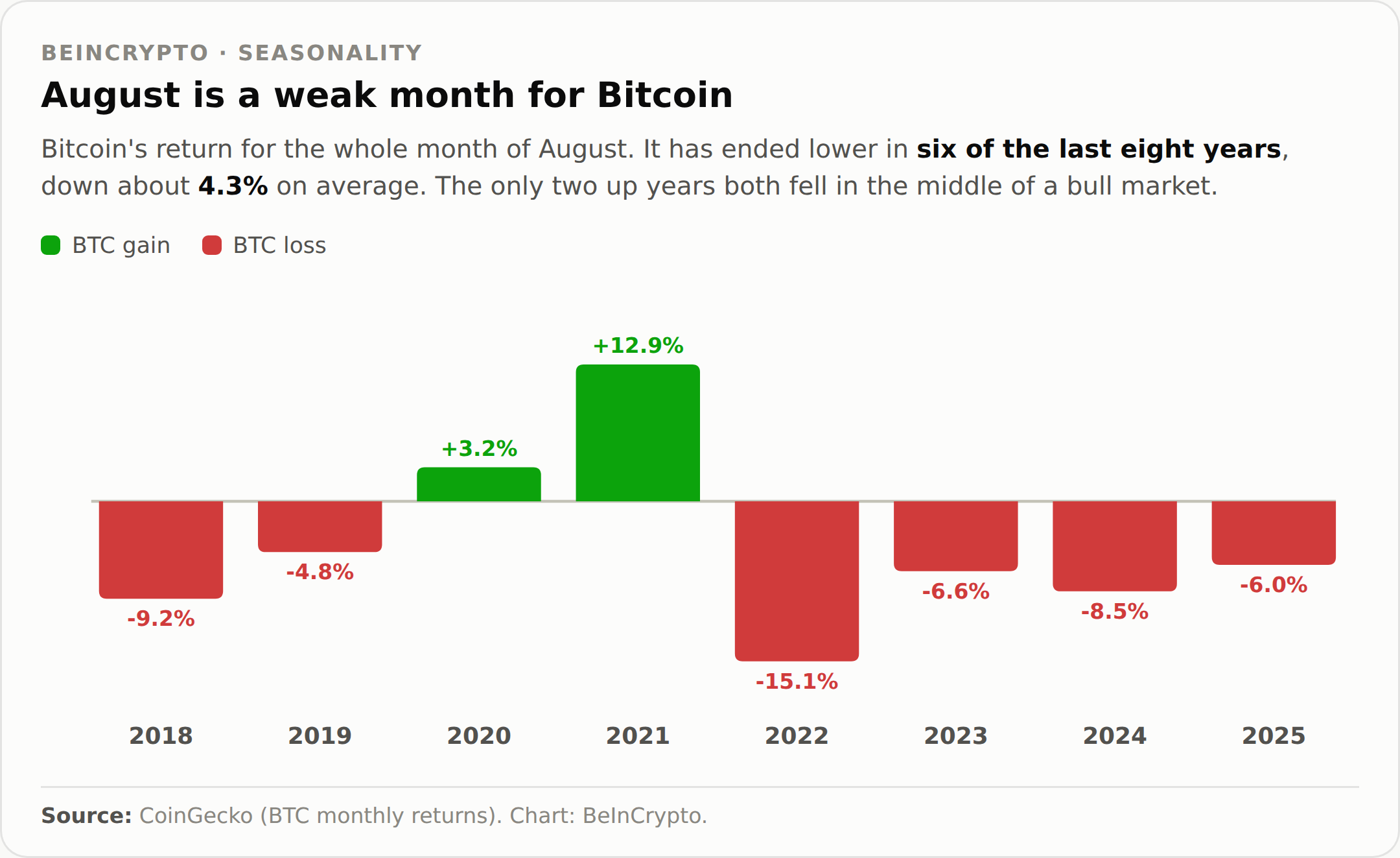
August has been unkind to Bitcoin. It has closed the month lower in six of the last eight years, so buyers begin from a weak seasonal base.

The chart makes that base look shakier. Bitcoin has formed a double top, a bearish reversal pattern where price fails twice at the same resistance and struggles higher. The two peaks built on comparable volume, which adds weight to the signal.

Sell-side volume has also risen since August 1, pushing the current Bitcoin price toward the lower edge of the range rather than back toward the highs.
Want more token insights like this? Sign up for Editor Harsh Notariya’s Daily Crypto Newsletter here.
Large holders are pulling back at the same time. Supply held by Bitcoin whales in the 10,000 to 100,000 BTC band peaked on August 3 near 2.26 million BTC, then eased to 2.25 million. The move is small, but it suggests the biggest wallets are trimming rather than adding.

Whale behavior alone does not confirm a trend, so the next question is whether long-term holders agree.
Long-Term Holders Flip From Buyers to Sellers
They appear to. The Hodler Net Position Change, a metric that tracks the net change in supply held by long-term holders, stayed positive through July as those holders added coins. It turned negative in early August.
The shift is sharp. Net selling deepened from about 1,802 BTC on August 2 to roughly 11,472 BTC on August 4, a more than six-fold jump in two days. That points to long-term holders possibly selling into strength rather than holding through it.

With whales and long-term holders leaning the same way, the market now meets two events that have moved Bitcoin hard before.
The Two Events That Have Moved Bitcoin Before
The first is Friday’s US jobs report. It is the same release that helped trigger Bitcoin’s sharp early-August drop in 2024, when a weak print sparked recession fear. Economists expect another soft reading this week, near 80,000 new jobs with unemployment around 4.2%.
Since 2023, Bitcoin has tended to fall on weak labor data.

The second is the Jackson Hole symposium in the final week of August. A hawkish speech there in 2022 helped send Bitcoin below $20,000. For years, a dovish Fed later softened those blows, but that cushion is gone. Kevin Warsh took over as Fed chair in May and has run a hawkish, inflation-first line, with markets now pricing higher-for-longer rather than cuts.

Warsh gives his first Jackson Hole speech as chair this month, and a market still hoping for relief is exposed to disappointment. That sets up the price chart as the decider.
Bitcoin Price Levels to Watch Before Friday’s Jobs Report
The first line buyers need to defend sits at $61,080. A clean loss of that level would expose $59,500, the last support before the pattern’s neckline.
The neckline runs through the $57,750 to $57,470 zone. A daily close below it would confirm the double top and open a measured move of roughly 14%, which points toward the sub-$50,000 region near $49,700. The 14% drop potential is in line with August 2022’s drop size.

The setup is not confirmed yet. A double top only completes on a neckline break, so a hold above $61,080 keeps the range alive. A reclaim of the $66,930 to $67,230 ceiling that capped both peaks would invalidate the bearish Bitcoin price outlook entirely.
For now, the structure and on-chain flows lean the same way into a hostile macro week. The $57,750 neckline separates a routine August pullback from a 14% slide toward $50,000.
The post Bitcoin Under $50,000? These Two Feared August Events Could Trigger It appeared first on BeInCrypto.

The Greatest Financial Magic Trick in Real Estate (in 57 seconds) #shorts

Faulty fans recalled over fire risk with people told to stop using them ‘immediately’ | News UK

(VIDEO) Kansas Mother of Four Recovering After Suspected Spider Bite Causes Severe Liver Complications


-

 Business7 days ago
Why Trees Belong on the Risk Register
-

 Fashion5 days ago
Weekend Open Thread: Wit & Wisdom
-

 Politics5 days ago
Meta enters AI-training agreement with far-right ‘propaganda rag’ Newsmax
-

 Politics7 days ago
Reform UK betrays West Mids residents by running from party pledges
-

 Politics3 days ago
Zack Polanski: an incitement to murder Nigel Farage?
-

 Crypto World4 days ago
MicroStrategy Post-Earnings CLARITY Act Push Could Add New Catalyst for Its Stock
-

 Crypto World4 days ago
XRP Ledger v3.3.0 brings five institutional features
-

 News Videos6 days ago
Bitcoin Enters the 3rd Stage of the Bear Market
-

 Politics6 days ago
Luke Littler’s dominance sparks GOAT debate
-

 Sports6 days ago
Seema Kaliramna Wins Discus Throw Bronze, Takes India’s CWG Medals Tally To 17
-

 Crypto World5 days ago
New York sues Kalshi over prediction market gambling
-

 Crypto World3 days ago
Crypto PAC spending tops $2M in Michigan House race
-

 Business5 days ago
Trump Announces Hamas Disarmament Agreement as Iran Strikes Kuwait Air Base and US Attacks Pause Overnight
-

 Tech3 days ago
ESET tracks rise in malicious AI skills and adaptable malware
-

 Business3 days ago
DTCR: Deleveraging And A Hedge Fund Collapse Point To A Possible AI Bottom
-
 Crypto World5 days ago
3 Fed Officials Just Explained Their Rate Hike Vote: Is Inflation Winning?
-

 Tech5 days ago
Gemini Spark can now use Chrome logins and saved passwords to run errands on your behalf
-

 Tech5 days ago
Building A Reproduction PlayStation Motherboard
-

 NewsBeat6 days ago
Four people die trying to cross Channel in small boats
-

 Sports4 days ago
France Cricket implodes: letters hidden in a drawer and a board at war
You must be logged in to post a comment Login