

Crypto World
Ethics Rules Were Not Enough to Win Democrats on CLARITY Act



Seven Senate Democrats say the updated CLARITY Act text falls short. They opposed the proposed draft, even after it added ethics rules barring public officials from issuing digital assets.
The 616-page bill needs 60 votes to clear the Senate. Their opposition complicates the path to that threshold before the August recess.
What the New CLARITY Act Text Adds
Senate Republicans released the 616-page bill, formally H.R. 3633, on Wednesday. The Digital Asset Market Clarity Act sets a federal framework for crypto oversight.
The text divides authority between the Securities and Exchange Commission (SEC) and the Commodity Futures Trading Commission (CFTC). Only 2 parts are new since the May draft.
The additions are ethics requirements and a law enforcement section with stablecoin seizure powers. The former stops covered officials from issuing or sponsoring a digital asset in exchange for consideration.
The group spans the President, Vice President, and lawmakers, plus their spouses, throughout their time in office. The agreement sunsets on January 20, 2029.
Democrats and Banks Seek Changes
Nonetheless, the addition was not enough for democrats. Senators Catherine Cortez Masto, Angela Alsobrooks, Cory Booker, Ruben Gallego, John Hickenlooper, Mark Warner, and Raphael Warnock said the language still needs work, alongside consumer protection, illicit finance, and market integrity.
“The Republican-proposed text of the CLARITY Act as it currently stands falls short… We have been working in good faith with our Republican colleagues for the past year and will continue doing so to get this over the finish line,” the statement read
According to Semafor, Alsobrooks said she will oppose the crypto bill unless Republicans strengthen its ethics rules. She criticized the draft for relying only on the Justice Department to enforce them and called that approach “wild and unserious and stone crazy.” She wants state attorneys general empowered to act if the DOJ does not.
Follow us on X to get the latest news as it happens
Meanwhile, the banking industry is also seeking changes. Six trade groups, led by the American Bankers Association (ABA), signed a joint statement on deposit risk.
“The latest version of the Digital Asset Market Clarity Act released today in the Senate still puts at risk the local lending that drives economic activity in the US,” they said.
Majority Leader John Thune plans to bring the bill to the floor next week. Whether the revised text wins enough Democratic support remains the key question.
Subscribe to our YouTube channel to watch leaders and journalists provide expert insights
The post Ethics Rules Were Not Enough to Win Democrats on CLARITY Act appeared first on BeInCrypto.

Crypto World
Bitcoin Rejected at $67K, Strategy Stays on Hold, BitMEX Shuts Down: Weekly Crypto Recap
The previous business week ended with a leg down that drove the primary cryptocurrency to $62,500. However, it reacted swiftly and recovered to $64,000 during the weekend.
The gradual climb continued on Sunday and Monday morning when BTC peaked at $65,000, but it was rejected and slipped south by over a grand to $63,750. The next leg up was a lot more impressive. Bitcoin didn’t stop at $65,000, and even the $66,000 resistance fell on the first attempt. Thus, the asset’s rally extended for a bit more, reaching $67,000 (on some exchanges) for the first time since the middle of June.
It came on the heels of renewed ETF net inflows and new accumulations from certain large investors. However, the price run couldn’t be sustained for long, and BTC quickly dipped back down to $66,000 on Wednesday, $65,000 on Thursday, and it plunged to $64,000 earlier today.
Despite its $3,000 correction from the local top, bitcoin remains about 2% up on the week. Similar gains are evident from Ethereum, which challenged $1,950 at one point, and TRX, which remains at around $0.33. Even more impressive price performance comes from XMR; a 9% pump has driven the privacy token to over $350. UNI and HBAR have posted notable gains as well, while HYPE, ZEC, CC, and DOGE remain in the red on a weekly scale.
Bitcoin’s market dominance has also dwindled in the past few days. It exploded to over 57% during the mid-week run, but it has dipped below 56% on CoinGecko now.
Market Data
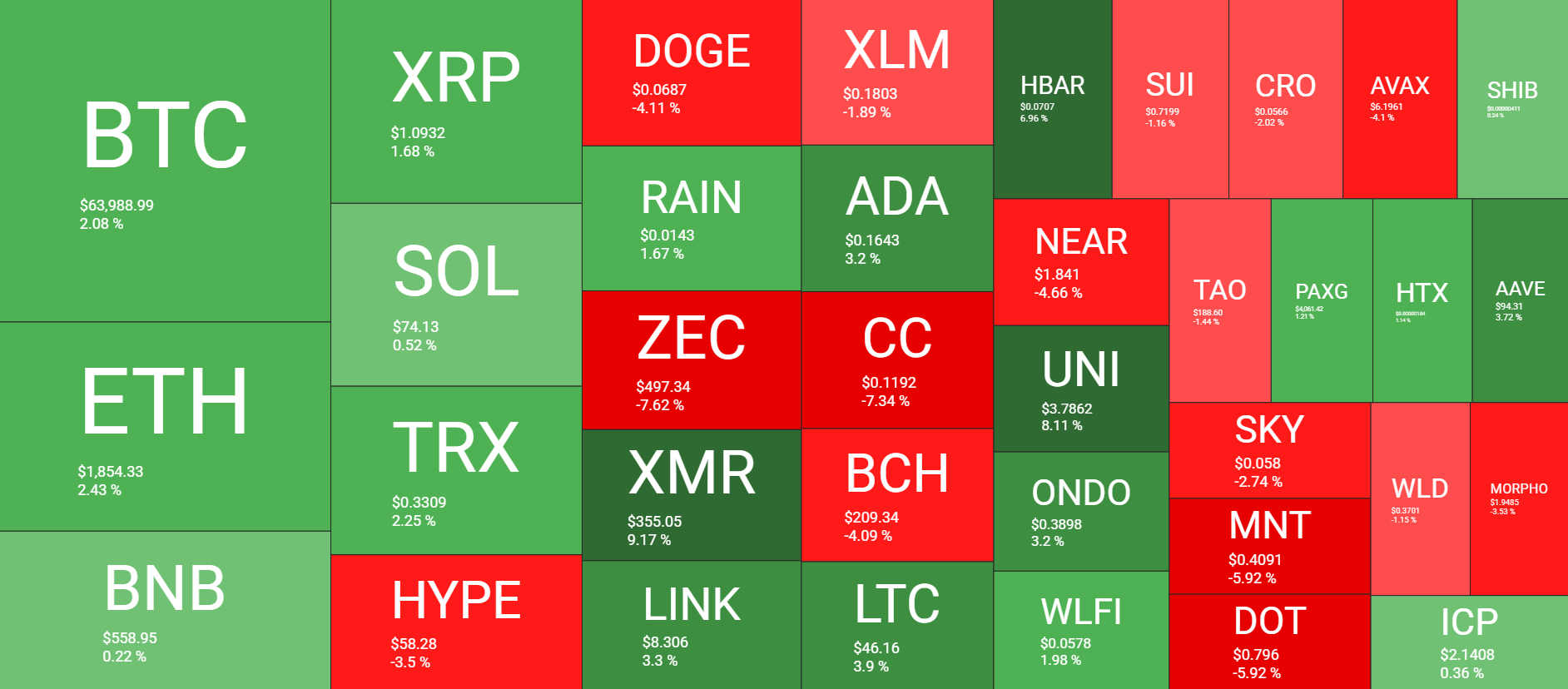
Market Cap: $2.295T | 24H Vol: $61B | BTC Dominance: 55.9%
BTC: $64.000 (+2%) | ETH: $1,855 (+2.4%) | XRP: $1.09 (+1.7%)
This Week’s Crypto Headlines You Can’t Miss
Strategy Extends Bitcoin Buying Pause While Growing Its USD Reserve: Details. Saylor’s company appears to have listened to some market experts who suggested that it should pause its BTC purchases in favor of rebuilding its USD reserve. The past week proved that narrative right once again with another no-buy bitcoin announcement.
Veteran Crypto Exchange BitMEX to Shut Down in September. After nearly a decade in existence, the veteran derivatives platform BitMEX announced that it will close shop in September. The creator of the 100x perpetual swap will permanently cease operations on September 23 and urged users to withdraw their funds by then. While on the subject, DEX aggregator Odos said it will shut down next week.
SEC Agrees to Overhaul Recordkeeping After Settling Coinbase Lawsuit Over Gensler’s Lost Texts. Despite not admitting any wrongdoing, the US Securities and Exchange Commission settled with Coinbase a lawsuit launched by the exchange and agreed to pay $150,000 in attorney fees. The regulator also said it will review its own internal processes.
‘Hackers Day’: 3 Crypto Protocols Drained of $35 Million in 24 Hours. July 23 became known in the crypto community as ‘Hackers’ Day’ with 3 major exploits taking place within less than 24 hours. The largest of the bunch was against Arbitrum-based protocol AFX Trade, in which the bad actors swiped over $24 million in USDC.
EU Hits Russia With Toughest Crypto Crackdown Yet. The European Union approved its 21st sanctions package against Russia, targeting 11 crypto operators and 94 financial institutions to combat sanctions evasion. Many of those platforms came from Belarus and Nigeria and were linked to numerous Russian financial activities.
Ethereum (ETH) Is Cheap, But Not at Bottom Yet: Analysts. The world’s largest altcoin may be trading well below its record peaks and at a discount, but that doesn’t necessarily mean that it has bottomed yet. Analysts at CryptoQuant noted that only two out of five signals suggest that the worst is behind ETH.
Charts
This week, we have a chart analysis of Ethereum, Ripple, Cardano, Binance Coin, and Hyperliquid – click here for the complete price analysis.
The post Bitcoin Rejected at $67K, Strategy Stays on Hold, BitMEX Shuts Down: Weekly Crypto Recap appeared first on CryptoPotato.

Hyperliquid, a decentralized perpetual futures exchange, has crossed a notable threshold in the tokenized asset boom: its weekly trading volume from tokenized real-world assets (RWAs) has surpassed the volume of every other asset category combined on the platform for the first time.
According to Blockworks analytics covering the week of July 13 to July 19, RWAs generated $25.1 billion in trading volume, representing 52% of Hyperliquid’s total weekly volume of $48.2 billion. The shift highlights how quickly tokenized financial instruments are becoming a primary driver of activity on certain crypto trading venues.
Key takeaways
- Blockworks data shows Hyperliquid’s RWA weekly trading volume reached $25.1 billion (July 13–19), 52% of the exchange’s total $48.2 billion.
- For the first time, RWA volume exceeded the combined trading volume of all other asset categories on Hyperliquid.
- RWA adoption is expanding: RWA.xyz reports RWA holders rose 32% in the past month to 1.25 million, while total RWA value increased 3.5% to $36.7 billion.
- Hyperliquid earned $7.6 million in weekly revenue, placing it third among crypto applications by revenue, behind Tether and Circle.
RWA trading becomes the dominant slice of Hyperliquid volume
Hyperliquid’s latest weekly numbers point to a structural change in what traders are choosing to transact. Blockworks’ platform-level breakdown indicates that tokenized real-world assets are no longer a side theme or niche product—on Hyperliquid, they are now the engine of activity.
ARK Invest’s Lorenzo Valente underscored the magnitude in an X post, stating that the Hyperliquid RWA market was larger than the combined crypto perpetual volume of every other DEX.
While DEX activity has historically skewed toward native crypto assets, the data now suggests tokenized instruments are increasingly central to derivatives-style trading. That matters because perpetual trading is typically used for continuous exposure, hedging, and rapid position adjustments—capabilities that become more valuable as RWAs gain depth, liquidity, and more accessible trading venues.
Growing RWA base supports higher turnover
The volume surge lines up with broader metrics for tokenized assets. RWA.xyz data cited in the report shows that over the past month, the number of RWA holders increased 32% to 1.25 million. In the same period, the total value of RWAs rose 3.5% to $36.7 billion.
That combination—more holders alongside a rising tokenized asset base—can help explain why trading activity is scaling. Higher participation can translate into more demand for exposure, while increasing total value often corresponds with improved market depth and product availability, both of which can attract more frequent trading.
At the platform level, Hyperliquid’s momentum also suggests that tokenization is moving beyond issuance and custody into active trading ecosystems. For investors and traders, this transition is important: it changes how tokenized assets behave in practice, shifting attention from “paper asset on-chain” narratives toward liquidity, price discovery, and day-to-day market functioning.
Revenue signals institutional-grade attention
Hyperliquid’s performance is not only measured by volume. DefiLlama data cited in the report indicates that the exchange generated $7.6 million in revenue over the past week. On that basis, Hyperliquid ranked third among crypto applications by weekly revenue, behind stablecoin issuers Tether ($112 million) and Circle ($45 million).
In practical terms, revenue ranking matters because it can reflect sustained user activity rather than one-off spikes. For markets, a venue that consistently captures fees and trading-related income can be a sign of durable liquidity and repeated engagement from market participants.
Still, it’s worth noting what the data does—and does not—tell us. The figures establish scale and traction, but they don’t by themselves reveal which specific RWA instruments are driving all of the incremental interest. Traders may watch for continued diversification within RWA offerings, and for whether liquidity and spreads remain robust as new product categories come online.
Wall Street relevance: “structural shift” claims and the derivatives debate
Beyond crypto circles, the growth has attracted commentary from traditional finance and tokenization advocates. In an X post, Circle co-founder and CEO Jeremy Allaire said increasing RWA trading on Hyperliquid represents a “major structural shift” in crypto markets—moving away from “speculating on endogenous digital commodities.”
The framing reflects a broader industry thesis: once tokenized financial products move onto blockchain infrastructure, crypto markets can become integrated execution venues for assets that previously traded through legacy channels. Earlier in July, Pantera Capital also suggested that perpetual futures could become a dominant trading instrument beyond crypto, citing structural advantages such as 24/7 trading, no contract expiries, simpler position management, and continuous price discovery.
That argument has gained additional political and regulatory attention. The report also references remarks by Jeffrey Sprecher, CEO of ICE—the parent company of the New York Stock Exchange—who urged regulators to create a “level playing field” for launching 24/7 onchain perpetual futures contracts. Sprecher’s position points to a rising question for the industry: whether regulators will treat onchain perpetuals in the same way as traditional derivatives, or whether a new framework will emerge for continuous, blockchain-based trading.
For readers, the key implication is that the conversation is broadening. The debate is no longer limited to whether tokenization “can work,” but whether market structure—especially derivatives mechanics—will accelerate adoption of tokenized instruments across a wider set of participants.
Next, market watchers should focus on whether Hyperliquid’s RWA-led share of volume can remain dominant week after week as the holder base grows, and whether regulators move toward a clearer framework for 24/7 onchain derivatives. Sustained liquidity and expanded RWA product coverage will likely be the telltale signs that the shift is more than a short-term surge.
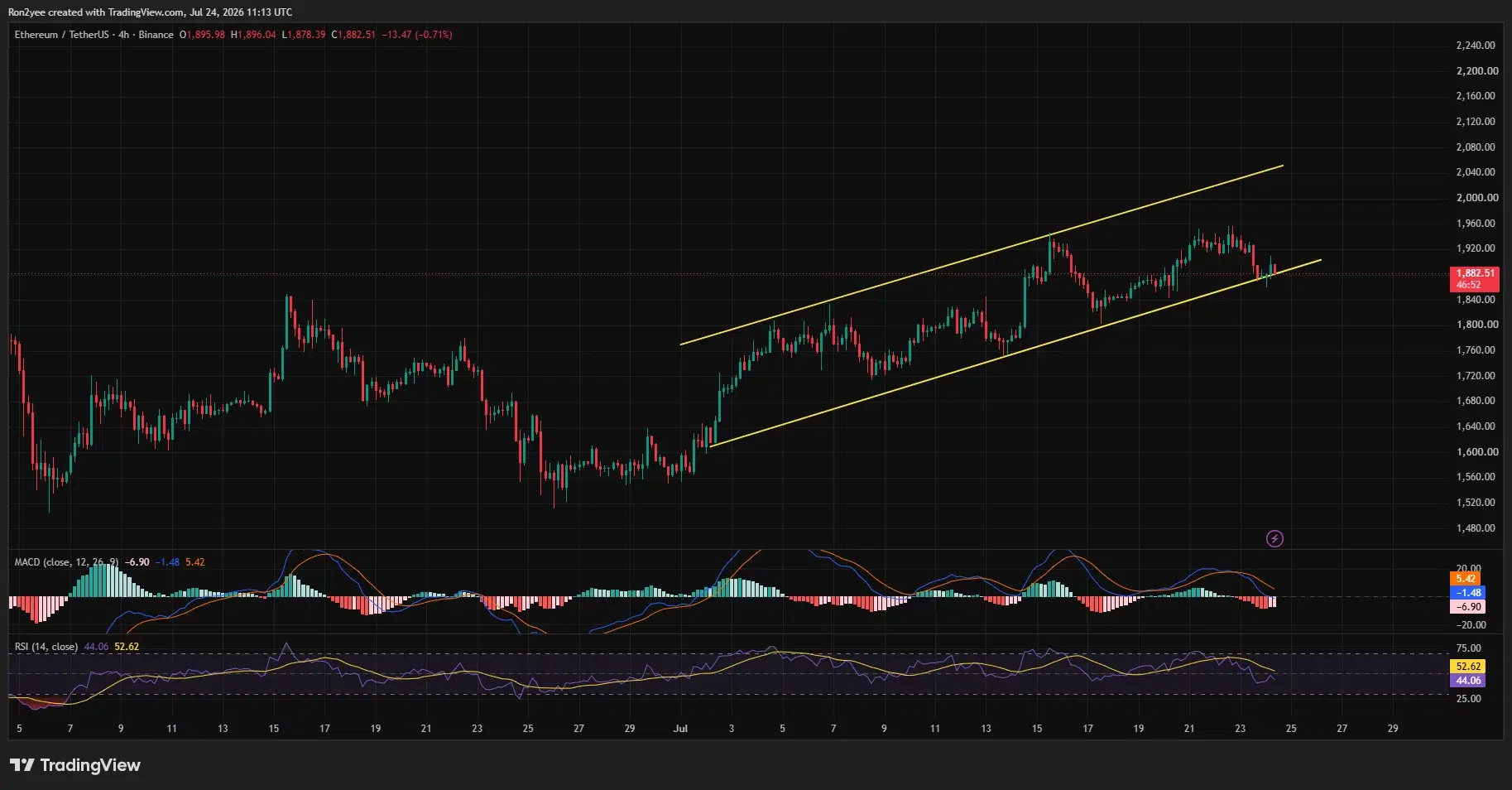
Ethereum price has retreated to $1,880 after failing to clear $2,000, as profit-taking, rising derivatives leverage and a sharp U.S. technology-stock sell-off weakened market sentiment.
Summary
- Ethereum price fell toward $1,880 after failing to break the key $2,000 resistance.
- Spot ETH ETFs logged $26.3 million in inflows despite weaker market sentiment.
- Holding $1,850 could support a rebound toward $1,950 and eventually $2,060.
According to data from crypto.news, Ethereum (ETH) price traded near $1,882 at press time, down about 3% over the previous 24 hours after reaching the $1,935–$1,950 region earlier in the week. Sellers emerged below the psychological $2,000 barrier and the 100-day exponential moving average, ending a rally that began near $1,560 in late June.
Wall Street’s technology rout added pressure during Thursday’s session. The Magnificent Seven stocks fell 4.8% and erased about $797 billion in market value, their worst day since the tariff-driven sell-off in April 2025. The S&P 500 dropped 1.2%, while the Nasdaq 100 lost 1.9%, according to CoinDesk.
Alphabet’s decision to raise its 2026 capital-spending forecast to as much as $205 billion and weaker-than-expected profits at Tesla drove the equity decline. High-beta assets came under pressure as investors questioned whether returns from artificial-intelligence spending could justify the sector’s rising costs.
Ether absorbed a steeper loss than Bitcoin, which held near $65,400 with a decline of less than 1%. The difference showed that investors remained more cautious toward altcoins as capital moved away from riskier trades.
ETF inflows and rising leverage have kept Ethereum’s recovery intact
U.S. spot Ethereum exchange-traded funds recorded $26.3 million in net inflows on July 23, extending their positive run to five consecutive sessions. BlackRock’s ETHA received $8.5 million, Fidelity’s FETH attracted $14.9 million, and Grayscale’s mini Ether fund added $2.9 million, according to Farside Investors.
The latest total followed inflows of $38 million, $37.5 million and $72.7 million during the first three sessions of the week. Although ETF demand has remained positive, Thursday’s figure dropped sharply from the previous day and failed to offset selling in the spot market.
Institutional access also expanded in Switzerland after BancaStato integrated Sygnum’s digital-asset infrastructure. The cantonal bank’s clients can now trade Bitcoin, Ether, Solana and USD Coin through its existing web and mobile banking platforms, adding another regulated distribution channel for ETH.
Derivatives traders increased their exposure as Ether approached resistance. Open interest climbed by 600,000 ETH over two days to 14.6 million ETH, its highest level since June 7, according to CoinGlass data.
Funding rates, positive through most of July, briefly turned negative on Thursday for the first time since June 29. The change occurred as $41.55 million in leveraged positions were liquidated over 24 hours, including $34.4 million in longs. A rise in open interest alongside negative funding leaves both bullish and bearish positions exposed to forced closures.
U.S. spot demand has yet to match the ETF recovery. CryptoQuant’s Coinbase Premium Index has remained negative for nearly three months, which means Ether has continued to trade at a discount on Coinbase compared with offshore exchanges.
Ethereum must defend $1,850 to preserve its ascending channel
The 4-hour chart places ETH at the lower boundary of an ascending parallel channel that has guided its recovery since early July. Immediate support sits between $1,850 and $1,880, while the channel’s upper boundary could reach approximately $2,060 if buyers reclaim $1,950.
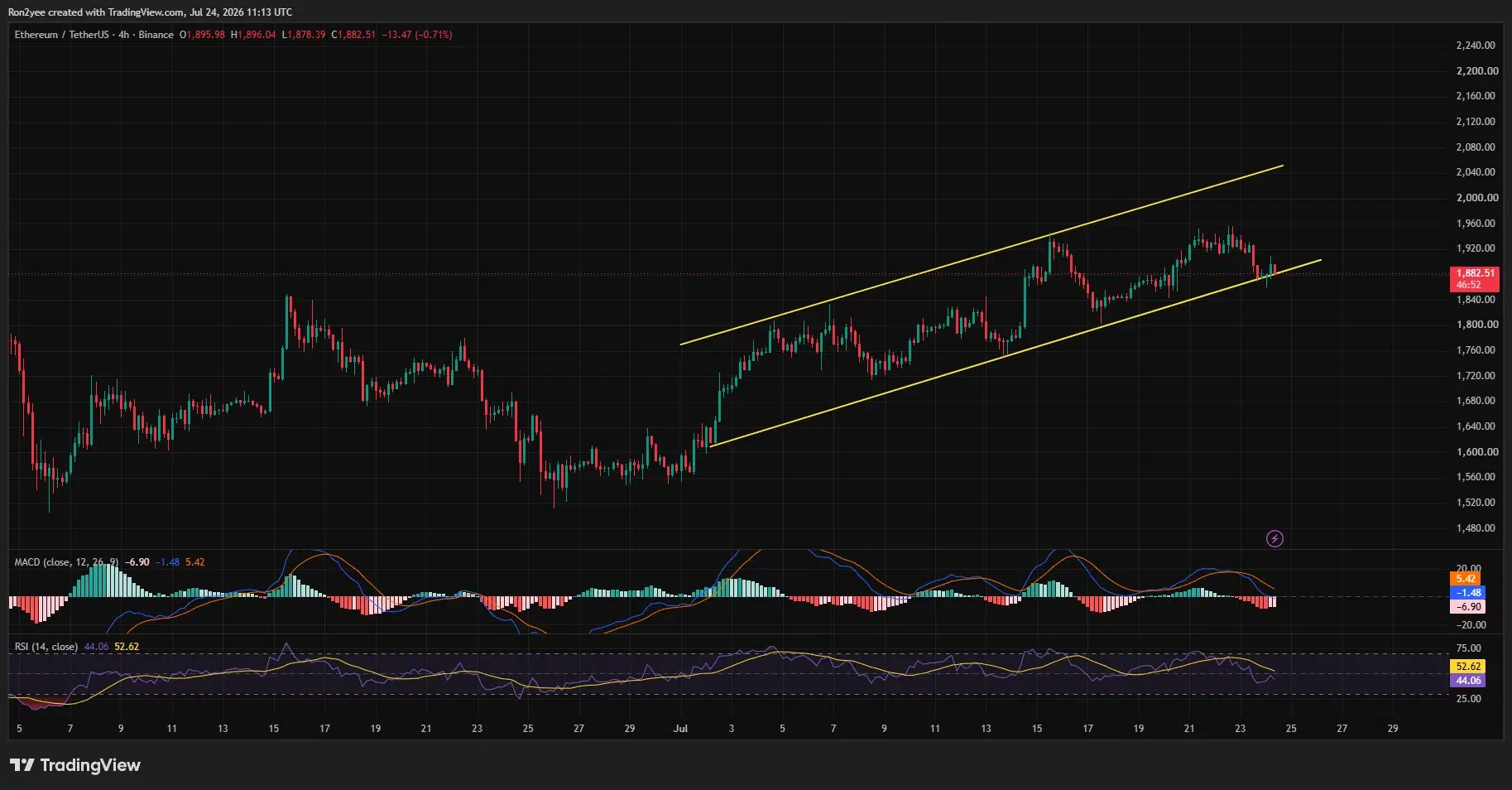
According to crypto analyst Ali Martinez, the latest reaction has kept the channel structure valid.
“As long as this support at $1,850 continues to hold, I’m watching for a move back toward the upper boundary near $2,060.”
Short-term momentum remains weak. The 4-hour relative strength index has fallen to 44.06, below its moving average of 52.62, while the MACD line at minus 1.48 sits beneath its 5.42 signal line. Its negative histogram reading of 6.90 shows that sellers still control the immediate move.
On the daily chart, ETH trades near the Ichimoku conversion line at $1,879 and above the forward cloud’s $1,816 upper boundary. The Chaikin Money Flow remains positive at 0.07, showing that net capital has not fully left the market despite the pullback.
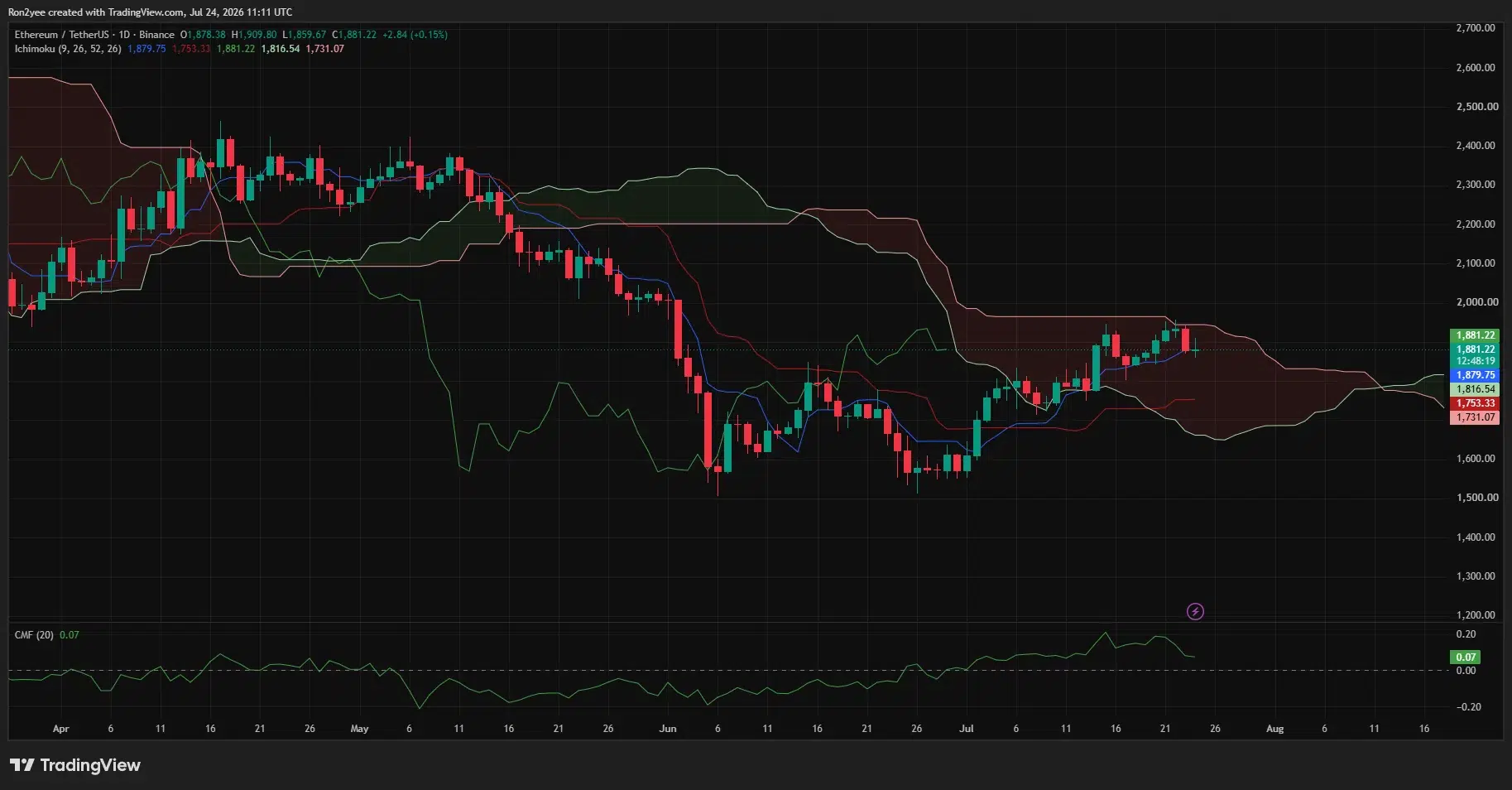
CoinGlass’s weekly liquidation heatmap places the closest concentration of leveraged positions around $1,900–$1,910. A larger overhead cluster sits near $1,955–$1,965, where a price advance could force short liquidations and reopen the path toward $2,000.
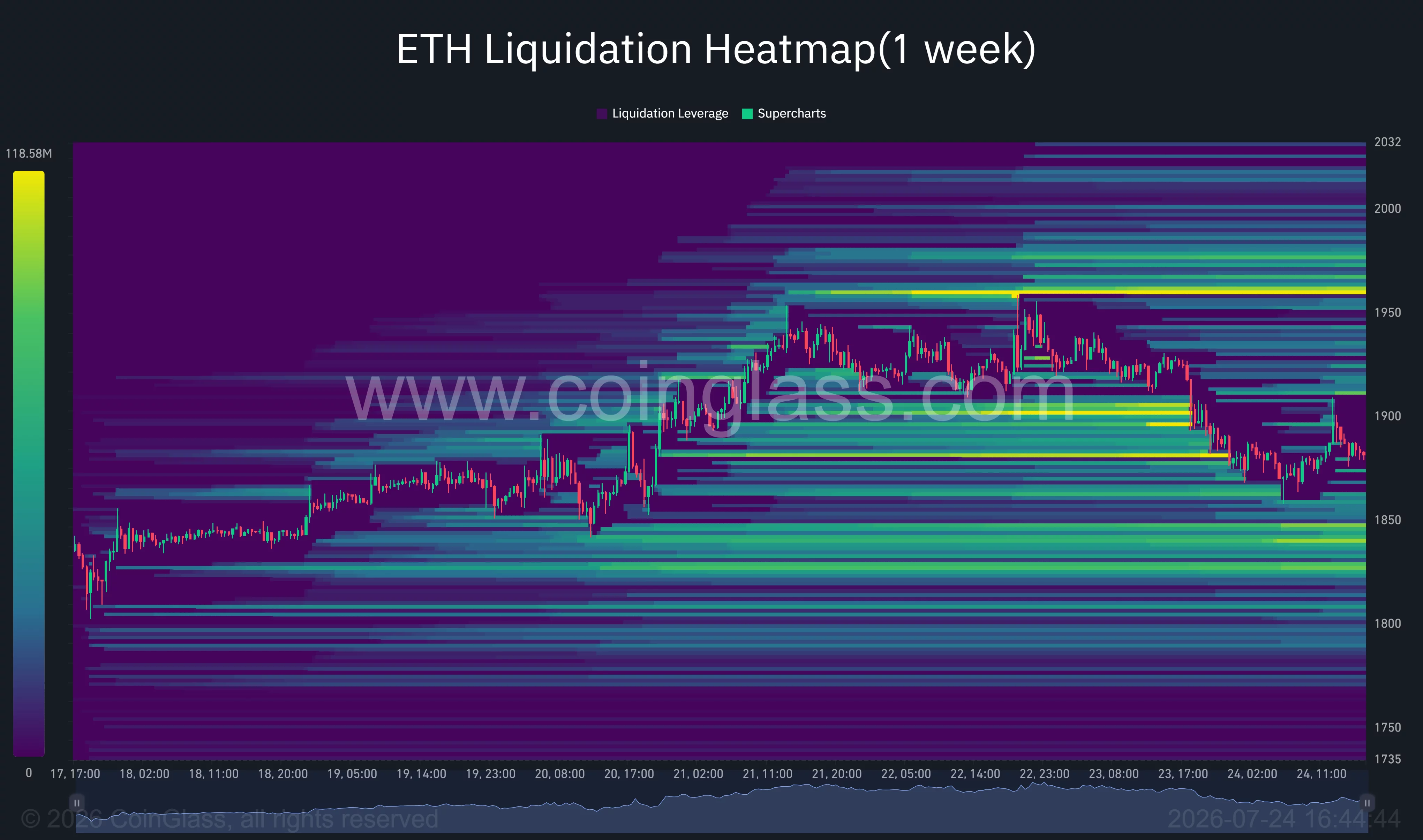
Downside liquidity has accumulated around $1,840–$1,850, followed by another concentration near $1,820. A 4-hour close below the channel boundary and $1,850 would invalidate the immediate recovery setup, exposing $1,816 and then $1,750–$1,730.
Persistent equity weakness, higher bond yields or renewed inflation pressure could deepen that breakdown. Bulls instead need to reclaim $1,910 and break the $1,950–$1,965 supply zone before Ethereum can make another credible attempt at $2,000.
Disclosure: This article does not represent investment advice. The content and materials featured on this page are for educational purposes only.

Thailand’s crypto market is facing renewed regulatory pressure after the country’s Securities and Exchange Commission (SEC) filed a criminal complaint against Bitkub Online and two former directors. The case centers on allegations that the exchange submitted misleading information to regulators in connection with a May 2021 cyberattack.
Bitkub is also in the spotlight because its parent company has been exploring a potential public listing, a development that heightens scrutiny around governance, risk controls, and the quality of disclosures for investors and customers alike.
Key takeaways
- The Thai SEC has filed a criminal complaint against Bitkub Online and former directors Sakolkorn Sakavee and Thaweesap Rawan over alleged false reporting tied to a May 2021 hack.
- Regulators say a cyberattack led to the theft of 16 types of digital assets worth about 1.7 billion baht (around $50 million), and that Bitkub’s daily net liquid capital reports failed to reflect the impact.
- Bitkub disputes the SEC’s characterization, arguing that disclosure was delayed to avoid a bank-run and that comparable assets were later purchased to cover the stolen funds.
- The SEC’s complaint could move through investigation, potential prosecution, and ultimately court proceedings.
What the SEC says happened after the 2021 hack
According to the SEC, a cyberattack in May 2021 resulted in the theft of 16 types of digital assets held by Bitkub. The regulator estimated the stolen assets were worth roughly 1.7 billion baht (about $50 million).
The core of the SEC’s allegation is not the hack itself, but the subsequent reporting. The SEC said Bitkub replaced the stolen assets by Oct. 31, 2021. However, the regulator claims that Bitkub did not accurately show the incident’s effects in the exchange’s daily net liquid capital reports.
In particular, the SEC alleged that reports filed between May 10 and Oct. 30, 2021 did not demonstrate a “significant reduction” in the exchange’s assets despite the theft. In the SEC’s view, the omission could have created the impression that customer assets remained unchanged and that the exchange had not suffered losses from the attack.
The complaint states that Bitkub and the former directors allegedly violated multiple provisions of Thailand’s digital asset regulations related to the alleged false disclosures. The matter is expected to progress through the Thai legal process, including investigation and possible prosecution before any court proceedings.
Bitkub’s response: delayed disclosure to prevent a bank run
Bitkub disputed the SEC’s allegations in a post on X. The exchange argued that the dispute stems from disclosure choices made after the May 2021 cyberattack rather than fraudulent conduct.
Bitkub said it delayed disclosing the wallet compromise to prevent a bank run while it worked to address the stolen funds. The company further stated that its co-founders later purchased digital assets equivalent to what was taken, meaning the exchange and its customers did not ultimately bear financial losses.
In addition, Bitkub said it has strengthened governance, compliance, and security systems since the incident.
The dispute effectively turns on competing narratives about timing and reporting accuracy: the SEC frames the documentation as materially misleading during the period when assets had been compromised, while Bitkub argues that the delayed disclosure was a risk-management decision intended to prevent panic among customers.
Why the case matters beyond one exchange
For Thailand’s crypto industry, this complaint underscores how regulators may treat disclosure practices—even where an operator claims losses were later covered. In many financial systems, timing and transparency during periods of operational stress are often as important as end results, because they influence how markets and counterparties assess risk.
From an investor and compliance perspective, the case also illustrates how governance is becoming a central focus for exchanges contemplating broader corporate moves. Bitkub’s public listing discussions—reported earlier by Cointelegraph—have already brought the company’s structure and controls into sharper view. While the SEC’s complaint relates specifically to 2021 reporting, it arrives at a time when corporate transparency is likely to be critical for any future fundraising or listing process.
Bitkub was founded in 2018 and has grown into one of Thailand’s most prominent trading venues. According to CoinGecko, it ranks first among Thai crypto exchanges by trust score and had about $712 million in daily trading volume at the time of publication.
IPO plans raise the stakes for governance and disclosures
In December 2025, Bitkub confirmed to Cointelegraph that it was considering an initial public offering, including a potential listing in Hong Kong. Cointelegraph also reported that it reached out to Bitkub for additional comment on the SEC complaint and its IPO plans, but did not receive a response by publication.
In that context, the SEC’s allegations could become more consequential than a purely legal matter. Even without determining guilt at this stage, criminal complaints can affect perceived risk for counterparties and potential investors, and they tend to intensify demands for internal documentation, auditability, and compliance readiness.
For customers, the practical question is how authorities and the exchange will reconcile the discrepancy between “late coverage” of stolen assets and the regulator’s view that early reporting should have shown a reduction in net liquid capital.
As the SEC’s complaint moves through Thailand’s legal system, readers will likely want to track what evidence is used to substantiate the alleged reporting gaps, how Bitkub supports its “bank run prevention” rationale, and whether the dispute changes the timeline or terms of any future corporate listing plans.

Thailand’s crypto industry is facing fresh regulatory scrutiny after authorities accused Bitkub, one of the country’s largest digital asset exchanges, of providing false information to regulators.
Thailand’s Securities and Exchange Commission (SEC) filed a criminal complaint against Bitkub Online and two former directors over alleged false reporting connected to a 2021 cyberattack, the regulator announced on Thursday.
The complaint names former Bitkub directors Sakolkorn Sakavee and Thaweesap Rawan, who the SEC said were responsible for submitting company reports during the period under investigation.
The case comes as Bitkub’s parent company considers a potential public listing, putting renewed attention on transparency and governance at one of Thailand’s most prominent crypto businesses.
SEC alleges Bitkub failed to disclose impact of hack
The SEC said a cyberattack in May 2021 resulted in the theft of 16 types of digital assets from Bitkub, worth about 1.7 billion baht ($50 million).
The regulator alleged that Bitkub later replaced the stolen assets by Oct. 31, 2021, but failed to accurately reflect the impact of the incident in its daily net liquid capital reports.
According to the SEC, reports submitted between May 10 and Oct. 30, 2021, did not show a significant reduction in the exchange’s assets following the theft.

Former Bitkub directors Sakolkorn Sakavee (left) and Thaweesap Rawan. Source: Bangkok Post
The regulator alleged that the omission gave the impression that customer assets remained unchanged and that the exchange had not suffered losses from the attack.
The SEC accused Bitkub and the former directors of violating multiple provisions of Thailand’s digital asset regulations over the alleged false disclosures. The case will now proceed through investigation, possible prosecution and court proceedings.
Bitkub says disclosure delayed to prevent bank run
Bitkub disputed the SEC’s allegations in a post on X, saying the case stems from disclosure decisions made after the May 2021 cyberattack rather than fraudulent conduct. The exchange said it delayed disclosing the wallet compromise to prevent a bank run while it addressed the loss of the stolen assets.
The company said its co-founders later purchased equivalent digital assets to cover the stolen funds, leaving neither the company nor its customers with financial losses. The company added that it has since strengthened its governance, compliance and security systems.
Related: Bank of Thailand targets USDT and cash flows in gray money crackdown
Founded in 2018, Bitkub has emerged as one of the largest crypto exchanges in Thailand. According to CoinGecko, the platform ranks first among Thai crypto exchanges by trust score and had about $712 million in daily trading volume at publishing time.
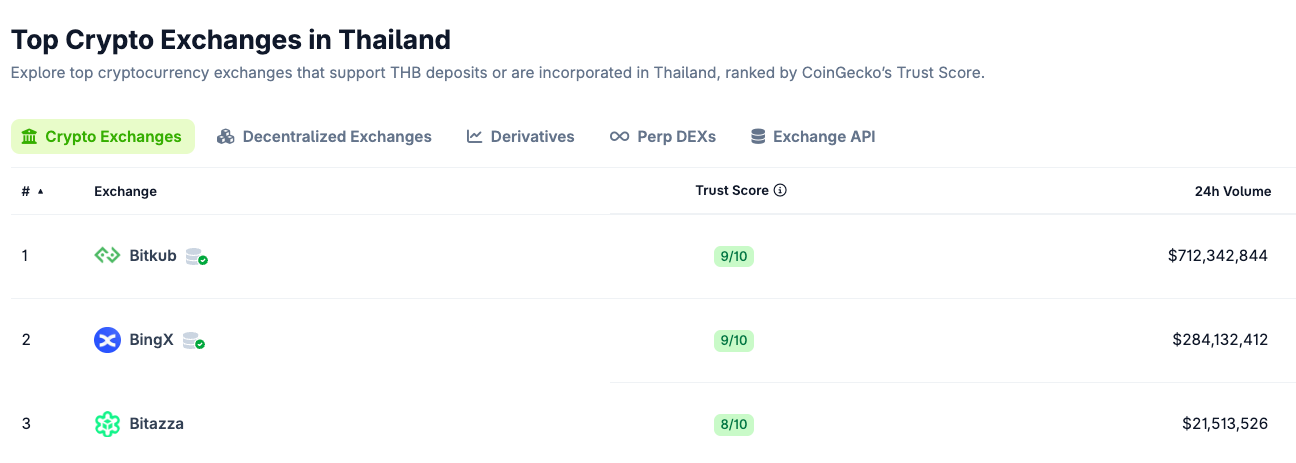
Source: CoinGecko
In December 2025, Bitkub confirmed to Cointelegraph it was considering an initial public offering (IPO), including a potential listing in Hong Kong.
Cointelegraph reached out to Bitkub for additional comment on the SEC’s complaint and its IPO plans but had not received a response by publication.
Magazine: Binance & OKX users face $1,900 fines in Vietnam, Coinbase in China? Asia Express
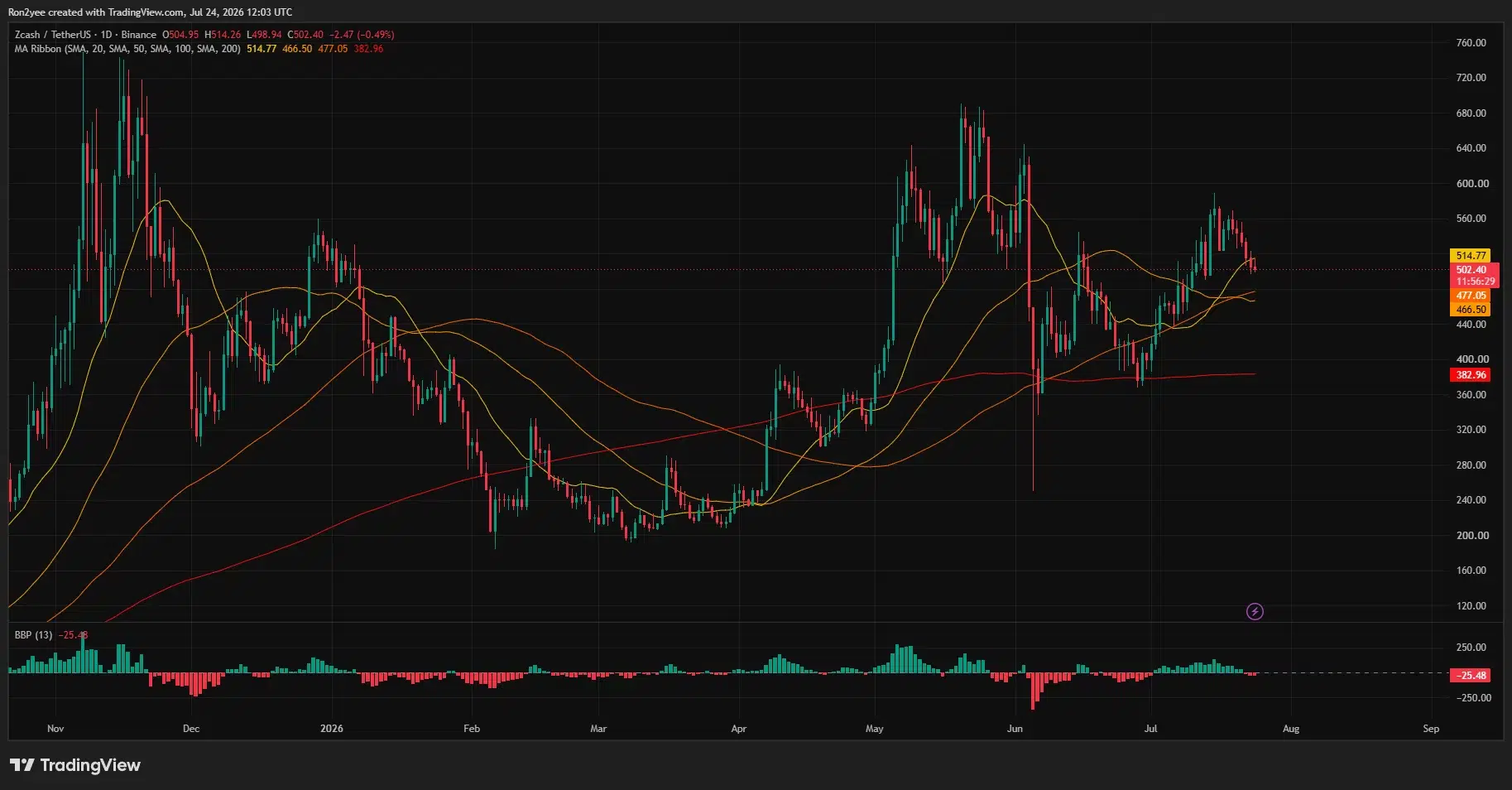
Zcash price has fallen toward the $500 psychological support as a 4-hour breakdown, leveraged liquidations, and caution before the Ironwood upgrade have weakened market sentiment.
Summary
- Zcash price has fallen toward $500 after losing $520 and triggering more than $2 million in long liquidations.
- Bulls must reclaim $530 to neutralize the bearish structure, while $550 remains the main breakout level.
- A daily close below $477 could expose $466 and the rounded-top target near $371.
According to data from crypto.news, Zcash (ZEC) price traded near $502 on July 24 after losing about 5.5% over the past week. Sellers took control after the token lost $520, while more than $2 million in long positions were liquidated over 24 hours. Automated stop orders added pressure once price slipped through intermediate support at $510.
Outside crypto, Thursday’s technology rout reduced demand for risk assets. The Magnificent Seven erased about $797 billion in market value after Alphabet and Tesla’s earnings raised concerns over heavy artificial intelligence spending. The Nasdaq Composite fell more than 2%, while Tesla dropped 14% and Alphabet lost almost 7%.
Oil and bond markets added another obstacle. Brent crude briefly moved above $100 after Houthi attacks on two Saudi tankers raised fears of disruption in the Red Sea. The 10-year U.S. Treasury yield reached an 18-month high near 4.70%, making speculative assets less attractive as traders reconsidered expectations for lower interest rates.
Crypto funds also lost institutional capital during the selloff. U.S. spot Bitcoin exchange-traded funds recorded $225 million in net outflows on July 23. BlackRock’s IBIT accounted for $202 million of the withdrawals, extending the defensive mood into altcoins such as ZEC.
Zcash price must reclaim $530 to repair its short-term structure
On the daily chart, ZEC has fallen below its 20-day simple moving average at $514.77 but remains above the 50-day SMA at $477.05 and the 100-day SMA at $466.50. Those averages form the first major support area if bulls cannot hold $500. The 200-day SMA sits much lower at $382.96.
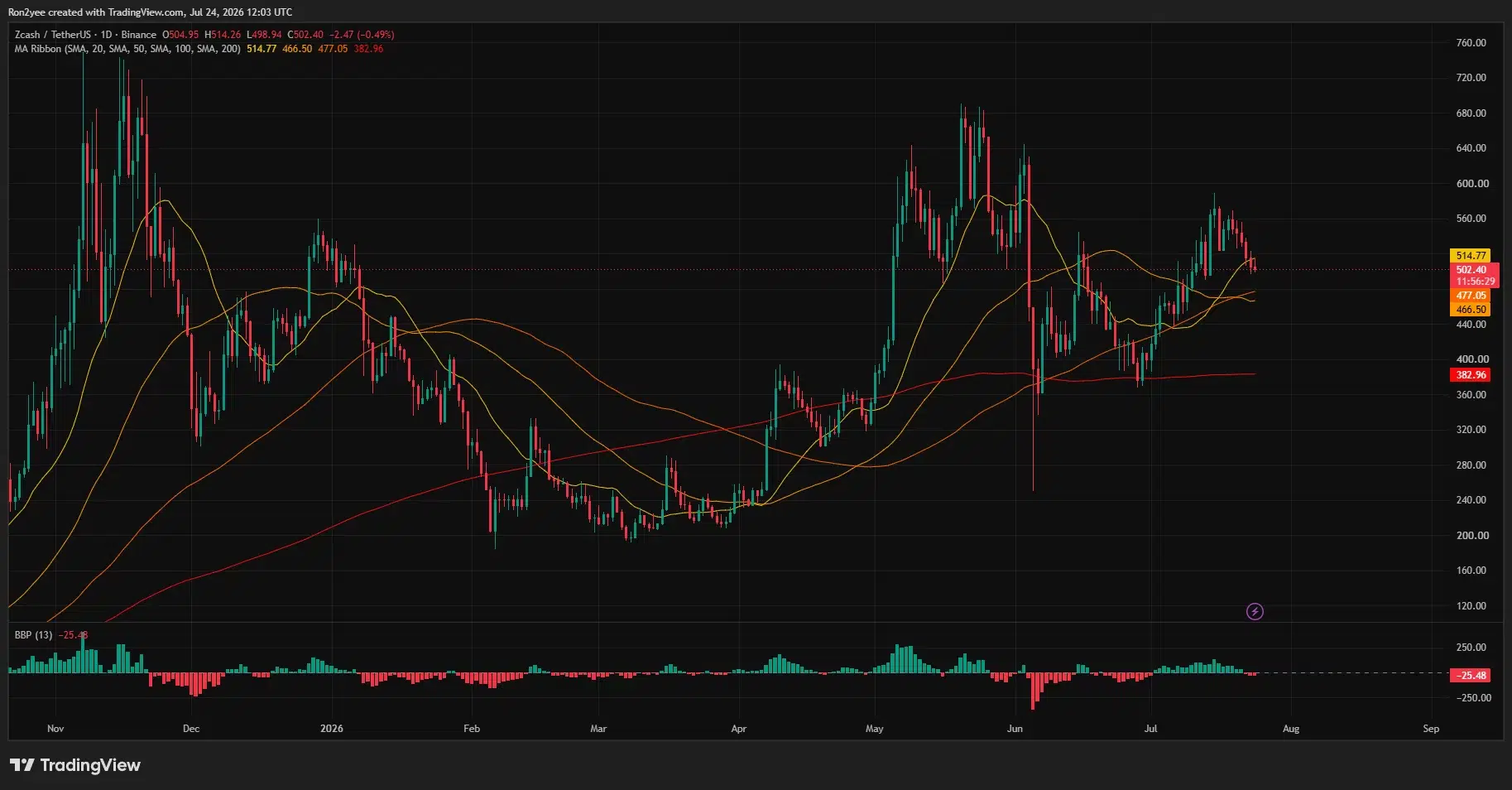
Bear-bull power has dropped to minus 25.48, which shows that sellers have gained control after ZEC’s rejection near $570. However, the token remains above its medium- and long-term averages, leaving the daily recovery structure intact unless price closes decisively below the $466–$477 zone.
The 4-hour chart carries a more bearish setup. ZEC has formed a rounded-top structure since its July 15 peak near $580, with price now testing the $500 area. A confirmed breakdown could extend toward $470 before exposing the pattern’s main support and projected target around $370.69.
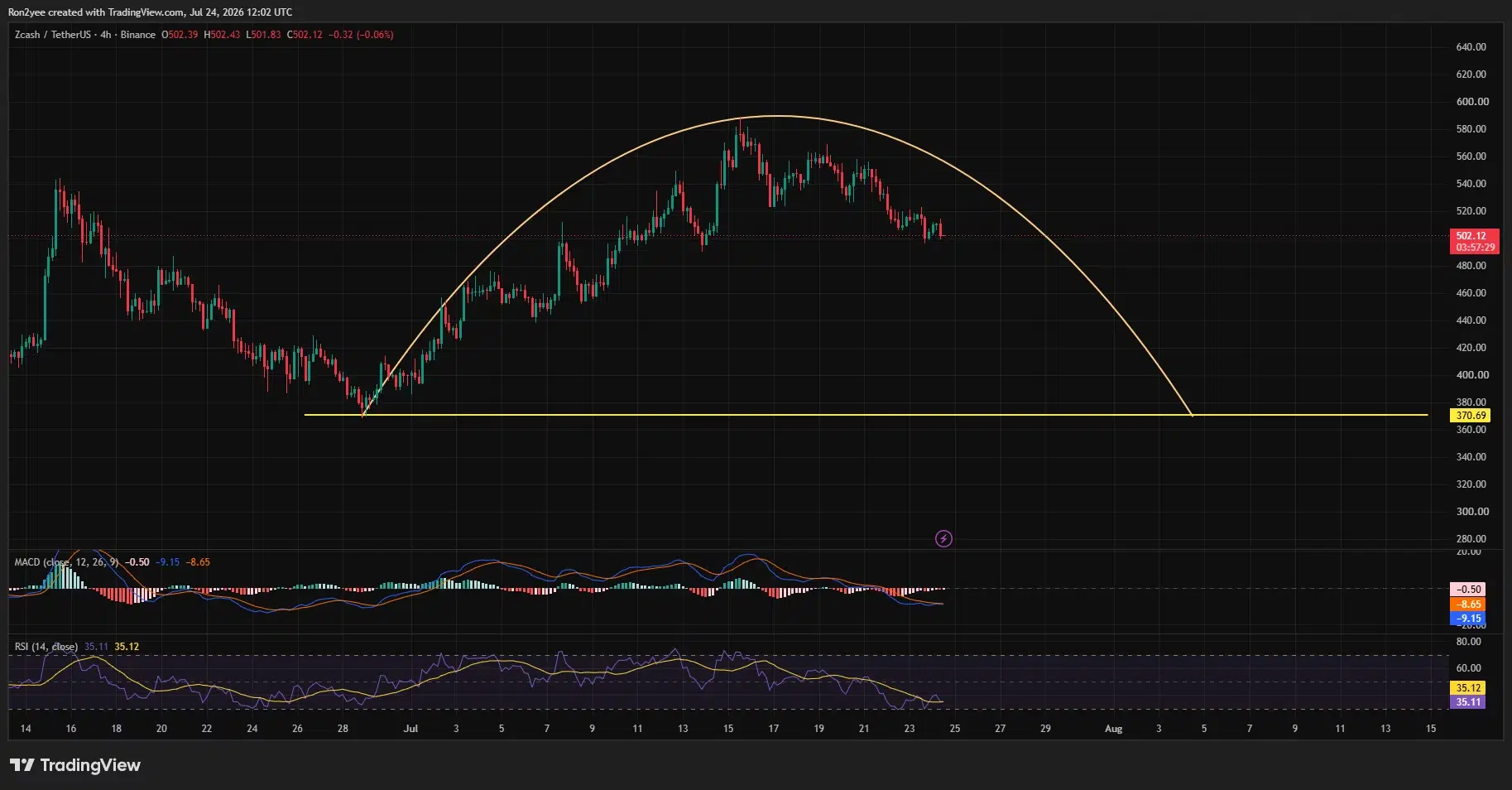
Momentum readings have yet to confirm a reversal. The 4-hour Relative Strength Index stands at 35.11, close to oversold territory but still above 30. The Moving Average Convergence Divergence line remains below its signal line at minus 9.15 versus minus 8.65, while the negative histogram shows that sellers retain an advantage.
According to trader Ardi, $500 has become the main liquidity pivot after ZEC lost $520. The trader expects a brief move below the threshold before any sustained recovery and wrote:
“A reclaim of $530 would return the chart to neutral and likely begin a sideways consolidation phase.”
Ardi identified $550 as the level that would fully break the current bearish structure. Beyond it, $620 would become the next macro breakout barrier. Failure to protect $500, however, could force the trader to close the remaining long position established near $425.
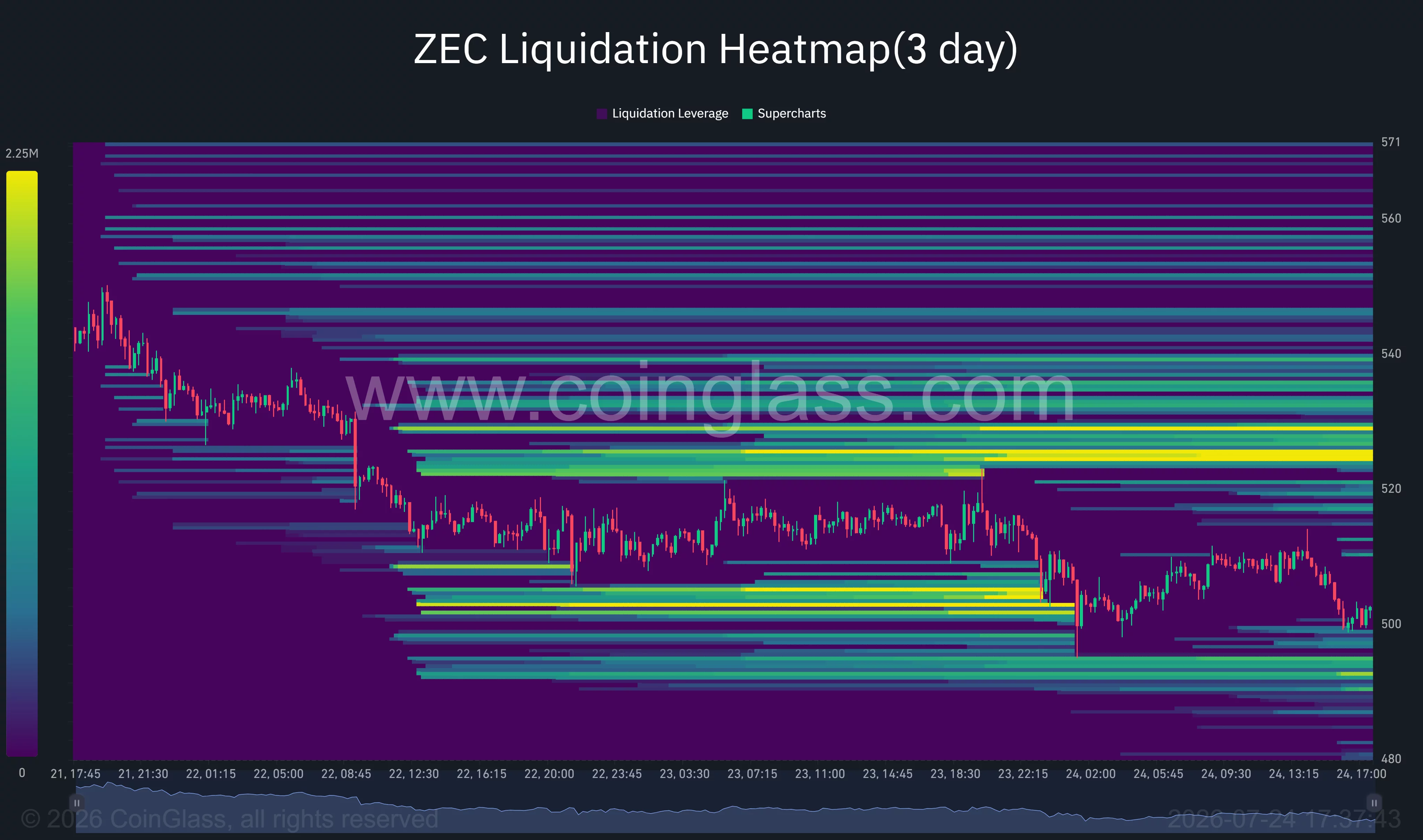
CoinGlass’s three-day liquidation heatmap places the strongest overhead concentration between $524 and $529. A rebound into that band could force short sellers to exit and help ZEC challenge Ardi’s $530 neutral level. Below the market, another dense leverage pocket sits around $490–$494, making that range a likely destination if $500 gives way.
Derivatives traders have not turned fully bearish. ZEC’s funding rate remained positive at approximately 0.0076%, showing that long positions still pay shorts. Yet falling open interest and weaker spot volume show that fewer traders are willing to carry leverage through the current decline, limiting the fuel available for an immediate rebound.
Loss of $477 would invalidate the remaining bullish setup
Ironwood, also known as NU6.3, will activate at block 3,428,143 on July 28. The upgrade will retire the vulnerable Orchard shielded pool and introduce a corrected pool. Funds leaving Orchard must pass through an accounting turnstile designed to prevent more ZEC from exiting than originally entered.
Zcash founder Zooko Wilcox has explained that the process cannot identify individual counterfeit coins or prove that the flaw was never exploited. Temporary wallet and exchange interruptions may occur as service providers update their systems, giving short-term traders another reason to reduce exposure before activation.
Zakura offers a longer-term counterweight to those concerns. The new Rust-based full-node client targets 50,000 private transactions per second and can reportedly start from a pruned snapshot in under two minutes. Still, the development has not stopped the current price correction.
A daily close below the 50-day SMA at $477.05 would weaken the primary recovery thesis and expose $466.50, followed by the June support region near $370. Continued ETF withdrawals, high Treasury yields, another oil spike, or complications during Ironwood activation would increase that downside risk. Bulls must first defend $500 and reclaim $530 before ZEC can make another attempt at $550.
Disclosure: This article does not represent investment advice. The content and materials featured on this page are for educational purposes only.
In the summer of 2024, a meme coin named DADDY went viral on crypto X, and its price skyrocketed within days. The controversial influencer Andrew Tate supported the token, and in the following months and years, his announcements or actions have triggered substantial price volatility.
Just a few days ago, he was arrested, which resulted in a major price decline for DADDY. Check out what exactly happened.
Tate Behind Bars
Besides being famous for his successful kickboxing career, Tate has also made global headlines due to his legal troubles. Over the years, he has faced multiple charges in the UK, Romania, and the USA, and has been arrested on numerous occasions.
On July 19, he and his brother (Tristan Tate) were once again detained in Miami after the British authorities issued 38 new criminal counts against them, including rape, actual bodily harm, and human trafficking.
“We have decided to prosecute Andrew and Tristan Tate for further offenses including rape, arranging or facilitating trafficking for sexual exploitation and offenses relating to indecent images of a child,” Malcolm McHaffie, head of the Special Crime Division at the CPS, said.
Andrew Tate, who denies the allegations, is due to face trial in Britain later this year, and according to his recent X post, he has been situated in a Special Housing Unit (SHU). He described his current location as “the highest level of security which exists,” claiming he has no contact with the outside world, is not allowed visitations, and has a neighbor who is “a cannibal who screams throughout the night.”
Several X users found his remarks controversial, questioning how he could still be tweeting when supposedly cut off from the world beyond prison walls.
And while his ability to interact with social media from behind bars may be surprising, the price action of the meme coin DADDY is anything but. Its price has tumbled by roughly 40% since his arrest, currently trading at a mere $0.0092 (per CoinGecko), while its market capitalization has shrunk from $8 million to less than $5 million.

DADDY: From a Crypto Sensation to a Worthless Token
Nearly two years ago, the token saw the light of day, and it acted as an opposition to MOTHER (another meme coin which is affiliated with the Australian model Iggy Azalea). Being widely known as a misogynist and one who often praises male dominance, Tate supported DADDY for “the patriarchy.”
His backing and the huge initial hype triggered a serious pump for the token, whose price briefly jumped to nearly $0.30, while its market capitalization was aiming at $100 million.
However, DADDY doesn’t rely on fundamentals but on clear speculation and enthusiasm on social media, so what happened next should come as a surprise. The price entered a steep downward trend, only worsened by the insider trading accusations directed at Tate.
The post Andrew Tate’s Meme Coin Crashes 40% Since His Arrest: Details appeared first on CryptoPotato.
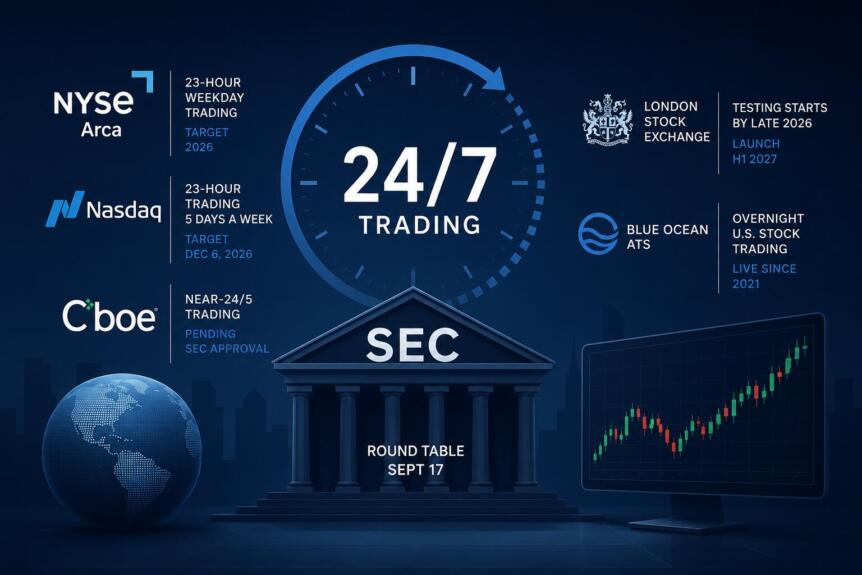
The SEC in the U.S. is scheduled to review the future of longer hours of the stock market after multiple exchanges in the nation have embarked on the journey of adopting trading that goes on almost through the day and night.
In a post made by Coin Bureau on X, it has been revealed that the SEC will organize a roundtable meeting on September 17, 2026 to discuss the implications of 24-hour trading in American financial markets.
SEC Plans Roundtable on Extended Trading Hours
According to Coin Bureau, it is reported that the SEC plans to organize a roundtable meeting to discuss the adoption of 24-hour trading for the U.S. stock exchange markets. The meeting will be held on September 17 and will revolve around the impact such changes will have on trading operations and the trading infrastructure.
The decision comes after rising interest from exchanges looking to extend their trading times. Even though the SEC has not granted permission for a national conversion to 24-hour trading, the discussion is a clear indication that the regulator is assessing proposals by exchanges.
Major Exchanges Advance 23-Hour Trading Plans
NYSE Arca is set to roll out 23-hour trading on weekdays and hopes for an implementation in 2026, based on information cited by Coin Bureau.
Nasdaq is planning to initiate 23-hour trading from December 6, 2026.
In the meantime, Cboe plans to roll out nearly 24/5 trading pending approval from the Securities and Exchange Commission. Across the globe, the London Stock Exchange is set to commence trials of extended hours trading by the end of 2026 and roll out a more comprehensive implementation in the first half of 2027.
Blue Ocean ATS Already Operates Overnight Trading
In contrast to other exchanges that are currently in the process of formulating their proposals, Blue Ocean ATS has provided its users with overnight U.S. stock trading since 2021. The company’s current system shows that an extended trading setup is operational, but it is used by a different category of customers.
With an increase in applications from exchanges for extending their trading periods, investors will have greater freedom to react to events beyond regular trading hours. Any further implementation will be subject to regulators’ decisions after their review process at the SEC.
Crypto Markets Provide a Reference for Continuous Trading
The cryptocurrency trading markets, from inception, have followed a trading model that is operational for 24 hours a week without market hours constraints. The current propositions being made by exchanges seem to indicate an increasing desire to extend similar flexibility to equity traders.
As things stand now, the SEC’s roundtable discussion is what constitutes the next phase in determining how extended trading can be integrated into the American financial framework. In any case, any modifications to market hours will have to be first sanctioned by the regulators.
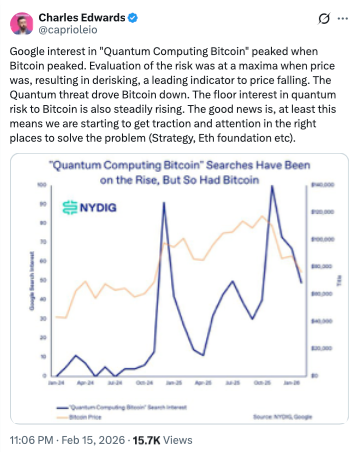
Bitcoin developers need to swallow their pride and outline a clear plan to harden the blockchain against quantum computing attacks, according to Capriole Investments founder Charles Edwards. He says the day they finally bite the bullet, the price will respond very quickly.
“If the Bitcoin core team says in two or three months: ‘this is our roadmap, we’re gonna solve it in the next two years, these are the rough steps we’ll take,’ that would be amazing news,” Edwards tells Cointelegraph on Trade Secrets.
“I think that would discount a lot of the risk pretty much overnight,” Edwards says.
The question of whether Bitcoin developers should modify the network to make its cryptography quantum-resistant has sparked heated debate within the Bitcoin community, with some arguing that major changes could conflict with Bitcoin’s core ethos. Others claim quantum computers are many years away, and a rushed cure could be worse than the disease.
Charles Edwards says a clear roadmap could push price up “very quickly”
Edwards often highlights the risk of quantum computing to Bitcoin to his 132,800 X followers. The fear is that, one day, powerful enough quantum computers could break the cryptography that protects the Bitcoin network and potentially compromise Bitcoin wallets.
The uncertainty has impacted investor sentiment, and some analysts say it has contributed to the downfall in Bitcoin’s price. The world’s largest asset manager, BlackRock recently pointed to quantum computing as a potential long-term risk in materials for spot Bitcoin ETF investors.
However, Edwards says if Bitcoin developers outline a clear roadmap to address the quantum threat, as some other chains have already done, it could send Bitcoin’s price higher “very quickly.”
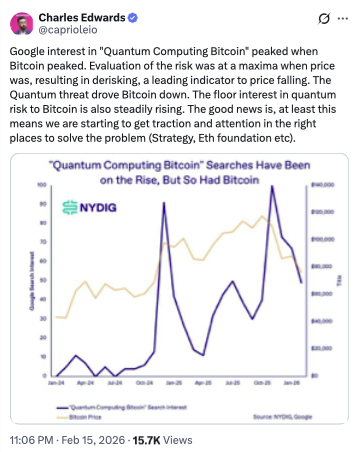
Source: Charles Edwards
“Double digits probably,” Edwards predicts. He adds the quantum issue is “somewhat counterintuitively an upside catalyst potential,” because it is currently on the back burner and the Bitcoin Improvement Proposals (BIPs) to date are “not really” a genuine solution.
Edwards is no stranger to making high-conviction calls on Bitcoin. Based in Melbourne, Australia, he founded Capriole Investments in 2019, a hedge fund focused on Bitcoin and digital assets. The firm uses a combination of quantitative models, AI, and macroeconomic analysis to guide its investment strategy across crypto markets.
Related: StarkWare CEO suggests 4% annual Bitcoin inflation to replace 21M cap
Charles Edwards says Bitcoin is 40% below its fair value
A growing number of observers worry the risk could become more serious if Bitcoin developers fail to make the necessary changes to the network before 2030. Ethereum is due to complete it’s post quantum overhaul by 2029, which will shine a spotlight on Bitcoin’s own preparations.
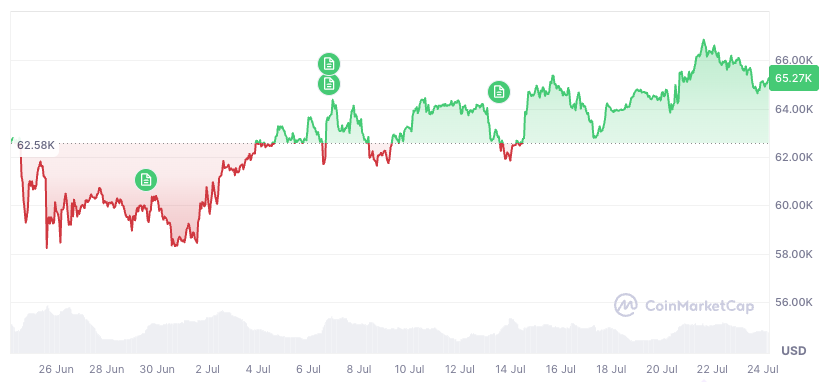
Bitcoin is trading at $65,270 at the time of publication. Source: CoinMarketCap
Edwards estimates that Bitcoin is currently around 40% below what he considers its fair value based on energy value, while arguing that quantum risk accounts for roughly a 30% discount. “That means it’s more than priced in,” Edwards said. Bitcoin is trading at $65,270 at the time of publication, roughly 49% below its October all-time highs of $126,100.
Edwards clarifies that Bitcoin’s current price reflects the quantum risk based on the information available today, rather than any unknown future developments that could accelerate the threat and tank the price further.
His estimate is based on the timelines outlined by leading quantum computing companies and researchers for when “Q Day” could arrive, the point at which quantum computers become powerful enough to reverse engineer private keys from public keys.
“That sits in that four to five year range, give or take, a few years,” Edwards says.
Edwards says he also factors in the time Bitcoin would need to develop and implement a solution, which BIP-360 author Ethan Heilman estimates could take years.
“If we’re gonna get into maths, it’s pretty simple; it is just an aggregation of those expert opinions. So it’s based on that, and based on the fact that there’s currently no solution for Bitcoin.”
“That risk again falls significantly if there’s a solution or if there’s a roadmap to a solution. But it also could grow if tomorrow we find out that Google is, you know, twice as far ahead on their roadmap to Q Day or some other major company,” he said.
“It’s priced in today, but it’s not to say that it can’t get worse or better. It’s just I think it’s skewed more probabilistically to the upside from here,” Edwards says.
Magazine: Bitcoin’s quantum dilemma: Bigger blocks or STARK proofs?
Cointelegraph publishes long-form journalism, analysis and narrative reporting produced by Cointelegraph’s in-house editorial team with subject-matter expertise. All articles are edited and reviewed by Cointelegraph editors in line with our editorial standards. Content published in here does not constitute financial, legal or investment advice. Readers should conduct their own research and consult qualified professionals where appropriate. Cointelegraph maintains full editorial independence.

Bitcoin price is holding up better than many risk assets despite a bearish prediction. BTC is trading near $65,500 after briefly slipping toward $64,600 intraday. That relative resilience stands out after the recent wave of selling. Still, the next move remains less certain than the rebound suggests.
The latest pullback followed renewed pressure across risk assets as investors trimmed exposure to growth and technology names. Bitcoin remains well below its cycle high near $126,000, while market value has contracted sharply. Meanwhile, margin-related selling added pressure as some traders liquidated BTC to meet collateral calls.
At the same time, weakness in major technology stocks has weighed on market sentiment. Heavy selling in large-cap names has made institutional investors more cautious. As a result, crypto has struggled to attract fresh momentum despite Bitcoin’s relative strength.
Whether BTC has carved out a tradable floor or is simply pausing before another leg lower depends on several technical and liquidity signals. Bulls must defend nearby support while reclaiming higher resistance levels. Otherwise, another wave of selling could keep the price under pressure before a stronger recovery begins.
Discover: The Best Token Presales
Bitcoin Price Prediction: Recover Above $70,000 While ETF Outflows Continue?
BTC is unlikely to reclaim higher levels quickly. Trading near $65,500, Bitcoin remains below the key resistance around $68,000. That area turned into resistance after the recent breakdown. Reclaiming it likely requires stronger macro sentiment or a clear improvement in spot ETF demand.
Spot Bitcoin ETFs have continued to see net outflows over its last session, showing institutions remain cautious. That is more than short-term noise. Until ETF demand steadies, the current trend lacks a strong catalyst for a sustained reversal.

Meanwhile, stronger support sits between $60,000 and $62,000, a zone that could come into focus if selling pressure returns. Bitcoin volatility has also compressed after recent swings. Historically, that setup often precedes a larger move instead of a slow, sideways grind.
The bullish case sees ETF flows stabilize, macro data support risk assets, and BTC reclaim $68,000. That could open the door to retesting $72,000. The base case keeps Bitcoin trading between $64,000 and $68,000 as markets await fresh catalysts. However, a sustained break below $64,000 could expose the $60,000 to $62,000 support zone. The trend remains cautious until price proves otherwise.
Trade BTC on Bybit and Get a Chance to Win Our $1,000 USDT Airdrop
Bitcoin Hyper Targets Early-Mover Upside as BTC Tests Critical Support
Here’s the uncomfortable truth for spot BTC holders: at current prices near $65,500, the risk-to-reward profile is less attractive than it was months ago. A recovery to $72,000 offers roughly 10% upside, while a drop to the $60,000 support zone implies about 8% downside. That makes chasing momentum less compelling unless Bitcoin reclaims key resistance.
As a result, some active traders are rotating into earlier-stage infrastructure and ecosystem plays tied to Bitcoin. Those assets have not appreciated as much as BTC during this cycle, giving them more room to run if market sentiment improves.
Bitcoin Hyper ($HYPER) is positioning itself as the first Bitcoin Layer 2 with Solana Virtual Machine (SVM) integration, targeting Bitcoin’s three core limitations: slow transactions, high fees, and near-zero programmability.
The presale has raised $33 million at a current price of $0.0136836, with staking available for early participants. The project has attracted attention for its decentralized canonical bridge for BTC transfers and sub-Solana-latency execution.
Research Bitcoin Hyper before the current presale stage closes.
Discover: The Best Crypto to Diversify Your Portfolio
The post Bitcoin Price Prediction: BTC USD Shrugging Off $800 Billion AI Sell-Off appeared first on Cryptonews.

Mindset for business and financial success

Brew York and Goose Beck Vineyard speakers at free event

Grupo Rotoplas S.A.B. de C.V. 2026 Q2 – Results – Earnings Call Presentation (OTCMKTS:GRPRF) 2026-07-24


-

 Fashion7 days ago
Weekend Open Thread – Corporette.com
-

 Politics6 days ago
The House | The City of London can help the new chancellor deliver growth in every postcode
-

 Crypto World6 days ago
Ripple Payments Joins MiCA With 14 Firms, Does It Mean Anything For XRP?
-

 Politics5 days ago
Democrats look to World Cup watch parties to register thousands of voters
-

 Crypto World7 days ago
Ripple wins EU-wide access as ESMA adds it to MiCA register
-

 Crypto World3 days ago
Grayscale Files For Worldcoin ETF, WLD Registers Sharp Rise
-

 Tech4 days ago
Sail Virtually Aboard The “Itanic” With IA-64 Emulator
-

 NewsBeat4 days ago
Unregistered fitter used Gas Safe logo on business flyers
-
 Tech3 days ago
Turtle Beach Command Series KB7 review: a nifty screen-equipped gaming keyboard
-

 News Videos5 days ago
Big Money Is Entering XRP
-
 Business2 days ago
New Jersey voter registration controversy explained: How 6,600 noncitizens got on the rolls, and what happens next
-

 Crypto World6 days ago
Kaspersky exposes OkoBot’s 20-module crypto wallet attack
-

 Business7 days ago
Airlines warn Sunshine Protection Act could disrupt flight scheduling
-
 Entertainment3 days ago
Johnny Depp’s R-Rated Gothic Cult Classic Gets New Release Ahead of Sydney Sweeney Remake
-

 NewsBeat6 days ago
Durham County Council to send out electoral registration emails
-

 Crypto World6 days ago
MiCA Licensing Faces Delays as ESMA Adds 14 CASPs to Register
-

 Crypto World2 days ago
Ethics, other provisions in crypto Clarity Act to be further discussed
-
 NewsBeat3 days ago
Shanghai science forum photos show China’s AI and robotics advances in rivalry with US
-

 Crypto World6 days ago
Chip Stocks Enter Bear Market After Moonshot Ai Unveils Kimi K3 Model
-

 Tech4 days ago
Watch Flock Safety CEO Garrett Langley discuss the future of surveillance at TechCrunch Disrupt 2026
You must be logged in to post a comment Login