
Crypto World
EU Finance Groups Seek to Lift Tokenized Securities Cap

European financial and tokenization stakeholders have escalated their push for changes to the EU’s Distributed Ledger Technology (DLT) Pilot Regime, warning that a proposed cap of 100 billion euros could choke off scaling. In a letter dated Sept. 7 and addressed to members of the European Council and the European Parliament’s Economic and Monetary Affairs Committee, a coalition urged lawmakers to remove the limit entirely or, if it remains, raise it to at least 500 billion euros.
The group argues that some existing European tokenization efforts have already reached a scale of about 350 billion euros and are planning further expansion. They also claim the EU’s proposed cap is mismatched to how global markets size up, noting that the threshold would be based on the market value of instruments admitted to DLT infrastructure rather than trading volumes.
Key takeaways
- A coalition of European financial and tokenization firms wants EU lawmakers to remove the proposed 100 billion euro cap on tokenized financial instruments or raise it to at least 500 billion euros.
- The letter, dated Sept. 7, is directed to EU Council members and the European Parliament’s Economic and Monetary Affairs Committee.
- Signatories include Nasdaq, Boerse Stuttgart Group, Securitize, the European Ethereum Institute and Axiology.
- The DLT Pilot Regime’s thresholds are described as based on admitted market value, making the EU cap small relative to global equity markets.
- Backers point to the US as an example of tokenization without volume-style limits, arguing Europe risks falling behind.
Why the 100 billion euro cap is drawing fire
The coalition’s central concern is the scale implied by the EU’s draft proposal. The letter states that lawmakers should treat 500 billion euros as a baseline if they decide to keep any cap on tokenized financial instruments.
In their view, the proposed 100 billion euro ceiling would be too low for Europe’s tokenization trajectory. They cite that certain regional projects already approach 350 billion euros in scale and plan additional growth, suggesting that a tighter cap would effectively force regulatory bottlenecks before the market has a chance to expand.
The industry letter also frames the limitation as structurally restrictive because of how it is measured. According to the signatories, the thresholds apply to the market value of financial instruments admitted to DLT infrastructure—rather than the volume of trading activity. That distinction, they argue, makes the proposed 100 billion euro number relatively small when compared with the size of global equity markets.
What the EU is proposing under its Market Integration package
The debate is linked to the European Commission’s Market Integration and Supervision Package. As described in the source, the Commission has proposed increasing the current cap—set at 6 billion euros—to as much as 100 billion euros, as part of revisions to the DLT Pilot Regime.
The DLT Pilot Regime, which took effect in 2023, allows eligible financial firms to test blockchain-based trading and settlement of assets such as stocks and bonds. It does so through exemptions from certain EU financial rules, enabling experimentation without fully stripping away regulatory guardrails.
For participants in the ecosystem, however, the issue is not whether the program should exist—it is whether the limits imposed on tokenized instruments are calibrated to real-world growth. The coalition’s letter argues that the proposed tighter ceiling would limit the ability of regulated on-chain markets to scale within Europe.
US comparison: “no volume caps” for tokenized equities
A major part of the coalition’s argument is comparative. In the letter, signatories contrast the EU framework with the United States, claiming that in the US, a dominant settlement platform enables tokenization of equities and other assets without volume caps.
The letter goes further by asserting that such an approach could cover as much as 150 trillion euros in assets. While the claim is presented as the coalition’s assessment, the underlying message is consistent: if Europe places restrictive caps on tokenized assets, global liquidity may gravitate to jurisdictions with fewer scaling constraints.
That comparison matters for investors and market operators because tokenization’s promise—especially for liquidity, settlement efficiency, and potentially broader access—depends on scale. Caps that are tight relative to market size can turn what should be regulatory sandboxes into permanent ceilings, reducing the economic case for deploying infrastructure in the region.
A repeated pattern: pressure on DLT rules over multiple months
This latest letter is not the first time firms have urged EU policymakers to adjust the DLT Pilot Regime. The coalition’s push follows earlier industry campaigns aimed at changing both the limits and the operational boundaries of the regime.
In April, 39 financial firms and industry groups—including Nasdaq and Boerse Stuttgart—called on EU policymakers to fast-track amendments and raise the regime’s overall limit to a range between 100 billion euros and 150 billion euros. That April proposal also sought broader asset eligibility and the removal of time limits on licenses issued under the program.
Earlier still, in February, tokenization and market infrastructure firms including Securitize, 21X and Boerse Stuttgart issued warnings that existing asset limits, volume caps and time-limited licenses were restricting the growth of regulated on-chain markets in Europe. That warning argued that without faster changes, liquidity could shift toward US markets as US regulators move toward larger-scale tokenization and onchain settlement.
Taken together, these efforts point to a recurring tension in the EU’s approach: the DLT Pilot Regime is designed as a testing framework, but industry participants want it to function more like a scalable launchpad for regulated tokenized markets. The letter from Sept. 7 reflects that shift in emphasis—from enabling pilots to ensuring they can grow beyond the early phase without hitting regulatory ceilings.
The push also arrives as distributed real-world assets (RWA) continue to build, even if the sector remains smaller than traditional capital markets. One cited figure in the source places the total value of distributed RWA at about $39.15 billion, excluding stablecoins, with US Treasury debt as the largest category at roughly $15.8 billion, according to RWA.xyz.
What to watch next
Lawmakers will now have to weigh whether the EU’s cap structure should be recalibrated to support tokenization scale, or whether limits should remain tighter for oversight reasons. For market participants, the key follow-up will be how the EU responds to the Sept. 7 request for either removal of the cap or a major increase to at least 500 billion euros—and whether revised thresholds continue to be based on admitted market value rather than other measures.



The exchange is offering up to 10x leverage on private-company valuations alongside 100 tokenized stocks and ETFs.

Coinbase has struck a partnership with payments and financial-technology platform Moov to bring stablecoin infrastructure to over 1,000 community banks and credit unions in the U.S. The companies say the integration is designed to help these smaller institutions support stablecoin payment acceptance, settlement, and real-time funding using Coinbase’s regulated digital-asset infrastructure.
In its announcement, Coinbase framed the effort as a way to expand practical stablecoin use beyond large banks and into retail-focused financial services. The planned infrastructure also includes options for businesses and merchants to access Coinbase custodial accounts, alongside payment-related features for consumer and commercial workflows.
Key takeaways
- Coinbase and Moov plan to connect stablecoin payment acceptance and settlement for 1,000+ community banks and credit unions.
- The infrastructure is positioned for consumer payments, merchant settlement, and payout use cases.
- Coinbase’s regulated digital asset infrastructure will be combined with Moov’s payments platform to enable real-time funding.
- The initiative lands as major U.S. banks continue experimenting with stablecoin rails and issuance programs.
- Non-bank players are also building stablecoin offerings, such as wallet-and-card products tied to public blockchain infrastructure.
Community institutions get a stablecoin payments pathway
The partnership is aimed at a segment of the U.S. financial system that typically has fewer internal resources to build stablecoin capabilities from scratch. Coinbase describes the effort as using its regulated digital asset infrastructure together with Moov’s payments layer to deliver stablecoin payment acceptance, settlement, and real-time funding to Moov’s customer base.
Coinbase specifically notes that the resulting setup is intended to support a range of transactional scenarios, including consumer stablecoin payments and merchant settlement and payouts. It also highlights that businesses and merchants would have access to Coinbase custodial accounts, which can be a key requirement for institutions trying to manage stablecoin holdings and transaction flows under existing operational controls.
For investors and operators, the practical significance is less about speculative token adoption and more about distribution: if community banks and credit unions can integrate stablecoin features into existing payment and funding rails, stablecoin usage may spread through retail banking channels rather than only via crypto-native apps.
How this fits into broader U.S. stablecoin experimentation
Coinbase’s Moov tie-up arrives amid continued activity from larger U.S. banks exploring stablecoin infrastructure. The announcement follows a report that U.S. Bank, the fifth-largest commercial bank in the U.S., completed a live cross-border payment using its proprietary USBDC stablecoin on the Stellar blockchain. Earlier coverage also described how major institutions are testing the mechanics of faster settlement and payment interoperability while working within regulatory and operational constraints.
Meanwhile, industry momentum at the issuer level has been building. Earlier this month, 21 financial institutions—including Bank of America, Citi, Goldman Sachs, Deutsche Bank, and UBS—announced plans to form a company intended to issue stablecoins, including a U.S. dollar-denominated stablecoin in the first half of 2027. While that initiative is distinct from Coinbase and Moov’s partnership (it centers on issuance rather than payments enablement for community institutions), it signals that stablecoins are moving from pilot concepts toward structured plans.
What remains uncertain is how widely these efforts will translate into everyday consumer usage and whether stablecoin payment adoption at community institutions will accelerate as product offerings mature. Still, partnerships like this one suggest a shift toward practical integration—bringing stablecoin capabilities closer to the customer journeys that banks already serve.
Competition isn’t only from banks: non-bank stablecoin products expand
Stablecoin infrastructure development is not limited to banks and regulated financial groups. Non-bank competitors are also pushing into consumer-facing experiences built on stablecoin rails.
In August, Western Union reportedly partnered with stablecoin infrastructure provider Rain to launch a digital wallet and Visa-branded card that allows users to hold and spend a U.S. dollar-backed stablecoin. That kind of product matters because it reduces friction for users who want stablecoin functionality without needing to manage accounts on exchanges or understand custody setups directly.
Compared with Western Union’s wallet-and-card approach, Coinbase and Moov’s collaboration is more institution-centric—designed to let banks and credit unions deliver stablecoin payment services within their own offerings. Together, these parallel tracks highlight a broader market pattern: stablecoins are being embedded both in traditional distribution networks (banks and merchants) and in consumer fintech interfaces.
Why custody and settlement design could be the real battleground
Coinbase’s mention of custodial accounts for businesses and merchants points to an important operational theme in stablecoin adoption: beyond sending value, institutions must solve for storage, controls, compliance requirements, and settlement processes.
Coinbase says the Moov partnership will enable stablecoin payment acceptance, settlement, and real-time funding by combining regulated infrastructure with Moov’s payments platform. The inclusion of real-time funding and settlement features suggests the partnership is oriented toward transaction handling that can fit into banking operations, rather than simply facilitating on-chain transfers.
For community banks and credit unions, the appeal is straightforward: they may be able to access stablecoin capabilities through established infrastructure layers rather than building internal systems for custody and settlement. For merchants and businesses, the ability to connect stablecoin workflows with custodial services could reduce operational overhead and speed time-to-launch—though the extent of availability, pricing, and rollout timelines were not specified in the announcement.
As the U.S. stablecoin landscape continues to evolve—through bank experiments, planned issuance efforts, and consumer-facing wallet products—partnerships that translate infrastructure into day-to-day payments may shape which models gain traction first.
What to watch next
Readers should track how Coinbase and Moov roll out the integration across Moov’s community bank and credit union network, and whether early pilots expand into broader merchant and consumer payment flows. Just as important will be how these projects align with the wider U.S. banking ecosystem’s stablecoin infrastructure tests and forthcoming issuance plans.


When Lynn Henderson walks into her local grocery store in British Columbia, she has one label at the top of her mind: “Made in Canada.” The 47-year-old is among a drive of Canadian consumers who are attempting to boycott U.S. products in a show of solidarity amid the ongoing trade war. “Even when I’m shopping with my toddler, he now asks specifically, ‘Oh, are these apples Canadian?’ And he will ask that before putting it in the cart,” Henderson tells TIME, noting that it’s a family effort. It costs more, she admits, but it’s worth “knowing that money is staying here in Canada and not going south at the border.”
The resurgence of the “Buy Canadian” movement comes amid a deepening U.S.-Canada trade dispute that shows no signs of waning. Canada’s retaliatory tariffs on U.S. goods took effect Tuesday, with Prime Minister Mark Carney matching the economic pressure imposed by the U.S. after trade negotiations collapsed last month. The U.S. has since announced a ban on Canadian dairy, motorcycles, and most alcoholic beverages. It’s all unfolding against the backdrop of U.S. President Donald Trump repeatedly talking of his ambitions to annex Canada and make it the 51st state.
While Carney’s government is going toe-to-toe with the Trump Administration, he’s urging the general population to take action, too.
“The most powerful actions have come from you: Buying Canadian and travelling in Canada,” Carney told Canadians in a national address Tuesday. “Decisions taken at the kitchen table, not the boardroom table.”
Other lawmakers have shared similar calls to action. “‘Buy Canadian’ reflects the economic solidarity Canadians are showing at a time when it matters most,” Quebec minister Joël Lightbound said in a statement to TIME. “By supporting one another and investing in what we build here at home, we are building Canada strong.”
Canadian consumers have responded en masse to the call. A Build Canada poll conducted Aug. 31-Sept. 4 found that many are already making sacrifices at the tills, as 69% of respondents reported “choosing Canadian products despite higher prices” and 55% said they had “stopped buying specific American brands.” Reports also indicate a surge in demand for Canadian products.
As the trade war stretches on, here’s what to know about the revitalized “Buy Canadian” movement, the people behind the U.S. products boycott, and what the data says about the effectiveness of the consumer-driven action.
The resurgence of the “Buy Canadian” movement
Campaigns promoting Canadian-made goods date back at least to the early 20th century, when Canadian manufacturers began pushing their “Made in Canada” products.
Among consumers, the effort has evolved into the “Buy Canadian” initiative, which encourages residents to support local businesses and industries as much as they can.
The movement skyrocketed last year in the midst of the trade war sparked by Trump’s tariffs. Businesses and consumers alike vowed to shun U.S. products, with Canada-based media publishing advisories on “how to shop Canadian.“
As the tariffs loomed in February 2025, a survey by accounting firm KPMG found that 93% of consumers wanted retailers and grocery stores to identify and promote Canadian products.
In late 2025, the Canadian government launched the “Buy Canadian Policy, to protect and prioritize Canadian workers and industries, and strengthen Canada’s domestic economy.”
Henderson, a public relations consultant, says Trump’s threats against Canada’s sovereignty last year signified a turning point.
“Canadians have felt for generations that these are not just our allies, but our friends, and neighbors,” she says. “Nobody wants to be spoken about like that by their friends and neighbors. It’s really hurtful.”
The reignited trade rift has revived Henderson’s passion for patriotic shopping, and she’s actively refrained from purchasing items, such as a new iPhone, that don’t align with her efforts. “I don’t want to spend that money to support an American business,” she says.
How consumers dedicated to the movement are approaching the challenge
Consumers in Canada are finding different ways to navigate how best to boycott U.S. goods and services, putting extra time in at the grocery store to ensure they are buying Canadian as often as they can.
Although she prioritizes Canadian products, Henderson is also open to items from other countries.
“We’re discovering that there’s some incredible produce from around the world,” she says. “We don’t actually need to get oranges from the U.S. anymore, because we can get oranges from Brazil or South Africa, and they’re fantastic.”
Brian Leonard, a 37-year-old who works in the coffee industry and lives in New Brunswick, is similarly passionate when he heads to the grocery store, and firmly believes in starting each day with a “Buy Canadian” mindset.
“For me, it always begins first thing in the morning with a cup of coffee. Buying coffee that is roasted locally in Canada,” Leonard tells TIME. “The first decision of your day can be something that sets up your whole day to be part of the movement.”
The way in which Canadians have been re-energized to support more local products has been “astounding,” Leonard adds. “I had a call yesterday, and the person mentioned they had switched dish soap because they realized the soap they were buying was American-made,” he says.
The topic of patriotic shopping is dominating business groups on Facebook and elsewhere, bringing further attention to the movement.
These social media groups have become a gateway for people to come together when seeking out Canadian alternatives to U.S. products. The “Made in Canada – Canadian Products” Facebook group, for example, boasts 1.4 million members. Similarly, the Reddit forum r/BuyCanadian has more than 250,000 members and nearly 7,000 weekly contributions.
For some, the efforts extend beyond trips to the grocery store and online checkouts.
Henderson is also now avoiding U.S. travel. “I live very close to the border. It used to be very common to just [cross over] and go to Seattle, go to Trader Joe’s, or outlet malls, and we will not do that now,” she says. ”We’d rather explore Canada.”
Meanwhile, Shireen Jeejeebhoy, a 63-year-old writer based in Toronto, says she has also deleted WhatsApp, stopped using Zoom, and is even trying to find alternatives to Google and Apple products.
“These things are really difficult to divest yourself from,” she tells TIME, explaining that she uses the website “Unplug America”—an online initiative aimed at replacing American tech products with Canadian equivalents—for guidance. “There are some things in the digital world that Canada does not have, and so I’m looking to the U.K., the E.U., or India for alternatives.”
However, even someone as dedicated to the movement as Jeejeebhoy struggles to find alternatives for everything.
“My skin doesn’t react well to most sunscreens, and as much as I’ve tried Canadian brands, there’s only one American brand that actually works well [for me] at an SPF 50,” she says, admitting it’s proven to be difficult. “So, as much as I want to use the Canadian brand sunscreen, I have to use a particular American product.”
Leonard identifies with the struggle, admitting it can be “overwhelming to a lot of people to try to completely overhaul everything they buy,” as people have different budgets and needs.
Taking part in the movement doesn’t have to be a rigid commitment, nor does it mean you should deprive yourself of life’s little treats, the consumers who spoke to TIME agreed upon.
Is the Buy Canadian movement working? Here’s what the data says
The shift away from American products could have significant economic consequences for Canada, where the U.S. accounted for 67.2% of Canadian goods and services exports in 2025, making it the country’s largest trading partner by far.
The Bank of Montreal (BMO) estimated in April 2025, following the initial resurgence of the “Buy Canadian” movement, that the shift in consumer attitudes could redirect roughly C$10 billion to the Canadian economy annually.
“If we are directing C$10 billion or so of economic activity back into Canada, that would otherwise be bleeding out to the U.S., then that’s a direct benefit,” Robert Kavcic, director and senior economist at BMO, tells TIME.
The Bank of Canada released an analysis in February “assessing the Buy Canadian movement one year later.”
It found that households had shifted their food spending away from U.S. products and towards Canadian ones. “The shift is modest but clearly visible. In March 2025—as trade tensions escalated—the proportion of food spending on Canadian products went up by approximately 2% relative to January 2025, while the proportion spent on U.S. products fell by a similar amount. And what started in March wasn’t short-lived—it persisted through the summer,” read the analysis.
Kavcic explains that “a certain share of that spending is now reallocated domestically,” thus benefiting the Canadian economy.
“I don’t know if Canadians can do a lot more than what they have already, because there’s a cost to that. There are certain families or workers that have to travel back and forth to the U.S., and there’s a cost to buying Canadian,” he says.
Despite these challenges, statistics from the Canadian Survey on Business Conditions, for the first quarter of 2026 over the last 12 months, found that 16.6% of businesses had changed their marketing to promote Canadian products. Among retailers, the figure was 41.6%, showing a clear push toward promoting domestically made goods.
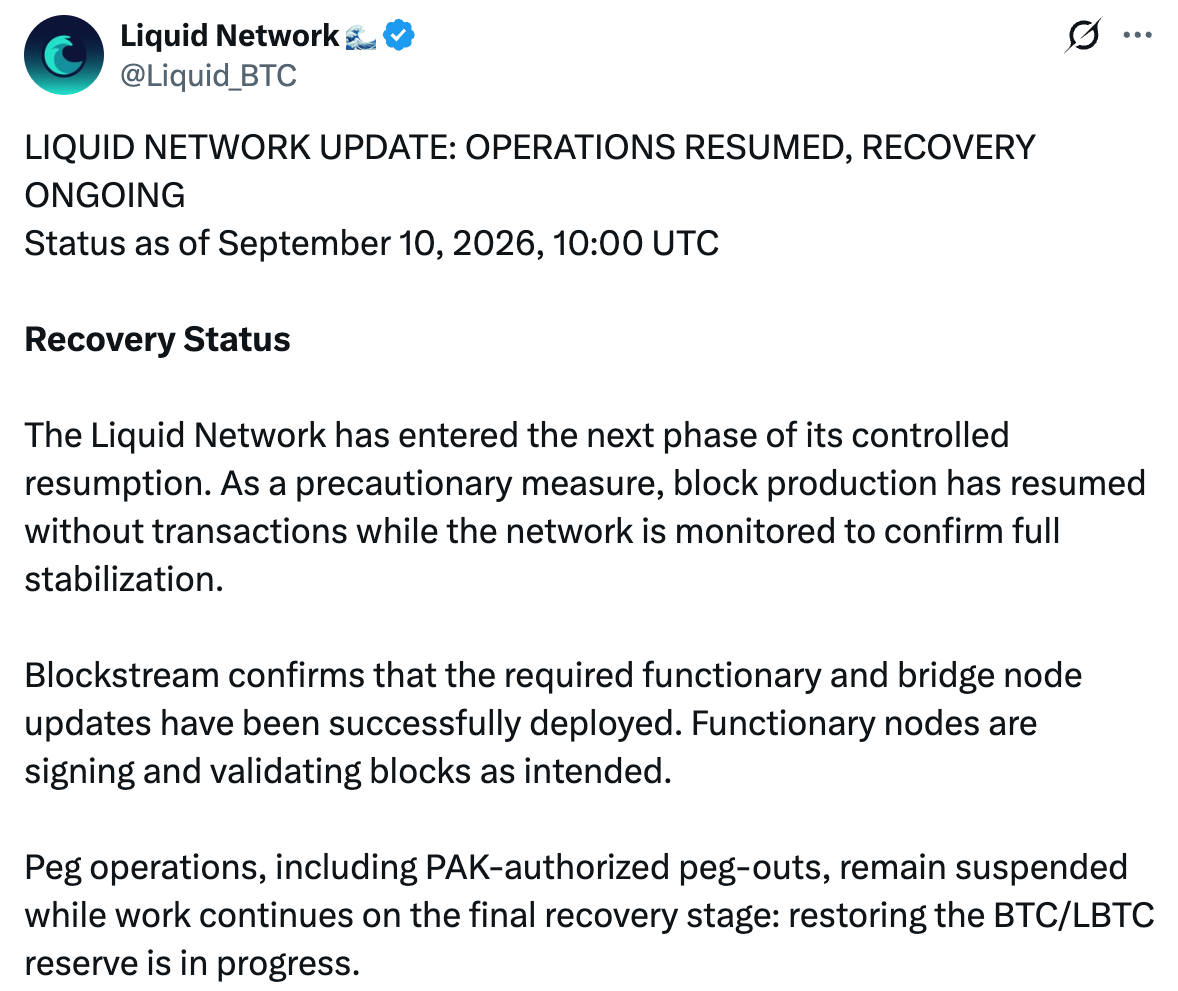
The Liquid Network has resumed block production following a $320 million Bitcoin withdrawal, although transactions and peg operations remain suspended as recovery efforts continue.
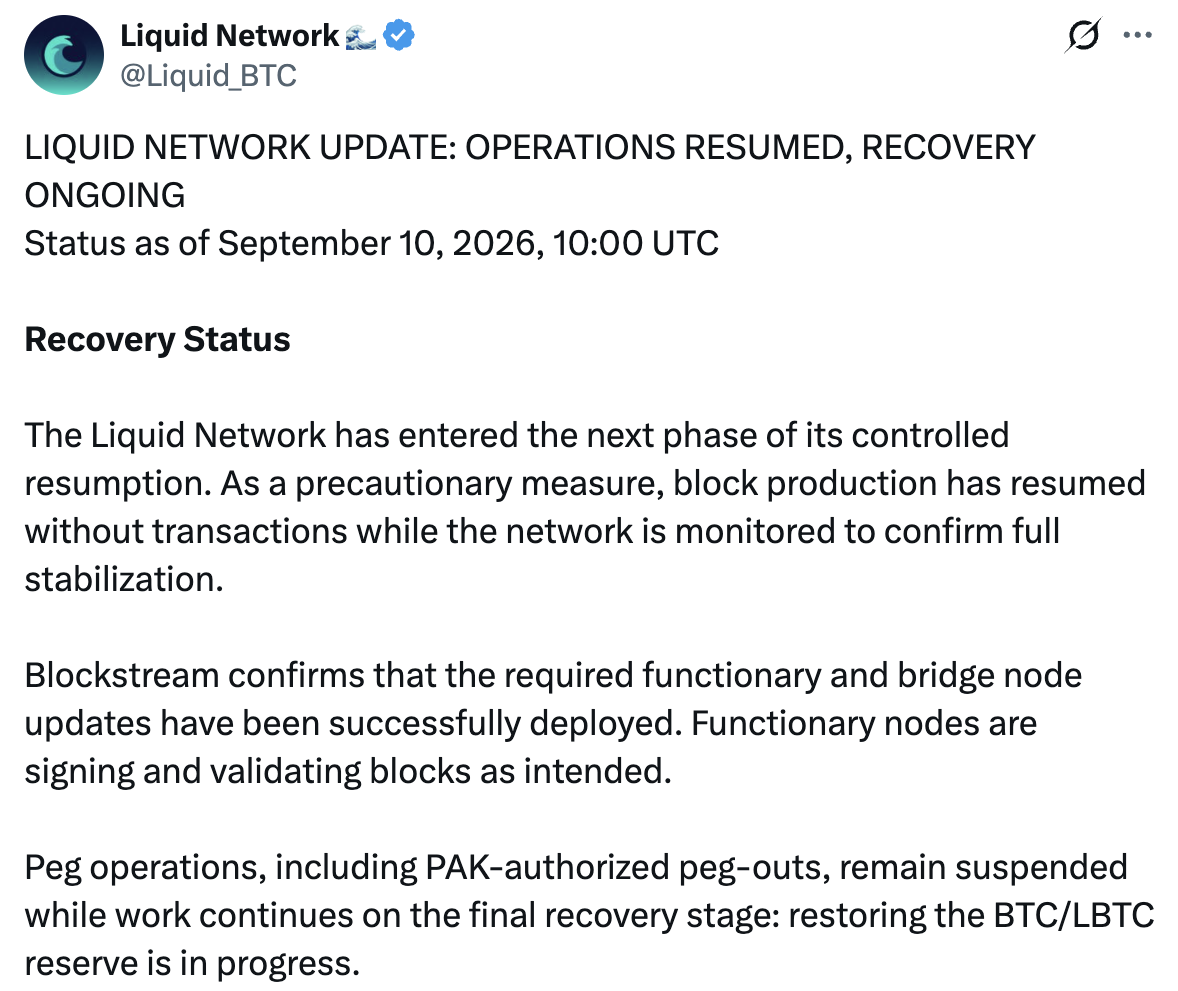
In a Thursday post on X, Liquid said block production had resumed “without transactions” as a precaution while the network is monitored to “confirm full stabilization.” Required updates to its functionary and bridge nodes have been deployed, with functionary nodes now signing and validating blocks as intended.
Peg operations, including PAK-authorized peg-outs, remain suspended while the network works to restore its BTC/L-BTC reserve.
A day earlier, Liquid released an emergency update to Elements, the software underlying the network, to address the proof-verification cache vulnerability linked to the incident. The update, Elements v23.3.4, hardened cache keys used for range proofs as part of the network’s recovery plan.
Source: Liquid Network
$270 million in Bitcoin returned after exploit
Liquid paused operations on Sept. 6 after actors claiming to be white-hat hackers withdrew about 4,000 Bitcoin (BTC), worth roughly $320 million, from the network’s federation wallet.
The withdrawal represented about 95% of the wallet’s roughly 4,200 BTC balance and involved L-BTC originating from a bug in Elements, the open-source software underpinning Liquid.
The actors subsequently returned 3,400 BTC, worth about $270 million at the time, after Blockstream confirmed that affected bridge nodes had been patched. About 598 BTC, worth roughly $46 million at current prices, remained outstanding as of Sept. 7.
Magazine: Token buybacks are booming. But are they good for crypto projects?
Jenson becomes the prediction market’s first CFO as Polymarket builds its regulated U.S. exchange and global platform.


PayPal, M0, and MoonPay have publicly launched PYUSDx after three products processed about $100 million through the business stablecoin platform.
Summary
- PYUSDx lets businesses issue programmable tokens backed one-to-one by PayPal USD.
- Saturn, Concrete, and Cap have processed about $100 million across three live products.
- Businesses can control token policies and allocate revenue generated by the backing.
- A shared swap facility converts supported tokens at par without separate liquidity pools.
M0 CEO and co-founder Luca Prosperi told crypto.news that PYUSDx gives businesses control over token rules, revenue, and administration that they would not receive by integrating PayPal USD directly.
PayPal, MoonPay and M0 introduced the platform in February as infrastructure for developers seeking to issue application-specific stablecoins without building the underlying token and reserve systems from scratch.
With the public launch, Saturn, Concrete, and Cap are using PYUSDx for three different products. Saturn operates a Bitcoin-backed lending product, Concrete runs an onchain investment vault, and Cap provides a credit platform.
According to Prosperi, the three products have processed about $100 million through the platform. The figure refers to processed volume rather than PYUSDx circulation or the value of reserves held against the tokens.
PYUSDx gives businesses control over token rules
A business can integrate PYUSD as an existing stablecoin or use PYUSDx to deploy a separate token with custom settings. Prosperi said the second option allows a builder to set administrative roles, compliance controls and upgrade policies for its product.
“When you hold someone else’s stablecoin, you use its programming and rulebook,” Prosperi said.
With a direct PYUSD integration, functions such as freezing, pausing, forced transfers, minting, and burning follow rules established by the issuer. Prosperi said most roles attached to a custom PYUSDx token instead belong to the business that deployed it.
Each builder can choose an administrator, apply compliance controls under its own policy, and determine how software upgrades are handled. According to Prosperi, a business can automatically adopt M0’s audited upgrades or follow its own process.
The model also gives businesses a share of the economics created by their tokens. Prosperi said revenue generated by PYUSD goes to its issuer, Paxos, while revenue accruing on the PYUSDx that backs a custom token can be sent to a treasury selected by the builder.
PYUSDx tokens are non-rebasing, meaning holder balances do not change automatically as revenue accumulates. The business can use the proceeds to reduce fees, fund rewards for holders, or add the money to its profit and loss account, according to Prosperi.
“The float economics that historically belonged to the issuer now sit one layer out, with the builder.”
Prosperi also said builders can use a template that accepts other approved stablecoins as backing, with separate limits for each asset. Wrapping and unwrapping occur one-to-one through a common swap facility, while transfers between supported blockchains use a burn-and-mint process.
Custom tokens carry three layers of backing
Every business-issued token is backed one-to-one by PYUSDx held in an onchain contract, according to Prosperi. Users can inspect the contract to verify the amount of backing attached to the token.
PYUSDx is backed by PYUSD held in reserve by MoonPay Digital Assets Limited, the issuer of PYUSDx. PayPal USD is issued by Paxos Trust Company, N.A., against dollar deposits, U.S. Treasuries, and cash equivalents.
The reserve structure runs from the custom token to PYUSDx, then from PYUSDx to PYUSD, and finally to the assets held against PYUSD. Prosperi described every link in the structure as fully reserved.
Responsibilities are divided among the participating companies. M0 supplies the onchain infrastructure and does not handle funds, while MoonPay manages the reserves supporting PYUSDx and Paxos holds the assets backing PYUSD, according to Prosperi.
Paxos operates as a national trust bank regulated by the U.S. Office of the Comptroller of the Currency. The OCC has proposed reporting requirements under the GENIUS Act for payment stablecoin issuers subject to its supervision.
Under the proposal, covered issuers would file a confidential report with the OCC each week for every payment stablecoin they issue. A separate quarterly filing would provide additional information required under the federal stablecoin framework.
PayPal has also extended PYUSD to more payment infrastructure since announcing PYUSDx. In July, the company added PYUSD to Polygon through the network’s Open Money Stack, which combines wallets, compliance tools and fiat conversion services.
Polygon Labs said the integration allows businesses to accept funds through cards, bank accounts or exchange balances, settle transactions in PYUSD and convert the stablecoin into local currencies through one system.
Shared reserves allow tokens to convert at par
Stablecoins with separate reserve pools may depend on individual markets and liquidity providers for conversions. Prosperi said the business-issued tokens on PYUSDx operate as different wrappers around the same underlying PYUSDx asset.
Moving from one custom token to another requires the first token to be unwrapped into PYUSDx before the second token is created through the wrapping process. According to Prosperi, the shared swap facility completes the conversion at par without a spread.
Projects do not need to fund separate liquidity pools for the process. Prosperi said the common backing also removes the need to establish a secondary market between each pair of business-issued tokens.
“There is no secondary market to bootstrap because there is nothing to price: the tokens are the same asset wearing different policies,” Prosperi said.
He compared the arrangement with deposits held at different banks that clear at par through a common settlement asset. Under the PYUSDx structure, the settlement asset is fully reserved, and a smart-contract transaction handles the clearing process, he added.
A fiat conversion follows several steps. Prosperi said users first exchange the custom token for PYUSDx at par, convert PYUSDx into PYUSD, and then use an off-ramp or redemption service that supports PYUSD-to-dollar transactions.
M0 uses the same swapping and bridging tools across its other tokenized finance products. Prosperi said the infrastructure currently makes Saturn’s and Cap’s tokens interchangeable and could later connect PYUSD-backed tokens with digital dollars supported by different reserves.
In June, Mastercard included PYUSD settlement in a service spanning Ethereum, Solana, Polygon, Base, Arbitrum, Canton, Tempo and the XRP Ledger.
Mastercard said the service allows issuers and acquirers to settle card transactions during weekends, holidays, and outside standard banking hours. Its existing security controls, fraud protections and dispute procedures remain part of the settlement process.
Payment use depends on velocity and counterparties
PYUSDx has entered public use through lending, credit, and investment products rather than consumer payments. Prosperi said DeFi-focused businesses formed the first group because onchain systems are already part of their standard operating tools.
According to Prosperi, blockchain activity can show whether a business-issued token has moved from collateral use into payments. He identified token velocity and counterparty mix as the two measurements he follows.
Velocity measures transfer volume against outstanding supply. Collateral often remains in one location, while a token used for payments moves between addresses more frequently.
“If a PYUSDx token’s velocity stays at DeFi levels a year from now, it has not left the building,” Prosperi said.
Counterparty mix tracks the destinations of transfers and the amount of activity moving toward fiat. Prosperi said merchant settlement and payroll use would appear as small, frequent transfers to addresses that are not smart contracts, along with unwrap-to-fiat transactions.
Distribution will determine whether such activity develops across PYUSDx products, according to Prosperi. Companies with millions of existing users will decide whether the infrastructure becomes part of everyday payments and merchant settlement.


Cosmos has launched a 17-company partner network as it prepares for a Wells Fargo tokenized-deposit rollout planned for fall 2026, according to its chief commercial officer.
Summary
- 17 qualified providers cover custody, compliance, security, infrastructure and systems integration.
- Wells Fargo plans to begin with a cross-border tokenized-deposit use case this fall.
- Banks must contract with providers separately and retain responsibility for compliance decisions.
- IBC supports ledger connectivity, while liquidity and policy standards still require industry agreement.
Cosmos Chief Commercial Officer Eran Barak told crypto.news that the Partner Network is designed to help banks move tokenization projects from trials into production without searching the open market for each service provider.
However, the network does not offer a pre-integrated system in which every participant operates under one technical and commercial agreement. Financial institutions must choose providers based on their needs, negotiate separate contracts, and determine how responsibility will be divided across the product.
“The Cosmos Tokenization Suite partner network is a qualified ecosystem, not a pre-wired integration marketplace,” Barak said.
According to Barak, participating companies have tested their services against the Cosmos Tokenization Suite across the functions banks may need for a complete tokenization product. Services include custody, wallet management, know-your-customer and know-your-business checks, compliance monitoring, core banking connections, node operations, and interoperability between ledgers.
Banks can therefore choose firms that already understand the Cosmos technology rather than assessing providers without experience using the system, he added.
Cosmos partner network removes the vendor search process
Commercial relationships will remain between each financial institution and the providers it selects. A bank’s regulatory environment, existing technology, and current vendor relationships will influence which companies it hires, according to Barak.
“What the network removes is the discovery and qualification burden — that work is already done,” he said.
“A bank evaluating tokenized deposits can move to implementation faster because the ecosystem is pre-vetted rather than open market.”
The Partner Network gives banks access to qualified providers, but it does not combine their services under one contract. Barak described the program as a vendor pool that can support different parts of a tokenized-deposit product.
Cosmos launched the network with 17 members, including BitGo, Blockchain.com, Blockdaemon, Galaxy Digital, OpenZeppelin, DFNS, and Hypernative. Other participants include Anseta, Balance, BCW Group, Coinbax, InfStones, Peersyst Technology, Silence Laboratories, Ubyx, Utila, and Zeeve.
Together, the companies offer custody, settlement, trading, transaction screening, wallet controls, smart-contract security, and blockchain infrastructure. Systems integrators within the group can also coordinate several providers for banks that do not want to manage each technical connection themselves.
Cosmos supplies the ledger and tokenization platform, while network members provide supporting products based on the bank’s requirements. The Cosmos Tokenization Suite can support round-the-clock payment settlement, treasury management, programmable escrow, trade finance, and payments initiated by software agents, according to the company.
A financial institution may keep an existing custody provider while selecting another network member for compliance screening, node operations, or ledger integration. Each provider would remain responsible for the service covered by its agreement.
Banks retain responsibility for compliance decisions
Accountability follows the contracts signed by the financial institution, Barak said. Cosmos is responsible for its digital ledger and tokenization technology under its agreement with the bank, while every partner remains responsible for its own service.
For example, a custody provider would handle matters involving access to assets, while a compliance company would be responsible for the accuracy of its screening product. Compliance decisions and regulatory liability remain with the bank regardless of the providers it selects, according to Barak.
Institutions seeking one contractor for the complete system can appoint a systems integrator. The integrator would serve as the primary contractor, with custody, compliance, or infrastructure providers working as subcontractors.
The model will receive its first named production test through Wells Fargo, Barak said. The U.S. bank is using Cosmos digital ledger technology to tokenize customer deposits, with an initial cross-border rollout planned for fall 2026.
Barak said the implementation is expected to add more clients, countries, currencies, and use cases through 2027. The rollout will place a regulated U.S. financial institution at the center of Cosmos’ effort to move tokenized deposits beyond limited trials.
Recent institutional discussions have also focused on measuring adoption through active financial products rather than market activity alone. A fintech executive recently argued that collateral would provide a clearer measure of bank adoption than cryptocurrency trading volume.
Cosmos uses IBC to connect separate bank ledgers
Tokenized deposits issued by different banks could remain divided across separate networks unless the institutions use compatible infrastructure and operating rules, Barak said.
Cosmos plans to address the technical part of that problem through the Inter-Blockchain Communication Protocol, or IBC. The open protocol allows assets to move directly between digital ledgers without relying on a central intermediary.
“Banks using IBC send assets directly to one another through self-hosted infrastructure, similar to how the internet routes packets,” Barak said.
IBC has operated in production for more than five years and already connects public and permissioned networks, according to Barak. Supported systems include Cosmos-based networks, Besu chains, Ethereum, and Solana.
Ongoing work is expected to add Canton, Cori, Parriot, and other networks later in 2026, he added.
Although IBC provides a transport layer between ledgers, Barak said technical connectivity does not resolve differences in compliance rules, liquidity practices, or settlement finality.
“That technology alone doesn’t solve fragmentation,” he said. “Compliance standards, liquidity practices, and settlement finality also need industry alignment.”
Under the model described by Barak, IBC provides the infrastructure for transferring assets and a neutral governance base for the protocol. Regulators and standards bodies would still need to establish common rules for the institutions and assets using those connections.
Wells Fargo rollout will provide production metrics
Cosmos plans to assess the Partner Network by measuring how quickly banks progress from a signed agreement to a live transaction, Barak said.
The company will also track the number of institutional users operating in production and transaction volume over time. Barak did not provide numerical targets for those measures or a date for publishing the first results.
Wells Fargo’s initial cross-border implementation is planned for fall 2026, followed by the proposed expansion across additional clients, countries, currencies and use cases through 2027.
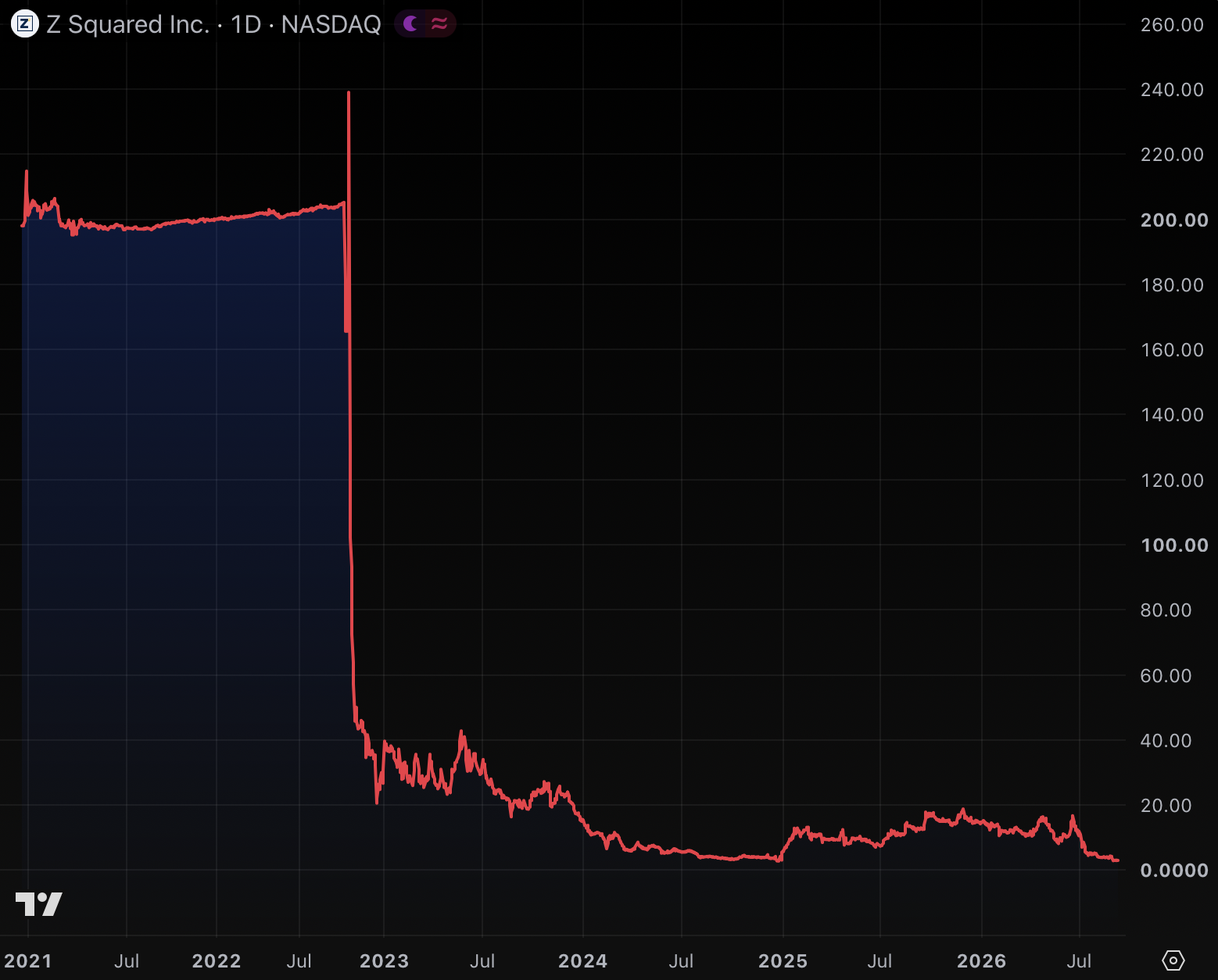
Z Squared, a public company that got Dogecoin mining rigs from a fund advertising 28% annual returns for investors, is facing SEC enforcement actions, a new seven-figure lawsuit from retirees, and a stock price down 76% over the past year.
Reitrees Paula and Stephen Darby, both 77 years old, sued Broad Street Global Management, LLC, BroadStreet, Inc, Steven Baldassarra, and Joseph Baldassarra in Miami federal court on September 4, and the court issued summons yesterday.
The Darbys allege that the Baldassarras “are trying to steal over half a billion dollars from their own investors, including the Darbys’ approximate $1,415,373.”
Anyone can make allegations in a civil lawsuit, which aren’t necessarily indicative of wrongdoing. Readers of a legal complaint shouldn’t interpret initial claims by plaintiffs seeking money as accurate nor probable.
The Broad Street Global Fund allegedly transferred investment interest from some of its investors into a Nasdaq-listed Dogecoin miner, Z Squared, whose ZSQR common stock has declined 76% over the past 12 months.
The Darbys’ complaint asks a judge to appoint a receiver over Broad Street Global Fund. It also seeks dissolution of the fund’s assets.
Among those assets sits a strange relic of the 2021 bull market — a year when BTC first rallied to $60,000, and Dogecoin first rallied to $0.73.
Today, for context, Dogecoin trades below $0.09.
The SEC steps in
In January 2025, the SEC sued Broad Street and its managers, alleging the group collected more than $1 billion from over 1,000 investors. The name Broad Street invokes the prestige of, but is unrelated to, a financial district street in downtown New York.
Investor money was supposed to fund hotels, custom home construction, and a South Carolina lagoon resort promising “perpetual income at rates of return never seen before.”
Disturbingly, Broad Street’s crypto mining division took in about $199 million after targeting outrageous, 28% annual returns.
A court-appointed monitor has overseen the company since April 2025, a few months after the SEC enforcement action.
Read more: Struggling bitcoin miner Hut 8 links to penny stock ring
$660 million of Dogecoin rigs that mine at a loss
With ongoing proceedings of the SEC case swept into the past, the mining arm worked to go public anyway. In April 2026, a blank check holding company merger brought the fleet of Dogecoin miners into the publicly-traded Z Squared.
Common shares of the combined company traded on Nasdaq under the symbol ZSQR.
Its CEO, David Halabu, had worked with Broad Street since late 2021.
Broad Street walked away with 41.5 million shares, about 81% of the company at the closing, and handed them to its members.
The valuation attached to that merger was ambitious. A valuation firm ascribed the 9,800-machine fleet a value of $660 million, even though that number assumed every machine was a flagship Bitmain L9 working on Dogecoin.
In reality, 8,228 of the machines were lower specification, L7 units.
Z Squared’s own books are less romantic. The machines came onto the books at $12.4 million and carried a net value of $11.3 million at quarter end. In the second quarter of 2026, the fleet earned just $1.6 million, 88% of it from Dogecoin.
Cost of revenue ran to 211% to simply generate that revenue, and the filing admited, “Our direct mining costs exceeded our mining revenue before giving effect to depreciation of our mining fleet.”
Its quarterly net loss was $13.8 million.
In other words, the company’s “$660 million” fleet of crypto miners generated money-losing revenue.
The Darbys want their cash
Broad Street’s November 2025 redemption notice offered investors two options for a payout: cash within 180 days, or stock of a Cayman acquisition company.
The Darbys chose cash. It was due on May 27, 2026.
With the deadline five days out, according to the Darbys, Broad Street changed their selection to the Cayman company’s stock. The Darbys are suing to get their cash.
Z Squared has since discovered artificial intelligence. On Wednesday it closed an all-stock purchase of an Arkansas data center campus with eight megawatts of power.
Halabu wrote to shareholders last month: “I would rather earn your confidence with delivered megawatts than ask for it with words.”
The SEC’s enforcement action remains ongoing. In the latest quarterly filing for ZSQR shareholders, the company disclosed, “BSG Series CM, LLC, the entity from which we acquired our entire mining fleet, was our controlling stockholder immediately after the business combination and is a named defendant in SEC enforcement proceedings.”
Got a tip? Send us an email securely via Protos Leaks. For more informed news and investigations, follow us on X, Bluesky, and Google News, or subscribe to our YouTube channel.

XRP hovers under $1.40 while the Ripple former chief architect just put a number on the maximalist dream: an eighteen-fold rally. That’s the gap David Schwartz, Ripple former CTO and one of the designers of the XRP Ledger, quietly implied during a live X Space.
“It is more likely that XRP flips Bitcoin due to surge in price of XRP than the collapse of Bitcoin.” — MC Solar Wind
David Schwartz, 2026 pic.twitter.com/hdDuF7VCEf
 (@MCSolarWind) September 9, 2026
Responding to a host who believes XRP will eventually surpass Bitcoin by market cap, Schwartz didn’t dodge the question; he reframed it. “I honestly have to say, I think XRP surging is probably more likely than not,” he said, adding that a flip is more plausible through XRP’s ascent than Bitcoin’s collapse.
The clip spread fast among XRP holders eager for validation from a technical insider. Fair enough, but the numbers behind that comment deserve scrutiny.

Bitcoin currently sits near $78,000, but XRP’s market cap runs about $87.25 billion, or just 5.5% of Bitcoin’s size. Closing that gap without Bitcoin moving requires exactly the kind of surge Schwartz described. The near-term tape isn’t cooperating with that narrative yet.
Trade Crypto on Bybit and Get a Chance to Win Our $1,000 USDT Airdrop
Can XRP Price Hit $1.50 This Week?
XRP’s daily range has stayed tight between $1.375 and $1.40, a compression pattern consistent with the descending-triangle setup analysts have flagged beneath resistance near $1.43–$1.46. Support sits at $1.34–$1.35, with deeper floors at $1.32 and $1.20 if momentum fails.
Bitcoin’s dominance reading of 59.05% and an altcoin season index of 39 both point to capital still parked in BTC rather than rotating into XRP or other majors.

- Bull case: A clean break above $1.43 opens a path toward $1.50, and more aggressive models put $1.68–$2.00 in play if the CLARITY Act clears the Senate on September 15 and ETF inflows accelerate.
- Base case: continued consolidation between $1.34 and $1.43 while traders wait on the Fed’s September 16 decision.
- Bear case: a break below $1.32 invalidates near-term bullish structure and opens room toward $1.20.
For deeper scenario modeling, see this extreme XRP price target breakdown and a more moderate long-term forecast for comparison.
Discover: The Best Token Presales
LiquidChain Targets Early Mover Upside as Ripple Tests Key Levels
An 18x surge to flip Bitcoin is a headline, not a trade setup. XRP would still need to pass Ethereum, Tether, and BNB just to reach third place. That’s the uncomfortable math nobody clips for social media.
For traders chasing outsized returns without waiting on a market cap miracle, attention is shifting toward earlier-stage infrastructure plays instead.
The Order rests. The architecture never sleeps.
⟁https://t.co/vqvBcdSQYC pic.twitter.com/bNof4XHJ58
— LiquidChain (@getliquidchain) September 9, 2026
LiquidChain ($LIQUID) is building a Layer 3 execution environment that fuses Bitcoin, Ethereum, and Solana liquidity into a single unified layer. With Liquid, developers deploy once and reach all three ecosystems rather than fragmenting across chains.
The presale token sits at $0.014954, with $960K raised so far. Core features include Single-Step Execution, Verifiable Settlement, and a Deploy-Once Architecture designed to cut cross-chain friction.
Those tracking early-stage L3 infrastructure can research LiquidChain before the next presale price tier.
Earn $50 and Enter $300K Prize Draw on EdgeX
The post Ripple Former CTO Says XRP Could Flip Bitcoin Through an 18x Surge appeared first on Cryptonews.

Join Our Telegram channel to stay up to date on breaking news coverage
MetaMask will become its own company by the end of 2026, and its owner is betting the wallet built for crypto can grow into a mainstream consumer finance platform.
Consensys Software Inc. announced on September 9 that it will split into two independent companies. The existing company rebrands as MetaMask, focused on the consumer platform, while a newly formed company takes the Consensys name along with the protocols and institutional infrastructure businesses, including Linea, Besu and Teku. Consensys co-founder Joe Lubin serves as chairman and CEO of MetaMask and executive chairman of the new Consensys. Mike Kriak leads the new Consensys as CEO, with David Cunningham as president.
For MetaMask, the split formalises a shift that has been underway for months. The company said in the announcement that the wallet will keep its focus on consumer self-custody while expanding beyond crypto into payments, savings, investing and traditional financial products.
The consumer buildout
The buildout began in 2025, when MetaMask launched its mUSD stablecoin on Ethereum and Linea. It added Bitcoin support in December after adding Solana. In February, eligible users outside the United States gained access to 200 tokenized US stocks, ETFs and commodities through Ondo Global Markets, and the Mastercard-enabled MetaMask Card reached 49 US states that month, expanding a product already live in Europe, Canada, Mexico, Brazil and Argentina.
In June, MetaMask launched Money Account, which lets users earn up to 4% variable APY on eligible mUSD balances and spend the funds through MetaMask Card. The company’s product leadership has framed the direction plainly: senior director of product Johann Bornman said at the time that the company was working toward a “neo-banking experience.”
Lubin said in the announcement that MetaMask has grown into “a platform where people don’t just hold their assets, but manage their money in its many diverse forms and aspects.”
The scale behind the bet is company-reported rather than independently checked: MetaMask says it has more than 100 million downloads across roughly 190 countries and has handled trillions of dollars in cumulative transaction volume.
The separation is expected to complete by the end of 2026. The company did not disclose financial details of the separation, and stayed mum on a possible IPO and token.
Join Our Telegram channel to stay up to date on breaking news coverage

From Precise Nutrition to Global Active-Lifestyle Aesthetics: Taiwan’s MCB Takes Center Stage at Vitafoods Asia 2026

OKX brings OpenAI and Anthropic bets to Europe as pre-IPO trading grows

Manchester United vs Sabah LIVE team news and how to watch Champions League opener


-
 Tech2 days ago
Memory prices are slowing because buyers ran out of money
-

 Crypto World2 days ago
Bitcoin price risks $76K drop as $78K support weakens
-

 Business15 hours ago
Micron Stock Climbs Above $1,031 as AI Memory Crunch and a $50 Billion Outlook Fuel the Rally
-

 Business16 hours ago
AMD Stock Climbs After Management Lifts 2027 Data Center Outlook Toward $70 Billion in AI Sales
-

 Crypto World2 days ago
Ethereum price stalls below $2,500 as ADX drops to 11
-

 Crypto World2 days ago
Robinhood Stock: How To Take Advantage With Reduced Risk
-

 NewsBeat2 days ago
What went right this week: an ‘historic’ fall in violent crime, plus more
-

 Crypto World18 hours ago
Bitcoin price risks $70K if $78K neckline breaks
-
 Crypto World1 day ago
Bitcoin price holds near $79K as cycle drawdowns narrow
-
 Sports2 days ago
Phones confiscated, players sent home: Pakistan’s England tour turmoil revives memories of Mohammad Amir, Salman Butt and Mohammad Asif’s 2010 Lord’s spot-fixing scandal | Cricket News
-

 NewsBeat2 days ago
England up in reading, maths and science rankings as Scotland and Wales dip
-

 Business2 days ago
Meta debuts long-awaited personal AI agent, Muse
-
 Crypto World2 days ago
Brent Crude Oil Moves Above $100 for the First Time in 3 Months
-

 Crypto World2 days ago
Intel Stock Jumps 9% on Chip Price Hike Report, US Stake Gains $36 Billion
-

 Crypto World2 days ago
Pump Fun and Kraken delete Hunter Biden $LAPTOP promotion
-
 Tech2 days ago
Strong Password Policy and Password Manager Guide
-

 Crypto World2 days ago
Visa expands stablecoin card network to 160 programs
-

 Business2 days ago
Egyptian TV Presenter Sarah Khalifa, 11 Others Sentenced To Death In Major Drug Trafficking Case In Cairo
-
Business2 days ago
Xometry at Goldman Sachs Communacopia + Technology Conference 2026: growth, AI and Siemens
-

 Business2 days ago
ServiceTitan, Inc. (TTAN) Q2 2027 Earnings Call Transcript
You must be logged in to post a comment Login