
Crypto World
EUR/USD and GBP/USD Await a Fresh Impulse from Inflation Data


The euro and pound are holding their ground against the US dollar, although the momentum in European currencies has become more subdued following their previous gains. Market participants are reluctant to establish new positions ahead of the release of the July US inflation report, which could alter expectations for the Federal Reserve’s future policy. Recent labour market data is also encouraging caution: a weak ADP report and a decline in the ISM employment component have added to signs of a gradual cooling in the US labour market.
Today, the main focus will be on the US Consumer Price Index (CPI). According to forecasts, annual inflation may slow to 3.4% from 3.5%, while monthly prices are expected to rise by 0.1% after falling 0.4% a month earlier. Core CPI is forecast at 2.5% year-on-year and 0.2% month-on-month. Weaker-than-expected figures could strengthen expectations of monetary policy easing by the Fed and put additional pressure on the dollar. If inflation comes in above forecasts or proves more persistent, the US currency could receive fresh support. Final inflation figures for Germany and Italy will also be released in Europe, although their impact is likely to remain limited in the absence of significant deviations from preliminary estimates. Therefore, US inflation data is likely to be the main driver for EUR/USD and GBP/USD during today’s session.
EUR/USD
In recent trading sessions, EUR/USD has been moving within a relatively narrow range of 1.1500–1.1580. Technical analysis suggests the possibility of another test of the lower boundary, as a Dark Cloud Cover pattern has formed on the daily timeframe. If sellers manage to establish a position below 1.1500, the pair could resume its downward move towards 1.1430–1.1460. Conversely, weaker-than-expected US inflation data could push the price towards 1.1600–1.1620.
Key events for EUR/USD:
- today at 09:00 (GMT+3): German Consumer Price Index (CPI);
- today at 11:00 (GMT+3): Italian Harmonised Index of Consumer Prices (HICP);
- today at 15:30 (GMT+3): US Consumer Price Index (CPI).

GBP/USD
GBP/USD buyers managed to push the pair to a new local high around 1.3500. Technical analysis indicates the possibility of further gains towards 1.3540–1.3560 if the 1.3480–1.3500 area is established as support. Stronger-than-expected US inflation data could support the dollar and trigger another test of the 1.3400 level in GBP/USD.
Key events for GBP/USD:
- tomorrow at 09:00 (GMT+3): UK GDP;
- tomorrow at 14:00 (GMT+3): NI’s monthly GDP tracker;
- tomorrow at 21:00 (GMT+3): US federal budget execution report.

Overall, EUR/USD and GBP/USD are holding their ground after their previous gains, but their next direction will largely depend on today’s US inflation report. Weaker CPI data could strengthen expectations of Fed easing and put additional pressure on the dollar, creating room for further gains in European currencies. If inflation comes in above forecasts, however, the US currency could receive fresh support, increasing the likelihood of EUR/USD and GBP/USD returning to their nearest support levels.
Trade over 50 forex markets 24 hours a day with FXOpen. Take advantage of low commissions, deep liquidity, and spreads from 0.0 pips (additional fees may apply). Open your FXOpen account now or learn more about trading forex with FXOpen.
This article represents the opinion of the Companies operating under the FXOpen brand only. It is not to be construed as an offer, solicitation, or recommendation with respect to products and services provided by the Companies operating under the FXOpen brand, nor is it to be considered financial advice.


The world’s third-largest public holder of Bitcoin made a substantial transfer hours ago, which raised some questions given the peculiar timing.
Metaplanet, which adopted its BTC strategy a few years ago and was described as Japan’s Strategy, has moved 3,881 units (worth around $250 million), according to data from Arkham and Lookonchain.
The company currently holds 43,000 BTC after its latest purchase, which was announced in early July, of 2,823 units for $222 million. Its goal of holding 100,000 BTC by the end of 2026 appears unreachable at the moment, given its current portfolio and a substantial reduction in the frequency of its purchases.
Its average acquisition price remains just over $96,000, meaning it has spent over $4.1 billion to accumulate its BTC fortune. However, the asset’s significant correction over the past several months has put Metaplanet’s position well in the red, with a paper loss of $1.4 billion.
Metaplanet (@Metaplanet) transferred a total of 3,881 $BTC ($247.3M) over the past 3 hours.
Metaplanet bought a total of 43,000 $BTC at an average price of $96,191 and is currently sitting on a loss of $1.4B(-34%).https://t.co/HGljOETBsX pic.twitter.com/L0JeP8wHxv
— Lookonchain (@lookonchain) August 12, 2026
The timing of the transfer is interesting. There’s no confirmation that the company intends to sell, but it wouldn’t be a surprise since many other BTC treasury companies have done so, including the leader, Strategy.
The largest corporate holder of the cryptocurrency has completed several sales this year, and the trend was mimicked by miners and other firms that hold Bitcoin on their balance sheets. Metaplanet has refrained from doing so for now, but such transfers raise some questions.
The post Metaplanet Moves $250M in Bitcoin as Paper Loss Swells to $1.4B appeared first on CryptoPotato.


A group of crypto companies and industry organizations has called on frontier AI labs to give Bitcoin and other open-source financial infrastructure developers trusted access to their most capable models as AI-assisted cyber threats become more advanced.
Summary
- Crypto companies have urged frontier AI labs to give Bitcoin and open source financial infrastructure developers trusted access to their most capable models.
- The Bitcoin Policy Institute said current restrictions can leave qualified defenders relying on less capable AI tools while sophisticated attackers gain access to advanced systems.
- Anchorage Digital, BitGo, Bitwise, Blockstream, Kraken, Ledger, MARA and Trezor were among the companies and organizations that signed the open letter.
- BPI said advanced AI can help defenders scan large codebases and find vulnerabilities faster, but the same capabilities can also be used by attackers.
The Bitcoin Policy Institute said in an open letter published Monday that developers responsible for securing open-source financial systems can be excluded from specialist cyber programs or restricted by safeguards built into publicly available frontier AI models.
Bitcoin developers seek access to stronger AI security tools
Under the proposal, AI companies would “establish or expand standing trusted-access programs for qualified defenders of open-source financial infrastructure,” allowing vetted security researchers and maintainers to use capabilities that may otherwise be restricted.
BPI argued that access has become more important as advanced AI systems gain the ability to examine large codebases, identify potential vulnerabilities and speed up difficult technical work. These capabilities can help legitimate researchers find flaws, but the institute said they can also be used by attackers looking for weaknesses.
For Bitcoin developers, the letter said the access gap can leave maintainers dependent on less capable open-weight models when frontier systems either refuse security-related requests or remain available only through programs that do not include open-source financial infrastructure.
The institute pointed to the amount of capital dependent on such software, noting that Bitcoin alone secures more than $1 trillion in value. A serious vulnerability in financial infrastructure can therefore put users’ savings at risk, the letter said.
Several major crypto companies joined the request, including Anchorage Digital, BitGo, Bitwise, Blockstream, Bull Bitcoin, MARA, Kraken, Ledger and Trezor. The African Bitcoin Institute was also among the organizations that signed the letter.
Bitcoin Core’s recent security work has provided examples of the type of vulnerabilities maintainers must identify before they can affect users. In June, crypto.news previously reported that Bitcoin Core 31.1rc1 fixed a privacy problem involving PrivateBroadcast that could expose a user’s IP address under certain network conditions. The release candidate also contained changes covering wallet accuracy, networking, blockchain validation, and MuSig2 security.
A month earlier, Bitcoin Core developers disclosed a high-severity bug tracked as CVE-2024-52911 that could allow miners to remotely crash some nodes. The vulnerability affected versions after 0.14.0 and before 29.0, although triggering it required miners to produce costly proof-of-work blocks. Security researcher Cory Fields privately reported the flaw in 2024 before Bitcoin Core 29.0 shipped with the fix in April 2025.
Frontier AI could strengthen open-source defenders
BPI described frontier AI as a technology that is changing the economics of both cybersecurity research and cyber operations because increasingly capable models can perform tasks that previously required substantial amounts of specialist human work.
Advanced models could eventually become one of the “most powerful defensive technologies ever developed,” the institute said, particularly when researchers use them to inspect software and identify weaknesses before attackers exploit them.
“Without dedicated access programs, defenders may lack the tools needed to keep pace with evolving threats to the infrastructure they maintain,” the letter said.
BPI also said it had received multiple independent reports from open-source maintainers about sophisticated actors using advanced AI capabilities to sustain attacks. Some of the activity potentially involved foreign adversaries, according to the institute.
Rather than asking AI developers to remove security controls from their models for all users, the signatories are seeking standing programs through which qualified defenders could receive additional access after being vetted.
The proposal would put open-source financial developers closer to researchers and organizations already permitted to use advanced cyber capabilities under controlled programs, while retaining restrictions intended to prevent unrestricted access by malicious users.
The potential defensive value of AI has already been tested elsewhere in crypto. In July, an Ethereum Foundation study found that coordinated AI agents could uncover genuine vulnerabilities in software used by Ethereum, including a libp2p flaw later disclosed as CVE-2026-34219. The Foundation’s Protocol Security team said the harder part was determining which AI-generated reports represented real vulnerabilities rather than convincing false positives.
Human validation and reproducible proof therefore remained necessary even when AI systems successfully identified security problems, according to the Foundation.
AI-assisted attacks raise pressure on crypto security
The request comes after crypto platforms suffered another heavy period of security losses in 2026, with attackers increasingly able to combine software vulnerabilities, compromised credentials, social engineering and other attack methods.
DefiLlama data cited in June showed more than $634 million was stolen from cryptocurrency platforms during April, the industry’s highest monthly loss since the Bybit hack, which contributed to roughly $1.4 billion in losses in February 2025.
Earlier figures covered in April showed more than $606 million had already been stolen across 12 incidents during the first 18 days of the month. The amount was roughly 3.7 times the $165.5 million lost throughout the first quarter of 2026.
Two attacks accounted for most of April’s losses at that stage. Drift Protocol lost about $285 million, while an exploit involving KelpDAO resulted in losses of roughly $292 million, with the two incidents accounting for about 95% of the reported total during the first 18 days.
The attack pattern has also moved outside isolated smart-contract bugs. DefiLlama had recorded more than $17 billion in losses across 518 crypto hacking incidents over the previous decade by April, with private-key leaks, phishing and credential theft accounting for an increasing part of the damage alongside protocol exploits.
At the same time, security companies have warned that AI can lower the amount of time and technical work required to search for exploitable weaknesses. CertiK said in April that AI-assisted phishing, deepfakes and automated exploit tools were making attacks faster and harder to detect, while cross-chain infrastructure and social engineering remained important attack routes.
Advanced AI models have changed vulnerability discovery
Concerns over access have intensified as frontier models demonstrate stronger vulnerability-discovery capabilities, giving security researchers tools that can inspect software at a scale that was previously difficult to achieve.
Mitchell Amador, CEO of bug bounty platform Immunefi, described the proliferation of systems including Claude Opus 4.8 and ChatGPT 5.5 as contributing to a “vulnerability apocalypse” for crypto security, arguing that advanced models had changed the balance between attackers and defenders.
Amador said the next three to four years could be critical for crypto cybersecurity while defensive teams work to use the same AI capabilities to produce more secure codebases. Increased use of crowdsourced security systems could shorten that period to less than two years, he added.
AI-based security tools were already part of the industry’s defensive infrastructure before the latest concerns. In an October 2025 interview with Immunefi, Amador said automated vulnerability detection should operate alongside audits, bug bounties, monitoring systems and transaction firewalls rather than replace them. He said at the time that fewer than 10% of projects used AI vulnerability tools.
Ethereum co-founder Vitalik Buterin made a similar case for defensive uses in May, arguing that AI-assisted formal verification could eventually allow developers to combine highly optimized software with machine-checked proofs of correctness. He cited potential applications across Ethereum’s consensus systems, zero-knowledge technology, and quantum-resistant cryptography while cautioning that formal verification could not eliminate every source of software risk.
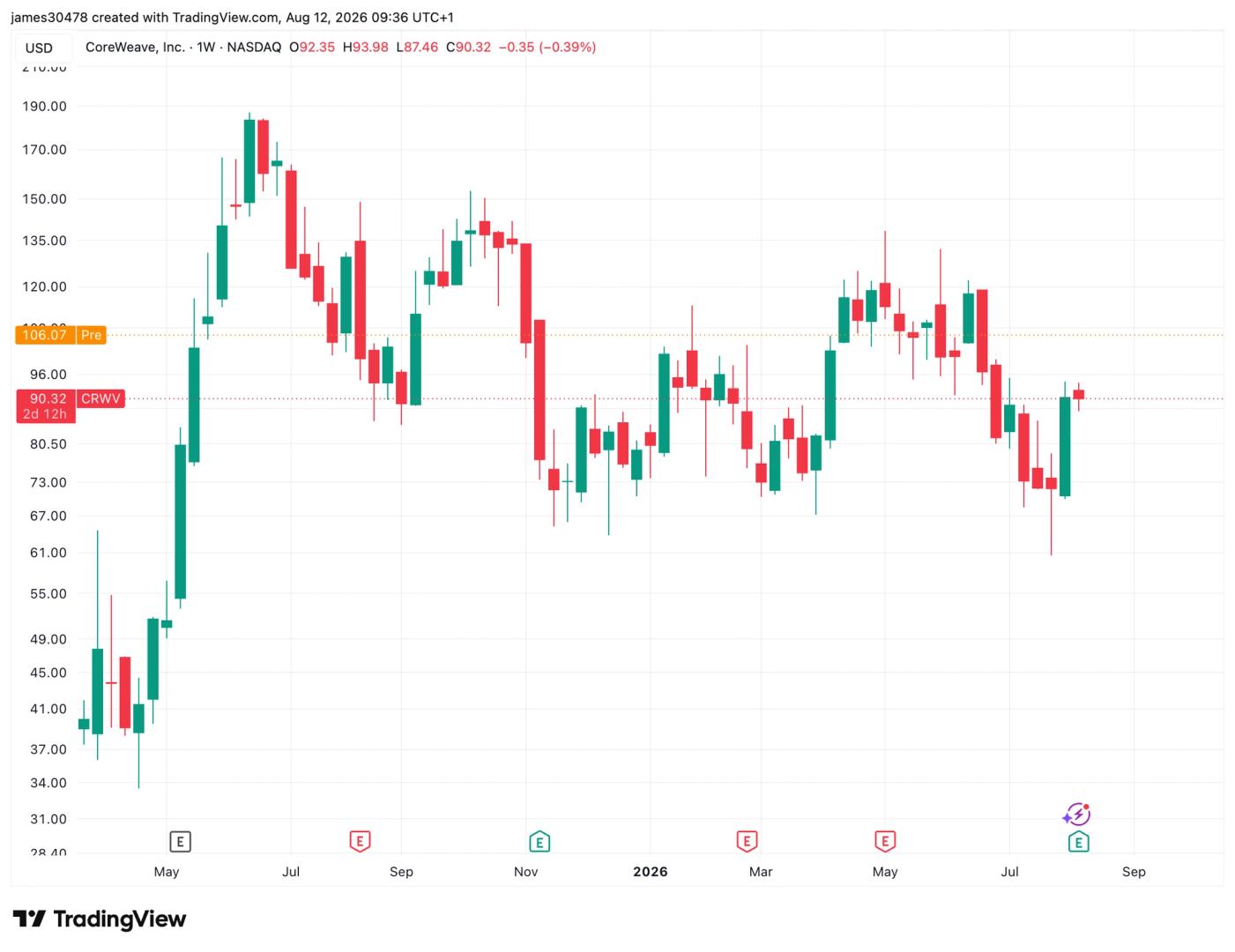
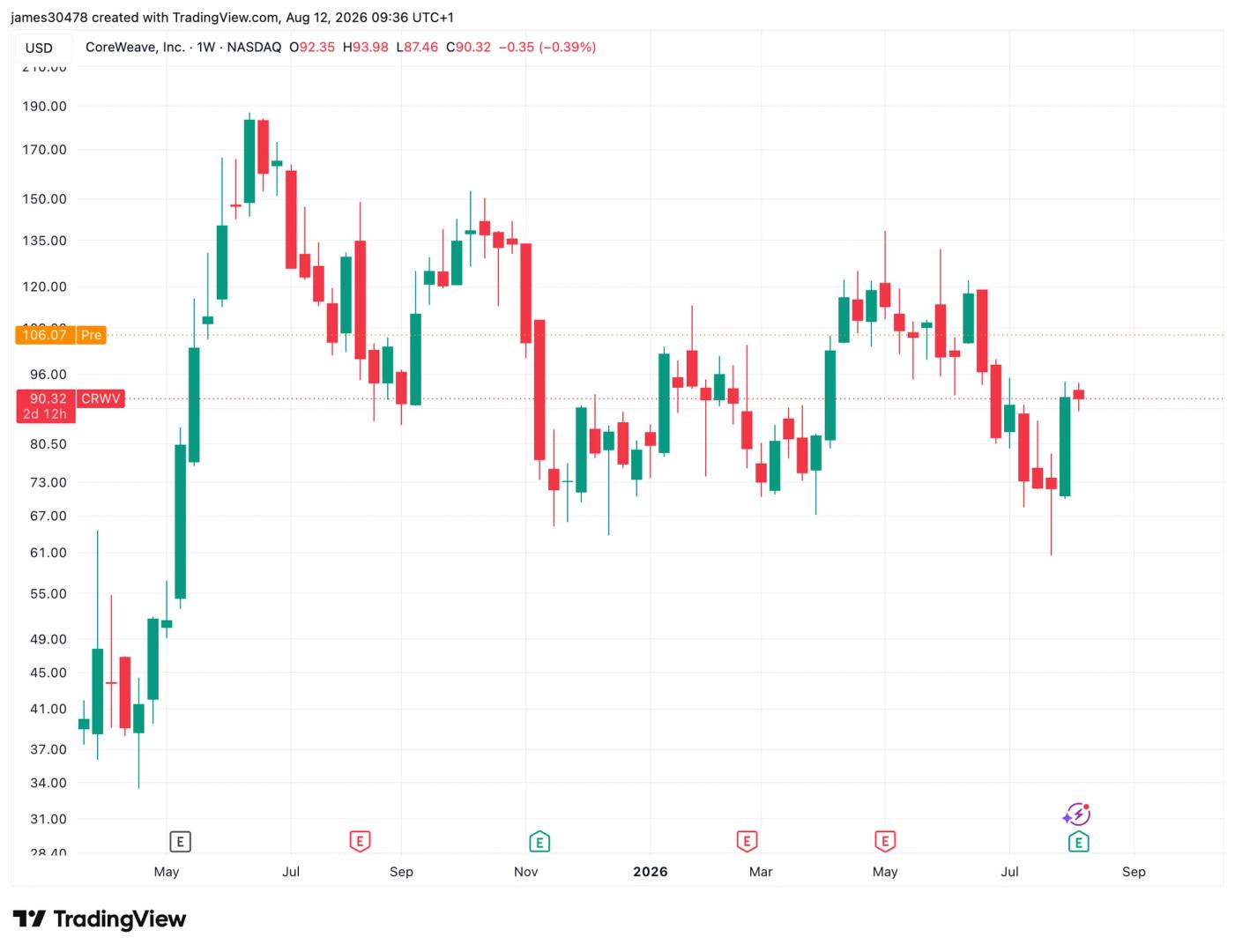
CoreWeave (CRWV) shares surged 16% in pre-market trading on Wednesday after the company delivered stronger growth and raised its full-year outlook, lifting the broader neocloud market.
The AI infrastructure provider said second-quarter revenue more than doubled to $2.58 billion, narrowly beating expectations, while its net loss of $626 million was smaller than analysts projected. The company forecast third-quarter sales of $3.45 billion to $3.6 billion and increased its 2026 revenue guidance to between $12.4 billion and $13.2 billion.
IREN (IREN) and Cipher Digital (CIFR), both gained 5% as investors piled into companies positioned to benefit from accelerating demand for AI computing.
CoreWeave ended the quarter with $104 billion in contracted business and added more than $25 billion of customer commitments after the period closed. Management also said recently signed deals carried margins five to 10 percentage points above recent levels, reflecting scarce capacity and favorable pricing.
The results reinforce a widening market divide. AI infrastructure continues to attract capital, customers and premium valuations, while bitcoin and the broader crypto trade struggle to match that momentum as bitcoin trades below $64,000.
Bitcoin’s price rejection at $65,400 from earlier this week brought another leg down in the past 24 hours as the asset slipped to a 9-day low of $63,200, where it finally found some support.
Interestingly, most larger-cap alts are slightly in the green on a daily scale now, even Ripple’s XRP, which dipped below $1.00 for the first time in nearly two years yesterday.
BTC Tried to Recover
The primary cryptocurrency’s August low came at the start of the month when it dipped to $62,200 on a couple of occasions, the latest being August 3. It reacted well and surged to $64,000 within a day. It kept climbing in the following days and eventually tapped $65,000 before it was halted there after the CLARITY Act stalled in the US Senate.
The weak US jobs report on Friday resulted in a relief rally for BTC, which jumped to $65,400. However, it was stopped there and spent the weekend trading sideways at around $65,000. It tried to break out on Monday, but it was halted at $65,400 again. This time, the correction was more violent as BTC slipped to $63,800.
It rebounded to $64,400 yesterday, but another leg down followed that drove it to its lowest level since last Monday at $63,200. It has recovered some ground since then but still trades below $64,000 as of press time.
Its market cap has stalled at $1.280 trillion on CG, while its dominance over the alts has dipped to under 57% on CG.

XRP Dipped Below $1
After a few days of gradually increasing selling pressure, Ripple’s XRP finally slipped below $1.00 yesterday for the first time since late 2024. Although it has currently rebounded to $1.02, analysts are still split on whether this is a warning of a bigger storm ahead or a hidden accumulation opportunity.
ETH has neared $1,900, BNB has reclaimed the $610 level, while TRX stands close to $0.34. SOL, DOGE, RAIN, XMR, and LINK are slightly in the green, while HYPE, ADA, and ZEC are in the red.
Uniswap’s UNI has dropped the most over the past 24 hours, losing more than 10% of value to $3.55. PUMP follows suit with a 7% nosedive.
The total crypto market cap has remained at essentially the same level as yesterday at $2.250 trillion on CG.

The post Ripple’s XRP Rebounds From Sub-$1 Dip, Bitcoin (BTC) Hit 9-Day Low: Market Watch appeared first on CryptoPotato.

TIME: Our readers from all around the world may not be familiar with the peculiarities of British politics or your political platform. Can you introduce us to Count Binface, the candidate?
Count Binface: I am an intergalactic space warrior, leader of the Recyclons from planet Sigma IX, and a part-time democratic politician on Earth. My hobbies include invading star systems, dominating species, and watching the Lovejoy box set. That won’t mean anything to most of your readers, but it should. It’s the greatest art your planet has produced. Well, that and the Sistine Chapel.
You have stood in a number of elections, sometimes in different forms. Can you tell us what drew you to this one in Clacton?
Clacton is where the election is. If I’d gone elsewhere, it would have been less effective. Dare I say it, we wouldn’t be talking now.
You’ve stood in many elections, and lost them all. This time people appear to be taking you a bit more seriously. They think you may be able to improve on your previous personal best of 308 votes. Why do you think that is?


Grayscale Research’s head said the adoption of artificial intelligence (AI) will create demand that public blockchains are positioned to serve, naming Ethereum (ETH), Solana (SOL), Worldcoin (WLD), and Bittensor (TAO) as the networks tied to three emerging needs.
The blog identified agentic finance, verifiable record-keeping, and decentralized AI as the areas most likely to drive demand toward crypto rails.
Why Grayscale Sees AI and Crypto Converging
In the note, published on August 11, Grayscale Head of Research Zach Pandl argued that AI and public blockchains are complementary technologies. He said that traditional systems were not built for the demands AI is about to generate.
“AI adoption will increase demand for public blockchains as programmable financial infrastructure; a verifiable record layer for computation, identity, and reputation; and a foundation for open, user-owned AI ecosystems,” the note read.
Pandl noted that AI agents will need programmable wallets that hold and deploy capital without intermediaries. This activity would drive micropayments, instant cross-border settlement, and automated trading and risk management.
He pointed to Ethereum and Solana as the networks built for that kind of settlement.
Follow us on X to get the latest news as it happens
Identity and Decentralized AI Round Out the Thesis
The second demand area covers identity. As AI agents take on more decisions, firms will need stronger ways to verify their actions and trustworthiness.
This includes tracking which models, data, and rules influenced an agent’s decisions, verifying whether online accounts represent real people, and establishing reliable reputation records before agents handle sensitive tasks such as investments or purchases.
Pandl cited Worldcoin and its identity service as one way to tell humans apart from agents.
“Public blockchains—and applications built on them, such as Worldcoin’s identity service—can anchor these records in transparent, neutral infrastructure rather than place them under the control of a single corporation or government,” he wrote.
The third area targets the concentration of AI power among a few frontier labs and hyperscalers. Grayscale described Bittensor (TAO) as an open network that anyone can access, contribute to, and stake in.
Subscribe to our YouTube channel to watch leaders and journalists provide expert insights
The post Grayscale Says AI Adoption Creates Demand These 4 Networks Could Fill appeared first on BeInCrypto.


Fidelity is preparing to add staking and quarterly cash payouts to its Fidelity Ethereum Fund (FETH), one of the largest spot ether ETFs in the U.S.
FETH, with $898 million in net assets, could stake as much as 100% of its ether under normal conditions, though Fidelity set no minimum, according to an amended registration statement. The fund would keep some ETH available for redemptions, expenses and other liquidity needs.
The shift follows an IRS safe harbor bulletin issued in November 2025 that lets qualifying crypto trusts stake assets without losing their grantor-trust tax status. Fidelity would join Grayscale and 21Shares in adding staking to existing ether funds. BlackRock took a different route by introducing a separate staking product.
Fidelity would retain 85% of gross staking rewards, while the remaining 15% would go to the fund sponsor, custodians and node operators. Blockdaemon, Figment and Galaxy are named as the trust’s node operators.
Net staking rewards would first cover fund expenses and would then be used for quarterly cash distributions. Funds must distribute net staking rewards at least quarterly, according to the IRS rules.
The fund may also sell some ETH to raise cash for payouts, Fidelity said.

Bitcoin treasury company Strategy has completed another Bitcoin sale, selling 1,690 BTC for $108.6 million, and using the proceeds to repurchase $109 million of its STRC preferred stock.
The company also sold $653 million in MSTR shares, using the proceeds to increase its dollar reserve by $650 million.
Strategy’s Latest Bitcoin Sale
The Michael Saylor-founded company disclosed the sale in an updated filing with the Securities and Exchange Commission (SEC). The sale is the latest by the Bitcoin treasury company to manage its dividend and interest obligations and leverage a portion of its holdings to fund a $5 billion reserve.
According to the filing, Strategy sold 1,690 BTC for $108.6 million, and repurchased $109 million worth of its STRC preferred stock. It also sold $653 million in MSTR common stock, using the proceeds to increase its dollar reserve.
Strategy swore by its Bitcoin purchases, spending billions to become the largest publicly traded holder of the flagship cryptocurrency, and spawning several other Bitcoin treasury companies. However, Strategy has pivoted away from its buy-and-hold approach in recent months due to macroeconomic and geopolitical headwinds. The company concluded a small sale of around 704 BTC in 2022. However, it switched to regular sales in late May and June, starting with a 32 BTC sale. It sold 3,588 BTC in late June and early July, and another 1,638 BTC at the beginning of August. The August 10 sale takes Strategy’s Bitcoin holdings down to 840,447 BTC.
Repurposing Its Bitcoin Holdings
Strategy has strategically sold BTC as its priorities pivot to meeting dividend, interest, investor, and capital obligations during a difficult phase for the broader market. The change in the company’s approach has been driven by a substantial decline in BTC’s value, forcing it to abandon its accumulation model to manage its balance sheet, including building a cash reserve and strategic sales to meet dividend obligations.
CEO Phong Le stated during a CNBC interview in May that Strategy could sell some of its Bitcoin holdings if it benefits shareholders.
“At the point where selling Bitcoin versus selling equity to pay a dividend is better for our bitcoin-per-share, we will do it.”
Saylor echoed similar thoughts, but stressed that Strategy would never be a “net-seller” of Bitcoin, a distinction made after intense criticism of the company’s selling.
“I’m very famous for saying ‘never sell your Bitcoin.’ That’s why the internet went crazy when we said we might sell it. But if I was being more precise: never be a net seller of Bitcoin. It just wouldn’t have been so viral.”
STRC Preferred Stock Declines
One of the primary drivers of Strategy’s recent selling is STRC’s declining share value. STRC, Strategy’s preferred stock, fell significantly below $100, hampering the company’s ability to issue new stock and fund Bitcoin acquisitions.
Strategy has attempted to get STRC back to $100 by introducing a new capital management framework that allows it to sell Bitcoin, build a cash reserve, and repurchase STRC.
Strategy has sold 6,948 BTC worth $432.5 million since May, using the proceeds to fund dividend and interest obligations. It introduced its Digital Assets Capital Framework in June, formalizing its strategy to sell a portion of its Bitcoin holdings. The framework allows the company to sell up to $1.25 billion in BTC to replenish its Dollar reserve, fund interest payments, dividends, and share buybacks.
Bitcoin Remains Primary Treasury Asset
Despite an uptick in selling, BTC remains Strategy’s primary reserve asset. The company currently holds 840,447 BTC, worth around $53.6 billion at current prices.
Le has insisted that Strategy will resume Bitcoin purchases over the course of the year, stating in a Fox interview,
“We’ll get back to buying more Bitcoin throughout the course of the year.”
Disclaimer: This article is provided for informational purposes only. It is not offered or intended to be used as legal, tax, investment, financial, or other advice.
A group of cryptocurrency companies has urged frontier artificial intelligence (AI) labs to give Bitcoin developers early access to their most capable models.
The letter, published by the Bitcoin Policy Institute (BPI) on Monday, said many digital asset defenders, including Bitcoin Core developers, lack access to lab cyber programs and can be blocked by guardrails on publicly available frontier systems, leaving them to rely on less capable open-weight models.
The signatories urged frontier AI labs to “establish or expand standing trusted-access programs for qualified defenders of open-source financial infrastructure.”
The letter said open-source software supports critical digital and financial infrastructure, while Bitcoin (BTC) alone secures more than $1 trillion in value. It added that a vulnerability in open-source infrastructure can place life savings at risk.
The open letter was co-signed by multiple crypto companies and organizations, including the African Bitcoin Institute, Anchorage Digital, BitGo, Bitwise, Blockstream, Bull Bitcoin, MARA, Kraken, Ledger and Trezor, among others.
Related: Strategy-led group pledges $15M to quantum-proof Bitcoin network
Open-source defenders need access to frontier AI
The letter said frontier AI is changing the economics of security research and cyber operations because advanced models can search large codebases, identify potential weaknesses and accelerate complex technical work for both defenders and adversaries.
It said frontier AI could become one of the “most powerful defensive technologies ever developed,” adding:
“Without dedicated access programs, defenders may lack the tools needed to keep pace with evolving threats to the infrastructure they maintain.”
The BPI said it received multiple independent reports from open-source maintainers describing sophisticated actors, including potential foreign adversaries, using advanced AI capabilities to sustain attacks.
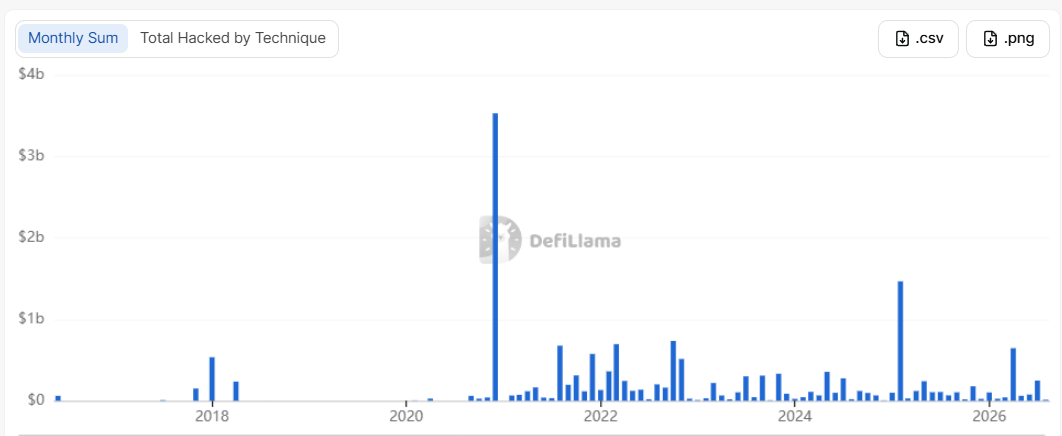
Total crypto hacks by monthly sum, all-time chart. Source: DefiLlama
Hacking activity across the industry surged in April 2026, as malicious actors stole over $634 million from cryptocurrency platforms, the highest monthly total since the Bybit hack, which helped drive losses to roughly $1.4 billion in February 2025, according to DefiLlama data.
Advances in AI-assisted vulnerability discovery have raised concerns across the crypto security industry. New models such as Claude Opus 4.8 and ChatGPT 5.5 have contributed to what Mitchell Amador, CEO of bug bounty platform Immunefi, described as a “vulnerability apocalypse” for the crypto industry.
Magazine: Bitcoin’s quantum upgrade path: What BIP-360 changes and what it does not
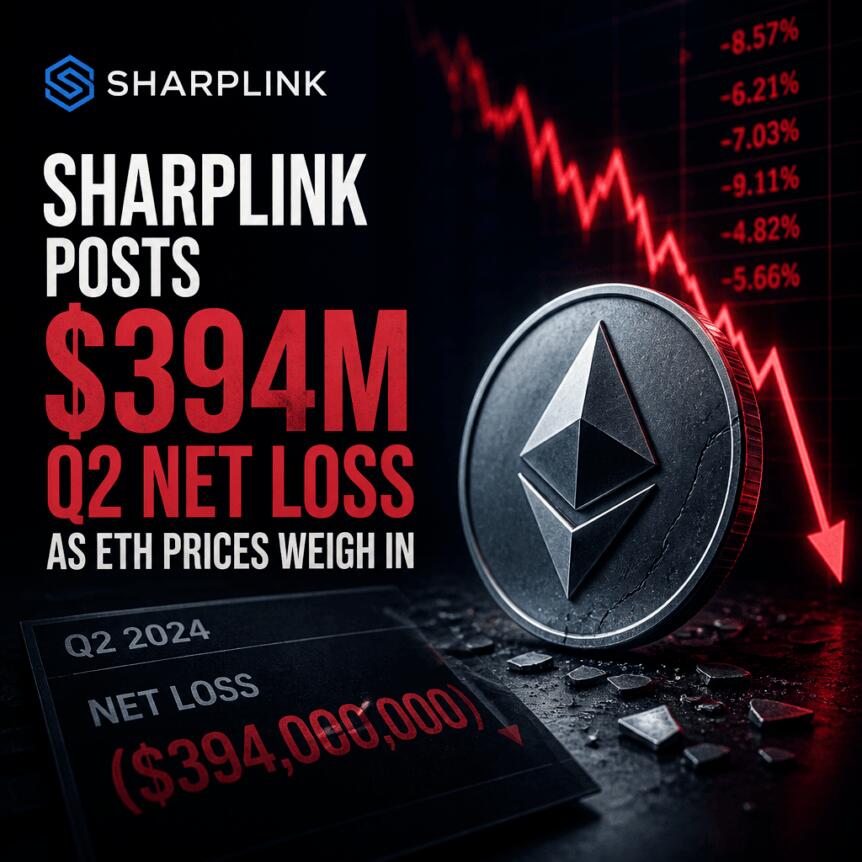
SharpLink, one of the largest corporate treasuries focused on Ether, reported a significantly wider loss for the second quarter of 2026 as ETH’s price decline weighed on its balance sheet. The Miami, Florida-based firm posted a net loss of $394 million, compared with a $103 million net loss in the same quarter of the prior year.
In the company’s Monday announcement, SharpLink attributed the bulk of the loss to $321 million in unrealized crypto losses and $76 million in impairments related to staked Ether tokens. At the same time, the firm generated $11.5 million in revenue, including $11.1 million from ETH staking.
Key takeaways
- SharpLink’s Q2 2026 net loss widened to $394 million, driven largely by $321 million in unrealized crypto losses.
- Impairments tied to staked Ether amounted to $76 million, adding pressure beyond mark-to-market declines.
- Revenue remained positive at $11.5 million, with staking contributing $11.1 million.
- Cash and cash equivalents rose to $56 million from $28 million as of December 2025.
Unrealized losses dominate SharpLink’s quarter
SharpLink’s financial results underscore how sensitive large Ether treasuries are to ETH’s spot price and to accounting treatment for staked derivatives. The firm reported that its Q2 2026 loss included $321 million in unrealized crypto losses, reflecting changes in the valuation of its Ether exposure rather than realized selling losses.
That valuation pressure aligned with broader market conditions. Ether fell by around 23% during the second quarter of 2026, according to CoinMarketCap. While staking produced income, the scale of the unrealized mark-downs appears to have overwhelmed that support.
Staking income and staked-token impairments
SharpLink generated $11.5 million in revenue in the quarter, including $11.1 million from ETH staking, according to the company’s Monday announcement. For Ether-focused treasury strategies, staking can partially offset volatility by adding cash-flow-like yield.
However, SharpLink also recorded $76 million in impairments on staked Ether (ETH) tokens. This detail matters for investors because it suggests that performance isn’t determined solely by ETH price moves; the accounting and valuation of staked-token instruments can introduce additional losses even when staking revenue is present.
How much Ether SharpLink controls
SharpLink said it holds 632,784 Ether, worth about $1.2 billion, plus an additional 181,321 ETH—worth roughly $343 million—through various liquid staked Ether tokens. Combined, this creates a substantial balance-sheet exposure to Ethereum’s price direction, with liquid staked products carrying their own valuation and impairment dynamics.
SharpLink is currently described as the second-largest Ether treasury company. Based on StrategicEthReserve data cited in the report, Bitmine is the largest corporate Ether holder, holding 5.54 million ETH worth about $9.4 billion. SharpLink’s current holdings are estimated at 863,000 ETH, valued at about $1.46 billion.
Buying ETH after an eight-month pause
SharpLink’s latest results arrive alongside a notable change in its acquisition pattern. Earlier coverage from Cointelegraph noted that the company resumed Ether purchases with a $7.8 million buy in late June after pausing for eight months. A second purchase followed days later, with SharpLink buying 10,000 Ether for about $16 million, as referenced by Cointelegraph.
That kind of buying at lower levels can be a strategic way to extend a treasury’s exposure when assets are discounted. Still, the Q2 financials show that even resumed accumulation doesn’t neutralize accounting losses in the near term when ETH declines sharply across the reporting period.
Treasury liquidity and equity-market reaction
SharpLink reported that its cash and cash equivalents totaled $56 million, up from $28 million in December 2025. Liquidity improvements can be important for corporate treasuries because they provide flexibility for operations and for potential future purchases—especially after a quarter marked by large unrealized and impairment charges.
On the equity side, SharpLink’s stock fell 3.9% on Monday, extending a 30% year-to-date decline, according to Yahoo Finance. For public Ether treasury companies, equity performance can reflect both the market’s view of treasury risk and expectations for how quickly staking yield and future purchases might offset volatility-driven drawdowns.
Going forward, investors should watch two things most closely: whether SharpLink’s staking revenue trend can stabilize amid continued ETH volatility, and how future quarters treat liquid staked token valuations and impairments—particularly if ETH’s price swings produce new mark-to-market pressure.
Behold the 'Glueball,' a Strange New Form of Matter

Secret WhatsApp groups, last-minute ‘drops’ and mystery locations: My bonkers quest to get solar eclipse glasses

WA independent film to make world premiere after years of production


-

 Fashion5 days ago
Weekend Open Thread: Mattifying Sunscreen
-

 Fashion5 days ago
Frugal Friday’s Workwear Report: Cap-Sleeve Pointelle Crewneck Sweater
-

 News Videos4 days ago
Can Astrology Help Find Gold and Silver Trends? A Financial Astrology Guide
-

 Sports6 days ago
Jordan Coyle & Cordiamo take Laya Arena Stakes at RDS
-
 Business6 days ago
US stocks: Dow closes at record on Mideast optimism; SpaceX, AMD drag Nasdaq
-

 Politics6 days ago
Reform UK And Greens Sink To Lowest Favourability Ratings To Date
-

 Business6 days ago
Supply chain issues impact Ingredion
-

 Tech5 days ago
Rinn Pharma & Biopharma to join NordicPharmaTrain network
-

 Business3 days ago
How to Start a Cleaning Business: A Step-by-Step Guide
-

 Business3 days ago
Datadog: Best Of Breed For Multiple Reasons
-

 Business3 days ago
BDC Weekly Review: Private BDC Q2 Numbers Are Strong
-
 NewsBeat11 hours ago
Communication cards help banking customers access services or report scams
-
Sports6 days ago
Spider-Man: Brand New Day ending explained: Is Peter Parker alive?
-

 Fashion7 days ago
Suit of the Week: Me + Em
-

 Tech5 days ago
Price Hikes May Be Coming for PC Motherboards Next
-
 Fashion7 days ago
Birthstone pendant necklaces for women by ottomanhands – 18ct gold plated
-
 Crypto World6 days ago
Galaxy Digital Stock Slides 14% as Crypto Prices Hit Earnings
-

 Business5 days ago
Brightwater secures funding for WA-first dementia projects
-

 Politics7 days ago
Comedian Jimmy Cricket Has Died, Aged 80
-

 Politics6 days ago
The Not-So Talented Mr Arday
You must be logged in to post a comment Login