
Crypto World
European watchdogs prepare direct oversight of AI and tokenization in retail finance


The European Securities and Markets Authority (ESMA) said it would make AI, tokenization and other emerging technologies relevant to finance a new supervisory priority from 2027.
“Firms are increasingly using AI and tokenized products in day-to-day financial services to gain market share,” the financial watchdog said in a report released Wednesday, explaining why it is focusing on these two areas initially. “Technological innovation brings benefits but also risks,” it added.
Under its new supervisory program, the ESMA and national regulators across the European Union will examine how regulated firms use artificial intelligence and tokenized products in their core activities, rather than only in back-office operations.
The initiative, called “Innovation with investor safeguards,” will focus on building regulators’ ability to supervise new technology and ensuring firms have proper governance, reliable data and client-aligned outcomes.
The European Central Bank (ECB) has also recently announced several moves in the tokenization and stablecoin sectors of cryptocurrency. Earlier this week, the ECB said it plans to invest a small portion of its reserves in tokenized securities, giving it direct exposure to blockchain-based financial markets. T


Strive built its Bitcoin treasury by raising $85.88 million in three trading days. The firm completed three SATA sessions between September 21 and September 23. Analysts estimate the raise funded roughly 1,001 additional coins for its Bitcoin treasury.
Strive’s Bitcoin Treasury Grows Session By Session
Strive opened the week with $27.69 million in net proceeds on September 21. The company sold about 284,000 shares to fund its Bitcoin treasury that day. Trackers estimate the session added 321.97 coins at an average price of $86,001.
The pace accelerated on September 22, and the Bitcoin treasury expanded further. Strive raised $36.08 million and sold roughly 370,000 shares. The session added an estimated 418.27 coins at an average price of $86,266.
September 23 brought a smaller but steady gain for the Bitcoin treasury. Strive raised $22.11 million and sold about 226,700 shares. The tracker values that day’s addition at 261.43 coins, priced near $84,556.
Strategy’s Bitcoin Treasury Faces A Funding Gap
Michael Saylor’s Strategy runs a larger Bitcoin treasury but has hit a financing wall. Its preferred stock, STRC, has traded below the $100 par value since June. The shares fell as low as $73.62 during that stretch.
Because STRC has failed to raise new capital since June, Strategy shifted tactics. The company turned to STRC buybacks instead of fresh share sales. Even so, Strategy still expanded its Bitcoin treasury during the September 14-20 week.
Strategy added 950 coins that week for $75.7 million. The average purchase price came to $79,670 per coin. Its total Bitcoin treasury now holds 846,000 coins, bought for about $63.8 billion at an average cost of $75,416 each.
A Widening Gap Between The Two Companies
Strive’s Bitcoin treasury has outpaced Strategy’s buying rate in recent weeks. Between September 14 and 18, Strive purchased 1,355 coins for $107.7 million. Its total holdings reached 26,355 coins at that point.
Warrant exercises added extra fuel to Strive’s fundraising engine. Those exercises generated $21.2 million in gross proceeds last week. More than half of Strive’s total capital raised has come through SATA proceeds since the program began.
The contrast highlights two different paths for building a Bitcoin treasury. Strive leans on ATM share sales and warrant activity to keep buying. Strategy, meanwhile, now depends on buybacks and other funding sources while STRC remains under par.

A bizarre drama played out on YouTube this past week, when a channel called Mighty Mike Plays posted a video explaining how nine-year-old “Mighty Mike” apparently got a hold of his father Dave’s company card and spent $118,000 on a YouTube ad campaign.
However, the story immediately appeared to have a number of holes, and within a few days there were too many red flags for influencers, who had initially boosted the story’s reach, to ignore.
Just a kid and his dad
Mighty Mike Plays, which features Roblox and Minecraft videos, was created in June of 2024 but only started posting videos in August of this year.
Over the past month, the channel has uploaded 175 long and short form videos — a considerable number for a child of nine.
When it suddenly started reaching the front page of YouTube ads, people began to comment that Mike was going to get in trouble with his father. They were, in fact, being played by the marketing.
On September 14, the channel released a video titled “Message from Dad… Mighty Mike Plays is Over.”
In the video, Dave speaks while Mike plays Minecraft. He states that Mike had spent $118,000 on the YouTube ad campaign and worst of all that the charges were on his company card and now he might get fired.
Dave didn’t explain why he would ever use a company card for anything but company purchases or how using the card even for a $20 ad campaign — as he stated was his intention — wasn’t illegal, but no red flags outside of this were obvious yet.
Read more: Kalshi’s AI ad turned an Asian YouTuber into ‘a white dude’
99 problems and the vid is one
On September 18, a new video was released, once again with Mike playing Minecraft and Dave speaking. Unfortunately, this time the video was nothing but red flags. Dave states that he’s been fired from his job and that the company has demanded that he pay back all $118,000 within 30 days.
He doesn’t clarify what will happen in 30 days if the company isn’t paid back.
Dave doesn’t show any proof of ad spend or any emails with his colleagues where they discuss the circumstances. Instead he suggests that the family will soon lose their home because he’ll have to sell it within the 30-day period.
All of this sounds like fiction, but it only gets more absurd.
Dave states that he doesn’t want to start a GoFundMe or Kickstarter to support his family and doesn’t specify a reason, though it’s thought that if you lie about the reason you need funds on these websites you can get sued and the money can get clawed back.
Instead, he says, he wants to sell merchandise online to try to raise the funds himself — a bizarre decision.
Slop merch, slop campaign
Dave’s website is filled with AI-created merchandise, all selling for immense prices (nearly $100 for t-shirts that say “118k” and “67 wassup chat”), some supposedly already sold out.
And, as eagle-eyed YouTubers quickly pointed out, the terms of service, which previously promised that returns would be allowed within 30 days, now state that ALL SALES ARE FINAL.
It’s unclear if this is legal or binding to anyone who bought the merchandise before the change.

Needless to say, it’s now Dave who’s claiming that he’s going to be suing numerous influencers and YouTubers for suggesting that he’s a scammer, emailing them to say he’s hired a lawyer and will be taking them to court for libel — an expensive move for a man who supposedly just lost his job and owes $118,000.
Regardless, Mike and Dave are posting videos again but have yet to address any of the previous red flags littering their videos.
Protos will follow the story for more information if anything changes.
Got a tip? Send us an email securely via Protos Leaks. For more informed news and investigations, follow us on X, Bluesky, and Google News, or subscribe to our YouTube channel.

A recent dispute between AMC Entertainment CEO Adam Aron and Robinhood highlighted that issue, centering on whether synthetic or tokenized products may leave investors with economic exposure to a stock but without the same legal rights as registered shareholders. Issuer-sponsored models aim to narrow that gap by tying the token directly to the issuer’s records.
“The architecture we establish now matters and that is why we are bringing together this group of leading firms to chart the course,” said Tom Farley, CEO of Bullish.
Alpaca said it plans to contribute to interoperability between traditional securities and onchain markets through its Instant Tokenization Network.
“Tokenization creates an opportunity to connect issuers and investors in ways that weren’t possible with traditional market infrastructure,” said Arush Sehgal, head of digital assets at Alpaca. “Getting it right means preserving shareholder rights and ensuring onchain markets remain connected to the markets they’re built on.
Apex Fintech Solutions, which provides infrastructure for broker-dealers and other financial firms, said the group could help establish standards that enable tokenized markets to connect with existing systems.
The coalition said its work follows last week’s U.S. Securities and Exchange Commission exemption allowing limited onchain trading of U.S.-listed equities under certain conditions.


AI is not arriving in a world capable of receiving it. Instead, it is coming into a world that has spent the last two decades systematically dismantling the very foundations that would allow us to deploy such a powerful technology responsibly. Institutional authority, shared truth, and information integrity have been battered. We are building the most sophisticated cognitive technology in human history atop the most fractured trust landscape in modern memory.
If you wanted to design the worst possible moment for AI to emerge, you might create a moment like this one.
From post-truth to post-trust
A decade ago, we worried about living in a “post-truth” world. Oxford Dictionaries selected “post-truth” as its Word of the Year in 2016, defining it as circumstances in which objective facts are less influential in shaping public opinion than appeals to emotion and personal belief. Post-truth describes a world where facts still exist but are often overshadowed by emotional narratives.
What we are experiencing now goes deeper. I call this the “post-trust era:” a world where the very mechanisms that allow us to establish trust have broken down. It is not just that emotions sometimes trump facts. It is that we have lost shared foundations for deciding what counts as a fact in the first place.
Look at what has happened to our information ecosystem over the past two decades. We moved from a world in which truth was curated by editors, printed by presses, and distributed by a small number of recognizable intermediaries, to a world in which anyone can publish, amplify, distort, or fabricate. Data exploded, and social media fragmented audiences. Algorithms began optimizing for clicks, engagement, and sensationalism. The incentives shifted from accuracy to attention: virality over veracity, outrage over nuance, speed over scrutiny.
The numbers tell their own story. Nearly 8 in 10 people get directed to their news primarily through algorithmic systems such as social feeds, search engines, and aggregators, effectively outsourcing their information diet to systems they neither understand nor fully trust. In the United States, trust in the federal government has fallen from over 70% in the late 1950s to under 20% today. Confidence in mass media has dropped: fewer than one-third of Americans express even a “fair amount” of trust. Religious institutions, financial systems, healthcare organizations, and even science itself have seen trust erode.
Post-truth describes a distortion in how people weigh facts and feelings. Post-trust describes a deeper fracture: the loss of shared procedures for determining what is real.
When the first photographs appeared in the 1830s, people marveled at their fidelity. For nearly two centuries, seeing was believing. A picture was not perfect, but it was evidence.
In early 2023, an AI-generated image of Pope Francis wearing a stylish white puffer jacket spread across social media platforms. It was compelling because it sat in a narrow band between familiar and unexpected. The photo’s style, posture, and lighting borrowed credibility from decades of real photography. Many accepted it as real before they had time to question it.
Within two years, AI-generated images, voices, and video had become so pervasive and so convincing that the question was no longer “can you spot the fake?” but “can you trust anything you see?”
The ability to fabricate convincing “evidence” at scale has arrived just as our information ecosystem is most fragmented. Research from Duke and NYU shows that exposing people to opposing political views on social media can increase polarization rather than reduce it. A landmark study in Science found that false news spreads significantly faster and more widely than trustworthy news online. Neuroimaging research suggests that when people encounter information challenging their political beliefs, brain regions associated with negative emotion light up, while confirmatory information activates reward pathways. We are not only divided about facts. We are wired to process confirming and disconfirming information through different cognitive channels altogether.
That is the substrate into which AI arrives: a world where information is abundant, but trust is scarce, where consensus reality has splintered, and where the mechanisms for establishing shared truth have broken down.
A different kind of intelligence
Into this fractured substrate arrives something genuinely new. Not just another tool, but the first technology in history whose core competence is cognition.
Past technologies extended our capabilities while remaining subordinate to human thought. The printing press amplified the words we chose to print. Electricity transformed the energy we decided to harness. Combustion engines replaced the muscle power we used, and computers executed calculations we programmed. The internet distributed the messages we wrote.
AI breaks that pattern. It no longer merely executes tasks. It generates arguments, synthesizes information, makes recommendations, and produces creative work that feels, at a human level, like someone else’s thoughts. A single model can write an essay, summarize a legal transcript, translate a medical note, draft code, plan a marketing campaign, and compose music.
At the heart of most of these systems is an architecture that learns by predicting what comes next, a word, pixel, or token, in a sequence. These models do not know “truth” in the way humans understand it. They discover patterns, frequencies, and correlations in whatever data they are given.
And here is where the timing becomes critical: the data they are given is generated in a post-trust world.
AI is trained on our news stories, our social media feeds, our digitized books, our biased archives, our polarized debates, our conspiracy theories, our scientific breakthroughs, and our misinformation. It absorbs not only our knowledge but our distortions. It learns not only our facts but also our conflicts about those facts.
The result is a strange mirror. AI reflects us to ourselves, refracted through statistical patterns and scaled by computation. It gives us answers we cannot easily audit, based on training data we cannot thoroughly inspect, optimized for objectives we do not always control.
A new kind of cognitive infrastructure is emerging at the precise moment our social infrastructure for trust is under strain.
Excerpted from The Trust Code with permission from Tiffany Xingyu Wang.

Digital asset treasury (DAT) companies—public vehicles that hold crypto and aim to finance growth through a trading premium over their crypto holdings—are losing much of their early advantage, according to a report released this week by DWF Ventures.
In its analysis of the 20 largest DATs by assets under management, DWF found that only four trade above their “mNAV,” a metric that compares a company’s market value to the value of its underlying crypto holdings. The implication is straightforward: investors appear less willing to pay extra for crypto exposure through listed balance sheets, shrinking one of the model’s key funding mechanisms.
Key takeaways
- Only four of the 20 largest digital asset treasuries trade above mNAV, meaning most trade at discounts to their crypto holdings.
- DWF links the shift to investors no longer pricing DAT shares at a persistent premium for crypto exposure.
- DAT stocks have generally struggled to outperform simply holding the underlying cryptocurrency, with the reported advantage—when it exists—often modest.
- External warnings about “mNAV collapse” predate the latest market weakening, including concerns raised by Standard Chartered and Galaxy Digital.
Most DATs now trade below their crypto holdings
DWF’s report, published Thursday, examined the largest DAT companies by assets under management and found that just four trade above an mNAV of 1—where market value exceeds the value of held crypto. Those firms are Bit Digital, Strive, Hyperliquid Strategies, and BitMine.
For investors, discounts like these matter because DAT growth strategies typically rely on issuing equity at prices above the value of existing holdings. When shares trade at a premium, companies can raise capital and add to their crypto exposure without diluting existing shareholders’ effective value. When that premium disappears—or flips into a discount—new share issuance becomes less attractive and can dilute shareholders rather than strengthen the treasury.
DWF characterizes the widespread discounts as a sign that the market is no longer willing to pay the same premium for publicly traded crypto exposure.
The “treasury premium” appears to have peaked
DWF points to Strategy, the Bitcoin treasury model pioneer, as an early benchmark for how the premium worked when the approach first captured investor attention. According to the report, the general pattern across DATs has been that mNAV premiums peaked when the strategy was new and demand for the structure was strongest.
DWF highlights Strategy’s mNAV peak in late 2024 during a Bitcoin rally, when demand for leveraged BTC exposure was reported to be particularly strong. The broader framing from DWF is that, as the novelty and momentum around BTC treasury structures faded, the premium investors were willing to pay weakened as well.
DWF also notes that while some DATs have outperformed the underlying cryptocurrency at times, the outperformance has typically been small compared with what investors could have achieved by simply holding the crypto directly.
Earlier coverage from Cointelegraph described how Michael Saylor’s Strategy helped popularize the Bitcoin treasury approach beginning in 2020, setting the template DATs later tried to follow.
Real-world evidence: Sequans exits its BTC treasury
The DWF findings arrive alongside a concrete example of a company moving away from the treasury approach. Sequans Communications, a French semiconductor firm that launched a Bitcoin treasury strategy last year, disclosed that it sold its remaining 314 BTC, completing an exit process.
As reported by Cointelegraph, the exit began with a redemption of its convertible debt in May and concluded with the sale of the remaining Bitcoin. After the transaction, Sequans said it holds no cryptocurrency on its balance sheet, according to the report linked by Cointelegraph: Sequans exits bitcoin treasury strategy after selling remaining 314 BTC.
While a single exit does not determine whether DATs as a category will fail, it underscores the practical consequences of a structure that depends on continued investor support. If share prices fail to sustain a premium over NAV, the cost of raising and maintaining exposure via equity becomes harder to justify.
Warnings about mNAV collapse preceded the latest market stress
DWF’s report is not the first to question whether the DAT model can keep functioning without a persistent equity premium. Standard Chartered reportedly raised concerns in September 2025, when Bitcoin and the broader crypto market were described as booming. The bank warned that an “mNAV collapse” could trigger consolidation among digital asset treasuries.
Galaxy Digital made a similar argument, stating that the model “critically depends on a persistent equity premium to NAV.” In Galaxy’s view, that premium is what allows companies to issue shares and buy more crypto while avoiding dilution of existing holders. If shares trade below NAV, raising new equity can become dilutive and undermine the strategy’s financing logic.
In research cited by Cointelegraph, Galaxy analyst Will Owens wrote that “if the premium collapses, or worse, flips to a discount, the model begins to break.”
These concerns align with the timing and direction of market movement. The source notes that Bitcoin fell from a record high of more than $126,000 in October to below $60,000 before recovering to around $86,000, creating conditions in which treasury premiums and leveraged demand could plausibly weaken.
In other words, the issue raised by the earlier institutional warnings has not gone away: it appears to be a structural dependence on investor willingness to pay above NAV, not just a temporary valuation adjustment.
Why the discount trend matters now
For traders and longer-term investors, the shift toward widespread DAT discounts changes how the category should be evaluated. If most treasuries trade below their underlying holdings, the “equity as growth capital” thesis becomes less reliable, and performance may converge toward the crypto market itself—minus whatever inefficiencies arise from the stock wrapper.
It also raises the question of what happens when premiums do not recover quickly. DWF’s findings suggest that the model’s early advantage—capital accessibility driven by investor enthusiasm—has faded, leaving fewer companies able to compound holdings through share issuance without eroding shareholder value.
Investors watching DATs next should focus on whether any remaining premiums can stabilize and on how companies respond when share prices do not justify continued equity-funded purchases—especially as market volatility continues to pressure crypto-linked balance sheets.

Former Democratic congressman Tim Ryan has said the CLARITY Act could still pass this year if lawmakers resolve disputes that blocked a 49–50 Senate vote on Sep. 15.
Summary
- The Senate vote was a procedural step to open debate, not a final vote on the bill.
- Ryan said ethics, consumer protection, illicit finance and stablecoin rewards remain points of dispute.
- He sees a possible agreement during this year’s lame-duck session.
- SEC and CFTC actions can help firms now, Ryan said, but legislation would offer firmer long-term rules.
Tim Ryan, a former Ohio congressman and adviser to Shyft, told crypto.news that lawmakers still have a path to an agreement if they return to negotiations and make concessions. The Senate rejected cloture on a motion to proceed to the Digital Asset Market CLARITY Act on Sep. 15, with 49 senators voting yes, 50 voting no, and one not voting. The motion needed 60 votes to advance the bill to debate; it was not a final vote on passage.
Ryan identified unresolved concerns about ethics, consumer protection, illicit finance and stablecoin rewards. In his view, support for clear crypto rules remains bipartisan, even though senators have yet to agree on the details. He said a deal could still be reached in the lame-duck session later this year if both sides are willing to compromise.
“I think there’s still a path,” Ryan said. “The legitimate concerns around ethics, consumer protection, illicit finance and stablecoin rewards need to be addressed.”
CLARITY Act talks could resume after the failed vote
Ryan’s assessment follows a statement from seven Senate Democrats who voted against cloture. As previously covered by crypto.news, the senators described the result as “not the end” of their work on the legislation and pledged to continue bipartisan talks. Their statement came on Sep. 16, one day after the vote.
For Ryan, the distinction between a procedural defeat and a final rejection matters. Senators voted on whether to take up the measure, leaving its provisions open to further negotiation. He said the outstanding issues need answers before the bill can secure enough support to move forward.
The proposed legislation would set federal rules for digital asset markets and divide responsibilities between the Securities and Exchange Commission and the Commodity Futures Trading Commission. Under the framework described in earlier CLARITY Act coverage, qualifying digital commodities and their spot markets would fall primarily under CFTC oversight, while securities-related activity would remain with the SEC. The bill would also set registration requirements for crypto trading platforms and other market participants.
Ryan tied the negotiations to decisions being made by American companies. Businesses hiring workers and committing capital, he said, need rules they can rely on beyond a change in administration. He also argued that jobs and investment are at stake in the congressional debate.
SEC and CFTC actions have limits, Ryan says
With the bill stalled, both regulators have taken steps under their existing powers. Ryan said the agencies can make meaningful progress, but he does not believe their actions alone can provide the lasting framework businesses and consumers need.
“Agency action helps, but companies making long-term investments need long-term certainty,” he said. “If you’re building a business, hiring people and investing capital, you need to know the rules are going to last beyond the next administration.”
On Sep. 17, the SEC granted temporary, conditional relief for certain venues trading tokenized U.S.-listed stocks through permissioned automated market makers and liquidity pools. The order lasts five years after publication and requires eligible stock tokens to give holders the same rights as equivalent traditional shares.
The SEC also placed limits on trading symbols and volume, required trading to stop when the underlying stock is halted, and sought public comment on the exemption. Its tokenized stock order concerns securities already within the SEC’s remit, rather than settling how every crypto asset should be regulated.
The CFTC’s Market Participants Division issued a separate no-action position that day for qualifying passive software providers. Subject to stated conditions, division staff will not recommend enforcement over a failure to register as an introducing broker, or as an associated person of one, when the software helps users trade with registered derivatives firms and markets. The CFTC developer relief applies to the activities covered by the letter; it does not change the underlying registration law.
The CFTC also submitted a proposed framework for crypto transactions and markets for White House review on Sep. 17. That submission begins a review process: the proposal would still need to return to the commission for a vote before publication and public comment. CFTC Chair Michael Selig had previously directed staff to examine what market rules the agency could establish using its existing authority.
Bitcoin, XRP and Solana remain part of the classification debate
Asked whether assets could face conflicting treatment, Ryan said uncertainty remains despite guidance from the two agencies. He pointed to Bitcoin, XRP and Solana as assets for which regulators have provided more clarity, while calling for Congress to establish consistent rules that businesses and consumers can use without resolving classification disputes through individual court cases.
The SEC’s March 17 interpretation, issued with CFTC guidance, listed Bitcoin, XRP and Solana among its examples of digital commodities. The SEC based that assessment on its understanding of the assets’ characteristics, terms and functions at the time. The interpretation also said a crypto asset that is not itself a security can be involved in a transaction subject to securities law, and that the agency may refine its views after public feedback.
For U.S. token holders and platforms, Ryan’s concern is how those distinctions apply when an asset is sold or traded. He said businesses and consumers should have consistent rules instead of having to litigate the treatment of assets case by case.
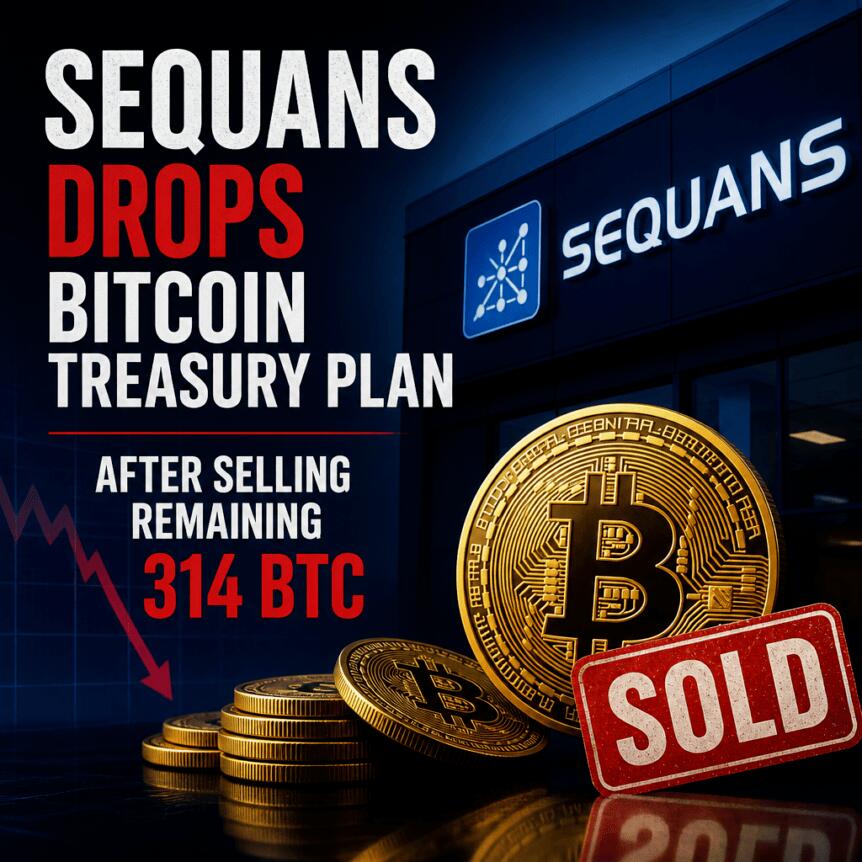
French semiconductor company Sequans Communications has fully exited its Bitcoin treasury strategy, selling its remaining 314 BTC and leaving the firm with no cryptocurrency holdings. The move completes a process that began after the company ramped up its Bitcoin position in mid-2025 and gradually shifted away from the approach as it adjusted its financing and corporate priorities.
According to a statement from Sequans released on Thursday, the exit was tied to the redemption of its convertible debt in May. Management said the company will now refocus on its core cellular Internet-of-Things (IoT) and software-defined radio businesses, with the Bitcoin proceeds previously used to reduce debt and strengthen its balance sheet.
Key takeaways
- Sequans sold its last 314 BTC, finishing a Bitcoin treasury strategy that previously left the company holding more than 3,200 BTC.
- The company linked the exit to its May redemption of convertible debt, using prior Bitcoin sales to help eliminate that obligation.
- Sequans says it now has no cryptocurrency holdings and no outstanding debt, other than government-financed research and development commitments.
- More treasury operators have been scaling back or fully exiting Bitcoin strategies in 2026, according to VanEck research.
Sequans completes its Bitcoin treasury exit
Sequans’ final liquidation of its Bitcoin holdings comes after earlier steps to reduce exposure. The company said it began trimming its BTC less than six months after launching the treasury strategy, selling 970 BTC in November to help redeem half of its convertible debt.
By May 2026, Sequans stated it was “no longer pursuing” the treasury strategy and would monetize the remaining Bitcoin over time. Thursday’s update indicates that monetization has now reached its end point, with the company confirming it has sold its remaining 314 BTC.
From launch to reduction: how the strategy played out
Sequans launched its Bitcoin treasury approach in June 2025, after announcing a $384 million sale of equity securities and convertible secured debentures. At the time, CEO Georges Karam described Bitcoin as “a premier asset and a compelling long-term investment,” framing the purchase as part of a broader treasury plan rather than a short-term trading activity.
However, the strategy’s lifecycle was tightly connected to capital structure decisions. In the months that followed, Sequans used Bitcoin sales to address its convertible debt schedule. The company later moved from debt reduction to broader balance-sheet repositioning, ultimately deciding to monetize the remaining BTC rather than continue accumulating.
Why fully exiting matters for investors and market structure
Corporate Bitcoin treasuries typically balance two competing priorities: pursuing long-term exposure to BTC while maintaining flexibility to manage liquidity, repayments, and business investment. When companies stop accumulating—or liquidate holdings—it can signal that treasury activity has become less aligned with either cash needs or corporate strategy.
In Sequans’ case, management said the Bitcoin sales were used to “eliminate its convertible debt” and strengthen the balance sheet. The result is a simpler capital structure from an investor perspective: fewer moving parts tied to crypto holdings and less exposure to Bitcoin price volatility affecting treasury balances.
Sequans also emphasized that after the final sale, it holds no cryptocurrency and has no outstanding debt beyond government-financed R&D obligations. That framing suggests the company views the treasury era as closed, rather than pausing crypto activity and leaving the door open to future re-entry.
Wider 2026 trend: more treasuries abandon Bitcoin
Sequans’ departure fits a broader pattern in 2026. In late July, Matthew Sigel, head of digital assets research at VanEck, said in a public update that he had identified at least nine companies that fully liquidated or abandoned Bitcoin and crypto treasury strategies in 2026, alongside several others that reduced their holdings.
The reasons cited across exits have ranged widely. VanEck’s Sigel pointed to factors such as debt repayment needs, working capital requirements, shareholder return objectives, and business-strategy changes. In other words, the shift away from Bitcoin treasuries has not appeared to be driven by one single cause.
One example highlighted in earlier coverage is UK-listed Satsuma Technology. Cointelegraph reported that the company raised 100 million British pounds (about $135 million) through convertible loan notes in July 2025 to expand a Bitcoin treasury. A year later, shareholders voted overwhelmingly to return substantially all of the company’s capital and cancel its listing, and the board authorized the closure of trading activities and the sale of its entire 669 BTC position.
Other companies referenced in 2026 reporting as fully liquidating their Bitcoin holdings include Bitdeer, Genius Group, and Prenetics. MARA Holdings and Empery Digital were also mentioned as making substantial sales without abandoning their treasury strategies entirely, underscoring that corporate behavior is diverging rather than uniform.
What to watch next
For Sequans, the immediate question is how quickly the company can translate its renewed focus on cellular IoT and software-defined radio into operating momentum now that crypto exposure has been removed. More broadly, readers may want to track whether 2026’s wave of treasury exits continues—or if companies that reduced holdings begin to reallocate capital back toward Bitcoin as financing conditions and market sentiment evolve.

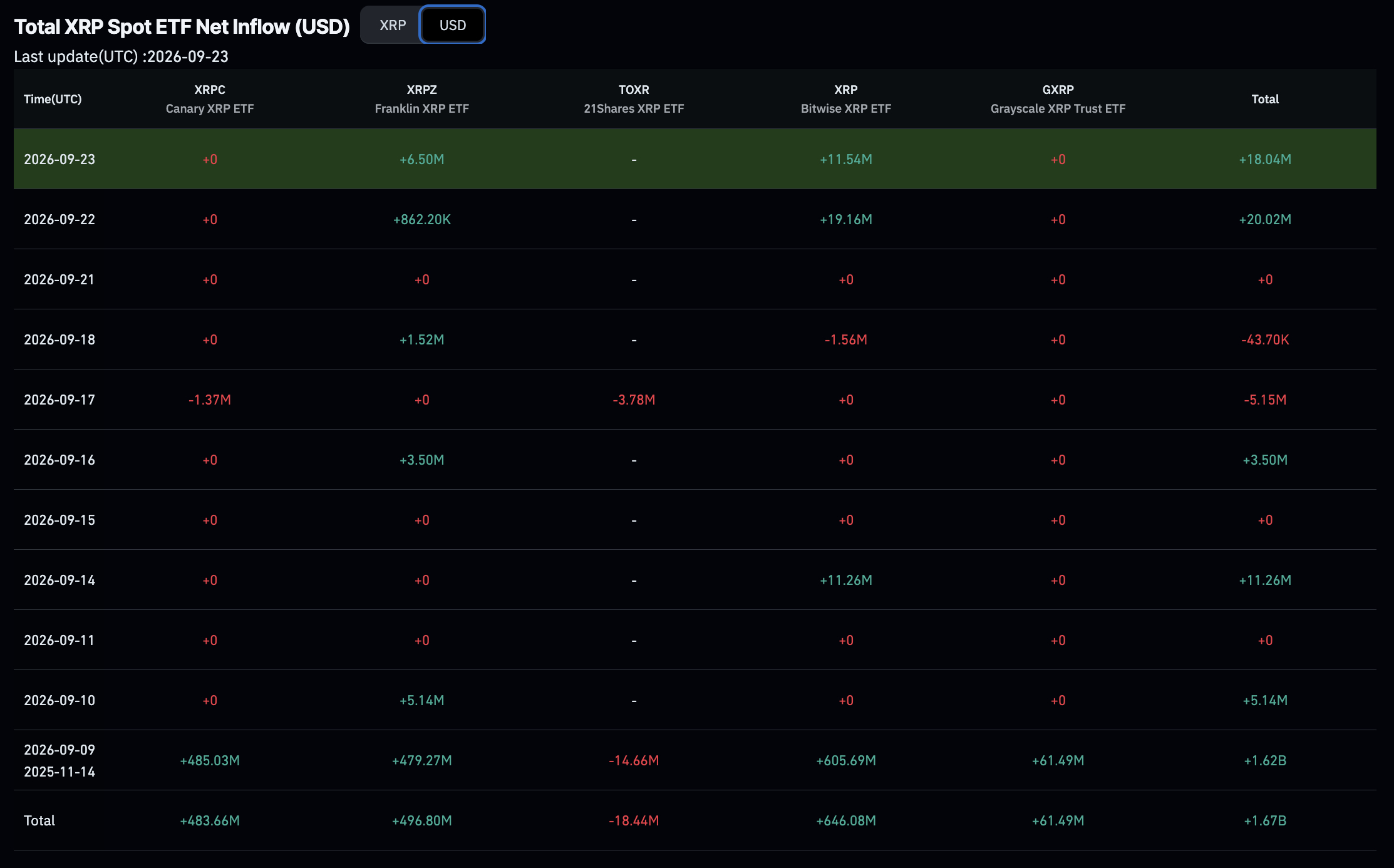
XRP price is hovering at the $1.50 level, down 8% over the prior 24 hours after failing to hold the $1.60 level. The drop happens even as U.S. spot XRP ETFs pulled in $18.04 million in net inflows during the previous session. The gap forces a blunt question onto the desk: if demand for regulated funds keeps showing up and the token still can’t hold its highs, how much weight does that demand actually carry against spot-market selling?

XRP’s 24-hour range ran from $1.60 down to $1.46, meaning the token was sitting at the bottom of its own daily band. Market capitalization fell to $92 billion, keeping XRP fifth by market cap. Against Bitcoin, XRP slipped 5.6% to 0.00001755 BTC, confirming the move wasn’t purely a dollar-denominated dip.
Discover: Best Crypto IPO this September
Why ETF Inflows Did Not Stop XRP Price Drop?
The Bitwise XRP ETF led Tuesday’s inflows with $11.54 million, lifting its cumulative total to $646.08 million, while Franklin Templeton’s XRPZ added $6.50 million to reach $496.80 million cumulatively. Across all XRP ETFs, net inflows reached $18.04 million, taking cumulative inflows since launch to roughly $1.67 billion.
Total net assets actually fell from $1.731 billion in the prior session despite the fresh inflows. That decline can be explained by XRP’s lower price, which reduced the market value of the tokens already held by the funds.
The scale of the new money also remains relatively small compared with XRP’s spot market. The $18.04 million ETF inflow represented roughly 0.44% of the $4.1 billion in XRP spot volume over 24 hours. The two measurements use different time windows, with ETF flows covering a U.S. trading session and spot volume covering a rolling 24-hour period, but the comparison still shows the ETF inflow was modest relative to overall trading activity.
CoinGecko’s own market note points to profit-taking as the session’s primary driver. XRP price ran from about $1.29 to $1.38 on September 18, then pushed toward $1.60 over the following days. It was a move that left recent buyers sitting on gains once the price stalled below resistance.
Elevated Binance deposits add a possible distribution signal to that story, but a deposit isn’t a sale. Tokens moving onto an exchange can reflect trading, market-making, custody shifts, or collateral posting just as easily as outright liquidation.
On-chain data adds a second layer. Santiment put XRP’s 365-day MVRV ratio at -11.75% on September 23, meaning the average holder active over the past year is sitting on an unrealized loss. That’s consistent with rallies drawing sell orders from traders trying to reduce exposure.
Earn $50 and Enter $300K Prize Draw on EdgeX
Technical Levels: $1.60 Rejection and $1.45 Support
The sell-off unfolded in three distinct legs. XRP traded near $1.60 late on September 23 before the first sharp break, which took it from $1.58 to about $1.52. It then chopped sideways between $1.49 and $1.52 overnight, with a failed recovery attempt lifting the price back toward $1.52 near 11:00 IST on September 24 before buyers gave up.
The final leg started after 13:45 IST, when XRP broke below $1.48 and reached $1.46 by roughly 15:00 IST. That marks a second failed attempt this week to establish price above the $1.60 zone, following a similar test on September 22.
These are reference points drawn from recent trading, not forecasts. XRP’s futures positioning around the move matters for how sharp the next leg gets, since a crowded book on either side tends to accelerate whichever direction price breaks.
Trade XRP on Bybit and Get a Chance to Win Our $1,000 USDT Airdrop
The post XRP Price Under Pressure: Spot Selling Overwhelms ETF Demand appeared first on Cryptonews.
Crypto World
Quantum threat to Bitcoin could materialize before commercial viability, EU regulators warn

European financial authorities warned that an advanced quantum computer could undermine cryptography used to secure blockchains, saying the threat could emerge before the technology has a viable commercial application.
The warning from the Joint Committee of the European Supervisory Authorities (ESAs), which includes the European Banking Authority (EBA), European Securities and Markets Authority (ESMA) and European Insurance and Occupational Pensions Authority (EIOPA), brings fresh urgency to a long-running question for bitcoin of whether to freeze or not freeze the BTC in legacy wallets. In the event that quantum computers one day do become capable of breaking bitcoin’s cryptography, roughly 6.9 million bitcoin, worth roughly $586 billion, are currently vulnerable, according to Cryptoquant.
“Threats could materialize earlier than any viable commercial application,” the authorities said in their Autumn 2026 Risk and Vulnerabilities report released Wednesday. An advanced quantum computer “could undermine some cryptography systems widely used to secure communications, transactions, databases and blockchains,” according to the report..
Although the report does not mention timelines for quantum computing becoming commercially viable, a recent IBM report says it will be in use in four years or less.

As Deace noted, “If the environment is this bad in my home state, where Trump has been the most popular political figure over the last decade, I can’t imagine where it is everywhere else.”
There’s similar scrambling in Texas, where a super PAC blessed by Senate Majority Leader John Thune is now on track to spend more than $100 million, an add on of $35 million to the $65 million the group had already booked in advertising to boost Ken Paxton’s bid against James Talarico. The total price tag for keeping the Senate seat is on track to approach $200 million just on the GOP side.
It’s little better for House Republicans. Between their official campaign arm, allied outside organizations, and the candidates themselves, there is a massive $485 million well of ad reservations between Aug. 1 and Election Day—and that’s just in districts Trump won, according to a Politico analysis.
Even Speaker Mike Johnson has grown frustrated with Trump and his constant introduction of tumult in the political ether. During his Sept. 13 appearance on NBC’s Meet the Press, Johnson appeared obviously annoyed as he kept getting asked about Trump’s fresh promise to send every American adult a $5,000 check if Republicans keep their House and Senate majorities. “I guess we’re going to spend the whole segment talking about this one issue,” Johnson said. “I want to talk about what we’ve actually done and not ideas on the table.”

Banks warn AI shopping agents raise online fraud and data privacy risks

Strive Outpaces Saylor’s Strategy With $86 Million Bitcoin Treasury Push

Tarek El Moussa on His Divorce From Christina Haack




-

 Fashion6 days ago
Weekend Open Thread: Talbots – Corporette.com
-

 Tech4 days ago
Researchers escape OpenAI Codex sandbox to run commands on host
-

 Crypto World2 days ago
Goldman Sachs and Deutsche Bank Agree: The S&P 500 Rally Isn't Over
-

 Crypto World4 days ago
Who Needs CLARITY Anyway? ARB Could See 70X Increase: Hodler’s Digest
-

 Crypto World6 days ago
Circle launches Arc Studio AI agent for building onchain apps
-

 Crypto World7 days ago
Mortgage and refinance interest rates today, Thursday, September 17, 2026
-

 Fashion9 hours ago
8 iPhone Accessories That Add Personality
-
 NewsBeat6 days ago
Trump says US has reached an agreement to take permanent control of Greenland’s security
-

 Crypto World6 days ago
Trading Bitcoin on Robinhood? Why 2% Spread Has Traders Worried
-

 Crypto World6 days ago
Bitcoin price breaks channel as RSI climbs to 63
-

 Business4 days ago
Analog Devices (ADI) Bets $1.35 Billion on Chips that Let Machines Think for Themselves
-

 Tech3 days ago
Google’s $899 Googlebook is a bet that you’ll buy a new laptop for Gemini
-

 Crypto World4 days ago
Coinbase, Robinhood, Circle Seen as Tokenized-Stock Winners
-

 Tech5 days ago
Trump suggests rebranding AI with a new name, says he’s also creating an AI Force
-
 Business2 days ago
Oil Price Today (September 23): Crude oil below $100 on hopes of US-Iran talks. What did Trump say?
-

 Tech7 days ago
GPT-6 Astra Reached the Nether in Minecraft, Lost Its Stash to a Creeper, and Farmed Potatoes for Hours
-

 Crypto World6 days ago
World Money launches in 150+ countries with Stripe
-

 Crypto World6 days ago
Silver prices recover quickly, hitting weekly high today
-
 Crypto World2 days ago
Trump-Xi Polymarket Odds for Handshake Hit 50%
-
 Crypto World21 hours ago
Bitcoin Threatens Sub-$84,000 Breakdown as Long Liquidations Spike
You must be logged in to post a comment Login