

Crypto World
Europe’s unlicensed crypto firms face ‘wipeout’ as MiCA transition deadline nears



The locked capital needed for a MiCA spot license is relatively small, somewhere between 50,000 euros ($57,000) and 150,000 euros by class, according to Patrick Gruhn, founder and CEO of Perpetuals.com Ltd. (PDC).
What becomes costly is the license itself, which can be as high as 700,000 euros in year one and 250,000 euros a year after for a lean firm, or into the millions for a large exchange, Gruhn said via email. “Call it 12–24 months to the first authorized trade with maybe €100k lawyer fees,” he said.
As for the number of jobs that could be lost due to MiCA, no reliable estimate exists. However, many of the 80% of pre-MiCA platforms facing extinction are tiny shell entities, Gruhn said.
“That overstates the situation significantly,” Gruhn said. “And much of it is reallocation, since licensed firms have to hire compliance staff and the offshore ones don’t.”
Changing environment
Nevertheless, MiCA threatens to stifle crypto as an industry in some countries. The situation is particularly harsh in Poland, where domestic legislative delays and presidential vetoes have meant the Polish Financial Supervision Authority (KNF) has faced roadblocks in establishing a fully functional crypto application and licensing regime.
Mateusz Kara, CEO of Morphic Financial Group, which is headquartered in London and has deep roots and operations in Poland, said the MiCA deadline could “wipe out Polish crypto.”

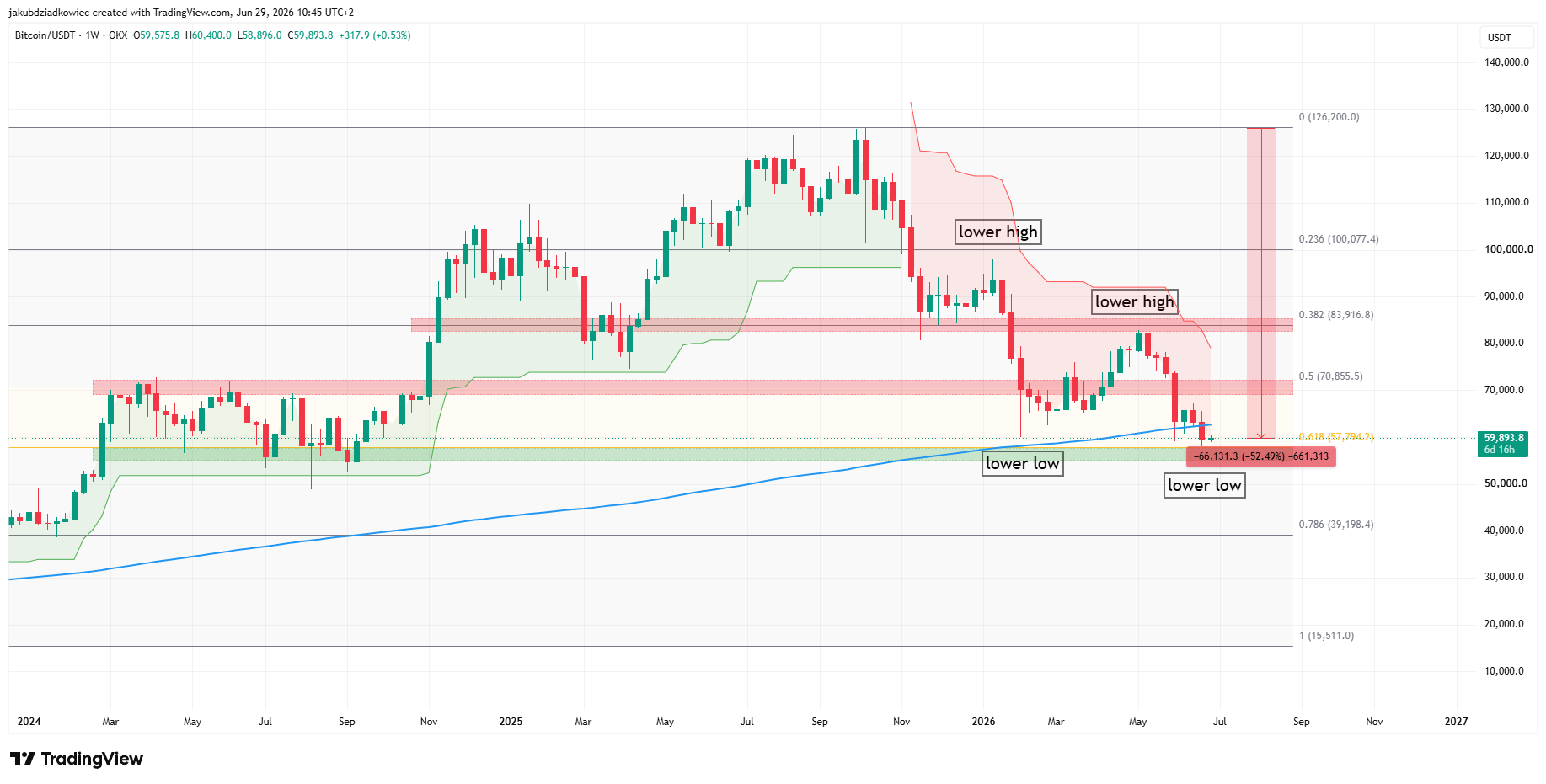
Bitcoin (BTC) and silver have almost nothing in common, yet both now sit roughly 52% below their record highs at the same moment. Their weekly charts have started to rhyme, candle for candle.
Bitcoin trades near $59,893, while silver hovers around $58.50 per ounce. Both assets broke key support levels in recent weeks, and their momentum indicators rolled over together.
The 52% Mirror in Bitcoin and Silver
The headline number is hard to ignore. Bitcoin trades about 52% under its $126,200 peak from late 2025. Silver sits 52% beneath its $121.76 record set in January 2026.
The structure matches just as closely. Both weekly charts show a clear sequence of lower highs and lower lows since their tops.
Supertrend confirms the regime on each chart. The indicator flipped bearish on Bitcoin in November 2025 and on silver in mid-March 2026.

Each asset has also surrendered major Fibonacci supports. Bitcoin lost the 0.382 and 0.5 levels, and now defends the 0.618 golden pocket near $58,000.
Silver broke through both its 0.382 and 0.618 levels. Its last visible support is the 0.786 retracement around $54.50.

Where Bitcoin and Silver Split on the 200-Week Average
One difference breaks the symmetry. The 200-week moving average separates the two charts in a meaningful way.
Bitcoin closed below its 200-week moving average last week for the first time this cycle. That level had acted as a long-term floor at previous Bitcoin bottoms.
Silver tells a calmer story here. Its 200-week average sits near $36, far below the current price of around $58.50.
That gap gives silver a wide cushion. Bitcoin, by contrast, has already lost the support that bulls watch most closely.
A weekly close back above that average would ease the pressure on Bitcoin. Until then, the metal holds the stronger structural position of the two.
Momentum Warns That Both Trends Could Extend
Momentum points the same way on both weekly charts. Each relative strength index (RSI) has broken down in recent weeks.
Silver’s RSI lost an ascending support line that had held since July 2022. The line confirmed twice, in March 2025 and March 2026, before breaking in May 2026. The reading now sits near 39.

Bitcoin’s RSI looks weaker still. It trades inside a falling channel and failed to reclaim the midline in May 2026, sliding toward 34.

Readings below 40 points to fading demand on both assets, a divergence that earlier predictions also flagged. A move back above the broken levels would mark the first sign of repair.
For now, silver must defend $54.50 to avoid a slide toward its $50 long-term support. Bitcoin needs to hold the $58,000 golden pocket or risk a drop toward the 0.786 level near $39,000.
The two charts have fallen in step for months. Whether they bottom together or break down together is the question traders now face.
The post The 52% Coincidence: Bitcoin and Silver Are Bleeding in Near-Perfect Sync appeared first on BeInCrypto.
XRP is still under heavy selling pressure, mirroring the broader crypto market. Both its USDT and BTC pairs continue to trade within clear downtrend structures. While the dollar pair is testing a major demand zone, the BTC pair is also hovering just above an important support level, leaving the market at a key decision point.
Ripple Price Analysis: The USDT Pair
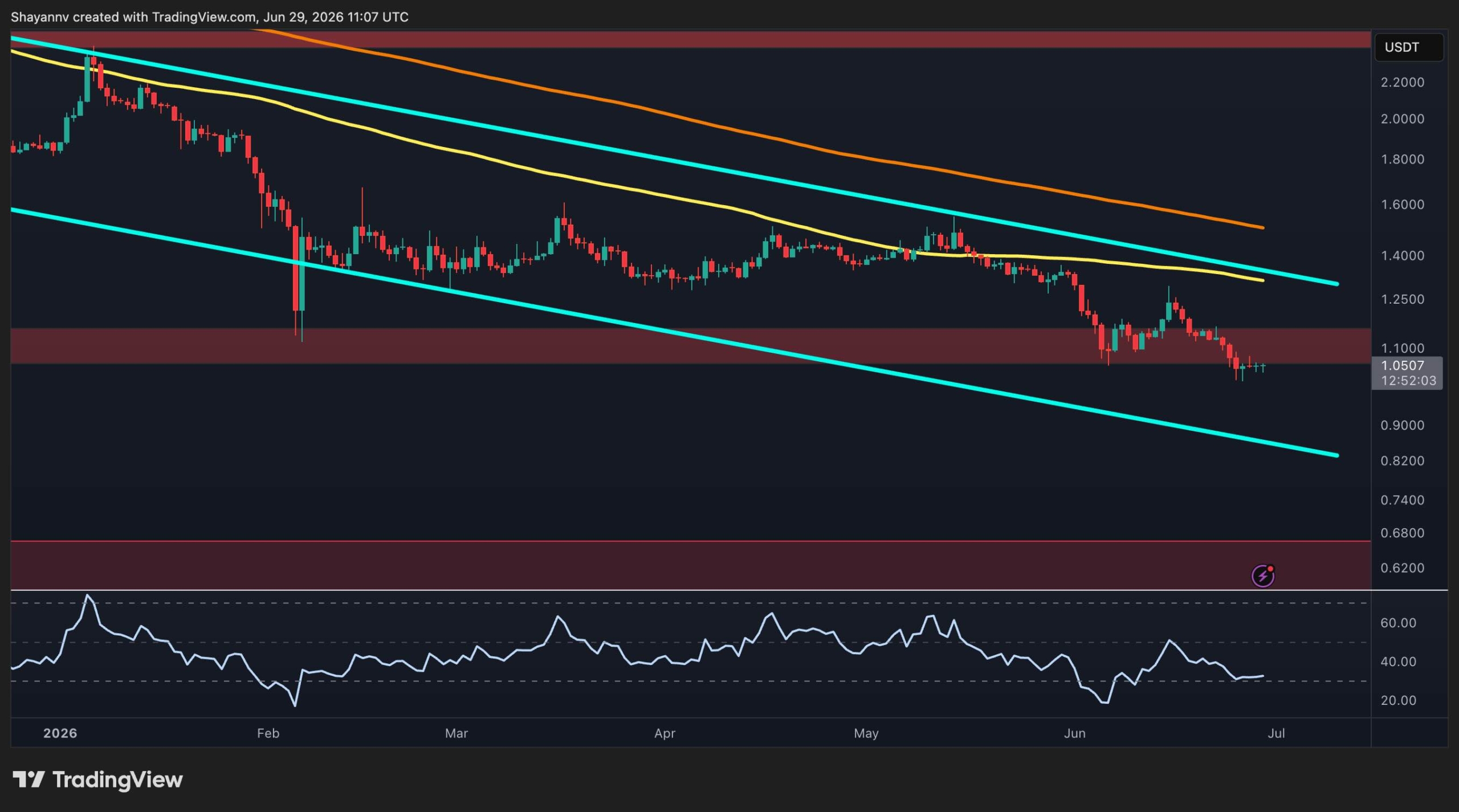
The daily chart shows XRP extending its broader bearish structure while remaining confined inside a long-term descending channel. The asset is currently trading around $1.05 after losing several higher lows over the past few weeks, confirming that sellers continue to dominate the higher timeframe.
The most important support now sits in the $1.00 to $1.10 zone, where the price is currently attempting to stabilize. This area has previously attracted demand and could produce a relief bounce if buyers manage to defend it once again. However, the overall trend remains bearish as XRP continues to trade below both major moving averages, with the 100-day and 200-day averages sloping lower simultaneously and acting as dynamic resistance levels.
Any recovery attempt is likely to face its first obstacle around the 100-day moving average near the $1.3 area, which coincides with the upper boundary of the descending channel. A breakout above both the channel resistance and the moving average would be required to signal a meaningful shift in market structure.
On the downside, losing the current support area could expose the lower boundary of the descending channel near the $0.80 region, making this support zone particularly important for the medium-term outlook.
The BTC Pair
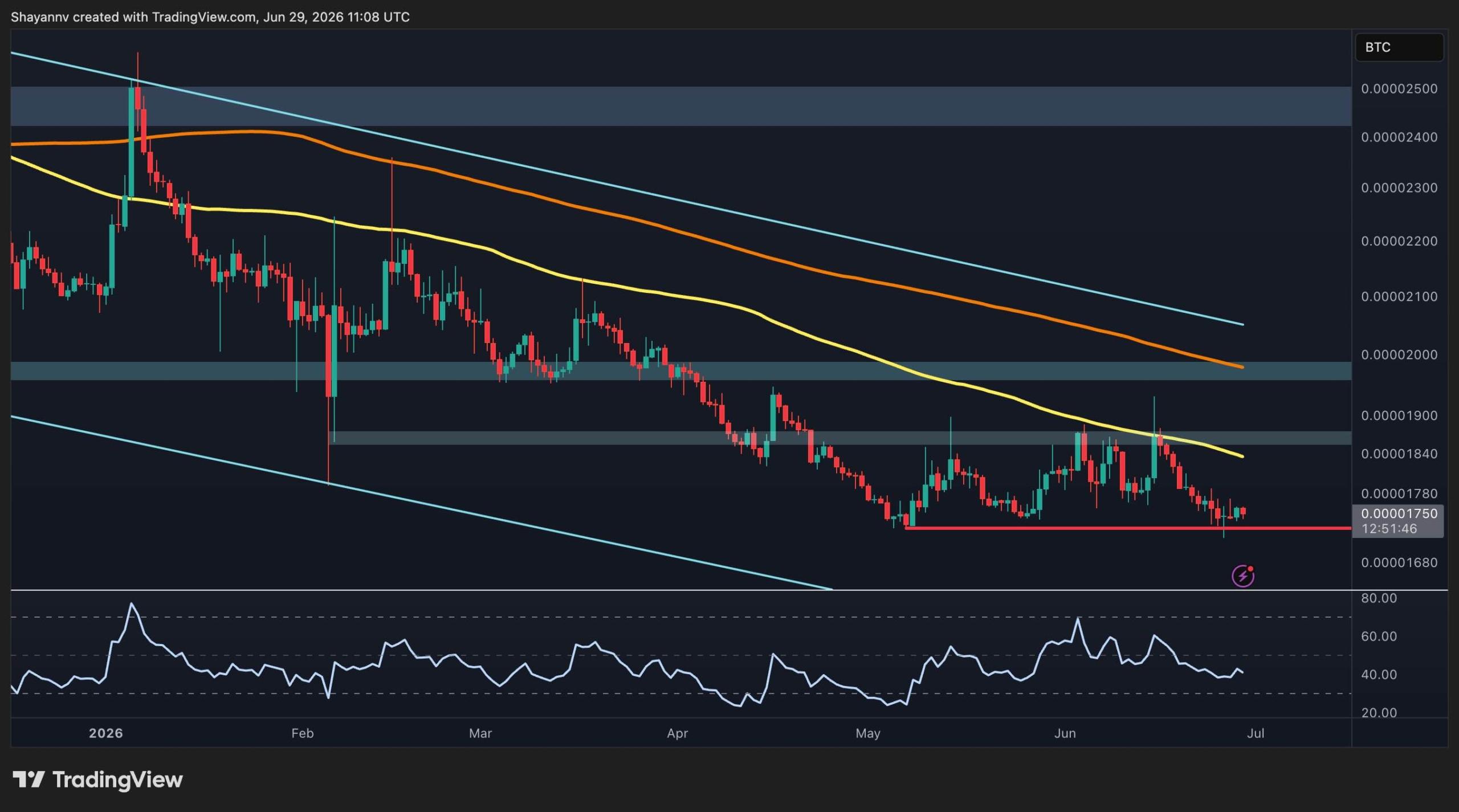
Against Bitcoin, XRP continues to underperform, with the XRP/BTC pair remaining firmly inside its own descending channel. The pair is currently trading around 1,750 sats, sitting directly above a horizontal support level that has repeatedly prevented deeper declines since May.
Although this support has held on multiple occasions, none of the subsequent rebounds has produced a clear bullish breakout, highlighting persistent selling pressure and a lack of sustained bullish momentum. The repeated failures near the 100-day moving average further reinforce the bearish structure.
Overhead, the first major horizontal resistance is located around 1,850 sats, which converges with the declining 100-day moving average. Above that, stronger resistance emerges near 2,000 sats, followed by the descending 200-day moving average and the upper channel resistance. As long as XRP remains below these resistance clusters, the trend against Bitcoin favors continued relative weakness.
On the downside, a confirmed breakdown below the 1,700 sats support region would likely invalidate the current consolidation and open the door for another leg lower toward the psychological support level around 1,500 sats, and potentially lower. This keeps XRP at a critical decision point on both USDT and BTC charts, as the buyers and sellers fight one another to establish dominance over the trend.
The post Ripple Price Analysis: Calm Before the Storm for XRP as Decision Time Arrives appeared first on CryptoPotato.

Strategy has introduced a new “Digital Credit Capital Framework” aimed at monetizing part of its Bitcoin holdings to support dividends, bolster cash reserves, and fund share repurchases—while explicitly keeping a long-term Bitcoin strategy in place. The move was detailed in a Monday 8-K filing with the US Securities and Exchange Commission.
In the filing, Strategy also outlined changes to its STRC preferred stock dividend policy, including an increase in the annual dividend rate to 12% from 11.5%, and authorized separate buyback programs for its preferred securities and its Class A common stock. The company said it may sell Bitcoin to raise as much as $1.25 billion to strengthen liquidity for dividends, debt costs, and additional buybacks.
Key takeaways
- Strategy’s new Digital Credit Capital Framework formalizes a Bitcoin monetization program to generate cash for dividends, interest, and debt payments.
- Cash reserves are reported at $2.55 billion, covering about 17 months of preferred stock dividends and interest under the new rules.
- The annual dividend rate on STRC preferred stock rises to 12% from 11.5%, alongside buyback authorizations for both preferred securities and Class A shares.
- Strategy disclosed the company raised roughly $1.15 billion in net proceeds by selling 12.67 million shares, while also reporting no BTC purchases during the week ended Sunday.
A framework built around dividends, buybacks, and controlled monetization
Strategy’s 8-K filing with the SEC describes the Digital Credit Capital Framework as an approach designed to “monetize part” of its Bitcoin holdings. The stated purpose is to produce funds that can be used for dividends, replenishing cash reserves, and repurchasing securities, while maintaining the company’s broader long-term exposure to Bitcoin.
A central element is the disclosed capacity to sell Bitcoin—up to $1.25 billion—to increase cash reserves and support capital allocation. The company ties this liquidity plan to payments and buybacks rather than positioning it as a shift away from Bitcoin as a core treasury asset.
The filing also includes updated dividend mechanics for STRC preferred stock. Strategy raised the STRC annual dividend rate to 12% from 11.5% and revised aspects of how that dividend policy operates in relation to the company’s liquidity planning.
Cash reserve rules: $2.55 billion earmarked for payment coverage
Strategy said its cash reserve has grown to $2.55 billion. According to the filing, that reserve is intended to cover approximately 17 months of preferred stock dividends and interest payments.
Under the new policy, the reserve is restricted in use: it can only be used for dividend and interest payments, and it must be maintained at a minimum level equivalent to at least 12 months of those obligations unless the board approves changes.
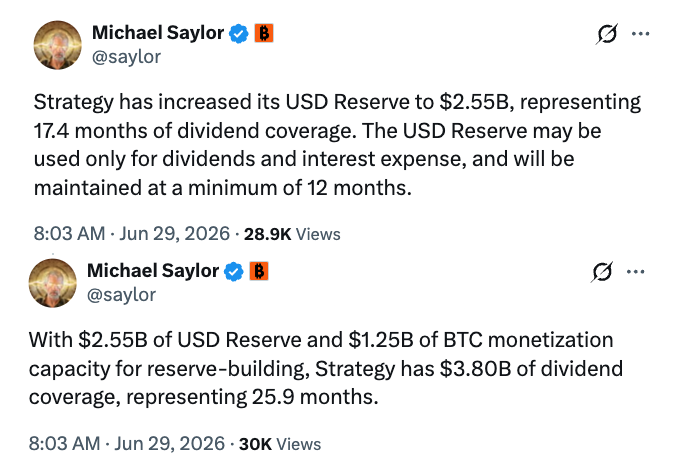
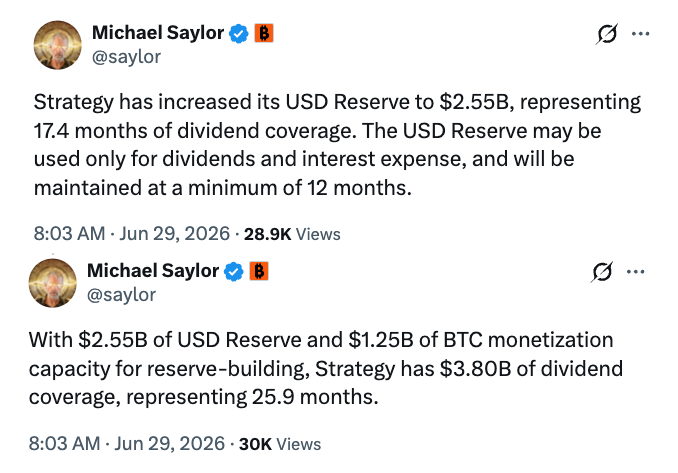
Michael Saylor, Strategy’s executive chairman, said in connection with the framework that the company’s existing cash reserve, together with the $1.25 billion Bitcoin monetization capacity, could provide up to $3.8 billion in dividend coverage—equivalent to nearly 26 months.
For investors and traders, the key implication is that Strategy is trying to reduce uncertainty around short-term funding needs associated with preferred dividends and interest. By placing constraints around the cash reserve’s use and establishing minimum coverage requirements, the company is effectively outlining a “runway” for payments even if market conditions remain volatile.
Dividend increase and buyback authorization raise the stakes for liquidity management
Beyond the framework itself, Strategy adjusted two capital-return levers at the same time: the STRC preferred dividend rate and its ability to repurchase securities.
The filing indicates that the annual dividend rate for STRC preferred stock was increased to 12% from 11.5%. It also authorizes separate buyback programs for preferred securities and for the company’s Class A MSTR common stock.
This combination—higher dividend obligations alongside expanded repurchase permissions—places greater emphasis on the effectiveness of the liquidity plan described in the framework. Strategy’s approach suggests that the company views Bitcoin monetization capacity as a tool to keep both dividend payments and capital returns functioning through market drawdowns.
Strategy’s filings and related messaging also reference discipline in equity issuance under certain trading conditions. In one statement tied to the rollout, Michael Saylor said Strategy expects to remain disciplined in its use of MSTR issuance, particularly when the stock trades at or near 1x mNAV, according to posts on X associated with his remarks.
No BTC purchases reported; holdings unchanged at 847,363 BTC
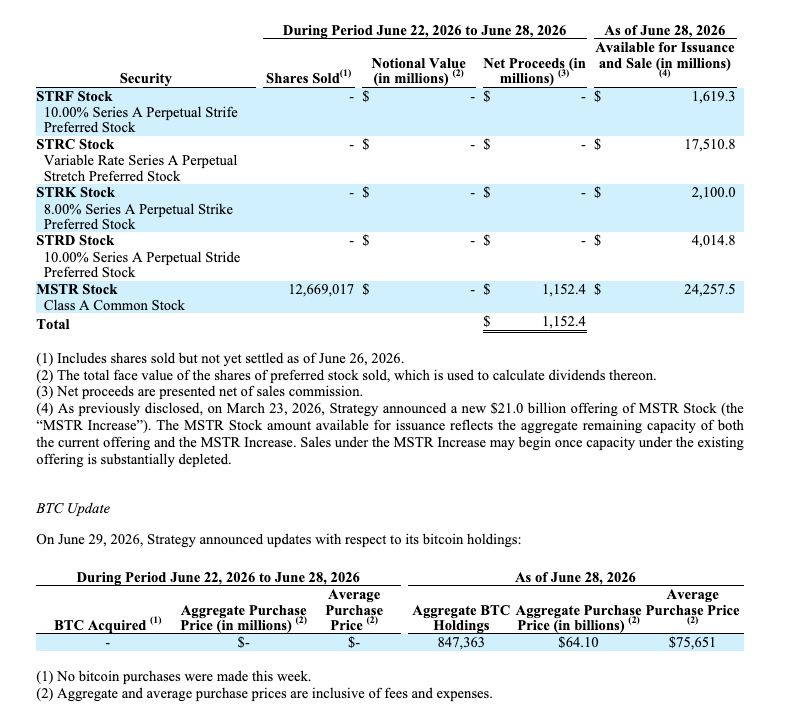
Strategy’s SEC disclosure also covered its recent Bitcoin buying activity. The company reported that it did not acquire any BTC during the week ended Sunday, leaving its holdings unchanged at 847,363 BTC purchased for a combined $64.1 billion, at an average purchase price of $75,651 per bitcoin.
Cointelegraph previously reported Strategy’s approach to liquidity and treasury operations, including weekly reserve updates; in the context of this filing, the immediate takeaway is that the company’s Bitcoin inventory did not increase over the referenced week. It also reported adding a net 3,625 BTC so far in June after buying 3,657 BTC and selling 32 BTC earlier in the month.
Separately, Strategy disclosed that it raised around $1.15 billion in net proceeds by selling 12.67 million MSTR shares, a financing activity that complements—and may partially offset—the need to sell Bitcoin for cash.
At the same time, market conditions around Strategy’s equity have been pressured. The article cites TradingView data indicating STRC traded at a discount to par, and notes that MSTR shares were down nearly 50% year-to-date at the time of publication. Earlier commentary from Grayscale’s research head Zach Pandl suggested Strategy should consider selling $3 billion in Bitcoin to address cash obligations, as covered by Cointelegraph.
Monday’s market reaction reflected renewed investor interest: ahead of the Nasdaq open, MSTR shares were bid up by more than 5.5%, according to the account in the source article.
What to watch next
Investors should focus on how Strategy implements the framework—especially whether the company actually executes Bitcoin sales up to the stated $1.25 billion capacity and how quickly it uses that cash for dividends, debt costs, and buybacks while keeping the reserve rules intact. The next signals to track are updates on cash reserve levels, execution of repurchase programs, and any further disclosures linking the framework’s monetization plan to market volatility.

Money has undergone a remarkable transformation throughout human history. From trading goods through barter systems to using coins, paper currency, credit cards, and online banking, each innovation has made transactions faster and more efficient. Today, we are witnessing another major shift: the evolution of digital cash.
Digital cash is more than simply paying with a smartphone or making online purchases. It represents a new generation of programmable, decentralized, and borderless financial systems that redefine how value is stored, transferred, and managed. Powered by blockchain technology, digital cash is laying the foundation for a more connected and accessible global economy.
The Journey from Physical to Digital
Traditional cash served societies well for centuries because it offered simplicity and universal acceptance. However, as commerce expanded globally and the internet became central to daily life, physical money revealed several limitations:
- Slow international transfers
- High transaction costs
- Dependence on financial intermediaries
- Limited accessibility for the unbanked
- Vulnerability to inflation and counterfeiting
Electronic banking and digital payment platforms addressed many of these issues by allowing instant payments through centralized financial institutions. Yet these systems still rely heavily on trusted intermediaries that control transactions, maintain user data, and establish access rules.
Bitcoin: The First Truly Digital Cash
The launch of Bitcoin in 2009 introduced a groundbreaking concept: peer-to-peer digital cash without requiring banks or payment processors.
Bitcoin solved the long-standing “double-spending” problem through blockchain technology, enabling users to securely transfer value across the internet while maintaining transparency and decentralization.
Key innovations included:
- Borderless transactions
- Limited supply due to scarcity
- Cryptographic security
- Public verification
- Decentralized consensus
Although Bitcoin has increasingly been recognized as digital gold and a store of value, it has also demonstrated that decentralized money can function on a global scale.
Expanding Beyond Simple Payments
The evolution did not stop with Bitcoin.
New blockchain networks expanded digital cash by introducing programmable assets that can interact with smart contracts. This transformed digital currencies from simple payment tools into components of decentralized financial ecosystems.
Today’s digital assets can:
- Earn yield automatically
- Serve as collateral for loans
- Participate in decentralized governance
- Enable instant cross-border settlements
- Power decentralized applications (dApps)
- Facilitate automated financial services
Money is no longer static—it has become programmable.
The Rise of Stablecoins
One of the most important developments in digital cash has been the emergence of stablecoins.
Unlike cryptocurrencies with highly volatile prices, stablecoins are designed to maintain relatively stable values by being pegged to traditional assets such as the U.S. dollar.
Their benefits include:
- Faster international payments
- Lower transaction fees
- Reduced exchange-rate volatility
- Improved accessibility for businesses
- Efficient settlements for decentralized finance (DeFi)
Stablecoins have become essential infrastructure connecting traditional finance with blockchain ecosystems.
Digital Cash Becomes Intelligent
Artificial intelligence is introducing another layer of evolution.
AI agents can now interact directly with blockchain networks, enabling autonomous financial activities such as:
- Managing digital wallets
- Executing recurring payments
- Optimizing investment strategies
- Monitoring market conditions
- Rebalancing portfolios
- Paying for digital services automatically
This convergence of AI and blockchain is giving rise to autonomous financial systems where software can independently manage economic decisions within predefined parameters.
Cross-Chain Connectivity Changes Everything
Early blockchain ecosystems often operated in isolation, requiring users to remain within a single network.
Modern interoperability solutions now allow assets to move securely across multiple blockchains, creating a more unified financial landscape.
Cross-chain connectivity enables:
- Seamless asset transfers
- Greater liquidity
- Improved user experiences
- Multi-chain decentralized applications
- Broader financial accessibility
Instead of choosing one blockchain, users can benefit from the strengths of many interconnected networks.
Challenges That Remain
Despite rapid innovation, digital cash still faces several obstacles:
Regulation
Governments continue developing frameworks for cryptocurrencies, stablecoins, taxation, and digital asset compliance.
Scalability
Blockchain networks must continue increasing transaction throughput while maintaining decentralization and security.
Security
Protecting wallets, smart contracts, and users from cyber threats remains a top priority.
User Experience
Mass adoption depends on making blockchain technology as intuitive as today’s online banking and payment apps.
The Future of Digital Cash
Digital cash is steadily evolving into a comprehensive financial ecosystem rather than simply replacing physical money.
In the coming years, we can expect:
- Greater institutional adoption
- More widespread use of stablecoins
- AI-powered financial automation
- Tokenized real-world assets
- Enhanced privacy technologies
- Faster cross-border settlements
- Increased integration with everyday commerce
Digital cash will likely become an invisible layer of the internet, seamlessly powering transactions across both digital and physical economies.
Conclusion
The evolution of digital cash reflects humanity’s ongoing pursuit of faster, safer, and more inclusive ways to exchange value. From Bitcoin’s decentralized breakthrough to programmable money, stablecoins, AI-driven finance, and cross-chain interoperability, digital cash has grown into a sophisticated financial infrastructure capable of supporting the next generation of the global economy.
As blockchain technology continues to mature, digital cash will become increasingly embedded in everyday life—not merely as an alternative payment method, but as the foundation of a smarter, more open, and interconnected financial system.
REQUEST AN ARTICLE


The monetization program also authorizes Strategy to sell bitcoin to finance up to $1 billion of Digital Credit Securities repurchases and up to $1 billion of Class A common stock buybacks. Any bitcoin monetization beyond these authorized purposes would require additional board approval. The repurchase programs have no expiration date.
The monetization program is part of a broader capital allocation strategy that also includes increasing the dividend on Strategy’s preferred stock STRC to 12%, from 11.5%, adopting a formal USD Reserve policy, and requiring sufficient cash reserves to cover at least 12 months of preferred stock dividends and interest obligations.
Michael Saylor, Founder and Executive Chairman of Strategy said, “At the same time, Digital Credit requires liquidity, discipline, and active capital management. This framework is designed to strengthen credit quality and enable the Company to reduce expected preferred stock dividend payments when accretive. This framework also sets out how we plan to use our capital management toolkit while maintaining our commitment to long-term Bitcoin exposure.”
MSTR shares are up 3% following the announcement, while bitcoin trades below $60,000.
Bitcoin infrastructure company Breez has added a feature to its developer toolkit that lets users send USDC (USDC) and USDt (USDT) across more than 30 blockchain networks directly from a Bitcoin balance, without first converting or holding stablecoins.
According to an announcement shared with Cointelegraph, the feature uses the Lightning Network alongside automated conversion to route payments from Bitcoin (BTC) to USDC or USDT before delivering funds to the recipient’s preferred blockchain.
When a user enters a recipient’s wallet address, the Breez SDK identifies the destination blockchain, calculates a conversion route and displays the amount, network and fees before the payment is confirmed. The transaction is then routed through liquidity providers, including Flashnet and Boltz, which convert the sender’s Bitcoin into stablecoins and deliver it on the recipient’s chosen blockchain.
Roy Sheinfeld, CEO of Breez, told Cointelegraph the feature does not require USDT or USDC to be issued on the Lightning Network. Instead, it relies on “interoperability” to let users spend from a Bitcoin balance while recipients receive stablecoins on supported blockchain networks.
Breez said users continue holding Bitcoin until they initiate a payment, while recipients receive stablecoins on their preferred blockchain without requiring the sender to manage separate stablecoin balances. The feature is non-custodial and initially supports only outbound stablecoin payments, with support for receiving stablecoins from external blockchain networks planned for a future release.
The feature is designed to allow developers to add stablecoin payments without integrating multiple blockchain networks or requiring users to manage separate Bitcoin and stablecoin balances.
Related: Credit unions managing $25B in assets join stablecoin infrastructure program
Bitcoin payment infrastructure expands
The launch comes as companies expand Bitcoin and the Lightning Network, a layer-2 payment network designed to make Bitcoin transactions faster and less expensive, into new financial and commercial applications.
In February, Secure Digital Markets, an institutional trading and lending desk, completed a $1 million Bitcoin payment to Kraken over the Lightning Network in less than half a second, demonstrating the protocol’s potential for high-value institutional transfers. The transaction illustrated how Lightning is increasingly being tested for use cases beyond small retail payments.
That same month, Bitcoin infrastructure company Voltage introduced a US dollar-settled revolving credit line that embeds business credit into Lightning payment flows, allowing companies to settle repayments in either US dollars or Bitcoin. The product is intended to enable businesses to access working capital using Lightning for payments, without holding crypto on their balance sheets.
Event platform Satlantis also launched a Bitcoin-native ticketing platform with embedded Lightning wallets, allowing organizers to sell tickets and accept BTC alongside traditional payment methods.
In March, Tether-backed Bitcoin infrastructure startup Ark Labs in a $5.2 million funding round to develop technology supporting stablecoin issuance, transfers and settlement on Bitcoin.
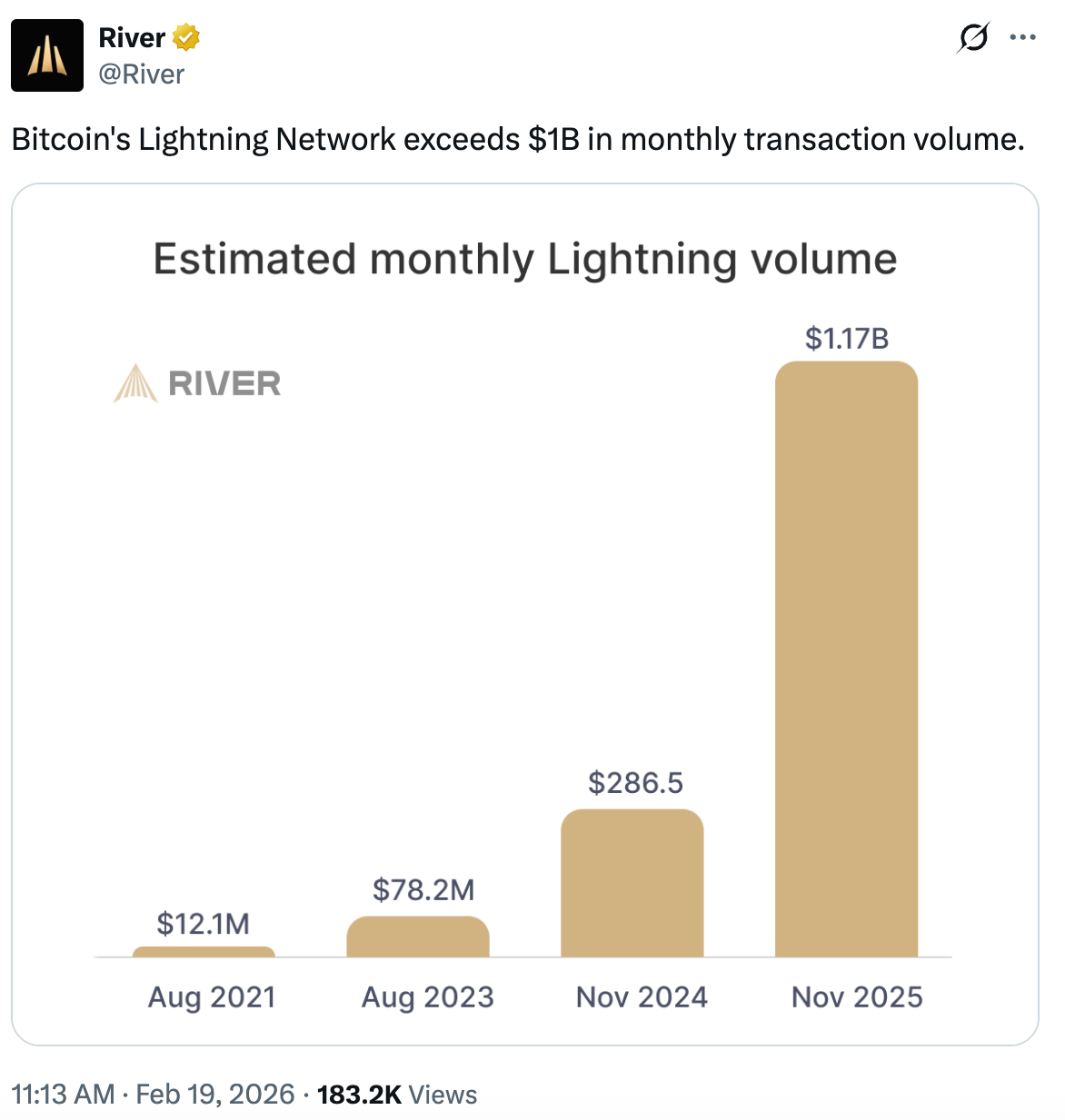
Lightning adoption has continued to grow. A February report from River estimated the network surpassed $1 billion in monthly transaction volume in late 2025, up from around $12 million in 2021.
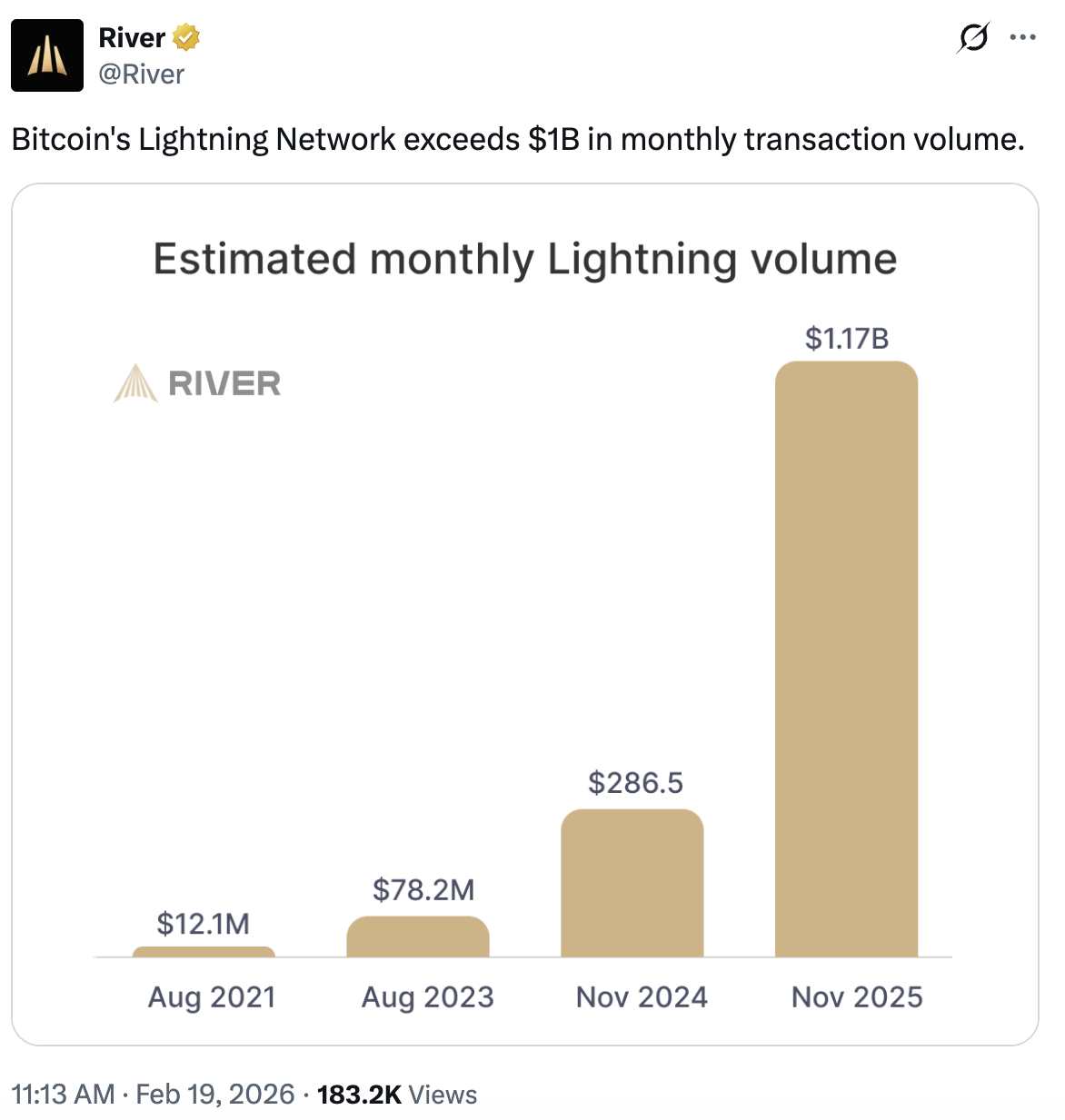
Lightning Network transaction volumes continue to grow. Source: River
Magazine: Bitcoin decouples from tech stocks, Ether eyes ‘selling wave’: Market Moves
Strategy is adopting a new capital framework that allows it to monetize part of its Bitcoin holdings to fund dividends, build cash reserves and repurchase securities while maintaining its long-term Bitcoin strategy.
In a Monday 8-K filing with the US Securities and Exchange Commission, Strategy introduced its “Digital Credit Capital Framework,” which includes a Bitcoin monetization program and changes to its STRC preferred stock dividend policy.
The company has raised the STRC annual dividend rate to 12% from 11.5% and authorized separate buyback programs for preferred securities and its Class A MSTR common stock. Strategy said it may sell Bitcoin (BTC) to raise as much as $1.25 billion to increase its cash reserve, pay dividends and debt costs, as well as fund stock buybacks.
The filing comes amid a volatile stretch that has seen the value of MSTR shares slide almost 50% year-to-date while the price of STRC on Friday dropped as low as $71.25, a 28.75% discount to par, according to TradingView data. Grayscale’s research head Zach Pandl last week said Strategy should sell $3 billion in Bitcoin to cover its cash obligations.
Ahead of Monday’s Nasdaq open, investors had bid up MSTR share price more than 5.5%.
Strategy boosts cash reserve to $2.55 billion
A key part of the new framework is the company’s cash reserve, which it said has grown to $2.55 billion, or enough to cover about 17 months of preferred stock dividends and interest payments.
Under the new policy, the reserve can only be used for those payments and must be maintained at a minimum of 12 months unless the board approves otherwise.
Source: Michael Saylor
Strategy executive chairman Michael Saylor said the existing cash reserve, combined with the $1.25 billion Bitcoin monetization capacity, gives Strategy up to $3.8 billion in dividend coverage, or nearly 26 months.
Related: Grayscale’s Pandl says Strategy should sell $3B Bitcoin to restore confidence
“Strategy expects to remain disciplined in its use of MSTR issuance, particularly when the stock trades at or near 1x mNAV,” Saylor added.
No Bitcoin purchases as Strategy raises $1.15 billion
The biggest public Bitcoin treasury company also reported that it did not acquire any BTC during the week ended Sunday, leaving its holdings unchanged at 847,363 BTC purchased for a combined $64.1 billion, at an average of $75,651 apiece. At last look, traders were paying about $60,018 to buy the token.
The company has added a net 3,625 BTC so far in June after buying 3,657 BTC and selling 32 BTC earlier in the month.
Source: SEC
At the same time, the company disclosed raising around $1.15 billion in net proceeds by selling 12.67 million MSTR shares.
Magazine: Bitcoin slides to $58K, XRP hits $1 but onchain data promising: Market Moves
The road from believing “crypto is a scam” to “Bitcoin is a legitimate asset class” is a long way to travel, fraught with many a twist and turn.
Yet against all the odds, a surprising number of high-profile skeptics have undertaken the journey unscathed and, perhaps more remarkably, without ever admitting they were wrong.
The very naysayers who once warned of a “crypto apocalypse” have begun preaching the virtues of blockchain rails and launching tokenized products of their own.
From Bitcoin exchange-traded funds to tokenized gold, here are five of the biggest crypto backflips.
Born-again crypto converts
Larry Fink: ‘Index of money laundering’ to ETF king
Larry Fink may be the archetypal born-again crypto convert. In 2017, the BlackRock chief executive cast Bitcoin as an “index of money laundering,” nicely capturing mainstream finance’s view at the time of a market they believed was dominated by wild speculation and dubious flows.
As a side note: people in glass houses shouldn’t throw stones. While money laundering in crypto was estimated at $82 billion in 2025, the United Nations Office on Drugs and Crime estimates that roughly $800 billion to $2 trillion is laundered the old fashioned way each year.
Related: BlackRock Bitcoin ETF sees near-record outflows as BTC dips below $75K
It’s not entirely clear why Fink decided to recalibrate but by 2020 he started acknowledging its potential, in 2023 he was actively defending BlackRock’s crypto push, and today BlackRock has become one of the most important institutional access points to Bitcoin via spot ETFs, helping pull the asset into the heart of the regulated investment universe.
In his annual shareholder letters, Fink now waxes lyrical about tokenization and writes impassioned OpEds about how it is set to transform the financial system.
Reluctant but will make money anyway
Jamie Dimon: still hates Bitcoin, loves the rails
If Fink is a born-again believer, Jamie Dimon sits squarely in the reluctant and still skeptical camp.
The JPMorgan chief has called Bitcoin a “fraud,” crypto investors “stupid,” and warned that BTC will blow up on more than one occasion, not to mention using Congressional hearings as a platform to reiterate his distaste for the asset.
But watch what he does, not what he says as JPMorgan has quietly become one of Wall Street’s biggest blockchain infrastructure providers.
The world’s largest bank has built out its Onyx division, rolled out JPM Coin, experimented with linking bank infrastructure to crypto wallets, and developed tokenized collateral platforms to move cash and securities around more efficiently.
Oh sure, Dimon still trashes Bitcoin in public, but JPMorgan now sells many of the rails that make institutional digital asset markets viable.
Peter Schiff: gold forever, but now onchain
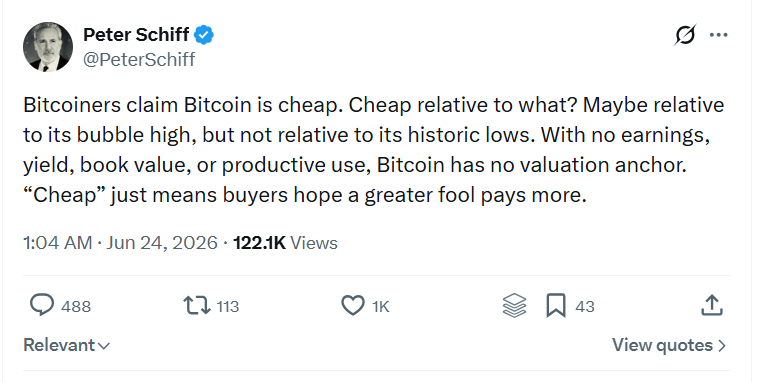
Peter Schiff hasn’t softened his rhetoric as prices and adoption grow. If anything, each Bitcoin rally only amplifies his warnings about bubbles, “greater fools,” and inevitable collapse. It’s a highly effective form of advertising for Schiff’s beloved gold industry.
Peter Schiff’s infamous “greater fools” comment. Source: Peter Schiff
Yet even the perpetual goldbug has edged into the digital asset world by launching a tokenized gold platform, T-Gold.com, in December 2025, that uses blockchain to represent vaulted bullion as transferable tokens.
The product lets users buy physical gold and silver stored in segregated vaults and receive digital tokens representing specific quantities of the metals, with ownership recorded on a blockchain.
Related: Tucker Carlson presses Peter Schiff on Bitcoin as new global reserve currency
For Schiff, this is not apostasy but reinforcement: a way to tell crypto-native investors “you can keep the rails, but swap the asset for something with thousands of years of monetary history instead.”
Nouriel Roubini: Technodollars, not Bitcoin
Nouriel Roubini, once known in crypto circles as “Dr. Doom,” might seem like an unlikely candidate for any kind of crypto conversion.
He has spent years describing most digital assets as “useless,” warning of a “crypto apocalypse,” and cataloguing the sector’s governance failures, conflicts of interest, and investor harm.
Yet this week, he published a whitepaper co-authored with Atlas Capital and announced USAFi, a tokenized instrument marketed as a regulated permissionless security, designed to embody what he calls the “Technodollar.”
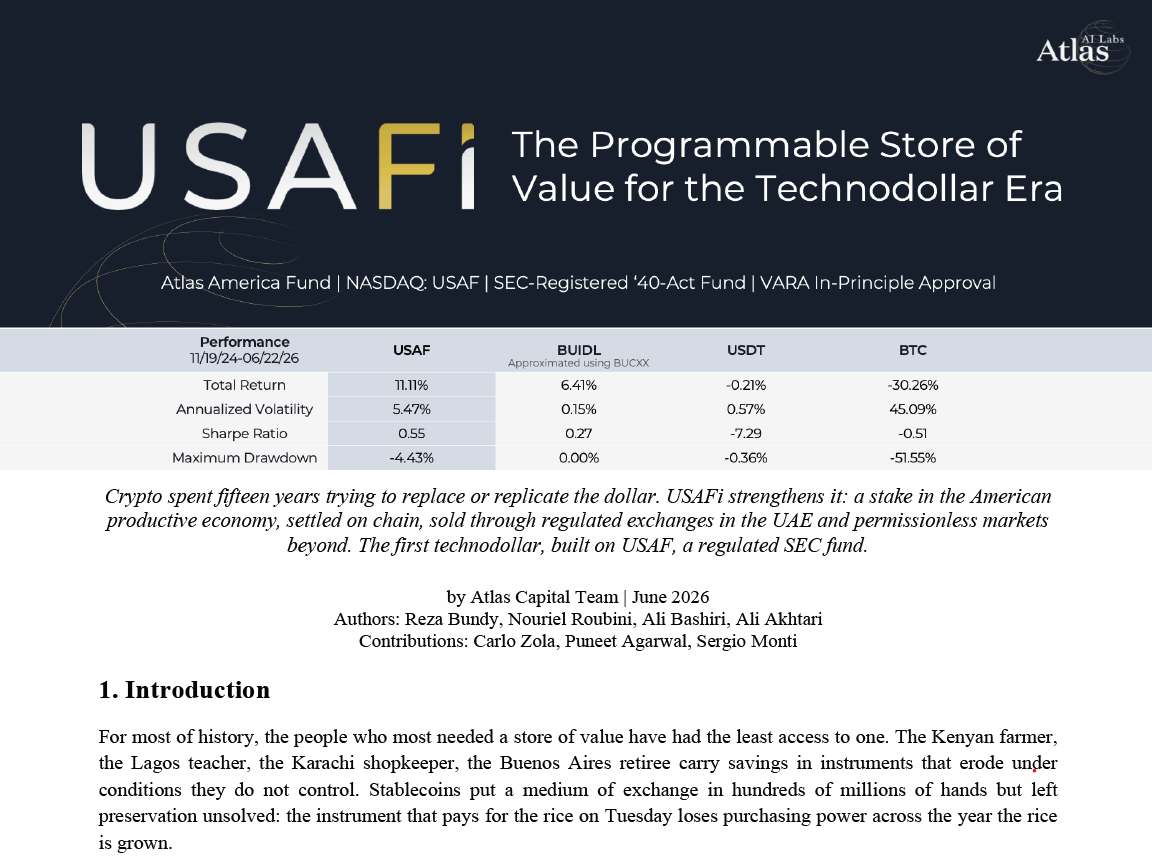
USAFi whitepaper. Source: Atlas AI Labs
Roubini insists this is “not a reversal,” telling Cointelegraph he “remains skeptical of unbacked crypto assets whose value depends primarily on speculation rather than fundamentals.”
The Technodollar, he argued, is about “modernizing the financial system through regulated, asset-backed digital instruments that can be trusted by institutions and individuals alike.”
He added that he still believes most crypto assets “suffer from excessive speculation, weak governance, conflicts of interest, and insufficient investor protections.”
Don’t understand it, but happy to cash in
Donald Trump: vibes over whitepapers
Perhaps unsurprisingly, Donald Trump belongs in a category of his own. The same politician who once said Bitcoin “seems like a scam” and warned that it could undermine dollar hegemony later rebranded himself as the “crypto president.”
Trump has flirted with nonfungible token drops, launched his own meme coin and one for his wife, and pitched himself as the defender of domestic crypto innovation against overreaching regulators (all while reportedly pocketing over $2.3 billion from his various crypto endeavors since 2024).
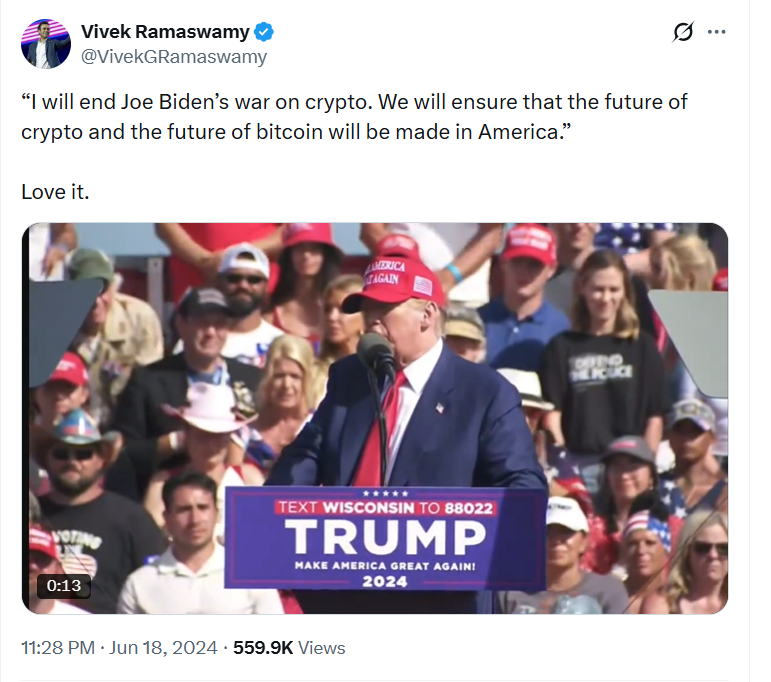
Trump promised to end Joe Biden’s war on crypto. Source: Vivek Ramaswamy
He may not be able to tell you the difference between proof-of-work and proof-of-stake, but he does understand his constituencies.
Related: Trump crypto company’s USD1 stablecoins backing UFC event bonuses
The crypto industry has matured into an important voting bloc, and its donors are increasingly strategic. What matters is the ability to read a room full of HODLers and say the right words about freedom, innovation, and firing Gary Gensler.
What changed: faith, incentives, or both?
Born-again converts like Fink have reframed crypto and tokenization as extensions of their existing mission, encouraged by clear demand and the opportunity to graft new fee streams onto enormous asset management franchises.
The reluctant skeptics, on the other hand, have tried to draw bright lines between “bad crypto” and “good digital finance,” and the opportunists, well, they’ve learned that even a shallow embrace of digital assets can unlock both support and riches.
Of course, whether these moves represent genuine intellectual evolution or a simple instinct to follow the money remains to be seen. But perhaps the bigger question is: which crypto skeptic will be the next to see the light? Is it too much to hope that Warren Buffett will review his famed opinion about Bitcoin that it is “rat poison squared?”
Magazine: Bitcoin will not hit $1M by 2030, says veteran trader Peter Brandt

Galaxy Digital’s Head of Firmwide Research Alex Thorn cut the firm’s estimated probability of CLARITY Act passage in 2026 from 60% to 50% on June 26, citing a narrowing Senate calendar and intensifying competition for floor time, not unresolved policy disputes.
The downgrade marks the second directional cut in weeks, pulling the odds back to levels last seen in April after a brief surge to 75% following the Senate Banking Committee markup in May.
The context matters for anyone tracking crypto regulation and market structure legislation heading into the second half of 2026. A bill that passed the House 294-134 on July 17, 2025, with 78 Democrats crossing the aisle, is now stalling not on substance but on scheduling, and the window is closing fast.

Thorn’s note framed the issue plainly: the shortening calendar and growing competition for floor time are the primary drivers, with a July vote still possible but the path to 60 Senate votes increasingly unclear.
Discover: The Best Token Presales
Clarity ACT: Senate Adjourned Until July 13, Leaving Weeks Before the August Recess
The structural constraint is straightforward. The US Senate adjourned until July 13, and the August recess creates a hard backstop that compresses meaningful floor time to roughly two to three weeks. Senate Majority Leader John Thune secured unanimous consent for the adjournment with no objection, meaning the chamber has already consumed time that the CLARITY Act needed.
The Banking Committee and Agriculture Committee have not yet released a merged bill text, a prerequisite for any floor vote. Until a unified Senate draft is published, Thune cannot schedule floor consideration, and without an early July scheduling commitment, the bill slides to September.
That is not a soft deadline; September puts crypto legislation 2026 directly into midterm election season, where bipartisan cooperation on complex market structure bills has historically collapsed.
The Senate requires 60 votes for CLARITY Act passage, a threshold that demands meaningful Democratic buy-in. Competing priorities, FISA legislation, the National Defense Authorization Act, Trump’s housing bill tied to the SAVE Act, and a backlog of nominations, are all positioned ahead of crypto market structure in the queue.
Galaxy’s scenario framework is specific. If a unified Senate text is published around July 4, as Senator Cynthia Lummis has indicated is the target, and Thune commits to a floor vote before the recess, Thorn said odds could move back above 60%. The policy building blocks are largely in place: the bill establishes SEC/CFTC jurisdictional boundaries, introduces a mature blockchain test for securities classification, and extends federal AML obligations to digital commodity intermediaries for the first time.
If neither a merged text nor a scheduling commitment materializes before mid-July, Galaxy’s framework points to another downgrade. Ethics provisions, specifically conflict-of-interest rules for government officials’ crypto holdings, remain unsettled after a Van Hollen amendment failed 11-13 in committee, and Senators Ruben Gallego and Cory Booker have both treated enforceable ethics rules as a condition for their support. That is not resolved; it is deferred.
Parallel regulatory timelines in 2026 have consistently shown that prediction markets reprice faster than institutional analysts when legislative momentum stalls.
Polymarket traders currently put CLARITY Act passage at 41%, nine points below Galaxy’s 50%, having fallen from 82% in February as the Senate calendar deteriorated. That gap does not invalidate Thorn’s estimate, but it reflects how sharply informed public sentiment has moved against the July timeline.
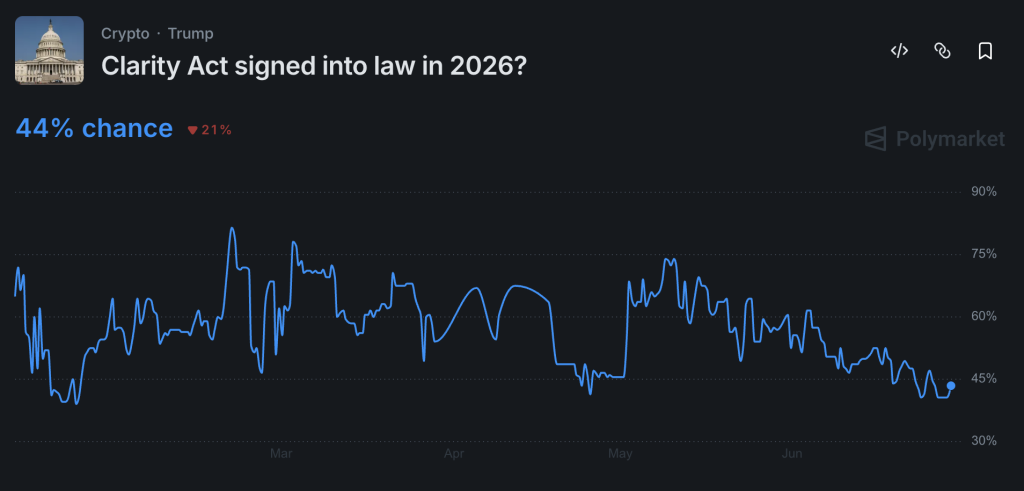
The divergence is worth holding. Galaxy is pricing in the possibility that Lummis’s July 4 text target holds and leadership acts; Polymarket is pricing in the base rate of Senate inaction on complex legislation under a compressed calendar.
The CLARITY Act’s failure to clear the Senate this year would not be a minor procedural setback. Senator Lummis has warned that a miss in 2026 risks pushing market structure legislation to 2030 or beyond, given the probability of a changed chamber composition after November.
For institutional participants waiting on the SEC/CFTC jurisdictional split the bill codifies, each week of delay extends compliance uncertainty across the digital asset intermediary sector. The next hard signal to watch: publication of the merged Senate text. Its presence or absence in the first two weeks of July will determine whether Galaxy’s 50% holds or gets cut again.
Discover: The Best Crypto to Diversify Your Portfolio
Don’t Miss Out on Our $1,000 USDT Airdrop on ByBit
The post Here’s Why Galaxy Just Slashed Clarity Act Odds In Half appeared first on Cryptonews.
Crypto World
Prediction market consolidation could spark wave of M&A across sports betting, Bernstein says


The rapid consolidation of the prediction market technology stack is raising the odds of a new wave of mergers and acquisitions across sports betting and financial markets, according to Wall Street broker Bernstein.
Over the past eight months, every major consumer-facing prediction platform has moved to own both customer distribution and exchange infrastructure, the report said.
“Kalshi and Polymarket own the stack but trail on distribution, which leaves each as plausibly a target as an acquirer,” analysts led by Ian Moore said in the Monday report.
The analysts noted that DraftKings acquired Railbird to launch its DKeX exchange, Robinhood partnered with Susquehanna to build Rothera, Coinbase acquired The Clearing Company shortly after launching event contracts, and Flutter established a dual-FCM structure to preserve access to multiple exchanges.
The trend reflects Bernstein’s view that prediction markets are converging with sports betting and consumer finance into a single competitive landscape, opening the door to combinations that previously seemed unlikely, including sportsbooks buying exchanges, exchanges buying sportsbooks, and consolidation among sportsbook operators themselves.

Cambridgeshire farm shop owner ‘disappointed’ after burglary leaves it unable to open

American Tower: The Market Is Ignoring This 10% IRR (NYSE:AMT)

The 52% Coincidence: Bitcoin and Silver Are Bleeding in Near-Perfect Sync

No Jackpot Winner as $257 Million Prize Rolls Over to $269 Million Monday Draw

Renter of Home in Anne Heche Crash Denies Settlement With Son

Blockchain.com files with SEC for U.S. IPO

MASSIVE XRP PRICE REVERSAL INCOMING?! #xrp #crypto #cryptocurrency

Martin Lewis: Why broadband and mobile bills should stay fixed #gmb #money #consumer

Shriram Finance Personal Loan | Shriram Finance Personal Loan Kaise Le
-
 Sports6 days ago
Two goals and an assist by sheer aura: Cristiano Ronaldo just entered the World Cup chat
-

 Fashion3 days ago
Weekend Open Thread: Staud – Corporette.com
-

 Politics3 days ago
The House | Manchesterism won’t survive the painful trade-offs unless it gets citizens on board
-

 Politics4 days ago
Potential 2028er World Cup attendee leaderboard
-

 Business3 days ago
Asia stock markets slide as tech shares slump
-

 Tech4 days ago
A Look At A Gaggle Of Transputer Boards
-

 News Videos20 hours ago
MAJOR BITCOIN & MARKET UPDATE!!!! (MUST WATCH ASAP!!!)
-
Crypto World5 days ago
Bitcoin (BTC) Dips Below $62K, Ethereum (ETH) Plunges 6% Daily: Market Watch
-
 Crypto World4 days ago
Dell (DELL) Shares Tumble Over 5% Following Analyst Downgrade to Hold
-

 Crypto World5 days ago
Securitize Wraps Roubini's SEC-Registered ETF as Dubai VARA Digital Security
-
Business6 days ago
Entergy settles forward sale agreements, raises $672 million in cash proceeds
-

 Crypto World2 days ago
Coinbase, Circle Deepen Crypto Stock Losses Despite Resilient S&P 500
-

 Crypto World2 days ago
Kraken's xStocks Opens Bending Spoons IPO Registration to EEA Retail
-

 Sports3 days ago
FIH Pro League: India defeat Pakistan 7-1, register biggest win of campaign | Other Sports News
-

 Crypto World3 days ago
RTX holders must register wallets before token distribution begins
-
 Crypto World3 days ago
Hyperliquid Named on Singapore MAS Investor Alert Register
-

 Tech2 days ago
Russian hackers now target Signal backup recovery keys
-

 Tech2 days ago
Bluekit phishing kit adopts browser-in-the-middle for login theft
-

 Sports4 days ago
India vs Bangladesh LIVE Score, Women’s T20 World Cup: Bangladesh Opt To Bat; India Enter ‘Do-Or-Die’ Stage As Semi-Final Race Heats Up
-
Crypto World3 days ago
The DATA Foundation Launches to Tackle AI’s Multi-Billion Dollar Training Data Bottleneck
You must be logged in to post a comment Login