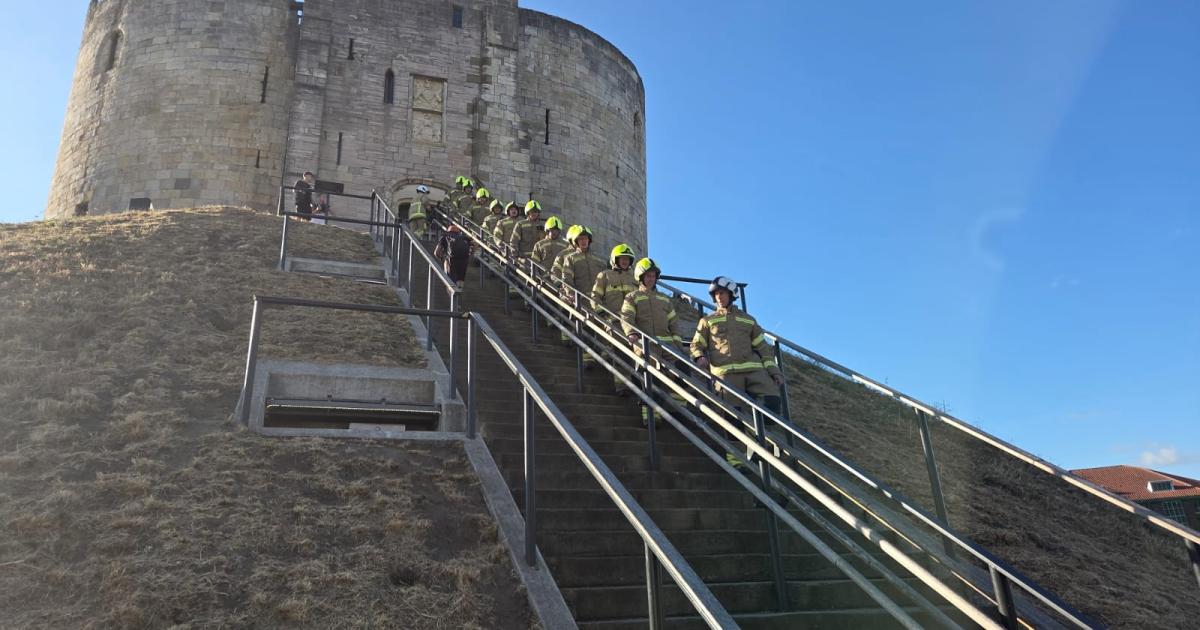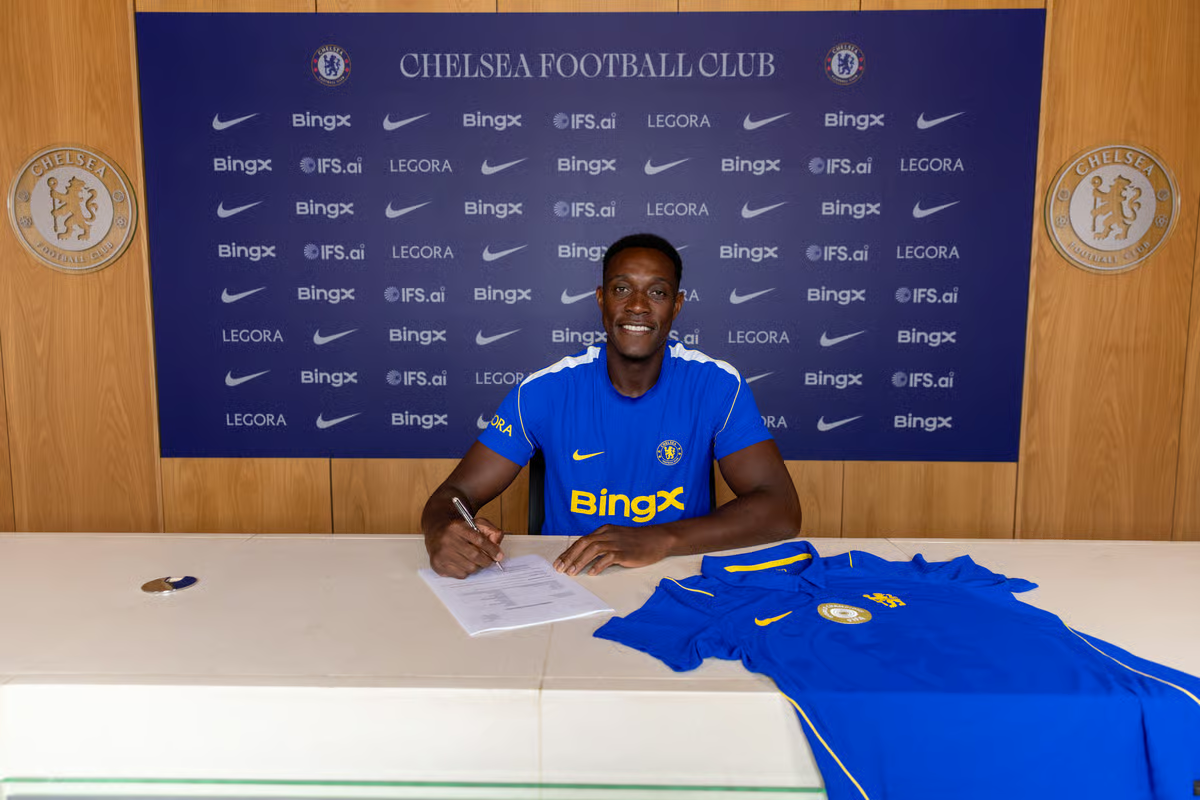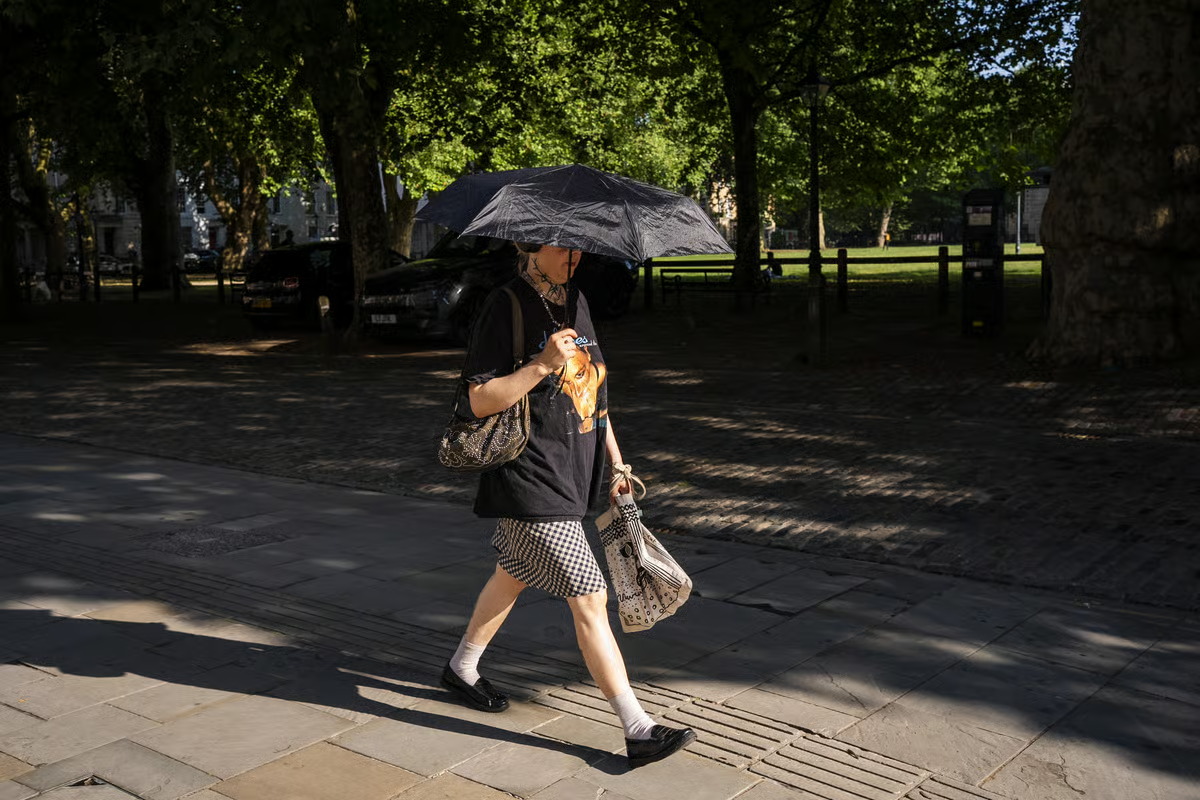


The June temperature record that had stood since 1976 was repeatedly broken during last week’s heatwave, as exceptionally hot and humid conditions led the Met Office to issue a rare red warning for extreme heat for some areas – the first time it has issued such a warning for three days in a row.
The terraced home on Baff Street in Spennymoor has been boarded up since the incident just before 6.40pm on Saturday (June 27) when a white Vauxhall Vivaro crashed into the front wall.
The van fled the scene and was found abandoned nearby.
Durham Police said it has since been recovered and will undergo forensic examination.
Advertisement
A picture taken at the scene in Spennymoor (Image: NORTHERN ECHO)
Officers are now hunting those responsible and have appealed for information.
Fire services also attended later in the evening, arriving around 7.30pm to secure the property.
A spokesperson said: “We were notified of an incident at Baff Street in Spennymoor on Saturday, June 27, just after 7.30pm.
“On attendance, crews were presented with a single vehicle that had collided with a terraced property.
Advertisement
“Upon arrival, there was damage caused to the front elevation of the property.
“Firefighters worked with partner agencies, assessing and making the scene safe and handed it over to the police at around 8.30pm.”
Baff Street in Spennymoor (Image: NORTHERN ECHO)
Gas and electricity engineers are also believed to have attended.
A Spennymoor home on Baff Street has been boarded up after a van deliberately drove into it as police hunt the fleeing suspects. (Image: NORTHERN ECHO)
A spokesperson for Durham Police said: “Enquiries are ongoing to locate the suspects and officers would like to speak to anyone who may have any information that could help their investigation.”
Advertisement
Anyone with information can call the force on 101, quoting incident number 425 of June 27, visit durham.police.uk, or contact Crimestoppers anonymously nformation on 0800 555 111 or at crimestoppers-uk.org
If approved, an existing building would be demolished to make way for the new science and technology building
A developer is hoping to build a new eight-storey science and technology building at a science park. Stanhope PLC has submitted an Environmental Impact Assessment (EIA) application to Greater Cambridge Shared Planning for the development of a new building at Cambridge Science Park (CSP).
Advertisement
The site sits within the science park campus, owned by Trinity College Cambridge. If approved, ‘building 163’ would be demolished for the new science and technology building to be built in its place.
The site area is approximately 0.366 hectares and is located on the eastern edge of the science park. The building will have a ground level plus seven storeys (eight storeys in total).
If approved, the building would predominantly be used for offices with dry lab space on the lower floors. With regards to car parking, the screening report states: “Parking for CSP 163 is currently proposed to be undercroft car stackers located within the current parking area of the Site, to accommodate 125 car parks.”
Vehicular access for the proposed development would be via Cambridge Science Park Road from Milton Road. Additionally, 248 cycle parking spaces would also be provided if approved.
Advertisement
The developer wishes to bring forward the development at “as soon as possible”. According to the proposals, construction would start at the site no earlier than autumn 2027 and be completed by 2030.
Cambridge Science Park is an 152-acre site in north Cambridge, founded by Trinity College Cambridge in 1970. It is reportedly the UK’s oldest science park.
Arsenal have been conducting an internal review and will now see the club’s head of sports science and performance, Tom Allen depart the Emirates – following their head of medical out the door
Arsenal have seen another one of Mikel Arteta’s lieutenants leave this summer with the club’s head of sports science and performance, Tom Allen, to depart.
Advertisement
Last month, the Gunners axed head of medical, Dr Zafar Iqbal. His exit came as a surprise and Allen is another senior figure who will no longer be part of Arteta’s backroom staff. Allen had been at the Emirates Stadium for nine years, joining in 2017 having previously been at Aston Villa.
The injuries suffered by some of Arsenal’s leading lights has led to them having a look internally and assessing how they can prevent that in the future. Arteta recommended an old acquaintance, Joaquín Acedo, a physiotherapist from Spain, to undertake a review. Being without key players has threatened to derail their hopes in previous seasons.
Allen is not the only influential figure leaving the red side of north London. Another popular member of the first-team staff, Sam Wilson, is also leaving the club. He is lead physical performance coach and has been on Arsenal’s books for 12 years. He is expected to join a club in Europe, reports the Telegraph.
Arteta does ultimately employ an intense game-plan and also operates by using a smaller number of players than many of their rivals, ultimately placing more of a load on the individuals. But the club equally want to ensure they’re doing all they can to protect against injury.
Advertisement
Kai Havertz, Bukayo Saka and Martin Odegaard all missed significant periods last term, whilst Jurrien Timber was not able to recover in time to start the Champions League final – and was eventually forced to miss the World Cup.
Arsenal are looking to build on a season that saw them win the Premier League for the first time in 22 years. Their ability to overcome a late season wobble was also a huge plus following years of near misses and them losing in crunch games. They could not land a memorable double in Europe, however.
Despite taking an early lead PSG ultimately claimed the European Cup on penalties and Arsenal’s defensive style was criticised by some pundits. It led to talk of the Gunners’ need to bolster their quality in the final third and Arteta admitted the club would act to take them to even greater heights.
Advertisement
“We’ll start to make some very important decisions, we want to reach another level,” he said. “We’re going to have to show that ambition because they are more than capable of doing it but it’s going to demand us to be very, very ambitious, very fast and very smart.”
Join our new WhatsApp community and receive your daily dose of MirrorFootball content. We also treat our community members to special offers, promotions, and adverts from us and our partners. If you don’t like our community, you can check out any time you like. If you’re curious, you can read our Privacy Notice.
Upgrade your World Cup TV setup with the Sky Glass ‘designed for football’
This article contains affiliate links, we will receive a commission on any sales we generate from it. Learn more
Sky is knocking 20% off its entire range of Glass TVs to mark the start of the 2026 FIFA World Cup. Until June 17, shoppers can upgrade to the Sky smart TV that’s ‘designed for football’ from £4.50 per month when taken alongside a Sky TV and Netflix package.
Picture a busy road running through a residential neighbourhood. The noise, the fumes, the danger to cyclists and pedestrians – all familiar concerns. But here is one you might not have considered: that traffic may also be making your street more prone to vandalism, burglary and violence.
That is what our new research, using data from tens of thousands of households across England, Scotland and Wales, suggests. We found that when motor traffic increases in a neighbourhood, residents’ assessments of street crime go up.
At first glance, there is no obvious reason why traffic should influence crime. However, a closer look at crime theory reveals several plausible pathways.
The most direct mechanism is guardianship: the idea that everyday surveillance by residents and passersby helps keep crime in check. Influential American urbanist and activist Jane Jacobs famously called this “eyes on the street”.
Advertisement
While it might seem that traffic provides a ready supply of guardians in the form of drivers, their deterrent effect is negligible. Instead, heavy traffic undermines guardianship in multiple ways: wide roads and parked cars fragment public space and obscure sightlines, outsiders are less likely to stand out, and, if traffic discourages walking, there are fewer genuine guardians to keep an eye on things.
Traffic also erodes the social fabric. Research consistently shows that busy roads undermine community ties: neighbours talk less, look out for each other less and feel less ownership of shared spaces.
Criminologists describe communities’ ability to sustain these kinds of social ties and shared norms as “collective efficacy”. Its absence is one of the strongest predictors of violent crime. Chronic stress from traffic noise and congestion is also a likely driver of aggression and antisocial behaviour.
Finally, “broken windows” theory holds that visible disorder (potholes, noise, litter) signals neglect and invites further incivility. Traffic contributes to all of these.
Advertisement
What we found
To test these ideas, we used data from Understanding Society, a large-scale longitudinal study that followed thousands of UK households across three survey waves between 2011 and 2018.
Crucially, the study records both residents’ assessments of crime in their area and interviewers’ evaluations of whether the street they live on carried heavy traffic. Because these two measures were collected separately, any shared bias in how they are recorded is minimal. Looking at residents’ own perceptions – rather than recorded crime – avoids some of the biases inherent in police data, including under-reporting and changes to recording practices. As well as providing a stable measure over time, this captures what residents actually experience on their streets, including everyday, low-level offences that are rarely reported to police.
We used fixed-effects models, which compare each household to itself over time, effectively stripping away background differences between neighbourhoods (such as wealth and density) that might otherwise affect crime. This means our findings reflect what happens when traffic changes within the same neighbourhood, not simply that busier areas might be more crime-prone.
The results were consistent. When a neighbourhood went from low to high traffic, residents’ assessments of vandalism increased by around 9%, burglary by 6%, and violence by 6.5%.
Advertisement
We also found support for the collective efficacy mechanism. As traffic increased, residents reported that neighbours were less willing to help each other – a direct measure of community bonds fraying. That erosion of mutual trust, in turn, was associated with higher perceived crime.
Low traffic neighbourhoods are one way cities are trying to reduce the amount of street traffic. Yau Ming Low/Shutterstock
To check our findings, we accounted for potential differences in how interviewers recorded traffic levels. These checks demonstrated that our headline figures are, if anything, likely to underestimate the effect.
Our findings align with, and complement, recent studies that have directly tested this relationship.
Research on London’s low traffic neighbourhoods – schemes that restrict through-traffic on residential streets – found that their introduction led to roughly a 10% reduction in recorded crime. Those studies used a quasi-experimental design with high validity, ours uses a national observational approach that can be applied more broadly. Together, they build a compelling case.
Advertisement
What this means for policy and crime prevention
Low traffic neighbourhoods and 20mph zones are already justified on road safety, health and environmental grounds. Our findings add crime reduction to that list.
Many crime prevention strategies, such as the UK’s Secured by Design guidance for new residential developments have, historically, promoted designs which discourage pedestrian accessibility. This is intended to make it harder for offenders to enter and escape.
However, if reducing walkability pushes people into cars, and cars make streets less safe, then those well-intentioned design choices may be making things worse by generating crime elsewhere. Effective crime prevention needs to consider the entire urban layout.
This was after officers were called to reports of a 15-year-old boy getting in to difficulty in the water on Saturday 27 June 2026 at 4:51pm.
(Image: Phil Taylor)
Officers have been working our emergency service colleagues from GMFRS and NWAS.
A spokesman has just confirmed that a body has been located in the water today (Monday 29 June) and recovered from the North West Under Water Search and Marine Unit.
Whilst formal identification has yet to take place, specialist officers are supporting the family at this difficult time.
Advertisement
Detective Inspector Dave Ogden from Salford CID said: “Saturday’s incident is truly heart breaking, and my thoughts remain with the family and loved ones of the young boy who has so tragically lost his life.
“While we are satisfied there are no suspicious circumstances, this incident is an incredibly upsetting reminder of the serious risks associated with open water.
(Image: Phil Taylor)
“We understand people want to make the most of the warm weather, but we would urge everyone to stay safe and avoid entering reservoirs, rivers, canals or ponds.
“Please take care and enjoy the weather in a safe way.”
Former NBA stars Malik Beasley and Ed Davis have been indicted in connection with an alleged illegal sports betting scheme.
Beasley and Davis are facing charges alongside four alleged co-conspirators, identified as William Brown, Robert Gorodetsky, Ernesto Plascencia and current NBA player agent Paolo Zamorano, the U.S. Attorney’s Office for the Eastern District of New York said Monday. “Several” defendants were arrested Monday and will be arraigned at an unspecified later date, according to prosecutors
Prosecutors allege Beasley, a player for the Milwaukee Bucks at the time, agreed to alter his performance during games and accepted bribes from his co-defendants, who used that information to place bets based on his performance “with the intention of profiting off the scheme.” Those bets were worth hundreds of thousands of dollars, prosecutors noted.
“As alleged, the defendants turned professional basketball into a criminal betting operation, bribing then-NBA player Malik Beasley to fix his performance in multiple games in order to place fraudulent wagers, enrich themselves and cheat legitimate sportsbooks,” U.S. Attorney Joseph Nocella said in a statement.
Advertisement
“These defendants allegedly operated an illegal betting ring in an attempt to unlawfully earn hundreds of thousands of dollars. As alleged, Malik Beasley allowed himself to be bought and altered his gametime performance to line pockets of Ed Davis and his other co-conspirators,” said James Barnacle, the assistant director in charge of the FBI’s New York field office.
Beasley, 29, joined the Milwaukee Bucks for the 2023-2024 season, following stints with the Los Angeles Lakers, Utah Jazz, Minnesota Timberwolves and Denver Nuggets. He then moved to the Detroit Pistons for the 2024-2025 season. Earlier this year, he signed a deal to play for the Santurce Crabbers, a Puerto Rican team co-owned by music star Bad Bunny.
Davis, 37, most recently played for the Cleveland Cavaliers during the 2021-2022 season. He and Bealsey both played for the Minnesota Timberwolves in 2020 and 2021.
This is a breaking news story. Check back for updates.

Catalina Birlea was killed at a property in Cambridge in October 2025
16:01, 29 Jun 2026Updated 16:08, 29 Jun 2026
A man who killed a sex worker in Cambridge has been sentenced to life in prison. Jon Ismaili, 34, was found guilty at Cambridge Crown Court on June 26 of the murder of Catalina Birlea.
Ismaili, of School Lane, Waterbeach, went to the address where Catalina was staying in Chesterton Road on October 2 and stayed there for around two hours. He then left and a friend found Catalina unresponsive.
She was pronounced dead at the scene. Following a manhunt for Ismaili, he was arrested on October 5. A post-mortem revealed Catalina died as a result of a compression of her neck.
Advertisement
Today (Monday, June 29), Ismaili was sentenced to life in prison with a minimum term of 18 and a half years. Following his guilty verdict last week, Detective Inspector Mark Dollard said: “Only Ismaili knows what happened at the property that morning and why he murdered Catalina.
“He left the house knowing exactly what he had done, covering his face and actively avoiding police. I am pleased officers were able to catch up with him so quickly through diligent detective work putting together a comprehensive investigation.
“Catalina was working as a sex worker that morning, and this case underlines the risks faced by those in this industry. To those working in the sex industry who have experienced violence please report it to the police. We will listen, we will investigate without prejudice and we will support you.”
Alexis Green-Harding will become principal at Vale of York Academy, in Clifton, in September.
Mr Green-Harding previously worked at Archbishop Holgate’s CE School, in Badger Hill, where he served as head and deputy head of the school.
Mr Green-Harding said it is an “honour and a privilege to be joining Vale of York Academy as principal”.
Advertisement
“I am really looking forward to getting to know the pupils, families, staff and wider community, and to working together to build on all that makes the academy special.
“Vale has a strong sense of community, where people are known, valued and supported, and that is something I am committed to protecting and strengthening.
“I am excited about what we can achieve together and ensuring that Vale continues to be a school we are all proud of.
“Most importantly, I want every student to feel happy, safe and successful here, and to leave fully prepared for their next steps.”
Advertisement
Recommended reading:
Vale of York Academy is part of the Heartwood Learning Trust, formerly the Hope Sentamu Learning Trust, which also runs Manor CE Academy in Poppleton.
A trust spokesperson said Vale of York Academy has seen “steady improvements in their results in recent years and Mr Green-Harding is committed to continuing this upward trend”.
“He is keen to ensure that the school continues to focus on providing high quality teaching alongside strong pastoral support for students,” they added.
Advertisement
Trust ‘excited about new chapter’ for school, says CEO
Helen Winn, CEO of the Heartwood Learning Trust, noted Vale of York Academy’s Ofsted inspection last year, which found it had maintained the standards of its previous ‘good’ rating, and said: “We are excited about the next chapter for Vale of York Academy and look forward to seeing the school continue to go from strength to strength under Mr Green-Harding’s leadership.”
She said the trust is “delighted to welcome Mr Green-Harding to Vale of York Academy”.
“He brings a wealth of leadership experience, a deep commitment to improving outcomes for young people and a genuine passion for creating school communities where every child can thrive.
“When Ofsted visited last year they noted that staff are proud to work at the school and that pupils develop positive relationships with staff. These comments reflect the strong culture that exists within the school and provide an excellent foundation for the future.”
Brazil squad: Alisson Becker, Ederson, Weverton, Marquinhos, Gabriel Magalhaes, Gleison Bremer, Leo Pereira, Roger Ibanez, Danilo, Alex Sandro, Douglas Santos, Casemiro, Bruno Guimaraes, Ederson, Fabinho, Danilo, Lucas Paqueta, Vinicius Jr, Raphinha, Matheus Cunha, Luiz Henrique, Gabriel Martinelli, Neymar, Endrick, Rayan, Igor Thiago
You must be logged in to post a comment Login