
Crypto World
Everything You Need to Know About SpaceX’s Wildlife Refuge Land Swap with the Trump Administration


If that mitigates the environmental damage the rocket can do, however, the planned launch cadence exacerbates it. In August, SpaceX founder and CEO Elon Musk told Aviation Week that he envisions daily Starship launches—carrying crew, satellites, and other cargo to space—as early as 2027. More headsnapping was his 2025 boast on X, that “In about 6 or 7 years, there will be days where Starship launches more than 24 times in 24 hours.”
Clearly, not all of those launches could come from the Texas site, but SpaceX has other launch facilities at Vandenberg Space Force Base in California, and dedicated pads at the Kennedy Space Center and the Cape Canaveral Space Force Station in Florida. A company so large, with more than a $2 trillion valuation, could always build more launchpads at more coastal sites whenever it chooses.
What precedent could the SpaceX land swap set?
The Texas base is making news at the moment, not simply for what it means for this potential development site, but for others elsewhere in the U.S. The Trump Administration is currently pursuing a similar land swap with a private land developer, involving a strip of land in Yosemite National Park for an undeveloped parcel in California so that residents in a planned private housing complex near the park will have easier access to it. Yet another land exchange is under consideration that would open up a federally designated wilderness area on Georgia’s Cumberland island to the construction of luxury homes.

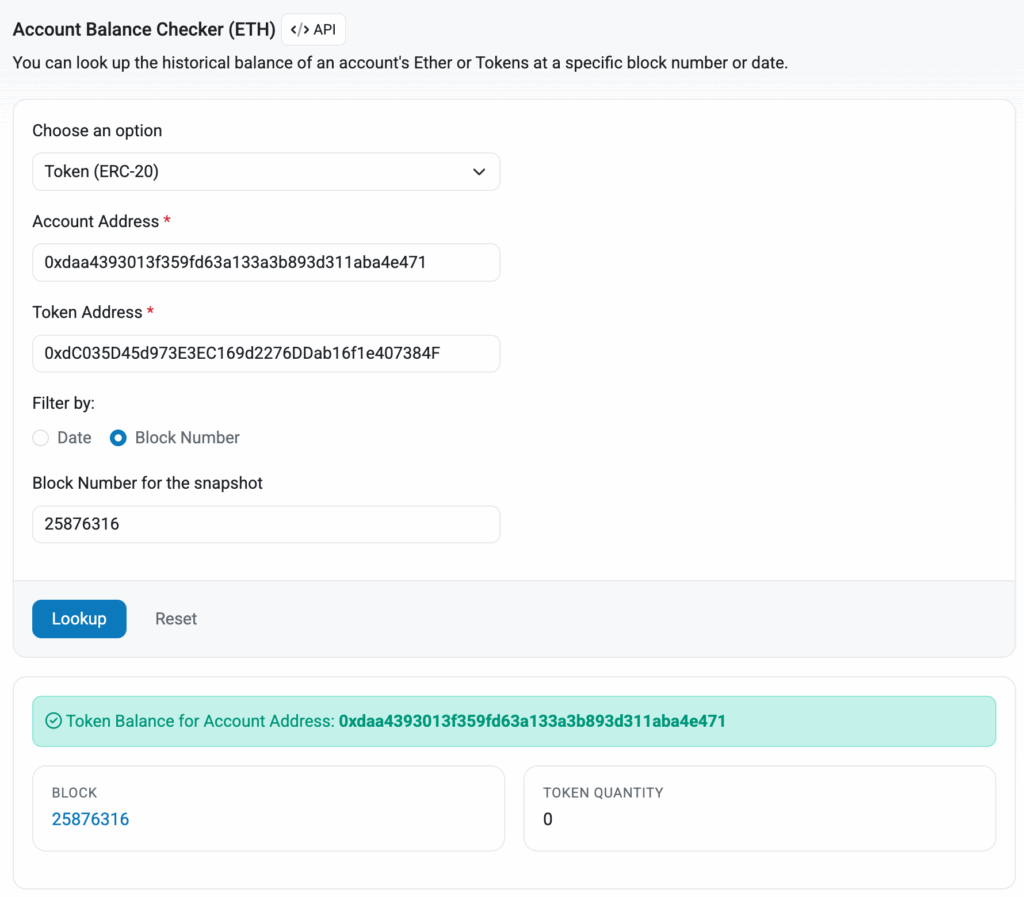
Justin Sun-owned HTX claimed in its September proof of reserves (PoR) that it held 360949.90 USDS in 0xdaa4393013f359fd63a133a3b893d311aba4e471 at a block height of 25876316.
However, that address at that block height actually contained 0 USDS.
The only transaction where this address actually received USDS was at a block height of 25889452. This was on September 2, after the PoR which is dated September 1.
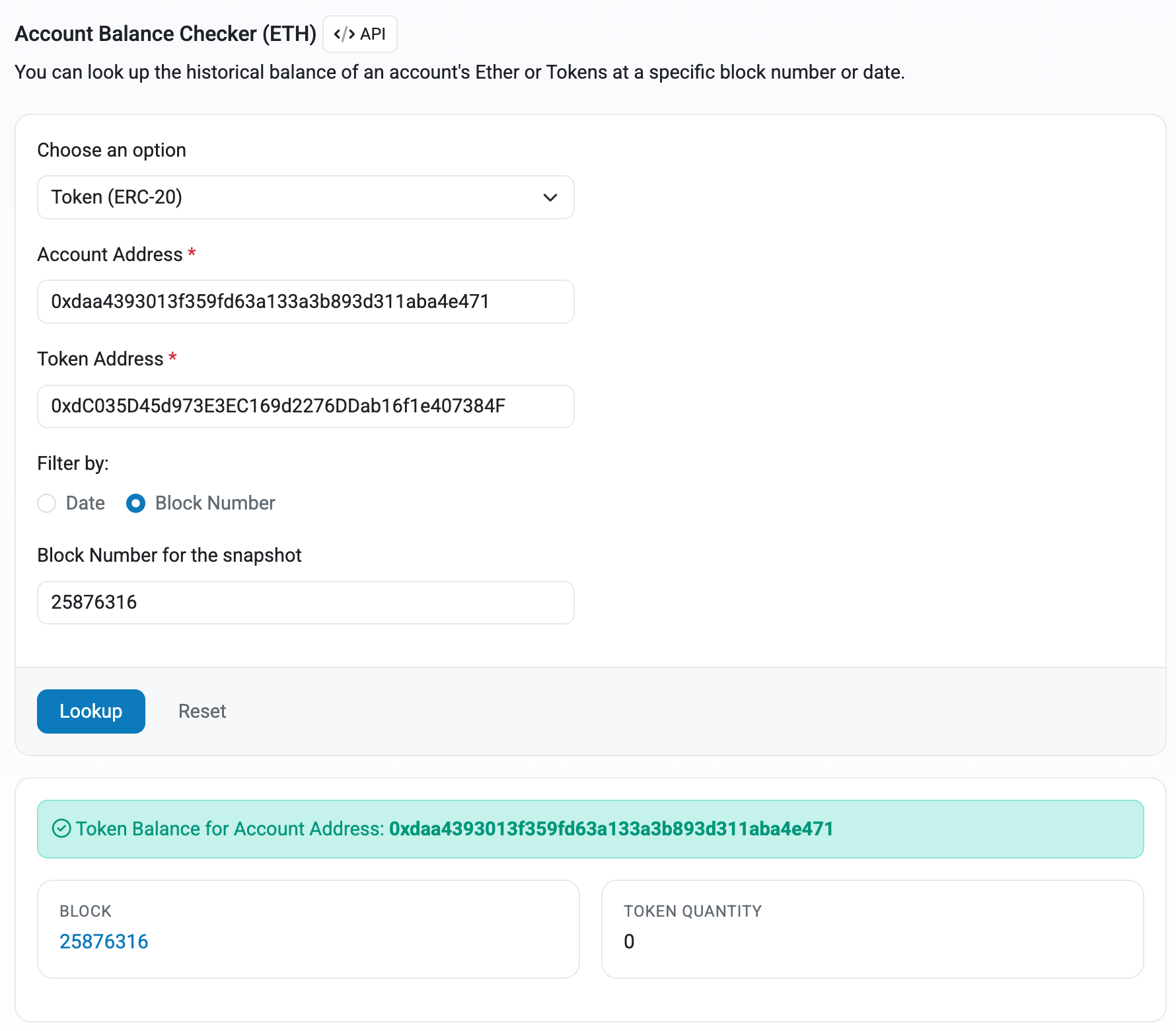
This isn’t the only problem in this PoR.
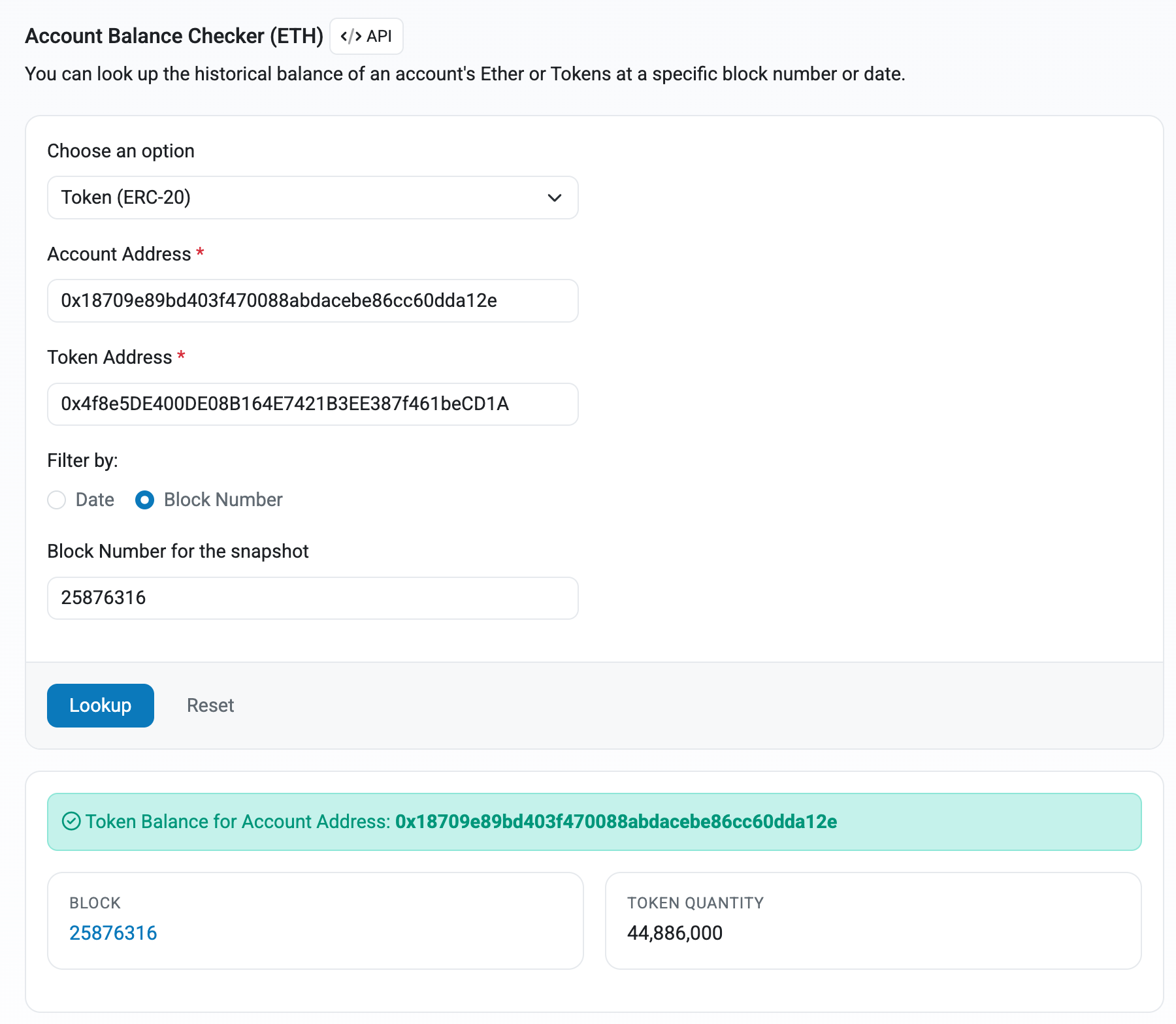
Additionally, it claims that there were 44,975,772.00 of the Sun-founded USDD in 0x18709e89bd403f470088abdacebe86cc60dda12e at a block height of 25876316.
However, this address actually had 44,886,000 USDD in that address at that block height.
Read more: Tether has publicly listed a company that partially controls USDS
These are also not the only mistakes that HTX has made in its PoR historically.
As Protos has previously reported, it previously claimed a certain amount of STEAK-USDC in its May PoR, however it didn’t have any STEAK-USDC in that address at the claimed block height.
However, it did have an equivalent amount of sUSDS in that address, suggesting it had confused its disclosures between these assets.
All of these issues raise serious concerns about HTX’s PoR process, and especially how it makes certain that all assets are matched to liabilities at all times.
Protos reached out to HTX for comment on this discrepancy, but it didn’t respond before publication.
Got a tip? Send us an email securely via Protos Leaks. For more informed news and investigations, follow us on X, Bluesky, and Google News, or subscribe to our YouTube channel.
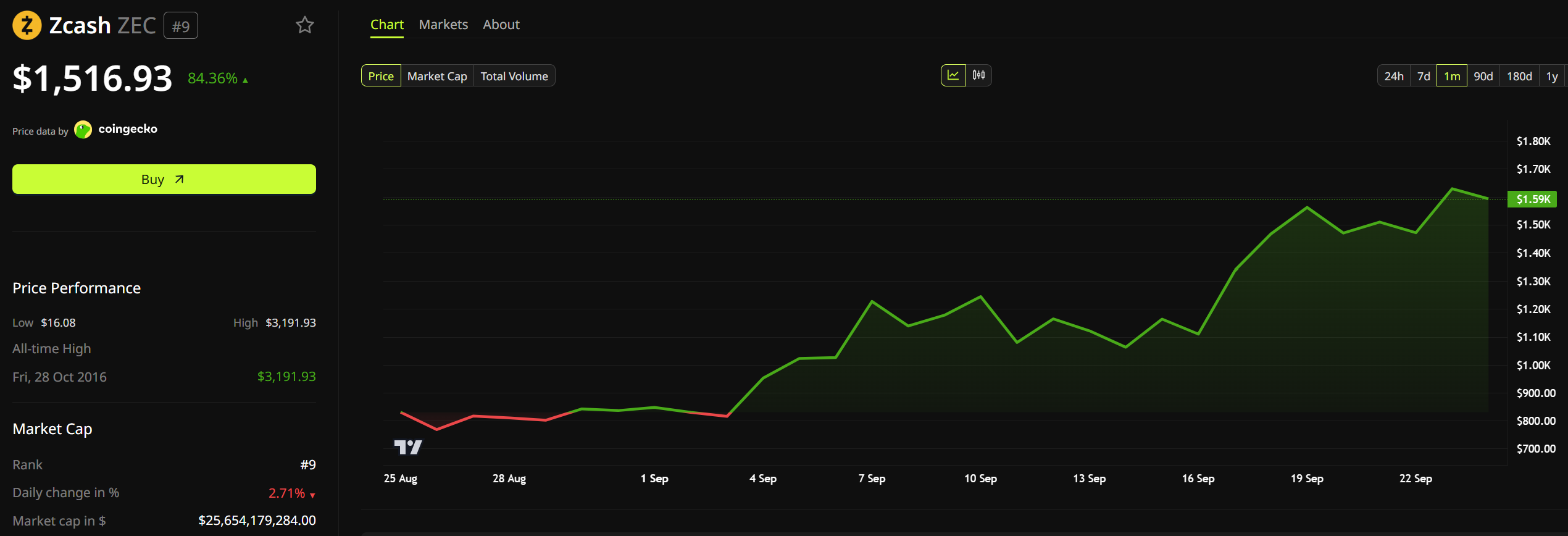
Ledger now lets Zcash (ZEC) holders keep private balances inside its own desktop app, Ledger Wallet. The update lands as ZEC trades 84% higher than a month ago.
Ledger makes hardware wallets, small devices that keep the keys to crypto funds offline. Until now, its users needed a separate third-party app to hold private ZEC.

What Changes for Zcash Holders on Ledger
Zcash offers two kinds of balance:
- A transparent balance is public, like Bitcoin.
- A private, or shielded, balance hides the amounts and addresses involved.
Ledger’s support page says one account can now hold both.
Private funds only appear if they sit in Ironwood, the new privacy pool Zcash launched in July. It replaced the old pool after researcher Taylor Hornby found a flaw there, as covered in the Ironwood upgrade.
Ledger Chief Technology Officer Charles Guillemet said the private data never leaves the user’s computer.
“Privacy here is not a server setting. To keep your shielded balance private, the scanning and the transaction building happen on your machine: your unified viewing key is stored locally and is never shared with anyone, including us,” Guillemet wrote.
A viewing key lets software read a wallet’s private history. Some simpler wallets send it to a server.
However, there are limits. Private ZEC cannot be swapped without first making it public, and the original Nano S cannot run the feature.
An older app from developer Zondax will be pulled on November 5, so its users must move their funds before then.
Where ZEC’s Rally Stands
ZEC traded at $1,516 as of this writing, down almost 3% in the last 24 hours. However, it is up 23% over seven days and over 84% in the last month, ranking ninth by market value.
Money has also flowed into Zcash funds. Zcash exchange-traded funds drew $98.2 million in the week to September 18, the largest weekly ETF inflow among 14 crypto products.

Some backers see more room to run.
ZEC hit a 24-hour high of $1,658.86 before sliding back below $1,530 at the time of writing. Ledger, meanwhile, left the choice to users, asking followers whether they hold ZEC shielded or transparent.
The post Ledger Finally Adds Private Zcash Balances: Will It Extend ZEC Rally? appeared first on BeInCrypto.

Hsin-Ju Chuang, a former partner at crypto venture firm Hack VC, was pronounced dead on Aug. 24 and recently became public after a local newspaper, Hoodline, reported the news this month and circulated on social media.
Her body was found by the California Highway Patrol inside a vehicle in the desert, according to the report.
Chuang, 37, of North Las Vegas, was pronounced dead at the scene at 9:47 p.m. local time last month, a coroner’s release said. The coroner directed further questions to the California Highway Patrol. Authorities have not announced a cause of death, revealed the results of an autopsy, or provided further details about the circumstances, Hoodline said.
The California Highway Patrol spokesperson referred CoinDesk’s request for further comment to the CHP’s Inland Division, which is handling the investigation.
Her death has drawn attention across crypto social media because Chuang, a longtime operator in the crypto industry, published a lengthy X post on Aug. 23, stating that she had rejected a settlement with Hack VC that would have required her to remain silent about her experience at the firm.
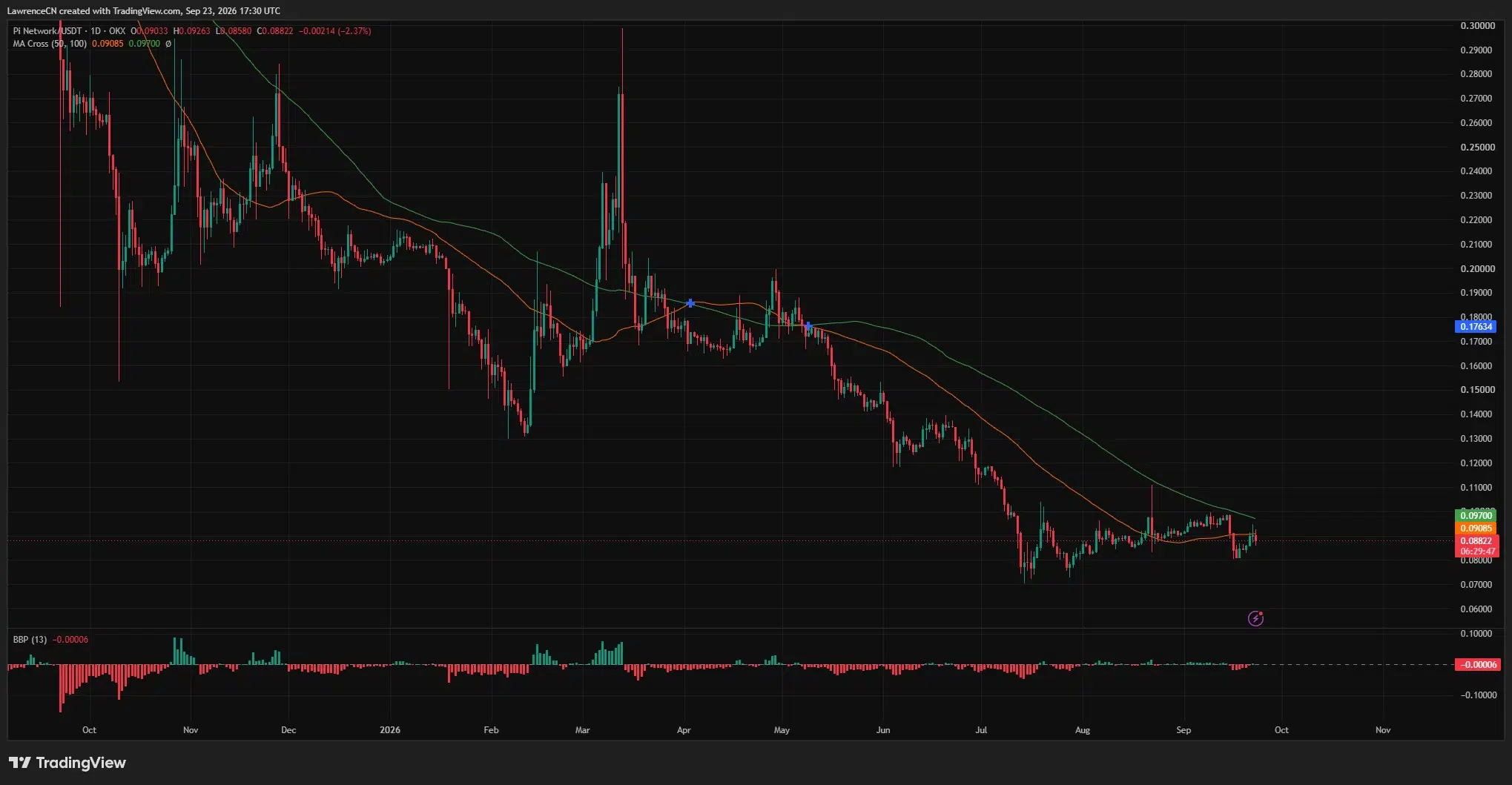
Pi Network price fell back toward $0.088 on Sep. 23 after an intraday move above $0.092 failed to hold. The pullback came as traders weighed recent network upgrades against a daily chart that still shows PI below its main moving averages.
Summary
- Pi Network price traded near $0.0882 after reaching $0.0926 earlier in the daily session.
- The daily 50-day and 100-day moving averages stood near $0.0909 and $0.0970.
- A 4-hour Supertrend level near $0.0861 remained below the price.
- Pi Network said more than 417,000 users can resume identity verification after an account review.
According to the PI/USDT daily chart, the token opened near $0.0903, reached $0.0926, and fell as low as $0.0858 before trading around $0.0882. The move left PI below $0.09 despite a rebound from the session low.
CoinGecko listed PI near $0.0883, down about 0.7% over 24 hours but up roughly 7.3% over seven days. The weekly gain gives the latest decline a different scale from the longer slide visible on the daily chart.
Pi Network price faces a test at $0.0909
The daily chart places PI below its 50-day moving average of about $0.0909 and its 100-day moving average near $0.0970. Both lines slope downward, and the shorter average remains beneath the longer one. PI would first need to recover $0.0909 to challenge the area around $0.0926, where the latest advance stalled.
A move through that range would bring $0.0970 into view. PI traded close to $0.098 during its earlier September rise before losing ground, making the 100-day average a useful level for judging whether a recovery extends beyond a brief bounce.
On the downside, the latest daily low near $0.0858 is the first level to watch. The chart then shows a recent trading area around $0.080 to $0.083. A daily close below that area would put the July lows, near $0.07, back in focus.
The daily Bear Bull Power reading was slightly negative, near −0.00006. Its small size points to limited momentum in either direction at the chart’s latest reading, even though price remains below both moving averages.
A 4-hour rebound is still holding above $0.0861
The shorter timeframe gives buyers one firmer signal. The 4-hour Supertrend line stood near $0.0861, below PI’s price of about $0.0882. PI also recovered after a sharp fall toward $0.081 earlier in the week, then reached the $0.091 to $0.092 area before pulling back again.
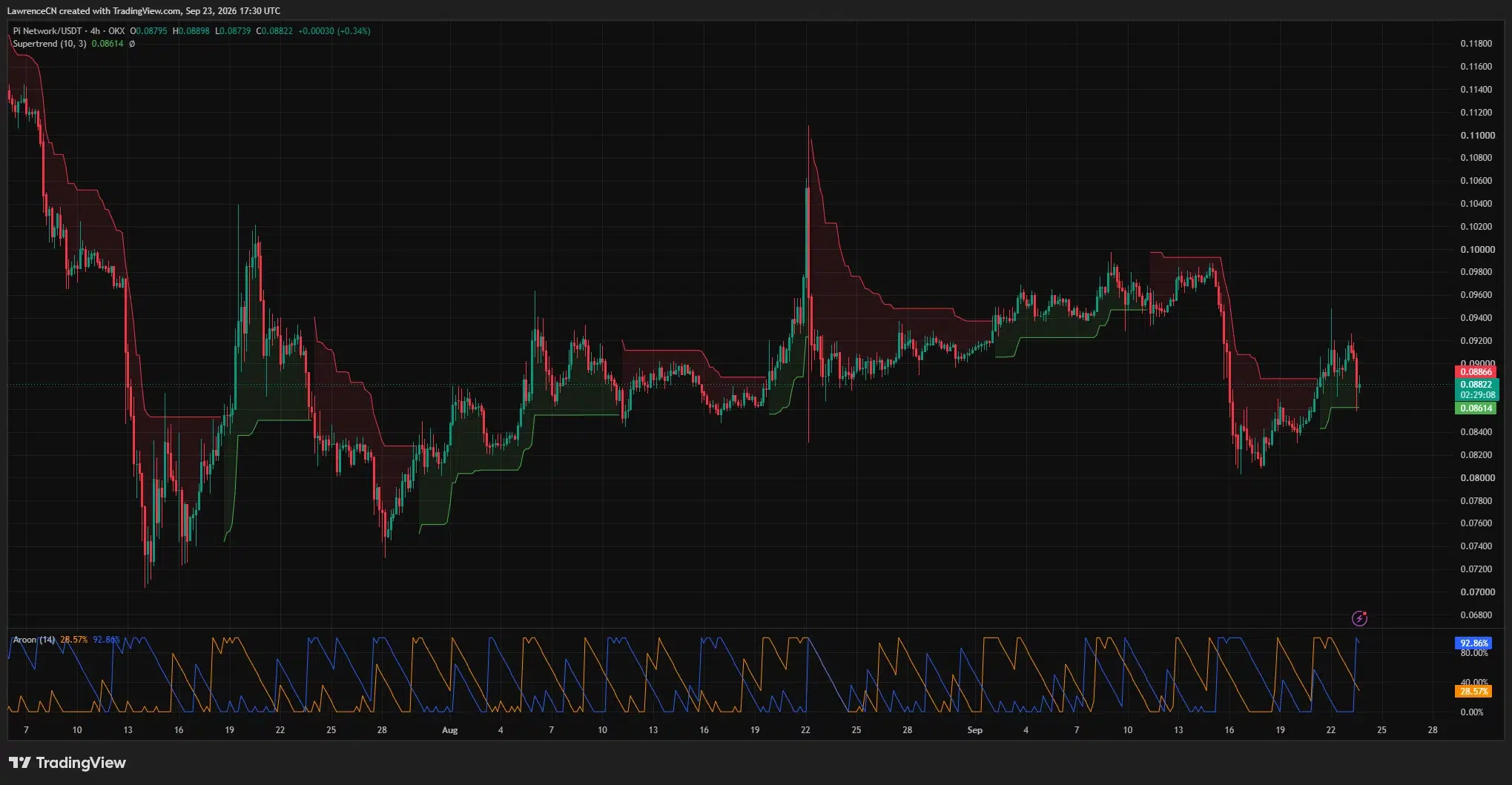
The 4-hour Aroon indicator showed its up line near 92.86% and down line near 28.57%. Those readings reflect a more recent high than low within the indicator’s lookback period. They fit the recovery from this week’s low, though the failed push past $0.092 shows that the rebound has yet to clear nearby resistance.
A sustained break below the Supertrend level around $0.0861 would weaken the short-term setup and expose the $0.083 to $0.081 area. If buyers instead regain $0.09 and close above $0.0926, the daily 100-day moving average near $0.0970 becomes the next larger test. Both paths depend on levels the charts have already shown; neither is a confirmed outcome.
KYC progress brings more users closer to migration
Pi Network said on Sep. 17 that more than 417,000 users previously flagged as possible duplicate accounts can move forward with identity verification. The team also said it planned an update to address a separate issue affecting 497,000 users who were stuck in the migration process. The second group should not be counted as already unblocked.
The project has also been moving through a series of protocol upgrades. Its node page says mainnet nodes must upgrade to Protocol v27. These changes may affect access and network use over time, but the announcements alone do not establish why PI fell during the Sep. 23 session.
Migration also does not automatically mean that newly eligible users will sell tokens. For traders, the measurable near-term question is whether demand can carry PI back above the $0.0909 to $0.0926 resistance range. The token remains more than 97% below its February 2025 peak of roughly $2.99, according to crypto.news’ account of its first year on open mainnet. At the current price, a short-term recovery would still leave that larger decline intact.
For U.S. readers tracking PI, the same chart levels provide a clearer test than the upgrade calendar: $0.0861 is the nearby 4-hour support signal, while a daily move above $0.0909 and $0.0926 would show whether buyers can sustain the rebound.
Disclosure: This article does not represent investment advice. The content and materials featured on this page are for educational purposes only.
Cardano’s native token has been thriving amid the latest green environment, with its valuation climbing to a peak not seen since May.
Naturally, the major ascent has drawn multiple bullish predictions from analysts, but certain elements suggest a correction could also be in the cards.
The Next Upward Move?
As of press time, ADA is worth around $0.25, up about 30% in a week. X user CW claimed that the asset is showing an accumulation signal while gradually rising.
“Accumulation is taking place at the current level. It is gathering energy for its next upward move. MACD and EMA trends are forming a bullish momentum,” they added.
For his part, Jesse Olson argued that Cardano’s cryptocurrency has flipped “ultra bullish” on the daily chart, with the price breaking above a vital zone and continuing to make higher highs and higher lows. Shortly after, the analyst estimated that ADA has a pending buy signal on the weekly chart, noting that it hasn’t been bullish on the seven-day timeframe in 14 months.
More Crypto Online also weighed in, saying the token continues to follow a specific bullish price channel and setting $0.315 as the next target to watch.
Somewhat expected, X user Sssebi, who has issued optimistic price predictions even when ADA traded at much lower levels over the past several months, couldn’t stay silent amid the rally. They simply claimed the token could do “something really crazy” without providing a specific target.
Those who want to explore additional forecasts can read our detailed article here.
Short Setup?
X user Mork differentiated themselves from the overall bullish sentiment, describing ADA as one of their favorite short setups right now. The market observer noted the asset’s strong recent performance but said they won’t rush to chase the first move away from resistance.
“I’m waiting for another move into the level. If buyers don’t step in there, I’ll take a closer look at the short,” they said.
Meanwhile, ADA’s Relative Strength Index (RSI) suggests that the asset may indeed experience a short-term correction. The ratio has risen into overbought territory above 70, meaning the price has soared too much in a short period, and it might be time to cool off. Conversely, readings below 30 are usually interpreted as buying opportunities.

The post Top Cardano Price Predictions as ADA Explodes 30% in a Week appeared first on CryptoPotato.
The activity had already drawn attention from Beni, a co-founder of research firm Stealth Neolab, who said Kalshi’s ether perpetual recorded about $539 million in 24-hour volume against just $3.1 million in open interest. He later found that trades of exactly $5,500 made up 48% to 58% of notional volume on four days in September. Beni said the figures came from Kalshi’s public API.
Diana said the patterns can be explained by Kalshi’s liquidity incentive program, which rewards participants for providing liquidity.
“We send our data every day to them [the CFTC], and it’s not that weird for them to sort of review our data on the regular,” Diana said in an interview.
The CFTC had not returned a request for comment sent Tuesday.
The scrutiny comes as prediction markets have grown rapidly, drawing more attention to how platforms report trading volume and police activity between participants. Liquidity incentive programs typically reward market participants for providing orders, helping create markets where other customers can buy or sell.
Kalshi said such incentives explain trading patterns that have attracted attention, including bursts of similarly sized trades.
Asked about protections against wash trading and self-trading, Diana said Kalshi has “tons of tools” and a “full surveillance team in place.” Wash trading involves transactions designed to create the appearance of market activity without a genuine change in economic exposure.

OKX US CEO Roshan Robert has said tokenized stocks must preserve the rights of traditional shares as the SEC begins a five-year test of blockchain-based U.S. stock trading.
Summary
- Robert said tokenization should change how shares trade and settle, while preserving their shareholder rights.
- The SEC requires qualifying stock tokens to carry rights matching the equivalent traditional shares.
- Issuers can object before an unaffiliated third party’s tokenized shares begin trading under the exemption.
- Robert said live trading could help the SEC assess pricing, liquidity and possible changes to market rules.
Roshan Robert, CEO of OKX US, told crypto.news that holders of tokenized National Market System stocks should receive the same rights and privileges as investors who own traditional shares of the same class. In his view, changing the technology used to trade and settle a share should not change the investor’s claim on the company.
The distinction matters under the Securities and Exchange Commission’s five-year trading exemption, issued on Sep. 17. Qualifying venues can use permissioned automated market makers and liquidity pools to trade tokenized versions of certain U.S. listed stocks, subject to limits and other conditions. The order expires on Sep. 17, 2031, unless the SEC changes it.
Tokenized stocks must preserve ownership and voting rights
Under the SEC order, a venue must verify that each tokenized stock provides the rights and privileges of an equivalent class of conventional stock. The agency identifies the investor’s interest in the company, dividends, voting rights, and a claim on remaining assets if the company is liquidated. A product that only tracks a share’s price through synthetic exposure does not qualify as tokenized NMS stock under the exemption.
Robert said parity between the two forms of the same share is necessary to protect investors and avoid splitting traditional and tokenized markets into products with different rights. For a U.S. investor, the SEC’s condition makes the rights attached to the token central to whether it can trade through this particular route.
The legal structure can differ across stock-linked tokens already on the market. A recent ownership review covered by the publication found that a token could give its holder a direct ownership interest, a claim through a custodian or a contractual claim without ordinary shareholder rights. The token’s movement on a blockchain does not, by itself, settle which of those interests its holder owns.
Even where a third party creates the token, the SEC order requires a qualifying venue to check how shareholder rights reach the holder. Its conditions address access to voting materials and other issuer communications, along with the underlying economic rights. The exemption covers secondary trading; it does not permit a venue to conduct a company’s initial share offering under the order.
Issuers get 30 days to object to third-party tokens
When an unaffiliated third party tokenizes a company’s stock, the venue must give the issuer written notice before trading begins. The SEC requires a wait of at least 30 calendar days after the issuer receives it. If the company objects within that period, the venue cannot offer the tokenized stock under this exemption. The process applies specifically to shares tokenized by an unaffiliated party, rather than every tokenized share.
Robert described written notice as a safeguard for secondary trading on public blockchains. He said issuer involvement can help keep tokenized shares aligned with the original stock’s shareholder rights, disclosures and corporate actions. A defined way for companies to respond would also give investors more confidence in the market, according to Robert.
Issuer objections have already become a live issue outside the SEC’s new route. As earlier coverage of the AMC dispute detailed in September, AMC Entertainment challenged a Robinhood product linked to its shares. The SEC’s objection process concerns qualifying tokenized NMS stocks; its order excludes products that offer only synthetic exposure to a company’s share price.
Liquidity pool prices pose a test for U.S. stock rules
For Robert, equal ownership rights are only part of the work needed to operate tokenized stock markets at scale. He said venues must also maintain fair access, protection against front-running and manipulation, dependable market data, and records that allow trading activity to be reviewed. He called for market surveillance and leverage controls while the systems develop.
Pricing presents a specific problem. An automated market maker can set a token’s price from the assets held in its liquidity pool rather than directly from bids and offers across conventional stock exchanges. The SEC said that design may make it difficult for a venue to meet Regulation NMS requirements intended to prevent trades at prices inferior to protected quotes elsewhere. The agency also identified a risk that the tokenized share’s price could diverge from the traditional share’s price.
A September report on trading-hour gaps examined the problem when the main U.S. stock market is closed. RedStone COO Marcin Kaźmierczak said traders may have less ability to correct a gap between a pool’s token price and the underlying share when they cannot trade the share in its primary market.
The SEC has limited the number of eligible stock symbols and the trading volume permitted under its exemption. Venues must use public, auditable smart contracts on public blockchains, even though access to their trading pools is permissioned. They must also stop trading a tokenized stock when the primary exchange halts its underlying share.
The five-year exemption gives the SEC trading data
Robert said some questions about tokenized markets can only be tested while venues operate under controlled conditions. He expects live activity to show the SEC how investors use the products, how liquidity develops and whether pool prices stay aligned with the shares traded on established exchanges.
The order also grants conditional relief to certain firms supplying tokenized shares to the approved liquidity pools, while requiring operational records and disclosures. For venues, the exemption is temporary relief from the definition of an exchange under the Securities Exchange Act; it is not a permanent set of tokenized stock rules.
Robert said evidence from the five-year period could help the SEC decide whether Regulation NMS needs changes and whether any part of the exemption should become permanent. The commission has requested public comments on the order, including how tokenized trading might affect pricing and liquidity in the underlying stock market.
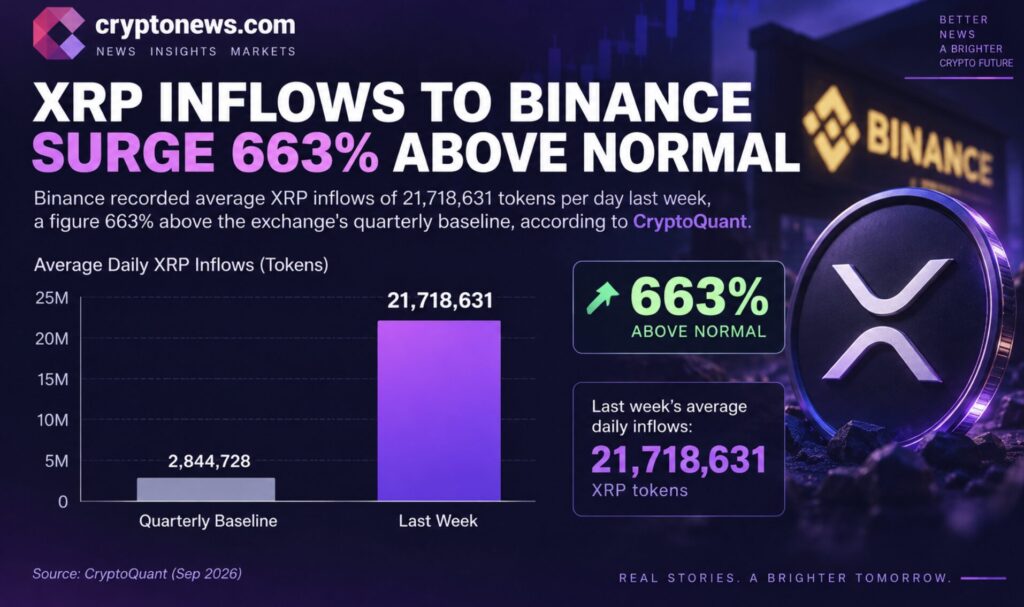
XRP Price Prediction: Ripple (XRP) trades at $1.59 as of this writing, up 1.6% on the day, with a 24-hour range spanning $1.5577 to $1.6561. Beneath the green candle sits a wrinkle worth flagging before the bulls get too comfortable. There’s a number circulating on-chain that most traders scrolling past the price chart haven’t clocked yet.
Binance’s XRP reserves have climbed to roughly 2.68 billion tokens, the highest balance since June, following a stretch of decline and a slow rebuild.

On-chain trackers noted the deposit surge ran 663% above the quarterly baseline, with withdrawals rising in tandem, a pattern that reads less like panic-selling and more like liquidity churn.
“A rise in reserves does not necessarily mean that XRP holders are preparing for an immediate sell-off,” CryptoQuant wrote in its latest note.
The buildup lands mid-rally, with XRP-specific tailwinds stacking on top: a reported push above $1.64 accompanied by 3,647 new wallets, plus talk of a $2.2 billion institutional flow that remains thin on verifiable detail.
The broader question is whether this liquidity buildup fuels the next leg or sets up a supply overhang.
XRP Price Prediction: Can XRP Price Hit $1.80 This Week?
XRP’s break above the $1.55–$1.56 zone, a level that had capped the token through repeated tests, turned former resistance into a support shelf, and XRP price is now pressing toward the next psychological marker.
Volume around the breakout has been elevated enough to suggest genuine participation rather than a thin-book spike.

(Source – TradingView, XRPUSD)
Bull case: A daily close above $1.65 opens room toward the $1.80 target floating in secondary market commentary — though that figure is speculative, not a consensus call from a named institutional desk.
Base case: Consolidation between $1.55 and $1.65 while the market digests the Evernorth financing news and waits on Nasdaq-related developments.
Bear case: A failure to hold $1.55 support risks a slide back toward $1.48, the level referenced in recent market coverage.
The Evernorth angle deserves a mention here, a reported $30 million convertible note with NH Investment & Securities, earmarked for XRP purchases ahead of a Nasdaq vote. If confirmed, it’s a near-term liquidity catalyst.
For a deeper technical breakdown of these levels, this recent XRP price analysis maps out the bullish and bearish scenarios in more detail, while open interest and funding-rate data add derivatives context worth checking before sizing a position.
Maxi Doge Targets Early Mover Upside as XRP Tests Key Levels
XRP holders riding this move from $1.50 are sitting on solid gains, and fair enough. But here’s the uncomfortable math: at XRP’s market cap, doubling requires tens of billions in fresh capital rotation.
That’s a heavy lift even in a bull cycle. Traders chasing asymmetric upside are increasingly looking further down the risk curve, toward tokens still in price discovery.
That’s the lane Maxi Doge (MAXI) is running in. It’s a meme token built around leverage-trading culture, a 240-lb canine mascot channeling “1000x leverage” energy, with holder-only trading competitions and leaderboard rewards baked into the community layer.
The presale has raised $4,863,455.57 at a current price of $0.000284, with dynamic APY staking live for early participants. A Maxi Fund treasury backs liquidity and partnerships going forward.
The obvious caveat: presale tokens carry outsized risk, and meme-driven price action can reverse as fast as it builds. Those weighing the risk-reward can research Maxi Doge directly before deciding.
Get Ahead of Next Meme Coin Launch Here
Key Takeaways
- XRP holding above $1.55 support keeps the path toward $1.65–$1.80 intact, contingent on sustained volume.
- A close below $1.55 invalidates the breakout and risks a retest of the $1.48 zone.
- Rising Binance reserves reflect liquidity buildup, not confirmed sell pressure, per on-chain data.
- Evernorth’s $30 million note and its Nasdaq vote outcome stand as the next confirmable catalyst to watch.
The post Can Ripple Crack $1.80? XRP Price Prediction Says This Week appeared first on Cryptonews.
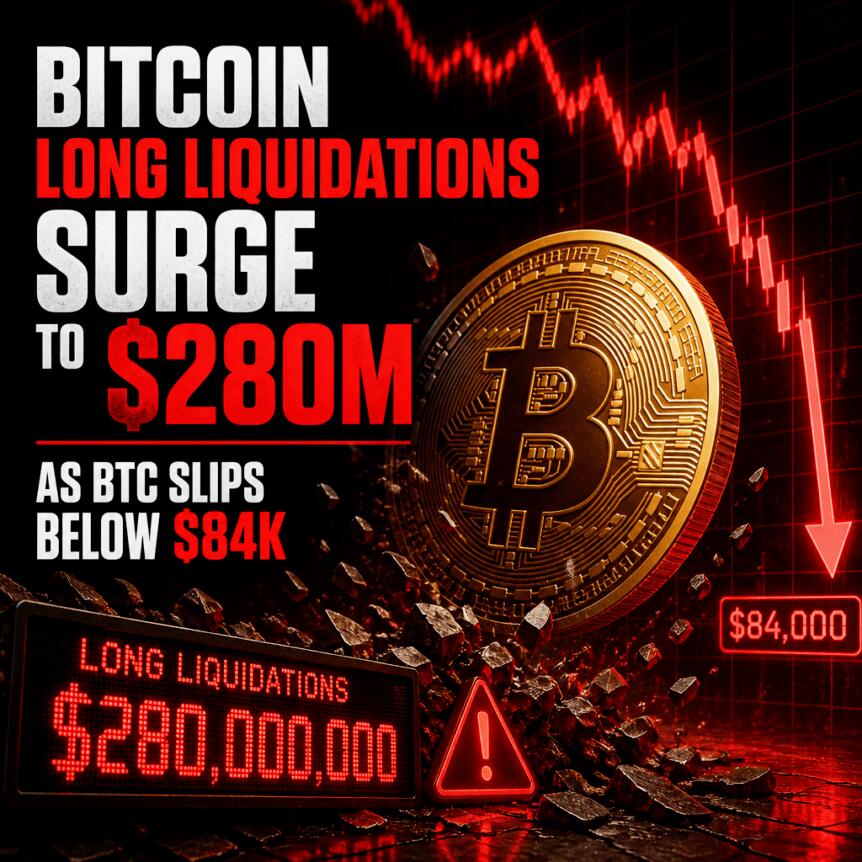
Bitcoin ran into selling pressure Wednesday after failing to hold a push above the $87,000 area, with on-chain indicators pointing to weaker spot buy interest. Price slid under $84,000 around the Wall Street open, triggering a sharp wave of leverage unwinds.
Intraday, TradingView data showed BTC/USD losing momentum after a second attempt to break higher stalled. The move kept traders focused on whether the market can defend a key downside level near $82,000—an inflection point highlighted by analysts monitoring both price structure and demand flows.
Key takeaways
- BTC was rejected near $87,000 and dipped below $84,000 around the U.S. market open.
- Liquidations totaled about $280 million across roughly four hours, indicating leverage was heavily concentrated.
- Crypto demand on spot markets remains negative on a rolling 30-day basis, according to CryptoQuant.
- Traders are watching $82,000 as a level bulls may need to defend to avoid a deeper retracement.
From $87,000 rejection to a liquidity-driven dip
Following an attempted breakout, BTC/USD traded down into local lows just under $84,000 into the Wall Street open, with TradingView tracking a second unsuccessful push beyond $87,000. Analysts characterized the action as part of a narrow intraday range—one where liquidity built up on both sides as market participants tried to force a directional move.
That balance broke briefly as price weakness accelerated. According to CoinGlass liquidation data compiled over the four hours leading up to the time of writing, approximately $280 million in liquidations occurred, a sign that derivatives positioning was vulnerable when support failed.
In this environment, levels matter not only for technical traders, but also for investors evaluating how quickly the market can absorb selling pressure. A breakdown from a consolidation band can create cascading effects as leveraged positions unwind, often worsening short-term price volatility even if longer-term demand is still present.
$82,000 under the microscope as structure tests continue
With BTC pushed lower, attention turned to where bullish structure could be defended if the down move extended. Trader and analyst Rekt Capital pointed to $82,000 as a critical area for bulls to hold, arguing that bullish continuation requires Bitcoin to remain above—or at least successfully retest—that level after dips.
“For bullish continuation and to avoid reverting back into the $60k-$80k Range, Bitcoin would need to stay above or at minimum successfully retest ~$82k on any future dip,” Rekt Capital wrote on X.
His warning also framed a larger technical issue: if BTC fails to maintain the lower bound of the current structure, traders may increasingly revert to viewing the market through the lens of a broader prior range (between $60,000 and $80,000), which would likely change expectations for near-term upside.
As part of the broader debate about where the market may consolidate next, Cointelegraph previously reported that some conditions could set up a likely next consolidation area around $90,000. That potential pivot point was linked to the increased likelihood of profit-taking among traders as price moves into regions where gains are already secured.
Spot demand remains the sticking point
Even with Bitcoin maintaining momentum over the past several weeks, spot-market buying interest has been inconsistent. While BTC has gained more than 35% since the week beginning Aug. 17, on-chain analysis suggests demand is still not fully catching up—particularly when focusing on spot rather than derivatives.
In its latest research, CryptoQuant said demand is “still largely confined to derivatives markets.” In a blog post released on the day, the analytics firm noted that the negative value of BTC spot demand had narrowed slightly, while futures demand continued to rise. It also reported that total demand showed a small recovery compared with the previous day.
CryptoQuant’s accompanying data measured cumulative 30-day apparent spot demand at around -180,000 BTC as of Tuesday. Negative values indicate that, over the 30-day window, supply has outpaced demand on spot—an important distinction for investors because spot demand is often viewed as a more durable signal of accumulation than purely leveraged activity.
The key shift, according to CryptoQuant, is that the trend may be improving rather than deteriorating. The firm added that if the momentum continues, spot demand could eventually “flip to positive,” which it said would mark the beginning of a more meaningful rally.
For market participants, this creates a practical watchlist: even if price action holds support in the short term, the durability of any upside attempt may depend on whether spot buyers begin to absorb more supply rather than leaving futures-driven activity to carry the market.
Why the current range matters for ETF holders and broader positioning
Cointelegraph previously noted that the trading range has implications for certain investor cohorts. In particular, the aggregate cost basis of U.S. spot Bitcoin exchange-traded funds (ETFs) is just below $86,000. That places part of the current price action—roughly between the recent $84,000 dip and the $87,000 rejection—near a psychologically and positioning-relevant region for ETF holders.
When price hovers around such areas, market behavior can reflect shifting expectations about whether holders are likely to add, wait, or reduce exposure. If spot demand continues to lag, price may struggle to sustain breakouts even when ETF-related positioning provides a floor effect. Conversely, a sustained turn toward positive spot demand would potentially support higher highs by adding an underlying bid from the spot market.
For now, traders are left balancing two signals: the immediate tape shows heavy liquidation risk when ranges break, while on-chain demand data suggests spot interest is only slowly improving. The next move will likely depend on whether BTC can reclaim and hold above near-term resistance—without spot demand remaining stuck in negative territory.
Heading forward, investors should watch whether BTC can defend the $82,000 area during any renewed selloff and whether CryptoQuant’s spot-demand trend continues to edge toward a positive reading on the rolling 30-day metric. A sustained shift would help clarify whether the recent dip was a temporary shakeout—or the start of a deeper retracement.

Blockchain.com has signed a memorandum of understanding with the New York Stock Exchange (NYSE) to bring access to tokenized US stocks and exchange-traded funds (ETFs) to Blockchain.com users via NYSE’s planned digital trading platform. The arrangement is designed to extend NYSE’s tokenized securities roadmap beyond traditional market participants and into Blockchain.com’s global customer base, pending regulatory approval.
The proposal also includes an exchange of market data. NYSE affiliate ICE Data Services plans to provide Blockchain.com with crypto market data and analytics, while Blockchain.com would supply certain ICE and NYSE market data feeds back to the NYSE ecosystem.
Key takeaways
- Blockchain.com would distribute tokenized US equities and ETFs from NYSE’s digital alternative trading system (ATS), subject to regulatory approval.
- NYSE’s planned tokenized securities offering would be broadened to Blockchain.com’s user base, potentially widening retail access to US-listed products.
- The deal includes reciprocal market-data sharing between ICE Data Services and Blockchain.com.
- Industry commentary suggests NYSE’s model may emphasize retail-friendly features such as 24/7 trading and request-for-quote style execution.
- The agreement comes shortly after the SEC introduced a five-year “Innovation Exemption” for certain tokenized securities trading venues.
Blockchain.com meets NYSE on tokenized equities and ETFs
Under the memorandum of understanding, Blockchain.com would distribute tokenized US-listed stocks and ETFs that trade on NYSE’s digital ATS. The scope of distribution would depend on regulatory approvals, which remain a key gating item for any tokenized securities implementation.
The partnership also signals a clear convergence between crypto-native distribution networks and legacy market infrastructure. If approved, Blockchain.com would function as a channel for NYSE-linked tokenized instruments, while NYSE’s planned platform would supply the underlying venue for those assets.
For market participants, the practical difference is less about whether tokenization is possible and more about how it will be operationalized—particularly around settlement, custody, and how trading continuity is delivered to end users.
Why the NYSE model may matter for retail traders
Rid Noch, vice president of US equity market structure at TD Securities, told Cointelegraph that NYSE’s planned tokenized ATS appears “primarily like a play for retail flow.” According to Noch, the design—featuring planned 24/7 trading and request-for-quote functionality—aligns more closely with the way retail participants often engage with markets outside standard trading hours.
He further argued that because retail trades are typically pre-funded, the move to instant settlement would likely require limited disruption to existing retail workflows.
The bigger differentiator Noch highlighted is “true weekend trading.” He suggested this could be particularly meaningful for retail-heavy participants or during periods when news-driven price movements spill beyond traditional market hours. Noch referenced the early stages of tokenized oil perpetual contracts during the start of the Iran conflict, when trading activity ramped up over a weekend.
That framing matters because it points to what investors may actually feel first: not the tokenization itself, but when and how they can respond to price-relevant events.
Exchanges race toward onchain equity—without agreeing on the same model
The Blockchain.com-NYSE memorandum sits within a broader trend: major trading platforms exploring ways to offer equity exposure using token-like structures. Tanay Ved, senior research associate at Talos, described the shift in comments shared with Cointelegraph, saying traditional markets are adopting the “24/7, programmable structure crypto pioneered.”
Ved noted that multiple approaches are being tested across leading venues. He pointed to Kraken’s xStocks and its separate tokenized equity model partnership with Nasdaq, as well as efforts from Binance, Coinbase, and Robinhood to bring equities onchain through different product frameworks.
However, Ved emphasized that these initiatives involve trade-offs that can materially affect user rights and how much of the “real ownership” story each product delivers. In a quoted assessment shared by Cointelegraph, Ved said tokenization models range from issuer-native equity to custodial exposure and even to derivatives—each trading ownership for accessibility. “Which model wins out is yet to be seen,” he added, framing the current phase as early adoption where the market is still deciding what structure best balances compliance, usability, and investor protections.
For readers, the implication is straightforward: tokenized equities are not a single category with uniform rules. Even when instruments reference the same underlying equities, the legal and economic structure can differ—changing what holders actually own, how votes and rights are handled, and how the product behaves in edge cases.
Tokenized securities gain regulatory momentum as the SEC opens a pathway
This NYSE-Blockchain.com development arrives less than a week after the US Securities and Exchange Commission (SEC) introduced a five-year “Innovation Exemption” intended for certain tokenized securities trading venues. The SEC press release described the exemption as allowing eligible venues to use permissioned automated market maker (AMM) liquidity pools to facilitate trading without being treated as exchanges under the Exchange Act, provided they meet specific conditions.
One central requirement is that tokenized stocks must carry the same rights and privileges as their conventional share counterparts. The SEC’s framework therefore has direct consequences for which tokenized products may qualify and which may be excluded in their current form.
According to the coverage, the exemption’s conditions appear to disqualify some existing offerings that provide exposure without granting holders the same rights as conventional shareholders—specifically citing Kraken’s xStocks and Robinhood’s Stock Tokens. The message for market operators is that tokenization alone is not enough; product design must align with rights parity expectations.
SEC Commissioner Hester Peirce also indicated publicly that the exemption covers one model while leaving room for other approaches outside the framework, underscoring that the regulator’s path may not be the only path—though it may become a reference point for compliance expectations.
A fast-expanding tokenized stock market underscores demand—if structure is solved
While regulatory structures evolve, the tokenized stock market itself has been growing. RWA.xyz data cited by Cointelegraph reported distributed value of $3.14 billion as of Wednesday, representing an increase of more than 18% over the prior 30 days. The same dataset showed the number of holders rising nearly 72% to 3.87 million.
Those figures suggest that interest is not limited to institutional experimentation. But they also highlight why the details of each exchange’s model—rights, settlement, liquidity mechanics, and operating hours—will matter. If weekend trading and faster settlement prove compelling, they could become the practical drivers that pull retail participation further into the tokenized securities layer.
What remains to be seen is which tokenized formats can scale while meeting the kinds of rights and eligibility requirements the SEC has emphasized.
With Blockchain.com now linked to NYSE’s planned tokenized trading initiative, the next watchpoint is regulatory approval and the final product structure—especially how ownership rights, settlement behavior, and liquidity mechanisms will be implemented across tokenized US stocks and ETFs.

2026 Week 4 Mountain West College Football Previews

Motorola partners with Bang & Olufsen to bring high-end audio to its flagship phones

Ambulance delay “contributed to premature death” of West Belfast man, inquest hears



![LISA - 'MONEY' Dance Practice [Mirrored]](https://wordupnews.com/wp-content/uploads/2026/02/1770259125_maxresdefault-80x80.jpg)

-

 Fashion5 days ago
Weekend Open Thread: Talbots – Corporette.com
-

 Tech3 days ago
Researchers escape OpenAI Codex sandbox to run commands on host
-

 Crypto World5 days ago
Circle launches Arc Studio AI agent for building onchain apps
-
 NewsBeat5 days ago
Trump says US has reached an agreement to take permanent control of Greenland’s security
-

 Crypto World3 days ago
Who Needs CLARITY Anyway? ARB Could See 70X Increase: Hodler’s Digest
-

 Crypto World5 days ago
Trading Bitcoin on Robinhood? Why 2% Spread Has Traders Worried
-

 Crypto World5 days ago
Bitcoin price breaks channel as RSI climbs to 63
-

 Crypto World6 days ago
Mortgage and refinance interest rates today, Thursday, September 17, 2026
-

 Crypto World21 hours ago
Goldman Sachs and Deutsche Bank Agree: The S&P 500 Rally Isn't Over
-

 Crypto World7 days ago
US Charges Robinhood Engineers Over Crypto Listing Trades
-

 Tech2 days ago
Google’s $899 Googlebook is a bet that you’ll buy a new laptop for Gemini
-

 Business3 days ago
Analog Devices (ADI) Bets $1.35 Billion on Chips that Let Machines Think for Themselves
-

 Crypto World3 days ago
Coinbase, Robinhood, Circle Seen as Tokenized-Stock Winners
-

 Crypto World5 days ago
Silver prices recover quickly, hitting weekly high today
-

 Crypto World5 days ago
World Money launches in 150+ countries with Stripe
-

 Tech6 days ago
GPT-6 Astra Reached the Nether in Minecraft, Lost Its Stash to a Creeper, and Farmed Potatoes for Hours
-

 Tech4 days ago
Trump suggests rebranding AI with a new name, says he’s also creating an AI Force
-
 NewsBeat5 days ago
US was ‘on brink of war’ with China over false AI report of nukes moving in Middle East
-

 Crypto World3 days ago
Bitcoin price holds above $81K as key catalysts line up
-

 Crypto World2 days ago
Meta Jumps 11% As Muse Shines and Investors Show an Appetite for Advancing AI
You must be logged in to post a comment Login