

Crypto World
Ex-OpenAI Researcher Hedge Fund Bets Big on BTC Miners in SEC Filing


Leopold Aschenbrenner, a former OpenAI researcher who departed the lab’s superalignment cadre to launch the San Francisco‑based hedge fund Situational Awareness LP, has steered his portfolio toward the AI compute backbone. The latest 13F filing for Q4 2025 reveals a dramatic scale‑up: the fund reports about $5.52 billion in US equity exposures across 29 positions, up from a few hundred million dollars at the start of 2025. Rather than chasing consumer AI software, the strategy bets on the infrastructure that powers the AI boom—power plants, data centers, and the hardware that underpins high‑end computation. The concentration is clear: a small cadre of AI infrastructure names and energy plays that the fund believes will capture the surge in demand for AI workloads.
Key takeaways
- The Q4 2025 13F shows Situational Awareness with roughly $5.52 billion in US equity holdings across 29 positions, signaling a deliberate tilt toward AI infrastructure and energy‑intensive compute.
- Top holdings include CoreWeave, Bloom Energy, Intel, Lumentum, and Core Scientific, reflecting a strategy anchored in data center capacity and related hardware ecosystems.
- The amended Schedule 13D reveals a 9.4% stake in Core Scientific, amounting to 28,756,478 shares with shared voting and disposition power, indicating a levered view on the company’s expansion into AI hosting and HPC environments.
- Beyond pure mining, the fund has increased exposure to Bitcoin miners and energy players such as IREN, Cipher Mining, Riot Platforms, Bitdeer, and Applied Digital, signaling a broader bets on AI compute throughput via specialized energy infrastructure.
- Aschenbrenner’s strategy also includes a noted short in Infosys, reflecting a view that large‑language model adoption and AI coding tools could pressure traditional outsourcing software services models.
Tickers mentioned: $BTC
Market context: The shift underscores a growing convergence between crypto mining and AI compute ecosystems, where megawatt‑dense sites and long‑term data‑center arrangements are increasingly treated as scarce, high‑value assets in the new compute economy.
Sentiment: Neutral
Price impact: Neutral. The moves reflect strategic positioning in a sector undergoing structural changes rather than immediate price catalysts.
Trading idea (Not Financial Advice): Hold. The cross‑section of AI infrastructure and mining assets suggests exposure to broader compute demand, but the concentration in a handful of names warrants careful risk management.
Market context: The AI compute narrative is evolving from a focus on chip supply and software models to ownership of the physical and energy assets that enable massive data‑center deployments. The post‑halving environment has encouraged miners to pivot toward hosting AI workloads, recasting megawatts and data‑center capacity as strategic assets rather than mere hash rate capacity.
Why it matters
The portfolio strategy signals a shift in how investors view AI reverberations across sectors. By placing heavy bets on AI infrastructure players like CoreWeave and Bloom Energy, the fund aligns with the premise that the next era of AI growth will be defined by the reliability and scalability of compute foundations. CoreWeave, a major AI cloud firm, has pursued long‑term HPC hosting contracts, reinforcing the idea that enterprise‑grade compute capacity will anchor AI deployment for years to come. That dynamic is echoed in the fund’s positioning around Core Scientific and other miners‑turned‑infrastructure operators, highlighting a broader trend where mining assets are repurposed as high‑density compute farms capable of supporting AI workloads.
Moreover, the mix of energy‑oriented firms with traditional chip and optics players points to a convergence of energy efficiency, power reliability, and advanced hardware as the bedrock of AI scalability. The emphasis on Bloom Energy and similar energy infrastructure names acknowledges that the economics of AI compute increasingly hinge on dependable, low‑cost power and resilient facilities. In this context, the bitcoin ecosystem—often used as a proxy for large‑scale, independent energy demand—appears intertwined with broader infrastructure plays, rather than living in its own isolated corner of markets. Bitcoin (CRYPTO: BTC) remains a barometer for how much compute demand miners can leverage, particularly as large data centers seek to optimize energy intensity and uptime amid rising competition for grid capacity.
The presence of a substantial Core Scientific stake via an amended Schedule 13D demonstrates the degree to which the fund leverages governance and ownership rights to influence a company’s expansion into AI hosting and HPC. This move aligns with a broader industry pattern where miners diversify beyond hashing to become multipurpose data‑center operators that can monetize surplus capacity across AI workloads, rendering traditional hash rate metrics less decisive in evaluating value creation.
Finally, the Infosys short reflects an acceleration of AI coding tools and large‑language models that, in the hedge fund’s view, could erode the traditional outsourcing model long relied upon by software services giants. If AI tools increasingly curtail demand for routine outsourcing tasks, equities tied to that segment may face new headwinds, even as AI infrastructure assets benefit from expanding compute demand. The net effect is a nuanced stance: bets that the core compute economy—powered by energy, data centers, and HPC—will drive durable value, tempered by selective shorts on areas perceived as vulnerable to AI displacement.
What to watch next
- Next 13F filing cycles (early 2026) to reveal whether the $5.5B positioning is sustained or expanded across additional AI infrastructure names.
- Any new or amended Schedule 13D/13G disclosures around Core Scientific or other holdings, signaling shifts in control or strategy.
- Updates on long‑term HPC contracts and data‑center expansions tied to CoreWeave and similar operators, which would validate the thesis of AI hosting as a growth engine.
- Further moves in mining‑to‑infrastructure transitions, including additional energy‑asset investments from the broader field, and how such moves interact with regulatory and grid‑capacity constraints.
- Regulatory or policy developments affecting large‑scale AI compute deployments and crypto mining operations, which could influence capital flows into AI infrastructure equities.
Sources & verification
- Situational Awareness 13F Filing, Q4 2025 — 13f.info
- Amended Schedule 13D for Core Scientific — filing PDF
- Fortune profile on Leopold Aschenbrenner and the fund’s size — fortune.com
- Hut 8 research/coverage on AI data center pivot and compute revenue — cointelegraph.com
- CoreWeave and AI data center partnerships — cointelegraph.com
Market reaction and key details
Situational Awareness has built a narrative around a recalibration of AI investment risk, moving from a focus on peak‑AI software potential to the tangible, capital‑intensive backbone that makes AI feasible at scale. The 13F results highlight how a single fund can tilt an entire sub‑sector toward a handful of strategic names, elevating the importance of long‑term contracts, energy reliability, and data‑center capacity in determining which players benefit most from the AI era. While the broader market continues to wrestle with volatility and regulatory questions, the fund’s emphasis on compute infrastructure—paired with a measured portfolio tilt toward miners pivoting to AI hosting—illustrates a disciplined approach to navigating the evolving landscape of AI, crypto, and high‑performance computing.
What to watch next



Binance founder Changpeng Zhao has endorsed Predict.fun’s strategic acquisition of Probable.
Summary
- Predict.fun has announced a strategic acquisition of on-chain prediction platform Probable.
- Probable was incubated by PancakeSwap and YZi Labs before the deal.
- The combined platform aims to improve prediction market architecture, execution efficiency, and capital utilization.
Binance founder Zhao Changpeng has publicly welcomed a tie-up in the BNB (BNB) Chain prediction market segment, after Predict.fun said it would acquire on-chain platform Probable in a strategic deal. In a social media post commenting on the announcement, Zhao congratulated both teams and said he was pleased to see “two strong projects joining forces,” framing the move as a positive consolidation of liquidity and talent. Probable, which had been incubated by PancakeSwap and YZi Labs, will now be integrated into the Predict.fun stack, bringing its experience in market design and on-chain execution under a single brand. For users, the merger is expected to reduce fragmentation across similar products on BNB Chain, while giving Predict.fun access to a broader base of traders and liquidity providers.
Congrats! Good to see two strong project combing forces. https://t.co/lHDwTZ8oiu
— CZ 🔶 BNB (@cz_binance) March 4, 2026
According to the projects, the acquisition will be used to accelerate upgrades to Predict.fun’s market architecture, including how odds are quoted, orders are matched, and capital is reused across multiple markets. Prediction protocols typically rely on careful incentive design and risk controls to ensure that liquidity is deep enough for larger trades, without exposing liquidity providers to outsized drawdowns when events move quickly. By combining Probable’s technology with its own roadmap, Predict.fun aims to roll out more efficient routing of orders, better collateral management, and potentially new types of markets around crypto, macro, and sports. The move comes as on-chain prediction platforms see renewed attention from traders looking for transparent alternatives to centralized sites and from DeFi users seeking new yield sources.
Consolidation in on-chain prediction markets
Zhao’s endorsement highlights a broader consolidation trend among on-chain prediction projects as they compete for users in a crowded DeFi landscape. Smaller, standalone platforms often struggle with thin liquidity and high user-acquisition costs, making mergers and strategic acquisitions an attractive way to scale more quickly. By pooling technology and order flow, projects like Predict.fun and Probable can offer tighter spreads and higher maximum trade sizes, which are critical for attracting professional bettors and market makers. In turn, healthier liquidity can make markets more informative, giving participants better-implied probabilities around elections, macro events, and crypto-specific outcomes.
The deal also lands at a time when regulators are paying closer attention to prediction markets, including in the U.S., where agencies such as the CFTC are reviewing new rules and proposals. Projects operating on large networks must factor in how evolving frameworks like MiCA and existing securities and derivatives rules might apply to certain markets or payout structures. For Predict.fun, building a more robust, capital-efficient architecture could help it adapt to changing policy conditions while remaining competitive with centralized and off-chain venues. With high-profile figures like Zhao signaling support, the combined platform is positioning itself as a leading prediction hub on BNB Chain, betting that better execution and deeper liquidity will draw in the next wave of on-chain forecasters and liquidity providers.
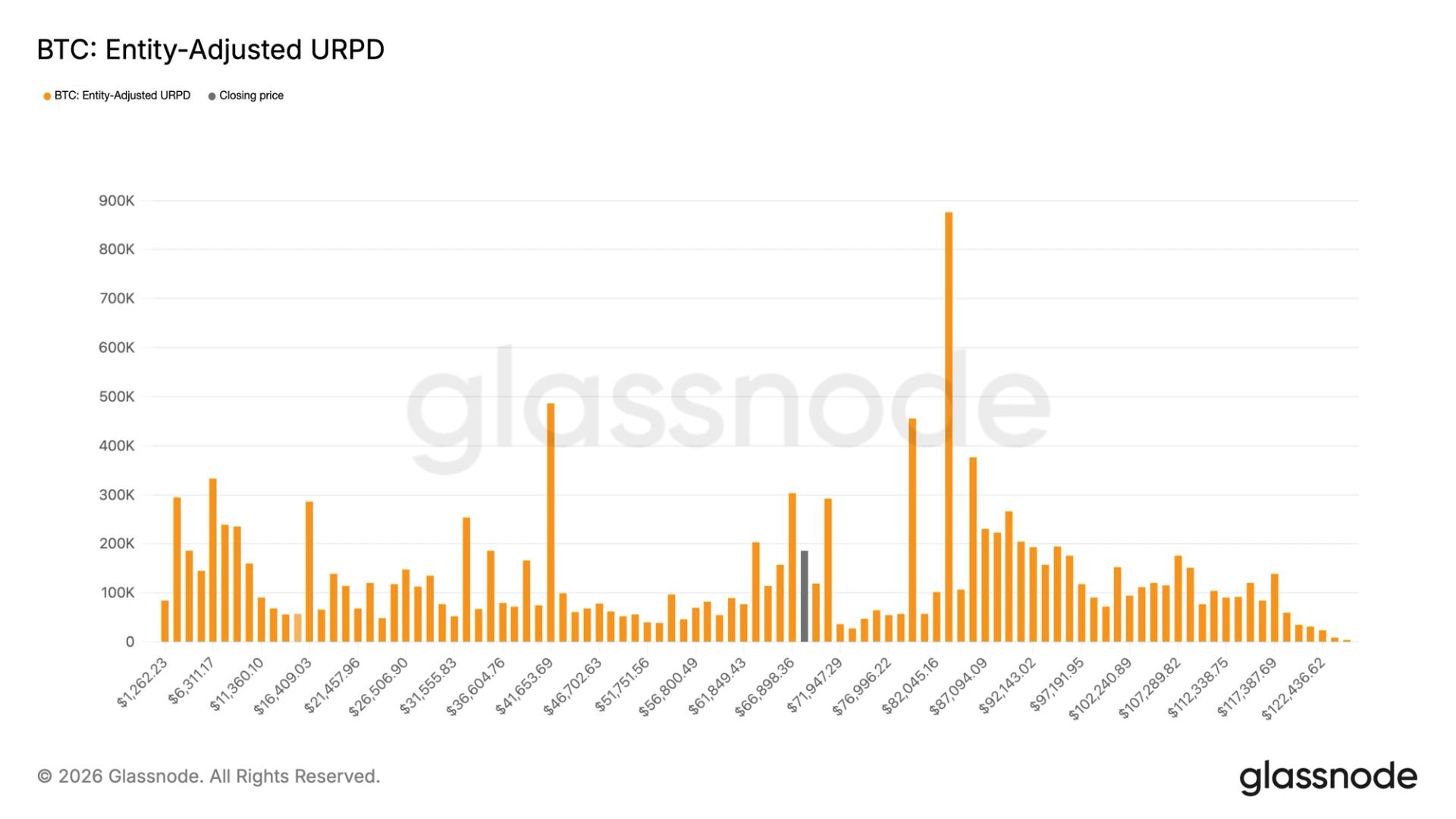
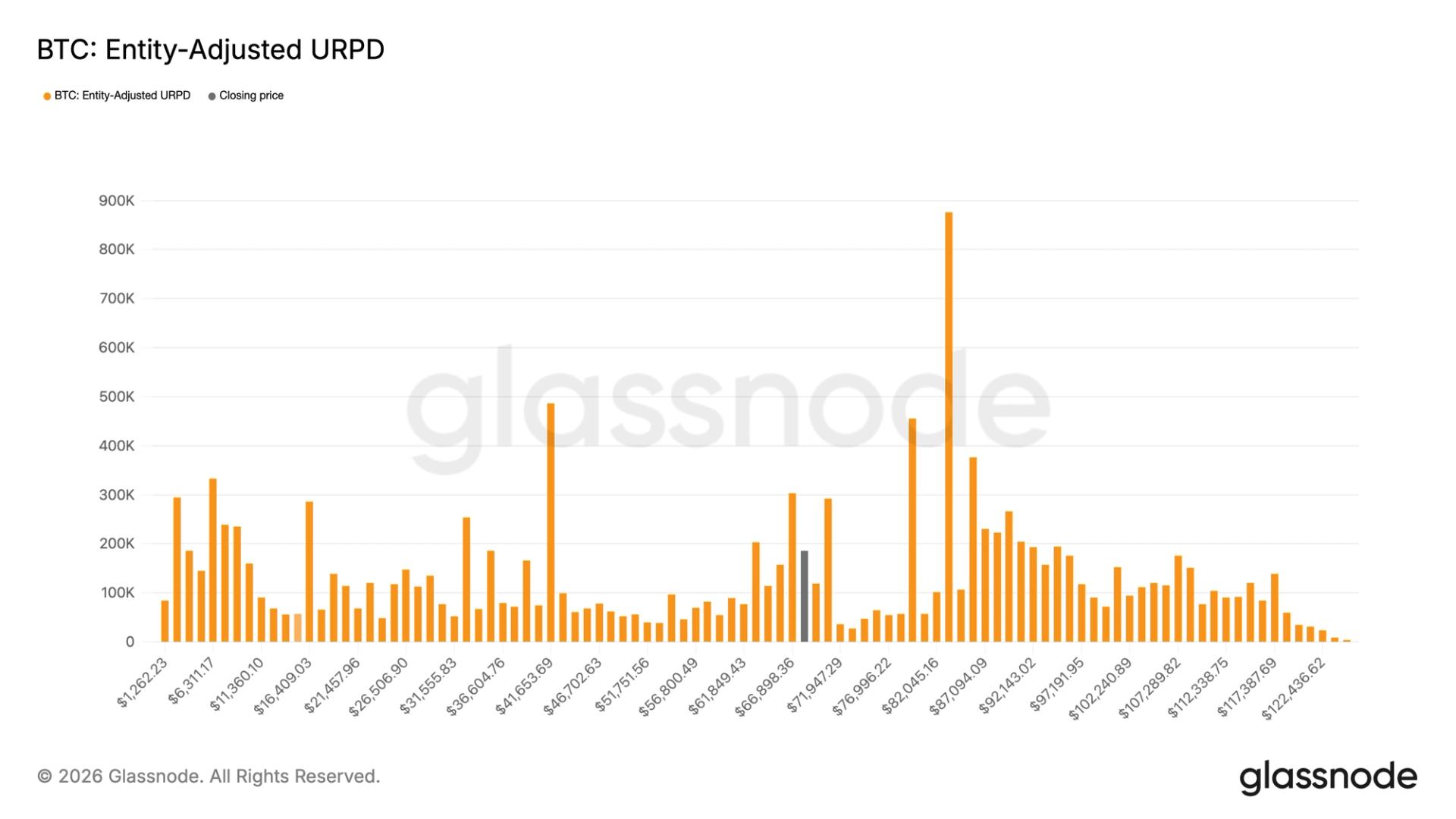
Bitcoin’s “air pocket” is once again coming into focus as the largest cryptocurrency by market capitalization rose on Wednesday to just below $72,000.
The air pocket refers to a thin area of supply between $72,000 and $80,000, where relatively few coins last changed hands, according to data from Glassnode.
Roughly just 1% of the circulating bitcoin supply sits within this range. Because so few holders established positions there, the market may encounter limited resistance if prices begin moving through the zone. In practical terms, that means if bitcoin pushes decisively above $72,000, the move toward $80,000 could occur relatively quickly.
Historically, bitcoin has spent very little time trading in $72,000 to $80,000 region. One instance came in November 2024, when prices surged rapidly after Donald Trump’s U.S. presidential election victory, quickly moving through the range without forming much trading volume.
A second example occurred earlier this year, when bitcoin fell from around $80,000 to $70,000 at the end of January, before sliding further to roughly $60,000 by Feb. 6, a decline that unfolded over just a few days.
The supply dynamics are visible through Glassnode’s Realized Price Distribution (URPD) metric. URPD shows the price levels at which the current set of unspent transaction outputs were last moved, effectively mapping where existing bitcoin holders acquired their coins.
CoinDesk Research notes that during bitcoin’s recent consolidation between $60,000 and $70,000, more than 400,000 BTC were accumulated, showing strong support below current levels.

Over the weekend, crypto markets acted as the first barometer of investor sentiment as geopolitical tensions around Iran intensified after U.S. and Israeli strikes. In the early hours of Saturday, a video posted by U.S. President Donald Trump announced new attacks against Iran, prompting an immediate reaction in digital assets. Bitcoin, the market’s bellwether, briefly traded near $63,000 before eking out a partial recovery as weekend liquidity moved through crypto-native venues. With traditional markets closed, traders leaned on perpetual futures and tokenized assets to express views on risk, inflation expectations, and macro uncertainty—demonstrating how 24/7 crypto trading is increasingly a real-time shock absorber for broader markets.
Key takeaways
- Bitcoin briefly traded around the $63,000 level in the immediate aftermath of the announcements, before rebounding as sentiment evolved.
- Crypto markets served as a real-time gauge for macro shocks when traditional markets were closed, highlighting the primacy of continuous price discovery.
- Perpetual futures on both centralized and decentralized venues sustained liquidity, with tokenized assets and RWAs gaining traction as the weekend progressed.
- Hyperliquid maintained elevated trading volume over the weekend, suggesting sustained demand for cross-asset liquidity during geopolitical turmoil.
- Institutional interest in tokenized assets and crypto rails intensified, with XAUT and related prediction markets drawing notable activity amid the episode.
Tickers mentioned: $BTC, $IBIT, $XAUT
Sentiment: Neutral
Price impact: Negative. Bitcoin briefly dropped to around $63,000 in response to the announcements and similar shocks in other assets, before stabilizing.
Market context: The weekend escalation reinforced crypto’s role as a near real-time risk indicator, with 24/7 liquidity enabling price discovery even when traditional markets pause. The episode also foreshadowed how institutional interest in tokenized assets and RWAs could accelerate the integration of crypto rails into mainstream finance.
Why it matters
The episode underscores a maturation trend in which digital assets function as live barometers of macro risk, not merely as speculative instruments. As geopolitical headlines circulated, Bitcoin and related crypto markets absorbed the information flow in real time, illustrating how traders leverage around-the-clock liquidity to calibrate risk exposure during shocks that unfold outside conventional trading hours.
Institutional interest in tokenization and RWAs is increasingly visible in market structure developments. Proposals and pilot programs around tokenized assets and cross-border liquidity access point to a future where crypto rails support a broader set of financial instruments, even as traditional venues test longer trading hours. In this context, players are evaluating whether extended hours and on-chain settlement can coexist with regulatory norms while maintaining risk controls that protect investors.
Additionally, the weekend episode highlights the growing relevance of alternatives to spot markets. Tokenized gold, such as XAUT, and cross-asset liquidity vehicles gained visibility as traders sought diversified exposure beyond conventional equities during a period of heightened uncertainty. The convergence of crypto, tokenization, and traditional asset proxies suggests a longer arc toward more integrated, cross-market risk management frameworks.
What to watch next
- Regulatory and market-infrastructure developments around 24/7 trading and tokenized assets, including updates on 23-hour trading proposals from Nasdaq.
- Further geopolitical developments and how BTC and other major assets respond in real time on perpetual futures and tokenized instruments.
- Tracking volume trends on platforms like Hyperliquid to see if weekend activity sustains beyond periods of stress.
- Monitoring tokenized assets such as XAUT and related RWAs for continued institutional uptake and pricing dynamics.
Sources & verification
- Public statements and video posts related to the weekend strikes, including the Truth Social post by Donald Trump announcing attacks on Iran.
- Bitcoin price movements around the $63,000 level as reported in crypto coverage documenting the weekend reaction.
- Bloomberg reporting on 24/7 crypto trading activity and Hyperliquid volume during the period.
- Cointelegraph reporting on tokenized assets like XAUT and on-chain/Ancedent market activity (e.g., Polymarket volumes) during the episode.
- Nasdaq’s and NYSE’s explorations of extended or 24/7 trading concepts, including the Nasdaq rulebook solicitation for near-24-hour trading and related market-structure discussions.
Bitcoin absorbs geopolitical shocks in real time
Bitcoin (CRYPTO: BTC) began the weekend on a sensitive footing after a video posted by President Donald Trump signaled U.S. and Israeli strikes against Iran. In the first hours after the announcement, the asset traded near the $63,000 area as participants recalibrated risk exposure and liquidity considerations in a market that never sleeps. The move underscored how geopolitical shocks are increasingly priced in real time on crypto platforms, where 24/7 trading creates a continuous feedback loop between news events and price action.
Analysts described the initial move as swift but contained, noting that Bitcoin did not break its broader market structure. “The initial weekend move to the downside was sharp but contained, and Bitcoin’s architecture held,” said Jonatan Randin, senior market analyst at PrimeXBT. “When it became clear that escalation risk appeared limited, price retraced and found footing.” The sentiment framing suggests a non-systemic risk event rather than a collapse in risk appetite.
Throughout the Saturday-to-Sunday window, traders shifted toward venues designed for constant liquidity, including perpetual futures that operate around the clock. With spot sessions quiet on traditional exchanges, crypto markets offered a live lens into risk appetite and inflation expectations as investors allocated capital across cross-asset plays and hedges.
Observers highlighted how uninterrupted trading both tests and strengthens price discovery. “Liquidity can thin during off-hours, potentially amplifying short-term moves, but the nonstop market accelerates price discovery and price adjustment,” noted Iliya Kalchev, an analyst at Nexo Dispatch. That view aligns with the growing use of digital rails to price geopolitical risk in real time—especially as institutions explore tokenized instruments and RWAs that can trade outside standard hours.
Beyond the classic spot market, tokenized assets and cross-asset liquidity drew attention. Bitwise’s executives flagged rising demand in tokenized gold, including XAUT (CRYPTO: XAUT), as traders moved to diversify via tokenized reserves. Prediction markets also reported elevated volumes on platforms such as Polymarket during the episode, illustrating how markets blend crypto and traditional risk proxies when macro uncertainty spikes. These signals map onto a broader trend: more capital is testing crypto rails as a flexible, around-the-clock access point to risk exposure.
The shift toward tokenized assets dovetails with big-picture industry projections. McKinsey and Standard Chartered have argued tokenized assets could reach into the trillions of dollars by 2030, while Boston Consulting Group offers a similar long-run expansion forecast. Within that landscape, traditional venues are testing longer trading horizons, with Nasdaq pursuing a near 23-hour framework and the New York Stock Exchange exploring blockchain-enabled platforms as a bridge to on-chain finance. In this context, the iShares Bitcoin Trust (EXCHANGE: IBIT) has already positioned itself as a conventional-accessibility vehicle for investors seeking crypto exposure within familiar structures.
From a macro perspective, the episode reinforces Bitcoin’s emergence as a macro-asset sensitive to liquidity shifts and geopolitical risk. “Bitcoin has evolved into a macro asset, reacting not only to tech dynamics but to shifts in liquidity and policy expectations,” Kalchev said. The observation echoes a longer trend: crypto markets provide a continuous, cross-border price signal in an era of fragmented liquidity across traditional exchanges.
In parallel, data ripples from the broader crypto ecosystem underscored a persistent appetite for cross-asset liquidity. Hyperliquid, a perpetual-futures DEX, extended above-weekend volumes for commodities and traditional assets such as oil, at least for the period in focus. Bitwise’s Matt Hougan also noted a surge in tokenized-gold activity, while research and platforms tracking markets like Polymarket documented record engagement. Taken together, the weekend episode points to a convergence: tokenized assets and crypto rails are becoming more central to risk management across investors who traditionally rely on stocks, bonds, and commodities.
As more traditional players contemplate 24/7 or near-24/7 trading systems, the crypto world has already been operating with that tempo for years. The weekend episode shows that markets can digest news quickly when the information stream never pauses, potentially accelerating the integration of crypto into mainstream financial infrastructure while sharpening the debate over regulation, liquidity, and systemic risk across the global financial system.
Looking ahead, the weekend’s dynamics emphasize the importance of robust market data, trusted custody, and reliable on-chain settlement for institutional participants. If the trend toward wider adoption of tokenized assets continues, there will be increased demand for transparent price feeds, better risk management tools, and standardized benchmarks that help investors navigate the evolving landscape.
For traders, the episode reinforces a practical takeaway: in a world where news can ripple across asset classes in minutes, the speed of reaction matters as much as the direction of movement. The implication is that risk management in crypto now includes cross-asset hedges, liquidity-aware positioning, and a readiness to respond to geopolitical headlines as they break—anywhere, anytime.
Bitcoin price has reclaimed the $72,000 level as flows and positioning turn more supportive.
Summary
- Bitcoin price touched an intraday high near $72,000, its strongest level in weeks.
- U.S. spot ETFs recorded solid net inflows while funding normalized and open interest rebuilt.
- Major crypto assets rose 5%–8% on the day as liquidity and volumes improved across derivatives and spot venues.
Bitcoin (BTC) price has climbed back to the $72,000 area after a volatile stretch marked by forced liquidations, ETF outflows, and macro-driven risk aversion. The move higher follows several sessions of gradual recovery from lows near $63,000, as net selling from long-term holders slowed and fresh capital re-entered via spot ETFs and large over-the-counter blocks.
On the derivatives side, funding rates that had flipped sharply negative during the drawdown have normalized toward neutral, suggesting that aggressive short positioning is being unwound rather than extended. The rebound comes as broader risk markets remain choppy, indicating that bitcoin’s latest leg higher is being driven more by crypto-native flows and position reset dynamics than by a broad risk-on rally in equities.
Traders point to a combination of short-covering and structural demand from ETF buyers as key drivers of the latest push toward $72,000. After weeks of consolidation below key resistance levels, the reclaim of the $70,000–$72,000 band has forced some bears to buy back positions, adding fuel to the upside. At the same time, on-chain and fund data show continued interest from institutional allocators who are using dips to build or rebalance positions through regulated vehicles. This behavior contrasts with prior cycles, where sharp rebounds were often dominated by highly leveraged perpetual futures rather than spot-led flows. The current setup, with more of the move coming from cash market demand, is seen by some desks as a healthier backdrop even if volatility remains elevated.
Flows, leverage and next levels
Under the surface, market structure indicators still matter for judging whether the break toward $72,000 can sustain. Open interest in Bitcoin futures has increased from post-liquidation lows, but not yet to the extremes seen at previous local tops, which reduces the risk of an immediate, large-scale long squeeze. Funding across major venues is positive but contained, implying that traders are willing to pay a modest premium to stay long without crowding into highly leveraged bets. Options markets show a modest skew toward calls at higher strikes, with implied volatility elevated around upcoming macro data, reflecting a market that is optimistic but still hedging tail risks rather than abandoning protection altogether.
For investors and traders, the key focus now is whether bitcoin can hold above reclaimed support levels and convert the $70,000–$72,000 zone from resistance into a base for further advances. A clean break and sustained close above this area would open the door to tests of higher psychological levels flagged in recent research, while a failure could send the price back into the mid-$60,000s as momentum fades. Flows into spot ETFs, the behavior of large holders on-chain, and the pace of new leverage build-up will likely determine which scenario plays out. As regulatory frameworks such as MiCA advance and large platforms like Coinbase deepen their integration of bitcoin into mainstream investment products, market participants will be watching whether this latest move marks the start of a more durable leg higher or just another range expansion within an ongoing consolidation.
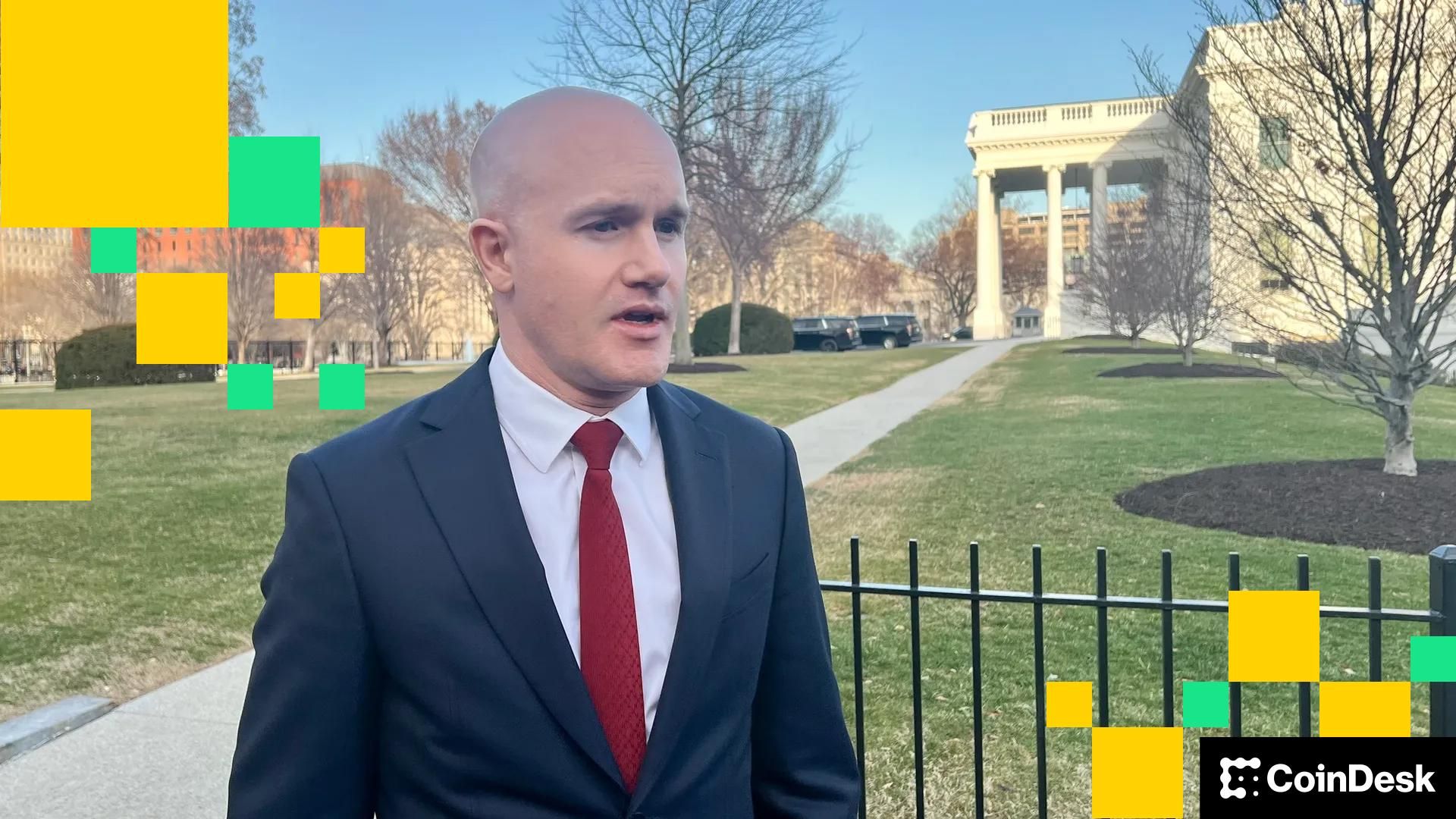
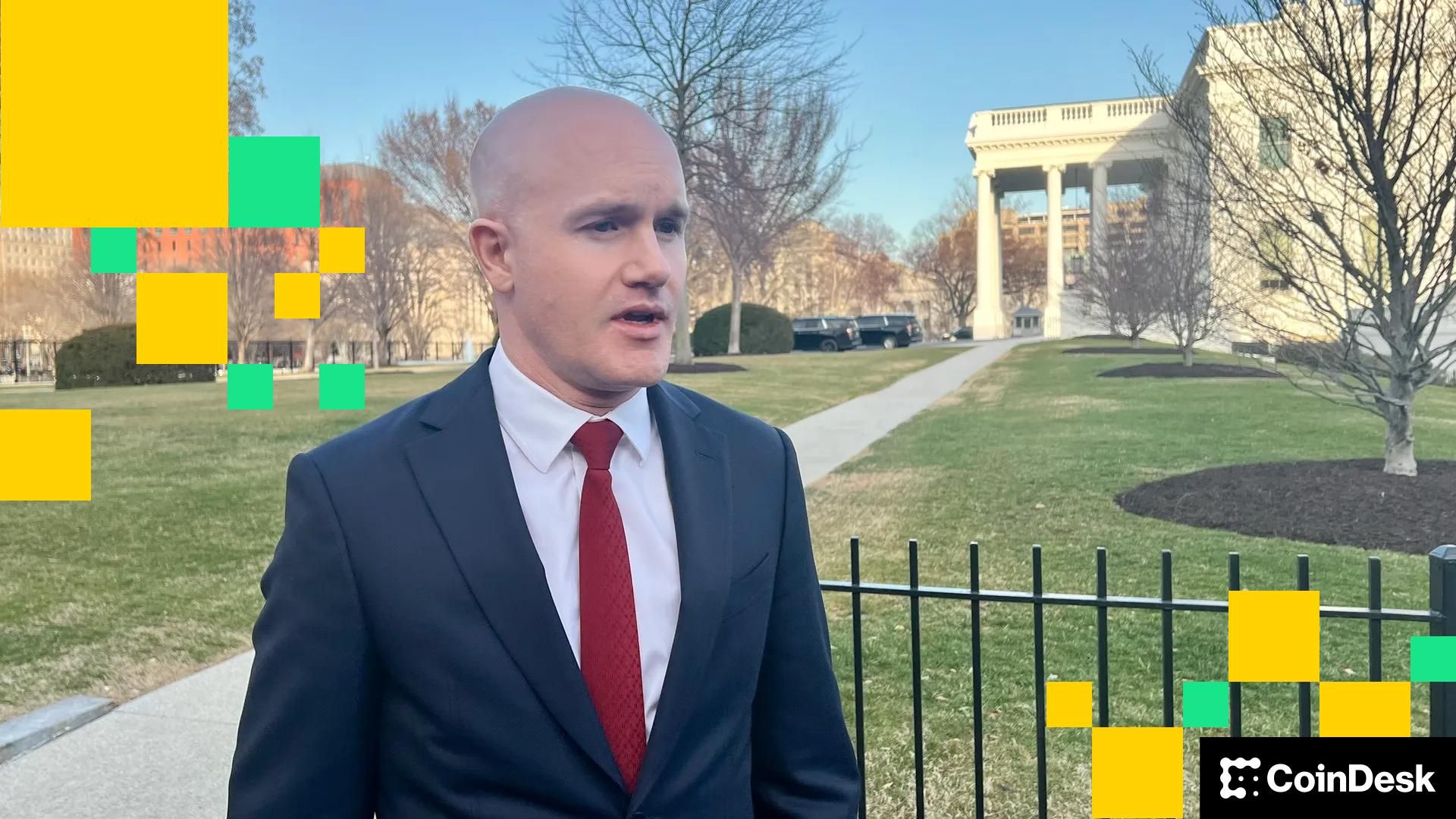
Crypto-related stocks opened the Wednesday U.S. session with sizable gains as bitcoin surged above $72,000 for the first time in almost a month.
Crypto exchange Coinbase (COIN) jumped above $200 to its strongest price since late January, up 12% in the first minutes of trading. Strategy (MSTR), the largest corporate bitcoin holder, advanced nearly 9% to a one-month high.
Galaxy Digital (GLXY), Robinhood (HOOD) and Ethereum treasury firm BitMine (BMNR) were up 6%-8%. Stablecoin issuer Circle (CRCL) climbed another 6%, now up over 70% in the week since its fourth-quarter earnings report.
Bitcoin miners, increasingly tied to the artificial intelligence data center buildout, also rebounded following the Tuesday selloff. Bitfarms (BITF), Hive (HIVE), Hut 8 (HUT) and IREN saw 6%-10% gains.
The broader U.S. equity market was also seeing gains, with the Nasdaq and S&P 500 each higher by about 1% in early action.
The strong early showing came as bitcoin jumped to $72,600 at the start of the U.S. session, its highest price since early February. Recently, it pared some of the gains and retreated to $71,500, still up roughly 5% over the past 24 hours.
The $70,000-$72,000 range, which capped previous rally attempts over the past month, is a crucial zone for bitcoin to overcome if this rally is to last.
Bitcoin’s outperformance over equities comes after crypto assets have massively underperformed any other asset class over the past two months, which could explain why it is now diverging, according to Wintermute OTC trader Jasper De Maere. Another factor could be that, unlike stocks, digital assets are not tied to supply chains, energy costs, or other narratives that seem to be weighing on prices, he wrote in a note.
De Maere also argued that equities and crypto have become “substitute risk-assets.” With uncertainty slowing inflows into stocks, capital may be rotating into digital assets instead. “Uncertainty is slowing down inflows in equities, which creates opportunity for crypto, which is what we’re seeing now,” he said. Still, he cautioned that the outperformance may not last. “The situation is fluid,” and a chain reaction of longer tension resulting in higher energy prices, sticky inflation, which could lower the odds of another rate cut, would be negative for crypto.
For now, he expects volatility to persist until there is greater clarity.


- Dogecoin holds key support at $0.088, signalling a potential rebound.
- Technical indicators show bullish patterns and rising trader interest.
- Unlimited supply limits long-term gains despite short-term recovery signs.
Dogecoin has taken a noticeable hit in recent days, with prices dipping amid global uncertainty triggered by the Iran war.
The popular memecoin, which once soared to unprecedented highs, now trades around $0.092, down slightly from its recent weekly levels.
While the price dip is noticeable, technical indicators suggest that the digital asset may be finding its footing, ready for a comeback.
Technical signals point to recovery
Several technical indicators suggest that Dogecoin may be preparing for a rebound.
To start with, $0.088 has turned into a key support zone after holding firm multiple times over the past month.
As a result, this level appears to have attracted buying interest, preventing further downward pressure.
A double bottom pattern has also formed on shorter timeframes, signalling a potential reversal.

In addition, the relative strength index (RSI) shows a bullish divergence, suggesting that selling momentum may be waning.
Open interest in DOGE futures has also spiked, indicating heightened market participation and renewed investor attention.
These signs collectively point to a possible relief rally in the short term, even as the broader market remains cautious.
But despite the rebound signals, Dogecoin price faces a major hurdle near $0.10, a level it needs to surpass to confirm any upward momentum.
Should DOGE clear this barrier, it may test the next key resistance zones, but any significant rally will still contend with structural challenges like its infinite supply and lack of much real-world use cases.
Balancing speculation and fundamentals
While technical patterns are encouraging, Dogecoin’s fundamentals present a more cautious picture.
Its unlimited token supply continues to dilute value over time, making dramatic long-term price increases unlikely without substantial adoption.
Unlike other cryptocurrencies that benefit from scarcity, DOGE relies heavily on community support and speculative trading.
Its all-time high (ATH) of $0.73 recorded in 2021 remains far off, emphasising the challenges the coin faces.
Despite this, short-term momentum is undeniable, especially seeing that social interest in the coin has picked up over the past few days, coinciding with relief rallies in the past.
For now, while structural limitations and the uncertain macro environment suggest that investors should temper expectations, DOGE seems to be stabilising, offering cautious optimism for those tracking the memecoin closely.
President Donald Trump has issued a direct warning to the banking industry: stop blocking crypto or face consequences. This came as the CLARITY Act is currently at a standstill, with the President now blaming the banks.
In a late Tuesday statement (March 3), Trump accused major financial institutions of undermining his administration’s digital asset agenda.
This news broke as the crypto market moved higher overnight, surging 2.6% and pushing the total crypto market cap over $2.4 trillion.
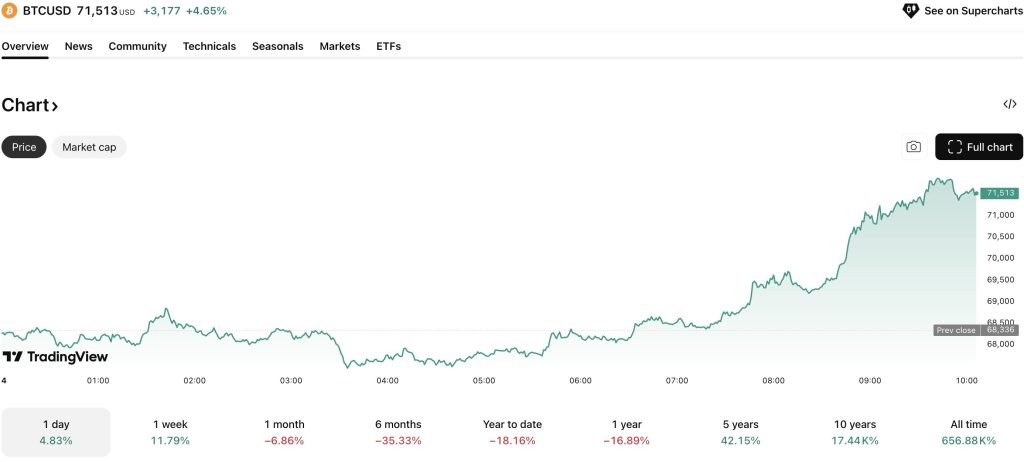
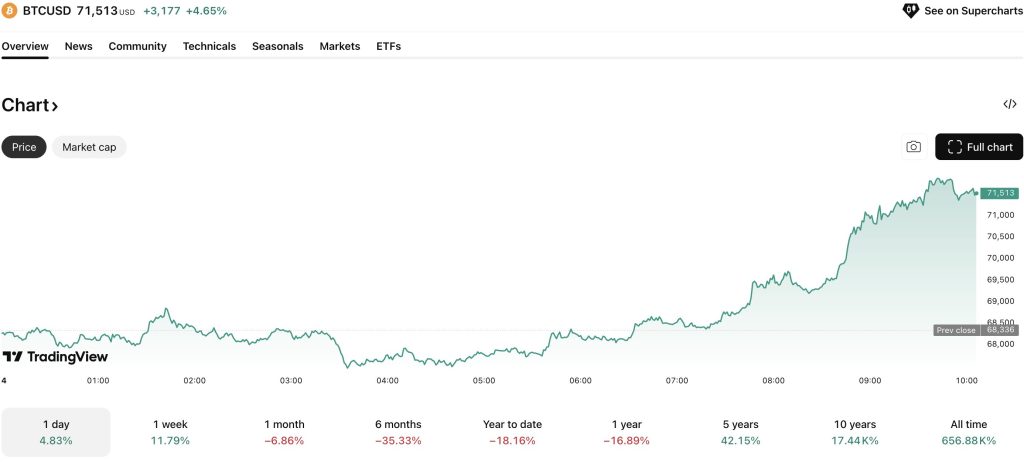
Bitcoin USD has surged in the European morning trading session, flying back above $71,000 with a +6% move, one of its best days in recent weeks.
The Battle for the Clarity Act: Trump Vs. The Banks
The immediate trigger for this confrontation is the stalled CLARITY Act. This market-structure bill, designed to reshape how digital assets are regulated in the US, passed the House last year but has hit a wall in the Senate.
Trump took to his Truth Social platform late on Tuesday to frame the delay as a national security failure:
“The Banks are hitting record profits, and we are not going to allow them to undermine our powerful Crypto Agenda,” Trump wrote. He argued that inaction would cede ground to China, framing the Trump crypto policy as vital to maintaining US financial dominance.
Banks are specifically opposing provisions that would allow crypto exchanges to pay yield to users holding stablecoins. Traditional finance institutions argue this could trigger a deposit flight, draining capital from retail bank crypto accounts into higher-yielding digital asset platforms.
This follows the administration’s earlier legislative win, the Genius Act, signed in July. That law created a framework for issuers but remained silent on whether intermediaries could offer yield. The CLARITY Act aims to close that loop, and banks are scared.
BILLIONAIRE KEVIN O'LEARY SAID THE CLARITY ACT WILL PASS AND SEND BITCOIN TO $200,000 — Crypto Fergani (@cryptofergani) March 3, 2026
TRILLIONS INCOMING  pic.twitter.com/FffPLwwXSv
EXPLORE: Best Crypto Presales to buy in 2026
Reversing Operation Choke Point
The administration is not relying solely on legislation. The White House is actively moving to dismantle the legacy of Operation Choke Point 2.0.
This informal regulatory strategy, utilized during the previous administration under Joe Biden, pressured banks to sever ties with crypto clients under the guise of risk management.
On March 1, the OCC repealed Interpretive Letter #1179. This removed the requirement for banks to seek pre-approval before engaging in crypto activities. Yet, industry reports suggest that despite the regulatory green light, banks remain hesitant.
Trump’s latest comments signal he could be set to go on the offensive to push the CLARITY Act through once and for all. And by now, we all know what Donald wants; he seemingly gets it.
The stakes for the industry are existential. Without reliable banking rails, crypto firms face higher operational costs and settlement risks. While the US struggles with basic access issues, other nations are integrating blockchain at the central bank level.
A similar contrast is evident globally, as the Bank of Japan explores blockchain-based reserve settlement, highlighting that traditional institutions elsewhere are adapting rather than obstructing.
As the CLARITY Act Nears, the Bitcoin Price Surges Past $70,000: What Next for BTC USD?
Bitcoin has resumed its rally, pumping more than 6% overnight and now trading at $71,200, even though sentiment across global equity markets remains risk-averse, as evidenced by falling precious metal prices.
There is a possibility that capital leaving the lagging silver market may be partially rotating into the surprisingly resilient BTC. Since the US attack on Iran, the Bitcoin price has risen by around 10%, after initially dropping to roughly $63,000 in the immediate aftermath.
At the same time, USD strength has not triggered declines in the crypto market, as it often does, potentially signaling renewed belief in crypto as a store-of-value amid growing global tensions.
BTC/USD now needs to hold above $70,000 to signal further upside. A loss here would signal weakness, and a drop back toward support at $66,000 becomes likely.
However, holding $70,000 and a fresh injection of volume could see Bitcoin revisit its February high of $78,600. Macroeconomic news and volume are the two key indicators to watch when plotting BTC’s next move.
DISCOVER: Next Crypto to Explode in 2026
The post CLARITY Act News: Trump Administration Confronts Banks Over Crypto Banking Access appeared first on Cryptonews.


Kraken Financial becomes the first crypto bank to receive a Fed master account, marking a significant milestone in crypto integration with TradFi.
Kraken Financial, the baking arm of U.S. centralized exchange Kraken, announced that it has a Federal Reserve master account, granting it direct access to the U.S. payment systems.
In a blog post published today, March 4, the firm said that the approval marks a major milestone for the integration of crypto and traditional financial rails. It also makes Kraken Financial the first crypto-focused bank to receive a master account from the U.S. central bank.
Kraken Financial is state regulated, holding a Special Purpose Depository Institution (SPDI) license in Wyoming, making it able to offer both digital asset custody and fiat deposit accounts. The Fed master account connects the bank directly to the central bank’s payment infrastructure, including Fedwire. The firm said it expects the move to make fiat transactions more efficient for its institutional clients.
Last month, Kraken announced that it will sponsor so-called “Trump Accounts” for every child born in Wyoming this year, via its banking arm. The parent company of the bank and the CEX, which is the second largest in the U.S. by daily trading volume, is registered in the state, which is generally known for its crypt-friendly legislation efforts.
Both Ripple and crypto-focused, federally chartered bank Anchorage Digital have applied for Fed master accounts last year, but have yet to receive them.
This article was generated with the assistance of AI workflows.
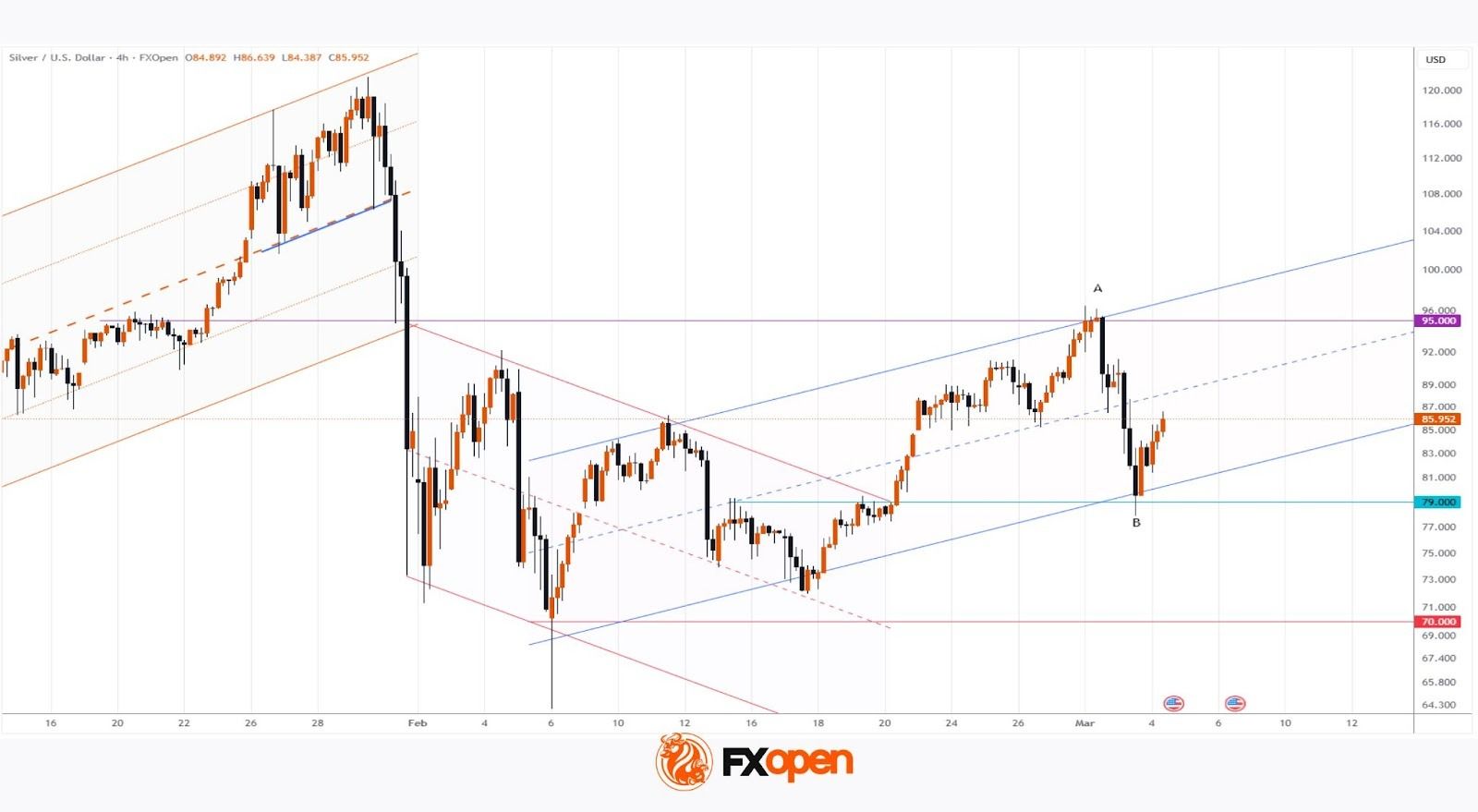
As can be seen on the XAG/USD chart, the price of silver is recovering after forming yesterday’s low below the $79 level. The price per ounce has already exceeded $86 today (+10% in less than 24 hours!).
Volatility in the silver market is being driven by fluctuations in the US dollar, as well as military action in the Middle East, which is fuelling concerns about a prolonged regional conflict. According to media reports:
→ Yesterday, Israel carried out a strike on a building where religious figures had gathered to elect a new Supreme Leader.
→ Following the death of Ali Khamenei, he was succeeded by his son Mojtaba Khamenei. Although some sources consider him the leading candidate (no official statements have yet been made), this has raised concerns that the new Iranian leadership may continue existing policies — increasing uncertainty over the outcome of the conflict.
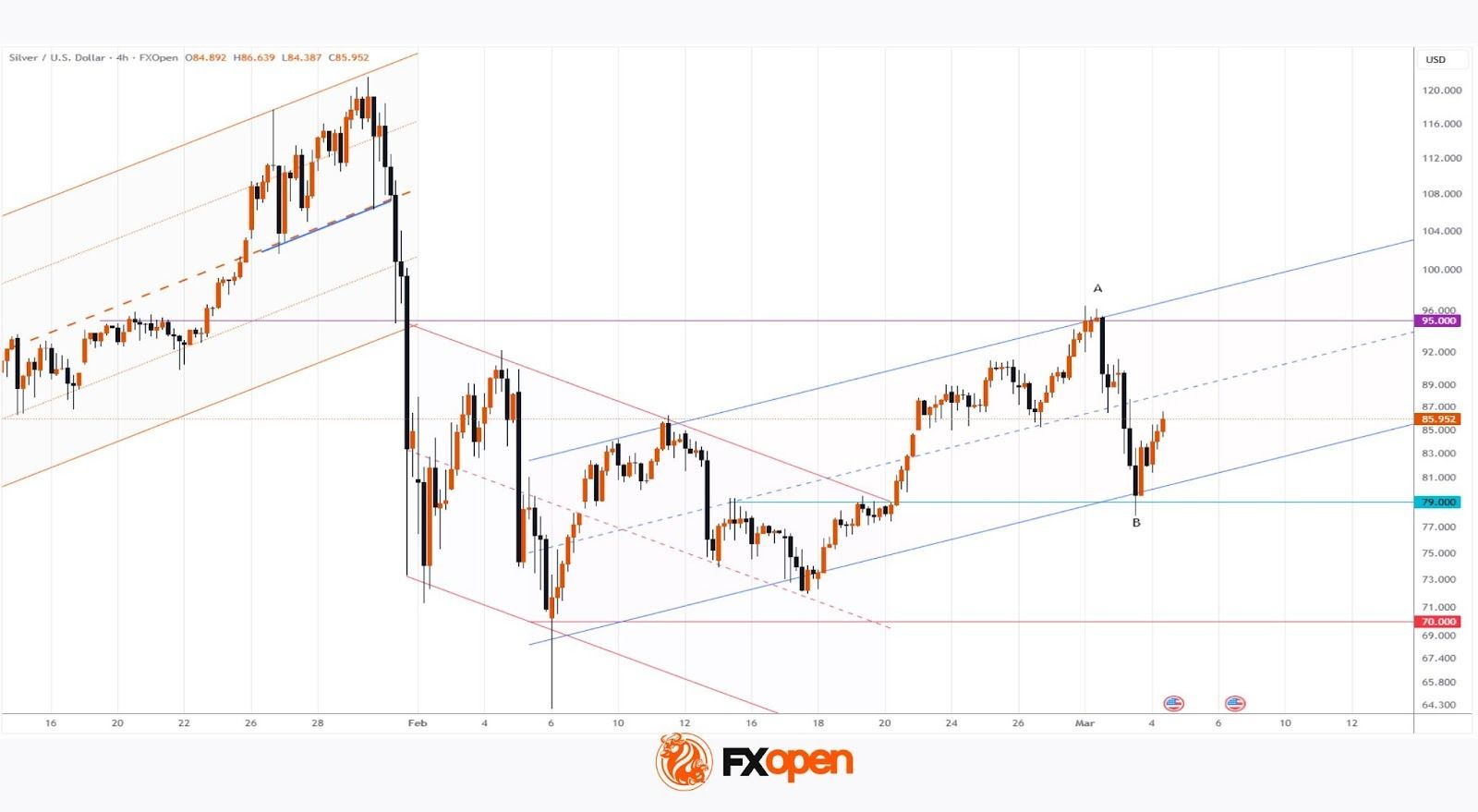
On 20 February, when analysing the XAG/USD chart, we:
→ highlighted the importance of the $95 resistance level;
→ suggested that the price of silver could consolidate above the breakout level of the descending channel around $79 (shown in red), reinforced by the psychological $80 mark.
Indeed, our assumptions were reflected in the formation of a zigzag pattern, with a bearish reversal at the A peak and a bullish reversal at yesterday’s low B. Notably, these and other key extremes make it possible to outline the contours of an upward trajectory (shown in blue).
It is possible that the upward movement observed this morning will continue during the US trading session, allowing XAG/USD to reach the blue median line. Price action at that point may provide important clues — if the median does not show signs of resistance, this may be interpreted as an indication of further upside potential.
Start trading commodity CFDs with tight spreads (additional fees may apply). Open your trading account now or learn more about trading commodity CFDs with FXOpen.
This article represents the opinion of the Companies operating under the FXOpen brand only. It is not to be construed as an offer, solicitation, or recommendation with respect to products and services provided by the Companies operating under the FXOpen brand, nor is it to be considered financial advice.


Police in Thailand have asked Interpol to issue a red notice against Benjamin Mauerberger, an alleged money launderer for a number of South Asian scam operations with links to the world’s once-fourth largest crypto exchange, KuCoin.
Local media reports that Thailand’s Crime Suppression Division filed a request that, if approved, would see Interpol issue a global warrant for Mauerberger’s arrest.
Thailand charged the South African businessman and his wife, Cattaliya Beevor, with investment fraud and money laundering last week.
Courts accused the duo of conning investors out of 1 billion baht ($31.6 million) in 2016 through a series of fraudulent projects involving power plants, private jets, and real estate investments.
Mauerberger reportedly fled his base in Bangkok last September and is now residing in the United Arab Emirates (UAE).
Read more: Cambodia has deported 48K foreigners since scam center crackdown began
He’s been documented hopping between the UAE, Cambodia, and Dubai in an attempt to evade US authorities that allege he’s played a key role in laundering funds for numerous scam syndicates.
Indeed, according to Project Brazen’s Whale Hunting newsletter, Mauerberger helped KuCoin and its Thai subsidiary secretly acquire shares in his wife’s firm, Finansia X PCL.
The firm was reportedly used by Mauerberger and his Cambodian associates to move large sums of money into KuCoin without regulatory oversight.
It also accused Mauerberger of using a Laos-based bitcoin (BTC) mining firm with connections to Thailand’s former prime minister, to launder funds and make them look like freshly mined crypto.
Read more: Cambodian scam rings facing disruption since kingpin’s arrest
In addition, Mauerberger was reportedly the financial fixer for Thailand’s political dynasty and helped the country’s former prime minister acquire a $60 million private jet and investments in energy firms.
Protos has reached out to KuCoin for comment and will update this piece should we hear anything back.
Taiwan indicts scam kingpin Chen Zi in absentia
Mauerberger’s alleged shadow enterprise, which includes $1.5 billion worth of properties, assets, and firms, is reportedly connected to other alleged scam kingpins such as the recently arrested and extradited Chen Zi.
Zi’s “Prince Group ”corporation, based in Cambodia, was sanctioned by the US and UK last October alongside Huione Group. The US seized $15 billion worth of BTC in connection to Zi’s alleged scam enterprise.
Reuters reports that Taiwan has indicted 62 people linked to the Prince Group today, including Chen Zi, who was indicted in absentia.
Singaporean and Taiwanese authorities found $700 million in assets linked to his alleged operations, and Taiwan uncovered $334 million of laundered funds that entered the country between 2025 and 2026.
Got a tip? Send us an email securely via Protos Leaks. For more informed news and investigations, follow us on X, Bluesky, and Google News, or subscribe to our YouTube channel.

DJI Osmo Pocket 4 Emerges from the Shadows, Quick Start Guide Teased

XRP MARKETCAP DOESN’T MEAN S**T – BANKS WON’T WARN YOU OF THIS – TRANSATLANTIC RAILS ARE READY TO GO

Man arrested for breaching Slavery Trafficking Risk Order


-

 Politics6 days ago
ITV enters Gaza with IDF amid ongoing genocide
-

 Politics1 day ago
Alan Cumming Brands Baftas Ceremony A ‘Triggering S**tshow’
-

 Fashion5 days ago
Weekend Open Thread: Iris Top
-

 NewsBeat7 days ago
Cuba says its forces have killed four on US-registered speedboat | World News
-

 Tech3 days ago
Unihertz’s Titan 2 Elite Arrives Just as Physical Keyboards Refuse to Fade Away
-
Sports4 days ago
The Vikings Need a Duck
-
 NewsBeat4 days ago
Dubai flights cancelled as Brit told airspace closed ’10 minutes after boarding’
-
 NewsBeat7 days ago
Manchester Central Mosque issues statement as it imposes new measures ‘with immediate effect’ after armed men enter
-

 NewsBeat3 days ago
‘Significant’ damage to boarded-up Horden house after fire
-
 NewsBeat4 days ago
The empty pub on busy Cambridge road that has been boarded up for years
-

 NewsBeat4 days ago
Abusive parents will now be treated like sex offenders and placed on a ‘child cruelty register’ | News UK
-

 Business6 days ago
Discord Pushes Implementation of Global Age Checks to Second Half of 2026
-

 Entertainment2 days ago
Baby Gear Guide: Strollers, Car Seats
-

 Business6 days ago
Only 4% of women globally reside in countries that offer almost complete legal equality
-
 Tech5 days ago
NASA Reveals Identity of Astronaut Who Suffered Medical Incident Aboard ISS
-
Politics4 days ago
FIFA hypocrisy after Israel murder over 400 Palestinian footballers
-
 NewsBeat3 days ago
Emirates confirms when flights will resume amid Dubai airport chaos
-

 Crypto World6 days ago
From Crypto Treasury to RWA: ETHZilla Retreats and Relaunches as Forum Markets on Nasdaq
-

 NewsBeat2 days ago
Is it acceptable to comment on the appearance of strangers in public? Readers discuss
-

 Tech3 days ago
Viral ad shows aged Musk, Altman, and Bezos using jobless humans to power AI