
Crypto World
Self-Custodial Lightning for Mobile Payments



Lightning has promised fast, cheap Bitcoin payments for years. But for most people, using it still means choosing between an easy custodial wallet or a self-custodial setup that requires extra work – managing channels, getting inbound liquidity, and staying online so payments don’t fail.
Cake Wallet says its latest release is built to remove that friction. In the newest update, the wallet is rolling out self-custodial Lightning support designed for everyday use, so people can send and receive near-instant payments on mobile without having to run Lightning like a hobby and without giving up control of funds. Users can also move BTC back on-chain at any time.
A Lightning UX for the people
At the center of the launch is an integration powered by the Breez SDK and Spark. Cake’s announcement positions this as the missing bridge between non-custodial in principle and usable in practice, removing the need for users to manage channels, inbound capacity, liquidity, or continuous uptime monitoring.
In a short statement, Cake Labs CEO Vikrant Sharma has described the point of the release as refusing to force users into “a choice between convenience and sovereignty.”
Spark’s role is also worth unpacking. It’s a Bitcoin-native layer-2 built for payments and settlement, designed to let developers build natively on Bitcoin while remaining compatible with Lightning. In other words, the infrastructure is being engineered so wallet teams can offer a smoother Lightning experience without pushing users into a purely custodial model.
Privacy-First
Cake is also leaning into a privacy-first framing. In its release, the company says users can receive over Lightning without revealing a Spark address, and that Spark transactions are not published to Spark block explorers by default, reducing unnecessary exposure of activity.
The company has been moving toward a privacy-by-default approach on Bitcoin for some time, adding tools like Silent Payments and PayJoin v2 to make on-chain activity harder to trace and group together.
Human-Readable Lightning Addresses and Spending Options Inside the App
Lightning can be fast and cheap, but it still struggles with day-to-day UX details, like having to generate a new invoice and paste it into a chat for every payment.
Cake Wallet is trying to remove that step by introducing custom Lightning addresses, allowing users to receive via an @cake.cash username instead of sharing invoices or complex payment strings. Cake says the address can be created immediately, with no minimum balance requirement.
The update also brings Lightning directly into Cake Pay, the company’s prepaid debit card and gift card service. In Cake’s documentation, Cake Pay is explained as a way to buy gift cards or add a debit card to Apple Pay or Google Pay, designed to make crypto spending more practical without turning the experience into a data trail.
All Your Bitcoin, Lightning, and Storage in One App
Many Bitcoin users still use one app for everyday payments and another for long-term storage.
Cake Wallet says this update brings those workflows into one place: on-chain Bitcoin, Lightning, privacy tools, and hardware wallet support. Users can move funds between cold storage, on-chain, and Lightning inside the app, without switching tools or manually copying addresses.
With additions like human-readable Lightning addresses and Lightning-enabled Cake Pay for gift cards and prepaid debit cards, the update is clearly pushing toward everyday usability. If it delivers on reliability in real-world conditions, it finally makes Lightning a practical payment layer you can keep on your phone.

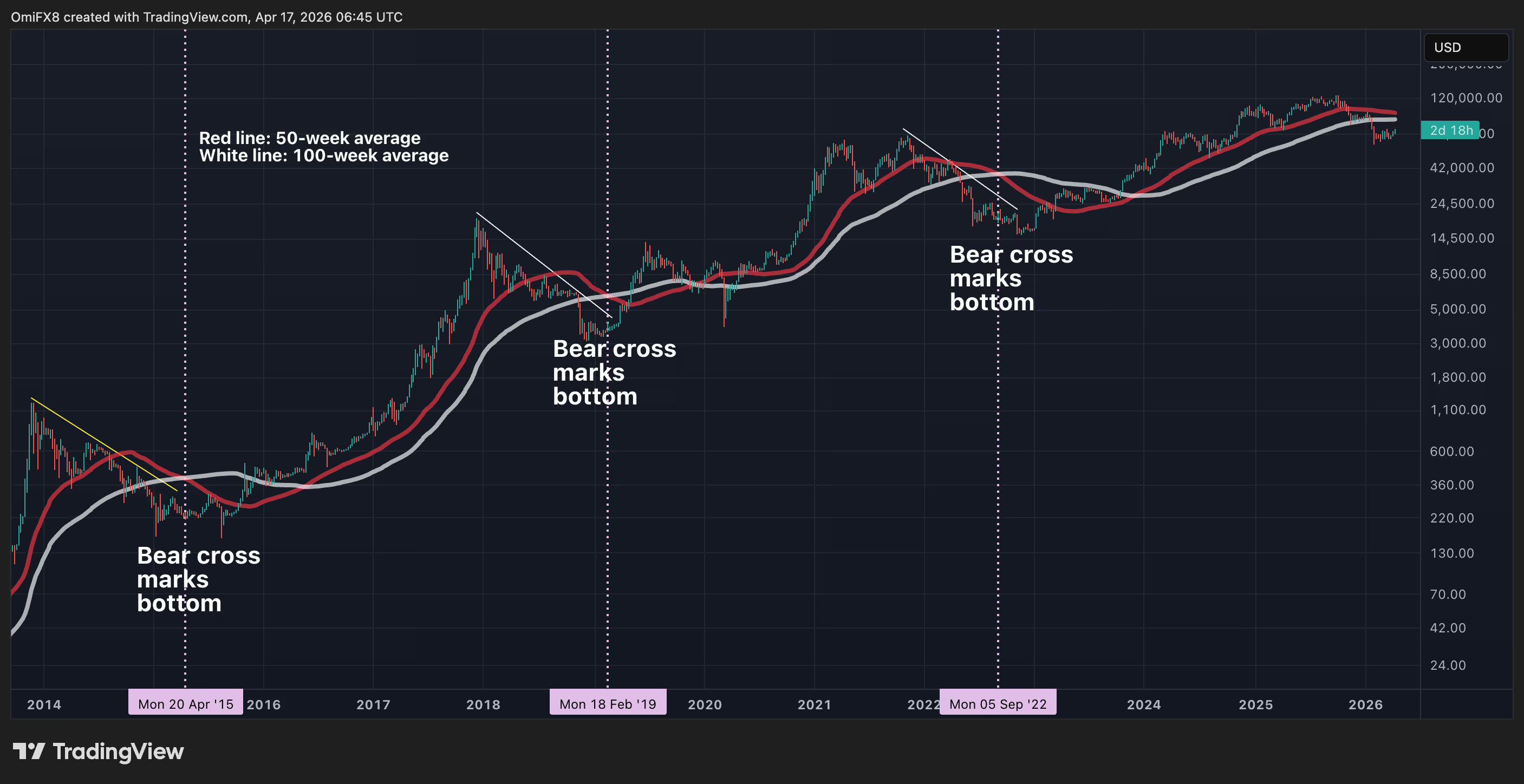
Here is something worth noting about bitcoin . Beneath all the noise from daily price swings, X posts and macro headlines, there is a remarkably simple indicator that has quietly called every major market bottom since 2015. Not once, but every single time.
To the dismay of bulls, it hasn’t fired yet, suggesting the broader bear market may not be over, and the recent bounce to $75,000 from $65,000 could be a temporary recovery.
The indicator
It involves two lines on the price chart. That’s it, no complex formula, analysis of blockchain data needed.
These two lines represent bitcoin’s average price over the past 50 and 100 weeks. They act as simple moving averages, showing near-term and long-term trends in bitcoin’s price.

Most of the time, the 50-week average is above the 100-week line. That’s the natural state for markets that trend upward over time, as is the case with bitcoin.
But occasionally, during periods of peak fear, when selling is relentless, and sentiment has collapsed, the 50-week average falls below the 100-week average. This crossover is known as a bear market signal.
It has occurred three times in bitcoin’s history. Each time, it has coincided with the end of a bear market, marking major price bottoms that have not been revisited since.
In other words, it’s been a contrary indicator, ironically marking bottoms rather than deeper downturns.
Three times, three bottoms
Look at the vertical lines on the chart going back to 2015. These mark the three bearish crossovers – April 2015, February 2019, and September 2022. Each one occurred near the bottoming phase, not precisely at the lowest point, but within the same range.
In 2015, BTC was written off as a failed experiment. Then the crossover happened. BTC subsequently rallied from $200 to nearly $20,000 by the end of 2017. A similar pattern played out after the early 2019 crossover.
The 2022 crypto winter, characterized by several bankruptcies and scams, shattered investor confidence. The downtrend, however, ran out of steam after the crossover happened in September. BTC bottomed out in the final months and later chalked out a rally to $126,000 by October 20205.
Each of these bull runs delivered returns far exceeding those of equities and other major asset classes.
What is it saying now?
As of April 17, the crossover has not happened.
Bitcoin has declined sharply from its October record high of over $126,000 to around $75,000, briefly reaching $60,000 in early February. As a result, the two averages are moving closer together, but the 50-week average still holds above the 100-week average.
The takeaway: If history is any guide, the broader bear market may still be intact and could worsen before finding a bottom. It also means that the recent bounce toward $75,000 is likely a temporary recovery rather than the start of a full-fledged bull market.
That said, historical patterns are just that – patterns – and they do not guarantee future outcomes. If U.S. equities, already at record highs, continue to advance, institutional demand for Bitcoin ETFs could strengthen, potentially supporting a price rally.
Cardano (ADA) founder Charles Hoskinson argues BIP-361’s zero-knowledge recovery mechanism cannot rescue roughly 1.7 million Bitcoin (BTC) locked in pre-2013 addresses. This includes roughly 1.1 million Bitcoins attributed to Satoshi Nakamoto.
Casa co-founder Jameson Lopp and five co-authors submitted the Bitcoin Improvement Proposal (BIP-361). It seeks to sunset legacy ECDSA/Schnorr signatures, rendering funds on those addresses unspendable.
Hoskinson Flags Fatal Gap in Bitcoin’s Quantum Plan
Estimates indicate that over 34% of Bitcoin is held in addresses potentially vulnerable to future quantum threats, prompting renewed focus on mitigation efforts. The BIP-361 proposal seeks to address the vulnerability.
The draft phases out legacy Bitcoin signatures in three stages. Phase A blocks new sends to vulnerable addresses. In Phase B, nodes would reject all transactions that rely on ECDSA and Schnorr signatures
Phase C, pending further research, would let holders recover frozen coins. They would submit a zero-knowledge proof of possession of a BIP-39 seed phrase. However, concerns remain over the feasibility of such recovery. In a recent video, Hoskinson stated that,
“1.7 million coins can’t do that. It’s not possible. 1.1 million of which belong to Satoshi.”
Subscribe to our YouTube channel to watch leaders and journalists provide expert insights
He explained that these coins originate from Bitcoin’s early architecture, which predates modern standards like BIP-39 seed phrases and hierarchical deterministic key generation.
As a result, they fall outside the assumptions required for zero-knowledge-based recovery systems, limiting the effectiveness of proposals like BIP-361 for older holdings.
“if you build a ZK system based upon proof of a statement, your bit 39 key, say I have these things, you can recover some of the 8 million Bitcoin, but 1.7 million are on not under this scheme. All of the 2013 Bitcoin and before,” he added.
The limitation is acknowledged in BIP-361 itself, which concedes it is “not possible to construct a proof of HD wallet ownership for UTXOs created before BIP-32 existed.”
“Phase C is also compatible with an ‘Hourglass’ style BIP for spending P2PK encumbered funds, provided such a BIP has activated by the time Phase C activates,” the draft reads.
Hoskinson also disputes the soft-fork classification. He says the plan would require a hard fork. The BIP-361 text acknowledges that consensus rules may eventually need to loosen.
“After Phase B, both senders and receivers will require upgraded wallets. Phase C, if activated in conjunction with Phase B, may be soft forkable, otherwise it would likely require a loosening of consensus rules (a hard fork) to allow vulnerable funds to be recovered,” the authors wrote.
Notably, Lopp acknowledged the discomfort with the proposal, stating that he does not like it himself but considers the alternative even less acceptable.
Follow us on X to get the latest news as it happens
The post Why BIP-361 Can’t Rescue Satoshi’s Bitcoin, According to Charles Hoskinson appeared first on BeInCrypto.
Crypto World
Ethereum had a record 200 million transaction in Q1. Here’s what it means for ether (ETH)
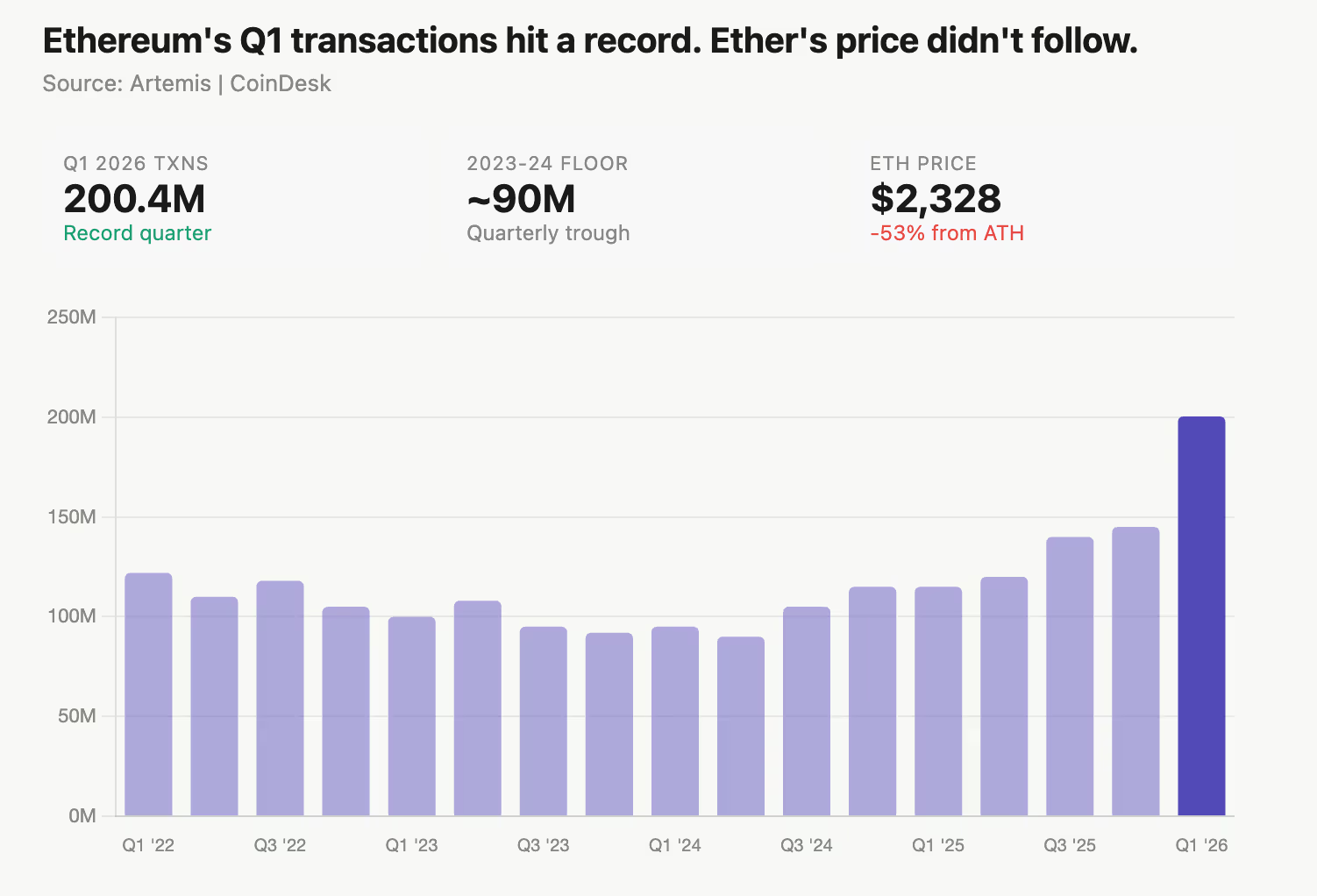
Ethereum, the world’s largest smart contract blockchain, just printed its busiest quarter ever, and the token’s price hasn’t budged.
The network processed 200.4 million transactions on its base layer in Q1 2026, marking the first time it has crossed that threshold in a single quarter, according to Artemis data. Quarterly transaction count bottomed near 90 million in 2023, then spent most of 2024 grinding sideways between 100 million and 120 million.

The Ethereum smart contract blockchain is a decentralized system that can automatically execute agreements without the need for a bank, lawyer, or middleman. Transactions on Ethereum are records of actions, such as sending native token ether (ETH), interacting with smart contracts, or transferring tokens, that are securely processed and imprinted on the blockchain.
Layer 2s and stablecoins lead the boom
The recovery in Ethereum’s on-chain activity began in mid-2025, with each successive quarter seeing higher activity than the last. This led to Q1 2026, when activity jumped 43% from Q4 2025’s 145 million, marking a clear U-shaped growth from the 2023 bottom.
Still, Ethereum’s native token ether is down over 50% from its August 2025 high of nearly $5,000. It traded around $2,328 as of Friday morning. This divergence may present an opportunity for traders looking to capitalize on fundamental growth and statistics.
Most of the traffic lives on Layer 2s, which are separate networks built on top of Ethereum that process transactions cheaply and then batch them down to the main chain for final settlement. Think of Layer 2s as extra packs attached to your bike, letting you carry more than you could on your own.
Base and Arbitrum are the two largest, where users interact with them for lower fees, and the activity shows up on Ethereum’s base layer as settlement and bridging.
Stablecoins, or tokenized versions of fiat currencies, are also being used heavily on Ethereum. According to Token Terminal, the total supply of stablecoins on Ethereum has reached a record $180 billion, according to Token Terminal, accounting for about 60% of the global stablecoin market.
Both trends push transaction counts higher on L1 through settlement and bridging activity, even when end users never directly touch the base layer.
The risk flagged by some analysts is that L2 activity masks base-layer fee pressure.
Ethereum earns less per transaction after the Dencun upgrade significantly reduced data costs for L2s, meaning more activity does not cleanly translate into more burn or more holder value.
The broader read is that Ethereum’s usage has completed the kind of multi-year recovery that typically precedes price movement rather than trails it.
Whether this quarter marks an inflection or the top of a local cycle depends on whether the 200 million figure holds in Q2, and whether the growth continues to be driven by genuine onboarding rather than bot activity, which has increasingly dominated stablecoin transaction volume on-chain.

Cardano founder Charles Hoskinson has gone on record calling Bitcoin’s proposed quantum defense both technically mislabeled and functionally inadequate. The detail most outlets are missing: roughly 1.7 million BTC may be beyond saving, no matter what developers vote through. This is all happening when Bitcoin price prediction is getting bullish.
In a video posted to his YouTube channel late Wednesday, Hoskinson dissected BIP-361, the proposal from developer Jameson Lopp and others to phase out quantum-vulnerable Bitcoin addresses. He says that BIP-361 is being marketed as a soft fork but would functionally require a hard fork, since it invalidates existing signature schemes that active users currently rely on.
“To actually do this, you need a hard fork,” Hoskinson said flatly.
He called the soft fork characterization a lie. Bitcoin’s development culture has historically treated hard forks as violations of the network’s immutability, which makes the political fallout as significant as the technical one. The broader quantum security debate has been intensifying across the industry for months.
The deeper problem sits in the recovery mechanism. BIP-361 proposes that users with frozen quantum-vulnerable funds could reclaim them via a zero-knowledge proof tied to a BIP-39 seed phrase. According to Hoskinson, approximately 1.7 million BTC, including the estimated ~1 million coins attributed to Satoshi Nakamoto, predate BIP-39’s 2013 introduction entirely. No BIP-39 seed phrase exists for those wallets.
The zero-knowledge recovery path simply doesn’t apply. Satoshi’s coins, by this analysis, are structurally unrecoverable under the current proposal regardless of how the fork resolves.
Discover: The best crypto to diversify your portfolio with
Bitcoin Price Prediction: Fork or no Fork, $250,000 the Target
Hoskinson’s skepticism about Bitcoin’s protocol governance hasn’t dampened his price outlook. He publicly predicted BTC reaches $250,000 by mid-2026, a 3X from current levels, citing institutional inflows, Magnificent 7 tech integration, the incoming Clarity Act, and sustained end-user growth as primary drivers. He reiterated the forecast in a Bloomberg interview at TOKEN2049 Singapore.
— Coin Bureau (@coinbureau) November 23, 2025
 HOSKINSON PUSHES HIS $250K BITCOIN TARGET TO LATE 2026.
After calling for $250,000 $BTC by end-2025 in April and then moving it to mid-2026 in October, he now expects it to happen by the end of 2026. pic.twitter.com/uyCKexxoKF
Technically, Bitcoin’s current position at just under $74,000 reflects a meaningful recovery from the sub-$66,000 low due to the fear of an Iran war. Early this month, the peak stood at $73,000; BTC has now cleared that level convincingly. Analyst consensus has been steadily repricing upward as macro headwinds ease.
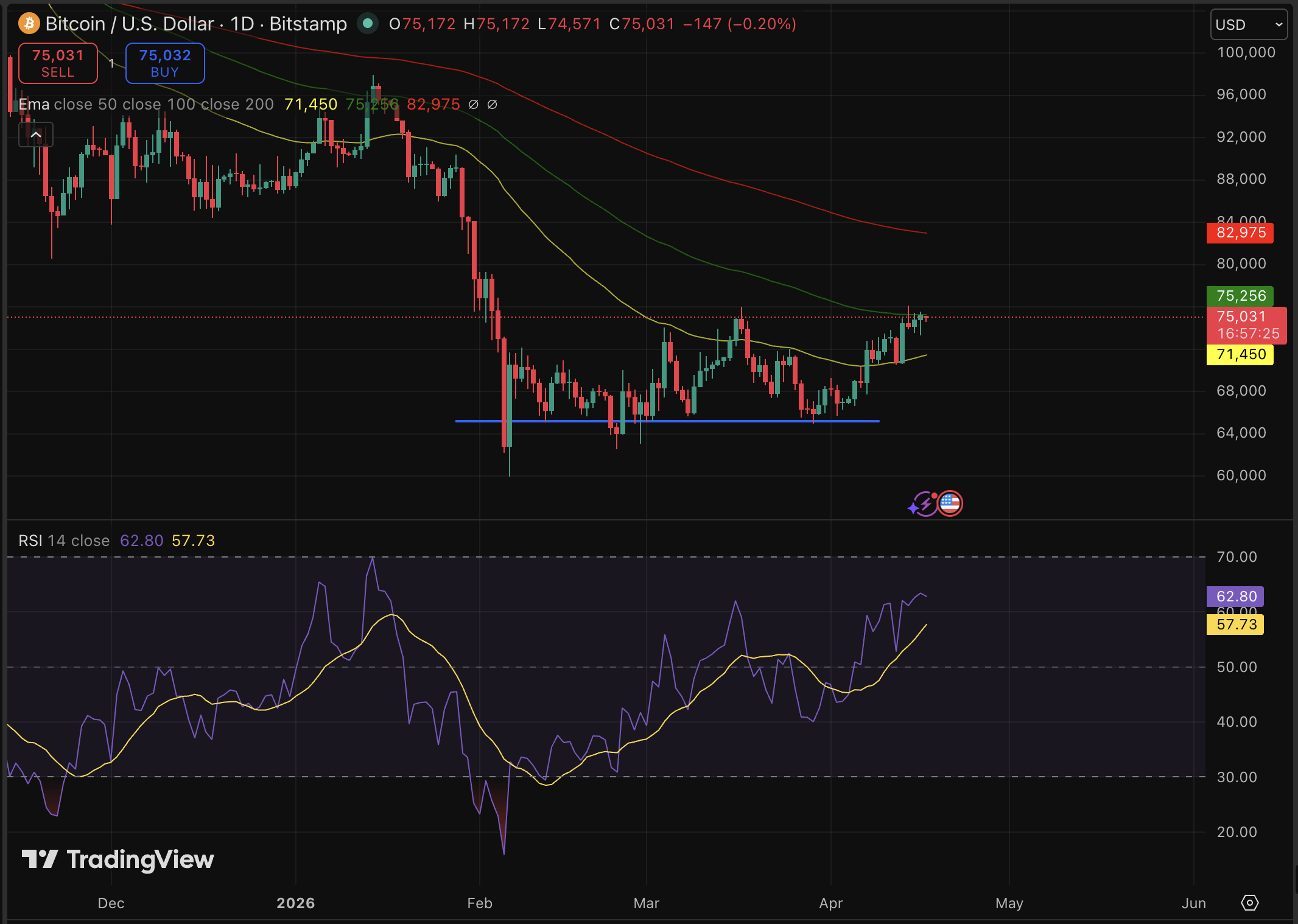
The quantum debate is a wildcard that existing price models don’t price cleanly. If BIP-361 stalls, or forces a hard fork, short-term volatility is the near-certain outcome.
Discover: The best pre-launch token sales
Bitcoin is Getting Forked, Hyper is Here to Fix
Bitcoin’s limitations are precisely what’s fueling conviction in the layer-2 thesis right now. To be back to $120,000+ high, BTC’s upside requires institutional scale, an asymmetric early-stage return that individual traders once found in spot BTC is largely gone.
Bitcoin Hyper ($HYPER) is positioning directly inside that gap. It’s the first Bitcoin Layer 2 integrating the Solana Virtual Machine (SVM), delivering faster smart contract execution than Solana itself while preserving Bitcoin’s underlying security.
The project has raised $32 million at a current presale price of $0.0136, with a high 36% APY staking already live. Key infrastructure includes a Decentralized Canonical Bridge for BTC transfers and extremely low-latency transaction processing, addressing Bitcoin’s three core bottlenecks simultaneously: slow speed, high fees, and zero programmability.
The presale has been gaining traction precisely as the Bitcoin protocol debate raises questions about the base layer’s adaptability.
Research Bitcoin Hyper before the current price tier closes.
The post Bitcoin Price Prediction: Cardano Hoskinson Says BTC Fix Can’t Save Satoshi Bags appeared first on Cryptonews.

Key Takeaways
- On April 15, the S&P 500 reached 7,022.95, breaking its January 28 record, while the Nasdaq achieved an unprecedented high of 24,016
- Tom Lee contends the US market is absorbing elevated oil prices more effectively than global counterparts, despite crude exceeding $100/barrel following Hormuz Strait disruptions
- Monthly defense expenditures approaching $30 billion are strengthening corporate earnings and providing economic support amid US-Iran tensions
- Historical patterns suggest oil price spikes may produce milder inflation effects than current market fears indicate, according to Lee
- Cash-heavy institutional investors face pressure to enter markets at record levels, generating fresh demand — Lee holds firm on his 7,300 S&P 500 projection
Both the S&P 500 and Nasdaq established fresh all-time records this week, recovering from declines associated with escalating US-Iran tensions that have weighed on investor sentiment since late January. The S&P 500 finished trading at 7,022.95 on April 15, eclipsing its prior benchmark from January 28. Meanwhile, the Nasdaq concluded at 24,016, marking its own historic milestone.
Fundstrat’s founder Tom Lee joined CNBC’s Closing Bell to outline his view that current market conditions are fundamentally stronger than those present during earlier 2026 peaks. He presented three distinct rationales supporting this position.
Lee’s opening argument centered on oil prices. Crude prices jumped past the $100 threshold after disruptions to shipping through the Hormuz Strait. While recognizing this challenge, Lee emphasized that American markets are weathering the situation more successfully than international peers.
“The stock market finds itself in superior condition compared to where we stood at the year’s outset,” Lee stated. He highlighted that elevated energy costs are constraining other economies more severely, while US equities have demonstrated resilience in absorbing this pressure.
Crude prices experienced some retreat from peak levels as market participants anticipated potential diplomatic resolution between Washington and Tehran.
Earnings Strength Persists
Lee’s second rationale emphasized corporate financial performance. He observed that company profitability has maintained momentum throughout the conflict period, suggesting the geopolitical situation has actually provided economic stimulus rather than hindrance to American businesses.
Defense sector expenditures play a central role in this dynamic. Lee highlighted that monthly defense outlays currently hover around $30 billion, with scenarios suggesting potential expansion to $60 billion. These funds are circulating directly through the domestic economy.
He drew a contrast with oil-related costs, estimating American consumers collectively shoulder approximately $12 billion monthly in elevated energy expenses — yielding a net economic benefit when compared against defense spending inflows.
Technology sector firms have delivered robust first quarter 2026 earnings, frequently surpassing analyst projections. These results have helped validate current Nasdaq price levels.
Inflation Concerns May Be Overblown
Lee’s third point challenged widespread inflation anxieties. Numerous market observers have cautioned that triple-digit oil prices will cascade into broader consumer price increases. Lee offered a contrary perspective.
“Historical examination of energy price fluctuations reveals that their influence on core inflation metrics proves less pronounced than we initially expected,” he explained. He anticipates the inflationary impact will be more modest than current market pricing suggests.
Institutional Capital Deployment Accelerates
Throughout the recent market correction, substantial institutional capital remained uncommitted as fund managers accumulated cash positions. With equity indices now establishing new records, these investors confront mounting pressure to allocate reserves or risk underperforming their respective benchmarks.
Lee reaffirmed his year-end S&P 500 forecast of 7,300, implying approximately 4% appreciation potential from present levels.
Bitcoin alongside other digital assets have traditionally correlated with technology equities during risk-on market phases, while blockchain analytics reveal increased capital flows into institutional Bitcoin investment vehicles throughout recent weeks.



Sanctioned crypto exchange Grinex halted trading after a suspected state-level cyberattack drained up to $15 million in crypto.
Summary
- Grinex suspended trading after a suspected state-linked attack drained about $13.7 million from 54 wallets.
- On-chain data shows roughly $15 million in USDT moving through Tron and Ethereum, with funds converted to avoid freezing.
Grinex said Thursday it had suspended operations after losing more than 1 billion Russian rubles, roughly $13.7 million, from 54 wallets in what it described as a highly sophisticated breach. The Kyrgyzstan-registered exchange pointed to signs that the attackers had access to resources typically associated with foreign intelligence agencies.
“Due to the attack, the Grinex exchange has been forced to suspend operations. All available information has been transferred to law enforcement agencies. A criminal complaint has been filed at the location of the infrastructure,” the exchange said.
Details shared by Grinex suggested a coordinated operation rather than a routine exploit. The platform said the digital footprint and execution pointed to “an unprecedented level of resources and technology available only to entities of hostile states.”
The incident adds fresh scrutiny to an exchange already under watch from Western authorities. Grinex has been widely linked to Russia’s sanctioned crypto infrastructure and has been described by blockchain analysts as a continuation of the previously blacklisted Garantex platform.
Earlier findings from Global Ledger indicated that Garantex shifted liquidity and user balances to Grinex following its shutdown in March 2025. On-chain data showed funds moving through one-time-use wallets before landing in Grinex accounts, while some users reported that balances frozen on Garantex later appeared on the new platform. Investigators also pointed to similarities in website design and internal confirmations, suggesting operational overlap between the two entities.
Garantex had been sanctioned by the United States in 2022 for facilitating illicit finance and was later targeted by European Union restrictions. Operations formally ceased in March 2025 after Tether froze nearly $2.5 billion worth of ruble-backed stablecoins tied to the exchange. Authorities in India also arrested co-founder Aleksej Bešciokov shortly after the shutdown.
Multiple platforms may have been exposed
According to TRM Labs, activity tied to the attacker may extend beyond Grinex. The blockchain intelligence firm identified two wallets linked to Kyrgyzstan-based exchange TokenSpot that sent about $5,000 to the same consolidation address used in the Grinex breach.
TokenSpot acknowledged a temporary disruption earlier this week. A notice on its Telegram channel mentioned technical work and a brief outage on April 15, followed by confirmation a day later that full services had resumed.
Further analysis from TRM Labs uncovered at least 16 additional addresses connected to the incident, beyond those disclosed by Grinex. Funds from the attack were funneled into a single address holding around 45.9 million TRON, valued close to $15 million.
Funds routed to avoid freezing risk
Blockchain analytics firm Elliptic has traced roughly $15 million in USDt leaving Grinex-linked accounts and moving across the Tron and Ethereum networks. The firm said the attacker converted the stablecoins into other assets soon after the theft.
“This USDT was then converted to another asset, either TRX or ETH. By doing so, the thief avoided the risk of the stolen USDT being frozen by Tether,” Elliptic said.
Past incidents show a pattern of exchanges tied to sanctioned jurisdictions becoming targets for politically motivated or financially driven attacks. Iran-based platform Nobitex lost $81 million in June 2025, with a pro-Israel hacker group claiming responsibility.
Attention now turns to whether Grinex can resume operations and how authorities respond, especially given its alleged role in facilitating sanction evasion and links to previously blacklisted entities.
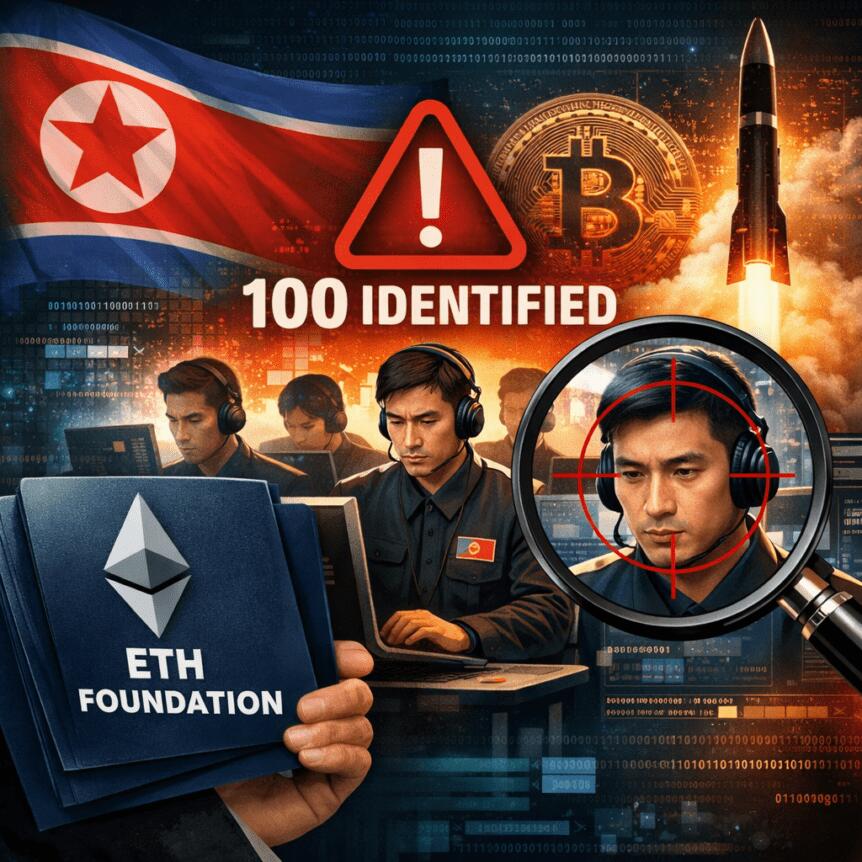
The Ethereum ecosystem has expanded its security toolkit with a six-month initiative funded through its ETH Rangers program. The Ketman Project, described as a public‑goods security effort, identified a network of North Korean operatives embedded in Web3 companies, pinpointing 100 DPRK IT workers and alerting about 53 projects that could be employing such operatives. The Ethereum Foundation summarized the findings in a recent recap, underscoring the importance of the project for the broader ecosystem.
According to the Ethereum Foundation, the Ketman Project was built during a six‑month period under the ETH Rangers program, which launched in late 2024 to fund individuals performing security work for the ecosystem. One recipient used the stipend to tackle the Ketman initiative, focusing on exposing fake developers and other actors impersonating legitimate crypto engineers.
During the stipend period, Ketman identified 100 DPRK IT workers operating within Web3 organizations and reached out to about 53 projects to alert them to potential DPRK involvement. The Foundation framed the effort as a direct response to a pressing operational security threat facing the Ethereum ecosystem today.
The Ketman Project’s own materials outline the tactics, behaviors, and patterns used by DPRK-linked actors. The project describes several red flags used to spot impersonators and suspicious activity, including the reuse of avatars and profile metadata across multiple GitHub accounts, exposure of unlinked email addresses during screen sharing, and default language settings—such as Russian—that contradict the operators’ claimed nationality.
Beyond identification, Ketman co‑developed an open‑source detection tool to flag suspicious GitHub activity and helped author an industry-standard framework for identifying DPRK IT workers in partnership with the blockchain‑focused nonprofit Security Alliance. The Ketman site provides deeper dives into the operational methods employed by DPRK operatives and how attackers blend into crypto teams.
Key takeaways
- Ethereum Foundation funded the Ketman Project through the ETH Rangers program for six months, revealing a DPRK‑linked presence in Web3 and alerting dozens of projects.
- The effort identified 100 North Korean IT workers and prompted alerts to roughly 53 projects over the course of the program.
- Ketman developed an open‑source detection tool and co-authored an industry‑standard framework for identifying DPRK IT workers with the Security Alliance.
- Red flags highlighted by Ketman include reused avatars across GitHub accounts, exposed emails from screen sharing, and default language settings that conflict with stated nationality.
- The work illustrates a broader push to harden the crypto economy against state‑backed threat actors, leveraging community‑driven intelligence alongside formal governance bodies.
Operational security gains and investor implications
The Ethereum Foundation’s recap frames Ketman as a pragmatic response to a persistent risk: state‑backed actors tied to DPRK have repeatedly targeted the crypto sector, contributing to significant losses over the years. By mapping specific operational patterns and distributing defensive signals to projects, the initiative helps reduce the attack surface for startups and established protocols alike. For investors and builders, the development signals a maturing security culture where threat intel is disseminated more quickly and translated into concrete protections rather than remaining in isolated analysis.
From a risk management perspective, the Ketman project embodies a shift toward proactive defense in public ecosystems. The combination of detection tooling and a formal framework provides participants with repeatable methods to vet contributors and contractors, potentially lowering the likelihood of insider risks or compromised open‑source projects slipping through governance gaps. While it is not a silver bullet, the approach adds a data‑driven layer to ongoing security work in the space where rapid innovation often clashes with evolving threat models.
Context: DPRK actors, Lazarus, and the crypto threat landscape
Threat actors associated with North Korea have long loomed over crypto infrastructure, with high‑profile breaches attributed to groups such as Lazarus. Analysts note that as the market grows, so does the fingerprint of these actors—ranging from social engineering and fake personas to sophisticated supply‑chain compromises. The Ketman Project’s findings fit within this larger pattern of state‑linked crypto threats, reinforcing the case for heightened due diligence, better attribution signals, and more transparent security collaborations among projects and communities.
That context matters for investors and practitioners alike. Enhanced threat intelligence—especially when backed by open‑source tools and cross‑organizational collaboration—can help teams prioritize security spend and adopt stronger onboarding and verification practices. It also raises questions about how to balance openness with security in open ecosystems where contributors span the globe and operate under varying regulatory regimes.
What to watch next
Several questions remain as the Ketman initiative wraps its six‑month window. How widely will the open‑source detection tool be adopted by projects and exchanges? Will the Security Alliance and Ketman publish ongoing, standardized benchmarks to measure the effectiveness of the DPRK‑identification framework? And how will platforms translate these threat signals into concrete changes—such as enhanced contributor vetting, more robust identity checks, or stricter code‑review processes?
The Ethereum Foundation’s involvement signals continued institutional support for security tooling that is broadly usable across the ecosystem. If Ketman’s tools and methodologies gain traction, we could see a shift from ad hoc security reviews to more coordinated, sector‑wide threat intelligence sharing. That development would be a meaningful catalyst for ecosystem resilience, especially as decentralized finance, layer‑2 scaling, and new Web3 use cases proliferate.
In the near term, what remains uncertain is the scalability and sustainability of such programs. Will funding through ETH Rangers translate into a larger, repeatable budget for security research? How will other ecosystems—ranging from alternative smart contract platforms to fiat‑onramp operators—adopt similar threat intelligence frameworks? The coming months will reveal whether Ketman’s approach can be generalized into a standard practice for securing crypto projects against sophisticated, state‑backed adversaries.
Readers should monitor announcements from the Ketman Project and the Security Alliance for updates on the framework, as well as any new threat alerts tied to DPRK‑linked actors. The effort underscores a broader industry trend: security is increasingly a collaborative, community‑driven discipline that complements technical development with actionable intelligence and governance‑level responses.
For those evaluating risk in personal or institutional deployments, this development offers a reminder to emphasize transparency, contributor verification, and proactive security monitoring as core components of any long‑term crypto strategy. The fight against sophisticated threat actors is ongoing, but initiatives like Ketman mark a tangible step toward a safer, more resilient ecosystem.


Former Treasury Secretary Henry Paulson has called on U.S. policymakers to prepare an emergency response plan for a potential breakdown in demand for U.S. Treasurys, warning that the consequences could be severe.
Summary
- The Former Treasury Secretary has warned U.S. authorities to prepare an emergency plan for a potential collapse in Treasury demand.
- Rising U.S. debt and higher yields have raised concerns about a feedback loop that could strain the financial system.
- Heavy Treasury exposure among stablecoin issuers like Tether has added risk for crypto markets during periods of stress.
Speaking in a Bloomberg interview on Thursday, Paulson urged authorities to have a “break-the-glass” framework ready in advance, describing it as a targeted and short-term intervention designed for moments of extreme stress.
“We need an emergency break-the-glass plan, which is targeted and short-term, on the shelf, so it’s ready to go when we hit the wall,” he said. “When we hit it, it will be vicious, so we have to prepare for that eventuality.”
Concerns around the Treasury market have been building as U.S. government debt continues to climb past $39 trillion, raising questions about long-term sustainability and investor appetite.
Treasurys remain the foundation of global finance, serving as the benchmark against which assets such as corporate bonds, mortgages, and equities are priced. Any disruption in that market risks cascading effects across the financial system.
Economists have long warned of a potential feedback loop where rising debt levels push investors to demand higher yields, increasing borrowing costs, and increasing the fiscal deficit. A scenario where the Treasury struggles to attract sufficient buyers could leave the Federal Reserve stepping in more aggressively, effectively absorbing supply to stabilize markets.
A breakdown in the Treasury market would not leave digital assets untouched, with both upside and downside risks coming into play.
On one side, a loss of confidence in U.S. debt or a wave of monetary expansion could drive capital toward alternative stores of value, including Bitcoin and gold. Inflation concerns and pressure on the dollar have historically strengthened the case for non-sovereign assets.
At the same time, stablecoins introduce a direct link between crypto markets and U.S. government debt. Tether, the largest stablecoin issuer, holds a significant portion of its reserves in Treasurys, including Treasury bills and overnight reverse repurchase agreements.
U.S. Treasury officials have already taken steps aimed at improving market functioning, including a large-scale debt buyback announced on Thursday.
Authorities accepted $15 billion worth of older securities maturing between 2026 and 2028, marking the largest such operation to date. The program is designed to retire less liquid bonds and inject cash back into the system, giving investors room to reallocate capital.
Liquidity management measures like these are intended to keep trading conditions stable, though concerns around long-term demand continue to shape discussions among policymakers and market participants.

Key takeaways
- Pi Network’s PI token holds steady at $0.1730, up 4.5% from the previous day.
- The Pi Core Team’s upgrade to enable smart contracts, with a deadline set for April 27, is a potential catalyst.
Pi Network’s PI token has managed to hold steady around $0.1770 as of Friday, adding a 4.5% gain from the previous day.
The Pi Core Team (PCT) is driving momentum with the impending upgrade to the mainnet, which will enable smart contract functionality—expected to be a key catalyst for price movement.
PI rallies ahead of the Protocol 22 upgrade
PI is up 4.5% in the last 24 hours, outperforming the broader cryptocurrency market. The rally comes after the Pi Core Team announced that April 27 is the final deadline for all mainnet nodes to complete necessary steps for remaining connected to the network, as part of the Stellar Protocol version 22 upgrade.
While this upgrade will cause a brief 15-minute downtime during internal data transfer, it lays the groundwork for future improvements. Additionally, the full upgrade to version 26 is slated for June 22, ahead of Pi2Day on June 28.
Will PI rally higher in the near term?
The PI/USD 4-hour chart is bearish and efficient, trading above the $0.1770 level. However, Pi Network remains in a bearish posture, with the token still trading below the 50-, 100-, and 200-day Exponential Moving Averages (EMAs).
The immediate resistance level is marked at $0.1785, corresponding to the 50-day EMA, followed by stronger resistance at $0.1865 (100-day EMA) and $0.2334 (200-day EMA).
However, momentum indicators present mixed signals. The Relative Strength Index (RSI) at 71 is above the neutral 50 line, and is heading into the overbought region.

The Moving Average Convergence Divergence (MACD) crossing above its signal line indicates growing bullish momentum.
On the downside, key support is found at $0.1556, near the February 23 low, with further weakness potentially exposing $0.1310 if the market slips below this level.
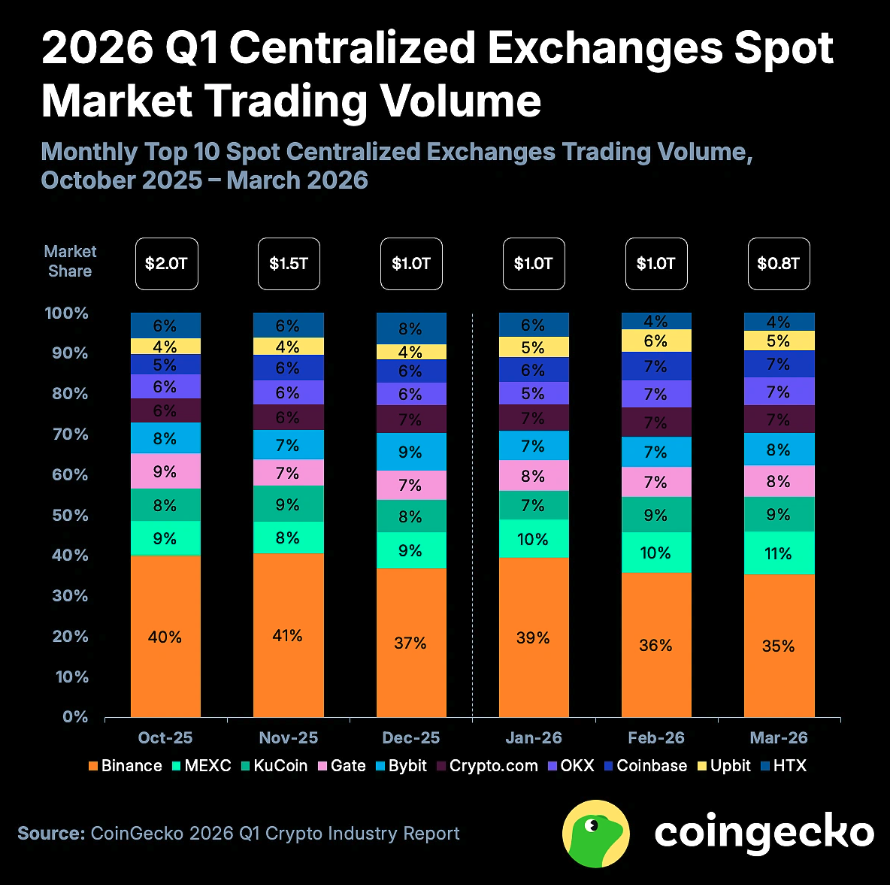
The cryptocurrency market has entered a “sustained crypto winter,” according to CoinGecko, as spot trading volumes on centralized crypto exchanges rapidly fell over the first quarter of 2026.
Crypto market capitalization fell by more than 20% during the first quarter as “bearish momentum from late 2025 collided with global geopolitical instability,” CoinGecko said in a report on Thursday.
That caused the top 10 centralized exchanges by spot volume to record a 39% decrease in trading volume over the quarter ended in March, dropping to $2.7 trillion from $4.5 trillion in the fourth quarter of 2025.
The drop comes as the crypto market has struggled to maintain positive momentum after Bitcoin (BTC) hit a record high of more than $126,000 six months ago, as the wider market reacted to fears of an economic slowdown and uncertainty over the fallout from US-Israeli strikes on Iran in February.

March was the “weakest month,” according to CoinGecko, with $800 billion in trading volume, the lowest since November 2023.
CoinGecko said that the contraction in crypto markets was worsened by Kevin Warsh’s nomination as US Federal Reserve chair, which signaled “a potential hawkish shift in US monetary policy.”
Related: Three things Bitcoin must do to hold highs above $76K: Analysts
It added that daily trading activity across the crypto market saw “a significant decline” over the first quarter, with average daily trading volumes at $117.8 billion, a drop of 27% compared to the fourth quarter of 2025.
All of the top 10 spot centralized exchanges recorded declining volumes in the first quarter, CoinGecko said, with HTX, formerly Huobi, seeing “the biggest slump” quarter-on-quarter as volumes dipped 55% to $133.6 billion.
It said that Bitcoin fell 22% over the first quarter, “continuing to underperform all assets, despite US equity indexes such as NASDAQ and S&P 500 falling -7.1% and -4.8% respectively, their worst quarterly returns since 2022.”
Big Questions: Should you sell your Bitcoin for nickels for a 43% profit?

BITCOIN & GOLD LIVE TRADING ANALYSIS @tradingmentor22 Live Trading || #goldtrading #cryptotrading

TikTok star D4vd arrested after ‘body of missing teen’ found in his Tesla

Nearly 160,000 uninsured cars seized on UK roads


-

 Politics7 days ago
US brings back mandatory military draft registration
-
 Sports7 days ago
Man United discover Nico Schlotterbeck transfer fee as defender reaches Dortmund agreement
-

 Fashion7 days ago
Weekend Open Thread: Veronica Beard
-

 Politics5 days ago
World Cup exit makes Italy enter crisis mode
-

 Business6 days ago
Tesla Model Y Tops China Auto Sales in March 2026 With 39,827 Registrations, Beating Cheaper EVs and Gas Cars
-

 Crypto World4 days ago
The SEC Conditionalises DeFi Platforms to Be Avoided for Broker Registration
-

 Crypto World3 days ago
SEC Signals Exemption for Crypto Interfaces From Broker Registration
-

 News Videos2 days ago
Secure crypto trading starts with an FIU-registered
-
 NewsBeat4 days ago
Pep Guardiola and Gary Neville agree over Arsenal title problem that benefits Man City
-

 Business6 days ago
Ireland Fuel Protests Enter Day 5 as Blockades Spark Shortages and Government Prepares Support Package
-

 Business7 days ago
OpenAI Halts Stargate UK Data Centre Project Over Energy Costs and Copyright Row
-

 Crypto World6 days ago
Federal judge blocks Arizona from bringing criminal charges against Kalshi
-

 NewsBeat3 days ago
Trump and Pope Leo: Behind their disagreement over Iran war
-

 Crypto World3 days ago
SEC Proposes Certain Crypto Interfaces Don’t Need to Register as Brokers
-
 NewsBeat5 days ago
JD Vance announces ‘no agreement’ with Iran over nuclear weapons fear
-

 Business6 days ago
IMF retains floor for precautionary balances at SDR 20 billion
-

 Business6 days ago
Former Liverpool CEO eviscerates FIFA for World Cup ticket pricing
-
Crypto World4 days ago
Sei Network Enters Quiet Reset Phase as On-Chain Metrics Signal a Slowdown in 2026
-
Business6 days ago
Coreweave CSO Venturo sells $5.5m in class a common stock
-
Sports6 days ago
1st-Round WR Enters Vikings Mock Draft Orbit
You must be logged in to post a comment Login