

Crypto World
Ex-Tether CIO Pursues Stake Sale in Stablecoin Issuer, Bloomberg Says


Richard Heathcote, the former chief investment officer of Tether, is reportedly looking to sell part of his stake in the stablecoin issuer, according to a Bloomberg report citing people familiar with the matter. Heathcote holds 1.26% of Tether, and the planned transaction would involve only a portion of that ownership.
Tether, which issues USDt (USDT), remains privately held despite operating as one of crypto’s most profitable businesses. The reported partial sale is notable not only because of Heathcote’s senior role, but also because it would be among the few glimpses into ownership at a company that underpins a large share of the stablecoin market.
Key takeaways
- Bloomberg reports that former Tether CIO Richard Heathcote plans to sell part of his 1.26% stake, offering rare insight into Tether ownership.
- USDT remains the dominant stablecoin by market capitalization, with DefiLlama data placing its circulating supply around $184 billion (about 59% market share).
- The potential sale comes as Tether faces increased regulatory pressure in Europe, including platform delistings after Tether did not align with the EU’s MiCA framework.
- Broader IPO chatter continues in crypto, even as exchanges weigh listing paths amid regulatory and operational constraints.
Why Heathcote’s stake sale matters
Bloomberg’s report focuses on the planned sale by Richard Heathcote, who stepped away from the role of Tether’s chief investment officer in March. The report says he moved into an advisory capacity after overseeing the company’s investment portfolio.
For markets, transactions involving insiders in key stablecoin issuers are often watched closely—even when only partial. Tether’s scale means its ownership structure and governance are relevant to traders and institutions that rely on USDT’s liquidity. While the report does not specify deal size beyond the portion of the stake, it underscores that influential executives at stablecoin issuers are not necessarily bound to long-term illiquidity, despite the asset’s centrality to crypto settlement and exchange activity.
Heathcote’s stake also highlights the challenge of assessing control and incentives in privately held crypto firms. With Tether not publicly listed, investors and observers have fewer direct market signals about internal changes. A reported sale, even a partial one, can become a data point for how senior stakeholders view holding periods, risk, and governance in a fast-changing regulatory environment.
USDT’s market position remains central
Any ownership move at Tether inevitably ties back to USDT’s dominance. According to DefiLlama data, USDT has a circulating supply of roughly $184 billion and accounts for approximately 59% of the stablecoin market by market capitalization.
This matters because USDT is not just a retail token—it is deeply embedded in the infrastructure of exchanges, trading pairs, and on-chain activity. When large portions of market liquidity are concentrated in a single issuer, stakeholders tend to pay particular attention to credible updates on that issuer’s financial posture, governance, and regulatory standing.
At the same time, the reported sale is not automatically a signal about USDT’s strength or weakness. Stablecoins can remain widely used even as regulatory constraints limit where they are permitted. The more meaningful question for investors is whether Tether’s regulatory path and distribution access continue to affect demand for USDT in key jurisdictions.
Regulatory pressure in Europe intersects with business uncertainty
The Heathcote sale report arrives as Tether faces heightened scrutiny in Europe. Earlier coverage from Cointelegraph noted that USDT has been delisted by an increasing number of platforms operating under MiCA authorizations after Tether chose not to comply with the EU’s crypto framework.
That tension has been visible in operator decisions. Cointelegraph previously reported that Revolut would remove USDT from its platform, reflecting how regulatory alignment—or lack of it—can translate into immediate distribution losses for a stablecoin issuer.
For market participants, this creates a split reality: USDT may remain dominant by market size, but issuer exposure to regulation can change the on-ramps and availability that sustain that market share in Europe. In that context, insider ownership moves may be read less as a market bet on USDT itself and more as an adjustment to the broader uncertainty around compliance, platform access, and long-term growth channels.
IPO speculation continues elsewhere in crypto
While Tether’s executives have publicly indicated the company does not need to go public, crypto’s IPO debate appears to be broadening beyond stablecoins. Several other firms have reportedly explored listing routes.
Cointelegraph previously highlighted that Kraken has taken steps that could lead toward an IPO. Fortune reported in September 2025 that Kraken raised $500 million at a $15 billion valuation, fueling expectations that the exchange was positioning for a public listing. Kraken also announced it had confidentially filed a draft registration statement with the US Securities and Exchange Commission in November 2025 for a proposed initial public offering.
However, Bloomberg later reported that Kraken’s IPO timeline could slip into 2027 after layoffs tied to the company’s increasing use of artificial intelligence. The implication for readers is that even when a path to liquidity exists, operational restructuring and market conditions can delay capital-market milestones.
In South Korea, Cointelegraph reported that Bithumb delayed its IPO until after 2028. The exchange said it was working to strengthen accounting policies and internal controls after earlier regulatory setbacks, underscoring how compliance process—not only investor demand—can shape public-market timing for crypto firms.
Separately, Cointelegraph has also published coverage focusing on anonymity-related risks and how AI may be used to identify hidden identities in crypto activity, reflecting the broader environment in which regulators, exchanges, and compliance teams are operating.
What to watch next
For Tether, the next signals likely won’t come from ownership headlines alone. Investors should track whether additional European platforms follow through on delistings under MiCA and how Tether responds operationally and commercially in regions tightening stablecoin rules. Meanwhile, Bloomberg’s reported stake sale may prompt renewed attention to how insiders manage liquidity in privately held firms as crypto firms weigh—or postpone—public listings.

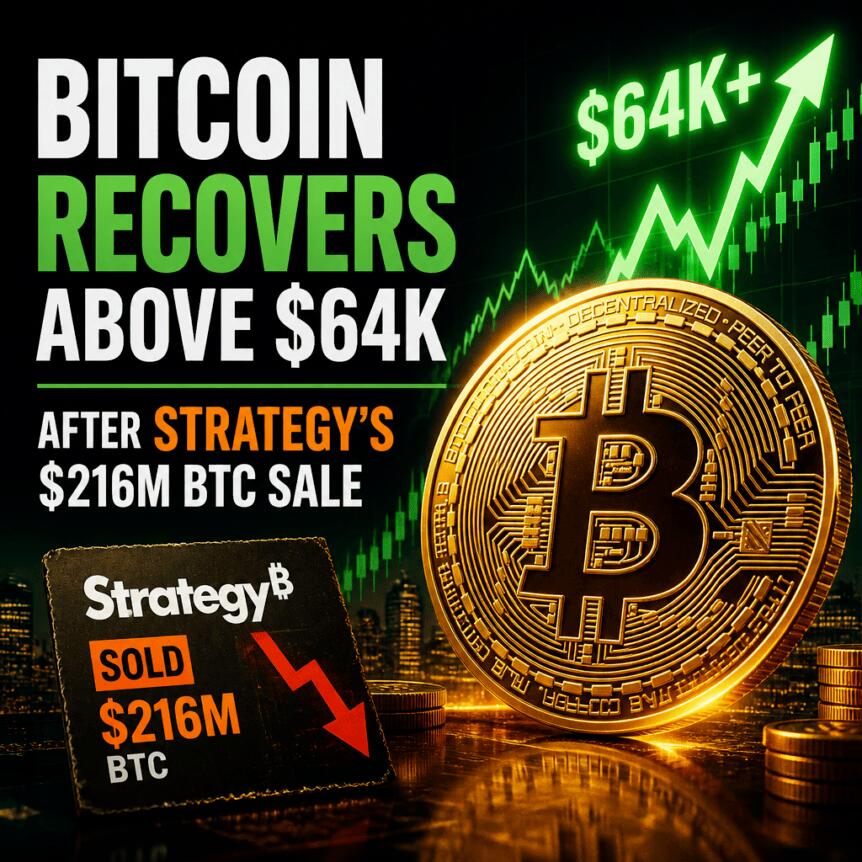
Bitcoin’s dip from just under $64,000 to around $62,000 Monday was not a slow grind lower—it was a fast unwind driven by derivatives positioning, then amplified by a new catalyst from Strategy’s latest regulatory disclosure.
According to Cointelegraph’s coverage of the filing, the move was linked to Strategy’s largest reported Bitcoin sale of 3,588 BTC. While spot demand was only slightly negative during Sunday’s upswing, Monday’s turn showed how quickly leverage can shift when corporate treasury supply hits the tape.
Key takeaways
- Sunday’s rally was largely futures-led, with net futures buying of roughly $415 million, leaving price vulnerable to forced unwind.
- Strategy’s SEC disclosure appears to have triggered Monday’s unwind, with four-hour net futures selling jumping to about $456 million.
- Liquidations ran in both directions during the volatility, totaling roughly $42 million in long liquidations and $49 million in short liquidations.
- Spot buying returned on Monday afternoon—after days of limited spot participation—suggesting a more balanced push-pull between spot and derivatives.
- With open futures positions near $20.6 billion and funding staying positive, the market remains leveraged, but the setup is fragile if new macro headlines or selling pressure extend.
From futures momentum to leverage unwind
Sunday’s move toward $64,000 was dominated by derivatives flows. The session saw net futures buying of roughly $415 million, including a concentrated four-hour window of about $687 million. That burst reportedly force-closed around $33 million in bets against Bitcoin, highlighting how rapidly directional exposure built.
At the same time, spot flows were slightly negative. That matters because when price rises mainly on paper positions rather than cash demand, the move can reverse quickly if traders reduce risk—especially when leverage is crowded and stops or margin calls force synchronized selling.
Monday’s selloff accelerated once the Strategy story landed. The SEC disclosure described the company selling BTC to fund dividend payments, with additional sell capacity still available afterward. As that information reached traders, the derivatives market shifted from buying pressure to selling pressure within hours.
Strategy’s sale: what the filing implies for flow expectations
The filing referenced in Cointelegraph’s reporting described Strategy selling 3,588 BTC for $216 million to fund dividend payments. The disclosure also indicated that an additional $1.25 billion of sale capacity remained unused.
For traders, the near-term question is straightforward: was Monday’s move a one-off repricing of known corporate supply, or the start of a broader selling pattern? The market’s reaction suggests traders treated the disclosure as actionable, at least for positioning purposes.
Immediately after the news hit, futures flows swung to approximately $456 million of net selling in a four-hour window. Both sides were liquidated as price moved sharply, with around $42 million of bullish positions wiped out alongside about $49 million of bearish positions—an outcome consistent with choppy, momentum-driven trading rather than a clean trend.
Funding stays positive, but fragility is rising
Despite the whipsaw, Bitcoin’s funding rate reportedly remained in positive territory for more than a week, including during Monday’s decline. Positive funding typically indicates that leveraged longs are paying shorts—often interpreted as “optimism” in the derivatives market.
That said, the overall structure matters more than a single funding reading. With roughly $20.6 billion in open futures positions, the market still carries significant leverage. In this environment, even modest catalysts can produce outsized price swings if many traders are already crowded on the same side or if momentum traders are forced to exit quickly.
Open interest figures showed the scale of exposure did not disappear—meaning the market may still be susceptible to another round of repricing should catalysts stack up.
One notable difference between Sunday and Monday is the market’s later composition: Monday afternoon recovery included net futures buying of about $568 million paired with spot buying of roughly $143 million. That combination—spot participation joining derivatives—helps explain why the rebound looked less like a pure futures-led bounce and more like a market trying to find support with cash demand.
What to watch next: unused capacity and the Fed’s minutes
Beyond Strategy, the key uncertainty is whether the unused $1.25 billion authorization becomes a lingering overhang for rallies. If traders believe additional corporate sales are likely, rallies can struggle to sustain even when funding remains positive and spot buying appears to return.
On the macro side, attention turns to the Federal Reserve’s minutes from the June meeting. Cointelegraph notes markets are currently pricing a 75.6% chance that rates will remain at 3.50%-3.75% in July. Still, any hawkish language in the minutes could test crowded leveraged long positions.
The article highlights potential pressure zones around $62,300 to $62,800 above current price action, and downside levels around $61,000 and $59,500 if momentum shifts again. In a market where funding has stayed positive and open interest remains elevated, levels tied to forced unwind dynamics can matter as much as long-term valuation arguments.
For now, traders should focus on whether Monday’s spot reappearance persists and whether Strategy’s remaining sale authorization translates into further market-selling expectations. With leverage still embedded in open futures positions and upcoming macro catalysts in play, Bitcoin’s next move may depend less on narrative and more on whether cash buyers can consistently offset derivatives-induced volatility.
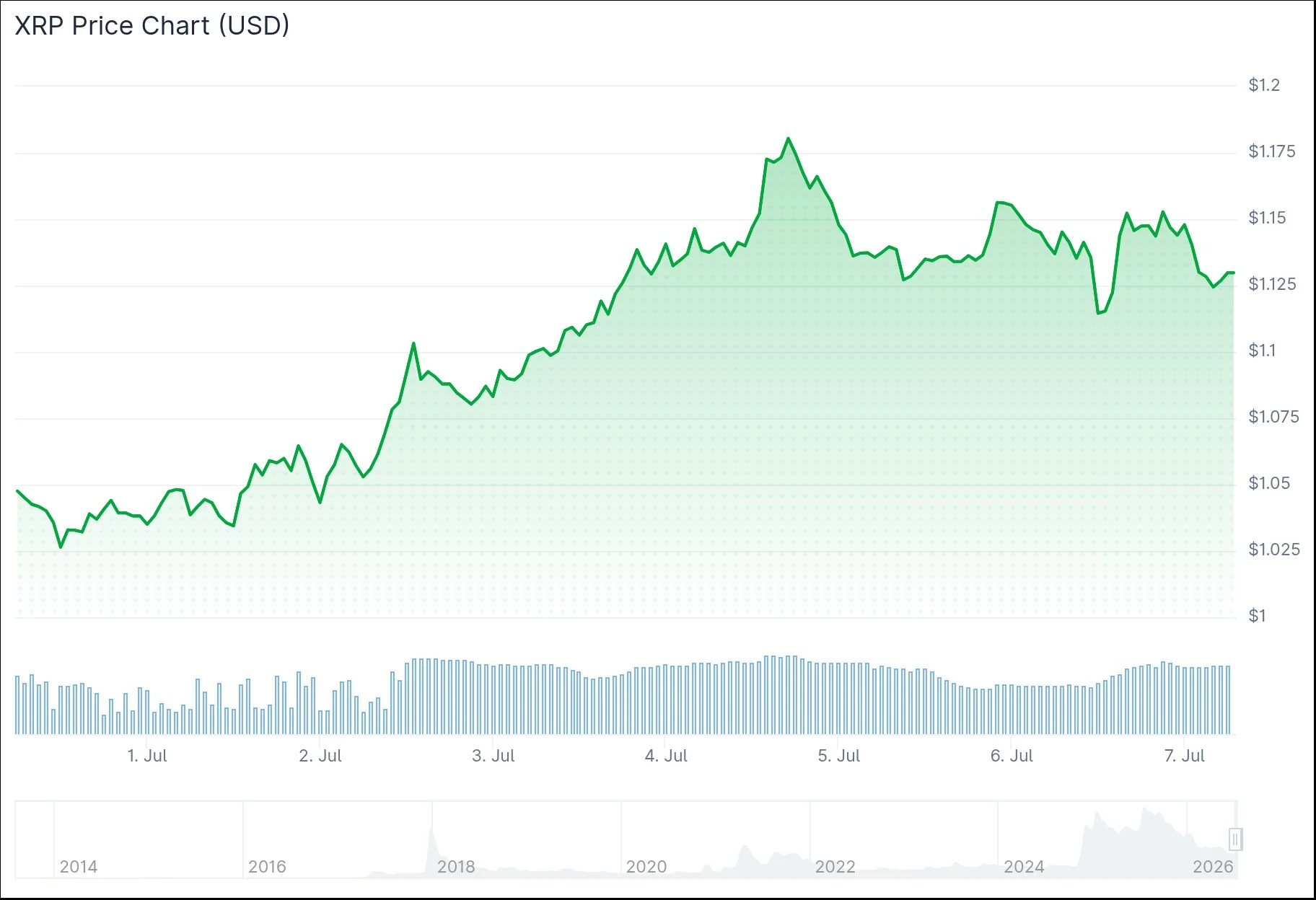
Key Highlights
- XRP gained approximately 8% over a seven-day period following a rebound from $1.03
- Spot ETF net inflows decreased by 55% during June, falling from $132M to $59M
- The XRP Binance Scarcity Index reached 0.77, marking its highest reading in over 24 months
- Binance’s XRP holdings have declined 20% since November 2024, currently sitting at approximately 2.6 billion tokens
- Critical resistance level identified at $1.20, with upside target at $1.50 and downside risk at $0.80
XRP has demonstrated a solid recovery over the past week, posting gains of nearly 8% after establishing support at the $1.03 level. The digital asset is currently changing hands above $1.15, successfully reclaiming a price point that served as a support threshold before the June downturn.
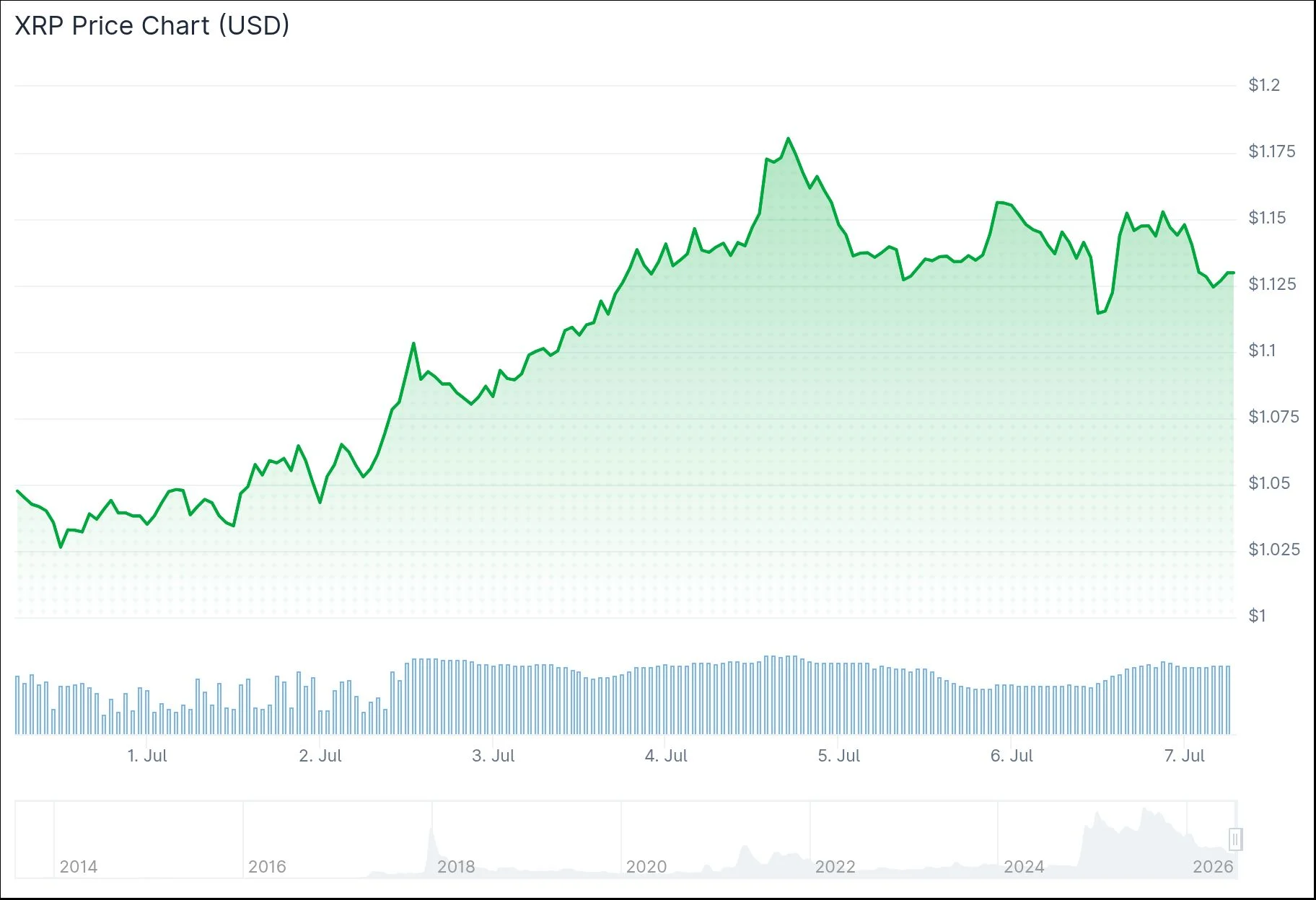
Market activity intensified significantly, with trading volume surging approximately 62% within a 24-hour window to reach $1.8 billion. Such dramatic volume increases typically indicate fresh market participation following periods of subdued trading activity.
This rebound follows a challenging June for XRP holders. The token experienced a significant decline from heights above $1.55 in February, ultimately bottoming out near the $1.00 to $1.04 range by late June—representing the most substantial holder drawdown in over a decade.
Institutional appetite, as measured through ETF flows, painted a cautious picture during this period. Net capital inflows to XRP-linked spot exchange-traded funds contracted from $132 million in May to just $59 million in June, representing a 55% month-over-month decline. Traditional finance interest appeared to wane despite the token’s price compression.
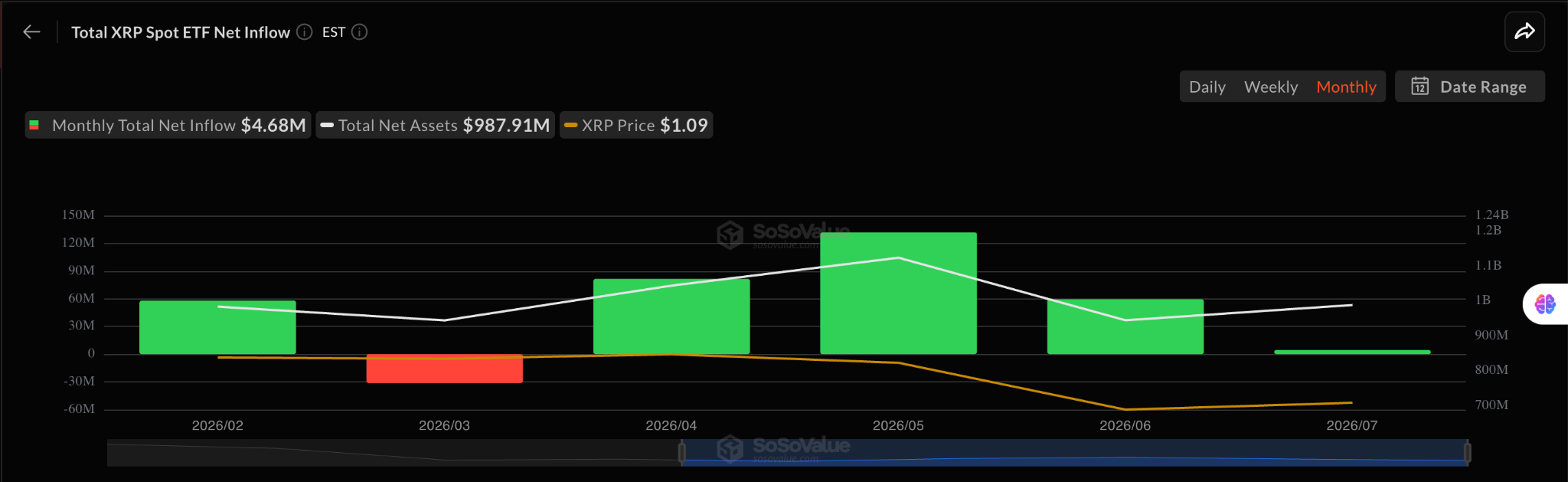
Large Holders Accumulate as Exchange Inventory Tightens
Blockchain metrics revealed a contrasting narrative within the cryptocurrency ecosystem. Daily active addresses on the XRP Ledger surged to levels not witnessed since February, as reported by Santiment. During that February timeframe, XRP traded within a $1.47 to $1.54 range.
Concurrently, the XRP Binance Scarcity Index climbed to 0.77 this week, representing its most elevated reading in more than two years, based on analysis from CryptoQuant researcher ArabxChain. This indicator quantifies XRP’s availability on Binance compared to historical benchmarks.

Binance’s XRP inventory has contracted by approximately 20% since November 2024, declining from roughly 3.27 billion tokens to around 2.6 billion currently. Holdings specifically dropped from about 2.8 billion in May to 2.6 billion by early July, coinciding precisely with the scarcity index’s breakout to new highs.
Market observers at ChartNerd highlighted this technical formation on X, describing XRP’s “3rd Retest” as a favorable entry point for position builders, characterizing it as “a gift” for chart-focused market participants.
Short Position Liquidations Contributed to Initial Rally
Futures market data from Coinglass reveals funding rates plunged into deeply negative territory between June 26 and 28, coinciding precisely with the price bottom. This concentration of short positions created conditions favorable for a squeeze.
The subsequent rally to $1.13 appears consistent with forced short covering rather than organic new demand. Funding rates have since normalized to slightly positive, suggesting a healthier positioning landscape.
Immediate resistance is located at $1.20, which previously contained the mid-June recovery attempt. A confirmed daily close above this threshold would expose the $1.35–$1.40 region, representing approximately 22% upside from current pricing.
The daily Relative Strength Index currently reads near 55, indicating additional headroom exists before overbought territory becomes a concern.
The 200-day Exponential Moving Average is positioned at $1.50, which technical analysts identify as the primary bullish objective if buying momentum persists. Conversely, a breakdown below $1.00 would negate the current recovery thesis.
XRP volume recently exceeded Bitcoin on South Korean platform Upbit, providing an interesting data point as market participants evaluate whether genuine demand is materializing.


The Bitcoin treasury company Strategy offloaded 3,588 BTC last week for approximately $216 million. The asset briefly plunged below $61,500 before recovering quickly.
While the sale initially drew attention, the decision to sell more of the cryptocurrency could be a positive step that strengthens confidence in the company’s financing structure, according to Grayscale Research Head of Research Zach Pandl.
A Bullish Outcome
In a recent market update, Pandl said that the move may help Bitcoin’s price find a more durable bottom. Although concerns had emerged over Strategy’s funding approach, the research head noted that the company’s overall financial position remained strong.
Strategy currently holds about $52 billion worth of BTC against roughly $7 billion in debt, while its annual preferred equity dividend obligations remain below $2 billion. This leaves it with sufficient resources to meet both debt repayments and dividend commitments. However, changing market conditions had raised questions about how the company would manage competing financial priorities.
By late May, Strategy’s US dollar reserves dropped to about $870 million, leaving enough cash to cover roughly six months of dividend payments. The decline sparked concerns over the company’s next move. Investors questioned whether it would sell discounted shares, part with some of its Bitcoin holdings, or make sacrifices that could affect preferred shareholders.
Those concerns were addressed in late June when Strategy introduced a new capital management framework. Under the updated approach, the company said it would issue shares and sell BTC whenever necessary to maintain sufficient US dollar reserves to cover its dividend obligations.
On July 6, Strategy confirmed it had sold another stash of Bitcoin the week before. Its dollar reserves remain at about $2.55 billion, providing roughly 17 months of dividend coverage. Pandl added that the recovery in STRC’s price is a sign that investors have become more confident in the company’s financing decisions following these changes.
Strategy FUD Fails to Derail BTC
Market sentiment remains heavily focused on fears surrounding Strategy’s sale, although Bitcoin has already recovered from the initial decline, according to Santiment. Even so, the analytics firm described it as an unexpected relief rally after the crypto asset once again defended the $60,000 level.
It added that the rebound followed an overly bearish mood at the end of June.
The post Why Strategy Selling More Bitcoin May Not Be Bearish After All appeared first on CryptoPotato.
TLDR:
- BONK faces renewed scrutiny after BonkDAO confirmed a malicious governance proposal drained about $20 million from its treasury.
- The attacker reportedly spent about $4.4 million buying BONK tokens to gain enough voting power for the proposal.
- The vote passed through the DAO’s own governance process, meaning the attack did not rely on a smart contract exploit.
- BONK price action weakened after the drain, with the token trading below major moving averages and facing resistance near $0.00000445.
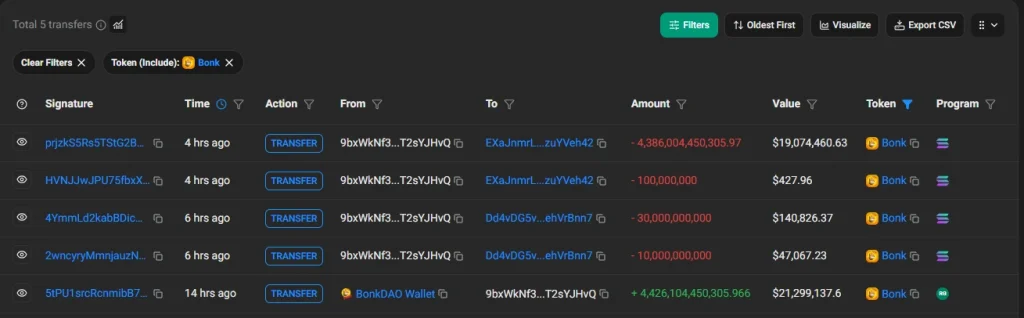
BONK faced fresh selling pressure after BonkDAO confirmed a malicious governance proposal drained about $20 million from its treasury. The incident took place on July 6, 2026, and exposed a weak point in token-weighted voting systems. BonkDAO said the attacker used a proposal to move treasury funds into a wallet they controlled.
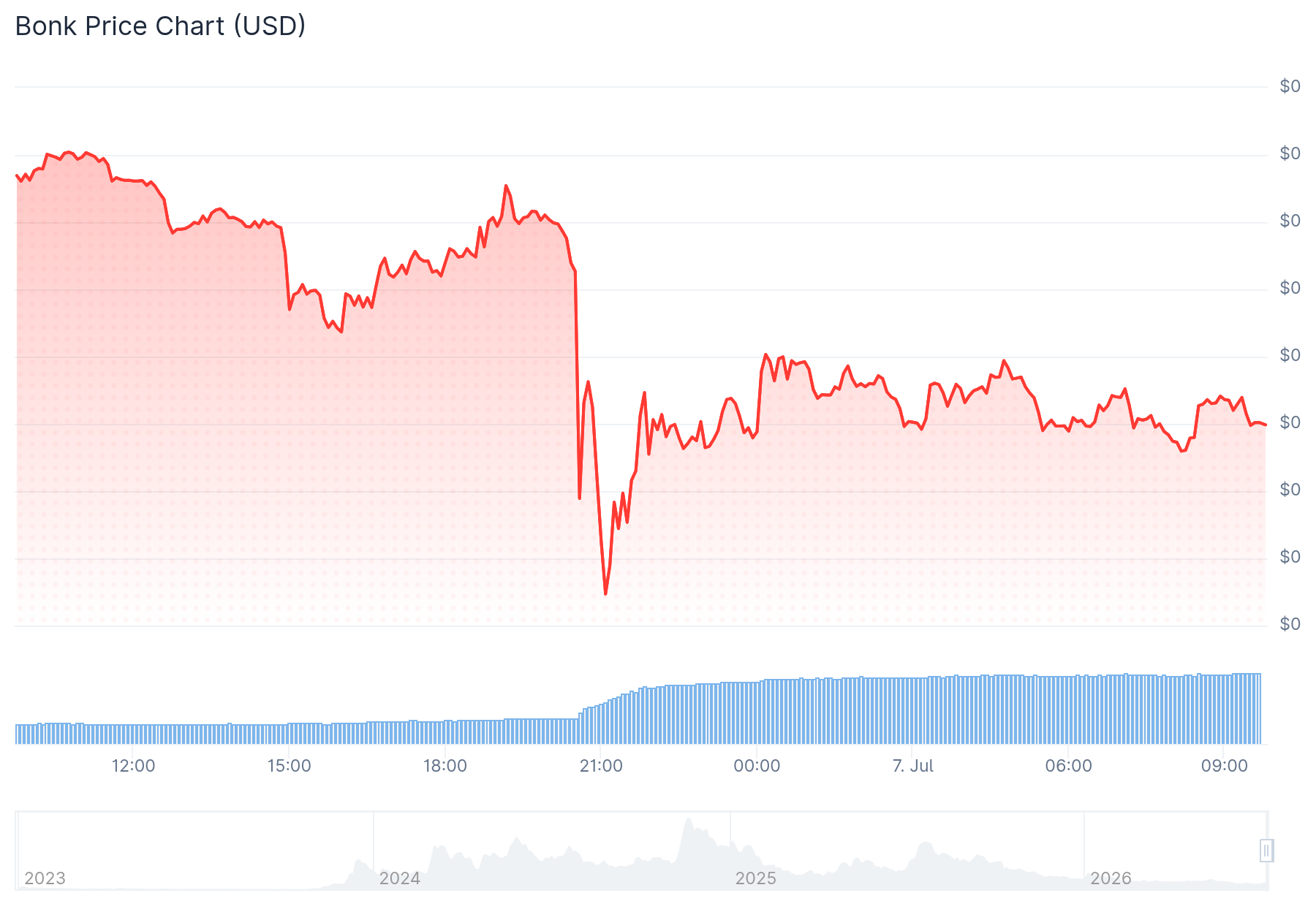
The move did not involve a smart contract exploit. Instead, the attacker used the DAO’s own rules to pass the vote. BONK traded near $0.00000442 after the incident, with an intraday low near $0.00000414.
BONK Treasury Drain Shows DAO Voting Risk
BonkDAO described the incident as a malicious governance proposal that drained an estimated $20 million in BONK tokens. The project said it identified exchange wallets used to buy tokens before the proposal. It also said it was working with exchanges, bridges, the Solana Foundation, and law enforcement.
The attacker reportedly built voting power over several days. Onchain reports said the wallet spent about $4.4 million buying BONK before the vote. That stake gave the attacker enough influence to push the proposal past quorum.
The proposal then transferred about 4.43 trillion BONK from the treasury. The vote passed with only a small number of active wallets involved. Most DAO members did not take part, which left the treasury exposed to a concentrated vote.
The attack stands out as it used valid transactions. The buying, voting, and treasury transfer all moved through the governance system. That makes the case different from a front-end hack or direct wallet drainer.
In March 2026, Bonk.fun faced a separate website-related incident. Attackers used a fake signing flow to target users. This time, no individual user wallets were drained. The target was the DAO treasury itself.
BONK Price Weakens as Governance Attack Hits Confidence
BONK price action weakened after news of the treasury drain spread. The token’s market value fell below the $500 million area, while trading volume rose sharply. That mix pointed to heavy speculation and fading short-term confidence.
Technical pressure also stayed visible. BONK traded below its 20-day, 50-day, and 200-day moving averages. The token faced resistance near $0.00000445, while short-term forecasts pointed to a possible range between $0.00000352 and $0.00000548.
The governance attack also revived a wider debate across DAOs. Token-weighted voting can expose treasuries when quorum levels sit too low. A wealthy attacker can buy enough influence, pass a proposal, and exit after execution.
This risk is not new, but the BonkDAO case shows how fast it can hit a major memecoin treasury. Many DAO systems focus on smart contract safety. Governance settings now need the same level of review.
Projects may respond with longer timelocks, higher quorum rules, and emergency multisig controls. Time-weighted voting could also reduce the risk of last-minute token accumulation. For BONK, the next focus is fund tracing, exchange cooperation, and whether any treasury assets can be frozen or recovered.


BNB Chain has published a guide for moving assets from a centralized exchange to BNB Chain, as European crypto users adjust to new rules under the Markets in Crypto-Assets framework.
Summary
- MiCA has changed EU exchange access, pushing some users to compare licensed platforms and self-custody.
- BNB Chain’s guide frames wallets, test transfers, and recovery phrases as core safety steps.
- Stablecoin delistings and Binance limits have made European crypto users review custody options more carefully.
The guide explains how users can hold crypto in their own wallets and connect directly to decentralized apps.
Meanwhile, the timing follows the end of MiCA’s transition period on July 1. As previously reported, MiCA now requires crypto firms to hold CASP licenses to keep serving users under the EU rulebook. The change has pushed users to check whether their exchanges can still offer services in the bloc.
BNB Chain guide focuses on self-custody
BNB Chain’s guide presents self-custody as an alternative to keeping assets on a centralized exchange. It says users who move on-chain control their own private keys, while centralized platforms hold keys on behalf of customers.
The guide also warns that self-custody comes with responsibility. Users must protect their recovery phrases, send test transfers before moving larger sums, and keep a small amount of BNB for network fees. It also tells users to avoid fake wallet apps, fake bridge sites, and links sent through messages or ads.
BNB Chain says users can access swaps, stablecoins, staking, lending, borrowing, tokenized real-world assets, and perpetual trading from their wallets. It names apps such as PancakeSwap, Venus, Lista DAO, Aster, DappBay, and BscTrace as tools available across the ecosystem.
Exchange shifts put wallets in focus
The guide lands as several exchange services in Europe change under MiCA. As previously reported, Binance said it would suspend several EU services after failing to secure a MiCA license before the deadline. The pause covered new spot orders, new deposits, sign-ups, and some yield products, while withdrawals remained available.
Licensed rivals have also used the deadline to compete for users. As previously reported, Coinbase and OKX targeted Binance users with transfer offers before the rule change took full effect. The shift has made regulation, custody, and access central issues for EU users choosing where to hold crypto.
Stablecoins are also part of the change. As previously reported, USDT lost access to regulated EU exchange order books after Tether chose not to seek MiCA authorization. That has pushed compliant stablecoins such as USDC and EURC into a stronger position on licensed platforms.
Licensed firms gain ground
The EU market is not closing to crypto, but access now depends more on authorization. ESMA’s MiCA register rose to 300 authorized crypto firms after 57 new providers were added around the deadline.
The updated list includes banks, trading firms, and crypto companies that can serve users across the bloc through MiCA passporting. Ripple also joined the licensed market after securing approval in Luxembourg, as previously reported.
BNB Chain’s message is aimed at users who want direct control rather than a licensed exchange account. The guide does not remove the risks of DeFi or self-custody. It instead gives users a route to move assets, test transactions, check apps, and decide how much responsibility they want to hold themselves.


Ripple legal chief and National Cryptocurrency Association President Stuart Alderoty said Washington should stop treating crypto users as a small political group.
Summary
- Alderoty says 67 million U.S. crypto holders make digital assets a major voting bloc.
- Polling shows mixed views, with many Americans still worried about crypto risk and influence.
- The CLARITY Act remains under Senate pressure as lawmakers weigh rules, ethics, and oversight.
In a July 7 post on X, he said U.S. crypto holders now represent one of the country’s largest public groups.
Alderoty pointed to National Cryptocurrency Association data showing that 67 million American adults own crypto. He said, “For starters, it means more people have crypto than have dogs.” He added that crypto users are “by any reasonable standard” a large national group.
His comments came after a Politico poll showed limited public support for the CLARITY Act. Alderoty argued that weak support for one bill does not mean crypto users are irrelevant. He said the 27% support figure is close to the share of adults who already hold crypto.
Crypto ownership broadens across the U.S.
The 2026 State of Crypto Holders Report said one in four U.S. adults now owns crypto, or more than 67 million people. The report also said the country added 12 million holders over the past year.
Alderoty said the data challenges old images of crypto holders as wealthy male tech workers or short-term speculators. The report said women made up 42% of new holders in 2025 and 2026, compared with 34% among earlier holders.
The same report said nearly a quarter of holders earn $75,000 or less per year. It also said construction and manufacturing workers now make up more than 21% of the holder base. Alderoty used those figures to argue that crypto ownership now reaches working and middle-class households.
CLARITY Act debate enters tighter window
The remarks come as Congress continues to debate the CLARITY Act, a bill meant to set federal rules for crypto markets. As previously reported, the bill missed its July 4 target and now faces an Aug. 7 deadline before the Senate summer break.
The bill has already cleared key steps, but it still needs a full Senate vote. Senate staff also need to merge versions from the Banking and Agriculture committees before lawmakers can move cleanly toward final passage.
As previously reported, the Senate Banking Committee advanced the bill in a 15 to 9 vote in May. The bill still needs 60 Senate votes, while ethics language, anti-money laundering rules, and agency oversight remain points of debate.
Polling and lobbying shape the fight
Public polling gives lawmakers a mixed picture. A Politico and Public First survey found that crypto ranked low among voter priorities, with only 4% saying a candidate’s crypto stance would shape their vote.
Other polling shows voters want stronger rules. Americans for Financial Reform said voters across parties worry about crypto industry influence in Washington and want crypto firms to follow bank-like rules.
The industry has also increased political spending. Reuters reported that crypto firms have spent $189 million so far on the 2026 U.S. election cycle, more than their 2024 total. The report named Ripple Labs, Coinbase, Andreessen Horowitz, and Foris DAX among the top contributors to corporate policy-focused political action committees.
Alderoty’s message places crypto ownership at the center of the Washington debate. His argument is that lawmakers do not need to endorse a specific token to pass basic rules. They must decide whether 67 million holders are a niche group or a public market that needs clear guardrails.


Paradigm has led an oversubscribed seed funding round for sovereign financial infrastructure firm M1X Global, bringing the company’s total funding to $8.5 million just 14 weeks after its public launch.
Summary
- Paradigm has led M1X Global’s oversubscribed seed round, bringing the sovereign financial infrastructure firm’s total funding to $8.5 million.
- M1X Global said its blockchain based sovereign bond USDM1 is being deployed for institutional use and supports regulated 24/7 financial markets.
- The investment adds to Paradigm’s recent backing of blockchain payment and sovereign infrastructure projects beyond traditional crypto venture funding.
According to a press release shared with crypto.news, the round also attracted participation from Breed VC following M1X Global’s earlier angel raise. The company said the funding comes as regulatory clarity and institutional interest continue driving adoption of blockchain-based financial infrastructure.
M1X builds blockchain infrastructure for sovereign markets
Working with governments on digital financial systems, M1X Global has concentrated on sovereign financial instruments issued on blockchain networks. Its flagship partnership with the Republic of the Marshall Islands led to the launch of USDM1, which the company described as the first U.S. dollar-denominated secured sovereign bond issued natively on a public blockchain.
M1X Global said it coordinated the issuance with Cleary Gottlieb, Stellar Development Foundation, Anchorage Digital Bank, Guidepost, Inca Digital and Crossmint. According to the company, USDM1 was created to expand access to government aid and financial services across the Pacific while introducing a blockchain-native sovereign instrument for institutional markets.
The company said USDM1 combines the legal and economic structure of fully collateralized U.S. dollar sovereign debt with programmable digital asset features, enabling T+0 settlement, enforceable legal protections and programmable transfers. It added that the instrument qualifies as eligible sovereign collateral for regulated 24/7 markets and has already featured in institutional working groups involving Bank of America, Citadel Securities, Virtu Financial, Tradeweb, and DTCC.
According to M1X Global, the bond has also been structured to remain bankruptcy remote while supporting look-through to high-quality liquid assets and inclusion in legal netting sets used for collateral.
“Paradigm’s investment is an important milestone for M1X Global, strengthening our ability to scale the infrastructure behind sovereign financial instruments and to accelerate the build-out of systems that can support their use across regulated markets. This support advances our capacity as we continue to see strong onboarding demand and institutional adoption of USDM1, “ M1X Global Chief Executive Officer Mark Lurie said in an accompanying statement.
Jordan Goldman, president and chief operating officer of M1X Global, added that institutional deployment of USDM1 has demonstrated how sovereign digital assets can support both public services and financial markets.
According to Goldman, the assets can “deliver meaningful impacts in both domestic and institutional contexts” by improving access to government services while providing new sources of high-quality collateral for institutions operating in around-the-clock markets.
The investment continues Paradigm’s recent expansion beyond traditional crypto venture funding.
In June, the firm led a $9 million Series A round for Latin American payments platform El Dorado, supporting its stablecoin-powered cross-border payment network operating across 12 countries. It has also partnered with Stripe on the Tempo Layer 1 blockchain and participated in U.S. stablecoin policy discussions, including urging regulators not to restrict third-party stablecoin reward programs.


Yield Guild Games will shut down YGG Play, its crypto game publishing arm, after deciding the business is no longer commercially sustainable.
Summary
- Yield Guild Games is cutting 35 jobs and closing YGG Play after weak gaming demand.
- YGG will focus on gaming datasets for AI after extending total runway to four years.
- The shutdown adds to crypto layoffs as firms shift resources toward automation and AI products.
The company blamed weak crypto market conditions and a difficult video game publishing market.
YGG said the Oct. 10 market crash changed retail trading behavior and reduced the liquidity that many consumer crypto apps need. It said Bitcoin later fell below $60,000, while several altcoins lost 80% or more from prior levels.
The company said YGG Play had shown early traction before conditions worsened. It signed nine games, worked with intellectual property brands such as Pudgy Penguins, launched a publishing platform, and passed $9 million in lifetime revenue by the end of the first quarter of 2026.
35 staff affected by restructuring
The shutdown will affect 35 workers across different teams. YGG said it would help those employees find new roles and invited companies to contact it for hiring referrals.
The company will retire the YGG Play website, launchpad, and community rewards platform. It will also stop marketing support for third-party games. LOL Land and Waifu Sweeper will be taken down, while GIGACHADBAT and Ragnarok Breaker will continue through their own studios.
“Sunsetting YGG Play is a heavy decision, but it is a market decision, not a product decision,” said YGG co-founder Gabby Dizon.
He added that the company remains focused on using technology to create economic opportunities.
Company turns toward AI data
YGG said it will now move resources into the AI data economy. Its first focus will be a business-to-business pipeline for gaming datasets that can help train AI models.
The company said games can produce useful data because players make fast and complex decisions during play. YGG said its global community can help create behavioral datasets by playing games and completing related tasks.
YGG also pointed to its AI Alerts channel, formerly YGG Alerts, as part of the new direction. The company said the channel has already brought in 27,000 applications in its first five days by connecting Filipino workers with remote AI training jobs.
Crypto and gaming layoffs continue
The move adds to broader job cuts across crypto and gaming. As previously reported, Kraken cut about 150 jobs as AI tools took on a larger role across the exchange. Coinbase, Gemini, and Dune also reduced staff this year while reshaping operations.
In addition, BitGo cut nearly 15% of its workforce while shifting focus toward security, trading, stablecoins, settlement, and AI infrastructure. The cuts showed how crypto firms have continued to review costs after weaker market conditions.
The web3 gaming sector has also faced pressure. As previously reported, blockchain gaming activity fell in 2025 as user numbers dropped, funding slowed, and hundreds of gaming apps went inactive.
YGG said its treasury stood at $20.6 million at the end of the first quarter. It held $6.2 million in stablecoins, T-bills, and large-cap tokens. The company said the restructuring extends its operating runway to four years.

Crypto gaming company Yield Guild Games says it has shut down its crypto game publishing arm, YGG Play, and will instead focus on feeding data to artificial intelligence.
Yield Guild Games said Monday that it would also lay off 35 employees, adding that a prolonged crypto market downturn and a “similarly brutal” video game publishing market meant YGG Play “cannot be commercially sustainable.”
It said a major market crash on Oct. 10 “fundamentally altered retail market psychology, and we do not expect the crypto consumer market or the Web3 games publishing market to recover sufficiently in the near term.”
The layoffs add to the more than 5,000 jobs that crypto companies have cut this year, with many citing a crypto market slump and a refocus toward opportunities presented by artificial intelligence.
“Sunsetting YGG Play is a heavy decision, but it is a market decision, not a product decision,” Yield Guild Games co-founder Gabby Dizon said. “I am proud of what this team achieved under such tough conditions.”

Source: Yield Guild Games
Yield Guild Games said it would be closing YGG Play’s website, its web app that launched games and its community-focused rewards site. It would also end all marketing support for third-party games.
The company’s board game-style browser game LOL Land and its puzzle game Waifu Sweeper would also be taken down. The Web3 versions of the baseball game GIGACHADBAT and the battle game Ragnarok Breaker would continue as normal.
The company said sunsetting YGG Play and its restructure would extend its operating runway to four years, adding it had $20.6 million in its treasury as of the end of the first quarter.
Yield Guild pivots to AI data
Yield Guild Games said it would refocus its resources “into the AI data economy” to provide information that can be used to train AI models.
It will initially create a pipeline for gaming datasets, and said its global community “can generate these behavioral datasets just by playing.”
The company said it was “an organic next step” and the data would help AI networks understand “human irrationality and emergent behavior,” as video game players “constantly make complex, split-second decisions.”
More than 5,000 crypto layoffs in 2026
The crypto industry has cut over 5,000 jobs so far this year, with Block Inc. undertaking the largest round of layoffs in February by cutting 4,000 staff, or about half its workforce at the time.
Last month, crypto infrastructure company BitGo laid off 15% of its staff, an estimated 90 people, while Robinhood cut 10% of its workforce.
Earlier in the year, Kraken laid off 150 workers, and Coinbase cut 700 employees. Gemini also laid off 200 employees in February and Crypto.com cut about 180 staff a month later, both citing the use of AI.
Magazine: Solana exec trolls crypto gamers, Pixel tackles play-to-earn issues: Web3 Gamer
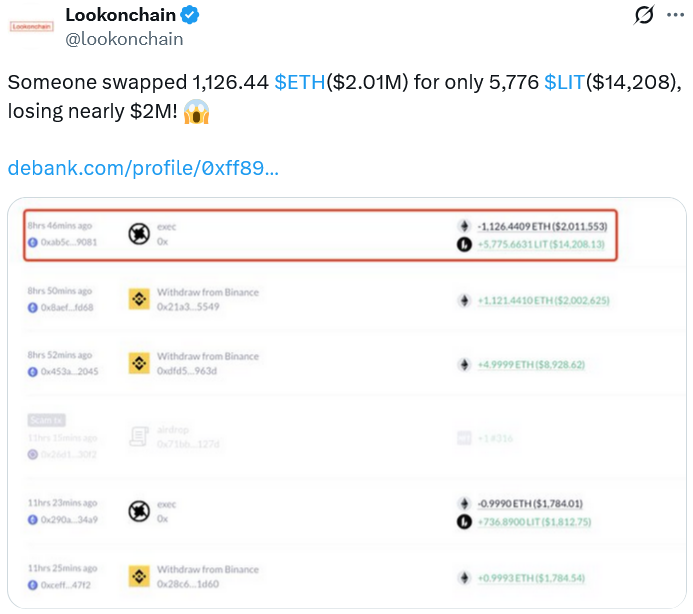
A trader who swapped $2.01 million worth of Ether on a decentralized exchange has been left with just $14,500 worth of tokens after a router directed the order through a low-liquidity pool, allowing an Ethereum block builder to profit massively from a same-block arbitrage trade.
The trader swapped 1,126.44 of Ether (ETH) but only received 5,776 Lighter (LIT) tokens, in a “textbook case of same-block backrun extraction,” according to GoPlus Security.
“This was a real, highly imbalanced backrunner arbitrage, not a classic sandwich attack,” GoPlus Security said. Titan Builder was the biggest beneficiary, walking away with $1.8 million from the transaction, which took place on Monday at 1:59 am UTC.
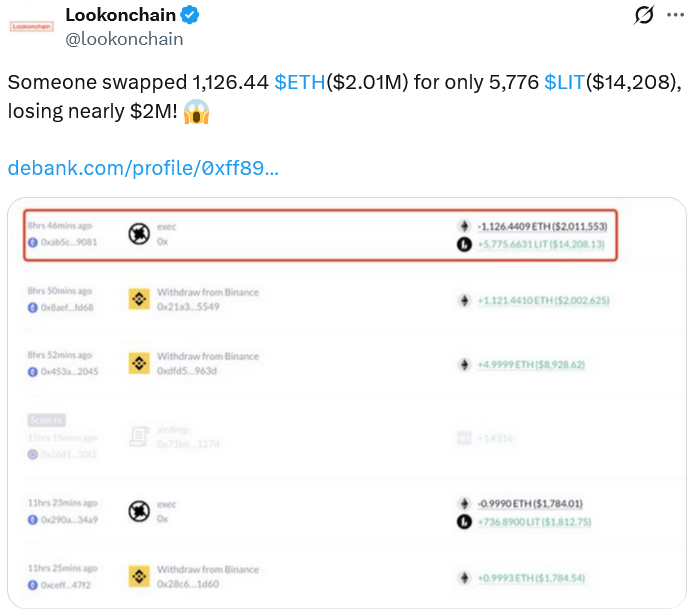
Source: Lookonchain
The incident is a reminder of the risks posed by maximal extractable value (MEV) bots and liquidity routers on top of hackers and scammers, which continue to run rampant in the crypto industry.
Don’t sign DEX transactions blindly, trader says
To reduce the risk of such incidents, crypto trader Ruslan Khairullin said traders should read the transaction route before signing the transaction.
“This is what happens when you clicked confirm faster than you read the route. Painful lesson to see in a real time.”
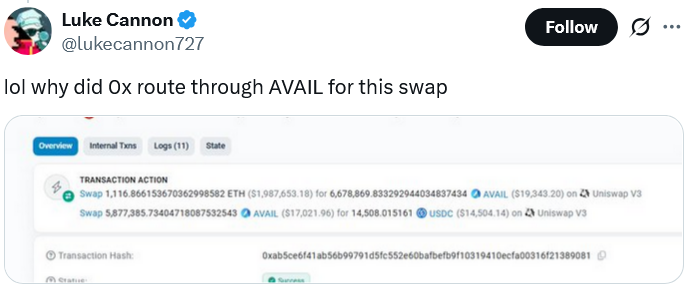
Source: Luke Cannon
How the victim lost $2M to a bot
The victim’s swap routed approximately 1,117 Ether into a low-liquidity AVAIL/WETH pool on Uniswap v3, causing the trade to execute at roughly 120 times higher than what AVAIL could later be sold for, GoPlus Security said.
After the trader received nearly 6.67 million AVAIL tokens at an inflated price, the router involved, 0x router, sold a small amount of externally sourced AVAIL into the same pool to extract about 1,072 WETH before paying out 1,018 ETH, worth $1.8 million, to Titan as a builder reward.
The AVAIL was then swapped for $14,200 worth of LIT tokens, marking a 99.3% loss.
Related: ‘All DeFi unsafe’ claim sparks AI security debate after April hack surge
Cointelegraph reached out to Titan but didn’t receive an immediate response.
Titan has now made $112.6 million in revenue from its block building services this year, data from DefiLlama shows.
Titan’s biggest day this year came in March when it extracted around $34 million in arbitrage profit from a MEV bot incident on the CoW Protocol.
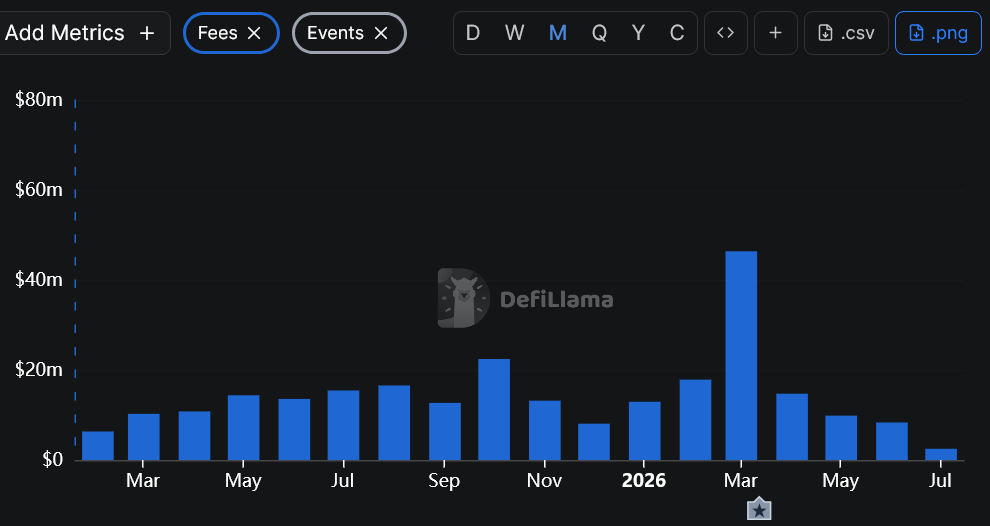
Monthly change in Titan’s revenue since February 2025. Source: DefiLlama
Magazine: China’s 107 Bitcoin memory thief, Bithumb CEO booked: Asia Express

South Tees NHS doctor suspended for forged certificates

Managing Risk in Volatile Markets: Lessons From Crypto Trading

From Asian Games to World Cup, Filipinas in for tough buildup


-

 Fashion4 days ago
Weekend Open Thread: High Hopes
-

 Politics4 days ago
The House | “Reframing the debate from a binary discussion of winners and losers”: Yuan Yang reviews ‘We Are Not Machines’
-

 Fashion14 hours ago
Open Thread: What Great Books Have You Read Recently?
-
 NewsBeat2 days ago
Taylor Swift and Travis Kelce wedding staffer hilariously struggles to keep her cool while checking in megastars
-

 News Videos7 days ago
How to Build INSANE Live Financial Dashboards With Claude
-
 Crypto World6 days ago
Airdrop Registration Becomes Key Focus For Remittix As RTX Launch Updates Approach
-

 Sports6 days ago
Broncos roster: OL Ben Powers (No. 74) entering final year of contract
-

 Crypto World5 days ago
Binance stock trading tops $1B in first month after launch
-

 NewsBeat6 days ago
Presenter Caroline Flack’s brother Paul Flack dies aged 55
-

 Crypto World5 days ago
Alibaba-affiliate Ant Group enters the humanoid robot market with 12 deals
-

 Crypto World4 days ago
Standard Chartered Secures MiCA License as ESMA Adds 37 New Crypto Firms
-

 Crypto World2 days ago
South Africa proposes crypto tax guidance under existing rules
-

 News Videos15 hours ago
Best Time to Enter Small Caps Right Now? Another Bull Run? | Financially Free
-

 Business5 days ago
Meta Platforms Stock Jumps 7% Today as Bloomberg Reports Company Plans to Enter the Cloud Business
-
 NewsBeat5 days ago
New exhibition reflects five decades of movement between island of Ireland and GB
-

 Tech2 days ago
Lenovo laptops are now shipping with YMTC SSDs, a sign of Chinese NAND entering the mainstream
-

 Business4 days ago
What a 10 Percent Drop Means for Buyers, Sellers and Renters
-

 Crypto World4 days ago
Binance Re-Enters Philippines As EU MiCA Rules Restrict Access
-

 News Videos18 hours ago
Avoid entering in FOMO #bitcoin #cryptocurrency #trading #scalping
-

 News Videos3 hours ago
Whats Hidden Inside This Cash Register? #treasure #reselling #money
You must be logged in to post a comment Login