
Crypto World
Exclusive: Myanmar’s Dictator Wants to Rebuild Ties With the West


On Feb. 1, 2021, a convoy of black military vehicles rolled through Naypyidaw to detain top NLD leaders. Suu Kyi was sentenced to 33 years (now reduced to 18) on charges ranging from corruption to illegally possessing walkie-talkies. “I have been extremely lenient toward her,” Min Aung Hlaing says with a straight face. “We made every possible effort to prevent the situation from reaching this point.”
What really drove Min Aung Hlaing to seize power dominated discussions among officials in squalid detention. “We talked about it a lot,” says Turnell, who spent 650 days in custody. “There was certainly a part of the military that didn’t want any loosening of the sort under way.”
The coup is best understood as a reaction to a regime losing control. According to a leaked 2004 military dossier, the junta engineered reforms to hedge against Beijing’s overbearing influence and leverage Suu Kyi’s freedom to win Western trade, aid, and diplomatic legitimacy. But the generals miscalculated the public’s fierce devotion to “The Lady,” whose popularity proved fundamentally incompatible with the military’s absolute power. Myanmar’s military also has sprawling business interests spanning banking, mining, gems, construction, manufacturing, tobacco, tourism, transport, telecoms, and real estate. Reforms threatened this gravy train.

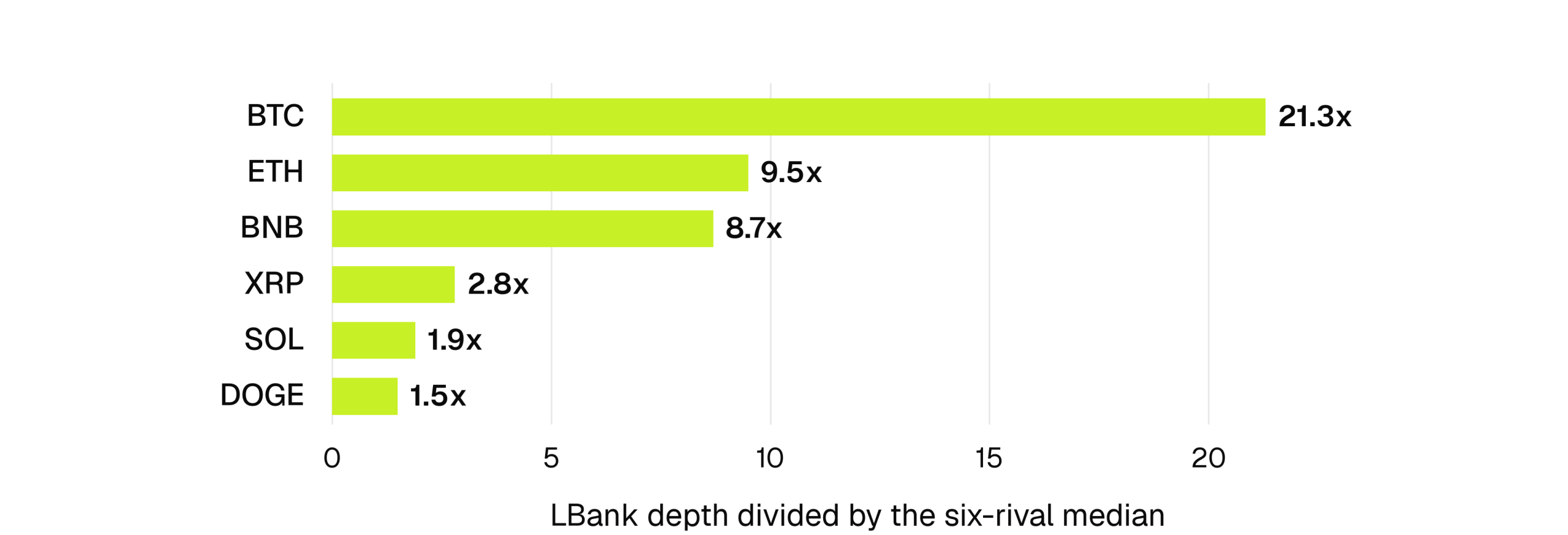
BeInCrypto examined how LBank compares with rival exchanges on trading depth, access to emerging tokens and tokenized products.
- Major trading pairs: LBank ranked first in five of six major USDT order-book tests against Binance, OKX, Gate, Bitget, MEXC and Bybit. Its displayed depth exceeded the six-peer median on every pair, although this does not guarantee execution quality.
- Early token access: LBank scheduled PONS trading 54 days and seven hours before Bitget. Selected tokens also recorded sharp price gains, but the sample does not prove typical customer returns or worldwide first listings.
- Robinhood-linked products: LBank led 9 of 22 selected tokenized-product depth comparisons. Its HOODON book held 4.42 times the competitor exchange’s displayed depth, while HOODX held 2.23 times as much. These are two separate products linked to Robinhood.
- Security evidence: LBank supplied an ISO/IEC 27001:2022 certificate and documented relationships with Elliptic and CertiK. These show defined security and compliance arrangements, but they do not independently confirm completed testing, guarantee protection from breaches, or establish customer-asset coverage.
Choosing an exchange involves two practical questions: can you trade the asset you want, and how much will the trade cost? LBank’s emphasis on early listings and tokenized products makes both worth examining alongside its established crypto markets.
Our comparisons cover spot markets, where users trade tokens themselves rather than leveraged contracts. An order book lists offers to buy and sell; its midpoint lies halfway between the best buying and selling prices.
We measure displayed depth by adding orders within 2% of that midpoint. More depth can help absorb trades, but a buyer needs available sell orders and a seller needs buy orders.
LBank Led Five of Six Major Pair Tests
Our 29 August comparison covered Bitcoin, Ethereum, Solana, XRP, BNB and Dogecoin, each traded against USDT, a stablecoin designed to track the US dollar. We compared LBank with Binance, OKX, Gate, Bitget, MEXC and Bybit.
Across three snapshots, LBank ranked first in five pairs and second in Dogecoin. Its displayed depth exceeded the median, or middle value, of the six rivals on every pair.
Table 1 Major pair comparison
USDT pair
LBank depth
Strongest rival
Rival depth
Rank
BTC
$52.16m
Bitget
$11.79m
1 of 7
ETH
$25.24m
Bitget
$8.15m
1 of 7
SOL
$11.10m
Bitget
$10.98m
1 of 7
XRP
$4.92m
Bitget
$4.36m
1 of 7
BNB
$11.23m
Bitget
$4.15m
1 of 7
DOGE
$4.47m
MEXC
$4.51m
2 of 7
Source: Public order books from LBank, Binance, OKX, Gate, Bitget, MEXC and Bybit. Three snapshots, 29 August 2026; first 100 price levels per side; combined depth within 2%. Dollar amounts are approximate USDT values.

Bitcoin showed the clearest advantage: $52.16 million against Bitget’s $11.79 million, the strongest competing book. Solana was much closer, at $11.10 million against $10.98 million.
The test capped each side at 100 price levels, which can exclude different amounts of depth on different exchanges. Orders can also disappear before a trade executes. These results therefore describe the sampled books, rather than full market capacity or guaranteed execution prices.
| What this means: LBank showed competitive capacity in its core markets, particularly Bitcoin and Ethereum. That gives traders and trading partners a reason to compare its quotes for major assets, while testing the relevant side of the book at their intended order size. |
Early Listings Gave Access to Tokens With Large Gains
LBank nominated NIULAI, PONS, Artificial Inu and The Index for a closer look. CoinGecko’s 8 September capture showed large monthly gains in three, while NIULAI fell over the available seven-day window.
Table 2: Price changes in the four nominated tokens
Asset
7 days
30 days
PONS
+49.47%
+2,226.07%
Artificial Inu
+50.12%
+7,921.56%
The Index
+23.03%
+212.59%
NIULAI
-2.37%
Unavailable
Source: CoinGecko captures, 8 September 2026: PONS, Artificial Inu, The Index and NIULAI. NIULAI’s 30-day change was unavailable. Selection: LBank, not a representative sample of its listings.
These are changes in token prices, not returns earned by every LBank customer. Entry time, exit price and trading costs determine individual results. Artificial Inu appears as AI on CoinGecko and AI1 on LBank; we matched asset identities rather than relying on symbols alone.
The listing history does support a specific access advantage. LBank scheduled PONS trading for 15 July at 07:00 UTC; Bitget scheduled it for 7 September at 14:00 UTC. LBank’s launch was 54 days and seven hours earlier.
What this means: LBank offered access to PONS well before that particular rival, giving users an earlier opportunity to trade it. The evidence does not establish a worldwide first listing, typical customer profits or consistently successful token selection.
Small Token Books Limited Larger Purchases
The next question is whether traders could transact at the prices they saw. Three direct order-book captures per comparison on 8 September found much less nearby depth for several nominated tokens.
Table 3 Nearby depth in the same smaller tokens
Asset
LBank depth
Matched rival
Rival depth
NIULAI
$82
Gate
$17,011
PONS
$288
Gate
$113,214
Artificial Inu
$5,792
Gate
$2,660
The Index
$9
MEXC
$1,194
Source: BeInCrypto direct exchange captures, 8 September 2026. Median combined buy and sell depth within 2%; approximate dollars from USDT values. AI1 uses the later matched LBank and Gate capture; Gate names the same token AINVDA.
PONS illustrates the difference between an attractive quote and enough orders behind it. LBank’s spread, the gap between its best buying and selling prices, was only 0.011%, narrower than Gate’s 0.081%. Yet a simulated $1,000 purchase on the captured LBank book paid an average 2.23% above the midpoint, against 0.06% on Gate.

Source: Median simulated buying premium across three captures per comparison. Rivals: Gate for NIULAI, PONS and Artificial Inu; MEXC for The Index. No trades were placed. Calculations use displayed sell orders and exclude fees, delays, cancellations and new orders.
Artificial Inu needs a further distinction. LBank had more combined depth than Gate in the matched capture, but only about $96 consisted of sell orders, against Gate’s $1,396. Most of LBank’s depth was buying interest, offering little help to someone buying the token.
Its combined depth had also risen sharply between capture rounds. That change shows why a single snapshot cannot establish persistent liquidity.
What this means: Early access did not consistently translate into capacity for larger purchases. The simulations show why retail users need to inspect sell orders before buying; for listing partners, the weakness is the amount and balance of available liquidity, not simply the number of tokens offered.
bStocks Accounted for Most Tokenized Trading in the Sample
LBank offers tokenized products across bStocks, Ondo and xStocks. Our 8 September CoinGecko screen covered 22 selected products across those three families.
Tokenized products provide exposure linked to an underlying asset through a digital token. Two tokens referencing the same company can have different issuers and terms, so we compared the exact product and USDT spot pair across exchanges.
Table 4: Reported activity across the selected tokenized basket
Product family
Products
24h volume
Basket share
bStocks
8
$14.39m
63.91%
Ondo
6
$4.43m
19.67%
xStocks
8
$3.70m
16.42%
Total
22
$22.51m
100%
Source: CoinGecko ticker captures, 8 September 2026; selected LBank basket. Totals use unrounded figures. Share means share of this basket’s reported volume, not global market share. Ticker data and depth fields.
The basket covered eight reference names: Apple, Amazon, Circle, Nvidia, Robinhood, Tesla, SK Hynix and SpaceX. Including SK Hynix and SpaceX-linked products takes the comparison beyond ordinary US-listed shares. This is a selected product sample, not a measure of the whole US stock market.
xStocks represented just 16.42% of the basket’s $22.51 million in reported daily trading. The broader total reflects added product coverage, not evidence of a sudden increase in activity.
We also checked six overlapping xStocks pairs against completed one-minute trading records over nearly aligned 24-hour windows. CoinGecko showed $2.61 million; the reconstruction gave $2.64 million, 1.08% higher. Valuing the reconstructed quantities at CoinGecko’s latest prices narrowed the gap to 0.07%, suggesting pricing explains most of the difference.
Both calculations ultimately use exchange-reported activity. Agreement supports consistency between the two methods, but does not independently audit the trades.
What this means: bStocks contributed almost two-thirds of this sample’s reported activity, so an xStocks-only view would miss much of the trading covered here. Traders and partners should assess each product’s liquidity and terms separately.
Robinhood Products Had the Largest Depth Advantages
LBank led nine of the 22 exact-product depth comparisons. Its two largest leads over the strongest available rivals were HOODON and HOODX, two different products linked to Robinhood shares.

Source: CoinGecko, 8 September 2026. Combined upward and downward 2% depth; Gate was the strongest valid matched rival in both cases. Four valid venues, including LBank, returned for each product.
HOODON held $1,096,872 on LBank against Gate’s $248,125, a 4.42-fold difference. HOODX held $564,324 against $252,804, or 2.23 times as much. Both reference Robinhood, so these are two product strengths tied to one company.
Table 5: Other product comparisons show where the result changes
Product
Family
LBank depth
Strongest rival
Rival depth
HOODB
bStocks
$613,791
Binance
$499,816
TSLAB
bStocks
$548,588
Binance
$927,889
NVDAX
xStocks
$881,259
Gate
$597,711
NVDAON
Ondo
$312,474
MEXC
$885,850
Source: Selected examples from the 22-product CoinGecko capture, 8 September 2026. Each row compares the same token against USDT. Product sources: HOODB, TSLAB, NVDAX, NVDAON.
Results also varied across issuers. LBank led 9 of the 22 tokenized-product depth comparisons in the September 8 snapshot: four of eight bStocks products, four of seven xStocks products and one of seven Ondo products.
The table below lists every product where LBank led. Each comparison matches the same token and USDT trading pair against the strongest qualifying rival. Depth measures the combined value of buy and sell orders within 2% of the market midpoint.

Robinhood stood out across all three product families, accounting for three of LBank’s nine leads. HOODON held 4.42 times Gate’s displayed depth, while HOODX held 2.23 times as much—the two largest percentage advantages in the sample. HOODB also exceeded Binance’s depth by 22.8%.
The other leads ranged from 1.8% for Nvidia’s bStocks product to 47.4% for Nvidia’s xStocks product. The narrow advantages in NVDAB and CRCLX could reverse with relatively small changes in displayed orders.
These rankings cover valid returned matches in an 18-exchange screen. Missing markets were not counted as zero, and the number of qualifying rivals differed by product.
What this means: LBank’s strongest result was the consistency of its Robinhood lead across three separate tokenized products. Its other wins give traders and partners a wider set of markets to consider. These books showed more combined buying and selling interest near the market price than their strongest qualifying rivals, although actual execution still depends on order size, the side of the book and whether those orders remain available.
LBank Documents Security Controls and Partnerships
LBank supplied evidence of security controls and external partnerships that deserves consideration alongside trading performance. The sources establish different things, from a certificate’s stated scope to announced testing arrangements.
Table 6: What the security evidence supports
Evidence
Documented scope
Limit of the evidence
ISO/IEC 27001:2022
LBK EXCHANGE FZE; platform, infrastructure, applications and AWS security management. Stated validity 13 Feb 2026 to 12 Feb 2029, subject to periodic audits.
Names Prescient Security LLC as issuer. Issuer confirmation remained incomplete in this review.
Elliptic
Provider confirms transaction and wallet screening and fund tracing.
Partnership announcement; no measured control outcomes.
CertiK
LBank announces simulated attack testing and rewards for finding vulnerabilities, 10 Aug 2026.
Announcement does not establish completed tests or fixes.
Source: Certificate supplied by LBank and reviewed 1 September 2026; Elliptic announcement; LBank CertiK announcement. Elliptic’s page is dated 12 March 2025.
LBank also told BeInCrypto that SlowMist joined its security initiative. This review did not independently confirm that participation or its scope.
Access depends on jurisdiction as well as technical controls. Historical notices from Japan’s FSA on 14 June 2024, Spain’s CNMV on 9 September 2024 and India’s FIU on 1 October 2025 addressed registration or compliance. Those records alone do not determine today’s legal status.
| What this means: The documentation gives users and partners specific controls to investigate. It does not measure how reliably every control operates, guarantee protection from breaches or replace checking the legal entity and permissions relevant to a user’s country. |
What the Research Can Establish
Table 7: Research scope and dates
Test
Capture date
Basis
Major pairs
29 Aug 2026
Seven exchanges; three snapshots; first 100 levels per side.
Nominated tokens
8 Sep 2026
CoinGecko prices; listing notices; three direct books per comparison.
Tokenized products
8 Sep 2026
22 products; 18-venue screen; exact USDT spot matches; stale or anomalous rows excluded.
Volume check
8 Sep 2026
Six xStocks pairs; 1,440 completed one-minute records per pair; nearly aligned windows.
The observations describe two dated research windows, not live rankings or a controlled before-and-after comparison. Reported turnover is not independently audited. The nominated tokens and selected tokenized basket cannot establish exchange-wide market share or typical investment returns.
Public wallet trackers cover different address sets, and no complete current reserve package was supplied in the reviewed material. This study therefore cannot establish whether assets cover everything owed to customers; that does not demonstrate a shortfall. Verification requires dated assets and liabilities, a way for customers to check inclusion, and a defined independent review.
What this means: The findings support comparisons of specific markets and documented arrangements. They cannot establish the exchange’s overall financial condition or guarantee what a future trade will cost.
LBank Makes a Stronger Case for Some Trades Than Others
Table 8: Where the evidence is strongest
Use case
Finding
Condition
Major crypto trades
Led five of six sampled books
Depth must persist until execution.
New token access
PONS available earlier than Bitget
Large gains did not ensure deep sell books.
Tokenized products
Led nine of 22 comparisons
Choose the exact issuer and pair.
LBank’s strongest evidence concerns its major crypto markets and selected tokenized products. The sampled Bitcoin and Ethereum books compared favourably with large rivals, and the Robinhood-linked products showed substantial depth advantages. Its earlier PONS listing adds a separate benefit for traders seeking new assets.
The smaller-token tests qualify that case. Access to a rising asset can coexist with a thin sell book, making a larger purchase more expensive than the headline quote suggests. LBank has demonstrated reasons to consider individual markets; this research does not establish consistent leadership across its full catalogue.
For a retail trader, the practical conclusion is to compare the exact token, the relevant side of its book and the intended order size before choosing a venue. For partners, the strongest next test is whether LBank sustains the observed depth and delivers comparable execution over time.
Sources
- LBank public API documentation
- Binance official spot API documentation
- OKX market data API documentation
- Gate API documentation
- Bitget order-book API documentation
- MEXC spot API documentation
- Bybit order-book API documentation
- Dune xStocks query 6512755
- DefiLlama LBank profile
- Arkham LBank entity profile
- Japan Financial Services Agency warning
- Spain CNMV warning
- India Financial Intelligence Unit notice
The post LBank Market Depth: How It Compares With Six Major Crypto Exchanges appeared first on BeInCrypto.
The frog-themed meme coin PEPE has emerged as one of the top-performing cryptocurrencies over the past week, with its price rising by roughly 50% to a nine-month high of $0.0000049.
The token has already demonstrated its ability to deliver triple and even quadruple gains in the past, and many analysts now believe another move of that scale could be on the horizon.
‘The Frog is Waking Up’
X user Giannis Andreou noted that PEPE’s weekly chart is holding a higher low above its 2023 base, meaning the test now comes at $0.0000048-$0.0000055.
The analyst claimed the weekly candle “is still open,” arguing that a close above the upper boundary, followed by a successful retest, could strengthen the case for $0.0000065-$0.0000075.
“Clear that, and $0.000009-$0.0000105 becomes the next zone to watch. The bigger recovery scenario reaches $0.000013–$0.000016,” he added.
At the same time, the analyst warned that a rejection may lead to a drop to the $0.0000023-$0.0000032 range.
For his part, Crypto With Gopal argued that the meme coin’s price is testing the lower trendline after a rejection near $0.0000054, showing momentum is tightening. He believes that the setup remains bullish, but buyers must defend support and reclaim the upper resistance to initiate a further upswing.
X user Plazma also chipped in, estimating that PEPE had formed a golden cross on the 50-day/200-day moving average: a setup usually considered highly positive for the price.
The Dangerous Game With Meme Coins
PEPE’s price increase is impressive and could go even higher, but traders and investors who want to hop on the bandwagon should keep in mind that tokens like this are highly volatile and often driven more by hype and speculation than fundamentals. Recently, X user Crypto Bitlord warned people to stay away from memes, claiming 99% of them are scams.
“It’s hard for me to recommend anyone play that game because the statistics are against you,” he added.
PEPE has been on the market for more than three years and has built a solid community base, but no one can say for sure whether the project has a bright future or is a time-ticking bomb.
Meanwhile, CoinGlass data shows that over the past few days, investors have moved PEPE tokens from self-custody to centralized exchanges. That reinforces the bearish scenario since it increases immediate selling pressure.

- PEPE Exchange Netflow, Source: CoinGlass
The post ‘The Frog is Waking Up!’ PEPE Explodes 50% in a Week as Golden Cross Forms appeared first on CryptoPotato.

The U.S. Commodity Futures Trading Commission has warned federally regulated prediction markets that contracts settling on what named people say, attend or do may face a presumption of being readily susceptible to manipulation.
Summary
- CFTC staff says mention markets carry heightened manipulation risks because outcomes depend on individual conduct.
- Designated contract markets must show strong safeguards before listing mention contracts under existing federal rules.
- Gabriel Perez disgorged $107,539 after using nonpublic presidential speech information to trade event contracts profitably.
- George Santos paid $35,000 after the CFTC found manipulative trading tied to his attendance contract.
- Kalshi still lists Trump speech markets, while mention contracts remain excluded from proposed margining plans.
The CFTC’s Division of Market Oversight issued the staff advisory on Sept. 22, covering contracts based on specific words or phrases, event attendance, public appearances and interactions between individuals. The guidance applies directly to designated contract markets and describes only limited circumstances in which such products may satisfy existing federal market-integrity requirements.
Unlike a new Commission rule, the advisory is informational and expressly says it creates no new legal obligations. Exchanges remain responsible for complying with the Commodity Exchange Act, including Core Principle 3, which requires designated contract markets to list only derivatives that are not readily susceptible to manipulation.
CFTC says mention markets can be presumed manipulable
Mention markets differ from contracts based on election results, economic releases or regulated sporting outcomes because settlement can depend on conduct controlled by one named person or a small group, according to the advisory. The regulator cited examples involving speeches, earnings calls, social-media posts, event appearances, photographs and personal interactions.
CFTC staff said a person controlling an outcome could deliberately trigger it, prevent it from occurring or know the result before traders outside that person’s circle. A podcast host, for example, could say a word tied to a contract payout, while people with access to scripts, prepared remarks or guest lists might possess material nonpublic information before settlement.
For that reason, the Division of Market Oversight said it may view mention markets as “presumptively readily susceptible to manipulation.” The phrase represents staff’s regulatory view under Core Principle 3 and does not mean every contract in the category is automatically prohibited.
A designated market could rebut that presumption in limited cases by showing that its contract design and controls sufficiently reduce manipulation risks. Staff identified independent verification and substantial public scrutiny as central considerations when evaluating those products.
The advisory asks exchanges to examine whether the person controlling settlement faces legal, professional, fiduciary, confidentiality, contractual or organizational duties that discourage deliberate interference. Exchanges should separately consider whether outside traders could influence the individual through payments, social pressure, inducements or other forms of interference.
Public settings receive particular attention. CFTC staff said formal events involving public figures may provide stronger independent verification, while conduct occurring privately or involving non-public people can be harder to verify and monitor. Even a public speech may present concerns when a contract turns on an incidental word with little connection to the substance of the event.
Recent cases show how insiders can control outcomes
The advisory follows two CFTC enforcement cases involving traders whose own access or conduct affected event-contract outcomes.
On Aug. 28, the regulator ordered former White House teleprompter operator Gabriel Perez to disgorge $107,539.02 and pay a $65,000 civil penalty after finding that he used advance access to President Donald Trump’s speeches to trade presidential mention contracts. Perez received a three-year trading ban.
Between December 2025 and February 2026, Perez had access to presidential speeches before delivery because of his federal employment, according to the CFTC order. The Commission found he misappropriated that information and generated more than $107,500 in trading profits. The CFTC credited KalshiEX for assisting the investigation.
As previously reported, the White House speech betting case involving advance access to Trump’s remarks ended with Perez agreeing to more than $172,000 in disgorgement and penalties after the regulator completed its investigation.
A separate July case involved former Rep. George Santos. The CFTC found that Santos traded contracts on whether he would attend the 2026 State of the Union while making public statements about his own attendance plans.
The regulator said contract prices moved in directions favorable to Santos after several of his social-media statements. Its settlement required him to disgorge $17,569.98, pay a $17,500 civil penalty and accept a three-year trading ban.
Kalshi later imposed its own permanent suspension. Kalshi’s lifetime ban on Santos over the State of the Union market followed the federal enforcement action and covered his access to the exchange directly or indirectly.
Kalshi keeps some mention markets live under tighter scrutiny
The new guidance does not amount to an industrywide ban on mention contracts.
As of Sept. 23, Kalshi still displayed markets tied to what Trump would say during United Nations meetings, including contracts covering terms such as AI, NATO and ceasefire. Another contract covering Trump’s United Nations General Assembly speech had recorded nearly $194,000 in volume in the available snapshot.
CFTC filing records show Kalshi previously self-certified amendments covering contracts asking whether a specific word would be said by a person, including a separate template tied to Trump. Those amendments were recorded as certified in June.
The Sept. 22 advisory means future Part 40 submissions involving such products are expected to contain more detailed, contract-specific manipulation analysis. Staff encouraged platforms to identify potential controllers and known insiders, then calibrate position limits, reporting requirements, recordkeeping and surveillance controls around those risks.
Staff said independent obligations placed on the person controlling an outcome do not replace the exchange’s own market-surveillance duties. Exchanges seeking to list a mention contract are expected to explain how their rules can detect manipulation, attempted manipulation and misuse of nonpublic information.
Kalshi has already reduced its exposure to some parts of the category. CFTC review of mention markets prompted Kalshi to pull sports mention contracts in August while political and corporate versions remained available.
A separate development arrived on the same day as the new CFTC advisory. Kalshi Klear requested approval for a margin framework covering selected event contracts, but mention and culture markets were excluded from the proposed eligible group, according to its filing coverage.
Prediction-market rulemaking remains unfinished
The mention-market advisory sits alongside a separate CFTC rulemaking process covering event contracts more generally.
The Commission proposed amendments to Regulation 40.11 in June that would create a formal process for assessing contracts involving areas Congress specifically identified, including gaming, terrorism, assassination, war and activities unlawful under federal or state law. The proposal includes a 90-day review process and contract-specific public-interest factors.
CFTC data said trading volume on federally registered prediction markets surpassed $25 billion during 2025. The regulator described event contracts as a growing part of derivatives markets while noting that the figure remained small beside the roughly $31 trillion notional value of the overall futures market it regulates.
The Commission has not published a final version of the June prediction-market proposal as of Sept. 23. Its current 2026 final-rule list does not show a completed Regulation 40.11 rulemaking, leaving the Sept. 22 staff advisory operating under existing Core Principle 3 and Part 40 requirements.
The federal framework is developing while courts consider separate disputes over state gambling authority. On Aug. 28, the Ninth Circuit ruled that Kalshi had not shown Nevada’s regulation of its sports event contracts was likely displaced by the Commodity Exchange Act, allowing Nevada’s sports-related enforcement to continue while other issues returned to the lower court.
As previously reported, the Ninth Circuit’s Nevada ruling on Kalshi’s sports prediction contracts did not invalidate the CFTC’s prediction-market rules or decide how every category of event contract must be treated.
Polymarket’s U.S. operation is part of the federally registered market structure through QCEX. CFTC records show amendments to the Polymarket U.S. rulebook were certified in April, while QCEX has continued filing event products with the regulator during 2026.
For mention markets specifically, the next compliance step falls on designated contract markets when they submit new products or amendments under Part 40. The Sept. 22 advisory says staff expects each filing to provide a detailed evaluation of the manipulation factors and describe the controls intended to address them.
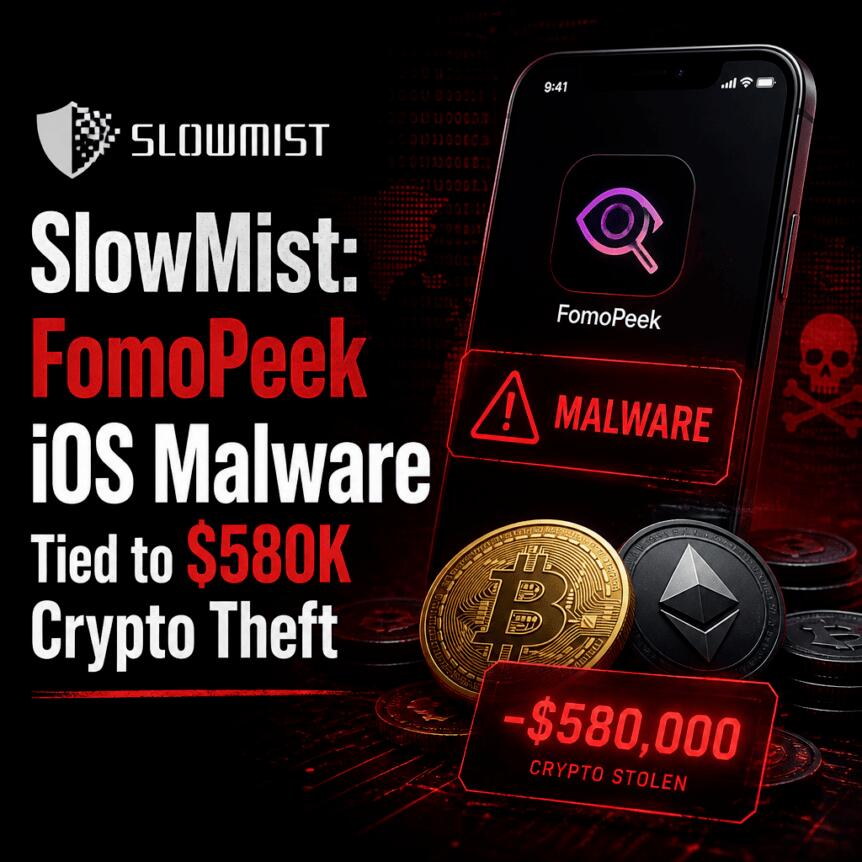
Apple’s App Store has once again been used as a delivery channel for a crypto theft operation. According to an investigation by blockchain security firm SlowMist, a malicious iOS app named FomoPeek was linked to nearly $580,000 in stolen crypto, with the attackers using kernel-level exploits to break out of Apple’s sandbox and reach sensitive wallet data.
SlowMist says the compromise targeted specific app versions, while a later release removed the malicious components. The incident highlights a persistent risk for mobile users: even when an app is distributed through official stores, flaws at the operating-system level can enable attackers to access data that should remain protected.
Key takeaways
- SlowMist links FomoPeek to about 579,984 USDT stolen after the app contained kernel exploits capable of escaping iOS sandbox protections.
- Only certain versions were affected: SlowMist points to releases on Sept. 9 and Sept. 12, with version 1.3 released on Sept. 17 removing the malicious modules.
- The malicious code targeted protected data: researchers report access to iOS Keychain data and files belonging to other apps.
- Onchain tracing shows cross-network movement: funds were routed through multiple blockchains and later consolidated through several addresses and services.
What SlowMist found inside the FomoPeek app
In its threat intelligence analysis, SlowMist said FomoPeek included multiple malicious modules designed to exploit iOS vulnerabilities. The goal, according to the report, was to gain elevated privileges and escape the constraints of Apple’s application sandbox.
Once the app achieved this elevated access, SlowMist reports it could reach Keychain data as well as files belonging to other apps. For users, that matters because Keychain entries often store credentials and other sensitive material used by wallets and related services—data that normally remains isolated from third-party applications.
SlowMist said the malicious components were part of the app releases issued on Sept. 9 and Sept. 12. The firm added that version 1.3, released on Sept. 17, removed the harmful elements.
Release timing and the window of exposure
SlowMist’s timeline indicates the attack depended on users installing (or keeping) the affected FomoPeek versions rather than a permanently compromised build. The firm said its investigation began after it received reports from users who experienced asset theft and confirmed that at least some of those users had installed one of the vulnerable releases.
This distinction is important for practical risk management. Even if a malicious app is later patched or sanitized, the harm can already be done during the earlier window—especially when the app can exploit kernel weaknesses and access protected data. For mobile users and wallet operators, the lesson is that version-by-version scrutiny can be just as critical as store-level distribution.
Exploit framework details and affected iOS ranges
SlowMist said the exploit framework it observed featured eight attack methods. The report describes intended support for a broad set of iOS versions, including 12.0 to 18.7.2 and 26.0 to 26.1.
The breadth of those ranges underscores why kernel exploitation is so difficult to contain. When an attacker can target multiple configurations, the same malicious app can potentially work across a larger portion of the installed base, increasing the likelihood of successful compromise.
Onchain analysis: nearly $580,000 in stolen crypto
Beyond the app-side findings, SlowMist analyzed the associated blockchain activity. The firm identified a primary hacker address tied to the incident that received approximately 579,984 USDT.
According to SlowMist, the address became active on Sept. 15—after the initial affected releases—suggesting the theft activity followed the period during which users could have installed vulnerable versions. SlowMist further said the stolen funds were spread across multiple blockchain networks before being consolidated through additional addresses and services.
SlowMist reported that portions of the funds were routed toward services including FixedFloat, KuCoin, and cce.cash, while other portions were dispersed through additional addresses that the firm continued to trace.
For investors, traders, and compliance teams, this pattern is typical of efforts to obscure fund trails: attackers frequently move value across networks, fragment flows through intermediaries, and then consolidate proceeds in ways that make attribution harder.
Attempts to get responses
Cointelegraph said it reached out to Apple, SlowMist, and OKX for comment. The outlet reported that it did not receive a response before publication.
SlowMist’s investigation was conducted together with the OKX security team, according to the report. The collaboration points to how incident response in crypto increasingly blends onchain forensics with software security research—especially when attacks originate in mainstream distribution channels like app stores.
Users who installed FomoPeek on iOS versions before the reported removal on Sept. 17 should consider reviewing wallet permissions and checking whether any accounts show unauthorized activity. The key uncertainty going forward is whether additional malicious versions or related packages exist outside the specific releases SlowMist identified—and whether Apple or the broader mobile security community will accelerate defenses against kernel-exploit delivery through app-store software.
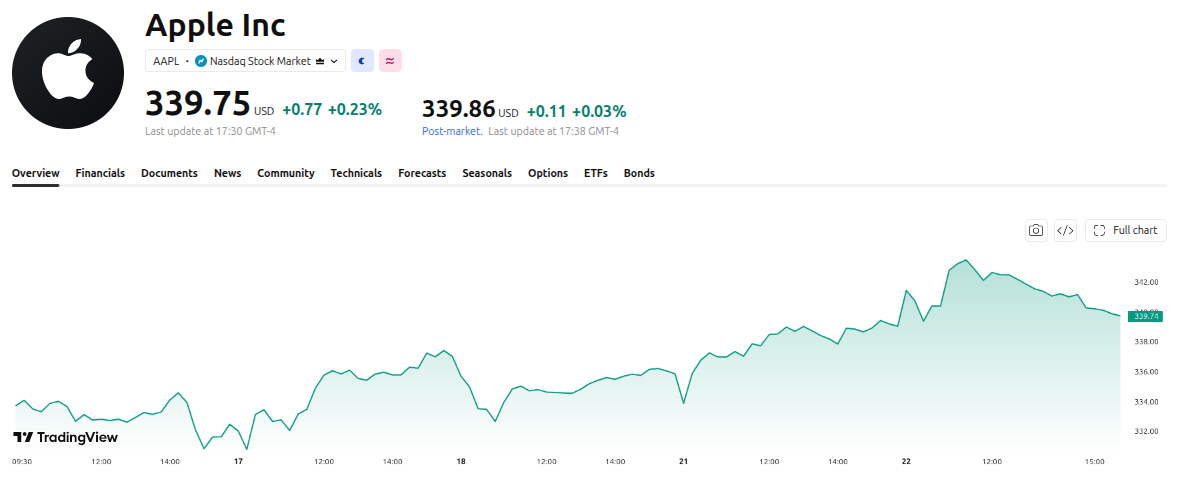
Apple shares reached a fresh all-time high on September 21, 2026. The stock touched nearly $345 intraday before settling near $339.
NVIDIA, meanwhile, trades near record levels, even as its forward valuation multiple has compressed sharply from earlier this year.
What’s Really Driving Apple’s Record-Breaking Rally
A forward price-to-earnings ratio measures a stock’s current price against analysts’ projected future earnings. It offers a snapshot of how expensive a company looks relative to expected growth. That distinction matters for understanding what’s happening between these two tech giants right now.
Apple’s rally reflects renewed confidence in its hardware and services ecosystem. Strong demand for the latest iPhone models, particularly the iPhone 18 Pro and the upcoming foldable iPhone Duo, has extended delivery times and lifted upgrade-cycle expectations.

Improvements to on-device Siri AI and a smooth CEO transition have further reassured investors that Apple can monetize artificial intelligence without the massive capital spending required by hyperscalers.
The stock has climbed more than 36% over the trailing 12 months, according to TradingView data, pushing its market cap above $5 trillion.
Services revenue and high-margin software continue expanding Apple’s cash-generation machine, giving investors a steadier growth story than many of its AI-exposed peers currently offer.
Follow us on X to get the latest news as it happens.
Why Has NVIDIA’s Valuation Compressed So Much?
NVIDIA’s fundamentals remain exceptional on paper. Recent quarterly revenue exceeded $96 billion, up more than 100% year over year, with data-center sales driving the bulk of that growth.
Yet NVIDIA’s forward price-to-earnings ratio has fallen sharply from levels above 25x earlier this year, even as shares trade near record territory.
Investors appear to be pricing in risks around potential slowdowns in AI capital expenditure, competition from custom chips, memory-cost pressures, and the sheer scale of expectations already embedded in current forecasts.
This de-rating has occurred even as NVIDIA shares remain well above prior-year levels and are still up meaningfully in 2026. The stock simply hasn’t kept pace with the explosive rise in its own earnings power, creating a valuation gap rarely seen for the company in recent years.
The divergence highlights two very different investor mindsets at work. Apple is being rewarded for steady, high-quality growth and capital discipline. NVIDIA is being scrutinized for whether its extraordinary growth rate can hold, even though that growth remains genuinely robust today.
Whether NVIDIA’s more modest multiple represents a buying opportunity or an early warning will likely depend on upcoming hyperscaler earnings and capital-spending guidance in the months ahead.
Subscribe to our YouTube channel to watch leaders and journalists provide expert insights
The post Why Is NVIDIA Getting Cheaper While Apple Hits New All-Time Highs appeared first on BeInCrypto.
A malicious iOS app distributed through Apple’s App Store has been linked to nearly $580,000 in stolen crypto after researchers found it contained multiple kernel exploits capable of escaping Apple’s sandbox and accessing sensitive wallet data.
According to an investigation published by blockchain security firm SlowMist, the app, called FomoPeek, introduced two malicious modules that could exploit iOS vulnerabilities, gain elevated privileges and access Keychain data and files belonging to other apps.
SlowMist said the affected versions were released on Sept. 9 and Sept. 12, while version 1.3, released Sept. 17, removed the malicious components.
SlowMist said its investigation, conducted with the OKX security team, began after it received reports from users who had suffered asset theft and found that some had previously installed the affected FomoPeek versions.
The exploit framework included eight attack methods and declared support for iOS versions ranging from 12.0 to 18.7.2 and 26.0 to 26.1.
SlowMist’s onchain analysis identified a primary hacker address associated with the incident that received about 579,984 USDT. The firm said the address became active on Sept. 15 and that the stolen funds involved multiple blockchain networks before being consolidated and transferred through several addresses and services.
SlowMist said portions of the funds were transferred toward services including FixedFloat, KuCoin and cce.cash, while other funds were dispersed through additional addresses that the firm continued to trace.
Cointelegraph reached out to Apple, SlowMist and OKX for comment but did not receive a response before publication.
Related: Hugging Face hack exposes the open-weight AI cybersecurity paradox


US President Donald Trump previously tapped David Sacks as his AI and crypto czar before Sacks stepped down from the role earlier this year after reaching his service limit as a special government employee.
CryptoQuant CEO Ki Young Ju has laid out what he expects from Bitcoin’s (BTC) current bull cycle. He also sees the following bear market as different from past ones.
Ju ties that outlook to a change in who owns Bitcoin and the kind of capital it now attracts. His outlook arrives with the asset trading near its highest level since January.
Ju Reads a Calmer Cycle in the On-Chain Data
Ju expects gains of 3 to 5 times this cycle rather than another 10x-plus parabolic rally. A gentler bear market would follow, in his view.
He credited Bitcoin’s larger market and growing institutional ownership. Retail hot money, he noted, powered past cycles and their 80% crashes.
Ju pointed to on-chain data as support. The Market Value to Realized Value (MVRV) ratio never fell below 1 this cycle.
“Some investors took losses, but holders as a whole never went underwater,” he said. “Even the PnL Index’s 365-day moving average, which typically lags at turning points, is forming a meaningful inflection right now.”
Ju also flagged a rise in realized cap and a halt in selling by OG whales. Futures whales, meanwhile, built large long positions near the bottom.
“None of this means Bitcoin has a ceiling. It means the trade-off has changed. Giving up the 10x parabola also means giving up the 80% crash, and that is exactly what invites patient, long-horizon capital instead of hot money,” he wrote.
Follow us on X to get the latest news as it happens
Doing the Math From Bitcoin’s June Low
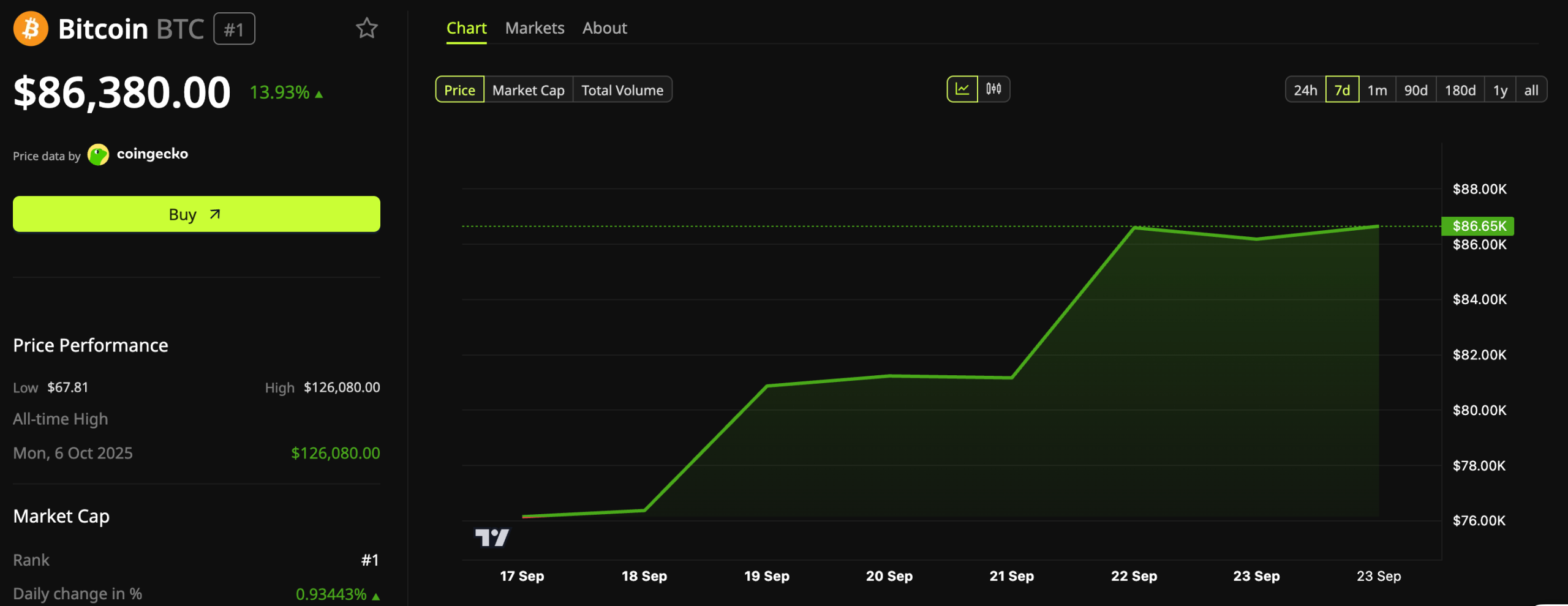
Bitcoin’s September rally gives his view some footing. The asset reached $87,395 on September 21, its highest price since late January.
That move followed Bitcoin’s first weekly close above the 50-week moving average since November 2025. Galaxy’s Alex Thorn has described reclaiming that average as strong confirmation of past bear market lows.
Before that close, Bitcoin had traded below the average for 45 straight weeks. The lowest point of that stretch came in late June, when the price fell to near $58,000.

Bitcoin has since gained about 49%, trading at $86,380 by press time. Measured from those lows, a 3x move would equal roughly $174,000, about 38% above the $126,080 record from October 6, 2025.
A 4x move would equal about $232,000, and a 5x move would equal about $290,000. Those levels fall between two calls from VanEck’s Matthew Sigel, who has forecast $100,000 for next year and $500,000 by 2029
Subscribe to our YouTube channel to watch leaders and journalists provide expert insights
The post The 10x Bitcoin Rally Isn't Coming. CryptoQuant CEO Predicts a Calmer Cycle appeared first on BeInCrypto.
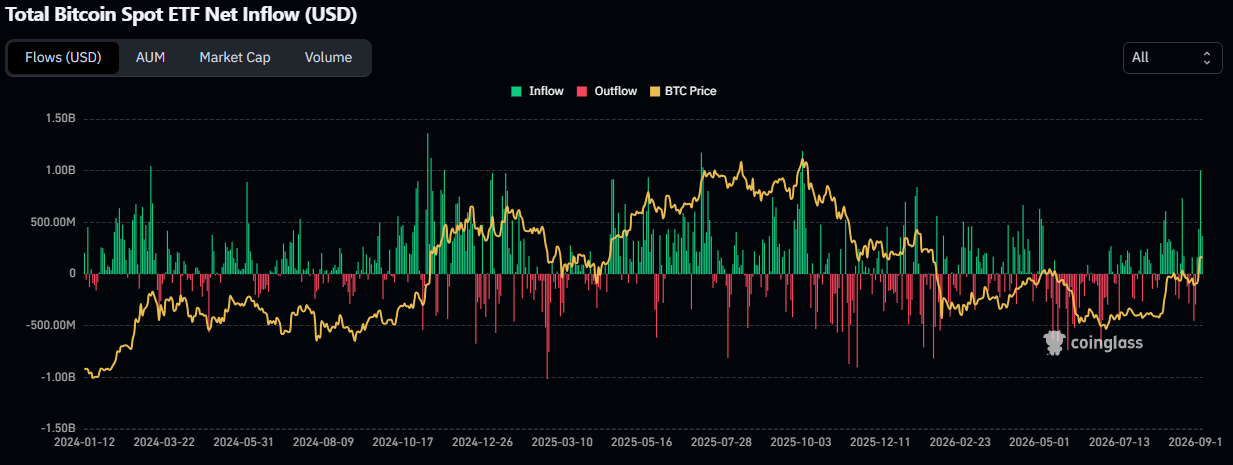
Bitcoin (BTC) exchange-traded funds (ETFs) absorbed nearly $1 billion on Monday, Sept. 21. But BTC had already jumped earlier that day on a short squeeze, CoinGlass data shows.
Bitcoin briefly topped $84,000 that day, its first trip to that level since Jan. 31. The move liquidated $262.3 million in short positions within an hour.
The Squeeze Came Before the ETF Money
That timing raises a real question about which move actually came first. Spot ETF flows are reported once daily, reflecting trades placed during the US cash session, which opens hours after Asian and European markets are already trading.

BTC’s climb came from the day’s short squeeze, which had already pushed the price higher before any same-day ETF buying could take place. That sequence suggests the derivatives market, not ETF demand, supplied the initial spark.
Outflows in the Dip, Inflows in the Rally
This would not be the first time flows tracked price rather than leading it. Spot Bitcoin ETFs posted net outflows on five of six trading days between Sept. 9 and Sept. 16, per CoinGlass. BTC was pulling back over that stretch.
Flows didn’t turn sustainably positive again until Sept. 17, when BTC’s price resumed climbing. Cumulative inflows have since topped $56.98 billion, and total net assets across all Bitcoin ETFs now stand at $107.86 billion.
Fund concentration tells a similar story. The BlackRock iShares Bitcoin Trust (IBIT) holds 785,640 BTC. That’s more than four times the 176,510 BTC held by the Fidelity Wise Origin Bitcoin Fund (FBTC). That single dominant fund looks more like capital chasing a trend than broad, independent conviction buying.
Flows May Not Spark the Rally, But They Can Extend It
None of this means ETF demand is irrelevant. Creating new ETF shares requires market makers to buy real BTC. So sustained inflows can still add real buying pressure to a rally already underway, even without starting it.
The data available cannot settle whether ETFs are capable of starting a rally on their own. What it shows for this leg is that the futures market moved first, and Wall Street’s money showed up after.
The post Bitcoin ETFs Pull In $1 Billion Monday: Are They Driving This Rally or Chasing It? appeared first on BeInCrypto.
Crypto World
Solana starts testing upgrade that could cut finality from 12.8 seconds to 150 milliseconds

A planned upgrade to make Solana even faster has moved to a testnet, where developers will try to cut the time a payment takes to become irreversible from about 13 seconds to 0.15 seconds.
That moment is known as finality. Exchanges wait for it before crediting deposits, bridges wait before releasing money on another blockchain and merchants need it to know that a payment cannot be taken back.
The upgrade, called Alpenglow, is now being introduced on Solana’s public test network, a copy of the blockchain that uses tokens with no monetary value. Developers can test the migration, find problems and restart the network without putting users’ money at risk.
Solana currently uses a system called TowerBFT to reach consensus, the process through which validators agree on which transactions belong in the permanent record. Validators record their votes on the blockchain and stack enough of them across 32 slots before a block becomes final.
Alpenglow replaces that system with a voting protocol called Votor. Validators send votes directly to one another and can settle on a block after one or two rounds, removing the long chain of onchain votes.

LBank Market Depth: How It Compares With Six Major Crypto Exchanges

Asiad 2026: India’s eFootball medal hopes dashed by bizarre forfeit | Asian Games 2026

GoldenEye 007 Runs on Super Nintendo in Retroports’ Super FX2 Dam Test




-

 Fashion5 days ago
Weekend Open Thread: Talbots – Corporette.com
-

 Tech2 days ago
Researchers escape OpenAI Codex sandbox to run commands on host
-

 Crypto World4 days ago
Circle launches Arc Studio AI agent for building onchain apps
-
 NewsBeat4 days ago
Trump says US has reached an agreement to take permanent control of Greenland’s security
-

 Crypto World2 days ago
Who Needs CLARITY Anyway? ARB Could See 70X Increase: Hodler’s Digest
-

 Crypto World4 days ago
Bitcoin price breaks channel as RSI climbs to 63
-

 Crypto World4 days ago
Trading Bitcoin on Robinhood? Why 2% Spread Has Traders Worried
-

 Crypto World6 days ago
US Charges Robinhood Engineers Over Crypto Listing Trades
-

 Crypto World4 days ago
World Money launches in 150+ countries with Stripe
-

 Business2 days ago
Analog Devices (ADI) Bets $1.35 Billion on Chips that Let Machines Think for Themselves
-

 Crypto World5 days ago
Mortgage and refinance interest rates today, Thursday, September 17, 2026
-

 Crypto World5 days ago
Silver prices recover quickly, hitting weekly high today
-

 Crypto World2 days ago
Coinbase, Robinhood, Circle Seen as Tokenized-Stock Winners
-

 Tech5 days ago
GPT-6 Astra Reached the Nether in Minecraft, Lost Its Stash to a Creeper, and Farmed Potatoes for Hours
-
 NewsBeat4 days ago
US was ‘on brink of war’ with China over false AI report of nukes moving in Middle East
-

 Crypto World2 days ago
Bitcoin price holds above $81K as key catalysts line up
-

 Entertainment6 days ago
Grey’s Anatomy Showrunner Teases Changes After Cast Exits
-

 Crypto World4 days ago
CFTC sends crypto market structure rulemaking to White House
-
 Crypto World1 day ago
Meta Jumps 11% As Muse Shines and Investors Show an Appetite for Advancing AI
-

 Business5 days ago
Newsom accelerates AI oversight, advances ‘kill switch’ plan
You must be logged in to post a comment Login