Crypto World
Explore the most cutting-edge non-custodial crypto wallets of 2026

“In 2026 and thereafter, Non-Custodial Wallets Will Be Critical to Your Strategy.”
Think of two users:
User A stores all of their cryptocurrency on the exchange and third-party services.
User B has complete control of their private keys, can automate DeFi strategies, and connects directly to Web3-native solutions.


This elucidates the reason why non-custodial crypto wallets are becoming so important to the infrastructure market –
“Retail as well as large-scale crypto users are demanding it because of its expected benefits.”
They are no longer a fringe technology; they are now becoming part of the foundational structure—as significant as your identity access management, treasury systems, and security keys.
According to industry research studies, the non-custodial wallet industry will be approximately $1.5-2.5 billion by the year 2026, and the anticipated growth rate over the next decade is expected to be very high as well, often exceeding 20-25% compound annual growth rate (CAGR), varying by report methodology.
Various recent studies show that the bulk of all cryptocurrency wallets being used today are self-custodial, indicating a growing trend toward individual control over assets and financial transactions as a whole.
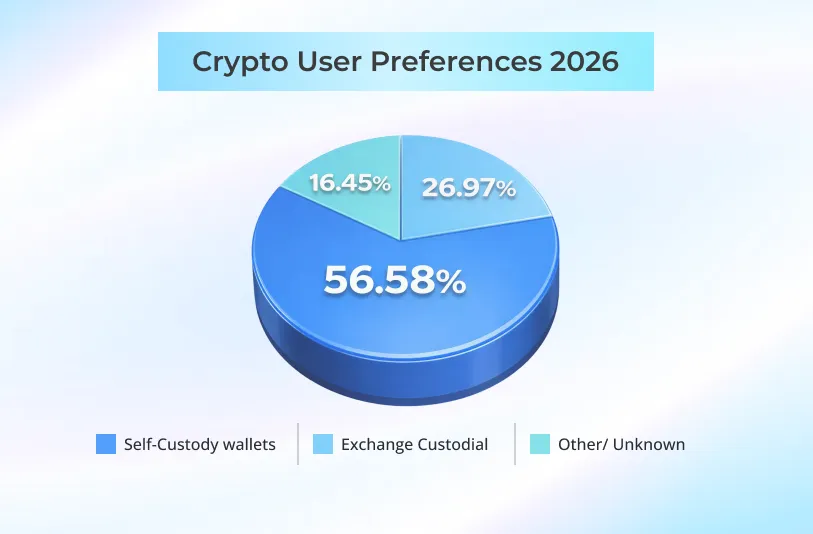

Source: https://coinlaw.io/self-custody-wallet-statistics/
For enterprise leaders currently planning to roll out their own Web3 crypto wallet, the extreme diversity of self-custodial wallet options — from hardware air-gapped wallets to smart contract-based wallets — presents an important question:
- What trends and tactics should your enterprise’s wallet strategy look at moving forward?
Now that we have defined an overall strategic environment, let’s look at the wallets that you came to evaluate.
A Look at Today’s Peak Value Non-Custodial Crypto Wallets
Here, we will analyze the top self-custodial wallets of 2026, not just simply by looking at a list of ‘features,’ but instead from an enterprise perspective: how relevant is each wallet’s use case for you? What security models do they utilize? How do they compare in the overall ecosystem, and how can developing similar wallets give you a competitive advantage?
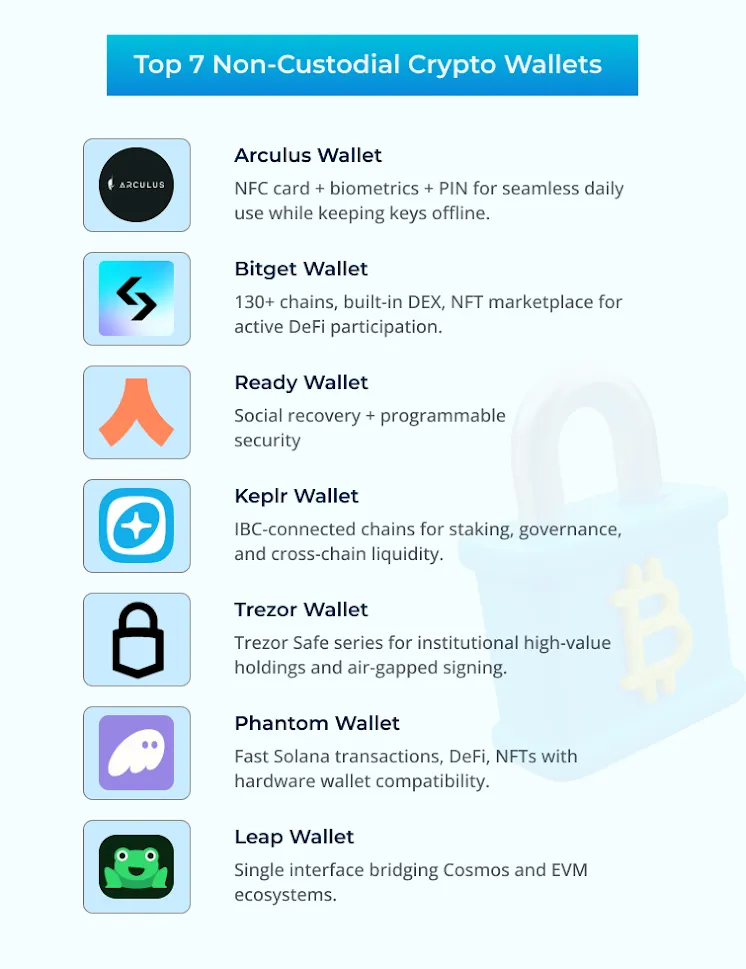

1. Arculus Wallet
The Arculus wallet offers a unique solution for securing digital assets.
The Arculus card, using NFC technology, connects to the user’s smartphone through an app. The private keys are stored offline on the card.
As a result, consumers are able to use the wallet daily without handling private keys or seed phrases frequently (though a one-time recovery phrase is generated at setup).
To use crypto in day-to-day use, the users will be required to first unlock the app using biometrics, enter their 6-digit PIN when prompted, and then tap their NFC-enabled Arculus card against the back of their phone.
For enterprise teams, launching an Arculus-like wallet will provide the following merits:
- When a user’s interaction with their wallet is limited to their hardware card or application, the user’s exposure to their written seed phrases (physically/electronically stored) or chances of losing possession of the seed phrase during routine usage (such as for migrating devices or support issues) are greatly reduced.
- It helps facilitate an authentication consumer experience that feels similar to existing payment processes with a physical card plus phone journey.
- A physical NFC-enabled card that functions as a hardware wallet helps maintain mobile accessibility.
The Rationale Behind This Trend:
Self-custodial wallets like Arculus aim to minimize how often users must interact with their recovery phrase and front-load their access using hardware, digital PIN numbers, and biometric means.
Why This Is Important for You:
Reimagining how users store their keys and recover them can potentially lead to new user experience innovation opportunities; your goal should not be to replicate other wallet solutions; rather, you should focus on solving the challenges that users face with current wallets.
2. Bitget Wallet
The Bitget Wallet is a multi-chain wallet with a built-in DEX aggregator that offers customers access to NFT marketplaces, too, where they can buy, sell, and trade. This non-custodial crypto wallet provides multiple DeFi integrations with support for 130+ chains (Ethereum, Solana, Polygon, etc.) – hence encouraging direct user participation in the broader ecosystem.
Bitget Wallet is designed with integrative value for users, providing an aggregated view of assets and activity across EVM networks, non-EVMs’ Layer-1, and Layer-2 chains.
DEX integrations reduce time lost switching between applications.
MARK
Native NFT marketplace support is valuable for targeting users pursuing content ownership, loyalty rewards, and digital goods strategies.
Critical Insight For Web3 Wallet Businesses
Based on projections of future digital wallet usage, white label crypto wallets that combine the functions of “secure storage” and “active finance”—trading, staking, liquidity participation, and governance—will be the most successful in helping you capture long-term adoption.
3. Ready Wallet (formerly Argent)
Ready is typically characterized as an Ethereum-focused smart contract wallet, with the goal of improving user experience by incorporating concepts like social recovery, programmable security, and DeFi-compatible functionality.
Specific features that align with this are
- The use of social recovery methodologies leads to lower total cost of support due to being more streamlined than traditional recovery methods that only rely on seed phrases.
- Programmable security through policy-based controls (e.g., daily transfer limits, whitelisted addresses, and other guardrails) provides a clear, consistent, and adaptable level of protection for wallet operations.
- Native capabilities for staking on L2 systems and connection to DeFi protocol features cement the idea that the wallet is intended to serve as a facilitator of financial actions.
Enterprise Lens
Crypto wallet development with account abstraction and configurable defense will become a critical enabler of automated financial flows within Web3-based applications.
4. Keplr Wallet
Keplr is one of the major wallets used by those actively engaged with the Cosmos ecosystem. It is a self-custodial hub for IBC-connected chains.
In addition to participating in staking and governance on their native protocol, consumers can move value in a multitude of ways between other Cosmos chains as well as across the entire Cosmos ecosystem.
Web3 leaders need to take notice of what this can mean for your audience if you engineer a Keplr-grade wallet:
- A way to engage on a large scale in governance (both as validators and via delegations in DAO votes) rather than relying on ad hoc participation.
- When linking to other blockchain networks, IBC-enabled assets allow for a higher level of liquidity movement & redirection.
- This will be possible using a method that does not require customers to retain custody of their relevant assets on any one blockchain within the Cosmos universe.
A Signal To Watch
As cryptocurrency wallet development initiatives continue to create more tools and data services over diverse Cosmos blockchains, wallets that promote interactivity & interoperability among users will spur the ongoing development of both DeFi & app-specific chains.
5. Trezor Wallet
Hardware wallets are becoming an integral part of many institutions’ high-security operations, and Trezor wallets (Trezor Safe 3, Trezor Safe 5, Trezor Safe 7) are considered to be one of the best non-custodial hardware wallets available for the safe storage of numerous types of digital assets.
Trezor offers high-security, isolated keys that can be stored offline and are ideal for longer-term or treasury-type holdings.
- The ability to integrate with a desktop suite and 3rd party applications helps facilitate policy enforcement & audit workflows.
- Offline signing adds a strong security shield for high-value or high-risk transactions.
A Thought to Carry Forward
Security professionals often refer to hardware security modules, cold wallets, and air-gapped signing technology when it comes to developing treasury-based wallet systems.
Get Your Enterprise’s Crypto Wallet Launch Checklist Now
6. Phantom Wallet
Phantom is one of the premier decentralized wallets for the Solana ecosystem. It provides people with a non-custodial wallet experience with all of the key features for staking. interacting with DeFi directly within the wallet and managing NFTs while prioritizing UX.
This wallet product is compatible with hardware wallet integrations, adding extra security for end-users.
Why should you care?
- Solana wallets serve as transaction engines that empower high volume, low fees, and fast settlement.
- Enterprise use cases include gaming and loyalty programs, payroll experiments, and cross-chain financial services.
An Industry Cue
Solana-centric crypto wallet development as a whole is increasing in volume and velocity across multiple verticals; thus, the trend is towards active wallet activity instead of passive storage.
7. Leap Wallet
Leap Wallet supports both the Cosmos network and the EVM environment, enabling users to bridge the gap between these two through a single interface.
The Core Message
Wallets that reduce their operational footprint across Cosmos + EVM or other multi-technology stacks will position themselves for success when catering to corporate clients willing to adopt seamless workflows.
Decoding 2026’s Self-Custodial Wallet Success Codes – X-Factors Enterprises Can Use
| Wallet | Core Trend | Build Inspiration For You | Security Innovation |
|---|---|---|---|
| Arculus | NFC mobile payments | Card+phone UX like traditional finance | NFC card + biometrics + 6-digit PIN |
| Bitget | Multi-chain DeFi hub | DEX aggregator eliminates app switching | Unified risk control across 130+ chains |
| Ready | Account abstraction | Social recovery cuts support costs | Programmable security through policy-based controls |
| Keplr | Cosmos interoperability | IBC enables governance at scale | Security-hardened IBC cross-chain liquidity hub |
| Trezor | Institutional cold storage | Air-gapped treasury operations | Offline hardware isolation |
| Phantom | High TPS transaction engine | Solana gaming/loyalty enablement | Hardware wallet compatibility |
| Leap | Multi-stack unification | Single UI for Cosmos+EVM workflows | Fail-safe cross-ecosystem bridging |
Conclusion: The wallet is not the ultimate objective; it’s just the base level
If your organization is creating a non-custodial wallet & you are currently or will be looking for the ideal technical or product partner to help you achieve your vision for your project, make sure they help you navigate the security, compliance & UX trade-offs first.
Whether you want to create crypto wallets like the ones discussed above or want to create an AI smart crypto wallet with features like cross-chain composability, physical key storage, reg-ready governance core, or customized functionalities, Antier’s properly designed tech stack will help you craft a top-tier solution. That would grow into a durable component of your Web3 infrastructure, not just an application included in your product portfolio.
Schedule a tactical meeting to architect a self-custodial wallet product with the potential to be in a league of its own.
Frequently Asked Questions
01. Why are non-custodial wallets becoming critical for cryptocurrency users?
Non-custodial wallets are essential because they provide users with complete control over their private keys, enabling automation of DeFi strategies and direct connections to Web3-native solutions, which are increasingly demanded by both retail and large-scale crypto users.
02. What is the projected market size for non-custodial wallets by 2026?
The non-custodial wallet industry is expected to reach approximately $1.5-2.5 billion by 2026, with a high anticipated growth rate often exceeding 20-25% compound annual growth rate (CAGR).
03. What factors should enterprises consider when developing their own Web3 crypto wallet strategy?
Enterprises should evaluate the diversity of self-custodial wallet options, the relevance of each wallet’s use case, the security models they utilize, and how developing similar wallets can provide a competitive advantage in the overall ecosystem.