
Crypto World
FalconX Integrates Interstice to Connect Canton to Ethereum, Solana

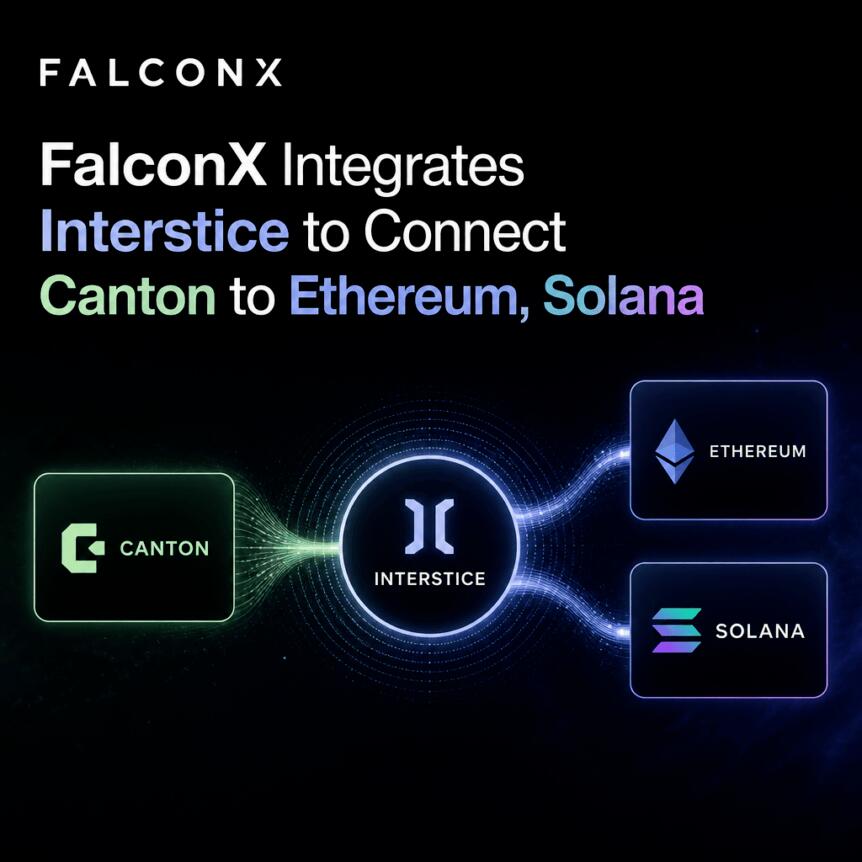
Interstice Digital has launched a non-custodial cross-chain swap engine intended to move tokenized assets between the Canton institutional blockchain and major public networks, including Ethereum and Solana, with support for Robinhood Chain. The company says the system is designed so Interstice does not take custody of users’ funds and does not submit transactions on their behalf.
Instead, the announcement highlights FalconX, a digital asset prime brokerage for institutional clients, as the liquidity provider behind the engine. Interstice frames the integration as a way to connect Canton’s institutional tokenization activity with on-chain liquidity and trading access on public blockchains.
Key takeaways
- Interstice’s cross-chain swap engine is described as non-custodial, with users retaining control rather than Interstice executing trades.
- FalconX is positioned as the liquidity layer supporting swaps between Canton and public networks such as Ethereum and Solana.
- Canton is built for regulated, institutional use, with privacy and permissioning controls aimed at compliant tokenized settlement.
- The launch does not specify which assets are supported initially or provide usage or transaction-volume figures.
A non-custodial route between Canton and public liquidity
According to Interstice’s Tuesday announcement, the swap engine is intended to enable asset transfers across four networks: Canton, Ethereum, Solana, and Robinhood Chain. The core promise is operational: swaps can be performed without Interstice taking custody of assets or acting as the direct transaction executor for users.
For institutions and tokenization platforms, that distinction matters because custody and execution control can shape risk management requirements, compliance reviews, and operational workflows. While the announcement confirms Interstice’s role is limited to providing the infrastructure, it does not disclose further implementation details such as the exact mechanism by which routing and execution occur or which asset types are immediately supported.
FalconX’s involvement is central to Interstice’s approach. The prime brokerage is described as providing liquidity for the engine, with the stated aim of giving users a path between tokenized assets on Canton and liquidity available on public chains. In practice, this kind of integration can reduce friction for moving exposure between an institutional settlement environment and the broader, liquid ecosystems of public blockchains—particularly where counterparties and market makers operate primarily outside permissioned networks.
Canton’s institutional positioning is expanding
Canton is a public blockchain built with institutional finance in mind, featuring privacy and permissioning controls for regulated transactions and tokenized assets. Interstice’s announcement connects the swap engine to this broader Canton narrative: bringing more access to tokenized assets and settlement while enabling interaction with the trading activity of public chains.
The ecosystem has already attracted traditional financial institutions. The article notes that Canton’s partners include major banks and market participants such as JPMorgan, Goldman Sachs, and BNP Paribas.
Interstice’s integration arrives alongside additional signals that institutional tokenization activity on Canton is accelerating. In July, electronic trading platform Tradeweb executed an onchain US Treasury trade on Canton, according to earlier coverage. The described transaction involved Franklin Templeton transferring a tokenized Treasury security to Virtu Financial in exchange for tokenized cash. Tradeweb said it was the first real-time purchase and sale of a tokenized US Treasury settled against USDCx—a USDC-backed stablecoin issued on Canton—with other participants including Societe Generale, Digital Asset, and Blockdaemon. Tradeweb’s role was execution and price discovery, while Canton synchronized settlement between the two tokenized assets in real time.
Additional deployments mentioned in the coverage include Societe Generale’s euro- and dollar-denominated stablecoins on Canton for tokenized collateral, repo financing, and institutional settlement. Separate reporting also indicates Visa has tested private stablecoin settlement on the network, and other efforts include a Japanese government bond collateral pilot involving Mizuho and Nomura, along with S&P Dow Jones Indices placing its iBoxx US Treasuries Index on Canton.
Why the swap engine matters for tokenized markets
Cross-chain capability is increasingly important to institutional tokenization because value often needs to move between different environments—permissioned settlement rails on one side and public-chain trading venues on the other. Interstice’s swap engine is designed specifically to address that gap by providing a “route” between Canton tokenized assets and liquidity on chains like Ethereum and Solana.
The announcement’s non-custodial framing also reflects a practical concern for regulated users: who controls assets during exchange. Even when cross-chain tools are technically capable, the operational control model can be a deal-breaker for institutions that must satisfy internal risk committees. By stating that Interstice does not hold custody and does not execute transactions on users’ behalf, the company is signaling a reduced intermediary role compared with custodial bridge designs.
Still, readers should note what remains missing from the public description. Interstice did not disclose which assets are supported at launch, and it did not provide transaction volume figures. Those details can heavily influence how quickly liquidity fragments or how the system behaves under real market conditions, especially if initial support is limited to a small set of tokenized instruments or stablecoins.
Another factor to watch is how liquidity provided through FalconX translates into effective pricing and routing across chains. While the announcement confirms FalconX is supplying liquidity, it does not specify whether the liquidity model is tied to specific market makers, whether swaps are routed through particular venues on public networks, or how spreads may vary depending on supported pairs.
What to watch next
The next checkpoints are likely to be practical rather than theoretical: which assets Interstice supports first on the engine, how users integrate it into existing Canton workflows, and whether the system expands institutional tokenization’s reach into public-chain liquidity without introducing new operational complexity. For now, the launch adds another infrastructure layer to Canton’s institutional ecosystem—but the market will want clarity on real-world usage and supported token coverage.



This year, TIME and Statista have published the first edition of America’s Best Incubators and Accelerators 2026. It identifies the most outstanding hubs offering incubator and accelerator programs in the United States, based on a multi-stage research process combining an open application, structured alumni feedback, track record analysis, and expert recommendations.
Methodology
The process began with an application phase running from January to April 2026. TIME published an announcement article, and the call for entries was promoted across social media channels and shared by InBIA, a global nonprofit organization focused on advancing entrepreneurship and supporting innovation ecosystems. In addition, Statista independently identified several hundred potential candidates through databases and other publicly available sources and invited them to participate via email and LinkedIn. To be eligible, incubators and accelerators had to be physically located in the United States, offer at least one incubation or acceleration program, and have been in operation since at least 2022. During the online registration, participants provided general information about their organization, including the number of employees and the number of startups or alumni per program cohort, along with contact details.
Following the registration phase, all eligible incubators and accelerators were asked to reach out to their alumni who had participated in programs between 2020 and 2025. More than 2,000 alumni responded and evaluated their experience. Each alumnus provided a general recommendation on a scale from 0 to 10 and rated six specific aspects on a scale from 1 to 5, with an additional “not relevant” option. These aspects covered Mentoring & Training, Infrastructure, Legal Assistance, Funding Opportunities, Networking Opportunities, and Business Development Advice. Furthermore, alumni answered questions about the application process, funding, and post-program support.
Statista also reviewed publicly available information and data on the track record of incubators and accelerators, that were evaluated by their alumni, specifically with regard to the five most successful startups that had participated in one of their programs. This information was collected through desk research using official and publicly available sources, including organization websites, public presentations, and online media articles. Where justified by the available data, these organizations were also included in the ranking.
The data collected was then analyzed to produce four distinct subscores. The general alumni recommendation accounted for 40% of the total score, while the six subcriteria from the alumni evaluations accounted for 45%. The Track Record Score was derived from information that incubators and accelerators provided about the top five startups that had participated in one of their programs. The Expert Score was based on recommendations from startup investors and entrepreneurs who were asked to name the Incubators and Accelerators they know and regard highly.
The final overall score was calculated as a weighted average of these components: the general alumni recommendation contributed 40%, the six alumni subcriteria 45%, the Track Record Score 10%, and the Expert Score 5%. This weighting ensures that the ranking is primarily driven by the direct experience of program participants while also accounting for measurable outcomes and the broader reputation within the entrepreneurial community.
Wall Street fears Nvidia (NVDA) is quietly turning into a bank for the AI boom. Bank of America (BofA) says that fear is exactly why Nvidia stock trades at up to a 50% discount, and it kept its $350 target.
Analyst Vivek Arya made the call as Nvidia guaranteed up to $105 billion in leases for an OpenAI data center in Ohio. Earnings arrive on August 26.
Why Investors Fear Nvidia’s New Role as AI Financier
On Monday, Nvidia agreed to backstop up to $105 billion in leases at a new Ohio data center campus. SB Energy, a developer backed by SoftBank and OpenAI, will build and own the site.
The campus sits on a Cold War-era uranium enrichment site in Pike County. OpenAI signed a 20-year lease for the facility, according to Nvidia’s announcement.
The worry is easy to grasp. Nvidia sells chips to OpenAI, has pledged to invest up to $100 billion in the company under a 2025 partnership, and now backs its rent. Critics call the money loop circular.
However, Arya says the market is misreading the deal. Nvidia does not guarantee OpenAI’s full rent. It covers only the leftover gap if OpenAI defaults and the site is re-leased or sold. Even then, the bill is capped at $105 billion, well below the $250 billion floated in earlier reports.
There is also a prize for taking that risk. Nvidia becomes the exclusive AI compute provider on the campus, locking rivals out of scarce land and power. CEO Jensen Huang put the logic plainly in the release, saying
“land, power and shell have become vital in the age of AI.”
Follow us on X to get the latest news as it happens
BofA Sees Nvidia Stock at a 34% to 50% Discount
Arya values Nvidia piece by piece on its free cash flow. Even after loading in every financing risk, his math shows the shares trading 34% to 50% below fair value.
“Nvidia’s ecosystem investments, especially into disruptive frontier labs and neoclouds, are critical to accelerating the [artificial-intelligence] cycle, though they risk lower earnings quality and a depressed trading multiple,” said Arya in his latest note.
Neoclouds are smaller cloud firms built to rent out graphics processing units (GPUs). In plain terms, Arya thinks the deals speed up the AI boom, even if they scare shareholders today.
His fix is simple. Nvidia puts only about half of its free cash flow into buybacks, while peers return 75% to 100%. A bigger program would hand cash back, ease doubts about earnings quality, and could lift the multiple.
Wall Street Consensus and the August 26 Test
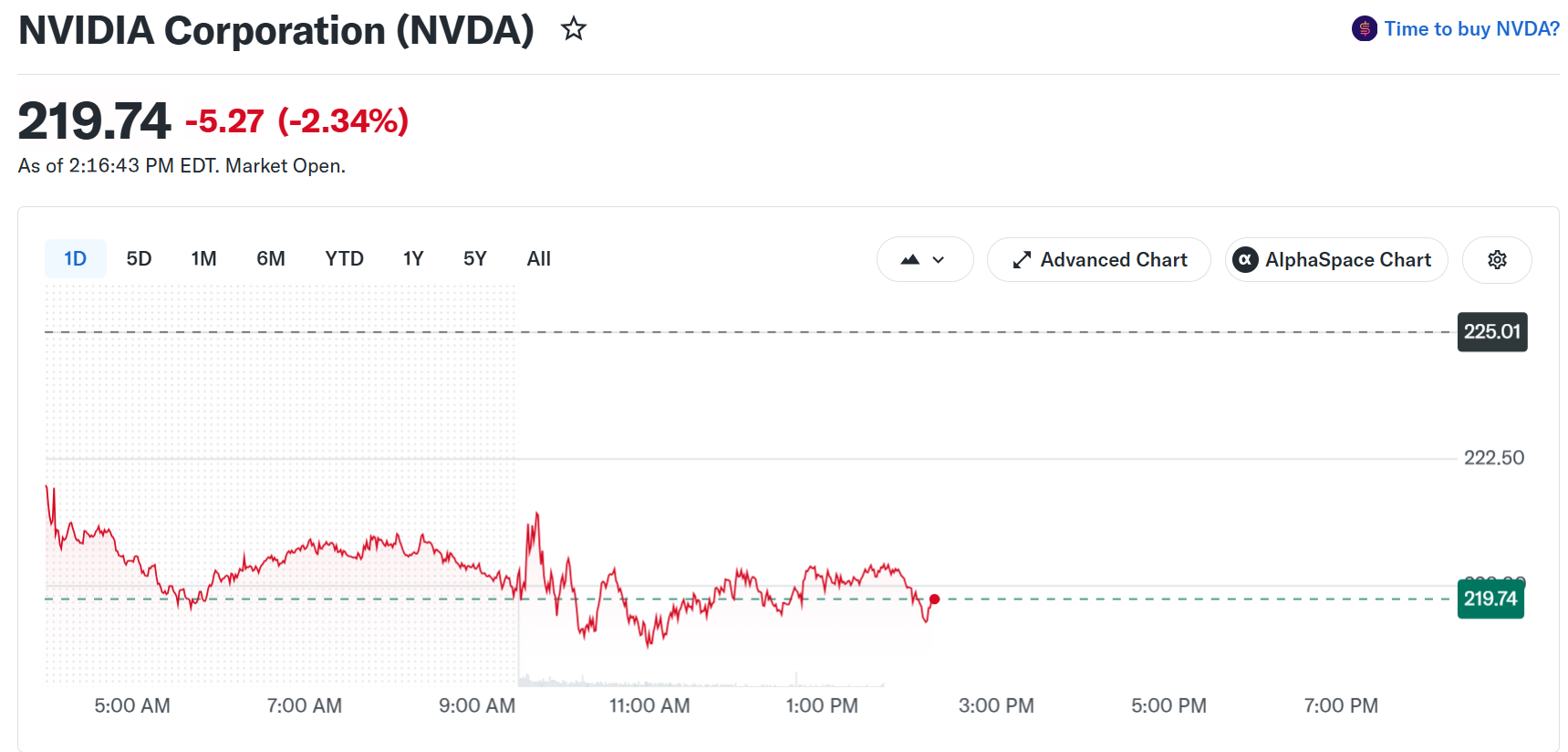
Nvidia stock, NVDA, traded for $219.74 as of this writing. A run to $350 means roughly 59% upside, or about $3 trillion in added value on its $5.45 trillion market cap.

Arya is bullish but far from alone. TipRanks data shows 36 of 37 analysts rate the stock a Buy, with an average target of $309.94. Even the lowest target on the Street, at $250, sits above the current price.

The risks are real, though. If AI demand cools, re-leasing a giant Ohio campus becomes much harder. The stock has also dropped after past earnings six times since August 2024.
Arya expects Nvidia to detail its off-balance-sheet commitments on August 26. If that disclosure lands well, the discount he sees may finally start to close.
The post Bank of America Thinks Nvidia Stock Could Go 50% Higher appeared first on BeInCrypto.

A staff member sorts Kweichow Moutai liquor at a supermarket in Yongnian district of Handan, North China’s Hebei province, Jan 9, 2025.
Cfoto | Future Publishing | Getty Images
BEIJING — Walk down most streets in China and you’ll find a liquor store advertising premium spirits brand Moutai, along with posters of resale prices by vintage year.
It’s a testament to how intertwined the red-and-white-labeled bottles have been with China’s economy in recent decades. The 53% alcohol content “baijiu” was long a staple at government and business dinners for toasts and sealing deals, so much so that Moutai’s stock became a market bellwether.
But the spirits company is now struggling, as China’s business world adapts to the tech-heavy artificial intelligence era.
Kweichow Moutai’s half-year report this month showed a rare drop in net profit, down by 1.95% to 44.5 billion yuan ($6.6 billion). It was the first decline for the first six months of a year since 2014, and only the second such drop based on data going back to 2002, according to Wind Information data.
The latest results followed a decline of 4.5% in net profit for all of 2025 — the first annual decline on record, data showed.
It’s all related to changes in the economic environment, said Ye Yuhua, fund manager at Ba Luo Fund. That’s according to a CNBC translation of Mandarin.
When the real estate sector thrived, there were naturally more scenarios involving premium baijiu consumption, he said. Now with the economic shift to high-end tech, Ye noted the people involved with this emerging industry aren’t as inclined to drink baijiu.
“It’s an irreversible trend,” he said. “Baijiu has become a saturated market.”
China’s anti-corruption crackdown has intensified in recent years, contributing to drag on retail sales. In 2020, Chinese authorities also tightened restrictions on real estate developers’ ability to borrow heavily for growth, clamping down on a construction-heavy sector that had come to determine a quarter of the economy.
Stock drop
Moutai was the largest listed company in mainland China by market capitalization from 2020 to 2023, according to Wind Information data.
Shares briefly fell Monday after the weekend release of its semi-annual financial report, driving its year-to-date losses to 5.7% as of Tuesday. The stock is has declined on an annual basis for four consecutive years.
The half-year report also showed China’s state funds Central Huijin and China Securities Finance, sometimes dubbed part of the “National Team,” were no longer among the 10 largest holders of Moutai stock.
Institutional investor sentiment likely troughed given the exit of Huijin and China Securities Finance from its top 10 shareholders in the second quarter, Citi sad in a report.
The most significant signal from the baijiu company’s latest financial report is that the value of Moutai in business negotiations is shrinking, said Dongfang Li, an independent stock analyst.
However, he pointed out that Moutai’s high 90% gross margin, its profitability and stable dividend continue to attract institutional funds. Li expects institutional allocation to persist.
Citi analysts attributed the decline to the company’s transition from wholesale to direct-to-consumer sales rather than soft demand. The bank maintained its “buy” rating on Moutai.
They expect Moutai to benefit from a recent rotation back into China’s consumer sector, with global long-only investors cautiously returning to high-quality, large-cap consumer staples.
Morningstar similarly said in a report that a mix shift toward direct-to-consumer sales likely distorted Moutai’s payment line, while underlying demand appeared stronger than reported revenue growth. More broadly, it said Moutai is its preferred pick within China’s baijiu sector, citing its competitive position and deepening market-oriented reform.
Shifts to watch
Looking ahead, both Citi and Morningstar mentioned the upcoming Mid-Autumn Festival in their reports. Citi said Moutai may have been incentivized to shift some inventory supply from the second quarter to the third, when the Mid-Autumn Festival falls, to capture the full benefit of its second round of price hikes, which took effect on July 18.
Morningstar, meanwhile, said recent price hikes and seasonally stronger Mid-Autumn Festival sales should support a gradual earnings pickup from the second half. It expects Moutai’s net profit to grow at an 8% compound annual growth rate from 2025 to 2030.
Moutai has implemented two rounds of price hikes for its flagship liquor this year.
Investors, meanwhile, are still waiting for the baijiu market to recover before making strategic moves, said Wenjie Ding, investment strategist for global capital investment at China Asset Management.
She noted ETF data showed net outflows for the better part of this year from food and beverage companies with significant baijiu weighting, although sentiment could have improved modestly this month.
As Beijing has left real estate behind in pursuit of technological development, will Moutai be replaced by another stock as well, signaling a changing of the old guard for good?
Li pointed out that since the beginning of the year, several Chinese tech names have surpassed Moutai in market value at different points. He noted memory chip company CXMT that listed last month has a market capitalization about 2.5-times that of Moutai.
“The market is shifting from the traditional economy’s logic of steady growth to high growth potential and global competitiveness brought about by technological innovation,” he said in Chinese, according to a CNBC translation.

South Korea has decided to block domestic access to Polymarket after authorities determined that its services facilitate activities considered illegal gambling under local law.
The Korea Media and Communications Commission announced on August 18 that its Communications Deliberation Subcommittee had reviewed the platform and approved an access-blocking corrective measure.
South Korea Blocks Polymarket
According to a report by local media, the platform came under scrutiny in South Korea in late May, when police began investigating users on suspicion of gambling. The country’s media watchdog subsequently opened its own review on July 6. In reaching its decision, the commission said Polymarket’s structure, combined with wagers on events outside users’ control, “encourages gambling behavior.”
Polymarket, on the other hand, argued that it was outside South Korean jurisdiction after removing Korean-language services and disabling payments denominated in Korean won. The commission rejected that position and said that technical changes or service methods do not remove a platform’s obligation to comply with domestic law.
South Korea is not alone in restricting Polymarket. France blocked the platform last month over concerns about user losses and potential betting manipulation, while Australia and Germany imposed access restrictions in 2025 after classifying it as an illegal gambling service. More than 30 countries, including Italy, Indonesia, and Argentina, have also blocked or restricted Polymarket.
More Legal Trouble Emerges
The pressure on prediction markets as a whole is also building in the US, although the legal questions vary by jurisdiction. In Baltimore, officials, for instance, have taken aim at both Polymarket and Kalshi.
As reported by CryptoPotato, the city and Mayor Brandon M. Scott filed separate lawsuits on August 13, accusing two platforms of effectively offering sports betting without the licenses required in Maryland. The complaints also allege that both companies presented their products in ways that could leave consumers with the impression that they are legal and properly regulated.
Baltimore argued that calling them “event contracts” or prediction-market trades does not change their underlying nature. The city is seeking penalties, consumer restitution, disgorgement, and other legal remedies. Meanwhile, Kalshi is also facing a separate legal fight with New York officials over its operations in the state.
The post Polymarket Hit With Access Block in South Korea Over Gambling Allegations appeared first on CryptoPotato.


The U.S. Securities and Exchange Commission has proposed two registration exemptions, including a $75 million annual pathway, under its new Reg Crypto framework for certain crypto investment contracts.
Summary
- The larger exemption would allow qualifying issuers to raise up to $75 million in 12 months.
- A separate pathway would permit offerings of up to $5 million across four years.
- The proposal includes a conditional safe harbor and disclosure requirements for participating issuers.
- Stakeholders will have 60 days to submit comments on the proposed framework.
SEC Reg Crypto rules create two offering exemptions
The SEC said in an Aug. 18 press release that Regulation Crypto Assets would establish a tailored framework for certain investment contracts involving digital assets. The proposal follows the Commission’s March 2026 interpretation of how federal securities laws apply to crypto assets and related transactions.
Under the first exemption, an eligible issuer could offer up to $5 million in crypto investment contracts during a four-year period without completing the standard registration process under the Securities Act of 1933. The pathway would provide smaller projects with a route to raise capital while remaining subject to the framework’s conditions.
A second exemption would cover offerings of up to $75 million during any 12-month period. Issuers using the larger pathway would face extra obligations, including financial statement requirements and continued reporting after an offering.
Both routes would require issuers to provide investors with narrative disclosures based on principles specified in the proposed rules. Describing the common requirement, the Commission said issuers would need to make “certain principles-based narrative disclosures” available to their investors.
The SEC has not presented either exemption as an automatic exclusion for all token sales. Each route applies to qualifying crypto investment contracts and depends on compliance with the conditions set out in the proposal. The release does not suggest that every crypto asset or transaction would become exempt from federal securities law.
Before the proposal emerged, the Commission had scheduled an Aug. 14 open meeting to consider the offering framework. The agency later canceled the meeting because of what it called an unforeseen scheduling issue and did not immediately provide a replacement date.
As crypto.news previously reported, the rulemaking package had already entered the White House review process under RIN 3235-AN38 before the meeting was canceled. Its publication now moves the plan into the public rulemaking process rather than putting the exemptions into immediate effect.
Conditional safe harbor could change token treatment
Alongside the two offering exemptions, Reg Crypto proposes a conditional safe harbor from the term “investment contract” within the definitions of a security under the Securities Act of 1933 and the Securities Exchange Act of 1934.
Under the proposal, a crypto asset initially connected to an investment contract could cease to receive that treatment when the arrangement satisfies the safe harbor’s conditions. The framework therefore addresses the legal agreement surrounding a token rather than treating the asset as permanently tied to one securities classification.
The approach follows the SEC’s March interpretation, which addressed when a crypto asset may be sold as part of an investment contract and when that contractual relationship may end. Earlier coverage of the interpretation noted that the SEC and Commodity Futures Trading Commission presented the guidance as a complement to congressional work, not a replacement for legislation.
For U.S. token issuers, the distinction affects how projects could structure fundraising and later transactions. Investors would also receive different levels of information depending on which exemption the issuer uses, with the $75 million pathway carrying financial statements and ongoing reports.
The Commission further proposed overriding state registration and qualification requirements for offers and sales covered by the exemptions. According to the release, the preemption would also reach certain secondary-market transactions that meet the framework’s requirements.
Such federal preemption would reduce the need for qualifying issuers to complete separate securities registration processes in individual states. The proposal would not, however, remove every state-level rule that could apply to a project, because its stated preemption concerns registration and qualification requirements for covered transactions.
SEC rules cannot replace the CLARITY Act
Reg Crypto arrives while the Digital Asset Market Clarity Act remains pending in the Senate. The two measures cover overlapping parts of U.S. crypto policy but rely on different legal routes and do not have the same scope.
Using its existing authority, the SEC can set exemptions and reporting conditions for investment contracts governed by federal securities laws. Congress would have to change the statutory division of authority between the SEC and CFTC or establish a complete market structure regime for digital assets.
The CLARITY Act would address that division by defining categories of digital assets and assigning oversight between the two regulators. Reg Crypto concentrates on securities offerings, issuer disclosures, and the circumstances under which an investment-contract relationship may end.
Recent CLARITY Act coverage reported that the Senate left for its August recess without holding a floor vote. Senate Majority Leader John Thune filed cloture before the break, leaving the chamber to consider the procedural motion after lawmakers return.
The House passed its version of the legislation by a 294–134 vote in July 2025. In the Senate, the measure needs 60 votes to overcome a filibuster before lawmakers can proceed to the remaining stages of consideration.
Reg Crypto would not settle every issue covered by the bill, including the full boundary between securities and commodities oversight or a federal framework for spot crypto trading. The SEC proposal instead provides an agency-led route for a narrower group of transactions while the congressional process remains unfinished.
Public comment will shape the final SEC framework
Stakeholders will have 60 days to comment on Reg Crypto after the proposal enters the prescribed publication process. Issuers, investors, trading platforms, legal professionals, and other members of the public may submit responses addressing the exemptions, disclosures, and safe-harbor conditions.
The proposed rules are not yet final and do not immediately change the registration duties of crypto issuers. After reviewing the submissions, the SEC may revise the text before deciding whether to adopt a final version.
Separately, the Commission has been developing an Innovation Exemption for tokenized securities and onchain trading. White House meeting coverage cited Galaxy Digital research head Alex Thorn as saying he expected the SEC to publish Reg Crypto, the Innovation Exemption, or both within weeks, regardless of the CLARITY Act’s outcome.
The Innovation Exemption would require its own regulatory process and is not part of the two fundraising exemptions announced under Reg Crypto. The SEC has not included a final implementation date for that separate framework in the Reg Crypto release.
Crypto World
Robinhood CEO urges U.S. to clear path for tokenized stocks as overseas markets advance


Vlad Tenev says tokenized stocks could bring real-time settlement and 24/7 trading, but U.S. rules remain a hurdle.
Cypherpunk Technologies has acquired a 4.2 GSol/s Zcash mining fleet for $33.33 million, giving the Nasdaq-listed company about 18% of the network’s total computing power.
Summary
- The acquired Bitmain Z15 Pro fleet produces roughly 7,800 ZEC per month.
- Cypherpunk paid through a pre-funded warrant covering 43.29 million common shares.
- The equipment operates at hosting facilities across the United States.
- Cypherpunk holds 323,394 ZEC, equal to about 1.92% of the circulating supply.
Cypherpunk Technologies said on Aug. 18 that it had launched Cypherpunk Mining after purchasing the equipment and related hosting agreements from entities affiliated with Winklevoss Capital.
The fleet consists of Bitmain Z15 Pro machines already operating at facilities across the United States. With an aggregate Equihash computing capacity of about 4.2 GSol/s, the company described the operation as the largest active Zcash mining fleet in the world.
About 43,800 ZEC are distributed to miners across the network each month, according to the company. Cypherpunk’s 18% share of the current hashrate puts its estimated production at roughly 7,800 ZEC per month, although the actual amount can change with network difficulty and competing computing power.
Will McEvoy, chief investment officer at Cypherpunk, said in an Aug. 18 X post that the business was already generating positive cash flow. He added that the company entered the operation without debt and plans to add its own data center and power assets over time.
Cypherpunk paid with a warrant tied to 43.29 million shares
An Aug. 18 SEC filing identified the seller as Moria Mining LLC and the receiving entity as Cypherpunk Mining LLC, a wholly owned subsidiary of Cypherpunk Technologies. Winklevoss Treasury Investments LLC, an affiliate of Moria Mining, also signed the asset purchase agreement.
Under the agreement, Cypherpunk acquired the mining machines, their associated hosting contracts, and other rights attached to the operation. The buyer also assumed liabilities connected with the purchased assets from the Aug. 17 closing date, excluding liabilities specifically left with the seller.
Rather than paying cash, Cypherpunk issued Winklevoss Treasury Investments a pre-funded warrant to purchase 43,290,042 common shares. The warrant carries an exercise price of $0.001 per share, while the transaction valued Cypherpunk stock at $0.77 per share.
Exercise of the warrant is subject to a 19.99% beneficial ownership ceiling. Winklevoss Treasury Investments may adjust the limit after giving the company notice, but it cannot raise the cap beyond 19.99%, according to the filing.
Cypherpunk must also seek shareholder approval at its next annual meeting before issuing more than 5,377,442 shares through the warrant. The threshold represents about 4.99% of the common stock outstanding before the purchase agreement was signed and addresses restrictions under Nasdaq listing rules.
If shareholders do not approve the proposal at the first meeting, the filing requires Cypherpunk to continue seeking approval at later annual meetings. Winklevoss Treasury Investments must vote its eligible Cypherpunk securities in favor of the proposal.
“Up until now, investors have had limited options for Zcash mining exposure,” Cameron and Tyler Winklevoss said in the company announcement.
Zcash mining adds tokens to Cypherpunk’s treasury
Mining gives Cypherpunk a second route for increasing its ZEC holdings without relying entirely on purchases in the open market. The company currently owns 323,394.38 ZEC, representing about 1.92% of the cryptocurrency’s circulating supply, and has set a target of reaching 5%.
Cypherpunk began building that position after the former biotechnology company Leap Therapeutics changed its name and business strategy in 2025. As crypto.news previously reported, the company initially used $50 million from a Winklevoss Capital-led private placement to acquire 203,775 ZEC.
A later purchase took its holdings to 314,185 ZEC by May 2026. At the same time, Cypherpunk invested $5 million in Zcash Open Development Labs, an organization working on the Zcash protocol and the Zodl wallet alongside backers including Coinbase Ventures, a16z crypto, and Paradigm.
The acquired mining fleet increases the company’s exposure to both the price of ZEC and the economics of producing it. Cypherpunk said the operation can supply tokens for its treasury, fund investments in privacy technology, and provide cash for additional expansion.
According to McEvoy’s post, one megawatt of current-generation Zcash machines produces about $450 in revenue per megawatt-hour under current market conditions. He compared the figure with approximately $223 for AI data center colocation and $133 for Bitcoin mining.
McEvoy also put the equipment cost for one megawatt of Zcash mining capacity at about $2.4 million, compared with roughly $10 million to $12 million for AI infrastructure. The figures are company estimates and remain sensitive to changes in ZEC’s price, mining difficulty, equipment performance, hosting charges and electricity costs.
Cypherpunk’s announcement placed the addressable annual Zcash mining market above $250 million at current token prices. The company said current production costs remain below the spot price of ZEC, although its SEC disclosure classified future hashrate, mining income, profitability, and comparative economics as forward-looking statements.
U.S. investors gain listed exposure to Zcash production
Because Cypherpunk trades on the Nasdaq Capital Market under the ticker CYPH, American investors can obtain indirect exposure to Zcash mining through a publicly listed stock. The company’s share price, however, remains tied to operating costs, warrant dilution, ZEC price movements, and risks affecting the underlying network.
Regulated Zcash exposure in the United States may also expand through Grayscale. In May, the asset manager filed to convert its existing Zcash Trust into a spot exchange-traded fund on NYSE Arca under the ticker ZCSH.
The proposed fund held 391,103.89 ZEC worth about $99.4 million as of March 31, according to its filing. Unlike shielded Zcash users, the trust would keep its tokens in transparent custody with Coinbase Custody, while BNY Mellon would serve as administrator.
Zcash and companies tied to the token remain exposed to network-specific risks. In June, disclosure of a critical flaw in the Orchard shielded pool sent ZEC down as much as 45% and pulled Cypherpunk shares 37% lower. A subsequent security report said the vulnerability could have allowed undetectable counterfeit ZEC before developers deployed an emergency repair.
Shielded Labs said it found no evidence that anyone used the flaw on the main network, but Zcash’s privacy design prevented researchers from proving that exploitation had never occurred. Developers later restored Orchard with corrected code through a network upgrade.
Cypherpunk has appointed Kevin Zhang as head of mining to manage the new operation. Zhang began mining Bitcoin in 2014 and Zcash in 2016, later building mining facilities in North America and helping Foundry develop its Bitcoin mining pool and crypto mining operations.
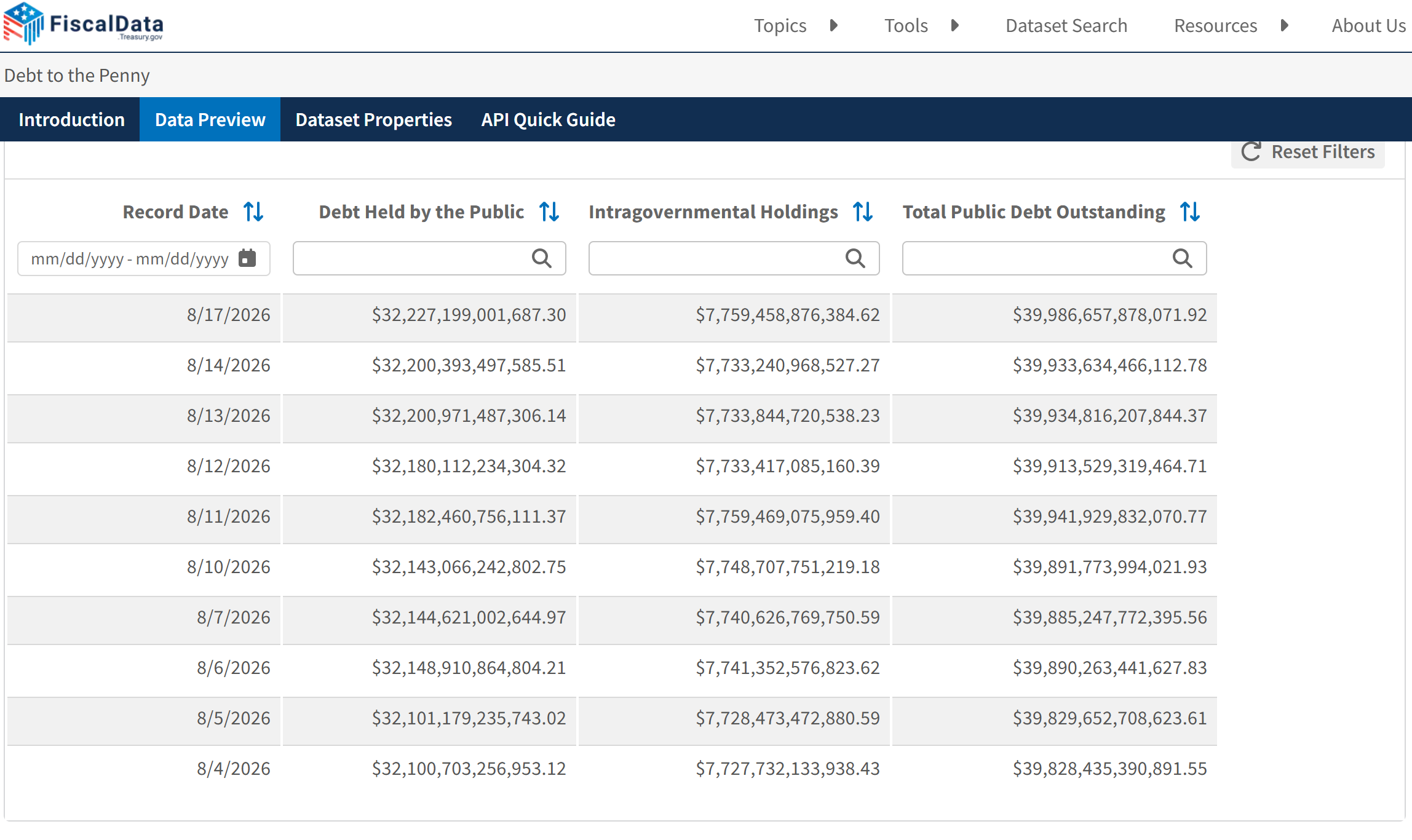
The $40 trillion US debt mark is now within reach, at $39.9 trillion on Tuesday. That equals roughly $116,000 for every American, or nearly two Bitcoins at today’s price.
Bitcoin (BTC) backers call the debt the best reason to own a scarce asset. However, a new Conference Board report shows that the same debt is draining the budgets that fund everyday crypto buying.
Follow us on X to get the latest news as it happens
Why the $40 Trillion US Debt Hits Household Budgets
The Peter G. Peterson Foundation’s debt tracker showed $39.9 trillion on Tuesday, as did the Fiscal data dashboard. Interest alone burns through more than $2.8 billion per day, according to the foundation.

The Conference Board, a nonpartisan business research group, released a report the same day. It modeled five fiscal paths, including a one-week US default.
In that scenario, small business loan payments jump by 21.6%, student loan costs by 8.7%, and housing costs by up to 6.7%.
The default case is a stress test, not a forecast. Congress has always raised the debt ceiling before missing payments, most recently after the 2023 standoff.
The baseline path is still heavy. The report sees debt at 154% of GDP by 2036. It also flags 2032 as the year Social Security’s main trust fund runs dry.
A retiree on a $2,100 monthly benefit could then lose about $170 per month.
“The national debt is not just a number on the government’s balance sheet—it affects the financial decisions Americans make every day,” David K. Young, president of the CEO Center at the Conference Board, said in the announcement.
Could Americans Even Afford Bitcoin and Crypto?
Bitcoin trades near $64,594 after gaining 0.5% in 24 hours, per BeInCrypto Markets data. At that price, the average debt share of $116,000 equals about 1.8 BTC.

Most buyers never get close to a whole coin. A JPMorgan Chase Institute study covering 2015 through mid-2022 found that the median buyer moved about $620 into crypto in total. That was less than one week’s take-home pay.
Today, that $620 buys less than 0.01 BTC. The debt squeeze eats the same money. The Conference Board’s higher-deficit path adds $55,000 to a modeled family’s five-year mortgage bill, over $900 per month.
The strain is felt most at the bottom. In the JPMorgan data, lower-income millennials paid about $45,400 per Bitcoin on average, versus $42,400 for top earners. Buying late, at high prices, was the norm.
Debt and crypto stress already overlap. An Office of Financial Research (OFR) brief studied areas where crypto use runs highest. The share of low-income households there holding mortgages nearly quadrupled between 2020 and 2024, from 4.1% to 15.4%.
US housing regulators have even studied Bitcoin as mortgage collateral. Crypto now sits deep inside household balance sheets.
Rising Treasury Yields Test the Bitcoin Hedge Trade
The squeeze deepens as bond yields climb. The 30-year Treasury yield trades near levels last seen in 2003. Strategists at Barclays and BMO Capital Markets attribute the move to fiscal concerns and a heavy bond supply.

The fiscal data backs them up. Treasury figures showed a $432.3 billion deficit in July, the widest monthly gap since March 2021. Interest costs are on track to hit $1.37 trillion this fiscal year, behind only Social Security and Medicare.
Companies are crowding the market too. US firms have sold nearly $1.7 trillion in bonds this year, up 27% from the same period in 2025. All that supply competes with crypto for investor cash.
Higher safe yields raise the bar for risk assets. Still, Bitcoin carry trade returns recently beat two-year Treasury yields. And the bond selloff has revived debate over which assets stay safe at all.
The answer is a qualified yes. A typical $620 stake remains within reach for most households. The harder question is whether that cash survives rising loan payments. Where yields settle in the coming months may decide it.
The post $40 Trillion US Debt: Could Americans Even Afford Bitcoin and Crypto Right Now? appeared first on BeInCrypto.


Iceland is holding a long-awaited referendum on Aug. 29 to decide whether the country should resume accession negotiations with the European Union.
The country initially applied for E.U. membership in 2009, but accession negotiations were halted upon a change in government in 2013. Then, in 2015, Iceland announced it “should not be regarded as a candidate country for E.U. membership.” However, the membership application was never formally withdrawn.
Iceland’s Prime Minister Kristrún Frostadóttir said she believes now “is a great time for Iceland to join [the E.U.] because of the geopolitical situation we’re in.” She praised the conduct of the E.U. in recent years and said it had made her want to expedite the referendum process.
The E.U. is “looking strategically around. They’re aware that the world is changing. The Arctic has increased focus now, and I think a lot of European countries, and the European bureaucracy in Brussels is aware, that they need increased flexibility for Europe to stay more modern,” she said. “This is where Iceland comes in.”
Read More: Why the Movements of a U.S. Oil Company in Greenland Have Attracted Attention
The E.U. in June signaled a willingness to enlarge the bloc by opening the first negotiating clusters for Ukraine and Moldova.
Here’s what you need to know about Iceland’s referendum, what will be asked of the roughly 400,000-strong population, and what could come next.
What is the referendum about and what will voters be asked?
The exact question being put to voters for a yes or no answer is: “Should Iceland reopen accession negotiations with the European Union?”
Eirikur Bergmann, a professor of politics at Bifröst University in Iceland, describes the vote as more of a “pre-referendum,” because while it could resume negotiations, it does not mean Iceland is set to join the bloc.
What are “accession negotiations”?
Accession negotiations are the formal process by which a country and the E.U. set out the conditions for admission into the bloc.
These are based on the country’s adoption and implementation of the E.U. acquis—the body of common E.U. law.
Typically, before a country begins accession negotiations, all 27 member states must unanimously agree to open them.
A country negotiates membership with the E.U. in certain chapters. Iceland previously opened 27 of the 35 chapters and provisionally closed 11 of them.
Iceland and the E.U. would need to review the chapters that were already closed, but experts predict this would likely be a relatively quick process.
“The job that was done previously has been done,” Bergmann tells TIME. “Every chapter will be looked at again, but there’s not much work to be done on most of them.”
A European Commission spokesperson told TIME that if Iceland were to notify the E.U. that it wished to resume accession negotiations, the E.U. and its member states would “quickly determine how best to take the process forward, building on the work already done.”
“A substantial amount of work was already completed during the earlier negotiations, and that would naturally be taken into account,” the spokesperson said, adding that “no two accession processes are identical” and “each candidate country is assessed on its own merits, and negotiations take account of its specific circumstances.”
Iceland is already deeply integrated with the bloc, with Bergmann describing it as being “at least three quarters inside the realms” of the E.U. The country “is already almost completely aligned with the E.U. on most of the issues that have been difficult for the accession of other countries,” he explains.
The country is part of the European Free Trade Association (EFTA), which encourages further economic integration with the E.U. It is a member of the European Economic Area (EEA), which allows for the free movement of goods and services and enables cooperation across multiple industries between Iceland and the E.U.
Iceland is also part of the Schengen Area, allowing people to travel without internal border controls between member states.
What happens if Icelanders vote “yes” in the referendum?
If a majority of Icelanders vote “yes,” the Icelandic government will resume accession negotiations with the E.U.
If and when a deal is reached, the agreement will be put to a second referendum for the Icelandic people to accept or reject.
However, the road ahead for Iceland to join the E.U. could still be a lengthy process, with both sides having to reach an agreement and negotiate an accession treaty—outlining the terms of membership.
If the majority of people vote “no” in the Aug. 29 referendum, accession talks with the E.U. would not resume, yet the country would likely remain closely tied to the bloc through its existing partnerships.
Why fishing remains a major obstacle to E.U. membership
A key issue for many Icelanders centers on fishing rights.
“Fisheries have been the main stumbling block for Iceland’s membership,” Bergmann says. “The political reality in Iceland is that no politician could ever advocate for an accessional treaty of Iceland that will not both practically and formally guarantee Iceland’s control over its fishing grounds.”
Iceland has a deep and rich historical connection with fisheries, which serve as both an economic driving force and an important part of the country’s cultural heritage.
Fisheries are covered under Chapter 13. That chapter had not been opened when negotiations were put on hold in 2013 and Iceland hadn’t submitted a negotiating position.
Under the E.U.’s Common Fisheries Policy, regulatory authority and international representation would no longer remain exclusively Icelandic. However, the European Commissioner for Fisheries and Oceans Costas Kadis has signaled there is room to discuss flexibility and tailored arrangements for Iceland.
“What people outside of Iceland often do not get is how the political identity in Iceland plays out in domestic politics,” says Bergmann. “Oftentimes there hasn’t been an understanding of this in Brussels, for example, around the fishing policies, where people think it’s a practical issue, when it’s a much bigger question and much more symbolic.”
Has Trump impacted Iceland’s E.U. debate?
Since returning to office, U.S. President Donald Trump has repeatedly threatened to annex Greenland, a semi-autonomous Danish territory.
Concerns mounted after Trump repeatedly referred to Greenland as “Iceland” during his speech at Davos in January.
Frostadóttir said “yeah,” when asked whether Trump confusing Greenland and Iceland has concerned her.
“Obviously, all of this Greenland matter concerns people, right? It’s a huge problem. The fact that we have leaders in the free world talking like this is an issue. It’s a massive issue, and I know Icelanders are very concerned about it,” she said in a July interview.
Read More: Trump Refuses to Rule Out Leaving NATO Over Greenland Tussle—Can He Legally Do That?
Iceland is a member of NATO and has a long-standing Bilateral Defense Agreement with the U.S.
“Iceland has never felt that it needed to set up its own defenses,” Bergmann says. “But now Iceland finds itself in a completely different situation where the U.S. is not as reliable a partner as it once was.”
Furthermore, Iceland also does not have standing armed forces of its own.
“This pushes Iceland in the direction of Europe and makes for a new dimension to consider on the sort of accession question of whether the E.U. or European countries might become Iceland security guarantors rather than the U.S.,” insists Bergmann.
Michael Saylor has a simple message for young people entering an AI-heavy economy: learn the technology early, then use it to find opportunities others have not seen. He also mentioned a trick called “finding the new S-curve.”
The Strategy founder (formerly MicroStrategy) made the argument during a recent Diary of a CEO interview with Steven Bartlett.
Don’t Try to Outwork AI
Saylor believes AI will increasingly handle routine knowledge work. For an 18-year-old deciding what to study, learning tasks AI can already perform may offer less long-term value.
“You don’t want to learn how to do things the AI can do,” Saylor said. His alternative: “What you want to do is learn how to ask the AI to do something that’s never been done before.”
That could mean creating a product or using AI to make an existing service cheaper. He also stresses that people still need expertise in a particular field.
Find the New S-Curve
Saylor describes technological progress as an S-curve: a technology develops slowly, enters rapid improvement, then eventually matures.
His advice is to position yourself near the start of that rapid-growth phase. AI and other emerging digital technologies, in his view, still offer that opportunity.
The goal is to spot something that has only recently become possible and build around it early.
“So, let me tell you why you shouldn’t buy a house… [you’re] taking on a massive tax load and you’re taking on a maintenance load. These things are all hard, right? Real estate business is hard. Starting your own company is hard. Investing in other companies is hard… So that’s why Bitcoin is such a compelling thing. Why shouldn’t the typical person just be able to take their money, put it into an asset which appreciates in value 15% a year, and they don’t have to worry about it?” Saylor said.
Is Saylor Right?
Broadly, yes. Stanford researchers said in July that AI’s impact on worker productivity is generally positive, while the tougher market for recent graduates may already be partly linked to AI.
The strongest part of Saylor’s argument is domain expertise. Knowing how to prompt ChatGPT alone is unlikely to create a durable advantage. Combining AI fluency with deep knowledge of a specific problem has a stronger economic case.
MicroStrategy Is Having a Difficult 2026
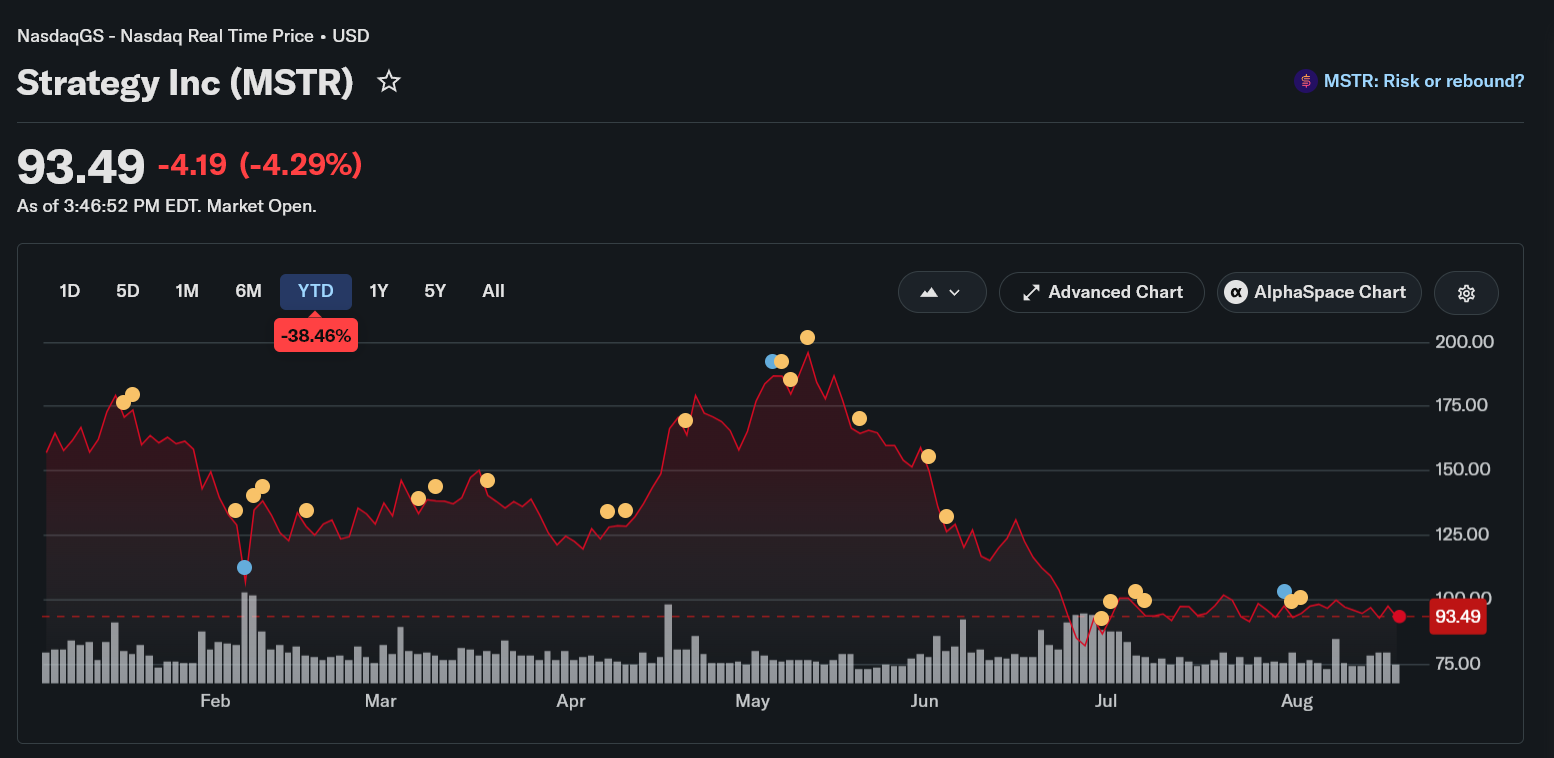
Saylor’s own company also shows the risks of aggressive bets. Strategy held 840,447 Bitcoin as of August 16, bought for roughly $63.36 billion at an average price of $75,385.

It reported an $8.22 billion Q2 net loss, largely from falling Bitcoin prices. Strategy has also faced criticism over shareholder dilution and recent Bitcoin sales after years of Saylor promoting a strong hold philosophy.
This week, Saylor told investors to prepare for “difficult years.” His broader point still stands: being early can create opportunity, but execution and risk matter.
The post MicroStrategy Founder Explains How to Make Money With AI: Is He Right? appeared first on BeInCrypto.

The Best SEAL Team Series Officially Arrives on Netflix in 24 Hours

Parents of social media victims see Meta trial as pivotal for online safety

Supreme Court denies Verizon rehearing in $46.9M FCC location-data case





-

 Fashion4 days ago
Weekend Open Thread: Ann Taylor
-
 Sports5 days ago
This U.S. Amateur is a glimpse into golf’s future in more ways than you think
-

 Sports4 days ago
Birmingham 2026: Day 6 Timetable for Irish Athletes
-
 NewsBeat4 days ago
Myanmar says over 300,000 Rohingya refugees verified for repatriation as exodus enters ninth year
-
 Tech5 days ago
11 Ways to Rank Your Videos
-

 Politics4 days ago
SEQ Code: The Three Letter Boarding Pass Code That Could Give You The Worst Seat
-
 Entertainment7 days ago
Keke Palmer Subtly Hints At Sean Evans Drama With Cryptic Post
-
 Crypto World7 days ago
XRP bridge drained after software mistook fake deposits for real ones
-

 Tech5 days ago
DeepSeek Harness launches as open source rival to Claude Code, alongside V4-Pro on API with higher prices
-

 Sports6 days ago
DeQuan Jones in ‘high spirits’ after successful leg surgery
-
 Crypto World6 days ago
Perplexity AI Predicts an XRP Scenario Few Analysts Are Discussing
-

 Tech7 days ago
SpaceXAI’s Grok Bot turns agents into persistent digital coworkers that can operate your apps for $120-per-month
-

 Politics7 days ago
How Average Are You In The UK?
-
 Entertainment6 days ago
2026’s Most Ambitious Fantasy Movie Officially Scores Sequel Update
-

 Crypto World1 day ago
OCC Greenlights Trump Family Crypto Firm for Trust Charter
-
 Entertainment6 days ago
All 10 Hayao Miyazaki Fantasy Movies, Ranked
-

 Business7 days ago
Evolv Technologies Holdings, Inc. (EVLV) Q2 2026 Earnings Call Transcript
-
 Tech7 days ago
A Zoom Screen-Sharing Bug Let Anyone Take Over Other Devices On a Call
-
 Entertainment6 days ago
Travis Kelce Breaks Silence On ‘Crazy’ Taylor Swift Wedding
-

 Fashion6 days ago
Wednesday’s Workwear Report: Stretch-Cotton Pleated-Waist Top
You must be logged in to post a comment Login