
Crypto World
Farage’s Reform UK party receives record political donation

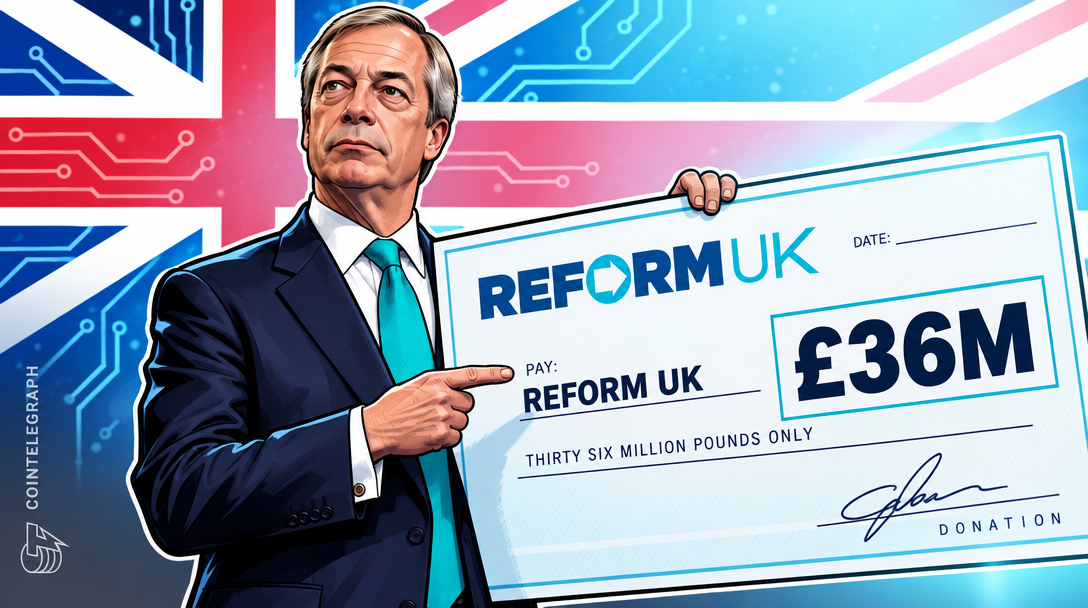
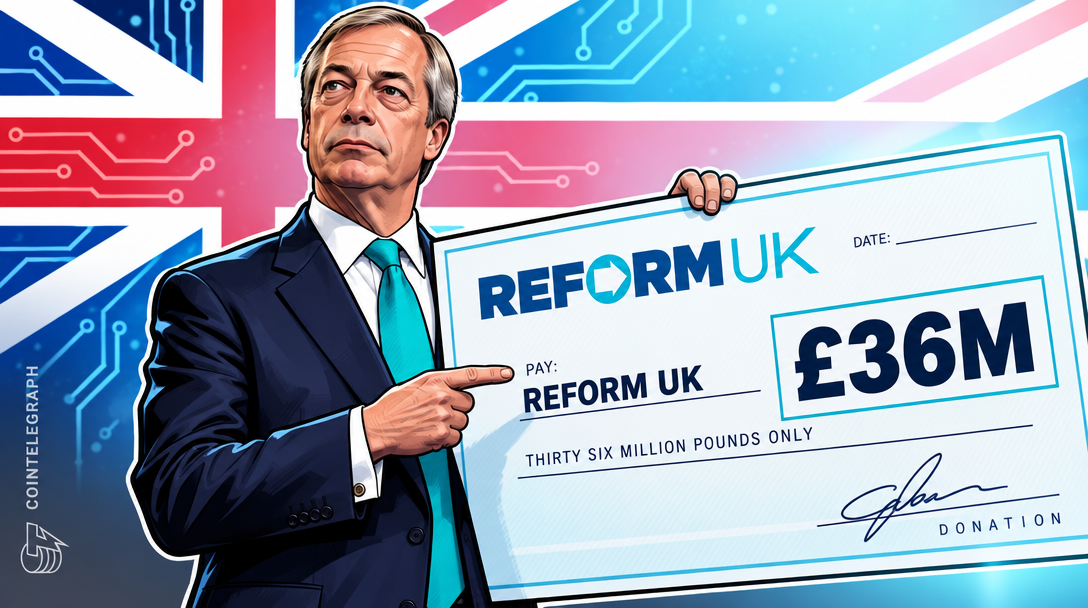
Ben Delo, a British crypto billionaire, gave 36 million pounds ($49 million) to Nigel Farage’s Reform UK in the biggest donation ever made to a British political party, the DPA and other media reported on Saturday.
Delo, who co-founded the BitMEX cryptocurrency exchange, said he had given the money to ensure a “fair fight” at the polls.
Farage said: “I am honored and humbled that Ben Delo has shown such confidence in Reform. … Ben knows that we are the only party that can turn the country around and reverse Britain’s decline.”
Delo was previously the second-biggest donor to Reform UK behind billionaire Christopher Harborne, who gave 9 million pounds to the party last August.
Cointelegraph reported last month that Farage was under investigation after receiving millions of dollars’ worth of donations and gifts from two figures tied to the crypto industry: Harborne and George Cottrell.
Related: UK politicians mull permanent crypto donation ban in wake of Nigel Farage scandal
The UK lawmaker resigned his position as a member of Parliament in July amid the crypto scandal, triggering a controversial by-election that Farage won with 63% of the vote, ahead of satirical candidate Count Binface.
The contributions tied to the crypto industry have raised questions from many lawmakers about the influence of digital assets on UK politics.
In July, Labour MPs were reportedly considering that a moratorium on crypto donations announced in March, pending legislation, be made permanent in response to what Farage called “gifts” from Harborne and Cottrell.
The Telegraph newspaper said the 36 million pound donation represented 1 million pounds each month until a general election in 2029, but Delo made the entire payment up front to prevent it from being blocked.
Cointelegraph previously reported that Delo was one of three BitMEX co-founders who pleaded guilty to federal charges in the US related to violations of the Bank Secrecy Act.
While he agreed to pay a $10 million fine in 2022, Delo did not serve time in prison. He and his colleagues Arthur Hayes and Samuel Reed received a pardon from US President Donald Trump in March 2025.
Magazine: Trading stocks against BONER is the latest trend for DeFi degens

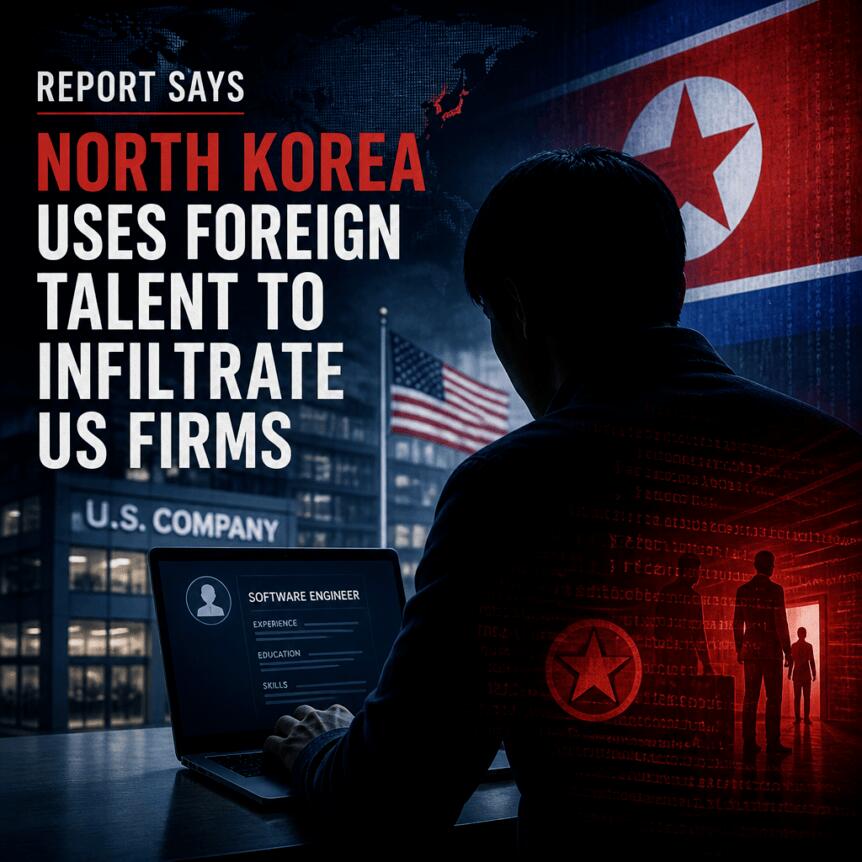
North Korea appears to be expanding its use of remote IT workers in third countries as part of an increasingly targeted strategy to infiltrate U.S. companies and channel funds toward its weapons programs. NBC News reported on Friday that the scheme involves foreign-based job seekers—often recruited through mainstream platforms—who are then positioned to move contracts and access before being replaced by North Korean operatives.
The details come after a July warning issued by the U.S. government and multiple foreign agencies. The alert said North Korean IT workers actively look for contracts with the intention of remitting salaries back to their parent agencies. It also highlighted their potential as insider threats, citing participation in data exfiltration, cryptocurrency theft, and theft of sensitive information.
Key takeaways
- U.S. and allied agencies have warned that North Korean IT workers seek contracts to funnel pay back to DPRK-linked agencies while posing insider and data-risk threats.
- NBC reports North Korean efforts increasingly rely on third-country remote workers to pass job interviews, then hand over roles to DPRK operatives.
- Recruitment tactics described by NBC include scouting on platforms like LinkedIn and offering cryptocurrency compensation for “interview associate” work.
- Related reporting from earlier this year tied North Korea-linked hacking activity to large crypto losses, suggesting the operational model may be bearing fruit.
- With economic pressure continuing, the scheme underscores why organizations should tighten identity, access, and payment controls for remote hiring.
From direct recruitment to third-country remote access
According to NBC’s report, North Korea’s approach has shifted toward leveraging remote workers outside the DPRK to gain entry into companies that may not otherwise connect the threat to North Korea. Instead of relying solely on traditional infiltration channels, the scheme centers on obtaining legitimate work contracts after successfully navigating hiring processes.
The reported workflow is straightforward but high-risk for employers: third-country IT workers are brought in to secure contracts and, after roles are established, are “usually” replaced by North Korean operatives. The operational logic is clear—create an initial foothold that looks normal from an outside hiring perspective, then transition to the underlying actors with access to systems, credentials, or internal knowledge.
NBC also said some foreign workers were recruited after being scouted on LinkedIn. In other cases, applicants were allegedly offered cryptocurrency payments to perform part-time “interview associate” tasks—work that can help them appear credible in recruitment pipelines while potentially aligning them with a longer-term operational goal.
The July alert and what it implies for corporate defenses
The July alert referenced by NBC is significant because it frames the threat not just as external hacking, but as a multi-stage infiltration risk that includes insider behavior. In that advisory, U.S. government and partner agencies described North Korean IT workers as contract-seekers who intend to remit earnings to DPRK agencies.
Just as importantly, the alert connects the labor recruitment angle to cyber outcomes. It described how these workers can function as insider threats to companies, while also being implicated in data exfiltration and cryptocurrency theft, along with theft of sensitive information. Even without additional details about each case in NBC’s report, the combined message is that the threat model includes both access and monetization.
For companies processing remote hires, this means that hiring risk is inseparable from security risk. Organizations that rely on remote onboarding, contractor access, or permissive internal tooling could be inadvertently enabling a pathway for identity compromise, unauthorized code and data handling, and lateral movement once the “handover” occurs.
Why cryptocurrency appears in the recruitment workflow
NBC’s reporting that some candidates were offered cryptocurrency as part of “interview associate” arrangements matters for two reasons. First, it signals that the recruitment pipeline may be designed to blend into existing work structures while still using mechanisms that are harder to trace than conventional payroll.
Second, it aligns with earlier warnings and reporting that tie North Korea-linked actors to crypto-enabled theft and financial diversion. In May, Cointelegraph reported—citing cybersecurity firm CrowdStrike—that North Korea state-affiliated hackers and threat actors were responsible for more than $2 billion in cryptocurrency losses in 2025, representing a 51% year-on-year increase. While that figure reflects cyber theft broadly rather than the specific “interview associate” step described by NBC, the throughline is consistent: crypto is both a tool and an outcome for DPRK-linked operations.
Sanctions pressure, economic indicators, and persistence
The recruitment strategy also fits a broader pattern of persistent activity despite sanctions. The report notes that the Bank of Korea estimated North Korea’s GDP increased 3.5% in 2025 even with global restrictions in place. That kind of resilience can be read as a reminder that threat actors do not need normalization of trade to sustain operations—alternative channels, including cybercrime and illicit financial routing, can help fill gaps.
For investors and builders in crypto and broader tech ecosystems, the implications extend beyond national security. North Korea-linked tactics reportedly combine labor infiltration with cyber operations and monetization. That combination increases the likelihood that compromised systems, stolen credentials, and exfiltrated data can feed downstream fraud and theft—potentially involving crypto at multiple stages.
As governments and companies tighten controls around known malware and exchange-related abuse, schemes that begin at recruitment and onboarding may become more attractive because they can bypass purely technical perimeter defenses.
What to watch next is whether more enforcement and advisories provide granular indicators—such as specific behaviors during remote hiring, payment patterns, or contract-approval structures—that organizations can use for earlier screening. In the meantime, the core concern is clear: if role handovers from third-country contractors to DPRK operatives are a recurring tactic, security teams should assume that “legitimate” employment pathways can conceal hostile intent.


StarkWare said a Bitcoin transaction using its Quantum Safe Bitcoin, or QSB, design was mined on mainnet without changing Bitcoin’s consensus rules. The transaction 305a24ff…ab07 was confirmed in block 964,199 on Aug. 26. Blockstream’s record shows that it combined 39,179- and 10,000-satoshi… Read the full story at The Defiant


Moonwell lost roughly $8.7 million on Thursday after an attacker manipulated the price of MAMO, a small-cap token the lending protocol accepts as collateral on Base, and used the inflated position to borrow real assets. The protocol had no faster remedy than shutting itself down. Moonwell's… Read the full story at The Defiant


North Korea (DPRK) is now using remote workers from third countries, including Iran and Lebanon, to aid its efforts to infiltrate US companies and obtain money to fund its weapons programs, NBC reported on Friday.
An alert issued in July by the US government and several foreign agencies said North Korean IT workers “seek out contracts with the intent of remitting their salaries to their parent North Korean agencies. They also pose an insider threat to companies and are involved in data exfiltration, cryptocurrency theft, and theft of sensitive information.”
As the US and other governments have moved to counter North Korea’s efforts, the DPRK has turned increasingly to third-country IT workers to pass job interviews, the report said. After work contracts are obtained, the positions are usually taken over by North Korean operatives.
NBC reported that foreign IT workers had been scouted on LinkedIn, with some offered $500 monthly in cryptocurrency to work part-time as “interview associates.”
Related: Consensys unknowingly outsourced developer work to North Korean
The DPRK’s increasingly sophisticated tactics may be meeting with some success.
Cointelegraph reported in May, citing cybersecurity company CrowdStrike, that North Korean state-affiliated hackers and threat actors were responsible for more than $2 billion in crypto losses in 2025, a 51% year-on-year increase.
The Bank of Korea estimates North Korea’s GDP increased 3.5% in 2025 in spite of global sanctions.
Magazine: Bitcoin adoption metrics say one thing, price action says another
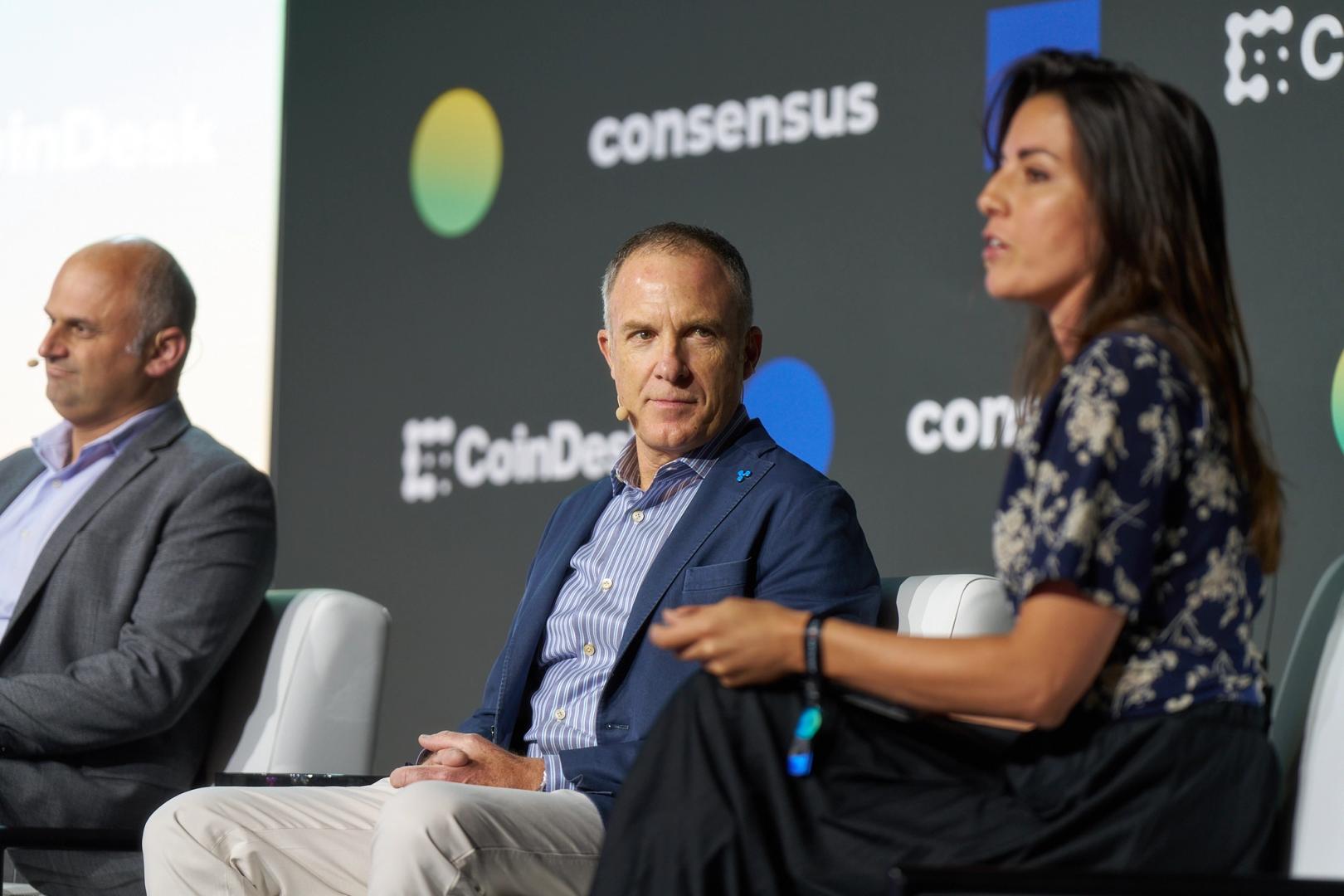
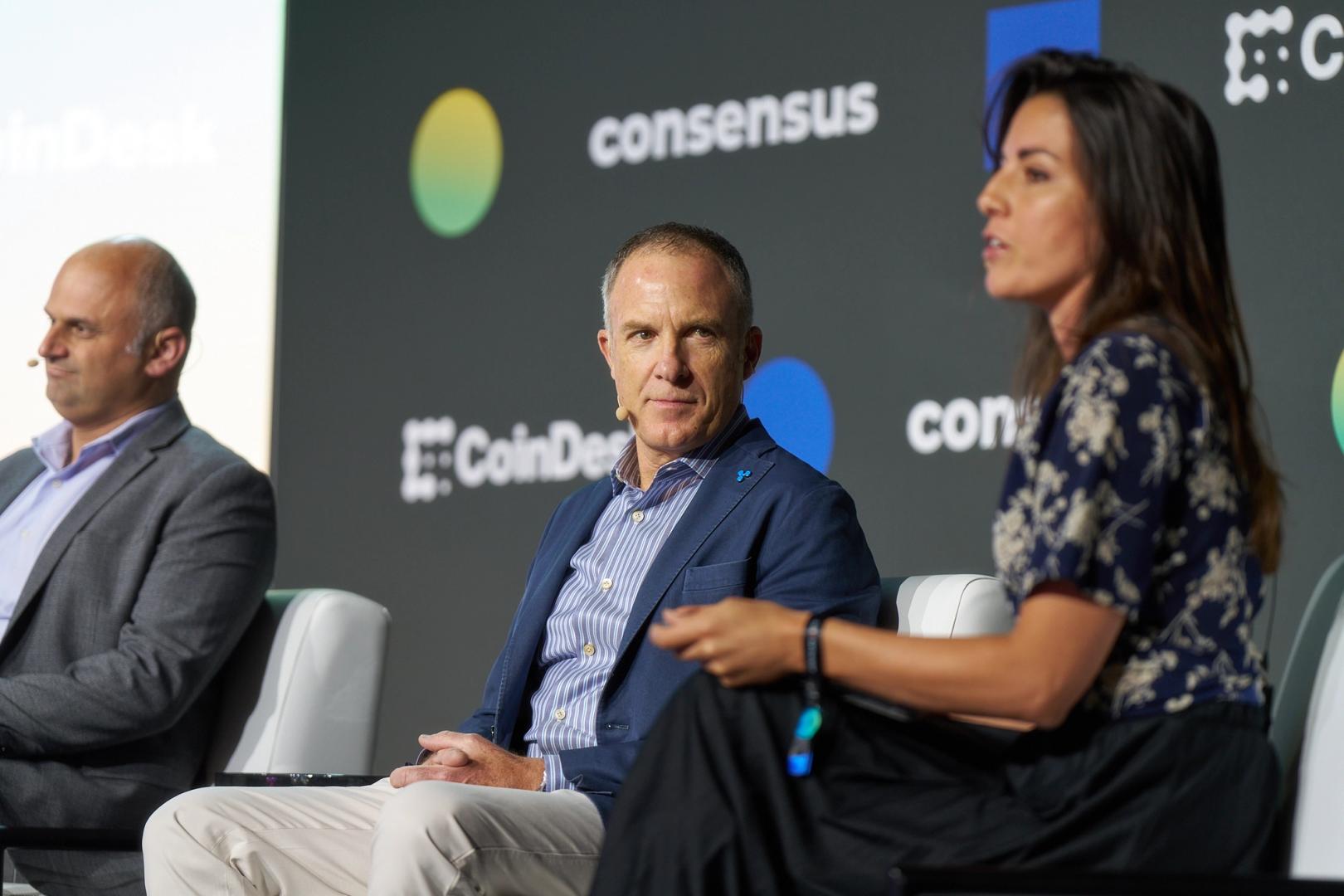
Payments and capital markets are driving growth for Ripple’s $2.4 billion digital dollar as it looks to bring RLUSD to Europe under MiCA, the firm’s Jack McDonald said.

Two years ago, Taylor Fritz won his semifinal over fellow American Frances Tiafoe to reach the final against Jannik Sinner, who was on the cusp of winning his second major championship and cementing his status, along with Carlos Alcaraz, as the alpha dogs of their game. Sinner beat Fritz in straight sets in 2024—and has since won three more Grand Slam championships.
I was there the night Fritz reached that final. I wrote all about it. And truth be told, until Friday, I pretty much forgot about it.
Win or lose on Sunday, Shelton’s performance at this year’s tournament will be remembered. After all, he already outlasted Alcaraz, the defending U.S. Open champion and a seven-time Slam victor, in a five-set quarterfinal epic that ended at 3:33 a.m. Wednesday—the latest finish in tournament history. Shelton won in a 10-point, fifth-set tiebreaker.
By defeating Tiafoe, a close friend whom he called “a big brother,” in Friday’s semifinal 4-6, 6-3, 6-3, 7-5, Shelton became the first Black American man to reach a U.S. Open final since the event’s stadium namesake, Arthur Ashe, in 1972. Shelton’s the first Black American man to reach a Grand Slam singles final since MaliVai Washington, who lost to Richard Krajicek of the Netherlands at Wimbledon in 1996.


Bitcoin Suisse says rising AI investment, government debt and weakening stock-bond diversification strengthen the case for adding bitcoin to traditional portfolios.

Anthropic is reportedly in early-stage discussions with Nvidia over a potentially massive funding round that could rival the largest IPOs in history, according to Reuters. The talks include the possibility of Nvidia investing about $10 billion, Reuters said on Saturday, citing people familiar with the matter.
Reuters also reported that Anthropic may be aiming to raise up to $100 billion in the offering, a figure that—if realized—could place the company’s valuation around $2 trillion. Negotiations are still ongoing and could change, the people said, with both sides remaining tight-lipped as talks remain confidential.
Key takeaways
- Reuters reports Anthropic is discussing a deal with Nvidia that could include a roughly $10 billion investment.
- The potential IPO fundraising target discussed by Reuters could reach as much as $100 billion, implying a valuation near $2 trillion.
- If structured as an early backer arrangement, Nvidia’s involvement would both support the offering and deepen its relationship with an important customer.
- Broader AI competition is increasingly spanning chips, model ecosystems, and developer tooling—areas where Nvidia is already expanding.
Why Nvidia’s potential role matters
While IPO participation can be purely financial, Nvidia’s reported interest would likely carry strategic weight. Reuters said Nvidia could act as an early strategic backer—an approach that often helps issuers secure stronger investor confidence, potentially smoothing the path for a large-scale listing.
From Nvidia’s perspective, Anthropic is a high-profile AI customer. Reuters’ reporting suggests the discussions could be a way for Nvidia to both support a major capital raise and strengthen commercial ties with a company viewed as central to frontier AI development.
A fundraising goal that would reshape the IPO landscape
Reuters described the potential size of the offering as extraordinary: up to $100 billion, with a possible valuation of about $2 trillion for Anthropic. Whether that scale is achievable depends on market conditions and the final structure of the deal, including investor demand and how much of the funding is actually raised through new shares versus other components of the transaction.
Still, the reported numbers highlight how quickly the market is adjusting to “mega-round” expectations around leading AI firms. Anthropic—positioned as a major player in frontier models—would be entering a public market environment where investor appetite for AI-related exposure is already shaped by years of capital inflows and competition for computing resources.
Context: Nvidia’s push across the AI stack
The Nvidia-Anthropic story arrives after Nvidia moved to broaden its influence beyond hardware. Earlier this month, Cointelegraph reported that Nvidia agreed to acquire Hugging Face for $12.9 billion, a deal intended to expand Nvidia’s reach into AI software and the tools developers use to build and deploy models.
Cointelegraph noted that Hugging Face serves more than 18 million developers and hosts over three million models, quoting Nvidia CEO Jensen Huang’s remarks. The acquisition, Cointelegraph reported, would give Nvidia control of a major platform for AI models as companies increasingly compete across chips, software, and developer ecosystems.
That background matters because a potential Nvidia backer role in Anthropic could be seen as another step in the same broader strategy: linking foundational compute (chips), model development and deployment infrastructure (model and developer platforms), and high-impact frontier model providers.
Deals around compute capacity underscore the demand
Nvidia’s potential involvement with Anthropic also fits into a larger pattern of AI-related infrastructure contracting. Cointelegraph previously reported that Bitcoin miner Riot Platforms secured a 20-year agreement to supply 191 megawatts of capacity from its Rockdale, Texas, campus to a “leading frontier AI” company.
Cointelegraph said the customer was Anthropic, and cited Bloomberg’s reporting that the deal was valued at about $9 billion, again referencing people familiar with the matter. Agreements like this reflect how aggressively AI builders and compute providers are trying to lock in long-duration supply as demand for processing power continues to rise.
In that context, a potential IPO of Anthropic at a valuation near $2 trillion would not just be a financial event—it would be one of the clearest public signals yet about how much capital the market believes frontier AI companies need and how seriously investors are pricing them.
For now, the key unknown is how these negotiations resolve: Reuters’ reporting leaves open both the final fundraising amount and whether Nvidia’s role materializes in the way described. Investors and observers will want to watch for confirmation from the companies, more detailed deal terms, and how market appetite for large AI IPOs evolves as discussions move from talks to filings.

Popular analyst CryptoGoos outlined a remarkably simple BTC trading strategy that has successfully tracked and identified the asset’s most important cycle bottoms and tops.
If it plays out again, the next major buy signal could be happening as we speak (or as you read). The idea is quite interesting – instead of relying on complicated indicators, moving averages, and on-chain metrics, investors should look into the US midterm elections.
This striking historical pattern shows that Bitcoin has struggled during every previous midterm election year before recovering strongly once the vote was out of the way. That makes this year and the following several months highly interesting.
No Good Midterm Year
Given the fact that BTC was essentially an unknown internet magic money in 2010, we won’t count that midterm election year. Instead, we will focus on 2014, 2018, and 2022. A quick look into that shows that all three were ugly. 12 years ago, BTC had already collapsed following the extraordinary 2013 bull market and the failure of Mt. Gox.
Fast forward to the 2018 bear market, the cryptocurrency plunged from almost $20,000 to under $3,500. The 2022 example was no better, as the asset entered another brutal downturn amid aggressive Fed rate hikes, the deterioration of Terra/LUNA, and a broader crypto credit crisis. Days after the November 8 midterm election, FTX imploded, which resulted in the last leg down of that cycle with BTC slumping toward $16,000.
Research from CryptoQuant found that BTC declined by more than 60% during each of those three midterm election years. As such, the similarities with 2026 are hard to ignore. The cryptocurrency remains far below its October 2025 all-time high despite its most recent recovery.
Signal to Buy?
The more interesting part of CryptoGoos’ conclusion is what comes after the vote, as BTC has historically rebounded strongly in the 12 months following the US midterm elections. Data tracking the previous three cycles puts the average subsequent gain at over 50%.
Obviously, this doesn’t guarantee that the election itself mechanically leads to a sharp bitcoin price uptick. A more reasonable explanation is that midterm years tend to coincide with several conditions that can pressure risk assets, such as political uncertainty, reduced investor appetite, changing fiscal expectations, and, in BTC’s particular case, the historically weak part of its four-year cycle.
Once the election passes, one major source of uncertainty goes away, and markets can start pricing the next two years of fiscal, regulatory, and monetary policy with considerably more confidence.
If investors choose to follow CryptoGoos’ strategy and accumulate BTC now ahead of the midterms, the first sales should begin with a 25% offload next year, followed by a more significant 50% dump in 2028 and another 25% in the post-election 2029.
The post This Bitcoin Election Strategy Has Worked 3 Times: Here’s When It Says to Buy BTC appeared first on CryptoPotato.


Aave’s live onchain dashboard listed V4 user deposits at $806 million. Deposits jumped by 30% over seven days and reached a new all-time high above $800 million. The latest reading extends a steep August climb. Aave announced that V4 deposits crossed $500 million on Aug. 19 and $600 million on Aug…. Read the full story at The Defiant

Oregon-Oklahoma State weather updates: Latest news on forecast after thunderstorms, lightning push back kickoff

Supercon Is Nigh! | Hackaday

Donna Summer – She Works Hard For The Money

Memory prices are slowing because buyers ran out of money

Micron Stock Climbs Above $1,031 as AI Memory Crunch and a $50 Billion Outlook Fuel the Rally

AMD Stock Climbs After Management Lifts 2027 Data Center Outlook Toward $70 Billion in AI Sales


-
Tech4 days ago
Memory prices are slowing because buyers ran out of money
-
 Business3 days ago
Micron Stock Climbs Above $1,031 as AI Memory Crunch and a $50 Billion Outlook Fuel the Rally
-
 Business3 days ago
AMD Stock Climbs After Management Lifts 2027 Data Center Outlook Toward $70 Billion in AI Sales
-

 Crypto World4 days ago
Bitcoin price risks $76K drop as $78K support weakens
-

 Crypto World4 days ago
Robinhood Stock: How To Take Advantage With Reduced Risk
-

 Crypto World4 days ago
Ethereum price stalls below $2,500 as ADX drops to 11
-

 NewsBeat4 days ago
England up in reading, maths and science rankings as Scotland and Wales dip
-

 Fashion23 hours ago
Weekend Open Thread – Corporette.com
-

 Crypto World2 days ago
OKX launches 10x OpenAI, Anthropic X-Perps in Europe
-

 Crypto World2 days ago
2 Chip Stocks Broke Out This Week. Neither Was Nvidia
-

 Crypto World1 day ago
XAG/USD: Silver’s Short-Term Rally Meets Its Moment of Truth
-
 Crypto World4 days ago
Intel Stock Jumps 9% on Chip Price Hike Report, US Stake Gains $36 Billion
-

 NewsBeat4 days ago
What went right this week: an ‘historic’ fall in violent crime, plus more
-

 Crypto World3 days ago
Bitcoin price risks $70K if $78K neckline breaks
-

 Crypto World1 day ago
Diesel Tops $6 a Gallon for the First Time as 28 States Set Records
-

 Business4 days ago
Meta debuts long-awaited personal AI agent, Muse
-
Crypto World2 days ago
Ethereum Price Analysis: Consolidation at $2.5K Tests Momentum as On-Chain Activity Surges
-
 Crypto World3 days ago
Bitcoin price holds near $79K as cycle drawdowns narrow
-
 Crypto World3 days ago
Ethereum price breakout hinges on a close above $2,535
-
 Sports4 days ago
Phones confiscated, players sent home: Pakistan’s England tour turmoil revives memories of Mohammad Amir, Salman Butt and Mohammad Asif’s 2010 Lord’s spot-fixing scandal | Cricket News
You must be logged in to post a comment Login