

Crypto World
Federal Reserve Taps A16z Co-Founder for Monetary Policy Task Force

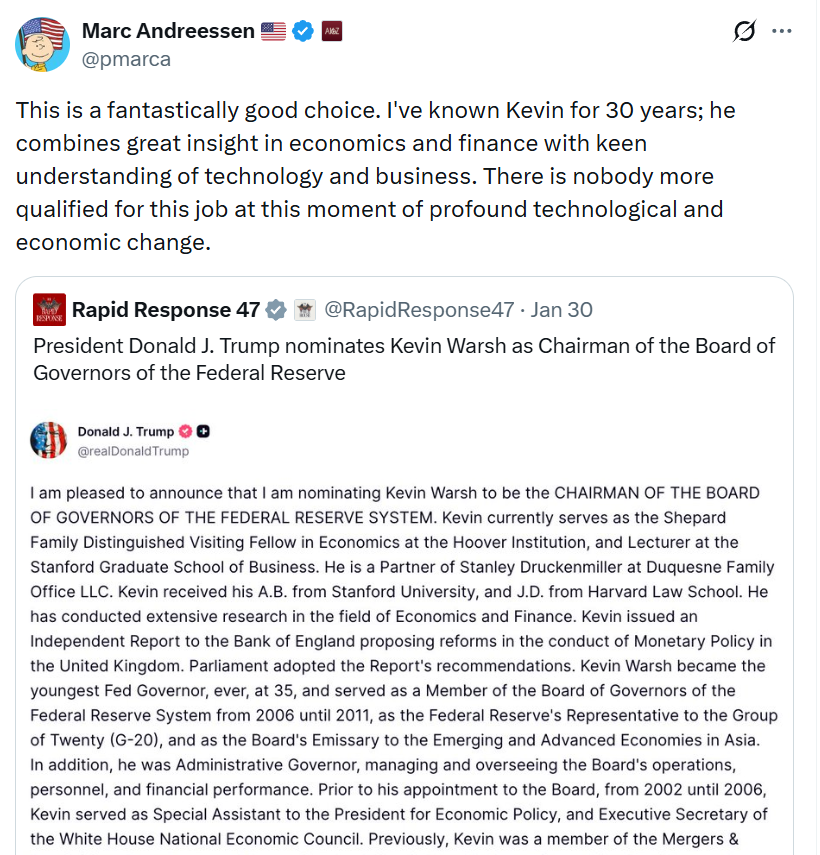
The US Federal Reserve named Andreessen Horowitz (a16z) co-founder Marc Andreessen to help lead a task force studying how artificial intelligence and other new technologies could affect productivity and jobs.
Andreessen will serve on the Fed’s Productivity and Jobs task force alongside Charles I. Jones, a Stanford University economics professor currently on leave at Anthropic, and Asha Sharma, Microsoft’s executive vice president and Xbox CEO.
The new task force will assess how general-purpose technologies such as AI will affect employment and productivity to better inform the central bank’s policymaking, the Fed said in a Thursday press release.
The group is one of five task forces launched under new Fed Chair Kevin Warsh, each responsible for examining important areas of monetary policy conduct. The other task forces will focus on the Fed’s policy communication, balance sheet policy, data quality and inflation frameworks.
Andreessen co-founded Andreessen Horowitz, which has become one of Silicon Valley’s most influential venture capital firms and a major backer of crypto and AI startups.
Andreessen and Warsh’s ties date back to the early 1990s at Stanford University. During a 2025 interview with CNBC, Warsh said that both Andreessen and Palantir’s Peter Thiel “have been friends from my days in college.”
Andreessen publicly supported Warsh’s appointment as Fed chairman. “I’ve known Kevin for 30 years; he combines great insight in economics and finance with keen understanding of technology and business,” he wrote in a Jan. 30 X post following US President Donald Trump’s nomination.
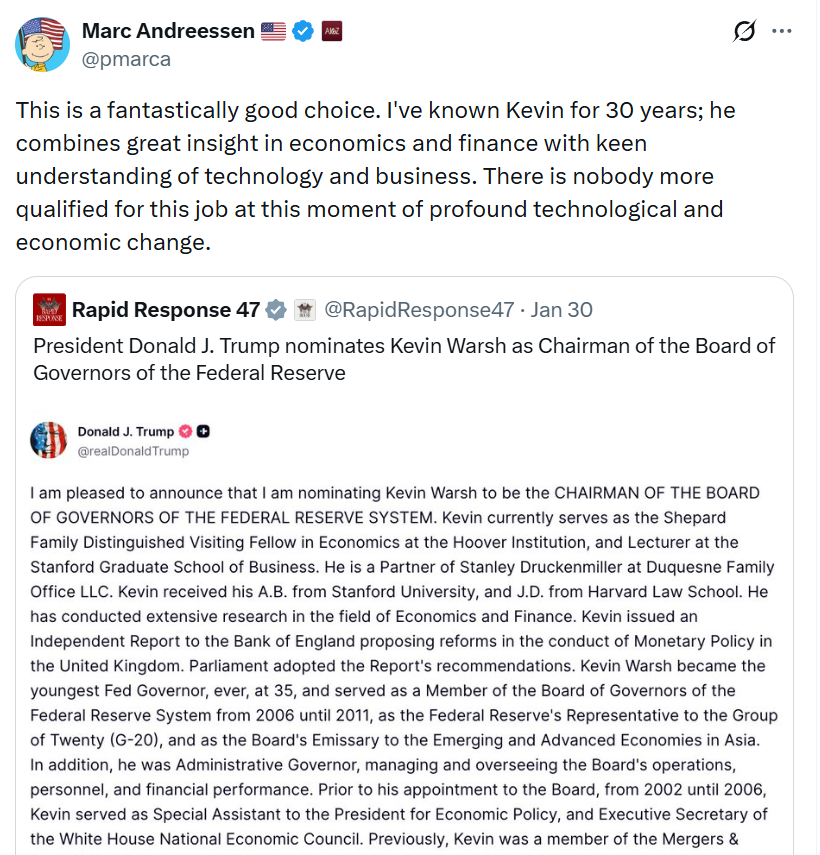
Source: Marc Andreessen
Warsh launches Fed task forces
Warsh revealed the leadership-driven overhaul and the creation of the five new task forces during a press conference on June 17.
“These subjects are timely, consequential, and, in my view, worthy of a fresh look,” said Warsh during the press conference, adding that each of these will be independently led by “some of the very best minds—both inside and outside the economics profession.”
Warsh also said that the central bank will strive to publish policy statements and guidance in shorter, clearer language.
Related: Hyperliquid shows how onchain perps could challenge Wall Street: Pantera
FOMC divided over AI’s economic impact
The Federal Open Market Committee (FOMC) is sharply divided over the economic impact of AI and whether it is an inflationary or disinflationary technology. Some view AI as a long-term disinflationary productivity booster, while others argue that the current spending on AI infrastructure is actively increasing inflation.
During a May 27 speech, Governor Lisa Cook said that she expects AI to further “boost productivity growth, contributing to my expectation that GDP will grow robustly,” but added that it presents the risk of “higher inflation.”
In former Fed Chair Jerome Powell’s statements from March 2026, he said that data center spending is “putting pressure on all kinds of goods and services” and is “probably pushing inflation up at the margin.”
Magazine: Strategy sells $216M Bitcoin, Bollinger bullish on BTC: Hodler’s Digest, June 29-July 6, 2026

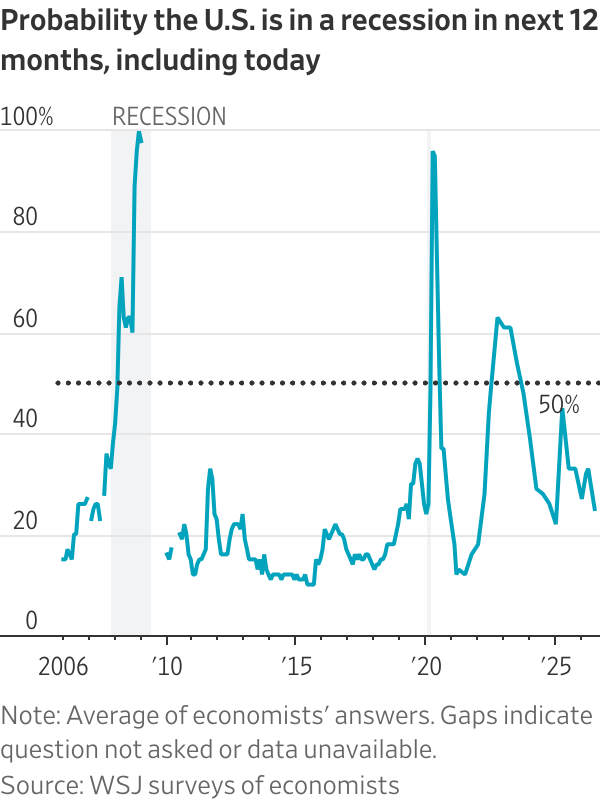
US economists lowered their recession odds to 25% while raising inflation forecasts, according to a Wall Street Journal survey, leaving the Federal Reserve little room to cut interest rates this year.
The shift matters for crypto markets. A higher-for-longer Fed removes the catalyst that risk assets had counted on for a second-half recovery.
Survey Points to Sticky Inflation and a Cautious Fed
The July survey of 72 economists ran from July 2 to July 7. They cut recession odds to 25% from 33%, the lowest reading since early 2025.
Follow us on X to get the latest news as it happens

Job-market views improved too, with December unemployment seen at 4.3%. Furthermore, forecasters now expect the economy to grow 2.1% this year, up from 2% in April.
Nonetheless, inflation told a different story. Economists expect consumer prices to rise 3.4% through December, above April’s 3.2% estimate. Core PCE, the gauge Fed watches most closely, is projected at 3.2%.
“We’re learning that there’s more momentum in the economy: It keeps growing at 2% no matter what you throw at it, and inflation stays elevated,” Robert Fry, a Delaware-based independent economic consultant, said.
Why Rate Expectations Weigh on Bitcoin
Interest rates shape how investors treat risk. Lower rates cut returns on cash and bonds, pushing money into stocks and crypto. Higher-for-longer rates do the reverse.
When safe assets pay more, capital rotates out of volatile holdings first. Bitcoin (BTC) often sits near the front of that queue. A delayed cut, therefore, removes a key support.
Traders have turned more hawkish this week. CME FedWatch shows a 34.2% chance of a hike at the July meeting, up from 18.2% a week ago. Renewed US-Iran hostilities have fueled those bets.

The Fed’s June minutes reinforced the divide. Officials voted unanimously to hold, yet split on the path ahead. Nine of 18 policymakers projected one hike before the end of 2026.
Several flagged inflation risks are tied to spending on artificial intelligence (AI). The next Federal Open Market Committee (FOMC) meeting is scheduled for July 28 and 29.
Given persistent inflation, a rate cut looks unlikely. Cooler data must now do the work of reviving risk appetite.
Subscribe to our YouTube channel to watch leaders and journalists provide expert insights
The post Economists See Lower Recession Risk: Will Fed Still Hike Interest Rates? appeared first on BeInCrypto.


Tom Lee has reaffirmed that Ethereum will play the central role as traditional finance and cryptocurrency converge into a single market.
Summary
- Tom Lee says traditional finance and crypto will eventually merge into one market, with Ethereum at the center.
- His comments come as Bitmine’s Ethereum treasury has grown to 5.74 million ETH, equal to 4.8% of the total supply.
- Lee also links Ethereum’s outlook to the CLARITY Act and expanding layer-2 payment activity involving Visa and Shopify.
According to a post published by Bitmine chairman Tom Lee on X, he believes the line separating traditional financial markets and digital assets will eventually disappear, with Ethereum positioned at the center of that transition.
Lee shared the view while responding to a post from Fundstrat Capital head of distribution Carrie Presley, who recalled telling him during an interview nearly six years ago that she was highly optimistic about Ethereum and blockchain technology. Lee acknowledged the exchange and reiterated that he remains bullish on Ethereum.
His latest comments arrive as Bitmine continues expanding one of the largest corporate Ethereum treasuries in the market. The company said last week that it held 5,742,237 ETH, equal to about 4.8% of Ethereum’s circulating supply of roughly 120.7 million ETH. Bitmine added that its combined crypto holdings, cash, marketable securities, and other investments were valued at about $11.1 billion.
Bitmine continues expanding its Ethereum treasury
Recent disclosures show Bitmine has steadily increased its Ethereum holdings throughout the year. Crypto.news previously reported that the company added another 27,084 ETH in its latest weekly purchase, pushing its treasury above 5.7 million ETH before the newest holdings update confirmed the total at more than 5.74 million ETH.
Beyond Ethereum, Bitmine reported holding 206 Bitcoin alongside $527 million in cash and marketable securities. The company also disclosed equity investments in Beast Industries and Eightco Holdings as part of its balance sheet.
Lee has repeatedly linked Ethereum’s long-term outlook to changing U.S. crypto regulation. In earlier comments released by Bitmine, he said investors had become more optimistic about the chances of the CLARITY Act advancing through Congress, arguing that clearer rules could support smart contract platforms as digital assets become more integrated into payment systems and financial services.
Ethereum adoption continues to expand into financial services
While discussing Ethereum’s role in financial infrastructure, Lee pointed to existing commercial activity already taking place on Ethereum layer-2 networks. According to his earlier remarks, companies including Shopify and Visa already process USDC-related activity through Ethereum scaling networks, demonstrating practical use beyond speculation.
Presley’s recent reminder of their conversation from nearly six years ago also highlighted how long Lee has maintained his positive view on Ethereum. Responding publicly on X, Lee confirmed that his conviction has remained unchanged, adding that he still expects Ethereum to become the foundation connecting traditional finance with the crypto economy as both markets continue moving closer together.
At press time, Ethereum (ETH) was trading at around $1,800, little changed over the past 24 hours and up 2.2% over the previous seven days.


In the last week of June, XRP printed its weakest price since late 2024, briefly touching $1.01 before stabilizing in the $1.05 to $1.13 range where it has traded through early July. The token is down more than 25% for the year and roughly 65% below the $3.65 cycle high it set in July 2025. On the same June days that the chart broke down, tokenized real-world assets on the XRP Ledger crossed $3.5 billion, more than triple the level at which they started the year, spot XRP exchange-traded funds extended a net inflow streak that would reach eight consecutive weeks, and Ripple stood weeks away from full European authorization under MiCA.
Summary
- Ripple has delivered record institutional growth in 2026, but XRP remains more than 25% lower this year and near multi-year lows.
- The article examines both sides of the debate: whether Ripple’s expanding infrastructure will eventually lift XRP or whether the company and token have permanently diverged.
- Upcoming CLARITY Act votes, ETF flows, XRPL upgrades, and institutional adoption could determine whether the gap between Ripple and XRP finally closes.
That is the whole story in one paragraph, and it is genuinely strange. By any operational measure, the 12 months behind Ripple are the most productive in the company’s history: a settled SEC case, launched ETFs, a $1.25 billion prime brokerage acquisition, membership in the clearing infrastructure of American equities, a stablecoin with $18 billion in quarterly transfer volume, and regulatory licenses stacking up on three continents.
By the only measure most holders care about, the same 12 months are the worst since the 2022 bear market. The gap between what Ripple built and what XRP is worth has never been wider, and how that gap closes, upward through the price or downward through the narrative, is now the central question hanging over the fourth largest ecosystem in crypto.
This feature lays out both sides honestly: the case that the infrastructure eventually drags the token up, and the case that the token and the company have simply decoupled, with the price telling the truer story.
The year Ripple built: an inventory
It helps to see the accumulation in one place, because no single item explains the disconnect. The pattern does.
Legal closure came first. The SEC’s enforcement case against Ripple, filed in December 2020, formally concluded in 2025 with a financial settlement, ending the overhang that had defined the token’s American existence for half a decade and building on the 2023 court finding that programmatic exchange sales of XRP were not securities transactions.
Then distribution. Spot XRP ETFs launched in November 2025 across 5 providers and have accumulated roughly $1.49 billion in cumulative net inflows since. May 2026 was the strongest month of the year with $118 million, including a record $60.5 million week.
The streak ran 8 consecutive weeks into July, as crypto.news reported, before showing its first daily pauses, and assets under management sit near $1.05 billion, about 1.5% of the token’s market capitalization, led by Bitwise at $331 million, Canary at $265 million, and Franklin at $262 million.
Then market plumbing. Ripple closed its acquisition of prime broker Hidden Road in October 2025 and rebranded it Ripple Prime. On March 2, 2026, Ripple Prime joined the participant directory of the National Securities Clearing Corporation, placing an XRP-linked institution inside the DTCC complex that clears the bulk of American equity trading and safeguards roughly $100 trillion in assets. DTCC has since named Ripple Prime to the working group of more than 50 firms shaping its tokenization service for Russell 1000 stocks, ETFs, and Treasuries, scheduled for October 2026.
Then the ledger itself. XRPL tokenized assets grew from $991 million on January 1 to $3.5 billion by midsummer. In early May, JPMorgan, Mastercard, Ondo Finance, and Ripple completed the first cross-border tokenized US Treasury redemption on the XRPL, settling in under 5 seconds. Daily transactions hit 3 million on March 15, roughly three times mid-2025 averages.
A protocol amendment from XRPL version 3.1.0 that would enable fixed-term lending through Single Asset Vaults is under validator vote, and support has been climbing toward the 80% supermajority it needs, a governance process crypto.news has tracked as it approaches the threshold.
Then the stablecoin. RLUSD reached a $1.72 billion market capitalization in under a year, moved more than $18 billion in the first quarter alone, and Ripple hedged the strategy in July by joining Open USD, the consortium dollar token backed by Visa, Mastercard, Stripe, BlackRock, and more than 140 other companies.
Then the licenses. A full Electronic Money Institution approval from Luxembourg in February, UK Financial Conduct Authority permissions in January, and the full MiCA Crypto-Asset Service Provider license on July 6 that opened all 30 countries of the European Economic Area, arriving days after the transition deadline locked unlicensed competitors out of the bloc.
Any one of these, delivered into the 2024 market, would have produced a rally measured in double digits. Delivered into 2026, the entire list produced a chart that goes down and to the right.
The year XRP traded: an autopsy
The price ledger is shorter and harsher. XRP closed 2025 near $1.90 after the July peak at $3.65, rallied to about $2.40 in the new year, then spent 2026 in decline: a sharp February selloff that prompted Standard Chartered to cut its year-end target from $8 to $2.80, a spring of lower highs between $1.28 and $1.50, a June that opened near $1.30 and closed near $1.04, and a July that has been a daily fight to defend the $1 line.
The token trades below every major moving average, with the 20-day near $1.11, the 50-day near $1.20, and the 200-day near $1.52. Relative strength readings in the low 30s mark the deepest oversold territory of the cycle.
Two facts about the decline matter for interpreting it. First, it was market-wide. Bitcoin fell from above $100,000 to below $62,000, briefly touching $58,000. Ethereum, Solana, and BNB fell comparably or worse; total crypto market capitalization shed $2.3 trillion over 8 weeks, and digital assets posted a third consecutive losing quarter, the longest streak since 2022, as institutional capital rotated toward AI equities. Everything outside Bitcoin and Ethereum lost roughly 23% in 6 months. XRP’s beta to that drawdown was high, as it always is, because the token falls harder than Bitcoin when sentiment turns.
Second, and more uncomfortable for the bull case, none of the good news interrupted it. The full MiCA license produced a 3% weekly decline around the preliminary approval and indifference at the final one. The DTCC milestone passed without a candle. The Treasury redemption pilot with JPMorgan, arguably the most institutionally significant event in XRPL history, is invisible on the chart.
The one catalyst the market visibly responds to is legislative: the token jumped 4.5% within an hour of the CLARITY Act clearing committee on May 14, and it sagged when the July 4 signing target slipped, price action crypto.news examined as the delay sank in. The market has, in effect, told everyone what it is waiting for, and it is not another license.
What the forecasters did with the same facts
The professional forecasting record around XRP in 2026 is itself evidence of the disconnect, because analysts looking at identical data have produced the widest dispersion of targets for any large-cap asset.
Standard Chartered entered the year at $8 for 2026 and cut to $2.80 in February after the selloff, a 65% downgrade in a single revision, while explicitly leaving its 2030 target untouched at $28. The bank’s stated logic was that regulatory clarity, institutional involvement, and new investment products justify higher long-term valuations, but near-term price action would remain correlated with the broad crypto market. That is the lag thesis and the beta thesis coexisting in one research note.
Bitwise carries a $4.94 year-end forecast. JPMorgan’s contribution is conditional rather than directional: $4 to $8.4 billion of first-year ETF inflows if the CLARITY Act passes, with no comparable estimate under failure. Algorithmic models cluster far lower, in the $1.70 to $2 band, essentially extrapolating the chart. The professional consensus for year-end sits above $2, which would require a 77% rally from current levels in under 6 months, a move the asset has produced before but only during regime changes in sentiment.
Forecast dispersion this wide is unusual for an asset of this size, and it maps precisely onto the two readings of the disconnect. Analysts weighting the infrastructure see multiples of the current price; models weighting the tape see the current price as fair. When the same inputs produce a $1.70 answer and a $28 answer depending on the discount rate applied to institutional adoption, the market is not confused. It is unpriced, waiting on the one variable, classification, that neither the company nor the chart can supply.
The bear reading: the token and the company are different assets
The uncomfortable thesis deserves its full strength. Ripple’s success and XRP’s value are linked by a mechanism, and the mechanism is thin.
Ripple the company earns revenue from payments, custody, prime brokerage, and stablecoin float. Almost none of that revenue requires the XRP price to be anything in particular. The company’s own announcements make the point unintentionally: the MiCA license release mentions XRP essentially once, in the boilerplate.
Ripple Payments has moved more than $100 billion across 60-plus markets, but most of that volume settles in fiat or RLUSD, and where it does route through the XRP Ledger, the burned fee per transaction is a fraction of a cent. 3 million daily transactions at those rates destroys token supply at a pace measured in rounding errors. The stablecoin strategy, on this reading, actively competes with the bridge-asset story that once justified the token: every corridor that settles in RLUSD is a corridor that does not need XRP volatility risk.
Supply mechanics deepen the skepticism, and they deserve their own accounting. Ripple releases up to 1 billion XRP from escrow every month under a schedule set in 2017, relocking the majority into new escrow contracts while a smaller portion enters circulation through sales and ecosystem distributions. The market has watched this metronome for years, and its psychological weight exceeds its mechanical weight: even in months when net new supply is modest, the release event itself gives traders a recurring reason to expect selling, and expectations of supply function like supply. Set the monthly release against the demand side and the imbalance is stark. The entire ETF complex has absorbed roughly $1.49 billion over 8 months, an average of around $6 million of daily buying, in a token that trades north of $1.4 billion in daily volume.
Institutional flows at that scale can support a floor; they cannot fight a distribution schedule and a bear market simultaneously. The bear case does not need Ripple to fail. It needs only for the demand mechanisms to keep growing slower than the supply mechanisms, which is a fair description of every month of 2026 so far.
There is also the exchange migration to consider from the skeptical side. Tokens leaving exchanges for ETF custody are commonly read as bullish scarcity, but a share of that movement is simply the same speculative holders changing wrappers, retail selling spot that funds buy into trusts, with no net new demand created. The flow data cannot distinguish conviction from repackaging, which is why the bears discount it. The comparison Brad Garlinghouse himself invited when he attacked Michael Saylor’s leverage model cuts both ways, as crypto.news observed: both Strategy and Ripple sit atop enormous token treasuries whose value depends on a market they are simultaneously supplying.
On this view, the 2026 chart is not a mispricing. It is the market correctly concluding that owning XRP is not owning Ripple, that the institutional build-out accrues to Ripple’s private shareholders, and that the token’s fair value is whatever speculative demand plus modest utility demand will bear in a risk-off tape. The disconnect is not a gap waiting to close. It is the honest spread between an equity story and a token story that were never the same story.
The bull reading: infrastructure is demand with a lag
The counterargument does not deny any of that. It argues the causality has a delay measured in years, and that 2026 is the trough of the lag, not the verdict.
Start with the demand channels that did not exist 18 months ago. ETFs holding $1.05 billion sound small against a $69 billion market cap until you note the direction and the constraint: 8 straight weeks of net inflows through the worst quarter since 2022, from a buyer base that is still legally capped. Pension funds, sovereign wealth funds, and most insurance portfolios cannot allocate to an unclassified asset at all.
That is precisely the constraint the CLARITY Act removes by making XRP a digital commodity under CFTC oversight, and it is why JPMorgan and Standard Chartered independently project $4 to $8.4 billion in first-year inflows under passage, a 5- to 8-fold expansion of the current ETF base. The bill’s merged draft is due the week of July 13, with floor action targeted a week later. The single largest catalyst in the token’s history has a date range attached to it.
Second, the utility story is finally measurable instead of theoretical. Tokenized assets tripling to $3.5 billion, a functioning institutional redemption pilot with the largest bank in America, a lending protocol approaching validator approval, and RLUSD volume in the tens of billions are all activity that lives on the ledger whose native asset is XRP.
The fee-burn mechanism is tiny per transaction, but the investment case was never fee burn; it is that reserve requirements, liquidity provisioning, and settlement paths on a busy institutional ledger create structural demand for the asset that denominates it. Japan already offers the proof of concept, where SBI’s remittance corridors made the country the one place XRP is used at scale in production, a story crypto.news has documented, and Europe post-MiCA is the first market since Japan where Ripple holds the full regulatory stack to attempt a repeat.
Third, the on-chain footprint of conviction is visible even at the lows. Whale accumulation ran through the spring, with roughly 450 million XRP moving through Binance in a 10-day stretch in March, wallet creation hit a 3-month high near 5,000 per day in late June, and large-holder balances rose while retail sentiment collapsed. Someone with size is treating $1 as a level to buy, and the historical pattern in this asset is that accumulation phases at multi-month lows precede the violent repricings the token is famous for. July, for what it is worth, is historically XRP’s strongest month, averaging around 10% gains, though seasonality in a fear-gripped market deserves limited weight.
The bull synthesis: the company spent 2026 building the pipes, the law that fills them sits 3 weeks from a vote, and the price is a coiled spring compressed by macro conditions that have nothing to do with Ripple. Standard Chartered, even after cutting its 2026 target to $2.80, left its 2030 target at $28, which is the lag thesis expressed as a forecast.
The map of the battlefield at $1
For traders, the disconnect compresses into a few price zones that both camps agree on even while disagreeing about everything else.
Support is a dense band between $1.00 and $1.06, where a thick concentration of historical buying has absorbed every test since late June, including seven separate probes of the $1.04 to $1.06 area. Beneath it, the map goes dark: a decisive daily close below $1 opens territory the token has not traded since 2024, with the next meaningful demand zone estimated between $0.80 and $0.90. The bounce attempts of early July have built a sequence of higher lows above $1.03, and the immediate breakout zone sits at $1.056 to $1.066, where a surge of volume, at one point 1,400% above the hourly average, marked the strongest buying of the month.
Resistance begins where the moving averages live. The 20-day average near $1.11 and the descending channel midline have capped every rally attempt; above that, $1.18 to $1.20 is the zone that separates a technical bounce from a trend change, since it contains the 50-day average and the highs of the last failed breakout. A move through $1.20 would be the first structural repair of the year. The level that matters for the larger argument is further up: analysts broadly treat $1.65 as the line above which the downtrend that began at $3.65 would formally be broken.
The holder structure beneath those levels is where the two theses interact most directly. Exchange balances have been falling as tokens migrate to ETF custodians and cold storage, whale addresses have grown through the decline, and the retail cohort, measured by funding rates and sentiment indexes reading extreme fear, is maximally absent.
That configuration, shrinking liquid supply against a depressed price, is the classic setup for violent moves in both directions: thin order books amplify whatever catalyst arrives. A CLARITY passage into this structure would meet little overhead supply until the mid-$1.20s. A failure into this structure would find equally little bid support below $1. The market has arranged itself for an outsized reaction to a binary event, which is rational, because that is exactly what the calendar is offering.
What would actually settle the argument
Disconnects resolve through evidence, and four specific markers will decide which reading was right.
The CLARITY floor vote before the August 7 recess is the binary. Passage activates the constrained buyer base and converts the classification question from risk to fact; failure removes the identified catalyst and hands the bear thesis another year of confirmation. Nothing else on this list matters as much.
XRPL settlement disclosures are the slow variable. Europe will produce client announcements through the fall; the tell is whether named institutions settle on the ledger or through RLUSD and fiat rails that bypass the token. Every disclosure is a data point for exactly the mechanism the two camps dispute.
ETF flow behavior around the $1 level tests the institutional bid. The first net outflow day arrived on June 30 as the quarter closed. If inflows resume through a flat tape, the allocation story survives the drawdown. If outflows follow the price down, the ETF base was momentum money wearing an institutional costume.
The lending amendment vote tests whether the ledger’s institutional roadmap ships. Validator support has been grinding toward the 80% threshold; activation would open uncollateralized fixed-term credit through Single Asset Vaults, the first XRPL primitive aimed squarely at the institutional DeFi demand the bull case requires.
One more marker sits outside the token entirely: Ripple’s own capital decisions. The company has explored an initial public offering intermittently, and hints have circulated that XRP holders might somehow participate in a listing. Nothing concrete has emerged, and nothing should be assumed, but the scenario clarifies the stakes of the disconnect better than any chart.
If Ripple lists, the market will finally price the company and the token side by side, in public, every trading day. Either the equity valuation validates the institutional story and drags attention back to the ledger that underpins it, or investors will buy the company and continue ignoring the token, at which point the decoupling thesis stops being a thesis and becomes a quote on two screens. The company has every incentive to make the token matter before that comparison goes live.
For holders, the practical takeaway is about position sizing against a calendar, not about conviction in either narrative. The next 26 days contain the merged CLARITY draft, a possible floor vote, the July escrow release, continuing ETF flow data, and the validator vote on the lending amendment. That is an unusual density of resolution for a single month. The disconnect between Ripple’s year and XRP’s year has been stable precisely because nothing forced the two stories to reconcile. The Senate schedule is about to force it.
The widest gap in crypto right now is not between any two tokens. It is between a company having its best year and a token having its worst, wearing the same three letters. Markets close gaps like this one eventually, and they are indifferent about the direction. 26 days of Senate calendar will supply the first, and probably decisive, piece of the answer.


Sometime in the week of July 13, according to people briefed on the negotiations, Senate staff will release a unified draft of the Digital Asset Market Clarity Act, merging months of parallel work by the Banking and Agriculture Committees into a single text reportedly more than 70 pages longer than either predecessor. Floor action is targeted for the week of July 20. The Senate leaves for its August recess on the 7th, and a defense spending bill is competing for the floor time in between. Senator Cynthia Lummis, the chamber’s lead crypto legislator, has stated the stakes without decoration: this is likely the last chance to get real digital asset legislation on the books before 2030, and failure means another country writes the rules while America spends a decade catching up.
Summary
- The CLARITY Act’s path to passage hinges on winning support from seven Senate Democrats before the August recess.
- Ethics rules, regulator staffing, and DeFi protections remain the biggest obstacles to securing the 60 votes needed.
- A successful vote could reshape U.S. crypto regulation, while failure may delay comprehensive legislation until 2030.
Strip away the drama and the CLARITY Act’s fate reduces to one number: seven. Republicans hold 53 seats, cloture requires 60, and every Republican vote is already assumed. Seven Democrats must cross, and as of this writing, zero have committed. Ruben Gallego of Arizona and Angela Alsobrooks of Maryland, the two Democrats who advanced the bill through the Banking Committee on May 14, have both said their committee votes do not guarantee floor support.
Galaxy Research has cut its odds of 2026 passage to 50%, down from 60% earlier in the month and 75% right after the committee markup, citing calendar compression more than substance. Stifel’s chief Washington strategist has written that if the Senate fails to act before recess, the bill’s prospects deteriorate materially.
This piece maps the actual arithmetic: what the bill does, what each unresolved dispute costs in votes, what the fallback looks like if it dies, and why both the optimists and the pessimists have a defensible case with 3 weeks on the clock.
What the bill actually does, in one section
The CLARITY Act would create the first federal statutory framework for digital asset markets. Its core mechanism is a three-bucket taxonomy. Digital commodities, assets that rely on a blockchain for their value and meet decentralization criteria, with Bitcoin the clearest case and Ether and Solana likely included, would fall under Commodity Futures Trading Commission jurisdiction for spot market oversight, an authority the agency has never held in statute. Assets that qualify as investment contracts, tokens sold to fund a centralized team, would remain with the Securities and Exchange Commission. Permitted payment stablecoins would sit with banking regulators under the GENIUS Act framework that Congress completed earlier, after its own bruising fight over state versus federal authority that crypto.news followed through the Senate.
Around that taxonomy, the bill builds a registration regime for digital commodity exchanges, brokers, and dealers, applies the Bank Secrecy Act to them for anti-money-laundering purposes, codifies a clearer standard for when the Howey investment contract test applies to a token, and shields software developers from money transmitter liability when they do not custody customer assets, a provision drawn from the Blockchain Regulatory Certainty Act. Lummis points to more than 16 illicit finance safeguards in the text and $150 million in dedicated enforcement funding, including new sanctions authority aimed at Iran and explicit powers for exchanges to freeze illicit funds.
The practical consequence, if it passes, is that exchanges would know which regulator they answer to, token issuers would know which test applies to them, DeFi builders would know they are not money transmitters, and institutional allocators who legally cannot touch unclassified assets, pension funds and sovereign wealth funds chief among them, would gain a defined category to buy. JPMorgan and Standard Chartered have each projected $4 to $8.4 billion in first-year spot XRP ETF inflows alone under passage, and Citi and Standard Chartered carry Bitcoin targets of $143,000 and $150,000 respectively that are contingent on the bill becoming law. The May 14 committee vote offered a small-scale preview: within an hour of the result, Bitcoin jumped to $81,449, and XRP gained 4.5%.
How the bill got here: a two-year procedural ledger
The distance already traveled is worth recording, because it explains why supporters treat this window as unrepeatable.
The House passed its version, H.R. 3633, on July 17, 2025, by 294 to 134, the strongest bipartisan congressional vote on crypto in history, with provisions from Majority Whip Tom Emmer’s Securities Clarity Act and the Blockchain Regulatory Certainty Act folded into the text. The bill then entered the Senate, where jurisdiction split between two committees with overlapping turf. Banking handled the securities side; Agriculture, which oversees the CFTC, handled the commodities side. The two tracks proceeded separately for most of a year.
The Senate Banking Committee advanced its text on May 14, 2026, by 15 to 9, with all 13 Republicans joined by Gallego and Alsobrooks, both of whom attached explicit caveats that committee support did not commit them on the floor. Senator Lummis called it the most consequential Senate action on crypto regulation ever taken. The Agriculture Committee’s version cleared on strictly partisan lines, which is why the merged draft required months of member-level negotiation instead of a staff-level splice. The bill was placed on the Senate Legislative Calendar as Calendar No. 423 on June 1, making it formally eligible for floor consideration at any moment leadership chooses.
Since then, the record is a sequence of missed markers. The White House floated July 4 as a signing target in May; the Senate left for its state work period on June 29 with the bill untouched. A tentative bipartisan ethics framework reached in May came apart in June when Republicans and White House officials withdrew from the state attorney general enforcement mechanism. Emergency leadership meetings were reported in late June to salvage the effort. More than 200 organizations, spanning exchanges, startups, and trade associations, sent coordinated letters urging a floor vote, and Treasury Secretary Scott Bessent has pressed publicly for action. Galaxy Digital, in the most concrete expression of institutional conviction available, placed a $10 million prediction market position on 2026 passage back when its own research desk still quoted 60% odds. Polymarket has traded the question between 59-72% across the spring before drifting toward the coin-flip consensus.
That ledger supports both readings of the moment. Optimists see a bill that has cleared every gate it has actually faced, usually by comfortable margins. Pessimists see a bill that has cleared every gate except the one that requires opposition votes, and has now spent two months parked in front of it.
Dispute one: the ethics wall
Every path to 7 Democratic votes runs through a single provision that does not yet exist in agreed form: a conflict-of-interest rule barring senior government officials, up to and including the president, from holding business interests in the crypto industry while in office.
The demand is not abstract. President Trump’s crypto exposure, estimated at $2.3 billion across the TRUMP and MELANIA memecoins, the family’s involvement in World Liberty Financial, and Bitcoin mining ventures, means the officeholder who would sign the bill is also the individual most directly affected by its ethics language. Senator Kirsten Gillibrand said at Consensus Miami in May that the bill will not get approved in the Senate without the provision. Senator Elizabeth Warren has argued the latest draft contains nothing addressing the conflict. Gallego has promised to do everything he can to crack down on what he called corrupt dealings. These are not fringe positions within the caucus; they are the price of admission.
The White House position, articulated by crypto adviser Patrick Witt, is that ethics rules must apply across the board, from the president to the most junior official, and that language singling out one officeholder is unacceptable. Between those positions, negotiators have tried and discarded several mechanisms. An amendment from Senator Chris Van Hollen that would have barred senior officials from crypto business interests failed in committee on a near party-line vote. A tentative framework involving state attorney general enforcement collapsed when Republicans and the White House backed away, and a narrowed substitute placing enforcement solely with the US Attorney General was rejected by Democrats as circular, since the Attorney General serves at the president’s pleasure. Republicans floated impeachment as the constitutional remedy for presidential ethics violations, an offer Democrats declined as no remedy at all.
Industry figures close to the talks say the ethics agreement is the key that unlocks everything else, and that if ethics closes, the rest of the bill comes together quickly. That is probably right, and it is also the problem. The dispute is not about crypto policy, where the two sides are by most accounts 80-85% aligned. It is about whether a sitting president’s family business gets carved around or constrained, a question on which neither side can move without paying a visible political price.
Dispute two: the agencies that would run the new regime
A second standoff has grown from a staffing footnote into a potential statutory switch. The SEC and CFTC would both receive expanded mandates under the bill, and both currently operate with vacant commissioner seats. The White House and Senate Democrats have spent weeks trading blame over nominations for the minority seats, and some Agriculture Committee Democrats have made agency staffing a condition of their floor support.
Senator Amy Klobuchar has sharpened that condition into an amendment that would block new CFTC rules from taking effect until at least four commissioners are confirmed. In effect, the amendment would make the entire regulatory framework the bill creates contingent on a nominations process the bill does not control. CFTC Chair Selig pushed back on July 9, arguing the agency’s statute requires no quorum for rulemaking and that the bill is being derailed by matters extraneous to its substance. He is right about the statute and beside the point about the politics: for Democrats skeptical of handing a lightly staffed, Republican-led CFTC a new industry to supervise, the amendment is leverage, and leverage is the only currency that matters at 55 votes.
Dispute three: the developer shield and the law enforcement split
The third fight cuts across party lines. Section 604, the Blockchain Regulatory Certainty Act language, would protect developers of decentralized software from money transmitter classification when no centralized intermediary controls customer assets. The DeFi industry treats the provision as existential, and it received an unexpected boost on July 8 when Senator Ron Wyden, no reflexive friend of the industry, wrote to Senate leadership urging that the BRCA be preserved in any floor text.
Law enforcement organizations see it differently. The National Sheriffs’ Association, the Fraternal Order of Police, and the National District Attorneys’ Association have raised objections that the shield could complicate illicit finance prosecutions, and the White House Crypto Council has hosted them directly to negotiate. Several Democrats have said plainly they will not vote yes until law enforcement signals its concerns are addressed. The split within the enforcement community itself, between officials who want the bill’s new funding and sanctions tools and those who fear the developer shield, has become its own subplot, one crypto.news examined as the vote approached. Wyden’s letter matters precisely because it gives cover on the civil liberties flank while the law enforcement flank is negotiated separately.
The calendar is the real opponent
None of these disputes is individually unsolvable. The bill’s true adversary is time, and the schedule deserves to be spelled out.
The Senate returned from its state work period on July 13 with three working weeks before the August 7 recess. The first week is partly claimed by the defense spending bill. The merged CLARITY text, once released, needs a motion to proceed, floor debate, an amendment process that will relitigate ethics, staffing, and Section 604 in public, and a cloture vote at 60. If it clears, the House must then act on whatever the Senate produced. House Agriculture digital assets subcommittee chair Dusty Johnson has promised a fast companion vote, and House Financial Services chair French Hill has previewed the same posture, meaning a Senate-passed bill could reach the president on a single House vote without a conference committee. That is real, but it assumes the Senate text stays close enough to the House version that Republican whips can sell it, another constraint the drafters must respect while simultaneously buying Democratic votes.
After the recess, the math changes character. Members return in September to a midterm campaign already in motion, and controversial 60-vote bills do not move in October of an election year. That is why Lummis frames the window as now or 2030: a new Congress means new committee drafts, new markups, and, depending on the midterms, possibly a chamber with no interest in the project at all. As crypto.news reported, even the downstream steps carry fresh uncertainty, with House Republican infighting slowing that chamber and the president holding up an unrelated bipartisan housing bill over his voting rules agenda, a reminder that a signature is not automatic even after passage.
The case that it passes, and the case that it dies
The optimist’s case rests on alignment and incentive. On substance, negotiators are most of the way there; the merged draft’s added consumer protections are designed specifically to give Democrats something to claim. The industry’s political machine, with Fairshake-affiliated committees holding roughly $193 million entering the year and Coinbase and Ripple contributing $25 million each, gives moderate Democrats in competitive states a concrete reason not to be the vote that killed the bill.
SEC Commissioner Hester Peirce, a former Banking Committee staffer who knows the gate count precisely, said in early July she still expects passage this summer. And the ethics dispute, for all its heat, has a known landing zone: uniform rules with a phased enforcement mechanism, the structure analysts at TD Cowen have flagged as the available off-ramp. When a deal has one sticking point, and both sides know the compromise shape, deals tend to close when the deadline is real. This deadline is real.
The pessimist’s case rests on revealed behavior. Every prior deadline has slipped: the July 4 signing target the White House floated in May died quietly, the tentative ethics framework from May collapsed in June, and negotiations that insiders described as close have now been close for 8 weeks. The Democrats being asked to cross are being asked to hand the current administration a signature legislative win, ratify a regulatory structure its appointees will implement, and accept ethics language the White House has veto power over, all while the president’s family holds billions in the assets being legislated. That is a heavy lift for 7 members of an opposition party in an election year, and the safest individual choice for each of them is to demand one more concession until the clock solves the problem. Galaxy’s drift from 75-50% is just that logic expressed as a number.
Both cases share one observation: the merged draft’s release is the last genuine information event before the vote itself. If the text contains a real ethics mechanism that Gallego and Alsobrooks can defend publicly, the whip count moves within days. If it punts, the punt is the answer.
What the market has already priced, and what it has not
The trading question underneath the politics is how much of a CLARITY outcome is already in prices, and the evidence points to less than the headlines suggest.
The clean natural experiment is May 14. The committee vote was telegraphed for weeks, the whip count was known, and passage was expected. Prices still moved sharply on the result, Bitcoin to $81,449 within the hour and XRP up 4.5% on the day, which says the market was assigning meaningful probability to failure even at a gate the bill was favored to clear. If a 15-to-9 committee vote was worth several percentage points, a 60-vote floor passage, the gate the market has watched slip for 2 months, is worth considerably more, and the asymmetry runs in both directions. A bill priced at 50% that passes should produce roughly the mirror image of a bill priced at 50% that dies.
The second-order effects are less symmetric. Passage would trigger mechanical flows with published estimates attached: the $4 to $8.4 billion first-year ETF inflow projections for XRP alone assume allocator categories, pension funds, sovereign funds, and insurance portfolios that currently cannot hold unclassified assets at all. Those buyers do not front-run legislation; their mandates activate on enactment, which is why the inflow case survives even if traders fully price the vote beforehand.
Failure, by contrast, produces no forced selling. It removes a catalyst without creating an obligation, which is why the bearish scenario for most large caps is a grind lower on faded expectations, not a crash, with the notable exception of assets like XRP where a specific institutional unlock has been the centerpiece of the 2026 thesis.
The third variable is the broader tape. This entire negotiation is unfolding inside the worst crypto market since 2022, with digital assets posting a third consecutive quarterly loss in Q2, Bitcoin trading near $62,000, and total market capitalization down $2.3 trillion over 8 weeks at the June trough. A weak market cuts both ways politically.
It weakens the industry’s swagger in Washington, but it also lowers the temperature of the enrichment critique, since it is harder to argue the bill is a giveaway to a booming sector when the sector is visibly bleeding. Whether that helps or hurts with the 7 persuadables is unknowable, but it is one more way in which the CLARITY vote and the market are pricing each other in real time.
What fills the void if the bill dies
The fallback framework already exists, and its limits are the strongest argument the bill’s supporters have. The SEC has formalized an administrative regime known as Regulation Crypto, including a fundraising exemption that Chair Paul Atkins has explicitly described as a bridge to the CLARITY Act. The CFTC continues to stretch its existing derivatives authority toward spot-adjacent products.
Together they amount to a workable de facto system, which is precisely the danger: administrative frameworks are reversible by the next commission without a vote of Congress, and every market participant pricing regulatory certainty into valuations is pricing an asset that a future administration can repossess.
The market consequences of failure would be uneven. Assets whose institutional story depends on classification, XRP being the canonical case, would lose their largest identified catalyst, and as crypto.news noted when the July 4 target slipped, the token’s key support levels already trade in the shadow of the Senate calendar. Bitcoin, already wrapped in ETFs and commodity treatment, needs the bill least.
The stablecoin sector keeps the GENIUS Act either way, though the adjacent fight over yield, the $6 trillion standoff between banks and crypto that crypto.news has covered, would continue under rules the industry considers unfinished. Exchanges and DeFi builders would return to jurisdiction-shopping, and the comparison that stings most would be Europe, where MiCA’s licensed perimeter is already fully operational, and the question of what a token is has a written answer.
The three tells worth watching
Between now and August 7, three signals will resolve most of the uncertainty. First, the ethics language in the merged draft, specifically whether it contains an enforcement mechanism independent of presidential appointees, because that single design choice is what Gallego and Alsobrooks have said their votes depend on.
Second, whether Majority Leader Thune actually schedules floor time in the week of July 20, since leadership does not burn scarce floor days on bills expected to fail cloture. Third, any public movement from the roughly 10 Democrats considered persuadable, with particular attention to members who took crypto-aligned money in competitive races.
The CLARITY Act has completed more of the legislative journey than any market structure bill in American crypto history: a 294 to 134 House vote, a 15 to 9 committee vote, calendar placement, and now a merged text on the runway. What remains is the hardest 100 meters in American lawmaking, a 60-vote sprint through an ethics minefield with a stopwatch running. 7 Democrats hold the outcome, the deadline is 26 days away, and for once in this industry the phrase last chance is not marketing. It is the Senate schedule.


Thailand’s central bank plans stricter checks on large cash deposits and high-value stablecoin transactions as part of a campaign against hidden capital flows. The Bank of Thailand will require customers depositing 5 million baht, about $150,000, or more in cash to explain and document where the money came from. Officials expect the rules to begin in the fourth quarter of 2026.
Summary
- Thailand will require source checks for cash deposits worth five million baht or more nationwide.
- Regulators are reviewing large USDT trades for hidden ownership and bypassed domestic remittance channels now.
- Existing withdrawal checks cut high-value cash activity, prompting matching controls on deposits later this year.
The central bank is also working with Thailand’s Securities and Exchange Commission to examine large USDT transactions. According to The Nation, officials found transaction patterns that may conceal beneficial owners or avoid domestic remittance channels. The review focuses on tracing who controls the funds and whether regulated platforms followed local rules.
Existing withdrawal controls expand to deposits
The planned deposit checks extend controls introduced in April for cash withdrawals of at least 5 million baht. Customers making those withdrawals must give banks a verified business reason and explain why they cannot use an electronic transfer or cheque. The Bank of Thailand said high-value cash withdrawals later fell by 35%.
Governor Vitai Ratanakorn said the authorities would keep several controls running together rather than rely on one temporary response. “The measures we are implementing are not short-term fixes,” he said, adding that they require “multiple parallel strategies.” Banks will now face matching checks on large deposits, closing a gap between cash entering and leaving accounts.
USDT remains approved for regulated trading
The USDT review does not amount to a ban on the stablecoin. Thailand’s SEC added USDT and USDC to its approved cryptocurrency list in March 2025. Licensed digital asset exchanges can use them as base trading pairs, while issuers and regulated service providers can accept them in specified transactions.
AS reported at the time that the approval expanded legal access to USDT on regulated Thai platforms. The current inquiry instead targets unusually large flows, unclear ownership, and possible efforts to move value outside official remittance routes. It places transaction monitoring beside Thailand’s existing rules for licensed crypto firms and customer checks.
Thailand has taken a mixed approach to digital assets. It has allowed approved crypto trading and tested controlled uses while keeping direct crypto payments restricted in many domestic settings. Crypto.news reported that the SEC was preparing rules for crypto exchange-traded funds, derivatives, and tokenized bonds during 2026.
The Bank of Thailand and SEC also supervised TouristDigiPay, a program that lets eligible foreign visitors convert crypto into baht before paying through the PromptPay QR network. Users must register with approved providers and complete identity checks. Crypto.news reported that the model keeps merchants inside the baht payment system while allowing regulated conversion from digital assets.
Wider controls cover gold and mule accounts
The wider campaign also covers bullion, banknotes, payment gateways, and mule accounts. Banks must report suspicious gold transactions, including rapid online purchases followed by same-day physical withdrawals. The Nation reported that monthly physical gold withdrawals fell from about 4,000 kilograms to roughly 700 kilograms after tighter oversight.
Officials are also studying large banknote exchanges and accounts linked to online gambling. The stablecoin review adds blockchain records to that work, but regulators have not announced penalties or named platforms in the latest report. The SEC will handle any formal enforcement based on the findings. Customers and exchanges now await guidance before the fourth-quarter cash-deposit rules take effect. Authorities have not provided a timetable for completing the USDT audit or publishing its transaction findings.


Thailand’s central bank is considering measures requiring anyone depositing 5 million baht ($150,000) or more in cash to prove the origin of the funds.
This is part of a fourth-quarter push that also puts Tether (USDT) transactions under a joint audit with securities regulators.
Why Thailand Is Watching USDT
Bank of Thailand (BOT) Governor Vitai Ratanakorn framed the measures as a strike against the country’s grey economy. The push, reported by Thansettakij, extends the central bank’s grey-money campaign to digital assets.
Vitai said in January that roughly 40% of USDT sellers on local platforms were foreigners. He argued they should not be operating in Thailand.
The BOT is now working with the Securities and Exchange Commission (SEC) to review unusually high-volume USDT trading. Authorities have identified transactions that may indicate disclosure avoidance or the movement of funds outside standard financial channels.
Follow us on X to get the latest news as it happens
Cash and Bullion Rules Tighten
The deposit rule complements checks already applied to large withdrawals. Since April, cash withdrawals above 5 million baht have faced enhanced due diligence. The value of large cash withdrawals has since fallen 35%.
The BOT is reviewing the legal framework before issuing the deposit requirements.
“In addition, it is considering measures for high-value banknote exchanges — such as bringing in large quantities of 1,000-baht notes to exchange for 100- or 500-baht notes — which may require an explanation of the reason for the transaction,” the report read.
In addition, the BOT has tightened oversight of gold trading to limit its impact on the baht and detect suspicious activity.
“The measures we are implementing are not short-term fixes; they require the continuous deployment of multiple parallel strategies,” Governor Vitai said.
The coming quarter will test how far the BOT can extend its reach.
Subscribe to our YouTube channel to watch leaders and journalists provide expert insights
The post Thailand Wants to Audit USDT Transactions in New Crackdown appeared first on BeInCrypto.


Pakistan Virtual Assets Regulatory Authority (PVARA) chairman Bilal bin Saqib has called for continued dialogue on the treatment of digital assets under Islamic law after meeting prominent scholar Mufti Taqi Usmani, who backed a ruling against purchases made with crypto.
In a Saturday post, Saqib said the discussion covered blockchain technology, digital assets, stablecoins and tokenized real-world assets (RWAs), as well as the need to protect Pakistanis from fraud, exploitation and financial harm.
Saqib said the different categories of digital assets merit “careful technical assessment alongside rigorous Shariah examination, rather than being viewed through a single lens.”
The exchange highlights tension between Pakistan’s push to build a regulated crypto market and religious objections that could shape public acceptance. Religious views could carry significant weight in Pakistan, where about 231.7 million people, or 96.35% of the population, identified as Muslim in the 2023 census.
Pakistan’s crypto framework meets religious scrutiny
According to Pakistani newspaper Dawn, Usmani and five other scholars signed an Islamic legal ruling issued by Jamia Darul Uloom Karachi, a prominent Islamic seminary, on Friday.
The ruling reportedly said purchases made with crypto, including stablecoins such as USDT, were not permitted because digital tokens did not qualify as recognized property or wealth under their interpretation of Islamic law.
Saqib did not directly challenge the claim. Instead, he called for scholars, regulators and industry participants to continue discussing distinctions among digital-asset categories.
“I shared that blockchain, digital assets, stablecoins, and tokenized real-world assets represent a broad spectrum of technologies and use cases,” he said.
Related: PUSD stablecoin deploys on ADI Chain, targeting $3T Islamic finance market
The discussion comes as Pakistan shifts from years of restrictions toward a licensed virtual-asset sector. On April 15, the State Bank of Pakistan allowed banks to open accounts for virtual asset service providers (VASPs) licensed by the PVARA, ending an eight-year restriction on regulated institutions dealing with crypto.
The move followed the passage of Pakistan’s Virtual Assets Act 2026 in March, which established PVARA as the statutory body responsible for licensing and oversight of virtual asset activities.
Magazine: Bitcoin nearing late stages of bear market: Jamie Coutts, Real Vision

It’s that time of the week again, the weekend, in which the regular reader and investor might want to explore something lighter, fun, and more optimistic.
In this article, we will review the price predictions for bitcoin in 2026 made by some of the top AIs: ChatGPT, Gemini, Grok, and Perplexity. Sit back, enjoy, and let’s all hope at least one of the bullish targets below will be reached.
Let’s Be Realistic (but Also Hopeful)
Instead of starting with ChatGPT as we usually do in these articles, we will try something different and go for the less popular option, Perplexity. Its realistic take on the matter doesn’t envision a new all-time high, but the upper boundary is close to it: $95,000 to $125,000. Both of these sound quite impressive, given the current market state in which BTC fights for $64,000.
To be able to reach these yearly highs, though, Perplexity noted that several factors have to align: institutional ETF demand has to return, more favorable Fed policy, and renewed risk-on appetite from investors.
Grok’s opinion is largely in agreement, as its range is $90,000 to $120,000. No new all-time high, but still double-digit gains. Aside from the aforementioned factors, it outlined moderate macro improvement, no major recessions, and BTC’s increasing dominance as a store-of-value asset.
As with our similar article for XRP, Gemini was the least bullish. Its realistic targets are between $75,000 and $100,000, and it highlighted the same catalysts as above.
ChatGPT was more specific. It didn’t provide a wide range. Instead, it said that its realistic target for Bitcoin’s highest price in 2026 is $95,000.
“This scenario would not require a completely new speculative mania. Bitcoin would need ETF demand to stabilize, corporate buyers to stop reducing their exposure, and macroeconomic conditions to become moderately more supportive,” it said.
All Aboard the Bull Train
The other side of the coin sees bitcoin rocketing toward new all-time high levels. In fact, all of the AIs’ bull case predictions envisioned new records this year. ChatGPT, for example, noted that the primary cryptocurrency can jump past $130,000 and peak about five grand above that level.
Gemini’s target was even higher. Google’s AI noted that under extreme conditions, BTC can top at somewhere between $150,000 and $180,000. Grok’s most optimistic scenario predicted a massive rise toward $200,000 or even slightly above. Perplexity joined the $200,000+ narrative, setting a target of $210,000.
However, all AIs agreed that many, many factors would have to align for such high numbers to be even possible. It’s not just the ETFs and easing monetary policy mentioned above. BTC would need an accelerating global economy, peace deals among many of the warring parties, and a sweeping cross-asset bull run, combined with “expanding institutional digital-asset treasuries,” to propel the cryptocurrency toward new peaks.
The post Bitcoin Price Predictions for H2 2026: Which AI Sees the Biggest Rally and Why? appeared first on CryptoPotato.

Pakistan’s virtual-asset regulator is urging continued dialogue on how digital assets should be assessed under Islamic law, after a prominent scholar backed a religious ruling that certain crypto-based purchases are impermissible.
Pakistan Virtual Assets Regulatory Authority (PVARA) chairman Bilal bin Saqib met with Mufti Taqi Usmani, and in a post shared on Saturday he said the conversation covered blockchain technology, digital assets, stablecoins, and tokenized real-world assets (RWAs), alongside the need to shield Pakistanis from fraud and financial harm.
Key takeaways
- PVARA chairman Bilal bin Saqib called for scholars and regulators to keep discussing how Islamic law should apply to different categories of digital assets.
- Mufti Taqi Usmani and other scholars reportedly issued a ruling declaring crypto-based purchases impermissible, including transactions involving stablecoins such as USDT.
- Saqib did not directly dispute the religious ruling; instead, he emphasized differentiated technical and Shariah review rather than one uniform approach.
- The episode underscores a broader challenge for Pakistan’s move toward a regulated crypto industry: maintaining compliance both legally and religiously.
Religious ruling vs. regulator’s call for category-by-category review
According to Pakistani outlet Dawn, Usmani and five other scholars signed an Islamic legal ruling issued by Jamia Darul Uloom Karachi on Friday. Dawn reports the ruling states that purchases made using cryptocurrency—including stablecoins such as USDT—are not permitted because, under their interpretation of Islamic law, digital tokens do not constitute recognized property or wealth.
Speaking after his meeting with Usmani, Saqib chose a different emphasis. He said the discussion highlighted that digital assets are not a single, uniform instrument and therefore should not be judged through one lens. Instead, he argued for “careful technical assessment alongside rigorous Shariah examination,” suggesting that separate asset types and use cases may warrant distinct evaluation.
Pakistan’s regulated crypto pivot intensifies the stakes
The exchanges come as Pakistan moves away from years of broad restrictions and toward licensed oversight for virtual assets. In April, the State Bank of Pakistan reportedly allowed banks to open accounts for virtual asset service providers (VASPs) that are licensed by PVARA, ending an eight-year restriction on regulated institutions dealing with crypto.
That banking adjustment followed the passage of Pakistan’s Virtual Assets Act 2026 in March, which established PVARA as the statutory body responsible for licensing and monitoring virtual-asset activities. With this framework in place, the PVARA chairman’s comments indicate the regulator sees public acceptance and compliance scrutiny as tightly linked.
The religious question may carry particular weight in Pakistan’s social and political context. The 2023 national census reported that about 231.7 million people—96.35% of the population—identified as Muslim.
Stablecoins and tokenized RWAs at the center of the debate
Within Saqib’s remarks, stablecoins and tokenized real-world assets (RWAs) featured prominently, reflecting how mainstream crypto utility increasingly extends beyond volatile tokens. Stablecoins are designed to track a reserve-based reference value, while tokenized RWAs aim to represent exposure to conventional assets through blockchain mechanisms.
At the same time, the religious ruling reported by Dawn specifically flagged crypto-based purchasing—including stablecoin payments—as impermissible under the scholars’ view of what counts as legitimate property or wealth. Saqib’s response did not concede or reject the legal reasoning; rather, he stressed that regulators and scholars should continue distinguishing among categories of digital assets and examine their practical functions in addition to their Shariah interpretation.
What investors and builders should watch next
For Pakistan’s licensed crypto sector, the immediate question is whether ongoing engagement between PVARA, religious scholars, and industry participants leads to a clearer framework for how different tokens are treated in real-world transactions. Saqib’s call for continued dialogue suggests the regulator may seek more granular alignment rather than a blanket approach—something that could influence how VASPs structure products, payment rails, and consumer-facing services.
Readers should watch for follow-up statements from PVARA, the State Bank of Pakistan, and religious authorities clarifying how guidance may evolve for stablecoin payments and other crypto-enabled commerce, especially as the country’s regulated market expands.


Ripple CEO Brad Garlinghouse said the company seriously considered closing after the U.S. Securities and Exchange Commission sued it in December 2020. He said he and co-founder Chris Larsen discussed distributing Ripple’s XRP holdings to shareholders on a pro rata basis and dissolving the business. Garlinghouse described that choice as the easier path against an agency with “infinite power and resources.”
Summary
- Ripple considered dissolving and distributing XRP to shareholders before choosing to fight the SEC lawsuit.
- Garlinghouse said the company protected hundreds of jobs despite spending about $150 million on litigation.
- The case ended in 2025, while Ripple’s penalty and institutional sales restrictions remained in force.
The company rejected the shutdown plan because it would have ended hundreds of jobs. Garlinghouse said Ripple chose to defend itself even though the result remained uncertain. “I’m glad in retrospect, but that was not obvious at the time,” he said during a talk at the University of Kansas School of Business. He estimated that Ripple spent about $150 million on the legal fight. A Wu Blockchain post shared the remarks on July 12, bringing new attention to Ripple’s internal response during the lawsuit’s earliest months.
The case changed how Ripple could sell XRP
The SEC accused Ripple, Garlinghouse and Larsen of conducting unregistered securities sales through XRP. The agency said Ripple had raised more than $1.3 billion. The lawsuit placed pressure on the company’s U.S. business, partnerships and access to institutional clients. It also created years of uncertainty over how federal securities law applied to XRP transactions.
Garlinghouse also said he met SEC officials four times between 2017 and 2019 without a lawyer. He said officials never warned him that XRP could be treated as a security, which affected Ripple’s decision to challenge the case. Judge Analisa Torres issued a split ruling in July 2023. She found that Ripple’s programmatic XRP sales on public exchanges did not amount to securities transactions. However, she ruled that some direct sales to institutional buyers broke securities laws. The court later ordered Ripple to pay a $125 million civil penalty and barred it from repeating unregistered institutional sales.
Appeals ended, but the final judgment remained
Ripple and the SEC tried to settle the remaining dispute in 2025. Their proposal would have reduced the penalty to $50 million and removed the injunction. Judge Torres rejected the request because the court had already entered a final judgment. Both sides then dropped their appeals, and the Second Circuit closed the case on August 22, 2025.
A crypto.news review of the case said the end of the appeals did not erase the original judgment. Ripple still faced the $125 million penalty and the permanent injunction tied to future institutional XRP sales. Exchange-based XRP trading received clearer treatment under the 2023 ruling, but the decision did not create a single federal rule for every digital asset transaction.
Ripple expands while U.S. rules remain unfinished
Ripple continued to expand after the lawsuit. Recent crypto.news coverage reported that the company secured a full Markets in Crypto-Assets license in Luxembourg. The approval allows Ripple to offer regulated crypto services across the European Economic Area. That gives the company a clearer operating framework in Europe than it currently has in the United States. Crypto.news also reported that Ripple’s European approval arrived as U.S. legal clarity remained tied to federal legislation and the treatment of digital assets.
U.S. lawmakers continue to debate market structure rules that could define when digital assets fall under securities or commodities oversight. For Ripple, the near-shutdown disclosure shows how enforcement pressure shaped its strategy and spending for several years. The company survived the case, kept its workforce and expanded abroad, while some limits from the final judgment remain active.
New Syrian parliament meets for first time in Damascus

Economists See Lower Recession Risk: Will Fed Still Hike Interest Rates?

15 Fashion Necessities for Vacation Travel That Fit in a Carry-on


-

 Fashion6 days ago
Open Thread: What Great Books Have You Read Recently?
-

 News Videos5 days ago
Whats Hidden Inside This Cash Register? #treasure #reselling #money
-

 Fashion2 days ago
Weekend Open Thread: Nutriplenish Leave-In Conditioner
-

 Fashion3 days ago
Loro Piana Fall 2026 Enters Houston’s Art Scene
-
 Tech5 days ago
Anthropic’s new “J-lens” reveals a silent workspace inside Claude that mirrors a leading theory of consciousness
-

 Crypto World6 days ago
$1,000 Credit Alert! BlockDAG X Exchange Pre-Registration Now Officially Open, Polkadot Dips & Zcash Rebounds
-

 Business6 days ago
AXT Shares Jump Nearly 14% as Semiconductor Materials Maker Rebounds on AI-Linked Indium Phosphide Demand
-

 Sports5 days ago
Joshua Pacio ‘more complete’ ahead of ONE rematch vs Malachiev
-
 Sports3 days ago
2026 Genesis Scottish Open Thursday TV coverage: Round 1
-

 News Videos6 days ago
Best Time to Enter Small Caps Right Now? Another Bull Run? | Financially Free
-
 Crypto World6 days ago
SK hynix (000660.KS) Stock Dips as $28B Nasdaq ADR Offering Drives AI Memory Expansion
-

 Tech4 days ago
Anthropic brings Claude Cowork to mobile and web as usage data shows most users aren’t coding
-

 Sports2 days ago
Super Eagles star Moses Simon opens up on Liverpool transfer regret
-

 News Videos6 days ago
Avoid entering in FOMO #bitcoin #cryptocurrency #trading #scalping
-
Sports5 days ago
We have punished the disrespect
-

 Crypto World5 days ago
Binance lists Strategy’s STRC stock as company expands Bitcoin funding
-

 Tech3 days ago
Character.AI enters the microdrama arena with its own productions, but there’s a twist
-

 Tech6 days ago
9 Best Keyboards (2025), Tested and Reviewed
-
 Business5 days ago
Enbridge: AI Tailwind Priced In (Rating Downgrade)
-

 News Videos5 days ago
“What’s going on?!” Carl Froch discusses Floyd Mayweather Jr financial issues
You must be logged in to post a comment Login