
Crypto World
Former MAS official Ziqing Ang joins TRM Labs as APAC policy head



TRM Labs has appointed former Monetary Authority of Singapore official Ziqing Ang as Head of Policy for Asia-Pacific as the blockchain intelligence firm tracks more than $103 billion in adjusted crypto crime volume in 2025.
Summary
- TRM Labs has appointed former MAS official Ziqing Ang as Head of Policy for Asia Pacific, where she will work with regulators, law enforcement and private institutions.
- TRM tracked adjusted crypto crime volume rising from about $123 million in 2020 to more than $103 billion in 2025.
- Investment scams, including pig butchering schemes, accounted for 62% of fraud inflows last year, while AI enabled scam activity increased 40%.
- Ang spent more than eight years at MAS before moving into institutional digital assets through roles at Sygnum and BPI Financial Group.
- Her appointment follows TRM’s hiring of former MAS regulator Claudia Hui as Head of Compliance Advisory for APAC last month.
According to details shared with crypto.news, Ang will work with regulators, policymakers, law enforcement agencies and private institutions across Asia-Pacific, focusing on illicit financial networks and policy responses as governments develop rules for digital assets and artificial intelligence.
Her appointment comes as criminal groups across the region increasingly use cryptocurrency alongside new technology to run investment scams and other fraud operations. TRM tracked adjusted crypto crime volume rising from about $123 million in 2020 to more than $103 billion in 2025, while investment scams, including pig-butchering schemes, accounted for 62% of fraud inflows last year.
Generative AI has also become part of scam operations, according to TRM, which recorded a 40% increase in AI-enabled scam activity. The company has tracked uses ranging from deepfake recruitment videos to fabricated account dashboards as criminal groups incorporate the technology into operational infrastructure.
TRM Labs puts APAC policy under Ziqing Ang
With more than a decade of experience across regulation, financial markets and digital assets, Ang enters the position after working on both the government and private-sector sides of financial services.
She began her career at the Monetary Authority of Singapore, spending more than eight years across financial markets development and reserve management. During that period, Ang worked with industry and public-sector participants on initiatives involving Singapore’s capital markets and its role as an international financial center.
Her work at MAS later included managing fixed-income portfolios and contributing to macroeconomic and investment research connected with Singapore’s official foreign reserves.
After leaving the regulator, Ang joined Sygnum, which describes itself as the world’s first regulated digital asset bank, as vice president of business development. Her responsibilities there included supporting digital asset adoption among institutional and accredited investors.
Ang most recently served as chief business officer at Bright Point International Digital Assets, part of BPI Financial Group, where she led development of its over-the-counter brokerage operations. Her work covered licensing as well as the institutional infrastructure needed to support the business.
Ari Redbord, TRM Labs’ global head of policy, said Ang’s experience moving between the public and private sectors would support the company’s work with authorities and institutions in Asia-Pacific.
“This is a moment when the public and private sectors must come together to get ahead of the threats emerging in this region,” Redbord said. “Ziqing brings deep expertise and experience working across both the public and private sectors, and the credibility to bring regulators and industry together around this work.”
Hiring officials with regulatory backgrounds has also become common among digital asset companies expanding in Asia. In June, crypto.news previously reported that former TRM executive Angela Ang joined BitGo as managing director for APAC and president of BitGo Singapore after previously spending more than a decade at MAS.
Singapore tightens crypto licensing and oversight
Ang’s appointment also comes while Singapore continues to enforce its licensing rules for digital asset firms.
In May, MAS revoked Bsquared Technology’s Major Payment Institution license after identifying weaknesses in risk management, conflicts of interest and outsourcing arrangements. The regulator also found that the company had provided false or misleading information during its license application and subsequent inspection, with the Bsquared license revocation taking effect on May 14.
The regulator has separately continued using its Investor Alert List to identify companies that consumers could mistakenly view as regulated.
Bybit was added to the list in June, with MAS stating that the exchange was not licensed or regulated to provide services to users in Singapore.
Hyperliquid was also added to the list during the same month. The decentralized trading platform responded that it had never claimed to hold a Singapore license or authorization, while MAS clarified that inclusion on the list was not itself an enforcement action.
By July, Bitget had issued its own notice confirming that it did not hold a license, approval, registration or authorization from MAS and did not offer or target services to people in Singapore. The company also said Singapore remained a restricted market for its platform.
Ang said Asia-Pacific is reaching an important point in the development of rules covering both AI and digital assets.
“Asia-Pacific is at an important stage in how it regulates technology in the age of AI, and the decisions made over the next few years will shape the safety of the ecosystem,” she said.
“I’ve spent my career moving between regulators and the institutions they oversee, and I’ve seen how much good regulation and strong partnerships between the public and private sector can do.”
Crypto scam compounds remain an APAC enforcement target
TRM’s figures on investment fraud come as authorities continue pursuing scam networks operating across Southeast Asia, where pig-butchering operations have been linked to large compounds and human trafficking.
In March, the FBI and Thai police froze about $580 million in cryptocurrency and seized around 8,000 phones during a cross-border fraud operation targeting Southeast Asian pig-butchering groups accused of defrauding U.S. victims.
Authorities said organized groups operating industrial-scale compounds have used fake cryptocurrency investment platforms to obtain funds from victims. Some operations have also relied on trafficking victims who were forced to participate in online scams.
A separate investigation opened in India in July after reports that Indian nationals had been trafficked to Myanmar and forced to work inside crypto scam compounds. Police in Maharashtra registered a criminal case after the wife of a 24-year-old man said he had been taken near the Thailand-Myanmar border after accepting what he believed was a job in Bangkok.
Law enforcement cases have also documented how funds from pig-butchering schemes move through both conventional banking channels and cryptocurrency.
Chinese national Jingliang Su was sentenced to 46 months in a U.S. prison in January after pleading guilty in connection with a network that prosecutors said transferred more than $36.9 million from U.S. bank accounts before converting funds into USDT and sending the assets to Cambodia. Prosecutors said 174 victims had been targeted through social media, text messages and dating platforms and directed toward fake investment services that displayed fabricated profits.
Fake dashboards resembling legitimate trading platforms have also appeared in enforcement actions involving scam compounds. U.S. authorities previously seized a fraudulent website linked to an operation in Burma that displayed false deposits and fabricated investment returns while directing some victims toward malicious mobile applications.
TRM said generative AI is increasing the range of tools available to fraud networks, with deepfakes and fabricated interfaces becoming part of scam operations instead of remaining experimental uses of the technology.
TRM Labs expands its APAC compliance team
Alongside Ang’s appointment, TRM has been building out its regional policy and compliance personnel as governments develop digital asset frameworks.
The company appointed former MAS regulator Claudia Hui as Head of Compliance Advisory for APAC last month. TRM said the hire formed part of its expansion across policy, compliance and go-to-market operations in the region.
Ang said her new role would involve working directly with regulators, law enforcement agencies and industry participants as those frameworks develop.
“TRM’s focus on building a safer world is the kind of work I want to be part of, and I’m looking forward to working with regulators, law enforcement, and industry across the region to support responsible innovation,” she said.



Bitfinex Securities completed a record $50 million raise for Alkemya, whose token represents interests in a partnership that holds nickel assets.
Crypto World
Unstoppable Domains drops $2 million plan to bring .crypto and .bitcoin to standard internet


The abandoned bids would have cost over $2 million in base fees alone, leading the firm to prioritize financial viability over broader internet adoption.


Developers are holding details for two weeks while fixes reach operators, in the second Lightning security emergency this month traced to AI work on Bitcoin code.


The UK is moving to put stablecoins at the center of a new Bank of England mandate aimed at supporting innovation in digital payments.
The government plans to give the Bank of England, the UK’s central bank, a secondary objective to support innovation in payment systems and emerging forms of digital money, HM Treasury announced on Thursday.
The mandate will cover payment systems that use digital settlement assets such as stablecoins, while financial stability will remain the BoE’s primary objective.
The proposal comes as the UK steps up its work on stablecoins through regulatory changes, payment experiments and closer coordination with the US.
BoE innovation mandate faces September debate
The new responsibility would extend an existing approach used to regulate central counterparties (CCPs) and central securities depositories (CSDs), which help clear, hold and settle financial assets.
Under the proposed change, the central bank would report annually to Parliament on its progress toward the payments innovation objective.
“Developments in digital payments technology, including tokenisation and DLT [distributed ledger technology], have the potential to transform financial markets across the globe,” City Minister Lucy Rigby said.
The government expects to implement the objective through amendments to the Financial Services and Markets Bill, which is scheduled for further debate in the House of Lords on Sept. 7 and 9.
Stablecoin rules still face industry concerns
The new mandate’s impact may depend on how BoE uses its annual reporting requirement, Maksym Sakharov, co-founder and CEO of on-chain banking infrastructure provider WeFi, told Cointelegraph.
“The objective is secondary to financial stability, so it overrides nothing, but the bank will have to publish an annual account of its innovation efforts in payments and digital money,” Sakharov said. This requirement could put greater public scrutiny on stablecoin rules the central bank finalized in June.
Related: Binance to plan UK relaunch with FCA license application: Report
Sakharov pointed to requirements for systemic stablecoin issuers to hold at least 30% of their backing assets in non-interest-bearing deposits at the central bank.
“The reserve split is the first thing to fix,” he said, adding that the requirement could determine whether a stablecoin business is commercially viable.
UK steps up stablecoin push
The new mandate follows increasing UK efforts involving stablecoins, or crypto assets designed to maintain a stable value by tracking assets such as the US dollar.
In August, a group participating in the Bank of England’s Digital Pound Lab began testing whether a stablecoin and a simulated digital British pound could work together in a cross-border trade payment. The experimental platform does not use real customers or money.
Related: Revolut rolls out euro stablecoin in 3 European markets
In mid-July, the UK and US published a joint statement on stablecoins, with the governments saying they “intend to enable the use of stablecoins in cross-border finance” and calling for greater alignment of their regulatory frameworks.
BoE also previously dropped plans to limit stablecoin holdings to 20,000 British pounds for individuals and 10 million pounds for businesses, replacing them with a temporary 40 billion pound ($52.9 billion) issuance cap for each systemic stablecoin.
Magazine: MiCA cracks down on USDT in Europe… but no one else cares

Bitcoin (BTC) has pushed its daily relative strength index (RSI) above 85, a level crypto analyst Sykodelic says has never appeared during a bear market, after the asset reached above $81,000 this week.
The reading is being used to argue that the latest rally looks more like the opening of a new uptrend than a temporary bear-market bounce.
Bitcoin’s RSI Breaks a Historical Pattern
In a post on August 27, Sykodelic pointed to Bitcoin’s 10-year price history and argued that every time the daily RSI moved above 85, it either came near the top of a major uptrend or appeared at the beginning of one.
“Never in Bitcoin’s history has it ever tagged 85+ in a bear market,” the analyst wrote. “Even when Bitcoin was worth $10 in 2011 there was not a 1D RSI reading of 85+ in a bear market.”
However, he did acknowledge that the current move could become the first exception, but added, “But I doubt it.”
The analyst later described the price action as “vertical accumulation,” saying the current structure resembles November 2024, the last time Bitcoin’s daily RSI reached 85. The pattern starts with a move into overbought territory, followed by a rally that gives traders few entries. Price then works through resistance without large pullbacks, with a higher continuation while “everyone expects it to drop again.”
Derivatives activity has also picked up. Arab Chain reported earlier today that Bitcoin open interest on Binance reached about $9.54 billion, its highest level in three months, showing a clear return of activity and liquidity to the futures market.
According to the market watchers, an uptick in open interest coming at the same time that price is increasing could be a reflection of “growing confidence in the bullish trend.” However, it also raises liquidation risk if BTC reverses.
The Bull-Cycle Case Still Needs Confirmation
CryptoQuant recently offered a more cautious reading in an update published August 25, which showed its Bull Score had risen from 30 to 80, with eight out of 10 indicators in bullish territory, while apparent spot demand posted its fastest monthly increase since late December 2025. Spot and futures demand also rose together for the first time since early October of the same year.
CryptoQuant nevertheless set a condition for confirmation: Bitcoin needs a daily close above its 365-day moving average, currently near $83,000.
BTC’s rejection after crossing $81,000 also added another wrinkle, with the price falling by roughly $3,000 from that local high but remaining more than 22% higher on the week at the time.
The OG crypto was trading near $79,000 at the time of writing, having barely changed in 24 hours but still up nearly 14% in seven days, with a range stretching from about $69,000 to $81,000 in that time. Its 30-day gain stood at roughly 24%, but Bitcoin is still almost 38% below its October 2025 record of just over $126,000.
The post Bitcoin’s RSI Has Done This Only Near Major Bull Runs: Analyst appeared first on CryptoPotato.


BlockFi founder Zac Prince has announced a new crypto loan program to attract more assets with promises of interest-only loans, waived origination fees, and other promotional offers.
Meanwhile, members of a BlockFi class action who secured a court-ordered payout in their lawsuit against Prince, still haven’t actually received any money from that $13.25 million settlement.
Prince was a defendant in this litigation, settling allegations that he violated US securities laws by selling BlockFi Interest Accounts without adequate disclosures.
A judge has ordered that insurance companies backing him and his executive team at BlockFi must pay $13.25 million for this class of BlockFi customers.
Today, anyone who decides to trust Prince’s new product, a so-called “crypto portfolio line of credit” by GalaxyOne, are able to entrust as many digital assets with Prince’s new employer as they desire.
Eager to amass as much capital as possible, Galaxy is extending customers fee waivers and interest-only payment options to make sure depositors can maximize their financial leverage.
From 2018-2022, BlockFi amassed digital assets in its own way, paying up to 9.5% APY to incentivize inbound deposits. These APYs were obviously unsustainable, and the company went bankrupt in November 2022.
Prince, now a managing director of GalaxyOne, described his company’s newest crypto promo, saying, “We’re excited to bring a competitive crypto-backed borrowing product to market.”
He emphasized its “competitive” fees.
Read more: BlockFi’s Zac Prince has returned to work in crypto
GalaxyOne’s new product lets clients borrow against BTC, ETH, and SOL. Despite Galaxy claiming there’s no origination fee or rehypothecation, borrowers always risk liquidation of their collateral if prices fall.
Galaxy presents those guardrails as its differentiators. Sure, but they don’t make Prince’s encore performance any less awkward.
In addition to BlockFi’s high APY interest accounts, Prince also ran ran BlockFi’s crypto-backed loan programs. Both terminated four years ago.
According to the still-in-progress BlockFi, Inc. Securities Litigation, the $13.25 million payout is still pending a claims administrator who’s “moving forward the next steps in preparation for distribution.”
BlockFi’s insurers fund the $13.25 million pool, with Prince and the other defendants legally waiving any admission of wrongdoing.
A court approved that deal in December 2025.
Prince, meanwhile, is still making personal income from launching variants of crypto loan products.
Galaxy’s 2026 proxy filing doesn’t disclose Prince’s compensation, yet he’s apparently returned to profit from crypto lending before this class of BlockFi victims received their distributions.
Galaxy has history with BlockFi and Terra LUNA
Unfortunately, Galaxy also has a history with another collapsed crypto project, Terra LUNA, adding to its embarassing history with BlockFi.
With regard to Do Kwon’s collapsed high-yield scheme Terra LUNA, New York’s attorney general secured an agreement requiring $200 million in disgorgement after finding that Galaxy promoted Kwon’s LUNA while selling the now-worthless token.
Galaxy neither admitted nor denied the findings in that settlement.
The attorney general wrote, “Galaxy helped a little-known token increase its market price from $0.31 in October 2020 to $119.18 in April 2022, while profiting in the hundreds of millions of dollars.”
LUNA is currently trading below $0.00005.
Galaxy must pay New York that disgorgement amount in four installments through 2028.
Got a tip? Send us an email securely via Protos Leaks. For more informed news and investigations, follow us on X, Bluesky, and Google News, or subscribe to our YouTube channel.


The Blockchain Association’s Summer Mersinger dismisses the harm to community banks in defending the stablecoin rewards language in the Clarity Act, says community banker Nate Franzén.
Ethereum price held above $2,500 on Aug. 27 after strong US spot ETF inflows, improving global liquidity conditions, and a historic short squeeze supported its weekly breakout.
Summary
- Ethereum price gained about 7.8% from its Aug. 21 opening price to trade near $2,507.
- US spot Ethereum ETFs attracted $697.2 million during their strongest inflow week of 2026.
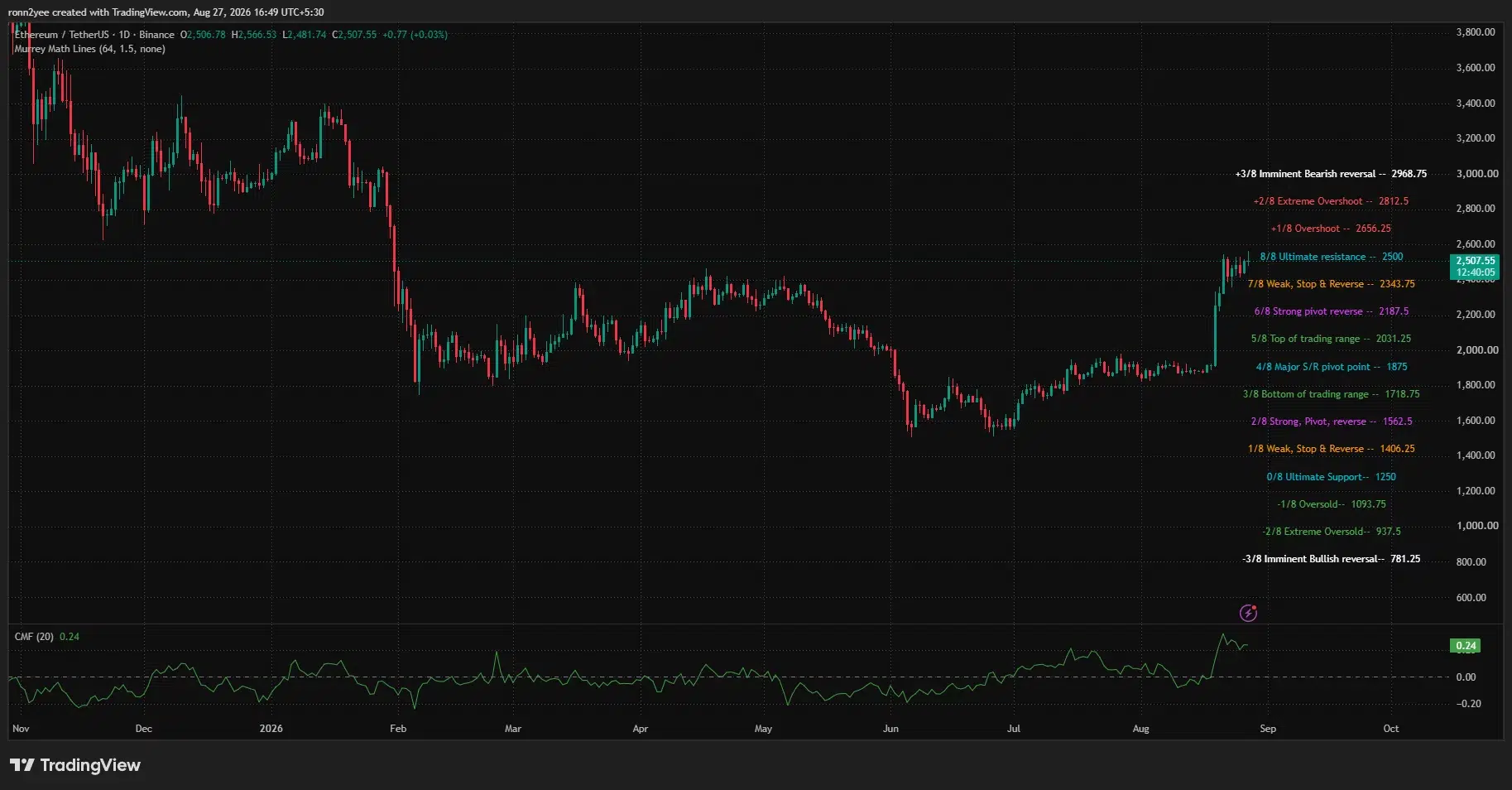
- The daily chart places ETH at the critical $2,500 resistance level, with $2,656 as the next upside target.
- Liquidation data show concentrated leverage around $2,550 above price and $2,415 below it.
Ethereum price holds its weekly breakout
According to data from crypto.news, Ethereum (ETH) price traded near $2,507 at the time of writing, up about 7.8% from its Aug. 21 opening price of $2,326. The token briefly reached a weekly high near $2,566 before settling into a narrow range around the psychological $2,500 level.
The move followed a sharp breakout from the $1,875–$1,950 range that had contained ETH for much of August. Buyers pushed the price above its February-to-May resistance area and have so far prevented a deeper return to the former range.
Ethereum’s daily chart shows the price trading almost exactly at the $2,500 Murrey Math resistance. Chaikin Money Flow stood at 0.24, remaining well above zero and showing that buying pressure continued to outweigh selling pressure.
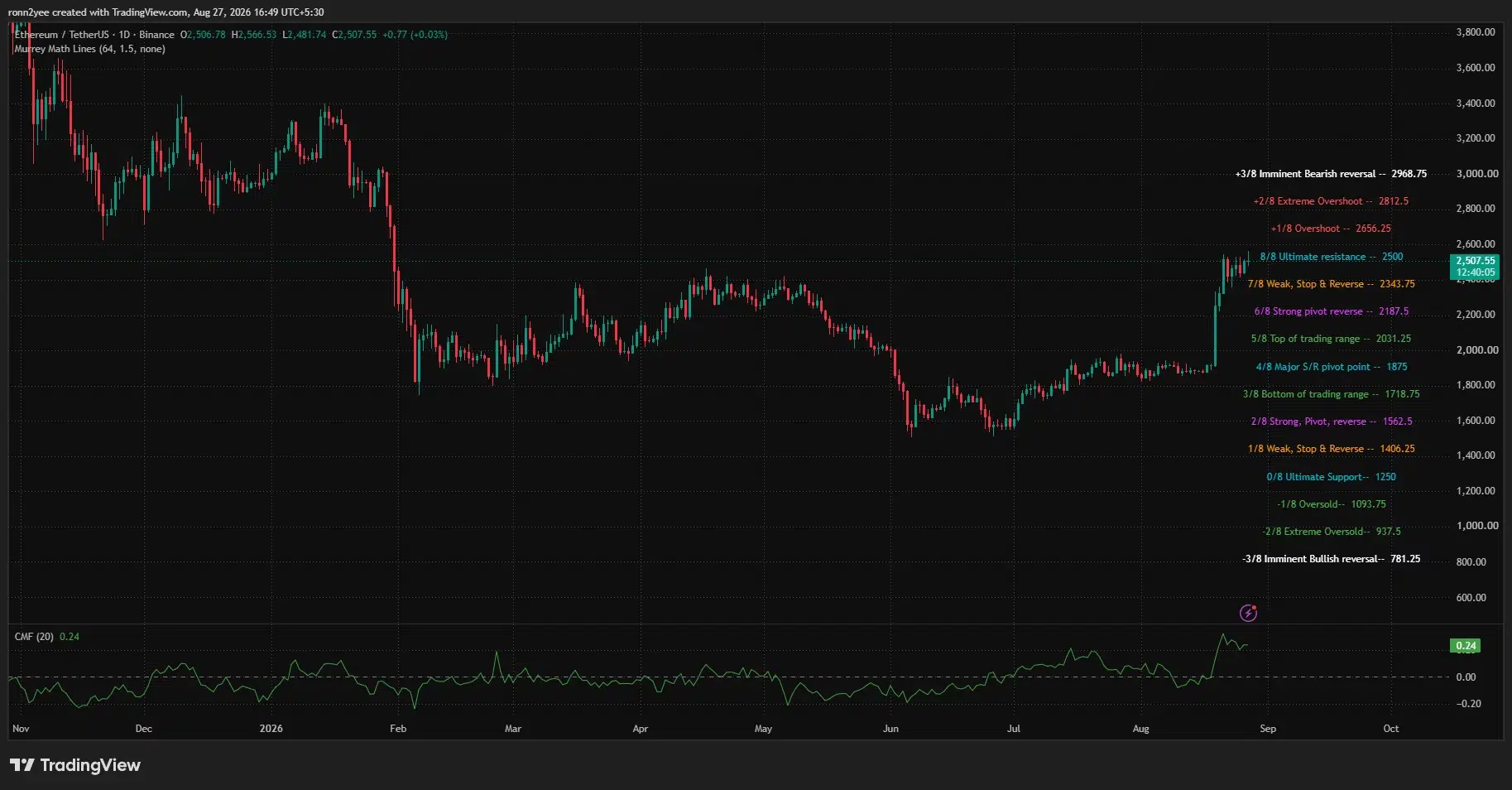
Holding above $2,500 would turn the former resistance into support and strengthen the case for another leg higher. A rejection, however, could leave the breakout vulnerable because ETH has moved more than 30% from its pre-rally consolidation zone without a major correction.
Why is Ethereum price up?
Ethereum’s rally began after the US Treasury announced that it would at least double the maximum size of its long-end liquidity-support bond buybacks from $2 billion to $4 billion per operation beginning Sept. 9. The increase covers nominal Treasury securities in the 10-to-20-year and 20-to-30-year sectors. The Treasury announced the change on Aug. 19.
Market participants treated the decision as supportive of liquidity-sensitive assets. Bond buybacks can improve trading conditions in older Treasury securities, while lower long-term yields generally make risk assets such as cryptocurrencies more attractive relative to fixed-income investments.
A record derivatives squeeze amplified the initial move. Nearly $3 billion in leveraged crypto positions were liquidated in 24 hours, with bearish positions accounting for about 92% of the total. Ethereum jumped roughly 18% during the event as short sellers were forced to close positions in a rising market. crypto.news reported that it was the largest concentrated short squeeze since November 2021.
US institutional demand then helped ETH retain those gains. Spot Ethereum exchange-traded funds recorded approximately $697.2 million in net inflows during the week ending Aug. 21, their strongest weekly performance of 2026. The inflows formed part of a combined $2.6 billion entering US-listed Bitcoin and Ethereum funds.
ETF demand provided a spot-market foundation after the liquidation-driven rally. It also helped offset isolated negative developments in decentralized finance, including the estimated $8.5 million loss connected to the Term Finance governance attack.
Ethereum faces a liquidity test at $2,550
The 4-hour chart shows ETH consolidating in the upper half of its Bollinger Bands. Price stood above the indicator’s $2,477 midpoint, while the upper and lower bands were positioned near $2,514 and $2,441.
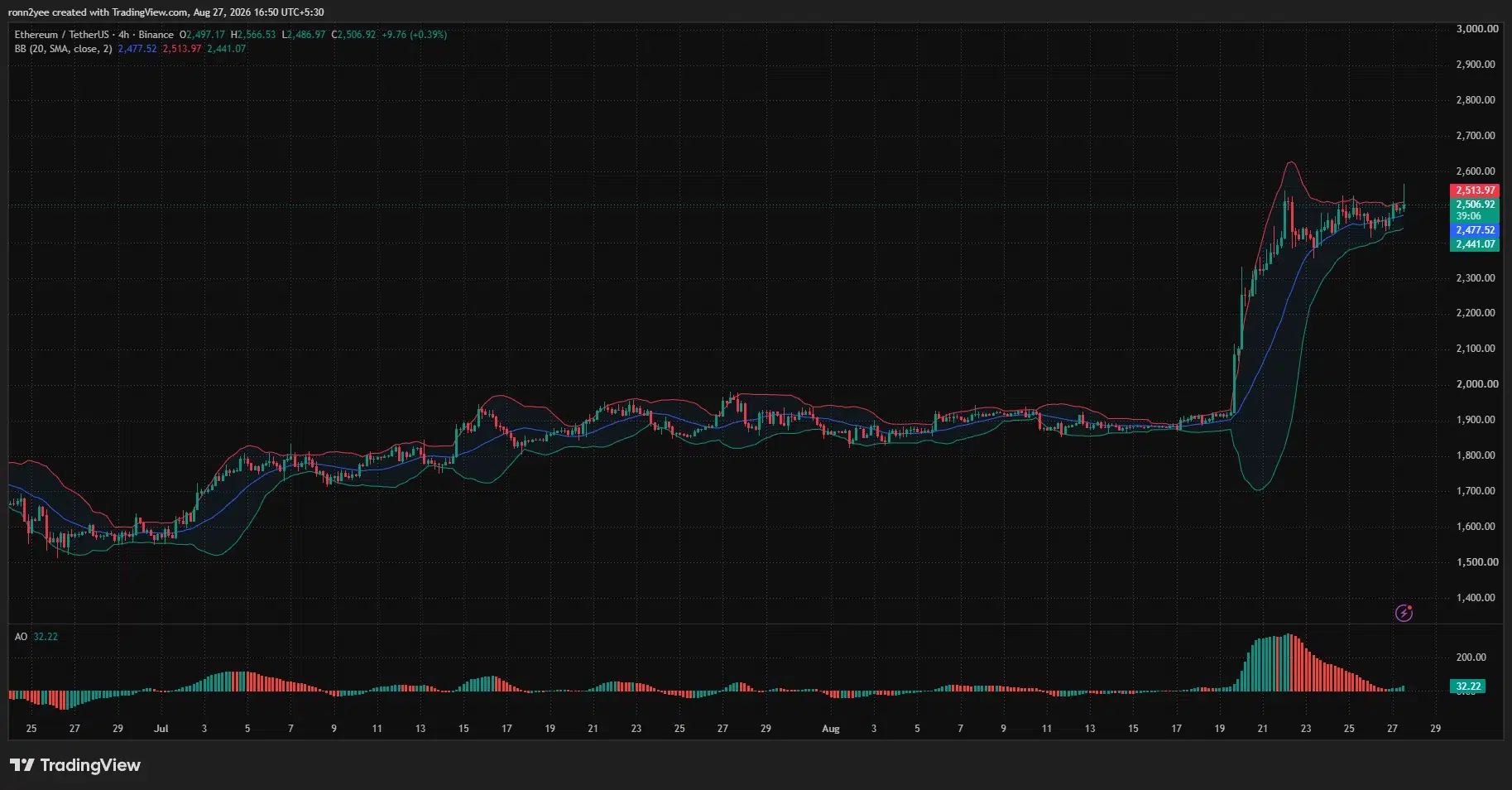
A 4-hour close above the upper band would indicate that buyers have regained short-term control. The Awesome Oscillator remained positive at 32.22 and had started printing green bars again, suggesting that momentum was attempting to recover after weakening during the consolidation.
The three-day CoinGlass liquidation heatmap identifies the largest nearby liquidity concentration around $2,545–$2,555. Price often moves toward areas containing dense leveraged positions, making that region the immediate target if ETH continues higher.
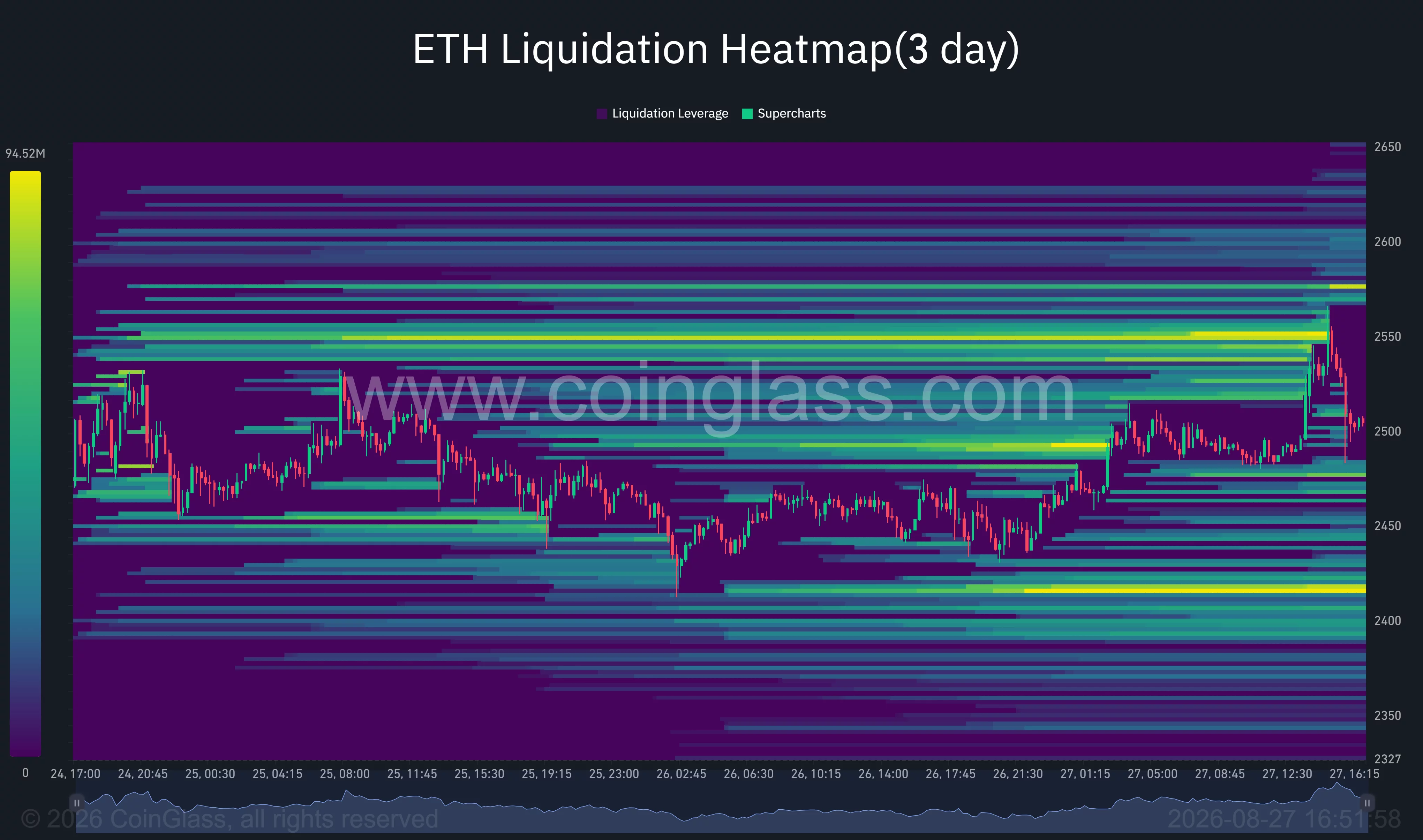
Clearing $2,550 could expose thinner liquidity between approximately $2,575 and $2,600. The daily chart identifies $2,656 as the next major technical target, followed by $2,812 if momentum expands.
Leverage also creates downside risk. The heatmap shows a large liquidation cluster near $2,410–$2,420, while the 4-hour Bollinger Band provides nearer support at $2,477 and $2,441. Losing those levels could pull ETH toward the larger liquidity pool below.
Broader daily support sits at $2,343, followed by the $2,187 pivot. A decline below $2,343 would place the latest breakout at risk and increase the chance of a return toward the previous trading range.
Analysts watch the weekly close above $2,550
Crypto trader Daan Crypto Trades said ETH was consolidating above its previous resistance but needed to extend the rally soon to avoid falling back below the breakout level.
“Otherwise you risk deviating back below the resistance and for this to turn into a big liquidity grab,” the analyst wrote.
The trader said bulls should push Ethereum to new local highs by the end of the week. Failure to do so could produce a rejection wick, weakening the apparent breakout.
Analyst Ted Pillows also identified $2,550 as Ethereum’s decisive resistance zone. According to his weekly chart, a close above that level could open a move toward $3,000. The chart places the first major support near $2,180 and a lower support area around $1,950.
The daily Murrey Math setup broadly supports that upside scenario. A confirmed break above $2,500 would place $2,656, $2,812, and $2,969 on the chart as successive targets. The first two levels represent overbought territory, meaning traders could take profits even if the broader trend remains positive.
Ethereum’s next move therefore depends on whether ETF-supported spot demand can carry the price through the $2,550 liquidity wall. A weekly close above it would confirm that buyers retained control after the short squeeze, while a drop through $2,441 would signal that the rally has entered a deeper retracement.
Disclosure: This article does not represent investment advice. The content and materials featured on this page are for educational purposes only.
Crypto World
SimpleSwap Marks a Year Inside Exodus Wallet, Ships Five Partner Updates WithNo Integration Changes


SimpleSwap today marked one year of fixed-rate exchanges running inside the Exodus wallet.
SimpleSwap-powered fixed-rate exchanges have been running within the Exodus wallet for a year. Over those twelve months, the partner side of the product gained five capabilities, none of which required Exodus or any other partner to change their integration.
Automatic refunds on swaps paused for screening
A small number of exchanges are paused for compliance checks. If a check requires further review and the exchange cannot proceed, the funds are automatically returned to the refund address; no ticket is needed.
Most refunds are completed within 5 to 15 minutes, although they can take up to 30 minutes when networks are busy. Partner statistics first show the exchange as failed, then as refunded once the money arrives.
What partners need to know:
- The refund_address field must be passed in the API request. Partners who do not collect a refund address from the user can provide their own and settle directly with the user.
- A standard network fee is deducted from the returned amount. No service charge is added on top of it.
- Coverage spans the major networks and assets. Account managers hold the current list.
- Refunds apply to eligible exchanges, not to every case.
A pause does not mean the user is being accused; it simply means there is reason to take a closer look. Crypto funds can carry over history from earlier or third-party transactions that the current sender may know nothing about, which is why the money is returned rather than left sitting somewhere.
“Nobody celebrates a swap that had to be sent back,” said Stefan Lauer, Head of Infrastructure at SimpleSwap. “But whether that money comes back on its own or through a support ticket is the part a partner lives with every day. Wallets put their own users in front of infrastructure they did not build, and a year of that from Exodus is not a small thing to hand over. Most of what shipped this year came from taking it seriously.”
Fee settings per API key and per pair
Partner accounts now set the fee percentage for an individual API key and an individual pair, rather than across the account as a whole.
A wallet can issue a separate key for each product or traffic source, give each one its own margin, and then compare the results directly. A BTC-to-USDT route can be priced differently from a long-tail altcoin route.
Pricing experiments run within the dashboard rather than in a release cycle.
Margin set on the individual transaction
The exchange creation method accepts a custom_fee parameter, so the profit share is set when an exchange is created rather than inherited from its key. Reference: https://api.simpleswap.io/docs/api/create-exchange
A promotional rate for one user segment can run alongside a standard rate for another, without changing account settings.
This is the level of payment flows usually needed, where pricing depends on the basket rather than on the integration.
Reverse estimate
A standard estimate answers the question “How much will I receive for 1 BTC?” Reverse estimate answers the opposite one: “How much does the customer need to send to receive 500 USDT?”.
Payment services use it to quote goods and services in a stable equivalent while accepting whatever asset the buyer holds.
The settlement figure is known before the invoice goes out.
300+ assets added, with no partner-side release
More than 300 assets were listed over the year, including tokens requested directly by partners. They reach partner apps through the same currency call already in place.
Behind that pace sits the aggregation layer, which now draws on 20+ liquidity providers across CEX and DEX venues, with NEAR among the sources announced publicly. A wider pool means a new asset can usually be routed through existing infrastructure, rather than waiting for a single venue to support it.
Listing requests arrive when a coin starts moving, making the speed of adding an asset a commercial rather than a technical question.
Where things stand after year one
- 20+ liquidity providers aggregated across CEX and DEX sources
- 2,800+ assets available for exchange, 300+ of them listed in the past year
- 3.2M+ trading pairs
- 6,000+ partner products running SimpleSwap
- 20M+ swaps processed for 10M+ users since 2018
- 99.9% uptime
- 4-minute average support response when a case needs a person
Five changes went out over the year, and not one of them was a migration. The integration Exodus shipped in August 2025 is the same one running today, with a broader asset list and finer control over what each transaction earns. Teams that want to switch any of it on will find the details in the API documentation or through their account manager.
About SimpleSwap
SimpleSwap is a self-custodial, multi-source swap aggregator that helps users exchange crypto with greater privacy and control, without having to compare providers and routes themselves. It supports direct wallet-to-wallet swaps across 20+ liquidity providers and 2,800+ swappable assets, combining liquidity from well-known CEX and DEX sources under the hood.
Operating since 2018, the exchange infrastructure is integrated into 6,000+ partner products, including Exodus, Tangem, Ellipal, Cake Wallet, and Tonkeeper.
For partners: SimpleSwap API integration at https://simpleswap.io/affiliate-program API documentation: https://api.simpleswap.io/docs
The post SimpleSwap Marks a Year Inside Exodus Wallet, Ships Five Partner Updates WithNo Integration Changes appeared first on BeInCrypto.

XRP price is trying to reconcile two conflicting signals coming from the asset. One points to distribution. The other points to accumulation at scale. Both are happening at once, and that’s not a coincidence.
CryptoQuant-linked analyst Darkfost flagged a 231 million XRP withdrawal from Binance in a single day this week, worth $330-335 million at the time, the largest such move in about six months. Whale wallets have also sent close to 1.45 billion XRP to Binance over the trailing 30 days.
Those figures look like sell-side ammunition even as some of that liquidity cycles back off-exchange. Meanwhile, seven U.S. spot XRP ETFs have pulled in $1.55 billion in cumulative inflows, with August alone doubling July’s pace.
The market isn’t dragging XRP down; Solana posted 20%+ gains this week while Bitcoin keeps on going higher.
Discover: The Best Token Presales
Can XRP Price Hit $1.70 This Week?
XRP price is moving in an intraday range of $1.40 to $1.45, showing a market still digesting last week’s 50% rally before this week’s pullback toward the $1.40 zone. Immediate support sits near $1.40, with a deeper floor around $1.33-1.36 based on Fibonacci retracement levels.
Resistance clusters at $1.50-$1.55, where XRP was already rejected once, then again near the $1.65 prior weekly close. RSI(14) readings near 25 suggest an oversold condition, though the aggregate technical signal still leans toward sell pressure.

If XRP can maintain its ETF inflows with whale-driven supply, it could reclaim $1.50, and momentum carries it back toward $1.65. Consolidation could also happen between $1.40 and $1.50 while the market waits for the next flow data print.
But it’s going to look bad if it breaks below $1.40, which opens the door to $1.33, especially if escrow unlock concerns resurface and compound whale selling.
We are watching for confirmation and should track daily ETF flow reports alongside exchange balance shifts before committing size.
Trade XRP on Bybit and Get a Chance to Win Our $1,000 USDT Airdrop
LiquidChain Targets Early Mover Upside as XRP Tests Key Levels
A 4.53% bounce off recent lows is constructive, but XRP at a market cap already north of $80 billion isn’t handing out 10x setups. The math simply doesn’t work that way at scale.
This pushed a segment of traders toward earlier-stage plays where the upside curve looks different. LiquidChain ($LIQUID), a Layer 3 infrastructure project positioning itself as the connective tissue between Bitcoin, Ethereum, and Solana liquidity pools, is on traders’ radar.
The Order doesn’t ask twice.
⟁
When the signal comes, you answer.https://t.co/vqvBcdSQYC pic.twitter.com/z4Oc2AUBpi— LiquidChain (@getliquidchain) August 27, 2026
The pitch: a Unified Liquidity Layer with Single-Step Execution and Verifiable Settlement, built on a Deploy-Once Architecture that lets developers ship once and reach all three ecosystems instead of fragmenting deployments across chains.
Current presale price sits at $0.01494, with $950K raised so far.
Research LiquidChain directly before the presale closes.
Discover: The Best Crypto to Diversify Your Portfolio
The post XRP Price Caught Between $231M Whale Selling and ETF Inflows appeared first on Cryptonews.
Microsoft slaps a fresh coat of AI paint on the Microsoft 365 Roadmap

earn more money #studentmotivation #studyhacks #motivation

‘I went to gorgeous seaside town 2hrs from Cambridge with award-winning beach’





-

 Fashion6 days ago
Weekend Open Thread: Madewell – Corporette.com
-

 Crypto World2 days ago
SpaceX stock could rise 75% to $240, JPMorgan says
-

 Business5 days ago
Musk’s Tesla, SpaceX Confirm $16.8 Billion ‘Terafab’ Chip Plant as World’s Largest Building in Texas
-

 Crypto World5 days ago
anatomy of crypto’s biggest liquidation event since 2021
-

 Crypto World3 days ago
A $30 Billion AI Fund Implodes, Now the SEC Is Investigating Wall Street’s Role
-

 Politics5 days ago
6 months on, Irish renters crushed by effects of government housing bill
-

 Crypto World1 day ago
Did Trump Just Move SpaceX Stock With One Truth Social Post?
-

 Business4 days ago
Mystery AI Model ‘Ox Alpha’ Draws Developers With Free Access as Chinese Lab Origins Remain Debated
-
 NewsBeat5 days ago
The ‘Lucky Dip Gang’ causing carnage for clicks: After five thugs were killed speeding in the wrong direction on a motorway, GUY ADAMS investigates a sick new trend… and why police aren’t even allowed to pursue them
-

 Business3 days ago
Moderna CEO warns China is pouring state money into mRNA technology
-

 Business7 days ago
Five Below: Kids Discount Retailer Reaps Rich Rewards
-
 Crypto World6 days ago
Nvidia Stock Suffers Longest Losing Streak Since 2022: Will Q2 Earnings End It?
-

 Business3 days ago
NVIDIA Stock Drops Nearly 2 Percent to $210 on Seventh Losing Day Ahead of Critical AI Earnings
-

 Sports4 days ago
Deshaun Watson fires back at Browns fans after being booed: ‘It’s a disrespectful thing’
-

 Business6 days ago
UK firms in critical financial distress rise 9% to 53,756
-
 Crypto World4 days ago
Google Gemini AI Predicts Ethereum Could Become the Trade Retail Misses in 2026
-

 Tech6 days ago
Unitree’s New Superman Robot Claims to Outjump and Outrun Every Human, Usain Bolt Included
-

 Tech6 days ago
Faster chip in a familiar form factor
-

 Crypto World6 days ago
SEC Regulation Crypto vs CLARITY Act: which framework wins
-

 Business5 days ago
Will Tesla Stock Be Higher or Lower a Year From Now? Here’s What Wall Street Analysts Are Saying
You must be logged in to post a comment Login