

Crypto World
From the World Cup Stadium to 24/7 Support: How HTX is Redefining VIP Services


As the highly anticipated match between Spain and Belgium ignited the stadium, HTX’s SVIP users witnessed this world-class sporting moment far beyond the trading screen: through live match viewing, an exclusive VIP Lounge, customized travel itineraries, and face-to-face networking with fellow users from across the globe.

This premium experience, themed “HTX SVIP World Cup Journey,” was more than just a luxury getaway. It served as a tangible expression of HTX’s philosophy on VIP services — proving that SVIP is not merely a membership tier, but a long-term partnership.
One SVIP client, K, shared his thoughts after the experience:
“Previously, when I thought about exchange VIP perks, the first things that came to mind were usually ‘behind-the-scenes benefits’ like trading fee discounts, dedicated customer support, and higher limits. But this time, HTX brought us straight to the World Cup stadium, with access to a custom VIP lounge and an exclusive live match experience. These are real, tangible benefits you can actually enjoy.”

From a Trading Platform to a Long-Term Partner
For key clients, the most valuable service isn’t demonstrated when everything is going well, but at critical moments — when markets shift rapidly, capital needs to be mobilized quickly, or account issues require immediate resolution.
Unlike retail users, key and institutional clients face significantly more complex challenges: a single large trade may require liquidity arrangements; a market strategy may hinge on onboarding and verification timelines; a delayed withdrawal could impact subsequent capital deployment.
To address these challenges, HTX has established a dedicated service framework for SVIP users and institutional clients at Prime 5 and above that operates independently of the standard support queue. Spanning major communication channels such as Telegram, email, and WeChat, this framework uses Telegram as its primary 24/7 service hub, ensuring clients across different time zones can reach a dedicated support team whenever they need assistance.
Rather than addressing standard retail queries, this specialized team focuses on high-impact matters of direct concern to key clients. These include liquidity support, KYC verification, institutional onboarding, account management, and other time-sensitive operational issues. Through this tiered service framework, key clients benefit from streamlined communication pathways and high-priority response times.
Fast Issue Resolution: The Key to Effective Customer Support
For VIP services, being “online” is merely the baseline. The true differentiator is the ability to understand complex business scenarios in depth and rapidly coordinate internal resources to resolve issues.
Case Study 1: Seamless Institutional Onboarding. A newly onboarded institutional client sought to complete verification and start trading ahead of a major market event. The dedicated team maintained continuous communication via Telegram, helping organize account settings, streamlining outstanding documentation, and coordinating internal reviews to successfully launch the client within their target window.
Case Study 2: Frictionless Verification. A Prime client was unclear about the supplementary documentation required for level 3 KYC verification. Through real-time communication, the team clarified each requirement step-by-step, eliminating the prolonged wait times typically caused by repeated document resubmissions.
Case Study 3: Rapid Settlement Support. During a large-scale withdrawal, a client noticed their transaction was pending. After receiving the client’s feedback, the team immediately intervened and tracked the issue internally, enabling the transaction to be processed within 5 minutes. While this represents a specific operational resolution, it highlights the dedicated team’s execution capabilities when handling high-priority issues.
Furthermore, when clients require liquidity support for large positions, the team provides direct coordination and specialized assistance. For institutions and high-net-worth individuals, the value of such services goes beyond simply solving an isolated issue—it significantly reduces communication friction, buying critical time for high-stakes investment decisions.
From Foundational Efficiency to Tailored VIP Privileges
Exceptional VIP service must first address trading efficiency challenges. Only on top of that foundation can a highly differentiated product and benefit ecosystem be built.
Built around the diverse needs of SVIP users, HTX has developed a multi-tiered benefits system spanning trading fees, Earn products, lending, and exclusive privileges.
- 1. Tailored Fee Structures. SVIP clients can earn rebates on their trades and unlock tailored, ultra-low fee structures that match their specific operational profiles and trading styles.
- 2. Exclusive VIP Flexible Earn. HTX has introduced an exclusive VIP Flexible Earn program for USDT, offering enhanced yield opportunities for eligible Prime users. Specifically, Prime 5–Prime 7 users can enjoy up to 6.00% APY with a 50,000 USDT quota, while Prime 8–Prime 9 users can access up to 7.00% APY with an 80,000 USDT quota. Prime 10–Prime 11 users can enjoy the highest tier of benefits, with up to 9.00% APY on a 100,000 USDT quota. Additionally, based on trading volumes or net deposit metrics, the platform can issue APY Booster Coupons covering core assets like USDT, USDD, and ETH.
- 3. Optimized Lending Terms. For SVIP users who use Collateral Swap, larger loan amounts unlock progressively higher discount rates—up to 28% off (72% of the standard cost)—along with tailored liquidation-delay protection policies.
These benefits are built around a single principle: VIP service is not about repackaging standardized products. Instead, it is about designing bespoke service frameworks tailored to each client’s trading scale, capital structure, and business needs.
Making Premium Service Tangible
If dedicated responses, optimized fee structures, and customized liquidity support form the professional bedrock of VIP service, then initiatives such as the World Cup Journey, holiday gifts, and personalized birthday celebrations elevate these services from the trading dashboard into real-world experiences.
HTX provides its SVIP users with premium physical and offline experiences, including customized holiday gift sets, exclusive birthday celebrations, and bespoke brand collectibles. The World Cup Journey further expands the horizons of global high-end privileges, proving that VIP service does not just live in account settings—it can manifest at world-class sporting events, key global cities, and during significant moments in users’ lives.
The World Cup Journey is merely one chapter of HTX’s global SVIP experience. From 24/7 on-demand communication channels to specialist assistance for liquidity, verification, and account settings; and from tailored trading fees, Earn products, and optimized lending privileges to live access at world-class arenas—HTX is actively cultivating a VIP service ecosystem that starts with execution efficiency and matures into a long-term partnership.
True VIP service does not simply mean offering more perks when times are good. It means ensuring that when clients need it most, there is always someone to answer, someone who understands, and someone to walk beside them.
The post From the World Cup Stadium to 24/7 Support: How HTX is Redefining VIP Services appeared first on BeInCrypto.

Cardano’s ADA has been struggling to remain in crypto’s top 20, and its recent performance has been quite concerning (to say the least). Even so, analysts continue to float optimistic price targets for it.
Solana’s native token has flashed signs of an uptrend, while Ethereum (ETH) might be heading toward the biggest crash in its history.
ADA’s Latest Forecasts
The asset’s price has slipped well below $0.20 and is among the most severely affected by the prolonged bear market. X user The Boss noted the downward structure but reminded that the strongest reversals begin during such a negative environment when “almost nobody is paying attention.”
CryptoJack and Celal Kucuker also chipped in. The former spotted the formation of an inverse head-and-shoulders pattern on ADA’s chart, which has historically been a precursor of a rally, while the latter envisioned a parabolic increase to a new all-time high of $5.
The whale activity supports the bullish perspective. Investors holding between 100,000 and 100 million ADA have boosted their total possessions to more than 25.6 million coins, while those owning fewer than 100 units have reduced their exposure. This combination represents a healthy setup for the token, yet it can’t 100% guarantee a short-term pump.
Of course, not everyone is so optimistic. X user Alexander Legolas believes that Bitcoin (BTC) may soon tumble to $48,000, dragging ADA to around $0.10 along the way.
SOL’s Targets
Solana’s native cryptocurrency currently trades at around $75 (per CoinGecko), but some market observers think it may soon head north to much higher levels.
Ali Martinez recently argued that the Average True Range (ATR) stop has flipped below price, marking the first SuperTrend buy signal on the asset since October 10. That said, he projected a possible rise to $96 and even $121.
Michael van de Poppe suggested that SOL could stage a decisive comeback should it stay above $73, while the rising fear, uncertainty, and doubt (FUD) around the project may also be considered good news. After all, this means that most weak-hand investors have already exited, potentially setting the stage for a meaningful recovery.
ETH Crash Incoming?
Earlier this week, the second-largest cryptocurrency tried to reclaim the $2,000 psychological mark, but failed and now trades at approximately $1,830. And while many investors eagerly await a substantial rebound, certain analysts warned that a major collapse could be on the way. Crypto Rover told his 1.6 million followers on X that ETH might repeat previous cycles that ended in “devastating sell-offs.”
“The worst may still be ahead,” he added.
Ash Crypto is in the completely opposite corner. They reminded that every time the Russell 2000 hits a new all-time high, ETH has followed with a parabolic move in the next 12-18 months.
“We are seeing the same setup now. If history repeats, ETH could be gearing up for one of its biggest runs yet,” the analyst concluded.
The post Bullish ADA Predictions, SOL Shows Rally Potential, and More: Bits Recap July 17 appeared first on CryptoPotato.
The value of SpaceX’s longest-dated series of bonds shriveled to 90.7 cents on the dollar this week while their effective yield sank to a junk bond-like rate of 7.5%.
This is despite bond investors lending Elon Musk’s company billions of dollars and signaling their willingness to delay principal maturity until 2056.
The 9.3% collapse ranks SpaceX’s long bonds dead last among 1,450 benchmark corporate notes rated US investment-grade “BBB.”
The notes’ credit spread, i.e. the extra yield lenders demand for taking idiosyncratic SpaceX risk, has worsened from 175 basis points at issuance to 231.
At the same time, the stock price of Musk’s company has also been cratering from its high and even trading below its IPO price, so it is not surprising to see the value of its bonds follow suit.

A collapse from highs to lows at SpaceX
For obvious reasons, bond prices typically correlate to quick downturns in common stock prices of the corporate issuer.
Fear is often company-wide and not usually unique to its creditworthiness as distinct from its general business prospects.
A bond trader at Post Oak Group explained the irony of SpaceX needing to raise capital from bond markets so early into its life as a public company.
“Two weeks after the largest IPO in history, SpaceX is already tapping debt markets while carrying a $5 billion net loss and CapEx [capital expenditures] that more than doubled year over year,” he told CNBC.
Indeed, SpaceX’s own filings show company-wide CapEx jumping 86% to $20.7 billion — not quite double, but close enough.
Meanwhile, SpaceX also absorbed more money-losing operations from the Grok side of X, the xAI segment which has lost $6.4 billion from operations.
Worse, SpaceX started subsidizing xAI in the middle of an AI industry-wide borrowing binge. Nvidia, SpaceX, and Amazon unloaded $75 billion of bonds on investors in a matter of weeks, emptying bond traders’ pocketbooks right when SpaceX needed to borrow more.
With lots of supply, the answer is predictable: lower prices.
Read more: 28,000 crypto wallets pledged $560M for SpaceX shares they didn’t get
SpaceX priced its first-ever bond sale on June 23 in five slices maturing between 2031 and 2056. It had another $20 billion bridge loan earlier this year.
Initially, demand seemed bottomless. Buyers happily placed nearly $90 billion of orders at issuance. Then, the bonds started trading.
Buyers at issuance logged roughly $305 million of paper losses in the first two days of secondary trading.
The difference between a bond’s yield and its price
SpaceX’s bonds (aka “notes”) maturing in 2056 pay a fixed 6.65% coupon. That means the company must pay $66.50 per year, for 30 years, on every $1,000 of face value.
Those payments (aka “coupons”) are fixed. The price of those bonds, however, fluctuates in terms of their overall value to an investor.
In other words, what buyers will pay for that fixed stream of payments fluctuates on a daily basis. This is the variable “price” of the bond, which is distinct from its yield of coupon payments.
Anyone buying bonds at a discount locks in a fatter return, because the stream of payments is constant. Price and yield are two ends of a seesaw; one falls, the other rises.
In the case of SpaceX, its bonds sold in June at 99.45 cents on the dollar and slid to 94.52 cents by July 7. They now fetch an even worse 90 cents on the dollar, enough to push the effective yield (due to the bonds’ lower price) to a junk-like rate of 7.5%.
Next, the bond “spread” is the portion of that yield above the US Treasury bond rate, and it is risk premium mostly attributable to SpaceX.
When that spread widens, or gets larger, the market is repricing SpaceX as less creditworthy.
Man Group calculated that SpaceX’s 30-year bonds pay a bigger effective yield than the average junk-rated borrower, despite an investment-grade rating.
Bondholders and shareholders grieve together
Common shareholders of SPCX have similar grievances.
Their stock peaked at $225.64 on June 16, days after an IPO that ultimately raised $85.7 billion. Since then, they’ve surrendered more than $1 trillion in market capitalization.
When SpaceX revealed its bond sale on June 22, SPCX shares dropped 16% in a day. On Thursday, SPCX closed at $131.11, its first finish below the $135 IPO price, and roughly 42% off the peak.
Equity holders can at least tell themselves a story about traveling to Mars. Bondholders own no upside on the possibilities of space travel, only the hope for a full slate of coupon payments.
SpaceX still owes its lenders three decades of 6.65% coupons. Yet within three weeks, an increasingly uncertain market has already discounted many months of those payments by repricing those bonds lower.
Got a tip? Send us an email securely via Protos Leaks. For more informed news and investigations, follow us on X, Bluesky, and Google News, or subscribe to our YouTube channel.
Crypto World
Playbook for WEEX Cup 2026: Data Intelligence, Predictive Insight, and $1M in Community Rewards

Every World Cup produces a moment nobody saw coming. This year, WEEX, a world leading crypto exchange, gave its community three ways to get ahead of it: a live prediction data report with Foregate, a $1,000,000 Dice Rush campaign, and an interview with football legend Michael Owen that ended up predicting the tournament’s biggest upset before it happened.
The Guide That Reads the Tournament Like a Market
WEEX teamed up with ForeGate, the Solana-based on-chain prediction market, to publish the ForeGate 2026 World Cup Winning Guide — a living report tracking advancement odds, likely matchups, and title paths as the tournament unfolds.
The idea was simple: treat football like a market, not a guessing game.
Where most World Cup content freezes on kickoff day, this one kept moving — updated as results came in, odds shifted, and underdogs made their case. While the tournament kept changing, WEEX made sure the data changed with it.
WEEX Cup: Where Every Roll Could Be Worth $1,000,000

Alongside the data, WEEX built something louder: WEEX Cup – Dice Rush, a World Cup-themed event backed by a $1,000,000 USDT prize pool, plus trial fund, token rewards and more!
The mechanics are built for momentum, not complexity:
- Earn dice — complete tasks like deposits, trading, or inviting friends
- Roll to win — move across the board, unlock BTC, ETH, USDT, coupons, and more
- Stack points — unlock milestone rewards and enter WEEX Cup match predictions
- Back a champion — use points to support the team you believe will lift the trophy, then share the prize pool with everyone who called it right
Users who picked less-favored outcomes were positioned for bigger rewards — a mechanic that turned out to be more prophetic than anyone expected.
The numbers tell the story. Over 100,000 users have joined the event so far. More than $1,000,000 in rewards has already been distributed, with top winners claiming over $2,000 each.
One line sums up the design philosophy: the crowd isn’t always right, and the ones who bet against it get paid more for being early.
When WEEX and Michael Owen Predicted the Upset Before It Happened
Weeks before Cape Verde became the story of the tournament, WEEX COO Andrew Weiner sat down with football legend Michael Owen to talk about what makes this World Cup different.
One line from that conversation stands out now:
“When you’re in the minority of opinion, you have the biggest chance for the biggest value.”
Owen went further, pointing to the tournament’s expansion to 48 teams as fertile ground for exactly this kind of surprise:
“There’s possible value in certain situations — it’s down to people to try to find it.”
Then Cape Verde happened.
A nation of 546,000 people, ranked outside the world’s top 70, playing in its first-ever World Cup — and it didn’t just show up. It drew Spain 0-0. It drew Uruguay 2-2. It drew Saudi Arabia 0-0, advancing out of the group stage without winning a single match, one of only five teams in World Cup history to do so.
Then, in the round of 16, Cape Verde held reigning champions Argentina to a 1-1 draw through regulation time — before finally falling 3-2 in extra time.
Four matches. Three former World Cup champions faced. Zero regulation-time losses.
It was, by every measure, the value Owen had described weeks earlier — found by a team nobody was pricing in.
A football legend called it before the tournament even started. That’s the kind of insight WEEX brought to its community.
WEEX’s World Cup Journey: Three Moves, One Idea
Report, game, and conversation weren’t three separate campaigns. They were one belief, expressed three ways:
The best value in football — and in markets — is rarely where everyone’s already looking.
WEEX didn’t just watch the World Cup happen. It built tools to help its community read it, play it, and occasionally, predict it before the world caught on.
Disclaimer: This information does not hold any official affiliation, sponsorship, or endorsement with FIFA or any official international football governing body.
About WEEX
Founded in 2018, WEEX has developed into a global crypto exchange with over 6.2 million users across more than 150 countries. The platform emphasizes security, liquidity, and usability, providing over 1,200 spot trading pairs and offering up to 400x leverage in crypto futures trading. In addition to the traditional spot and derivatives markets, WEEX is expanding rapidly in the AI era delivering real time AI news, empowering users with AI trading tools, and exploring innovative trade to earn models that make intelligent trading more accessible to everyone. Its 1,000 BTC Protection Fund further strengthens asset safety and transparency, while features such as copy trading and advanced trading tools allow users to follow professional traders and experience a more efficient, intelligent trading journey.
Follow WEEX on social media
Instagram: @WEEX Exchange
Tiktok: @weex_global
Youtube: @WEEX_Official
Discord: WEEX Community
Telegram: WeexGlobal Group
The post Playbook for WEEX Cup 2026: Data Intelligence, Predictive Insight, and $1M in Community Rewards appeared first on BeInCrypto.

Europe’s MiCA licensing pipeline added 14 more crypto-asset service providers to ESMA’s interim Markets in Crypto-Assets (MiCA) register in the second post-deadline update, bringing momentum down from the larger first wave after the transitional period ended.
According to an ESMA update published on Thursday, the total number of licensed crypto-asset service providers (CASPs) now stands at 294. The latest entries include Ripple Payments Europe (Ripple’s European payments business), Bison Bank based in Portugal, and Croatia’s state-owned Hrvatska poštanska banka (HPB).
Key takeaways
- ESMA added 14 CASPs in the latest MiCA register update, taking the licensed total to 294.
- Banking groups are prominent among new entrants, including institutions from Germany, Portugal, and Croatia.
- EMT and ART registers did not change: 21 EMT issuers remain unchanged, and ART still lists no approved issuers.
- ESMA also expanded its non-compliant list by two entities after actions by Italy’s CONSOB.
MiCA register slows after an initial surge
ESMA’s latest expansion arrives after a more aggressive update on July 3, when the regulator added 37 CASPs in its first major post-deadline roll-out following the end of MiCA’s transitional period. The difference in scale—37 entries the first time versus 14 this update—suggests a shift from the fastest initial licensing push into a steadier, slower cadence.
Still, the register’s upward trajectory remains important for firms planning market entry. For investors and market participants, the register functions as an on-the-record signal of which providers are operating under MiCA’s licensing umbrella, rather than relying only on voluntary or transitional arrangements.
Banks and payment providers extend regulated crypto services
The newest CASP entries underscore how established financial institutions continue to embed crypto services within regulated frameworks. Alongside Ripple Payments Europe and the banks already named, ESMA’s update includes German cooperative banks Volksbank Schwarzwald-Donau-Neckar and Raiffeisenbank Auerbach-Freihung.
ESMA also listed Kaiser Partner Privatbank, a Liechtenstein-based private banking group, further expanding the footprint of wealth and private banking providers offering crypto-related services under MiCA.
The latest additions build on a broader pattern already visible in ESMA’s interim register, which includes dozens of traditional finance firms—such as Spain’s BBVA and CaixaBank, Germany’s Commerzbank, France’s CACEIS Bank, and Standard Chartered Luxembourg.
EMT and ART issuance remains largely static
While CASP licensing activity continues to progress, ESMA reported no changes to two token-specific registers that track stable-value and reference-asset products.
For electronic money tokens (EMTs)—crypto-assets designed to maintain a stable value against a single official currency—ESMA’s register remains at 21 unique issuers. For asset-referenced tokens (ARTs), which are designed to track multiple assets such as currencies or commodities, the register continues to show no approved issuers.
That divergence matters because it points to uneven readiness across MiCA’s product categories. CASPs can continue onboarding under MiCA’s service rules, while token issuance—particularly ARTs—appears to be moving at a slower pace.
Non-compliant register adds two entities
Separately from the licensed CASP framework, ESMA also updated its non-compliant register by adding Reversal Investment Group and Kortex.
ESMA said the additions followed enforcement actions by Italy’s securities regulator, the Commissione Nazionale per le Società e la Borsa (CONSOB). With these additions, the non-compliant list now totals 164 entries, including crypto exchange MEXC.
For market participants, non-compliant listings are a caution flag: they indicate entities that ESMA deems to be outside MiCA’s compliance expectations. Traders and users looking for regulatory clarity typically treat the contrast between the licensed register and the non-compliant register as a practical guide for due diligence.
What to watch next
With ESMA’s CASP register continuing to climb—while EMT and especially ART approvals remain comparatively constrained—investors should watch whether token issuance accelerates in the next updates and how quickly the gap between service-provider licensing and token product approvals narrows under MiCA.
Argentine court has ordered the identification of holders behind 25 cryptocurrency wallets and frozen assets linked to the $LIBRA token investigation after authorities traced millions of dollars across multiple blockchain networks.
Summary
- An Argentine judge has ordered the identification of holders behind 25 crypto wallets and frozen assets linked to the $LIBRA investigation.
- Investigators traced nearly 498,539 USDT through multiple wallets, with several transactions passing through Binance, Bybit, OKX, and Bitfinex.
- Authorities are seeking KYC records and transaction data after tracing about $8.2 million that began moving again in May.
According to Argentine newspaper Clarín, Federal Judge Marcelo Martínez de Giorgi issued the order after reviewing a report from the Cybercrime Technical Department of the Argentine Federal Police, which reconstructed the movement of crypto assets linked to the $LIBRA case from May onward.
The order seeks account holder identities, know-your-customer records, IP addresses, transaction histories, and other information that could identify those behind the transactions.
The latest measure centers on 25 wallets believed to have handled part of the money left with the creators of the $LIBRA token following its failed launch in February 2025. The judge also instructed authorities to freeze assets associated with those wallets, although it remains unclear whether the funds are still held there or have already been transferred elsewhere.
Court documents reviewed by the publication reconstructed the activity of eight wallets identified as the “Libra Team,” which investigators linked to the token’s creation and the withdrawal of investor funds after Argentine President Javier Milei promoted the project on social media. During that period, the token’s price briefly surged before collapsing within minutes.
According to the report, token creator Hayden Davis previously said roughly $110 million remained under his control after the launch. Investigators found that four of the eight Libra Team wallets consolidated funds into a single wallet identified as “61yk.”
Investigators trace funds through exchanges
The police report stated that wallet “61yk” had remained frozen for nearly six months under an order from the U.S. District Court for the Southern District of New York, which is handling a separate case involving Davis.
After the restriction was lifted, investigators alleged the wallet redistributed funds using what the report described as a “digital smurfing” strategy, breaking larger balances into smaller transfers to make the transactions harder to follow or eventually convert into fiat currency.
Authorities traced a major movement on May 10, when 498,539 USDT was transferred through a cross-chain interoperability protocol to a wallet on the Tron network. The receiving wallet then split the funds into 17 separate transactions in what investigators described as another attempt to obscure the trail.
The Federal Police report found that at least 10 of those transactions passed through Binance, while eight wallets were linked to Bybit, two to OKX, and another two to Bitfinex. Because centralized exchanges generally require customer identity verification, investigators believe those transfers could help identify some of the individuals involved, although the report noted that some platforms may not hold KYC information for every account.
Crypto analyst Fernando Molina, who has independently tracked the movement of $LIBRA funds, previously estimated that about $8.2 million remained dormant before becoming active again in May through wallets now under judicial scrutiny.
Separate information reviewed by Clarín indicates that the remaining funds are managed through a trust established by Davis, which is intended to distribute grants to Argentine companies as part of a proposed revival of the project before the end of the year. Earlier reports said the trust had already received 71 grant applications.
Bitcoin (BTC) has been counting down to its next bottom for nearly two months, a classic onchain metric suggests.
Key points:
- BTC supply in loss passed 50% for the first time this bear market in early June.
- In previous bear markets, that event sparked a countdown to a new BTC price macro bottom.
- Separate data hints that the bull market’s “emotional premium” has now gone.
Supply in loss countdown already Bitcoin’s second-longest
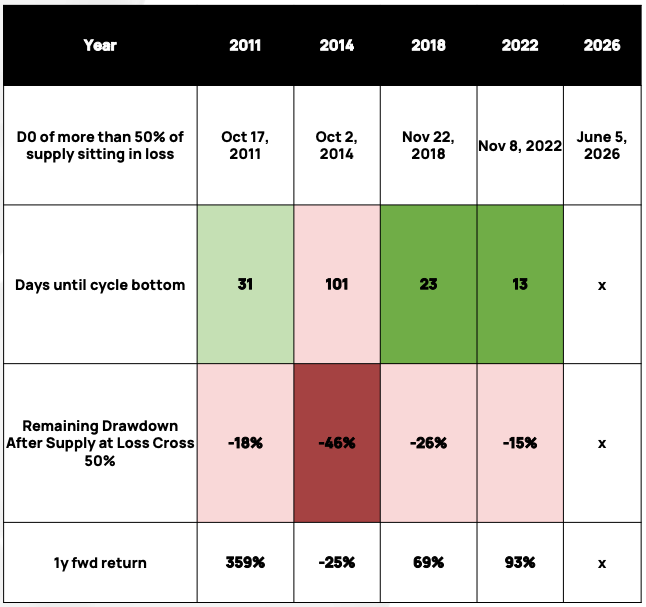
In its H1 2026 Round-Up report, crypto research company K33 Research flagged more than 50% of the BTC supply now being held at a loss.
A typical bear-market feature, supply in loss has become a yardstick for progress toward macro bottoms for BTC/USD.
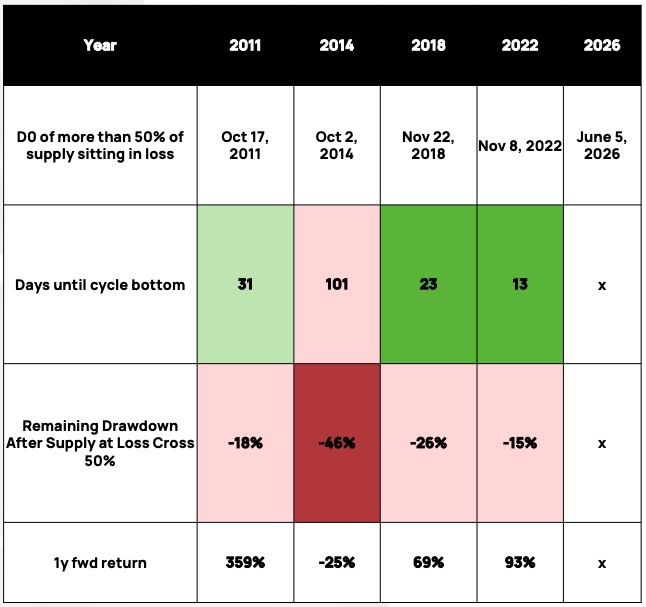
K33 data shows that once supply in loss passes the 50% mark, the bottom has come no more than 101 days later. Bear markets have provided various time frames, with the shortest bottom “window” lasting just 13 days in 2022.
The 2018 bear market required 23 days to reach its floor, while in 2014, Bitcoin continued to decline for 101 days after the 50% supply-in-loss mark was hit.
In 2026, supply in loss repeated standard bear-market behavior, crossing 50% on June 5. Since then, 42 days have elapsed, making this year’s bottom window Bitcoin’s second-longest ever.
BTC supply in loss and days until bear-market bottom (screenshot). Source: K33 Research
In accompanying commentary, K33 observed that returns over the year following the phenomenon “tend to be very solid.”
Earlier this month, Axel Adler Jr., a contributor to onchain analytics platform CryptoQuant, estimated that supply in loss was around two months away from levels that correspond to bear-market bottoms.
CryptoQuant data puts supply in loss at 46% as of July 17.
“Distribution of capital” teases silver lining
Continuing, CryptoQuant eyed what it described as “rare” readings from Bitcoin investor cost-basis models.
Related: Bitcoin $107K buyers providing ‘early signals’ of 2026 bear-market bottom: Glassnode
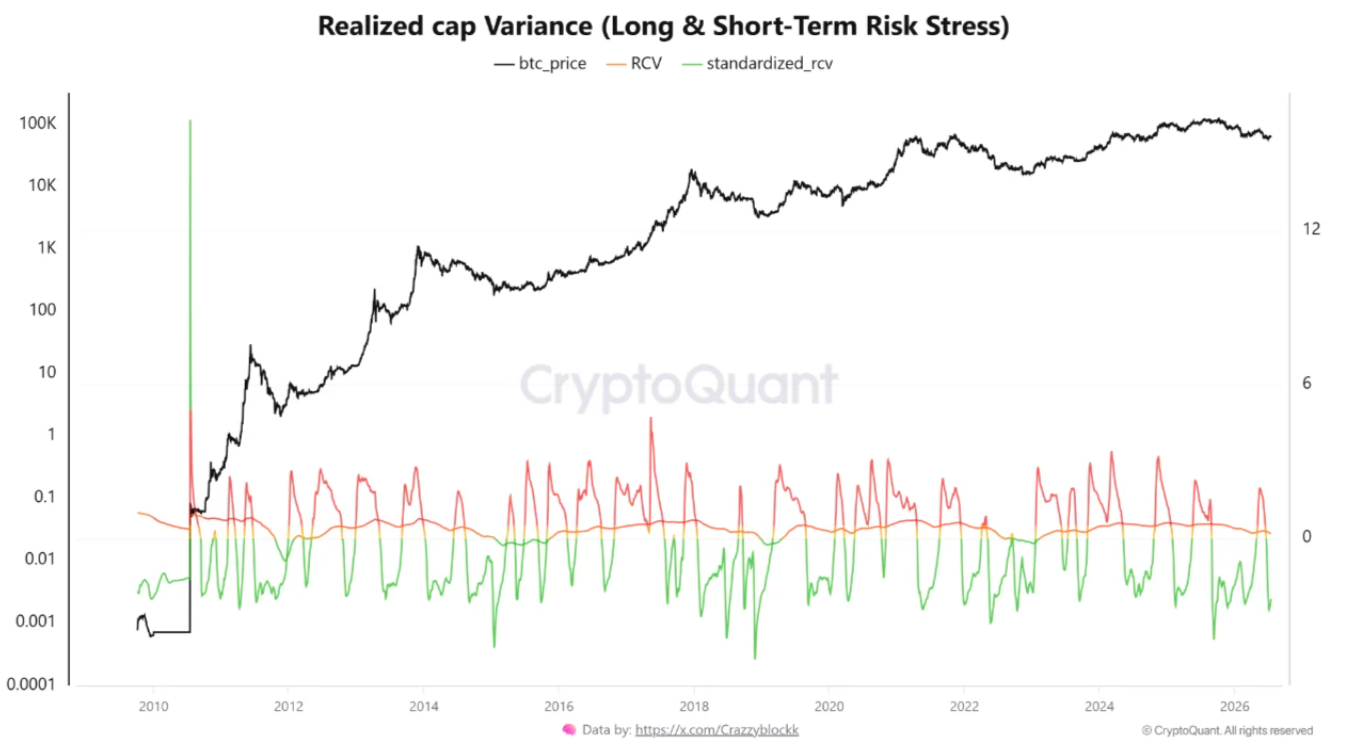
The realized cap variance (RCV) model, which measures the difference between realized cap and market cap, currently sits in the bottom six percent of its historical range.
“Instead of tracking price alone, it isolates the variance between realized cap and market cap relative to its own rolling history, capturing how stretched or compressed investor cost basis has become versus current valuation,” contributor Crazzyblockk explained in a QuickTake blog post on Thursday.
“When that variance compresses into deeply negative z-score territory, the emotional premium built during rallies has largely been priced out. The metric doesn’t read narrative, it reads the distribution of capital.”
Bitcoin RCV data (screenshot). Source: CryptoQuant
At -2.35, standardized RCV’s Z-score is once again pointing to the final stages of the Bitcoin bear market.
“Every prior stretch where the model spent extended time below a -2.0 z-score, late 2018, mid-2022, early 2015, preceded forward twelve-month returns north of 75%,” the post noted.
“The most extreme reading in this dataset, -4.68 in November 2018, landed almost exactly on Bitcoin’s cycle bottom near $3,792.”

The CLARITY Act, the bill that would define whether digital assets fall under SEC or CFTC jurisdiction, has two remaining floor windows before the August recess: the weeks of July 20 and July 27.
Miss both, and Senator Lummis has warned that market structure legislation could slip to 2030 or die entirely at the end of the 119th Congress in January 2027, forcing a full restart.
That is not a political projection, it is the structural consequence of a Senate calendar that leaves roughly three weeks of productive session after September before lawmakers enter full midterm campaign mode.
One year after Washington’s Crypto Week, the scorecard is uneven. The GENIUS Act became law on July 18, 2025, establishing the first federal framework for payment stablecoins.
BREAKING:
SEN. LUMMIS SAYS THE CLARITY ACT WILL BE INTRODUCED WITHIN DAYS AFTER 10 MONTHS OF WORK
SENATE VOTE IS NOW TARGETED FOR THE WEEK OF JULY 20
BULLISH FOR CRYPTO pic.twitter.com/1BuG9FWUEs— Midas (@DeFiMidas) July 14, 2026
An anti-CBDC provision eventually passed inside the 21st Century ROAD to Housing Act, becoming law automatically on July 10, the House voted 358–32, the Senate 85–5, margins that made Trump’s refusal to sign irrelevant.
The CLARITY Act, which passed the House 294–134 on July 17, 2025, cleared the Senate Banking Committee 15–9 on May 14, 2026, and has sat on the Senate Legislative Calendar since June 1 with no floor vote scheduled.
The distinction between GENIUS and CLARITY matters here. GENIUS governed one product. CLARITY governs the entire market. It answers the classification question that determines everything downstream: whether a given digital asset falls under SEC jurisdiction as a security or CFTC jurisdiction as a commodity.
Registration, custody, listing decisions, and disclosure posture all flow from that single determination. Without a statutory answer, the question gets resolved by whichever agency sues first, or whichever party holds the White House.

Discover: The Best Token Presales
The Vote Math Is Getting Harder
Senate leadership needs 60 votes. The Republican coalition is already fractured. Senators Josh Hawley (R-Mo.) and Rand Paul (R-Ky.) were the only two Republicans to vote against the GENIUS Act; per Galaxy Digital analyst Alex Thorn, both are expected to oppose CLARITY as well.
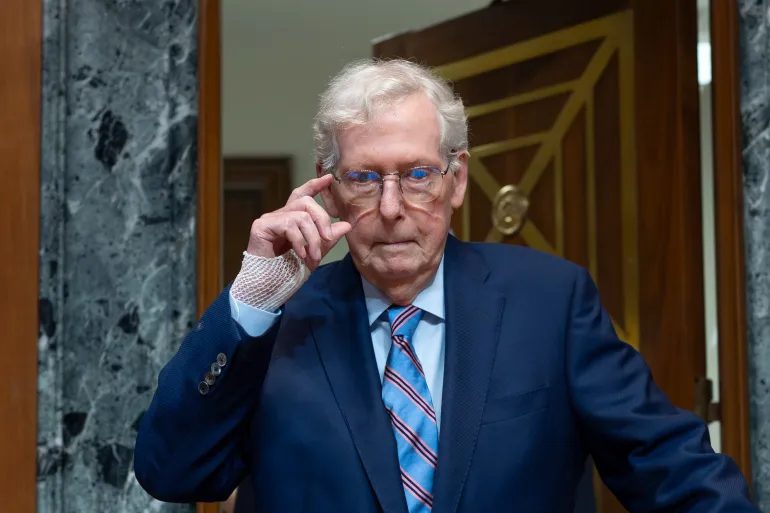
Senator McConnell has missed votes due to an ongoing medical issue, and the death of Senator Lindsey Graham at 71 further narrows an already thin Republican majority. By Thorn’s calculation, leadership may need as many as nine Democratic crossovers to reach the threshold.
Those crossovers are not secured. Senators Ruben Gallego (D-Ariz.) and Angela Alsobrooks (D-Md.) voted yes in committee but explicitly characterized those votes as conditional, not floor commitments.
Polymarket’s current passage odds in 2026 are approximately 34% and falling.
Discover: The Best Crypto to Diversify Your Portfolio
Clarity Act: Four Disputes, Zero Resolutions
The first and most visible obstacle is ethics. Senator Elizabeth Warren (D-Mass.) wrote to Majority Leader John Thune and Minority Leader Chuck Schumer on July 13, demanding guardrails preventing senior officials and members of Congress from profiting off the crypto industry.
The letter cited approximately $1.4 billion in crypto-related income disclosed in the president’s 2025 financial filing. Senator Kirsten Gillibrand (D-N.Y.) has made enforceable ethics language covering officials’ crypto holdings a prerequisite for her support. The merged draft from the Banking and Agriculture committees omits ethics provisions entirely.
A compromise floated by Senator Lummis would allow state attorneys general to sue exchanges that list tokens issued by public officials in violation of the act – but Senate Republicans are unlikely to advance any ethics language the White House actively opposes. For a detailed breakdown of this standoff, see the ethics dispute driving the CLARITY Act delay.
The second dispute centers on law enforcement. The National District Attorneys Association argued to Senate leadership that Section 604, the Blockchain Regulatory Certainty Act provision, would materially impair criminal investigations by shielding non-custodial software developers from money transmitter obligations.
Senator Ron Wyden (D-Ore.) countered that developers who never control customer funds should not be classified as money transmitters for publishing code. Senators Mark Warner (D-Va.) and Catherine Cortez Masto (D-Nev.) have tied their votes directly to law enforcement’s sign-off.
Third: banking trade groups, including the ABA and ICBA, argue the bill creates a stablecoin yield loophole allowing digital asset platforms to offer interest-equivalent rewards that circumvent the GENIUS Act’s prohibition on issuer-paid interest.
The Independent Community Bankers of America has questioned the bill’s pace entirely. Fourth, and structurally acute: the CFTC has operated with a single commissioner, and the SEC has two vacancies. Rules issued by a lone CFTC commissioner could invite legal challenge and keep jurisdictional uncertainty alive. Senator Amy Klobuchar has proposed blocking the framework from taking effect until at least four CFTC commissioners are confirmed.
Don’t Miss Out on Our $1,000 USDT Airdrop on ByBit
The post Two July Windows Left: The CLARITY Act’s Senate Fight and What Failure Means appeared first on Cryptonews.
Crypto World
Bitcoin (BTC) price falls below $63,00 as AI fatigue, Middle East tensions drag crypto, tech stocks lower
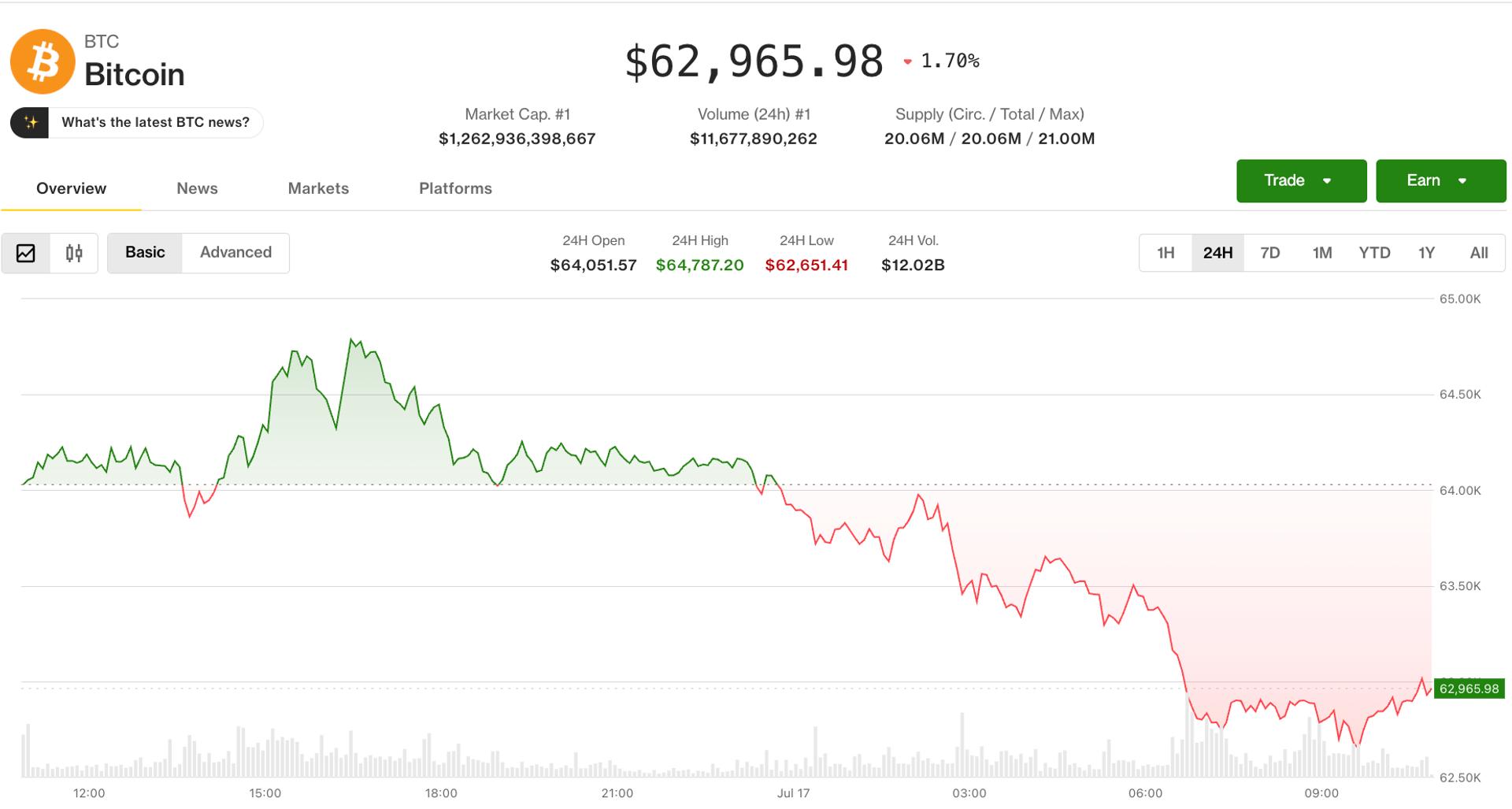
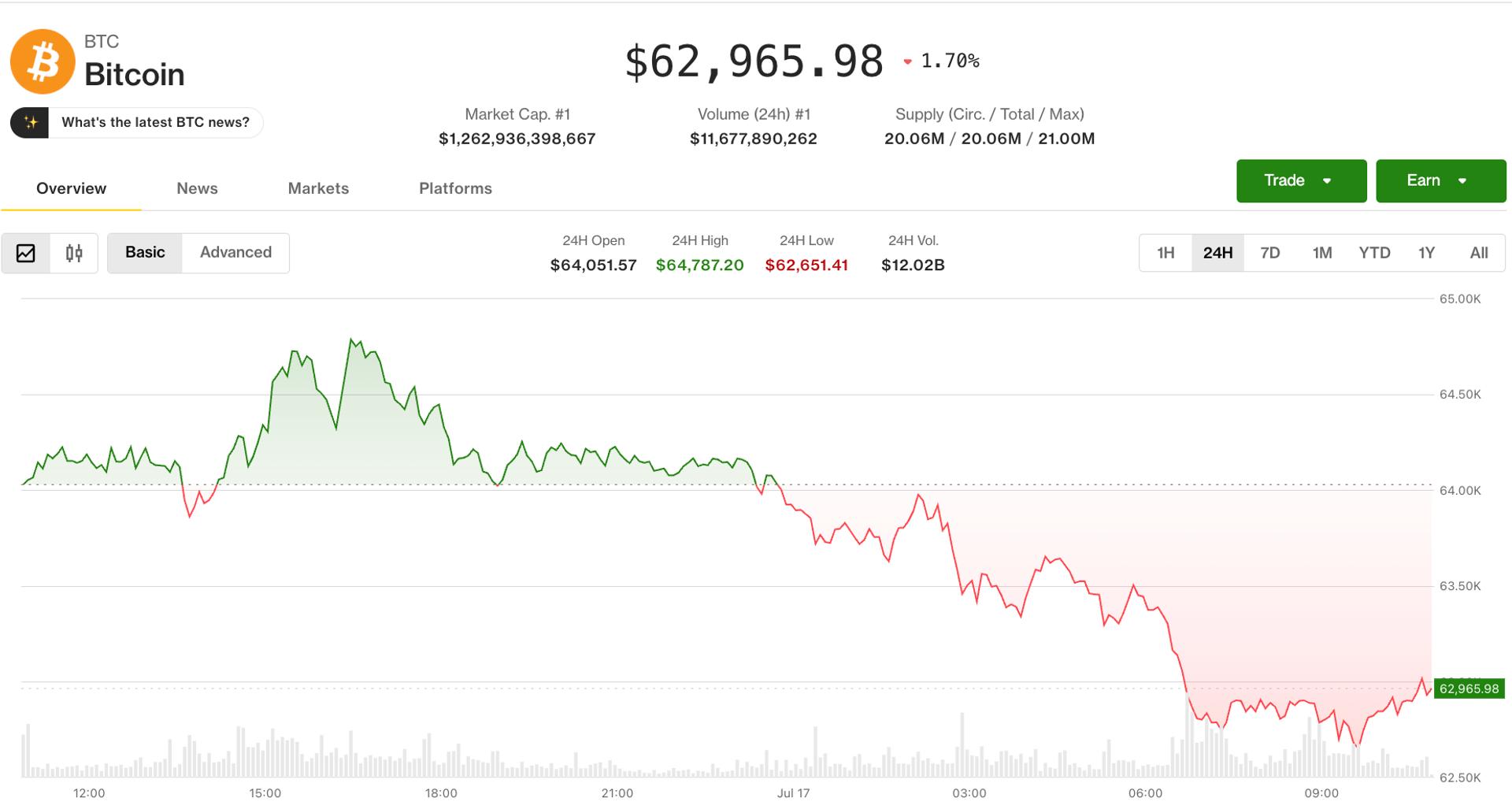
The crypto market fell Friday, with bitcoin recovering from a drop below $63,000 to trade down 1.2% since midnight UTC and ether (ETH) losing 1.74%. Total crypto market capitalization shed 1.86% to sit at $2.16 trillion.
The selloff is not isolated to crypto. Nasdaq 100 index futures dropped 1.91% and S&P 500 futures slipped 0.96%, pointing to macro forces driving the move rather than anything crypto-specific. Japan’s Nikkei 225 index dropped 4%, while South Korea’s Kospi stock exchange was closed for Constitution Day.
In a a classic risk-off rotation, the Dollar Index (DXY) rose to 100.75 while gold advanced 0.61% to climb back above $4,000.
The move to the downside can be attributed to a selloff in tech stocks across North America and Asia, as well as mounting tensions in the Middle East.
“The market is ending the week with two bruises: AI fatigue and Hormuz heat,” said Patrick Munnelly at Tickmill Group. “The semiconductor selloff has gone from profit-taking to position-clearing, dragging Asia toward its worst levels in months.”
Bitcoin fell to about $63,000 on Friday, down 1.7% over 24 hours and 2.2% on the week, as a deepening selloff in chipmakers dragged risk assets lower, per CoinDesk data. Ether held better at $1,836, still up 2.4% over seven days, while Hyperliquid led the losses at 8% on the day and 12% on the week.
Nasdaq 100 futures dropped 1.8% and S&P 500 contracts fell 0.9% as a semiconductor ETF slid 3% in premarket trading. Taiwanese stocks fell into a technical correction and Asia’s main benchmark hit a two-month low. Europe held up better on lower tech exposure.
The question driving it is the one that has hung over the sector all month. Chipmakers are under scrutiny over whether the hundreds of billions that AI hyperscalers are spending will produce the returns to justify their valuations, and TSMC’s results this week did not settle it.
Crypto is following the same current it has all quarter. This week’s soft inflation print gave bitcoin a lift toward $65,000, but that was a macro trade, and the chip selloff is pulling the other way. The Fed meets July 28 and 29.
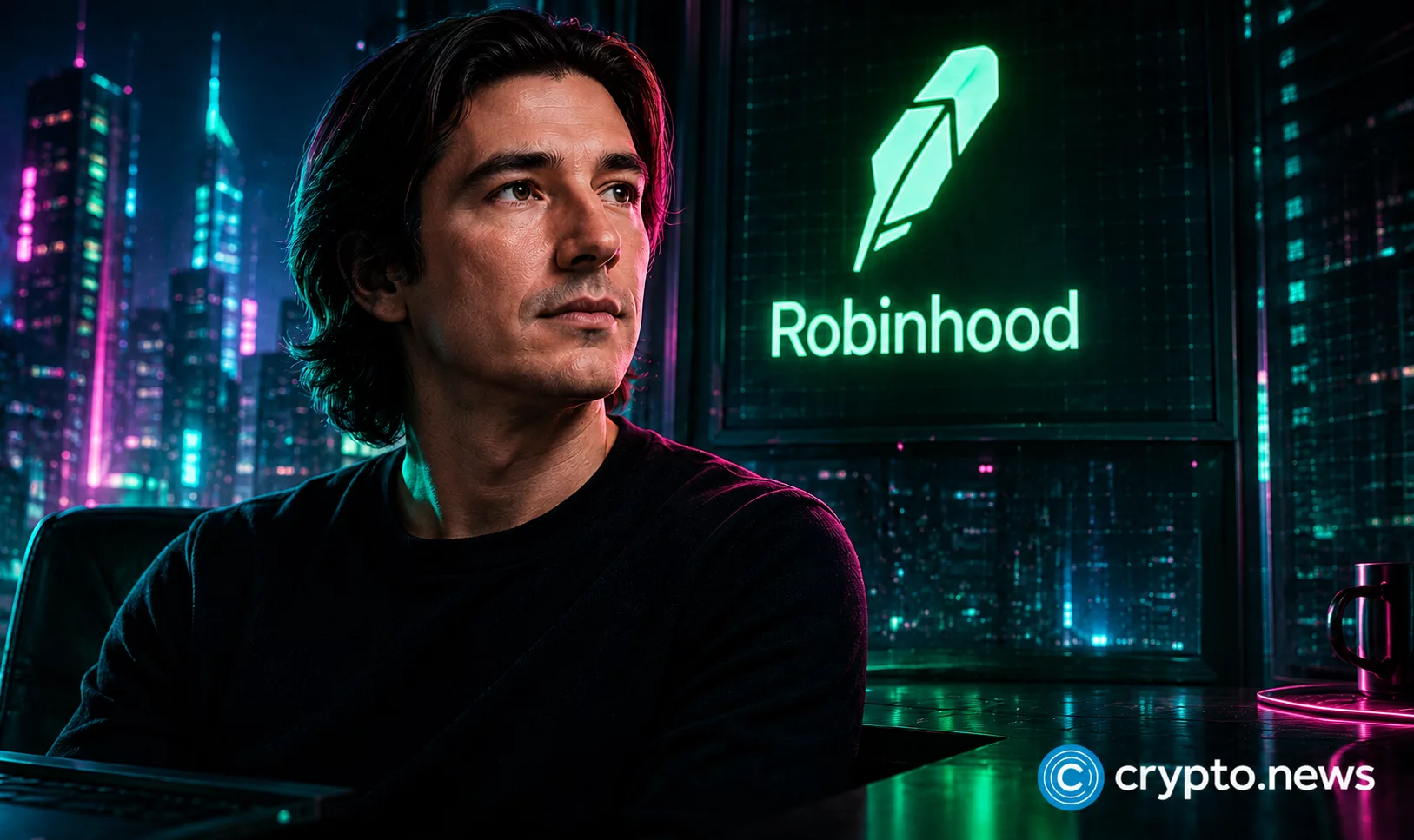
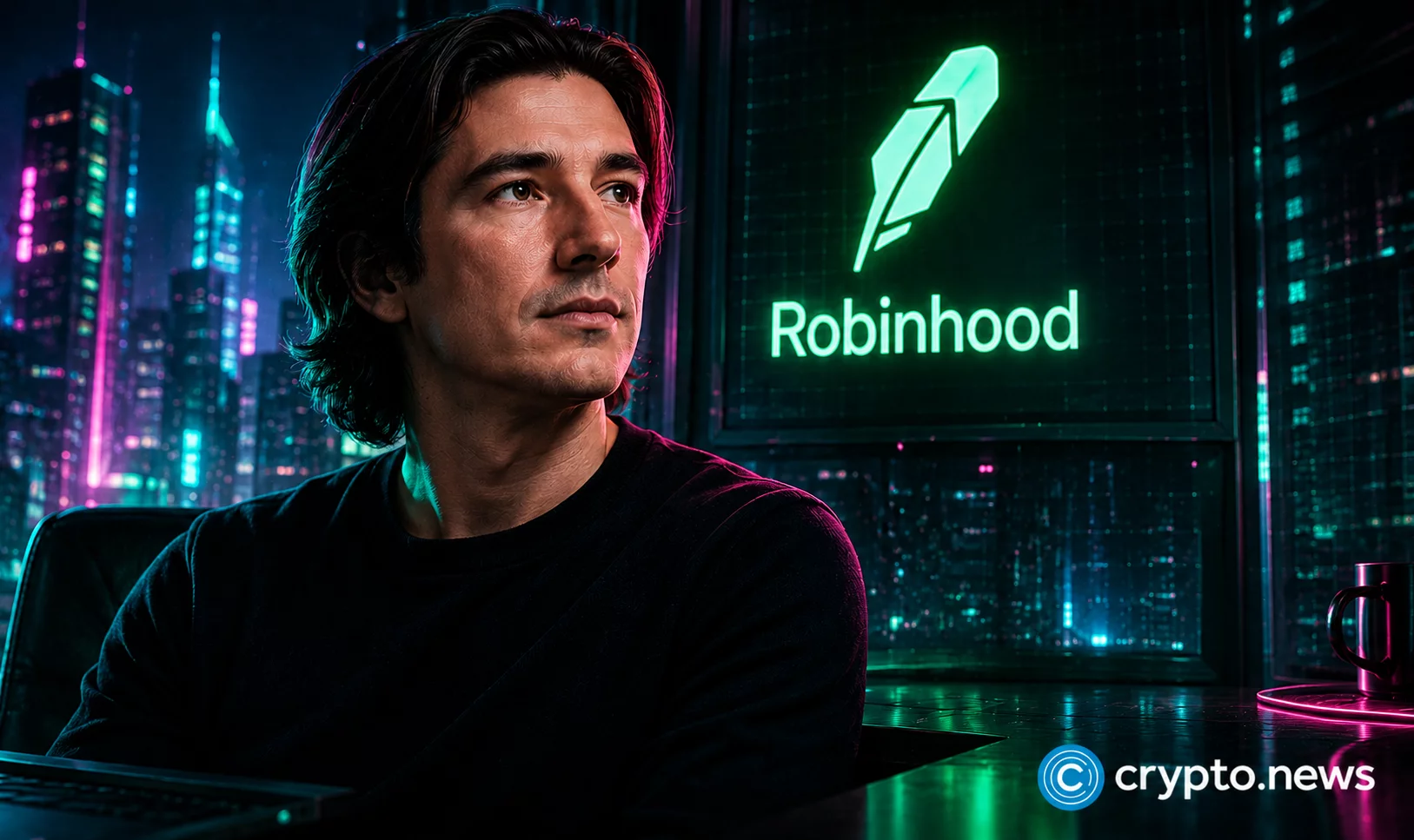
He built the app that made stock trading free, sat at the center of the GameStop crisis, launched a blockchain, dismissed memecoins, embraced one six days later, and runs an AI company chasing mathematical superintelligence on the side.
Summary
- Vlad Tenev is co-founder and CEO of Robinhood Markets, the brokerage that popularized commission-free trading and now runs its own blockchain, roughly 28 million customers across 38 countries.
- He co-founded the company with Baiju Bhatt. Before it was Robinhood, they called it CashCat, a discarded name that a memecoin resurrected in 2026.
- Robinhood was at the center of the 2021 GameStop episode, and in the second quarter of that year, 62% of its crypto revenue came from Dogecoin. Its history with joke-driven investing is long.
- In July 2026 he launched Robinhood Chain, told CNBC that assets without underlying utility are not productive, then posted six days later that the chain works great for memes too.
- He is also co-founder of Harmonic, an artificial intelligence company pursuing what it calls mathematical superintelligence, and predicts AI agents will soon trade as well as experienced humans.
Most crypto figures are one thing. Vlad Tenev is the chief executive of a publicly listed American brokerage, the person who made retail stock trading free and then had to explain to Congress what free actually cost, a blockchain founder, an advisor to a decentralized perpetuals exchange, and the co-founder of an artificial intelligence company trying to build mathematical superintelligence. In July 2026 he did all of those jobs in the same fortnight, and in the middle of it dismissed memecoins on television and then endorsed one on X. Understanding him is less about biography than about a pattern that repeats: Tenev builds the infrastructure for a kind of trading he describes as serious, and the traffic that shows up is not.
The company he built
Tenev co-founded Robinhood with Baiju Bhatt. The pitch was simple and, at the time, radical: stock trading with no commissions, on a phone, designed for people who had never owned a brokerage account. It worked. Robinhood now serves roughly 28 million customers across 38 countries and trades on Nasdaq under HOOD.
The name almost was not Robinhood. Before settling on it, the founders called the company CashCat, a detail preserved in a New Yorker profile and largely forgotten until 2026, when a memecoin on Robinhood’s own blockchain resurrected it and briefly reached a $156 million market capitalization. Tenev had tweeted about the CashCat name himself back in April 2021, which meant the lore was documented and personally acknowledged long before anyone tokenized it.
The commission-free model is what everything else follows from, and it is not what most users think. Robinhood does not charge commissions because it routes customer orders to market makers who pay for that flow. The practice is called payment for order flow, and the economics rest on retail orders being valuable precisely because they are uninformed. That structure made Robinhood large, made it controversial, and, as of 2026, has been rebuilt on a blockchain by a company Tenev advises.
GameStop, and what it proved
In January 2021, Robinhood ended up at the center of the most chaotic retail trading episode in modern American history. GameStop’s stock, propelled by a retail crowd largely trading on Robinhood, ran to levels that threatened the firms on the other side. Robinhood restricted buying in the affected names. The decision triggered accusations that the platform had sided with institutions against its own users, congressional hearings, and a durable reputational cost that shaped how the company is read to this day.
The technical explanation, that clearing house collateral requirements spiked and the firm had to restrict activity to meet them, is broadly accepted and did little to change the narrative. The episode fixed Robinhood in the public imagination as the company that democratized trading right up until democratization became expensive.
It also proved something about the business. In the second quarter of 2021, 62% of Robinhood’s crypto revenue came from Dogecoin. A single joke asset produced the majority of a public company’s crypto business. Robinhood has never been a stranger to speculative retail enthusiasm. It has monetized it repeatedly, and the July 2026 memecoin episode is the third act of a pattern rather than a departure from one.
The blockchain bet
On July 1, 2026, Tenev unveiled the blockchain he launched at a livestream from the Old Royal Naval College in London, billed as The World is Flat and described by the company as its most ambitious global expansion and product vision to date.
The architecture was serious. Robinhood Chain is an Ethereum layer 2 built on Arbitrum’s Orbit stack, using ether for gas, running roughly 100-millisecond block times, and settling to Ethereum mainnet. Its flagship product is Stock Tokens: on-chain instruments tracking equities including Nvidia, Apple, and Alphabet, tradeable around the clock and usable in DeFi. The launch stack included Chainlink for oracle pricing, BitGo for custody, Uniswap for liquidity, Morpho for lending, and Lighter for perpetual futures inside Robinhood Wallet.
The business logic is visible in the earnings. Robinhood’s crypto transaction revenue fell 47% year over year to $134 million in the first quarter of 2026, and native-app crypto trading volume dropped 48% to $24 billion. The company cut roughly 10% of its workforce, about 290 people, weeks before the launch. Total revenue of $1.07 billion and platform assets up 39% to $307 billion show the wider business is healthy, but the chain is an explicit attempt to swap volatile transaction revenue for infrastructure income. Tenev is not experimenting. He is trying to own the rails.
The strategy has a wrinkle worth knowing: Stock Tokens are structured as tokenized debt securities, conferring no shareholder rights and no legal ownership of the underlying shares, and they are unavailable to US persons. The CEO of an American brokerage built a tokenized equity product his American customers cannot buy.
The six days
The sequence that defines his 2026 is short enough to state precisely.
On July 2, the day after the chain went live, Tenev told CNBC that the future of crypto is in real-world assets, drawing an explicit line between productive tokenized assets and speculative tokens without underlying utility. His formulation was that an asset not tied to an underlying utility is not a productive asset.
On July 8, as CASHCAT climbed toward a nine-figure market capitalization on his own chain, he posted on X that while the company is building Robinhood Chain to be the best chain for real-world assets, it works great for memes too. He followed the token’s account. For the full context, crypto.news has covered his memecoin reversal in full.
Six days. The charitable reading is that a permissionless chain cannot control what deploys on it and a CEO refusing to acknowledge the most visible thing on his own network would look absurd. The uncharitable reading is that the endorsement, however light, told the market what the company actually values, which is volume, and that a regulated brokerage asking institutions to tokenize serious assets on its chain does not advance that case by cheerleading a cat token. Robinhood’s crypto chief stayed on message throughout, insisting the focus remains a secure and scalable foundation for real-world assets.
Both readings are available and Tenev has not resolved them, which may itself be the position.
The trade the market noticed
One episode from July belongs in any honest account, because it is the kind of detail that shapes how a CEO is read.
Filings show Tenev sold 375,000 HOOD shares in early July, at weighted average prices ranging from roughly $112.22 to $118.14, for a total in the region of $43.6 million. Robinhood’s chief legal officer, Daniel Gallagher, sold shares on July 6 for approximately $1.1 million. Robinhood Ventures Fund I sold as well. The sales landed in the same window as the chain launch, the CNBC interview, and the CASHCAT post.
Context matters and cuts in both directions. Tenev continued to hold more than 48.2 million Class B shares after the transaction, so this was a trim rather than an exit, and by any proportional measure a small one. Executive share sales are also routinely conducted under pre-scheduled plans adopted months in advance precisely so that timing cannot be read as signalling, and a sale executed under such a plan carries no information about what the seller thinks. Anyone drawing conclusions from the timing needs to check whether a plan governed it before drawing them.
What is not in dispute is how it looks, and appearance is the currency a consumer brokerage trades in. A chief executive selling $43.6 million of stock during the fortnight he launched a blockchain and amplified a memecoin on it is a set of facts that arrive together whether or not they are connected. Robinhood’s history makes that harder rather than easier: this is the company whose defining crisis was a decision that looked like it served institutions over users, explained afterward by a technical account that was accurate and did not land.
The broader pattern is what makes it worth stating. Tenev’s public communication is consistently accurate at the level of the individual statement and consistently ambiguous at the level of what the company actually wants. Assets without utility do not last, and the chain works great for memes. Robinhood Chain is institutional infrastructure, and its most famous asset is a cat. The stock is a long-term bet, and here is $43.6 million. Each statement defensible, the aggregate unresolved.
That ambiguity may be deliberate, and it may simply be what running a retail brokerage in 2026 requires: the serious story is what persuades institutions and regulators, and the fun story is what brings volume. Tenev has never had to choose, and the July sequence is the clearest example yet of a career spent not choosing.
The other company
The part of Tenev that crypto coverage almost entirely misses is that he co-founded an artificial intelligence company and it is not a side project.
Harmonic was founded in 2023 by Tenev and Tudor Achim, former chief executive of Helm.ai. Its stated goal is building AI systems that can solve complex mathematical problems, an ambition the company calls mathematical superintelligence, with a flagship model named Aristotle. It raised a $100 million Series B in July 2025 at an $875 million valuation, led by Kleiner Perkins with participation from Sequoia Capital, Index Ventures, and Paradigm.
Note that last name. Paradigm is one of crypto’s largest venture firms, and it is funding the Robinhood CEO’s AI mathematics company. That crossover is not incidental to how Tenev talks about the future.
Because the AI thesis is now inside Robinhood. He has predicted that AI agents will soon trade financial assets as effectively as experienced human traders. The company is building toward it: Robinhood markets its chain as AI-native and is rolling out Agentic Accounts, which let eligible users connect AI models to Robinhood’s data and tools through a Trading MCP so agents can analyze markets and construct strategies while humans retain control of capital. Third parties have gone further, with the agent platform Bankr integrating Robinhood Chain so users can trade tokenized stocks and memecoins by text command on X or Telegram.
There is an asymmetry there worth noticing. Americans are barred from Stock Tokens and barred from perpetual futures through the wallet. Agentic Accounts are rolling out in the United States. The AI trading product is the one Tenev can ship to his home market.
The business nobody covers
Ask what Robinhood’s fastest-growing crypto-adjacent business is and most people will say the chain. They would be wrong.
Robinhood’s prediction markets platform processed more than 12 billion contracts in 2025, including a record 8.5 billion in the fourth quarter alone. On the earnings call, Tenev noted that NBA contracts had overtaken NFL contracts in trading activity, defying expectations that the end of football season would drag volumes down, and pointed to the Winter Olympics, the FIFA World Cup, and March Madness as catalysts for a strong year. He described the business as being at the beginning. Non-sports contracts are contributing too, with a government shutdown contract driving substantial volume. For more context, crypto.news has explained Robinhood’s fastest-growing business.
For context on scale, the company reported record fourth-quarter revenue of $1.28 billion, slightly below Street estimates of $1.34 billion, with earnings of 66 cents per share against a 62-cent consensus.
That business sits inside the same regulatory fight as everything else Tenev touches. The CFTC is asserting exclusive federal jurisdiction over prediction markets, litigating against states, and doing it with a single confirmed commissioner. Whatever happens to Robinhood’s prediction markets will be decided by the same understaffed agency that the CLARITY Act would make crypto’s primary regulator.
Reading him
The pattern across sixteen years is consistent enough to state.
Tenev builds infrastructure for a serious version of retail finance, describes it in serious terms, and then discovers that what retail actually wants is the fun version.
Commission-free trading was democratization until it was GameStop. The crypto business was portfolio diversification until 62% of it was Dogecoin. Robinhood Chain is institutional settlement infrastructure for tokenized real-world assets, and its defining asset is a cat named after a company name he threw away in 2010.
The uncharitable conclusion is that he keeps building casinos and calling them exchanges. The charitable one, and probably the more accurate, is that he keeps building genuine infrastructure and retail keeps using it for entertainment, which is a fact about retail and not about him. The chain is real. The engineering is real. Tokenized equities settling on-chain is a thesis serious institutions share, and Robinhood is the only brokerage that also built the settlement layer.
What is not resolved is whether Tenev can hold both positions at once, because the entire regulatory proposition of Robinhood Chain is that a licensed brokerage extends institutional standards into DeFi, and that proposition is what would persuade issuers to tokenize serious assets there. The measurable test is close: second-quarter earnings land on July 29 and will show whether Stock Tokens are converting, or whether the $12.8 million of tokenized assets on a $312 million chain is what it looks like. That is the thesis he is betting the company on.
What to watch
Three measurable things will settle how the 2026 chapter is read.
Second-quarter earnings on July 29. This is the first look at Stock Token adoption from the company’s own books instead of from chain metrics distorted by a 90-day gas subsidy. Crypto transaction revenue fell 47% year over year in the first quarter and native-app crypto volume fell 48%. The chain was the response. Either the response is producing revenue or it is producing traffic, and the filing will say which.
The real-world asset figure on the chain. Roughly $12.8 million of tokenized assets against about $312 million in total value locked. That ratio is the entire thesis expressed as a fraction. If it improves substantially while memecoin activity fades, Tenev was right and the speculation was ignition. If it stays flat, the chain attracted a crowd that had no interest in the product.
Whether the American wall moves. Stock Tokens are barred to US persons. Wallet perpetuals are barred to US persons. Agentic Accounts are rolling out in the United States. That asymmetry is a map of what American law currently permits, and it is why the CLARITY Act and the CFTC’s staffing matter to Robinhood more than to almost any other listed company. If tokenized equities come onshore, Tenev has already built the rail and 28 million customers become addressable. If they do not, he has built a product for everywhere except home.
The through-line is that every one of those depends on decisions made outside the company, by regulators and legislators, which is an unusual position for a founder who spent a decade routing around gatekeepers. Robinhood’s original insight was that you could give retail direct access and let the incumbents object afterward. The chain inverts it: this time the access requires permission first, and Tenev is waiting on Washington like everyone else.
Frequently asked questions
Who is Vlad Tenev?
Co-founder and chief executive of Robinhood Markets, the brokerage that popularized commission-free stock trading and now operates its own Ethereum layer 2 blockchain. He co-founded the company with Baiju Bhatt. Robinhood serves roughly 28 million customers across 38 countries and trades on Nasdaq under HOOD. He is also co-founder of Harmonic, an artificial intelligence company, and an advisor to the perpetuals exchange Lighter.
What was Robinhood’s original name?
CashCat. Tenev and Bhatt used it before settling on Robinhood, a detail recorded in a New Yorker profile. Tenev tweeted about the name himself in April 2021. In July 2026, a community memecoin called CASHCAT resurrected the discarded name on Robinhood’s own blockchain and briefly reached a market capitalization near $156 million, with no affiliation to the company.
What was Tenev’s role in GameStop?
Robinhood was the primary platform for the retail crowd driving GameStop’s 2021 surge, and it restricted buying in the affected stocks at the peak. The move triggered accusations that the company had sided with institutions against its users and led to congressional hearings. Robinhood explained that clearing house collateral requirements had spiked, an account broadly accepted technically and largely ineffective reputationally.
Did Tenev change his position on memecoins?
The sequence is documented. On July 2, 2026, he told CNBC that assets not tied to an underlying utility are not productive assets and that real-world assets were crypto’s durable direction. On July 8, as CASHCAT climbed on his chain, he posted that the chain works great for memes too and followed the token’s account. Whether that constitutes a reversal or an acknowledgement of a permissionless network is contested.
What is Harmonic?
An artificial intelligence company Tenev co-founded in 2023 with Tudor Achim, former chief executive of Helm.ai, aiming to build AI systems that solve complex mathematical problems, an ambition it calls mathematical superintelligence. Its flagship model is Aristotle. It raised a $100 million Series B in July 2025 at an $875 million valuation, led by Kleiner Perkins with Sequoia, Index Ventures, and the crypto venture firm Paradigm participating.
Why did Robinhood build a blockchain?
Business pressure and strategic positioning. Crypto transaction revenue fell 47% year over year to $134 million in the first quarter of 2026 and native-app crypto volume dropped 48% to $24 billion, prompting roughly 290 layoffs. The chain is an attempt to replace volatile transaction revenue with infrastructure income, and Robinhood is the only major brokerage that built its own settlement layer instead of partnering for one.
What are Robinhood’s prediction markets?
Its fastest-growing and least-covered business. The platform processed more than 12 billion contracts in 2025, including a record 8.5 billion in the fourth quarter. Tenev has said NBA contracts overtook NFL contracts in activity and pointed to the Winter Olympics, FIFA World Cup, and March Madness as catalysts. The sector’s regulatory future rests with the CFTC, which is claiming exclusive jurisdiction while operating with one confirmed commissioner.
What is Tenev’s view on AI and trading?
He has predicted AI agents will soon trade financial assets as effectively as experienced human traders, and Robinhood is building toward it. The company markets its chain as AI-native and is rolling out Agentic Accounts, letting eligible users connect AI models to Robinhood’s data and tools through a Trading MCP while retaining control of capital. Notably, Agentic Accounts are rolling out in the United States, where Stock Tokens and wallet perpetuals are unavailable.
Disclaimer: This article is for information and educational purposes only and does not constitute financial or investment advice. It describes a public company, its executives, and its products, and is not a recommendation to buy or sell any security or token. Company figures, product availability, and jurisdictional restrictions change frequently and should be verified independently. Always do your own research. Information is accurate as of July 17, 2026.
Andy Burnham vows to give people ‘hope back’ as he becomes Labour leader

Tap-to-pay fraud fuels organized retail crime, police say
Bullish ADA Predictions, SOL Shows Rally Potential, and More: Bits Recap July 17


-

 Fashion6 days ago
Weekend Open Thread: Nutriplenish Leave-In Conditioner
-
 NewsBeat20 hours ago
London Mayor Sadiq Khan handed a peerage by Keir Starmer alongside 15 other Labour figures… just days before the PM leaves No10
-

 Crypto World1 day ago
CFTC blocks Kalshi from unwinding Michigan trades after court order
-

 Business1 day ago
Nvidia Stock Slips After Big Tuesday Rally as Huang Confirms Vera Rubin Chip Is Now in Production Today
-

 Politics2 days ago
Young campaigners urge incoming PM to act on outdoor junk food ads
-

 News Videos3 days ago
XRP BOMBSHELL… XRP OMBOARDED FOR TRANSACTIONS!!!
-
 Entertainment2 days ago
Disney’s Most Ambitious Failed Star Wars Attraction Is Coming to SDCC
-

 Tech3 days ago
Get Your ESP32 Sunny Side Up With This Solar Dev Board
-

 Crypto World15 hours ago
Injective Submits SEC Transfer-Agent Registration to Onchain Ownership Records
-

 Tech3 days ago
Dark Secrets Emerge When Jailbreaking LLMs
-
 Sports2 days ago
New Cornerback Enters Vikings Trade Rumor Mill
-

 News Videos5 hours ago
Money | Class 12 Economics | CBSE Board Exam 2026-27
-

 Business1 day ago
Palantir Shares Rise After Expanded Nvidia Partnership and Fresh Analyst Upgrades Ahead of Earnings Day
-

 Business10 hours ago
Banco Bilbao Vizcaya Argentaria, S.A. (BBVA) Discusses Global Macro Environment and Economic Outlook for Core Markets Transcript
-
 Tech4 days ago
Cloudflare Precursor Watches Your Mouse and Keyboard To Decide If You Are Human
-

 News Videos4 days ago
how to make coin bank box with cardboard #scienceproject #money #diy #shorts
-
 Entertainment2 days ago
Vicki Gunvalson Defends Discussing Heather Dubrow’s Money
-
Crypto World3 days ago
Ripple, Coinbase, Circle Join Linux x402 Foundation to Help Shape AI Payments
-

 Crypto World13 hours ago
Claude Fable 5 Slips to Second in AI Coding Leaderboard
-
Business11 hours ago
Nephros, Inc. (NEPH) Discusses Evolving Water Safety Strategies and Expansion Beyond Filtration Transcript
You must be logged in to post a comment Login