
Crypto World
Galaxy Digital Records $216M Q1 Loss Amid Helios Expansion Push

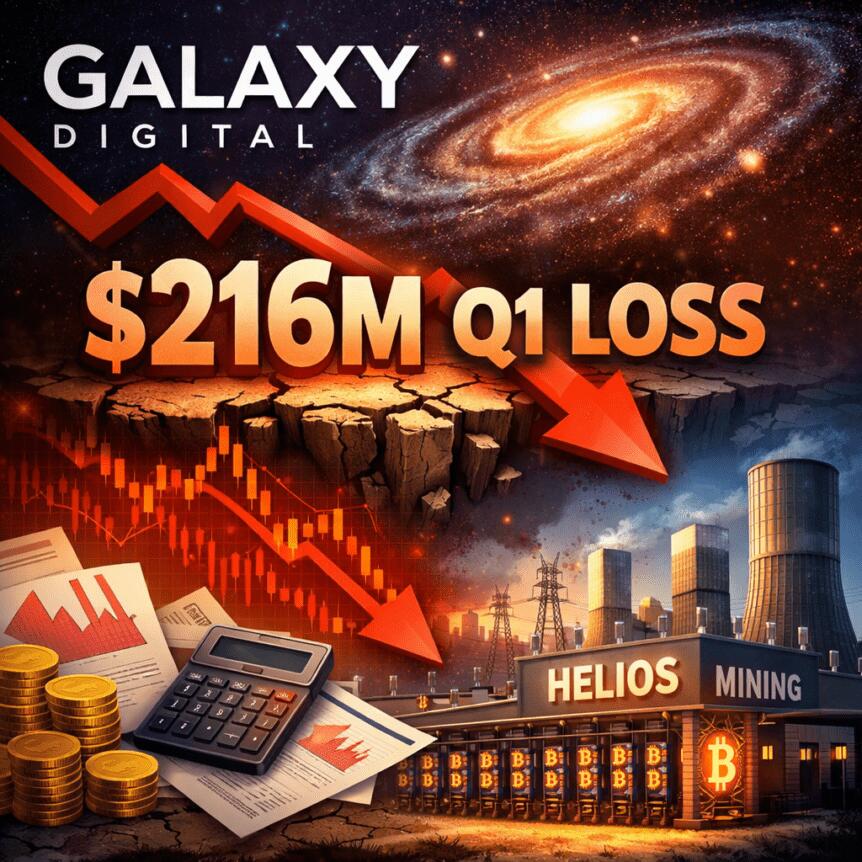
Galaxy Digital has reported a first-quarter 2026 net loss of $216 million, with earnings per diluted share of $0.49 loss, narrowing versus Q1 2025. The firm’s results come as it continues tilting away from a crypto-market-driven model toward a data-center and AI-focused growth strategy anchored by its Helios campus in Texas.
For the quarter ended March 31, Galaxy posted gross revenue of $10.2 billion, roughly flat with Q4 2025, but down from $12.9 billion in the year-ago period. The results align with the company’s pivot toward recurring revenue streams while it continues to manage exposure to crypto asset prices.
Looking back at full-year 2025, Galaxy reported a net loss of $241 million on gross revenue of $61.4 billion. The company reiterated that near-term growth will hinge on scaling its data-center operations and monetizing AI workloads through Helios, rather than relying primarily on crypto trading activity.
Management noted that growth in the data-center segment is expected to begin contributing to earnings in the second quarter of 2026, once revenue recognition from the Helios campus in Texas starts to appear in the company’s financials. The Helios project, acquired in December 2022, is being developed into a large-scale data-center campus designed to support high-performance computing and AI workloads.
The quarterly figures underlined Galaxy’s strategic transition—from crypto-market cycles to a diversified model centered on Helios and AI-enabled data-center revenue.
Key takeaways
- Q1 2026 net loss: $216 million, with diluted-earnings per share of $0.49 (vs. a $0.86 loss per share in Q1 2025), signaling narrowing losses as the business shifts focus toward non-volatile revenue streams.
- Revenue situation: Gross quarterly revenue stands at $10.2 billion, flat versus the prior quarter but lower than the year-ago period, highlighting a move away from asset-price-driven swings toward recurring income.
- Crypto-price headwinds: Weaker digital-asset prices weighed on asset valuations, with Galaxy noting a roughly 20% drop in crypto market capitalization during the quarter. Digital Assets contributed $49 million in adjusted gross profit, while the Treasury and corporate segment bore heavy losses (about $167 million in adjusted EBITDA).
- Helios ramp and revenue timing: The company said data-center growth should begin contributing to earnings in Q2 2026 as Helios starts recognizing revenue, supported by ongoing Phase I deployments.
- Balance sheet and allocation: As of March 31, 2026, Galaxy reported $2.8 billion in equity capital, up 46% year over year. Equity is distributed across digital assets (33%), data centers (28%), and treasury/corporate holdings (39%).
Strategic pivot: from market cycles to infrastructure and AI
The quarter’s results reinforce Galaxy’s deliberate shift from a crypto-market-driven stance toward a more diversified business model anchored by Helios and AI-enabled data-center revenue. Galaxy executives have consistently signaled that the Helios campus—Dallas-area expansion of the Argo Blockchain acquisition into a broad HPC and AI facility—will be a long-term growth engine. In the latest update, management stressed that Helios is not just a hardware deployment but a platform for recurring revenue streams tied to capacity and service agreements with institutional clients and AI workloads.
Delivered milestones at Helios underscore the transition. Galaxy reported the first data hall to CoreWeave, a notable progress marker in Phase I, and reaffirmed that the project remains on budget and on schedule to deliver substantially all 133 megawatts of critical IT load under the Phase I lease by the end of Q2 2026. This implies a ramp in revenue recognition as data-center capacity comes online and tenants begin consuming services.
Analysts and investors watching Galaxy’s path will be focused on how quickly Helios monetizes its capacity, how pricing for high-performance computing and AI workloads evolves, and whether the data-center business can offset volatility from crypto markets. The company’s stated trajectory suggests a longer-term horizon where recurring fees and capacity utilization will provide more predictable cash flows than crypto asset price swings.
Operational clarity: Helios milestones and capacity targets
Galaxy has long framed Helios as the primary growth platform. The Texas campus, which began as a larger-scale data-center initiative anchored in PoE (power and cooling) efficiency and AI compute, has progressed toward a multi-phase deployment. Galaxy’s update indicates progress toward delivering most of the Phase I capacity—133 MW of IT load—by the end of the current quarter, with revenue recognition following as customers begin to deploy workloads.
Constructive progress on Helios matters beyond the topline numbers because it translates into a tangible shift in the business mix. The company has already pointed to the likelihood of Helicots (Helios’ capabilities) supporting AI workloads as a compelling use case for institutional clients seeking scalable compute capacity. If Helios meets its phased targets, the data-center segment could start contributing meaningfully to profitability during 2026, offering more resilience in soft crypto markets than a purely asset-price-driven business model.
As of the end of March 2026, Galaxy’s equity capital stood at roughly $2.8 billion, a 46% year-over-year increase. The capital mix—roughly one-third in digital assets, just under a third in data centers, and the remainder in treasury and corporate holdings—highlights the company’s diversified but still crypto-adjacent balance sheet. The trajectory implies risk has shifted toward infrastructure upside and capital-intensive growth rather than speculative crypto exposure alone.
Implications for investors and the market
Galaxy’s Q1 2026 results illustrate both the challenges and opportunities facing a crypto-adjacent firm trying to pivot into infrastructure-led growth. The weaker crypto price environment clearly depressed asset valuations, contributing to the quarterly loss structure that persists despite stabilizing per-share losses versus a year earlier. Yet the early indicators from Helios—data-center capacity coming online and a clear revenue ramp in the quarters ahead—offer a potential path to steadier, recurring income that could cushion earnings when crypto markets remain volatile.
Investors will be watching several moving parts: the pace at which Helios contributes to quarterly results, the ability to attract and retain long-term data-center tenants, and the management of capital allocation across the firm’s diversified portfolio. The 20% contraction in crypto market capitalization during the quarter underlines the sensitivity of Galaxy’s financials to digital-asset cycles, even as a portion of revenue becomes more deterministic through data-center contracts and AI compute services.
Additionally, the broader market context remains relevant. As Galaxy shifts toward a blended model, any regulatory developments around digital assets, data-center energy costs, or AI compute demand could influence the pace and profitability of Helios’ rollout. Analysts will also scrutinize how the Helios ramp aligns with expectations for the company’s 2026 guidance and whether the anticipated Q2 2026 revenue recognition from Helios translates into meaningful earnings uplift in the back half of the year.
In the short term, Galaxy’s results reinforce a narrative common to many crypto-adjacent operators: price action in digital assets will continue to reverberate through the earnings line, but the growth story is increasingly anchored in infrastructure, capacity utilization, and the monetization of AI workloads. The question for investors is whether Helios can deliver the reliable, scalable revenue streams necessary to offset periods of crypto weakness and drive a more durable earnings trajectory over the next several quarters.
Looking ahead, readers should monitor Helios’ progress toward full Phase I capacity, any updates on tenancy and utilization rates, and the broader demand environment for AI compute services. These factors will likely shape Galaxy Digital’s next earnings cycle and the long-term viability of its transition from a crypto-market focus to an infrastructure-led business model.



Institutional crypto allocation depends on a small group of firms producing ratings, risk scores, and benchmark rates. These firms provide the evaluative layer behind capital decisions.
Best Digital Asset Ratings & Analytics Provider is an award category within The BeInCrypto Institutional 100, an annual research-driven program recognising institutional digital asset excellence across 26 categories and six pillars.
This category sits in Pillar 2: Capital Markets & Infrastructure. The 15 firms below are its longlist. A shortlist will be named in May 2026, and the winner will be announced at Proof of Talk in Paris on June 2–3, 2026.
- Longlist: 15 firms, covering traditional credit rating agencies, specialist benchmark and stablecoin raters, blockchain intelligence with risk scoring, DeFi risk managers and credit raters, and security-and-ratings hybrids
- Candidates screened: Starting pool of more than 30 ratings and analytics providers across the institutional digital asset stack; 15 advanced to this longlist, with 5 additional firms held in the outreach pool
- Scoring (Track C): Editorial quantitative 20%, Expert Council 80%
- Criteria assessed: Coverage and scale, methodological discipline, institutional adoption, regulatory standing, on-chain integration, track record, and market impact
- Sources: Regulator filings (SEC NRSRO register, ESMA CRA register, EU BMR registry, IOSCO compliance statements), firm-published methodologies, oracle integration disclosures, audited financial filings, and private-market data platforms including PitchBook, Tracxn, and Crunchbase, supplemented by mainstream financial press
| # | Firm | Sub-Segment | HQ | Scale Signal | Core Ratings Product | Representative Work |
|---|---|---|---|---|---|---|
| 1 | Moody’s Ratings | TradFi CRA | New York / London | NRSRO and ESMA registered 20+ stablecoins covered |
Stablecoin ratings, DAM, DIRA | Stablecoin methodology launched (2026) Canton Network node enables on-chain access |
| 2 | S&P Global Ratings | TradFi CRA | New York | NRSRO and ESMA registered 10 stablecoins on SSA scale |
Stablecoin assessments, indices | Chainlink DataLink integration (2025) On-chain ratings via Base network |
| 3 | Fitch Ratings | TradFi CRA | New York / London | NRSRO registered Active digital asset research |
Credit research, stablecoin risk | Institutional risk coverage across crypto exposure Referenced in DeFi lending analysis |
| 4 | Chainalysis | Blockchain Intelligence | New York | $8.6B valuation 1,500+ institutional clients |
KYT risk scoring, investigations | Industry benchmark for transaction risk scoring Integration with on-chain compliance systems |
| 5 | TRM Labs | Blockchain Intelligence | San Francisco | $1B valuation (2026) $300M+ assets frozen |
Risk scoring, transaction monitoring | Dynamic risk scoring engine T3 Financial Crimes Unit partnership |
| 6 | Elliptic | Blockchain Intelligence | London | 1,100+ networks tracked 2B+ labeled addresses |
Risk analytics, screening tools | Stablecoin issuer due diligence framework Cross-chain analytics coverage |
| 7 | Kaiko | Benchmark Administrator | Paris | EU BMR registered Clients include CBOE, Gemini |
Reference rates, indices | Regulated crypto benchmark rates On-chain rate publishing via oracles |
| 8 | Bluechip | Stablecoin Rater | United States | SMIDGE rating framework A+ to F scale |
Stablecoin safety ratings | Independent stablecoin grading system Public ratings across major issuers |
| 9 | Particula | Tokenization Rater | Berlin | 200+ risk assessments On-chain scoring across networks |
Digital Asset Risk Passport | PDARP launched (2026) Programmable on-chain risk scores |
| 10 | Gauntlet | DeFi Risk Manager | New York | $1B valuation Compound engagement through 2026 |
Risk modeling, parameter tuning | DeFi risk parameter frameworks Institutional yield strategy curation |
| 11 | Chaos Labs | DeFi Risk Manager | US / Israel | Multi-protocol coverage Aave engagement ended 2026 |
Risk-aware oracle systems | Chaos Oracles risk-aware feeds Protocol-level risk simulations |
| 12 | LlamaRisk | DeFi Risk Manager | Decentralized | Aave primary risk provider Ethena committee member |
Risk assessments, NAV oracle | LlamaGuard NAV for RWAs Expanded Aave risk coverage |
| 13 | Credora (RedStone) | DeFi Credit Rater | Global | Live on Morpho, Spark Oracle-integrated ratings |
Credit scoring, risk analytics | Default-probability rating system Integrated oracle + rating infrastructure |
| 14 | Exponential.fi | DeFi Rating Platform | United States | A–F rating framework Published methodology |
Pool-level risk ratings | DeFi pool risk scoring model Composability-based risk framework |
| 15 | CertiK | Security + Ratings | New York | 5,500+ audits completed $300B+ assets secured |
Skynet Score, audits, monitoring | Real-time project risk scoring Cross-chain evaluation system |
About This List
The BeInCrypto Institutional 100 — Ratings & Analytics (2026 Long List) identifies firms whose core output is evaluative: ratings, risk scores, benchmark rates, and credit assessments used by institutions when allocating capital in digital assets.
Methodology
This category is evaluated under Track C of the BIC 100 methodology: 20% quantitative metrics and 80% Expert Council scoring.
Assessment spans six criteria: coverage and scale, methodological rigor, institutional adoption, regulatory standing, on-chain integration, and market impact.
Data was verified using regulatory registers, firm methodologies, and private-market sources including PitchBook and Tracxn. Figures reflect the most recent available data at publication.
The post BeInCrypto Institutional Research: 15 Firms Rating Digital Asset Risk for Investors appeared first on BeInCrypto.


Imagine a tireless analyst who works around the clock, cross-referencing a company’s onchain purchasing patterns with satellite imagery of its warehouses, correlating its job postings with its patent filings, and mapping its entire supply chain by watching the flow of smart contract payments. This analyst never sleeps, never loses focus and costs almost nothing to run.
That analyst is coming. It’s an AI agent, and your competition will have one.
The rush to build agentic commerce is well underway. The combination of decision-making AI with smart contracts on blockchains is genuinely powerful. Consumer-facing agents will go bargain hunting and close deals autonomously. Enterprise agents will forecast demand and execute procurement at scale through onchain contracts. The efficiency gains are enormous.
But this technology works in both directions. The same infrastructure that lets an enterprise agent negotiate better deals also broadcasts a remarkable amount of information about how that enterprise operates. Public blockchains have no native privacy. And “security by obscurity” — the hope that nobody will bother to piece together all those scattered data points — collapses completely when automated agents can spend their nights reverse-engineering a competitor’s operations, for pennies.
This is not new. It is about to get much, much faster.
Companies have always leaked intelligence. iFixit has built a business around tearing apart every major new electronics product within days of launch, exposing components, likely bill-of-materials costs, and manufacturing approaches for anyone to study. Satellite imagery firms already track everything from warehouse activity to crop yields to oil tanker movements, selling the insights to hedge funds and competitors alike. Specialized competitive intelligence firms have long mapped supply chains and reverse-engineered pricing strategies.
What’s different now is the synthesis. Each of these data streams, taken alone, tells a partial story. An agentic system can pull them all together — public filings, onchain transaction flows, satellite data, job postings, patent applications, shipping records — and deliver not just raw data about your competition but a coherent picture of their strategic road map, updated continuously.
The question this forces is not whether competitors will know more. They will. The question is: what should companies do about it?
Start by admitting what was never really secret
The first step is a clear-eyed audit, from first principles, of what needs to be confidential — because sensitive information is not always treated as such.
Take business strategy. Companies have to tell shareholders so they’ll buy the stock. They have to tell employees so they’ll pull in the same direction. They need to tell partners so they’ll invest alongside them. And once they’ve told all those audiences, they’ve effectively told the competition too. Strategy has not been a real secret for a long time.
The best companies already know this. Apple doesn’t hide that it’s building an ecosystem play. Amazon doesn’t disguise its obsession with logistics efficiency. They don’t win by surprise. They win by execution.
And even execution, at a high level, is more transparent than most people admit. Anyone can walk into a Walmart store and catalog every product on the shelves. Anyone can unscrew the back of any piece of electronics and identify every component. Any analyst can read the 10-K and map out the cost structure.
What’s genuinely left to protect
Strip away strategy, strip away the broad strokes of execution, and what remains is operational detail. Not what components are in a product, but what the company is paying for them. Not that a company has a supply chain, but the specific terms, conditions, volume commitments, and quality management processes that make one supply chain faster or cheaper than the next. The granular, day-to-day mechanics of how the machine actually runs.
This is the data that creates a durable competitive advantage. And in an era of agentic commerce, it’s precisely the data most at risk — because it’s flowing through the same blockchain infrastructure that agents use to transact.
The privacy imperative
If enterprise agents are executing procurement contracts, managing supplier relationships, and orchestrating logistics on public blockchains without privacy, those enterprises are broadcasting their operational playbook to every competitor running an analytical agent. The very system designed to drive efficiency becomes the system that strips away the competitive moat.
The answer isn’t to avoid blockchains — the efficiency and automation benefits are too significant. The answer is to demand privacy as foundational infrastructure, built in from the start, not bolted on as an afterthought.
And the rethinking won’t stop at blockchain transactions. Enterprises will need to examine every digital touchpoint — email metadata, web server configurations, government disclosures, DNS records — with fresh eyes, asking not “could someone find this?” but “what could an agent synthesize from this combined with everything else it knows?”
The new competitive landscape
The world is entering an era where the floor of competitive intelligence rises dramatically for everyone. Agents will make the kind of analysis that once required dedicated teams and significant budgets available to any company willing to deploy them.
The companies that will thrive aren’t the ones that try to hide everything — that’s a losing game. They’re the ones that will clearly distinguish between what can’t be secret (strategy, product design, market positioning) and what must be (operational mechanics, pricing terms, supplier relationships), and then invest seriously in the infrastructure to protect what matters.
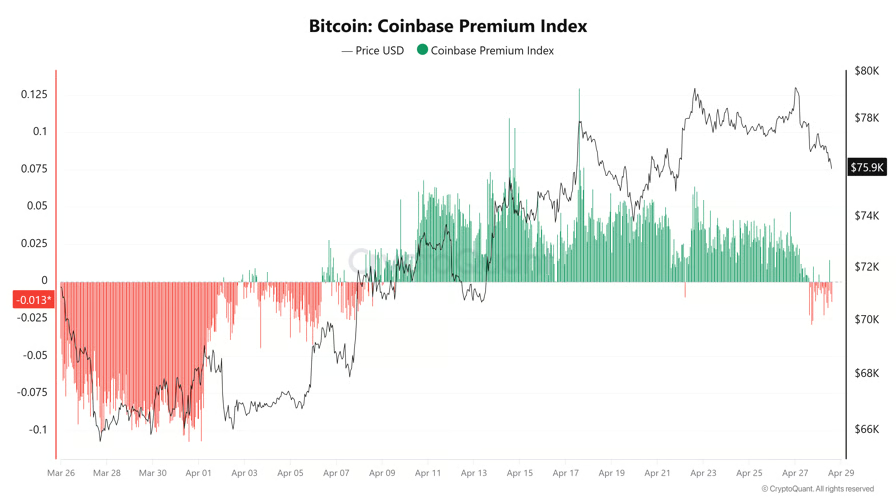
Bitcoin’s (BTC) Coinbase Premium Index has turned negative at -0.008 for the first time in three weeks, signaling a sharp reduction in US spot market demand and aligning with BTC’s current price drop. The signal held across hourly readings through the next 48 hours, showing consistent selling pressure from US-based buyers. The shift comes as the net weekly average of BTC realized losses climbed to $829 million, suggesting reduced investor conviction.
Bitcoin Coinbase Premium Index. Source: CryptoQuant
Crypto trader Ardi highlighted a break in both trendline support and the $77,300 liquidity zone. The trader linked the move to weakening spot demand, noting that the premium has posted consecutive red readings for the first time since BTC was near $67,000.
Ardi said that price action during the Federal Open Market Committee (FOMC) meeting window could remain volatile, with rapid moves in either direction. Traders could place focus on the $74,500–$75,500 range as a key downside area tied to demand exhaustion.
Onchain data adds to this view. Crypto analyst Darkfost noted that the weekly realized losses reached $829 million on a seven-day average, compared to $566 million in realized profits. The net realized profit briefly turned positive on April 9, then reversed within two weeks.
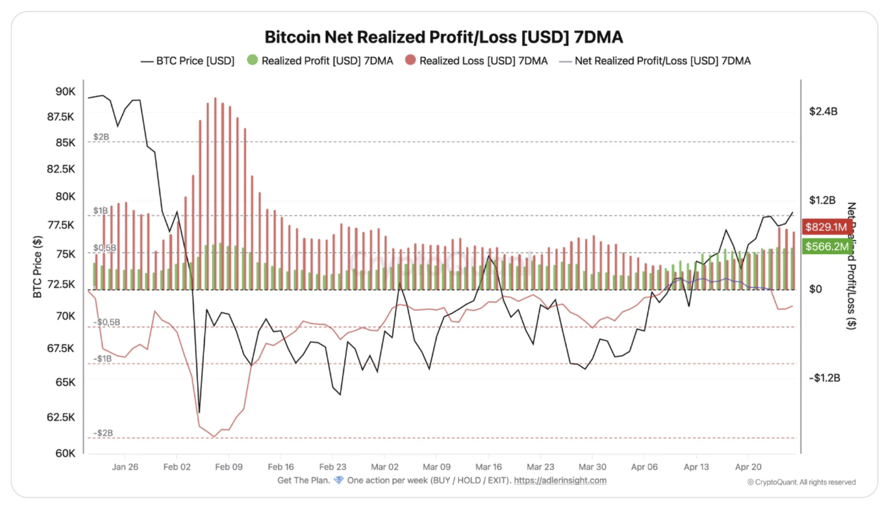
Bitcoin net realized profit/loss [USD] 7DMA. Source: CryptoQuant
The share of supply in profit stands at 64%, a level that has not historically supported sustained upside. This indicates weaker conviction among holders despite the recent rebound.
Related: Bitcoin price hits one-week low as $100 oil sparks fresh Asia crisis fears
Bitcoin sell volumes at Binance reach $828 million
Derivatives data shows strong sell-side activity on Binance. Crypto analyst Amr Taha noted that the 24-hour cumulative net taker volume dropped by $828 million on April 27, the lowest reading since late March.
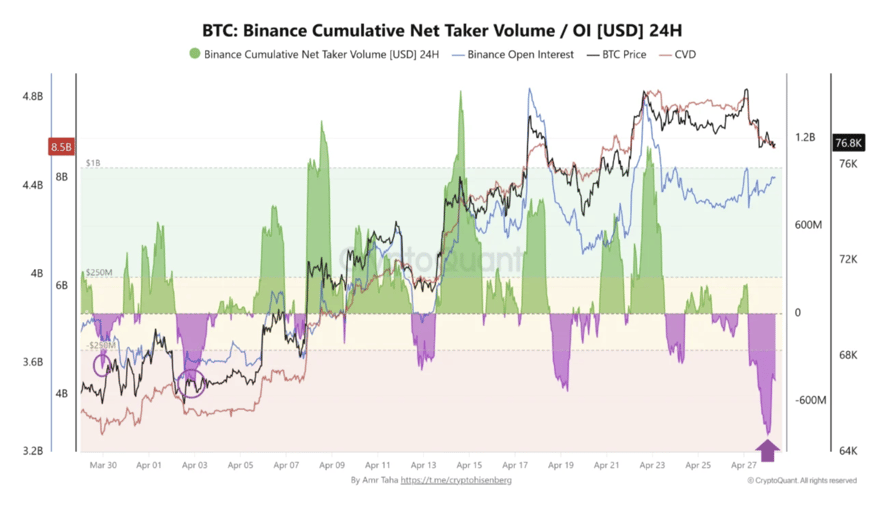
BTC cumulative net taker volume on Binance. Source: CryptoQuant
Negative net taker volume indicates that the market’s sell orders exceed its buy orders. The Binance taker buy/sell ratio has also fallen to 0.89, a level last recorded on March 29.
That earlier reading aligned with a local pivot when Bitcoin tested $66,000, then recovered by 15% over the past 30 days.
The current readings place both metrics back near prior exhaustion zones. Taha described the setup as closer to a short-term capitulation than a larger trend breakdown.
Related: Can Bitcoin hit $250K this year? Traders say it may be time to ‘sell in May’
Crypto World
XRP Price Outlook: How Bank Adoption and Token Scarcity Could Drive Long-Term Value Growth

TLDR:
- Banks integrating Ripple’s DLT are expected to grow XRP Ledger transaction volumes massively over time.
- Payment providers like Finastra and Volante are adding transaction volume through XRPL’s Cross-Currency RTGS functions.
- XRP cannot be mined and a portion is burned per transaction, meaning circulating supply will keep falling.
- XRP targets the $180 trillion international payments market, positioning it as a top bridging currency asset.
XRP is drawing renewed attention from the crypto community as Ripple’s distributed ledger technology gains traction among global banks.
Analysts and long-time observers point to a combination of rising network adoption, a shrinking token supply, and a massive addressable market.
Together, these factors are expected to push XRP toward higher and more stable valuations over time. The case being made is straightforward and grounded in market mechanics.
Banking Adoption and Payment Providers Fuel XRP Network Activity
As more banks integrate Ripple’s distributed ledger solution, transaction volumes across the network are expected to grow.
Each new institutional participant adds meaningful activity to the XRP Ledger. This growing participation directly increases the utility of XRP as a functional asset.
Payment service providers are also entering the picture. Companies like Finastra, Volante, and CGI are tapping into the XRPL’s Cross-Currency RTGS functions.
They are also using the Neutral Liquidity Marketplace that the XRP Ledger provides. This adds another significant layer of transaction volume on top of banking activity.
A recent post from crypto commentator SMQKE on X laid out the case clearly. The post stated that “the transaction volumes of the network will grow massively” as banks and payment providers deepen their integration with Ripple’s infrastructure. More network activity directly translates to greater XRP utility.
Greater utility, in turn, supports a stronger case for price appreciation. This is not speculative reasoning. It follows a basic supply-and-demand framework that has held across multiple asset classes over time.
Decreasing Supply and a $180 Trillion Market Position XRP for Long-Term Value
XRP cannot be mined, which makes its supply dynamics fundamentally different from Bitcoin and similar assets. A small amount of XRP is permanently burned with every transaction processed on the ledger. Over time, this means the circulating supply will only continue to fall.
As the SMQKE post noted, “everything that exists in a limited amount and is actively used is becoming more expensive.”
This principle applies directly to XRP as network usage climbs. A shrinking supply base against rising demand creates natural upward pressure on price.
The addressable market adds further weight to this outlook. XRP is positioned to serve international funds transfers, a market with an annual volume of $180 trillion.
Even a fraction of that volume flowing through the XRP Ledger would represent enormous demand for the token.
On the question of price volatility, Ripple has addressed this directly. The company expects volatility to ease as demand becomes more constant.
A steady flow of transactions using XRP as a bridging currency is expected to support price stability over time.

Crypto World
A crypto coalition releases technical proposal to save Aave users from a massive token exploit


A $300 million hole doesn’t usually come with a neat repair manual. This time, the group spearheading the Kelp DAO recovery effort is trying to write one.
DeFi United, a coalition of multiple blockchain projects and crypto ecosystem individuals, has laid out a detailed, step-by-step plan to restore the backing of rsETH after this month’s Kelp DAO hack sent shockwaves through DeFi lending markets, releasing more than 116,000 tokens that weren’t properly accounted for.
The proposal, circulated on Aave’s official X account, reads like a coordinated cleanup operation, one that leans heavily on Aave’s infrastructure to unwind the damage and get markets back on a stable footing.
The incident traces back to April 18, when an attacker exploited a vulnerability in rsETH’s bridge. By forging a message that appeared legitimate, the attacker tricked the Ethereum side of the system into releasing 116,500 rsETH, making the system believe the funds had moved when they hadn’t, allowing a large batch of rsETH to be created without backing.
Those tokens didn’t just sit idle. They were spread across multiple wallets and deployed across DeFi, with a significant portion used as collateral on Aave and other lending platforms.
That’s where the problem became systemic: protocols like Aave suddenly found themselves holding collateral that, at least temporarily, wasn’t fully backed.
According to the proposal, most of the exploited funds are still in play. Roughly 107,000 of the original 116,500 rsETH remain tied up in active positions across Aave and Compound.
That leaves two problems to solve at once: restoring the actual backing of rsETH itself, and unwinding the loans created using those extra tokens.
DeFi United’s proposal aims to tackle both sides of that equation simultaneously.
On the backing side, the group says it has already lined up enough ETH commitments to fully re-collateralize rsETH. The plan is to feed that ETH back into the system in stages, converting it to rsETH and depositing it back into the system so the token is once again fully backed.
At the same time, attention shifts to the lending markets where the damage is most visible.
Instead of letting things play out chaotically, the plan is to step in and carefully unwind the mess.
A big part of that involves dealing with the positions the attacker opened on Aave. These are essentially loans backed by rsETH that shouldn’t have existed in the first place. Rather than waiting for those loans to collapse on their own — which could cause more market disruption — the proposal suggests nudging the system so they can be closed out in a more controlled way.
In practice, temporarily adjusting how rsETH is valued inside the system will enable those bad positions to be liquidated or closed more smoothly. As those positions are unwound, the underlying assets (like ETH) can be recovered. The proposal estimates this could free up around 13,000 ETH from Aave alone.
Once that collateral is back in hand, it gets converted into ETH and used to cover the shortfall created by the exploit — essentially filling the hole left behind.
The process isn’t risk-free. It hinges on governance approvals across multiple chains, the successful deployment of committed funds and a smooth execution of the unwind.
Still, the plan reflects a more coordinated response than DeFi has often managed previously. If executed as intended, the end goal is straightforward: “rsETH backing is fully restored, and all affected markets are stabilized,” as the proposal says.


The CFTC filed suit against Wisconsin to establish its exclusive regulatory authority over prediction markets, a sector closely tied to crypto and blockchain-based derivatives.
The U.S. Commodity Futures Trading Commission (CFTC) sued Wisconsin on April 28, 2026, to reassert its exclusive jurisdiction over prediction markets. The action challenges state-level regulatory interference in a sector increasingly built on blockchain technology and crypto assets. The lawsuit underscores ongoing federal-state jurisdictional disputes over decentralized and tokenized derivatives platforms.
The CFTC’s enforcement action signals the regulator’s intent to maintain control over derivatives-adjacent products in the crypto space, potentially affecting platforms that tokenize prediction market shares or operate on decentralized protocols.
The CFTC said that its lawsuit is in response to Wisconsin filing civil suits against multiple CFTC-regulated prediction market companies — Kalshi, Polymarket, Crypto.com, Robinhood, and Coinbase — alleging violations of state law.
Sources: CFTC
This article was generated automatically by The Defiant’s AI news system from publicly available sources.
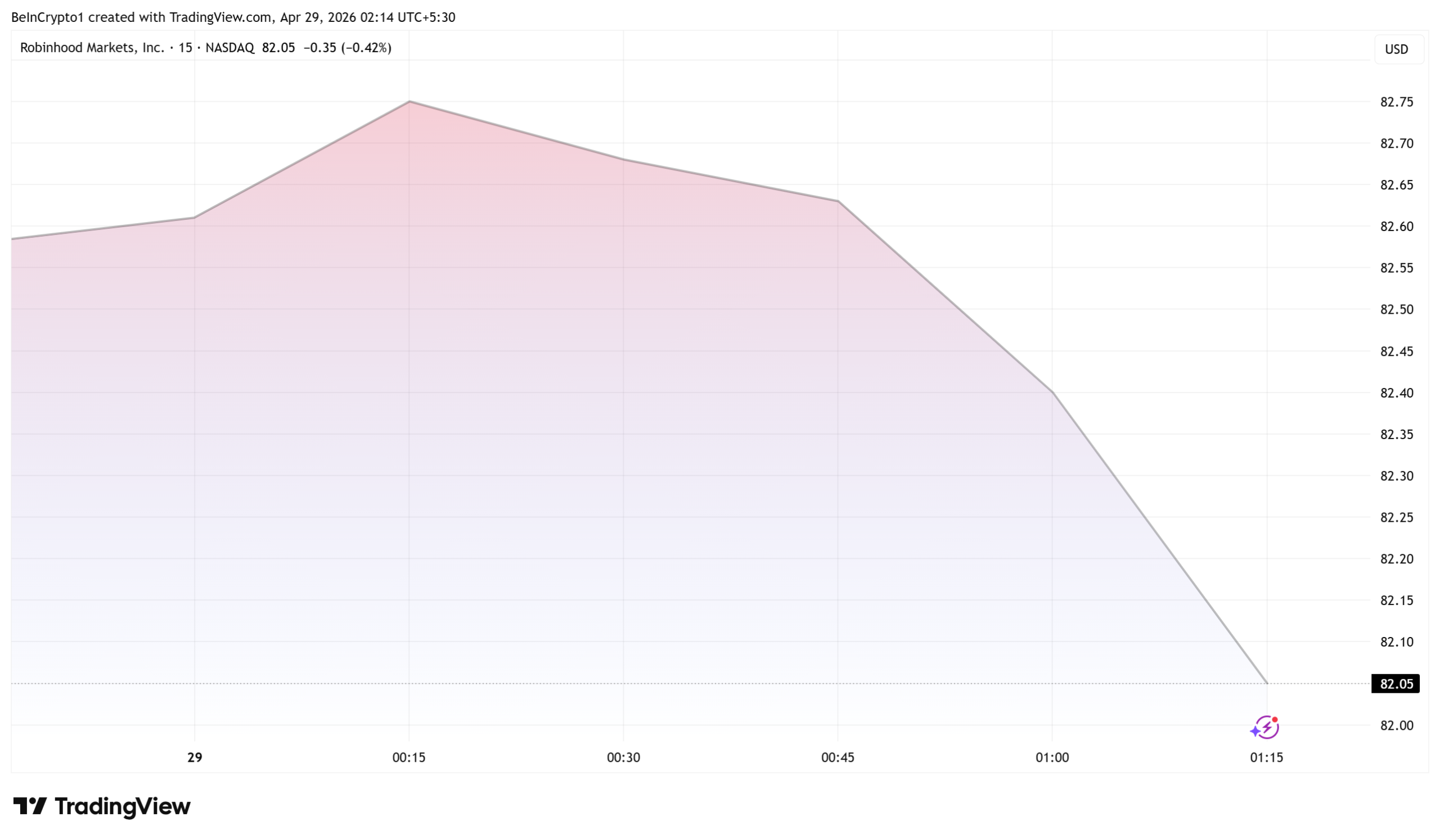
Robinhood Markets shares slipped about 6% in after-hours trading Tuesday after the retail brokerage reported a 47% year-over-year drop in cryptocurrency revenue, dragging overall first-quarter results below Wall Street expectations.
The Menlo Park firm posted $346 million in first-quarter profit, or $0.38 per diluted share, narrowly missing analyst estimates of $0.39 even as net income rose 3% from a year earlier.
Crypto Revenue Slides as Bitcoin Cools
Crypto transactions generated $134 million in revenue during the quarter, down 47% year-over-year as digital asset trading activity cooled across the platform.
Total revenue reached $1.07 billion, up 15% year-over-year but short of the $1.14 billion analysts had projected. The miss arrived even as equities, options, futures, and prediction markets posted double-digit growth or record volumes, the company said.
Trading fees drove much of the platform’s gains last year, when HOOD stock peaked at $153.86 in October alongside crypto’s broader run.
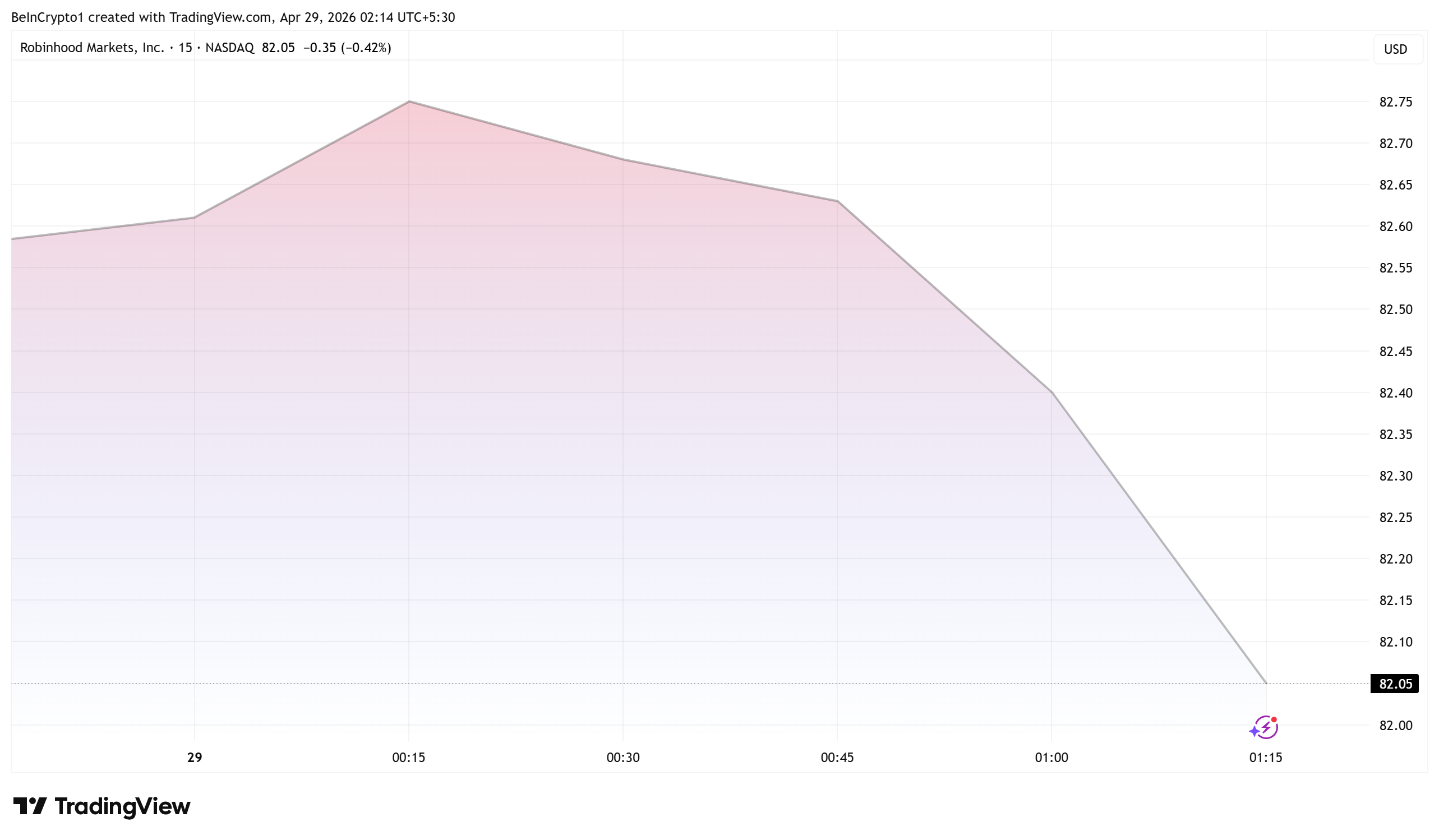
Robinhood stock dipped on this report, and was trading for $82.05 as of this writing.
Prediction Markets and Tokenization Cushion the Slide
Chairman and CEO Vlad Tenev pointed to the firm’s expanding role across customer finances in a statement.
“Robinhood is increasingly positioned at the center of our customers’ financial lives,” he stated in the broadcast.
Wagers routed through Kalshi-powered prediction markets logged record volumes, supported by a one-cent transaction fee.
Robinhood also launched the public testnet for Robinhood Chain, an Ethereum (ETH) layer-2 network built around tokenized assets.
Total platform assets stood at $307 billion, up 39% year-over-year on the back of net deposits and higher equity valuations.
The firm’s European tokenized stocks product continues to offer customers exposure to private companies including OpenAI and SpaceX.
The after-hours sell-off pushed HOOD to roughly $82, well off the October peak. The path forward depends on whether prediction markets and tokenization can offset the cooling in digital asset trading.
The post HOOD Stock Topples After Robinhood Earnings Reveals 47% Decrease in Crypto Revenue appeared first on BeInCrypto.
Crypto World
LayerZero Pledges 10,000 ETH to DeFi United as Industry Rallies Behind Kelp DAO Recovery
TLDR:
- LayerZero Labs is donating 5,000 ETH and depositing another 5,000 ETH into Aave to strengthen market liquidity.
- The $292M Kelp DAO exploit involved an RPC-poisoning attack that forged cross-chain messages via LayerZero’s DVN.
- DeFi United has raised over $300M in ETH and stablecoins, with major contributors including Consensys and Arbitrum DAO.
- Total value locked across DeFi fell from $95B to $80B following the Kelp DAO hack, reflecting broad market disruption.
LayerZero Labs has committed over 10,000 ETH to the DeFi United recovery initiative, led by Aave, following the $292 million Kelp DAO exploit.
The crypto infrastructure provider will donate 5,000 ETH directly and deposit another 5,000 ETH into Aave markets.
This contribution, valued at roughly $23 million, places LayerZero among the largest participants in the industry-wide effort to restore rsETH backing after the April 18 attack.
LayerZero’s Contribution to DeFi United
LayerZero’s pledge comes approximately five days after the company first announced its intent to join a recovery effort.
The firm will also work to deepen liquidity for GHO, the native stablecoin on Aave. This move signals a broader commitment beyond a simple financial donation.
LayerZero confirmed the details in an official post on X, stating it is “donating 5,000 ETH to DeFi United, depositing an additional 5,000 ETH to strengthen Aave markets liquidity, and strategically deepening GHO liquidity.”
LayerZero also confirmed plans to continue working with Aave and other DeFi participants. The focus will be on how Omnichain Fungible Tokens (OFTs) should be designed and configured for use in lending markets. This collaboration could shape future standards across the ecosystem.
The exploit on April 18 involved a sophisticated RPC-poisoning attack on LayerZero’s Decentralized Verifier Network.
Attackers forged a cross-chain message, releasing unbacked rsETH from Kelp’s LayerZero-powered bridge adapter on Ethereum. Around 107,000 rsETH then entered lending positions on Aave, creating substantial bad debt.
Industry Response and Recovery Progress
DeFi United has now raised over $300 million in ETH and stablecoins from dozens of protocols and individuals. Arbitrum DAO has a pending vote to release 30,765 ETH toward the effort.
Consensys and Joseph Lubin together are contributing 30,000 ETH, matched by a low-interest loan from Mantle.
Aave DAO also has a pending proposal to approve a 25,000 ETH contribution. This adds to Aave founder Stani Kulechov’s personal pledge of 5,000 ETH. Kelp DAO contributed 2,000 ETH, while Circle is buying AAVE tokens to support the protocol’s stability.
There remains a dispute over responsibility for the attack. LayerZero states it “recommended multi-DVN redundancy” to protect against single points of failure. Kelp, however, says it “used the default configuration” provided, which relied on a 1-of-1 DVN setup with only LayerZero Labs as the verifier.
Meanwhile, the total value locked across DeFi has dropped to $80 billion, down from roughly $95 billion just before the hack.
Aave has released a detailed technical recovery plan, and the broader effort to restore rsETH backing continues to move forward.


A federal judge rejected Sam Bankman-Fried’s request for a new trial on Tuesday, April 28, 2026, denying the former FTX chief’s attempt to reopen his criminal case based on claims of newly discovered evidence.
US District Judge Lewis Kaplan issued the ruling in New York, where he oversaw Bankman-Fried’s 2023 trial. Bankman-Fried was convicted over the collapse of FTX and later sentenced to 25 years in prison.
The motion was filed under Rule 33, a procedure that allows defendants to seek a new trial if new evidence emerges. Bankman-Fried argued that the jury did not hear the full picture of FTX’s finances, including claims that the exchange had assets that could repay customers.
He also argued that evidence about lawyers’ involvement in FTX decisions could have supported his claim that he acted in good faith rather than with criminal intent.
However, Kaplan denied the motion even after Bankman-Fried tried to withdraw it. Bankman-Fried had claimed the judge would not be fair in deciding the request.
The ruling leaves Bankman-Fried’s broader appeal before the Second Circuit as his main path to challenge the conviction.
The post Judge Rejects Sam Bankman-Fried’s Retrial Bid in FTX Case appeared first on BeInCrypto.
Crypto World
RailsX Goes Live: Amboss Brings Self-Custodial Bitcoin and Stablecoin Trading to the Lightning Network
TLDR:
- RailsX enables peer-to-peer bitcoin and stablecoin trading natively on the Lightning Network with no intermediary..
- The platform launches with two stablecoin pairs, USDT-L and USDC-L, both issued by Speed Wallet on Lightning.
- All trades settle atomically through Lightning channels in seconds, removing the need for centralized exchanges.
- RailsX combines Amboss’s Magma liquidity marketplace with Taproot Assets to power decentralized BTC trading.
RailsX, a new peer-to-peer exchange built on the Lightning Network, is now live for early users. Amboss Technologies developed the platform to allow self-custodial trading between bitcoin and stablecoins.
The launch introduces two stablecoin-bitcoin pairs: USDT-L and USDC-L, both issued by Speed Wallet. Users retain full control of their private keys throughout all transactions, removing the need for centralized custody.
Trading Bitcoin Against Stablecoins Without Giving Up Custody
RailsX routes all trades through existing Lightning payment channels. This means settlement happens in seconds, with minimal fees and no third-party intermediary holding assets.
There is no centralized order book managing trades on the platform. Instead, transactions execute atomically, giving users a fully decentralized trading experience.
The platform is accessible through open-source node manager Thunderhub, with no additional setup required. Amboss is also coordinating liquidity formation across BTC/stablecoin pairs to support growing trading volume.
RailsX combines Amboss’s liquidity marketplace, Magma, with Taproot Assets to enable this decentralized structure. The company says this approach aligns with its reading of U.S. draft Clarity Act legislation.
Speed Wallet handles the issuance and underlying custody for both USDT-L and USDC-L. All assets remain fully backed and transparent under Speed Wallet’s framework.
Before RailsX launched, Speed Wallet had already been operating wrapped stablecoins for its own users. Now, that infrastructure is available to the entire Lightning Network through RailsX.
Amboss CEO and co-founder Jesse Shrader addressed what the platform means for everyday users. “RailsX lets users trade, hold, and move value on Lightning without ever giving up control of their money,” Shrader said.
He added that the platform is designed to unlock Bitcoin’s potential as a medium of exchange. According to Shrader, RailsX serves global stablecoin demand without exposing users to cross-chain decentralized finance risks.
Stablecoins Return to Bitcoin via Taproot Assets
RailsX builds on Amboss’s existing Rails product, which lets users supply liquidity to Lightning channels and earn yield. The new platform extends that foundation into fully self-custodial stablecoin trading.
Industry leaders have recently discussed bringing stablecoins back to Bitcoin using Taproot Assets. These include Tether CEO Paolo Ardoino and Lightning Labs CEO Elizabeth Stark.
Speed Wallet CEO Raj Patel spoke directly about the platform’s role in expanding access. “Speed Wallet built this technology with one goal: to make stablecoins on Lightning accessible to everyone,” Patel said.
He described RailsX as the kind of distribution platform Speed Wallet had always envisioned. Patel also noted that the launch takes self-custody stablecoin trading into the mainstream for the broader Lightning Network.
The Lightning Network saw a sharp drop in capacity earlier this year amid bear market conditions. However, capacity has largely stabilized over the past two months.
According to The Block’s data dashboard, total U.S. dollar capacity on the network stands at roughly $380 million. Bitcoin capacity hovers at approximately 4,870 BTC. RailsX was first unveiled in January and is now entering its early-user phase.
The platform represents a growing push to make Bitcoin a practical medium of exchange at scale. As stablecoin demand rises globally, Lightning-native solutions like RailsX are drawing increasing attention from users seeking alternatives to centralized exchanges.

Shell Buys a Gas Producer Far From the Middle East Turmoil

BeInCrypto Institutional Research: 15 Firms Rating Digital Asset Risk for Investors

Blake Lively’s Company ‘Quietly Shut Down’ In 2025

Manchester United reach agreement with Casemiro over contract clause amid transfer speculation

US brings back mandatory military draft registration

Steven Gerrard disagrees with Gary Neville over ‘shock’ Chelsea and Arsenal claim | Football


-

 Tech1 day ago
Register Renaming | Hackaday
-

 Fashion4 days ago
Weekend Open Thread – Corporette.com
-
Crypto World3 days ago
Hyperliquid $HYPE Rally Builds Momentum as AI Sector Enters Prove-It Phase
-

 Politics6 days ago
Making troops accountable for war crimes threatens US alliance, ex-SAS colonel warns
-

 Politics6 days ago
Disabled people challenge government SEND proposals over segregation concerns
-

 Business5 days ago
Patterson-UTI Energy, Inc. (PTEN) Q1 2026 Earnings Call Transcript
-

 Business7 days ago
Rolls-Royce Voted UK’s Most Iconic Trade Mark as IPO Register Hits 150
-
 Sports2 days ago
IPL 2026: Ruturaj Gaikwad registers slowest fifty of the season, enters all-time unwanted list | Cricket News
-

 Politics1 day ago
Drax board avoid their own AGM, accused of greenwashing & environmental racism
-

 Politics6 days ago
Starmer handler McSweeney to be dragged from shadows by Foreign Affairs Committee
-

 Politics6 days ago
Zack Polanski responds to home secretary’s taser threat
-
Politics6 days ago
Wings Over Scotland | How To Get Away With Crimes
-

 Politics6 days ago
‘Iran is still a nuclear threat’
-
 Business7 days ago
HCL Tech share price tank over 9% after weak Q4. JPMorgan, HSBC & 3 others cut target price
-

 NewsBeat3 days ago
LK Bennett closes all stores after entering administration
-
 Sports6 days ago
Tim Bradley names the current best in the world: “Better than Inoue and Usyk”
-

 Crypto World5 days ago
Michael Saylor says BTC winter is over. Market analyst disagrees, says bitcoin was in a pullback
-
 Crypto World7 days ago
Ethereum Price News: ETH Flashes a Bullish Setup No Holder Should Miss While Pepeto Nears Its Binance Listing
-

 Business7 days ago
The Job Benefits Most Men Don’t Know to Negotiate
-

 Sports7 days ago
Manny Pacquiao buys shuttered Floyd Mayweather gym, will use it as base of operations for upcoming rematch
You must be logged in to post a comment Login