
Crypto World
Galaxy lowers CLARITY Act odds to 10%

Galaxy cited unresolved ethics, stablecoin yield and developer protection issues, along with a narrow Senate window when lawmakers return in September.

Kalshi must implement initial geofencing by Aug. 19 and a GeoComply multi-source geofencing system by Sept. 2.
XRP price has steadied near $1 as whale transfers to Binance fell to their lowest level since 2021, although weak demand and bearish chart signals continue to limit a recovery.
Summary
- XRP price traded near $1.00 after losing about 3.2% over the past seven days.
- Binance whale inflows fell to $61 million on a three-month average.
- Daily RSI remained weak at 36, while the 4-hour MACD showed early improvement.
- Liquidation clusters between $1.02 and $1.05 could attract price during a rebound.
XRP price remains under pressure near $1
CryptoQuant contributor Darkfost reported that the three-month average of XRP whale inflows to Binance has dropped to about $61 million, its lowest reading since 2021.
The figure stood at $456 million in January 2025 and $355 million in October 2025. Current transfers are therefore six to eight times lower than the peaks recorded last year, according to the analyst.
Reduced exchange deposits usually mean fewer tokens are immediately available for sale. Darkfost described the decline as a positive development for XRP but warned that lower selling activity alone cannot confirm a bullish reversal.
Net flows remain positive at roughly $18.8 million, meaning large deposits are still exceeding withdrawals. Darkfost also said the slowdown fits a market-wide decline in exchange inflows and trading volume, with selling pressure fading before demand has fully recovered.
XRP traded around $1.00 at the time of writing, little changed over 24 hours, but down approximately 3.2% during the past week. The token has a market capitalization of about $62.8 billion and nearly $900 million in daily trading volume.
XRP price has repeatedly moved above and below $1 since Aug. 11. The latest dip reached approximately $0.988 before buyers returned, but the recovery stopped near $1.01.
Daily XRP chart keeps sellers in control
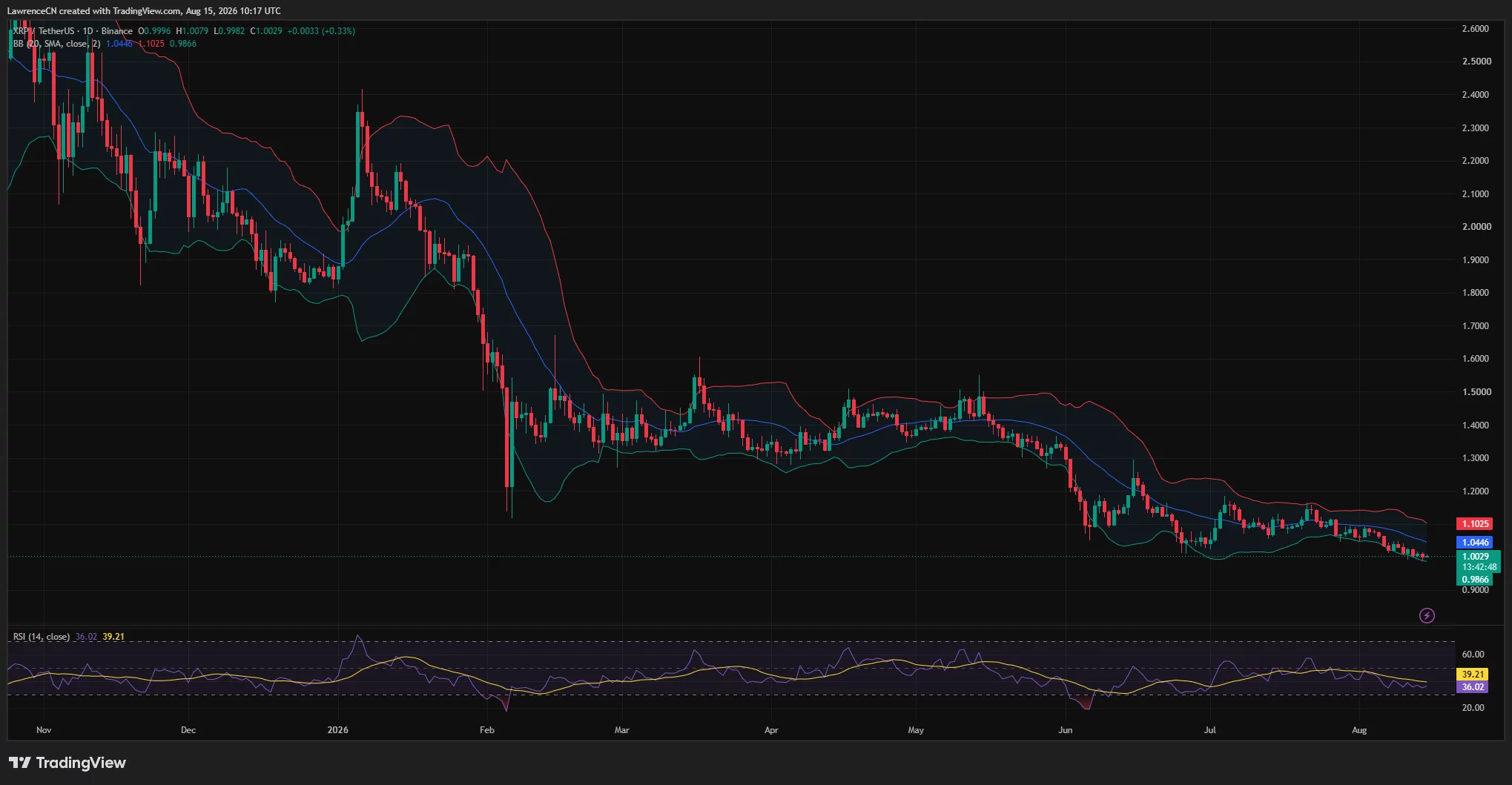
The daily chart shows XRP trading below the Bollinger Bands’ 20-day middle line at $1.0446. Staying below that average leaves the short-term structure tilted toward sellers, even though the price is approaching the lower band at $0.9866.
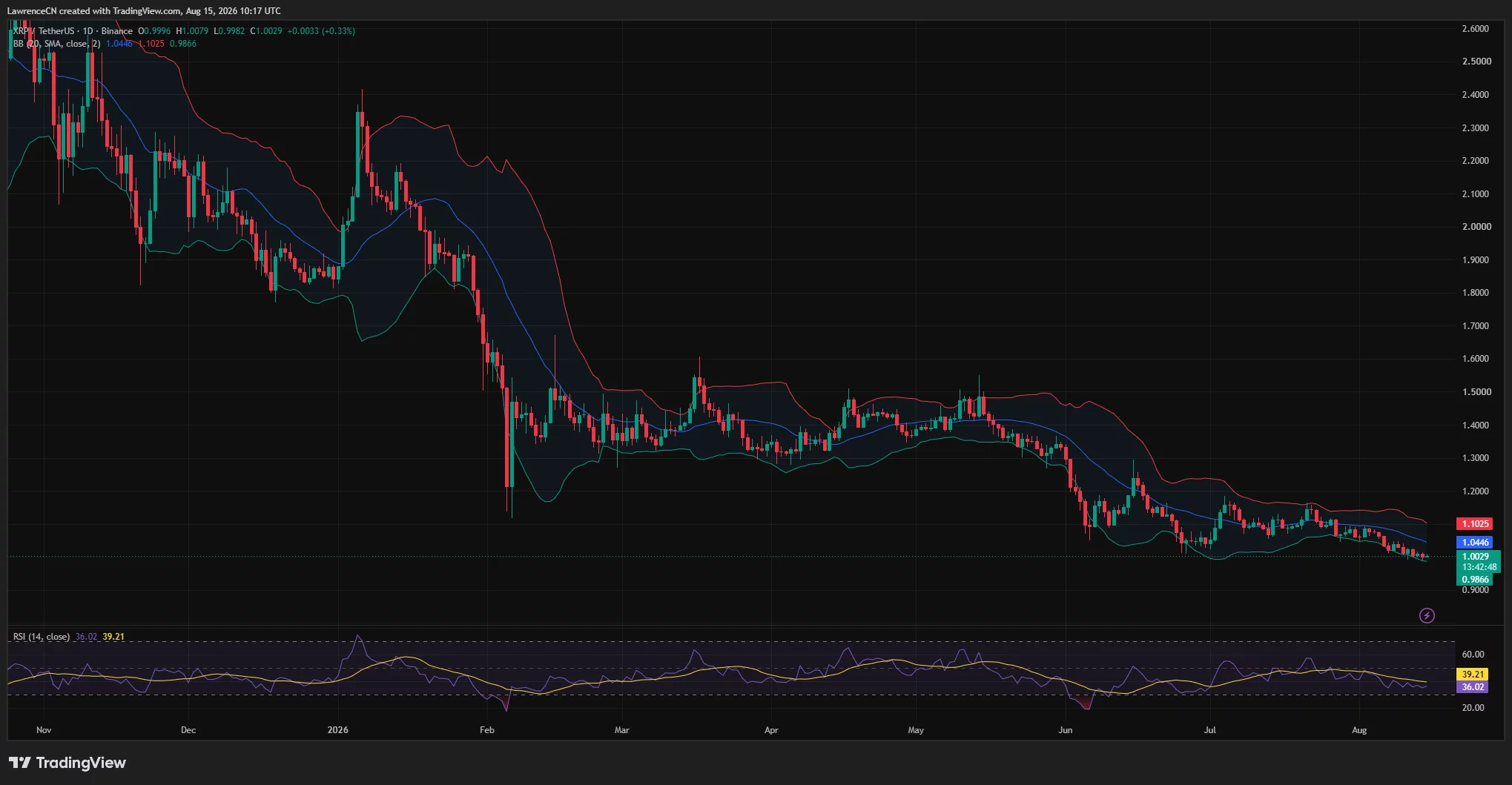
The daily relative strength index stood at 36.02, below its signal average of 39.21. The reading shows weak momentum but remains above the conventional oversold threshold of 30, leaving room for another decline before the indicator reaches an extreme.
A close below the $0.9866 lower Bollinger Band would weaken the $1 support case and expose the area around $0.95. The chart has not established a clear daily reversal pattern, with lower highs and lower lows continuing from XRP’s May peak.
For a recovery, buyers first need to reclaim the Bollinger middle line near $1.045. The upper band at $1.1025 would become the next target if the price closes above that level and trading activity rises.
The narrow distance between the current price and the lower band also creates the possibility of a short-term bounce. Such a move would remain corrective unless XRP breaks above its declining daily average and holds the gain.
Falling wedge offers an early recovery setup
On the 4-hour chart, XRP has moved inside a falling wedge formed after the July 21 high near $1.165. Price is now close to the point where the two descending trendlines converge, making a breakout increasingly likely as the available trading range contracts.
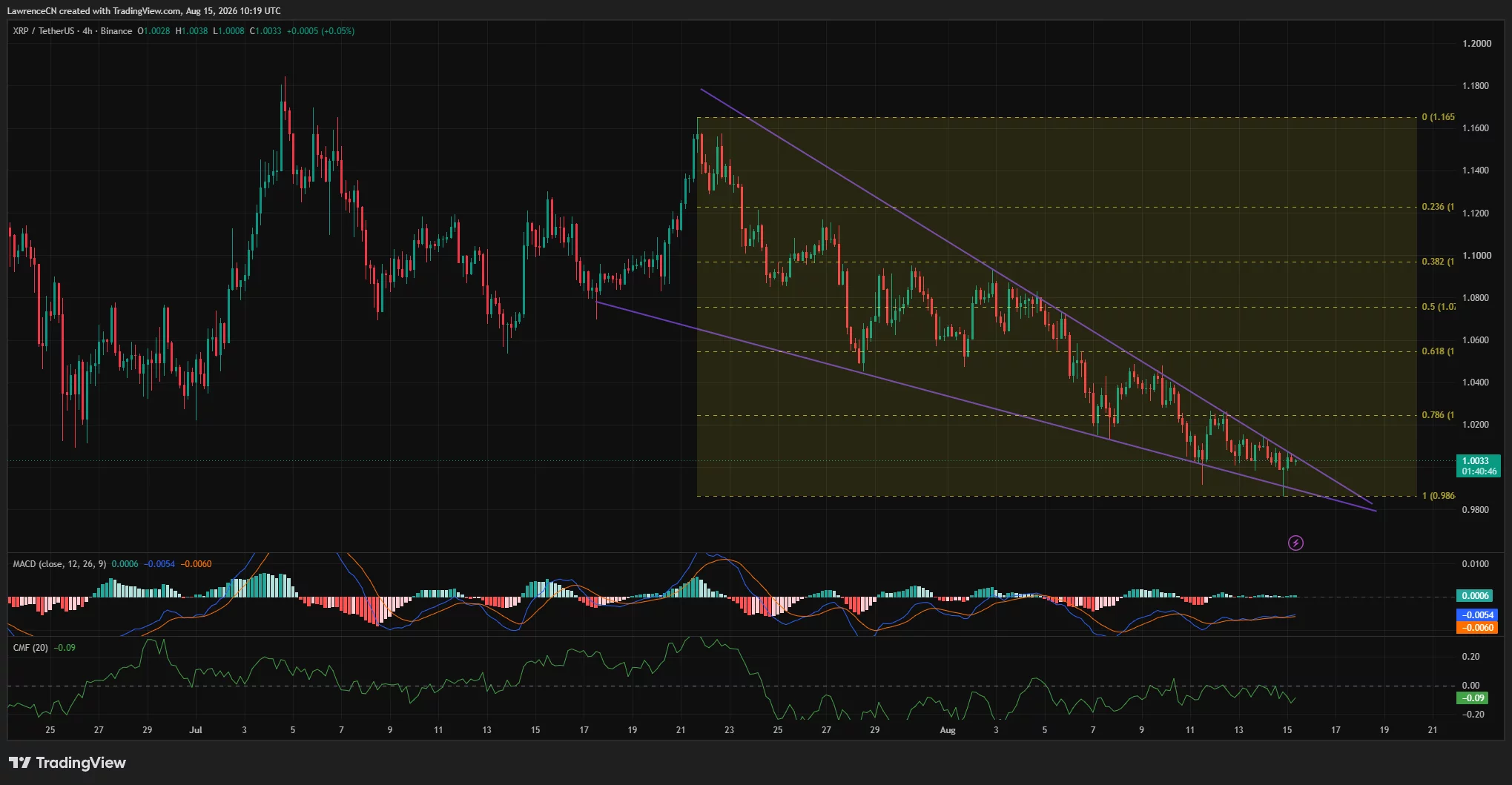
The first nearby barrier sits at the 78.6% Fibonacci retracement around $1.024. A breakout above the wedge and this level would open a path toward $1.055, followed by $1.076.
Higher resistance appears near $1.097 and $1.123. XRP would need to clear the entire sequence before it could challenge the July high around $1.165.
4-hour momentum has started to improve. The MACD line stood near minus 0.0054, above the signal line at minus 0.0060, while the histogram turned slightly positive at 0.0006. The crossover points to easing downside momentum rather than a confirmed trend change because both lines remain below zero.
Chaikin Money Flow remained negative at minus 0.09, showing that capital flows still favor sellers. A wedge breakout accompanied by CMF moving above zero would provide firmer evidence that buyers are returning.
Failure to leave the wedge could push XRP back toward $0.986. A confirmed 4-hour close below the lower trendline would invalidate the recovery setup and increase the risk of a move toward $0.98 or $0.95.
Liquidation map places XRP targets above $1
CoinGlass’ one-week liquidation heatmap shows several leveraged-position clusters above the current price. The nearest liquidity is concentrated around $1.01, followed by larger pockets between $1.02 and $1.03.
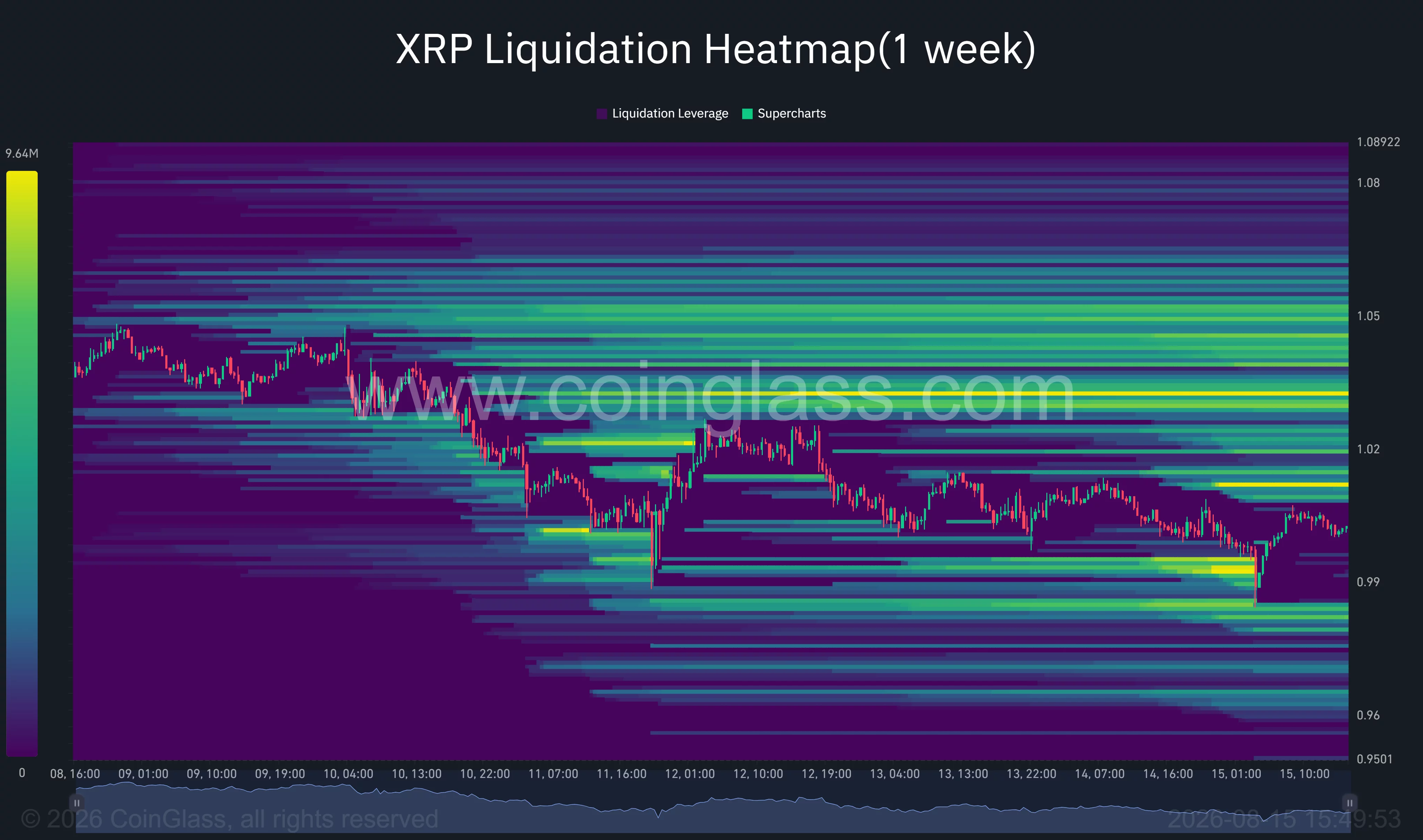
The strongest overhead concentrations appear near $1.03 and from approximately $1.045 to $1.05. Since price often moves toward areas holding large leveraged positions, a rebound could accelerate as short liquidations are triggered across these levels.
Additional liquidity below the market is visible near $0.98 to $0.99. A loss of $1 could therefore pull XRP toward that zone before buyers receive another chance to defend the daily lower Bollinger Band.
For US investors trading during the weekend, thinner liquidity may increase sudden moves around the $1 level. The charts place $0.986 as the immediate downside boundary, while a move through $1.024 would offer the first technical sign that XRP is breaking out of its month-long decline.
Falling Binance whale inflows reduce one source of possible selling, but Darkfost’s data and the negative daily structure reach the same conclusion: XRP still needs fresh buying demand before a lasting recovery can begin.
Disclosure: This article does not represent investment advice. The content and materials featured on this page are for educational purposes only.
Bitcoin’s week-long correction drove the asset to a new local low of $62,500, where it finally found some support and now sits at around $63,000.
Most larger-cap alts have experienced little to no volatility on a 24-hour scale, aside from LINK and WLFI, both of which are up by over 5%.
BTC Calms at $63K
After a very stagnant previous weekend, bitcoin tried to break out on Monday morning, but it was immediately halted at $65,400. This was the second rejection at that level in the past three days. However, this one was more violent as BTC dipped to $62,800 within hours.
It tried to bounce off twice, but it was stopped at $64,400. Each subsequent leg down was more painful than the previous. The bears took complete control of the market by mid-week, and the selling pressure intensified in the following days. The culmination took place on Friday when BTC slumped to $62,500 for the first time in 10-11 days.
It finally bounced off in the following hour, but it was stopped at $63,200 and now struggles at $63,000. Its market capitalization has stalled at $1.260 trillion on CG, while its dominance over the alts, which peaked at 57.3% earlier this week, is now down to under 57%.

LINK Tries to Break Out
Analysts have been quite optimistic about LINK’s future lately, often predicting massive rallies. The first breakout attempt has taken place as the asset is up by over 5% daily and has reclaimed the $9 support. WLFI is the only other notable gainer from the larger caps, while UNI has dumped by 5%.
In contrast, XRP, SOL, TRX, HYPE, and RAIN are slightly in the red, while ETH, BNB, and DOGE have marked insignificant gains.
VELVET has entered the top 100 alts. It has soared by 25% daily and by roughly 150% in the past week. ETHFI follows suit, surging by 12% daily. OKB completes the top 3 price gainer club with a 6.5% jump.
The total crypto market cap is down to under $2.230 trillion on CG.

The post Chainlink (LINK) Is Breaking Out, Bitcoin (BTC) Sluggish at $63K: Weekend Watch appeared first on CryptoPotato.

She didn’t say anything right away. Finally, she looked up. “My sister was just diagnosed with stage 4 colon cancer. I’m worried I might have it too.”
For the next 15 minutes I watched as they talked about how she was processing her sister’s diagnosis, her fears about the future, what it all meant for her future colon cancer screening, and why at this point we were most concerned about IBS.
By the end of the visit, her expression had cleared; I realized I hadn’t noticed how frightened she was. I felt ashamed of myself. What kind of doctor was I going to be?
My supervising physician and I talked about it. “You learn how to look,” he said. “When you care, you get a feel for it.”
That lesson has stayed at the forefront for me as I’ve watched artificial intelligence sweep through medicine and enter the clinical environment of our internal medicine residency program at the Johns Hopkins Hospital. AI scribes. Chatbots that tell you a differential diagnosis if you put in a patient’s symptoms. Electronic medical record tools that will summarize a patient’s hospital course for you. But they can’t feel.


Africa Finance Corporation has raised 350 million Swiss francs or about $431 million, through its first digital bond, becoming the first African institution to issue such debt through a regulated exchange and central securities depository.
Summary
- The five-year digital bond carries a coupon rate of 1.4925%.
- Around 90% of investor demand came from Swiss accounts.
- Commerzbank and Deutsche Bank arranged the transaction.
- AFC will use the proceeds to support infrastructure financing across Africa.
AFC digital bond raises $431 million
Ledger Insights reported that Africa Finance Corporation issued the five-year bond through SIX, using its SDX digital platform for clearing and settlement. The transaction represents the first digital bond from an African institution to be processed through both a regulated exchange and a central securities depository.
Priced with a coupon of 1.4925%, the 350 million-franc bond is among the larger digital debt issues completed through the Swiss platform. UBS issued a 375 million-franc digital bond in 2022, according to Ledger Insights.
AFC separately described its offering as the largest Swiss franc-denominated digital bond from an international issuer. The company said it was also its fourth and largest bond issued in Swiss francs, following a 150 million-franc green bond completed in 2020.
Investor demand came mainly from Switzerland, with domestic accounts contributing about 90% of the orders and international investors providing the remaining 10%, according to AFC. Banks and other financial companies accounted for 57% of the order book, while asset managers represented 37% and hedge funds contributed 6%.
The bond was issued under AFC’s $5 billion Global Medium-Term Note Programme. Under the structure, the debt is represented as a tokenized security, while ownership details are kept on a regulated digital register using distributed ledger technology.
Trading and listing take place on the SIX Swiss Exchange, with the security deposited at SIX Digital Exchange. SIX SIS AG operates the clearing and settlement system used for the transaction.
Commerzbank AG served as the technical lead, while Deutsche Bank AG’s London branch participated through its Zurich branch. AFC said proceeds from the sale would cover its general funding needs and support its financing of infrastructure projects in Africa.
Digital format keeps the bond inside regulated markets
Unlike a crypto token issued through an open blockchain platform, AFC’s bond uses regulated market infrastructure for ownership records, trading, and settlement. Investors are buying a debt security issued by AFC, with the digital system changing how the bond is recorded and processed rather than the financial claim itself.
Banji Fehintola, an AFC executive board member and head of financial services, said the digital structure was “not an end in itself” but part of the company’s effort to diversify its sources of funding.
“The digital format of this bond is not an end in itself but a signal of our commitment to being at the frontier of innovation in the capital markets as we continue to diversify and strengthen AFC’s funding base to support Africa’s development.”
AFC President and CEO Samaila Zubairu said the deal also showed continued investor confidence in the institution’s credit profile and development strategy. According to the company, S&P Global rates AFC at A with a positive outlook, while Moody’s gives it an A3 rating with a stable outlook.
Before the digital sale, AFC returned to the international bond market in July with a $500 million, five-year senior unsecured Eurobond. The corporation said the digital issue secured funding at a level within the pricing of the earlier dollar benchmark.
Operating as a multilateral finance institution, AFC funds projects in power, transport, telecommunications, natural resources, and heavy industry. The organization was established in 2007 and now counts 48 African countries as members. It says it has invested $19 billion across the continent since its creation.
SIX combines digital and traditional settlement
AFC completed the issuance after Switzerland’s financial regulator approved a change to the structure of SIX’s digital asset operations. In May, the Swiss Financial Market Supervisory Authority allowed SIX Digital Exchange AG, its digital central securities depository, to merge into SIX SIS AG.
SIX said the consolidation placed its services for traditional and digital securities under one legal entity. FINMA also approved crypto custody through the combined central securities depository, allowing financial institutions to use the same regulated provider for conventional assets and certain digital assets.
The exchange operator launched SDX as a regulated market for securities issued and settled through distributed ledger technology. The platform has since hosted digital bonds from banks, public bodies and international institutions.
In November 2024, crypto.news covered Lugano’s third blockchain bond, a 120 million-franc issue listed on both SDX and the main SIX Swiss Exchange. Lugano had issued three such bonds worth a combined 320 million francs over two years.
The city’s third bond formed part of Project Helvetia, a Swiss National Bank pilot that tested settlement using wholesale central bank digital currency. Ledger Insights noted that AFC’s announcement did not identify wholesale central bank digital currency as part of its transaction.
AFC’s deal also ended a pause in new digital bond activity on SIX, where the previous issuance was completed by German development bank KfW in June 2025, according to Ledger Insights.
U.S. market follows a regulated tokenization path
American financial institutions are testing a comparable model in which blockchain records sit within existing securities infrastructure. The Depository Trust & Clearing Corporation planned to begin limited production transactions in July 2026, before a full tokenization service targeted for October.
As previously reported in May, DTCC formed a working group of more than 50 traditional finance and digital-asset companies. Participants include BlackRock, JPMorgan, Goldman Sachs, Morgan Stanley, Bank of America, Circle, Nasdaq and NYSE Group.
DTCC said the initial service could cover Russell 1000 stocks, major index-tracking exchange-traded funds, and U.S. Treasury securities held in its custody. Its subsidiary DTC received a three-year no-action letter from the Securities and Exchange Commission in December 2025 for the defined tokenization service.
For U.S. investors, the SEC’s position means representing a financial instrument on a blockchain does not remove it from securities rules. SEC Chair Paul Atkins said in April that a stock remains a stock whether it appears on paper, through a DTCC entry, or as a blockchain token.
Meanwhile, U.S. transfer agents asked the SEC in July to distinguish securities created with an issuer’s approval from third-party tokens that merely track an asset. The groups said regulated systems should preserve accurate ownership records, transfer controls, dividend rights, and investor protections.

The Russell 2000, an index tracking roughly 2,000 smaller publicly traded US companies that is generally viewed as one of Wall Street’s more risk-sensitive equity benchmarks, has returned to record territory at over 3,050 over the past few weeks.
According to popular analyst Crypto Rover, there’s a hidden connection between the index and the largest altcoin, which could lead to a major ETH rally.
ETH Rally Ahead?
As the market observer highlighted, the Russell 2000’s surge to a new all-time high follows previous similar gains charted in 2016 and 2020. After both instances, ETH went on a massive rally within 6-12 months.
Given the index’s risk-on significance, when it surges, it means that investors have become more comfortable moving away from mega-cap stocks and into smaller companies. This is often interpreted as evidence that risk appetite and liquidity conditions are improving.
Here’s where Crypto Rover outlined the connection with Ethereum as the Russell broke out during previous cycles before ETH eventually followed with significantly larger percentage gains. Analysts at Milk Road previously described the correlation between the two as almost “spooky,” suggesting that both tend to benefit when monetary policy turns easier, which hasn’t exactly been the case lately.
RUSSELL 2000 JUST HIT A NEW ALL-TIME HIGH.
The same setup played out in both 2016 and 2020.
Russell 2000 broke out first.
Ethereum followed months later with an explosive rally.
Historically, $ETH has lagged this move by around 6–12 months.
If the pattern repeats again,… pic.twitter.com/VWSgZ1lvJp
— Crypto Rover (@cryptorover) August 13, 2026
Ethereum also offers staking yield, while its broader ecosystem is heavily exposed to speculative activity, DeFi, tokenization, and other areas that expand during risk-on periods.
Although the relationship between the two appears superficial at first glance, Ash Crypto also recently spoke about it and predicted a similar surge as Crypto Rover.
Time to Buy ETH?
The altcoin jumped toward $2,000 in July, but it was halted on both attempts. It has since lost about $100, currently struggling below $1,900. Nevertheless, it is still up by over 20% since its local low at $1,520.
Other analysts are also optimistic about its future price movements, including Michaël van de Poppe, who commented recently that the perfect moment to buy an asset like ETH never comes, but the ideal time to accumulate it is right now:
“It’s always awkward to be positioning yourself into a position, as that’s the purpose of the markets. Previous breakouts of the market have resulted in generally big returns, as ETH is known for volatile movements. In that sense, last time a 60% breakout in less than a week took place. In 2023, the same happened,” he explained.
The post This TradFi Signal Preceded Explosive Ethereum Rallies: Is ETH Next? appeared first on CryptoPotato.


Robinhood Ventures Fund II has raised $225.5 million and opened at $22.50 on the New York Stock Exchange, 10% below its $25 initial public offering price.
Summary
- RVII raised $225.5 million after offering 8 million shares at $25 each.
- The fund opened at $22.50 on the NYSE, 10% below its IPO price.
- Its portfolio targets early- and growth-stage companies connected to Y Combinator.
- Retail investors can buy RVII shares without investing directly in its private holdings.
Reuters reported that Robinhood’s second publicly traded venture fund debuted on Thursday, giving individual investors access to early-stage companies usually available only to venture firms and wealthy investors.
The listing completed an offering that crypto.news previously covered after Robinhood Ventures Fund II priced 8 million shares at $25 each. The share sale raised $200 million, while Robinhood’s initial capital brought the fund’s total size to $225.5 million before sales charges and offering expenses.
RVII began trading on the NYSE at $22.50, placing its opening price $2.50 below the IPO level. The shares give U.S. investors an exchange-traded route into a managed collection of private businesses, although shareholders do not own those companies directly.
Robinhood venture fund targets younger startups
Robinhood designed RVII to invest in early- and growth-stage private companies, distinguishing it from Robinhood Ventures Fund I. The first fund, which was listed in March under the ticker RVI, mainly holds positions in more established businesses that have not yet gone public.
According to an August filing, RVII was prepared with holdings in about 80 private companies. Its strategy centers on businesses founded by current or former participants in Y Combinator, as well as other companies connected to the startup accelerator’s network.
Y Combinator has funded more than 5,000 companies since 2005, including over 100 businesses that reached valuations of at least $1 billion. Its past participants include U.S.-listed crypto exchange Coinbase, social media company Reddit, and OpenAI, the developer of ChatGPT.
The accelerator does not sponsor or endorse RVII, according to the fund’s regulatory disclosures. Robinhood has permission to use the Y Combinator name when describing the investment strategy, but the accelerator does not accept responsibility for the portfolio or its performance.
Rich Aberman, RVII’s portfolio manager and a former Y Combinator founder and visiting partner, described the fund as part of a new area of venture investing.
“Not only is this one of the more interesting things happening in venture at the moment, it’s like the frontier of that industry,” Aberman told Reuters.
Aberman said the structure could benefit “everyday Americans and retail investors” who have historically remained outside the wealth created by Silicon Valley startups.
Listed shares bring private-market risks
Structured as a business development company, RVII is a closed-end fund whose shares trade on the NYSE. Investors can buy and sell the listed shares through brokerage accounts, but they cannot redeem them directly with the fund before liquidation.
Market demand can therefore push the share price above or below the value of RVII’s underlying assets. Its $22.50 opening showed that such a gap can appear as soon as trading begins, even though IPO investors paid $25 for each share.
Early-stage companies also carry different risks from the later-stage businesses held by RVI. Young companies may lack steady revenue, require repeated funding rounds, or fail before reaching the public market. Private holdings can be difficult to value because they do not trade continuously on an exchange, leaving fund managers to rely on financing rounds, company information, and valuation methods disclosed in regulatory reports.
RVII charges a 2% annual management fee and a 20% incentive fee on realized capital gains. Its prospectus estimated total annual expenses at about 4.18%, though the actual cost can vary. Robinhood Ventures Fund I did not impose the same performance fee.
The fund’s registration documents describe the investment as speculative and warn that shareholders could lose a substantial portion of their money. Unlike direct investors in a startup, RVII shareholders also do not receive voting rights or direct claims against the companies held in the portfolio.
For U.S. retail buyers, RVII trades as a regulated, exchange-listed security rather than as a token representing a private company. The Securities and Exchange Commission declared its registration statement effective before the IPO, while the NYSE listing provides a public market for the fund shares.
Goldman Sachs served as lead bookrunner for the offering. Citigroup, JPMorgan, UBS Investment Bank, and Wells Fargo Securities acted as joint bookrunners, and the underwriting group received a 30-day option to buy another 1.2 million shares at the IPO price, less discounts and commissions.
If exercised in full, the option would add $30 million and increase the fund’s size to as much as $255.5 million before sales charges and expenses.
Robinhood expands retail private-market access
Robinhood’s first venture vehicle raised about $658.4 million when it listed in March. RVI initially fell roughly 16% during its first day of trading before later recovering, showing how the market price of a closed-end fund can move separately from its reported asset value.
The older fund has invested in companies including SpaceX, Stripe, Databricks, Canva, Ramp, Revolut and ElevenLabs. In April, it also bought OpenAI shares worth about $75 million, giving public-market investors indirect exposure to the private artificial intelligence company.
RVI’s holdings include businesses with links to digital assets. Stripe provides stablecoin and tokenization services, while Robinhood has separately expanded its own crypto operations, prediction markets, and tokenized-stock products.
Robinhood gained attention among individual investors through commission-free trading and has since added retirement accounts, advisory services, and a premium credit card. Its venture funds extend the same retail-focused model to private-company investments, where access has often depended on accreditation rules, high minimum commitments, or relationships with venture managers.
Companies have also remained private for longer while raising enough capital to reach multibillion-dollar valuations before an IPO. According to Reuters, investor interest in accessing businesses during that period has directed more money toward private-market products.
Robinhood Ventures is already preparing additional vehicles beyond RVI and RVII. Sarah Pinto, head of Robinhood Ventures and president of RVII, told Reuters that work had begun on funds three through six.
“We want to make sure that we’re not rushing into this and that we’re building funds where we can uniquely deliver performance,” Pinto said.
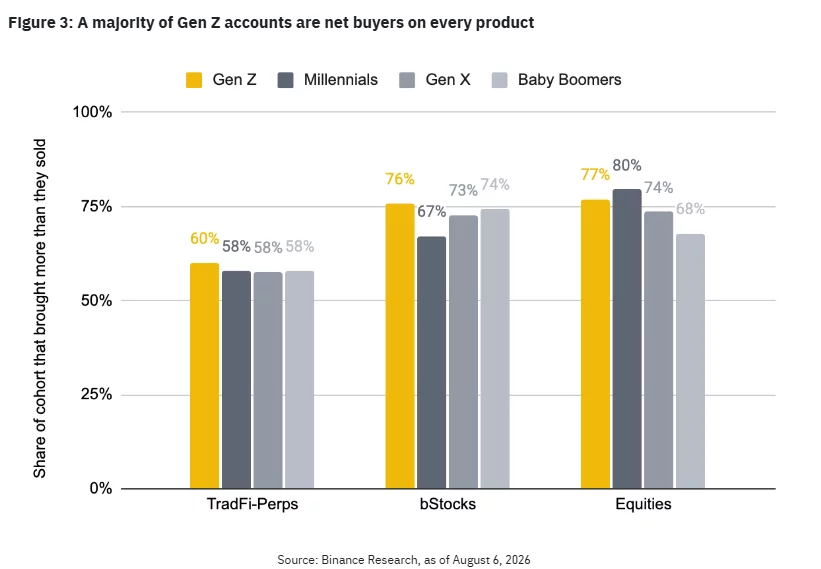
Gen Z traders on Binance have increased the ETF share of their equity trading volume to 25% in early August as their allocation to individual stocks has declined.
Summary
- ETFs accounted for 21.9% of Gen Z net equity inflows in July, up from 18.5% in June.
- Individual stocks received 74.2% of July inflows, compared with 77% one month earlier.
- Gen Z averaged fewer monthly trades than Millennials and Gen X across the products studied.
- Binance warned that its short direct-equities data window limits conclusions about lasting behavior.
Binance Research found that exchange-traded funds are taking a larger share of Gen Z equity activity across the exchange’s direct-equity, tokenized-stock, and traditional finance perpetual products.
The research compared trading frequency, net capital flows, and leverage use among Gen Z, Millennials, Gen X, and Baby Boomers. While the youngest group increased its ETF allocation, the figures also showed that Gen Z generally traded less often than other working-age generations.
During July, ETFs received 21.9% of Gen Z’s net equity inflows, rising from 18.5% in June. Over the same period, the share directed toward individual stocks fell from 77% to 74.2%.
By early August, ETFs represented 25% of the cohort’s equity trading volume, adding another data point to the increase recorded in July. Binance did not say whether the August share would hold for the entire month.
Gen Z ETF activity rises as trading remains limited
Across traditional finance perpetuals, Gen Z users completed an average of 13 trades per month. Millennials averaged 17, while Gen X recorded 16.5.
Similar patterns appeared across the other equity products included in the study, with Binance finding that Gen Z traded less frequently than the two older working-age groups. The research compared account activity rather than relying only on survey responses about investment preferences.
Sell-order data also indicated that part of the cohort was holding positions instead of actively trading in and out of them. Among Gen Z direct-equity accounts, 22% had never submitted a sell order.
The corresponding share stood at 19% for Gen X and 9% for Baby Boomers. Millennials recorded the largest buy-only group; however, 30% of their direct-equity accounts showed no sell orders.
Within the Gen Z buy-only group, Broadcom, Tesla, and the Schwab U.S. Dividend Equity ETF ranked among the leading assets by cumulative purchases. The mix included two U.S.-listed technology companies and an ETF designed to track dividend-paying American stocks.
Binance did not present the buy-only activity as proof of a long-term investment strategy. An account may have avoided selling because it entered the market recently, particularly given the limited operating history of the exchange’s direct-equity product.
Binance data shows limited demand for leveraged ETFs
Leveraged and inverse ETFs attracted little activity from Gen Z users, even though such products can amplify gains or provide exposure to falling markets.
Binance reported that 88.2% of Gen Z traditional finance perpetual accounts had not traded either type of ETF. The inactive share was lower among Millennials at 84.5% and Gen X at 85.9%.
Unlike standard ETFs, leveraged products generally seek to deliver a multiple of an index’s daily move, while inverse funds seek gains when the tracked market falls. Their returns can differ from the index over longer periods because the products reset each day, according to investor guidance from the U.S. Securities and Exchange Commission.
The Binance figures therefore show that the youngest traders in its sample were not using leveraged or inverse funds as frequently as other working-age cohorts. However, the report did not establish whether risk concerns, product awareness, eligibility rules, or other factors caused the difference.
For U.S. investors, the distinction between conventional ETFs and blockchain-based equity products remains important. A traditional ETF registered in the United States trades through regulated securities markets, while a tokenized stock or derivative may only provide economic exposure to the referenced asset.
As crypto.news previously reported, the SEC has warned that third-party stock tokens can carry different rights from conventional shares. Depending on the product’s legal structure, buyers may not receive direct ownership, voting privileges, or the protections available to registered shareholders.
Access also depends on location. Some international tokenized-equity platforms restrict U.S. persons even when their products track stocks or ETFs listed in American markets.
Tokenized stocks bring U.S. equities onto crypto platforms
Binance’s findings arrive as crypto exchanges add more ways for eligible users to trade instruments tied to U.S. stocks and ETFs.
The exchange launched bStocks in June with tokenized versions of Nvidia, Tesla, Circle, Micron, and SanDisk. Binance has said the products are backed on a one-to-one basis by underlying U.S. securities and can be converted into direct stock positions without conversion fees.
During the first nine trading days of Binance’s equities business, daily volume averaged about $143 million, according to research figures cited in an earlier report on the equities product debut. Turnover passed $1 billion, daily active traders peaked at 30,700, and total value locked approached $400 million during the period.
The short operating history also limits the Gen Z study. Binance cautioned that its direct-equities product only reached meaningful scale in June, leaving too little data to determine whether the allocation and trading patterns represent lasting generational behavior.
Elsewhere in the sector, Crypto.com introduced tokenized derivatives tied to 1,500 U.S. stocks and ETFs for eligible users in the European Economic Area and other approved markets. The tokenized derivatives offering includes instruments linked to Apple, Nvidia, Tesla, SPDR Gold Shares, and iShares Silver Trust.
Crypto.com’s products provide synthetic price exposure rather than legal or beneficial ownership of the underlying securities. Eligible users may receive dividend-equivalent adjustments, while the assets supporting the products are held with Alpaca, a U.S.-regulated self-clearing broker-dealer.
Binance bStocks competes with xStocks for second place
Growing interest in equity products has coincided with rapid changes among tokenized-stock issuers. Binance’s bStocks briefly overtook Kraken-backed xStocks this week, less than two months after its launch.
Token Terminal data placed bStocks at $624 million in tokenized stock value on Thursday, ahead of xStocks at $579 million. Ondo Finance remained the largest issuer in the ranking.
By Saturday, their positions had reversed, with xStocks holding $603 million and bStocks falling to $535.1 million. The platforms accounted for about 22.3% and 19.8%, respectively, of the roughly $2.7 billion market tracked by Token Terminal.
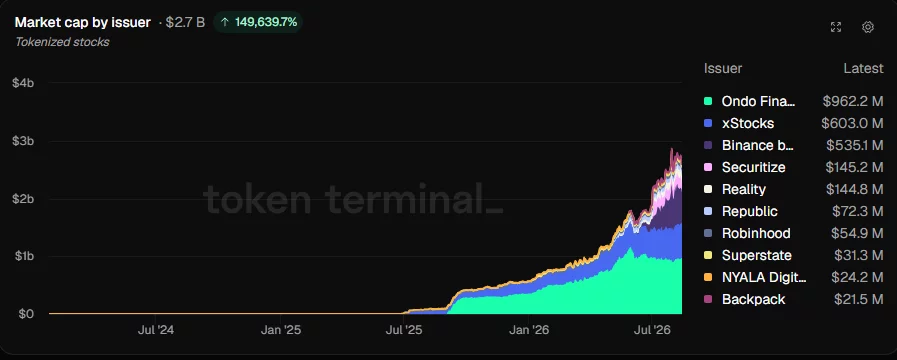
Ondo retained first place with $962.2 million. Earlier in August, bStocks had reached about $624 million, compared with roughly $579 million for xStocks and $927 million for Ondo.
Separate figures from RWA.xyz placed the distributed tokenized-stock value at $2.37 billion as of Saturday, an increase of about 5% over the preceding 30 days. Differences between that total and Token Terminal’s estimate can arise from the platforms, products, and valuation methods included by each data provider.
Tokenized equity adoption had already accelerated before Binance entered the issuer rankings. In July, data shared by DWF Labs showed that the number of holders across five major platforms had risen 92% in 30 days to 752,000, with Robinhood accounting for 328,000 holders and 44% of the measured total.
Robinhood held only $44 million in tokenized stocks in that comparison, while Ondo controlled $857 million and xStocks held $487 million. DWF Labs calculated an average Robinhood position of $134, compared with about $5,900 for Ondo and $1,900 for xStocks.
Bithumb has reported a 21.8 billion won, or about $15.7 million, net loss for the second quarter of 2026 as revenue fell 35.8% from a year earlier.
Summary
- Bithumb’s second-quarter revenue fell 35.8% to 86.3 billion won.
- The exchange swung from a 22 billion won profit to a 21.8 billion won loss.
- First-half revenue dropped 48.7%, while the net loss reached 108.7 billion won.
- Lower Korean crypto trading activity has reduced fee income across the domestic market.
According to Yonhap News Agency, Bithumb moved into the red during the three months through June after recording a 22 billion won net profit in the same quarter of 2025.
Bithumb’s quarterly loss has narrowed from Q1
Although the company’s latest result represented a year-on-year reversal, the second-quarter loss was smaller than the 86.9 billion won deficit reported during the first three months of 2026. The figures show Bithumb remained profitable at the operating level even as asset-related losses pulled its final result below zero.
Quarterly revenue reached 86.3 billion won, compared with about 134.4 billion won a year earlier. Operating profit fell 44% over the same period to 12.1 billion won, down from roughly 21.6 billion won.
Transaction commissions accounted for almost all of Bithumb’s operating revenue during the quarter. Local reports placed fee income at approximately 86.28 billion won, while revenue from other activities, including lending and market information services, amounted to only about 3.8 million won.
Heavy dependence on transaction fees leaves the exchange’s earnings closely tied to customer activity. When trading volume falls, fewer completed trades reduce the commissions collected by the platform, even if Bithumb retains a large share of South Korea’s crypto market.
At the same time, Bithumb attributed part of its net loss to changes in the value of its virtual asset holdings. Such valuation changes can cause net income to move differently from operating profit because the company must account for gains or losses on crypto assets held on its balance sheet.
First-half figures show a steeper revenue decline
Across the first six months of 2026, Bithumb recorded a net loss of 108.7 billion won, reversing a 55 billion won profit from the corresponding period last year.
First-half revenue fell 48.7% to 168.8 billion won, while operating profit declined 83.4% to 14.9 billion won. The company therefore remained profitable through its main exchange operations, but the amount earned from those activities dropped sharply as trading weakened.
The difference between the quarterly and half-year results also shows how heavily the first quarter weighed on the period. Subtracting the second-quarter figures from the six-month totals indicates that Bithumb generated about 82.5 billion won in first-quarter revenue and only 2.8 billion won in operating profit, alongside the previously disclosed 86.9 billion won net loss.
Lower trading across South Korea provides direct context for the revenue decline. A crypto.news report found that Upbit, Bithumb, Coinone, Korbit, and Gopax processed a combined $366.58 billion during the first half, down 54.6% from the same period in 2025.
During July 1–27, Bithumb handled approximately 4.71 trillion won in trades, according to NexBlock data cited in the report. Its share of trading among the five exchanges fell from 30.7% to 27.1%, while Upbit’s share increased from 62.3% to 67.4%.
The figures matter because Bithumb’s narrow revenue mix gives the exchange limited protection against a decline in spot-market activity. Fee income remains its main source of sales, leaving lower volume to pass quickly into quarterly revenue and operating earnings.
Weaker earnings arrive during Bithumb’s IPO work
Bithumb’s results have arrived while the company prepares for a public listing targeted for 2028. Its three-stage IPO roadmap calls for internal control improvements and preparation for Korean International Financial Reporting Standards during 2026.
Under the schedule disclosed in August, Bithumb expects to submit a preliminary listing application and complete the required audits in 2027. The company has also signed an advisory agreement with Samjong KPMG that runs through the end of that year, although it said the timetable could change with market conditions and the regulatory review.
Financial performance will form part of the information reviewed by prospective investors and listing authorities. Bithumb has said it plans to disclose its financial position, management matters, and crypto holdings more regularly as it prepares for the offering.
The company is also separating parts of its operations. Bithumb Asset has been spun off to define responsibilities between business units, while domestic and international securities firms, lawyers, and accounting firms are helping assess valuation and legal risks.
For U.S. investors, the main connection lies in Bithumb’s previous consideration of an overseas listing. Earlier reports linked the exchange with a possible Nasdaq offering, although its latest 2028 roadmap does not identify a final venue. Until Bithumb chooses a market and completes an offering, American investors do not have a U.S.-listed Bithumb stock through which to gain direct equity exposure.
Separately, South Korean brokerage Kiwoom Securities has held talks to acquire newly issued Bithumb shares. The proposed Kiwoom investment remained under negotiation in late June, with the two companies yet to agree on the investment size or ownership percentage.
Compliance costs remain part of Bithumb’s preparations
Alongside falling revenue, Bithumb has been addressing several regulatory and internal-control matters that could affect its listing work.
In June, South Korea’s Personal Information Protection Commission imposed a 210 million won penalty after finding that Bithumb transferred customer information overseas without meeting all consent and notice requirements. The regulator’s cross-border data ruling also required the exchange to revise its transfer procedures and explain them more clearly in its privacy policy.
An earlier anti-money laundering case produced a much larger 36.8 billion won fine and a six-month suspension covering new customer deposits and withdrawals to external wallets. In May, the Seoul Administrative Court paused the suspension while Bithumb’s legal challenge proceeds, allowing the exchange to continue operating without the restriction for the time being.
Regulators said the AML action involved about 6.65 million cases of inadequate user identity checks, as well as problems involving transaction monitoring and dealings with unregistered overseas virtual asset providers. Bithumb told local media that it would present its position during the remaining proceedings.
The exchange has said it will respond to changing market conditions by strengthening its internal operations and improving its services. Its disclosed IPO schedule requires the company to complete internal-control upgrades and K-IFRS conversion preparations during 2026 before audits, and a preliminary listing application is planned for 2027.


World Liberty Financial has received preliminary OCC approval to establish a national trust bank that would oversee more than $4 billion in USD1 stablecoin circulation.
Summary
- World Liberty Trust must meet the OCC’s conditions before it can begin operations.
- The proposed bank would issue USD1, manage its reserves, and serve institutional custody clients.
- WLTC must maintain at least $20 million in eligible capital before opening.
- WLFI rose after the decision but remains down more than 60% over the past year.
World Liberty Financial must meet OCC conditions
The Office of the Comptroller of the Currency said on Aug. 14 that it had granted preliminary conditional approval for World Liberty Trust Company, National Association, or WLTC, after reviewing the proposed bank’s application and commitments.
World Liberty Financial submitted the application through WLTC Holdings LLC in January. As crypto.news reported at the time, the proposed trust bank was designed to bring USD1 issuance, reserve management, and institutional custody under one federally supervised entity.
Preliminary approval allows World Liberty Financial to organize the bank but does not authorize it to open. According to the OCC’s 19-page approval decision, WLTC must complete its preopening requirements and receive final authorization before starting business.
Until then, the regulator can modify, suspend, or withdraw its approval if a new development raises concerns. WLTC must also notify the OCC about major changes to its business plan before making them.
The bank will need at least $20 million in eligible capital when it opens, while its organizers must submit an updated operating plan and receive OCC non-objection. Required appointments include a qualified internal audit manager, and the regulator must approve the bank’s proposed chief financial officer before the opening date.
WLTC would operate as a wholly owned subsidiary of Delaware-registered WLTC Holdings and maintain its main office in Bay Harbor Islands, Florida. The proposed institution must also apply for stock in a Federal Reserve Bank under federal law.
USD1 operations would move from BitGo to WLTC
Once fully authorized, World Liberty Trust plans to issue and redeem USD1 for institutional clients across the United States. The bank would also maintain the assets backing the dollar-pegged token and provide fiduciary custody services to USD1 users and other institutional customers.
BitGo Bank & Trust currently serves as the exclusive issuer and custodian for USD1. After opening, WLTC intends to acquire the stablecoin’s reserve assets and assume the liabilities connected to them, according to the OCC.
The regulator said the transfer may require additional approval under federal bank merger rules. Any acquisition of reserve assets from BitGo must therefore comply with the conditions set by the agency before the transaction can proceed.
Conversion services would form another part of WLTC’s planned operations. Institutional custody customers could submit approved stablecoins and receive USD1 in return, although the service would be limited to assets held in custody by the bank.
World Liberty Financial said USD1 has surpassed $4 billion in circulation. The company lists U.S. dollars held at financial institutions, U.S. government money market funds, and cash equivalents among the assets supporting the stablecoin.
USD1 is available on centralized platforms including Binance, Coinbase, Kraken, Crypto.com, OKX, and Bybit, as well as decentralized exchanges such as Uniswap and PancakeSwap. Reuters ranked it as the fourth-largest stablecoin by market capitalization following its rapid growth since its March 2025 launch.
World Liberty Trust President and Chairman Zach Witkoff said federal supervision would place the token’s main operations under one regulator.
“A national trust bank brings USD1 issuance, custody, and reserve management together under OCC supervision, examined on the same standards that have governed banks for generations.”
He added that the company welcomed “continuous scrutiny from federal regulators.”
Federal trust bank approval does not cover lending
Despite the bank designation, WLTC would not operate like a traditional commercial lender. National trust banks generally provide custody, fiduciary, settlement, and asset-servicing functions but cannot accept ordinary customer deposits or issue conventional loans.
A federal charter would let WLTC provide approved services nationwide under one primary regulator instead of applying for separate state licenses. The structure also places its operations under regular OCC examinations, along with federal anti-money laundering and sanctions requirements.
The company said customer assets would remain segregated and reserve management would operate independently. WLTC has selected Mack McCain as chief trust officer and Daniel Dietzel, a former chief financial officer at institutional prime broker Hidden Road, as its CFO.
A five-member board would oversee the proposed bank. Alongside Zach Witkoff, the board would include Scott Alper, Robert Witkoff, and independent directors Jeffrey Weiner and Erin Baskett. According to the company, Weiner previously led accounting firm Marcum, while Baskett serves on the Financial Industry Regulatory Authority’s Board of Governors.
World Liberty joins several digital asset companies that have entered the OCC charter process since December 2025. Ripple, Paxos, BitGo, and Fidelity Digital Assets have received conditional approvals, while Coinbase, Crypto.com, and Stripe-owned Bridge have also pursued national trust bank structures.
Circle moved one step further in July when it received final approval to establish its national trust bank. Circle first obtained conditional approval in December 2025 and then completed the OCC’s preopening requirements before receiving authorization.
The OCC reported that uninsured national trust banks under its supervision held $7.2 trillion in assets under administration as of March 31. Custody and safekeeping accounts represented $1.7 trillion, while fiduciary accounts accounted for the remaining $5.5 trillion.
Trump ties keep the charter under scrutiny
World Liberty Financial’s connection to U.S. President Donald Trump and his family has made the application a subject of congressional attention. Trump and members of the Witkoff family helped launch the company in 2024, while Trump later adopted the title of co-founder emeritus.
Sen. Elizabeth Warren asked OCC Comptroller Jonathan Gould in January to pause the charter review until Trump divested his financial interest in the company. Warren said approval could leave a presidential appointee regulating a business financially connected to the president.
Questions increased after reports that an Abu Dhabi-linked entity purchased a 49% interest in World Liberty Financial for $500 million shortly before Trump returned to office. In June, Senate Democrats questioned the potential national security implications of the transaction and its effect on the charter review.
The OCC said it received public comments concerning non-U.S. investors in World Liberty Financial. According to its decision, the foreign investors were not considered principal shareholders of the proposed bank, and several investors signed agreements promising not to control or influence its operations.
Eric Trump signed one of the agreements as president of a Trump family-linked investment vehicle. The regulator said Gould and agency staff followed their legal and ethical duties, while career employees handled the application review and nonpolitical examiners would supervise the bank.
Following the announcement, WLFI initially rose more than 2% to about $0.0597 before giving back part of the advance. TradingView data later placed the token near $0.0558, up about 8% over seven days but more than 65% below its level one year earlier.
Netflix Is Officially Removing Denzel Washington’s Forgotten Supernatural Crime Thriller

Anne Hathaway’s Pregnancy And The Rise Of The ‘Bumpvestigation’

G Money – SUFRIR (VIDEO OFICIAL)


-

 Fashion17 hours ago
Weekend Open Thread: Ann Taylor
-

 Business6 days ago
Datadog: Best Of Breed For Multiple Reasons
-

 Business6 days ago
How to Start a Cleaning Business: A Step-by-Step Guide
-

 Business6 days ago
BDC Weekly Review: Private BDC Q2 Numbers Are Strong
-
 NewsBeat3 days ago
Communication cards help banking customers access services or report scams
-
 Business4 days ago
Oil Price Today (August 11): Crude oil rises to $88 after Trump’s compensation demand dents Hormuz opening. Here’s why
-

 Fashion6 days ago
Amazon Sundays: Closet Care Before Fall
-
 Crypto World4 days ago
Why Did Nvidia Stock Fall on Monday Despite a $500 Billion Wall Street AI Deal?
-

 Politics7 days ago
Be quiet, Miriam! – spiked
-
 Entertainment6 days ago
Will Ferrell’s New Netflix Series Just Became One of the Streamer’s Biggest Hits of 2026
-

 Business6 days ago
5 Things You Must Know About Jorge Messi, the Father and Longtime Agent Who Shaped Lionel Messi’s Career
-

 Politics6 days ago
Ben-Gvir’s crocodile project halted but abuses at Ketziot Prison continue
-

 Business7 days ago
Mutual Fund Manager Scoops Up Beaten-Down Stocks
-

 Crypto World4 days ago
Revolut wins French banking licence, creates second EU banking hub
-

 Crypto World7 days ago
A Deep Dive Into One Of The Most Significant Hacks In Recent Memory
-

 Crypto World7 days ago
Bitcoin ETFs draw $853.5M in five-day inflow streak
-

 Politics6 days ago
The Church of England’s ruinous reparations racket
-

 Politics6 days ago
Saudi Arabia used 86% of missile stockpile defending Iran attacks
-

 Politics7 days ago
Calls to permanently pedestrianise central Belfast following festival success
-

 Politics6 days ago
The House Article | Burnham still needs to sell devolution to the public
You must be logged in to post a comment Login