

Crypto World
Galaxy Receives BitLicense From New York State Department of Financial Services



Galaxy has obtained a BitLicense from the New York State Department of Financial Services, regulatory approval to operate a cryptocurrency business in the state.


Andreessen Horowitz crypto executive Miles Jennings criticized Illinois’ newly enacted Digital Asset Privilege Tax Act on June 17, calling it “one of the most anti-crypto laws in the US.”
The law imposes a 0.2% tax on the exchange, transfer, and custody of digital assets, with no meaningful exemptions for routine self-custody moves.
Backlash From the Crypto Industry
According to Jennings, no other US state has a transaction-based tax on crypto like the one in Illinois, and there are no comparable levies on stocks, bonds, or derivatives anywhere else in the country.
‘That means crypto is being singled out in violation of several federal laws,” he wrote.
His comments were in line with those made in a June 16 letter from the Crypto Council for Innovation (CCI) to Illinois Governor J.B Pritzker, requesting that he veto the legislation. CCI had argued that the law places unique and disproportionate burdens on citizens simply by holding digital assets, thus potentially forcing users and entrepreneurs out of the state.
The group was of the view that the measure will tax blockchain-based activity based on the technology used rather than the nature of the transaction itself. It also raised concerns about the manner in which the law had been passed, noting that affected stakeholders had not been given the chance to weigh in.
On his part, Jennings accused Pritzker of poor timing, considering that Illinois had just adopted the Digital Asset and Consumer Protection Act, something he described as a “constructive approach to blockchain technology.”
“So, rather than embracing innovation and the cost efficiencies blockchain can deliver for ordinary people in Illinois, the state is poised to punish its entrepreneurs and citizens that want to use crypto,” he argued.
Tax Treatment Is a Growing Policy Battleground
The Illinois law comes at a time when the US Congress is working toward a national framework for crypto taxation, and CCI’s letter had argued that Pritzker should have held off on his approach until federal standards were in place. It warned that the Prairie State’s decision could lead to a “patchwork” of crypto tax laws across the other 49 jurisdictions, which would only muddy the waters even more.
That concern has some context. Earlier in the month, Coinbase vice president of tax Lawrence Zlatkin testified before the House Ways and Means Committee, pushing for simpler federal crypto tax rules, including treating federally regulated stablecoins as equivalent to cash and creating de minimis exemptions for small transactions.
The hearing covered six standalone bills aimed at updating how the US tax code treats digital assets, with Jennings’ post on X giving a direct read on what’s at stake:
“When states adopt discriminatory, asset-specific taxes that drive builders and users elsewhere, we all lose.”
The post Illinois Passed the Most Anti-Crypto Law in the US: Miles Jennings appeared first on CryptoPotato.


Strategy has returned to the spotlight after QCP estimated its current liquidity runway for dividend payments at about seven and a half months.
Summary
- QCP warned that Strategy may eventually sell more Bitcoin if dividend obligations outpace available funding sources.
- CEO Phong Le said the recent 32 BTC sale was a process test, not a dividend-driven liquidity move.
- Peter Schiff argued Strategy’s current Bitcoin buying model could dilute shareholders as dividend pressures grow.
According to market maker QCP, Strategy’s current liquidity position could support dividend payments for roughly seven and a half months, raising the possibility that the company may need to sell additional Bitcoin if alternative funding sources become less attractive.
The warning comes shortly after Strategy completed several balance-sheet transactions. QCP noted that the company repurchased nearly $1.5 billion of convertible notes due in 2029 while also raising about $200 million through sales of MSTR stock. Part of those proceeds funded another $100 million Bitcoin purchase, continuing the company’s long-running accumulation strategy.
Dividend obligations have become a focus
Attention has increasingly turned to how Strategy plans to manage future payout commitments tied to its capital structure.
In its market note, QCP argued that potential Bitcoin sales could emerge as one option if the company seeks to maintain dividends while continuing to operate its treasury strategy.
Those concerns surfaced after Strategy disclosed a sale of 32 BTC earlier this month, the first known reduction of its Bitcoin holdings. The transaction drew criticism from some crypto investors because Executive Chairman Michael Saylor has long promoted a buy-and-hold approach to Bitcoin ownership.
Addressing the sale in a June 13 interview, Strategy CEO Phong Le said the transaction was not driven by a need to raise cash for dividends. Le explained that the company conducted the sale to test internal procedures, generate tax losses that may offset future tax liabilities, and reduce potential market shock around future sales if they ever become necessary.
Le also rejected suggestions that Strategy lacks other financing options. According to the CEO, the company can still access equity issuance and preferred-stock financing to support its capital structure.
At the same time, Le acknowledged that management would evaluate both Bitcoin sales and share issuance based on financial outcomes rather than ideology. He said Strategy would choose whichever approach improves Bitcoin exposure per share for common shareholders.
Critics question the economics of new purchases
Separate criticism has come from Euro Pacific Capital chief Peter Schiff, who recently argued that Strategy’s model has become less effective than it was when MSTR stock traded at a substantial premium to the value of its Bitcoin holdings.
Schiff contended that earlier stock offerings increased Bitcoin exposure on a per-share basis because investors were willing to pay well above net asset value. In recent comments, he argued that issuing shares at lower valuations to purchase additional Bitcoin can dilute shareholders even as the company expands its overall Bitcoin reserve.
His remarks followed Strategy’s purchase of 1,550 BTC for approximately $101 million in early June. Schiff claimed the transaction reduced Bitcoin exposure per share and described the outcome as a “negative Bitcoin yield.”
Despite those concerns, Strategy has continued adding to its holdings. On June 15, Saylor disclosed another purchase of 1,587 BTC for roughly $100 million, bringing the company’s total Bitcoin holdings to 846,842 BTC.
The company also increased its dollar reserves to about $1.1 billion, providing additional liquidity while keeping its Bitcoin acquisition program in place.
Another point of debate involves Strategy’s STRC preferred shares. Schiff has argued that if those securities trade below their intended level, the company could face pressure to increase dividend payments, issue additional shares, or draw on cash reserves to meet obligations.
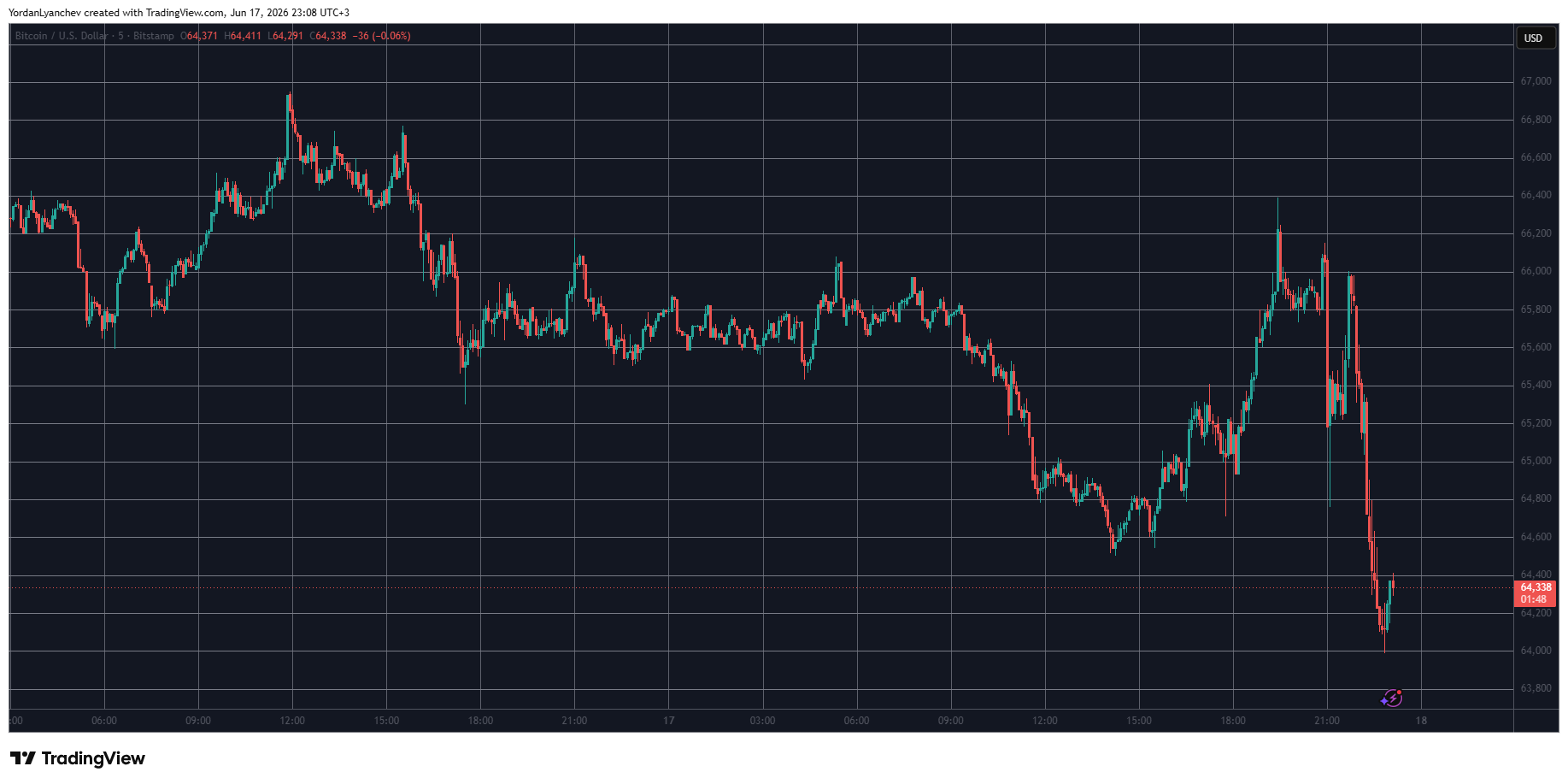
Bitcoin’s price is losing ground once again, as the asset was rejected at over $66,000 earlier today and dumped to $64,000 minutes ago, shortly after the conclusion of the latest FOMC meeting and the subsequent press conference by the new Fed Chair, Kevin Warsh.
Unlike what many expected when he replaced Jerome Powell, Warsh maintained a very hawkish tone during his speech, which caught investors by surprise.
Not The Easy-Money Chairman
DoubleLine Capital CEO Jeffrey Gundlach noted in an interview with CNBC that the new Fed Chair will aim for price stability instead of being the ‘easy money Chairman’ people thought.
“He is absolutely telling you that he plans on delivering on price stability. So that means we’re not going to have such easy money policy as everybody thought maybe Chairman Warsh would do back in the first quarter of this year when everyone was counting on rate cuts. He doesn’t sound like that today at all.”
Warsh’s hawkish speech came shortly after the US Federal Reserve maintained the interest rates unchanged for the fourth consecutive meeting.
BTC Slides Further
Bitcoin’s price already dipped after the initial Fed decision, but its situation only worsened following the press conference. The asset had dropped from an intraday high of $66,400 to $65,000, but rebounded to $65,500 before it slumped again to $64,000 minutes ago.
Most altcoins have followed suit. Ethereum is down by 3% daily to under $1,740, BNB has lost the $600 support, while XRP has fallen further below the $1.20 line. Expectedly, these intense price moves in the span of just a couple of hours have impacted the liquidations.
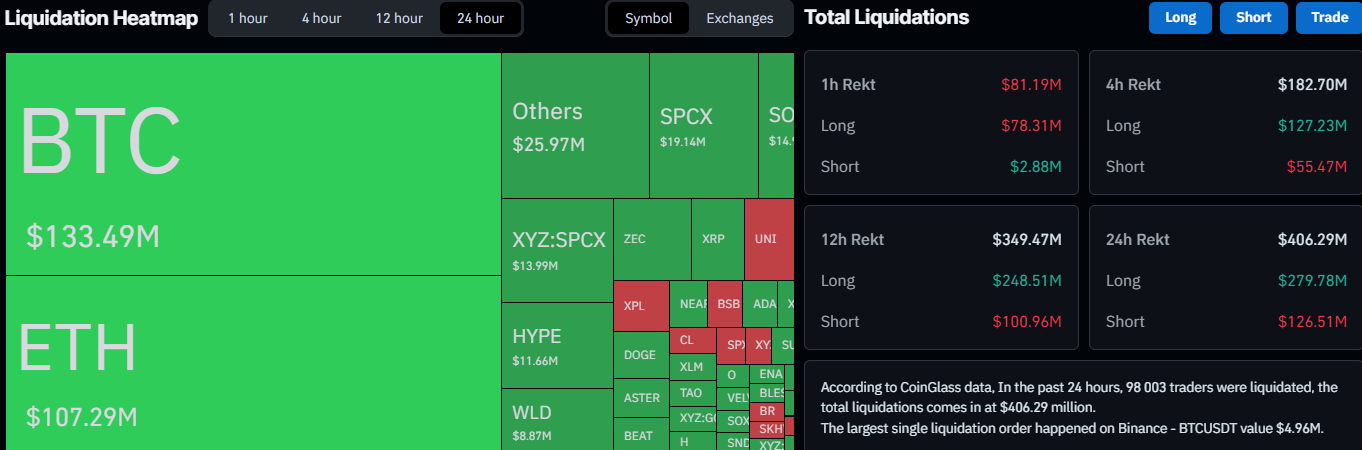
Data from CoinGlass shows that the total value of wrecked positions in the past 24 hours is up to over $400 million, with almost half of those coming in the past 4 hours. Longs are responsible for the lion’s share, with $280 million daily. Moreover, $79 million out of the $82 million in liquidated positions in the past hour alone are from longs.
Nearly 100,000 traders have been wiped out daily, with the largest liquidated position occurring on Binance. It was worth $5 million.
The post $400M Wiped Out in Hours as Bitcoin Crashes After FOMC and Warsh Speech appeared first on CryptoPotato.
Crypto World
FIFA wanted Avalanche’s blockchain to help curb World Cup ticket scalping. Here’s how it’s going


Beyond new revenue opportunities, the model gives FIFA more visibility into who ultimately attends its events. In the traditional ticketing ecosystem, much of that information is controlled by secondary marketplaces.
“The actual administrator of those tickets, FIFA, has no idea who the people are buying,” Carbonaro said. “That data sits with SeatGeek, StubHub, Ticketmaster, Vivid Seats.” He argued that FIFA Collect’s RTB and RTT system gives FIFA greater insight into how ticket rights change hands within its own ecosystem, rather than relying on third-party platforms that typically control the customer relationship.
With RTBs and RTTs, FIFA can better track how fans move through the ticketing process while keeping personal information offchain and using blockchain records as a verification mechanism.
That data component may ultimately prove as valuable as the ticketing functionality itself. Sports organizations increasingly view direct fan relationships as strategic assets, particularly as AI tools make first-party data more valuable.
Whether FIFA’s ticketing model becomes a template for future tournaments remains to be seen. Critics could argue that introducing tradable purchase rights simply creates another layer between fans and tickets.
Either way, the World Cup offers a glimpse of where blockchain adoption may be heading next. Instead of asking consumers to embrace crypto, projects like FIFA Collect are attempting to hide it altogether. And for Avalanche, that may be the most important test of all.

A fresh strategic investment in Flutterwave’s Series E round positions RLUSD as the stablecoin spine of continental payments infrastructure. It’s bullish for XRP price prediction, but markets are still digesting the implications.
Meanwhile, the macro backdrop is forcing traders to hold their breath: the Fed holds rates today, but Chair Kevin Warsh’s press conference on forward guidance, with inflation sitting at a three-year high, carries more weight than the decision itself.
Ripple’s Reece Merrick was direct about the intent: “Our investment will establish RLUSD within that infrastructure, with Flutterwave driving stablecoin flows over the XRPL and deepening its role as a settlement layer for real-world payments across the continent.”
Flutterwave is not a minor player. They are one of Africa’s dominant blockchain-based enterprise infrastructure providers. Plugging RLUSD into that pipeline targets a corridor where Sub-Saharan on-chain flows topped $205 billion over the past 12 months.
RLUSD itself carries weight: a $1.6 billion market cap, ranked 10th among stablecoins globally. But XRP price has yet to reflect any of it.
RIPPLE TO ENTER AFRICA WITH $3.3 BILLION DEAL
Ripple has acquired an equity stake in Flutterwave, valuing the African fintech at $3.3 BILLION.
The move deepens Ripple’s push into Africa’s cross-border payments market. pic.twitter.com/1DnSFEWPYC— Coin Bureau (@coinbureau) June 16, 2026
Discover: The Best Crypto to Diversify Your Portfolio
XRP Price Prediction: Break Up or Down
XRP is holding a recent range of $1.20–$1.25, with a spot price near $1.20 and a market cap close to $75 billion. The weekly print of 8% looks constructive on the surface, but the technical setup underneath is less comfortable than it appears.
Chart watchers flagging a developing head-and-shoulders pattern have identified $1.18 as the line in the sand; lose that zone and the pattern confirms, opening a path toward $1.1 and potentially under a dollar.
On the upside, resistance clusters in the $1.28-$1.30 band. A clean break there could ignite a run toward the $1.80 swing level that longer-term technical frameworks are watching. 21Shares assigns a 30% probability to XRP reaching $2.69 by 2026, with a base case near $2.45 contingent on ETF inflows and utility traction, both of which the Flutterwave deal nudges forward.

One data point worth anchoring: Binance’s estimated XRP leverage ratio is down roughly 78% from mid-2025 highs. This means violent liquidation cascades are materially less likely than they were. The setup is cleaner.
Discover: The Best Token Presales
Bitcoin Hyper Targets Early Mover Upside While XRP Tests Key Levels
XRP’s Africa stablecoin thesis is compelling, but at an $75 billion market cap, the asymmetry is limited even in a bull scenario. Traders rotating into infrastructure narratives at earlier stages are looking at a different risk-reward profile entirely. That’s the opening Bitcoin Hyper is trying to fill.
Bitcoin Hyper ($HYPER) is positioning as the first Bitcoin Layer 2 with Solana Virtual Machine (SVM) integration, targeting the three structural weaknesses that have capped Bitcoin’s DeFi utility for years: slow transactions, high fees, and no native programmability.
The architecture delivers sub-second finality and low-cost smart contract execution while inheriting Bitcoin’s security layer. The presale has raised $32.8 million at a current price of $0.0136, with staking active for early participants.
The Decentralized Canonical Bridge handles BTC transfers without the risk of centralized custody. This is a meaningful design distinction in a space where bridge exploits remain a recurring liability.
Research Bitcoin Hyper before the presale stage concludes.
The post XRP Price Prediction: Africa Stablecoin Drive Fuels Hopes of a Breakout appeared first on Cryptonews.

Blockchain.com is widening its tokenized real-world assets lineup through a partnership with Ondo Finance, adding 173 tokenized stocks and exchange-traded funds (ETFs) to its marketplace. The expansion takes Blockchain.com’s catalog of tokenized traditional assets to more than 430 offerings spanning Ethereum, Solana and BNB Chain.
In a Wednesday announcement, Blockchain.com said the newly listed products include tokenized exposure to private-company shares, actively managed ETFs, US Treasury-related offerings, and covered-call income strategies—highlighting SpaceX’s SPCX token among the additions. It also added themed baskets linked to areas such as AI infrastructure, energy, robotics, autonomous vehicles and quantum computing, alongside income-focused products from Global X and other issuers.
Key takeaways
- Blockchain.com expanded its tokenized stocks and ETF catalog by 173 items via Ondo Finance, bringing total offerings to 430+ across Ethereum, Solana and BNB Chain.
- The new list ranges from private-company shares and active ETFs to Treasuries and covered-call strategies, with SpaceX’s SPCX token called out by name.
- Blockchain.com says the assets are available immediately, using Ondo’s routing and liquidity infrastructure to support trading across all 173 listings at launch.
- Tokenized equities have accelerated this year: RWA.xyz data cited by the company shows distributed value is up to about $1.57 billion, roughly fivefold from around $330 million a year ago.
- Regulatory momentum for DeFi-style access to US equities has become a focal point after a US SEC proposal was described by Galaxy’s Alex Thorn as a potential “unlock” for tokenized stock trading.
Blockchain.com’s Ondo partnership grows across major chains
Blockchain.com’s latest move reinforces its strategy of bringing institutional-style market access into crypto rails. The firm positioned the onboarding as an “immediate” availability update, stating that Ondo’s routing and liquidity infrastructure supports trading across all 173 new tokenized assets from the time of launch.
Ondo is described by market-data provider RWA.xyz as one of the larger tokenization platforms by asset value. According to RWA.xyz figures cited in the announcement, Ondo has roughly $3.8 billion in distributed assets across 267 tokenized products. While those figures are platform-level totals rather than limited to equities, they underscore the scale of the infrastructure now being leveraged for broad catalog expansion.
What’s new in the 173-token slate
While tokenized equities have largely focused on making public-company shares transferable on-chain, Blockchain.com’s additions widen the scope of what investors can hold in token form. Among the specific categories it highlighted are:
- Private company shares, offering on-chain exposure beyond traditional publicly listed equities.
- Active ETF exposure, indicating continued demand for tokenized access to strategies managed by ETF issuers.
- US Treasury products, bringing fixed-income exposure into the same trading ecosystem.
- Covered-call strategies, which aim to generate income by holding an underlying asset while selling call options.
- Themed baskets tied to sectors such as AI infrastructure, energy, robotics, autonomous vehicles and quantum computing.
Blockchain.com singled out SpaceX’s SPCX token as one of the additions. That comes as tokenized SpaceX-related products have already drawn significant retail and institutional attention, even as the sector has encountered execution problems in some launches.
Tokenized equities keep climbing—though competition is intensifying
RWA.xyz data cited alongside Blockchain.com’s announcement suggests the tokenized equities segment has been gaining traction. The report referenced by the article places tokenized equities at approximately $1.57 billion in distributed value, up nearly fivefold from about $330 million a year ago.
The same data set referenced the variety of assets now circulating on-chain, including tokenized shares of public companies, ETFs, and private-firm equity. It also mentioned several large holdings by value, naming Strategy, Circle, Nvidia and Exodus shares as examples.
That growth has also attracted more rivals. Earlier this month, Exodus launched a marketplace for more than 200 tokenized stocks, ETFs and other real-world assets, also through a partnership with Ondo Finance—illustrating how Ondo-linked distribution is becoming a common foundation for new onchain “tradfi-like” trading experiences.
Beyond dedicated tokenized stock platforms, mainstream crypto venues have also pursued high-profile tokenized equity themes. Binance, for instance, said its tokenized IPO offering tied to SpaceX drew more than $557 million in USDC deposits from users seeking exposure to the listing.
SpaceX hype meets real-world frictions—and regulatory change could matter
Alongside growing interest, the SpaceX IPO storyline revealed operational and allocation challenges that have periodically constrained tokenized offerings. According to the earlier coverage referenced in the article, several exchanges—including Binance, Bybit, Bitget Wallet and MEXC—were reported to have canceled tokenized SpaceX offerings and refunded users after failing to secure share allocations. Those products, the article notes, relied on Kraken-owned xStocks for distribution and settlement infrastructure.
The reporting also pointed to the IPO’s reported oversubscription, citing Reuters coverage that demand for a $75 billion offering had reportedly reached more than four times that level and attracted more than $250 billion in investor demand. For tokenization firms and their partners, these dynamics highlight a recurring tension: onchain distribution can be fast, but underlying access to shares can remain constrained by traditional market mechanics.
At the same time, regulatory discussions may shape how these products evolve. The article references a US Securities and Exchange Commission proposal described by Galaxy head of research Alex Thorn as “one of the biggest unlocks yet for tokenized stocks.” Thorn’s comments were tied to the SEC’s proposal to rescind two National Market System rules, which he argued would remove “one of the biggest structural barriers to tokenized US equities trading in DeFi.” The linked SEC proposal appears to frame the issue as a rule change within market structure regulation, though the ultimate impact for onchain trading will depend on how the SEC proceeds and what replacement frameworks—if any—follow.
For investors using onchain equities platforms, the immediate practical takeaway is straightforward: more tokenized stock and ETF listings are now arriving through established infrastructure, but the sector’s next test will be whether liquidity, settlement reliability and regulatory clarity can keep pace with demand. Watch for how exchanges and wallet providers handle upcoming high-profile offerings—especially those that require constrained allocations—and for any follow-through from the SEC proposals that could expand the ways tokenized equities can be integrated into DeFi trading.
The GENIUS Act, signed into law last year, established the first federal framework for payment stablecoins in the United States. Among other requirements, issuers must hold reserves in cash, short-term Treasury securities and certain government money market funds.
The legislation has created an opportunity for traditional asset managers to offer regulated vehicles that stablecoin issuers can use to manage those reserves while generating yield.
Fidelity’s fund will invest in U.S. Treasury bills, notes and bonds with maturities of 93 days or less, cash, overnight repurchase agreements backed by Treasuries and other government money market funds that comply with the law.
“Fidelity has a longstanding history in fixed income and money markets, making us uniquely positioned to offer a money market fund for stablecoin issuers that is compliant with the new GENIUS-Act legislation,” said Robin Foley, Fidelity’s head of fixed income, in a statement.
While Fidelity’s announcement focused on reserve management, State Street framed its launch as part of a broader push into tokenized finance through partnerships with crypto firms such as Anchorage Digital and products designed for onchain liquidity management.


President Donald Trump said the United States will hand back Iran’s frozen money rather than seize it, warning that keeping the funds would destroy global confidence in the U.S. dollar.
His comments at the G7 summit touched a nerve central to crypto, where the threat of asset seizure is a core argument for holding neutral, borderless reserves like Bitcoin.
Returning the Frozen Money
Trump made the remarks at a G7 conference in France, responding to a question about whether Washington would unfreeze Iranian assets.
He drew a sharp line between paying Iran and releasing money the U.S. had frozen.
“It is not our money. It is their money. And we froze it at a certain point in time.”
Trump said he had personally weighed keeping the funds before deciding against it. A recent report indicated that the US had reached $1 billion in cumulative seizure of Iranian crypto assets as of late May.
Follow us on X to get the latest news as it happens
A Warning About Dollar Confidence
Trump argued that holding seized money would damage the dollar’s standing and its dominance as the world’s reserve asset.
“If we did not get back, no one would ever invest in the dollar again.”
He linked the decision to the currency’s strength under his administration.
“The dollar has become very strong under me.”
Trump also stressed the U.S. is not financing Iran directly, contrasting the deal with past cash transfers.
“We are not putting up money. Only if they are doing things right.”
Why Crypto is Watching
The seizure question sits at the center of Bitcoin’s appeal. Each time Washington weaponizes the dollar, it strengthens the case for a neutral store of value beyond any government’s reach.
That logic drives the debasement trade, where investors treat Bitcoin as a hedge against fiat risk and money printing.
Trump himself has floated a strategic reserve to strengthen the country’s position.
The post Trump to Return Iran’s Frozen Money to Protect the Dollar appeared first on BeInCrypto.


The distinction matters. Wrapped bitcoin products such as WBTC, Coinbase’s cbBTC and Circle’s recently announced synthetic bitcoin product already allow BTC to circulate in DeFi. But Tse said many bitcoin holders dislike giving up custody in exchange for synthetic tokens.
“Most users, many users, do not like it,” he said. “They don’t want to give up title, they don’t want to give up custody.”
Bitcoin layer-2s
Orkun Mahir Kılıç, co-founder and CEO of Chainway Labs, developer of Citrea, offered a blunter critique of the sector’s earlier ambitions.
“Trying to do the same things as Solana the day you launch doesn’t make any sense,” he said.
Bitcoin layer-2s should stop pitching themselves as general-purpose blockchains, he added. The market already has mature ecosystems for trading, lending, consumer applications and perpetual futures.
Instead, Kılıç said, Bitcoin layer-2s should focus on products “uniquely enabled by Bitcoin security and settlement.”
There are still things that wait to be solved on the Bitcoin layer-2 markets,” he said. “But definitely general-purpose ecosystem focus, like trying to compete with Ethereum applications on your day one, is a little bit hard to achieve.”
Diego Gutierrez Zaldivar, CEO and co-founder of Rootstock Labs, said Botanix’s closure reflects another lesson: building a blockchain ecosystem is much harder than solving the technical problem.
Crypto World
Here is how Coinbase plan to survive the crypto winter by ditching its reliance on trading fees


Coinbase’s (COIN) latest product launch event may not have changed Wall Street’s near-term earnings forecasts, but it reinforced a growing belief among analysts that the crypto exchange is steadily transforming itself into a broader financial platform with revenue streams that extend beyond bitcoin’s price cycles.
At Tuesday’s System Update event in New York, Coinbase unveiled products spanning derivatives, tokenized stocks, stablecoin payments, lending and artificial intelligence. While the announcements covered a wide range of businesses, analysts focused less on the individual products and more on what they reveal about the company’s long-term strategy.
For years, Coinbase’s fortunes have been closely tied to crypto trading activity. When bitcoin rallies and retail investors return to the market, trading revenue tends to surge. During slower periods, that revenue can fall sharply. Analysts increasingly view Coinbase’s product expansion as an effort to reduce that dependence.
“The new features are aligned with the company’s effort to become the ‘everything’ exchange,” Barclays analyst Benjamin Budish wrote following the event, adding that the company is seeking to capture a larger share of customers’ financial activity as crypto trading volumes remain relatively subdued.
Cantor Fitzgerald analyst Ramsey El-Assal struck a similar tone. While acknowledging softer conditions across crypto markets, he said Coinbase’s “innovation engine hasn’t skipped a beat” and argued that the company is positioning itself to benefit from a future where consumers manage investing, spending and borrowing through a single app or wallet.
‘The prize’
What stood out to analysts among Coinbase’s myriad new product launches was derivatives.

Massive breach spills credentials for thousands of sensitive networks

BBC responds as presenter Ashley Cain accused of branding women ‘s***s’ and ‘psychos’

Gold Prices Rise 0.58% to $4,379.50 as Safe-Haven Demand Persists Amid Economic Uncertainty


-

 Business3 days ago
No Jackpot Winner as $257 Million Prize Rolls Over to $269 Million Monday Draw
-

 Fashion5 days ago
Weekend Open Thread: Tuckernuck – Corporette.com
-

 Crypto World6 days ago
Oppenheimer backs SpaceX as $70 billion retail frenzy builds
-

 Crypto World6 days ago
Markets Rally as SpaceX IPO Looms Amid Iran Tensions and Inflation Surge
-
 Crypto World3 days ago
Zimbabwe Requires Crypto Businesses to Register Annually Under New FIU Regulations
-

 Tech5 days ago
NanoClaw integrates JFrog registries to secure AI agent downloads
-

 Crypto World5 days ago
Bitget enters Argentina’s regulated crypto market through PSAV registration
-

 Tech5 days ago
This Week In Security: Microsoft On Microsoft, Register Your Domains, Linux On ARM, And FreeBSD Joins The File Cache Club
-
 Tech6 days ago
Dutton Ranch star claims they ‘didn’t see any disruption’ on set following Chad Feehan’s exit from Yellowstone spinoff fueled by Taylor Sheridan clash rumors
-

 NewsBeat6 days ago
El Nino has formed in the Pacific and could set records, forecasters say
-

 Politics6 days ago
Politics Home | Healey Resignation Is “Colossal Failure Of Government”, Says Former Labour Defence Secretary
-
 Entertainment6 days ago
Donnie Wahlberg & More Heat Up Las Vegas at Circa’s Barry’s Downtown Prime
-
 Tech6 days ago
Opendoor Ends India Operations, Fueling a Bigger Conversation About AI and Outsourcing
-

 Politics6 days ago
Belfast burns, while Met chief points finger at Iran and Russia
-

 Sports6 days ago
First Time Since 1971: Australia Register Historic Low In ODI Cricket
-

 Business6 days ago
AT&T: Verizon's 27% Outperformance Sets Up A Solid Entry Point
-

 NewsBeat5 days ago
FBI searches office of Ohio voter registration group
-
 Tech6 days ago
Anthropic is spending $150M to embed 1,000 AI fellows inside nonprofits. No degree required.
-

 Politics6 days ago
Modi thanks Trump for wishes as US attacks Indian seafarers
-
 Entertainment6 days ago
‘The Pitt’s Fan-Favorite Doctor Confirms Noah Wyle Gave His Blessing to Return [Exclusive]
You must be logged in to post a comment Login