

Crypto World
Gate brings F1 Red Bull spectacle to Hong Kong waterfront for 13th anniversary



Gate is rolling an F1 Red Bull parade and “Racing the Future” exhibition through Hong Kong as part of its 13th‑anniversary push to fuse crypto branding with motorsport.
Summary
- Gate is staging an F1 Red Bull Racing parade around Victoria Harbour as part of a Hong Kong activation with the team.
- From April 18–24, the partners will host a “Racing the Future” exhibition at K11 MUSEA, showcasing the new 2026 Red Bull car, gear and interactive zones.
- A Blue Carpet ceremony and “Gate 13” anniversary gala at the Rosewood Hong Kong on April 20 will gather more than 300 industry guests and partners.
Gate is leaning on Formula 1 star power to anchor its 13th‑anniversary celebrations, rolling a branded Red Bull Racing parade car through Hong Kong’s Victoria Harbour district and wrapping it in a week‑long exhibition and gala. The company, an official sponsor and exclusive crypto‑exchange partner of Oracle Red Bull Racing, said the showcase is designed to bring “top‑tier racing culture into urban landmark scenes” while boosting its brand with local fans and global crypto users.
According to event materials, the F1 display car will follow a designated route around Victoria Harbour, giving spectators a close‑up view of the team’s 2026 machine as it passes through high‑traffic waterfront spots. Gate described the parade as a key offline moment in its cross‑industry tie‑up with Red Bull, positioned to “attract market and public attention” at a time when exchanges are fighting for mindshare in Asia’s post‑ETF bull market.
From April 18 to 24, Gate and Red Bull will host a “Racing the Future” outdoor exhibition at the K11 MUSEA promenade, where visitors can see the new 2026 Red Bull Racing car and core equipment, including race gear tied to drivers such as Max Verstappen and junior teammate Isack Hadjar. The event will feature a 13‑year “milestone wall” recounting Gate’s history, screenings of a new brand film and interactive zones that blend “top racing engineering and the aesthetics of speed.”
Organizers say the exhibition will be free but capacity‑controlled, with pre‑registration recommended for priority entry between 10 a.m. and 10 p.m. local time. One day of the run — April 20 — will be partially closed to the public to accommodate a private activation woven into Gate’s anniversary program.luma+1
That same day, the company will host its “Gate 13 Blue Carpet Ceremony,” formally unveiling the F1 display car and spotlighting its collaboration with Oracle Red Bull Racing and other lifestyle partners. In the evening, Gate will move the action indoors to the Rosewood Hong Kong for its “GATE GALA 13” anniversary dinner, where founder and CEO Dr. Han is scheduled to appear alongside more than 300 guests from leading institutions, partners and KOLs.
Gate’s Red Bull tie‑up dates back to a 2025 multi‑year sponsorship agreement that put its logo on the team’s cars, driver suits and pit equipment, replacing a prior $150 million deal with Bybit. The crypto exchange has since leaned heavily on the partnership in its marketing, echoing a wider trend of trading venues using elite sports sponsorships — from F1 to football — to rebuild trust and visibility after the last cycle’s blow‑ups.f1grandprix.
In previous crypto.news coverage, reporters have charted how exchanges from Binance to OKX and regional players have chased brand awareness through sports deals and experiential events, particularly in markets like Hong Kong that are racing to position themselves as regulated hubs for digital assets. Similar stories have highlighted how those efforts often converge around flagship weeks such as Paris Blockchain Week or Hong Kong’s FinTech Week, blending industry conferences with public‑facing stunts meant to pull crypto deeper into mainstream culture.


TLDR
- Ambiq Micro shares soared 30% to reach $59.51 following first-quarter revenue of $25.1 million, representing a 59% year-over-year increase and surpassing the $21.5 million analyst forecast.
- The company’s adjusted loss per share of 25 cents outperformed Wall Street’s consensus projection of a 36-cent loss.
- Edge AI demand fueled growth, with over 80% of shipped units in the quarter executing AI algorithms.
- Second-quarter revenue guidance of $31–$32 million significantly exceeded the $25.7 million analyst consensus.
- AMBQ’s performance contrasted sharply with the broader semiconductor sector, as the iShares Semiconductor ETF dropped 5.8%.
Shares of Ambiq Micro (AMBQ) rocketed 30% higher to $59.51 during Tuesday’s trading session after the Texas-headquartered semiconductor company reported first-quarter financial results that substantially exceeded Wall Street projections across key metrics.
The company recorded first-quarter revenue of $25.1 million, marking a 59% increase compared to the prior-year period. This figure significantly outpaced the $21.5 million analyst consensus. On a per-share basis, the adjusted loss narrowed to 25 cents, representing an improvement from the 38-cent loss posted in the year-ago quarter and beating the Street’s expectation of a 36-cent deficit.
Since making its public debut last July at an initial offering price of $24 per share, AMBQ stock has more than doubled in value.
Chief Executive Officer Fumihide Esaka highlighted the company’s “exceptional momentum” during the first quarter, attributing the performance to “accelerating demand for edge AI capabilities.” The company specializes in chips engineered to execute AI processes locally on devices rather than depending on cloud-based infrastructure.
Ambiq’s semiconductor solutions are deployed across various applications including smart watches, industrial sensors, portable gaming devices, and connected home products. More than 80% of the units the company shipped during the first quarter were equipped to run AI algorithms.
Second-Quarter Outlook Exceeds Projections
Looking ahead to the current quarter, Ambiq projected net sales ranging from $31 million to $32 million. This forecast substantially surpassed Wall Street’s consensus estimate of $25.7 million.
The chipmaker remains unprofitable at current revenue levels. During the earnings conference call, Chief Financial Officer Jeff Winzeler indicated that quarterly revenue would need to reach approximately $47 million for the company to achieve breakeven status.
Winzeler expressed optimism that the company could attain this milestone by mid-2028, with a possibility of reaching it as soon as late 2027.
The company’s SPOT platform — featuring ultra-low-power chip architecture — serves as the foundation for its edge AI push. Management emphasized plans to broaden the technology’s application across additional form factors, customer segments, and market verticals.
Esaka cited “established technology leadership, positive demand trends, and a robust product roadmap” as key factors supporting his confidence in sustained growth momentum.
Outperformance Amid Semiconductor Sector Weakness
Ambiq’s impressive quarterly results provided a stark contrast to the broader semiconductor industry’s performance on Tuesday.
The iShares Semiconductor ETF (SOXX) tumbled 5.8% during the session, marking its steepest single-day decline since October, based on Dow Jones Market Data.
While the majority of chip stocks traded lower, AMBQ defied the sector-wide weakness by a substantial margin.
The company’s first-quarter non-GAAP loss per share of 25 cents compared favorably to the consensus projection of a 36-cent loss. Top-line revenue of $25.1 million exceeded analyst expectations of $21.49 million.
Ambiq’s second-quarter revenue outlook of $31–$32 million signals ongoing sequential expansion as the company progresses toward its profitability objective.

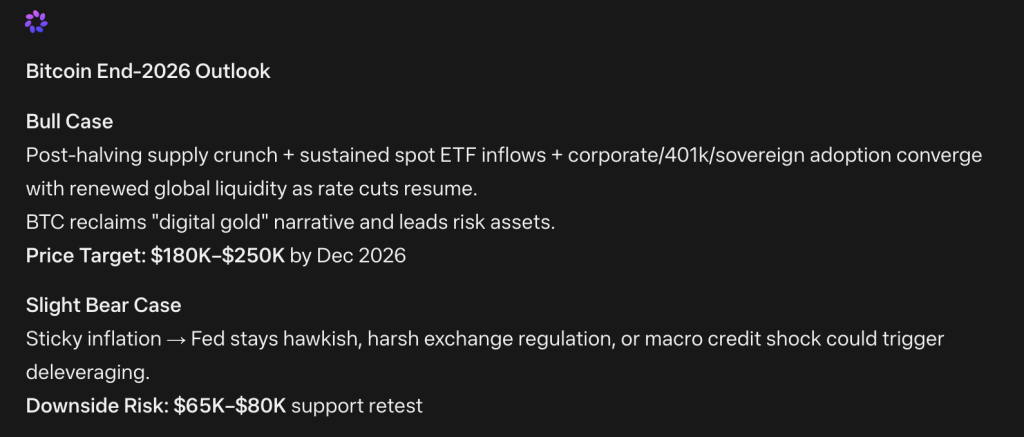
The number Mark Zuckerberg Meta AI predicts on Bitcoin price prediction by end-2026 is not $100,000. It is not $150,000 either.
It is $250,000. And the logic behind it is cleaner than most people expect from a social media company’s AI.
Meta’s model does not rely on a single catalyst. It stacks 4, all moving simultaneously. The post-halving supply crunch is already in effect, reducing new BTC issuance at the exact moment spot ETF inflows are pulling coins off exchanges at scale.
Layer corporate treasury adoption, 401k integration, and sovereign wealth fund positioning on top of that, and you have a demand profile that is structurally different from any previous cycle.
The final piece is macro: rate cuts resuming means global liquidity is expanding again, and Bitcoin has historically front-run liquidity cycles hard.
Meta frames all of this under the digital gold narrative, fully reclaimed, which means BTC is no longer competing with risk assets for capital; it is competing with gold for reserve allocation.
That is a different game entirely, and the AI thinks the trade looks like a $180,000 to $250,000 range when it plays out.
The bear case is tight but credible. Sticky inflation keeping the Fed hawkish longer than expected, a harsh regulatory move on exchanges, or a macro credit shock could trigger forced deleveraging across leveraged positions.
Meta puts the downside retest zone at $65,000 to $80,000 in that scenario, which is actually not that far from where BTC USD price sits right now. The floor is closer to the ceiling than the uncomfortable truth sitting underneath this prediction.

Bitcoin Price Prediction: $250,000 Target, Here Is the Distance the Chart Has to Cover to Hit Meta AI Predicts
BTC USD price is trading at $80,890 on the daily, having clawed back roughly $20,000 from the February low of $61,000 in what is shaping up as one of the steadier recoveries of this cycle.
No blowoff candles, no euphoric gaps. Just a consistent grind of higher lows since the bottom, which is actually the healthiest way to rebuild structure after a crash of that size.
The immediate problem is resistance at $82,000-$84,000. That zone has been tested twice in the past 2 weeks and rejected both times.
It is the remnant of the pre-crash consolidation range from late 2025, and it is where sellers who missed the top are sitting.
A clean break above $84,000, with volume, changes the entire picture and opens the path toward $90,000, then toward the $96,000 to $98,000 area, where the real overhead supply from October and November kicks in.
Support below is $76,000 to $78,000, the launchpad for the current leg, and where buyers have shown up consistently since March. Lose that zone, and the recovery thesis gets complicated fast, putting Meta’s bear-case floor of $65,000 back into a realistic range.
The gap between $80,890 and $250,000 is large. But so was the gap between $61,000 and here, and that closed in 3 months.
Meta Projects That Bitcoin Hyper Could Outperform Bitcoin Next
Some traders rotating between cycles are already looking past large caps entirely.
Bitcoin Hyper is positioning itself for that rotation. The project is building the first Bitcoin Layer 2 with Solana Virtual Machine integration, claiming sub-Solana latency while keeping Bitcoin’s security layer intact.
Fast, low-cost smart contracts on Bitcoin without abandoning its trust model. That is a gap neither Ethereum nor Solana fills directly.
The presale has raised $32.5 million at $0.013679 per token with high APY staking available for early participants.
The risk profile is different here. Higher upside potential, earlier entry, and significantly more execution risk than anything trading on major exchanges. That tradeoff is the whole point.
The post Mark Zuckerberg New META AI Predicts the Price of Bitcoin by The End of 2026 appeared first on Cryptonews.
Crypto World
Bhutan’s Gelephu Mindfulness City unveils fast-track licensing for global finance and crypto firms

Gelephu Mindfulness City (GMC), Bhutan’s Special Administrative Region for economic development, has introduced an accelerated licensing pathway for companies already regulated in leading global financial centres, including Singapore, Abu Dhabi Global Market, and Hong Kong.
Announced on 12 May, the initiative is designed to allow qualified firms to move from application to full operational readiness in a significantly shorter timeframe by combining expedited regulatory review with immediate access to banking infrastructure.
GMC said the new framework enables firms to incorporate, receive regulatory approval, open a corporate bank account, and begin operations through a single, coordinated process, removing delays often associated with entering new markets.
Accelerated licensing pathway for established firms
Under the new framework, companies that already hold licences in established financial centres such as Singapore, ADGM, and Hong Kong will be eligible for accelerated review, reflecting their existing regulatory standing.
GMC said the approach is intended to reduce duplication, maintain high standards, and help credible firms expand internationally with greater speed and certainty.
“GMC is designed to remove friction from the system. If a company has already demonstrated credibility in leading jurisdictions, we recognize that – and enable them to move faster,” said Jigdrel Singay, Board Member and Digital Assets & Fintech Lead, Gelephu Mindfulness City.
This accelerated pathway, combined with immediate access to banking, fundamentally changes the setup experience. Companies don’t just get approved – they get operational. Our goal is to create a trusted platform for digital assets and financial innovation, where regulation, infrastructure, and execution are aligned from the outset.
GMC said the integrated setup differs from most jurisdictions, where licensing and banking are typically separate and sequential processes, often resulting in months of delay even after regulatory approval.
Banking access integrated through DK Bank
As part of the framework, companies establishing a licence in GMC are guaranteed a corporate bank account with DK Bank, which GMC said removes one of the most common barriers to becoming operational.
The bank said it is designed to support globally active financial and digital asset companies from day one, offering multi-currency accounts across nine major currencies — USD, GBP, EUR, AUD, JPY, SGD, INR, HKD, and BTN — to support international operations.
DK Bank also offers digital asset financial services, including BTC-backed lending and asset swap capabilities, as well as integrated on- and off-ramps for digital assets.
GMC companies will also receive preferential banking terms, including fully waived banking fees for at least the first six months and discounted pricing thereafter.
“In most financial centres, getting licensed is only half the battle – getting a bank account is where companies get stuck,” said Yu Dong Zheng, CEO, DK Bank.
We’ve removed that bottleneck. At DK Bank, companies setting up in GMC can operate from day one, with banking built into the process. Our ambition is simple: to be the most Web3- and fintech-friendly bank in the world.
Tax incentives and institutional framework
GMC said the accelerated pathway is supported by a broader tax and regulatory framework designed to support real business activity, capital formation, and long-term investment.
The city highlighted targeted incentives for priority sectors, including 0% corporate tax depending on company investment levels, a territorial tax system aligned with Singapore and Hong Kong, and no capital gains, dividend, or inheritance tax.
Foreign talent tax exemptions will remain in place through 2030, while double taxation agreements are already in place and expanding, including with Singapore.
Beyond tax, GMC said it offers institutional infrastructure including Variable Capital Company (VCC) structures based on Singapore models, an International Dispute Resolution Centre (IDRC), common law frameworks inspired by Singapore with ADGM regulatory principles, and streamlined company and family office setup processes.
Industry participants also endorsed the initiative.
“The licensing process in GMC reflects a forward-thinking approach to digital assets, one that balances innovation with responsibility. As a custodian, we value jurisdictions that regulate and genuinely understand the infrastructure and risks behind this industry,” said Ian Loh, CEO, Ceffu.
We see this not just as a license, but as a partnership in shaping the future of digital finance.
John Ge, Co-Founder & CEO of BIT, added: “What differentiates GMC is the intentional design of the ecosystem and the alignment of regulation, banking, and operational readiness from day one.
The accelerated review process is both fast and pragmatic, with the GFSO demonstrating a clear openness to engage constructively while upholding high standards. This materially reduces execution risk for firms entering a new market.

Key takeaways
- Stellar continues consolidating between its 50-day and 100-day EMAs.
- CryptoQuant data suggests a neutral-to-bullish outlook for XLM.
On-chain and derivatives data support a mild bullish outlook
Stellar traded cautiously on Tuesday, but improving on-chain activity and derivatives positioning continued to support expectations for a potential upside breakout in both altcoins.
According to CryptoQuant summary data, Stellar reflects buy-side dominance with largely neutral market conditions, pointing to a mild bullish bias despite the lack of a decisive breakout.
CoinGlass data shows the OI-weighted funding rates for XLM flipped positive on Friday and remained positive on Tuesday at 0.0030%, respectively. Positive funding rates indicate that long-position holders are paying shorts, reflecting growing bullish positioning among traders.
Stellar technical outlook: Consolidation continues between key EMAs
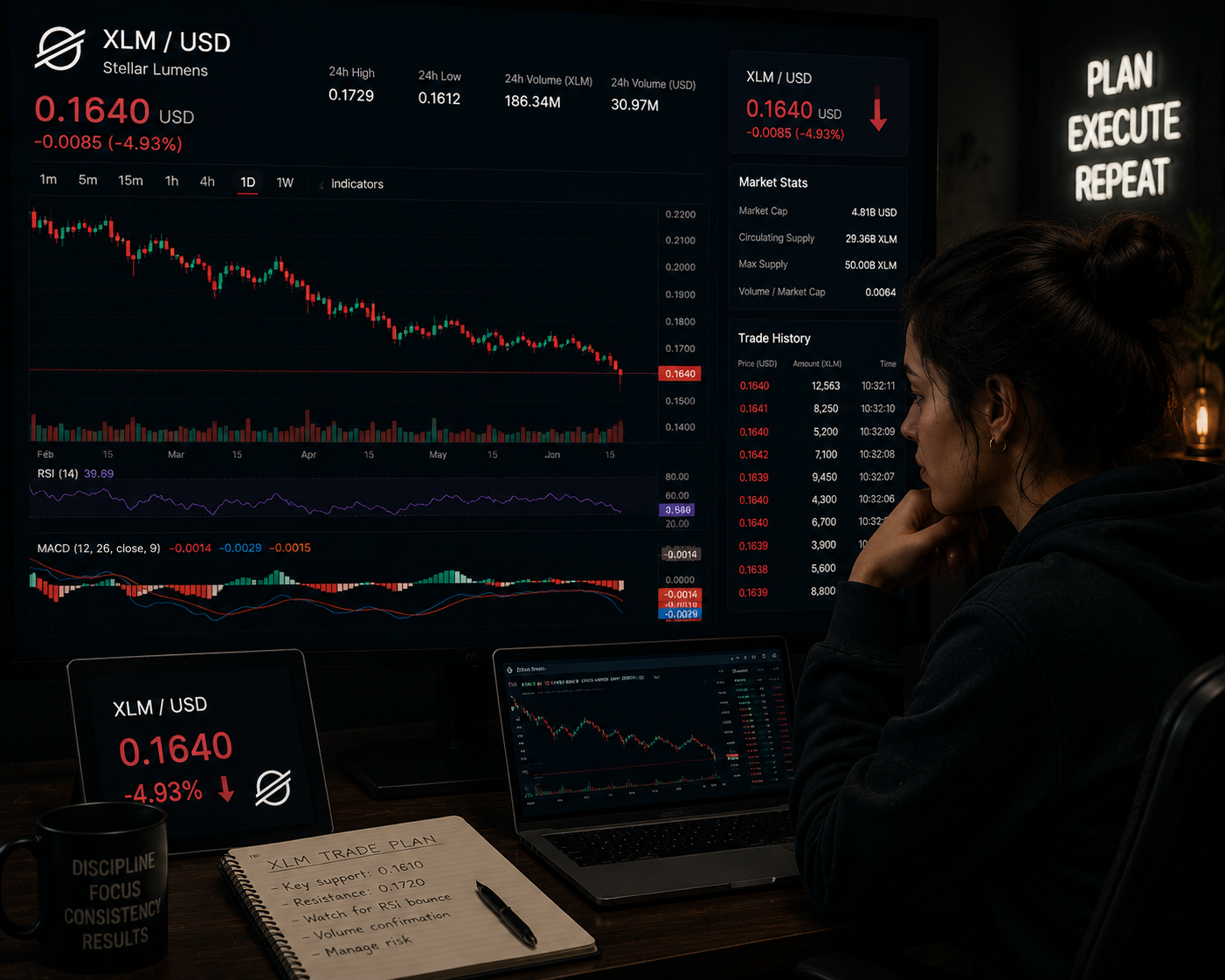
The XLM/USD 4-hour chart is bearish and efficient as it is currently trading at $0.164 per coin. It is currently trading between major moving averages as traders await a clearer directional move.
XLM continues to hold above its 50-day EMA near $0.165 but remains below the 100-day EMA at $0.174 and the 200-day EMA around $0.204. Broader descending trendline resistance also continues to cap upside attempts.
Momentum indicators nevertheless show early signs of improvement. The RSI sits near 57, slightly above the neutral midpoint. The MACD line remains marginally above zero, suggesting mild bullish momentum.
If the rally resumes, the bulls would encounter resistance at key levels, including the 100-day EMA at $0.174, the 23.6% Fibonacci retracement at $0.201, and the 200-day EMA just above $0.204.

However, if the bearish trend persists, immediate support would be seen at the 50-day EMA at $0.165. A daily candle close below this level would expose the major support at $0.136.
As long as XLM maintains support above the 50-day EMA, the current consolidation structure could support a gradual recovery attempt. However, a breakdown below $0.136 would likely reopen the broader bearish trend.
Bitcoin (BTC) saw classic volatility ahead of Tuesday’s Wall Street open as a key US inflation gauge hit its highest levels in three years.
Key points:
- US CPI inflation reaches its highest year-on-year levels since 2023.
- Energy prices fuel the rise, with the US-Iran war continuing to make its presence felt.
- Bitcoin traders retain support levels while a 200-day trend line comes in as resistance.
Bitcoin price on edge as CPI beats multiyear records
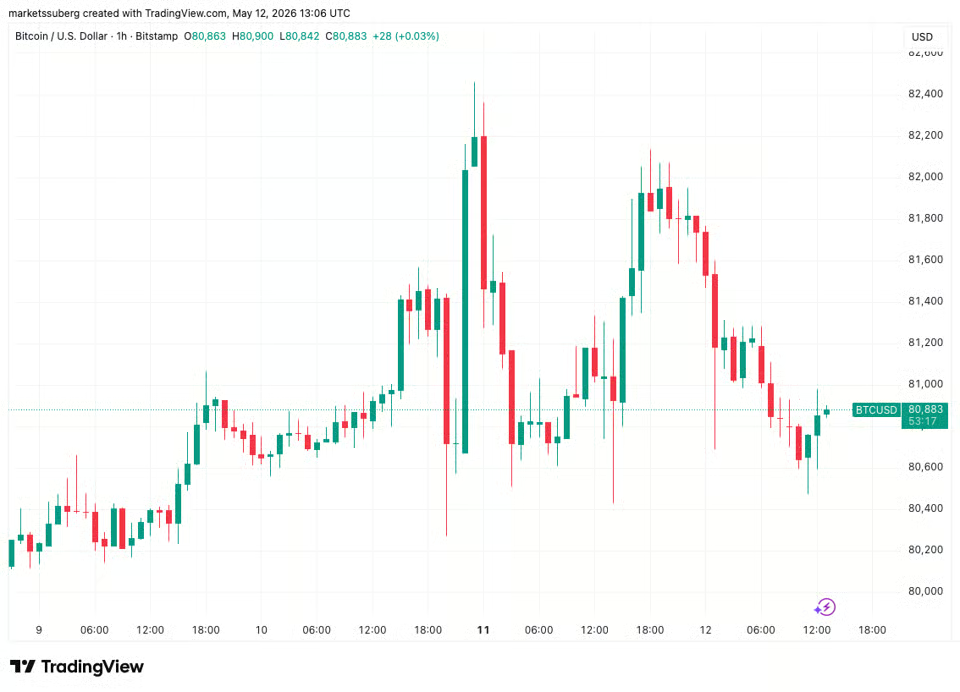
Data from TradingView showed BTC price action circling $81,000 as risk assets saw fresh headwinds.

BTC/USD one-hour chart. Source: Cointelegraph/TradingView
These came in the form of the April US Consumer Price Index (CPI), which at 3.8% year-on-year put inflation at its highest since 2023.
“The index for energy rose 3.8 percent in April, accounting for over forty percent of the monthly all items increase,” an official news release from the US Bureau of Labor Statistics (BLS) noted.
The 12-month increase in energy was almost 18%, continuing to show the impact of the US-Iran war and oil-supply squeeze on prices.
“Conversely, the indexes for new vehicles, communication, and medical care were among the major indexes that decreased in April,” the release added.

US CPI 12-month % change. Source: BLS
Reacting, trading resource The Kobeissi Letter observed that the odds of the Federal Reserve pivoting to interest-rate hikes were “surging.”
“We are now experiencing post-pandemic inflation levels amid surging oil prices,” it wrote in a post on X.

Fed target rate probabilities (screenshot). Source: CME Group
The latest data from CME Group’s FedWatch Tool showed expectations anchored around current rates staying in place throughout 2026 and next year.
Crypto and risk assets tend to see downside pressure when rate hikes return, thanks to the implied lower liquidity entering the market.
Questions over Bitcoin’s “momentum” at the 200-day trend line
Bitcoin traders, meanwhile, reiterated lines in the sand that bulls should protect in the short term.
Related: BTC price target becomes $85K next: Five things to know in Bitcoin this week
“The 21-MA is a crucial level to look at,” crypto trader and analyst Michaël van de Poppe told X followers on the day, referring to the 21-day simple moving average (SMA) at $78,800.
“The $76K area is a crucial support zone that I fancy not to be breached, if that happens, we’ll be going substantially lower.”

BTC/USDT one-day chart. Source: Michaël van de Poppe/X
Trading resource Material Indicators flagged problematic resistance in the form of the 200-day SMA near $82,600.
“Bulls appear to be attempting to establish an R/S Flip at $80.7k to build foundational support for another run at breaking the 200-Day SMA,” it summarized.
“Do bulls have the momentum to succeed?”

BTC/USD one-day chart. Source: Material Indicators/X

Key takeaways
- Bitcoin trades around $81,000, maintaining a bullish bias but facing resistance at the 200-day EMA.
- Traders await the US Consumer Price Index (CPI) data, which could trigger volatility in BTC and risky assets.
US CPI report could drive volatility for Bitcoin
Bitcoin traders are awaiting the release of the US Consumer Price Index (CPI) for April, scheduled for Tuesday at 12:30 GMT.
The report is expected to show a sharp increase in inflation, driven in part by higher oil prices amid the ongoing US-Iran tensions.
The monthly CPI is forecast to rise by 0.6%, following March’s 0.9% increase. The annual CPI reading is expected to climb to 3.7%, up from 3.3% in March, marking the highest level since September 2023. Core CPI, excluding food and energy prices, is anticipated at 0.3% for the month and 2.7% year-over-year.
The data will likely shape expectations for future interest rate cuts by the Federal Reserve (Fed), potentially triggering volatility in Bitcoin and other risk assets.
Additionally, elevated crude oil prices continue to add to inflationary pressures, reinforcing the likelihood of a more hawkish Fed stance, which could weigh on Bitcoin’s upside.
Negative headlines regarding the US-Iran situation could also strengthen the US Dollar (USD) as a reserve currency, further dampening short-term risk appetite.
Despite the uncertain macro environment, Bitcoin’s institutional and corporate demand remains strong, providing support for its price.
Spot Bitcoin ETFs recorded inflows of $27.25 million on Monday, according to CoinGlass data, breaking a two-day streak of outflows from the previous week.
While these inflows were modest, they reflect a cautious yet positive outlook from investors. If this trend continues, Bitcoin’s price could see further upward movement.
On the corporate side, Strategy (MSTR), led by Michael Saylor, added another 535 BTC to its treasury reserve on Monday, bringing its total Bitcoin holding to 818,869 BTC.
The company has consistently accumulated Bitcoin over recent months, with an average purchase price of $75,540—above the current market price, adding to the bullish sentiment.
Bitcoin technical outlook: Resistance at 200-day EMA
Bitcoin is trading around $81,000 on Tuesday, maintaining a constructive bullish bias as it holds above the 50-day and 100-day Exponential Moving Averages (EMAs) near $76,700.
The 50% Fibonacci retracement at $78,962 also provides strong support. However, Bitcoin is currently facing resistance at the 200-day EMA, located around $82,130.
A break above this level would likely open the path to the next resistance zone around $83,437 (61.8% Fibonacci retracement) and $84,410 (horizontal barrier).
The Relative Strength Index (RSI) on the 4-hour chart is at 55, and the Moving Average Convergence Divergence (MACD) remains mildly positive, suggesting that while momentum is bullish, there are no immediate overbought conditions.

If the rally continues, immediate resistance is seen at the 200-day EMA around $82,130, followed by the 61.8% Fibonacci retracement at roughly $83,437 and the horizontal barrier near $84,410.
However, if the bearish trend persists, sellers would encounter support at the psychological $80,000 level, ahead of the 50% retracement at $78,962, with the 100-day and 50-day EMAs near $76,647 and $76,248, the channel top around $75,680.


Crypto sleuth ZachXBT claims that Bitget executives are allowing “scams to operate behind the scenes” after 10 new wallets withdrew $480 million worth of LAB from the exchange.
The staggering sum, which represented 32% of the LAB supply, was withdrawn over the course of 12 hours. The token’s issuer, also called LAB, is a crypto trading infrastructure firm that claims to boast an “AI research engine.”
Fellow crypto investigator Specter Analyst claims to have tracked the LAB team depositing millions of dollars worth of the token to Bitget.
It said this all took place before a price pump in early May, leading them to suspect that LAB is a major coordinated pump-and-dump scheme that Bitget is profiting from.
Today, ZachXBT claimed that Bitget’s founder, Shawn Liu, is the exchange’s “big boss” and is helping the alleged scams. Bitget’s CEO, Gracy Chen, was otherwise described as the public face of operations.
Read more: Bitget suspended in Singapore for refusing to remove BTS-themed coin
ZachXBT called the crypto exchange a “cartel” and claimed that it “has gone unchallenged for years and doesn’t care as long as they benefit from the activity.”
The investigator added that it’s almost time for an increase in “public attacks” against the exchange.
ZachXBT previously put up a $10,000 bounty for anyone with insider details relating to LAB’s founder Vova Sadkov, and the listings of LAB on Bitget spot and perps across Bybit, Binance, and OKX.
He said, “These grifters are further hurting the industry reputation and it must not go unpunished.”
April also saw suspicious crypto listings on Bitget
Bitget is one of the largest crypto exchanges in the world and processed over $1 billion worth of trading volume in the last week. It claims to have no specific headquarters and has set up regional hubs across the globe.
Last month, Bitget-listed token $RAVE also raised suspicions of insider trading after its trading volume exceeded $300 million and its price plummeted 97% within days.
Multiple exchanges said they would investigate the listing, including Bitget, but ZachXBT wasn’t impressed with the response time.
Read more: AP just rugged crypto bros with a Swatch collab
On May 7, 20 days after Chen promised Bitget would investigate the $RAVE listing, ZachXBT noted that there is yet to be an update on the $RAVE investigation.
In 2021, the exchange was suspended by Singapore regulators for refusing to delist a token that was themed around the South Korean boy band BTS and used unlicensed images.
Protos has reached out to Bitget for comment on the LAB listing and will update this piece should we hear anything back.
Got a tip? Send us an email securely via Protos Leaks. For more informed news and investigations, follow us on X, Bluesky, and Google News, or subscribe to our YouTube channel.


Rachel Conlan, the chief marketing officer (CMO) at Binance, the world’s largest cryptocurrency exchange, said she is leaving the company next month after three years helping to build the brand.
Eowyn Chen, former CEO of Trust Wallet, will serve as the interim CMO, a Binance spokesperson said via email
“Serving as CMO of Binance has been the privilege of my career,” Conlan said in an email. “ I’m deeply grateful to Yi He, Richard [Teng] and the entire leadership team for the trust they placed in me, and to every member of the team I’ve had the honour of working with.”
Conlan, who took the post in September 2023, is credited with launching “Crypto,” the perfume. Also known as “Eau de Binance,” the fragrance was introduced by the exchange in March 2024 to celebrate International Women’s Day.
Prior to Binance, Conlan spent a year as the global head of brand and partnerships at rival OKX, working under CMO Haider Rafique.
“Rachel is a premier talent who has left an indelible mark on the company and after four years of remarkable service has decided to step down to focus on personal priorities,” a Binance spokesperson said.
Like other large crypto brands, Binance has signed a selection of high-profile partnerships, a number of which predate her tenure. These include the footballer Cristiano Ronaldo, Canadian singer-songwriter The Weeknd, the Alpine Formula One team and social media star Khaby Lame.
This year’s crypto market downturn may be hitting the wallets of marketing departments at large crypto firms. Crypto.com, a firm that has spent as much as $1 billion promoting its name on things like rebranding the Staples Center, an advert with Matt Damon, FI and UFC deals, only last week said its CMO, Steven Kalifowitz, is leaving the company.
In addition, Ben Zhou, the CEO of Bybit, the second-largest crypto exchange, said in a recent interview that he would not be renewing his F1 sponsorship, and is looking for other deals with better commercial value.
Conlan’s last day is June 15 and she will remain as an adviser to support the company through the transition, Binance said.


Cryptoquant’s bitcoin bull-bear cycle indicator turned green for the first time since 2023, which could signal that “the market structure is beginning to recover,” said the firm’s onchain market analyst Julio Moreno on Wednesday.
“Historically, this has been an important regime-change signal,” Moreno wrote. “When the indicator moves out of bear territory and enters the early bull zone, it often suggests that the worst phase of the correction has already passed and that market structure is beginning to recover.”
For Mati Greenspan, a former eToro senior market analyst and founder at Quantum Economics, the CryptoQuant Bull-Bear Market Cycle Indicator is a regime-shift indicator, not a crystal ball. He said that, “historically, it has been most useful for identifying when bitcoin stops behaving like a bear-market asset.”
Greenspan said that the real confirmation comes afterward, with sustained demand, liquidity, and price acceptance at higher levels. “So now all eyes are on price action to confirm validation,” he added.
He recalled that when this indicator turned green in 2019 and again in early 2023 following intense bearish phases, the market transitioned into “stronger bullish trends.” Moreno, however, acknowledged that March 2022 remains a critical exception. Back then, the indicator turned bullish but delivered a false positive, preceding a move into a deeper downtrend.
The analyst also stressed why the current May 2026 is so pivotal. “On one hand, the indicator is showing the first constructive regime shift in years,” he said. “Bitcoin is no longer behaving like a deep bear-market asset, and the recovery in the 30-day moving average suggests improving momentum beneath the surface.”
Currently, Bitcoin finds itself in a tug of war similar to 2022. While the onchain metrics are healing, the asset is struggling to decisively flip the $82,000 resistance level, a ceiling that has held firm despite multiple breakthrough attempts this month following a 35% rebound from February’s $60,000 lows.
To confirm this bullish signal, bitcoin must overcome the “exhaustion” presently visible in secondary metrics, Moreno suggested. Unlike the clean early-cycle entries of the past this move is clashing with a neutral Fear & Greed index and a complex macroeconomic backdrop.
While Arthur Hayes, chief investment officer of Maelstrom, did not mention CryptoQuant’s indicator, he echoed the sentiment that the cycle has shifted, stating he believes Bitcoin already found its bottom at $60,000 earlier this year. Hayes, who also co-founded the BitMEX exchange, pointed to $90,000 as the level at which the rally would turn explosive and head toward its previous high of $126,000.
Jason Fernandes, co-founder at AdLunam, concluded that while these indicators are useful, they are often misunderstood. “Metrics like MVRV (Market cap versus realized cap) or NUPL (net unrealized profit and loss) were never designed to be precise trading signals,” he said. “They are better viewed as behavioral frameworks for understanding where Bitcoin sits within a broader liquidity cycle.”
The second-largest cryptocurrency, which experienced a significant revival in mid-April and at the start of May, has been on a decline over the past week, and some analysts now believe it may plunge further in the near future.
Others remain cautious, arguing that traders should avoid jumping into ETH until it breaks convincingly out of its recent range.
Tread Carefully
As of press time, the asset is trading at around $2,280 (according to CoinGecko), representing a 4% decrease over the past 7 days. The renowned analyst Ali Martinez believes anything between $2,200 and $2,400 falls within a “no-trade zone,” arguing that only a sustained close outside this area will define “the next major move.”
X users Ted and CRYPTOWZARD also issued warning predictions. The former claimed that spot demand is weak and expects ETH to continue to underperform if it stays below $2,400.
CRYPTOWZRD forecasted that moving above the $2.4K resistance might trigger the next upside move, while trading below could lead to more “random movement.”
Certain factors reinforce the bearish scenario. The amount of ETH stored on centralized exchanges has been rising since May 5, recently surging to nearly 15 million coins. This displays that some investors have abandoned self-custody methods and flocked towards centralized platforms, which in turn increases immediate selling pressure.

Moreover, big investors have been reducing their exposure to the asset lately. Last week, Martinez revealed that whales (who owned almost 16 million ETH by October 2026) now hold less than 13 million units. Such a sell-off shows reduced confidence from these market participants, and their actions could trigger panic across the community, potentially prompting smaller players to cash out as well.
The Bullish Signs
Contrary to the pessimistic predictions and elements mentioned above, there are some developments suggesting a notable price resurgence could be on the way.
Earlier this month, Ali Martinez spotted a so-called golden cross on the asset’s chart, a pattern that appeared in the final days of April. The setup is widely viewed as bullish, occurring when the 50-day moving average crosses above the 200-day moving average. Back then, the analyst thought this could pave the way for a rally toward $2,680.
Meanwhile, Tom Lee’s Bitmine Immersion Technologies continues to increase its exposure to the cryptocurrency and now holds 5.21 million ETH. The stash represents roughly 4.3% of the asset’s circulating supply, while its USD equivalent is almost $12 billion.
The post Ethereum (ETH) Sits in a ‘No-Trade Zone:’ Here’s What Will Define the Next Major Move appeared first on CryptoPotato.

In The Vacuum Of AI Legislation, Libraries Have The Playbook

Infamous Director’s Extremely R-Rated Action Comedy Succeeds In Offending Absolutely Everybody

City of London scolds Andrew for failing to give up honour

Manchester United reach agreement with Casemiro over contract clause amid transfer speculation

US brings back mandatory military draft registration

Steven Gerrard disagrees with Gary Neville over ‘shock’ Chelsea and Arsenal claim | Football

Jahvillani – MONEY-POWER-RESPECT | Official Music Video

XRP Ripple Believe IT or NOT, XRP USE CASE ONLY FLARE Delivers, SBI LEADS with XRP CANTON SOLANA ETH

$30,000 XRP BUYBACK WON’T HAPPEN! – DTCC IS JUST ONE XRP SWITCH – BRAD SAYS IT ALL CONNECTS TO XRP!
-
 Crypto World4 days ago
HarrisX Poll Found 52% of Registered Voters Support the CLARITY Act
-

 Fashion4 days ago
Weekend Open Thread: Marianne Dress
-

 Crypto World5 days ago
Upbit adds B3 Korean won pair as Base token gains Korea access
-
 NewsBeat5 days ago
NCP car park operator enters administration putting 340 UK sites at risk of closure
-

 Fashion23 hours ago
Coffee Break: Travel Steam Iron
-

 Fashion2 days ago
What to Know Before Buying a Curling Wand or Curling Iron
-

 Tech2 days ago
Auto Enthusiast Carves Functional Two-Stroke Engine from Solid Metal
-

 Politics18 hours ago
What to expect when you’re expecting a budget
-

 Politics3 days ago
Politics Home Article | Starmer Enters The Danger Zone
-
 Business3 days ago
Ignore market noise, India’s long-term story intact, say D-Street bulls Ramesh Damani and Sunil Singhania
-

 Tech1 day ago
GM Agrees To Pay $12.75 Million To Settle California Lawsuit Over Misuse Of Customers’ Driving Data
-

 Crypto World6 days ago
BlackRock CEO Larry Fink Discusses a New Asset Class
-

 Entertainment5 days ago
Sarah Paulson Called Out For Met Gala ‘Hypocrisy’
-
 Sports6 days ago
NBA playoff winners and losers: Austin Reaves is not loving Lakers vs. Thunder matchup, but Chet Holmgren is
-

 Entertainment6 days ago
Bold and Beautiful Early Spoilers May 11-15: Steffy Revolted & Liam Overjoyed!
-

 Entertainment5 days ago
General Hospital: Ric & Ava Bombshell – Ric’s Massive Secret Exposed!
-

 Crypto World6 days ago
Robinhood says Wall Street is building onchain
-

 Politics5 days ago
Simon Cowell Says He Was ‘Horrible’ To Susan Boyle During BGT Audition
-

 Sports5 days ago
UEFA Champions League final schedule, teams, venue, live time and streaming | Football News
-

 Tech7 days ago
Apple and Samsung are dominating smartphone sales so thoroughly that only one other company makes the top 10
You must be logged in to post a comment Login