

Crypto World
Gold ETFs Rebound With $6.6 Billion Inflows After Record Selloff

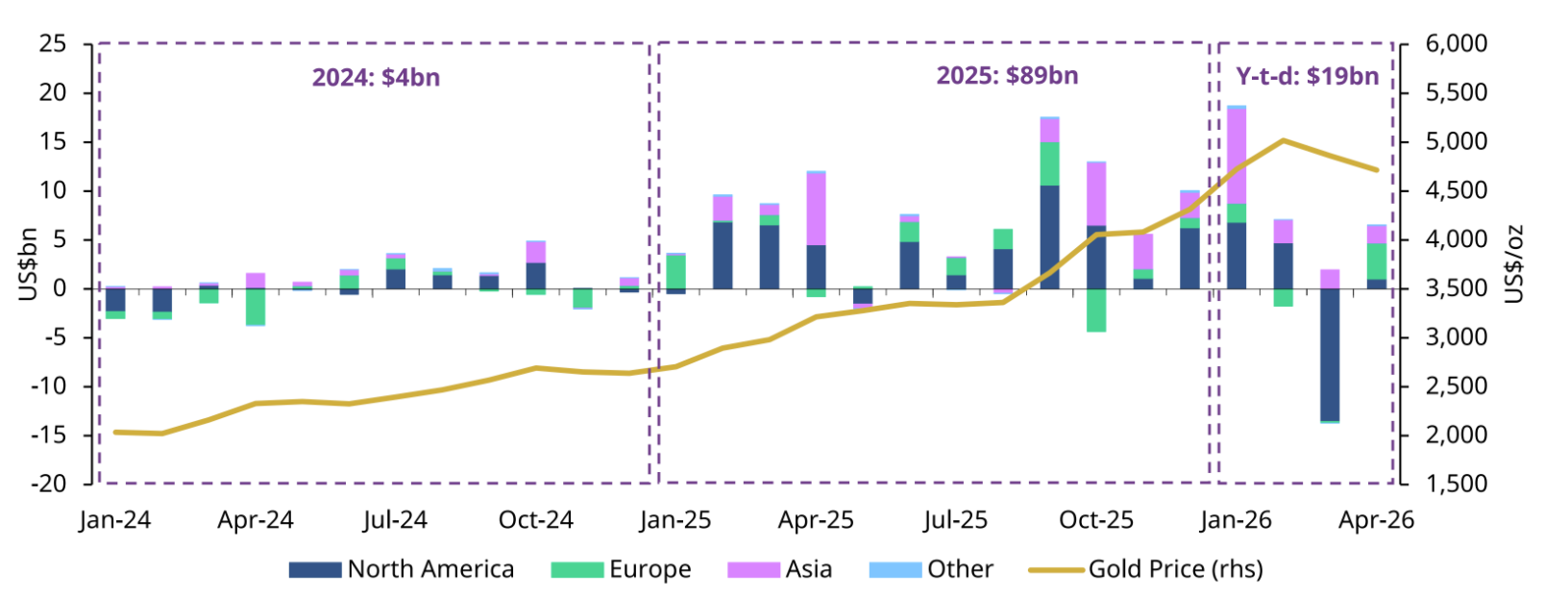
Global physically backed gold exchange-traded funds (ETFs) drew $6.6 billion in April, reversing March’s heavy outflows.
A record $12 billion drained from global gold ETFs in March, the steepest monthly outflow ever, as US-Iran tensions weighed on bullion. But as the chart below shows, investments rotated back into gold in April, with Europe and Asia bringing more capital into the market.

Gold Flows Reverse Course in April
The return of inflows came as gold prices stabilized. Bullion slipped 1.12% in April after plunging 13% in March, its sharpest monthly decline since 2008.
Year-to-date, global gold ETFs have recorded $19 billion in net inflows. Total assets under management rose 1% month over month to $615 billion, while collective holdings increased by 45 tonnes to 4,137 tonnes, the third-highest level on record.
The flow reversal coincided with a much shallower price drop. The bullion edged down just 1.12% during the month, compared with March’s 13% rout. That marked the steepest monthly decline since 2008.
All regions contributed to April’s recovery. European funds added $3.7 billion, Asian funds $1.8 billion, and North American funds $1 billion. Year-to-date, global gold ETFs have pulled in $19 billion.
Those inflows lifted total assets under management by 1% month over month to $615 billion. In addition, combined gold holdings climbed 45 tonnes to 4,137 tonnes, the third-highest level on record.
Follow us on X to get the latest news as it happens
China’s Steady Bullion Bid
Meanwhile, China has remained a consistent gold buyer even through the war-driven volatility. The People’s Bank of China (PBoC) added over 8 tonnes of gold in April, extending its buying streak to 18 consecutive months.
The PBoC’s April purchase was its largest monthly addition since December 2024, taking total holdings to roughly 2,322 tonnes.
The April figure follows 5 tonnes added in March. Together, the two months represent China’s largest two-month accumulation since the first quarter of 2025, per The Kobeissi Letter.
“Year-to-date, China’s central bank has bought +15 tonnes of gold, on track for its biggest annual purchase since 2023. Since 2022, the country has officially increased its gold holdings by +372 tonnes, or +19%, making China one of the strongest gold buyers in the world. China is buying the dip in gold,” the post added.
Thus, the April rebound suggests gold’s role as a portfolio anchor has not faded. Whether the recovery holds depends on Middle East tensions and expectations for Federal Reserve rate hikes.
Subscribe to our YouTube channel to watch leaders and journalists provide expert insights
The post Gold ETFs Rebound With $6.6 Billion Inflows After Record Selloff appeared first on BeInCrypto.


TLDR
- Major indices reached all-time highs last week, propelled by technology and artificial intelligence momentum
- Tuesday’s April inflation report and Thursday’s retail spending figures will shape Federal Reserve rate outlook
- Cisco’s Wednesday earnings call will reveal whether margin challenges persist amid AI networking opportunities
- Applied Materials results offer critical insight into semiconductor equipment demand sustainability
- Tuesday earnings from On Holding and Under Armour provide a pulse check on premium consumer apparel trends
Investors face a pivotal week as five strategically important companies report quarterly results while critical economic indicators hit the calendar. These events collectively address the market’s most pressing questions about consumer resilience and artificial intelligence infrastructure growth.
Both the S&P 500 and Nasdaq Composite notched record closes heading into this week. Technology shares provided substantial momentum, buoyed by artificial intelligence enthusiasm, robust semiconductor performance, and declining energy costs. However, upcoming economic releases and corporate earnings could substantially alter market sentiment.
The April Consumer Price Index arrives Tuesday morning. Three days later, April retail spending figures will be published. These reports carry significant weight in shaping investor perspectives on monetary policy direction and household financial health.
Let’s examine what makes each company worth monitoring closely.
Walmart
Walmart stands as perhaps the week’s most significant bellwether for understanding American consumer behavior.
Thursday’s retail spending report will reveal whether consumer purchases maintained momentum through April. Households proved surprisingly resilient when gasoline prices climbed toward $4.50 during March, though emerging signals suggest growing caution. Consumer expenditure growth has decelerated, with some households front-loading purchases of vehicles and major appliances to avoid anticipated price hikes.
Walmart’s customer base spans income levels but provides particularly valuable insight into lower- and middle-income household spending patterns. Robust retail figures would reinforce positive sentiment around the retailer. Disappointing data would intensify worries about how inflation continues pressuring these consumer segments.
Cisco Systems
Cisco unveils fiscal third-quarter performance Wednesday after market close.
Analysts will scrutinize top-line expansion, profitability metrics, and sales momentum in AI-focused networking products. During the previous quarter, Cisco exceeded expectations for both revenue and earnings, yet shares declined as margin compression emerged. This makes profitability the critical metric warranting closest attention in the upcoming release.
Artificial intelligence presents another important dimension. Corporate expenditure on data center capabilities and network architecture continues accelerating. Cisco needs to demonstrate it’s successfully capturing meaningful share of this spending wave, similar to gains posted by semiconductor manufacturers.
Applied Materials
Applied Materials operates outside the spotlight compared to Nvidia or AMD, yet serves an essential function within the chip ecosystem. The company’s equipment enables manufacturers to produce cutting-edge semiconductors.
Earnings are scheduled for release this week. Market participants will parse results to assess whether chipmaking equipment demand remains healthy. Semiconductor equities have delivered impressive returns driven by artificial intelligence applications, memory chip requirements, and data center infrastructure buildout.
Solid performance would validate this narrative. Disappointing forward guidance might trigger concerns that stock appreciation has outpaced actual business fundamentals.
On Holding
On Holding releases first-quarter financial results before Tuesday’s opening bell.
The Switzerland-based athletic footwear and apparel company has delivered rapid expansion, with investors focused on revenue trajectory, profit margins, and inventory management. The company’s recent appointment of its co-founders as co-chief executives adds another layer of interest to the earnings discussion and any strategic commentary provided.
On Holding offers perspective on premium athletic merchandise demand. Strong performance would indicate affluent consumers continue spending readily on branded products.
Under Armour
Under Armour publishes fiscal fourth-quarter numbers Tuesday morning.
The athletic apparel maker has pursued an operational restructuring emphasizing expense reduction and brand revitalization. Investors seek evidence these initiatives are translating into improved financial performance. Recent weakness in clothing retail categories elevates importance of this report as an apparel sector health indicator.
Revenue patterns, profitability, and inventory positions will draw primary attention.
Final Thoughts
This week transcends individual company performance—it represents a comprehensive examination of dominant market themes.
Inflation metrics will determine whether price pressures continue moderating. Retail figures will clarify actual consumer financial conditions. Cisco and Applied Materials will provide ground-level perspective on artificial intelligence and semiconductor demand sustainability. On Holding and Under Armour will indicate whether premium apparel purchases remain strong.
Each data point and earnings report contributes to the fundamental question facing investors: can markets sustain record valuations as new information arrives?


Key Takeaways
- The Defense Department disclosed thousands of pages documenting UAP encounters following President Trump’s mandate
- Military records detail objects executing sharp 90-degree maneuvers at high speeds and disabling aircraft weapons systems
- Advanced capabilities outlined in reports align with technologies developed by defense contractors specializing in stealth and electronic warfare
- Major defense firms including Lockheed Martin, Northrop Grumman, and RTX are linked to classified programs exploring similar technologies
- The iShares Aerospace & Defense ETF has declined 8% amid Iranian conflicts, with market watchers saying UAP disclosures won’t significantly impact defense sector valuations
The Defense Department made public 161 declassified files on Friday containing thousands of pages documenting what officials term “Unidentified Anomalous Phenomena.” President Donald Trump ordered the disclosure following his earlier commitment to transparency regarding UAP records in response to significant public curiosity.
The records are accessible through the Department of Defense’s official portal, with additional batches scheduled for future disclosure. The collection encompasses multiple decades and features declassified military communications, Apollo lunar mission documentation, and testimony from civilian observers.
A 2023 incident report documents an unidentified craft executing several sharp 90-degree directional changes while traveling at approximately 80 miles per hour. Such flight characteristics suggest breakthrough propulsion systems and advanced materials engineering—technological domains where companies like Lockheed Martin and GE Aerospace maintain active research programs.
Another documented encounter from 2022 in the East China Sea describes a football-sized object plunging into the ocean at extreme velocity without creating water displacement or velocity reduction. Such performance characteristics hold potential relevance for naval engineering firms including General Dynamics and Huntington-Ingalls Industries.
FBI documentation within the disclosure package references objects undetectable through visual observation yet clearly registering on radar systems. This capability mirrors optical camouflage technology, a specialty area for stealth-oriented defense manufacturers like Lockheed Martin and Northrop Grumman.
Military Aircraft Weapons System Rendered Inoperable
A 2023 pilot account describes complete weapons system failure occurring during proximity to a compact UAP. Such electronic disruption represents jamming and electronic warfare capabilities, sectors where defense contractors including RTX, BAE Systems, and L3Harris Technologies maintain specialized operations.
Regardless of the compelling nature of these accounts, market analysts don’t anticipate the UAP document release will boost defense sector equities. The iShares Aerospace & Defense ETF has experienced an 8% decline since Iranian hostilities commenced. Market participants remain concentrated on budget allocations and international conflicts rather than unexplained phenomena reports.
Classified Program Revenue Decreases at Lockheed
Lockheed Martin disclosed a 1% year-over-year revenue reduction in its aeronautics division during the first quarter of 2026. Company officials attributed the decrease largely to approximately $325 million in reduced classified program sales. Bank of America analysts project Lockheed’s classified program expenditures will range between $500 million and $700 million throughout the complete 2026 fiscal year.
The document disclosure arrives amid heightened public attention to UAPs that intensified following Congressional hearings in 2022—the first such proceedings in half a century. Former President Barack Obama further amplified interest during a February media appearance, stating aliens were “real,” though he subsequently explained he encountered no concrete evidence during his presidential tenure.
Trump issued directives to the Pentagon for UAP-related file disclosure shortly following Obama’s interview. The 161 documents currently published constitute the initial phase of the broader release initiative.
Numerous photographs contained within the files are characterized as unclear or display dark circular shapes. The actionable investment intelligence remains minimal at this stage.
Interested individuals can access the complete file collection directly at war.gov/UFO.
Key Takeaways
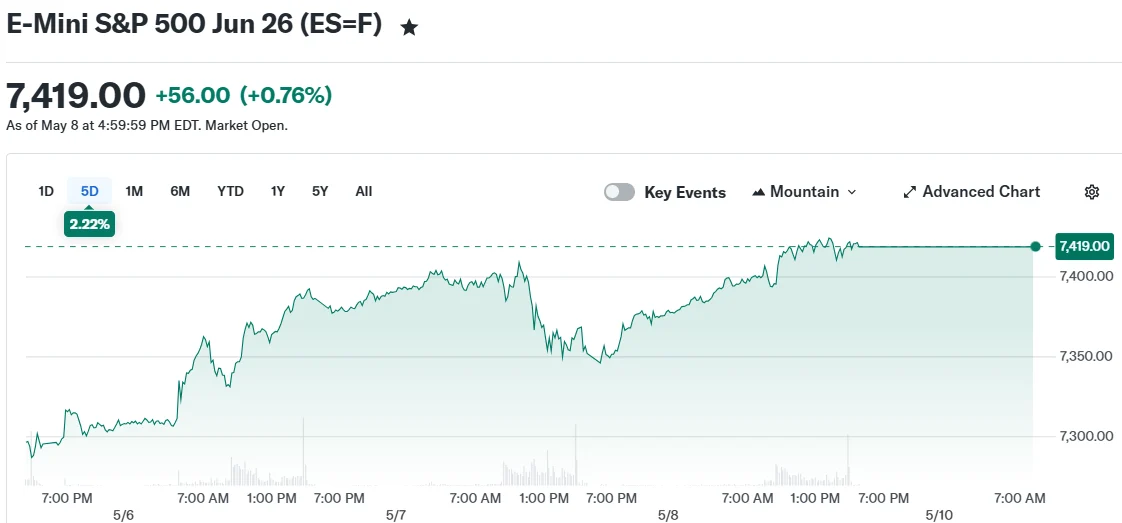
- Major U.S. indices notched fresh all-time highs last week, powered by semiconductor and artificial intelligence stocks
- Tuesday brings April inflation numbers; analysts expect close scrutiny of energy component following March’s 20%+ surge
- Semiconductor sector rallied strongly, with Micron climbing approximately 38% weekly and Intel gaining on reported Apple partnership
- Notable earnings releases include Cisco, Under Armour, Klarna, Alibaba, and Applied Materials
- Bitcoin hovered around $81,332, consolidating near the $80,000 threshold
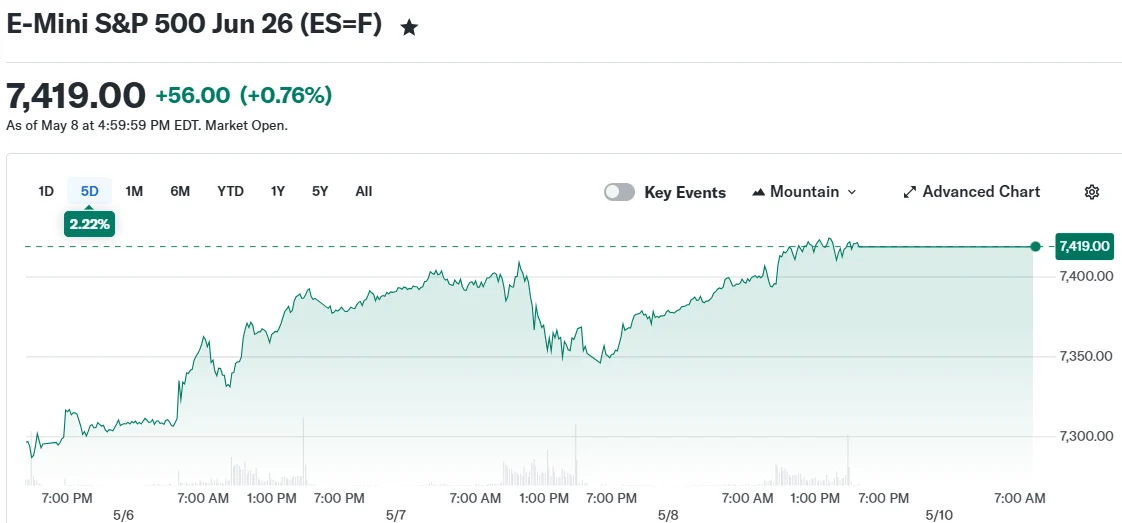
Wall Street concluded last week’s trading session with benchmark indices establishing new records. The S&P 500 advanced 0.84% to finish at 7,397.09, while the Nasdaq posted a robust 2.35% gain to reach 29,195.16. The Dow Jones Industrial Average managed only a marginal 0.02% increase, highlighting the technology sector’s dominance in the recent rally.
Employment data provided reassurance to market participants. April’s nonfarm payroll additions totaled 115,000, significantly exceeding consensus estimates of 55,000. Meanwhile, the jobless rate remained unchanged at 4.3%. These robust figures alleviated concerns about labor market deterioration while simultaneously diminishing expectations for imminent Federal Reserve interest rate reductions.
The benchmark 10-year Treasury note yield declined to 4.33%, accompanied by the VIX volatility index falling to 17.08. Gold appreciated 1.39% to $4,747 per ounce. Crude oil retreated 1.79% to $93.38 per barrel, influenced partly by indications that Washington and Tehran might be progressing toward diplomatic engagement.
Semiconductor equities dominated performance metrics. Micron skyrocketed nearly 38% over the five-day period. Sandisk climbed more than 31%. Intel shares jumped following media reports suggesting a preliminary agreement to manufacture processors for Apple. Advanced Micro Devices similarly posted gains.
Artificial Intelligence Partnerships Spark Market Activity
Anthropic announced plans to leverage SpaceX’s Colossus supercomputer infrastructure to expand computational capacity for its Claude AI platform. Akamai shares soared on reports of securing a $1.8 billion cloud services contract with Anthropic. Nvidia disclosed intentions to invest up to $2.1 billion in constructing as much as 5 gigawatts of AI infrastructure.
Not every artificial intelligence-related company shared in the gains. SoundHound declined despite reporting improved revenue figures. HubSpot retreated following disappointing forward guidance. Cloudflare fell after issuing weak second-quarter projections and announcing workforce reductions.
Rocket Lab soared 34% after delivering impressive first-quarter financial results and securing its largest launch contract to date. Dell shares climbed after President Trump encouraged White House visitors to “go out and buy a Dell.” Spirit Airlines ceased operations following the collapse of rescue negotiations.
Bitcoin concluded the week trading near $81,332, down 0.12%, maintaining its position close to the $80,000 mark without establishing a definitive directional trend.
Critical Events for the Coming Days
April’s Consumer Price Index data arrives Tuesday morning. Energy component pricing represents the primary area of interest following March’s surge exceeding 20%. Elevated gasoline costs are already straining household budgets, particularly among lower-income demographics.
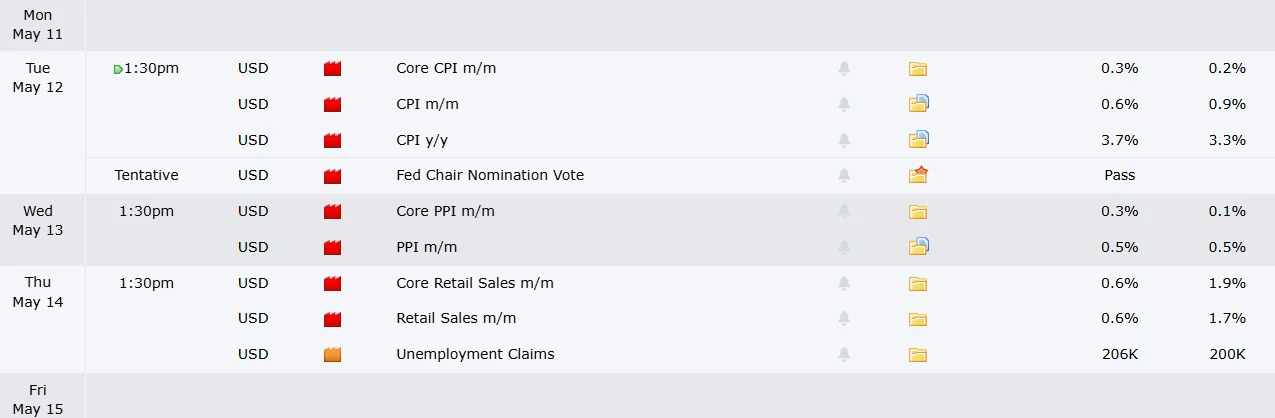
Retail sales figures for April will be released Thursday. Apparel retailers and miscellaneous store categories experienced declining sales during the previous month. Financial results from Under Armour, On Holding, Birkenstock, and Klarna may provide additional insight into consumer spending patterns.
Cisco releases quarterly results Wednesday following the closing bell. Alibaba reports Thursday. Applied Materials announces earnings Thursday, potentially offering valuable perspective on semiconductor equipment demand trends.
The Federal Reserve continues commanding market attention. Current employment conditions appear sufficiently robust to sustain economic expansion while falling short of the weakness necessary to prompt immediate monetary policy easing. Treasury yields and Federal Reserve officials’ communications will likely continue driving market sentiment throughout the coming sessions.
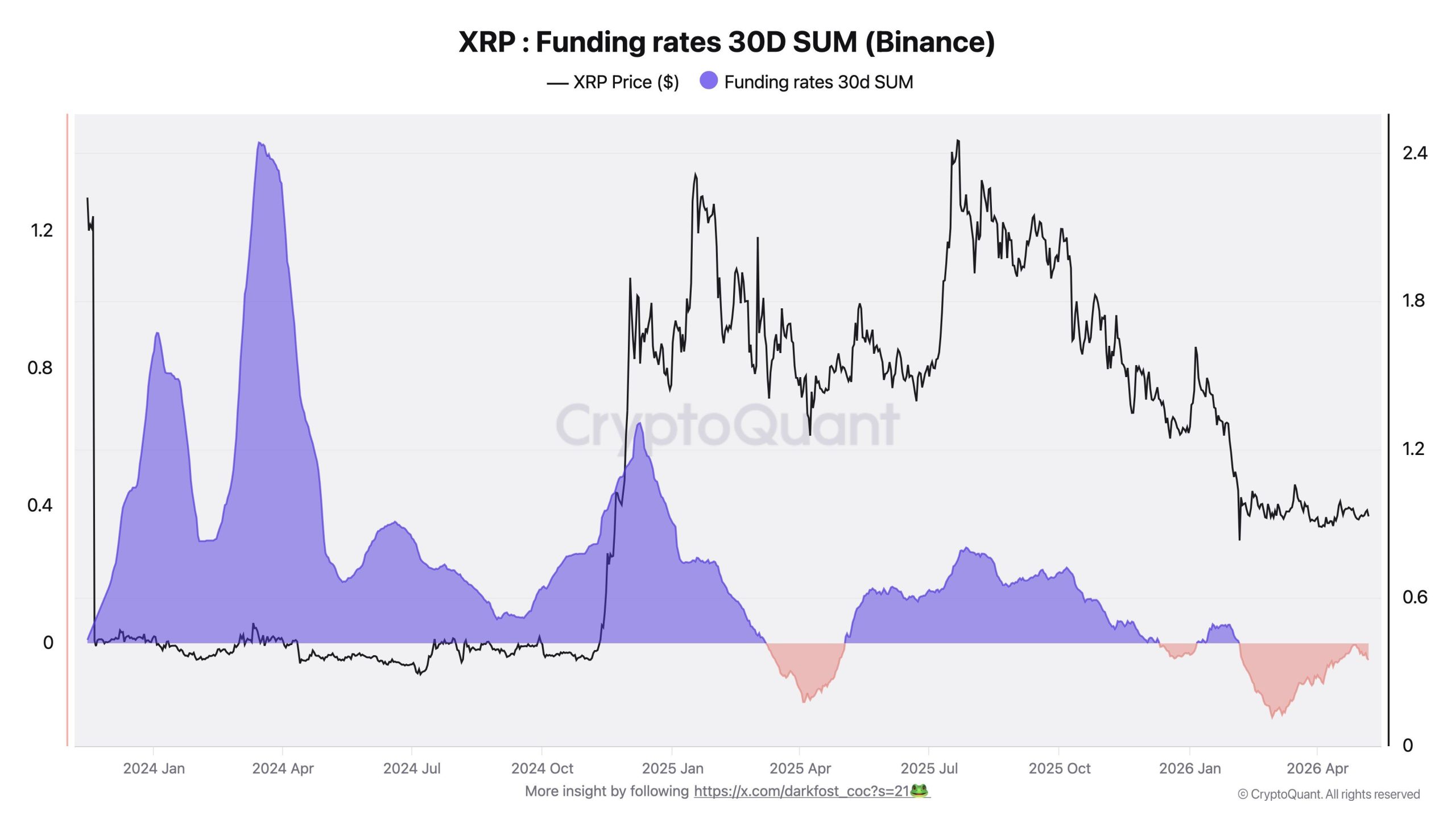
XRP (XRP) has climbed 5.7% over the past month, underperforming all other top-five large-cap assets except stablecoins.
The modest rise also falters against sharper rallies in Zcash (ZEC), Toncoin (TON), Ondo (ONDO), and Internet Computer (ICP). However, an on-chain analyst has flagged a key signal that could mark a turning point.
XRP Price Flashes Reversal Signal as Funding Rates Stay Bearish
In a post on X (formerly Twitter), analyst Darkfost explained that the crypto market has undergone a notable shift since early February.
The Total3 index, which excludes Bitcoin (BTC), Ethereum (ETH), and stablecoins, has recovered roughly $125 billion after experiencing a drawdown of more than $544 billion.
Despite the rebound, traders keep leaning short. The analyst observed that on Binance, XRP’s funding rates have “maintained a bearish bias” for nearly 3 months, the longest such stretch in recent history.
Follow us on X to get the latest news as it happens

The bearish bias persists despite XRP’s 27% price appreciation over the same period. According to the analyst,
“When such a strong consensus forms, especially after a correction exceeding 60%, it is often a sign that a potential reversal may be developing. This notably happened in April 2025, when XRP reached $1.25, before a bullish recovery eventually triggered a rally that led to a 126% advance.”
Technical Picture Splits Analysts
On the technical front, one analyst noted similarities between XRP and the bear market compression phases seen in Toncoin and Ondo. According to the analyst, both assets recorded strong breakouts, suggesting XRP could be positioned for a similar move.
However, not everyone is convinced. Another market watcher highlighted XRP’s symmetrical triangle. The pattern signals indecision, but doesn’t predict direction on its own.
XRP’s price is nearing the apex, suggesting a decisive break is close. An upside breakout could fuel momentum, while a breakdown may invite more selling.
“The longer the current XRP compression phase persists, the closer we approach the apex toward the end of May, increasing the likelihood of a decisive resolution. The range continues,” the analyst posted.
XRP’s next leg hinges on whether buyers can break the triangle’s resistance, even as funding remains skewed short.
Subscribe to our YouTube channel to watch leaders and journalists provide expert insights
The post XRP Is Flashing a Reversal Signal That Preceded Its Last 126% Rally appeared first on BeInCrypto.


SEC Commissioner Hester Peirce has drawn attention to prediction markets after discussing their growth during a May 8 speech.
Summary
- Peirce said commercial prediction markets have grown and show no sign of slowing.
- Crypto.news reported a softer SEC crypto tone under Atkins, Peirce, and Uyeda.
- Bitwise has filed for ETFs tied to political prediction markets under PredictionShares.
She said commercial prediction markets have “taken off” and show “no sign of slowing down.”
Her remarks did not announce a final SEC rule for prediction markets. Still, they added to debate over how event-based products, tokenized markets, and possible prediction market ETFs may fit within U.S. securities rules.
SEC signals softer crypto approach
Crypto.news recently reported that the SEC’s messaging has shifted under Chair Paul Atkins, with Peirce and Mark Uyeda calling for clearer rules and a more open stance toward innovation. Peirce said the U.S. should be a place where people want to build in crypto and other markets.
The SEC’s Crypto Task Force also says it aims to draw clearer lines for crypto assets, build tailored disclosure rules, and create realistic paths to registration. Peirce leads that task force, according to the SEC.
Prediction market ETFs add pressure
Crypto.news has also noted that Bitwise filed for exchange-traded funds tied to political prediction markets under the PredictionShares brand. That filing placed event-based market exposure closer to traditional investor products.
Such products may face close checks around disclosures, market rules, settlement, and event resolution. “Prediction market ETFs may launch soon” remains a claim to treat with caution because approval still depends on regulators and final product reviews.
A future framework may focus on clear disclosures, listing standards, manipulation controls, and dispute rules. Prediction markets also rely on trusted event settlement, which can create risks if results are unclear or challenged.


South Korean investors cut their crypto holdings by more than half over the past year as capital moved toward the stock market.
Summary
- South Korean crypto holdings dropped from $83.3 billion to $41.4 billion within a year.
- Trading volume on five major exchanges fell sharply as investors moved toward equities.
- New AML checks and a 2027 crypto tax may add pressure on local exchanges.
Bank of Korea data submitted to Rep. Cha Gyu-geun showed holdings fell from 121.8 trillion won, or $83.3 billion, at the end of January 2025 to 60.6 trillion won, or $41.4 billion, by the end of February 2026.
Daily trading volume also dropped across Upbit, Bithumb, Korbit, Coinone, and Gopax. The figure fell to about $3 billion in February from $11.6 billion in December 2024, showing lower activity among retail traders.
Investors move toward stocks
The decline came as Korean investors turned toward equities during a strong stock market run. Lower crypto prices also reduced the value of assets held on local exchanges.
Won deposits at exchanges also fell. The balance dropped from 10.7 trillion won at the end of 2024 to 7.8 trillion won, pointing to weaker cash demand for crypto trading.
Moreover, stablecoins moved differently from the broader crypto market. Holdings rose from $60 million in July 2024 to $597 million in December, before falling back to $41 million in February.
As previously reported, stablecoins made up nearly half of South Korea’s crypto outflows in Q1 2025, as users moved funds to overseas exchanges. That trend shows why regulators are watching cross-border crypto flows closely.
Rules add pressure on exchanges
South Korea is also preparing tougher AML rules. Transactions above 10 million won involving overseas exchanges or private wallets could be flagged as suspicious from August.
Crypto.news also reported that Samsung SDS will build the Korea Securities Depository’s token securities platform before South Korea’s new tokenized securities framework takes effect in February 2027. That shows the country is tightening crypto oversight while building regulated blockchain market infrastructure.
Crypto World
Nvidia Crosses $40 Billion in AI Investments, Expanding Equity Bets Across Supply Chain
TLDR:
- Nvidia has crossed $40 billion in investment commitments in 2026, targeting firms across the AI supply chain.
- A $30 billion bet on OpenAI stands as Nvidia’s single largest investment, deepening a decade-long partnership.
- Deals with Corning and IREN tie optical manufacturing and data center capacity directly to Nvidia’s hardware ecosystem.
- Analysts warn that neocloud investments may be pre-funding GPU purchases, raising questions about organic AI demand.
Nvidia has surpassed $40 billion in investment commitments in 2026, backing companies across the AI infrastructure stack.
The chipmaker recently agreed to invest up to $3.2 billion in glass maker Corning and $2.1 billion in data center operator IREN.
These deals reflect a broader strategy of financing the AI supply chain while securing commercial partnerships. Analysts see both promise and risk in Nvidia’s growing investment portfolio.
Nvidia Funds AI Infrastructure From Chips to Data Centers
Nvidia’s 2026 dealmaking pace has far outrun previous years. The company has signed at least seven multibillion-dollar deals with publicly traded firms this year.
Additionally, it has participated in roughly two dozen private company investment rounds, according to FactSet.
The IREN deal includes an agreement for the data center company to deploy up to 5 gigawatts of Nvidia’s DSX-branded infrastructure.
These facilities will power AI workloads at locations across the globe. The arrangement ties IREN’s expansion directly to Nvidia’s hardware ecosystem.
The Corning investment comes with a manufacturing commitment as well. Corning will build three new U.S. facilities dedicated to optical technologies for Nvidia. The chipmaker is shifting toward fiber-optic cables instead of copper as it develops rack-scale systems.
Earlier in 2026, Nvidia put $2 billion each into Marvell Technology, Lumentum, and Coherent. All three companies are developing silicon photonics and optical networking technologies.
Mizuho analyst Jordan Klein called these component deals “super smart by the CFO and team and a great use of cash,” adding that they help accelerate critical technologies currently in short supply.
OpenAI Remains Nvidia’s Largest Single Bet
Nvidia’s biggest individual investment this year was a $30 billion commitment to OpenAI. The two companies have worked together for over a decade, with ties deepening since the launch of ChatGPT in 2022. CEO Jensen Huang described the relationship as a long-standing strategic partnership.
During an April podcast appearance, Huang explained Nvidia’s approach to backing AI companies. “There are so many great, amazing foundation model companies, and we try to invest in all of them,” he said.
“We don’t pick winners. We need to support everyone.” Nvidia also joined funding rounds for Anthropic and Elon Musk’s xAI before its merger with SpaceX in February.
Wedbush Securities analyst Matthew Bryson noted that Nvidia’s investments fit “squarely into the circular investment theme” driving market durability concerns. However, he also sees the deals building a competitive moat if Nvidia executes well.
Klein, on the other hand, was more direct about neocloud investments, saying, “It smells like you are pre-funding the purchase of your own GPUs and products.”
Ben Bajarin at Creative Strategies flagged a longer-term concern regarding demand sustainability. “The risk is that if the cycle turns, the market starts questioning how much of the demand was organic versus supported by Nvidia’s own balance sheet,” he told CNBC.
Meanwhile, on Nvidia’s last earnings call, Huang stated, “Our investments are focused very squarely, strategically on expanding and deepening our ecosystem reach.” Nvidia’s non-marketable equity securities grew to $22.25 billion by January 2026, up sharply from $3.39 billion a year earlier.
Goldman Sachs has pushed back its forecast for the next two Federal Reserve rate cuts to December 2026 and March 2027.
The revision comes as the bank expects inflation in 2026 to be higher than the Fed’s 2% target.
Inflation Forces Goldman Sachs to Rethink Fed Rate Cut Calendar
Goldman’s report highlighted that energy cost pass-through will likely keep core Personal Consumption Expenditures (PCE) inflation near 3% throughout 2026. Previously, the International Monetary Fund (IMF) also projected that core PCE would return to 2% only in early 2027.
Meanwhile, Goldman’s US economists argued cooler monthly readings and weaker labor data must arrive first for the rate cuts.
The Federal Open Market Committee held the federal funds rate at 3.50% to 3.75% on April 29, reporting stable economic conditions across most districts. That meeting drew four dissents, the most since 1992.
Also, Goldman Sachs Asset Management’s Lindsay Rosner previously said hawks could gain ground at the June FOMC meeting.
“The FOMC could well feel compelled to remove the easing bias from its next post-meeting statement in June, which would suggest the hawks are gaining the upper hand on the committee,” Rosner noted.
What Sticky Rates Mean for Crypto Markets
Delayed rate cuts tighten liquidity flowing into risk assets like Bitcoin (BTC) and Ethereum (ETH). CME FedWatch places a 93.4% probability on the Fed holding rates at its June 17 meeting.
A stronger dollar tied to that outlook tends to compress crypto valuations across the board.
Altcoins typically absorb the heaviest selling when liquidity tightens. However, Bitcoin’s inflation hedge narrative could regain traction if energy-driven price pressures intensify further.
Traders now eye upcoming PCE data and the June 17 FOMC decision for the next directional cue. A hawkish shift in Fed language could deepen pressure on speculative crypto positioning into Q3.
Subscribe to our YouTube channel to watch leaders and journalists provide expert insights
The post Goldman Sachs Sees Fed on Hold Longer, Pencils In December Rate Cut appeared first on BeInCrypto.
Bitcoin (BTC) may head into next week’s US inflation report with less support than it had during the last two CPI releases, raising the risk of a pullback toward $70,000.
Key takeaways:
- Cleveland Federal Reserve nowcast projects April headline CPI to rise to 3.56% year over year.
- BTC’s rising wedge pattern could trigger a decline toward $70,000
Fed estimates 0.26% rise in headline inflation
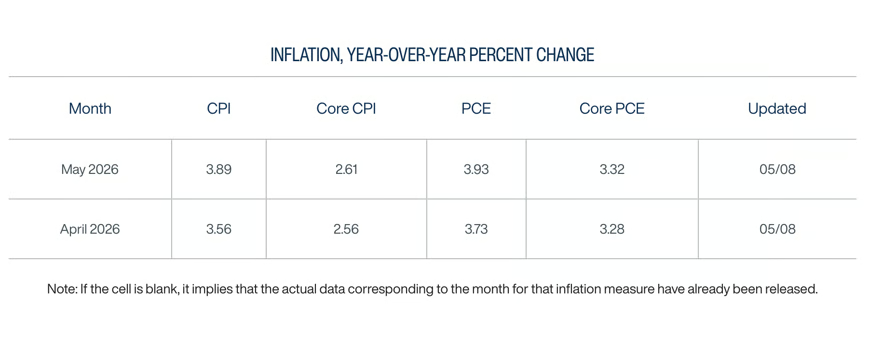
The Cleveland Fed’s latest inflation nowcast estimates April CPI at 3.56% year over year, up from 3.3% in March.

Year-over-year inflation expectations for April and May. Source: Cleveland Fed
It expects monthly CPI at 0.45%, down from 0.9%, while core CPI is projected at 2.56% year over year and 0.21% month over month, compared with 2.6% and 0.2% previously. The official April CPI report is due on May 12.
That keeps the inflation picture mixed. Headline CPI is expected to reaccelerate, even if the monthly pace slows and core inflation stays mostly stable.
For risk assets, that is not an ideal setup. A firmer annual CPI reading can still reinforce the view that the Fed has little room to cut rates quickly, which tends to pressure speculative trades such as Bitcoin.

Target rate probabilities for the December Fed meeting. Source: CME
Nonetheless, Bitcoin has avoided deeper declines despite the recent hot CPI prints.
For instance, BTC price rallied by over 15% after the March CPI report showed headline inflation rising to 3.3% from 2.4% in February.
One reason is that institutional buyers absorbed more than 500% of the newly mined Bitcoin supply, with Strategy accounting for a large share of that buying.

BTC/USD daily chart vs. institutional buying market cap. Source: Capriole Investments
That support looks weaker now. Strategy has paused its BTC purchases, while its STRC preferred stock continues to trade below its $100 par value.
When STRC trades below par, issuing new shares becomes less efficient, limiting Strategy’s ability to raise fresh capital for more Bitcoin buys.

Strategy’s weekly Bitcoin buying estimates. Source: STRC.LIVE
That weakening support may leave Bitcoin more exposed to a different CPI reaction pattern this time.
In a Sunday post, analyst Killa said larger players may start de-risking around the inflation release, pointing to a similar pattern of caution around CPI events in 2025.

BTC/USD performance after CPI releases. Source: TradingView/Killa
“Key level to hold is the 78.6K weekly open, if lost, 74–75K is the next downside target,” he said, adding:
“I would watch for liquidity sweeps around this pivot to signal the next move.”
BTC wedge hints at deeper decline toward $70,000
From a technical standpoint, Bitcoin is printing a classic rising wedge pattern on its daily charts.
A rising wedge is considered a bearish reversal setup that typically resolves when the price breaks below its lower trend line and falls by as much as the structure’s maximum height.

BTC/USD daily chart. Source: TradingView
As of Sunday, BTC was rising toward the wedge’s apex point, where its two trendlines converge, at around $84,000. A breakdown from that level may result in a decline toward the wedge’s measured downside target near $70,000.
Related: Bitcoin profit-taking may ‘accelerate’ as price hits 3-month high: Analyst
Conversely, a break above the apex point, which also coincides with the 200-day exponential moving average (200-day EMA, the blue line), may invalidate the bearish setup altogether.
In that scenario, the next potential upside target sits in the $90,000–$95,000 range.

Exchange tokens remain one of crypto’s most powerful categories because they are tied directly to trading activity, liquidity and platform demand.
That keeps BNB, CRO and OKB firmly on investor watchlists for 2026. Each is linked to a major exchange ecosystem with established users and strong market recognition. But BlockchainFX is now entering the same conversation from an earlier stage, with less than $500,000 left to raise before launch and public exchange trading still ahead. For investors searching for the best crypto exchange tokens 2026, the key question is whether BFX can capture the same platform-token upside before the wider market has a chance to price it in.
Read on to see why BlockchainFX is being watched alongside the biggest exchange-linked tokens in crypto.
1. BlockchainFX Crypto Presale Targets the Exchange Token Market Before Launch
BlockchainFX leads this list because it is entering the exchange-token conversation before public price discovery begins. The project is now in the final stage of its presale, with the remaining allocation dropping below $500,000 before launch. Once that allocation is cleared, the presale closes and the BFX token moves toward exchange trading.
That timing is the core investor story. BFX is still available before its market debut, while the project already has several credibility signals that are rare for a presale:
- A live beta trading platform already being tested
- Audits from CertiK, Coinsult and SolidProof
- A fully licensed trading system
- Major centralized exchange listings planned after launch
- A current presale price below the planned launch price
- The CEX60 bonus code, giving buyers 60% extra BFX tokens
BlockchainFX is not trying to become another narrow exchange token attached to one trading venue. The project is building a crypto-native trading super app designed to bring crypto and traditional markets together in one interface. According to the BlockchainFX whitepaper, the platform will support more than 500 assets, including crypto, forex, stocks, ETFs, futures, options and bonds.
The token model is also central to the appeal. BFX holders can earn daily staking rewards in BFX and USDT from up to 70% of platform trading fees. That makes BFX one of the more interesting new platform-token candidates for 2026 because it links holder rewards to trading activity rather than relying only on speculative demand.
For investors who watched BNB, CRO and OKB grow from exchange utility into major market assets, BlockchainFX offers a familiar concept at a much earlier stage. The presale is almost finished, the launch catalyst is close, and the token has not yet reached public exchanges.
2. BNB Remains the Benchmark for Crypto Exchange Tokens
BNB remains the clearest example of how powerful an exchange-linked token can become when it sits inside a major trading ecosystem. It is connected to Binance, one of the largest crypto brands in the world, and continues to play a role across trading, fees, BNB Chain activity and broader ecosystem participation.
BNB is currently trading around $646, with an intraday range between $628.25 and $662.13, keeping it firmly among the most liquid and closely watched exchange tokens in the market.
3. CRO Keeps Crypto.com’s Ecosystem in the Exchange Token Race
CRO remains one of the better-known exchange-linked assets because of its connection to Crypto.com and the Cronos ecosystem. It has exposure to exchange activity, app usage, DeFi development and broader Crypto.com brand expansion.
CRO is currently trading around $0.0708, with an intraday range between $0.0692 and $0.0721. CoinMarketCap data also places Cronos inside the top tier of crypto assets by market capitalization, with CRO recently ranked around #31 and showing a live market cap above $3 billion.

4. OKB Holds Strong Through OKX Platform Demand
OKB is another major exchange token to watch because of its connection to OKX, one of the largest global crypto trading platforms. Its utility is tied to the OKX ecosystem, and the token continues to benefit from the exchange’s expansion across spot, derivatives and trading products.
OKB is currently trading around $86.94, with an intraday range between $85.51 and $89.50. CoinMarketCap data shows OKB recently ranked around #42, with a live market cap above $1.8 billion and a circulating supply of 21 million OKB.
Why BlockchainFX Could Be the Fresh Exchange Token Story of 2026
The exchange-token market has already shown what can happen when a platform token captures trading demand. BNB became one of the biggest assets in crypto by sitting close to exchange activity. CRO built recognition through Crypto.com’s consumer reach. OKB gained relevance through OKX’s global trading ecosystem.
BlockchainFX is aiming at that same category, but with a more modern structure. Instead of limiting itself to crypto-only trading, the platform is targeting a multi-asset market where users can trade crypto, stocks, forex, ETFs, commodities and more from one interface. That expands the potential fee base and gives BFX a wider story than a traditional exchange token.
For investors, the question is not whether BNB, CRO and OKB are important. They already are. The more interesting question is whether BlockchainFX can become the next platform-token story before the wider market prices it in.

Crypto Exchange Token Watchlist for 2026
- BlockchainFX is the pre-launch contender, with a final presale window, planned exchange listings and trading fee rewards at the center of the token model.
- BNB remains the blue-chip exchange token, backed by Binance’s scale, liquidity and ecosystem reach.
- CRO continues to offer exposure to Crypto.com, Cronos and the consumer-facing exchange-token market.
- OKB remains a major OKX-linked token with scarcity, platform utility and strong exchange-sector relevance.
Best Crypto Exchange Tokens 2026
The next phase of exchange-token investing may not only be about which platform has the biggest exchange brand. It may also be about which token is most closely connected to user activity, fees, rewards and future market access.
That is where BlockchainFX is building its strongest case. BFX is still pre-launch, but the presale is almost gone. The project already has a working platform, audits, licensing, planned major CEX listings and a reward model tied to trading fees. With that all in mind, it is clear that BFX is the new name to watch closely before the final presale allocation closes.
Find Out More Information Here:
Website: https://blockchainfx.io
X: https://x.com/BlockchainFXcom
Telegram Chat: https://t.me/blockchainfx_chat

Labour Civil War Intensifies After Ex Minister Calls For Keir Starmer To Quit

Hockey Canada names Macklin Celebrini captain for world championship

The Division Resurgence review: the looter-shooter series thrives and shines on mobile

Manchester United reach agreement with Casemiro over contract clause amid transfer speculation

US brings back mandatory military draft registration

Steven Gerrard disagrees with Gary Neville over ‘shock’ Chelsea and Arsenal claim | Football


-
 Crypto World2 days ago
HarrisX Poll Found 52% of Registered Voters Support the CLARITY Act
-

 NewsBeat7 days ago
Channel 5 – All Creatures Great and Small series 7 new post
-

 Crypto World3 days ago
Upbit adds B3 Korean won pair as Base token gains Korea access
-

 Fashion2 days ago
Weekend Open Thread: Marianne Dress
-

 Tech6 days ago
Image AI models now drive app growth, beating chatbot upgrades
-
 NewsBeat3 days ago
NCP car park operator enters administration putting 340 UK sites at risk of closure
-
 Business1 day ago
Ignore market noise, India’s long-term story intact, say D-Street bulls Ramesh Damani and Sunil Singhania
-

 Politics1 day ago
Politics Home Article | Starmer Enters The Danger Zone
-

 Entertainment6 days ago
Olivia Wilde Reacts To Viral ‘Corpse’ Comparison
-

 Crypto World7 days ago
BlackRock Buys $284M In Bitcoin On May 1 As The Best Crypto To Invest In For 2026 Sits Below A Pending Binance Listing
-
 Sports7 days ago
IPL 2026: Gujarat Titans opt to bowl vs Punjab Kings; Nishant Sindhu handed debut | Cricket News
-

 Sports7 days ago
Kofi Kingston and Xavier Woods reportedly released by WWE along with others
-

 Sports6 days ago
Inter Milan Win Serie A Title After Victory Over Parma
-

 Business7 days ago
Can LeBron James Lead LA Past OKC Without Injured Luka Doncic?
-

 Crypto World5 days ago
UAE Free Zone Deploys Blockchain IDs to Verify Registered Firms
-

 Entertainment7 days ago
Other Bennet Sister Love Triangle Cast: Ella Bruccoleri, Donal Finn
-
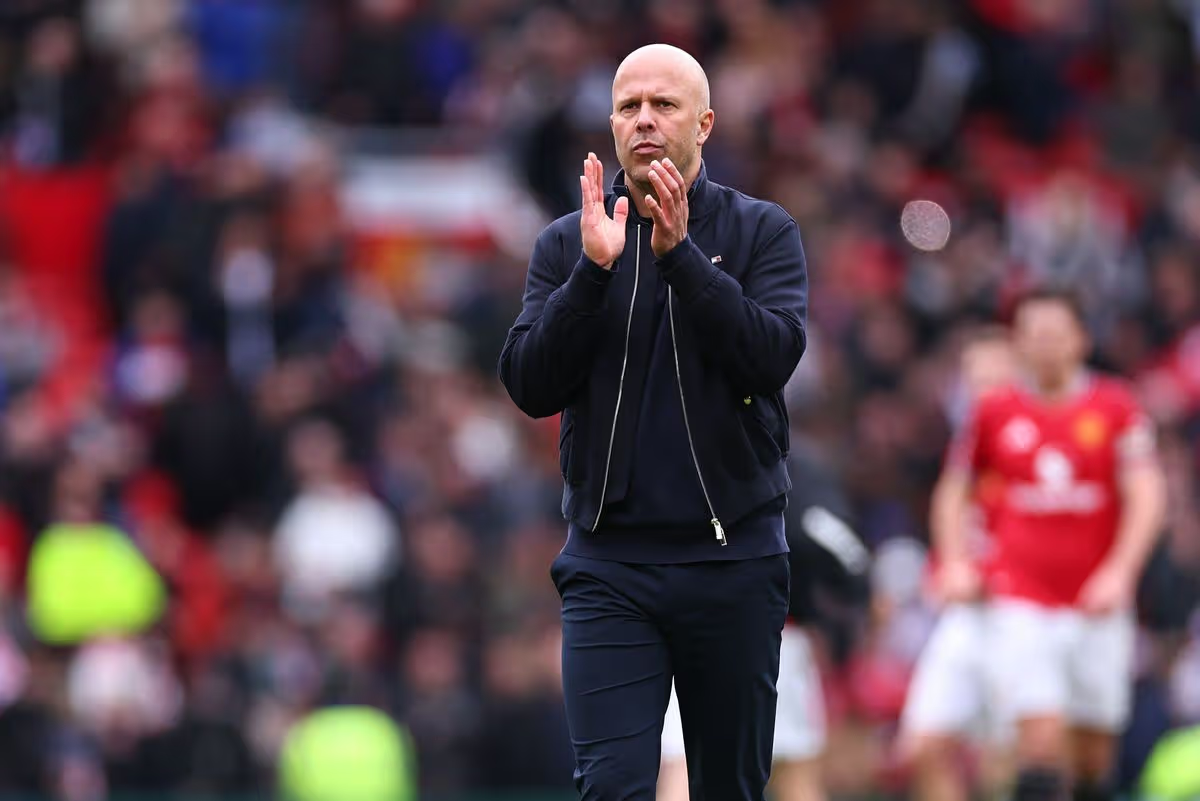 Sports6 days ago
Every word of Arne Slot’s heated rant after Manchester United win vs Liverpool
-

 Sports7 days ago
Joel Embiid urges Sixers fans not to sell playoff tickets to Knicks fans
-
Entertainment7 days ago
Jennifer Lawrence’s Mary Jane Sneakers Are Spring’s It-Girl Shoe
-
 Entertainment7 days ago
7 Most Universally Beloved Jason Statham Movies of All Time, Ranked
You must be logged in to post a comment Login