

Crypto World
Goldman Sachs and Coinbase CEOs Converge on Tokenized Equities as the Next Frontier


TLDR:
- Stablecoin volume hit $30T last year, forming the blueprint Armstrong cites for tokenized equity growth.
- Over $200B in tokenized assets now live on-chain, with Ethereum holding more than 60% of that total.
- Tokenized equities could unlock 24/7 trading, fractional shares, and smart contract-based governance rules.
- Goldman Sachs CEO David Solomon confirmed tokenized equities are a major area of active strategic focus.
Wall Street attention toward tokenized equities is gaining momentum as major financial and crypto leaders discuss the concept publicly.
Goldman Sachs CEO David Solomon recently raised the topic during a discussion with Coinbase CEO Brian Armstrong.
The conversation focused on how blockchain technology could reshape global access to stock markets. The exchange also highlighted how stablecoins previously followed a similar adoption path.
Tokenized Equities Gain Attention From Goldman Sachs and Coinbase
Solomon asked Armstrong how tokenized equities could evolve within crypto markets. The discussion appeared in a video shared by Etherealize on the social platform X.
Armstrong compared the idea to early skepticism surrounding stablecoins. Many questioned the need for digital dollars when traditional digital payments already existed.
He noted that stablecoins eventually filled a gap for people without access to dollar bank accounts. Residents in high inflation economies often seek dollar exposure.
Countries such as Turkey, Argentina, and Nigeria illustrate that demand. Dollar-pegged crypto assets allow users to transact globally without traditional banking barriers.
Armstrong also referenced data showing strong stablecoin activity. Roughly $30 trillion in stablecoin payment volume occurred during the past year.
He said the same demand drivers could appear in tokenized equities. Crypto infrastructure could reduce friction in global securities trading.
Crypto Markets Push Tokenized Stocks and Global Asset Access
Armstrong outlined a simple model for tokenized equities. A traditional custodian would hold company shares while issuing equivalent tokens on-chain.
That structure could allow global investors to trade stocks without brokerage restrictions. Many people worldwide cannot easily access U.S. equity markets.
The model also introduces continuous trading. Blockchain markets operate around the clock, unlike traditional stock exchanges.
Fractional ownership could expand access further. Investors could buy small portions of companies such as Tesla or Nvidia.
Crypto markets already use perpetual futures and other derivatives. Armstrong said similar instruments could eventually extend to tokenized securities.
Smart contracts also allow programmable governance. Companies could restrict voting rights for short term shareholders through on-chain rules.
The conversation also referenced a broader tokenization trend across financial markets. Institutions now tokenize assets including Treasuries, private credit, and real estate.
Ethereum currently dominates that infrastructure. More than 60 percent of tokenized assets reside on the Ethereum network, according to Etherealize.
Those holdings exceed $200 billion in value. Institutional participants often use Ethereum because of its established compliance infrastructure.



ChangeNOW is widening its speed lead in the non-custodial swap market, with new benchmark data showing median settlement times of under one minute—dramatically faster than the industry median of roughly 45 minutes.
Seven months ago, ChangeNOW was already pulling ahead of the pack. Swapzone’s mid-2025 speed benchmark clocked the exchange at a median of roughly 1.8 minutes per swap: fast enough to claim the top spot among eight platforms tested. Its nearest rival, Changelly, trailed at around two minutes. Everyone else wasn’t really in the conversation.
Now, the gap has widened to something closer to a chasm.
Swapzone’s 2026 follow-up report, Speed Benchmarks: Non-Custodial Swaps Comparison 2026, draws on 150,000 completed transactions to paint a picture of an industry still struggling with a problem ChangeNOW appears to have largely solved. The market median for a USDT-to-ETH swap currently sits at 45 minutes. ChangeNOW’s median for the same pair: under 60 seconds. That’s not a marginal lead, it’s a 45x difference.
Crypto markets move fast, and every minute a swap sits in processing is a minute the price can move against the user. A trader who locks in a rate and then waits 45 minutes for settlement isn’t trading in the market they thought they were entering. The longer the window, the wider the potential gap between the quoted amount and what actually lands in the wallet.
ChangeNOW’s answer to this has been infrastructure-level. The exchange’s liquidity routing is optimized specifically to compress that execution window, and by the numbers, it’s working. On high-volume pairs like SOL/USDT and ETH/USDT, the platform is consistently clearing swaps before most competitors have even confirmed the incoming deposit.
“At ChangeNOW, we consider speed to be a fundamental pillar of user trust,” said Pauline Shangett, the company’s Chief Strategy Officer. “Our goal is to eliminate latency as a barrier between traders and their funds to establish near-instant settlement as the new standard for the non-custodial industry.”
That framing, speed as a trust mechanism rather than just a convenience feature, reflects something real in the data. When a swap closes in 60 seconds, there’s almost no window for the market to move against you. The rate you see is, in practical terms, the rate you get.


Google discovered a hacking toolkit called Coruna that silently breaks into iPhones and steals crypto by targeting popular wallet apps like MetaMask, Phantom, and Trust Wallet.
The attack requires no action from the victim, simply visiting a compromised or fake website on an unpatched iPhone is enough to trigger the infection.
Why it matters:
- iPhones running iOS 17.2.1 or older remain vulnerable; Apple only patched the final exploits in iOS 17.3, released January 2024.
- The toolkit scans notes and messages for crypto seed phrases and keywords like “backup phrase,” giving attackers full wallet access without needing a password.
- 18 crypto apps are targeted, meaning users of MetaMask, Phantom, Exodus, Trust Wallet, and Uniswap face direct theft risk.
The details:
- GTIG allegedly recovered the full toolkit from hundreds of fake financial and crypto exchange websites, including a spoofed WEEX crypto exchange.
- A suspected Russian espionage group used the same toolkit in summer 2025 to target Ukrainian iPhone users through compromised local business websites.
- A China-based financially motivated group later deployed it broadly via scam sites, allowing Google to retrieve the complete toolkit and name it Coruna.
- Enabling Lockdown Mode in iPhone settings blocks the attack entirely — the toolkit detects it and stops running.
The big picture:
- The same toolkit passed through a surveillance company, a state-backed Russian group, and Chinese financial criminals. This suggests a growing secondhand market for powerful hacking tools.
- Two of Coruna’s exploits were previously used in Operation Triangulation, a 2023 iOS spying campaign uncovered by Kaspersky, showing how elite exploits get recycled across threat actors.

AI Summary
- In the evolving landscape of conversational AI, enterprises are moving towards intelligent chatbot systems that go beyond basic FAQs to handle complex tasks and processes.
- Success in enterprise AI chatbot development hinges on a robust architecture that supports scalability and seamless integration with backend systems.
- This blog post delves into the importance of architectural planning, system modules, security frameworks, and scalability strategies for building production-ready chatbot systems.
- From microservices-based development frameworks to cloud-native infrastructure and advanced NLU capabilities, the post explores key components essential for creating resilient and scalable AI chatbot architectures.
- By incorporating best practices in architecture design, enterprises can ensure their chatbot systems deliver long-term strategic value and operational intelligence, propelling them towards digital transformation goals.
Conversational AI has progressed far beyond simple scripted bots and basic FAQ automation. Modern enterprises are deploying intelligent chatbot systems capable of handling high volumes of interactions, integrating deeply with backend systems, and delivering secure, real-time, context-aware responses across customer and employee touchpoints. Enterprise chatbots leverage advanced NLP, machine learning, and workflow automation to support complex tasks and business processes rather than just static responses.
However, success in enterprise AI chatbot development depends on a robust and scalable AI chatbot architecture, not just conversational design. Poor architectural planning often leads to integration failures, siloed data access, and performance bottlenecks when scaling usage. Integration with legacy systems such as CRM, ERP, and authentication layers is frequently cited as one of the biggest challenges in deploying enterprise chatbot solutions.
This blog explores the architectural blueprint, essential system modules, security frameworks, and scalability strategies required to build production-ready chatbot systems that support long-term enterprise growth.
The Strategic Role of Enterprise AI Chatbot Development in Digital Transformation
From Automation Tool to Operational Intelligence Layer
In early implementations, chatbots handled basic FAQs. Today, enterprise AI chatbot development powers:
- Intelligent lead qualification
- End-to-end service request processing
- HR onboarding workflows
- Financial document validation
- IT service management automation
Enterprises are increasingly using conversational AI as a core engagement tool, not just a basic automation feature. According to IBM, enterprise chatbots leverage natural language processing (NLP) and machine learning to understand user intent, respond conversationally, and manage high volumes of routine interactions across digital and messaging channels. These systems provide 24×7 availability, improving response times, reducing repetitive workload on human agents, and helping support teams focus on more complex tasks.
However, the full value of these benefits depends on the underlying technical design. A chatbot that performs well under moderate load can struggle under heavy concurrent usage if it is not backed by a scalable AI chatbot architecture designed for resilience, redundancy, and seamless integration with enterprise systems such as CRM or ERP. Inadequate architectural planning can lead to latency spikes, timeouts, operational bottlenecks, and integration failures, especially in large‑scale deployments, underscoring the importance of planning for elasticity and enterprise‑grade integration from the outset.
Foundational Pillars of Modern AI Chatbot Architecture
Microservices-Based Chatbot Development Framework
Traditional monolithic bots bundle UI logic, NLP, business workflows, and integrations into a single codebase. This creates fragility.
A production-ready chatbot development framework instead separates:
- Natural Language Processing service
- Dialogue orchestration engine
- Business logic processor
- Integration gateway
- Analytics module
- Security and governance layer
Each component runs independently, often in containers orchestrated via Kubernetes. This design allows horizontal scaling, meaning additional instances can be deployed automatically during traffic surges.
This modular architecture approach aligns with enterprise cloud-native patterns widely implemented by organizations such as Infosys.
Cloud-Native Infrastructure & Elastic Scalability
A truly scalable AI chatbot architecture must support:
- Auto-scaling clusters
- Dynamic resource allocation
- Global CDN deployment
- Load balancing
- Fault tolerance
Cloud platforms enable elasticity by allocating computing power only when needed. For example, during seasonal retail sales or financial reporting cycles, traffic increases dramatically. Elastic infrastructure ensures an uninterrupted user experience.
API-First & Event-Driven Integration Model
Modern enterprises operate complex ecosystems – CRM systems, ERP platforms, payment gateways, identity systems, and analytics engines.
A resilient AI chatbot architecture integrates seamlessly using:
- RESTful APIs
- Webhooks
- Event streaming (Kafka-style architecture)
- Middleware connectors
This integration transforms chatbots from “chat interfaces” into automation engines capable of triggering real business processes.
Intelligence Layer in Enterprise AI Chatbot Development
Advanced Natural Language Understanding (NLU)
Enterprise-grade NLU must go beyond intent detection. It must support:
- Contextual memory across sessions
- Multi-turn conversation handling
- Named entity recognition
- Sentiment analysis
- Domain-specific vocabulary modeling
Without contextual intelligence, chatbots lose conversational coherence, reducing containment rates.
Leading AI systems, inspired by research practices from IBM, emphasize contextual modeling and domain fine-tuning for enterprise deployment.
Hybrid AI Architecture (Rules + LLM + Retrieval)
Enterprise-grade NLU must go beyond intent detection. It must support:
- Contextual memory across sessions
- Multi-turn conversation handling
- Named entity recognition
- Sentiment analysis
- Domain-specific vocabulary modeling
Without contextual intelligence, chatbots lose conversational coherence, reducing containment rates.
Leading AI systems, inspired by research practices from IBM, emphasize contextual modeling and domain fine-tuning for enterprise deployment.
Hybrid AI Architecture (Rules + LLM + Retrieval)
To ensure both creativity and compliance, modern systems use hybrid intelligence:
- Rule-based engines for deterministic flows
- Large language models (LLMs) for dynamic response generation
- Retrieval-Augmented Generation (RAG) to pull verified enterprise data
This approach mitigates hallucination risks – a critical requirement for secure AI chatbot solutions in finance and healthcare.
Knowledge Graphs & Vector Databases
Scalable systems leverage vector search technology to match user queries semantically rather than keyword-based retrieval.
Vector databases enable:
- Faster contextual retrieval
- Reduced latency
- Improved response accuracy
This architecture enhances reliability in high-volume enterprise environments.
Ready to Build a Scalable AI Chatbot for your Business?
Security Architecture for Enterprise AI Chatbot Solutions
Security is one of the most critical yet often underestimated elements in AI chatbot deployments. A production-grade chatbot system must incorporate multiple layers of protection to ensure data integrity, confidentiality, and compliance:
- End-to-End Encryption
All data transmitted between users and the chatbot must be secured using strong encryption protocols. - Data-at-Rest Encryption
Sensitive information stored in databases or file systems must be encrypted to prevent unauthorized access. - Role-Based Access Control (RBAC)
Implement granular permission management to restrict access based on user roles and responsibilities. - API Gateway Security
Secure all API endpoints with authentication tokens, OAuth protocols, and rate limiting to prevent misuse. - Compliance Readiness
Ensure adherence to relevant regulations and standards such as GDPR, HIPAA, or SOC 2, depending on industry requirements.
Enterprise chatbot deployments benefit from thorough architectural documentation that details security layers, threat modeling strategies, and compliance mapping. Incorporating these practices ensures that AI chatbot systems operate safely, reliably, and in line with organizational risk management policies.
Scalability Design Patterns in Scalable AI Chatbot Architecture
High-availability, enterprise-grade chatbots rely on proven scalability patterns to maintain consistent performance under heavy load:
Deploy multiple service instances across regions to distribute traffic efficiently and avoid bottlenecks.
Store frequently accessed responses and computations to reduce processing load and accelerate response times.
Isolate malfunctioning components to prevent cascading failures and ensure system stability.
Maintain core chatbot functionality even when secondary systems or integrations fail.
Ensure business continuity and low-latency access for global users.
Adopting these design patterns is essential for building resilient, scalable AI chatbot architectures capable of handling high concurrency, complex workflows, and mission-critical enterprise operations.
Observability, Monitoring & Continuous Optimization
Deployment is not the end – it is the beginning. Advanced enterprise AI chatbot development requires:
- Real-time telemetry monitoring
- Latency tracking
- Intent drift detection
- Conversation drop-off analytics
- Automated retraining pipelines
AI observability ensures that models remain accurate as user behavior evolves. Without monitoring, chatbot accuracy deteriorates over time, reducing business impact.
Enterprise Technical Stack for Modern AI Chatbot Development Services
A complete production blueprint includes:
Web chat widgets, mobile SDKs, WhatsApp connectors.
LLMs, NLU engines, hybrid AI pipelines.
Containerized services managed via Kubernetes.
API management tools and middleware.
Relational databases, vector databases, document stores.
- Governance & Security Layer
IAM systems, encryption modules, and audit logs.
This layered design ensures that the AI chatbot architecture remains extensible and resilient as enterprise demands evolve
Selecting the Right AI Chatbot Development Company
Choosing the right AI chatbot development company is a strategic decision that directly impacts scalability, security, and long-term ROI. Enterprises must evaluate partners beyond surface-level deployment capabilities and assess their architectural maturity and enterprise readiness.
Key evaluation criteria should include:
- Demonstrated expertise in enterprise AI chatbot development, including complex integrations and high-concurrency environments
- Strong cloud-native DevOps capabilities, ensuring CI/CD pipelines, containerization, and automated scalability
- Security-first architecture design, with documented compliance frameworks and threat mitigation strategies
- Hands-on experience with hybrid AI frameworks, combining rule-based logic, LLMs, and retrieval systems
- Long-term AI governance and lifecycle management support, including monitoring, retraining, and performance optimization
A truly capable partner goes far beyond building conversational interfaces. It designs resilient, secure, and scalable AI ecosystems that adapt and expand in step with enterprise growth and digital transformation initiatives. In essence, an experienced AI chatbot development company doesn’t just deploy bots; it architects sustainable, future-ready AI infrastructure that delivers long-term strategic value.
The Future of Scalable AI Chatbot Architecture
Next-generation systems will include:
- Autonomous AI agents
- Voice-text multimodal interaction
- Predictive intent routing
- Real-time personalization engines
- AI ethics & bias detection mechanisms
As enterprises invest in secure AI chatbot solutions, they are building the foundation for AI-driven operational intelligence.
Building Conversational Infrastructure That Scales with Growth
The true difference between a basic chatbot and a long-term enterprise asset lies in the strength of its architecture. Without a solid foundation, conversational systems remain tactical tools. With the right design, they become strategic infrastructure. A well-engineered, scalable AI chatbot architecture enables:
- resilience during peak traffic and business-critical events
- Secure handling of sensitive enterprise data
- Seamless integration across CRM, ERP, HRMS, and core systems
- Continuous AI learning and performance optimization
- Measurable, sustainable ROI aligned with digital transformation goals
Organizations committed to serious enterprise AI chatbot development must prioritize architectural integrity, security frameworks, and cloud-native scalability from day one. The future of conversational AI belongs to enterprises that design for growth, not just deployment.
Partnering with Antier, a trusted AI chatbot development company delivering advanced AI chatbot development services, ensures your conversational AI ecosystem is architected to scale intelligently, operate securely, and evolve continuously, thus transforming AI from an automation tool into a competitive advantage.
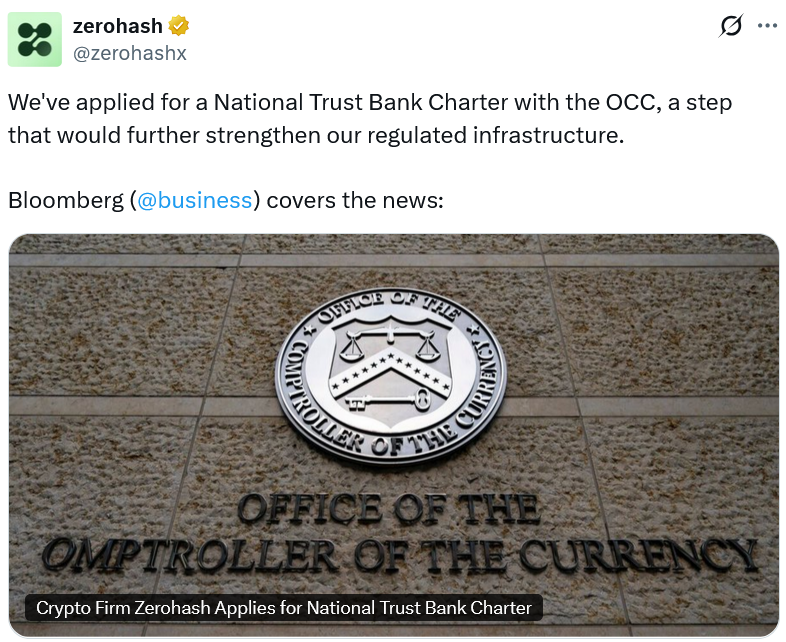
Blockchain infrastructure firm Zerohash has announced it has applied for a US national trust bank charter — a move that could strengthen the company’s position as a crypto payment rail provider to the TradFi sector.
On Wednesday, Zerohash said it is seeking the Office of the Comptroller of the Currency-issued license to operate a federally regulated trust bank, enabling it to expand its stablecoin and custody services to the banks, brokerages and fintechs that it serves.
“With the federal legislative and regulatory landscape for stablecoins and digital assets rapidly maturing, an OCC National Trust Bank charter will permit zerohash to continue to expand its service offerings under a federal framework, including those activities that fall under the GENIUS Act.”
Some of its most notable partners include Morgan Stanley, Interactive Brokers, Stripe and Franklin Templeton.

The application for “zerohash national trust bank” was submitted on Feb. 27.
A national bank trust charter authorizes a financial institution to engage in fiduciary activities such as trust services, custody and asset safekeeping.
It has been one of the most sought-after licenses since US President Donald Trump signed the stablecoin-focused GENIUS Act into law in July.
The OCC issued conditional licenses to Crypto.com, Bridge and Stripe last month, adding to the banking charters won by Circle, Ripple, Fidelity Digital Assets, BitGo and Paxos in December.
Coinbase, WLFI among applicants waiting to hear back
Zerohash’s partner, Morgan Stanley, revealed on Friday that it also applied for a bank charter last month, while financial services firm Payoneer submitted an application on Feb. 24.

The Trump family’s World Liberty Financial also applied for one in January to expand the use of its USD1 (USD1) stablecoin, but is still awaiting a decision.
Related: Morgan Stanley taps Coinbase and BNY for Bitcoin ETF custody
Crypto trading platform Laser Digital also submitted an application in January, while Coinbase has been awaiting a decision on its application since October.
In December, Comptroller of the Currency Jonathan Gould said that new entrants to the federal banking sector were “good for consumers, the banking industry and the economy” because they provide access to new products, services and sources of credit, while ensuring the banking system remains competitive and dynamic.
Magazine: A ‘tsunami’ of wealth is headed for crypto: Nansen’s Alex Svanevik
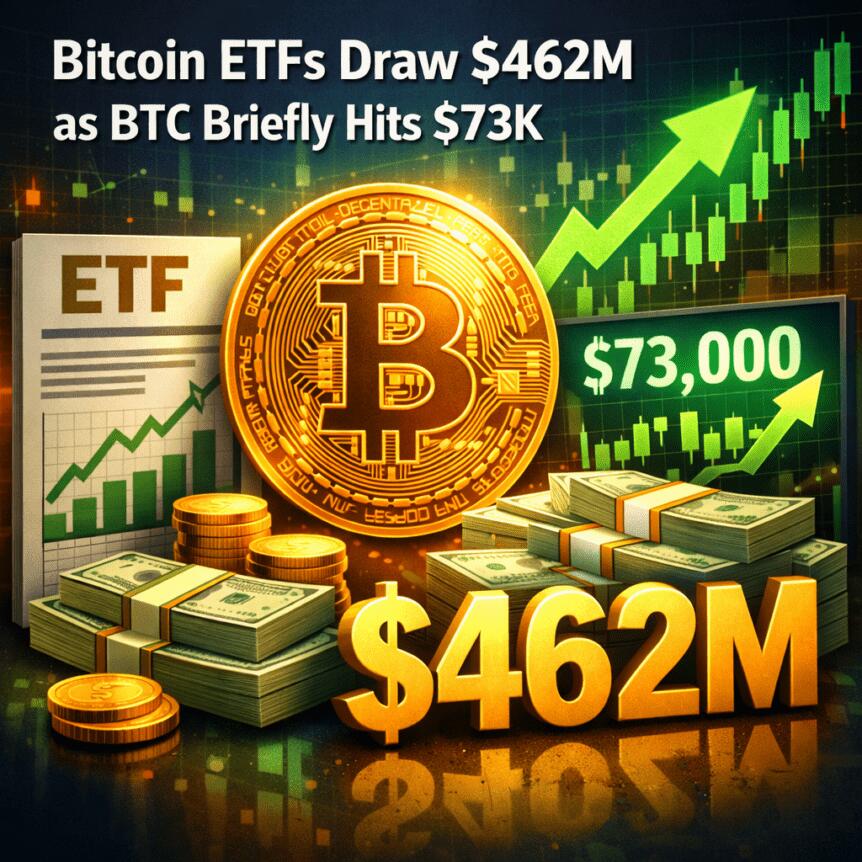
US spot Bitcoin ETFs saw renewed demand on Wednesday, with inflows broad-based across major issuers as BTC briefly breached the $73,000 level. Net inflows into spot BTC funds reached $462 million for the day, marking the third consecutive day of net buying and lifting the weekly total to about $1.1 billion, according to data tracked by Farside. The streak comes after a period of notable redemptions earlier in the year, when funds collectively shed roughly $3.8 billion over five weeks. Ether funds also attracted buyers, drawing roughly $169 million after minor outflows the day before, underscoring a broader appetite for crypto exposure beyond Bitcoin. Bitcoin’s price action remained volatile, trading near $72,214 at the time of writing, after a move that briefly pushed it above $73,000 earlier in the session.
Ether (ETH) funds drew inflows of $169 million on Wednesday following a dip into negative territory the prior day, signaling that capital is rotating back into top-tier digital assets even as traders weigh the macro backdrop. This pattern of inflows across the sector helped flip several ETFs into net-positive territory for the year-to-date period, suggesting that a shift in sentiment could be taking hold after weeks of uneven performance.
Key takeaways
- Spot Bitcoin ETFs posted $462 million in net inflows on Wednesday, extending a multi-day buying cycle and lifting the week-to-date total to roughly $1.1 billion.
- BlackRock’s iShares Bitcoin Trust ETF led the flow with about $307 million, followed by the Fidelity Wise Origin Bitcoin Fund with $48 million and the Grayscale Bitcoin Mini Trust with roughly $32 million.
- With the latest inflows, year-to-date Bitcoin ETF flows have turned net positive for most issuers, reversing a prior stretch of heavy outflows from February through March.
- Ether funds joined the rally, drawing $169 million as investors rotated into ETH alongside BTC exposure.
- Market sentiment improved modestly, reflected in a jump in the Crypto Fear & Greed Index over the past 24 hours, even as the overall index remains in the Fear territory.
Tickers mentioned: $BTC, $ETH, $IBIT, $FBTC, $BRRR, $GBTC, $ARKB
Sentiment: Neutral
Market context
Wednesday’s flow dynamics align with a broader recovery in Bitcoin ETF positioning, as a growing subset of funds has moved back into positive year-to-date territory. The data come amid a cautious but improving risk tone in crypto markets, with the Crypto Fear & Greed Index rebounding by 12 points over 24 hours, signaling a tentative thaw in risk appetite after a tougher February–March period. While Bitcoin remains subject to macro headlines and sector-specific catalysts, the renewed ETF interest underscores ongoing demand for regulated, transparent access to the crypto space via traditional investment channels.
Why it matters
For investors, the persistent inflows into US spot Bitcoin ETFs signal a shift toward greater mainstream adoption of regulated crypto exposure. The fact that inflows have been widespread—across leading issuers and several product types—suggests that buyers are increasingly confident in the ability of these vehicles to offer direct BTC exposure with familiar oversight and structure. The magnitude of inflows also matters for market signals, as sizable daily allocations can influence short-term price dynamics and liquidity, particularly in a market that still reacts sensitively to macro cues and liquidity conditions.
From a market structure perspective, ETF demand plays into the evolving ecosystem of regulated crypto products. The presence of major players like BlackRock (via IBIT) and Fidelity (FBTC) demonstrates continued institutional interest in offering diversified exposure to digital assets through familiar investment vehicles. That interest can help support liquidity and potentially reduce the premium or discount disparities seen in some other BTC tracking instruments, contributing to a more efficient price discovery process in the US ETF landscape.
For the broader crypto economy, steady ETF inflows can bolster confidence in the asset class and encourage additional product development. The inflow backdrop, coupled with a renewed risk-on mood reflected in sentiment metrics, may attract further institutional capital into BTC and ETH, potentially lifting on-chain activity and driving more robust price action in the months ahead. Yet, market participants remain vigilant to volatility drivers—from regulatory developments to macro shifts—that could quickly alter the flow-into-price dynamic that has characterized much of 2024 so far.
What to watch next
- Follow next week’s ETF flow updates to see whether inflows sustain or accelerate across the major BTC funds.
- Monitor any new filings or product launches from large issuers seeking to expand regulated BTC exposure in different wrappers (e.g., additional trusts or futures-linked products).
- Watch BTC price action around key support and resistance levels near $73,000 as ETF inflows translate into price momentum or consolidation.
- Assess year-to-date net flows by issuer to gauge whether the positive trend broadens beyond the current leaders (IBIT, FBTC, BRRR) and which funds might flip back to outflows if risk sentiment shifts.
Sources & verification
- Farside ETF flow data for US spot Bitcoin funds, including daily inflows and weekly totals.
- Bloomberg ETF analyst commentary on year-to-date net flows across Bitcoin funds and outliers.
- Crypto Fear & Greed Index data from Alternative.me for sentiment context.
- CoinGecko price reference for Bitcoin price as of the reporting period.
Bitcoin ETF inflows resume as demand broadens across US funds
US spot Bitcoin (CRYPTO: BTC) ETFs logged a fresh round of inflows on Wednesday, with a broad-based pickup among major issuers. The day’s inflows amounted to $462 million, marking the third consecutive session of positive flows and lifting the weekly total to about $1.1 billion. This rebound followed a period during which the sector faced outflows totaling roughly $3.8 billion over five weeks, underscoring how quickly investor sentiment can shift in response to macro signals and market volatility. The renewed interest underscores a shift back toward regulated, traceable access to BTC exposure, a trend that has gained traction as institutional players seek to balance risk with opportunity in the digital asset space. BTC moved to around $72,214 on the day, after briefly touching levels above $73,000 earlier in the session, reflecting the ongoing tug-of-war between momentum and profit-taking in a market that has become increasingly leverage-sensitive.
Within the ETF landscape, some funds attracted notably larger inflows than others. BlackRock’s iShares Bitcoin Trust ETF (EXCHANGE: IBIT) led the charge with about $307 million, signaling strong demand for the most scalable, widely supported BTC wrapper available to US investors. The Fidelity Wise Origin Bitcoin Fund (EXCHANGE: FBTC) followed with roughly $48 million, while the Grayscale Bitcoin Mini Trust ETF, trading under the BTC ticker, added about $32 million. Notably, not all funds posted inflows on the day; the CoinShares Bitcoin ETF, which trades under BRRR, recorded zero inflows, illustrating that dime-sized variations between vehicles can still occur in any given trading session. The landscape remains a reflection of a broader appetite for regulated access to BTC, rather than a uniform, across-the-board shift in every product category.
The data also align with a broader narrative about ETF-level performance in 2024. Bloomberg ETF analyst Eric Balchunas noted that nearly all Bitcoin ETFs had turned net-positive in year-to-date flows as of Tuesday, with only a handful still showing losses. Among those lagging were the Fidelity FBTC and the Grayscale Bitcoin Trust ETF (GBTC), which had seen outflows of $1.1 billion and $648 million, respectively, as well as ARK 21Shares Bitcoin ETF (ARKB) with about $162 million in outflows. The closing gap between inflows and outflows suggests a consolidation phase where major players are reshaping exposure to BTC through increasingly diverse product lines. Eric Balchunas noted the shifting dynamics in his update, highlighting the resilience of most BTC funds in turning positive for the year.
The renewed ETF activity arrived as market sentiment showed tentative recovery. The Crypto Fear & Greed Index rose by 12 points over the prior 24 hours, signaling a shift away from the depths of fear toward a more balanced posture among crypto traders. While the index remains in cautious territory, the improvement indicates a willingness among investors to re-engage with the asset class after a period of heightened risk aversion. Against this backdrop, BTC traders and ETF investors will be watching whether the inflow momentum carries into continued price strength or simply supports a short-term bounce within a broader consolidation range. Meanwhile, the broader market has seen Ether (ETH) strength alongside BTC, with ETH inflows totaling $169 million as investors rotated into the second-largest cryptocurrency by market cap.
As always, readers should be aware that ETF flows are just one gauge of market health. They often precede or coincide with shifts in price, but can be influenced by fund- specific factors such as redemption risk, share class conversions, and issuer-specific strategies. The coming weeks will reveal whether this latest wave of inflows signals a durable revival in BTC demand or a temporary reprieve within a longer cycle of volatility.
Crypto World
Rigetti Computing (RGTI) Stock: Revenue Miss Doesn’t Shake Analyst’s 142% Upside Forecast

Key Highlights
- Fourth quarter 2025 revenue dropped 17.6% annually to $1.87 million, falling short of the $2.33 million analyst consensus
- Mizuho’s Vijay Rakesh lowered his price target to $43 from $50 while keeping a Buy rating, seeing 142% potential upside
- The company reached 99.9% two-qubit gate fidelity at 28 nanoseconds, potentially outpacing rivals by 3–5x
- Cash reserves stand at approximately $590 million, with an $8.4 million contract from India’s Centre for Development of Advanced Computing
- The roadmap includes exceeding 150 physical qubits by December 2026 and surpassing 1,000 by late 2027
Rigetti Computing’s fourth quarter financial performance disappointed investors, yet the company’s technological achievements paint a more optimistic picture. Let’s break down the situation.
The company reported Q4 2025 revenue of $1.87 million, representing a 17.6% decline compared to the prior year period and missing analyst expectations of $2.33 million. The previous quarter saw revenue of $2.3 million, highlighting a notable sequential decline.
Gross profit margins also contracted, sliding to 35% from the 44% recorded in Q4 2024. Management pointed to contract mix as the primary factor behind this margin compression.
Operating losses expanded to $22.6 million during the quarter versus $18.5 million in the year-ago period. Operating expenses climbed to $23.2 million from $19.5 million, primarily reflecting increased investment in research and development.
The company recorded a per-share loss of $0.03, matching Wall Street’s consensus forecast.
In response, Mizuho’s Vijay Rakesh reduced his price objective from $50 to $43 — representing a 14% reduction. However, he maintained his Buy recommendation.
The $43 target price suggests approximately 142% potential upside from present trading levels. Rakesh’s valuation methodology applies roughly 9x to his projected revenue 30 months forward, based on Rigetti capturing a 10% share of the quantum computing sector.
First Quarter Guidance and Contract Pipeline
Rakesh projects Q1 2026 revenue reaching $3 million — representing a 62% sequential increase and 106% growth year-over-year. This anticipated expansion is primarily driven by Rigetti’s $5.7 million Novera quantum processor agreement.
Additionally, the company plans to ship its inaugural Cepheus-1 108-qubit system to India’s Centre for Development of Advanced Computing during the latter half of 2026, representing an $8.4 million engagement.
Rigetti’s balance sheet shows approximately $590 million in cash, providing sufficient capital to pursue its development timeline without near-term funding concerns.
Quantum Hardware Advancements
On the technology front, Rigetti demonstrated 99.9% two-qubit gate fidelity utilizing an innovative adiabatic CZ technique at 28 nanoseconds. According to the company, this performance potentially exceeds competing methodologies by a factor of 3 to 5.
The company has successfully deployed both an 84-qubit monolithic chip architecture and a 36-qubit chiplet-based configuration to cloud platforms.
Rigetti manages Fab One, characterized as the quantum computing industry’s first purpose-built integrated device fabrication center.
Strategic collaborations include working with Riverlane on error correction technologies and Nvidia to connect quantum processors with GPUs and CPUs through NVLink, leveraging CUDA-Q software for hybrid computing environments.
The company’s technical roadmap calls for exceeding 150 physical qubits by December 2026 and surpassing 1,000 qubits by year-end 2027. Management estimates quantum advantage is approximately three years from realization.
According to TipRanks, RGTI stock carries a Moderate Buy consensus rating derived from five Buy recommendations and two Hold recommendations. The analyst average price target stands at $37.60, suggesting approximately 111.7% upside potential from current trading prices.
Over the trailing twelve months, RGTI stock has appreciated more than 117%.
Vitalik Buterin just dropped a bombshell on Ethereum and its ultimate endgame with a “Sanctuary Tech” manifesto. The manifesto, which dropped on March 3, has gone under the radar due to ongoing macroeconomic tensions and an overall lack of retail interest in ETH USD and across the broader crypto market.
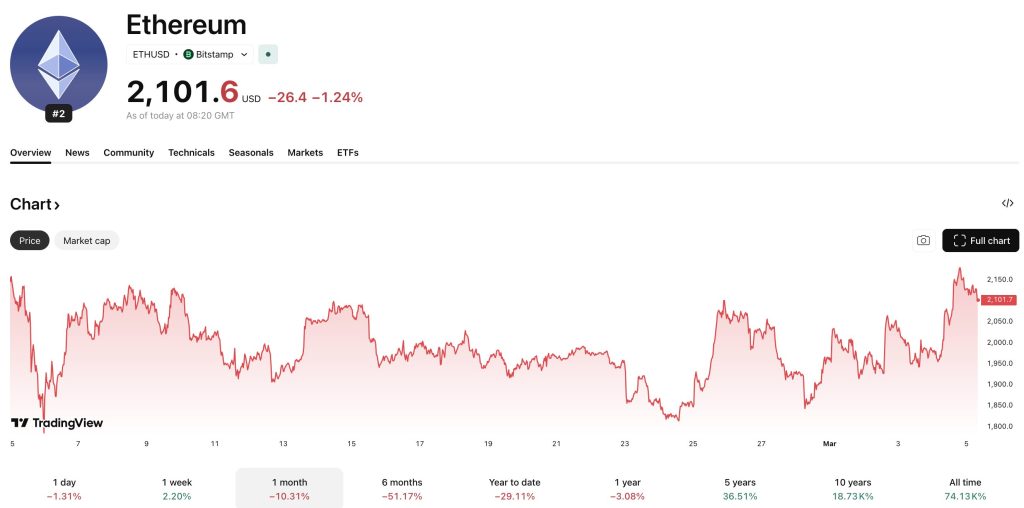
While the Ethereum co-founder outlines a future of resilient “digital islands” and anti-censorship upgrades, immediate price action remains hostage to a brutal institutional rotation. Currently up +6% overnight, the Ethereum price is enjoying a rare period of green candles and bullish sentiment.
What is Vitalik’s Sanctuary Tech: Big Moves Coming for Ethereum?
Ethereum co-founder Vitalik Buterin outlined a vision on March 3, when he took to X to state his desire to create “digital islands of stability” to counter growing government control, corporate power, and surveillance.
He acknowledged concerns that Ethereum hasn’t significantly improved lives in areas like freedom and privacy. To address this, he proposed “sanctuary technologies” that enable individuals and institutions to operate independently of outside pressures.
Buterin envisions Ethereum as a shared, ownerless digital space for building resilient social and economic structures, rejecting the idea of total dominance by any single corporation.
He believes infrastructure that withstands challenges will hold greater value for traders, and it could signal a huge shift for the future of the Ethereum network.
DISCOVER: Next Crypto to Explode in 2026
The Ethereum ETF Picture: BlackRock Hits $100M Positive Flows in the Last Three Days
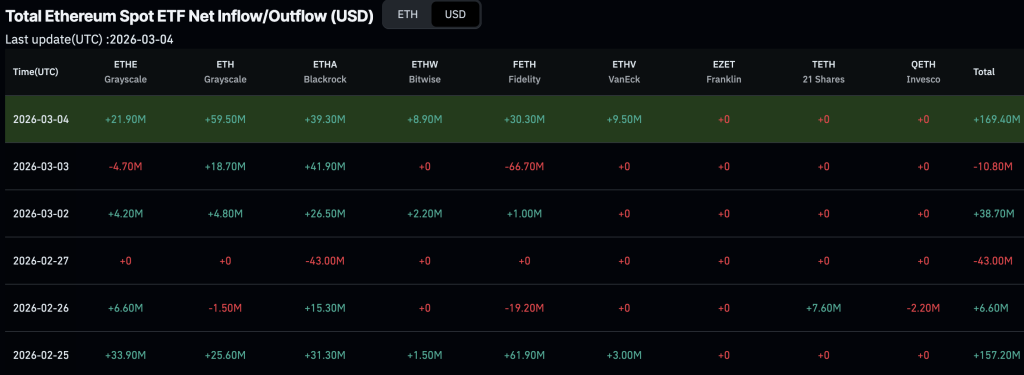
The Ethereum ETF landscape is currently a positive beacon amid a crumbling market. While crypto has enjoyed a rare period of green candles this week, overall price action has been horrendous since the October 2025 cycle highs.
ETFs have remained a solid foundation for ETH USD, with BlackRock (ETHA) leading the way with over +$110M in positive flows in the past week alone.
Grayscale is next up and across its two products (ETH and ETHE), the asset manager has seen more than +$170M in flows since February 25.
These recent moves signal that institutional capital wants greater exposure, even amid growing global economic tensions.
Asset managers aren’t the only firms choosing ETH/USD as an investment. Harvard recently announced it had cut its Bitcoin ETF exposure in favour of Ethereum.
Ethereum Price Analysis: Can $2,000 ETH USD Hold the Line?
The conflict between vision and flows converges at $2,000 on the chart. ETH USD is currently trading at around $2,100, and this level is the current line in the sand. If bulls can hold $2,000, the immediate target returns to the $2,300 resistance band, which also marks the February high.
A daily close above $2,350 would confirm that the BlackRock and Grayscale ETF flows are finally overpowering the sell-side pressure.
However, the downside scenario remains active. If $2,000 fails the hold once more, the door opens to $1,700, a capitulation wick zone.
Analysts tracking current volatility suggest that while AI models predict a recovery in the medium term, the immediate trend requires the $2,000 level to hold.
Watch the daily net flow data for the various ETF products. If we see three consecutive days of net positive inflows exceeding $50M, along with a reclaim of $2,300, Vitalik’s “Sanctuary Tech” narrative will likely begin to catch some attention. On the other hand, if the flows flip negative, the roadmap won’t save the price from testing lower support.
EXPLORE: Best Crypto Presales to Buy in 2026
The post Vitalik Drops Ethereum Endgame Bombshell: ETH USD to $3,000? appeared first on Cryptonews.

TLDR
- Baird maintained its Outperform rating on Nvidia while increasing the price target from $275 to $300
- Wedbush similarly elevated its target to $300 from $230, keeping its Outperform stance
- Analysts highlight Q1 guidance as exceeding buy-side expectations by a significant margin
- The chipmaker has ceased production of China-specific processors, redirecting TSMC capacity toward upcoming Vera Rubin architecture
- Shares of NVDA are currently trading around $183, reflecting gains exceeding 1,100% over three years
The semiconductor powerhouse reported an impressive quarterly revenue of $68 billion, marking a 73% year-over-year surge, prompting analysts to adjust their outlooks upward.
On February 26, Baird confirmed its Outperform stance on Nvidia while bumping its price objective from $275 to $300. The investment firm highlighted data center revenue acceleration reaching nearly double its prior growth pace, while noting that virtual reality metrics are outperforming competitor benchmarks.
Wedbush echoed this sentiment on the same date, upgrading its price objective from $230 to $300 and maintaining its Outperform designation.
Both analyst firms see potential gains exceeding 69% from the stock’s current trading range.
Wedbush emphasized that the Q1 guidance represented the most impressive aspect of Nvidia’s quarterly disclosure. According to the firm, the forward-looking projections substantially exceeded previous buy-side estimates.
Baird revised its financial models to incorporate the robust performance across business segments, with particular strength in data center operations and virtual reality divisions.
NVDA shares currently hover near $183, positioning the company’s market capitalization at roughly $4.4 trillion. The 52-week trading band extends from $86.62 to $212.19.
The equity trades at approximately 22x forward earnings projections, which several market observers consider attractive relative to its expansion profile.
Manufacturing Pivot from China to Vera Rubin Platform
According to a Financial Times article from March 5, Nvidia has discontinued production of semiconductors designated for Chinese customers.
The company has reallocated its manufacturing resources at TSMC, shifting from H200 chip production to focus on its upcoming Vera Rubin generation.
Sources familiar with the situation informed the Financial Times that Nvidia anticipates persistent regulatory obstacles from both U.S. and Chinese authorities will constrain China sales for the foreseeable future.
The Vera Rubin architecture is slated for introduction in late 2026, aligning with Nvidia’s strategy of implementing yearly GPU architecture updates.
Understanding the Analyst Price Projections
Achieving the $300 target from the current $183 level would necessitate approximately 64% appreciation.
One market analyst following the semiconductor giant projects Nvidia could approach $250 within the calendar year, implying a 37% advance from its March 2 closing price.
The same analyst suggested that while $300 remains achievable under favorable market circumstances and reduced investor anxiety, the $250 scenario appears more probable in the immediate term.
Customer appetite for preceding GPU generations—including Blackwell and Blackwell Ultra architectures—remains robust, while cloud service providers continue substantial capital allocation toward AI infrastructure buildouts.
Nvidia’s commitment to annual GPU architecture refreshes maintains a consistent product roadmap for enterprises seeking cutting-edge AI computing capabilities.
As of March 5, NVDA closed at $183.08, posting a 1.68% intraday gain.
Crypto World
IREN deepens AI push with 50,000 Nvidia GPU order; shares fall on at-the-market offering


IREN (IREN), a data center operator focused on AI cloud infrastructure, said it agreed to buy more than 50,000 specialized processing chips from Nvidia (NVDA), expanding its capacity by about 50%.
The B300 GPUs, or graphic processing units, will take the Sydney-based company’s total AI compute fleet to about 150,000 GPUs. A GPU is a specialized chip for performing large numbers of parallel computations, enabling the training and operation of artificial intelligence models at high speed.
The company also filed for a potential at-the-market share sale of up to $6 billion as part of its broader capital management strategy. The shares dropped 5% in pre-market trading on Thursday due to potential dilution.
The additional hardware is expected to be deployed in phases through the second half of 2026 across the company’s air-cooled data centers in Mackenzie, British Columbia, and Childress, Texas. Once fully deployed, the expanded fleet is projected to support more than $3.7 billion in annualized AI cloud revenue, positioning IREN among the larger AI cloud infrastructure providers globally.
IREN said it has secured about $9.3 billion in funding over the past eight months through customer prepayments, convertible notes, GPU leasing and financing arrangements, with roughly $3.5 billion in additional capital expenditures expected for the new GPU deployments in the second half of 2026.

War news may have investors on edge, but when fed a careful prompt, Claude AI reveals the medium-to-long-term outlook for crypto markets is only strengthening.
Investors appear to have largely priced in geopolitical risk earlier this year, following sharp selloffs sparked by former President Trump’s comments on potential U.S. military escalation tied to Greenland and Iran.
Against that backdrop, Claude is forecasting fresh all-time highs (ATHs) in 2026 for XRP, Solana and Cardano.
XRP ($XRP): Claude AI Sees a 6x Surge in 10 Months
In a recent statement, Ripple reiterated that XRP ($XRP) sits at the center of its strategy to position the XRP Ledger (XRPL) as a global, enterprise-grade payments network.

With near-instant settlement and extremely low transaction fees, XRPL is likely to gain an early lead in two of crypto’s fastest-expanding sectors: stablecoins and tokenized real-world assets.
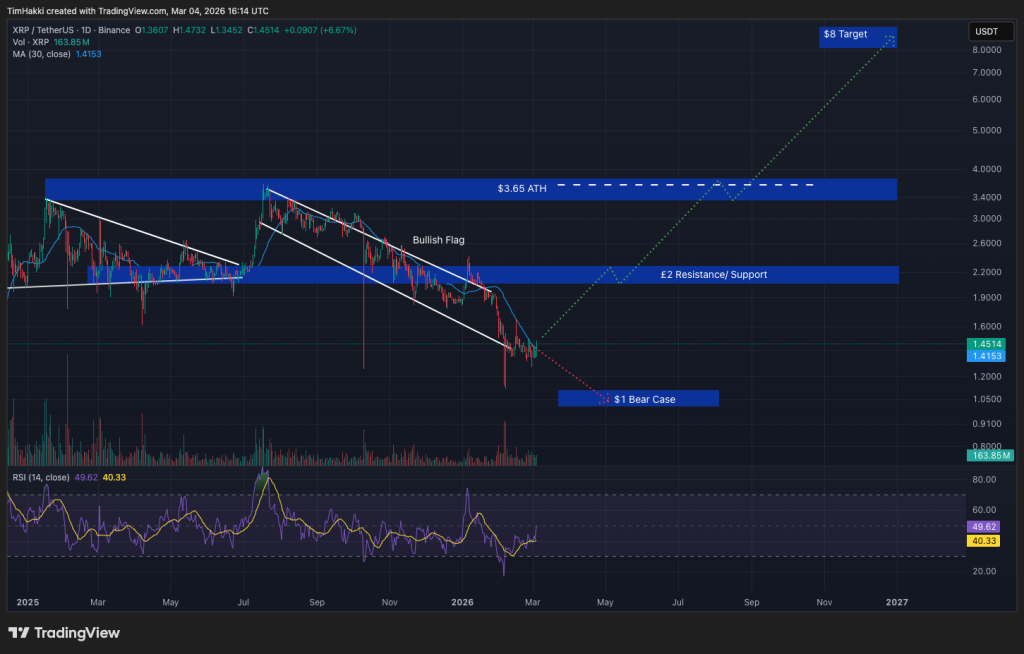
XRP is currently trading around $1.40, and Claude’s projections point to a possible surge toward $8 before year-end, implying a sixfold increase from current levels.
Technical indicators support the optimistic outlook. XRP’s relative strength index (RSI) is sitting at a neautral 50, while prices have stabilized around the 30-day moving average, suggesting the prolonged consolidation phase may be over.
Additional upside drivers include growing institutional exposure following the launch of U.S.-listed XRP ETFs, Ripple’s expanding global partnerships, and the prospect of clearer regulation if the CLARITY bill advances through Congress later this year.
Solana (SOL): Could Solana Really Break Past Its Previous High This Year?
Solana ($SOL) currently secures $6.8 billion in total value locked and has a market capitalization of $52 billion.
Institutional interest accelerated after the recent rollout of Solana-based exchange-traded funds from major asset managers, including Bitwise and Grayscale.
Despite this, SOL pulled sharply back toward the end of 2025 and spent much of February trading below $100.
Under Claude’s most bullish scenario, Solana could rally from its current price near $91 to $500 by Christmas. That would represent a 5.5x gain and place Solana high above its current ATH of $293, reached in January 2025.
Strengthening the long-term case, asset managers like Franklin Templeton and BlackRock are deploying tokenized products on Solana, highlighting the network’s early lead as a scalable, institution ready blockchain.
Cardano (ADA): Claude AI Envisions Up to 1,000% Upside
Created by Charles Hoskinson, Cardano ($ADA) focuses on academic research, rigorous security standards, scalability, and long-term sustainability.
With a market value over $10 billion and more than $140 million in TVL, Cardano’s ecosystem continues to expanding in step with the industry leaders.
Claude’s outlook suggests ADA could rise by more than 1,-00%, climbing from roughly $0.28 today to nearly $3.25 by Christmas. That would surpass its previous peak of $3.09 set in 2021.
The biggest driver for Cardano’s growth would be comprehensive crypto legislation in the US. With regulatory certainty comes capital, which will allow the best altcoins to decouple from Bitcoin’s price movements.
Given the global uncertainty, further downside cannot be ruled out, including a potential drop toward $0.15 if bearish conditions intensify.
Maxi Doge: Early-Stage Meme Coin Targets Explosive Gains
Strength in XRP, Solana and Cardano will spill over into the meme coin sector, as historically seen during major bull cycles.
One emerging project attracting significant attention is Maxi Doge ($MAXI), which has already raised $4.7 million in its ongoing presale as meme coin traders speculate it could dethrone Dogecoin.
Maxi Doge brands itself as Dogecoin’s brash, gym-obsessed degen cousin, tapping into the viral, loud meme culture that defined the 2021 bull market.
Launched as an ERC-20 token on Ethereum’s proof-of-stake network, MAXI also has a smaller environmental footprint compared to Dogecoin’s proof-of-work design.
Early presale buyers can currently stake MAXI for yields of up to 67% APY, with rewards tapering as additional tokens enter the staking pool.
The token is $0.0002807 in the current presale round, with automatic price increases scheduled at each funding milestone.
Investors looking to secure tokens can visit the official website and connect a supported wallet such as Best Wallet.
Purchases can also be completed using a bank card.
Visit the Official Website Here
The post Leading AI Claude Predicts the Price of XRP, Solana and Cardano by the end of 2026 appeared first on Cryptonews.

‘Below Deck’s Emile Kotze Sues Network for $850M Over Alleged Sexual Harassment

Arjun Tendulkar and Saaniya Chandhok officially married after grand Mumbai celebrations | Off the field News

How to Survive Daylight Saving Time: Start Early (2026)


-

 Politics6 days ago
ITV enters Gaza with IDF amid ongoing genocide
-

 Politics2 days ago
Alan Cumming Brands Baftas Ceremony A ‘Triggering S**tshow’
-

 Fashion6 days ago
Weekend Open Thread: Iris Top
-

 Tech4 days ago
Unihertz’s Titan 2 Elite Arrives Just as Physical Keyboards Refuse to Fade Away
-
Sports5 days ago
The Vikings Need a Duck
-
 NewsBeat5 days ago
Dubai flights cancelled as Brit told airspace closed ’10 minutes after boarding’
-

 NewsBeat5 days ago
Abusive parents will now be treated like sex offenders and placed on a ‘child cruelty register’ | News UK
-

 NewsBeat4 days ago
‘Significant’ damage to boarded-up Horden house after fire
-
 NewsBeat5 days ago
The empty pub on busy Cambridge road that has been boarded up for years
-

 Tech4 hours ago
Bitwarden adds support for passkey login on Windows 11
-

 Entertainment3 days ago
Baby Gear Guide: Strollers, Car Seats
-
 Tech6 days ago
NASA Reveals Identity of Astronaut Who Suffered Medical Incident Aboard ISS
-

 Business7 days ago
Only 4% of women globally reside in countries that offer almost complete legal equality
-
Politics4 days ago
FIFA hypocrisy after Israel murder over 400 Palestinian footballers
-
 NewsBeat4 days ago
Emirates confirms when flights will resume amid Dubai airport chaos
-

 NewsBeat3 days ago
Is it acceptable to comment on the appearance of strangers in public? Readers discuss
-

 Crypto World6 days ago
From Crypto Treasury to RWA: ETHZilla Retreats and Relaunches as Forum Markets on Nasdaq
-

 Tech4 days ago
Viral ad shows aged Musk, Altman, and Bezos using jobless humans to power AI
-

 Business7 days ago
World Economic Forum boss Borge Brende quits after review of Jeffrey Epstein links
-

 Video3 days ago
How to Build Finance Dashboards With AI in Minutes