

Crypto World
Goldman Sachs Cuts Crypto ETF Exposure, Rebalances Holdings

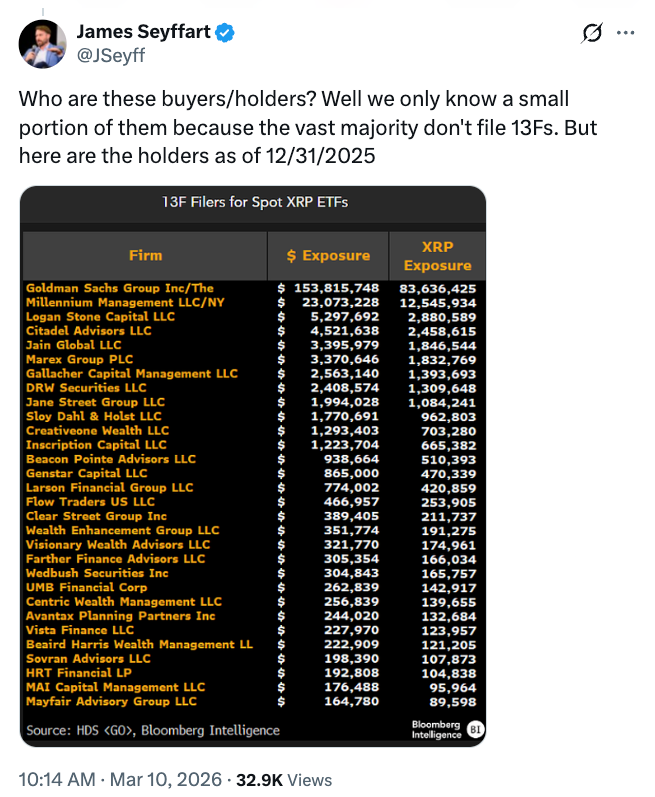
US investment bank Goldman Sachs sharply reduced its exposure to cryptocurrency exchange-traded funds (ETFs) in the first quarter of 2026.
No XRP-linked ETFs appeared in Goldman Sachs’ Q1 Form 13F filing with the US Securities and Exchange Commission.
In its Q42025 13F filing, Goldman Sachs reported holding nearly $154 million worth of XRP-related ETFs from Bitwise, Franklin Templeton, Grayscale and 21Shares.
Goldman Sachs was the largest institutional holder of XRP-related ETFs as of Dec. 31, 2025. Source: James Seyffart
Quarterly 13F filings are closely watched by crypto investors because they provide a rare look into how major institutional asset managers are allocating capital across digital-asset investment products. The bank pulled back from XRP products, even as broader institutional interest in digital-asset ETFs remains intact.
Early pullback from new crypto ETFs
Goldman Sachs no longer reported any holdings in Solana-linked ETFs either.
The bank previously disclosed positions in Solana-linked ETFs, including the Grayscale Solana Trust ETF (GSOL), the Bitwise Solana Staking ETF (BSOL) and the Fidelity Solana Fund (FSOL).
Both XRP- and Solana-linked ETFs launched in late 2025, when issuers began rolling out a new wave of crypto funds beyond Bitcoin (BTC) and Ether (ETH).
Solana ETFs began trading in late October 2025, with additional funds rolling out in November. The first spot XRP ETFs hit the market in mid-November as issuers raced to bring new altcoin products to investors.
Goldman Sachs trims Bitcoin ETF exposure, but still holds more than $700 million
While no longer reporting ETF exposure to XRP and Solana, Goldman Sachs continued to hold significant positions in Bitcoin and Ether ETFs, along with equity tied to crypto companies.
The bank held about $690 million in BlackRock’s iShares Bitcoin Trust ETF (IBIT) and another $25 million in the Fidelity Wise Origin Bitcoin Fund (FBTC), even after reducing both positions by roughly 10% during the quarter.
Goldman Sachs also cut its position in the iShares Ethereum Trust (ETHA) by about 70%, leaving it with roughly 7.2 million shares valued at around $114 million.
Related: JPMorgan piles into BlackRock’s Bitcoin ETF in Q1 2026
In crypto equities, Goldman Sachs increased its exposure to several names, led by a 249% jump in Circle Internet Group (CRCL) and a 205% rise in Galaxy Digital (GLXY), while also adding to positions in Coinbase Global (COIN), Robinhood Markets (HOOD) and PayPal Holdings (PYPL) during the quarter.
At the same time, it reduced stakes in major mining and infrastructure names, including BitMine Immersion Technologies (BMNR), Bit Digital (BTBT) and Riot Platforms (RIOT). It reduced positions in Strategy (MSTR) and IREN (IREN).
Magazine: XRP ‘probably going to $12,’ Bitcoin ETFs add $1B: Market Moves

Crypto World
World Liberty Financial treasury company AI Financial warns in SEC filing that it may not survive the year


The former Alt5 Sigma marked its 7.28 billion WLFI tokens at $706 million, down from a roughly $1.46 billion cost basis, while disclosing that the holdings remain locked amid liquidity concerns.
Bitmine Immersion Technologies chairman Tom Lee says the crypto treasury company took advantage of a recent Ether price drop under $2,200 to scoop up another 71,672 Ether for its stockpile.
Ether (ETH) has traded between $2,081 and $2,341 over the past seven days. It was trading at $2,128 as of Tuesday and was down 8.7% over the same period.
“Over the past week, we acquired 71,672 ETH. We view the recent pullback of ETH to below $2,200 as an attractive opportunity. Bitmine is expected to reach the alchemy of 5% sometime in 2026,” Lee said on Monday.
Bitmine is the largest Ether treasury company and has consistently bought the token, even during market downturns, in a business model similar to Michael Saylor’s Bitcoin treasury firm, Strategy.
Bitmine’s total treasury holdings stand at more than 5.2 million, with the company’s goal to hold 5% of the token’s circulating supply of 120.7 million. It bought 26,659 Ether between May 4 and May 11, breaking its three-week streak of adding more than 100,000 Ether per week.
It comes amid reports that an Ethereum whale who previously cashed out their Ether also bought the dip over the weekend, making a return to the asset.
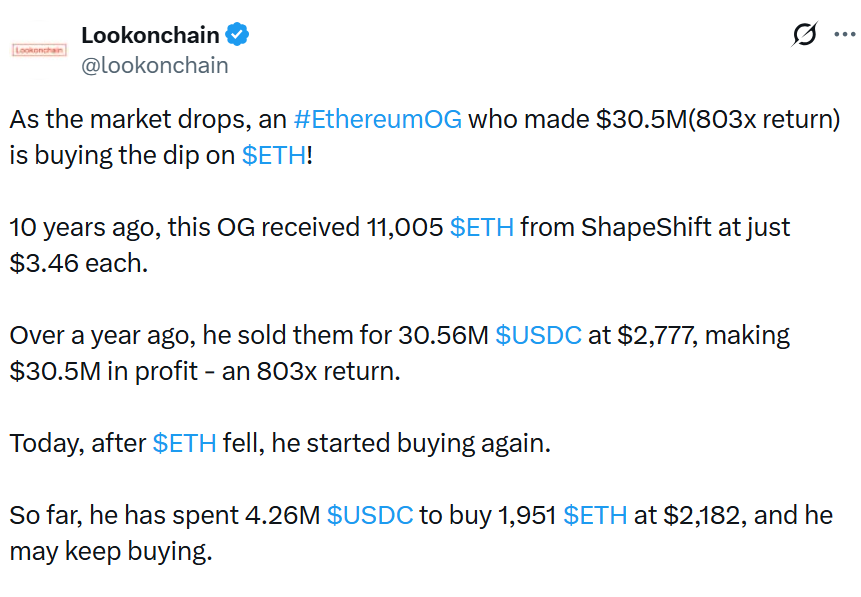
Blockchain analytics platform Lookonchain said in an X post Saturday that a whale who bought Ether more than a decade ago and sold their holdings a year ago has started buying again.
Source: Lookonchain
The OG whale purchased 1,951 Ether at $2,182, and Lookonchain speculated “he may keep buying.”
Ether under pressure amid Middle East conflict
Lee said Monday that rising oil prices, which soared after the conflict in the Middle East escalated earlier this year, have been a consistent drag on Ether’s price. He predicted that a reversal in oil prices could lead to Ether recovering.
Ether reached an all-time high of $4,946 in August 2025 but has since fallen about 57%. Analysts have predicted the token could still rise before the end of the year.
Related: Ethereum Foundation hits ‘Glamsterdam’ milestones, names new protocol leads
Financial institution Citigroup predicted in March that Ether could reach $3,175 in the next 12 months. In a bull case, however, it could hit $4,488, driven by stablecoin and tokenization interest and usage.
Meanwhile, CoinGecko, citing prediction market data, speculated that Ether has a 48% chance of ending the year at $1,500 and a 25% chance of ending the year at $3,500.
Earlier this year, banking giant Standard Chartered had a more bullish outlook. Geoffrey Kendrick, the bank’s head of digital assets research, said in a January report that Ether could hit $7,500 by the end of the year, driven by growing adoption of blockchains and onchain products.
Magazine: Guide to the top and emerging global crypto hubs — Mid-2026
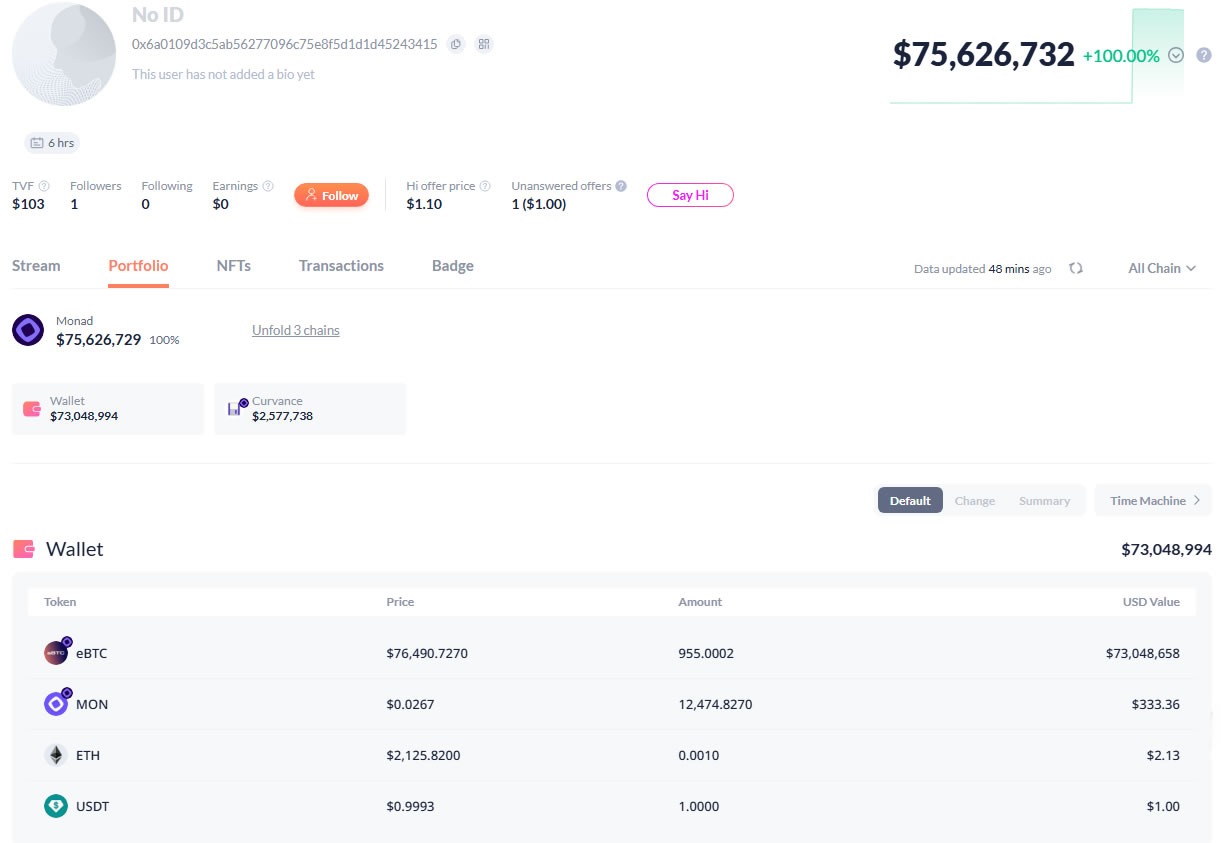
Decentralized finance protocol Echo Protocol was exploited after an attacker minted about 1,000 unauthorized eBTC on the protocol, which is deployed on the Monad blockchain.
Blockchain security firm PeckShield and analytics platform Lookonchain both reported the incident on Tuesday, noting that a hacker minted 1,000 synthetic Bitcoin (eBTC) worth around $76.7 million.
“We are currently investigating a security incident impacting the Echo bridge on Monad. All cross-chain transactions remain suspended while the investigation is underway,” Echo Protocol said on Tuesday.
This latest exploit comes in a month that has seen at least 12 protocols compromised, including THORChain, Verus Protocol’s Ethereum bridge, Transit Finance, TrustedVolumes and Ekubo.
According to PeckShield, the attacker attempted to launder some of the loot by depositing 45 eBTC worth around $3.45 million into DeFi lending and liquidity management protocol Curvance.
The attacker then borrowed 11.3 wrapped Bitcoin (wBTC) worth $868,000 against it, bridged the tokens to Ethereum, swapped them for ETH, and sent 384 ETH worth about $822,000 to the Tornado Cash mixing service.
The attacker still holds 955 eBTC worth about $73 million, according to DeBank.
Echo Protocol is a Bitcoin DeFi platform focused on Bitcoin liquidity aggregation, liquid staking, restaking, and yield generation. It creates unified, liquid BTC assets such as eBTC for users to bridge and deploy in DeFi for additional yield. The protocol is deployed on Monad, a high-performance, layer-1, EVM-compatible blockchain.
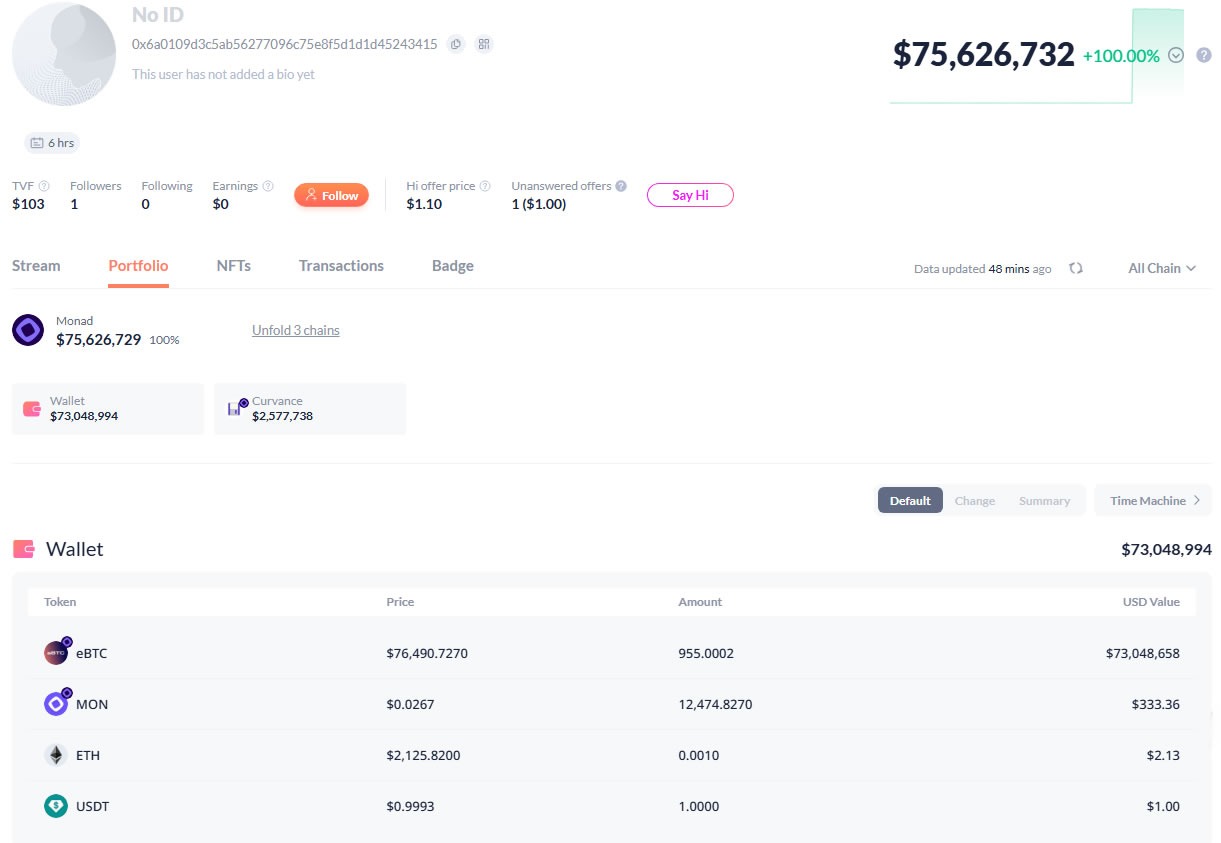
The hacker still holds 95% of the stolen crypto. Source: DeBank
Admin private key compromised
Blockchain developer “Marioo” reported that it was not a smart contract bug, but an admin private key compromise, and the root cause was “operational, not technical.”
The eBTC contract “worked exactly as designed,” they said, adding that the vulnerabilities included a single signature for the admin role, no timelock, no minting supply cap or rate limit, and no “supply sanity check” by Curvance for the freshly minted collateral.
Related: Hackers used AI to craft zero-day attack to bypass 2FA: Google
Curvance reported that it was aware of the “anomaly” detected in the Echo eBTC market on Curvance and confirmed that there was no compromise with its own smart contracts. It paused the affected market for investigation.
Monad co-founder Keone Hon clarified on X that “the Monad network is not affected and is operating normally.”
Meanwhile, Echo Protocol said it will provide updates through its official channels as more information becomes available.
DeFi hacks surge in 2026
The year has been challenging for DeFi security, with dozens of protocols exploited for hundreds of millions in crypto and more than 20 protocols shuttering services.
Two of the largest hacks this year included the exploit of the Drift Protocol, which lost $285 million, and Kelp DAO, which was exploited for $292 million in April.
On Monday, Verus Protocol’s Ethereum bridge was exploited through a fake cross-chain transfer message that allowed a hacker to steal at least $11.6 million in crypto.
Decentralized liquidity protocol THORChain halted trading on Friday after blockchain investigator ZachXBT flagged a suspected $10 million exploit.
Meanwhile, Transit Finance suffered a deprecated smart contract exploit, resulting in the loss of $1.88 million last week.
Magazine: DeFi’s billion-dollar secret: The insiders responsible for hacks


Standard Chartered will cut more than 15% of corporate function roles by 2030 as the UK-headquartered bank scales up the use of artificial intelligence.
The bank confirmed the plan in a strategy update to investors alongside fresh profitability targets.
Banking Giant Standard Chartered to Cut Thousands of Jobs
The banking giant’s restructuring is set to eliminate over 7,000 positions from its workforce of 80,000 employees. Speaking at a press briefing, chief executive Bill Winters said the headcount reduction will be driven by greater use of AI and automation.
“It’s not cost-cutting. It’s replacing in some cases lower-value human capital with the financial capital and the investment capital we’re putting in,” Winters said.
Follow us on X to get the latest news as it happens
The bank did not disclose which locations would absorb the cuts. However, some affected staff will move into other roles inside the business, the BBC reported.
Alongside the job cuts, Standard Chartered lifted its profitability outlook. The bank is now targeting a return on tangible equity (RoTE) above 15% in 2028, more than 3 percentage points above its 2025 level, and aims to push that figure to around 18% by 2030.
“We are scaling practical uses of automation, advanced analytics and artificial intelligence to streamline processes, improve decision‑making and enhance both client service and internal efficiency,” the bank said.
Standard Chartered joins a swelling roster of companies trimming headcount in 2026. Amazon announced 16,000 job cuts in January.
Meta will begin shedding roughly 8,000 roles, about 10% of its workforce, starting Wednesday. Crypto analytics platform Dune also cut a quarter of its staff as part of a pivot toward AI and institutional onchain data. The shakeout now reaches sectors as varied as banking, tech, and online gambling.
Subscribe to our YouTube channel to watch leaders and journalists provide expert insights
The post Standard Chartered Joins AI Layoff Wave With Over 7,000 Job Cuts Planned appeared first on BeInCrypto.
Crypto World
Ibiza Tech Forum 2026 to Host Blockchain, Digital Assets and Institutional Finance Programme


Ibiza Tech Forum 2026 will feature a dedicated programme on blockchain, digital assets, quantum technology, trading and alternative investment from May 19-22 in Ibiza, Spain. Now in its fourth edition, the forum will bring together exchanges, banks, investors, blockchain infrastructure providers, Web3 builders and global media professionals to discuss the next era of digital finance.
The digital assets industry is entering a new phase, with growing focus on regulation, institutional adoption, custody, liquidity, stablecoins, real-world assets and market infrastructure. As Europe adapts to MiCA, the GCC strengthens its position in digital finance, and Latin America continues to grow as a crypto and fintech frontier, Ibiza Tech Forum 2026 arrives as a meeting point between regions, capital and innovation.
The financial and crypto programme begins May 20 with a TradingView Trading Competition at Hotel Bonito Ibiza. The event will combine live trading, networking and community programming for traders, investors, financial creators and digital asset professionals.
The main digital assets stage takes place May 21 at Auditorio Caló de s’Oli. The day opens with “Connecting Europe and the GCC,” led by Adel Alawadhi, Co-founder and Chairman of The Corporate Group, covering capital corridors, regulation and international financial infrastructure.
A panel titled “Lost at Sea No More: How Europe’s Crypto Industry Survived to See MiCA” will feature representatives from MoonPay, Bit2Me, Criptan, Bitvavo and Mandioca, addressing compliance, adoption and market confidence in the post-MiCA regulatory environment. The programme will also include “The New Financial Backbone: How Exchanges Will Secure the Future of the Digital Economy,” with speakers from TradingView, Solana Foundation, FXStreet and Bybit EU examining liquidity, exchange infrastructure and institutional growth.
A session titled “Redefining Financial Infrastructure: Stablecoins, RWA and the Next Global Markets” will feature perspectives from BeInCrypto, BBVA, Trezora, Kraken and Damex, exploring how digital assets are moving from alternative markets into core financial infrastructure. The institutional future of blockchain will also be examined through “Blockchain Infrastructure for the Next Billion Users: When Governments and Corporations Finally Go On-Chain,” featuring The Hashgraph Group, Alastria, RSM Spain, MK Fintech Partners, Recoveris, Arkangeles and HitchAkbal.
Beyond crypto, the forum connects the digital assets ecosystem with the broader world of alternative investment. Sessions including “From Angels to Exits: How Smart Capital Really Moves,” “From Zero to Scale: Capital, Strategy and the Art of Growing Fast,” and “Beyond Traditional Markets: The Future of Alternative Investments in a Fintech-Driven World” will bring together venture capital, private markets, angel investors, fintech founders and Web3 leaders. The forum will also explore Web3 audience development through “The Community Playbook: Growing, Retaining and Monetizing Web3 Audiences.”
About Ibiza Tech Forum
Ibiza Tech Forum is an annual technology and innovation forum held in Ibiza, Spain, now in its fourth edition. The event connects founders, investors, financial institutions, blockchain developers and media professionals across digital assets, fintech, alternative investment and Web3. For more information, visit https://ibizatechforum.com/.
The post Ibiza Tech Forum 2026 to Host Blockchain, Digital Assets and Institutional Finance Programme appeared first on BeInCrypto.

Galaxy Digital, the crypto-focused financial services firm led by Mike Novogratz, has been awarded both a BitLicense and a Money Transmission License from the New York State Department of Financial Services (NYDFS) via its subsidiary GalaxyOne Prime NY. The approvals enable the firm to extend regulated digital asset trading and financing services to institutional clients operating within New York.
Galaxy disclosed the milestone on Monday, noting that GalaxyOne Prime NY will now offer its institutional trading and financing capabilities under the state’s stringent regulatory regime. The approvals deepen Galaxy’s footprint in New York, widely regarded as one of the most tightly regulated crypto markets in the United States. In commenting on the significance, Novogratz described New York as home to the deepest pool of institutional capital in the country and said the licenses would help broaden access to digital assets for institutional market participants.
BitLicense, introduced in 2015, is commonly viewed as one of the most challenging regulatory approvals for crypto businesses in the United States, requiring comprehensive controls around anti-money laundering, cybersecurity, capital reserves and consumer protection. The NYDFS issuance places Galaxy in a select group of firms authorized to operate crypto-related services for institutions within the state. The development follows other notable NYDFS approvals for prominent crypto players, including Jack Mallers’ Strike, which recently received authorization to provide Bitcoin services in New York.
Source: Galaxy
Key takeaways
- Galaxy One Prime NY gains BitLicense and Money Transmission License, enabling regulated institutional services in New York.
- The approvals mark a notable expansion of Galaxy’s regulated activities in one of the sector’s most scrutinized jurisdictions.
- In Q1 2026, Galaxy posted a net loss of $216 million as lower digital asset prices weighed on results, while gross revenue reached $10.2 billion for the quarter.
- The company is accelerating its pivot toward data-center infrastructure, with ambitions tied to the Helios Data Center campus in Texas and workloads in AI and high-performance computing.
- The NYDFS clearance follows a trend of increasing regulatory acceptance for major crypto firms, signaling evolving but rigorous oversight in the state.
Regulatory milestone and institutional access
Galaxy’s new authorization rests with its institutional arm, GalaxyOne Prime NY, which will be able to provide regulated trading and financing services to big-ticket clients in New York. The NYDFS approval underscores a broader push by state authorities to formalize compliance standards for digital asset businesses while preserving strong protections for consumers and the financial system. The BitLicense framework requires ongoing controls on money laundering prevention, cybersecurity resilience, capital adequacy and transparent consumer safeguards—stringent requirements that Galaxy will now align with for its New York clientele.
Novogratz’s remarks reflect the strategic rationale for the move: New York remains a central hub for institutional capital, and granting the licenses can help deepen institutional participation in digital assets. The NYDFS’s stance aligns with a longer-term trend of selective regulatory accommodation for established players that meet rigorous standards, contrasting with earlier cycles of cautious or restricted market access.
Cointelegraph’s coverage notes that other high-profile entrants, such as Strike, have also secured NYDFS approvals recently, illustrating a pattern of regulated entry for businesses seeking to unlock institutional access to digital asset services in New York.
From trading desks to data centers: Galaxy’s diversification strategy
Beyond its traditional trading and asset management activities, Galaxy is investing in data-center infrastructure to support compute-heavy workloads. In its recent disclosures, the company indicated that future growth would be anchored in the Helios Data Center campus in Texas and in revenues derived from AI and high-performance computing workloads. This shift mirrors a broader industry trend where crypto firms increasingly align with data-center capacity and compute services as a means to diversify revenue and capture demand from AI and cloud workloads.
The company has already signaled that the data-center business is a key growth vector, aiming to monetize the energy and compute scale required for mining, hosting, and AI-related tasks. Galaxy’s leadership argues that owning and operating scalable data-center capacity can stabilize revenue in periods of crypto price volatility and offer new avenues for institutional partners seeking robust compute resources beyond traditional trading and lending.
Galaxy’s exploration of data-center initiatives is not happening in a vacuum. Industry observers have highlighted similar trajectories among other crypto and digital-asset firms as they pivot to infrastructure, emphasizing the strategic value of stable, contract-backed data-center revenue in conjunction with trading and asset-management activities.
Q1 2026 results: a quarter of contrasts, with a longer-term pathway forward
Galaxy’s first-quarter results for 2026 reflect the volatility of the digital asset cycle. The firm reported a net loss of $216 million for the quarter ended March 31, attributable largely to lower digital asset prices, though the result was described as better than some analyst expectations. Gross revenue for the quarter totaled $10.2 billion, down from $12.9 billion in the year-ago period, underscoring the revenue sensitivity to crypto markets during the period.
Management projected that growth could accelerate into the current quarter as demand from Galaxy’s data-center operations increases. The earnings narrative shows a company navigating a cyclic market while doubling down on infrastructure investments that could underpin more diversified, recurring revenue streams in AI, high-performance computing and related workloads. In parallel with regulatory progress, Galaxy’s data-center shift could help balance profitability with the company’s capital allocation priorities in a market characterized by price volatility.
What to watch next
Readers should monitor how Galaxy scales its regulated institutional business in New York and how quickly its Helios Data Center initiatives translate into measurable revenue, particularly as AI compute demand grows. Regulatory developments in NYDFS will continue to shape the pace and scope of crypto market access for institutional players, while the company’s quarterly results will reveal whether the data-center strategy can dampen the volatility tied to crypto prices.
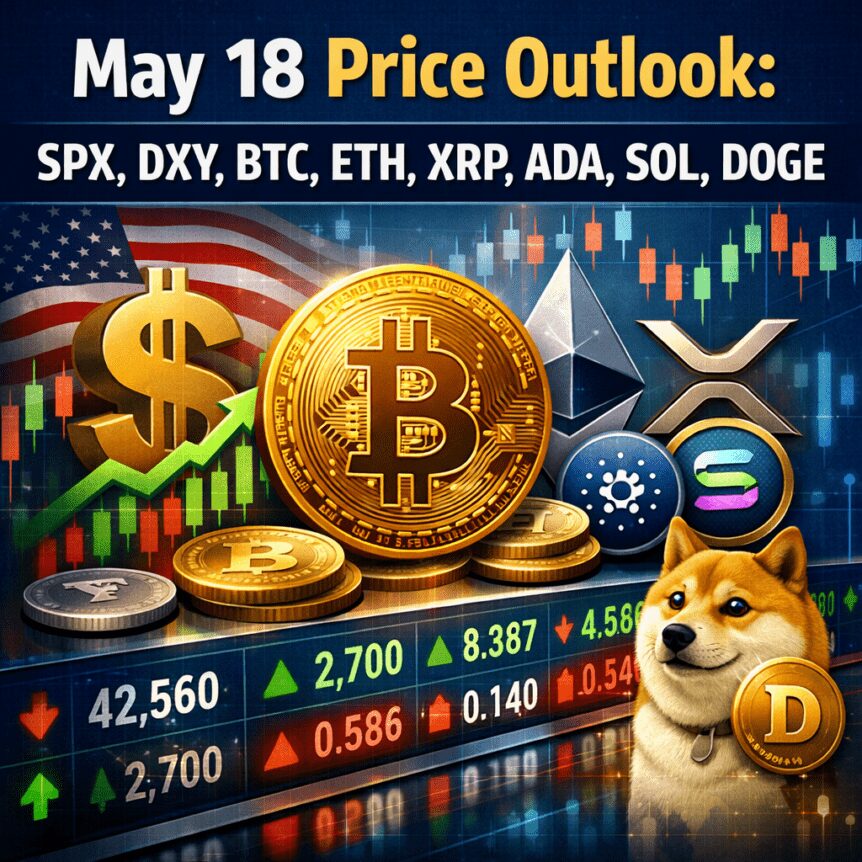
Bitcoin spent Monday under pressure, slipping back toward the $76,000 region as geopolitical headlines fueled a cautious mood across markets. A warning from US President Donald Trump about Iran added to the risk-off tone, with observers noting that even a measured military operation could intensify near-term volatility for the flagship cryptocurrency. On X, analyst CryptoRover warned that a potential US move against Iran “is extremely dangerous for BTC,” underscoring how macro headlines can quickly influence trader sentiment.
Against this backdrop, institutional flows also shifted. SoSoValue data showed spot Bitcoin ETFs recording $1 billion in weekly net outflows—the first net outflow after six straight weeks of inflows totaling $3.4 billion. The turn in ETF flow adds another layer of caution to an already sensitive tape as market participants weigh the prospects for a continued crypto rally into the second half of the year.
Meanwhile, a notable counterpoint to the softer price action came from Michael Saylor’s Strategy, the largest known public Bitcoin holder. The company disclosed it added 24,869 BTC for about $2.01 billion between May 11 and May 17, lifting its holdings to 843,738 BTC, per an 8-K filing with the U.S. Securities and Exchange Commission. The accumulation underscores a persistent bid from strategic, long-duration buyers even as the broader market wrestles with near-term headwinds.
Key takeaways
- Bitcoin is hovering near a key near-term support around $76,000, with a breach linked to increased downside risk unless a quick rebound materializes.
- Several top altcoins have broken below nearby supports, signaling a cautious mood among bulls in the immediate horizon.
- Spot BTC ETF outflows break a six-week inflow streak, suggesting a shift in institutional positioning or risk appetite.
- Strategic accumulation by the largest public BTC holder continues, reinforcing an ongoing bid at the long end of the spectrum.
Macro cues and Bitcoin’s near-term path
The broader market backdrop remains a mix of fresh macro headlines and technical pivot points. The S&P 500 advanced to an intraweek high around 7,517 before traders booked profits, a pattern that tests bulls’ resolve in the risk-on space. On the chart, a test of the 20-day exponential moving average around 7,273 could provide a telltale sign of whether buyers regain control or if sellers gain traction and push the index toward deeper consolidation. A sustained push above the 20-day EMA would tilt the market toward a renewed upside, whereas a break below could invite a retest of lower supports.
In the currency space, the U.S. Dollar Index (DXY) rebounded from a support level near 97.74 and cleared several moving averages. If the bulls can extend the breakout above interim resistance near 99.34, traders will eye a more substantial hurdle at 100.54, a level that, if cleared, could usher in a new uptrend toward 101.97. Conversely, a rejection at 100.54 or a slide below the 50-day moving average at 98.98 would keep the DXY in a broader range, sustaining a backdrop of mixed risk appetite for crypto assets.
Top coins in near-term focus: chart-driven paths and levels
Bitcoin remains the center of gravity for markets. The price sits near the 50-day moving average at roughly $75,627. A daily close above the 20-day EMA around $78,715 would embolden bulls and open a route toward the $84,000 resistance. A move that closes below the 50-day SMA keeps a risk of a test of the lower boundary of the current ascending channel, with a potential slide toward the mid-$60,000s if buyers fail to defend that line.
Ether has faced a softer patch as well, with price action breaking below the channel’s lower bound. The 20-day EMA near $2,255 has started to roll over, and the RSI sits near oversold territory, suggesting bears are in control in the near term. A recovery above the 20-day EMA will be essential for ETH to re-engage the broader uptrend; without that, 1,916 could become a more likely target as selling pressure persists.
XRP has slipped under the 50-day SMA around $1.39, signaling dwindling near-term momentum for the time being. A close below that level could expose a path toward $1.27 and then to $1.11, with a subsequent revisit to the psychological $1 mark if weakness persists. On the upside, a sustained push above $1.61 would suggest a short-term trend reversal and could carry the price toward $2 and then $2.40 as momentum re-accelerates.
BNB faced a pullback after failing to hold the $687 resistance. The immediate support sits near the 50-day SMA at about $637, with a break likely to target the $570 zone. A reversal above the $687 level would signal renewed demand and could send the pair toward $730, followed by a run to the $790 area if momentum remains constructive.
Solana’s structure turned softer as it closed below the 50-day SMA of roughly $85, implying a re-emergence of selling pressure. Support sits near $82, while the next resistance sits around the 20-day EMA near $88. A break below $82 would open the way to the mid-$70s, whereas a close above $98 would be a bullish signal that could re-assert the mid-$90s and beyond.
Dogecoin has slipped below the 20-day EMA, suggesting a short-term pause in momentum. The range appears to be consolidating between about $0.09 and $0.12. A sustained push above $0.12 could spark a move toward $0.14–$0.16, while a break below $0.09 would risk a slide toward $0.08.
Hyperliquid has demonstrated notable volatility as bulls and bears wrestle for control. A firm close above the $45.77 threshold would clear the way toward the $50–$51.43 zone, but the daily wick hints at selling pressure at higher levels. The 20-day EMA at $42.55 remains the critical line to watch for any sustained move lower, as a break could lead to a period of tight rangebound action between roughly $38 and $47.
Cardano has again traded near the 50-day SMA around $0.25, with the price flitting in a wide corridor between $0.22 and $0.31. A breakout above $0.31 could re-ignite upside momentum toward $0.40, while a break below $0.22 would raise the odds of a deeper correction toward the low-$0.20s or below.
Flows and what they imply for near-term dynamics
The juxtaposition of ETF outflows and recurrent accumulation by large holders paints a nuanced picture. On one hand, the outflow of about $1 billion from spot BTC ETFs marks a shift in funds leaving the greenlight-driven inflow streak that characterized much of the late spring. On the other hand, the stubborn accumulation by Strategy—adding nearly 25,000 BTC in a single week—underscores a persistent belief among long-term holders that Bitcoin remains a strategic treasury asset. How this tension resolves will likely hinge on macro risk appetite, the trajectory of inflation readings, and the persistence of geopolitical headlines that can abruptly tilt risk sentiment.
The market’s next turn will likely hinge on whether BTC can defend the critical $76,000 base and whether the wider crypto complex can hold its line above key moving averages during a period of elevated macro sensitivity. Traders should monitor whether the SPX can sustain its recent highs and whether the DXY can breach or retreat from its current levels. Any material moves in these macro gauges could quickly reshape crypto flows and price action in the days ahead.
As the week unfolds, analysts will be watching for fresh confirmations from major levels and any shifts in ETF positioning, which could either bolster a renewed rally or deepen a corrective move. The balance of risk and opportunity remains finely poised, with the next decisive move likely coming from risk-on catalysts or a decisive macro pivot.
Readers should stay attentive to the evolving mix of macro cues, liquidity flows, and technical patterns near these critical levels, as the coming sessions will likely define the near-term trajectory for Bitcoin and the broader market.
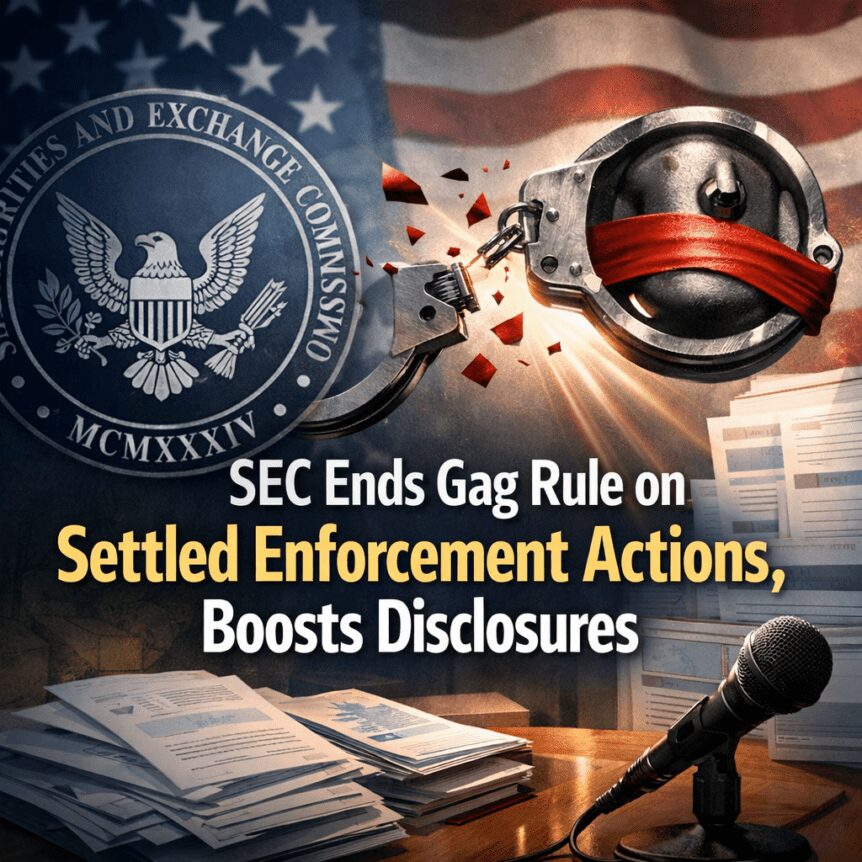
The U.S. Securities and Exchange Commission has rescinded a decades-old rule that barred parties from denying the agency’s allegations in enforcement settlements. The change ends a policy that had persisted since 1972 and signals a shift toward greater flexibility in how the SEC resolves—and potentially discloses—enforcement actions, including those affecting the crypto sector.
The SEC explained in its announcement that the no-deny policy created the impression that the agency was seeking to shield itself from criticism and did not reflect current enforcement practice. By removing the rule, the SEC said it would bring its settlement process in line with the approach used by the bulk of federal agencies, which do not maintain a comparable restriction on settlements.
“For more than 50 years, the Commission has conditioned settlement on a defendant’s promise not to publicly deny the Commission’s allegations. I am pleased that we are rescinding the no-deny policy today. This rescission ends the policy prohibiting such criticism by settling defendants,” SEC Chair Paul Atkins stated. The move follows a period of scrutiny over how crypto cases have been handled and how settlements are framed in public disclosures.
With the policy removed, the SEC indicated it will enjoy “more flexibility in settling enforcement actions.” The agency emphasized that it would not enforce existing no-deny provisions, though it may still require some defendants to admit to facts or liabilities as part of settlements on a case-by-case basis. The White House had been notified earlier in the month of the plan to rescind the rule, with the SEC submitting the rescission plan to the Office of Management and Budget for review.
Commissioner Hester Peirce supported the change in a separate statement, arguing that settlements that impose silence on non-governmental parties do not serve market integrity or investor protection. “Settlements shrouded in forced silence by the non-governmental party do not serve either the markets or the Commission’s investor-protection mission,” Peirce said.
As the policy shift takes effect, several contextual elements stand out for crypto markets and enforcement practices. Notably, the SEC has faced a steady stream of crypto-related actions in the past few years, with industry participants often criticizing the no-deny constraint as constraining legal rights and transparency in settlement disclosures. The agency’s crypto-related enforcement actions reached a high point in 2023, when dozens of actions were brought against crypto firms and settlements yielded hundreds of millions of dollars in penalties.
According to the broader regulatory narrative surrounding the sector, the move aligns with a trend toward more permissive public disclosures in settlements and a rebalancing of enforcement posture. The agency’s decision also unfolds within a wider ecosystem of U.S. policy and international standards, where firms monitor developments such as MiCA in the European Union and ongoing coordination among U.S. agencies on crypto regulation, licensing, and oversight. While the SEC is not adopting a blanket stance on admission or denial in all cases, the rescission invites attention to how settlements will be structured going forward and what information will be publicly reconciled as part of each resolution.
Key takeaways
- The SEC has rescinded its no-deny policy, ending a rule dating back to 1972 that barred defendants from denying allegations in settlements.
- The agency asserts greater flexibility in resolving enforcement actions, with no blanket requirement to deny or admit allegations in settlements.
- The SEC may still require some admissions of facts or liability on a case-by-case basis, signaling continued use of admissions in certain settlements.
- Historical context includes a notable Ripple Labs settlement and a record of crypto-related actions in the early 2020s, highlighting evolving enforcement strategies and industry responses.
Policy reversal and its practical implications for the crypto ecosystem
The rescission removes a long-standing constraint on how the SEC communicates settlements and how defendants articulate their positions in public disclosures. In practice, this change could affect the risk calculus for crypto firms negotiating settlements, particularly those that seek to limit public admissions or denials in order to maintain regulatory certainty for investors, partners, and banking relationships.
From a regulatory compliance perspective, the shift has several implications. First, it may alter how settlements are documented and disclosed, influencing due-diligence processes for banks, exchanges, and asset managers that rely on transparent and consistent enforcement histories. Second, the move interacts with ongoing licensing and oversight efforts by U.S. regulators, which increasingly emphasize clarity around liability, permissible conduct, and investor protection standards. Finally, the change dovetails with a global emphasis on clear governance and accountability in crypto markets, including how cross-border enforcement actions are coordinated and disclosed.
Historical context, enforcement strategy, and market impact
Several crypto actions have framed the enforcement landscape in recent years. The SEC’s crypto program has been characterized by a high volume of actions and settlements, with commentators noting the tension between aggressive regulatory posture and the need for transparent, predictable processes. A widely cited case from 2025—though not the only example—was a $50 million settlement with Ripple Labs that drew attention to the scope and terms of settlements in high-profile crypto matters. While the revised policy does not guarantee uniform outcomes across cases, it signals a shift toward more explicit public disclosures and potentially more nuanced settlements in which the government may permit or require admission of facts or liability where appropriate.
Industry observers have also pointed to ongoing debates about how settlements should balance investor protection with market openness. Commissioner Peirce’s remarks underscore concerns that silence in settlements can undermine regulatory integrity and market confidence. The SEC’s broader enforcement posture—particularly in the crypto arena—will likely continue to influence licensing decisions, collaboration with financial institutions, and the integration of crypto services within traditional banking rails.
Existing industry commentary suggests the rule’s removal may help reduce some of the friction encountered by firms negotiating settlements, while also preserving safeguards where admissions of facts or liability are warranted. In the regulatory context, the change may prompt lawmakers, watchdogs, and market participants to reassess how enforcement history is used in ongoing risk assessments, due diligence, and compliance programs.
According to Cointelegraph, the policy reversal reflects a broader shakeout in the approach to crypto enforcement and a recalibration of how settlements are framed for public accountability and investor protection. The move invites closer scrutiny of how the SEC will calibrate consent orders, admissions provisions, and the balance between rapid resolution and transparent disclosure, particularly for firms operating across multiple jurisdictions.
What comes next and how to monitor the trajectory
Key questions remain about how individual settlements will be structured going forward. Regulators will need to articulate when admissions will be required and how much emphasis will be placed on a defendant’s public statements as part of a resolution. Analysts and compliance teams should watch forthcoming enforcement actions and settlement agreements for changes in language, disclosures, and the presence or absence of admissions of facts or liability. Cross-agency coordination and potential impacts on licensing, enforcement priorities, and international cooperation will also merit close attention as market participants adapt to a recalibrated framework for enforcement settlements.
Institutions should reassess their internal policies on settlement disclosures, risk assessment, and communications with investors. The removal of the “gag” element could affect how inquiries from auditors, regulators, and counterparties are addressed, and may influence due-diligence practices in crypto product offerings, custody, and settlement services. As the regulatory landscape evolves, firms would do well to align their internal controls with the updated posture, ensuring that any admissions in settlements are consistent with risk appetite, disclosures, and investor protection standards.
Closing perspective: while the rescission broadens the toolset available in settlements, it also places renewed emphasis on regulatory clarity, lawful conduct, and transparent accountability. Stakeholders should monitor how this shift translates into practical terms for disclosure practices, enforcement outcomes, and the governance standards that underpin crypto market integrity in the United States.


The Securities and Exchange Commission (SEC) is reportedly preparing to release its innovation exemption for tokenized stocks. The framework would open the door to trading digital versions of public company shares.
The exemption could permit third-party tokens to track share prices without the backing or consent of the public companies. That marks a sharp shift in Washington’s approach to onchain securities.
SEC Set to Unveil “Innovation Exemption” for Tokenized Stocks
According to Bloomberg, the innovation exemption could be unveiled as early as this week. Under the framework, the tokens would trade on decentralized crypto platforms and may not provide the same shareholder benefits as traditional equities, including voting rights or dividend access.
Follow us on X to get the latest news as it happens
Tokenization has emerged as one of the crypto sector’s fastest-growing trends, with major Wall Street institutions moving swiftly to secure an early foothold in the market.
The Depository Trust & Clearing Corporation (DTCC) recently announced that it will begin facilitating limited production trades of securities tokenized through DTC’s tokenization service in July 2026. A broader rollout is planned for October 2026.
Meanwhile, in March 2026, Nasdaq revealed plans to introduce an equity token design. In January, the New York Stock Exchange announced it is developing a platform designed for the trading and on-chain settlement of tokenized securities.
Tokenized Stocks Surge 30%
Meanwhile, the tokenized stock market has expanded sharply over the past month. Per RWA.xyz, distributed tokenized stocks now total $1.4 billion in distributed value across 2,246 assets. That figure climbed 29.68% in the past 30 days.
Monthly transfer volume has reached $3.24 billion. Meanwhile, the holder base grew 25% to roughly 265,000 over the same window.
Ondo leads the market with $883 million in tokenized equity value and a 59.77% share. By comparison, xStocks follows at $404.5 million, or 27.38%.
Subscribe to our YouTube channel to watch leaders and journalists provide expert insights
The post SEC Prepares Tokenized Stock Rules as Onchain Market Tops $1.4 Billion appeared first on BeInCrypto.
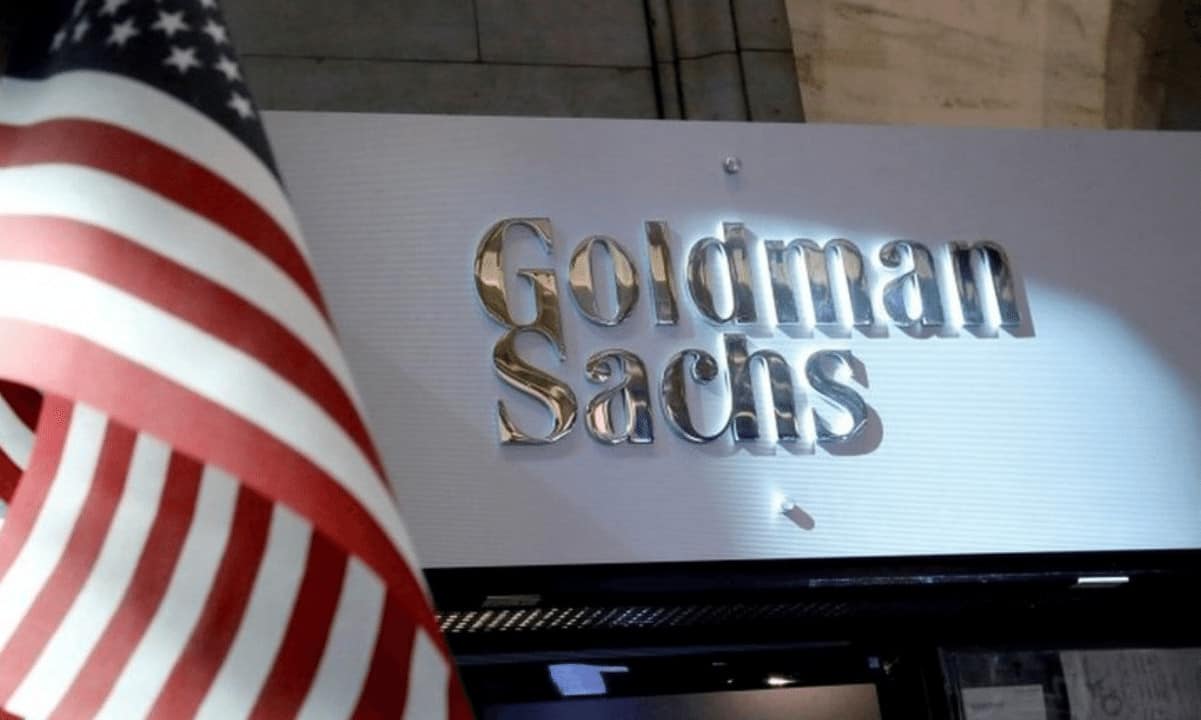
Goldman Sachs seems to have quietly unwound its entire XRP and Solana ETF positions in the first quarter of 2026.
This is according to its latest 13F filing, with the move coming after the firm had built up roughly $154 million in XRP ETF exposure just months earlier.
What the Filing Shows
Per Goldman’s Q1 2026 Form 13F, there are zero XRP ETF positions and zero Solana ETF positions, suggesting a clean exit from both. However, the filing shows multiple iShares Ethereum Trust entries, at approximately $114 million, $60 million, and $3.4 million, plus a separate iShares Staked Ethereum Trust position worth around $66.9 million.
The firm also retains a dominant position in Bitcoin (BTC), with hundreds of millions held primarily through the iShares Bitcoin Trust ETF across multiple account entries. It also added to its position in Circle, Galaxy Digital, and Coinbase while trimming holdings in Strategy, IREN, Bit Digital, and Riot.
One note worth flagging: several XRP-centric accounts have been circulating claims on X that Goldman still held the asset, citing what appeared to be an SEC filing screenshot.
But a check of Goldman’s actual submitted 13F found no such XRP positions, with the screenshot shared in those posts appearing to reflect Q4 2025 data, not the current quarter, which would explain the discrepancy.
Goldman’s XRP and Solana exposure was relatively new, considering that both ETFs launched in Q4 2025, and the Wall Street giant moved in quickly.
By the end of that quarter, as CryptoPotato reported, the firm had accumulated around $154 million across four XRP products, namely Bitwise, Franklin, Grayscale, and 21Shares, making it the largest disclosed institutional investor in spot XRP ETFs at the time. The Solana position came alongside it.
XRP ETF Demand Still Strong Despite Goldman Exit
The Q1 exit happened against a difficult background for the exchange-traded funds tracking the Ripple token. They had a pretty successful couple of months soon after their launch, but falling crypto prices in early 2026, caused by growing global uncertainty, put them on the back burner, which led to a first month in the red for them in March.
Nonetheless, things changed in April, with the products hitting a green patch and seeing more than $81 million in inflows. This month, with two weeks still to go, capital that has come into spot XRP ETFs stands at nearly $95 million, with cumulative net inflows hitting a new all-time high of $1.39 billion.
On their part, Solana ETFs have never seen a red month since their debut, even though inflows have reduced considerably from the $419 million recorded in November 2025. Like their XRP counterparts, the funds also recorded a new ATH in cumulative net inflows in May, after getting to $1.12 billion.
The post Goldman Sachs Exits XRP and SOL ETF Positions in Q1 2026 appeared first on CryptoPotato.

MPs Laugh As Robert Jenrick Speaks During Commons Debate

Puravankara shares surge 13% after Q4FY26 turnaround; reports Rs 114 crore profit

World Liberty Financial treasury company AI Financial warns in SEC filing that it may not survive the year

Manchester United reach agreement with Casemiro over contract clause amid transfer speculation

US brings back mandatory military draft registration

Steven Gerrard disagrees with Gary Neville over ‘shock’ Chelsea and Arsenal claim | Football

Breaking news for XRP today #xrp #xrpnews #ripple #crypto #cryptocurrency #sol #solana #bitcoin #btc

Why Banks Love When You Pay Minimum #shorts #finance #debtrap

0% interest Car loan trick #carloan #finance #interestrates #shorts
-

 Crypto World3 days ago
BloFin War of Whales 2026 Grand Prix opens registration for $5M trading championship
-

 Fashion3 days ago
Weekend Open Thread: Theory – Corporette.com
-

 Crypto World3 days ago
E-Estate Announces 1 Year Live: Washington DC Summit as Real Estate Tokenization Enters Its Next Phase
-

 Tech4 days ago
Tech Moves: Microsoft AI leader jumps to OpenAI; former AI2 exec joins Meta; and more
-
Crypto World6 days ago
Bitcoin Suisse expands with Digital Asset License and Investment Business Act Registration Approval in Bermuda
-

 Politics6 days ago
Pakistan to enter Chinese capital market as war inflation bites
-

 Crypto World6 days ago
Bitcoin Suisse expands with Digital Asset License and Investment Business Act Registration Approval in Bermuda
-
 Crypto World5 days ago
Google’s Gemini AI Predicts Incredible Solana Price by the End of 2026
-

 Business4 days ago
H&R Real Estate Investment Trust (HR.UN:CA) Q1 2026 Earnings Call Transcript
-

 Tech3 days ago
Google reimburses Register sources who were victims of API fraud
-

 Sports3 days ago
Napoleonic enters 2026 Doomben 10,000 field via Abounding withdrawal
-

 NewsBeat6 days ago
Comment on Keir Starmer surviving the day as Prime Minister like a turd that wont flush
-
 Entertainment5 days ago
Zara Larsson Has Blunt Response To Chris Brown Diss
-

 Fashion6 days ago
The Best-Kept Makeup Secret for a More Defined Face
-

 Politics6 days ago
Palestine’s flag becoming a regular sight at European football stadiums
-
 Crypto World5 days ago
Two AI Tokens Lead May Rally, But Risks Are Rising
-

 Politics7 days ago
The Trial of Majid Freeman, Verdict
-
 Tech6 days ago
Why AI is making typography a boardroom conversation
-

 Fashion2 days ago
On the Scene at Gucci’s Cruise Show in New York City: Mariah Carey, Kim Kardashian, Lindsay Lohan, Iman, and More!
-

 Politics6 days ago
The 81 MPs (so far) who have demanded tick-like Starmer out
You must be logged in to post a comment Login