

Crypto World
Grayscale Unveils Competitive 0.29% Fee Structure for Hyperliquid Staking ETF


Key Highlights
- Grayscale announces competitive 0.29% annual fee for HYPG ETF product.
- Fund could debut on exchanges this week following updated S-1 filing.
- Pricing strategy positions Grayscale below competing Hyperliquid offerings.
- Hyperliquid-focused funds have captured over $132 million in early flows.
- Asset manager continues expansion of digital asset investment products.
Grayscale has taken a significant step toward launching its Hyperliquid Staking ETF by establishing a sponsor fee of 0.29%. The revised regulatory filing confirmed HYPG as the official trading symbol. This pricing decision gives the asset manager a competitive advantage in the emerging Hyperliquid ETF marketplace.
Competitive Pricing Landscape Takes Shape
Grayscale submitted an updated S-1 registration document to the Securities and Exchange Commission this Monday. The revised submission included crucial details about the fund’s fee structure and ticker symbol. These additions suggest the product may begin trading within days.
At 0.29%, Grayscale’s fee structure undercuts several competing products in the space. Bitwise’s offering carries a 0.34% expense ratio once its promotional period concludes. Meanwhile, 21Shares has set its Hyperliquid ETF fee at 0.30%.
Once regulatory approval clears, the product will become available under the HYPG ticker symbol. James Seyffart, an ETF analyst at Bloomberg Intelligence, anticipates trading could commence this week. His forecast has intensified market focus on Grayscale’s launch schedule.
Hyperliquid Ecosystem Attracts Growing Interest
Hyperliquid functions as a decentralized platform for onchain perpetual futures contracts. The protocol’s native HYPE token facilitates operations throughout the network. By market capitalization, the token has secured a position among the top-tier digital assets.
Perpetual futures contracts enable market participants to gain price exposure without direct asset ownership. Unlike conventional futures, these instruments have no expiration date. As a result, they’ve emerged as a dominant force in cryptocurrency derivatives markets.
Regulatory frameworks have evolved to accommodate crypto derivatives products more broadly. The Commodity Futures Trading Commission recently cleared the way for such offerings in U.S. markets. This regulatory shift enabled prominent platforms like Coinbase and Kalshi to broaden their derivatives offerings.
Strong Initial Performance for HYPE Products
Hyperliquid-based ETFs have demonstrated impressive early market traction. Last month alone, HYPE-focused funds accumulated over $132 million in net inflows. These figures underscore significant investor appetite for regulated access to the token.
Grayscale is entering a marketplace where fee structures have become a critical differentiator. Its 0.29% expense ratio positions the company marginally below both 21Shares and Bitwise. This pricing advantage could prove decisive in attracting initial investors.
The new offering represents another milestone in Grayscale’s ongoing expansion of cryptocurrency investment vehicles. The company has established itself as a leader in regulated digital asset products. Through HYPG, Grayscale provides investors access to one of the most dynamic derivatives platforms in the crypto ecosystem.



Cryptocurrency exchange Coinbase will allow qualified borrowers to pledge digital assets to fund Fannie Mae-backed mortgage apartments beginning this summer.
In a Thursday notice, Coinbase and its partner, Better Home & Finance, said the mortgage structure plan launching “by summer 2026” will allow borrowers to initially use Bitcoin (BTC) or USDC (USDC) as collateral for loans to fund down payments for homes. The initiative, first announced in March, represented a significant shift in companies allowing digital assets to be used for financing houses.

Source: Pavel Danilyuk on Pexels
“We’re excited to expand access to all qualified borrowers to fix an ongoing issue: buyers who qualify on every measure that matters but cannot clear the down payment hurdle because their wealth isn’t where the system expects to find it,” said Better founder and CEO Vishal Garg.
Garg said in a March post on X:
“This isn’t a niche thing. It’s what everyone is going to do once most financial assets are tokenized. It’s just a better way to buy a house.”
The move by Coinbase and Better followed US regulatory agencies under the Trump administration being friendlier to crypto companies and more accepting of digital assets integrated with traditional finance. In June 2025, the US Federal Housing Finance Agency (FHFA) directed Fannie Mae and Freddie Mac to consider crypto as an asset in mortgage risk assessments without requiring a conversion into fiat.
Related: Crypto mortgages in US face valuation risks, regulatory uncertainty
Other mortgage lenders have made similar moves since the FHFA order. In February, Newrez began allowing borrowers to use their cryptocurrency holdings to qualify for a mortgage application.
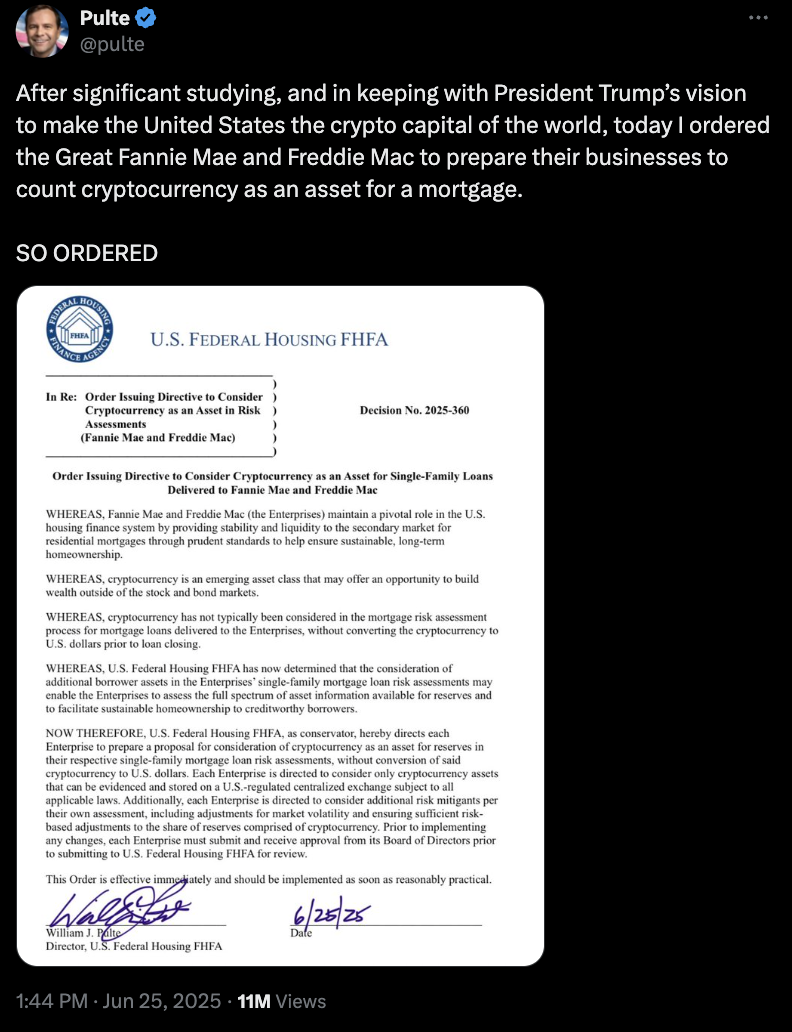
Source: Bill Pulte
Volatile crypto-backed mortgages scrutinized for political motivations
Although the price volatility of cryptocurrencies like Bitcoin may present challenges to the mortgage plan, some US lawmakers have accused FHFA head Bill Pulte of being “unduly influenced” by President Donald Trump in supporting such policies.
“Expanding underwriting criteria to include the consideration of unconverted cryptocurrency assets could pose risks to the stability of the housing market and the financial system,” said five US senators in a July 2025 letter to Pulte following the FHFA order.
Republican lawmakers, including crypto proponent Cynthia Lummis, have proposed codifying the FHFA order into law. She introduced the 21st Century Mortgage Act in July 2025, saying government agencies “must evolve to meet the needs of a modern, forward-thinking generation.”
Magazine: Bitcoin miners are pivoting to AI, so why is the hashrate near ATHs?
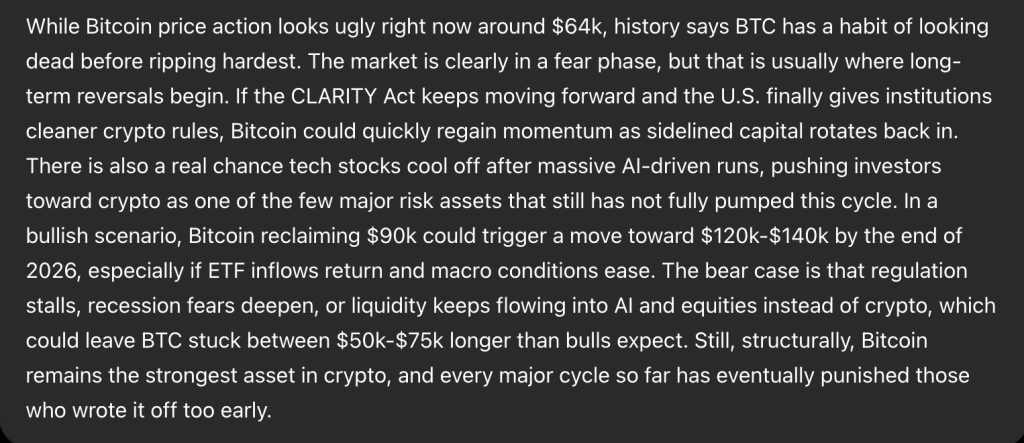
ChatGPT AI is not sugarcoating the current Bitcoin price picture at $64,000, but it is not throwing in the towel either, it predicts a $120,000 to $140,000 price prediction by the end of 2026 if BTC reclaims $90,000, and frames the current fear phase as historically the exact moment long-term reversals begin.
The framing Sam Altman’s AI is using is the most psychologically honest in this series: Bitcoin looks dead right now, and that is usually when it rips hardest.
That observation is not sentiment, it is a pattern. Every major Bitcoin bottom across the past 3 cycles has looked like the end of the story from the inside, and every time the market that wrote it off too early paid for it within 6 to 12 months.
The specific catalyst stack ChatGPT is pointing to has a variable that no other prediction in this series has mentioned: tech stocks cooling off after massive AI-driven runs.
If the Nvidia-led AI trade finally exhausts itself and capital starts looking for the next asymmetric opportunity, crypto, as one of the few major risk assets that has not fully pumped this cycle, becomes an obvious destination.
That rotation thesis is not dependent on crypto-specific catalysts at all, which makes it more durable than arguments that rest entirely on ETF flows or regulatory news.
The CLARITY Act moving forward is the regulatory unlock that removes institutional hesitation, and ETF inflows returning to the levels seen in early May is the mechanical demand driver that pushes price. Both of those need to be activated for the $90,000 reclaim that triggers the $120,000 to $140,000 path.

The bear case is the one the chart is currently living inside. Regulation stalling, recession fears deepening, or liquidity continuing to flow into AI and equities rather than crypto leaves BTC stuck between $50,000 and $75,000 longer than bulls expect.
From $64,000, the lower boundary of that range is only 22% away, which is not an abstract risk at this point.
Bitcoin Just Printed a Daily Low of $61,310 and the RSI Is Sending the Most Extreme Signal in a While
BTC is printing $64,166 on the daily with today’s low of $61,310 representing the deepest intraday level since the February 2026 capitulation wick near $61,000.
The fact that price has recovered from that low back to $64,166 within the same daily candle is the most important piece of near-term price action on this chart, because it mirrors almost exactly what happened in February when a similar wick below $62,000 preceded the recovery toward $98,000 over the following 8 weeks.
The daily chart from October 2025 tells the full story of this cycle’s correction. The peak near $124,000, the grind lower through November and December, the February capitulation at $61,000, the recovery to $98,000 in April, and now a second test of the $61,000 to $64,000 zone in early June.
This is the 2nd visit to cycle lows, and the 2nd visits to major support levels carry more structural significance than the first visits. Either this level holds and becomes a higher low that validates the recovery thesis, or it breaks, and the bear case of $50,000 becomes the next conversation.
The $65,000 to $68,000 zone is what BTC needs to reclaim and hold on a daily close basis to keep the floor intact. The February low of approximately $61,000 is the last line before genuinely new cycle territory opens below it.
ChatGPT’s closing argument that every major cycle has punished those who wrote Bitcoin off too early lands differently when the RSI is at 19.23.
This is not a call to buy based on emotion; it is a technical reading that says the selling pressure at current levels is at a historically extreme point that has preceded every significant Bitcoin reversal across multiple cycles.
LiquidChain Is Catching the Attention of Bitcoin holders: ChatGPT AI Predicts It’s the Next 100x
The rotation is already happening. Most people will only see it in hindsight.
Large-cap crypto is not failing. It is capped. Bitcoin, Ethereum, and XRP have been pressing against the same resistance bands for weeks. The macro tailwinds keep getting delayed.
The institutional inflows keep getting pushed to next quarter. Holding assets where the upside depends on catalysts you cannot control is not a strategy. It is waiting.
A capital that has navigated enough cycles does not wait at resistance. It moves before the destination becomes obvious.
Early-stage infrastructure plays operate on different math entirely. A small enough market cap means a modest rotation produces dramatic price movement. The asymmetry exists because the market has not priced in what is being built yet. That gap between current valuation and what the project is actually worth is where the returns come from.
Multi-chain fragmentation costs DeFi real money every single day. Bitcoin, Ethereum, and Solana run completely isolated liquidity systems with no native way to connect them. Every user moving value between ecosystems absorbs that cost directly in fees, slippage, and failed transactions.
LiquidChain collapses all 3 networks into a single execution layer. One deployment. Full ecosystem access. No cross-chain tax on every interaction.
The market has not found this yet. That is the entire point.
The presale is at $0.01454 with just over $820,000 raised. Ground floor is not a marketing phrase here. It is a description of where this actually sits in its lifecycle.
Execution is unproven. Adoption is unknown. Those risks are real and worth naming directly. Established assets offer a smoother ride toward a ceiling that is already visible. This offers an earlier seat at a table that has not been set yet.
Explore the LiquidChain Presale
The post Sam Altman ChatGPT AI Predicts Wild Bitcoin Price by End of 2026 appeared first on Cryptonews.
Crypto World
Bitcoin Open Interest Plunges 25% as Mass Liquidations Reset Crypto Derivatives Markets
TLDR:
-
- Bitcoin open interest dropped 25% to $23.2B, hitting its lowest level since early April in just four days.
- Ethereum open interest fell 13% to $9.8B, reaching levels not recorded since March amid the selloff.
- Forced liquidations of leveraged longs added extra selling pressure, accelerating the market’s rapid price decline.
- Declining open interest at multi-month lows reduces the immediate risk of further cascading selloffs in crypto markets
Bitcoin open interest fell sharply over four days, dropping 25% to $23.2 billion. This marked its lowest point since early April. Ethereum also recorded a 13% decline, reaching $9.8 billion.
The selloff at the end of May and early June triggered widespread liquidations. Leveraged traders were forced out of positions as prices declined rapidly. These numbers reflect how quickly market conditions can shift.
Liquidations Clear Excess Leverage From Bitcoin and Ethereum Markets
The late May and early June crypto selloff created a wave of forced closures across futures markets. When leveraged long positions are liquidated, exchanges automatically close them to recover losses. This process generates additional selling pressure, which can push prices even lower.
According to Santiment Intelligence, Bitcoin’s open interest dropped to levels not seen since early April. Ethereum’s open interest similarly fell to its lowest since March. Both declines happened within the same four-day window, pointing to coordinated market stress.
The forced exits removed a large portion of speculative capital from derivatives markets. Traders who held overleveraged positions had no room to absorb the price movement. As a result, the market experienced a rapid and broad reduction in open positions.
Declining Open Interest May Reduce the Risk of Further Selloffs
Elevated open interest is often a warning sign in crypto markets. It suggests that too much speculative capital is concentrated in leveraged bets. When prices reverse, those positions unwind quickly and amplify the downward move.
Santiment noted that the recent liquidation event brought both Bitcoin and Ethereum open interest back toward multi-month lows.
Historically, this kind of reset has helped stabilize markets after sharp corrections. Fewer open leveraged positions mean fewer forced closures if prices fall again.
This pattern has appeared multiple times across past market cycles. After major liquidation events, the reduced leverage environment tends to create a calmer trading backdrop. Traders who survived the flush often approach the market more cautiously in the weeks that follow.
While the pain of liquidations is real for affected traders, the broader market may benefit from the clearing effect. The reset removes the overcrowded positioning that makes markets fragile.
With open interest now at multi-month lows, the immediate risk of cascading selloffs has likely decreased for now.


Fidelity slashed its SpaceX IPO entry requirement from as much as $500,000 to just $2,000, opening the year’s biggest stock debut to millions of retail investors. Five brokerage flipping rules now decide who keeps that access.
The move follows SpaceX reserving up to 30% of its offering for retail clients, well above the small share they usually receive. That choice hands everyday investors rare entry to a roughly $1.77 trillion listing.
Fidelity Opens the SpaceX IPO to Retail Investors
Fidelity confirmed the lower threshold this week, pointing to the expanded retail allocation. Dropping the floor from as much as $500,000 to $2,000 erases about 99.6% of the prior barrier. The firm said the larger reserve meant more shares for ordinary clients.
SpaceX plans to sell about 555.6 million shares at $135 each, according to its filing with regulators. The raise targets roughly $74.4 billion, or up to $85.7 billion if underwriters exercise their option.
The company will trade on the Nasdaq under the ticker SPCX, with its debut targeted for June 12. The offering would rank as the largest IPO on record, eclipsing Saudi Aramco.
The expanded allocation is the lever, yet the terms still reward patient buyers over quick sellers. For readers weighing entry points, several routes already exist to buy SpaceX shares early.
Follow us on X to get the latest news as it happens
5 Brokerage Flip Rules That Could Cost You Access
Underwriters dislike investors who grab IPO shares and sell them fast. Most brokers punish this practice, known as flipping, by blocking access to future deals.
The conduct carries a regulatory definition. Wall Street watchdog FINRA treats a sale within 30 days of an offering as flipping.
Its Rule 5131, in force since 2011, bars brokers from clawing back a salesperson’s commission on flipped shares unless underwriters impose a penalty bid on the syndicate.
Brokers pass that pressure to clients through their own bans. Fidelity sets a distinctive clock for SpaceX.
- Selling within the first 15 calendar days marks a client as a flipper.
A first offense brings a six-month block. A second triggers a one-year block. A third means a permanent ban tied to the investor’s Social Security number.
Clients can sell freely from the 16th day onward. At 15 days, that window is the shortest of the group and half the 30-day standard FINRA uses.
- Robinhood treats any sale within 30 days as flipping.
Offenders then lose IPO Access for 60 days across every deal on the platform.
- SoFi also uses a 30-day window.
Violations bring bans of 180 days, then 365 days, then a permanent block.
SoFi may also charge a $50 fee on sales made before the 120th trading day.
That fee drops to $5 for later sales inside the window.
- Charles Schwab keeps its terms offering-specific.
Early sales can restrict future participation, often for six months on a first flip, though the firm advises confirming each deal directly.
- E*Trade warns that it may flag accounts and bar flippers from future IPOs for a set period.
The rules also bind investors before any shares change hands. To request stock, clients submit an indication of interest, sometimes called a conditional offer to purchase.
Placing that order means agreeing to the anti-flipping policy disclosed for the deal.
Investors should still confirm SpaceX-specific terms with their broker.
Special rules can apply to a single offering, and the penalties above may shift. A quick profit on day one could quietly lock a trader out of the next sought-after listing.
Demand and Volatility Cloud the Retail Opportunity
Notably, wider access does not guarantee an allocation. The offering covers about 555.6 million shares. Against a $1.77 trillion valuation at $135 each, that points to roughly 13 billion shares outstanding.
The result is a free float near 4%, and that thin supply could make early trading swing sharply.
The valuation also rests on steep growth assumptions. Goldman Sachs has told investors it expects SpaceX AI revenue to climb about 100-fold by 2030, the core of its case for a roughly $1.78 trillion price.
Those projections remain unproven and lean on the loss-making xAI unit.
Even so, demand looks intense across Wall Street. JPMorgan chief Jamie Dimon planned to pitch the deal personally to clients, with the bank lining up a live session for more than 2,500 of them across 90 locations.
Bank of America hosted similar events. That scramble suggests retail orders could be heavily scaled back.
Subscribe to our YouTube channel to watch leaders and journalists provide expert insights
Notwithstanding, the frenzy has not erased caution. SpaceX recently posted a quarterly loss, and Elon Musk locked all his shares for 366 days while keeping about 85% of voting power.
The math is straightforward for retail buyers. Long-term holders avoid the flip penalties entirely, while quick sellers risk losing access to the next major listing.
The post Fidelity Cuts SpaceX IPO Eligibility by 99%, But 5 Rules Could Cost You Access appeared first on BeInCrypto.
Crypto World
On-Chain Pre-IPO Tokens Hit $1.25B in Trading Volume as Tokenized Equity Market Expands
TLDR:
- The pre-IPO token market has recorded $1.25B in cumulative trading volume with over 20,000 active holders on-chain.
- SPV-backed protocols like PreStocks and Paimon Finance lead adoption by offering real share-backed token exposure via DEXes.
- Synthetic contracts carry no underlying share claims, introducing basis risk between oracle prices and actual private valuations.
- Closed-end fund structures offer SEC-registered exposure but limit redemptions and charge annual fees as high as 3.6%.
The pre-IPO tokenized equity sector has grown sharply on-chain, with platforms recording $1.25 billion in cumulative trading volume.
Over 3.5 million transactions have been processed across these protocols. More than 20,000 holders now participate in the space.
The combined market capitalization of tokenized pre-IPO stocks sits near $130 million, while Solana-based tokenized equity volumes continue reaching new weekly highs.
SPV-Backed and Synthetic Protocols Lead Market Adoption
Analyst Tanaka recently outlined the three main structures operating in the pre-IPO token space. SPV-backed protocols issue tokens tied to special purpose vehicles that hold actual company shares.
Synthetic contracts rely on oracles for pricing but carry no real share backing. Closed-end funds offer equity exposure inside regulated vehicles with net asset value pricing.
SPV-backed protocols currently lead in both adoption and secondary market liquidity. PreStocks operates on Solana, offering instant DEX trading, no investment minimums, and Regulation S compliance.
It lists names including SpaceX, OpenAI, Anthropic, Anduril, and Neuralink. Paimon Finance follows a similar model across BNB and HashKey chains, covering SpaceX, xAI, and Stripe, among others.
Both PreStocks and Paimon Finance anchor prices through internal pricing engines. They also rely on bid-ask spreads within their respective liquidity pools. This structure gives retail participants access to private company exposure without traditional barriers.
Synthetic protocols such as Ventuals and TradeXYZ price assets using real-time oracle feeds. Exits happen at market price, with funding rates serving as the primary cost.
However, these instruments carry no underlying share claims and introduce basis risk between contract prices and actual private valuations.
Closed-End Funds Prioritize Regulation Over Liquidity
Closed-end fund structures take a different approach, placing regulatory compliance at the center. Protocols like USVC and Fundrise VCX register with the SEC or equivalent regulators.
They price holdings to net asset value and restrict redemptions, often to quarterly windows following an IPO event.
Annual management fees on some of these products reach as high as 3.6%. While the regulatory structure provides investor protections, overall liquidity remains lower than what SPV secondary markets offer. This trade-off suits participants who prioritize compliance over trading flexibility.
Tanaka noted in the post that several companies have declared certain SPV token transfers void under their corporate bylaws.
This has triggered price volatility for affected tokens. Premiums over last known private valuations also remain elevated across most listings.
The timing of upcoming IPOs and public market capacity to absorb multiple large listings in 2026 also remain uncertain.
Tanaka disclosed no current positions in these instruments at present premium levels. The broader real-world asset infrastructure layer, nonetheless, continues to develop.


Russia has sanctioned a 17-year-old British schoolboy after he published a report exposing the country’s sanctions evasion which was partially enabled by Kyrgyzstani firms.
Reuters reported yesterday that Alexander Browder was sanctioned and barred, alongside four other British nationals, from entering Russia.
Russia’s foreign ministry claimed the sanction was warranted due to the “provocative anti-Russian rhetoric of British officials, the spread of insinuations about Russia, and London’s practical steps to supply the Kyiv regime with weapons.”
Roughly three months prior, Browder submitted a 46-page report to the Henry Jackson Society think tank detailing the scale of cryptocurrency money laundering within Russia.
His report was based on the findings of his own Global Cryptocurrency Laundering Database, a trove of data that reveals how cryptocurrency has been used to launder $350 billion in illicit funds across 164 cases between 2005 and 2025.
Browder discovered he had been sanctioned while at school.
He told the BBC, “No one said anything to me,” adding “I was sat in my economics class and I saw my name on the front page of Reuters saying that I was sanctioned.”
Read more: UK sanctions HTX for alleged Russian sanctions violations
He said, “For Russia [crypto laundering] is one of the key ways that they’re generating revenue to sustain their war of aggression, and so I’ve spent the last year and a half taking it down.”
Browder’s work covers Russia’s reliance on the Kyrgyzstan-based stablecoin A7A5, how four of the five major ransomware groups are based in the country, and the entire network moving money crypto to Russia’s benefit.
The report has been influential enough to spur 26 UK politicians to call for the country’s foreign secretary to sanction various Kyrgyzstani enablers of the network.
One month later, the UK implemented a series of UK sanctions against Russia that targeted the A7A5 network.
This included the sanctioning of Justin Sun’s Huobi Global, a crypto exchange that later rebranded to HTX, for its alleged interactions with the Russian crypto exchange Garantex.
Read more: Crypto has become Kim Jong-Un’s lifeline — and Russia’s secret weapon
Alongside Browder, Reuters reported that Washington Post journalist Catherine Belton, Committed to Good Chief Executive Alice Laugher, i Paper reporter Richard Holmes, and Chelsea Group Chairman Richard Westbury were all sanctioned by Russia.
The CEO of stablecoin firm A7, recently told Reuters that the firm is planning to expand its operations globally.
Ilan Shor said, “A7 plans to operate everywhere,” and claims that the sanctions, which he describes as “illegally imposed,” will be “lifted at some point.”
Got a tip? Send us an email securely via Protos Leaks. For more informed news and investigations, follow us on X, Bluesky, and Google News, or subscribe to our YouTube channel.
Key Highlights
- Bybit integrates USDPT stablecoin with fiat conversion services for Latin American users
- Western Union’s digital dollar debuts on a leading cryptocurrency exchange platform
- USDPT combines Solana blockchain infrastructure with traditional fiat currency gateways
- Partnership aims to accelerate cross-border transactions using stablecoin technology
- USDPT transitions from payment-only utility to full trading and fiat integration
Cryptocurrency exchange Bybit has integrated Western Union’s USDPT stablecoin into its fiat gateway services, marking a significant milestone for stablecoin adoption in Latin America. This collaboration represents the first time Western Union’s digital currency appears on a prominent crypto trading platform, bridging regulated stablecoin infrastructure with local currency exchange services.
Bybit Enables USDPT Access via Fiat Gateway
Bybit has rolled out support for USDPT purchases and sales through its One-Click Buy feature. Qualified users can now transact with the token provided their accounts meet eligibility requirements. This integration establishes an immediate fiat-to-stablecoin pathway within Western Union’s digital currency ecosystem.
Built on Solana’s blockchain infrastructure, USDPT maintains a direct 1:1 peg to the United States dollar. The stablecoin is issued by Anchorage Digital Bank, N.A., which also maintains the reserve assets supporting each token. This arrangement provides the digital asset with established regulatory oversight and institutional-grade custody solutions.
Through this partnership, Bybit contributes its trading infrastructure, fiat liquidity pools, and extensive customer network. Meanwhile, Western Union supplies its established payment channels, regulatory compliance framework, and decades of settlement expertise. The collaboration seeks to minimize transaction delays and eliminate inefficiencies in international money transfers.
Western Union Advances Digital Asset Initiatives
Western Union unveiled USDPT in May as a cornerstone of its evolving digital asset roadmap. The financial services giant developed this stablecoin specifically to facilitate practical payment applications and transaction settlement. Additionally, the platform enables continuous operation independent of conventional banking schedules.
The Bybit partnership extends USDPT’s utility beyond simple payment channels into comprehensive cryptocurrency trading ecosystems. Market participants in eligible regions can acquire tokens using their national currencies and subsequently exchange them back. This functionality positions the stablecoin as a practical tool for remittance services and digital dollar accessibility.
With over 140 years of experience in global money transfer services, Western Union’s entrance into stablecoin territory signals broader payment sector momentum toward blockchain settlement solutions. Furthermore, this initiative responds to escalating consumer demand for more efficient and economical international payment options.
Payment Industry Embraces Stablecoin Technology
Dollar-backed stablecoins have become a dominant force within digital asset markets. According to DeFiLlama analytics, the combined market capitalization of USD-pegged stablecoins approaches $320 billion. As a result, established payment companies increasingly explore regulated token solutions for settlement operations and fund transfers.
MoneyGram recently unveiled MGUSD on the Stellar network to power blockchain-enabled payment infrastructure. Similarly, Mastercard has broadened its integration of USDC, PYUSD, and RLUSD across specific settlement workflows. Western Union’s USDPT introduction now adds another recognized payment industry leader to this growing landscape.
The Bybit-Western Union alliance positions USDPT as a connector between cryptocurrency trading platforms and traditional financial systems. The stablecoin enables round-the-clock settlement while maintaining connections to regulated banking reserves. This strategic launch represents a concentrated effort to accelerate stablecoin adoption throughout Latin American markets.

Apex Group is guiding the fund administration for a tokenized real estate fund whose shares are issued on Goldman Sachs’ Digital Asset Platform (GS DAP). The collaboration brings together Goldman Sachs, digital asset exchange Archax, real estate manager LRC Group and interoperability provider Ownera, according to Apex.
“Tokenization at institutional scale depends on trusted, regulated infrastructure,” said Agnes Mazurek, Apex Group’s global head of digital assets, underscoring the growing demand from fund managers and investors for blockchain-native solutions that fit existing governance and oversight frameworks. The effort signals a broader industry push by banks, fund administrators and regulated digital-asset firms to bring real-world asset funds onto the blockchain while preserving familiar investor servicing and regulatory guardrails.
Tokenized units issued via GS DAP
The fund’s shares are issued as digital tokens on Goldman Sachs’ Digital Asset Platform (GS DAP), a blockchain-based framework designed to support issuance, settlement, custody and transfer of digital assets. GS DAP, which debuted in 2022, operates atop the Canton Network and uses Digital Asset’s smart contract language DAML to enable private, permissioned flows of data and value.
“Issuing blockchain-native fund units on GS DAP enables investment in real estate assets with precision while unlocking more seamless transferability in the future,” said Mathew McDermott, Goldman Sachs’ global head of digital assets and a Digital Asset board member. The arrangement positions tokenized real estate within a regulated structure, aiming to streamline ownership records and settlement processes while maintaining governance and investor protections.
In this collaboration, LRC Group, a pan-European real estate investment manager, will manage the fund, while Archax, described as a real-world assets (RWA) focused exchange, serves as custodian and the initial distribution partner. Ownera provides the interoperability layer that connects issuers, custodians and distribution channels, enabling the ecosystem to operate with greater connectivity across different platforms.
Cointelegraph requested additional details from Apex Group, but the firm did not provide further information by publication time.
Related industry coverage highlights the ongoing growth of real-world asset tokenization, including tokenized money-market funds, private funds and collateral networks. The broader market context shows institutional participants increasingly testing on-chain structures for traditional assets.
Apex Group’s involvement in tokenized real estate follows a previous move into tokenization in collaboration with Coinbase to launch a tokenized Bitcoin yield fund on the Base network earlier this year. The project underscored a trend where asset managers seek to combine blockchain-native issuance mechanisms with familiar fund governance and investor servicing standards.
Industry observers point to JPMorgan’s expansion of tokenization infrastructure through Kinexys, a platform focused on payments, collateral and asset tokenization, as part of a broader wave of Wall Street-backed experimentation with on-chain real assets. These efforts collectively illustrate a path toward more liquid, programmable access to real asset classes while aiming to preserve traditional risk controls and regulatory compliance.
Why this development matters for the market
Tokenizing real estate on GS DAP with a regulated, governance-oriented framework offers several potential benefits for investors and managers. First, on-chain units can improve settlement efficiency and reduce friction in cross-border transactions, potentially broadening the pool of eligible investors beyond typical fund structures. Second, the use of a centralized, regulated platform like GS DAP may help maintain consistent disclosure, compliance and investor servicing standards, even as assets move onto a blockchain-based issuance and transfer system. Third, the interoperability layer provided by Ownera could help align multiple distribution channels, custodians and issuers, reducing fragmentation in the tokenized-assets market.
What remains uncertain is how liquidity will evolve as tokenized real estate positions begin trading or transferring on chain. While GS DAP and Canton Network bring privacy and governance advantages to on-chain fund units, market liquidity for tokenized real estate remains a developing variable, contingent on regulatory clarity, custody reliability and the depth of secondary markets. Observers will also be watching how traditional asset managers balance compliance rigor with the speed and transparency promised by blockchain-native issuance.
Looking ahead: a continued push toward institutional tokenization
The Apex-led project reinforces a broader narrative: the financial industry is gradually moving real-world assets onto digital rails without sacrificing the controls and oversight investors expect. The integration of asset managers, custody partners and interoperability networks signals a more connected, standardized approach to tokenized funds—one that could accelerate the tokenization of real assets beyond private credit and real estate to include other asset classes as the ecosystem matures.
As tokenized funds gain traction, investors will want to monitor cadence from issuers about onboarding timelines, governance updates and liquidity options. Regulators, too, are likely to weigh in as more institutions pursue on-chain real asset offerings, looking to ensure that the benefits of tokenization are realized without compromising investor protections.
Readers should keep an eye on how this initiative unfolds across the GS DAP ecosystem, including any refinements to custody arrangements, distribution partnerships and cross-platform interoperability that could shape the pace and scope of institutional tokenization in the coming quarters.


Investors in Blackstone’s flagship private credit fund asked for their money back this quarter. Half of them won’t get it.
The $79 billion Blackstone Private Credit Fund (BCRED) told shareholders on Thursday that withdrawal requests hit 10% of its outstanding shares but the fund will honor just 5%.
It is the first time BCRED has ever capped redemptions.
The cap works out to about half of what investors wanted, according to a regulatory filing.
Last quarter, the fund did something more theatrical. Requests hit what was then a record 7.9%, higher than the quarterly 5% cap at which Blackstone is technically allowed to deny requests.
However, rather than turn anyone away, Blackstone tapped its own employees to fund the difference out of their personal accounts.
This quarter, with requests even higher, employee checkbooks stayed closed.
Private credit might not have been the cause of crypto’s rough week this week, but the two certainly declined together. Bitcoin led a broad sell-off, trading near $64,000 at time of writing and down 13% over the past week.
Given that tens of millions of US residents own crypto, many fund redemption requests came from the same crypto investors suffering these simultaneous drawdowns.
Tokenized private credit
Crypto players began piling into private credit a while ago, offering essentially the same products in a digital wrapper. Today, many stablecoin and altcoin treasury managers allocate capital directly to private credit funds.
Unfortunately, the same retail appetite that piled into illiquid yield products in traditional finance has been retreating, selling off tokenized proxies alongside real funds.
For example, ACRED, a tokenized feeder into Apollo’s Diversified Credit Fund, has lost 13% of its market cap over the last three weeks — its first reduction since inception after weeks of unbroken, consecutive upticks.
As Protos has previously documented, the same managers gating traditional credit funds have been tokenizing it on blockchains, where on-chain buying is instant and redeeming often takes weeks or months.
Crypto’s contribution to private credit was a change in speed as to how fast investors could buy. It did nothing to change the wait period to exit these illiquid funds.
In the meantime, a bad loan stays a bad loan, whether a smart contract wraps it or a quarterly tender offer rations it. This week, the largest private credit fund on the planet told half its investors the same thing: not yet.
The bear market continues in private credit
BCRED limits quarterly withdrawals to 5% of shares. When more investors want out than that, private credit managers slice everyone’s request down.
Any investor who requests a dollar receives 50 cents, with the rest locked in the fund until next quarter, when the same queue forms again.
Read more: Private credit firms prepare for bank run-type panic by gating investor withdrawals
BCRED is also hardly alone. Year to date, the common stocks of private credit giants Apollo, Ares, Blackstone, Blue Owl, and KKR are all lower, despite an 11% benchmark rally in the S&P 500 over the same time period.
Cliffwater’s $31 billion Corporate Lending Fund got hit with requests for 17% of its shares this week and is returning about one-third of those requests. The prior quarter, Cliffwater investors asked for a 14% redemption and received roughly half.
Got a tip? Send us an email securely via Protos Leaks. For more informed news and investigations, follow us on X, Bluesky, and Google News, or subscribe to our YouTube channel.
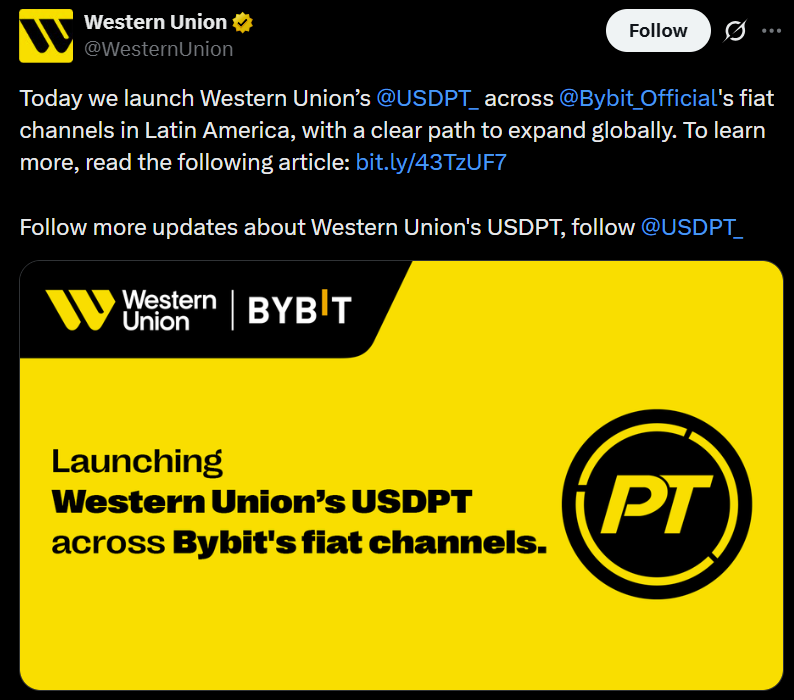
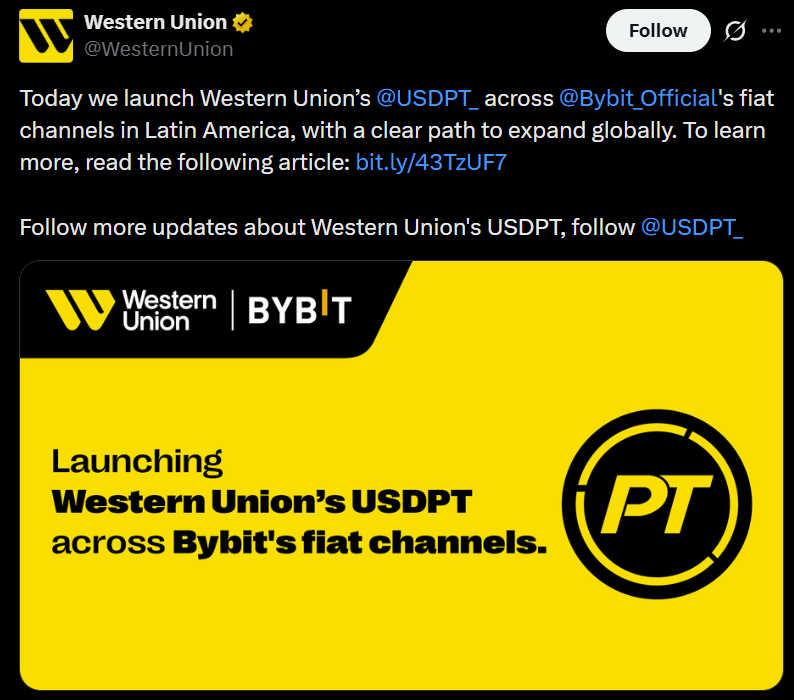
Crypto exchange Bybit has added support for Western Union’s USDPT stablecoin, a move that brings the payments giant’s digital dollar onto a major crypto trading venue for the first time.
The companies announced on Thursday that USDPT, Western Union’s US dollar-pegged stablecoin, is now available on Bybit for holding, trading and transfers. The integration expands USDPT beyond payments and into crypto trading while increasing the range of dollar-denominated stablecoins available to Bybit users.
Bybit said it is the first major cryptocurrency exchange to support USDPT.
Source: Western Union
Western Union launched USDPT in May as part of its broader digital asset strategy. The stablecoin is issued by Western Union Digital and backed by reserves held at Anchorage Digital Bank. USDPT initially launched on the Solana blockchain.
Originally founded in 1851 as a telegraph company, Western Union has said the stablecoin is designed to align with the framework outlined in the US GENIUS Act, the federal legislation that established regulatory standards for payment stablecoins.
Related: Why stablecoins and SWIFT may have to coexist
Payment giants deepen stablecoin push
Stablecoins remain one of the fastest-growing segments of the digital asset market despite broader weakness in crypto prices. According to DeFiLlama, the total value of dollar-pegged stablecoins has climbed to nearly $320 billion.
Western Union joins a growing list of financial institutions and payments companies entering the stablecoin market.
Earlier this month, global payment service MoneyGram launched its own US dollar-pegged stablecoin, MGUSD, on the Stellar network as part of its broader push into blockchain-based payments and cross-border transfers.
Meanwhile, Mastercard announced Wednesday that it is expanding support for several stablecoins, including USDC (USDC), PayPal USD (PYUSD) and Ripple USD (RLUSD), as the payments giant deepens its involvement in digital asset settlement.
That support includes expanded settlement capabilities to let issuers and acquirers settle some card transactions using regulated stablecoins.
Rival payment network Visa is also gaining traction. In April, the company said its stablecoin settlement pilot had reached a $7 billion annualized transaction run rate, underscoring increasing adoption of blockchain-based payment rails.
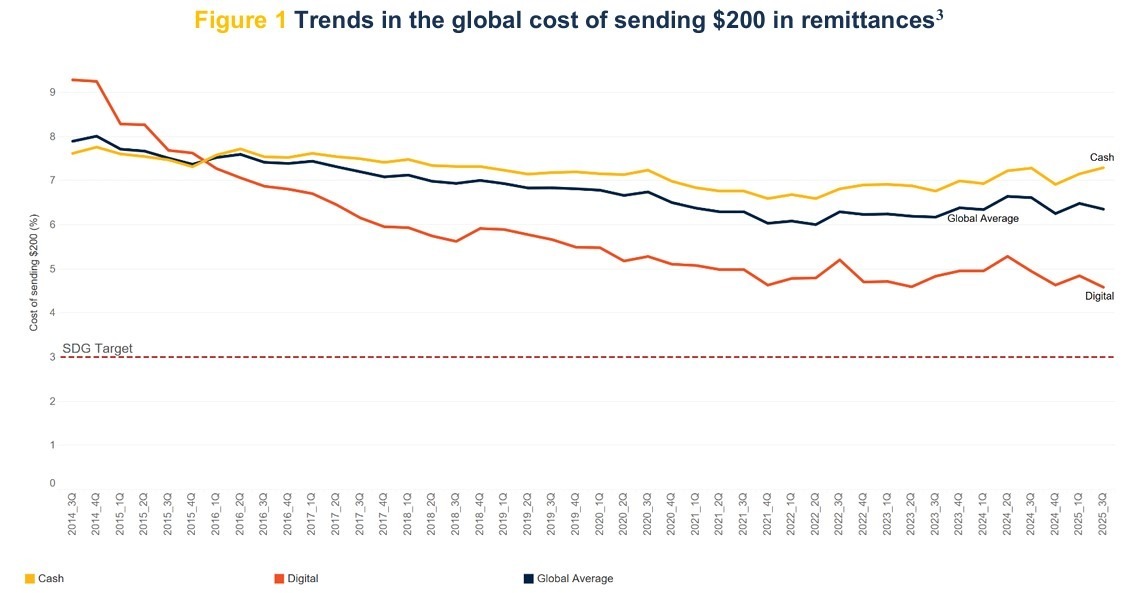
Using a $200 remittance as a benchmark, World Bank data shows that digital transfer methods can reduce costs compared with traditional cross-border payment channels. Source: World Bank
The trend comes as policymakers and international institutions continue to examine the role of stablecoins in cross-border payments. The World Bank has noted that traditional remittance channels remain costly and can limit access in developing economies, areas where stablecoin-based transfers could offer efficiencies.
Related: Coinbase expands branded stablecoin infrastructure business with Flipcash USDF launch

Coinbase to Launch Token-backed Mortgage Payments this Summer

Latto Seemingly Addresses 21 Savage Marriage Rumors (WATCH)

Hovertravel offers festival-goers great value fares to the Isle of Wight Festival

HarrisX Poll Found 52% of Registered Voters Support the CLARITY Act

BloFin War of Whales 2026 Grand Prix opens registration for $5M trading championship

Blockchain.com files with SEC for U.S. IPO

10 Jaw-Dropping Money Stats About the Average American

Cryptocurrency simple explanation #crypto #cryptocurrency #ChinkeeTan #money

CoinDCX : No.1 Crypto Exchange In India. | Sudheer Varma T | #crypto #coindcxapp #academyofstartups
-

 Tech7 days ago
Waymo dominates autonomous vehicle registrations as Tesla trails behind
-

 News Videos6 days ago
This is BROKEN! INSANE 5x MONEY CAR WASH WEEK! The NEW GTA Online UPDATE Today! (GTA5 New Update)
-
 Tech5 days ago
SpaceX just won a second Golden Dome contract. This one is $4.16 billion.
-

 Business3 days ago
Jade Biosciences, Inc. (JBIO) Discusses Positive Interim Results From JADE101 Phase I Healthy Volunteer Study and Development Plans Transcript
-

 News Videos6 days ago
SHE IS KILLING XRP!!! WATCH URGENT AND ACT FAST
-
 NewsBeat6 days ago
FIRST NIGHT REVIEW: Take That bring the Circus back to life in spectacular sun-soaked style
-

 Business5 days ago
Is the Spurs Phenom Already Better Than Prime Diesel?
-
Crypto World6 days ago
CFTC Has Approved the First Regulated Bitcoin Perpetual Contract in the U.S.
-

 Politics5 days ago
The House | Inside Andy Burnham’s Makerfield Campaign: “Nobody Thinks This Is In The Bag”
-

 Sports2 days ago
French Open 2026 results: Alexander Zverev beats Rafael Jodar and will play Jakub Mensik in semi-finals
-
 Entertainment6 days ago
Weak ‘Supergirl’ Box Office Tracking Amid Milly Alcock Backlash
-
 NewsBeat6 days ago
Novak Djokovic v Joao Fonseca LIVE: French Open latest scores and results after Jannik Sinner’s shocking collapse
-

 Tech2 days ago
CryZENx Releases Fresh Playable Content Deep Inside Jabu-Jabu for His Ocarina of Time Remake
-
 Crypto World6 days ago
Snowflake (SNOW) Stock Rallies on Strong Q1 Results and AI Product Growth
-

 Entertainment6 days ago
Maddox Jolie-Pitt Legally Requests to Drop Brad’s Surname
-

 Business5 days ago
Demand Conditions Improve In Chemicals Sector In April 2026
-
 Entertainment5 days ago
One of the Greatest Sitcoms of All Time Shoots Up Apple TV’s Charts 11 Years Later
-

 Crypto World6 days ago
MicroStrategy Moves $30 Million in BTC to Coinbase Prime: Is the Bitcoin Sell-Off Already Here?
-

 Tech6 days ago
This Week In Security: Ubiquiti Fixes, And FreeBSD Joins The Club You Don’t Want To Join
-
 Entertainment6 days ago
Bruce Willis’ Generosity Resurfaces Amid His Dementia
You must be logged in to post a comment Login