
Crypto World
Grayscale’s XRP ETF Sold $180 Million in Tokens After Major Loss

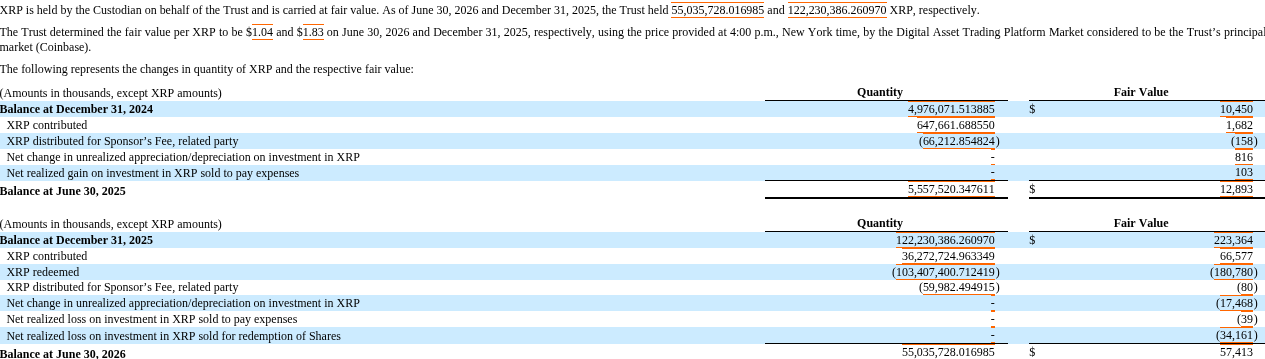
Grayscale XRP Trust ETF disclosed selling more than $180 million in tokens during the first half of 2026, according to a new SEC filing that also revealed significant realized losses.
The numbers show how sharply redemptions and falling prices have eroded trust over six months.

What the SEC Filing Actually Shows
A Form 10-Q is the quarterly report filed with the Securities and Exchange Commission (SEC) detailing financial performance and holdings. Grayscale’s submission covers the period ending June 30.
The headline figure stands out. The trust cashed out $180.78 million worth of XRP, selling 103.41 million tokens to redeem investor assets.
Holdings contracted dramatically as a result. The trust held 122.23 million XRP at the end of 2025, a figure that dropped to 55.04 million by June 30. Net assets fell even faster. The value declined from $223.36 million in December to just $57.41 million at the end of June.
Inflows did arrive. The trust created an additional 36.27 million XRP, contributions valued at $66.58 million. Those additions could not offset the exits. Outflows substantially exceeded inflows, driving the sharp reduction in holdings.
Follow us on X to get the latest news as it happens.

The mechanics involve authorized participants, who handle share creation and redemption based on shares issued or redeemed. Sponsor fees added pressure. Periodic XRP withdrawals covering those fees largely caused the reduction in holdings per share.
The Losses Behind the Redemptions
The losses tell their own story. Grayscale recorded a realized loss of $34.16 million on XRP sold for redemptions, plus $17.47 million in unrealized losses on the remaining position.
A smaller entry appears further down. Sales conducted to offset operating expenses generated an additional realized loss of $39,000.
Share counts reflected the exodus. Outstanding shares dropped from 6.30 million at the end of 2025 to 2.84 million by June 30, with the trust buying back 5.33 million shares while selling just 1.87 million.
Price action explains much of the damage. XRP traded at $1.06 at the time of writing, down roughly 1.35% over 24 hours and still far below its cycle highs, according to BeInCrypto data.

That decline compounds the redemption effect. Fewer tokens backing a cheaper asset produce the steep drop in net asset value in the filing documents.
Leadership activity had already drawn attention. Chief Executive Peter Mintzberg sold part of his personal stake in GXRP earlier this year. Redemptions themselves are routine, however. Authorized participants execute them mechanically, without expressing any directional view on the asset.
The scale still warrants attention. Losing half its holdings and three-quarters of its net assets within six months marks a significant contraction for the product.
Subscribe to our YouTube channel to watch leaders and journalists provide expert insights.
The post Grayscale’s XRP ETF Sold $180 Million in Tokens After Major Loss appeared first on BeInCrypto.


BlackRock’s newly launched tokenized money market fund, the BlackRock Daily Reinvestment Stablecoin Reserve Vehicle (BRSRV), has received the highest principal stability fund rating from S&P Global Ratings. The decision underscores how major TradFi players are attempting to translate money-market fundamentals—credit quality, liquidity, and short maturities—into tokenized structures aimed at stablecoin ecosystems.
At the same time, S&P’s latest Stablecoin Stability Assessments show limited upward movement across the stablecoin market: two of the 11 stablecoins it covers saw their scores revised lower over the prior three quarters, while the rest were unchanged. Notably, Tether’s USDt (USDT) remains among the lowest-rated assets in S&P’s framework.
Key takeaways
- S&P Global Ratings assigned an “AAAm” principal stability fund rating to BlackRock’s tokenized stablecoin reserve fund, BRSRV, on Monday.
- The AAAm assessment cited factors including investment and counterparty creditworthiness, short maturity design, and management’s ability to maintain a stable net asset value.
- S&P reported it found “no weaknesses” in its qualitative review of BlackRock Advisors’ management and organization, credit analysis, risk management, and compliance.
- S&P’s separate Stablecoin Stability Assessments framework still places USDT in the weakest category (“weak,” score of 5), and two other assessments were lowered during the previous three quarters.
S&P awards top principal stability rating to BlackRock’s tokenized reserve
S&P Global Ratings awarded BRSRV its highest principal stability fund rating—“AAAm”—emphasizing the fund’s focus on preserving principal rather than chasing yield. According to S&P, the rating was supported by the creditworthiness of the fund’s investments and counterparties, its maturity structure, and the demonstrated capacity of management to maintain a stable net asset value.
In addition, S&P said its qualitative assessment of BlackRock Advisors identified “no weaknesses,” covering areas such as management and organizational setup, credit research and analysis, risk management, and compliance practices.
S&P also highlighted the fund’s tokenization approach as “operationally resilient,” pointing to controls designed to mitigate cyber, smart contract, and blockchain network risks. The fund uses a permissioned architecture that restricts transactions to whitelisted wallets, a design choice intended to limit the operational surface area that public network tokenization can introduce.
What BRSRV holds—and how the fund is structured to support stability
BRSRV launched on Monday as an open-end management investment company, with the explicit goal of operating so that its shares may qualify as eligible reserve assets for payment stablecoin issuers under the GENIUS Act. The article of record notes that this linkage is part of a broader policy push to formalize how reserve assets can support stablecoin redemption expectations.
Per the fund’s described investment policy, BRSRV will hold cash, U.S. Treasury securities maturing in 93 days or less, and overnight repurchase agreements secured by Treasury instruments. The fund will also target a weighted average maturity of no more than 60 days and a weighted average life of no more than 120 days.
For market participants, these constraints matter because they directly influence how quickly risk can be re-priced and how sensitive the portfolio is to longer-duration credit and interest-rate dynamics. In principal stability frameworks, those short-duration characteristics typically play a central role in limiting exposure that could threaten stable net asset value.
Why “principal stability” is different from S&P’s stablecoin scores
While BRSRV’s “AAAm” rating is tied to the fund’s ability to keep a stable net asset value and limit principal losses from credit risk, S&P’s stablecoin scores are not the same product. The company’s Stablecoin Stability Assessments evaluate stablecoins themselves—how well they can maintain their pegs to fiat currencies—using a wider set of considerations.
S&P said that its stablecoin assessment framework currently covers 11 stablecoins. In its latest summary, six of those stablecoins have an “adequate” or stronger ability to maintain their pegs, while the remaining five do not meet that bar. S&P also noted that two assessments were revised lower over the previous three quarters, while the other nine stayed unchanged.
USDT remains in S&P’s lowest category, but several major coins score higher
According to S&P’s Stablecoin Stability Assessments, Tether’s USDt (USDT) remains at a score of 5, described as “weak.” This is despite S&P lowering its assessment from 4 (“constrained”) in November 2025. In the same section, TrueUSD (TUSD) and Ethena USD (USDe) are also assessed at 5.
By contrast, several widely used stablecoins fall into stronger categories. S&P assigned a score of 2 (“strong”) to Euro Coin (EURC), USD Coin (USDC), Global Dollar (USDG), and Paxos USD (USDP). Gemini USD (GUSD) and EUR Convertible (EURCV) received a score of 3 (“adequate”).
Other constrained outcomes still appear for First Digital USD (FDUSD) and Sky Dollar/Dai (USDS/DAI), each assessed at 4 (“constrained”).
S&P launched this assessment framework in December 2023, and the methodology—based on the summary provided—considers backing assets, liquidity, governance, redemption arrangements, legal and regulatory protections, technology dependencies, and the issuer’s track record. Assessments range from 1 (“very strong”) to 5 (“weak”).
For readers trying to interpret what these scores mean operationally, the key point is that the principal-stability rating applied to BRSRV does not directly translate into a stablecoin’s peg robustness. A reserve fund can be highly rated on principal stability even if a stablecoin’s broader system design, redemption mechanisms, and governance introduce additional peg risk.
What investors and builders should watch next
BRSRV’s AAAm outcome suggests tokenized reserve vehicles can meet stringent principal-stability expectations when portfolio composition, counterparty quality, and operational controls are tightly defined. Investors should watch whether additional tokenized reserve providers achieve comparable ratings—and whether S&P’s stablecoin assessments for top issuers move materially in subsequent quarters, especially given that some scores were revised lower despite an otherwise largely unchanged assessment set.


Most of the Bitcoin stolen through the COLDCARD wallet flaw remains unmoved, but on-chain investigators have detected a separate attacker beginning to route smaller amounts through a mixer.
Summary
- The largest known COLDCARD attacker controls 1,159 BTC across seven addresses.
- None of the 1,159 BTC has entered mixers or been transferred to an identifiable cash-out service.
- A separate attacker sent 64 BTC toward a mixer, initially mixing about 10 BTC.
- Investigators have distributed roughly 600 flagged addresses to law enforcement, exchanges, and analytics firms.
COLDCARD attacker leaves 1,159 BTC untouched
Galaxy Research said the largest known theft connected to the COLDCARD vulnerability involved 1,159 BTC. The funds remain spread across seven addresses associated with the attacker and have not moved since the initial sweep.
The Bitcoin was stolen within 41 minutes, according to the latest on-chain monitoring cited by Bitcoin News. Investigators have not detected transfers from the seven addresses to exchanges, mixers or other services commonly used to obscure stolen funds.
The assets are therefore better described as unmoved rather than technically frozen. Bitcoin transactions cannot be stopped at the protocol level merely because an address has been flagged.
However, the attacker could face difficulties converting the funds into fiat or other assets. Law enforcement agencies, cryptocurrency exchanges and blockchain analytics companies have reportedly flagged about 600 addresses connected with the wider theft.
Any transfer to a compliant exchange could trigger transaction monitoring controls and requests for information about the account receiving the Bitcoin.
Smaller attacker begins mixing stolen Bitcoin
Separate on-chain activity suggests another attacker has started attempting to obscure part of the stolen funds.
Analysts tracked 64 BTC entering a transaction flow linked to a mixer. Approximately 10 BTC was initially mixed, while about 54 BTC returned as change. The remaining funds were subsequently divided into outputs of roughly 7 BTC each for further mixing.
Mixers combine or restructure transactions to make it harder to connect the original source of cryptocurrency with its eventual destination. However, they do not guarantee that funds will become untraceable.
Analysts said the relatively large and consistently sized outputs make this laundering attempt easier to follow. Investigators can continue monitoring the transactions as the Bitcoin passes through additional addresses.
The activity also appears separate from the seven-address cluster holding 1,159 BTC. Previous reporting found that multiple attackers may have exploited the same wallet weakness, meaning movements from one cluster should not automatically be attributed to every COLDCARD theft.
Galaxy previously tracked 1,596 stolen BTC
As previously reported by crypto.news, Galaxy Research confirmed that attackers stole 1,596 BTC from approximately 7,300 addresses across three attack waves. It also identified 14 smaller incidents connected to the same seed-generation flaw.
A suspected fourth wave could raise the total to approximately 2,055 BTC, although Galaxy had not confirmed those additional losses through sufficient victim reports.
The vulnerability resulted from a firmware error that weakened the randomness used to generate wallet seed phrases. Attackers could reproduce possible seeds offline, derive their Bitcoin addresses, and compare them with addresses visible on the blockchain.
They did not need physical access to the devices, their PINs, or the Bitcoin network itself. The underlying Bitcoin protocol was not compromised.
Coinkite has released corrected firmware, but an update cannot secure a seed phrase generated using a vulnerable version. Affected users must create an entirely new seed and transfer their Bitcoin to addresses derived from it.
US investigators monitor flagged addresses
Galaxy previously said it shared confirmed attacker and victim addresses with US law enforcement agencies, exchanges and cyber-investigation groups. The expanding address list could help authorities identify stolen funds when attackers attempt to use regulated services.
Still, recovering the Bitcoin remains uncertain. An attacker may move funds through several addresses, mixers, decentralized platforms or services outside US jurisdiction before attempting to convert them.
The latest mixer activity gives investigators a new transaction trail to follow, while the 1,159 BTC held by the largest known attacker remains exposed to continuous public monitoring.
Crypto World
Mastercard Extends Crypto Credential to Cross-Border Stablecoin Payments in Borderless.xyz Pilot


Mastercard and Borderless.xyz are piloting the use of Mastercard Crypto Credential, the card network's verification system for digital asset transactions, in cross-border stablecoin payments, the companies said Wednesday. The pilot targets a bottleneck in stablecoin payment networks: every new… Read the full story at The Defiant
Mark Zuckerberg launched Muse Code in beta on Wednesday, Meta’s first artificial intelligence (AI) coding agent. Anthropic’s Claude Opus 5 beats it in all four comparisons Meta published at launch.
Meta released those charts anyway. The company is selling a cheaper tool rather than a better one. Independent test data suggests the gap is wider than Meta showed.
Follow us on X to get the latest news as it happens
Meta’s Own Charts Hand Anthropic Every Round
Muse Spark 1.2 is the model inside Muse Code. It scored 82.9% on Terminal-Bench 2.1.
Claude Opus 5 scored 86.7% on the same test. Terminal-Bench comes from the Laude Institute and Stanford researchers. It sets 89 real jobs spanning system repair, data work, and security.
Second place is respectable. Muse Code beat OpenAI’s Codex at 81.8% and Grok Build at 81.6%.

The next chart was harsher. DeepSWE 1.1 sets 113 coding tasks with internet access switched off during grading. Muse Spark 1.2 dropped to third at 59.3%.
Meta then published a test it built itself, drawn from 440 real pull requests by its own engineers. Muse Spark 1.2 scored 70.6% there, roughly nine points behind Opus 5.

That score sits only 2.3 points above Muse Spark 1.1, the model Meta shipped in July.
The Model Meta Left Off Its Coding Charts
Meta measured itself against GPT-5.6 Terra. OpenAI sells a stronger model called Sol, and Meta left it out of all three coding charts.
Sol tops the independent Terminal-Bench 2.1 leaderboard at 89.5%. Opus 5 follows at 89.1%.
Both figures beat the 86.7% Meta reported for Opus 5. Meta picked a weaker setting of its strongest rival and still finished behind it.
Against Sol, the true leader, Muse Spark 1.2 trails by 6.6 points rather than 3.8.
Meta did include Sol in one place. On a graphics processing unit (GPU) kernel task running past 1,000 tool calls, Sol improved on the baseline by 71.2%. Muse Spark 1.2 managed 68.7% and placed fourth of six.
One caveat cuts the other way. Muse Spark 1.2 does not appear on that public leaderboard yet, where only 26 of 183 tracked models have been tested. Its 82.9% remains a Meta figure.
“Muse Spark 1.2 is our next step as we push toward frontier, with larger, more capable models on the way,” Zuckerberg said in a post.
Zuckerberg May Soon Host the Model Beating His Own
Meta is reportedly in talks to lease compute to Anthropic. The deal could reach $10 billion over two years. Meta data centers would then help run the Claude models Muse Code was built to unseat.
The leadership behind Muse Code was expensive. Zuckerberg paid $14.3 billion in June 2025 for Scale AI and its founder Alexandr Wang, who now heads Meta Superintelligence Labs.
Price is the lever Wang has left. Rates match the July launch of Meta’s first paid API at $1.25 per million input tokens and $4.25 per million output tokens.
A contributor tier costs more than 10 times less. Developers qualify by letting Meta train on their work. Wang declined to give adoption numbers for the Muse Spark line.
Meta’s accounts explain the discount. Revenue climbed 28% to $60.8 billion last quarter, yet operating profit fell 8% to $18.8 billion.
Operating margin slid to 31% from 43% a year earlier. Meta spent $31.08 billion on capital projects in the quarter alone, and guides to as much as $145 billion for the year.
Muse Code does offer engineering Claude Code lacks. Background agents hold context across a session. Sub-agents work in isolated copies of a repository.
Meta has built a solid second-best coder and priced it like a budget option. The beta will show whether developers trade a few points of accuracy for a bill roughly a tenth the size.
The post Zuckerberg’s Muse Code Loses to Anthropic on Meta’s Own Benchmark Charts appeared first on BeInCrypto.
Ethereum is attempting to stabilize after recovering from its June lows, but the broader trend has yet to shift decisively in favor of the bulls. While the daily chart still reflects a bearish market structure beneath key moving averages, the 4-hour timeframe shows improving short-term momentum as price presses against key resistance levels.
Meanwhile, on-chain data continues to provide a constructive backdrop, with exchange balances falling to fresh cycle lows.
Ethereum Price Analysis: The Daily Chart
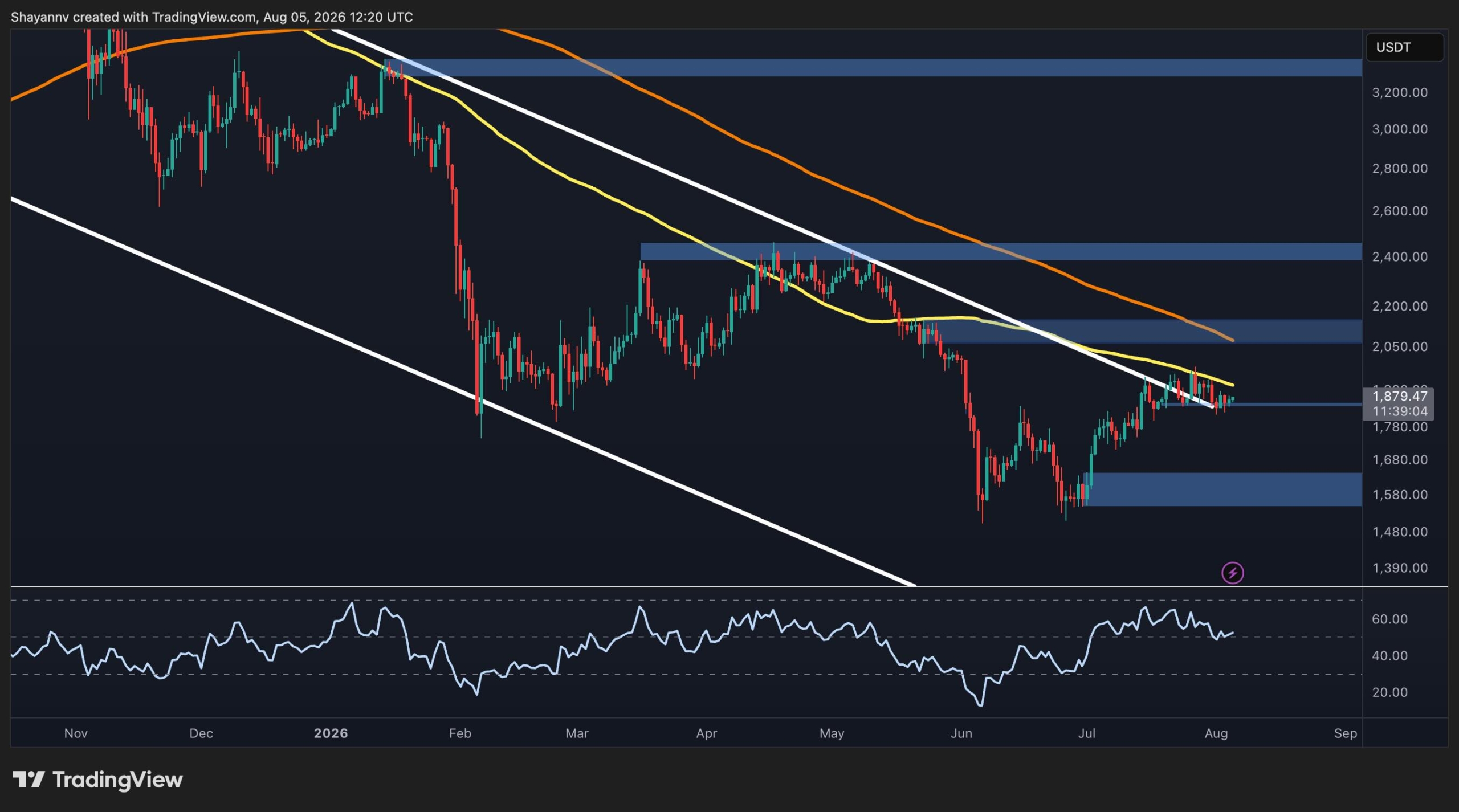
ETH is trading around $1.92K after rebounding from the $1.6K demand zone, where buyers stepped in aggressively following the sharp June selloff. The recovery has carried price back above a major confluence resistance formed by the long-term descending trendline and the 100-day moving average near $1.9K.
Despite the bounce, Ethereum remains below both the 100-day and 200-day moving averages, with the 200-day MA still trending lower near the $2.1K region. As long as the asset remains beneath these dynamic resistance levels, the broader market structure continues to favor sellers.
The first key resistance lies at $2.1K, where the mentioned 200-day moving average intersects with a major supply zone. A successful breakout above this cluster could expose the next resistance zone around $2.4K, which previously acted as a major distribution area.
On the downside, the immediate support is located around $1.85K, followed by the stronger demand zone at $1.6K. Losing the $1.85K area and dropping back inside the descending channel would invalidate the recent recovery attempt and likely reopen the path toward the $1.6K demand zone and potentially lower.
ETH/USDT 4-Hour Chart
The lower timeframe presents a more constructive picture. ETH has spent the past several sessions consolidating above the $1.85K support zone while gradually compressing beneath a descending trendline that has capped the price since the late-July high.
This structure resembles a short-term falling wedge or descending channel breakout attempt, with buyers repeatedly defending higher lows despite continued selling pressure from trendline resistance.
A decisive breakout above the descending trendline could trigger a move toward the psychological $2K level and the larger ascending channel’s upper boundary. Clearing those levels would strengthen the case for a continuation toward the daily resistance cluster near $2.2K and even $2.4K.
However, failure to break the trendline could lead to a breakdown of the $1.85K support, and if that zone gives way, ETH may revisit the broader demand area around $1.75K before buyers attempt another recovery.

On-Chain Analysis
The Exchange Supply Ratio continues to trend lower, reaching approximately 0.127, the lowest reading shown on the chart. This persistent decline indicates that a smaller proportion of Ethereum’s circulating supply is being held on centralized exchanges.
Historically, falling exchange balances suggest investors are moving coins into self-custody or long-term storage rather than preparing them for immediate sale. While this metric does not guarantee higher prices in the short term, it generally reflects declining spot sell-side pressure and improves the medium-term supply dynamics.
The combination of shrinking exchange reserves and ETH holding above a key support zone creates a constructive backdrop. Nevertheless, price confirmation remains essential. A sustained move above the descending trendline and the $2.2K resistance cluster would be needed to align the improving on-chain picture with a confirmed bullish technical reversal.

The post Ethereum Price Analysis: ETH Clears $1.9K, but a Bigger Test Awaits appeared first on CryptoPotato.


Circle on Aug. 5 named the founding validator cohort for Arc, its Layer 1 blockchain, listing BlackRock, The Depository Trust & Clearing Corporation, Galaxy, Global Payments, ICE, Mastercard, MoneyGram, SBI Group, Standard Chartered, Sumitomo Corporation and Visa alongside Circle itself, ahead of a… Read the full story at The Defiant

Solana’s native token has been bleeding heavily over the past few months, mirroring the broader cryptocurrency market’s weakness.
Some analysts believe a resurgence remains a plausible option as long as the price stays above certain critical levels.
Are Bulls Ready to Return?
SOL currently trades at approximately $73.70 (per CoinGecko) after slipping by 8% over the last 30 days. This is more or less exactly the level Ali Martinez recently described as a “make-or-break” moment. He argued that more than 50 million tokens were purchased around that zone, making it the most critical support on the map. The analyst claimed that a sustained close below could open the door to a plunge to $60 and even $50.
Most of the latest predictions, though, have been much more optimistic. Michael van de Poppe said “it would be great” to see a breakthrough of $76, saying such an uptrend could trigger a stronger rally to $120.
X user BATMAN also gave their two cents, suggesting that SOL’s valuation has neared a bullish trendline that has supported past major bottoms.
For their part, Pepesso claimed that the asset has one of “the cleanest setups in crypto right now.” They noted the brutal correction over the past months, adding that $45-$60 is the zone that “matters.”
“We are still well above it, but that’s the zone I’m watching if we retrace back in there. As long as $45 holds on any retest, this stays a clean accumulation setup,” the analyst said.
The X user opined that a reclaim of $100 could act as the first real confirmation, and from there, $150-$200 becomes the next range worth attention. On the other hand, a breakout under $45 would invalidate the bullish scenario.
The Concerning Factor
There are some signals that can serve as a bearish counterpoint to the aforementioned optimists. According to Ali Martinez, the number of addresses holding at least 0.1 SOL has declined by 5% over the past two weeks.
Specifically, addresses meeting that threshold have fallen from 11.84 million to 11.26 million, with the analyst outlining that this indicates a slowdown in participation among holders that could add further pressure to the price during the already fragile market conditions.
Small players reducing exposure to SOL is not necessarily a bearish factor and, in fact, combined with whale accumulation, is usually interpreted as a bullish signal. However, recent data does not show any meaningful interest from large holders at this stage.
The post Top Solana (SOL) Price Predictions as of Late appeared first on CryptoPotato.
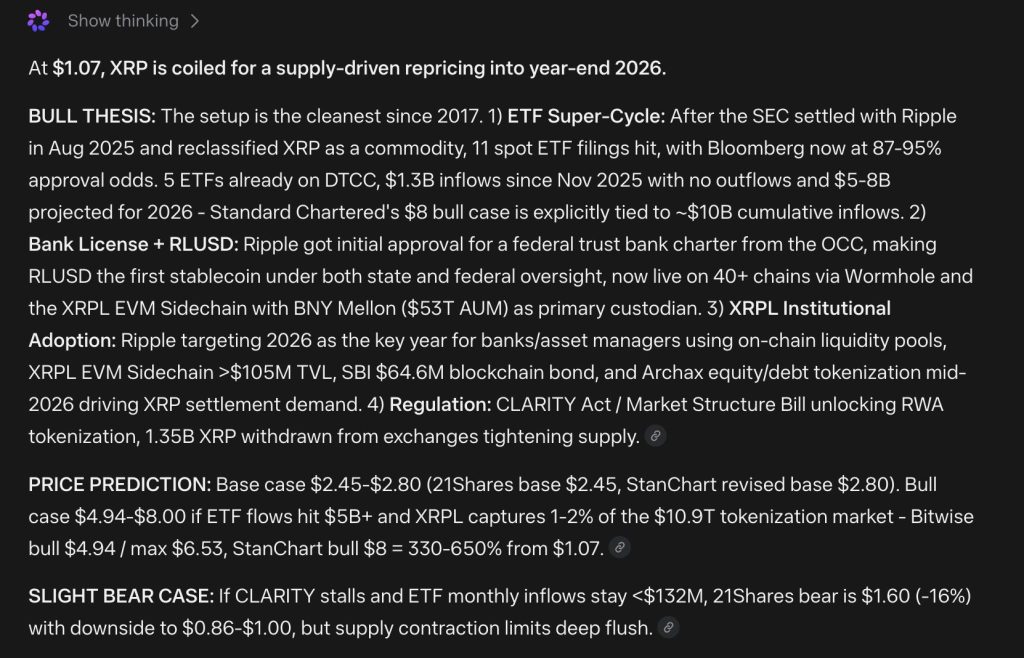
Meta AI predicts a supply driven repricing for XRP, and this price prediction calls the current setup the cleanest since 2017. At $1.07, the case is built around four catalysts rather than a single trigger.
The first is what Meta AI labels an ETF super cycle. After the SEC settled with Ripple in August 2025 and reclassified XRP as a commodity, 11 spot ETF filings followed, with Bloomberg now placing approval odds between 87 and 95%.
Five ETFs already sit on the DTCC list, $1.3 billion in inflows have arrived since November 2025 with zero outflows recorded, and $5 to $8 billion more is projected for 2026, the exact flow level Standard Chartered ties directly to its $8 bull case.
The second pillar is Ripple’s banking push. The company secured initial approval for a federal trust bank charter from the OCC, making RLUSD the first stablecoin under both state and federal oversight at once.

RLUSD is now live on more than 40 chains through Wormhole and the XRPL EVM Sidechain, with BNY Mellon, a custodian managing $53 trillion in assets, serving as primary custodian.
Institutional adoption on XRPL itself is the third leg. Ripple is targeting 2026 as the pivotal year for banks and asset managers actually using on chain liquidity pools, with the XRPL EVM Sidechain already holding more than $105 million in TVL, an SBI blockchain bond worth $64.6 million, and an Archax equity and debt tokenization push expected to drive real settlement demand by mid 2026.
Regulatory tailwinds round out the case, with the CLARITY Act or an equivalent market structure bill unlocking RWA tokenization while 1.35 billion XRP has already been withdrawn from exchanges, tightening available supply.
The base case price target sits at $2.45 to $2.80, drawing on 21Shares and a revised Standard Chartered figure. The bull case runs to $4.94 to $8.00 if ETF flows clear $5 billion and XRPL captures 1 to 2% of the $10.9 trillion tokenization market, a range Meta AI notes would mean a 330 to 650% move from $1.07.
The bear case is not dismissed. If CLARITY stalls and monthly ETF inflows stay under $132 million, 21Shares own bear scenario points to $1.60, a 16% decline, with downside risk extending to $0.86 to $1.00, though Meta AI argues the ongoing supply contraction limits how deep any flush could realistically go.

XRP Has Spent A Year Grinding Lower With No Real Bounce To Show For It
XRP peaked near $3.65 in August 2025, and the decline since has been remarkably steady rather than sharp, a long staircase of lower highs stretching from that summer peak all the way through the following winter.
February brought the sharpest single break, a gap down from above $2.30 to under $1.60 in a matter of days, and price has spent every month since compressing into an increasingly narrow range.
Price closed today at $1.07531, up 0.04%, in a session ranging between $1.06900 and $1.08182. Support sits at $1.00, the psychological floor that lines up closely with the bear case’s own downside target, then $0.86 below that if the supply contraction argument fails to hold.
Resistance stacks first at $1.20, then $1.40, then the far heavier ceiling near $1.60 that has capped every recovery attempt since February. The signal line reads 45.68 against 45.82, a gap so narrow it is effectively flat, and both lines have been drifting in that same tight band for months without any real separation.
That is not a chart building toward a breakout in either direction. For Meta AI’s base case near $2.45 to become plausible, XRP first needs to clear $1.60, a level this chart has not touched since before the February breakdown, regardless of how tight exchange supply has become in the background.
You Were Right About XRP. It Just Didn’t Pay.
Every trader has had the same experience. You read the analysis, you form a view, the market proves you correct, and it makes you nothing.
The problem isn’t the call. It’s the instrument. When you buy spot to express a view about one thing, you take on exposure to everything: liquidity, sentiment, unrelated flows, whatever happens in an unrelated market at 3am.
Your opinion was about a single question. Your position is exposed to all of them at once.
That’s what Kalshi is. A CFTC-regulated exchange where the prices are set by traders taking real positions, which is why the odds tend to move before the headlines do.
It isn’t free money. A contract that resolves against you goes to zero, and being directionally right on a slow timeline still loses if the contract expires first. Event trading pays for precision about timing, not just direction.
But the analysis above was free. What you do with it doesn’t have to be.
→ Get up to $25 to trade your first market on Kalshi
Don’t Miss Out on Our $1,000 USDT Airdrop on ByBit
The post Mark Zuckerberg Meta AI Predicts an XRP Surge Few Saw Coming appeared first on Cryptonews.
Cointelegraph is committed to providing independent, high-quality journalism across the crypto, blockchain, AI, and fintech industries.
All news, reviews, and analyses are produced with full journalistic independence and integrity. For more details on our standards and processes, please read our Editorial Policy.


Taj Tarsha, the founder of Few and Far, which claimed to be building an NFT exchange, has been indicted in the Southern District of New York for securities fraud and wire fraud.
The allegations in the indictment detail how Tarsha, along with the Few and Far team, raised over $10 million from investors by selling the rights to their future FAR token.
Subsequently, Tarsha allegedly “misappropriated millions of dollars raised by the company, using investor funds to gamble at an online casino, speculatively trade cryptocurrency, fund unrelated business ventures, and serve as collateral to finance his purchase of a luxury condominium in Miami.”
Additionally, he used some of the funds to support his “DJ hobby.”
Read more: Justin Sun’s NFT marketplace managed just four sales last month
According to the indictment, Tarsha was cynical about the NFT ecosystem, describing it as:
- a “bubble”
- “the last [company] I have in me”
- “the last juice I have to squeeze”
- a “magic ticket to a 10-30M exit.”
Similarly, he also apparently told his then-fiancée that he’d taken assets from Few and Far, something he knew was “unethical.”
Eventually, the Few and Far team apparently realized that assets had been misappropriated, leading to Tarsha being removed from the firm’s multisignature wallet.
Tarsha then allegedly “paid Co-Founder-1 and the operations director a significant amount of company funds to induce them to hand over control of the company’s multi-signature wallet.”
Tarsha also allegedly reached directly out to investors as part of his ploy to regain control.
Eventually, Tarsha and the rest of the team did launch the token, which subsequently lost more than 99% of its value.
Few and Far never launched the promised NFT exchange.
Got a tip? Send us an email securely via Protos Leaks. For more informed news and investigations, follow us on X, Bluesky, and Google News, or subscribe to our YouTube channel.

‘He should go. Now’: Luis Figo unleashes bombshell rant tearing apart embattled FIFA boss Infantino | Football News

National Gallery moves to protect artwork from Trump’s Freedom 250 Grand Prix vibrations

US stocks: Dow closes at record on Mideast optimism; SpaceX, AMD drag Nasdaq

Renter of Home in Anne Heche Crash Denies Settlement With Son

No Jackpot Winner as $257 Million Prize Rolls Over to $269 Million Monday Draw

Weekend Open Thread: Staud – Corporette.com

GIANT CRYPTO NEWS HAPPENING NOW! (Major Clarity Act News)

“money money green green” Kaytoven – MONEY! (Lyrics) Good Loyal Thots Remix

Why a money laundering investigation led Capital One to close hundreds of Trump Org bank accounts
-

 Fashion5 days ago
Weekend Open Thread: Wit & Wisdom
-

 Politics5 days ago
Meta enters AI-training agreement with far-right ‘propaganda rag’ Newsmax
-

 Politics3 days ago
Zack Polanski: an incitement to murder Nigel Farage?
-

 Crypto World4 days ago
MicroStrategy Post-Earnings CLARITY Act Push Could Add New Catalyst for Its Stock
-

 Crypto World5 days ago
XRP Ledger v3.3.0 brings five institutional features
-

 News Videos6 days ago
Bitcoin Enters the 3rd Stage of the Bear Market
-

 Politics6 days ago
Luke Littler’s dominance sparks GOAT debate
-

 Sports6 days ago
Seema Kaliramna Wins Discus Throw Bronze, Takes India’s CWG Medals Tally To 17
-

 Crypto World5 days ago
New York sues Kalshi over prediction market gambling
-

 Crypto World4 days ago
Crypto PAC spending tops $2M in Michigan House race
-

 Business5 days ago
Trump Announces Hamas Disarmament Agreement as Iran Strikes Kuwait Air Base and US Attacks Pause Overnight
-

 Business3 days ago
DTCR: Deleveraging And A Hedge Fund Collapse Point To A Possible AI Bottom
-

 Tech4 days ago
ESET tracks rise in malicious AI skills and adaptable malware
-
 Crypto World5 days ago
3 Fed Officials Just Explained Their Rate Hike Vote: Is Inflation Winning?
-

 Sports4 days ago
France Cricket implodes: letters hidden in a drawer and a board at war
-

 NewsBeat6 days ago
Four people die trying to cross Channel in small boats
-

 Tech6 days ago
Gemini Spark can now use Chrome logins and saved passwords to run errands on your behalf
-

 Tech5 days ago
Building A Reproduction PlayStation Motherboard
-
Crypto World3 days ago
XRP Ledger urges node upgrade after manifest flood
-

 Crypto World5 days ago
Moneyflip CEO charged in $40K murder-for-hire plot
You must be logged in to post a comment Login