
Crypto World
Growing TIME’s AI Coverage


TIME Editor in Chief Sam Jacobs and Executive Editor Alex Altman sent the following memo to staff on Monday:
Dear all,
TIME aspires to lead in the coverage of the remaking of the world by artificial intelligence.
Last week, we released our annual TIME100 AI list, led by Ayesha Javed, and an exclusive cover story about OpenAI drawing on unprecedented access inside the company. Today, we’re announcing a significant investment in our AI and technology coverage.
In just a few weeks, we’ll relaunch In the Loop, our AI newsletter, with a new format. Later this year, we plan to expand it to five days a week, giving readers a daily, essential briefing on the industry and the influences shaping it. Next year, we’ll build on the success of this year’s AI events in Davos, Cannes, New York and San Francisco by launching our first-ever TIME100 AI Leadership Forum in Washington, D.C. We are exploring additional opportunities to convene the world’s most influential AI leaders internationally too.
To support our continued commitment to this work, we’re pleased to announce the following staff changes.
Naomi Nix joined us Aug. 17 as a Senior Correspondent based in Washington. Naomi comes to TIME after four years covering Meta and the broader social media industry for The Washington Post, where her reporting focused on how powerful platforms shape American democracy and global politics. Before The Post, she covered tech lobbying and corporate influence for Bloomberg News, and got her start covering beats including education and City Hall for The 74, The Star-Ledger and the Chicago Tribune. At TIME, Naomi will contribute to In the Loop, write ambitious features and investigations, and report across platforms with a focus on policy, regulation, tech’s political influence, and the nexus between Silicon Valley and the nation’s capital.
Manisha Ganguly joins us as a Senior Correspondent based in London, starting Nov. 1. Manisha is a decorated investigative journalist and a pioneer in using open-source intelligence to expose war crimes. She joins us from The Guardian, where she was investigations correspondent and led visual forensics; she previously built out open-source investigative workflows at the BBC. She holds the first PhD awarded for research into OSINT’s impact on investigative journalism, from the University of Westminster. Manisha is currently writing her first book. At TIME, she will pursue investigations and features on AI and national security, profile key leaders and policymakers, and contribute to In the Loop and our coverage across platforms.
Harry Booth, who joined TIME in 2024, becomes Staff Writer and will relocate to San Francisco in January to anchor our coverage of the world’s most important AI hub. Since joining the London bureau, Harry has been a force behind our TIME100 AI, Philanthropy, and Climate franchises and our Best Inventions coverage. He co-authored our March cover story on Anthropic’s rise and its standoff with the Trump Administration, based on reporting inside the company. Harry will lead our beat coverage of the AI boom on the ground in the Bay Area, covering the frontier labs, hyperscalers, and startups defining this moment.
The additions of Naomi and Manisha, and Harry’s expanded role in San Francisco, will strengthen a team that already includes two agenda-setting correspondents on the AI beat: Billy Perrigo, based in London, and Andrew Chow, based in Washington. All will work with Senior Editor Dayana Sarkisova, who has done a terrific job leading our global beat coverage of AI leaders, companies, and their impact on society. Charlie Campbell, reporting to Gemma Fox, will continue to contribute greatly to our AI coverage from Asia.
In recent years, this global team has brought readers inside companies like Anthropic, OpenAI, Google, Nvidia, and Waymo; broken robotics scoops showing what the next wave of automation looks like; and reported on the global data center boom and the political backlash it has provoked, taking readers from a remote valley above the Arctic Circle in Norway to frontline communities in Tennessee and Texas. Last December, we named “The Architects of AI” our Person of the Year.
Assembling this team reflects TIME’s commitment to covering the most consequential story of our time with the ambition it demands—across every platform, through access and accountability, and careful scrutiny of AI’s promise and perils. Please join us in welcoming Naomi and Manisha, and in congratulating Harry on his upcoming move to San Francisco.
Sam and Alex

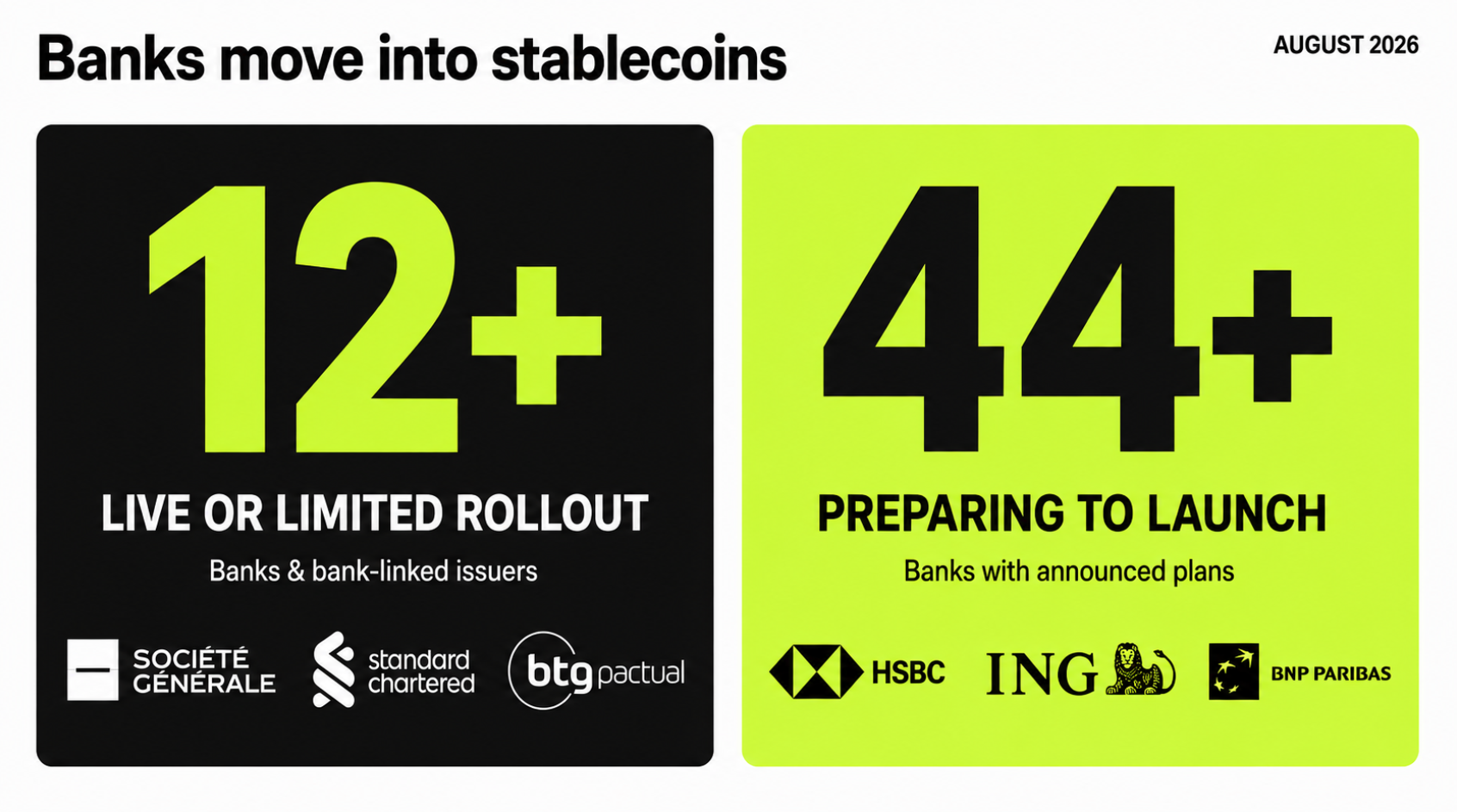
Stablecoins could make borrowing more expensive. That was the warning from Bank for International Settlements chief Pablo Hernández de Cos on August 28, as banks expand into digital money.
These digital assets are becoming an awkward asset class for banks. Because it’s almost killing their business model and forcing them to introduce new products.
The stablecoin market now holds roughly $304 billion, including about $183 billion in Tether and $74 billion in USDC. Federal Reserve researchers describe these tokens as potential competitors to traditional transaction accounts.
Arthur Firstov, Chief Business Officer at Mercuryo, told BeInCrypto why that matters.
“Stablecoins stopped being a crypto product and became a payments product. For years banks could wave it off as ‘crypto infrastructure’ – that’s a much harder line to hold when stablecoins are being used for payments, treasury, cross-border settlement, cards, merchant payouts, and institutional settlement. At that point they’re competing directly with one of the most valuable products a bank has: the transaction account.”
Banks are responding. A Federal Reserve survey in September 2025 found roughly half of respondents were prioritizing growth in at least one stablecoin or digital-asset area over the following three years.

What Happens to the Deposit?
J.P. Morgan’s JPM Coin represents a bank deposit on a blockchain. Société Générale-FORGE’s CoinVertible is a MiCA-regulated stablecoin backed by segregated collateral. Similar technology carries different promises to customers.
Nitin Gaur, Head of Institutions at Nethermind, explains the distinction.
“The interesting question stopped being whether a bank can issue and became what a bank is issuing. A tokenized deposit and a bank-issued stablecoin are two different liabilities with different legal character, different capital treatment, different insurance status and different settlement properties.”
A tokenized deposit remains bank funding. Under the US GENIUS Act, payment stablecoins require at least one-to-one backing with eligible reserves, such as cash or short-dated Treasuries. Treasury proposed implementation rules on August 17.
Gaur describes what that can mean for a bank’s balance sheet.
“A stablecoin issued under a GENIUS pathway is not a deposit. It is a payment instrument backed by segregated reserves the issuer cannot lend against. When a treasurer moves a hundred million from a demand deposit into the bank’s own coin, the bank has converted a funding source into a matched, non-lendable reserve pool,” Gaur said.
The wider effect depends on where reserves end up. Money deposited back at banks can still provide funding, although it may be more concentrated and quicker to leave.
Adrian Wall, Managing Director of the Digital Sovereignty Alliance, identifies the risk.
“If stablecoin adoption ultimately shifts funding away from bank deposits rather than recycling those funds back into the banking system, banks could face higher funding costs and potentially less capacity to extend credit.”
Payments Beyond Banking Hours
Customers already have reasons to use these products. In July, Citi reported a dollar payment from London to Thailand over a US holiday weekend, using its tokenized-deposit service alongside round-the-clock clearing.
Western Union launched USDPT in May, with Anchorage Digital Bank issuing the stablecoin on Solana.
The models are growing at different scales. J.P. Morgan reports around $7 billion in daily activity across Kinexys products. CoinVertible reported €156.6 million of euro tokens and $12.55 million of dollar tokens outstanding on August 31.
Those figures measure transaction volume and circulating supply respectively, so they cannot establish which model is winning.
37 Banks, One Coin
As more banks enter, separate coins could leave money scattered across smaller pools, with users having to exchange one bank’s token for another. Connecting the technology does not guarantee conversion at face value during market stress.
Europe’s Qivalis has assembled 37 banks across 15 countries around a planned euro stablecoin. It targets a launch in the second half of 2026, subject to regulatory authorization.
Ernesto Olmedo Pereira, Head of Strategy & DeFi at Qivalis, says sharing the currency is deliberate.
“If every bank launches its own token, you get dozens of thin, incompatible pools instead of one deep, liquid euro instrument. Qivalis, an independent company backed by 37 banks, exists precisely because the banks behind it decided to build one shared, interoperable euro rail together rather than compete with 37 separate ones.”
Banks could then compete through services surrounding that money, such as foreign exchange and corporate lending. The shared coin would carry payments between them.
Qivalis’s launch will test whether that cooperation can attract regular business beyond its founding banks.
Customers need money they can use across banking relationships. Banks will have to show that the services sold around those payments justify any higher cost of funding their loans.
The post The Stablecoin Race Could Make Bank Loans More Expensive appeared first on BeInCrypto.


Wallets linked to North Korea’s Lazarus Group have sold more than $30 million in Bitcoin through Hyperliquid over three weeks as U.S. officials and Payward explore regulated access to the platform.
Summary
- Lazarus-linked wallets sold more than $30 million in Bitcoin through Hyperliquid, Arkham data showed.
- The wallets used the proceeds to buy Ethereum and Solana before transferring the assets to exchanges.
- Payward is reportedly discussing a structure that could offer selected Hyperliquid perpetuals to U.S. traders.
- Hyperliquid has processed $5.19 trillion in cumulative perpetual trading volume, according to DefiLlama.
Lazarus-linked wallets convert Bitcoin into ETH and SOL
Arkham blockchain data, wallets associated with the North Korean state-sponsored Lazarus Group sold more than $30 million in Bitcoin on Hyperliquid during the past three weeks.
The wallets used proceeds from the Bitcoin sales to purchase Ethereum and Solana before sending the assets to centralized exchanges, including Kraken, LBank, and KuCoin, according to the blockchain analysis. Crypto investigator ZachXBT first identified the addresses in 2024, while Arkham later labeled them as connected to Lazarus.
Public blockchain records show transfers between addresses but do not reveal who controls the receiving exchange accounts. CoinDesk said it could not identify the account holders or determine whether the exchanges knew about the reported source of the funds.
Kraken said compliance sits at the center of its operations and that it continuously monitors blockchain activity with support from analytics providers. According to the exchange, its controls are designed to identify and block assets connected to sanctioned wallets before they reach the platform.
LBank said it uses industry-standard compliance tools for continuous monitoring. The exchange described illicit transfers across platforms, blockchains and jurisdictions as an industry problem that no single company can independently detect or resolve.
KuCoin said it could not confirm the reported activity without reviewing the underlying wallet data. The exchange also cautioned that public blockchain records do not show every step taken after assets arrive at a centralized platform, including account restrictions, regulatory reports and other risk controls.
Hyperliquid activity raises US sanctions questions
The reported transfers carry a direct U.S. angle because the Treasury Department has sanctioned Lazarus Group and identified it as a cyber organization controlled by North Korea’s government.
U.S. authorities have linked Lazarus to several digital-asset thefts, including the $625 million Ronin Network attack in 2022. As previously reported by crypto.news, former Defense Secretary Mark Esper recently cited North Korean hacking groups while arguing that regulated domestic crypto markets could give U.S. law enforcement better access to customer and transaction records.
Using a decentralized venue can complicate enforcement because Hyperliquid allows users to connect a wallet and trade without opening a traditional brokerage account. The protocol’s public blockchain still records transactions, allowing firms such as Arkham to trace transfers between labeled addresses.
The presence of a sanctioned actor’s assets on a decentralized platform does not establish that Hyperliquid assisted the activity or knew who controlled the wallets. CoinDesk’s report also did not establish that Kraken, LBank or KuCoin credited the transferred assets to unrestricted customer accounts.
For U.S. regulators, any plan to offer Hyperliquid-linked products domestically would need to address sanctions screening, customer identification and account-level controls. Wallet checks can identify previously labeled addresses, but funds may pass through several assets or addresses before arriving at another venue.
A recent Hyperliquid testnet deployment showed how a permissioned version of its infrastructure might operate. In August, a deployer using Kraken’s name whitelisted 10 wallets and tested controls for canceling orders, reducing positions, and moving collateral.
Neither Kraken nor Hyperliquid had confirmed ownership of that deployment when the report appeared. Because Hyperliquid’s testnet permits outside deployments, the Kraken name alone did not prove that the exchange created or operated it.
Payward discusses regulated Hyperliquid access
At the same time, Bloomberg reported that Kraken parent Payward is in advanced discussions with Hyperliquid Labs over offering selected perpetual contracts to American traders through Bitnomial, its CFTC-regulated derivatives business.
People familiar with the talks told Bloomberg that Payward had presented the Commodity Futures Trading Commission with an outline of the proposed structure. Any agreement would still require regulatory approval, while the financial terms remain unknown. Payward and Hyperliquid Labs declined to comment to Bloomberg.
President Donald Trump brought the possible U.S. entry into public view during an Aug. 19 White House event. Referring to CFTC Chair Michael Selig, Trump said he understood that the regulator was working to bring Hyperliquid into the United States in a “fully compliant and legal fashion.”
A Payward arrangement would give eligible U.S. customers access through a registered operator rather than through Hyperliquid’s permissionless interface. Commodity derivatives offered to American retail traders generally must use CFTC-regulated entities, and wallet screening alone does not replace exchange, clearing, and brokerage requirements.
Payward already has the regulatory infrastructure needed to operate in the domestic derivatives market. The company completed its Bitnomial purchase in May after agreeing to pay as much as $550 million in cash and stock.
The acquisition gave Payward control of a designated contract market, derivatives clearing organization and futures commission merchant. Together, the three registrations cover trading, clearing and brokerage services under CFTC oversight.
Kraken then launched regulated perpetuals for eligible U.S. customers in June. The service allows supported users to trade spot, margin, traditional futures and perpetual futures through Kraken Pro while using Bitnomial’s regulated structure.
Hyperliquid leads decentralized perpetual trading
Hyperliquid operates its principal exchange through HyperCore, an on-chain trading system that handles order matching, margin calculations and liquidations. Users trade from connected crypto wallets, while the platform’s main permissionless interface does not require a conventional brokerage account.
Perpetual futures differ from dated futures because they have no fixed expiry. Funding payments between long and short traders help keep contract prices close to the value of their underlying assets, allowing positions to remain open as long as margin requirements are met.
DefiLlama data showed Hyperliquid had processed approximately $5.19 trillion in cumulative perpetual volume at the time of writing. Its perpetual markets recorded about $60.44 billion in seven-day volume and $204.95 billion during the previous 30 days.
Open interest stood at roughly $13.3 billion, representing the notional value of outstanding perpetual positions. DefiLlama also recorded more than $32.6 billion in cumulative liquidations on the platform, including approximately $2.25 billion over the preceding 30 days.
Beyond markets operated by the core protocol, Hyperliquid Improvement Proposal 3 allows outside builders to launch independent perpetual exchanges using HyperCore. Deployers select their contracts, collateral, leverage limits, funding settings, and price sources after staking 500,000 HYPE.
Validators can slash the stake when a deployer manipulates an oracle or violates market rules. HIP-3 operators receive half of the trading fees generated by their markets, while newer permission tools tested on the network could let individual deployers restrict access to approved wallets.
Crypto World
Kalshi Is Imposing Its First-Ever Lifetime Ban on Former Rep. George Santos. Here’s Why

In addition to permanently banning Santos from Kalshi, the company also levied a fine of $71,356 against him.
Santos responded to the news on Monday, saying in a post on X: “Hey @Kalshi thanks for the lifetime ban from your gambling platform. Let’s see how much longer you guys are around for.”
In another post on X, Santos alleged that Kalshi “violates its own notices and deadlines,” accusing the company of giving him a 30-day notice on Aug. 7 but announcing the lifetime ban ahead of the deadline.
Robert DeNault, head of enforcement at Kalshi, said on social media that the company was temporarily suspending other individuals over allegations of insider trading. He added, though, that Santos was the only person who didn’t cooperate with Kalshi’s investigation into the alleged violations.
Kalshi’s penalties against Santos come after the Commodity Futures Trading Commission fined the former Congressman more than $35,000 in July related to trading on his attendance at Trump’s State of the Union address. The commission alleged that Santos engaged “in manipulative activity in an event contract — whose underlying event Santos controlled — designed to affect the price of the swap.” Santos didn’t admit to the allegations, but he agreed to pay the penalties.
The Japanese Bitcoin treasury company has transferred 10,270 BTC to Coinbase Prime this week, an amount equal to more than 29% of its reported holdings.
Fundstrat’s Tom Lee is treating September’s crash fear as a contrarian signal. He says a market this braced for weakness could rally instead, carrying Bitcoin (BTC) toward $150,000.
Lee has not dropped his correction call. He has moved it, pointing to the September 15 Federal Reserve (Fed) meeting as the moment that decides direction.
The September Fear Lee Is Betting Against
The fear has an evidence base, because across 10 US midterm election years since 1986, the average stock market low landed on September 2.
Those lows followed an average slide of 16.77% from the prior high. That history is what makes the current dangerous September pattern worth watching.
This year adds a hawkish twist. Three Fed presidents voted for a rate hike in July, not a cut. Chair Kevin Warsh then used his first Jackson Hole speech to put inflation first. Six-month PCE inflation was running at 4.1%.
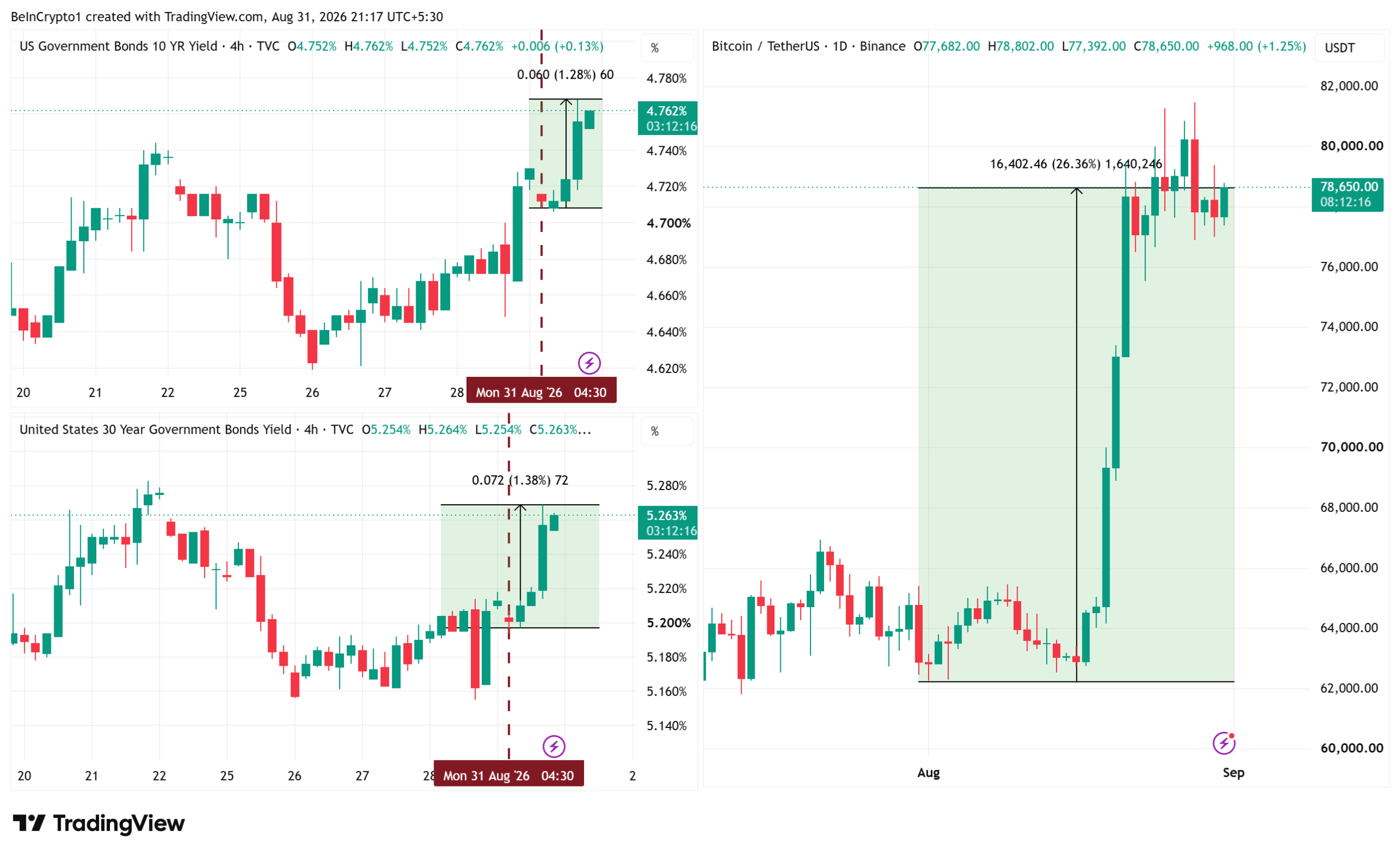
Bonds tell the same story, with the 30-year Treasury yield has held above 5%, well clear of an effective fed funds rate near 3.63%.

“I’m actually now thinking because of all this mounting concern, the market might surprise us to the upside,” Lee said, suggesting he sees a crowd leaning too far one way.
Follow us on X to get the latest news as it happens
Why September 15 Decides Direction
Lee spent August expecting those worries to converge and cost equities roughly 10%. Weak seasonality, hike talk and the AI data center backlash all pointed the same way.
His base case now is that policymakers neither hike nor cut.
“If the Fed doesn’t cut, doesn’t hike, which is our base case, I think actually the markets could rally very strongly,” he added in a CNBC interview.
Should the pullback slip into October, Lee thinks it could start above 8,000 on the S&P 500. The low might land near 7,300.
Bitcoin Could Reach $150,000, Tom Lee Says
Bitcoin’s current price level sits near $78,875, up only 0.3% over 24 hours. BTC still trades about 37% below its record from October 2025.

Lee calls the past year a shallow crypto winter caused by forced selling, not broken fundamentals. Very few investors still hold crypto, he argues.
He counts four catalysts.
- Crypto led all macro assets in the third quarter
- The four-year crypto cycle ends next month
- Korean traders are rotating back from AI stocks
- The CLARITY Act, a US market structure bill setting which regulator oversees digital assets, could pass this year
Rising institutional crypto ETF inflows reinforce his view that larger buyers are positioning for a strong fourth quarter.
Lee still treats $150,000 as possible for Bitcoin, alongside an S&P 500 above 8,200. For Bitcoin, that constitutes a 1.9 times gain, or about 2x. Both rest on earnings estimates that keep climbing.

Fresh jobs and inflation prints land before the meeting. Lee says weak readings on both would stop traders pricing a hike at all.
The post Tom Lee Says September Crash Fear Could Trigger a Stock Rally, Push Bitcoin 2x appeared first on BeInCrypto.
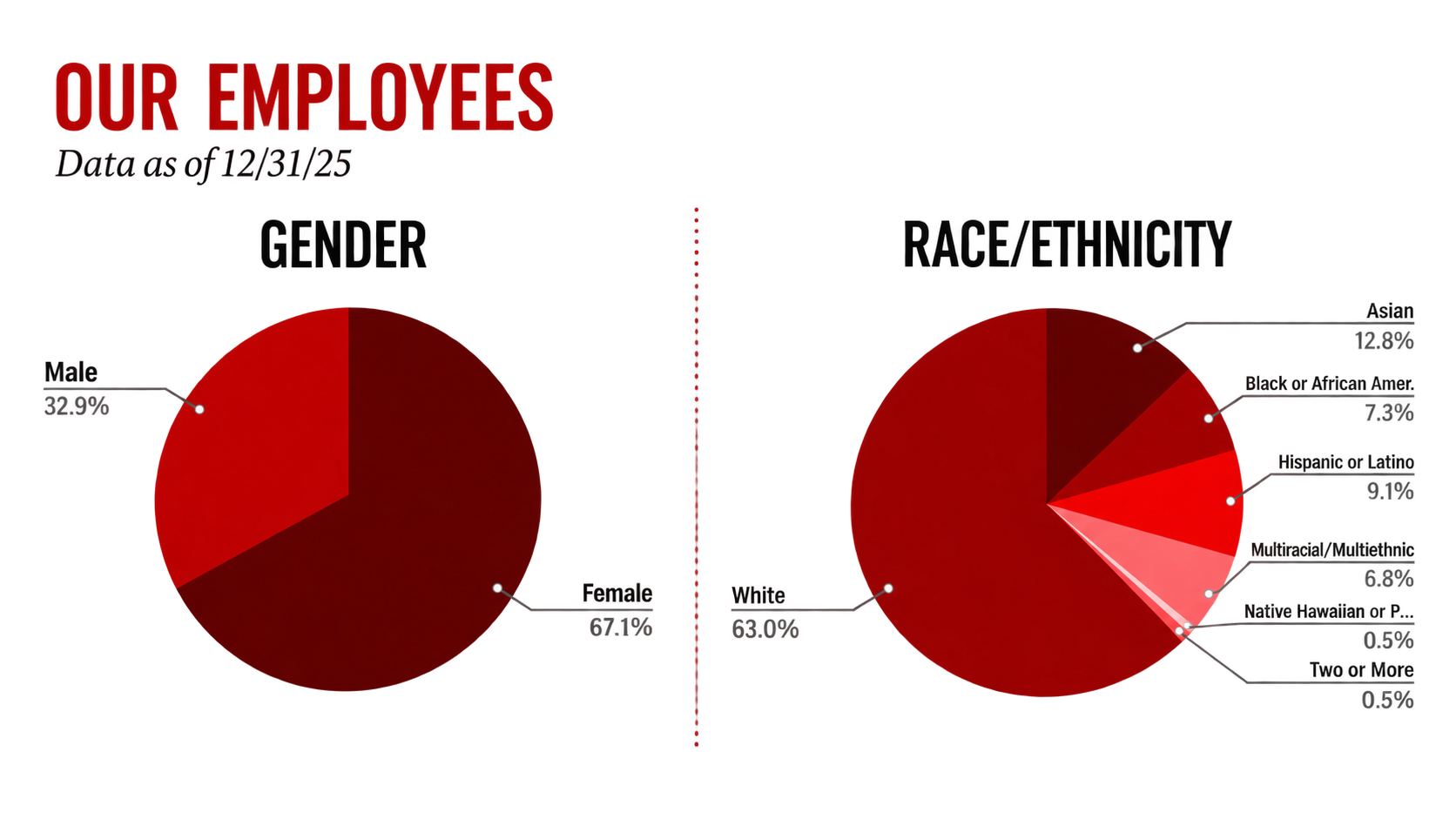
TIME is committed to sharing data about our global employee population annually. Information on gender identity and race is voluntarily self-reported by our employees. Here is how our employees have identified as of December 2025.
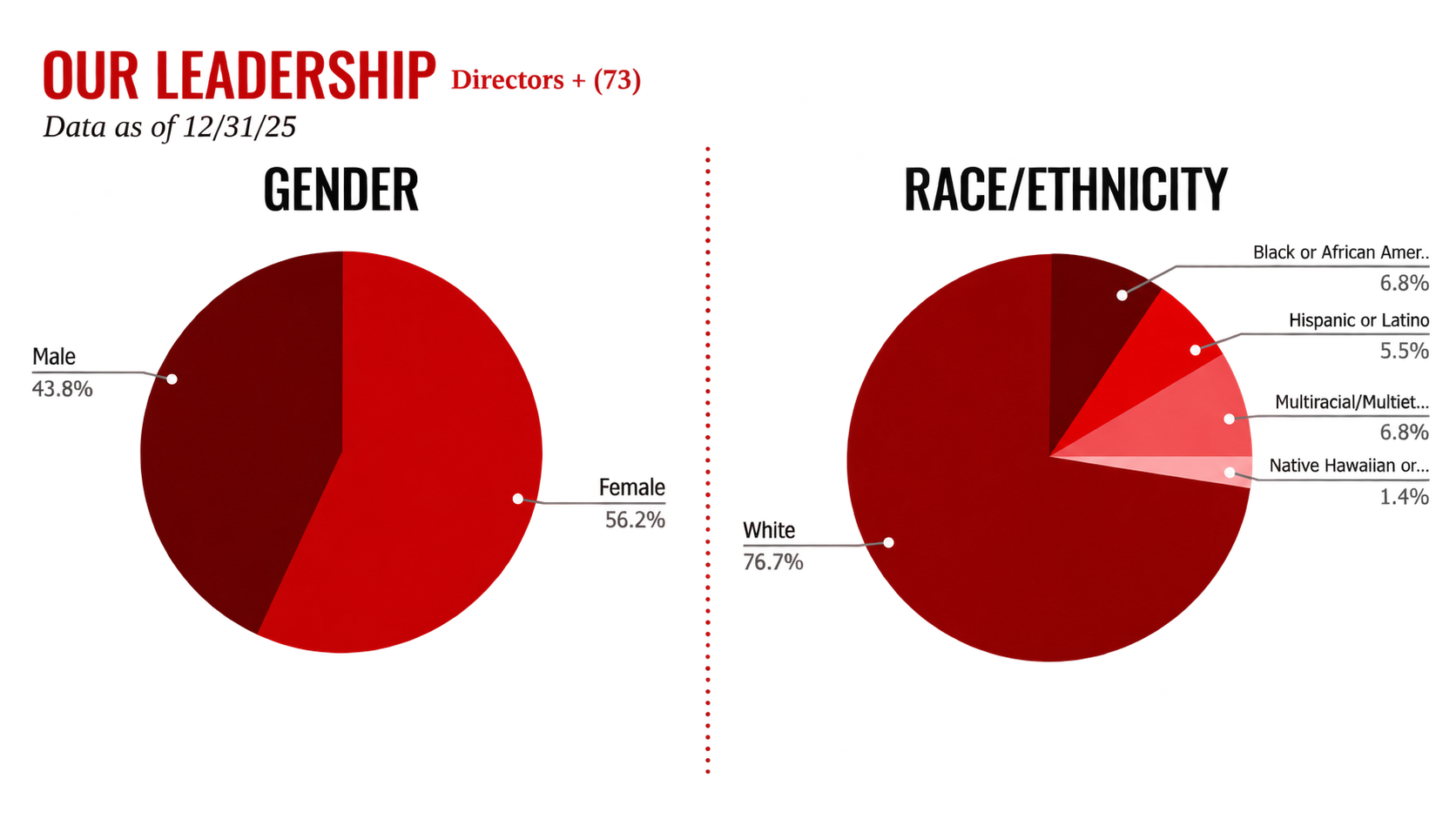
Notes:
- Information on gender identity and race is voluntarily self-reported by TIME employees.
- This data represents the employee population at TIME as of December 2025 (not including temporary and contract workers).
- “Leadership” here includes all employees with a “Director” title and above.
- We intend to report on the demographic makeup of our employee population annually.
- As a U.S.-headquartered company, the categories used here align with the U.S. Equal Employment Opportunity Commission (EEOC) classifications.
Previous Years:

Strive, a publicly traded asset manager and Bitcoin treasury company, added 1,800 Bitcoin to its balance sheet last week, accelerating a buy program that has helped it rank among the world’s largest publicly traded corporate holders of the asset.
The company bought the BTC between Aug. 24 and Aug. 28 for roughly $143 million, paying an average price of $79,431 per coin (including fees and expenses). CEO Matt Cole confirmed the acquisition on Monday via X: https://x.com/ColeMacro/status/2094396002308440227.
Key takeaways
- Strive purchased about 1,800 BTC over Aug. 24–Aug. 28 for approximately $143 million at an average of $79,431 per BTC.
- Total holdings rose to 23,156 BTC from 21,356 BTC a week earlier, showing faster accumulation across a short window.
- The latest inflow increased Strive’s BTC exposure by roughly 8.4% in five business days, according to Adam Livingston.
- With the new buys, Strive moved ahead of Bullish to become the fifth-largest publicly traded corporate Bitcoin holder, based on industry data from BitcoinTreasuries.net.
- Strive’s purchases align with a broader market rebound that followed a U.S. Treasury announcement on bond buybacks.
Strive’s accelerated accumulation lifts it into the top tier
Strive’s latest acquisition expands its Bitcoin strategy beyond a slow, incremental approach. The purchases increased its total holdings to 23,156 BTC, up from 21,356 BTC reported a week earlier. Earlier reporting from Cointelegraph noted that Strive had added 1,110 BTC the previous week for about $81.5 million at an average of $73,409 per coin (Cointelegraph).
Adam Livingston, an adviser to Saturn Credit, highlighted the pace of change after the most recent buys. In his post, he said the latest purchase increased Strive’s holdings by approximately 8.4% within just five business days (https://x.com/AdamBLiv/status/2094404735474295249).
For investors tracking corporate treasuries, the key point isn’t only the size of the purchase, but how quickly it is happening relative to recent baselines. Rapid accumulation can also signal that a company sees improved risk conditions, more favorable liquidity, or a strategy shift from opportunistic buying toward consistent treasury scaling.
Surpassing Bullish for fifth-largest publicly traded holder
The updated Strive balance also changes the standings among listed Bitcoin treasuries. According to industry data compiled at BitcoinTreasuries.net, Strive’s latest buys pushed it past Bullish—an exchange and digital asset infrastructure firm—making it the fifth-largest publicly traded corporate holder of Bitcoin.
This matters because position in these rankings is closely watched by market participants: it can affect perceived credibility of treasury strategies, influence how investors interpret management discipline around Bitcoin exposure, and contribute to the narrative of institutionalization across the sector.
Corporate buying follows a market rebound
Strive’s purchases come as Bitcoin and risk assets rebounded broadly after Aug. 19, when the U.S. Treasury Department announced plans to double the size of certain long-term bond buybacks. The move helped reduce Treasury yields and supported a return of risk appetite, with Bitcoin rallying more than 23% to a recent high above $81,000, as noted in Cointelegraph’s market coverage (Cointelegraph markets).
While treasury purchases do not need a specific catalyst, correlations between macro conditions and corporate activity are frequently discussed in crypto markets. When yields fall and liquidity improves, companies that treat Bitcoin as a treasury asset may find it easier to justify additional exposure—particularly if market volatility cools.
Strategy’s renewed buying underscores the broader trend
Strive is not alone. Michael Saylor’s Strategy—described as the largest corporate Bitcoin holder—announced Monday that it resumed buying BTC for the first time since June. Cointelegraph reported that Strategy acquired 4,603 Bitcoin at an average price of $80,318, per its announcement (Cointelegraph).
That purchase lifted Strategy’s holdings back above 845,000 BTC after four Bitcoin sales since May, reversing a temporary reduction in exposure. Together with Strive’s accelerated accumulation, the renewed buying from a major benchmark treasury adds weight to a theme seen across the corporate segment: listed companies appear willing to increase Bitcoin exposure when market conditions are supportive.
At the same time, the Strategy example also highlights an important tension. Corporate treasuries can be both active buyers and occasional sellers, meaning investors should pay attention not just to net accumulation, but also to the operational or capital-planning drivers behind any reductions.
For the near term, traders and long-term holders will likely watch whether Strive sustains this faster pace of buying over the next several weekly reporting windows, and whether other large corporate treasuries continue to add after recent rebounds—especially as macro conditions that helped fuel the move in yields remain in focus.

“These are as nutritious as fresh, and they’re convenient, and this way you don’t have to go back to the supermarket more than once a week,” she says. She also recommends checking out your local supermarket’s deals to see what’s on sale that week.
Diversify your protein sources
“We get kind of fixated that it has to be animal protein, and that’s clearly not the case,” says Planells. For animal protein, the Mediterranean diet favors seafood and leaner cuts of meat, and it also recommends plant-based sources of protein like beans and lentils.
Despite rising grocery costs, a May 2026 report from the American Farm Bureau Federation finds that “America’s demand for meat continues to grow.” As of July, ground beef prices were up 10% from the same time in 2025.
“Everyone wants protein, protein, protein, but we’re going to go broke,” says Planells.
Swap in leaner cuts and types of meat, embrace eggs, and try more plant-based protein like tofu, beans, nuts, and seeds, he recommends, which both comply with the Mediterranean diet and might end up being a cost effective and healthier trade.


Kalshi has permanently banned former U.S. Representative George Santos and imposed a $71,356 penalty after finding that he manipulated an attendance market to earn $17,839.57.
Summary
- Kalshi permanently suspended Santos from accessing its exchange either directly or indirectly.
- Santos earned $17,839.57 from contracts tied to his State of the Union attendance.
- Public statements by Santos moved contract prices in favor of his positions, Kalshi found.
- A separate CFTC order imposed a three-year trading ban and over $35,000 in payments.
Kalshi’s Aug. 28 disciplinary notice said Santos placed large trades between Feb. 2 and Feb. 25 in contracts that paid according to whether he attended President Donald Trump’s 2026 State of the Union address.
Kalshi says Santos traded an outcome he could control
As the person whose attendance determined the contracts’ result, Santos had direct influence over the event. Kalshi Rule 5.17(z) prohibits members from trading contracts when they can affect the underlying outcome.
Despite the restriction, Santos bought and sold contracts tied solely to his own attendance, the compliance department found. His trades involved both “Yes” contracts, which would pay if he appeared at the event, and “No” contracts, which would pay if he did not.
During the trading period, Santos published several statements about his travel and attendance plans. Kalshi said some of the posts were false or misleading and were made to move prices before he purchased or sold the relevant contracts.
The exchange determined that the statements had their intended effect on the market. By moving between “Yes” and “No” positions while controlling information about his plans, Santos generated $17,839.57 in profit, according to the notice.
Kalshi cited violations of rules against market manipulation, trading with material nonpublic information, trading on an outcome a member can influence, and using a deceptive scheme connected to exchange activity. Its compliance department also found that Santos failed to cooperate promptly and fully with the internal investigation.
Under the settlement, Santos cannot access Kalshi directly or through another person or account. The exchange also assessed a $71,356 penalty, exactly four times the profit amount listed in its notice. The document took effect on Aug. 28.
Social media posts moved Santos attendance contracts
A separate Commodity Futures Trading Commission order issued on July 31 provided a more detailed timeline of the trades. According to the regulator, Santos opened his Kalshi account on Feb. 11 and deposited about $7,000, using the funds exclusively to trade on his own attendance.
From Feb. 12 through Feb. 22, he accumulated 30,874 “Yes” contracts at a total cost of $6,695.94. While holding the position, Santos asked his X followers whether he should wear a serious suit or a bedazzled one to the address.
Following the post, the “Yes” contract rose from about $0.15 to $0.70. Santos then sold the full position for a $3,448.43 profit and withdrew $10,146.07 through a Venmo account created four days earlier, the CFTC said.
Later on Feb. 22, an airline notified Santos that his flight to Washington, D.C., had been canceled. He booked a train that night, then posted the next morning that bad weather had made his trip difficult and suggested the address might not take place. The “Yes” price fell from $0.63 to $0.28 after the post.
On the evening of Feb. 23, Santos posted that he would attend from the House gallery. A video repeating his attendance plans sent the contract from $0.40 to $0.70, according to the federal order.
About 40 minutes after publishing the video, Santos began buying “No” contracts. He eventually acquired 23,855 contracts for $8,650.66. His train was canceled about an hour after he began building the position, but he later responded, “I am” when another user asked if he was still going.
With both his flight and train canceled, Santos had not bought another ticket when he posted on Feb. 24 that he was watching the address on an airport television. The “Yes” contract fell from $0.73 to $0.02, increasing the value of his opposing position.
Santos closed the “No” trade early on Feb. 25 for a $14,390.57 profit, the CFTC found. Combined with his earlier gain, the two positions produced the amount later addressed by the exchange’s disciplinary action.
Federal penalties remain separate from Kalshi’s lifetime ban
The Kalshi sanction is separate from the CFTC settlement, which imposed different payment amounts and a shorter restriction covering all federally registered trading venues.
As crypto.news previously reported, the CFTC ordered Santos to disgorge $17,569.98, pay a $17,500 civil penalty, and stop trading on any CFTC-registered entity for three years. Santos consented to the July order without admitting or denying its findings or legal conclusions.
The regulator applied Section 6(c)(1) of the Commodity Exchange Act and Regulation 180.1, which prohibit manipulative or deceptive conduct involving swaps. Its order classified the State of the Union event contracts as swaps because their payouts depended on a future event with possible financial, economic or commercial consequences.
Although Kalshi cited Santos for failing to cooperate with its inquiry, the CFTC recognized his cooperation in the federal investigation. The findings concern two separate reviews conducted by the exchange and its regulator.
Earlier in June, federal investigators were examining the trades after Kalshi froze the account and referred the activity to authorities. The Commodity Futures Trading Commission later resolved its part of the matter through the July settlement; the reported Justice Department inquiry has not received a publicly announced resolution.
Prediction markets add controls after insider cases
Kalshi operates as a designated contract market under CFTC oversight, making its event contracts subject to federal derivatives rules and exchange-level restrictions. Users trade contracts priced according to the perceived chance of outcomes involving politics, sports, economic data, and other public events.
Concerns about privileged information have increased as contracts tied to speeches, political decisions, and unpublished content attract more trading. In February, Kalshi imposed a $20,397.58 penalty and a two-year suspension on a MrBeast-affiliated editor over trades involving unreleased YouTube videos.
A separate federal case involves U.S. Army Special Forces member Gannon Ken Van Dyke, whom prosecutors accused of using classified information to earn about $409,881 from Polymarket contracts linked to the capture of Nicolás Maduro. A federal judge paused the CFTC case in August while the related criminal proceeding continues. Van Dyke has pleaded not guilty and disputes whether the contracts qualify as swaps.
Kalshi has also added employer-disclosure rules, a whistleblower channel, and risk reviews for proposed markets. In June, it partnered with StarCompliance so participating financial firms could connect employee accounts to internal monitoring systems.
The exchange said it conducted more than 150 investigations during the first quarter of 2026, blocked over 100 suspected insider-trading attempts and referred 20 cases to law enforcement.
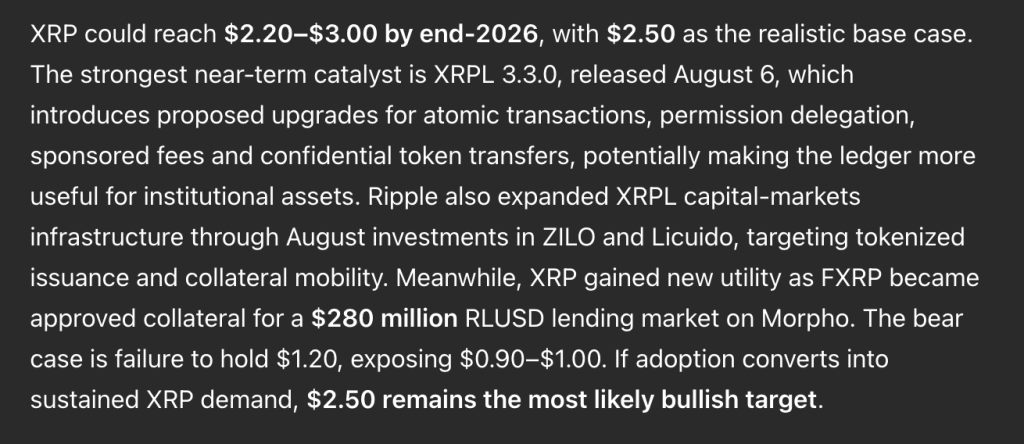
Ledger upgrades do not trend on social media, but they change what a network can hold. That distinction drives the latest ChatGPT AI price prediction, where the model predicts XRP reaching $2.20 to $3.00 by the end of 2026, with $2.50 as the realistic base case.
The strongest near-term catalyst landed on August 6. XRPL 3.3.0 introduces proposed upgrades for atomic transactions and permission delegation.
Sponsored fees and confidential token transfers arrive with it. Together they could make the ledger genuinely useful for institutional assets rather than just payments.
Ripple is building out the surrounding rails too. August investments in ZILO and Licuido target tokenized issuance and collateral mobility on XRPL.

New utility is already live elsewhere. FXRP became approved collateral for a $280 million RLUSD lending market on Morpho.
Collateral demand behaves differently from speculation. Once a protocol integrates an asset, that demand tends to persist through quiet periods.
The bear case is defined by a single level. Failure to hold $1.20 exposes $0.90 to $1.00. That would unwind the entire August move. If adoption converts into sustained XRP demand instead, $2.50 remains the most likely bullish target.
Make Your Prediction Count With $25 For Free on Kalshi
XRP Price Prediction: ChatGPT AI Predicts Institutional Plumbing Pays Off
The backdrop is a long, patient decline. XRP price traded above $2.40 in January 2026 before February collapsed it to $1.13 in a matter of sessions.
March through May settled into a narrow range around $1.40. June broke it, and XRP price stepped lower through July and August until it flatlined at $1.00. That floor held for weeks with almost no volatility. Then came the spike to $1.70, followed immediately by a sharp retreat.

Price is now rebuilding from that pullback. XRP closed at $1.44925, up $0.02638 for a gain of 1.85%, with a session range from $1.38912 to $1.47438.
A green candle after two red ones suggests buyers defending the move. Resistance sits at $1.47438, then $1.55, then the $1.70 spike high.
Support runs through $1.38912 and $1.30, with $1.00 as the structural base. RSI reads 73.73 against a signal line at 62.73. The 11 point gap has narrowed considerably from the extreme printed days ago.
That compression is what a cooling spike looks like. Momentum has come off the boil while price held above $1.38, which favors continuation over collapse.
Adoption is the variable that decides the rest. Convert it into demand and $2.50 stops being theoretical.
The Best Traders Around Use It: AI Copy Trading Bots From CryptoHopper
XRP Is Building Better Rails for Institutions. LiquidChain Is Building the Road Between Entire Networks.
XRPL’s latest upgrades make the institutional case stronger inside one ecosystem. LiquidChain is targeting what happens when that capital needs to move beyond a single chain.
Bitcoin, Ethereum, and Solana still operate as separate liquidity environments. Crossing between them means bridges, duplicated deployments, extra fees, and fragmented execution.
LiquidChain is building a single execution layer designed to connect all 3, so applications can reach multiple ecosystems without rebuilding the same stack chain by chain.
That matters if tokenized assets, lending, and collateral markets keep expanding. The more institutional activity moves on-chain, the more expensive fragmentation becomes.
LiquidChain’s presale is currently priced at $0.01454 with just over $920,000 raised. At that stage, the project does not need large-cap levels of capital for adoption to materially change its valuation.
Gain Special Access to Layer 3 Trading Here
The post Sam Altman ChatGPT AI Predicts XRP Price By End Of 2026 appeared first on Cryptonews.

Army Secretary Dan Driscoll is stepping down

JP Morgan traders back down bullishness on US stocks after Fed chair Warsh’s Jackson Hole speech

The Stablecoin Race Could Make Bank Loans More Expensive





-

 Crypto World6 days ago
SpaceX stock could rise 75% to $240, JPMorgan says
-

 Fashion3 days ago
Weekend Open Thread: Maeve – Corporette.com
-

 Crypto World4 days ago
Bitcoin’s 22% rally now needs real demand to outlast Treasury liquidity boost
-

 Crypto World5 days ago
Warsh Jackson Hole keynote puts financial innovation first
-

 Crypto World7 days ago
A $30 Billion AI Fund Implodes, Now the SEC Is Investigating Wall Street’s Role
-

 Business4 days ago
Salesforce Stock Soars 19% as Blowout Earnings and Agentforce AI Growth Silence Software Skeptics
-

 Crypto World6 days ago
Did Trump Just Move SpaceX Stock With One Truth Social Post?
-

 Crypto World5 days ago
Elon Musk Grok Bot Promise: We Will Make You Whole if AI Loses Your Money
-

 Business4 days ago
Apple Confirms September 9 Keynote and Reveals Its Full Pre-Order Schedule
-

 Business3 days ago
Onto Innovation Stock: AI’s Next Bottleneck Is Yield (NYSE:ONTO)
-
 NewsBeat5 days ago
Lindsay Clancy jury braces for closing arguments as judge tells court: ‘You’ve heard all the evidence’ – Live updates
-

 Business5 days ago
Walmart takes aim at younger shoppers with new fashion brand
-

 Crypto World3 days ago
Bitcoin price tests $82K resistance as Brandt stays long
-

 Business6 days ago
Thailand’s Eastern Economic Corridor Capital City (EECiti): Key Developments and Investment Opportunities
-

 Crypto World5 days ago
NVIDIA revenue hits $96.2B as AI demand doubles
-

 Business3 days ago
iPhone 18 Pro Pre-Orders Could Shift to Saturday as Apple Reportedly Avoids September 11 Anniversary
-

 Business7 days ago
NVIDIA Stock Drops Nearly 2 Percent to $210 on Seventh Losing Day Ahead of Critical AI Earnings
-

 NewsBeat6 days ago
Trump’s trade truce with China faces test with Iran effort
-
 Crypto World5 days ago
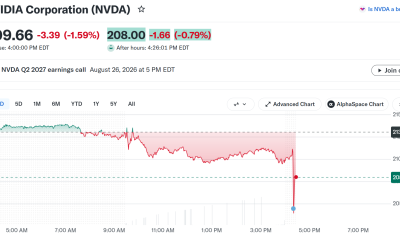
Nvidia Q2 Earnings Reveal $96.2 Billion Beat, So Why Is NVDA Falling?
-
 Tech5 days ago
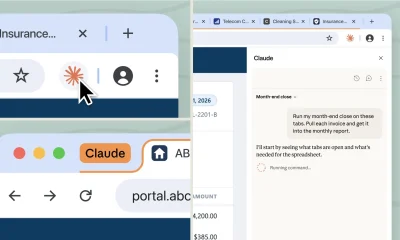
Claude Cowork gets its own browser that doesn’t touch your tabs, bookmarks, or saved passwords
You must be logged in to post a comment Login