
Crypto World
Hackers drain $7 million from crypto casino Duelbits in suspected private key compromise

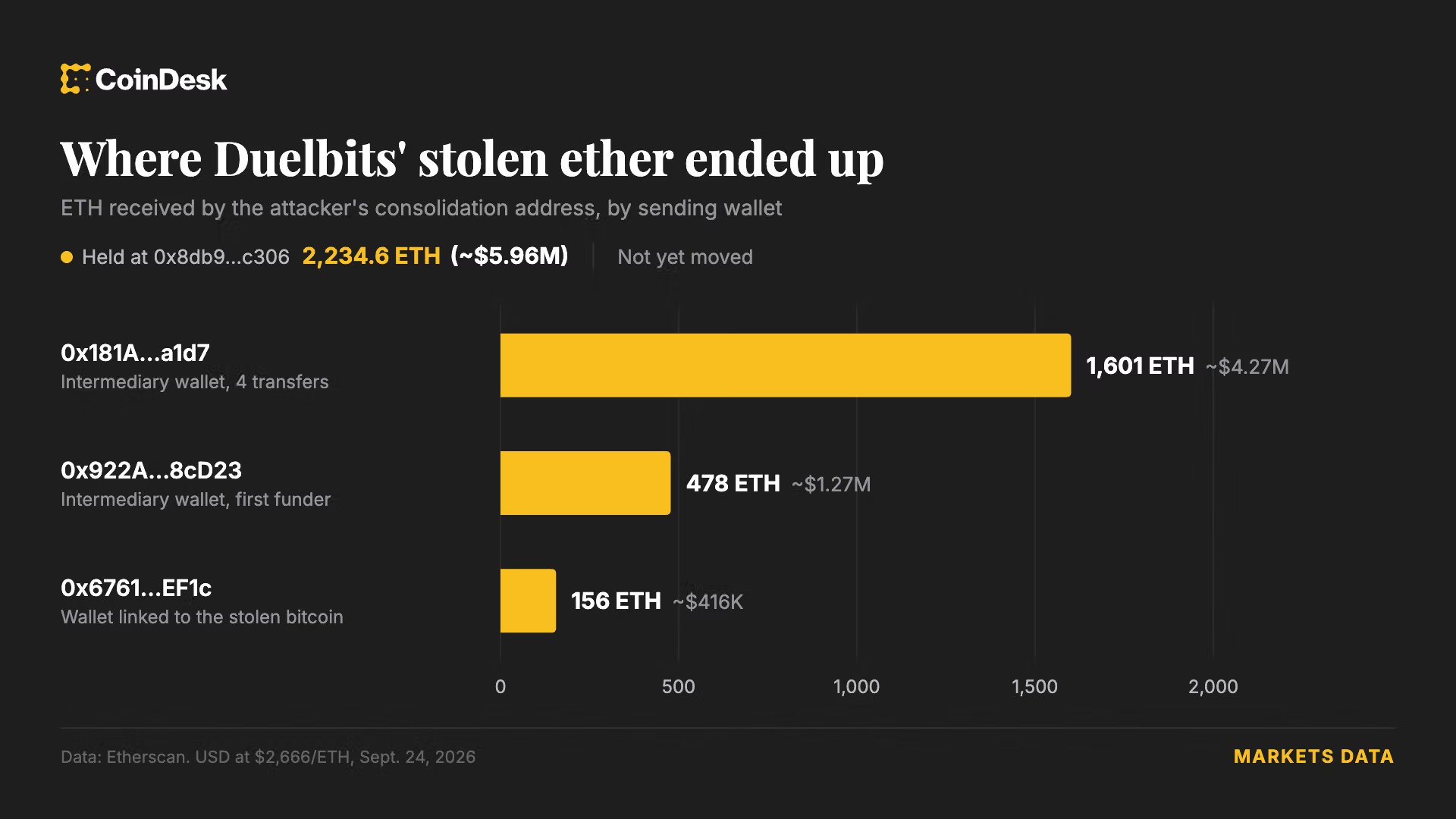
Crypto gambling platform Duelbits has taken its site offline after attackers drained roughly $7 million from its hot wallets on Thursday.
“Confirming a ~$7M hack. Still investigating exactly what happened and how,” co-founder Joe wrote on X, adding that “user funds are safe.” He said the platform would stay offline until the investigation is finished and its hot wallets are refilled.
Blockchain security firm Scam Sniffer first flagged the incident, reporting that Duelbits hot wallets on Ethereum, BNB Chain and Tron sent funds to newly created addresses in a suspected private key compromise. It later said the company’s bitcoin hot wallet also lost 8.1 BTC.
A private key compromise is also the method that targeted Stake, the largest crypto casino by volume, in 2023. Hackers at the time made off with $40 million.
Etherscan data shows the Ethereum wallet, labeled as a Duelbits hot wallet, sent 836 ETH, about 593,000 USDT, 97,000 USDC, 31,500 DAI and 12.4 billion SHIB to the attacker within minutes. The wallet now holds less than $25 in ether.

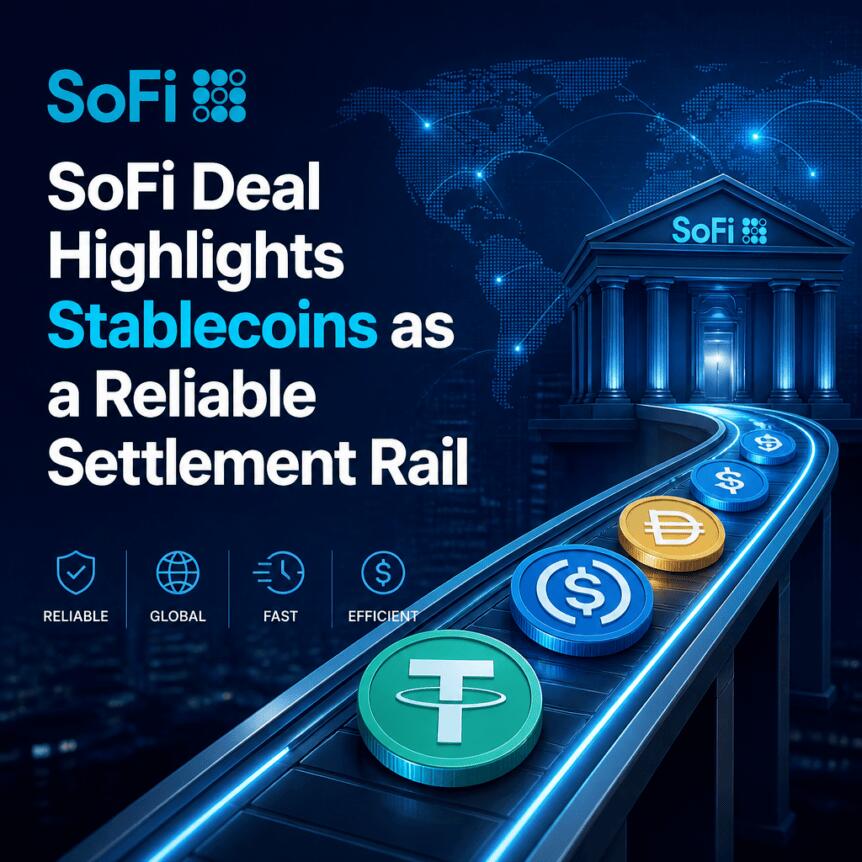
Stablecoins are finding a practical use case in payments: not necessarily to change how consumers pay with their cards, but to alter the settlement rail banks use behind the scenes. The latest example comes from SoFi, which says it has begun settling debit and credit card transactions with Mastercard using its SoFiUSD stablecoin.
According to a SoFi spokesperson, the bank is migrating its entire card program—expected to process more than $25 billion in annualized volume—to this blockchain-based settlement approach. Importantly, the bank does not expect the change to remove intermediaries from card payments. Instead, it replaces part of the transaction settlement process with an alternative rail designed to complete obligations faster.
Key takeaways
- SoFi is moving settlement of its debit and credit card transactions to Mastercard using its SoFiUSD stablecoin, while card usage for customers remains unchanged.
- SoFi expects its card program to reach more than $25 billion in annualized processing volume as it migrates the system.
- Payments experts argue this is not “disintermediation” in the card networks’ core operations—Visa/Mastercard and banks still calculate obligations and manage interactions.
- Faster blockchain settlement may reduce timing and some capital friction, but does not automatically guarantee cheaper payments end-to-end due to conversion, compliance, and integration costs.
- Dollar stablecoins can move quickly, but completing payments in local currencies may still require access to domestic liquidity and banking rails.
SoFi’s onchain card settlement shift
SoFi’s update is part of a broader trend in which stablecoins are tested and deployed as settlement mechanisms rather than as consumer-facing payment tools. The bank says it has begun settling debit and credit card transactions with Mastercard using its SoFiUSD stablecoin and is migrating its full card program to the same system.
From the perspective of cardholders, the change is largely invisible. The spokesperson told Cointelegraph that SoFi customers will continue using debit and credit cards normally, while the settlement process is moved onchain to enable faster completion between participants.
That distinction matters for how investors and builders interpret “adoption.” The stablecoin is operating in the plumbing of payments—where obligations between financial institutions are settled—rather than replacing consumer interfaces.
Not a clean break from Visa, Mastercard, or banks
Stablecoin settlement can sound like a direct challenge to traditional intermediaries, but the current card deployments appear to follow a more incremental path. A Federal Reserve note published in March suggested stablecoins could change the economics of payments without necessarily eliminating banks, and the latest industry commentary aligns with that view.
Cointelegraph spoke with Martins Benkitis, co-founder and CEO of emerging-markets liquidity provider Gravity Team. He argued that this stage should not be described as disintermediation: “I wouldn’t call it disintermediation at this stage,” he said. “Visa and Mastercard are still there. The banks are still there. The network is still calculating the obligations, managing the transaction and deciding how participants interact with it.”
In other words, stablecoins are being used to complement existing payment infrastructure, particularly at the settlement layer. That may still meaningfully increase stablecoin usage even if merchants and consumers never interact with the technology directly.
Benkitis added that if stablecoins become a major part of payments, businesses may not care where the stablecoin exists in the process as long as settlement availability matches operational needs. “They’ll care that settlement is available when they need it and that the money arrives,” he said.
The promise: smoother settlement and less capital friction
While cards remain intermediated, faster settlement is a key selling point. Varun Datta, a venture capitalist and founder of Truth Ventures, agreed that moving to continuous settlement can reduce delays and potentially cut the amount of capital financial firms must maintain across locations—an issue that can be especially acute when payments cross borders.
However, Datta cautioned that “speed” alone does not automatically translate into lower costs for end users. Payments still involve conversion steps, compliance requirements, systems integration, and stablecoin-management overhead. In his view, it is not enough to demonstrate operational improvement onchain; the industry needs evidence that these changes reduce total costs and improve liquidity management at scale.
Datta said he would want to see proof of lower end-to-end payment costs before concluding that the economic case is fully established. That framing is significant because many real-world payment projects live or die on unit economics—particularly if costs merely shift from settlement timing to operational complexity elsewhere.
Liquidity doesn’t disappear—especially across currencies
Another practical limitation emerges when stablecoin settlement eventually has to translate into local currency payments. Benkitis emphasized that while dollar-denominated stablecoins can move between balance sheets quickly, completing payments in emerging markets can remain more complex.
His concern is tied to local liquidity and the banking ecosystem that ultimately delivers the payment in the relevant currency. In markets where local currency liquidity is thinner, fewer banks may handle flows, and access to domestic banking rails remains necessary. “The stablecoin gets the value there quickly,” Benkitis said. “You still need the local liquidity to finish the payment.”
This is where the “rail change” narrative can diverge from adoption expectations. Onchain speed may improve settlement between participants, but it does not automatically solve downstream currency conversion, liquidity sourcing, or integration constraints in every geography.
Broader momentum: Visa’s parallel stablecoin efforts
SoFi’s move follows similar experimentation from card-network infrastructure. In April, Visa said its stablecoin settlement pilot had reached a $7 billion annualized run rate after expanding support to nine blockchains, describing blockchain settlement as a “viable complement to traditional settlement rails.” Visa also characterized its approach as an addition to existing settlement methods rather than a replacement of the broader ecosystem.
Taken together, these developments suggest a shared industry view: stablecoins are being tested where they can improve the settlement mechanics of large payment networks without requiring immediate removal of core participants.
Readers should watch whether these pilots expand beyond the largest corridors and what happens when stablecoin settlement meets local-currency liquidity constraints—if the industry can demonstrate not just faster settlement, but reliably lower total operating costs across geographies, stablecoin settlement could move from “complement” to a more durable part of the payments stack.

His mother washed hair in a South Philadelphia barbershop and later worked a makeup counter in a department store. “Neither my father nor his father finished high school. In fact, nobody in my family before me had ever had a university education,” he says. He would later attend Villanova, the Catholic college also attended by the first American Pontiff, Pope Leo XIV. “We make Popes and admirals,” he says of his alma mater.
He joined TOPGUN, whose exacting culture left a lasting impression. “What the school confers is attention to detail, dedication to execution, dedication to getting better, and being introspective and running to your own problems, of seeking the perfect flight that you’ll never get,” he adds. He flew F-14, F-15, and F/A-18 jets, and clocked more than 6,000 flight hours and 1,100 carrier landings. He says he initially aimed to serve as long as his father. “Serving for four years was intentional, and serving for 40 was a blessing,” he adds.
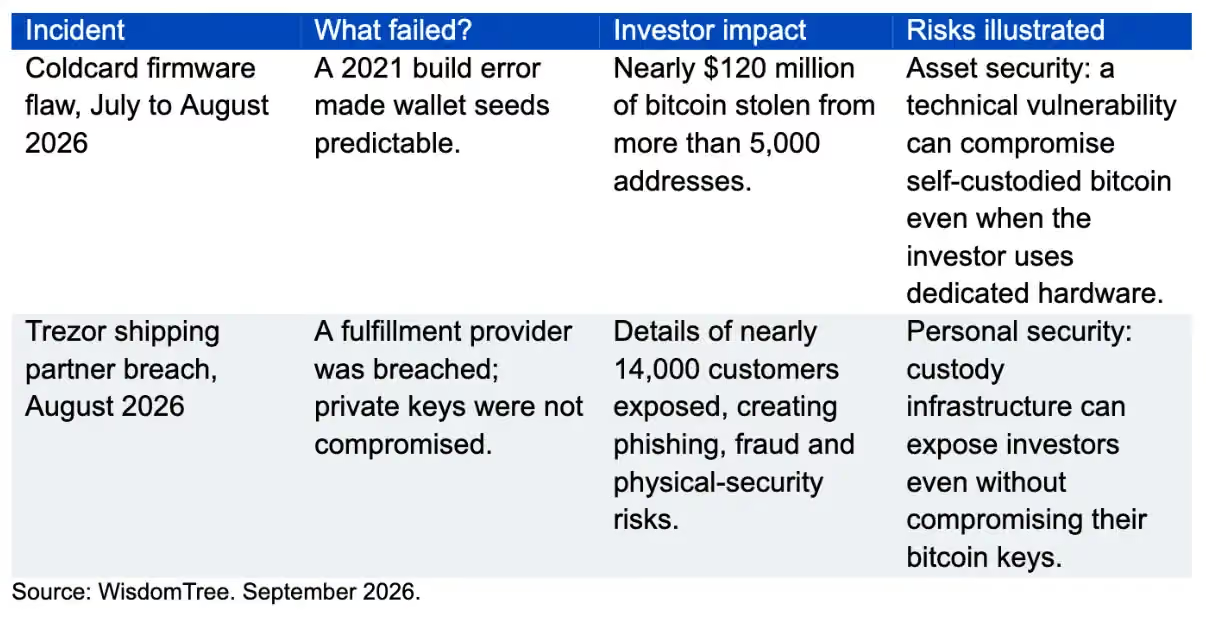
Hardware wallets can reduce certain risks, but they do not make operational security foolproof. The attack surface also extends beyond the device itself: backup phrases, personal data, software updates and transaction hygiene all matter.
Self-custody can expose investors to multiple forms of security risk

For an investor making a modest portfolio allocation, that is an uncomfortable mismatch. The operational burden does not improve bitcoin’s expected return. It is simply the cost of a direct bitcoin ownership model.
Bitcoin is not static
Bitcoin is built to resist arbitrary change, but it still evolves. Software upgrades, wallet compatibility issues and occasional chain splits can create decisions for direct holders.
A blockchain split can be particularly complex; it may create rights to assets on competing networks, leaving holders to decide whether to claim, hold, sell or ignore them. Security, liquidity, wallet support, transaction replay risk and tax treatment can all matter.
This is where the romantic version of self-custody collides with reality. Holding bitcoin directly means owning not only the asset, but also the operational consequences of its ecosystem.
Exposure and ownership are different decisions
Investors should separate two questions that are too often bundled together:
- Do I want bitcoin exposure?
- Do I want to manage bitcoin directly?
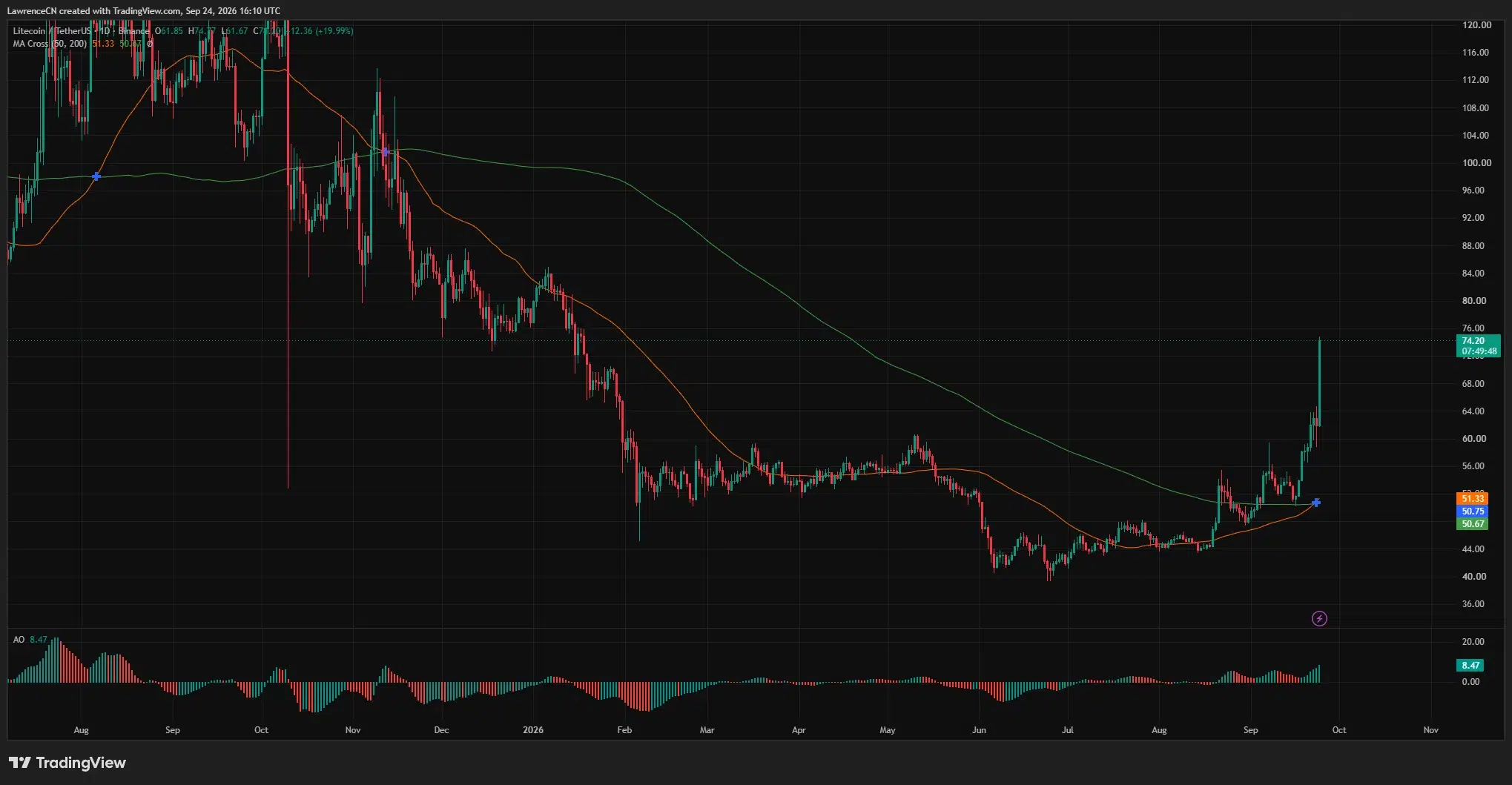
Litecoin price has climbed above $74 after breaking through the $64–$65 resistance area, while a golden cross on the daily chart has given traders another reason to watch whether the rally can clear $75.
Summary
- Litecoin price reached about $74.77 on Sep. 24 after opening near $61.85.
- The daily 50-day moving average has crossed above the 200-day average near $51.
- The 4-hour chart places immediate resistance at $75, followed by $78.13.
- CoinGlass’s three-day heatmap shows potential liquidation leverage around $75–$77.
Litecoin (LTC) price traded near $74.20 when the daily LTC/USDT chart was captured, up about 20% from its daily open. The price had briefly reached $74.77, extending a recovery from the mid-September lows and pushing well beyond the $64–$65 area that had held back earlier gains.
The daily chart also shows the 50-day moving average at about $51.33, above the 200-day average near $50.67. Traders call that crossing a golden cross. Both averages sit far below the current price, so the immediate question is whether buyers can hold the breakout near $70 and push through $75.
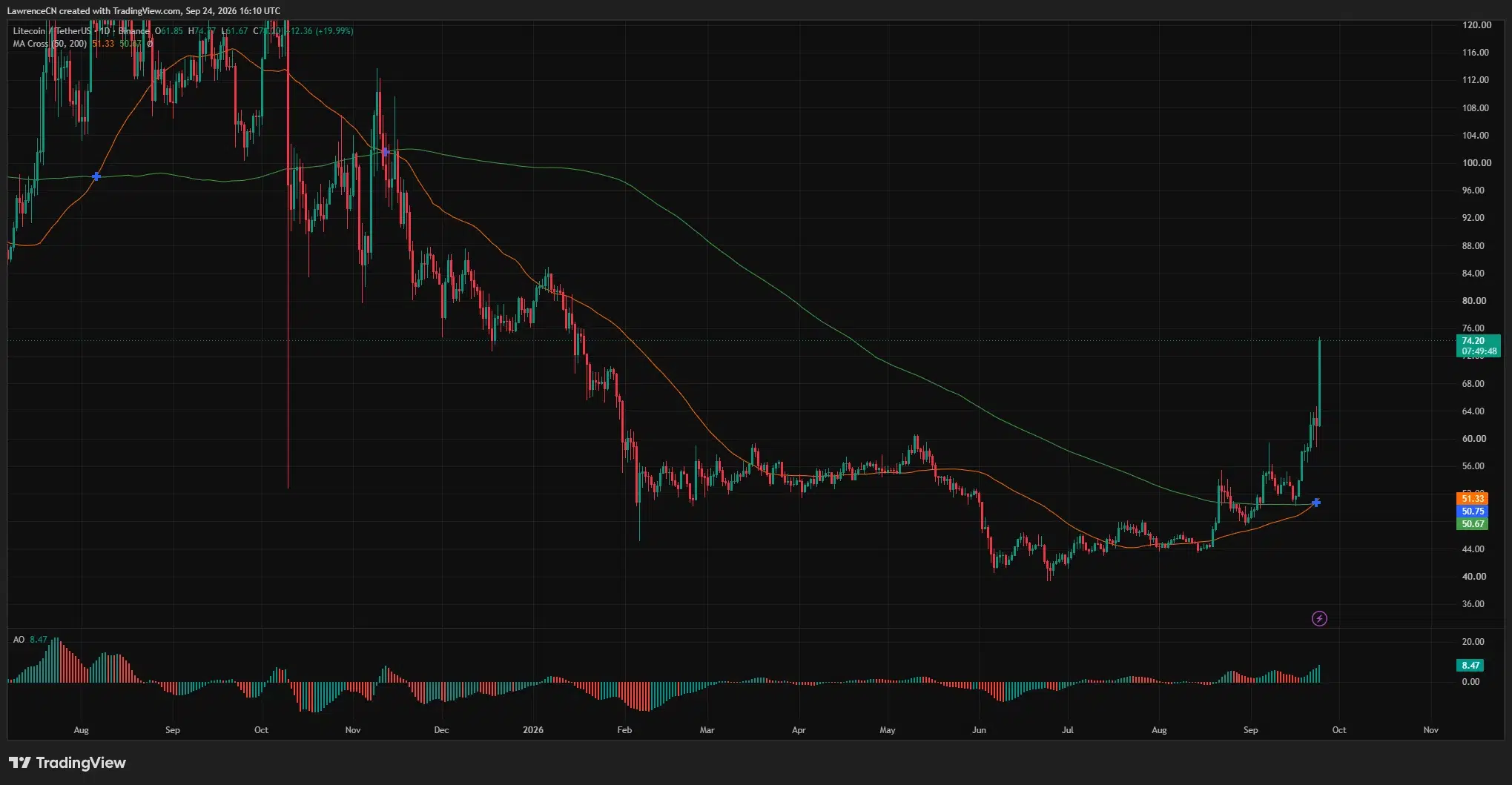
Litecoin Foundation data added to the activity surrounding the move. The organization reported on Sep. 23 that more than 17 million LTC, worth over $1 billion, had moved across the network within 24 hours. The measure tracks blockchain transfers rather than purchases on exchanges, so it does not establish how much of the price gain came from spot demand.
Litecoin’s $75 test comes after a sharp 4-hour advance
The 4-hour chart shows LTC moving rapidly through several marked price levels. After trading below $65 earlier in the session, it cleared the $65.63 trading-range boundary, moved above the $68.75 pivot and passed $71.88.
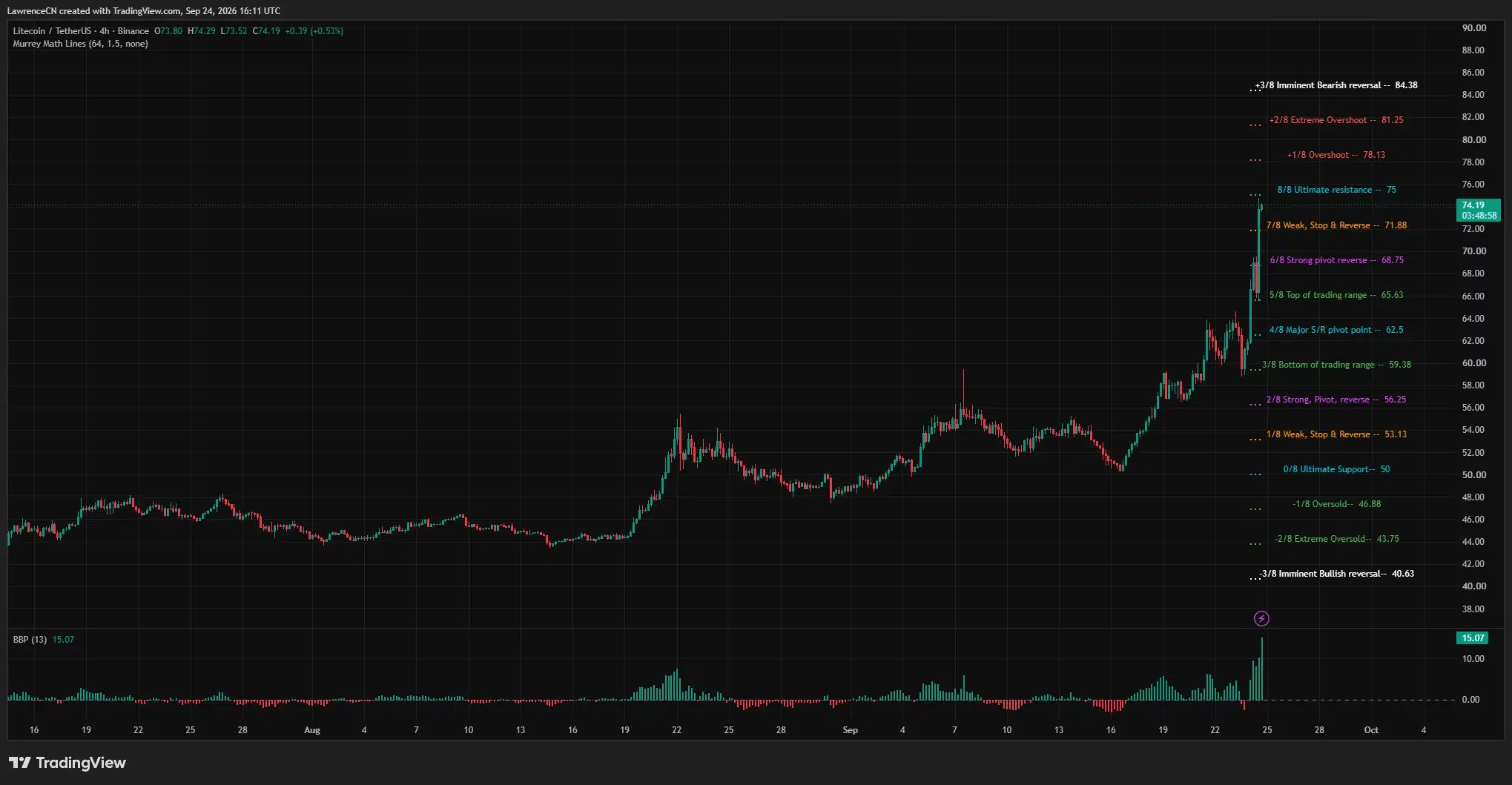
The latest 4-hour candle reached about $74.29 and stood near $74.19 when the chart was captured. Price was therefore close to $75, the next resistance marked by the chart’s Murrey Math levels. A move above $75 that holds could bring $78.13 into focus.
The pace of the climb matters for that test. The 4-hour BBP momentum reading rose to 15.07 as LTC approached $75, reflecting how far and how quickly the price had moved above its recent range. Strong momentum can carry a breakout further, but buyers would still need to defend the levels cleared during the rise.
The daily AO indicator also climbed to 8.47, one of its highest visible readings in months. Its rise supports the change in momentum shown by the price candles, while the golden cross reflects a slower shift in the daily trend. Neither signal confirms that $75 has been broken.
CoinGlass’s three-day liquidation heatmap shows bands of potential liquidation leverage near $75 and higher toward $77. If LTC rises into those bands, short positions may face pressure to close. The bands mark possible liquidation levels, however, rather than liquidations that have already occurred.
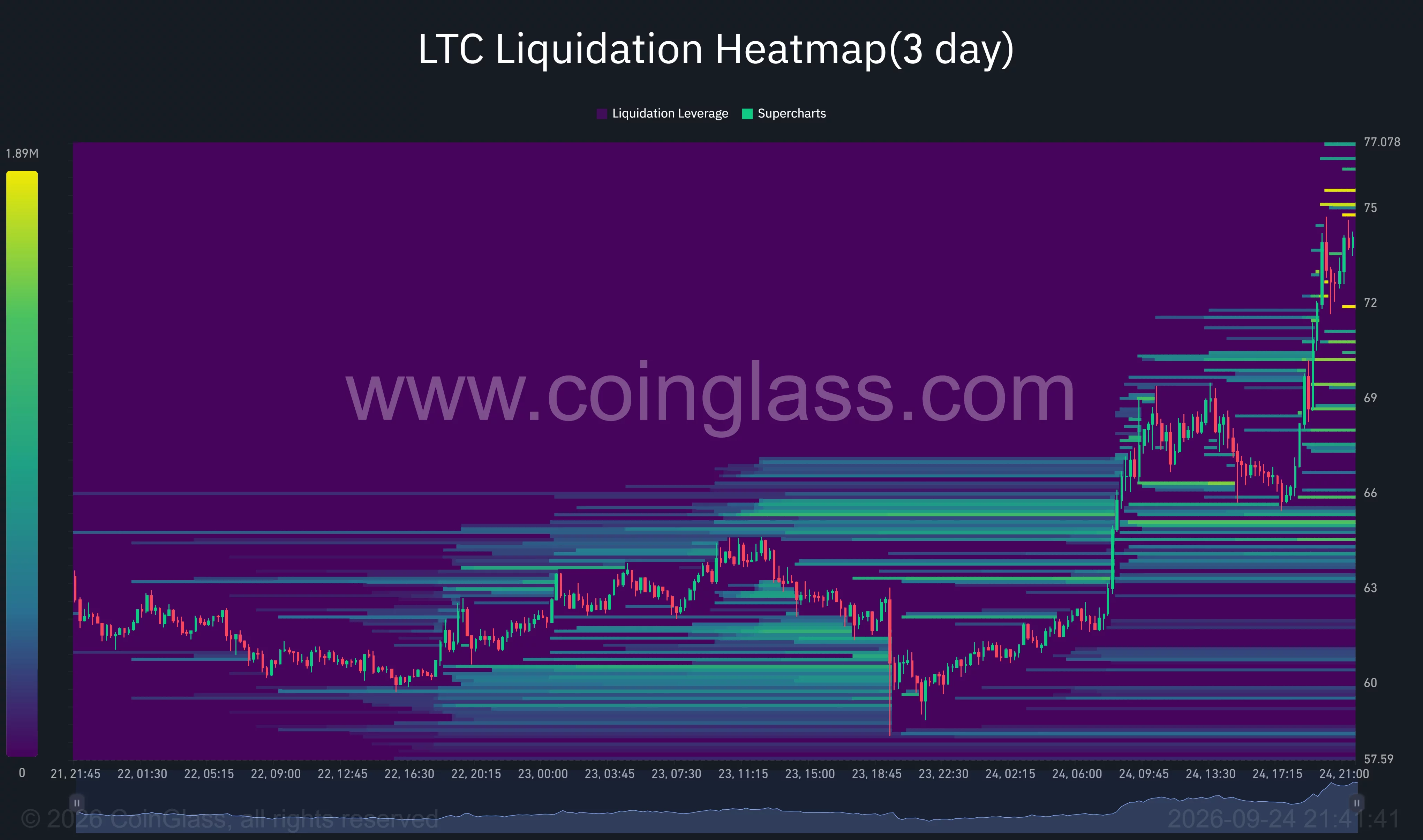
Earlier trading showed how quickly short covering could affect LTC. A one-hour rise from roughly $61.92 to $66.36 early on Sep. 24 coincided with reported short liquidations across major exchanges. CoinGlass data also showed Litecoin futures open interest above $500 million, pointing to substantial outstanding positions as the rally developed. Open interest does not reveal whether those traders expect a rise or fall.
What happens if LTC cannot hold the breakout?
If LTC turns lower before clearing $75, the 4-hour chart puts $71.88 at the first marked level below the current price. A drop through it would shift attention to the $68.75 pivot, followed by the former trading-range boundary at $65.63.
The heatmap shows potential liquidation leverage below price as well, with bands around $69–$71 and $64–$66. A decline into those areas could add to volatility. Their presence does not mean LTC must revisit them.
The $64–$65 area is especially relevant because it capped the previous advance before the Sep. 24 surge. Holding above it on a pullback would show that buyers continue to defend the breakout. Falling back below it would put LTC inside its old range, even though the daily moving averages have crossed.
Coinbase’s U.S. lending service provides a separate use for Litecoin. The exchange lists LTC as eligible collateral for USDC loans through Morpho on Base for qualifying customers, excluding residents of New York. That availability does not establish a link to Sep. 24 buying, leaving the $75 price test and the levels beneath it as the clearer near-term measures of the rally.
Disclosure: This article does not represent investment advice. The content and materials featured on this page are for educational purposes only.

The same zoning strategy applies to the lawn: “I start to cut back—not cut the lawn back, but cut back on how often I mow,” Phillips says of the turf her family still uses. As growth slows in the fall, she spaces out mowing and leaves the grass a little taller. A patch set aside as habitat is different: Once insects have settled in, leave it undisturbed through the winter rather than mowing it down.
Rake leaves into beds instead of bags
Eierman would like to rebrand “leaf litter” as “nature’s gold.” Fallen leaves insulate bumblebee queens near the soil surface where they hibernate and shelter butterflies, moths, caterpillars, and many other invertebrates. As the leaves break down, they also return nutrients to the soil, suppress weeds, and become free mulch and compost. “Nature knows what it’s doing,” Costanzo says. “We don’t have to clean it up.”
The most practical approach isn’t necessarily to leave every leaf exactly where it lands. The National Wildlife Federation recommends moving leaves off turf, pavement, driveways, and other places where a thick or slippery layer would create problems. Rake them beneath trees or into garden beds, aiming for a layer about 3 to 5 inches deep. If you still have extras, pile them in a little-used corner and let them slowly become leaf mold. Lightly spray newly placed leaves with a hose to keep them from blowing away on a windy day.
Crypto World
Major UK banks execute world’s first interbank customer transactions using tokenized sterling deposits

“These live transactions show how tokenized deposits can deliver practical, real-world benefits, contingent payments that give customers greater control over their money,” said Lucy Rigby, economic secretary to the Treasury.
For businesses and customers, tokenised deposits have the potential to speed up settlement, improve cash-flow management and provide more convenient, transparent and secure ways to pay.
“Tokenized deposits have the potential to play a key role in the evolution of digital money and payments in the U.K. and beyond,” said Gilbert Verdian, founder and CEO of Quant,
Tokenized deposits are digital records of money already held in a bank account. Unlike stablecoins, they remain a liability of the issuing bank and retain the protections attached to conventional deposits.
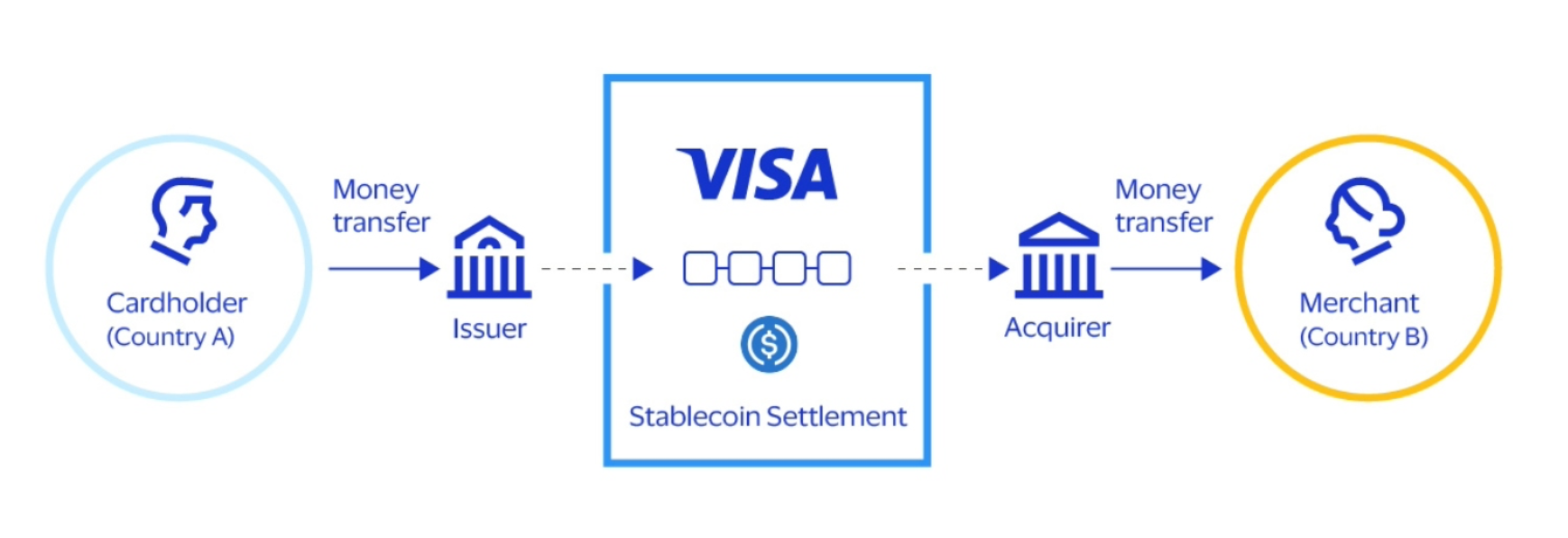
Stablecoins are increasingly being used to settle payments behind existing card networks, allowing money to move around the clock without changing how consumers pay.
But rather than cutting Visa, Mastercard or banks out of the process, the technology is beginning to replace a narrower piece of the payments stack: the traditional banking rails used to settle obligations between participants.
That shift was in focus this week when SoFi began settling debit and credit card transactions with Mastercard using its SoFiUSD stablecoin. The bank said it is migrating its entire card program, which it expects to process more than $25 billion in annualized volume, to the system.
The shift does not remove intermediaries from the card settlement process, a SoFi spokesperson told Cointelegraph, but provides an alternative blockchain-based settlement rail.
For customers, the change largely happens behind the scenes. SoFi cardholders will continue using their debit and credit cards as normal, while moving the process onchain allows the bank to settle transactions faster, according to the spokesperson.
Visa is also moving settlement onchain. In April, the company said its stablecoin settlement pilot had reached a $7 billion annualized run rate as it expanded support to nine blockchains, describing blockchain settlement as a “viable complement to traditional settlement rails.”
Related: US weighs overseas push for dollar-backed stablecoins: Bloomberg
Stablecoins don’t eliminate payment intermediaries
Federal Reserve researchers wrote in a March note that stablecoins could change the economics of payments without necessarily eliminating banks.
Cointelegraph spoke with payments and investment experts to better understand what moving card settlement onchain actually changes, and what remains largely the same.
“I wouldn’t call it disintermediation at this stage,” Martins Benkitis, co-founder and CEO of emerging-markets liquidity provider Gravity Team, told Cointelegraph.
“Visa and Mastercard are still there. The banks are still there. The network is still calculating the obligations, managing the transaction and deciding how participants interact with it,” he said.
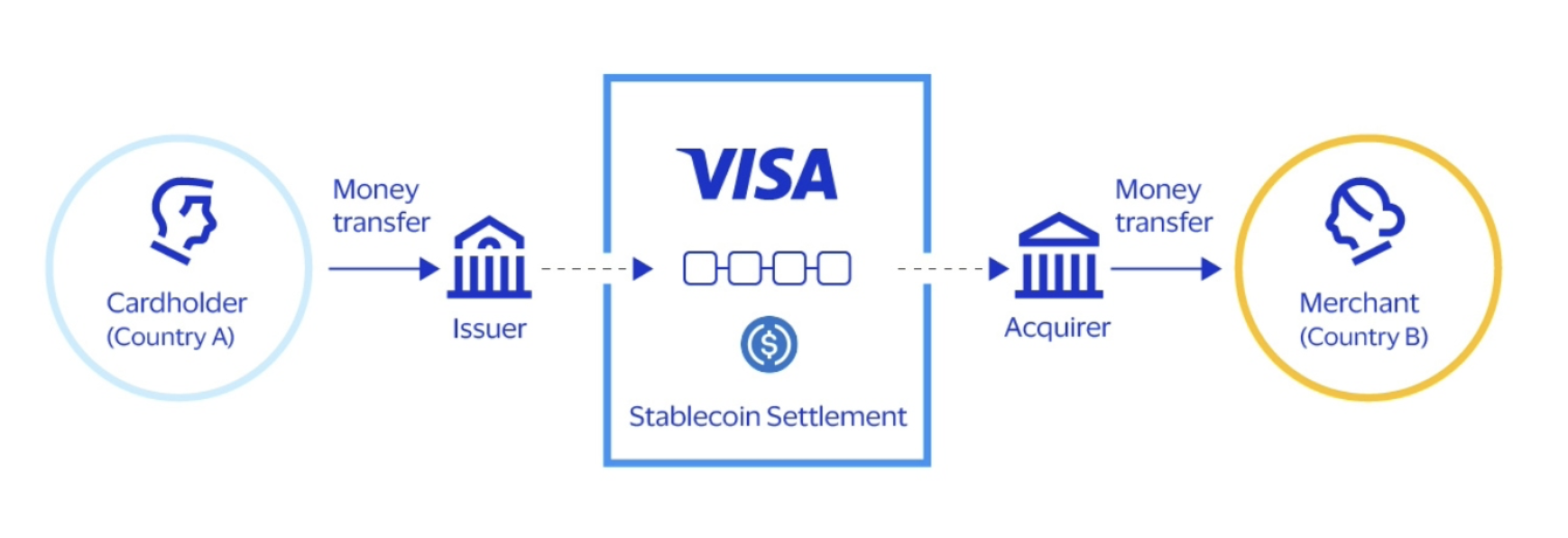
Visa stablecoin settlement model. Source: Visa
As a result, stablecoins could become a larger part of payments without businesses or consumers necessarily interacting with them directly.
“If stablecoins become a major part of payments, most businesses probably won’t care that there is a stablecoin somewhere in the process,” Benkitis said. “They’ll care that settlement is available when they need it and that the money arrives.”
The economics of faster settlement
Varun Datta, venture capitalist and founder of Truth Ventures, agreed that continuous settlement could reduce delays and the amount of capital firms need to keep in different locations for payments, particularly across borders.
But those benefits do not necessarily translate into cheaper payments, he said. Conversion, compliance, integration and stablecoin-management costs still need to be considered.
“I don’t think speed on a blockchain automatically means a cheaper end-to-end payment,” Datta said. He added that he would want to see evidence of lower total costs and better liquidity management at scale before calling the economic case proven.
Related: US stablecoin adoption could surge with bank-like protections: Visa survey
Stablecoins still need local liquidity
The economics can become more complicated when stablecoins ultimately need to be converted into local currencies.
Benkitis said that while dollar-denominated stablecoins can move between balance sheets within minutes, completing payments in emerging markets can be more complicated. Local currency liquidity can be thinner, fewer banks may handle the flows, and access to the domestic banking system is still required.
“The stablecoin gets the value there quickly,” Benkitis said. “You still need the local liquidity to finish the payment.”
Magazine: Winners and losers of the SEC’s new tokenized stocks rules
Today, we examine Ethereum, Ripple, Cardano, Binance Coin, and Hyperliquid in greater detail.
Ethereum (ETH)
This week, Ethereum rallied by 10% and managed to test the resistance at $2,800. However, sellers returned there to push the price into a pullback, but this could end up being just a brief pause before buyers push higher still.
With a higher high secured, Ethereum is well on its way to recover most of the losses incurred since 2025. If the resistance at $2,800 turns into support, then this cryptocurrency has the path clear towards $3,000 and beyond.
Looking ahead, Ethereum’s latest price action appears to confirm $1,500 as the bottom. As such, the expectation is that the current uptrend will continue and aim for $3,300 and $4,000 as the next major targets.

Ripple (XRP)
As expected, XRP has retested the $1.6 resistance and closed the week 15% higher. While this is an impressive performance, bulls still did not manage to break that level and turn it into support.
Sell volume increased again at $1.6, which did not allow the price to continue its rally. As long as sellers hold at this key level, XRP will be forced to move in a range between $1.3 and $1.6.
Looking ahead, XRP is preparing for its next major move as pressure is building under the key resistance. Considering the underlying market, the price may eventually break away and aim for $2 next.

Cardano (ADA)
ADA finally had its breakout and turned $0.23 into support. That confirms $0.15 as the bottom and allows the price to aim much higher in the future, with $0.30 and $0.33 as major targets.
This latest price action saw ADA to close the week 23% higher. This is an amazing performance, with bulls returning in force. That buying volume also fueled the breakout.
Looking ahead, ADA’s next major target is $0.30 and should be easy to reach if this momentum holds. However, before that, the price could re-test the breakout point at $0.23 as support.

Binance Coin (BNB)
Binance Coin is up 6% this week as buyers dominate the chart. The price also made a higher high and is close to reaching $800 next. The current resistance is found at $900 and the key support is at $690.
With the bullish momentum picking up speed, a test of the current resistance appears likely in the coming days. While sellers may return there, a four-digit valuation at $1,000 will act as a magnet for the price.
Looking ahead, BNB’s rally may just be starting after a long consolidation around $600, which lasted almost eight months in 2026. For this reason, a price above $1,000 is likely before the end of the year.

Hype (HYPE)
This week, Hyperliquid made a new record price at $98 and closed 17% higher. This level is a key resistance before $100 becomes possible. Considering the overall momentum, buyers may not let go of the price until they hit it.
At the time of this post, HYPE was found in a pullback. However, this may be short-lived before bulls see that they hit a three-digit valuation. Nevertheless, sellers may return as soon as price reaches it.
Looking ahead, HYPE continues to show strength, with clear higher highs and new record prices almost weekly. As long as this continues, the $100 milestone will be easy to reach and position this cryptocurrency to go higher still before the end of 2026.

The post Crypto Price Analysis Sep-24: ETH, XRP, ADA, BNB, and HYPE appeared first on CryptoPotato.
Stablecoin infrastructure provider HIFI has secured $37 million in Series A funding led by Left Lane Capital, underscoring continued demand for platforms that connect dollar stablecoins with traditional payments and banking rails. The deal arrives even as the broader crypto market has been under pressure.
According to Chainalysis, cross-border stablecoin flows rose 77.5% to $220.3 billion over the 12 months ending June 2026. During the same period, the wider crypto market contracted by more than a third, highlighting how stablecoin-related use cases have remained comparatively resilient.
Key takeaways
- HIFI raised $37 million in a Series A led by Left Lane Capital, with the company not disclosing a valuation.
- Chainalysis data shows cross-border stablecoin flows grew 77.5% to $220.3 billion in the year to June 2026 despite broader crypto weakness.
- HIFI says it processes about $7 billion in annualized volume through its platform.
- The company is expanding beyond payments into tokenized capital markets, including US-dollar settlement for tokenized repo and Treasury activity.
- HIFI also supports card-based payouts via Visa Direct using USDC, aligning with Visa’s reported growth in stablecoin-linked card programs.
Why stablecoin rails are still attracting capital
Stablecoins are increasingly viewed less as a trading vehicle and more as a settlement layer for moving value across borders and between regulated systems. That shift is reflected in the growth of cross-border stablecoin transfers, which Chainalysis reports surged to $220.3 billion during the year ending June 2026.
For investors, this matters because it points to durable infrastructure demand. Even when other segments of the crypto market slow, businesses building rails between stablecoin liquidity and real-world payment channels can benefit from ongoing enterprise adoption—particularly where speed, interoperability, and dollar settlement are required.
HIFI’s Series A and its role in dollar settlement
HIFI’s CEO Zach Walsh told Cointelegraph that the Series A is the company’s first priced funding round. While the startup did not share its valuation, it provided an operating datapoint: HIFI processes approximately $7 billion in annualized volume directly through its platform.
The funding will be used to scale HIFI’s “tokenized capital markets” infrastructure and extend its product suite, including stablecoin payments offerings, Walsh said. In practical terms, the platform enables customers to move funds into and out of stablecoins, route payouts through US banking rails and cards, and handle US-dollar settlement for the cash leg of tokenized repo and Treasury transactions.
From stablecoin payments to tokenized repo and Treasuries
HIFI’s push into tokenized capital markets comes alongside efforts from traditional market infrastructure providers. In July, the Depository Trust & Clearing Corporation (DTCC) conducted production trades using tokenized securities across multiple market functions, including US Treasury and repo settlement, equity transactions, securities lending, and collateral workflows.
DTCC noted that HIFI was among more than 30 participating firms. The exercise reportedly included organizations such as BlackRock, Goldman Sachs, and Nasdaq, and involved trades like US Treasury and repo delivery-versus-payment using assets held at the Depository Trust Company that were converted into tokenized representations.
DTCC also indicated it plans to launch its Tokenization Service in October. For companies like HIFI, that timeline is important: it suggests that market participants may soon need more standardized plumbing to connect tokenized assets and stablecoin-denominated or dollar-settled workflows to conventional settlement systems.
Visa Direct, USDC-to-card payouts, and growing card usage
Beyond institutional trading workflows, HIFI has been expanding into card-based payments. The company’s platform supports conversion of USDC and sending proceeds to eligible Visa debit and credit cards globally, according to HIFI’s website.
This expansion aligns with Visa’s reported growth in stablecoin-linked card activity. On Sept. 9, Visa said more than 160 stablecoin-linked card programs were live globally during its fiscal second quarter, with payment volume through those programs rising nearly 200% year over year. Visa also stated that its stablecoin settlement volume had surpassed a $20 billion annualized run rate—more than 15 times its level a year earlier.
For market participants, the significance is that stablecoin rails are increasingly being routed through consumer and merchant payment stacks, not just handled by exchanges or cross-border transfer desks. If that adoption continues, infrastructure providers that can reliably bridge stablecoin liquidity into regulated payment instruments could see sustained demand.
Investors and builders should watch for how DTCC’s planned Tokenization Service rollout intersects with stablecoin settlement capabilities—particularly whether more tokenized Treasury, repo, and lending workflows translate into higher usage of dollar-settling infrastructure like HIFI’s. The next signal to track is whether card-linked stablecoin programs keep scaling at similar rates as stablecoin-linked payouts expand beyond early adopters.
Stablecoin infrastructure firm HIFI has secured $37 million in a Series A funding round led by Left Lane Capital, underscoring how demand for rails that connect crypto stablecoins to traditional payment and capital-market workflows is holding up even as parts of the broader crypto market have cooled.
The round marks HIFI’s first priced financing, according to the company’s CEO Zach Walsh, who also said the platform is processing about $7 billion in annualized volume. The company did not disclose a valuation.
Key takeaways
- HIFI raised $37 million in a Series A led by Left Lane Capital, its first priced funding round.
- The company says it processes roughly $7 billion in annualized volume through its stablecoin infrastructure.
- Chainalysis data cited in the coverage shows cross-border stablecoin flows rose to $220.3 billion in the 12 months ending June 2026.
- HIFI is expanding beyond payments into tokenized capital markets, including settlement support for tokenized repo and Treasury transactions.
- HIFI is also pushing card-based payouts through Visa Direct using USDC-to-Visa debit/credit conversion.
Stablecoin rails keep attracting funding
While the wider crypto market contracted by more than a third over the same 12-month period referenced in the report, cross-border stablecoin activity continued to grow. According to Chainalysis, cross-border stablecoin flows rose 77.5% to $220.3 billion in the 12 months ending June 2026.
This divergence—stablecoin-specific usage strengthening while broader market metrics weaken—helps explain why infrastructure providers are still drawing investment. Stablecoins are increasingly used as a value-transfer layer for payments and settlement, which places infrastructure companies that integrate banking rails, card networks, and on-chain settlement mechanisms in a position to capture growing demand.
What HIFI’s Series A is expected to support
Walsh told Cointelegraph that the $37 million funding will support scaling HIFI’s tokenized capital markets infrastructure and expanding its product suite, including stablecoin payments offerings.
HIFI’s platform is designed to bridge fiat and stablecoins—helping customers move dollars into and out of stablecoins, send payouts through US banking rails and cards, and settle the cash side of tokenized repo and Treasury transactions in US dollars. For investors and fintech partners, the emphasis on cash settlement is important: tokenized assets often still require reliable linkage to regulated dollar systems, especially for delivery-versus-payment style workflows.
From payments to tokenized securities workflows
The funding comes as more traditional market infrastructure firms test or operationalize tokenization. In July, the Depository Trust & Clearing Corporation (DTCC) conducted production trades using tokenized securities across several market functions—covering US Treasury and repo settlement, equity transactions, securities lending, and collateral workflows. The trades involved US Treasury and repo delivery-versus-payment, equity activity, and collateral processes using assets held at the Depository Trust Company that had been converted into tokenized representations. DTCC also said it plans to launch its Tokenization Service in October, and HIFI was among more than 30 participating firms alongside entities including BlackRock, Goldman Sachs, and Nasdaq.
Within that context, HIFI’s positioning is straightforward: rather than limiting stablecoin use to consumer remittances or merchant payments, the company is building capabilities that can support the cash leg of tokenized capital-market transactions. That matters because tokenized capital markets typically require interoperability across custody, settlement, and payments—areas where stablecoin infrastructure can offer faster or more programmatic value movement, provided compliance and settlement integrity are maintained.
Visa Direct expansion and stablecoin-linked card programs
Beyond tokenized securities, HIFI is also expanding how stablecoins can flow into everyday payment rails. The company’s platform supports card-based payouts through Visa Direct. On its website, HIFI says customers can convert USDC and send proceeds to eligible Visa debit and credit cards globally.
This push aligns with Visa’s broader reporting on stablecoin-linked payment programs. The coverage notes that Visa reported increasing usage across its payments network, including more than 160 stablecoin-linked card programs live globally during its fiscal second quarter. Visa also said payment volume through those programs rose nearly 200% year over year, and that stablecoin settlement volume had surpassed a $20 billion annualized run rate—more than 15 times its level a year earlier.
For market participants, this is a useful signal: even as regulators and legacy financial systems grapple with how to integrate crypto responsibly, stablecoins are finding a path into mainstream card settlement and payout experiences. The practical benefit for users is that stablecoin conversion can be handled behind the scenes while still using card networks for end-user spending.
What to watch next
With HIFI scaling both tokenized capital markets infrastructure and stablecoin payments that plug into banking rails and card networks, the near-term question is how quickly tokenization pilots translate into repeatable, production-grade settlement workflows—and whether growth in cross-border stablecoin flows continues to outpace broader crypto market weakness into the next quarters.

Police lockdown St Peter’s after reports of threat to pupils

Christian Bolding on Building a Business That Can Keep Growing

SoFi Deal Highlights Stablecoins as a Reliable Settlement Rail




-

 Fashion6 days ago
Weekend Open Thread: Talbots – Corporette.com
-

 Tech4 days ago
Researchers escape OpenAI Codex sandbox to run commands on host
-

 Crypto World2 days ago
Goldman Sachs and Deutsche Bank Agree: The S&P 500 Rally Isn't Over
-

 Crypto World6 days ago
Circle launches Arc Studio AI agent for building onchain apps
-

 Crypto World4 days ago
Who Needs CLARITY Anyway? ARB Could See 70X Increase: Hodler’s Digest
-
 NewsBeat6 days ago
Trump says US has reached an agreement to take permanent control of Greenland’s security
-

 Crypto World7 days ago
Mortgage and refinance interest rates today, Thursday, September 17, 2026
-

 Crypto World6 days ago
Trading Bitcoin on Robinhood? Why 2% Spread Has Traders Worried
-

 Crypto World6 days ago
Bitcoin price breaks channel as RSI climbs to 63
-

 Fashion6 hours ago
8 iPhone Accessories That Add Personality
-

 Business4 days ago
Analog Devices (ADI) Bets $1.35 Billion on Chips that Let Machines Think for Themselves
-

 Tech3 days ago
Google’s $899 Googlebook is a bet that you’ll buy a new laptop for Gemini
-

 Tech5 days ago
Trump suggests rebranding AI with a new name, says he’s also creating an AI Force
-

 Crypto World4 days ago
Coinbase, Robinhood, Circle Seen as Tokenized-Stock Winners
-

 Tech7 days ago
GPT-6 Astra Reached the Nether in Minecraft, Lost Its Stash to a Creeper, and Farmed Potatoes for Hours
-
 Business2 days ago
Oil Price Today (September 23): Crude oil below $100 on hopes of US-Iran talks. What did Trump say?
-

 Crypto World6 days ago
World Money launches in 150+ countries with Stripe
-

 Crypto World6 days ago
Silver prices recover quickly, hitting weekly high today
-

 Crypto World2 days ago
Trump-Xi Polymarket Odds for Handshake Hit 50%
-

 Crypto World18 hours ago
Bitcoin Threatens Sub-$84,000 Breakdown as Long Liquidations Spike
You must be logged in to post a comment Login