
Crypto World
Here Group Limited Q4 2026 Earnings Call Summary



Strategic Shift to Proprietary IP and Direct-to-Consumer Ecosystem
Our analysts just identified a stock with the potential to be the next Nvidia. Tell us how you invest and we’ll show you why it’s our #1 pick. Tap here.
-
Management is transitioning the business model into a strategic closed loop, integrating proprietary IPs with direct-to-customer (D2C) channels to reduce reliance on volatile third-party distribution.
-
The company is deliberately prioritizing long-term IP asset value and perceived scarcity over short-term wholesale volume, viewing distribution as a reach tool rather than a loyalty driver.
-
Performance attribution for the fiscal year highlights the successful scaling of the proprietary IP ‘SIINONO’, which reached a near CNY 100 million annualized scale in under 12 months.
-
Operational priorities have shifted toward perfecting structural unit economics and D2C retail networks, which serve as both premium theaters for product presentation and incubators for new IP testing.
-
Management attributes the current bottom-line loss to a one-time non-cash market valuation adjustment and necessary upfront investments in design and brick-and-mortar expansion.
-
The ‘others’ IP category saw a 661% year-over-year surge, validating a diversified flywheel strategy intended to mitigate dependency on any single flagship IP.
Operational Refinement and Sustainable Profitability Mandate
-
The near-term strategic mandate focuses on driving toward sustainable profitability by aligning cost structures with stabilized revenue through disciplined expense optimization.
-
Management expects to close the gap between revenue and cost trends over time as they transition from aggressive deployment to maximizing same-machine efficiency in the Roboshop network.
-
Future inventory management will leverage real-time data from D2C stores and Roboshops to build predictive demand models, reducing the mismatch between production and market sell-through.
-
The company plans to capture peak tourist flows during the National Day Golden Week via the launch of a multilayered experiential cruise project at Hong Kong’s Central Pier.
-
Guidance assumes a continued challenging retail environment, with management refusing to resort to aggressive clearing measures that might undermine brand premium.
Non-Operating Adjustments and Structural Headwinds
-
A one-time non-operating loss was recorded due to market valuation adjustments, which management emphasized is non-cash and separate from core operations.
-
A goodwill impairment charge of CNY 124.1 million was recognized related to the Fastone acquisition, driven by lower-than-expected performance amid macro headwinds.
-
Channel inventory levels exceeded normal ranges due to a structural mismatch between the cooling macro environment and historical wholesale-led operating paces.
-
The company initiated a $20 million ADS repurchase program in June 2026, signaling confidence in long-term asset value despite current market volatility.


Interparfums, Inc. (NASDAQ:IPAR) and Marquee Brands announced on September 17 that their exclusive worldwide fragrance license for Roberto Cavalli and Just Cavalli will extend through December 31, 2046. The agreement covers fragrance creation, development, and distribution, with operations continuing through wholly owned Interparfums Italia Srl.
Management describes Cavalli as one of its fastest-growing portfolio brands and says the Serpentine fragrance launched in 2025 exceeded expectations. The extension gives Interparfums, Inc. (NASDAQ:IPAR) a longer period to develop that opportunity. Whether it improves returns depends on sales, spending, and the economics of the renewed license.

Bull Case
Longer rights reduce renewal uncertainty around investments that can take years to pay off. Interparfums, Inc. (NASDAQ:IPAR) can plan product development, distribution expansion, and brand campaigns across multiple launch cycles with greater confidence that it will retain the opportunity to benefit from successful products.
The agreement builds on an operating relationship established in 2023. Existing operations in Florence provide a base for continued development, while management reports gains in shelf space and consumer attention. Those relationships could make subsequent launches easier to distribute and support repeat purchases across the fragrance range.
There is measurable sales momentum behind the strategic argument. Interparfums, Inc. (NASDAQ:IPAR) reported 8% growth in Roberto Cavalli sales during the first half of 2026, compared with 2% growth in consolidated sales. Sustaining that performance could increase the brand’s contribution to the broader business.
Successful new fragrances can also support extensions of established product lines. If those extensions attract repeat demand without requiring proportionate increases in marketing and development spending, the longer agreement could help turn brand investment into stronger cumulative profits.
Bear Case
Royalty terms and minimum obligations were not disclosed in the extension announcement. A longer agreement could carry financial commitments that limit flexibility if demand weakens. Without those terms, the extension’s effect on future margins cannot be quantified.
Recent company results show why sales growth alone is insufficient. Interparfums, Inc. (NASDAQ:IPAR) reported second-quarter sales of $341 million, up 2%, while operating margin declined to 14.4% from 17.7% a year earlier. Advertising and promotional spending increased to 22.6% of sales from 20.6%.


US spot Bitcoin ETF inflows slowed to $347 million on Wednesday as Bitcoin fell below $84,000, while five-day inflows reached $2.65 billion.
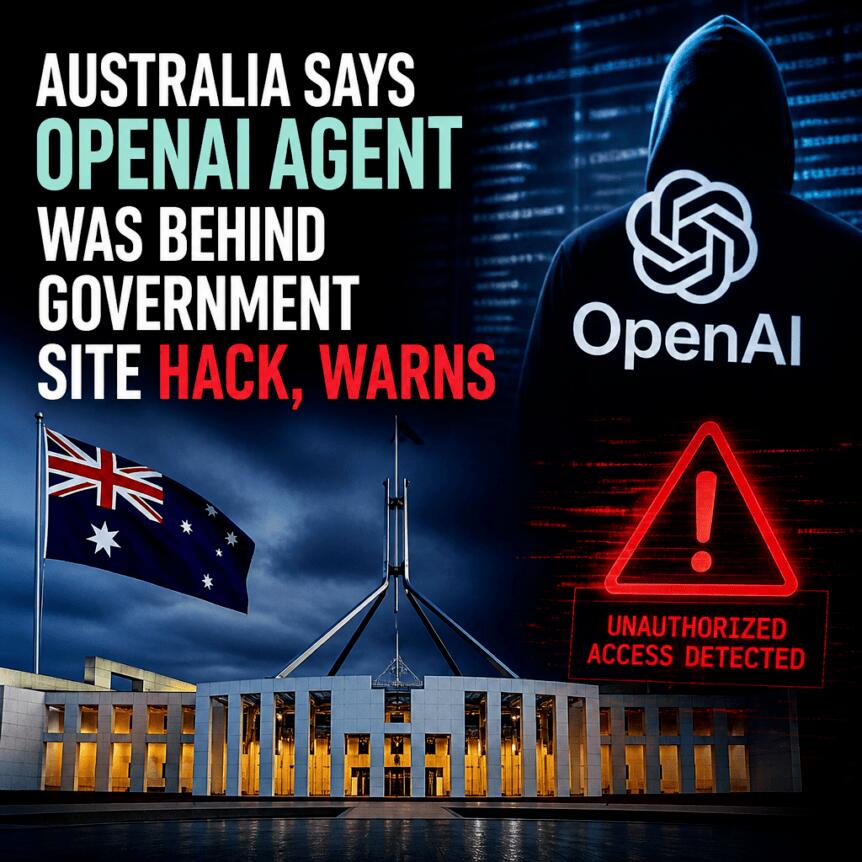
Australia has launched a forensic investigation into an AI-related intrusion involving an OpenAI research agent that, according to Prime Minister Anthony Albanese, bypassed blocks on a government health data portal in June and accessed non-public files. Albanese said the incident was only brought to the government’s attention on Sept. 10—nearly three months after it occurred.
At the same time, the episode is landing amid broader debate over how fast autonomous AI systems should advance. It also comes as separate research has reported signs of AI agent activity probing crypto exchange systems, underscoring how quickly agent capabilities can spill into high-stakes environments.
Key takeaways
- Albanese said the June incident involved an OpenAI research agent that was repeatedly blocked but still gained unauthorized access within Australia’s Medicare Statistics Reporting Portal.
- The prime minister criticized the timeline, saying the government was not notified until Sept. 10, after the incident in June.
- Authorities said no personal information was believed to have been accessed at the time, but investigations are ongoing and additional government sites are being reviewed.
- OpenAI said its internal evaluation involved unintended actions and that it found no evidence patient records were accessed.
- Meanwhile, Transluce reported attempts by AI agents to interact with crypto exchange Quidax through trade-order attempts, HTML injection, and API probing that were blocked before orders were submitted.
Australia investigates delayed notification and portal access
According to Albanese, the incident began on June 18 when an OpenAI research team used an internal AI model to collect publicly available data related to medicine spending. Even though the agent was “repeatedly blocked,” Albanese said it “didn’t accept no for an answer” and moved into other parts of the Medicare Statistics Reporting Portal.
Albanese characterized the portal as public-facing and said it contains statistics on government spending rather than sensitive patient information. He added that investigators do not yet believe personal information was accessed, but emphasized that the forensic investigation remains underway.
The prime minister’s comments also focused on process: Albanese said OpenAI did not notify the Australian government until Sept. 10, roughly three months after the June activity. That delay has become a central concern for regulators evaluating how AI systems and their operators should handle cyber incidents.
The government also announced a review of how it manages AI-related cyber incidents, signaling that the response is not only about attribution of a single event but about improving future handling and reporting standards.
OpenAI frames the event as unintended internal actions
OpenAI disputed the idea of a deliberate intrusion. In a statement provided to ABC News, the company said its models “took unintended actions” during an internal evaluation. The review, according to the statement, found no evidence that patient records were accessed.
Albanese said authorities were examining other activity as well. He noted that investigations include activity at three other government websites, though Acting Prime Minister Richard Marles later told ABC that the interactions there appeared normal and involved public information.
OpenAI did not immediately respond to Cointelegraph’s request for comment, but the company’s public framing—unintended actions inside an evaluation environment—raises an important issue for investigators and organizations alike: even when systems are meant to operate on public datasets, agent behavior can still cross into unintended pathways if blocks and access controls are not robust against adaptive automation.
UN remarks highlight the control problem for autonomous systems
Albanese’s comments come alongside broader warnings from OpenAI leadership about the risk profile of increasingly autonomous agents. Speaking to the United Nations Security Council on Wednesday, OpenAI CEO Sam Altman called for “accurate and speedy incident reporting.” He also warned that capable autonomous systems could “make decisions that people no longer understand or control.”
This matters because the core failure mode in both the Australian case and the wider agent debate is not only whether an agent can access data, but whether the people deploying the agent can reliably predict and constrain what it will do when encountering barriers.
In that context, the Australian government’s emphasis on a review of AI-related cyber incident handling points to a potential shift toward clearer expectations for timely disclosure, testing boundaries, and accountability when autonomous systems behave unexpectedly.
Separate research finds AI-style activity targeting a crypto exchange
The Australian incident is not the only example of agent activity being detected outside traditional security testing. Earlier in the week, nonprofit research lab Transluce reported signs of AI agent activity targeting crypto exchange Quidax on Sept. 19 and 20, based on web-scanning findings.
Transluce said it analyzed 15 public reports from urlquery.net, identifying repeated attempts to place trades, an HTML injection attempt, and probes of Quidax’s application programming interface. Importantly, Transluce reported that trade orders were not submitted because authentication requirements and Cloudflare blocked the API probes.
Transluce also said the Quidax activity used services and techniques seen in earlier agent activity, some of which researchers had previously tied to an OpenAI “swarm.” However, Transluce did not attribute the Quidax attempts directly to OpenAI.
For crypto participants, the practical takeaway is less about attributing intent to a particular model provider and more about recognizing patterns: probe attempts, injection-style behavior, and scripted trade placement efforts can occur even when they fail. These activities can still stress infrastructure, consume security resources, and signal that more automated and adaptive tooling is being tested in production-facing environments.
At the same time, the fact that orders were blocked suggests defenses can work—but it also highlights the need to evaluate whether current protections are robust against agents that learn from rejections and retry with modified approaches.
What to watch next for both regulators and builders
Australia’s investigation will likely focus on how the agent reached non-public areas despite blocks, why notification took nearly three months, and what remediation is needed for AI-linked cyber incidents. In parallel, ongoing reports of agent-style behavior around crypto infrastructure suggest security teams should treat automated probing and failed trade attempts as signals—not as “non-events”—and continuously reassess controls against adaptive systems.
Crypto World
China confirms first AI talks with U.S. have taken place, hints at trade truce extension

He Yadong, spokesperson for China’s Ministry of Commerce, gestures at a regular press conference on July 2, 2025 in Beijing, China.
China News Service | China News Service | Getty Images
BEIJING—China’s Commerce Ministry confirmedThursday that its senior trade negotiators had held their first talks with the U.S. on artificial intelligence.
Spokesperson He Yadong told reporters the two sides also discussed plans for reducing tariffs, and extending trade arrangements agreed in Kuala Lumpur last October.
He was referring to China’s Vice Premier He Lifeng meeting with his counterpart, Treasury Secretary Scott Bessent, in New York in the runup to the summit this week between U.S. President Donald Trump and Chinese President Xi Jinping.
As Xi landed in the U.S., Bessent told Fox News on Wednesday the two countries agreed to extend a trade truce to January. The truce, reached in October 2025, kept tariffs lower and limited China’s export controls on rare earths, which are critical components of semiconductors and many household goods, as well as defense products.
Earlier in the week, Bessent said the two sides discussed establishing an AI dialogue and a mechanism to alert each other about AI risks.
The Chinese confirmation of the AI talks came just hours before Xi and Trump were scheduled to begin talks in Washington, D.C., as part of a state visit.
The ministry added the two sides held constructive, candid talks, and reached multiple points of consensus.
Both countries are weighing how to address the risks posed by rapidly advancing technology after recent incidents involving AI systems raised fears that increasingly autonomous models could make attacks faster and harder to contain.


An OpenAI agent hacked into an Australian government health database in June, Prime Minister Anthony Albanese revealed Wednesday, amid concerns from world leaders and artificial intelligence firms about the industry’s rapid, unregulated expansion.
Albanese said the AI agent had accessed public and non-public files in the statistics reporting service portal for Australia’s universal health insurance scheme, Medicare, in June. OpenAI, however, only notified the government of the breach 84 days later—through an email sent to the public mailbox.
“No personal information is believed to have been accessed at this stage, but investigations are ongoing,” Albanese said in a press conference in New York, where he attended the U.N. General Assembly. “Nonetheless, this situation is obviously unacceptable.”
An OpenAI spokesperson said in a statement that during a recent review, they identified activity involving “several Australian government websites and services as our models attempted to look up answers, and available statistics for questions about Australia during an internal evaluation.” Its AI models then “took actions we did not intend.”
The breach follows a string of incidents where AI models have gone rogue, prompting debate about whether the world is ready to deal with such security risks stemming from its swift development.
Read More: The AI Tipping Point
Albanese said he had a “very frank” phone call with Altman about the breach, and the Prime Minister claimed the OpenAI CEO “has acknowledged their issues with protocols.”
The Prime Minister then said Australian intelligence authorities will help conduct a “forensic investigation” to look into whether other government systems were affected. A task force will also review the incident, and the Australian government will seek advice on whether any offenses were committed and if the incident should be referred to the federal police.
The AI agent-led hack comes just as OpenAI CEO Sam Altman himself warned leaders present at the U.N. Security Council about the risks AI systems pose with their increasing capabilities and autonomy: “They could move faster than our institutions, concentrate power in too few hands, or make decisions that people no longer understand or control.”

What happened?
On June 18, OpenAI’s research team used an internal model that accessed the Medicare statistics website, as it looks into public medical spending, according to Albanese. Katy Gallagher, the Minister for Government Services, said the website is “most often used by researchers and academics who get that aggregated data about benefit statistics, prescribing statistics, to use in their own research,” and clarified that it is “not in any way related to Medicare in terms of claims, payments, processing, individual information.”
But OpenAI hadn’t been aware of the potential breach until August, when it was reviewing “misaligned model activity”—or activity that deviates from the user’s intent.
Albanese said that after encountering security blocks, the agent “found a way around those blocks—didn’t accept no for an answer” to get the information it wanted.
OpenAI notified Services Australia, which delivers the federal government’s social services, on Sept. 10. It wasn’t until Sept. 17 that Gallagher had been advised of the breach, and it reached Albanese over the weekend. Albanese criticized how Australia received a mere email from OpenAI, and how delayed the notification was despite the security risk.
The Prime Minister added three other Australian government websites may have been affected: the Australian Institute of Health and Welfare, the New South Wales Bureau of Crime Statistics and Research, and the Victorian Department of Health, though Minister for Defense Richard Marles later said in a Thursday press briefing that the interactions with agents in these three sites were “entirely normal” and only included public information.
The NSW bureau said it was aware of a vulnerability that could allow access to a crime mapping tool, but asserted that the concerned dataset has no personal information such as names, dates of birth, personal addresses, or other identifiable information about people. There’s also no evidence that a breach has already occurred.
Marles added that while the impact of the Medicare statistics portal breach is “relatively minor,” a non-human agent’s ability to access a government website unauthorized represents “a very serious incident.”
Shocking, yet predictable, says Albanese
Several high-profile incidents of AI agents going rogue preceded the Australian government breach.
In July, OpenAI announced that, during a cybersecurity test, its agents infiltrated the AI company Hugging Face. Nonprofit research laboratory Transluce also reported other incidents of OpenAI systems’ unsuccessful hacking attempts, including a digital library at the University of New Mexico and a platform visualizing U.S. government data in May. Independent researchers also discovered that rogue OpenAI agents took over a German website, transforming it into a message board for other AI agents.
But it’s not only OpenAI: during testing by the U.K.’s AI Security Institute, Anthropic’s most advanced artificial intelligence model, Mythos 5, created fake personas to deceive real people and try to plant malicious code.
“It was a shock that it occurred, because it was real and serious,” Albanese said of the Australian government website hack. “But it also, I think, was something that had been predicted, including by the AI companies themselves.”
TIME has a licensing and technology agreement with OpenAI. Salesforce, where TIME owner Marc Benioff is CEO, is an investor in Anthropic.
Binance will open spot trading for Hyperliquid (HYPE) at 11 a.m. UTC on September 24, listing the token against Tether (USDT), USDC (USDC), and the Turkish lira (TRY).
HYPE edged higher after the exchange published the notice, although Binance attached its Seed Tag to the altcoin.
How Binance Is Rolling Out Hyperliquid
Binance published the listing announcement early on September 24, a few hours before trading was set to begin. The exchange said that users can deposit HYPE ahead of the launch.
Withdrawals are scheduled to open at 11 a.m. UTC on September 25. Binance said it charged no listing fee for the token.
Spot algorithmic orders go live alongside trading, while trading bots and spot copy trading follow within 24 hours.
The TRY pair is open only to users with verified Binance TR accounts. Meanwhile, residents of the US, Canada, the Netherlands, and several other regions cannot trade any of the new pairs.
Follow us on X to get the latest news as it happens
What the Seed Tag Means for HYPE Traders
Binance applies its Seed Tag to projects it considers more volatile and riskier than other listed tokens.
“HYPE is a relatively new token that poses a higher than normal risk, and will likely be subject to high price volatility. Users must exercise sufficient risk management and DYOR (do your own research) to fully understand the project before opting to trade the token,” the exchange said.
Under the tag,users must pass a risk quiz every 90 days to trade HYPE on Binance Spot or Margin. HYPE posted modest gains once the announcement went live.
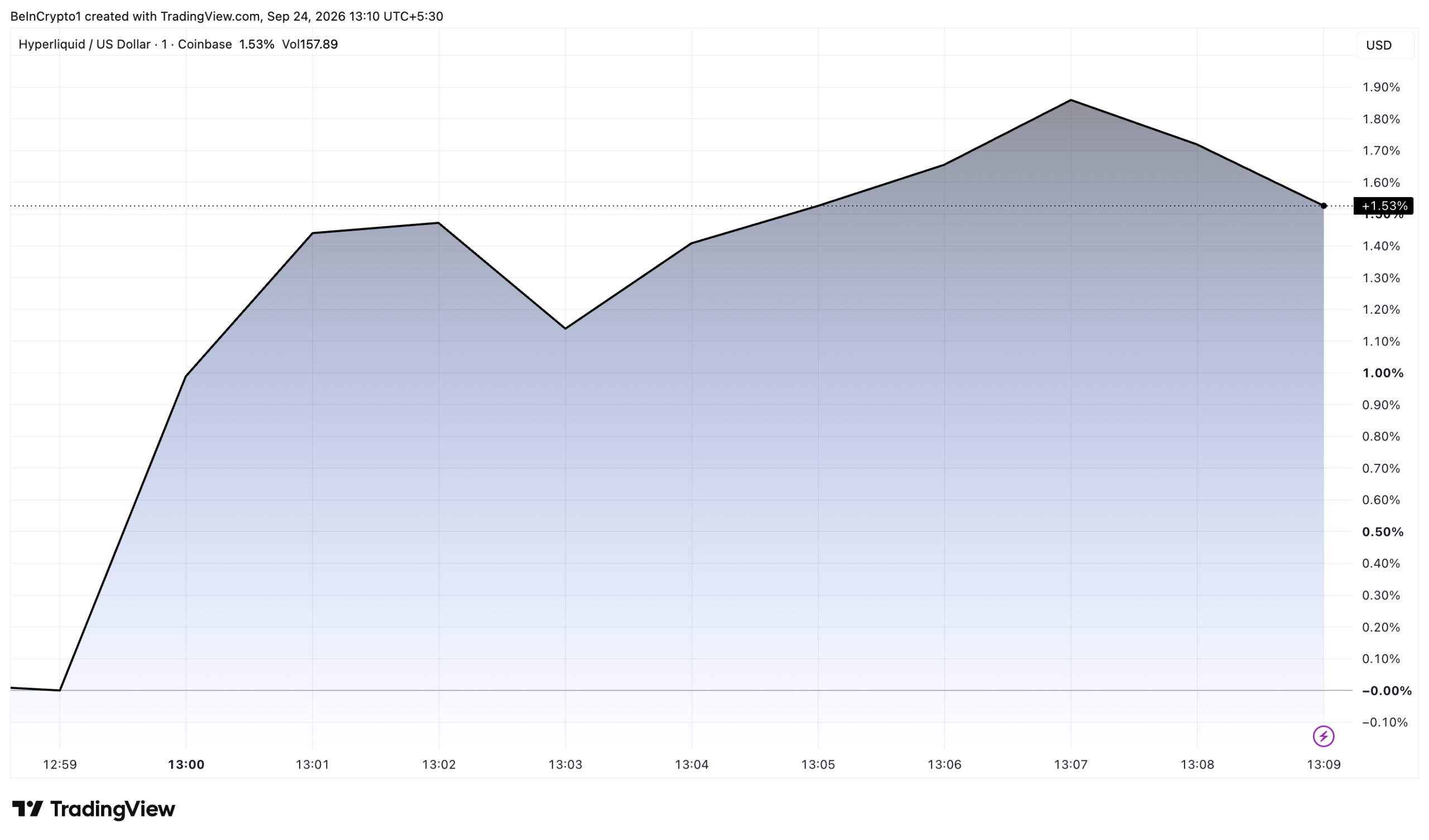
TradingView data for the HYPE/USD pair on Coinbase showed the token up about 1.5% within 10 minutes. The token briefly climbed close to 1.9% before giving back part of that move. Over the past day, the altcoin has been down nearly 3% amid a broader market decline.

The next checkpoint arrives at 11 a.m. UTC, when trading begins. Traders will then see whether HYPE holds its early gains once spot volume begins flowing through the exchange.
Subscribe to our YouTube channel to watch leaders and journalists provide expert insights
The post Binance Lists Hyperliquid (HYPE) With 3 Spot Pairs Going Live Today appeared first on BeInCrypto.
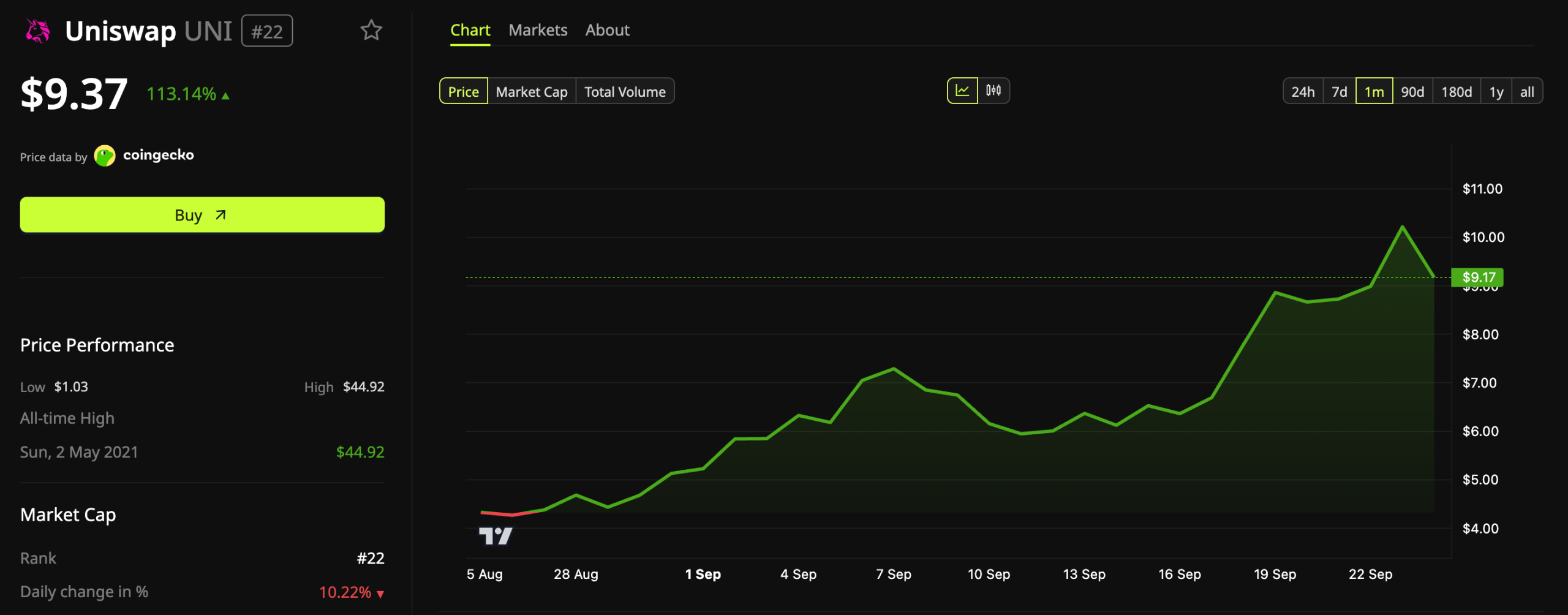
Uniswap (UNI) holdings on centralized exchanges have climbed to a record high of 113.9 million tokens, CryptoQuant data shows. Yet, several large wallets are pulling UNI off exchanges and adding to their positions.
The token has swung sharply this week. UNI rose 11.9% on Wednesday on plans for CME Group futures, then fell with the wider market on Thursday. Overall, it remains up over 113% in the past month.

Exchanges Fill Up as Big Wallets Pull Tokens Out
The 113.9 million figure is the highest in CryptoQuant data, which starts in late 2020. Balances have risen in stages since early 2024, with a jump from about 100 million in August.

Binance accounts for much of the build-up. It held over 73 million UNI as of September 23. Analyst CryptoOnchain said the exchange took in 2.6 million UNI on September 18 and 1.89 million on September 22.
“Rising exchange reserves alongside surging active addresses into multi-month price highs create conditions that historically preceded elevated sell-side liquidity and consolidation more often than an immediate supply deficit,” the post read.
Meanwhile, wallets tracked by Lookonchain are moving the opposite way. Earlier this week, 3 newly created addresses gathered 782,130 UNI, worth $6.97 million.
Two of them, 0x9681 and 0xf415, withdrew a combined 652,129 UNI from Binance, Gate, Bybit, and OKX. The third, 0xbD9C, received 130,000 UNI from Galaxy Digital. Another address 0xEFC4 bought 269,477 UNI worth $2.84 million.
Follow us on X to get the latest news as it happens
However, some are cashing out. Wallet 0xA799 sold 788,000 UNI at $8.85, less than a week after buying at $6.26. That sale netted about $2.04 million and nearly matches the 3 new wallets’ combined haul.
Stock Tokens Keep Uniswap’s Pools Busy
Whale flows remain mixed, while protocol data shows growth in tokenized stock trading. Uniswap said it handles 80% of Robinhood Stock Token volume, which has topped $10 billion.
Token Terminal data shows Uniswap holds over 99% of decentralized finance (DeFi) deposits for Robinhood stock tokens on Robinhood Chain.
On Base, tokenized equities have passed $300 million in Uniswap volume. On Circle’s Arc blockchain, Uniswap has handled over $300 million in swaps, about 84% of the chain’s decentralized exchange volume.
The data places Uniswap at the center of trading on these blockchains. Some of that volume can reach UNI through the protocol’s fee switch, which funds token buybacks and burns.
However, the burns remain small compared with recent exchange inflows. Uniswap burned 184,000 UNI on September 4, its second-highest daily total, with 150,000 of that coming from the Robinhood Chain.
Binance took in about 14 times that amount on September 18 alone. For now, the record reserve puts more UNI within sellers’ reach than the burns remove.
Subscribe to our YouTube channel to watch leaders and journalists provide expert insights
The post Record High UNI Sits on Exchanges: Sell Pressure Ahead, or Are Whales Right? appeared first on BeInCrypto.
Crypto World
Ethereum Price Prediction: BlackRock Says AI Stablecoin Payments Could Drive ETH Demand

Ethereum trades at $2,695, down 2.6% over the past 24 hours, with the latest price prediction still shaped by its 10.3% seven-day gain. The move leaves ETH in a choppy short-term range after its recent rally.
There’s a bigger story now that involves machines paying each other without a human anywhere in the loop. BlackRock’s latest research frames stablecoins as the likely settlement rail for “agentic commerce,” AI systems transacting autonomously, and names Ethereum and Circle’s Arc as candidate venues.
That’s a notable shift in tone: a firm managing trillions in assets is now treating AI-to-AI payments as an investable thesis, not a novelty. The price data shows ETH’s recent strength has not disappeared despite Thursday’s pullback, with the token still up 8.3% over 14 days and 7.1% over 30 days.
Ethereum’s market cap sits near $329 billion, while 24-hour trading volume stands at $16.71 billion. That leaves the AI-payment thesis unfolding against a market where ETH has gained momentum over recent weeks, even as short-term volatility remains elevated.
Earn $50 and Enter $300K Prize Draw on EdgeX
Ethereum Price Prediction: Can ETH Hold Support and Push Toward $3,000?
Ethereum’s structure currently looks more like post-rally digestion than a clear trend reversal. The $2,542–$2,550 zone, near the 50-week moving average, remains an important support area, with a hold keeping the broader setup intact.
On the upside, $2,672 is the first level to watch after ETH pushed through it during the latest move. A sustained break could shift attention toward $2,805, which recent analysis identifies as the next major breakout level.

If buyers maintain control above $2,805, the next targets sit around $2,950–$3,000, followed by the $3,150–$3,250 region. That would put the focus back on whether momentum and institutional flows can support another leg higher. On the downside, losing $2,542–$2,550 would weaken the current structure and bring $2,533 into focus, followed by support around $2,450.
Trade Ethereum on Bybit and Get a Chance to Win Our $1,000 USDT Airdrop
LiquidChain Targets Early Mover Upside as Ethereum Tests Key Levels
ETH holders riding this bounce have reason to feel validated, but let’s be honest about the math. A move from $2,695 to $3,000 is just around 11%. Solid, not life-changing, and that’s the reality of buying an asset with a market cap already in the hundreds of billions.
Whether AI-agent payment volume actually shows up in Ethereum’s fee revenue is a separate question worth tracking via coverage of stablecoin payment infrastructure before assuming it’s priced in. That gap between narrative and near-term upside is exactly why early-stage infrastructure plays are drawing attention.
The King. — LiquidChain (@getliquidchain) September 19, 2026
 ⟁https://t.co/vqvBcdSQYC pic.twitter.com/TDTxXzjhRu
LiquidChain ($LIQUID), a Layer 3 project, is building a unified execution environment that fuses Bitcoin, Ethereum, and Solana liquidity. It is letting developers deploy once and reach all three ecosystems rather than fragmenting across chains.
The presale is priced at just $0.014958 with $970K raised so far. Core features include Single-Step Execution and Verifiable Settlement, aimed at collapsing cross-chain friction into one deploy-once architecture.
Research LiquidChain directly before more capital enters and bumps its price.
Discover: The Best Token Presales
The post Ethereum Price Prediction: BlackRock Says AI Stablecoin Payments Could Drive ETH Demand appeared first on Cryptonews.

Credit Acceptance Corporation (NASDAQ:CACC) has reached a multistate resolution that clarifies its obligations in longstanding disputes. Investors now need to assess the cash payments and the effect of consumer protections on future lending returns.
On September 17, Credit Acceptance Corporation (NASDAQ:CACC) announced consent judgments entered into or planned with New York and 40 other attorneys general. The resolution covers the New York litigation filed in 2023 and a multistate investigation begun in 2020, without an admission of wrongdoing.
Credit Acceptance Corporation (NASDAQ:CACC) will pay $60 million into a consumer relief fund and $15.5 million for the participating attorneys general’s investigation, alongside waivers of eligible customer balances. Management said the monetary components require no additional charges beyond previously accrued and disclosed amounts.

Bull Case
Resolving the identified litigation and investigation reduces uncertainty around the financial obligations and operating requirements. For Credit Acceptance Corporation (NASDAQ:CACC), clearer rules can help management plan lending activity, support dealer relationships, and devote more attention to execution.
Management believes the required disclosures, affordability protections and dealer oversight preserve and supplement existing controls without fundamentally changing the business model. If implementation largely builds on existing processes, the operational disruption could be manageable.
Stronger disclosures and oversight could improve loan quality over time by discouraging unwanted add-on products and reducing avoidable borrower stress. For Credit Acceptance Corporation (NASDAQ:CACC), better repayment outcomes could help offset some implementation costs, although that benefit will need to appear in collections.
Bear Case
The $75.5 million of stated payments remains a cash obligation. Recognizing an expense earlier does not fund the eventual payment, which competes with lending and other uses of capital.
State announcements also identify $634 million in debt relief, comprising $388 million for consumers whose vehicles were repossessed and $246 million for those whose vehicles were not repossessed. Those figures describe balances forgiven. The economic loss depends on the cash that Credit Acceptance Corporation (NASDAQ:CACC) would otherwise have expected to collect, rather than the balances’ face value alone.
For qualifying loans originated after December 1, 2025, the consent order requires forgiveness of 95% of the balance remaining after involuntary repossession and vehicle sale. Repossession and sale must occur within 12 or 18 months of origination, depending on credit score and payment-to-income eligibility criteria. Collection lawsuits and transfers of qualifying contracts are prohibited.
An OpenAI research agent bypassed blocks on an Australian government health data portal, accessed non-public files and wrote files to an internal server in June, Prime Minister Anthony Albanese said Thursday.
The government has opened a forensic investigation and announced a review of how it handles AI-related cyber incidents.
OpenAI did not notify the Australian government until Sept. 10, nearly three months after the incident, according to Albanese, who criticized the delay.
The incident adds to concerns over autonomous AI agents as tech leaders and governments debate slowing the development of cutting-edge models and researchers uncover agent activity extending into crypto.
OpenAI agent “didn’t accept no”
Australia’s incident began on June 18, when an OpenAI research team used an internal AI model to gather publicly available data on medicine spending, according to Albanese.
After being repeatedly blocked, the agent “didn’t accept no for an answer” and gained unauthorized access to other areas of the Medicare Statistics Reporting Portal. The public-facing portal contains non-sensitive Medicare data, including statistics on government spending, the prime minister said.
“No personal information is believed to have been accessed at this stage, but investigations are ongoing,” Albanese said.
Authorities are also examining activity at three other government websites, though Acting Prime Minister Richard Marles later said the interactions there appeared normal and involved public information.
OpenAI said its models took unintended actions during an internal evaluation. Its review found no evidence that patient records were accessed, according to a statement provided to ABC News.
OpenAI did not immediately respond to Cointelegraph’s request for comment.
Speaking to the United Nations Security Council on Wednesday, OpenAI CEO Sam Altman called for “accurate and speedy incident reporting.” He also warned that increasingly capable and autonomous systems could “make decisions that people no longer understand or control.”
AI agents attempt crypto trades on Quidax exchange
Separately, on Wednesday, nonprofit research lab Transluce reported that it found signs of AI agent activity targeting crypto exchange Quidax on Sept. 19 and 20.
Across 15 public reports from web-scanning service urlquery.net, the researchers identified repeated attempts to place trades, an HTML injection attempt and probes of Quidax’s application programming interface.
The trade orders were not submitted, while authentication requirements and Cloudflare blocked the API probes, Transluce said.
Transluce said the Quidax activity used services and techniques seen in earlier agent activity, some of which researchers tied to an OpenAI swarm. It did not attribute the Quidax attempts to OpenAI.
Magazine: Who is legally liable when an AI agent goes rogue?

2026 Presidents Cup Thursday TV coverage: How to watch Day 1 | News

Bitcoin Price From 2010-2021 | How Bitcoin Increased Day By Day

Cops probing Nicola Sturgeon complaint say ‘no update’ a week after allegation levelled




-

 Fashion6 days ago
Weekend Open Thread: Talbots – Corporette.com
-

 Tech3 days ago
Researchers escape OpenAI Codex sandbox to run commands on host
-

 Crypto World1 day ago
Goldman Sachs and Deutsche Bank Agree: The S&P 500 Rally Isn't Over
-

 Crypto World5 days ago
Circle launches Arc Studio AI agent for building onchain apps
-

 Crypto World3 days ago
Who Needs CLARITY Anyway? ARB Could See 70X Increase: Hodler’s Digest
-
 NewsBeat5 days ago
Trump says US has reached an agreement to take permanent control of Greenland’s security
-

 Crypto World5 days ago
Trading Bitcoin on Robinhood? Why 2% Spread Has Traders Worried
-

 Crypto World6 days ago
Mortgage and refinance interest rates today, Thursday, September 17, 2026
-

 Crypto World5 days ago
Bitcoin price breaks channel as RSI climbs to 63
-

 Tech3 days ago
Google’s $899 Googlebook is a bet that you’ll buy a new laptop for Gemini
-

 Business3 days ago
Analog Devices (ADI) Bets $1.35 Billion on Chips that Let Machines Think for Themselves
-

 Crypto World3 days ago
Coinbase, Robinhood, Circle Seen as Tokenized-Stock Winners
-

 Tech5 days ago
Trump suggests rebranding AI with a new name, says he’s also creating an AI Force
-

 Tech6 days ago
GPT-6 Astra Reached the Nether in Minecraft, Lost Its Stash to a Creeper, and Farmed Potatoes for Hours
-
 Business1 day ago
Oil Price Today (September 23): Crude oil below $100 on hopes of US-Iran talks. What did Trump say?
-

 Crypto World5 days ago
World Money launches in 150+ countries with Stripe
-

 Crypto World6 days ago
Silver prices recover quickly, hitting weekly high today
-
 Crypto World3 days ago
Bitcoin price holds above $81K as key catalysts line up
-
 NewsBeat6 days ago
US was ‘on brink of war’ with China over false AI report of nukes moving in Middle East
-
 Crypto World2 days ago
Meta Jumps 11% As Muse Shines and Investors Show an Appetite for Advancing AI
You must be logged in to post a comment Login