

Crypto World
How a Stablecoin Remittance Platform on L2 Can Surpass Western Union

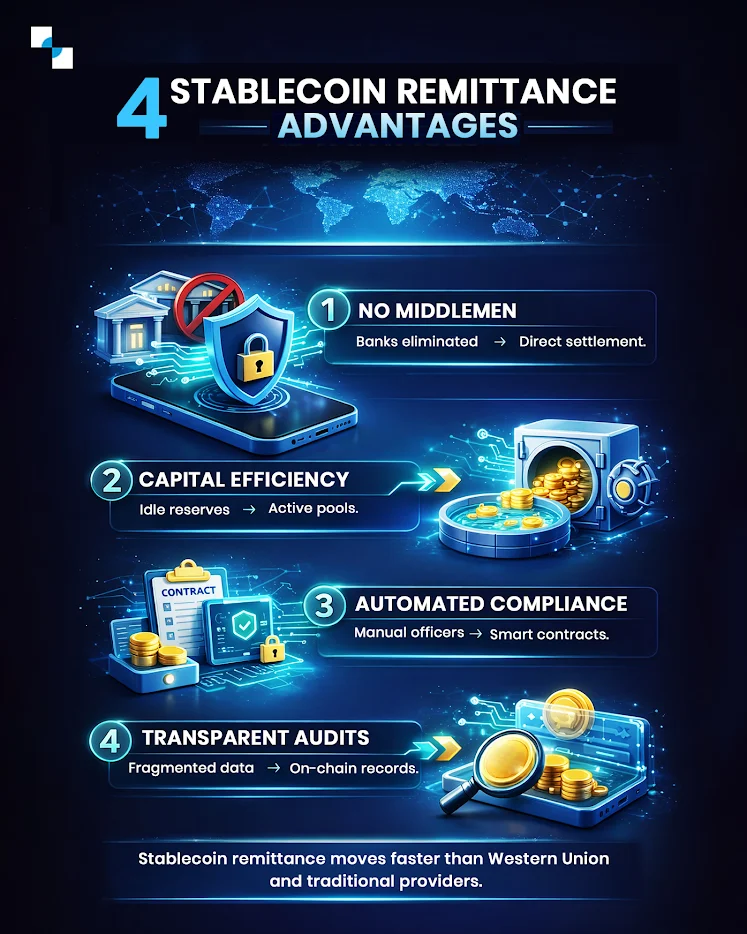
It’s 2026. Why do you still need to pay $12 for sending $200 from New York to Manila and wait for 2 days before it reflects in the recipient’s account? Why do we still expect migrant workers to lose $45 billion annually in the form of remittance fees? Don’t you think that making cross-border payments should be much faster and less expensive?
These questions aren’t rhetorical. It showcases the harsh reality faced by 281 million international migrants who sent $656 billion home to their families in 2023, as per the World Bank data. The average global remittance fee sits at 6.2%, and in some places, it’s over 10%. It’s something that has burdened the people who have left their homes to support their families financially.
Western Union, MoneyGram, all the old-school remittance giants have been running the show for decades. But their systems feel ancient now. Don’t you think using blockchain technology can be a better option? Currently, stablecoin remittance platforms built on Layer 2 blockchain networks are showing everyone what’s actually possible when you start from scratch.
The best part is that you don’t have to do stablecoin remittance platform development on your own, because there are specialists who can handle the technical stuff, test your platform, debug, and ensure that everything is working perfectly. It will let your users enjoy low-cost cross border payments at unbelievable speed.
Here are some stats that will make you think about the need to start with stablecoin payment platform development, without any confusion:
Top Recipients of Remittances (2024–2025 Trend):
1st: India ($129–$135 billion).
2nd: Mexico ($66–$68 billion).
3rd: China (approx. $48–$50 billion).
Based on data regarding India’s record-breaking remittances in 2024–2025, the total remittance fees for transferring $129–$135 billion amount to approximately $4 billion to $10 billion annually. The inefficiency isn’t just annoying, it’s economically devastating.
Speed, Cost, and Accessibility Advantages That Legacy Remittance Can’t Match
Stablecoin remittance isn’t just a little better than the old way; it’s a whole new game. Three big improvements set it apart, and when you put them together, you get something that feels completely different.
1. Lightning-Fast Settlements
- Legacy speed: Western Union averages 1-3 days, with weekend delays.
- Stablecoin speed: Arbitrum (15 seconds), Optimism (2 seconds), and Polygon (sub-second) operate 24/7.
- Real impact: 16% of recipients need funds urgently for emergencies (IFAD, 2022).
2. Fee Structures That Make Sense
Western Union charges 6-7% in total fees, including FX markups. On a $200 transfer, the median remittance size globally, $12-14 are gone before money reaches its destination. Send money twice monthly, and you’re paying $288-336 annually just in fees.
Stablecoin remittance platform development has focused on eliminating this burden:
- Layer 2 transaction fees: $0.01 to $0.50, regardless of transfer amount
- Total cost including on/off ramps: Under 2% (typically $3-4 on a $200 transfer)
- Annual savings: $192-264 for someone sending $200 twice monthly
The fee structure becomes even more compelling for smaller transactions. Western Union charges at least $5, even if you just want to send $20. That barely makes sense, as you lose a quarter of what you’re sending to fees. With Layer 2 tech, the cost stays flat whether you move $20 or $20,000. Suddenly, tiny payments actually work.
Launch a global stablecoin remittance platform with speed, security, and compliance built-in.
Accessibility Beyond Banking
Here’s a statistic that matters: Approximately 1.3 billion adults around the world still do not have a bank account or access to a financial institution as of the World Bank’s Global Findex 2025 report (based on 2024 data). Billions of people have mobile internet, but less than half of adults have a bank account. This gap represents an enormous opportunity.
Key accessibility advantages of stablecoin remittance platforms:
- You don’t need a bank account: Having a smartphone and internet connectivity is sufficient.
- Signing up is fast: You go through KYC with quick biometric authentication.
- No physical locations: Recipients don’t travel to agents, crucial for rural areas where the nearest Western Union might be hours away.
- 24/7 availability: No business hours, weekends, or holiday shutdowns to restrict when people can send or receive money.
Why Layer 2 Rails Make Western Union’s Infrastructure Look Outdated
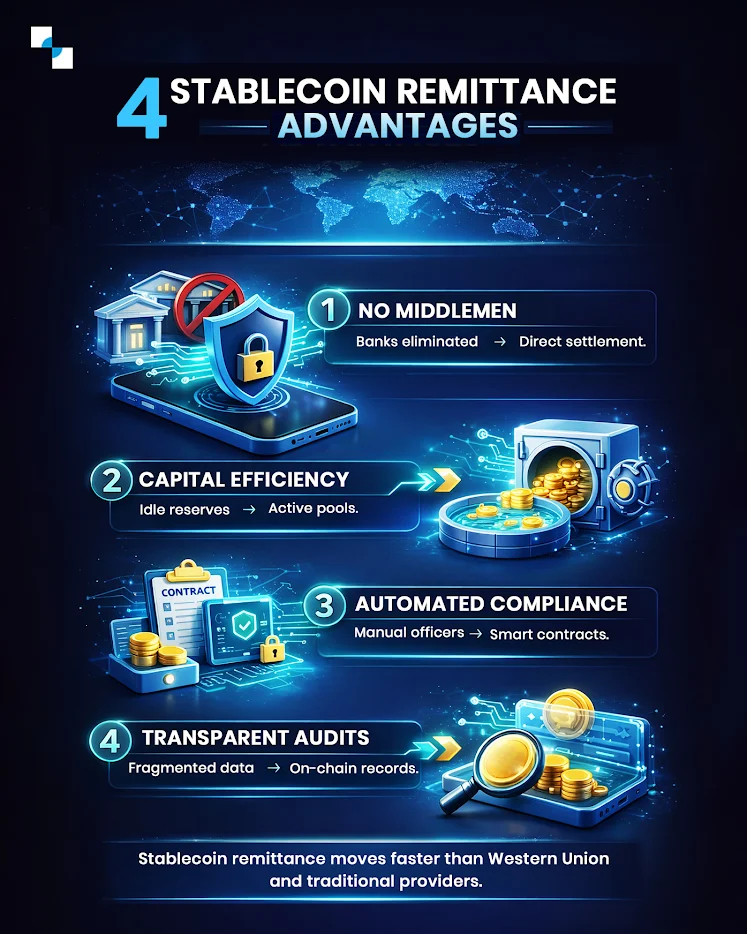
The technological gap between legacy remittance infrastructure and modern Layer 2 blockchain solutions isn’t incremental; it’s generational. Understanding why requires looking at how each system actually works.
1. Eliminating the Correspondent Banking Web
When you send money internationally through Western Union, it doesn’t travel directly from sender to recipient. It moves through a complex web of correspondent banking relationships. A transfer from the United States to Nigeria might touch five different institutions, each taking a cut and adding processing time.
Stablecoin remittance eliminates these intermediaries entirely:
- Direct movement: Value transfers on blockchain rails directly from sender to recipient.
- No reconciliation delays: Single-step settlement versus multi-institution coordination.
- Transparent routing: Complete visibility versus opaque correspondent chains.
2. Capital Efficiency Revolution
Western Union maintains nostro and vostro accounts, with pre-funded currency reserves across dozens of countries. These accounts hold hundreds of millions of dollars in idle capital waiting to facilitate transactions. That capital could be deployed productively, but instead must remain liquid, and that cost gets passed to users through fees.
Stablecoin remittance platform development uses smarter architecture with liquidity pools and automated market makers. The same dollar can facilitate multiple transactions daily rather than sitting idle. Capital providers earn yields while users get better rates through competitive market forces.
3. Smart Contract Compliance
Western Union employs thousands of compliance officers to manually review transactions, check sanctions lists, identify suspicious patterns, and file regulatory reports. This labor-intensive approach is necessary given their infrastructure. There’s no other way.
Stablecoin payment platform development embeds compliance directly into smart contracts:
- Automated checks: Sanctions lists are verified automatically with every transaction.
- Programmatic limits: Rules enforced by smart contracts, not manual review.
- Real-time reporting: Instant regulatory updates versus quarterly audits.
- Consistent application: Code never forgets rules or makes human errors.
4. Transparent Audit Trails
Old remittance systems keep their data locked away in separate databases, often split up by country because of different rules. If you want to track a transaction, you have to jump through hoops, pulling info from a bunch of systems that just don’t talk to each other.
Layer 2 blockchain rails provide transparent, immutable transaction records:
- Permanent records: Every transfer is recorded on-chain forever.
- Universal verification: Both parties verify transaction status independently.
- Regulatory preference: Complete audit trails that authorities prefer.
- Better fraud detection: Pattern visibility across the entire network rather than being trapped in silos.
Upgrade cross-border payments using stablecoins for instant, low-cost global transfers.
Instant Settlements and Near-Zero Fees Are Changing Cross-Border Payments Forever
The combination of instant settlement and negligible fees doesn’t just improve remittances, it fundamentally changes what’s possible with cross-border payments.
- Real Exchange Rates, Real Savings
Western Union advertises 5% fees but hides 3-4% FX markups. Users actually pay nearly 9% total. The foreign exchange market trades $7.5 trillion daily at razor-thin spreads, yet retail remittance users get the worst rates.
Stablecoin remittance platform sources rate from decentralized liquidity pools with compressed spreads of fractions of a percent. On a $500 transfer, the difference between a 4% markup and 0.5% spread is $17.50 in real savings.
-
Behavioral Changes Enable New Possibilities
Now, with instant, cheap transfers, people can send money whenever they want. It can be $200 every week or even $50 a day, instead of waiting to send $800 once a month. That means recipients get money when they actually need it, have more control over their cash, and don’t have to worry as much about running out or losing everything at once.
Near-zero transaction costs enable:
- Gig payments: Freelancers receive $30 without prohibitive fees.
- Business efficiency: Just-in-time international supplier payments.
- Micropayments: $10 charitable donations are viable at $0.05 fees.
- Automated finance: Smart contracts split funds and enable automated savings.
-
Financial Inclusion Through Programmability
Recipients get programmable money enabling automatic savings (20% of transfers), 5-7% yields through DeFi, and automated bill payments, all without traditional bank accounts. Stablecoin payment platform development makes sophisticated operations accessible through simple interfaces.
Wrapping Up
The remittance industry is experiencing its first fundamental transformation in decades. Western Union’s 6-7% fees versus stablecoin platforms’ sub-2% costs. Two-day settlement versus two-second settlement. Business hours versus 24/7 availability.
As of 2024, there are an estimated 304 million international migrants globally, representing approximately 3.7% of the world’s population. For them, Stablecoin payment platform development represents economic justice. Every dollar saved on fees feeds children, pays for education, or builds futures. When you’re sending 20% of your income across borders, eliminating a 6% fee is life-changing.
The market is responding, and stablecoin remittance volume has grown from negligible amounts in 2020 to billions in 2026. Technology isn’t enough to change an industry by itself. If you want to conduct stablecoin remittance platform development that actually works, you have to deal with tricky regulations, make the experience easy for people, set up solid ways to move money in and out of crypto, and keep everything secure.
Want to launch a platform that really sends money across borders instantly and without crazy fees? Antier knows stablecoin remittance inside and out. We blend deep blockchain know-how with a sharp focus on regulations and user experience, so you get a platform that’s fast, safe, and easy to use.
Contact Antier today to discuss how we can help you capture your share of the global remittance market that is projected to reach approximately $879 billion to $930 billion by the end of 2026. Let’s get started!
Frequently Asked Questions
01. Why are remittance fees still so high for international money transfers?
The average global remittance fee is 6.2%, with some regions exceeding 10%, leading to significant losses for migrant workers, totaling $45 billion annually.
02. How does stablecoin remittance compare to traditional methods?
Stablecoin remittance offers lightning-fast settlements, with transfers completed in seconds compared to the 1-3 days typical of legacy services like Western Union.
03. What advantages do stablecoin remittance platforms provide?
They provide lower costs, faster transaction speeds, and improved accessibility, making cross-border payments more efficient than traditional remittance methods.



Crypto advocacy group Coin Center is lobbying the U.S. Senate to maintain a crucial clause in the upcoming market structure bill, according to a new blog post.
This provision protects software developers from liability if third parties misuse their open-source code for illicit activities.
The stakes are incredibly high for the industry. Removing these protections could freeze innovation by making coders legally responsible for how strangers use their tools. That is a risk few developers are willing to take.
Key Takeaways
- Liability Shield: Coin Center argues that developers who do not control assets should not be treated as money transmitters.
- Senate Standoff: The Senate Judiciary Committee is blocking the clause, citing enforcement concerns over platforms like Tornado Cash.
- Procedural Roadblock: The dispute has stalled the broader market structure bill, delaying regulatory clarity.
Why Is Coin Center Lobbying so Hard?
The Senate Banking Committee is currently deliberating a comprehensive digital asset market structure bill.
This legislation aims to define how the CFTC and SEC regulate the industry. Recently, Trump suggested a crypto market structure bill could arrive soon, ramping up the urgency.
However, a specific clause protecting non-custodial developers has hit a wall. Leaders of the Senate Judiciary Committee, including Senators Dick Durbin and Chuck Grassley, have intervened. They argue that shielding developers weakens laws against unlicensed money transmitters.
This political friction has created a significant procedural hurdle for the bill. Without a compromise, the entire legislative package risks indefinite delay.
The Battle Over Code Liability
For Coin Center, preserving this liability shield is a top priority. The advocacy group contends that punishing developers for the actions of users creates “chilling uncertainty” for open-source innovation.
The core issue revolves around control. Coin Center argues that if you merely publish code, like the developers of a decentralized exchange, you do not control user funds. Therefore, you cannot comply with Bank Secrecy Act requirements designed for custodial intermediaries.
This distinction is vital for the DeFi sector. Protocols where rely on developers building open systems without fear of prosecution.
If the Senate removes these protections, writing smart contracts could become a criminal liability in the U.S.
This debate refers back to earlier legislative attempts, such as the Blockchain Regulatory Certainty Act, which sought similar clarifications regarding non-controlling blockchain services.
Discover: The best crypto to diversify your portfolio with.
What Happens Next?
The industry is now watching the Senate Banking Committee. They must decide whether to strip the clause to appease the Judiciary Committee or fight to keep it. Stripping it might pass the bill, but it leaves developers exposed.
Looking globally, the U.S. risks falling behind jurisdictions with clearer frameworks. For instance, Germany’s central bank endorsed stablecoins under the MiCA regulation, providing the kind of legal certainty U.S. builders are desperate for.
If the Senate fails to resolve this standoff, major market structure legislation could be pushed into late 2026. Until then, American developers operate in a dangerous gray zone.
Discover: Here’s the best pre-launch token sales in crypto now.
The post Coin Center Pushes Senate to Preserve Crypto Developer Liability Protections appeared first on Cryptonews.
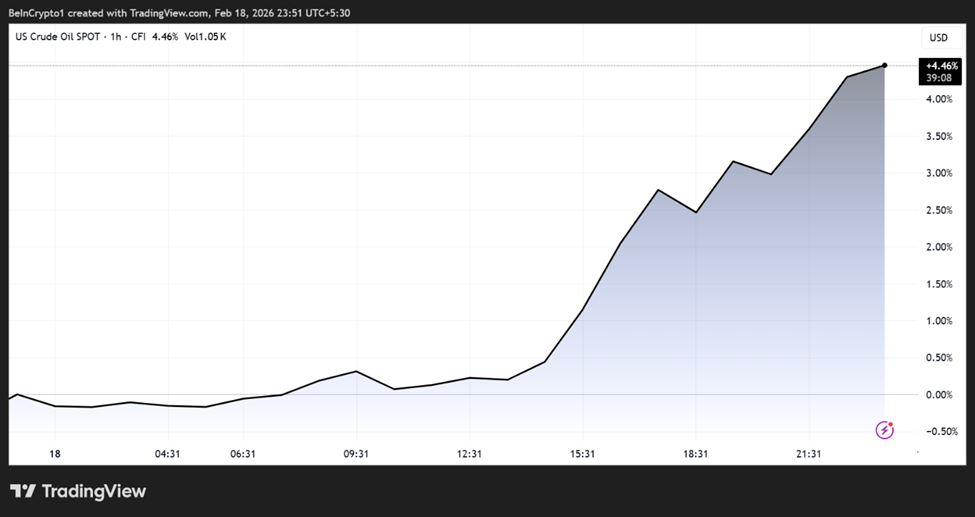
Global markets are reacting sharply to rising geopolitical tensions in the Middle East, as reports suggest the US could be moving closer to a direct military confrontation with Iran.
Safe-haven assets such as gold and silver are climbing, oil prices are rising on supply fears, and Bitcoin is slipping as traders rotate away from risk-sensitive assets.
Iran Military Buildup Fuels Market Anxiety
Recent intelligence and media reports indicate that any potential conflict would not be a limited strike. Rather, it would be a broader, weeks-long campaign if launched, raising concerns about prolonged volatility across commodities, equities, and crypto.
Sponsored
Sponsored
According to Axios analysis, evidence is mounting that a conflict could be imminent, with Israel reportedly preparing for a scenario of “war within days,” which could involve a “weeks-long ‘full-fledged’ war” and a joint US–Israeli campaign broader in scope than previous operations.
The same report noted that US forces in the region now include “2 aircraft carriers, 12 warships, hundreds of fighter jets, and multiple air defense systems.” This is in addition to more than 150 cargo flights transporting weapons and ammunition.
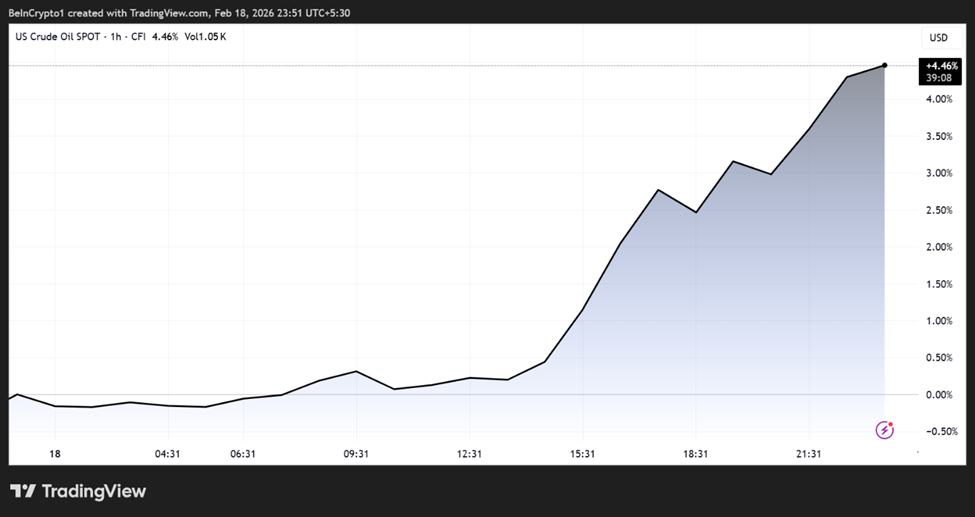
Oil prices reportedly surged above $64 per barrel following the news.
Separate commentary similarly described the US as being on the brink of a large-scale conflict, with stalled nuclear negotiations and a growing military presence increasing the risk of imminent action.
The assessment suggested that strikes could come within weeks if diplomacy collapses, with Donald Trump’s advisers continuing talks but failing to close key gaps.
Sponsored
Sponsored
Commodity markets have been the most immediate beneficiaries of the rising geopolitical risk premium.
Analysts tracking market moves reported that gold, silver, and oil all advanced as tensions escalated. Silver posted some of the strongest gains among major assets.
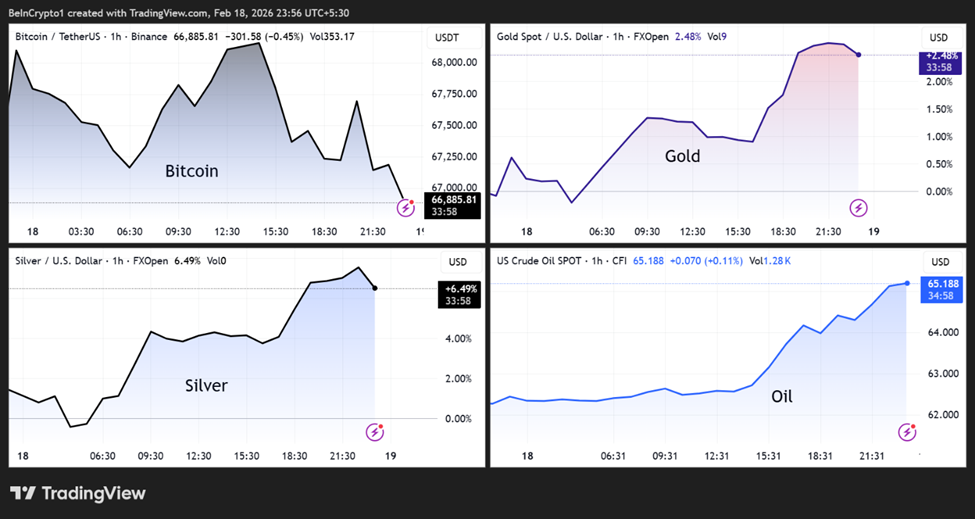
“The precious metals sector has so far been the primary beneficiary of heightened US attack concerns,” commented commodities strategist Ole Hansen, adding that gold is trading above $5,000 while silver and platinum have also recorded significant gains.
Oil markets are also reacting to the possibility of disruptions in the Strait of Hormuz, through which roughly one-fifth of global oil supply moves.
Even the perception of risk to this route tends to trigger sharp price swings, amplifying volatility across energy markets.
Sponsored
Sponsored
Bitcoin Slips as Risk Appetite Weakens
While traditional safe havens rallied, cryptocurrencies moved in the opposite direction. Bitcoin fell below the critical support of $67,014 and was trading for $66,384 as of this writing.
This divergence, where Bitcoin slumps while gold, silver, and oil advance, reflects a broader risk-off shift in investor sentiment.
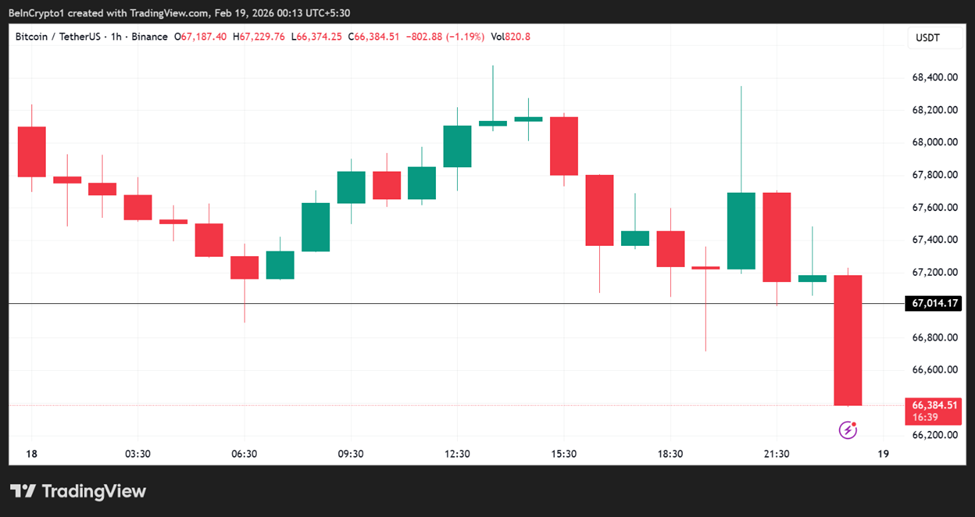
The divergence highlights a recurring pattern in periods of geopolitical stress: capital often flows first into commodities and cash-like instruments before returning to higher-beta assets such as crypto.
Debate Over the Likelihood and Consequences of War
Despite the buildup, some analysts remain skeptical that a full-scale war will materialize. Nigerian tech entrepreneur Mark Essien argued that a prolonged conflict would be far more complex than previous campaigns.
Sponsored
Sponsored
Based on this, Essien warns that Iran’s drone capabilities and potential insurgency could make the situation difficult to resolve quickly. Meanwhile, domestic opposition in the US is also visible.
“Americans do not want to go to war with Iran!!! They want to be able to afford their lives and get ahead,” wrote former congresswoman Marjorie Taylor Greene.
At the same time, geopolitical risks may be expanding beyond a bilateral confrontation. Reports cited by defense analysts suggest that China could be providing Iran with intelligence and navigation support, potentially complicating the regional strategic balance.
With peace talks continuing but showing little sign of a breakthrough, markets are preparing for prolonged uncertainty. Traders are increasingly pricing in the possibility that any military action would be larger, longer, and more disruptive than recent conflicts.
It explains why commodities are reflecting fear, cryptos are reflecting caution, and global investors are watching diplomatic developments closely.
Whether diplomacy prevails or tensions escalate further may determine the direction of oil and gold, as well as the next major trend across global financial markets.


DerivaDEX has launched a Bermuda-licensed crypto derivatives platform, becoming what it says is the first DAO-governed decentralized exchange to operate under formal regulatory approval.
According to a statement from the platform, the exchange received a T license from the Bermuda Monetary Authority and has begun offering crypto perpetual swaps trading to a limited number of advanced retail and institutional participants.
The BMA’s T, or test license, is issued for a digital asset business seeking to test a proof of concept.
At launch, DerivaDEX supports major crypto perpetual products and said it plans to expand into additional markets, including prediction markets and traditional securities. The company said the platform combines offchain order matching with onchain settlement to Ethereum, while allowing users to retain noncustodial control of funds.
DerivaDEX also said the platform, developed by DEXLabs, uses encrypted order handling and trusted execution environments, which are intended to mitigate front-running and other forms of market manipulation.
A decentralized autonomous organization, or DAO, is a blockchain-based governance structure in which token holders collectively vote on decisions according to rules encoded in smart contracts rather than relying on a traditional management hierarchy.
Related: Fed paper proposes initial margin weights for crypto-linked derivatives
Traditional asset managers move into DeFi infrastructure
DerivaDEX’s launch comes as traditional asset managers are increasingly engaging with decentralized finance infrastructure on public blockchains.
On Feb. 11, BlackRock made its tokenized US Treasury product, the USD Institutional Digital Liquidity Fund (BUIDL), available on the decentralized exchange Uniswap. The move allows institutional investors to trade the tokenized fund onchain, and included BlackRock purchasing an undisclosed amount of Uniswap’s governance token, UNI.
A few days later, Apollo Global Management agreed to acquire up to 90 million governance tokens of decentralized finance protocol Morpho over four years, representing 9% of the token’s 1 billion total supply. The $940 billion asset manager said the agreement includes supporting Morpho’s decentralized lending infrastructure.
These developments come as US lawmakers continue debating provisions in the Digital Asset Market Clarity Act, legislation aimed at defining how cryptocurrencies and decentralized finance platforms would be regulated.
While the major sticking point remains around stablecoin yield, in January, crypto venture firms Paradigm and Variant warned that current draft legislation left uncertainty over whether DeFi developers and infrastructure providers could face registration, Know Your Customer requirements or other compliance obligations designed for centralized intermediaries.
Magazine: Is China hoarding gold so yuan becomes global reserve instead of USD?
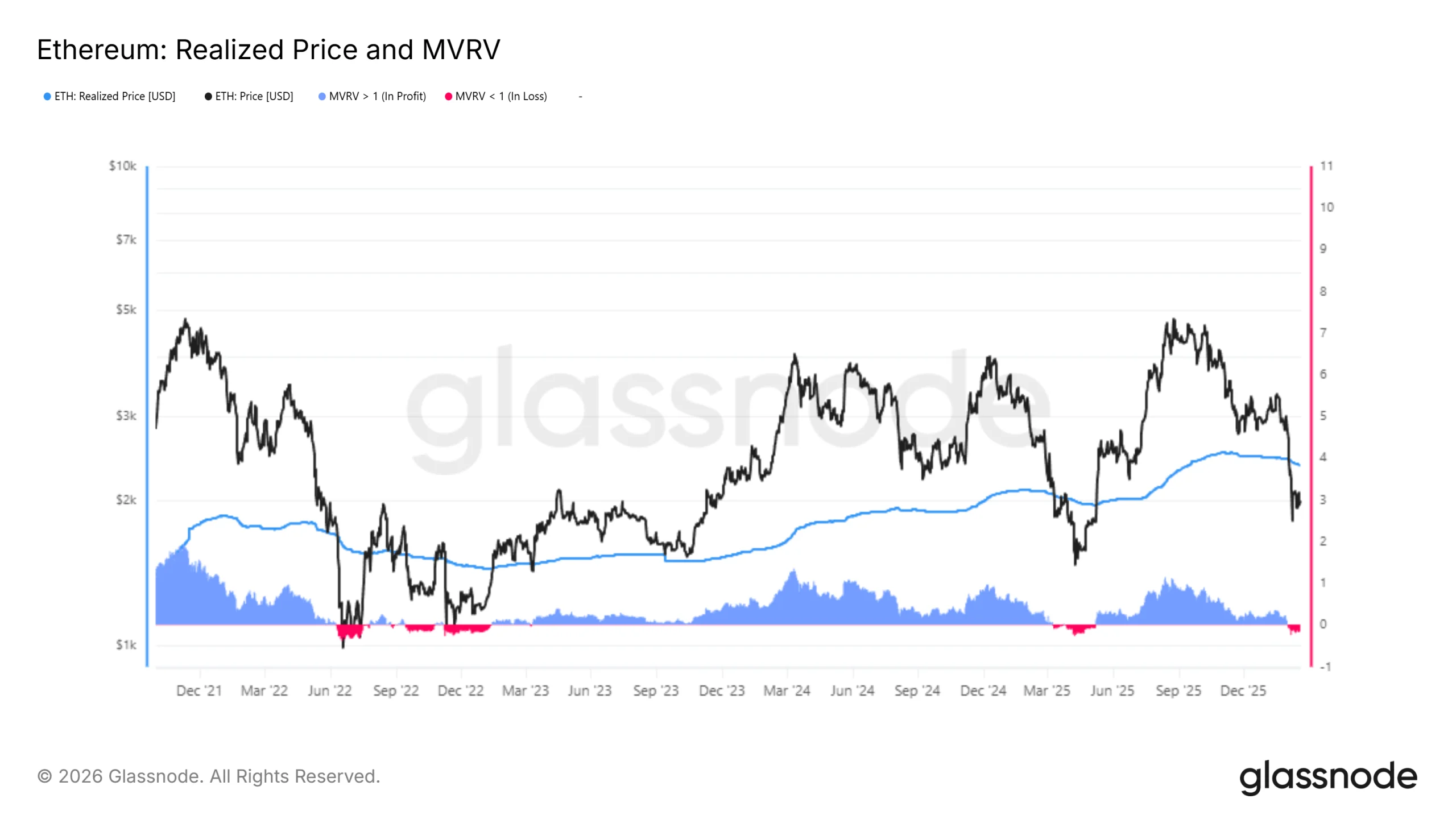
Ethereum has extended its recent decline, slipping toward the $2,000 level. At first glance, the pullback appears to be stabilizing. However, on-chain data suggests the weakness may not be over.
While ETH is hovering near a key level, underlying metrics reveal persistent stress; there is a chance that this cycle mirrors prior downturn patterns.
Sponsored
Sponsored
Ethereum Can Repeat History
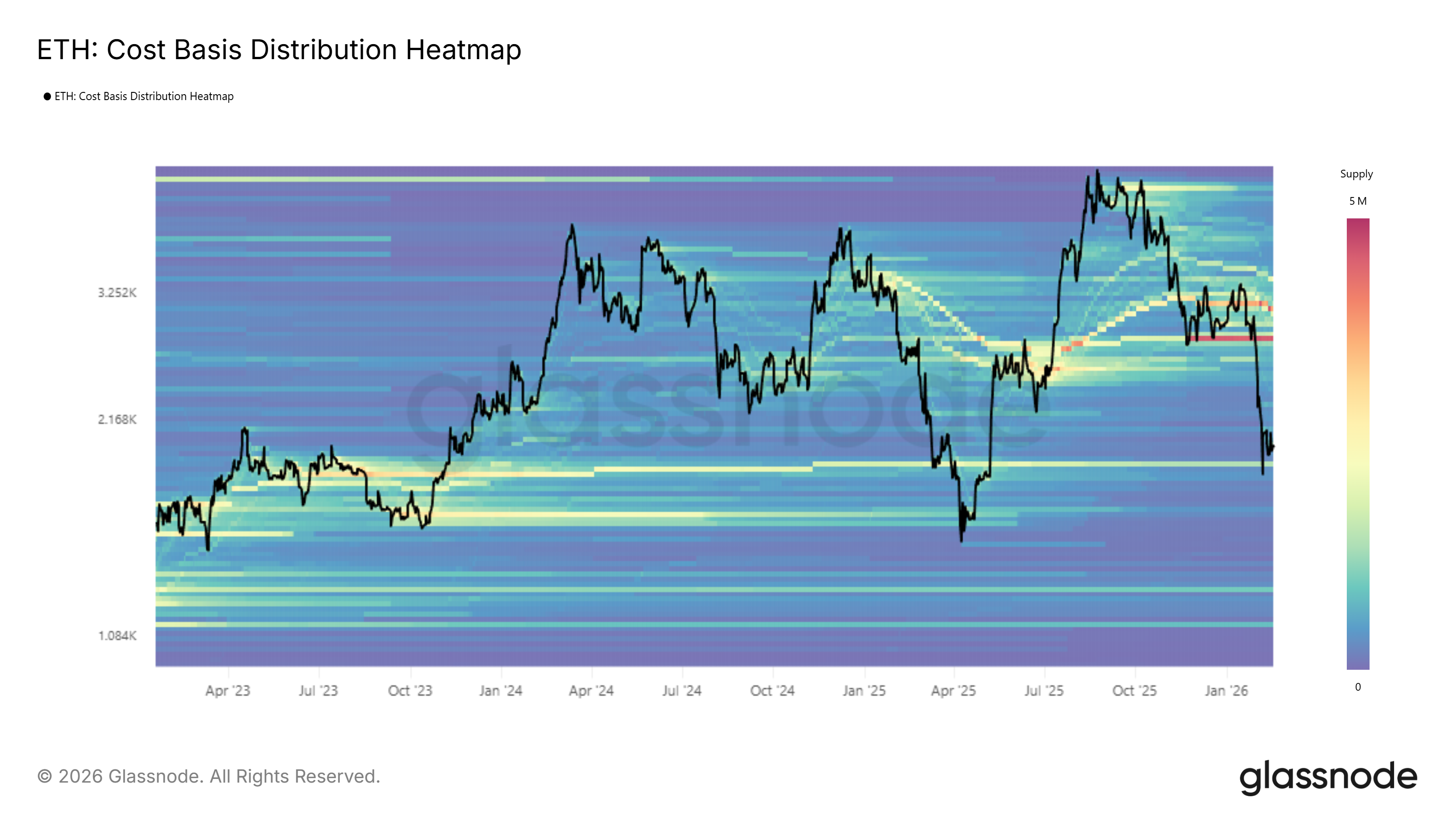
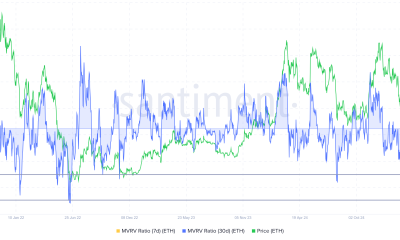
Ethereum fell below its Realized Price toward the end of January. Since then, ETH has remained trapped under this crucial on-chain benchmark. The Realized Price reflects the average acquisition cost of all coins in circulation. Trading below it often signals widespread unrealized losses.
The Market Value to Realized Value, or MVRV, ratio confirms this pressure. ETH’s MVRV has remained below 1.0, indicating that the average holder is at a loss. Extended periods in this zone historically coincide with deep market corrections.
Want more token insights like this? Sign up for Editor Harsh Notariya’s Daily Crypto Newsletter here.
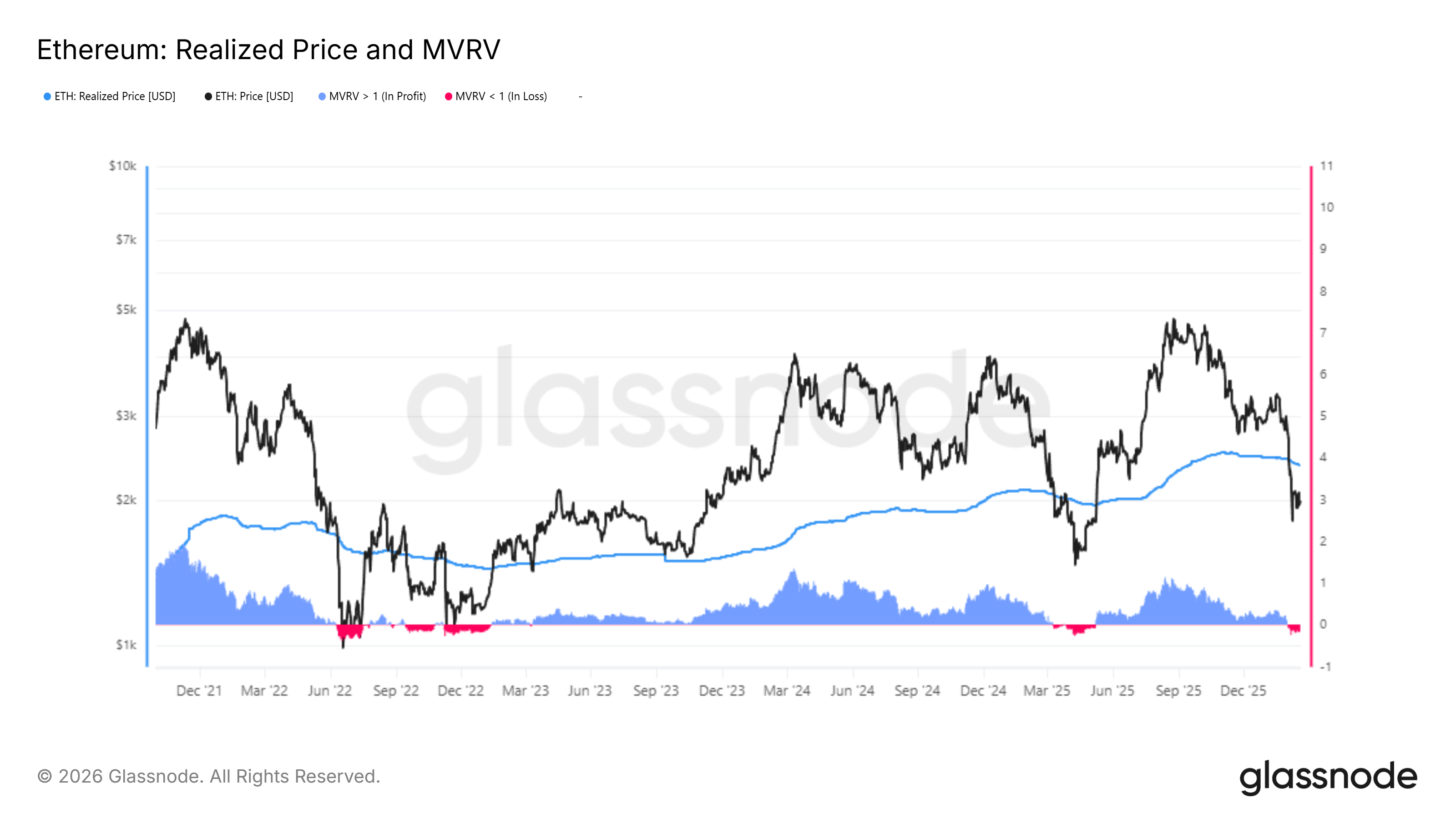
Past cycles show that recovery eventually follows prolonged sub-Realized Price trading. However, such recoveries often occur after capitulation phases. In prior bear markets, ETH experienced additional downside before forming durable bottoms. Current conditions suggest that further decline could precede stabilization.
ETH Selling Is Active
Exchange On-Balance data reveals an increasing supply moving onto trading platforms. Over the past week, approximately 445,000 ETH entered exchanges. At current prices, this represents more than $887 million in potential sell pressure.
Sponsored
Sponsored
Rising exchange balances typically indicate distribution. ETH Investors often transfer assets to exchanges with the intention of selling. The scale of recent inflows suggests heightened caution among holders.
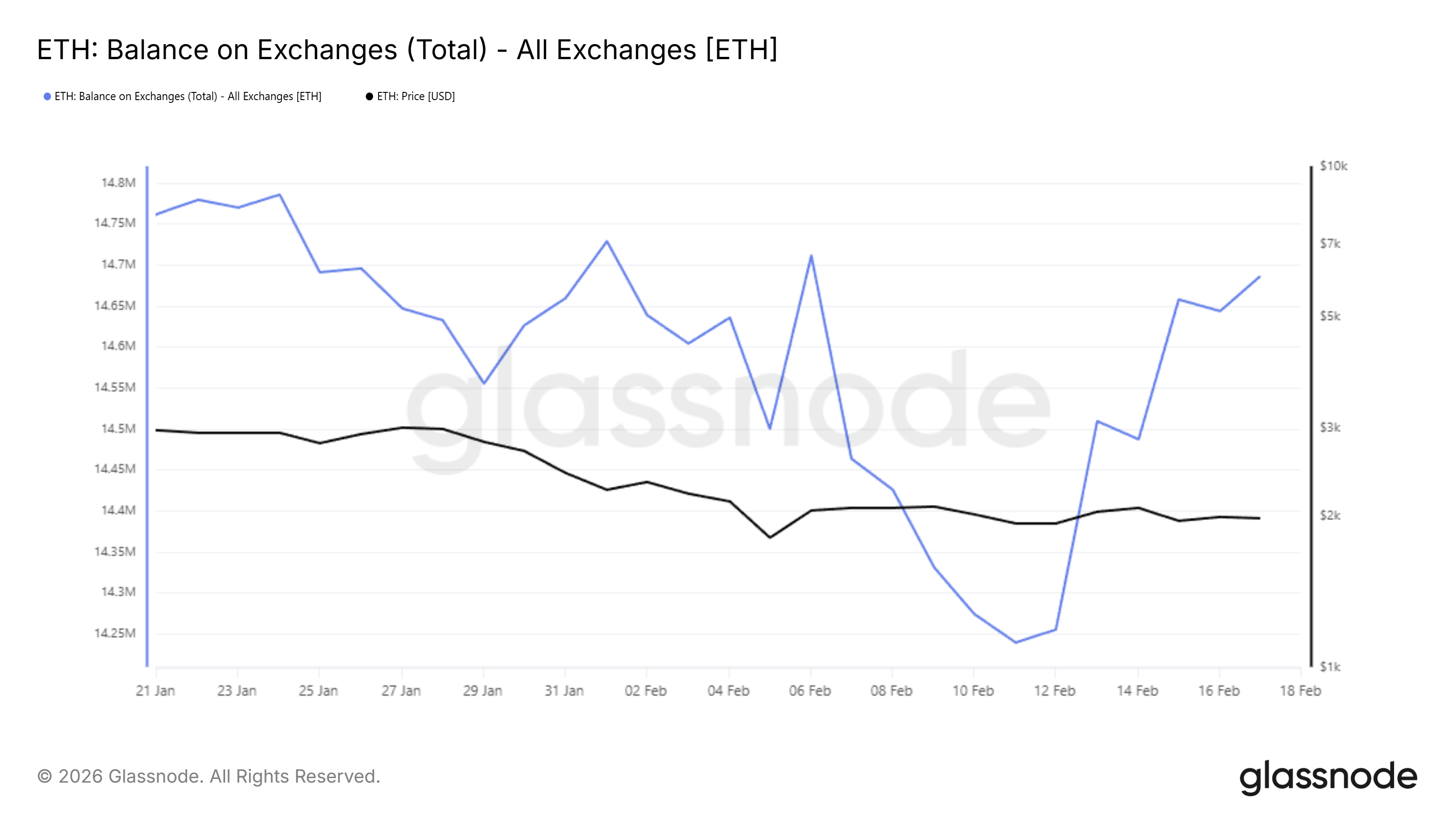
If the price fails to rebound quickly, panic selling could intensify. Similar spikes in exchange deposits have historically preceded sharp drawdowns. The combination of unrealized losses and rising supply increases downside vulnerability.
ETH Price May Witness Further Decline
Ethereum is trading at $1,997 at the time of writing. The $2,000 level represents a critical psychological threshold. While this zone may attract short-term buying, persistent selling pressure reduces the probability of a sustained bounce. The $1,866 level represents the next notable support based on the CBD Heatmap.
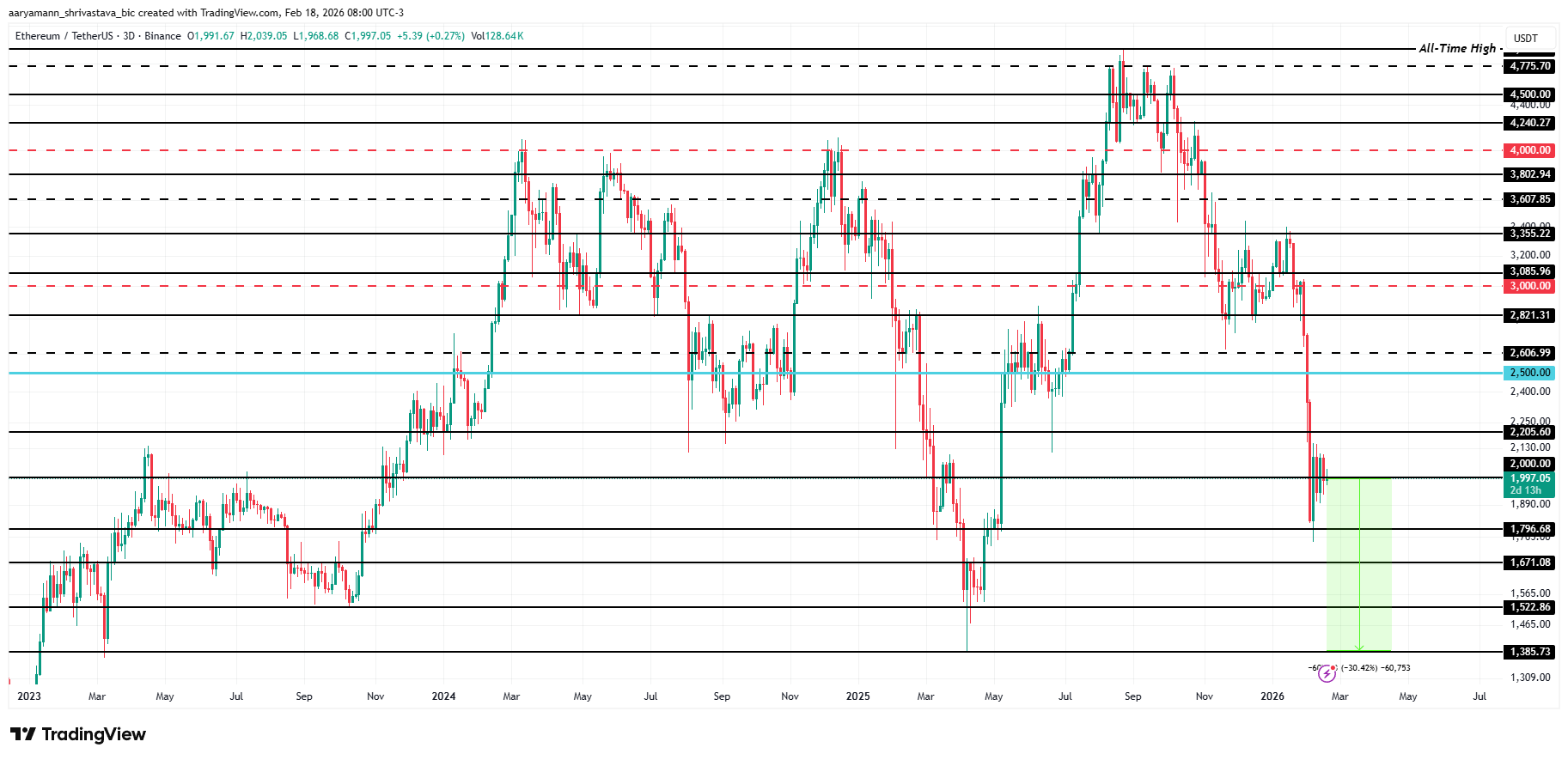
This zone reflects prior accumulation activity. If ETH loses $1,866, downside risk expands toward $1,385. This level has served as a structural bottom during previous cycles. A drop to $1,385 would represent roughly a 30% decline from current levels. The next major support beyond that sits near $1,231.
Conversely, a change in investor behavior could alter the trajectory. If holders reduce exchange deposits and accumulation resumes, ETH could stabilize above $2,000. A rebound may target $2,205 in the short term. Sustained buying pressure could extend gains toward $2,500, invalidating the current bearish outlook.


Crypto funds shifted to market-neutral trades as volatility punished directional bets and triggered a fourth straight month of losses.
Crypto funds opened 2026 with losses and defensive positioning, according to a February 18 survey by Presto Research and Otos Data.
The report shows investors shifting toward relative-value and market-neutral trades as macro uncertainty and price swings weigh on directional bets.
Market-Neutral Funds Outperform as Directional Strategies Sink
According to Presto’s survey, all liquid crypto hedge funds dipped by an average of 1.49% last month. The losses extended a difficult stretch for active managers, marking the fourth consecutive month of negative equally weighted performance across both fundamental and quantitative categories, a sequence not seen since late 2018 and early 2019.
The dispersion within the numbers tells a clearer story, with fundamental funds dropping 3.01% in January, while quantitative funds fell 3.51%. On the other hand, Presto revealed that market-neutral funds, which aim to profit from price differences rather than market direction, gained about 1.6%. Over six months, those same neutral strategies are up nearly 5% while fundamental funds are down more than 24%.
During that same period, Bitcoin (BTC) has fallen approximately 31%, Ethereum (ETH) 23%, and Solana (SOL) 47%.
Analysis by other market watchers supports the fragile tone, with data from Alphractal showing that Bitcoin was trading in a stress zone where weaker holders tend to sell while long-term investors accumulate. The firm’s founder, Joao Wedson, said long-term holder profit levels are still positive, a sign the market may not yet be at a final turning point.
Positioning Data Points to Defensive Posture, Not Panic
The Presto survey’s flow analysis shows a clear behavioral arc through January. The month opened with constructive positioning and call buying, but as rallies failed, traders rotated into tactical fade structures. By the third week, downside hedging became dominant, as ETF flows fluctuated, with periods of inflow offset by miner distribution and whale selling. Meanwhile, corporate accumulation remained present but insufficient to offset broader risk reduction.
You may also like:
Importantly, the report noted that positioning into the month-end was not outright capitulative. The analysts stated that while protection was in place, the leverage looked more orderly compared to the chaotic reset event in October 2025.
The absence of broad panic suggests that stress is building in pockets rather than being expressed as systemic liquidation. This distinction matters as the market assesses whether January represents continuation or exhaustion.
The researchers advised that until policy clarity improves or a structural crypto-specific catalyst emerges, rallies are likely to fade, volatility will stay reactive to headline risk, and adaptability rather than conviction will determine survival in the first quarter of 2026.
Whether January marked a continuation of the bear trend or the exhaustion phase of selling pressure remains an open question. However, at present, the data indicate that strategies that prioritize relative value over directional conviction are successfully navigating the current challenges.
SECRET PARTNERSHIP BONUS for CryptoPotato readers: Use this link to register and unlock $1,500 in exclusive BingX Exchange rewards (limited time offer).
Crypto World
Ethereum Protocol Restructures Into Three Tracks to Drive Scaling and Security Goals in 2026

TLDR:
- Ethereum shipped Pectra and Fusaka in 2025, doubling blob throughput and enabling validator data sampling via PeerDAS.
- The new Scale track merges L1 and blob scaling efforts, targeting gas limits beyond 100M under unified leadership.
- The Improve UX track advances native account abstraction and cross-L2 interoperability as top priorities for 2026.
- The new Harden the L1 track addresses post-quantum security, censorship resistance, and network testing infrastructure.
Ethereum Protocol has announced a major structural shift heading into 2026. The Ethereum Foundation’s Protocol team has reorganized its work into three core tracks: Scale, Improve UX, and Harden the L1.
This follows a productive 2025 that saw two major network upgrades shipped. The restructuring reflects a more mature approach to developing Ethereum’s infrastructure. It also sets a clear roadmap for the year ahead, covering scaling, usability, and network security.
Ethereum Protocol Reflects on a Productive 2025
Ethereum Protocol shipped two major upgrades in 2025: Pectra in May and Fusaka in December. Pectra introduced EIP-7702, allowing externally owned accounts to temporarily execute smart contract code.
This enabled transaction batching, gas sponsorship, and social recovery for users. Pectra also doubled blob throughput and raised the max effective validator balance to 2,048 ETH.
Fusaka brought PeerDAS to mainnet, changing how validators handle blob data. Instead of downloading full blob data, validators now sample it, cutting bandwidth requirements.
This change enabled an 8x increase in theoretical blob capacity. Two additional Blob Parameter Only forks shipped alongside Fusaka to begin ramping up blobs per block.
Beyond the two forks, the mainnet gas limit rose from 30M to 60M during 2025. This marked the first meaningful gas limit increase since 2021.
History expiry also removed pre-Merge data from full nodes, saving hundreds of gigabytes of disk space. On the UX side, the Open Intents Framework reached production and cross-chain address standards moved forward.
These milestones made 2025 one of the most active years at the Ethereum protocol level. With those deliverables behind it, the team saw an opportunity to restructure.
The new track model moves away from milestone-driven initiatives. It instead organizes work around longer-term goals.
Three Tracks Now Guide Ethereum Protocol’s Direction
The Scale track merges what were previously two separate efforts: Scale L1 and Scale Blobs. Led by Ansgar Dietrichs, Marius van der Wijden, and Raúl Kripalani, it targets gas limits beyond 100M.
The track also covers ePBS, zkEVM attester client development, and statelessness research. Blob scaling and execution scaling are treated as one connected effort.
The Improve UX track, led by Barnabé Monnot and Matt Garnett, focuses on account abstraction and interoperability. EIP-7701 and EIP-8141 are pushing smart account logic directly into the protocol.
Work here also connects to post-quantum readiness, since native account abstraction offers a natural path away from ECDSA. Cross-L2 interactions and faster confirmations remain central priorities.
The Harden the L1 track is entirely new and is led by Fredrik Svantes, Parithosh Jayanthi, and Thomas Thiery. Fredrik leads the Trillion Dollar Security Initiative, covering post-quantum hardening and trustless RPCs.
Thomas focuses on censorship resistance research, including FOCIL (EIP-7805) and measurable resistance metrics. Parithosh oversees devnets, testnets, and client interoperability testing infrastructure.
Glamsterdam is the next planned network upgrade, targeting the first half of 2026. Hegotá is expected to follow later in the year.
Pi Network Coin’s price is surging this month, even as the broader crypto market remains muted, with Bitcoin stuck at $67,000.
Summary
- Pi Network Coin price has rebounded by nearly 50% from its lowest level this month.
- The network will celebrate the first year anniversary of the mainnet launch on Friday.
- There are rising odds that it will be listed by Kraken, a top US exchange.
Pi Coin (PI) token jumped to a high of $0.20 on Wednesday, February 18, up by nearly 50% from its lowest level this month. This rally has brought its market capitalization to over $1.68 billion.
Pi Network is soaring as several important factors converge. First, the network will celebrate the first anniversary of its mainnet launch this Friday. As such, there is a likelihood the developers will make a major announcement to mark this occasion.
Second, there is a likelihood that Kraken, an American crypto exchange valued at over $20 billion, will list it later this year. Kraken added it to the chain section of the listing roadmap page.
A Kraken listing would be a big deal, as it would expose it to American investors, since it is now listed on exchanges like OKX, MEXC, and Gate, which have a negligible market share in the country. It would also raise the possibility of being listed by other companies, such as Binance and Coinbase.
Pi Coin’s price is soaring ahead of the first validator rewards distribution, which will occur in March this year. The risk, however, is that many of these validators may decide to sell their rewards.
Pi is also rising after developers began implementing a major network upgrade, as it transitions from Protocol 19 of the Stellar Network Consensus to Protocol 23. The first stage of the upgrade started on Sunday, and the process may continue in the coming weeks.
Meanwhile, data compiled by PiScan shows that the pace of token unlocks will continue to fall over the next few months. 109 million tokens will be unlocked in the remainder of February, followed by 104 million in March, 86 million in April, and 78 million in May.
Pi Network Coin price technical analysis
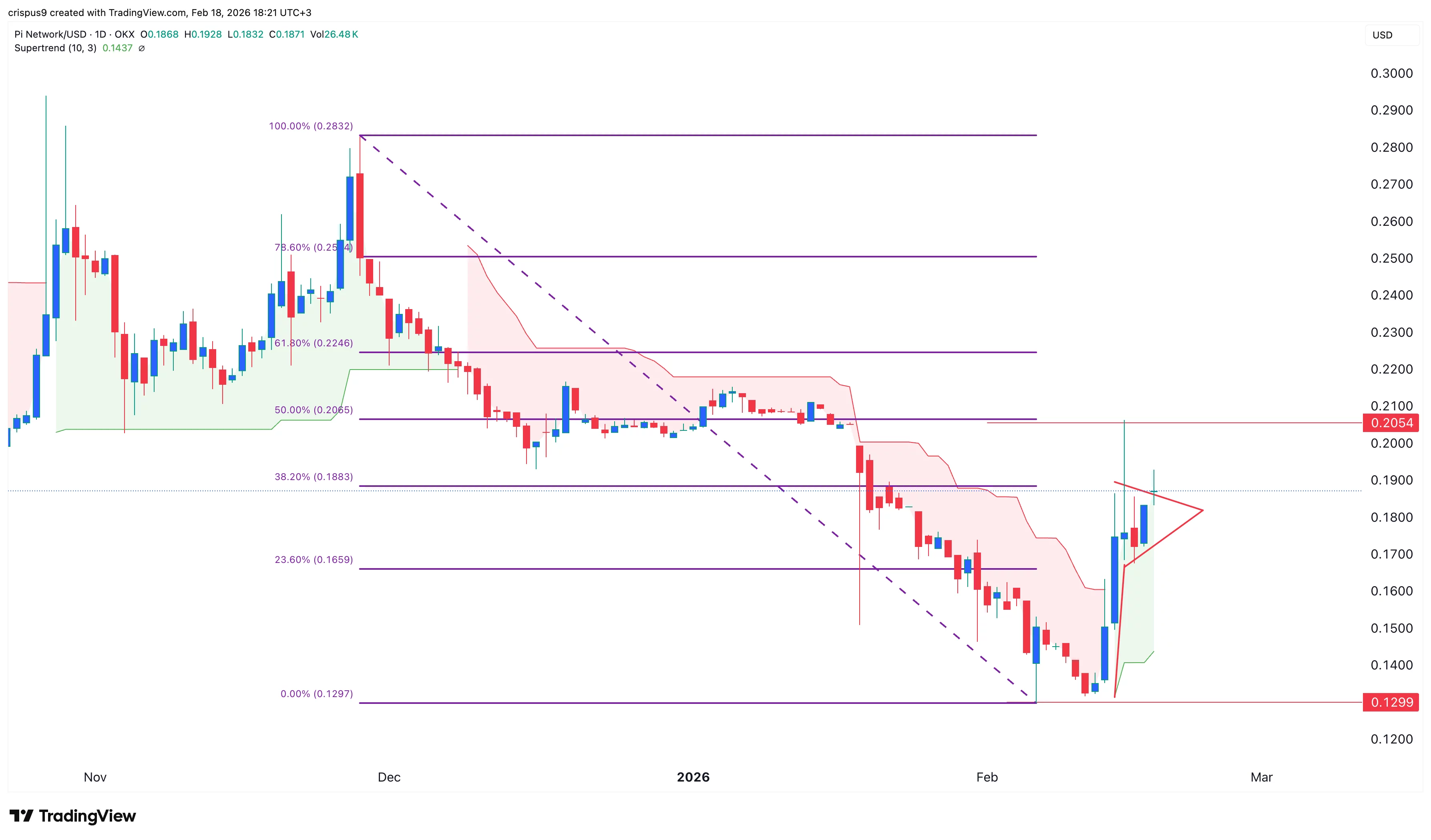
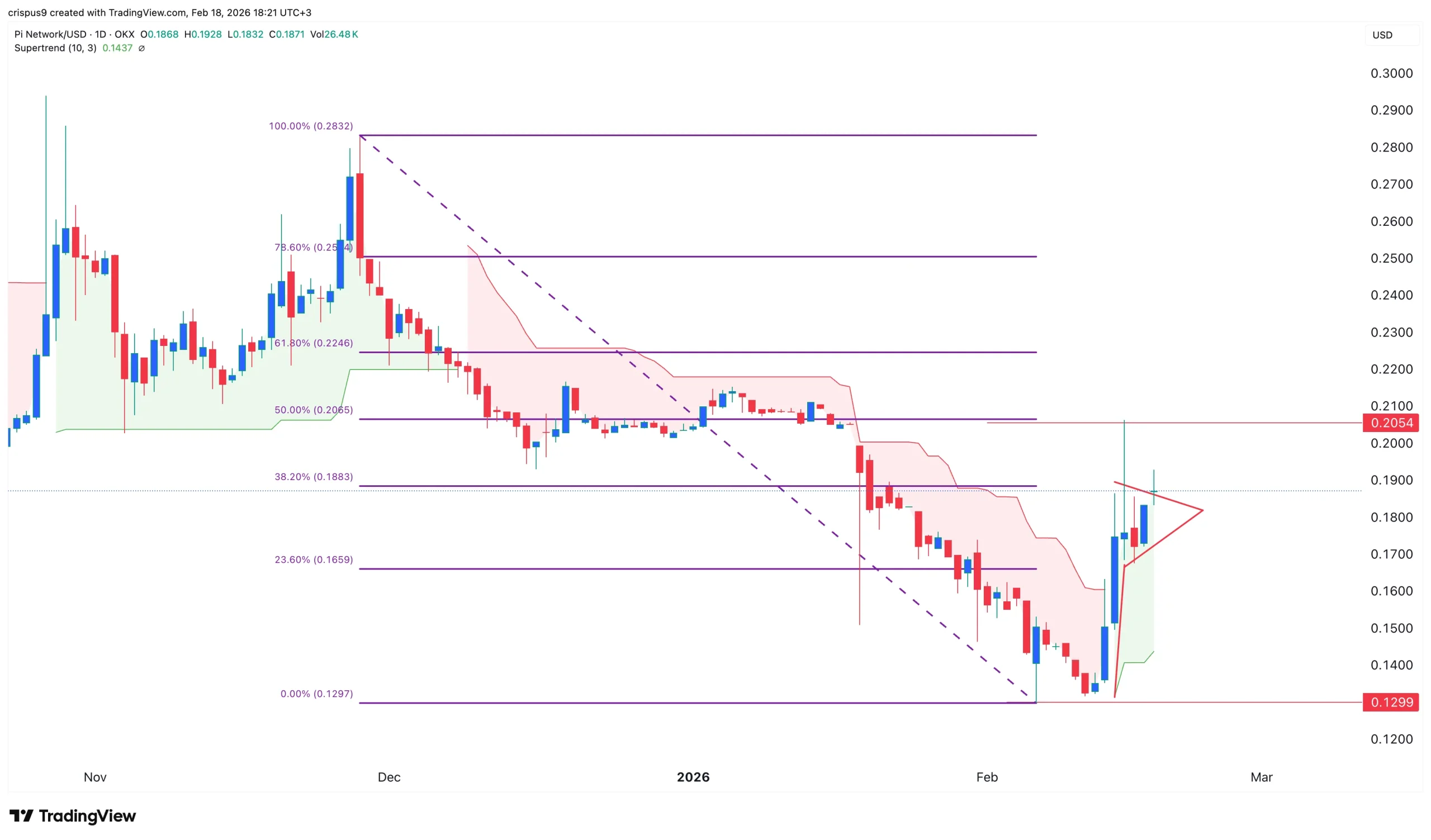
The 12-hour chart shows that the Pi Network Coin price has rebounded in the past few weeks, moving from a low of $0.1300 to the current $0.1870. It has flipped the Supertrend indicator from red to green for the first time since October last year.
The coin has also jumped above the 50-period and 100-period moving averages, and is slowly forming a bullish pennant pattern. It is also hovering at the 38.2% Fibonacci Retracement level.
Therefore, the coin may continue rising as bulls target the next key resistance level at $0.2055, its lowest level this month. This target aligns with the 50% Fibonacci Retracement level.


The Digital Chamber has officially announced the Prediction Markets Working Group, a strategic unit designed to secure federal oversight for the booming wagering sector.
With individual state regulators cracking down on prediction market platforms, the group is pushing for the Commodity Futures Trading Commission (CFTC) to take exclusive control to end the fragmentation of the market.
Key Takeaways
- New Defense Unit: The Digital Chamber forms a specialized group to defend prediction markets against state-level bans.
- Primary Goal: Advocating for CFTC supremacy over fragmented state gaming commission enforcement.
- First Move: Strategic letter sent to CFTC Chair Mike Selig urging tailored federal rulemaking over litigation.
What’s Happening to U.S. Prediction Markets Now?
The regulatory turf war has reached a boiling point. While volumes on decentralized platforms explode, state regulators are effectively trying to shut the sector down.
Just recently, the Nevada Gaming Control Board hit Kalshi with a civil enforcement action, seeking an injunction against what they term “unlicensed wagering.”
This creates a hostile environment for traders. Platforms are caught between federal compliance efforts and aggressive state gaming commissions claiming jurisdiction.
The Digital Chamber’s move is a direct response to this chaos, aiming to consolidate oversight under federal law rather than state gambling statutes.
The Mechanics of the Push
The group’s immediate strategy involves aggressive advocacy and litigation support. In the announcement released Tuesday, the Digital Chamber outlined plans to file “friend-of-the-court” briefs to educate judges on the CFTC’s historic regulatory exclusivity.
Their first official action was sending a letter to CFTC Chairman Mike Selig. The group praised Selig’s stance on maintaining federal jurisdiction but demanded an end to regulation by enforcement.
“For too long, operators in this space have navigated a maze of regulatory ambiguity, including unclear overlaps between federal and state regulators,” the group stated.
This initiative parallels broader legislative efforts. While Trump wants a market structure bill soon, this working group seeks to define prediction markets strictly as financial derivatives, not gambling products.
Discover: The hottest meme coins on Solana right now.
What Happens Next for Traders?
If the working group succeeds in establishing federal oversight, it opens the floodgates for institutional capital.
A clear mandate from the CFTC would remove the “gambling” stigma and allow US-based traders deeper access to liquid markets without fear of sudden platform geo-blocking.
However, the legal battles will likely drag on. While international jurisdictions move quickly, evident as Germany and the EU solidify frameworks like MiCA, the US remains stuck in litigation.
The next thing to look out for will be the CFTC’s response to the Digital Chamber’s letter.
Any signal of formal rulemaking could be a bullish catalyst for governance tokens associated with prediction platforms.
Discover: The next crypto to explode.
The post Crypto Lobby Forms Working Group to Push for Prediction Market Regulatory Clarity appeared first on Cryptonews.

Divided Federal Reserve officials at their January meeting indicated that further interest rate cuts should be paused for now and could resume later in the year only if inflation cooperates.
While the decision to hold the central bank’s benchmark rate steady mostly was met with approval, the path ahead appeared less certain, with members conflicted between fighting inflation and supporting the labor market, according to minutes released Wednesday from the Jan. 27-28 Federal Open Market Committee meeting.
“In considering the outlook for monetary policy, several participants commented that further downward adjustments to the target range for the federal funds rate would likely be appropriate if inflation were to decline in line with their expectations,” the meeting summary said.
However, meeting participants disagreed on where policy should head, with officials debating over whether the focus should be more on fighting inflation or supporting the labor market.
“Some participants commented that it would likely be appropriate to hold the policy rate steady for some time as the Committee carefully assesses incoming data, and a number of these participants judged that additional policy easing may not be warranted until there was clear indication that the progress of disinflation was firmly back on track,” the minutes said.
Moreover, some even entertained the notion that rate hikes could be on the table and wanted the post-meeting statement to more closely reflect “a two-sided description of the Committee’s future interest rate decisions.”
Such a description would have reflected “the possibility that upward adjustments to the target range for the federal funds rate could be appropriate if inflation remains at above-target levels.”
The Fed reduced its benchmark borrowing rate by three-quarters of a percentage point in consecutive cuts in September, October and December. Those moves put the key rate in a range between 3.5%-3.75%.
The meeting was the first for a new voting cast of regional presidents, at least two of whom, Lorie Logan of Dallas and Beth Hammack of Cleveland, have publicly said they think they Fed should be on hold indefinitely. Both have said they see inflation as a continuing threat and should be the focus of policy now. All 19 governors and regional presidents participate at the meeting, but only 12 vote.
With the Fed already split along ideological lines, the fissure could grow deeper if former Governor Kevin Warsh is confirmed as the next central bank chair. Warsh has spoken in favor of lower rates, a position also supported by current Governors Stephen Miran and Christopher Waller. Both Waller and Miran voted against the January decision, preferring instead another quarter-point cut. Current Chair Jerome Powell‘s term ends in May.
The meeting minutes do not identify individual participants and featured an array of characterizations to describe positions, rotating between “some,” “a few,” “many” and even featured two rare references to “a vast majority.”
Participants generally expected inflation to come down through the year, “though the pace and timing of this decline remained uncertain.” They noted the impact tariffs were having on prices and said they expected the impact to wane as the year goes by.
“Most participants, however, cautioned that progress toward the Committee’s 2 percent objective might be slower and more uneven than generally expected and judged that the risk of inflation running persistently above the Committee’s objective was meaningful,” the document said.
At the meeting, the rate-setting FOMC adjusted some of the language in its post-meeting statement. The changes noted that the risks to inflation and the labor market had come more closely into balance, softening prior worries over the employment picture.
Since the meeting, labor data has been a mixed bag, with indications that private sector job creation is slowing further and that the meager growth is coming almost entirely from the health-care sector. However, the unemployment rate dipped to 4.3% in January and nonfarm payroll growth was stronger than expected.
On inflation, the Fed’s key personal consumption expenditures prices metric has been mired around 3%. However, a report last week showed that the consumer price index when excluding food and energy prices was at its lowest in nearly five years.
Futures traders are placing the best bet for the next cut to come in June, with another in September or October, according to the CME Group’s FedWatch gauge.

- XRP has held strong near $1.40 despite mixed market signals.
- Key resistance levels to watch are $1.50, $1.54, and $1.91.
- Arizona has proposed to include XRP in a state-managed crypto reserve fund.
XRP cryptocurrency has held steady above $1.40, showing resilience despite a broadly cautious market.
Recent developments in US policy have added a fresh layer of optimism for XRP enthusiasts.
Arizona advances bill to include XRP in state reserve
Arizona lawmakers are moving forward with legislation that could formally include XRP in a state-managed digital assets fund.
The proposal seeks to create a strategic reserve for digital currencies obtained through seizures or confiscations.
XRP, alongside Bitcoin (BTC), is explicitly listed as an eligible asset.
🚨BREAKING: ARIZONA ADVANCES BILL TO ADD XRP TO OFFICIAL STATE DIGITAL ASSET RESERVE 🇺🇸🔥
Arizona’s Digital Assets Strategic Reserve Fund bill (SB1649) just CLEARED the Senate Finance Committee in a 4–2 vote — and it explicitly includes $XRP in the RESERVE. 👀
The bill now… pic.twitter.com/2x8uVH6LXD
— Diana (@InvestWithD) February 17, 2026
The bill recently passed a key Senate committee in a 4-2 vote, marking a significant step forward.
If enacted, the fund would be managed by the state treasurer with strict custodial oversight.
This move would make Arizona one of the first US states to formally reference XRP in a government financial framework.
For XRP holders, this development is largely symbolic.
The state would not be directly purchasing XRP with taxpayer money, but inclusion in the reserve adds credibility.
It reinforces XRP’s reputation as a functional and settlement-oriented digital asset rather than just a speculative token.
Market activity signals caution
XRP’s short-term price action has been mixed.
The coin is supported around $1.40 to $1.44, creating a key floor that traders are watching closely.
Exchange outflows suggest accumulation by larger holders, while smaller whales have added to their balances, hinting at potential upward pressure.
Technical indicators show both bullish and bearish signals.
Momentum oscillators suggest limited buying activity in the short term, but longer-term smart money metrics point to possible gains.
Patterns on the charts indicate that a break below $1.42 could trigger a short-term pullback toward $1.12.
At the same time, if support holds, traders could see upside targets near $1.91 and $2.13.
XRP has been rangebound for the past month, but the combination of policy developments and structural market accumulation could push it higher.
XRP price prediction
Policy developments in Arizona, combined with accumulation patterns and technical support, may give XRP the momentum it needs to challenge its next resistance levels.
Traders should watch the $1.40–$1.44 support zone closely.
A strong hold here could set the stage for a breakout.
The resistance levels to monitor are $1.50 and $1.54 in the near term.
Beyond that, the next targets are $1.67 and $1.91.
These levels align with smart money accumulation and historical trading ranges.
A sustained move above $2.00 could signal a return of broader bullish sentiment.
Overall, XRP’s price is poised in a delicate balance.
Short-term caution is warranted, but medium-term prospects look promising.

Financial Management | Introduction | Financial Decision | Function |BBA | B.Com | MBA | Class 12

Mario Kart World Crushes 14M Milestone

Coin Center Pushes Senate to Preserve Crypto Developer Liability Protections


-

 Sports7 days ago
Big Tech enters cricket ecosystem as ICC partners Google ahead of T20 WC | T20 World Cup 2026
-

 Video2 days ago
Bitcoin: We’re Entering The Most Dangerous Phase
-

 Tech4 days ago
Luxman Enters Its Second Century with the D-100 SACD Player and L-100 Integrated Amplifier
-

 Video5 days ago
The Final Warning: XRP Is Entering The Chaos Zone
-

 Sports2 days ago
GB's semi-final hopes hang by thread after loss to Switzerland
-

 Crypto World1 day ago
Can XRP Price Successfully Register a 33% Breakout Past $2?
-
 Tech2 days ago
The Music Industry Enters Its Less-Is-More Era
-

 Business21 hours ago
Infosys Limited (INFY) Discusses Tech Transitions and the Unique Aspects of the AI Era Transcript
-

 Video1 day ago
Financial Statement Analysis | Complete Chapter Revision in 10 Minutes | Class 12 Board exam 2026
-

 Entertainment8 hours ago
Kunal Nayyar’s Secret Acts Of Kindness Sparks Online Discussion
-
 Crypto World7 days ago
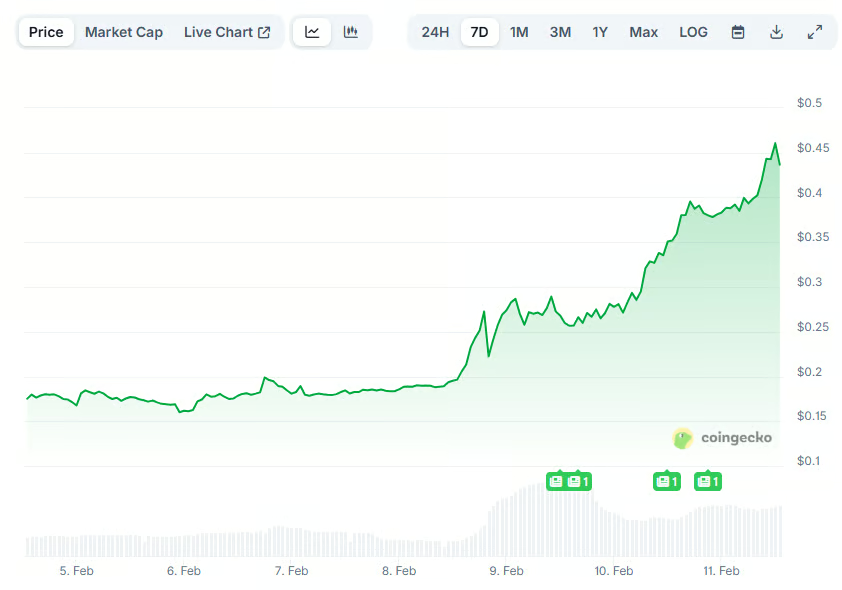
Pippin (PIPPIN) Enters Crypto’s Top 100 Club After Soaring 30% in a Day: More Room for Growth?
-

 Crypto World5 days ago
Bhutan’s Bitcoin sales enter third straight week with $6.7M BTC offload
-

 Tech12 hours ago
Retro Rover: LT6502 Laptop Packs 8-Bit Power On The Go
-
 Video7 days ago
Prepare: We Are Entering Phase 3 Of The Investing Cycle
-
 NewsBeat3 days ago
The strange Cambridgeshire cemetery that forbade church rectors from entering
-

 Business6 days ago
Barbeques Galore Enters Voluntary Administration
-

 Business14 hours ago
Tesla avoids California suspension after ending ‘autopilot’ marketing
-
 Crypto World6 days ago
Ethereum Price Struggles Below $2,000 Despite Entering Buy Zone
-

 Crypto World5 days ago
Kalshi enters $9B sports insurance market with new brokerage deal
-
 NewsBeat3 days ago
Man dies after entering floodwater during police pursuit