
Crypto World
How Americans and Canadians Are Feeling About the Escalating Trade War

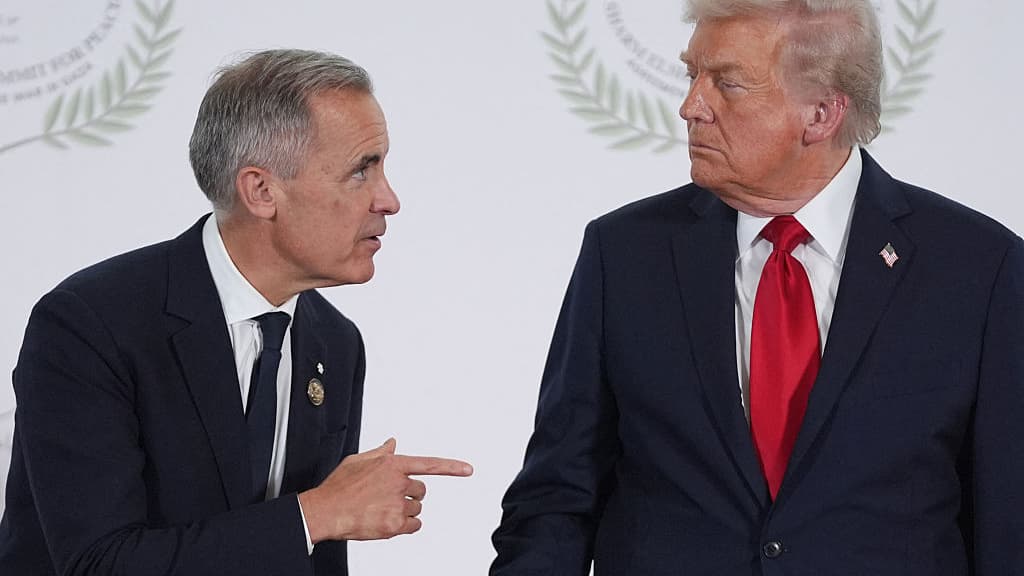
How do Canadians feel about the U.S.-Canada trade war?
The majority of Canadians—63%—said they feel that the country made the right choice to maintain its stance and walk away from trade talks with the U.S., “even if it meant higher costs and job losses,” according to an Ipsos poll conducted for Global News that was released on Aug. 29. Even more Canadians—73%—said they agreed with the nation’s decision to launch retaliatory tariffs on American products worth billions of dollars.
The poll did find, though, that support for those actions was lower among younger demographics than it was among older age groups. For instance, a little less than 50% of Gen Z adults backed Canada’s decision to remain firm in trade negotiations, compared to 80% for elderly boomers.
Another poll, conducted by the Canadian nonprofit Angus Reid Institute, found that about 76% of Canadians believe the country was right to suspend trade talks, and that 69% said they believe that Carney demonstrated “strength” by turning down a “bad deal.” A majority of Canadians—62%—also indicated support for retaliatory tariffs against the U.S., calling the move “about right under the circumstances.”

Coinbase has filed two SEC notice registrations dated Sept. 1 as it works to bring single-stock perpetual contracts to the United States through its regulated derivatives exchange and brokerage.
Summary
- Coinbase Derivatives filed Form 1-N to register as a security futures exchange.
- Coinbase Financial Markets submitted Form BD-N as a limited-purpose security futures broker-dealer.
- The filings do not provide a launch date, a list of supported stocks, or proposed leverage limits.
- Single-stock futures fall under the joint oversight of the SEC and CFTC.
Coinbase said in a Sep. 3 post on X that it is working to offer single-stock perpetual contracts in the United States after submitting SEC notice registrations for two of its regulated derivatives businesses.
“We’re working to bring single stock perps to the US,” the company said.
The attached documents show that Coinbase Derivatives, LLC filed Form 1-N, while Coinbase Financial Markets, Inc. submitted Form BD-N. Both notices carry a Sept. 1 filing date.
According to the company, it plans to work with the Securities and Exchange Commission and the Commodity Futures Trading Commission as it brings more financial products into the U.S. market. Coinbase did not announce when trading could start or identify which listed companies could serve as the underlying assets.
Coinbase filings establish a dual SEC-CFTC route
Under SEC rules, Form 1-N allows an exchange regulated by the CFTC to register with the SEC for the sole purpose of trading security futures products. Coinbase Derivatives has operated as a CFTC-designated contract market since 2020, according to the company’s regulatory disclosures.
The SEC’s Form 1-N instructions state that the notice supplies the agency with information about the exchange’s ownership, operations, rules, trading systems and disciplinary procedures. Filing the document does not turn Coinbase Derivatives into a general-purpose stock exchange such as Nasdaq or the New York Stock Exchange.
For the brokerage side, SEC Form BD-N allows an eligible CFTC registrant to register as a broker-dealer solely for trading security futures. SEC rules require the applicant to be registered with the CFTC as either a futures commission merchant or an introducing broker and to hold membership in the National Futures Association or another qualifying association.
Coinbase Financial Markets is already registered as a futures commission merchant with the CFTC. Its new notice would support customer access to security futures listed through the affiliated Coinbase Derivatives exchange.
According to the CFTC, futures on individual securities and narrow-based stock indexes are classified as security futures products. Such contracts carry features of both securities and futures, placing them under the joint authority of the SEC and CFTC.
The two filings therefore cover distinct functions: Coinbase Derivatives would provide the market where contracts are listed, while Coinbase Financial Markets would serve as the regulated intermediary for customers. Neither document shown in the announcement contains contract terms nor confirms final clearance for a commercial rollout.
Single-stock perpetuals would extend an existing overseas product
Coinbase launched stock perpetual futures for eligible customers outside the United States in March, according to the company’s International Exchange announcement. U.S. persons were expressly barred from using the service.
The initial international selection provided synthetic exposure to Apple, Microsoft, Alphabet, Amazon, Nvidia, Meta, and Tesla. Coinbase also listed contracts tied to the SPY and QQQ exchange-traded funds, which track the S&P 500 and Nasdaq-100, respectively.
According to Coinbase, the international single-stock contracts traded continuously, including during weekends, and initially offered leverage of up to 10 times. ETF perpetuals provided leverage of up to 20 times, while positions were settled in USDC and could be cross-margined with other spot and perpetual holdings.
Perpetual futures differ from standard futures because they have no fixed expiration date. Coinbase’s international products use a funding mechanism to keep contract prices near the value of their reference assets, allowing traders to maintain leveraged long or short exposure without purchasing the underlying shares.
Terms used outside the United States should not be treated as confirmed specifications for the proposed U.S. products. Coinbase has not said whether its domestic contracts would trade around the clock, settle in USDC, or carry the same leverage limits. The company also has not confirmed whether its first U.S. lineup would match the seven technology stocks offered internationally.
For American traders, the proposed contracts would provide derivatives exposure rather than ownership of the referenced shares. Coinbase’s international product description says stock perpetual holders do not receive shareholder rights associated with the underlying securities, such as voting rights.
Coinbase has expanded regulated derivatives access
The registration notices follow several additions to Coinbase’s derivatives business during 2026. In May, CFTC staff granted Coinbase Financial Markets regulatory relief connected to eligible U.S. institutions accessing certain derivatives listed on Deribit, the offshore platform Coinbase acquired.
In June, crypto.news reported US approval for Coinbase to provide access to global crypto perpetual futures. Chief Executive Brian Armstrong said at the time that years of regulatory work were needed to create a compliant route for U.S. customers into a market that had largely operated overseas.
Coinbase has also moved into additional national markets. On Sept. 2, the company launched 23 futures for eligible Canadian investors, covering perpetual and dated contracts tied to Bitcoin, Ether, Solana and 20 other crypto assets. Supported Canadian products offer leverage of up to 10 times.
Company market data showed Coinbase Derivatives with about $1.75 billion in 24-hour volume as of Sept. 3, compared with approximately $9.7 billion on Coinbase International Exchange. Coinbase’s figures cover each venue’s full derivatives activity and do not isolate trading in stock perpetuals.
Perpetual contracts remain contested in the US
Coinbase’s stock-product plan arrives while U.S. courts and regulators are still considering how some perpetual contracts should be classified. In June, CME Group sued the CFTC over the regulator’s treatment of crypto perpetuals offered through platforms including Coinbase and Kalshi.
According to CME’s complaint, perpetual contracts fit the definition of swaps under the Dodd-Frank Act and should not be regulated as ordinary futures. The exchange operator accused the CFTC of departing from its past approach and bypassing procedures required for swap products.
The CFTC rejected CME’s position and called the case “frivolous,” according to court coverage of the dispute. No final ruling has invalidated the regulator’s existing route for crypto perpetual contracts.
CFTC officials have separately identified leverage, funding-rate volatility, manipulation, and price convergence as possible risks in perpetual markets. In a June 2025 address, then-Acting Chair Caroline Pham said some commenters questioned whether contracts without an expiry could perform the risk-management and price-discovery roles associated with traditional futures.
Stock perpetuals can present additional trading-hour concerns because the contracts may remain active while the exchanges listing their reference shares are closed. Coinbase’s international risk disclosure warns that equity perpetuals involve liquidity, execution and price-volatility risks, particularly outside regular stock-market hours.
The Sept. 1 notices do not state whether the U.S. contracts would operate continuously or pause when the underlying equity markets close. Coinbase also has not disclosed proposed funding calculations, position limits, margin requirements, clearing arrangements or safeguards for periods when fresh stock prices are unavailable.


Paxos-issued USDG has launched natively on Mantle, adding the Ethereum layer-2 network to a stablecoin coalition with more than 150 partners.
Summary
- USDG can now be minted directly on Mantle and used for DeFi liquidity and institutional settlement.
- Mantle has joined the Global Dollar Network and can share in rewards generated by USDG activity.
- USDG had about $3.18 billion in circulation, ranking seventh among stablecoins tracked by DefiLlama.
- Mantle’s distributed RWA value reached $234.2 million after rising 19% over 30 days.
USDG brings native stablecoin issuance to Mantle
Global Dollar Network said in its announcement on Sept. 3 that USDG is now available as one of the first stablecoins issued directly on Mantle, allowing the token to enter circulation without relying on a wrapped version created through a third-party bridge.
Built as an Ethereum layer-2 network, Mantle uses Ethereum-compatible infrastructure while processing transactions away from the base chain. Developers can therefore use existing Ethereum tools while benefiting from the network’s lower transaction costs and higher capacity, according to the announcement.
USDG will provide a dollar-linked settlement and liquidity asset for Mantle’s decentralized finance applications and tokenized investment products. Mantle said intended uses range from DeFi transactions to capital allocation by institutions, though access to individual products remains subject to each issuer’s terms and local regulations.
Native issuance also changes the technical path used to place the stablecoin on the network. Instead of holding a token on another blockchain and issuing a bridged representation, Paxos can create and redeem USDG directly on Mantle. Paxos says each token is redeemable one-to-one for U.S. dollars.
USDG is already issued on Ethereum, Solana, Ink, X Layer and Robinhood Chain. In February 2025, crypto.news covered its Solana expansion, which gave institutions access through Kraken and Anchorage Digital and added payment, remittance, and treasury-management use cases.
According to DefiLlama data, USDG had approximately $3.18 billion in market capitalization and ranked as the seventh-largest stablecoin. Global Dollar Network placed circulation closer to $3.5 billion in Thursday’s announcement, a difference that may result from the timing and methods used by the two sources.
Mantle joins USDG’s 150-partner network
Alongside the native launch, Mantle has joined the Global Dollar Network, a coalition built around the distribution and use of USDG. The group has more than 150 partners, including Kraken, Robinhood, Paxos, OKX, and Worldpay.
Global Dollar Network uses a reward-sharing structure under which participating companies can receive part of the income generated by assets backing USDG. The amount available to each participant depends on its role, activity and commercial agreement with the network.
For Mantle, partner status adds an economic layer to the stablecoin integration. The network can receive rewards tied to USDG adoption while developers obtain another dollar-linked asset for trading, lending, payments and settlement.
Paxos Digital Singapore issues USDG under the supervision from the Monetary Authority of Singapore. Within the European Union, Paxos Issuance Europe issues the token under the supervision of Finland’s Financial Supervisory Authority and in compliance with the Markets in Crypto-Assets Regulation.
Paxos publishes monthly reserve reports covering the assets backing USDG. The company says the stablecoin is fully backed by reserves and can be redeemed at par, while the Global Dollar Network distributes part of the reserve income to eligible business partners rather than automatically paying it to every token holder.
An earlier European rollout made USDG available through exchanges and custody companies including Kraken, Gate, SwissBorg and Zodia Custody. The MiCA-compliant launch gave Paxos separate regulated issuance arrangements for Singapore and the European Economic Area.
Mantle expands its tokenized asset business
Native USDG arrives as Mantle adds tokenized equities, exchange-traded funds, commodities, U.S. Treasuries and asset-backed credit products. The Mantle team placed its RWA total value locked at about $240 million, compared with roughly $22 million a year earlier.
Separate data from RWA.xyz showed $234.2 million in distributed real-world asset value on Mantle as of Wednesday, up 19% over the previous 30 days. The difference between that figure and other estimates can stem from reporting dates and whether a provider measures distributed asset value, DeFi deposits or the full value of tokenized products.
Mantle said its ecosystem contains more than 700 tokenized assets. Recent additions include SPCXx, a product linked to privately held SpaceX, and USPXx, which tracks Franklin Templeton’s U.S. Equity Index ETF. Token terms can differ, meaning a blockchain token may provide direct ownership, an issuer-backed claim or only price exposure to the referenced asset.
More recent Blockworks Research data placed Mantle’s tokenized assets at about $330 million and its stablecoin supply near $550 million, taking the combined total to approximately $880 million. The same dataset counted 985 distinct tokenized products, including stocks, commodities, Treasury-linked assets, funds and yield-bearing stablecoins.
As previously reported in August, USDT0 accounted for about $440 million, or close to 80% of Mantle’s stablecoin supply at the time. USDe followed with $57.93 million, while USDC held $34.15 million and conventional USDT represented $12.96 million.
Adding USDG gives Mantle another regulated dollar product alongside USDT0, Ethena’s USDe, Agora’s AUSD, Circle’s USDC, Aave’s GHO and World Liberty Financial’s USD1. Mantle has said it wants stablecoin liquidity to support active onchain strategies rather than leave tokenized assets unused after issuance.
One such product opened to DeFi users in August after an earlier version distributed through Bybit passed $200 million in assets under management. The non-custodial vault accepts USDC and USDT0 through Fluxion, with CIAN designing the strategy and Grove connecting deposits to yield generated through the Sky ecosystem.
U.S. rules affect access to Mantle’s tokenized products
For U.S. users, USDG’s dollar peg does not by itself confirm that every Mantle application, reward program or tokenized asset is legally available in the country. Eligibility depends on the issuer, distributor, product structure, platform terms, and applicable federal and state rules.
The distinction matters for Mantle’s equity-linked products. In a January 2026 statement, the U.S. Securities and Exchange Commission said a tokenized security remains a security when its ownership record is maintained partly or entirely through a crypto network. Moving an instrument onto a blockchain does not remove it from U.S. securities law.
Mantle’s tokenized products linked to SpaceX and Franklin Templeton’s U.S. Equity Index ETF therefore require separate review of their ownership rights and distribution limits. A token that follows an asset’s price may not give its holder shares, voting rights, dividends or a direct claim against the referenced company or fund.
USDG also enters Mantle while U.S. agencies prepare rules under the GENIUS Act, which became law in July 2025. The framework establishes reserve, redemption, disclosure and licensing requirements for approved payment-stablecoin issuers, including a pathway for foreign issuers from jurisdictions that U.S. authorities determine have comparable oversight.
Federal agencies had not completed all implementing rules by the statutory July 2026 deadline. The Office of the Comptroller of the Currency was targeting November for its final rule, while the law was scheduled to take effect on Jan. 18, 2027, or 120 days after regulators completed the required rules.


BitMEX co-founder Ben Delo has supplied £4 million ($5.4 million), or about 75%, of the £5.3 million raised by Reform UK during the second quarter of 2026.
Summary
- Ben Delo gave Reform UK £4 million through two donations made in April.
- Delo’s contributions accounted for about 75% of the party’s second-quarter funding.
- Reform UK raised more than Labour and the Conservatives from April through June.
- President Donald Trump pardoned Delo and two other BitMEX co-founders in March 2025.
Ben Delo supplied most of Reform UK’s Q2 funding
Electoral Commission records published on Sept. 3 showed that Delo made two cash donations to Reform UK in April, giving the party £1 million and £3 million in separate transactions.
Together, the contributions accounted for roughly three-quarters of the £5.3 million that Reform reported between April and June. The total was equivalent to about $7.1 million based on the exchange rate cited by Reuters, while Delo’s share was worth approximately $5.4 million.
Reform collected more private donations during the quarter than Britain’s governing Labour Party and the opposition Conservatives, Reuters reported. Labour received about £3.6 million, while the Conservatives raised £2.8 million.
Responding to the figures, Reform credited its funding to support from British business owners.
“We are delighted to be supported by successful British entrepreneurs as we continue to build for the next general election,” the party said in a statement cited by Reuters.
Delo, who co-founded the crypto derivatives exchange BitMEX, announced in 2026 that he was returning to the UK from Hong Kong. Reuters reported that he said he wanted to enter politics “to save Britain before decline becomes irreversible.”
Having donated another £4 million during the first quarter, Delo has now given Reform £8 million in 2026. In June, crypto.news reported that Delo and crypto investor Christopher Harborne had supplied £7 million of the party’s first-quarter total.
Reform raised £9.3 million in that period, according to Electoral Commission figures cited by Reuters. Delo contributed £4 million, while Harborne provided slightly more than £3 million.
Reform UK’s crypto-linked donations face scrutiny
Harborne, previously Reform’s largest financial backer, did not report a contribution to the party during the second quarter. The British-born investor lives in Thailand and holds a stake in stablecoin issuer Tether.
His absence followed the UK government’s plans to limit political donations from British citizens living abroad to £100,000 per year. Reuters reported that Harborne had registered to vote in the UK, although the proposed rules have placed renewed attention on how overseas donors qualify to fund domestic political parties.
Delo’s return to Britain could affect how the rules apply to his future contributions. The Guardian reported that Reform believes he meets UK donor requirements, which generally depend on a person appearing on an electoral register or meeting another permitted-donor category.
The party’s funding has also drawn attention because of its leader Nigel Farage’s financial links to Harborne and George Cottrell, another figure connected to the crypto sector.
A parliamentary inquiry is examining whether Farage failed to declare a £5 million personal gift from Harborne under House of Commons rules. Farage has said the money was an unconditional personal gift intended to pay for security and did not need to be entered in the parliamentary register.
Reform has also said the payment complied with the applicable rules. Political opponents have disputed that position, and Parliamentary Standards Commissioner Daniel Greenberg opened an investigation into the matter.
In July, Farage resigned as an MP and sought a new mandate from voters in Clacton while the inquiries remained active. He later returned to Parliament after winning 63.34% of the vote, or 22,239 ballots, in the resulting by-election.
His return allowed parliamentary officials to resume their examination of the £5 million payment and other support associated with Harborne and Cottrell. Farage has denied wrongdoing and said he complied with the relevant disclosure requirements.
UK lawmakers have questioned crypto political donations
Political funding linked to the digital asset industry has led some UK lawmakers to call for tighter donation controls. The debate has focused on whether crypto transactions make it harder for authorities to identify the original source of political funds, particularly when assets pass through several wallets or services.
In February, Labour MP Matt Western called for a temporary ban until the Electoral Commission produced statutory guidance. His proposal included source checks, the use of platforms registered with the Financial Conduct Authority, and restrictions on funds connected to crypto mixers.
As previously covered in February, Western warned in a letter to the government that the existing system lacked a clear national enforcement lead for political finance and foreign interference risks.
The government introduced a moratorium on political donations made in cryptocurrency in March, according to an earlier report covering the policy. Labour lawmakers later considered making the restriction permanent as questions continued over crypto-linked funding received by Farage and Reform.
Neither Delo’s second-quarter contributions nor Harborne’s earlier donations to Reform were reported as cryptocurrency transfers. Electoral Commission filings identified Delo’s April payments as cash donations, meaning the debate over crypto funding also covers the political role of wealthy people whose fortunes came from the digital asset industry.
Farage had previously positioned Reform as receptive to crypto. During the Bitcoin 2025 conference in Las Vegas, he announced that the party would accept digital asset donations, making it the first major Westminster party to adopt such a policy.
Trump pardoned Delo after his BitMEX conviction
Delo’s record in the United States provides a direct connection between Reform’s latest donor figures and American crypto enforcement. He was one of three BitMEX co-founders charged over the exchange’s failure to maintain an adequate anti-money laundering program.
The U.S. Department of Justice said Delo pleaded guilty in February 2022 to violating the Bank Secrecy Act. Prosecutors alleged that BitMEX had operated without the anti-money laundering controls required for a company serving customers in the United States.
Under his plea agreement, Delo accepted responsibility for failing to establish, implement, and maintain the required compliance program. A federal judge sentenced him to 30 months of probation, and he agreed to pay a $10 million criminal fine representing financial gains tied to the offense.
Arthur Hayes and Samuel Reed, the other BitMEX co-founders charged in the case, also pleaded guilty to Bank Secrecy Act violations. Each agreed to pay a $10 million fine, while former BitMEX executive Gregory Dwyer later entered a guilty plea and accepted a $150,000 penalty.
President Donald Trump granted full pardons to Delo, Hayes, and Reed in March 2025. The clemency ended the remaining federal consequences attached to their convictions but did not erase the fines they had already paid under their plea agreements.
The BitMEX pardons followed other clemency decisions involving people tied to the U.S. crypto industry. Trump had pardoned Silk Road founder Ross Ulbricht in January 2025 after Ulbricht served more than a decade of a life sentence.
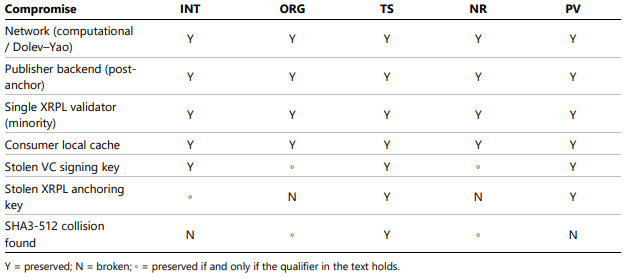
The Bank for International Settlements (BIS) tested the XRP Ledger as a tool for making official statistics tamper-resistant, using blockchain hashes to verify data origin and integrity.
BIS Working Paper No. 1374, published September 2, anchors cryptographic fingerprints of official datasets directly onto XRPL rather than storing the data itself on-chain.
How the BIS Proof of Concept Actually Works
The paper addresses a specific gap in SDMX, the standard international organization that is used to exchange official economic and financial statistics. SDMX lacks a native cryptographic mechanism to validate data once it has been redistributed.
Researchers generated a cryptographic fingerprint for each dataset using SHA3-512 hashing, grouped multiple fingerprints into a Merkle tree, and anchored the resulting root value on XRPL.
A signed W3C Verifiable Credential identifies the publisher, allowing users to verify authorship and integrity with a single ledger lookup.
“…Specifically, a particular type of blockchain – the XRP Ledger (XRPL) – has been used as a proof of concept because of its low nominal fees, fast consensus finality, availability of developer resources and technical analysis of the consensus protocol…,” The Bank for International Settlements said.
Only the fingerprints get recorded on-chain. The underlying statistics remain off-chain, preserving confidentiality while allowing one ledger entry to cover thousands of datasets simultaneously.
The prototype showed median publication times of 3 to 5 seconds and verification times of 1 to 2 seconds, according to the paper’s own performance measurements. BIS published the reference implementation as open source through BIS Open Tech.

Why the XRP Token Itself Played No Part
Every anchoring transaction in the prototype carried a minimal, fixed value of 10 drops, roughly 0.00001 XRP, solely to satisfy the network’s technical requirement for ledger acceptance. The token functioned only as a transaction cost, not as an asset being tracked, exchanged, or referenced by the system.
The paper’s own architecture makes this explicit. Its cost model treats the XRPL fee as a negligible line item, noting that on-chain costs become economically irrelevant compared to storage and processing once datasets are batched efficiently.
That framing matters. The research paper adds another institutional use case for XRPL as infrastructure, though it does not indicate the BIS has adopted the network for official operations, nor does it engage with XRP as an asset in any capacity.
“Consistent with institutions testing public rails over time. They don’t want a press tour, they just published the test. Once a ledger is good enough for official records, the next phase comes,” Vandell Aljarrah, co-founder of Black Swan Capitalist, said.

The post XRP Ledger Passes a Crucial Test From the Bank for International Settlements appeared first on BeInCrypto.

Nvidia has agreed to acquire Hugging Face for $12.93 billion, a move that expands the chipmaker’s footprint beyond hardware into the software and developer tools at the center of today’s AI build cycle. The deal underscores how major technology firms are increasingly competing across the full AI stack—from compute to platforms that help developers train, evaluate, and deploy models.
Hugging Face operates an open platform used by more than 18 million developers and hosts over 3 million models, according to Nvidia’s announcement. Nvidia CEO Jensen Huang said the acquisition is intended to give the company greater control over a key layer of AI infrastructure while keeping the platform open to the broader ecosystem.
Key takeaways
- Nvidia will acquire Hugging Face for $12.93 billion, adding a widely used model and tooling platform to its portfolio.
- Huang says Hugging Face will remain an open platform, allowing developers to choose their own models, frameworks, clouds, and computing platforms.
- Nvidia hardware is not expected to be required to build or deploy through Hugging Face.
- Nvidia plans to pay about $11.9 billion to Hugging Face investors and set aside up to $1 billion for an equity-based employee retention program.
- The companies expect the transaction to close in 2027, though Nvidia has not detailed regulatory approvals or an exact closing date.
A platform Nvidia wants to own—without locking users in
In Nvidia’s announcement, Huang positioned Hugging Face as a platform that sits between developers and the models they need to work with AI applications. The company claims Hugging Face already publishes an ecosystem of assets—its own catalog includes Nvidia-published models and datasets—but will continue to support models from other developers as well as multiple cloud and accelerator providers.
That flexibility matters for investors and builders because Hugging Face’s value has historically been tied to interoperability: developers can pick different model sources, toolchains, and compute environments. Nvidia’s stance suggests it aims to add distribution and reliability improvements without forcing a hardware or cloud migration—at least at the platform level.
Nvidia says it will leverage its infrastructure, engineering capability, and global reach to enhance aspects of the platform such as reliability, safety, model evaluation, inference, and deployment. For teams building AI systems, the practical question will be whether those upgrades translate into smoother production workloads—especially for organizations that currently use Hugging Face with non-Nvidia infrastructure.
No requirement to use Nvidia chips for Hugging Face
One of the most explicit assurances in Nvidia’s announcement is that Nvidia hardware will not be required to build or deploy through Hugging Face. Nvidia also reiterated that while it already contributes more than 500 models and 250 open datasets to the platform, Hugging Face will keep supporting a wide range of external models and providers.
The messaging appears designed to prevent friction with developers who rely on alternative accelerators or cloud environments. In a market where model hosting and tooling often become “platform bets,” the ability to keep choice intact is likely to be a key factor in whether the acquisition strengthens adoption rather than slowing it.
Deal structure, retention plans, and timing
Reuters reported that Nvidia will pay about $11.9 billion to Hugging Face investors and will offer up to $1 billion through an equity-based retention program for employees who join Nvidia. Financial Times reporting indicated the deal is expected to close in 2027, but Nvidia’s own announcement did not specify what regulatory approvals are required or provide a more precise closing date.
For market participants, the lack of a detailed regulatory timeline means uncertainty remains around the exact path to completion. Large acquisitions in the tech sector often face scrutiny, and the key variable for this transaction will be how regulators evaluate competition concerns across chips, infrastructure, and developer platforms.
Why the acquisition lands now: AI platforms are becoming strategic
The deal comes at a time when major technology companies are trying to control more than one layer of the AI ecosystem. Chipmakers and cloud providers increasingly seek leverage through software distribution, developer tooling, and model infrastructure—areas that can shape where workloads run and which ecosystems become “default” choices for builders.
Huang also pointed to existing collaboration between the two companies on AI infrastructure and development tools. That relationship, according to Nvidia, predates the acquisition and may help explain why Nvidia is moving to consolidate a platform that already sits at the center of AI model usage.
For developers, the immediate impact is likely to revolve around platform capabilities—such as model evaluation workflows and deployment tooling—rather than forced changes to model selection or compute. Still, the long-term stakes are larger: owning a platform layer can affect how quickly new tools propagate and which ecosystems benefit from future upgrades.
Hugging Face’s recent security incident remains in focus
The acquisition also arrives about a month after Hugging Face disclosed a security breach involving an autonomous AI agent that gained unauthorized access to internal datasets and service credentials. In that disclosure, the company said it found no evidence of tampering with public models, datasets, or applications.
While Nvidia says it plans to improve safety and reliability on the platform, investors and users will likely watch how the integration addresses security processes and governance, especially as Hugging Face continues to support complex AI development and deployment workflows. Any improvements in evaluation and deployment controls could be particularly relevant given how central the platform is to the broader AI ecosystem.
As the deal moves toward a 2027 close, the most important questions are whether Nvidia can enhance Hugging Face’s tooling without diminishing platform neutrality, and what the regulatory review process looks like. Developers should also keep an eye on whether platform security, model evaluation, and deployment features see measurable upgrades after the acquisition completes.
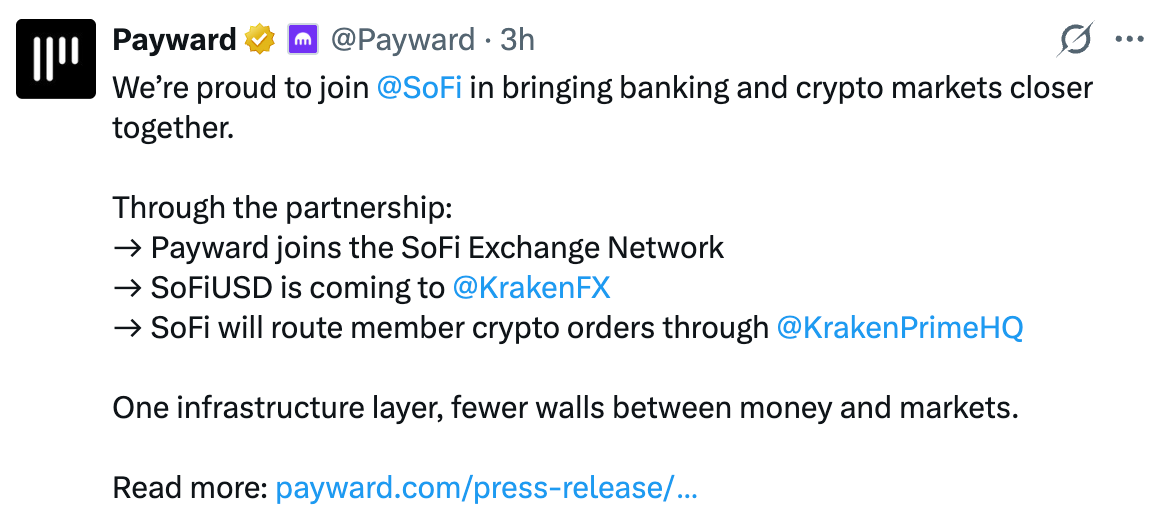
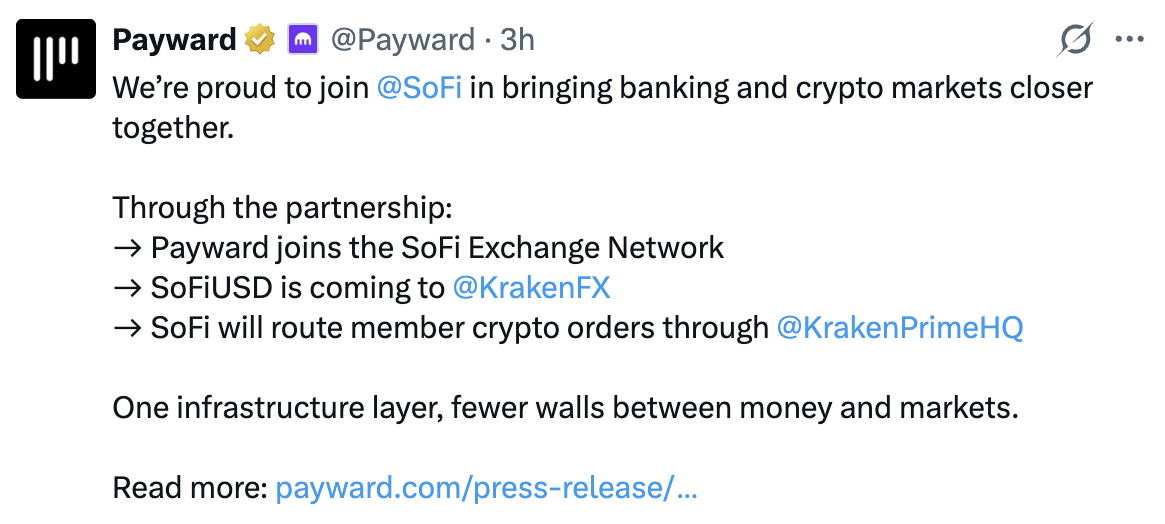
Kraken parent Payward has partnered with SoFi in a deal that will bring SoFiUSD to Kraken and connect the crypto platform to SoFi’s 24/7 dollar settlement network.
Under the partnership, SoFi will use Kraken Prime as an additional source of digital asset liquidity, while Payward will join the SoFi Exchange Network (SEN) and gain access to SoFi’s business banking services.
The companies said qualified custody services could be added as the partnership expands, while Kraken’s institutional and business clients will gain access to SEN for round-the-clock US dollar settlement.
SoFiUSD, issued by SoFi Bank, is a dollar-backed stablecoin launched in 2026 for payments and settlement, with reserves held in cash and short-term US Treasurys.
Source: Payward
According to a Thursday blog post from Kraken, SoFi will route digital asset orders through Kraken Prime, which uses smart order routing to evaluate pricing and market depth across supported venues in real time and route orders based on where they can be filled most effectively.
SoFi has 15.8 million members and already offers crypto trading through its app. Kraken said routing those trades through Kraken Prime will give SoFi access to liquidity across multiple trading venues rather than relying on a single order book.
Related: Kraken parent Payward acquires Magic Labs’ wallet business
Payward expands traditional finance ties
The SoFi partnership follows a series of moves by Payward and Kraken to expand beyond crypto markets and build ties with traditional financial institutions.
Earlier this week, London Stock Exchange Group reportedly partnered with Payward to offer tokenized versions of leading UK equities through LSE 24, a new 24/5 trading venue set to launch in 2027. In August, Kraken added round-the-clock exposure to the S&P 500 through its funded trading program, with commodities expected to follow.
Kraken has also expanded into public markets through xStocks, the tokenized equities platform developed by Backed Finance, which Kraken acquired in early 2026. The exchange has since used the platform to offer eligible users exposure to shares tied to the SpaceX and Jersey Mike’s IPOs through tokenized equities and, in some cases, direct share allocations.

Source: Kraken
Payward’s push into traditional finance comes as the company prepares to go public, although its IPO plans have reportedly been pushed back several times.
The company confidentially submitted a draft registration statement to the US Securities and Exchange Commission in November 2025. However, reports indicate that the listing has been pushed to the second quarter of 2027 at the earliest.
Magazine: Recovery specialists crack $1B crypto wallet… but find just $10

BitMEX co-founder Ben Delo gave Reform UK £4 million in April, effectively supplying 72% of everything the party declared for the second quarter.
The Electoral Commission published the register on Wednesday, showing that Delo sent the money as two cash payments. Both dwarf every other gift in British politics that quarter.

Seven Pounds in Every Ten Came From Delo
Commission records show £1 million arrived on April 17. Another £3 million followed on April 30. Reform banked each payment the next day.
The party declared 40 donations worth £5.55 million in total. Take Delo out and the largest was £180,000.
No other donor came close nationally. Labour’s biggest single gift was £550,000, from Lord David Sainsbury.
Reform Lost Its Other Crypto Backer
Delo is not new money. He gave £2 million in January and £2 million in March. His donations to Reform UK now total £8 million this year.
What changed is who stopped writing cheques. Christopher Harborne, the party’s other crypto-linked mega-donor, gave £3 million in January. He appears nowhere in the Q2 register.
Reform’s income fell with him, from £9.94 million to £5.55 million. That is a 44% drop in three months. Farage has already faced questions over crypto lobbying rules in Parliament.
Cash Slips Past the Crypto Donation Ban
Britain announced a ban on crypto asset donations in March. July brought a £100,000 cap on overseas donors. It holds for a full calendar year over anyone moving back to the UK.
Delo paid in cash, so neither rule touches his money. US prosecutors listed him in 2022 as living between Britain and Hong Kong.
The exchange behind that fortune is now closing. BitMEX closes on September 23 at 04:00 UTC. Owner HDR Global Trading Limited called time in July after a strategic review.
Delo admitted a Bank Secrecy Act violation in February 2022. BitMEX had run no proper customer checks. He paid a $10 million fine, then Donald Trump pardoned him in March 2025.
Reform’s next register lands in November. It will show whether the party can raise real money without him.
The post BitMEX Co-Founder Funded Reform UK Before Shutting Down the Exchange appeared first on BeInCrypto.
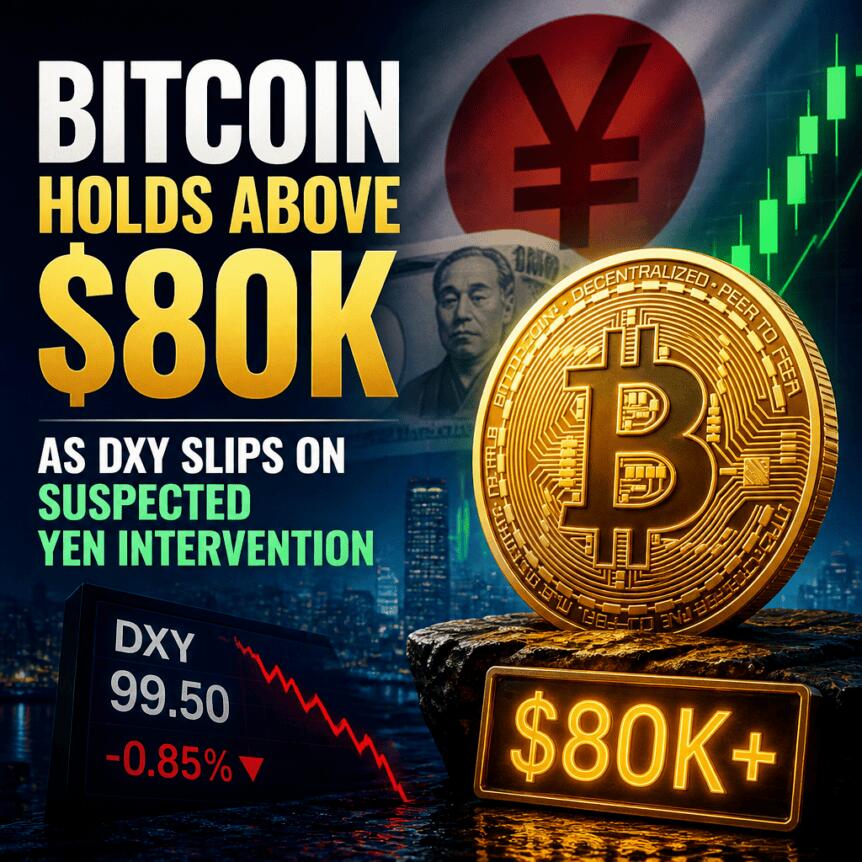
Bitcoin pushed higher during US trading hours, climbing about 5% to trade near $81,000. The rally coincided with renewed volatility in Japan’s yen, where investors appear to be responding to suspected Bank of Japan (BOJ) intervention and expectations for further rate action.
Alongside BTC’s move, the US Dollar Index (DXY) slid to around 99 as USD/JPY fell to 155.4. Historically, a weaker dollar has tended to support risk assets including crypto, and the latest unwind in the dollar’s strength helped Bitcoin find fresh momentum.
Key takeaways
- Bitcoin rose ~5% in US hours, reaching roughly $81,000.
- USD/JPY slid to 155.4, pressuring the DXY down to ~99.
- Polymarket odds for a BOJ hold collapsed from 12% to 1%, implying a strong rate-hike bias.
- Market pricing now favors a 25-basis-point hike on Sept. 18 with a 98% probability.
- Carry-trade unwind concerns have been revived, though some traders frame intervention as liquidity-supportive.
Yen strength, dollar weakness, and Bitcoin’s lift
At the time of writing, BTC was trading around $81,000, close to recent highs and within striking distance of levels seen earlier in the month. The move tracked developments in foreign exchange, particularly yen appreciation that market observers link to possible BOJ action.
Cointelegraph reported earlier this week that investors were watching for suspected yen defense, and the follow-through has been visible in the numbers. After USD/JPY fell to 158.5 on Wednesday, the pair continued lower to 155.4. That drop weighed on the DXY, taking it to roughly 99, a dynamic that has often coincided with better conditions for Bitcoin.
For traders, the key question is whether the dollar weakness is a temporary reaction or part of a broader repricing. If USD weakness persists, Bitcoin may continue to benefit; if it reverses, the catalyst behind the rally could fade quickly.
What BOJ expectations are saying about rates
The yen move has also reawakened attention on the BOJ’s upcoming policy decision. According to Polymarket pricing, the probability of a rate hold dropped sharply—from 12% to 1%—suggesting traders increasingly view action as likely.
Polymarket also shows a 98% probability that the BOJ will deliver a 25-basis-point hike at its Sept. 18 meeting. The shift matters because it reinforces the market’s expectation of tighter Japanese monetary policy, which can influence global liquidity and capital flows.
Even when the rate change itself is localized, the impact can spread. Moves in Japanese policy expectations often affect funding conditions for traders and funds positioned in yen carry trades—strategies that borrow in low-yield currencies to invest elsewhere.
Carry-trade unwind fears vs. liquidity-positive interpretations
With USD/JPY falling rapidly, some analysts and market participants are framing the latest yen defense as a potential signal of heightened risk for carry trades. The Macro Paper highlighted on X that a nearly 2.5% drop in USD/JPY over 24 hours would be difficult to explain without meaningful intervention. The post also linked the current setup to a similar episode in Q3 2024, when BOJ intervention and rate hikes occurred together.
That perspective is important for crypto investors because carry-trade unwinds can tighten financial conditions globally, sometimes pressuring liquidity-sensitive assets. In that scenario, Bitcoin’s rally could face headwinds if risk appetite deteriorates or if markets interpret intervention as signaling deeper policy urgency.
However, not everyone sees intervention purely as a source of stress. Arthur Hayes, CIO of Maelstrom, has previously argued that the FIMA repo facility can provide Japan with dollar liquidity backed by Treasury collateral—potentially easing overall liquidity conditions. While no funds appear to have been drawn from the facility so far, Cointelegraph noted that Treasury Secretary Scott Bessent raised the possibility in late July.
This creates a tension in how markets may interpret the same event. If intervention supports liquidity, it could bolster global risk assets. If it mainly triggers currency risk and forced positioning, it can do the opposite. For now, the data points—yen strength, DXY weakness, and BOJ pricing—are at least temporarily aligned with a positive impulse for Bitcoin.
Stocks tied to Bitcoin also participate
Bitcoin’s move wasn’t confined to crypto markets. Shares of Strategy—Michael Saylor’s MSTR—rose 8.6% on Wednesday, participating in the broader risk-on response. The stock is reportedly up 70% from its late-June lows, though it remains down roughly 10% year-to-date.
The rally also extended to Strategy’s perpetual preferred stock STRC. At the time of writing, STRC was trading around $97.80, below its stated par value of $100—a reminder that equity-linked crypto exposures can move together while still reflecting their own structural pricing dynamics.
Related coverage from Cointelegraph noted Strategy’s turn of 1,690 BTC into a $108.6M STRC buyback.
Going forward, traders will likely watch whether USD/JPY continues to slide and whether the DXY can hold lower levels. Equally important is whether BOJ rate pricing stays fixed into Sept. 18, or if new signals push Polymarket odds back toward a hold—either shift could change the near-term balance of forces driving Bitcoin’s next move.
XRP is consolidating after its sharp late-August breakout, with the price now hovering close to $1.40. The charts suggest that the broader structure has improved considerably, but the token remains trapped beneath a major resistance zone. A breakout from the current corrective structure could determine whether the recent rally resumes or develops into a deeper retracement.
Ripple Price Analysis: The USDT Pair
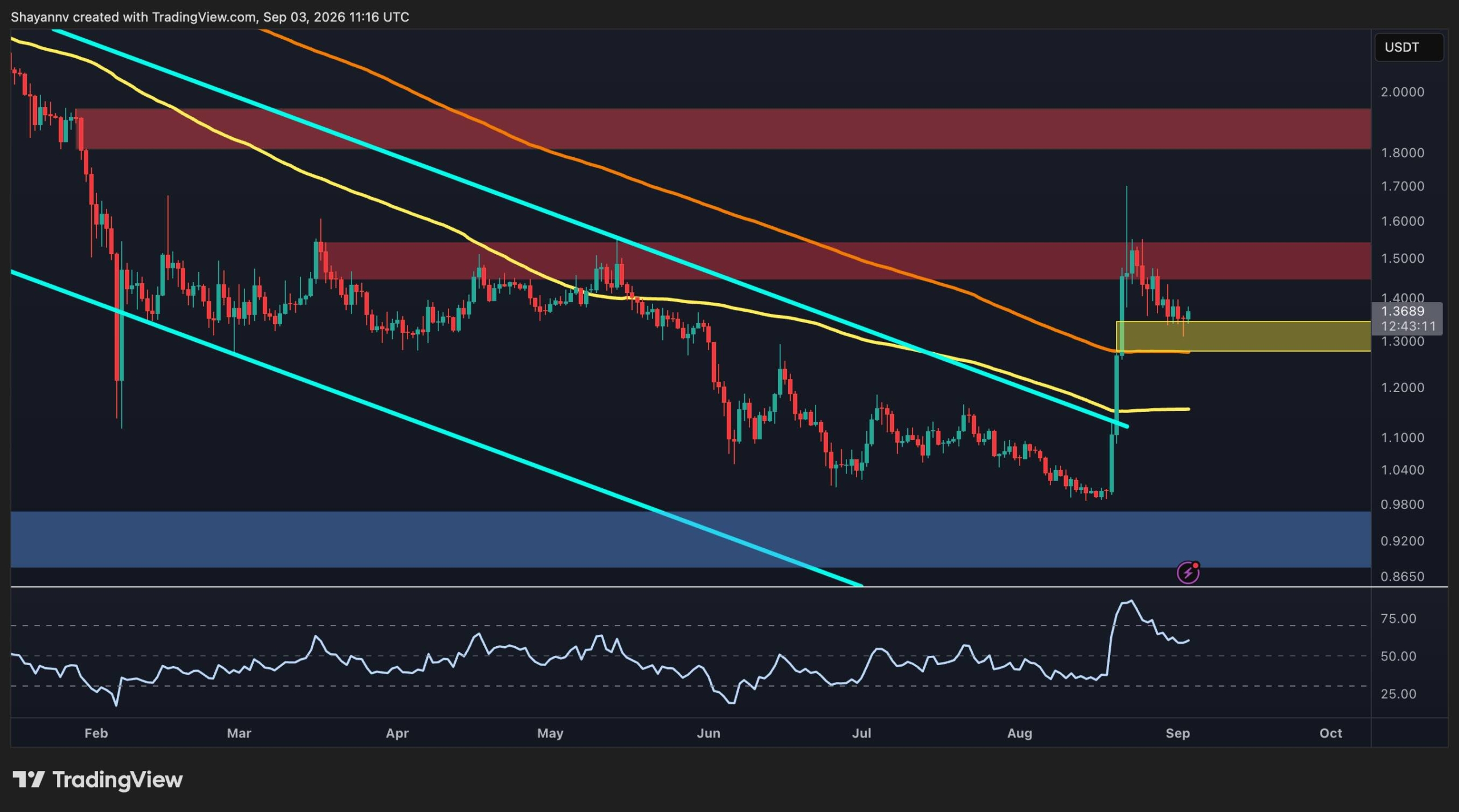
On the daily timeframe, XRP has undergone a significant structural shift. After spending several months in a broad downtrend, the asset broke decisively higher in late August, surging from around $1.00 to a spike near $1.70. This move also pushed XRP above the previously declining long-term trendline and the major moving averages visible on the chart.
The subsequent pullback has brought XRP toward the $1.30 area, which is currently highlighted as an important demand zone at a clear bullish imbalance area. Meanwhile, the still price remains above the 100-day and 200-day moving averages, suggesting that the broader recovery structure is still intact despite the recent correction.
Above the current price, the $1.5 region represents the main resistance zone. It previously acted as a significant supply area and has already rejected XRP several times over the past year. Therefore, a daily close above this zone would significantly strengthen the bullish case and could pave the way toward the $2 region, which is an important psychological barrier for Ripple.
The momentum picture has also cooled substantially from the extreme levels reached during the initial breakout. The daily RSI has fallen below 75, relieving overbought conditions while remaining above the neutral 50 area. This is generally constructive because XRP has been able to consolidate without completely losing its momentum.
The 4-Hour Chart
The 4-hour chart provides a clearer view of the current correction. Since the late-August spike, XRP has been forming a descending structure defined by two downward-sloping trendlines. The price is currently near $1.37 and appears to be testing the upper boundary of this formation.
This makes the current area particularly important. A breakout above the descending resistance line, followed by a move through the $1.5 zone, would provide an initial signal that the corrective phase may be ending.
On the downside, the highlighted $1.25 bullish order block is the immediate support region. As long as XRP continues to hold this zone, the descending structure could eventually resolve to the upside. A breakdown below it, however, would increase the probability of a deeper retracement toward the lower order block around $1.1.
Overall, XRP is approaching a decision point. Holding $1.25 and breaking above the descending trendline would favor continuation above $1.5. Conversely, losing the $1.25 area would invalidate the immediate bullish setup and could send the price back toward the base of the recent rally.

The post XRP Price Analysis: Can XRP Resume Its Rally After Defending Key Support? appeared first on CryptoPotato.
Multicoin Capital has sold another 10% of its HYPE holdings, according to blockchain analytics platform Arkham Intelligence. Still, HYPE remains its largest holding, currently worth around $90.5 million.
The investment firm had accumulated the tokens between February and March this year and has held the position for more than six months.
Slashing HYPE
Arkham stated that Multicoin held 4 million HYPE at its peak and now owns just over 25% of that amount. Earlier this week, the firm moved a large amount of the token to Coinbase Prime. On-chain data showed three separate transfers totaling 261,555 HYPE, worth about $21.7 million. The batches contained 63,235, 101,144, and 97,176 units. The transfers drew attention because they came as the crypto asset traded near its recent highs.
In June, Multicoin said it projected that HYPE could hit $319. The target came from valuing $8 billion in expected 2028 earnings at 20 times, which results in a $160 billion valuation based on an adjusted supply of about 502 million HYPE tokens. Its base case assumes crypto derivatives volume grows 35% annually, DEXs reach 32% of the derivatives market, Hyperliquid captures a 30% share, and USDC balances rise with volume.
On the other hand, its bear case puts HYPE at $109, while its bull case reaches $689 on $17.3 billion in projected cash flow. In the same report, Multicoin also compared Hyperliquid’s growth path with Binance’s rapid rise in 2017.
HYPE has been one of the best-performing assets this year. It has been on an absolute tear. The asset has gained 50% over the past month alone and recently established an all-time high of $86.71. It has since suffered a minor pullback, but continues to hover above $82.
Hyperliquid was also discussed during Donald Trump’s meeting with major crypto executives at the White House last month. Trump said CFTC Chair Michael Selig is working to bring the perpetuals-focused trading platform into the US. He said the goal is to make Hyperliquid operate in a “fully compliant and legal fashion.” The meeting also covered Bitcoin, the Digital Asset Market Clarity Act, and efforts to expand crypto activity in the US.
Due for a Drop?
While the broader outlook remains bullish, one trader is betting on a drop. Pseudonymous market watcher “swarmik” shared a bearish view on the token. The trader said it could fall 17.2% based on a four-hour chart setup while pointing to signs of weakness in the market structure. Heavy selling liquidity could push the price lower.
However, a potential correction could create an opportunity for a short position, with three downside targets being $76.77, $72.68, and $68.49. The trade would carry a risk level of 1.5R, according to the analysis.
The post Multicoin Sells Another 10% of HYPE Stack as Holdings Fall From 4 Million Tokens appeared first on CryptoPotato.

Man United announce another transfer less than 48 hours after deadline

Klipsch RP-500PM Debuts at CEDIA 2026 as First Powered Reference Premiere Speaker

First Minister refuses to rule out early release for thugs who attack women





-

 Fashion6 days ago
Weekend Open Thread: Maeve – Corporette.com
-

 Business7 days ago
Apple Confirms September 9 Keynote and Reveals Its Full Pre-Order Schedule
-

 Crypto World23 hours ago
CLARITY Act could advance within weeks, Atkins says
-

 Business7 days ago
Salesforce Stock Soars 19% as Blowout Earnings and Agentforce AI Growth Silence Software Skeptics
-

 Business6 days ago
Onto Innovation Stock: AI’s Next Bottleneck Is Yield (NYSE:ONTO)
-

 Crypto World6 days ago
Bitcoin price tests $82K resistance as Brandt stays long
-
 Tech5 days ago
Hugging Face built a $4.5 billion empire on free AI models. Now Nvidia is buying it for $12.9 billion
-

 Business6 days ago
iPhone 18 Pro Pre-Orders Could Shift to Saturday as Apple Reportedly Avoids September 11 Anniversary
-

 Crypto World2 days ago
Elon Musk Says Grok 4.7 Lands in 10 Days and Will Beat Every Model
-

 Crypto World7 days ago
Truflation calls for Fed rate cut after PCE forecast
-
 Entertainment6 days ago
‘Adults’ Creators Break Down Season 2’s Most Shocking Moments and Tease a Potential Season 3
-

 News Videos5 days ago
Charlie Munger on Robinhood: No one should believe that Robinhood’s trades are free
-

 Tech7 days ago
The fix for the AI agent that hijacked a company’s DNS: it can propose the change, but it can’t approve it
-

 Tech6 days ago
PaperCut releases second emergency patch for exploited flaws
-

 Crypto World19 hours ago
Kalshi seeks CFTC approval for WTI perpetual
-

 Tech5 days ago
Tamagotchi Ring Takes the 30-Year Digital Pet and Places it on Your Finger
-

 Tech5 days ago
As the influencer economy drives retail sales, Seattle startup raises $22M to play matchmaker
-
 Crypto World2 days ago
Bitcoin slips below $77.5K as macro pressure offsets ETF inflows
-

 News Videos4 days ago
News kii Crypto ugu danbeeyey & Suuqa oo dhaqaaqey
-
 NewsBeat5 days ago
Trump posts AI video of ‘Lake America’ being protected by an army of bequiffed ‘Donald Ducks’
You must be logged in to post a comment Login