

Crypto World
How Binance Turned CZ Into a Billionaire Richer Than Bill Gates


TLDR:
- Forbes estimates CZ’s fortune at $110B, placing the Binance founder ahead of Bill Gates in the latest rankings.
- Binance ownership remains the largest contributor to CZ’s wealth despite past regulatory settlements and leadership changes.
- Forbes says Bill Gates’ continued philanthropy has reduced his personal fortune while keeping him among top billionaires.
- CZ noted crypto wealth changes rapidly because private company valuations and digital asset prices fluctuate daily.
Changpeng Zhao, widely known as CZ, has moved ahead of Bill Gates on the latest Forbes billionaire rankings. The shift reflects the growing value of Binance alongside rising digital asset markets.
CZ’s estimated fortune now stands at $110 billion, placing him above the Microsoft co-founder in Forbes’ published list. The milestone also highlights how crypto infrastructure has become a significant source of global wealth.
CZ Tops Bill Gates as Binance Valuation Lifts Net Worth
Forbes estimates CZ’s net worth at $110 billion. Bill Gates follows with an estimated $108 billion. The updated rankings place CZ at No. 17 globally, while Gates ranks No. 19.
The largest contributor to CZ’s fortune remains his ownership stake in Binance. Forbes estimates that he still controls roughly 90% of the world’s largest cryptocurrency exchange.
The value of that stake has increased alongside stronger activity across digital asset markets. CZ also holds substantial personal cryptocurrency investments.
Previous public statements indicate that most of his personal assets remain invested in crypto, including Bitcoin and Binance Coin. Forbes factors those holdings into its overall wealth calculations.
CZ acknowledged the published ranking after its release but noted that billionaire estimates can change rapidly. He pointed to crypto market volatility, saying real-time valuations often differ from published figures because private company values and digital assets fluctuate continuously.
Binance Recovery Strengthened CZ’s Position
Binance remained the world’s largest cryptocurrency exchange despite major regulatory challenges over the past several years.
After stepping down as chief executive following a U.S. settlement in 2023, CZ retained his reported ownership stake in the company.
According to Forbes, Binance’s business recovered as trading activity stabilized and the exchange maintained a leading share of global crypto trading volume. That recovery significantly increased the estimated value of CZ’s equity.
Posts shared by DeFiTracer on X highlighted the updated Forbes rankings, describing CZ as the richest individual in the cryptocurrency industry. The discussion quickly spread across the crypto community as investors compared traditional technology fortunes with wealth created through digital asset infrastructure.
The rankings also reflect Bill Gates’ long-term philanthropic strategy. Forbes notes that Gates has continued transferring substantial assets to charitable causes through the Gates Foundation, reducing his personal fortune over time while remaining among the world’s wealthiest individuals.
The latest billionaire list illustrates how ownership of crypto infrastructure can rival wealth generated through traditional technology companies.
While token prices influence personal fortunes, Binance’s business valuation remains the largest driver behind CZ’s estimated net worth, according to Forbes. The figures also serve as a reminder that billionaire rankings change frequently as private company values and cryptocurrency markets continue to move.




Austria has asked the EU to explore hosting Anthropic inside Europe, weeks after Washington restricted foreign access to the company’s most advanced artificial intelligence models.
State Secretary for Digitalization Alexander Pröll made the proposal in a letter to the European Commission. He admitted he could not say how the plan would work in practice.
Europe’s Bid to Host Anthropic
Pröll sent the letter to European Commission Executive Vice President Henna Virkkunen. He argued that Europe risks being cut off from frontier AI breakthroughs unless it acts now.
In his letter, Pröll asked member states to weigh a far bigger step.
“the strategic establishment and participation of Anthropic within the European Union”
His pitch dangled incentives such as legal certainty, fresh capital, and full access to Europe’s single market. He offered no funding figure, timeline, or build plan, and conceded skeptics would doubt whether the idea can work.
Brussels is already weighing fallout from the public controversy.
Follow us on X to get the latest news as it happens
The US Curbs That Triggered the Appeal
Washington set this in motion on June 12. The Commerce Department issued an export directive on the firm’s two strongest models. It barred every foreign national, even Anthropic’s own non-citizen staff.
The order hit Claude Fable 5 and Claude Mythos 5, its newest AI models, days after launch. Unable to screen users by nationality, Anthropic pulled both worldwide. Claude Opus 4.8 stayed online.
Officials cited national security. The warning came from Amazon, Anthropic’s biggest backer, after its researchers pulled restricted cyberattack guidance from Mythos. Anthropic CEO Dario Amodei called the bypass narrow, not a full jailbreak. The model had already shown it could crack guarded government systems.
On June 26, the government eased the export block for more than 100 trusted US institutions. Fable 5 stays restricted.
Any relocation runs into Anthropic’s American foundations. The firm is funding a $50 billion data center build in Texas and New York. Amazon has invested $13 billion and is its primary training partner. In return, Anthropic has committed to spend over $100 billion on Amazon’s cloud within a decade.
The company also estimates US AI will need roughly 50 gigawatts of new power by 2028. Europe sits far behind on the inputs. Its Chips Act targets a 20% share of global chip output by 2030, up from under 10% now. The bloc’s own forecast sees just 11.7%, and EU auditors call the goal very unlikely.
The appeal lands as Brussels weighs its answer to US control over frontier AI. Europe still leads on regulation through its own AI rules.
Yet it lacks the compute, capital, and power base that keeps Anthropic rooted in America. Whether the Commission sees a real option or a political signal should grow clearer soon.
The post Europe Makes Bold Play for Anthropic After US AI Restrictions appeared first on BeInCrypto.

The Bank for International Settlements (BIS) has issued a blunt warning that the fast-growing stablecoin market could undermine core pillars of the global monetary system—particularly sovereign control and the ability of banks to fund lending to the real economy. In its Annual Economic Report, published Sunday, the Basel-based institution assessed the stablecoin sector at roughly $316 billion and argued that most tokens pegged to fiat currencies do not have the institutional features needed to function as safe, reliable money at scale.
Rather than dismissing tokenization altogether, BIS said policymakers should push toward “tokenized” versions of central bank and commercial bank money on regulated infrastructures. The report also expands BIS’s critique of public, permissionless blockchains—arguing that the economic incentives and governance gaps in decentralized networks make them a poor fit for systemically important financial infrastructure.
Key takeaways
- BIS warns that stablecoin growth could fragment the monetary system and weaken central banks’ ability to control money and credit.
- The BIS report argues that fiat-pegged stablecoins lack the institutional design needed to operate as reliable money at the scale financial systems require.
- Tokenized central bank money and tokenized commercial bank deposits on regulated platforms are presented as a more robust alternative.
- BIS points to “stablecoin dollarization” as a risk factor for monetary sovereignty and bank intermediation, especially in emerging markets.
- The report renews BIS’s stance that permissionless public blockchains face structural hurdles tied to settlement economics and accountability.
Stablecoins, monetary sovereignty, and the bank funding question
In its assessment of stablecoins, BIS focused on what it sees as structural vulnerabilities in how reserve assets underpin many tokens. The report argues that stablecoins pegged to fiat currencies may not provide the same institutional safeguards expected of money used throughout payments and finance.
More broadly, BIS said that a meaningful shift by holders away from commercial bank deposits and into private digital tokens could reduce banks’ funding base. In BIS’s framing, that contraction could constrain banks’ capacity to extend credit to the real economy—an issue that connects stablecoin adoption not just to payments, but to financial intermediation and credit creation.
Equally important for central banks, BIS said the current regulatory approach may not be sufficient if private digital currencies continue to expand. The report’s policy signal is that stablecoins should not be treated as the foundation of the future monetary system without addressing the risks to monetary stability and sovereign control.
The “stablecoin dollarization” risk
BIS also highlighted a trend it calls “stablecoin dollarization”: the growing use of dollar-denominated stablecoins in countries with weaker domestic currencies. According to BIS, this pattern can impair monetary sovereignty and reduce the effectiveness of local monetary policy.
The BIS report further links stablecoin dollarization to weaker bank intermediation and greater exposure to volatile cross-border capital flows. BIS’s concern is that when dollar-linked tokens become an increasingly common store of value and medium of exchange, domestic policy tools can become less effective—particularly in emerging market economies where financial systems may already face constraints.
For market participants, the implication is that stablecoin growth does not occur in a policy vacuum. Adoption in jurisdictions with currency stress can change the transmission of monetary policy, alter deposit dynamics, and potentially amplify external shocks.
BIS presses for “unified ledger” tokenization
While BIS critiqued stablecoins as they currently operate, it did not reject the underlying idea of tokenization. Instead, the report advocates a “unified ledger” architecture that brings tokenized central bank money, tokenized commercial bank deposits, and tokenized financial assets together on programmable platforms—within regulated legal and institutional frameworks.
BIS’s underlying argument is that tokenization can deliver practical benefits—such as programmable transactions and faster settlement—without giving up the institutional foundations that, in its view, are necessary for financial integrity, public trust, and system-level stability.
This is also where BIS’s recommendations differ from the most common public narrative around stablecoins. Rather than emphasizing private tokens as the endpoint, BIS is effectively calling for tokenized money to remain anchored in the regulated institutions that already underpin payments, liquidity, and compliance in traditional finance.
For investors and builders, the “unified ledger” approach suggests a direction of travel: interoperability and programmability, yes—but paired with clearer governance, defined responsibilities, and institutional accountability.
Why BIS says permissionless public chains struggle with institutional finance
BIS’s report includes one of its strongest critiques yet of permissionless public blockchains such as Bitcoin and Ethereum as a foundation for the monetary system. The BIS position is that decentralized networks relying on distributed validation and lacking a central governance structure struggle to meet expectations for scalability, legal accountability, and settlement finality—qualities BIS argues are required for systemically important financial infrastructure.
A central part of BIS’s technical-economic reasoning is that decentralized consensus mechanisms tend to rely on incentives through transaction fees. In BIS’s description, these fee dynamics rise as network activity increases, which can make congestion, longer confirmation times, and higher costs inherent traits rather than solvable short-term bugs.
BIS also argues that permissionless networks do not provide the governance and accountability frameworks institutional finance requires. Without an identifiable entity responsible for maintaining integrity, resolving disputes, or ensuring compliance with financial integrity standards, BIS contends these networks face major obstacles to supporting large-scale regulated financial activity.
Importantly, BIS does not frame tokenization as a substitute for governance. Its emphasis is that programmable financial infrastructure must be paired with enforceable responsibility structures if it is meant to support money-like functions at systemic scale.
What to watch next
For policymakers and market participants, BIS’s report raises the question of whether stablecoin regulation will evolve toward tokenized forms of central bank and commercial bank money on regulated rails. The key uncertainty now is how quickly regulators and financial institutions will translate BIS’s “unified ledger” vision into practical standards—and how adoption of private stablecoins could respond in the meantime.
Inflation charts suggest GTA 6 could be the cheapest Grand Theft Auto game ever. This is based on adjusting the prices of the previous version to 2026 economic standards.
This is validated by assessing GTA launch prices using the Consumer Price Index, or CPI. GTA 3’s $50 launch price in 2001 would equal about $94.29 in 2026.
GTA 5’s $60 launch price would equal about $85.87. GTA 6, priced at $79.99, then appears cheaper than both.
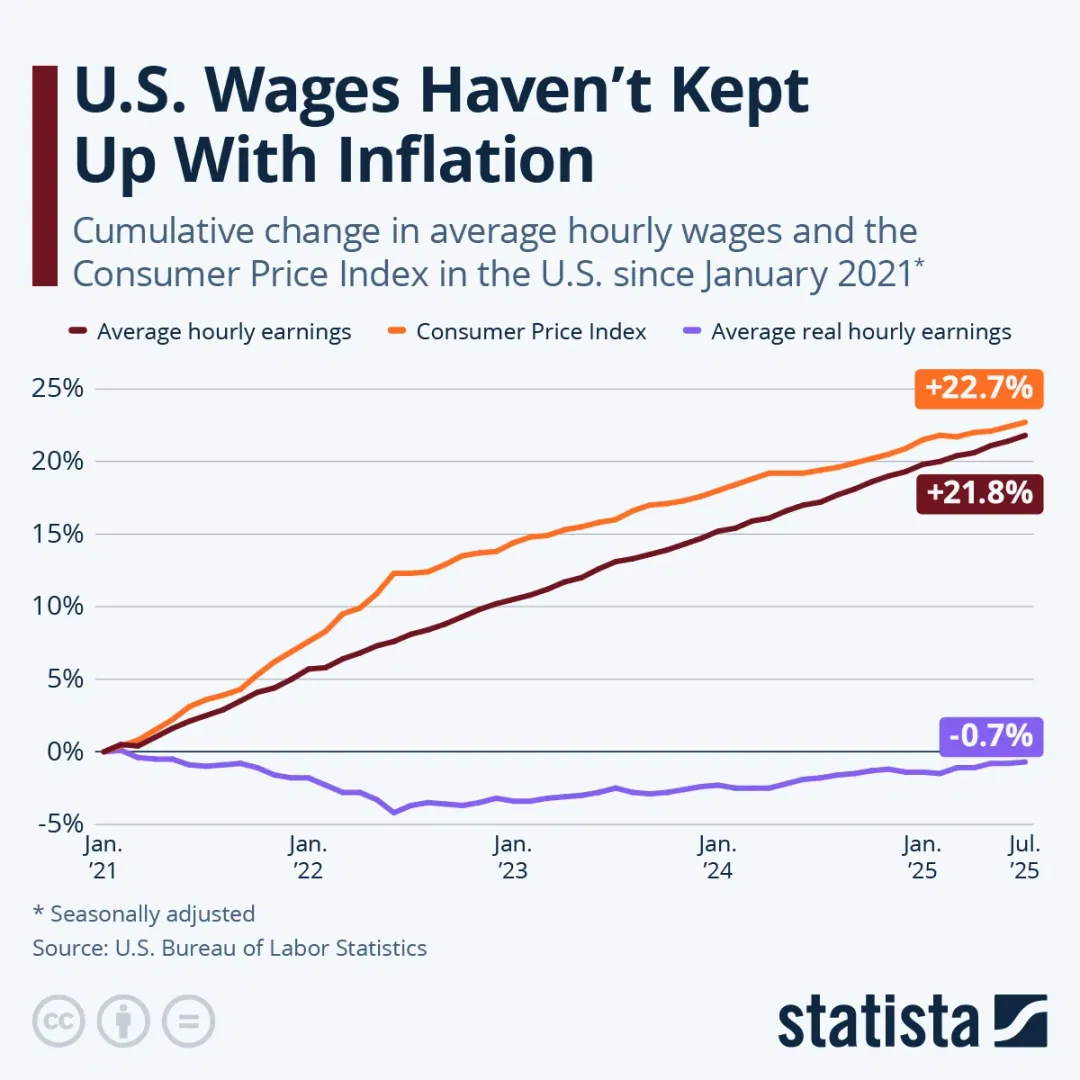
However, the problem is that CPI only tracks how prices change over time. It does not show whether people’s wages have kept up.
GTA VI Affordability Test
US Bureau of Labor Statistics data shows real average hourly earnings fell 0.7% between May 2025 and May 2026, after adjusting for inflation. That means the average worker had slightly less purchasing power, even before paying for a premium-priced game.
A better test is how many hours someone needs to work to buy the game. On that basis, GTA 6 may not feel cheaper for many buyers, especially if wages are flat and everyday costs remain high.
That creates a real challenge for Take-Two and Rockstar. GTA 6 is due to launch on November 19, 2026, for PlayStation 5 and Xbox Series X.
Its $79.99 standard edition is below the $90-plus price some investors expected, and Take-Two shares fell after the announcement.
The debate also comes at a sensitive time for gaming consumers. Digital ownership concerns and rising costs have made players more cautious about what premium prices actually offer.
Inflation-adjusted charts can show how GTA 6 compares with older games on paper. They cannot show whether buyers feel richer. On current wage data, many do not.

An inflation-adjusted chart can confirm that GTA 6 costs fewer historical dollars than its predecessors. What it cannot confirm is whether the people buying it have more real money to spend. On current BLS data, they have less.
The post GTA 6 May Be the Cheapest Edition Ever. So Why It Feels So Expensive? appeared first on BeInCrypto.
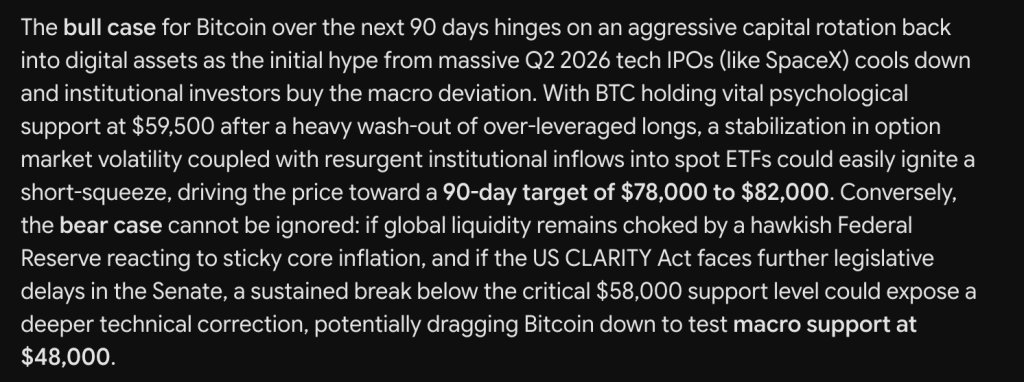
Google Gemini AI just zoomed in on a tighter window for Bitcoin price prediction that treats the next quarter as the real test rather than waiting for year end. The model predicts a 90 day target of $78,000 to $82,000, a sizable jump from where price sits today.
The bull case hinges on capital coming back home after chasing other shiny objects. Bitcoin is trading near $59,500 right now, and the thesis centers on an aggressive rotation back into digital assets once the initial hype from massive second quarter tech IPOs, including names like SpaceX, finally cools down.
As that excitement fades, institutional investors buying the macro deviation could redirect fresh capital straight back toward bitcoin.
The model points to $59,500 as vital psychological support, a level that has already absorbed a heavy washout of overleveraged long positions.
With that flush largely complete, a stabilization in option market volatility paired with resurgent institutional inflows into spot ETFs could easily ignite a short squeeze. That kind of squeeze, the model argues, is exactly what could drive price toward the $78,000 to $82,000 zone within the next three months.
The bear case is built around macro headwinds that have nothing to do with bitcoin itself. If global liquidity stays choked by a hawkish Federal Reserve responding to sticky core inflation, that kind of tightening tends to hit risk assets like bitcoin especially hard.
Further legislative delays on the US CLARITY Act in the Senate would remove one of the few near term catalysts bulls are counting on. If both of those pressures show up together, a sustained break below the critical $58,000 support level could expose a much deeper technical correction, potentially dragging bitcoin all the way down to test macro support at $48,000.
Bitcoin Price Prediction: BTC Hovers At The Line That Decides Its Next 90 Days
The daily chart shows bitcoin at $59,365 after a long decline from highs near $127,000 set back in October. That slide has been steep and persistent, with a brief relief rally into May that topped out near $83,000 before rolling over again into the current stretch of weakness.
Price has spent the last several sessions grinding just below $60,000, sitting right at the exact psychological level the prediction calls out as vital support.
That kind of tight consolidation right at a key round number often marks a genuine battle between buyers defending the level and sellers testing whether it breaks.
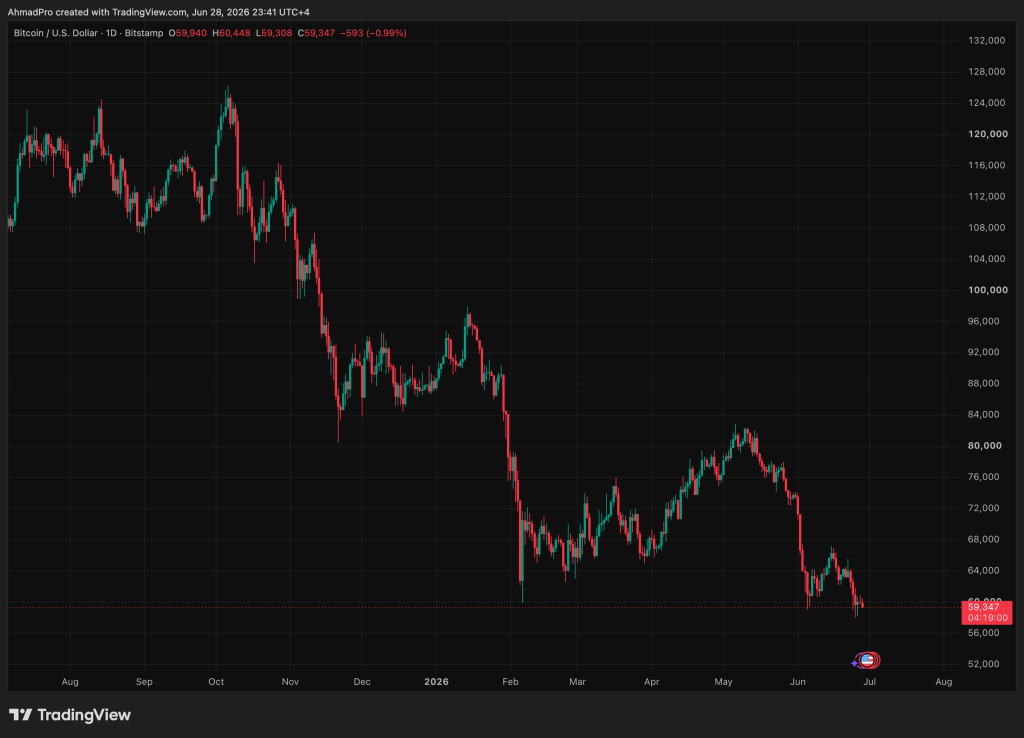
Immediate resistance sits near $64,000, a level price has rejected from multiple times during this recent stretch, with a heavier ceiling further up near $72,000 where the May rally eventually stalled out.
Support holds at $58,000, the exact threshold flagged in the bear case as the line that opens the door to deeper losses. The broader pattern here is one of lower highs and lower lows since October, a clean downtrend that has not yet shown any real sign of reversing.
Momentum on the daily candles looks weak and still leaning bearish, with red candles dominating the most recent sessions and limited buying response on the bounces.
Given how precisely price is testing the exact support level named in this prediction, the next move off $58,000 to $59,500 looks like it will determine which of these two scenarios actually plays out over the coming weeks.
Discover: The Best Token Presales
You Might Like What Gemini AI Predicts About LiquidChain
The rotation is already happening. Most people will only see it in hindsight.
Large-cap crypto is not failing. It is capped. Bitcoin, Ethereum, and XRP have been pressing against the same resistance bands for weeks. The macro tailwinds keep getting delayed.
The institutional inflows keep getting pushed to next quarter. Holding assets where the upside depends on catalysts you cannot control is not a strategy. It is waiting.
A capital that has navigated enough cycles does not wait at resistance. It moves before the destination becomes obvious.
Early-stage infrastructure plays operate on different math entirely. A small enough market cap means a modest rotation produces dramatic price movement. The asymmetry exists because the market has not priced in what is being built yet. That gap between current valuation and what the project is actually worth is where the returns come from.
Multi-chain fragmentation costs DeFi real money every single day. Bitcoin, Ethereum, and Solana run completely isolated liquidity systems with no native way to connect them. Every user moving value between ecosystems absorbs that cost directly in fees, slippage, and failed transactions.
LiquidChain collapses all 3 networks into a single execution layer. One deployment. Full ecosystem access. No cross-chain tax on every interaction.
The market has not found this yet. That is the entire point.
The presale is at $0.01454 with just over $840,000 raised. Ground floor is not a marketing phrase here. It is a description of where this actually sits in its lifecycle.
Execution is unproven. Adoption is unknown. Those risks are real and worth naming directly. Established assets offer a smoother ride toward a ceiling that is already visible. This offers an earlier seat at a table that has not been set yet.
Explore the LiquidChain Presale
The post Google Gemini AI Predicts Jaw-Dropping Bitcoin Price by Next 90 Days appeared first on Cryptonews.
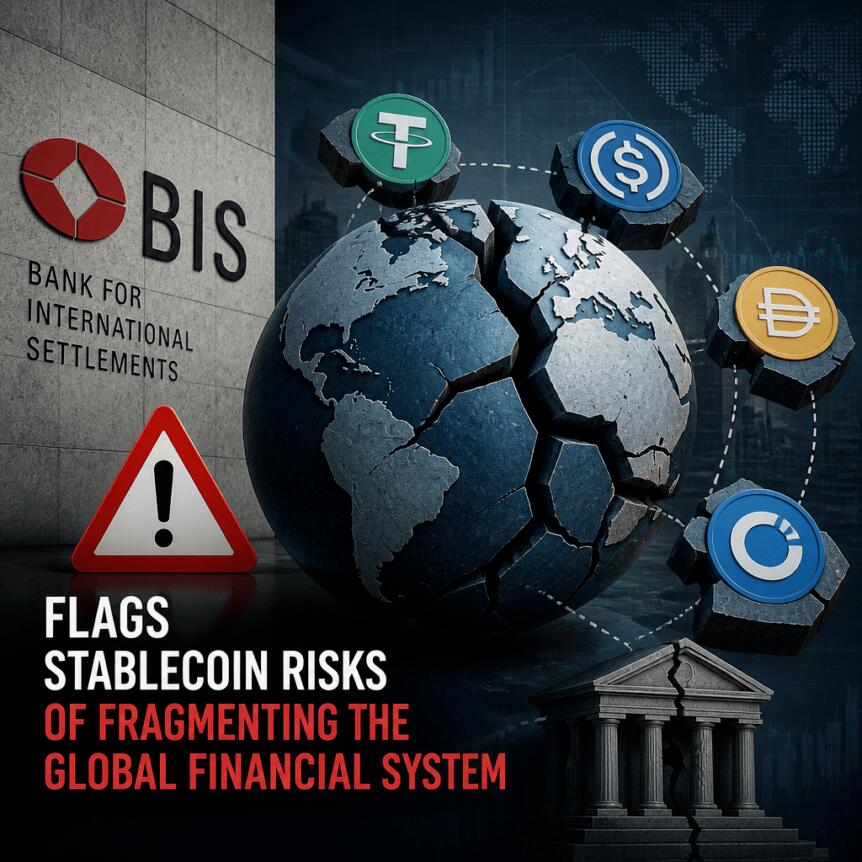
The Bank for International Settlements (BIS) has issued a warning that the fast-growing stablecoin market could destabilize the global monetary system—particularly by eroding central bank control and by pulling value away from bank deposits. In its Annual Economic Report published Sunday, the Basel-based institution says the scale of stablecoins has reached roughly $316 billion, and it argues that fiat-pegged tokens are not equipped with the institutional safeguards needed to function as “safe, reliable money” at system-wide levels.
Instead, BIS urges central banks and the broader financial sector to accelerate development of tokenized forms of central bank and commercial bank money on regulated infrastructures. The BIS message is not only a critique of today’s stablecoin structure, but also a policy signal that existing regulatory approaches may fall short as private digital currencies continue to expand.
Key takeaways
- BIS estimates the stablecoin market at about $316 billion and warns that its current design lacks features needed for large-scale “safe money.”
- Stablecoin growth could weaken banks and credit creation by enabling deposit migration into private digital tokens.
- BIS flags “stablecoin dollarization” as a risk to monetary sovereignty and domestic policy effectiveness, especially in emerging markets.
- Permissionless public chains face limits, in BIS’s view, due to scalability, legal accountability, and settlement finality requirements for systemic finance.
- BIS supports tokenization inside a regulated “unified ledger” model, combining tokenized central bank money and tokenized deposits.
Why BIS thinks stablecoins could strain the monetary system
In its report, BIS focuses on structural weaknesses it believes are inherent to stablecoins pegged to fiat currencies. The institution argues that these tokens do not carry the institutional features required to operate as trustworthy money at scale. A central part of BIS’s concern relates to how reserve assets are managed and governed.
BIS also highlights a potential macro-financial channel: if users shift value from commercial bank deposits into private digital tokens, banks could face reduced funding. In turn, that could constrain the credit banks provide to the real economy. The report frames this as a material risk created by stablecoins’ ability to transfer purchasing power outside the traditional deposit-based plumbing of the banking system.
For policymakers, BIS’s warning reads as a call for faster work on safer alternatives. Rather than aiming to position stablecoins as a lasting foundation for the monetary system, BIS says the more robust path is tokenized central bank and commercial bank money—supported by regulated infrastructures that preserve monetary stability and financial integrity.
Dollar-denominated stablecoins and the threat to sovereignty
BIS devotes particular attention to a trend it calls “stablecoin dollarization”—the increasing use of dollar-denominated stablecoins in jurisdictions with weaker domestic currencies. According to BIS, this pattern can have several second-order effects for countries that increasingly rely on external currency-linked digital products.
The report argues that stablecoin dollarization may undermine monetary sovereignty and reduce the effectiveness of domestic monetary policy. It also suggests the trend could decrease bank intermediation and heighten exposure to volatile cross-border capital flows, risks that BIS says are especially pronounced in emerging market economies.
For traders and market participants, this matters because stablecoin usage is not just a crypto-native phenomenon; it can reshape liquidity dynamics in foreign exchange-related channels by tying dollar value transfer more directly into the digital asset ecosystem.
BIS challenges permissionless networks as core monetary infrastructure
BIS goes beyond stablecoins themselves and delivers a sharply worded critique of the suitability of public permissionless blockchains—such as Bitcoin and Ethereum—as foundational layers for the monetary system. The report argues that decentralized networks that rely on distributed validation and lack central governance struggle to meet requirements that BIS believes systemically important financial infrastructure must satisfy, including scalability, legal accountability, and settlement finality.
A key part of BIS’s argument is that congestion and rising costs are not merely temporary bugs in permissionless systems, but rather are tied to their underlying economics. BIS contends that compensation for validators via transaction fees tends to increase with network activity, which can make congestion, slower confirmations, and higher costs persistent characteristics rather than solvable engineering limitations.
Just as importantly, BIS says permissionless networks generally lack the governance and accountability frameworks that institutional finance relies on. Without a clearly identifiable entity responsible for maintaining integrity, resolving disputes, or ensuring compliance with financial integrity standards, BIS argues that permissionless blockchains face major obstacles to supporting large-scale regulated financial activity.
Crucially, BIS is not rejecting tokenization outright. Instead, the BIS report argues for a different architecture—one where tokenized money and assets can be programmed for modern settlement benefits while remaining embedded in regulated, accountable institutional frameworks.
The “unified ledger” alternative BIS says can preserve stability
Rather than positioning tokenized assets to replace existing money mechanics, BIS proposes what it describes as a “unified ledger” approach. Under this model, tokenized central bank money, tokenized commercial bank deposits, and tokenized financial assets would be brought together on programmable platforms—within regulated legal and institutional boundaries.
In BIS’s framing, the objective is to keep the advantages that tokenization can bring—such as programmable transactions and faster settlement—while avoiding what it sees as the institutional risks associated with private fiat-pegged tokens operating outside traditional monetary controls.
This direction also signals an important policy tension: as private stablecoins expand, BIS suggests regulators and central banks may need to treat tokenized bank and central bank money as the more durable pathway for digital payments and settlement, not only a technological evolution but a governance one.
Going forward, investors, payment companies, and policymakers will likely watch whether jurisdictions move quickly toward regulated tokenized money pilots and whether new rules meaningfully address deposit-funding risks and dollarization dynamics—areas BIS singled out as central to its concerns.
TLDR:
- Coinbase introduced AI agent tools that connect autonomous software directly to crypto financial services.
- Agent financial accounts enable AI wallets, payments, and low-cost blockchain transactions through Base.
- Coinbase plans an Everything Exchange covering crypto, stocks, commodities, and tokenized assets.
- Payment upgrades include stablecoin rails, Coinbase One Card improvements, and direct deposit expansion.
Coinbase has expanded its artificial intelligence strategy with a new suite of products designed for autonomous software agents. In the last system update the company unveiled developer tool, AI-powered financial services, and crypto-native accounts.
The announcement also stated plans for a wider trading infrastructure expansion, beyond digital assets. The new offerings reflect Coinbase’s push to combine blockchain technology with AI-powered applications.
Coinbase Launches AI Financial Tools for the Intelligence Age
Coinbase CEO Brian Armstrong described the company’s latest vision by positioning Coinbase as a financial platform for the intelligence age. The announcement accompanied a product presentation focused on AI agents and crypto infrastructure.
According to Coinbase’s system update, the company introduced Coinbase for Agents. The developer toolkit allows creators to connect AI agents directly to existing Coinbase accounts for blockchain-based financial activity.
The company also revealed Coinbase Advisor. The feature brings AI-powered financial and investment assistance directly into the Coinbase application, allowing users to interact with digital financial guidance inside the platform.
Armstrong also presented agent financial accounts built on Base, MCP, and the x402 payment standard. According to the presentation, these accounts enable AI agents to hold wallets, process payments, access digital services, and complete transactions for less than one cent.
Coinbase Expands Trading Infrastructure Beyond Crypto Markets
Beyond artificial intelligence, Coinbase introduced its vision for an Everything Exchange. According to the company’s presentation, the platform aims to combine multiple asset classes within a unified global marketplace.
The proposed exchange includes tokenized equities, traditional stocks, commodities, and pre-IPO perpetual products. Coinbase said the goal is to provide unified liquidity across different financial markets through one trading platform.
The company also announced several payment improvements. These include updates to the Coinbase One Card, broader stablecoin payment rails, and expanded direct deposit capabilities for users.
Armstrong concluded the presentation by highlighting the growing role of AI agents in digital finance. The company stated that programmable intelligence paired with programmable money forms the foundation of its long-term product strategy as blockchain infrastructure continues to evolve.


CZ told CoinDesk over the course of two interviews that he saw multiple causes for crypto’s 2026 bear market including investors moving funds to AI, geopolitical events and the usual four-year crypto market cycle.
He laid out his goals for Binance.US — the U.S. crypto exchange he majority owns but does not run on a daily basis — saying he wanted to see the platform tap Binance Global — the global crypto exchange he majority owns but does not run — for its liquidity, as part of a broader push to make the U.S. market stronger.
And while he said his goal in Washington, D.C. was to clear up any “misunderstandings” about himself and Binance, he said that his pleading guilty to Bank Secrecy Act violations did not hurt his reputation.
Still, CZ told CoinDesk he does not want to run a crypto exchange again, saying he preferred to operate more as an informal adviser to the various companies he’s invested in.
Read more in CoinDesk.
There’s still no real word on where this bill is. As a reminder, the ethics provision remains the biggest hurdle to an agreement. Politico profiled White House crypto liaison Patrick Witt, confirming that any deal he helps broker will need presidential sign-off.
Crypto World
Barclays Finds AI Is Now Essential for Institutions, But Andreessen Questions Grid Readiness
A new Barclays AI survey shows institutional investors now use AI across daily research and risk work. The findings give real-world weight to Marc Andreessen’s warning that energy and cooling will decide how far it can scale.
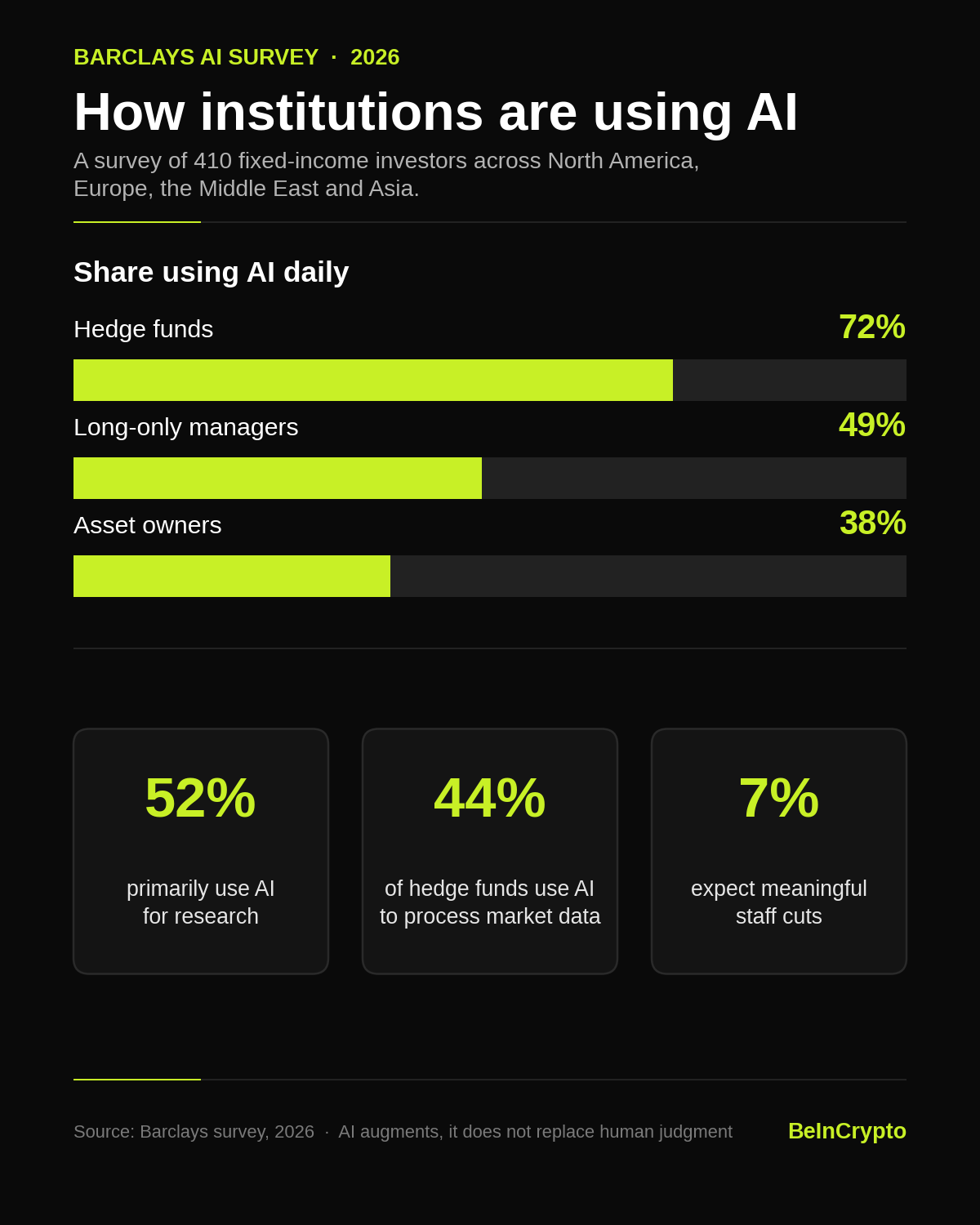
The survey polled 410 fixed-income investors across North America, Europe, the Middle East and Asia. It found AI has moved past testing and into everyday use, though humans still make the final calls.
Barclays AI Survey Shows Research Leads Adoption
Research is the leading use. About 52% of long-only managers and asset owners use AI mainly for research, Barclays found. Another 44% of hedge funds lean on it to process market data.
Hedge funds are the heaviest users. Some 72% report using AI daily, compared with 49% of long-only managers and 38% of asset owners. That gap tracks broader signs of strong institutional AI demand.
By contrast, AI stays on the sidelines in trading and execution. Most respondents see only minor impact there, and they ranked data security as the top barrier to wider use.
Few expect the shift to cost jobs. Only 7% foresee meaningful staff cuts, while most predict higher output and steady headcount.

Andreessen Ties AI Growth To Energy And Cooling
Marc Andreessen, cofounder of venture firm Andreessen Horowitz, tied AI’s future to physical limits in a recent post. The framing extends his long-running case for energy abundance.
The AI:AC Hypothesis. In the future, in each country, the amount of AI will be proportional to the amount of AC. And vice versa,” Marc Andreessen said in a post.
Follow us on X to get the latest news as it happens
His point is about power and heat. AI servers draw heavy power, and cooling them draws more, feeding a steep rise in AI electricity consumption.
The IEA expects data center demand to more than double by 2030, to about 945 terawatt hours. That is close to Japan’s total power use today.
The strain falls hardest on the United States. There, data centers may soon use more power than US aluminum, steel and cement production combined, per the IEA. Regions with cheap, reliable power will attract the most AI.
What The Pairing Means For Investors
Together, the two threads tell one story. Barclays shows demand for AI is already here. Andreessen flags the energy and cooling limits that will sort the winners from the rest.
Institutional money is funding both sides. The hyperscalers building that capacity include Microsoft, Amazon, Alphabet and Meta.
The four have set out a combined $725 billion in 2026 capital guidance, up 77% on this year.
The grid keeping pace may shape the next phase of AI energy consumption debates and the returns that follow.
The post Barclays Finds AI Is Now Essential for Institutions, But Andreessen Questions Grid Readiness appeared first on BeInCrypto.
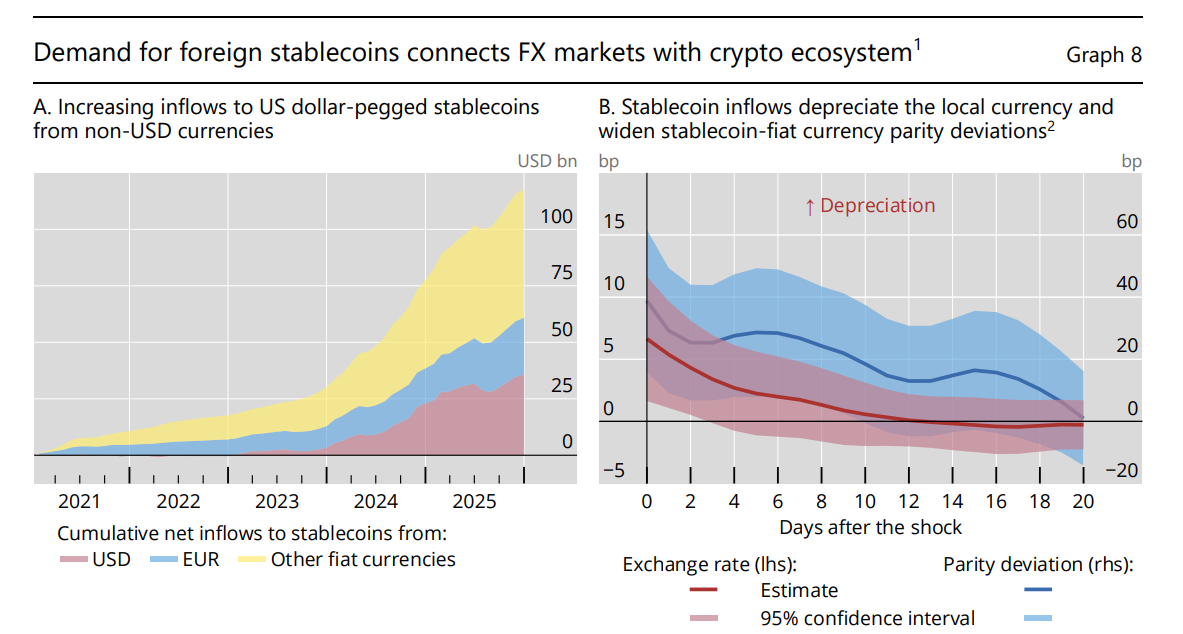
The Bank for International Settlements (BIS) warned that the rapid expansion of stablecoins risks fragmenting the global monetary system and weakening sovereign monetary control, urging central banks and the financial industry to accelerate the development of tokenized forms of central bank and commercial bank money as a safer alternative.
In its Annual Economic Report published Sunday, the Basel-based institution delivered a sharp assessment of the approximately $316 billion stablecoin market, arguing that tokens pegged to fiat currencies lack the institutional features required to serve as safe, reliable money at scale.
BIS pointed to structural vulnerabilities in reserve asset management and warned that a significant migration from commercial bank deposits into private digital tokens could reduce bank funding and constrain credit to the real economy.
The report also provides a signal to policymakers that the current regulatory approach to stablecoins may prove insufficient if private digital currencies continue expanding. Rather than positioning stablecoins as a durable foundation for the future monetary system, BIS said that tokenized commercial bank deposits, combined with tokenized central bank money operating on regulated infrastructures, offer a more robust path toward modernizing payments while preserving monetary stability.
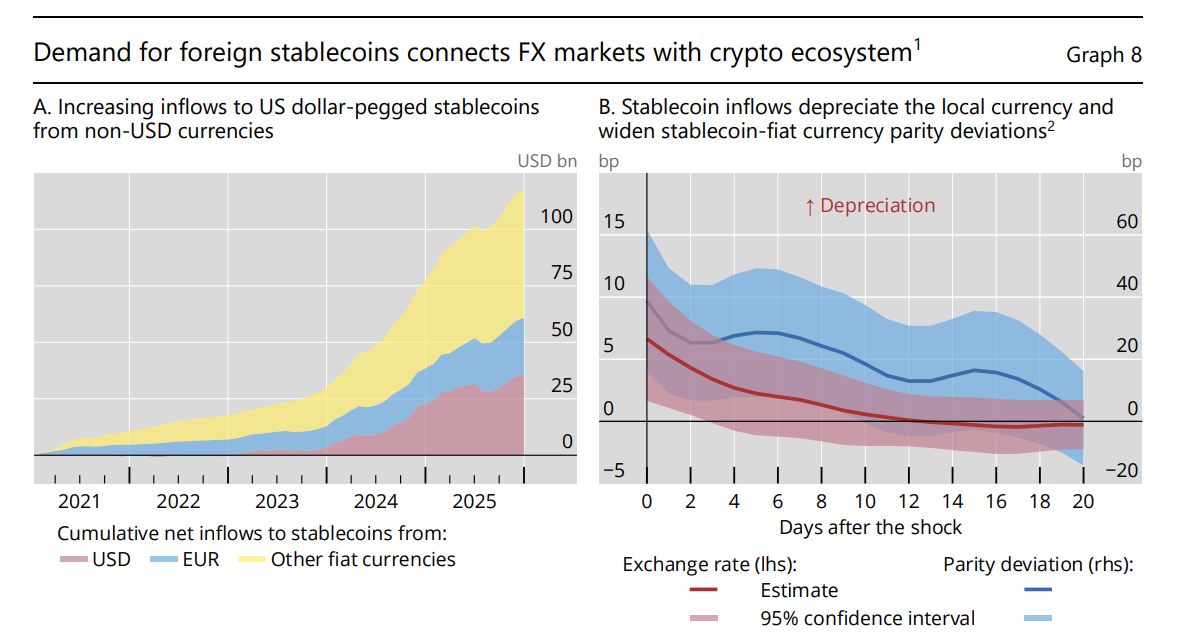
Demand for foreign stablecoins connects FX markets with crypto ecosystem. Source: BIS Annual Economic Report 2026.
The report focuses particular attention on “stablecoin dollarization,” that is, the growing use of dollar-denominated stablecoins in economies with weaker domestic currencies. According to BIS, this trend could weaken monetary sovereignty, erode the effectiveness of domestic monetary policy, reduce bank intermediation and increase exposure to volatile cross-border capital flows, particularly in emerging market economies.
Related: BIS Project Agorá shows tokenized payments can settle in seconds
BIS raises fresh concerns about public blockchains’ limits
The report also delivers one of BIS’s strongest critiques yet of public permissionless blockchains such as Bitcoin and Ethereum as a foundation for the monetary system. It argues that decentralized networks relying on distributed validation and lacking a central governance structure struggle to meet the requirements for scalability, legal accountability and settlement finality expected of systemically important financial infrastructure.
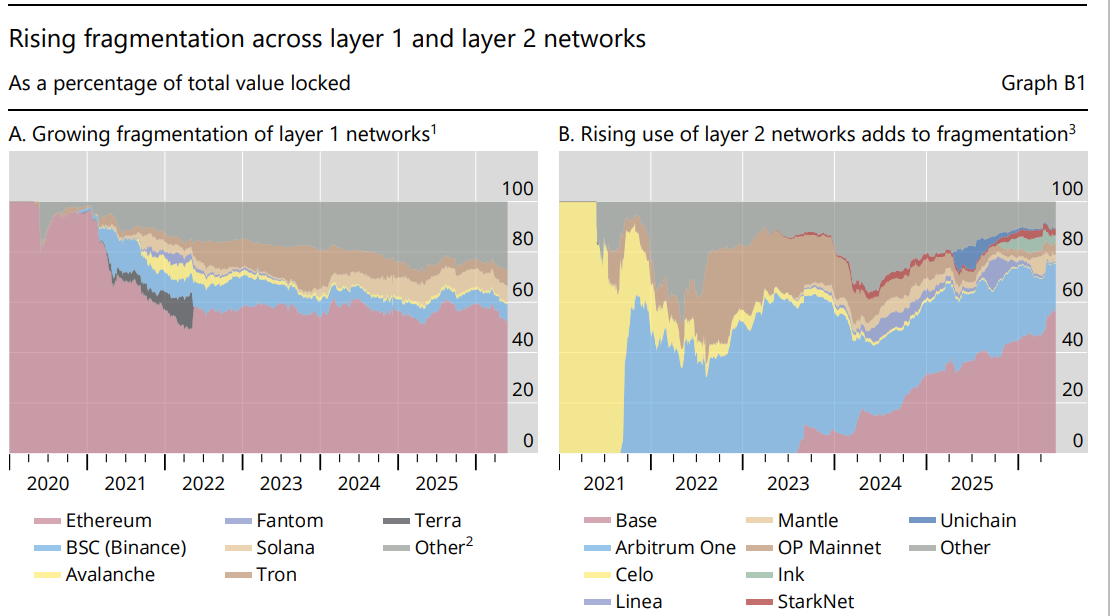
BIS raises concerns on rising fragmentation across layer 1 and layer 2 networks.
Source: BIS Annual Economic Report 2026.
At the center of BIS’s critique is the economics of decentralized consensus. The report argues that public permissionless blockchains compensate validators through transaction fees that rise as network activity increases, making congestion, longer confirmation times and higher costs structural features of the system rather than temporary technical shortcomings. According to BIS, these characteristics undermine the efficiency and network effects that are essential for a unified monetary system.
The Basel-based institution further argues that permissionless blockchains lack the clear governance and accountability frameworks required for institutional finance. Without an identifiable entity responsible for maintaining the integrity of the system, resolving disputes or ensuring compliance with financial integrity standards, BIS contends that such networks face significant obstacles to supporting large-scale regulated financial activity.
Rather than rejecting tokenization itself, BIS advocates a “unified ledger” architecture that combines tokenized central bank money, tokenized commercial bank deposits and tokenized financial assets on programmable platforms operating within regulated legal and institutional frameworks.
By preserving the benefits of tokenization, including programmable transactions and faster settlement, while maintaining the institutional foundations of the existing monetary system, BIS said that financial markets can improve efficiency without sacrificing monetary stability, financial integrity or public trust.

According to this week’s report from crypto market tracker CryptoRank, DeFi platforms suffered 121 hacks so far this year, resulting in approximately $942 million in losses.
The second quarter accounted for 85 incidents and about $775 million stolen, placing it as the most active period ever for exploits in the crypto sector.
The surge in attacks is against a backdrop of a crypto market struggle, pervaded by weakening investor confidence. Total value locked (TVL) in DeFi protocols has fallen every month this year, dropping from about $115 billion in January to $70 billion in late June.
Drift Protocol, KelpDAO Exploits Hiked Q2 Losses
Per CryptoRank’s data, Q2 2026’s 85 incidents are 49 more than the period with the second-highest frequency of exploits, which happens to be Q1 2026. However, total dollar-denominated losses were not as high as previous peaks, with the data provider reporting that two back-to-back attacks in April accounted for the majority of losses recorded in the quarter.
Drift Protocol and KelpDAO lost a combined $590 million, which is more than half of all the DeFi losses recorded in 2026. Drift Protocol disclosed that attackers had stolen about $285 million in user assets, with blockchain intelligence firm TRM Labs’s investigations linking the operation to hacking outfits connected with North Korea.
According to TRM, preparations for the attack started on-chain as early as March 11 with a 10 ETH withdrawal from Tornado Cash. The crypto tumbler transaction came after months of in-person meetings between the Pyongyang proxies and Drift employees.
“The attacker used social engineering to induce Drift Security Council multisig signers into pre-signing transactions that appeared routine but carried hidden authorizations for critical admin actions,” the firm wrote in a report published April 30.
Just over two weeks later, North Korea’s Lazarus Group exploited the liquid restaking protocol KelpDAO’s LayerZero bridge infrastructure and stole roughly $290 million worth of rsETH.
Chainalysis mentioned at the time that the attackers forged a cross-chain message on April 18 after compromising two remote procedure call nodes used by LayerZero’s Decentralized Verifier Network. At the same time, the criminals struck a third node with a distributed denial-of-service attack, making the system use compromised verifiers.
The verification process was rigged to allow for the creation of rsETH tokens on Ethereum without burning the corresponding assets on Unichain. Within days of the attack, lending protocol Aave’s TVL dropped from $26.4 billion to $14.3 billion, clocking $12 billion in withdrawn funds and a decline of about 46%.
Hacks Were One Problem; a Shrinking Market Was Another
Aave’s TVL dip wasn’t unique, with CryptoRank’s data showing the value locked in all of DeFi falling every single month in 2026, going from $115.3 billion in January to just over $70 billion in June. And while hacks were not the main reason for the decline, the firm noted that the frequency of incidents likely made users less confident, leading to a wider rotation away from the sector.
But the drop hasn’t been as bad as the one in the 2021-2022 cycle when the DeFi TVL tanked more than 70% in seven months. The current dip has been much slower, and the market has also been different structurally, CryptoQuant says, with the stablecoin supply growing to about $300 billion, real-world asset tokenization expanding, and capital dispersed across more sectors like derivatives, infrastructure, and lending, instead of being concentrated in a handful of AMMs and yield farms.
However, among the largest ecosystems by TVL, only Tron and Hyperliquid have managed to grow this year, with the former gaining 5% and the latter adding nearly 7% as it became the dominant venue for on-chain perpetuals. The rest of the top 10 chains are deeply in the red, with the worst hit being Plasma and Arbitrum, which have so far seen their TVL plunge by 74.6% and 55%, respectively.
The post Report: Q2 2026 Becomes Worst Quarter Ever for Crypto Hacks appeared first on CryptoPotato.

Diamond League Paris: Georgia Hunter Bell triumphs in 1,500m again

Europe Makes Bold Play for Anthropic After US AI Restrictions

Cheryl Reeve ties WNBA coaching wins record as Lynx beat Wings


-
 Sports5 days ago
Two goals and an assist by sheer aura: Cristiano Ronaldo just entered the World Cup chat
-

 Tech6 days ago
Microsoft accidentally kills epic Outlook email threads
-

 Fashion2 days ago
Weekend Open Thread: Staud – Corporette.com
-

 Politics3 days ago
The House | Manchesterism won’t survive the painful trade-offs unless it gets citizens on board
-

 Politics3 days ago
Potential 2028er World Cup attendee leaderboard
-

 Business3 days ago
Asia stock markets slide as tech shares slump
-

 Tech3 days ago
A Look At A Gaggle Of Transputer Boards
-
Crypto World5 days ago
Bitcoin (BTC) Dips Below $62K, Ethereum (ETH) Plunges 6% Daily: Market Watch
-
 Crypto World3 days ago
Dell (DELL) Shares Tumble Over 5% Following Analyst Downgrade to Hold
-

 Crypto World5 days ago
Securitize Wraps Roubini's SEC-Registered ETF as Dubai VARA Digital Security
-
Business5 days ago
Entergy settles forward sale agreements, raises $672 million in cash proceeds
-

 Crypto World2 days ago
Kraken's xStocks Opens Bending Spoons IPO Registration to EEA Retail
-

 Sports2 days ago
FIH Pro League: India defeat Pakistan 7-1, register biggest win of campaign | Other Sports News
-

 Crypto World1 day ago
Coinbase, Circle Deepen Crypto Stock Losses Despite Resilient S&P 500
-

 Crypto World2 days ago
RTX holders must register wallets before token distribution begins
-
Crypto World2 days ago
Hyperliquid Named on Singapore MAS Investor Alert Register
-

 Sports3 days ago
India vs Bangladesh LIVE Score, Women’s T20 World Cup: Bangladesh Opt To Bat; India Enter ‘Do-Or-Die’ Stage As Semi-Final Race Heats Up
-
Crypto World3 days ago
The DATA Foundation Launches to Tackle AI’s Multi-Billion Dollar Training Data Bottleneck
-

 Crypto World3 days ago
21Shares Cuts 2026 Crypto Forecasts as Institutional Demand Rises
-
 Crypto World3 days ago
AAVE price tests 9-month trendline after 17% rebound as breakout hopes build
You must be logged in to post a comment Login