
Crypto World
How CoreWeave and Miners Pivoted to AI Workloads


CoreWeave’s transformation from a crypto-mining operator to a large-scale AI infrastructure provider highlights a broader shift in how computing resources are reused across technology cycles. A recent briefing from The Miner Mag outlined how Ethereum’s move away from proof-of-work reduced demand for GPU-based mining, prompting CoreWeave and peers to redeploy GPUs toward AI training and other high-performance computing workloads as demand for compute power surged. As reported by Cointelegraph, CoreWeave began moving away from crypto mining as early as 2019, initially pivoting into cloud and high-performance computing before fully positioning itself as a GPU infrastructure provider for AI workloads. That pivot has gained momentum in recent quarters, aided by strategic capital injections that some observers see elevating CoreWeave to a leading role outside the largest hyperscale cloud providers.
Market chatter around CoreWeave’s ascent intensified after Nvidia disclosed a $2 billion equity investment in the company, a move Miner Mag described as a clear signal that CoreWeave has carved out a substantial niche among independent GPU infrastructure operators. The investment underscores a broader industry trend: assets once tethered to mining are being repurposed to support AI training, inference workloads, and other AI-centric compute pipelines demanded by researchers and enterprises alike. In effect, CoreWeave’s trajectory mirrors a multiyear shift in the compute ecosystem—from energy-intensive mining to purpose-built AI data-center capacity that can scale across diverse workloads.
Beyond the capital inflection point, CoreWeave’s growth has translated into notable liquidity for its leadership. The publication citing the situation noted executives have realized roughly $1.6 billion in proceeds from stock sales since the company’s initial public offering in March of last year, a signal of investor enthusiasm but also an ongoing liquidity story for insiders tied to the company’s performance in a niche but rapidly expanding segment of the GPU infrastructure world. The dynamic raises questions about how early winners in the AI compute race will monetize their positions as market competition intensifies and new entrants flood the space with capacity and price pressure.
Key takeaways
- CoreWeave transitioned from a crypto-mining focus to AI-centric GPU infrastructure, leveraging leveraged compute resources originally built for mining into AI data-center capacity.
- Nvidia’s $2 billion equity investment is a turning point, reinforcing CoreWeave’s status among independent GPU providers outside the big cloud platforms.
- Insider liquidity has grown, with approximately $1.6 billion in stock-sale proceeds since the IPO in March last year, highlighting strong investor interest but also the concentration of upside for insiders.
- The AI data-center sector is expanding rapidly, with thousands of entrants anticipated and a potential reshaping of market share away from a narrow group of Big Tech players by the early 2030s.
- Local resistance and regulatory scrutiny over power use, grid strain, and land use echo the challenges historically faced by Bitcoin miners as facilities scale.
- The broader data-center landscape is expected to become more fragmented and competitive, potentially altering how compute capacity is controlled and priced in the coming years.
Tickers mentioned: $BTC, $ETH, $CRWV, $MARA
Sentiment: Neutral
Market context: The shift from mining to AI compute sits within a broader lull-and-build cycle for crypto-adjacent infrastructure. As thousands of new entrants enter the data-center space, the concentration of compute capacity among a few giants could wane, aligning with DC Byte projections that Big Tech’s share of global computing capacity may decline by 2032, creating a more fragmented market landscape and shifting the risk/return dynamics for operators and investors alike.
Why it matters
The CoreWeave case illustrates how the hardware and capital that once powered crypto mining are being repurposed to support AI development at scale. For investors, this shift signals a potential new axis of growth in the GPU infrastructure sector, where demand is rising not only from AI model training but also from broader HPC applications that require high-bandwidth, low-latency compute fabrics. For builders and operators, it underscores the importance of securing access to reliable power, favorable regulatory environments, and seasoned capital as the AI data-center segment matures and competition intensifies.
From a market structure perspective, the transition points to a future where independent GPU infrastructure operators could play a larger role in providing specialized compute beyond the reach of the largest hyperscalers. This outcome could potentially foster more innovation, lower prices for AI workloads, and greater resilience across the AI supply chain—but it also introduces new risks, including capital intensity, long asset lifecycles, and regulatory headwinds tied to energy usage and land development. The Bloomberg/DC Byte line of thinking suggests that as thousands of new entrants enter the sector, control over capacity may become more diffuse, with implications for pricing, reliability, and service-level expectations across industries relying on AI acceleration.
On the technology side, CoreWeave’s path mirrors a broader convergence of crypto-adjacent firms with AI cloud services. The ability to repurpose GPUs, accelerators, and data-center footprints earned during the crypto era into AI-focused workloads demonstrates the resilience and adaptability of modern compute assets. It also raises questions about how future capital markets will value such pivots: will insiders continue to realize outsized liquidity, or will public markets demand a more diversified revenue stream and longer-term profitability profiles as AI adoption accelerates?
What to watch next
- Monitor Nvidia’s ongoing strategic commitments and any subsequent funding rounds or partnerships that deepen CoreWeave’s role in AI infrastructure.
- Track regulatory developments around AI data centers, energy consumption, and grid impacts in regions hosting large facilities.
- Follow signals from DC Byte and Bloomberg analyses on global data-center capacity concentration and potential shifts in market share by 2032.
- Observe new entrants in the GPU infrastructure space and any consolidation activity as the sector matures.
- Watch for additional milestones related to CoreWeave’s platform capabilities, performance benchmarks, and enterprise adoption in AI workloads.
Sources & verification
- Miner Mag’s coverage of CoreWeave’s AI pivot and the Ethereum mining demand shift.
- Cointelegraph’s report on CoreWeave’s 2019 pivot away from crypto mining toward cloud and HPC, then AI GPU infrastructure.
- Miner Mag’s note on Nvidia’s $2 billion equity investment in CoreWeave and its implications for independent GPU operators.
- The IPO and insider liquidity figure cited by Miner Mag, noting $1.6 billion in stock-sale proceeds since the March IPO.
- Bloomberg / DC Byte research cited regarding the expected fragmentation of the global data-center market and the potential decline of Big Tech’s share by 2032.
- Cointelegraph’s coverage of AI data centers’ local resistance in relation to power consumption, grid strain, and land use.
Market reaction and key details
CoreWeave’s pivot is a telling case of how compute assets can migrate across cycles, reshaping the competitive landscape for GPU infrastructure providers. The Nvidia investment adds a layer of strategic validation, aligning the company with a leading chipmaker’s ecosystem and signaling confidence in CoreWeave’s ability to scale AI-specific capacity. As the AI compute segment grows, the industry will be watching how the company manages operational challenges—ranging from power requirements and grid reliability to regulatory scrutiny and community concerns in host regions.
What to watch next
- NVIDIA’s ongoing partnerships and capital deployments with CoreWeave or similar independent GPU operators.
- Regulatory and community responses to the expansion of AI data centers, especially regarding energy and land-use impacts.
- Capacity growth and pricing dynamics as thousands of new entrants enter the data-center arena, according to industry research.
https://platform.twitter.com/widgets.js



Hong Kong granted its first two stablecoin issuer licenses to HSBC and Anchorpoint Financial, a Standard Chartered-led consortium that includes Animoca Brands on Friday.
The approvals by the Hong Kong Monetary Authority (HKMA), the territory’s central bank, mark the first batch under the Stablecoins Ordinance, which took effect in August 2025.
“We look forward to the issuers launching business according to their plans, exploring growth opportunities while properly managing risks,” HKMA chief executive Eddie Yue said in an announcement on Friday.
“We hope their promotion of regulated stablecoins will address pain points in financial and economic activities, create values for both individuals and businesses, and support the healthy development of digital assets in Hong Kong.”
The HKMA assessed 36 applications and had signaled that the initial round would be limited. Financial Secretary Paul Chan said in his February budget address that only “a small number” would be approved, with the regulator prioritizing risk management, reserve quality, and anti-money-laundering controls.
The decision to license the city’s note-issuing banks first appears to be deliberate. HSBC and Standard Chartered are two of only three commercial banks authorized to print Hong Kong dollar banknotes, a system that dates to 1846, when private banks began issuing currency backed by silver deposits in the absence of a colonial central bank.
Today, each note-issuing bank deposits U.S. dollars with the government’s Exchange Fund at the fixed rate of HK$7.80 per dollar and receives Certificates of Indebtedness in return, against which it prints banknotes.
Yue drew the parallel in a December 2023 blog post.
Pre-1935 banknotes issued by commercial banks in exchange for deposited silver were a form of “private money,” Yue wrote, and stablecoins function as their blockchain-based equivalent — tokens with stable value that can serve as a medium of exchange on-chain.
A strict identity regime
The licenses come with one of the world’s strictest KYC frameworks for digital money.
Under the HKMA’s AML guidelines, licensed stablecoins can only be transferred to wallets whose owners have been identity-verified. The travel rule applies to transfers above HK$8,000 (~$1,000).
In practice, this means HKD stablecoins will likely embed compliance checks into their smart contracts, restricting transfers to wallets listed in an on-chain white list. That makes them structurally different from freely transferable tokens like USDT or USDC.
A HKD CBDC takes a back seat
The bank-led stablecoin model also reflects the HKMA’s decision to deprioritize its central bank digital currency for retail use, as an 11-group pilot program completed in October found the retail case was weak.
CBDCs have historically been a big theme at Hong Kong Fintech Week. Last year, there was barely a mention. Instead, stablecoins were the hot topic.
Standard Chartered CEO Bill Winters said at the time Hong Kong’s push into stablecoins and tokenized deposits could “lay the foundation for a new era of digital trade settlement,” positioning them as a new medium for cross-border commerce.
Whether the market agrees remains to be seen.
Stablecoins are a roughly $310 billion asset class, and USD-denominated tokens dominate nearly all of it.
Data from CoinGecko shows that the largest stablecoins by market cap are dollar-pegged, with no euro-or yen-pegged tokens breaking into the top ranks.
Hong Kong is betting that regulated, bank-issued HKD stablecoins can carve out a role in regional trade settlement, issued by the same institutions, under the same constraints, on new rails.
The question is whether a non-dollar stablecoin, however tightly regulated, can build the network effects needed to compete.
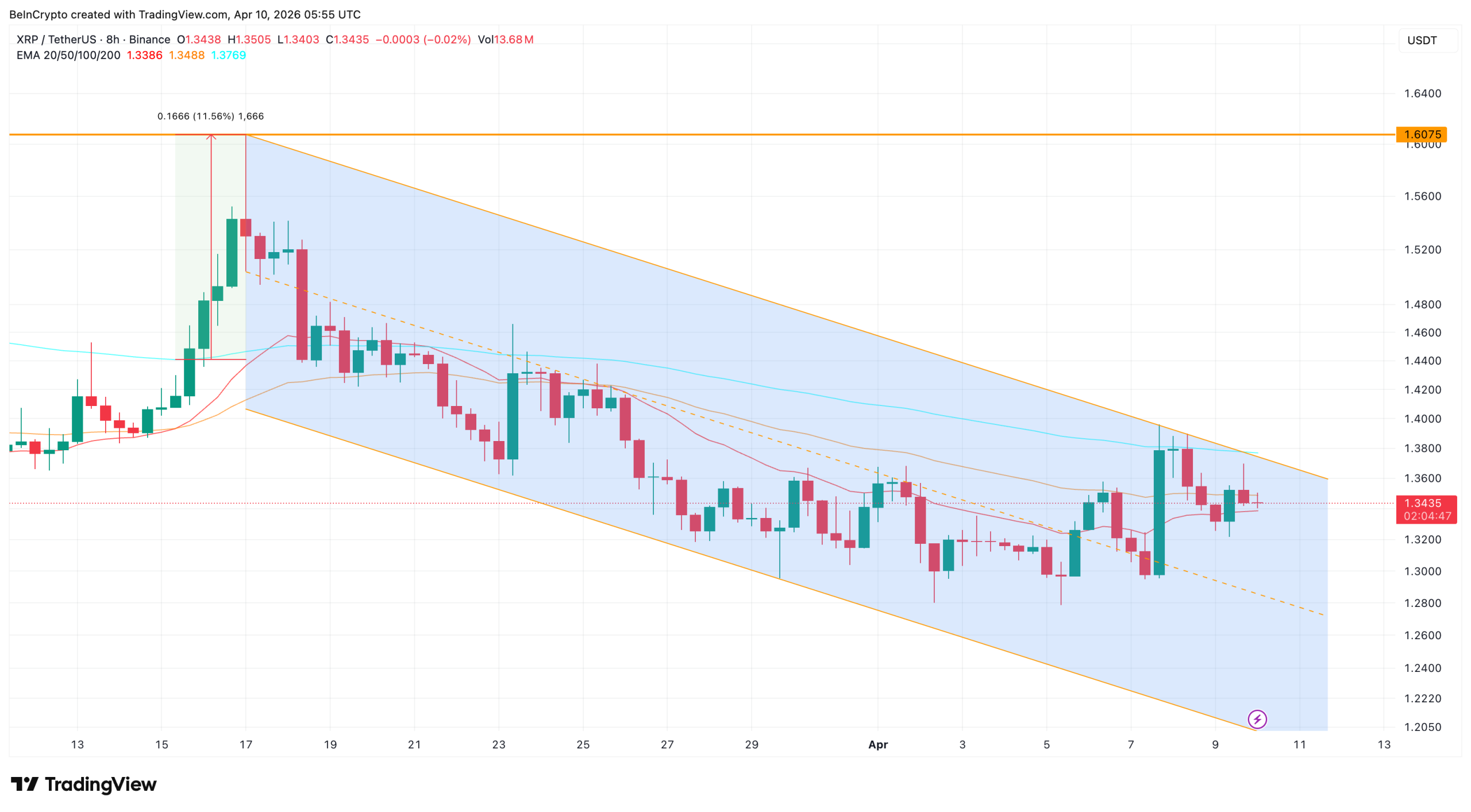
XRP price today sits near $1.34, barely changed over 30 days, down just 2.5%. Yet a shift in who holds XRP (XRP) supply suggests the freeze may not last much longer.
On-chain data reveals the token’s least convinced holders have exited while two whale cohorts added 130 million tokens. With price compressed inside a falling channel, XRP technical analysis points to a convergence that could finally force a direction.
A Falling Channel Keeps Price Frozen Below Key Resistance
XRP price has traded inside a falling channel on the 8-hour chart since its March 17 peak near $1.60. Every attempt to escape since then has failed at the same ceiling.
The most recent rejection came on April 7 and 8. XRP reclaimed the 20-period and 50-period Exponential Moving Averages (EMA), trend indicators that weight recent price moves more heavily. However, the 100-period EMA rejected the advance cleanly.
That level carries weight. Around March 15, XRP reclaimed the 100 EMA and it triggered another 11% rally to the $1.60 high. The same EMA now aligns with the channel’s upper trendline, creating a double XRP resistance wall.
Want more token insights like this? Sign up for Editor Harsh Notariya’s Daily Crypto Newsletter here.
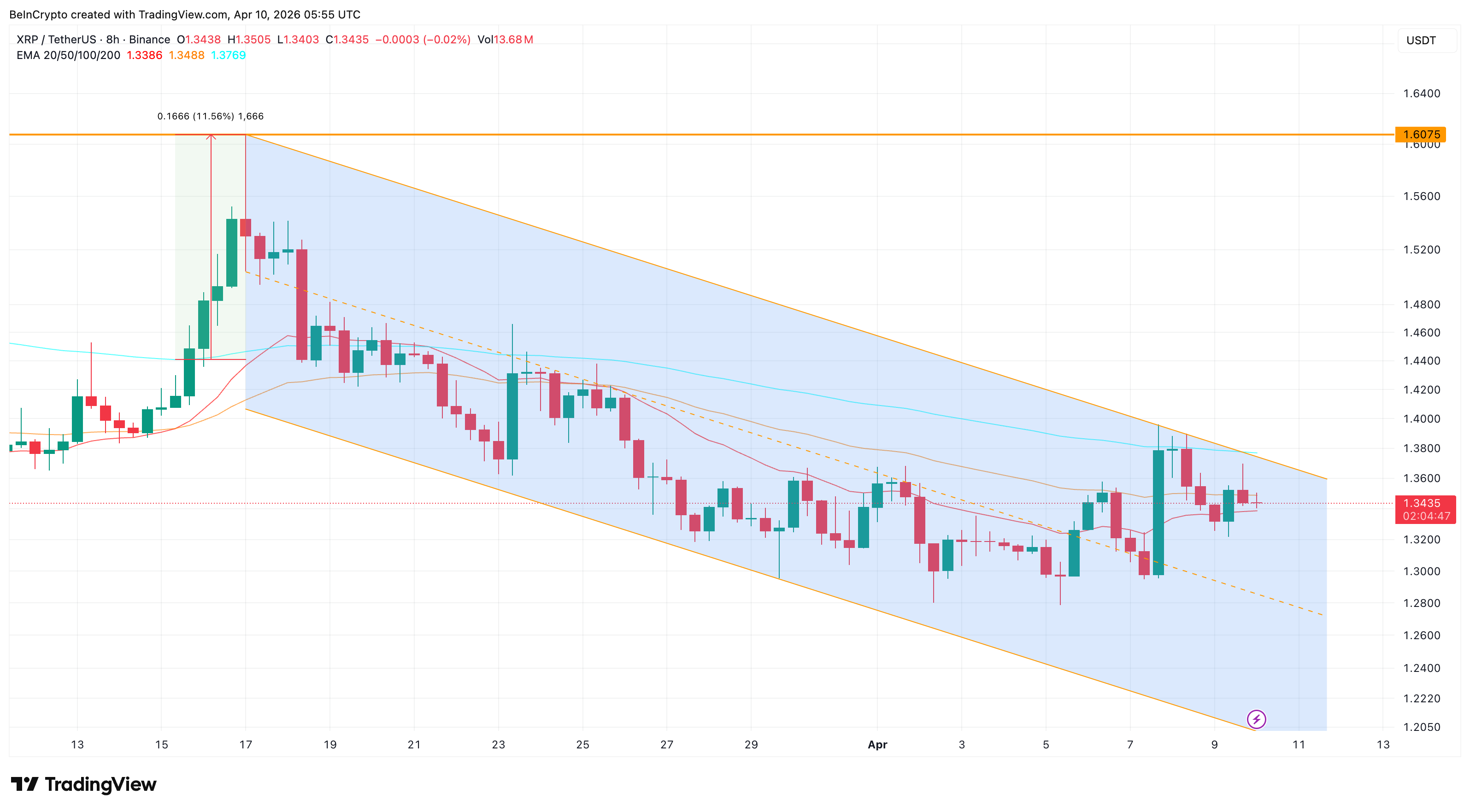
BeInCrypto recently covered a similar setup in Zcash. The token broke above its own falling channel and surged higher. XRP price prediction models suggest a comparable move is possible if this resistance falls.
Yet an EMA alone does not confirm buyer conviction. The answer lies in who is accumulating and who is walking away.
Weakest Holders Walk Out as XRP Whale Accumulation Builds
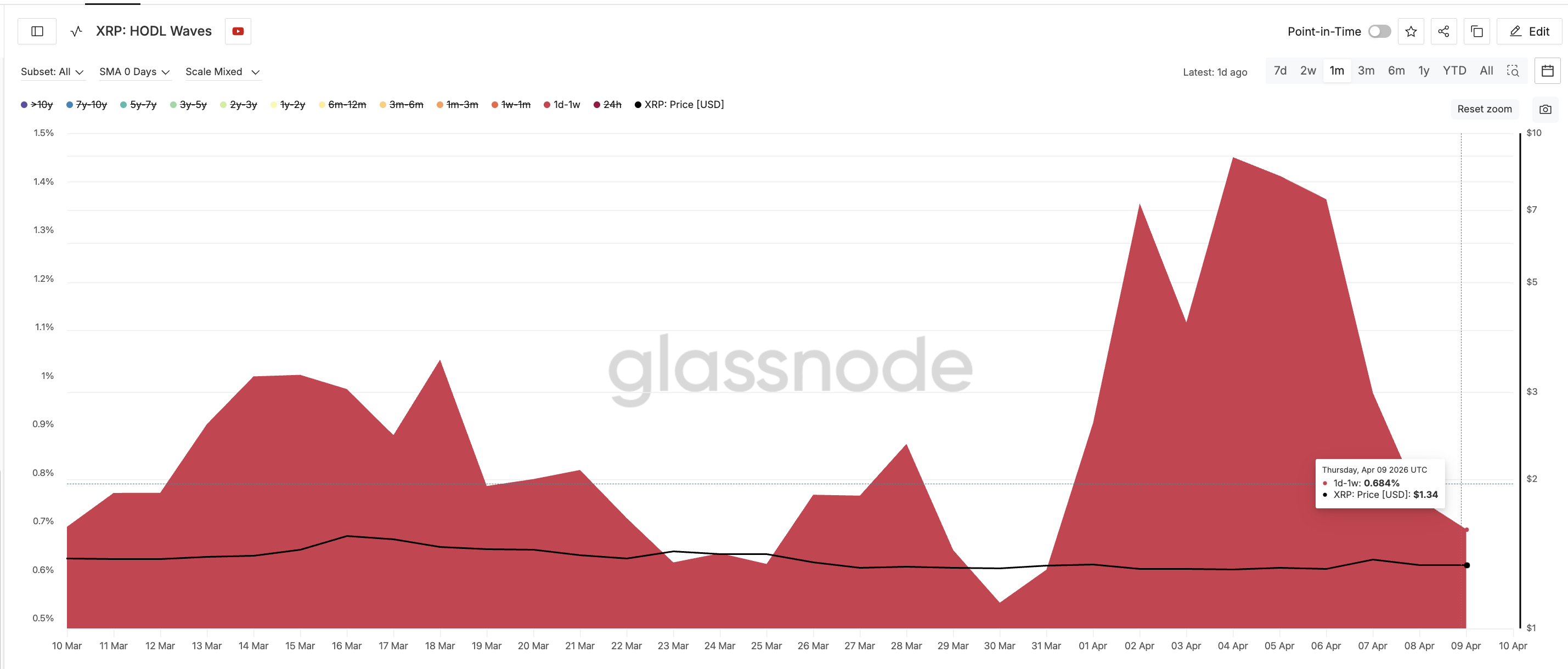
Glassnode data shows that speculative money is draining from XRP. The 1-day to 1-week HODL Waves cohort tracks the share of supply held by the newest holders. It peaked at 1.45% on April 4. That reading has since collapsed to 0.684%.
More than half of this short-term supply exited in under a week. In isolation, that looks bearish. Yet these are the holders who typically sell into every bounce and kill rallies before they start. Their exit may actually be clearing the noise.
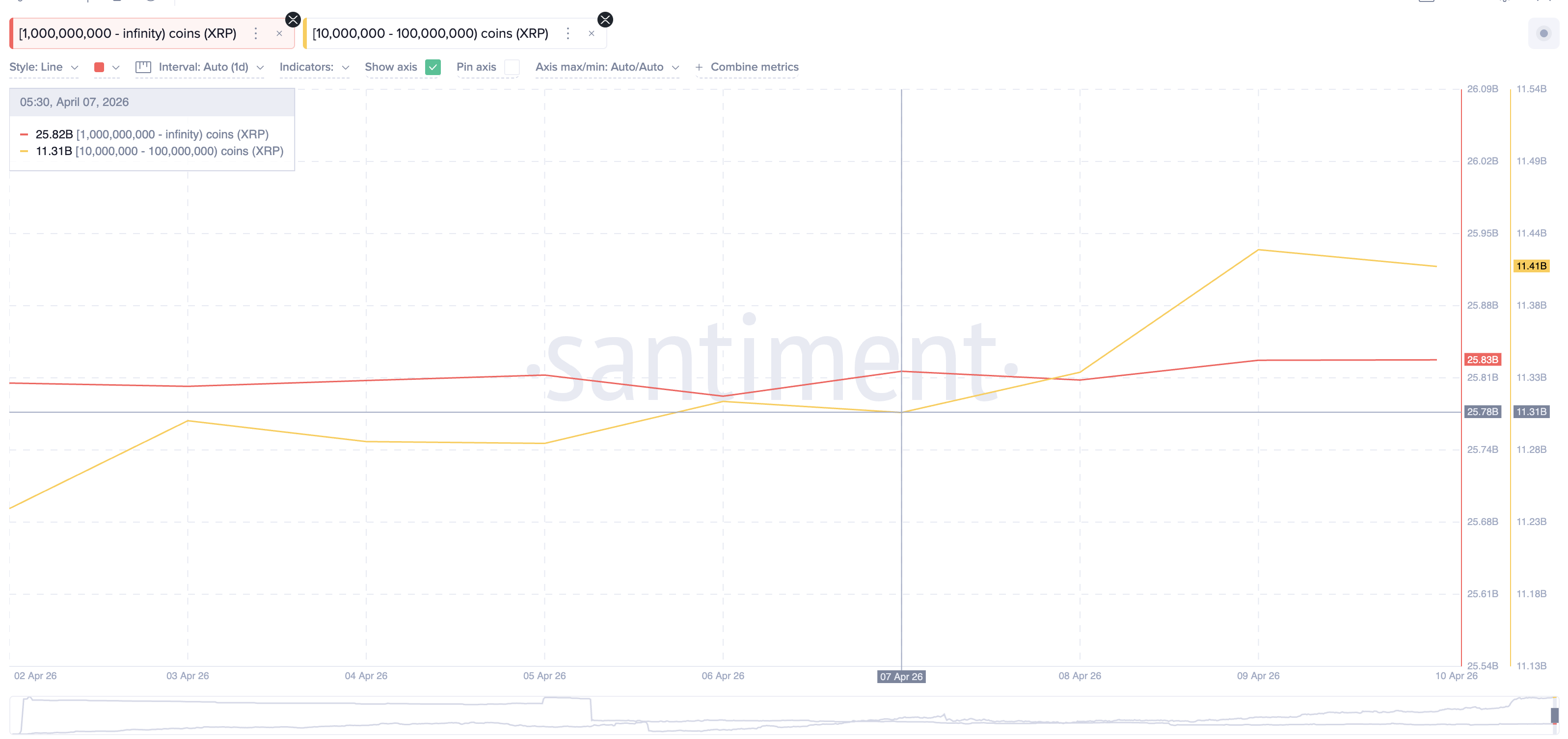
Meanwhile, XRP whale accumulation has picked up from two separate cohorts. Santiment data shows the 1 billion-plus XRP cohort grew from 25.80 billion to 25.83 billion tokens since April 6. The 10 million to 100 million cohort followed a day later, rising from 11.31 billion to 11.41 billion. Together, both groups added roughly 130 million XRP, and only after the speculative traders started selling.
However, the buying remains gradual. A Glassnode cost basis heatmap reveals roughly 420 million XRP sitting in a supply cluster directly overhead, between $1.37 and $1.38.
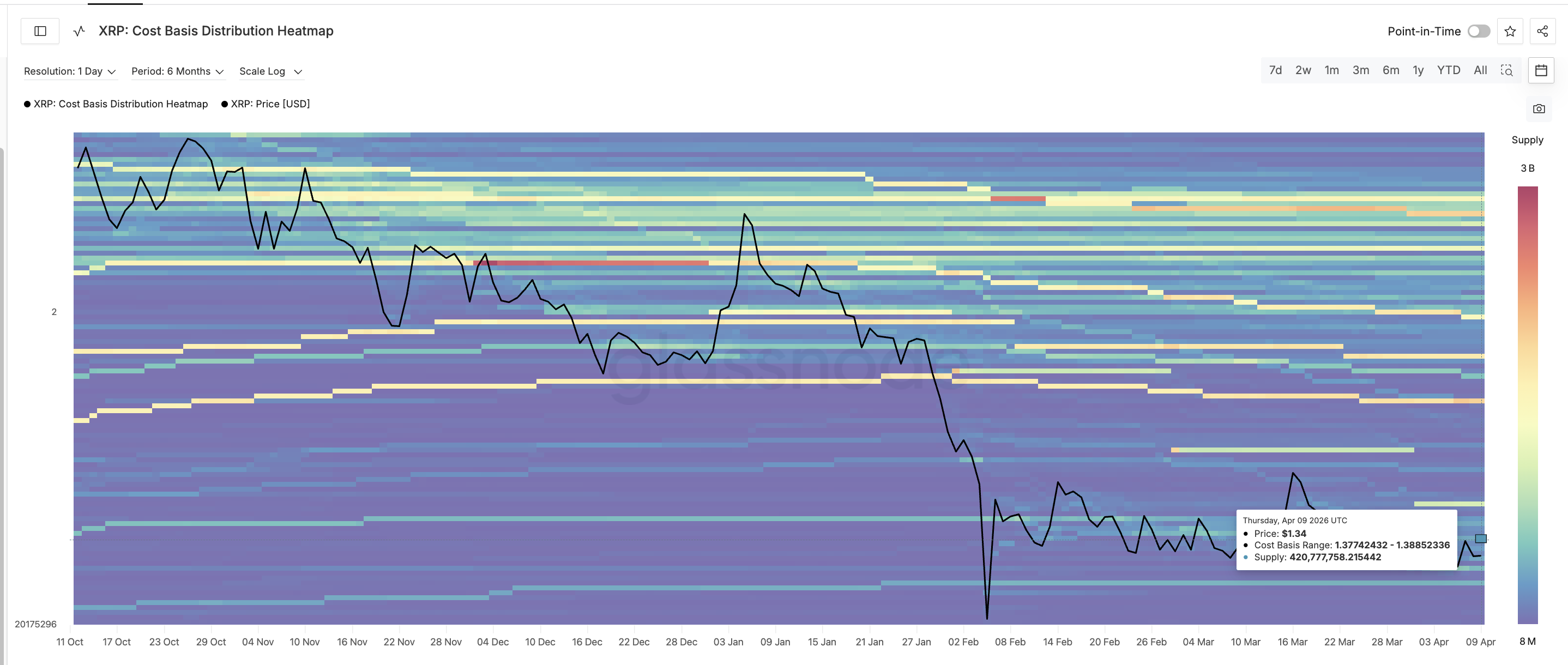
If that cluster’s holders begin selling into strength, whale buying alone may not crack through. The price chart reveals exactly where that wall sits.
XRP Price Levels That Decide Whether the Freeze Breaks
The 8-hour Fibonacci chart maps the convergence zone. The immediate levels are $1.35 ($1.349 to be precise) and $1.36. Reclaiming and holding both would be the first sign of life.
However, $1.38 is where the freeze lives or dies. The 100-period EMA, the channel’s upper trendline, and the 420 million XRP supply cluster all converge at that level. A clean close above $1.380 would confirm the XRP breakout. It would clear the channel, the EMA, and the supply wall simultaneously. Targets then open at $1.43, $1.51, and the March 17 high of $1.60.
Yet failure to reclaim $1.35 would keep XRP price frozen inside the channel. In that scenario, $1.32 becomes the next XRP support level at risk. A deeper breakdown exposes $1.28 ($1.279 to be exact), where buyer interest has previously held.
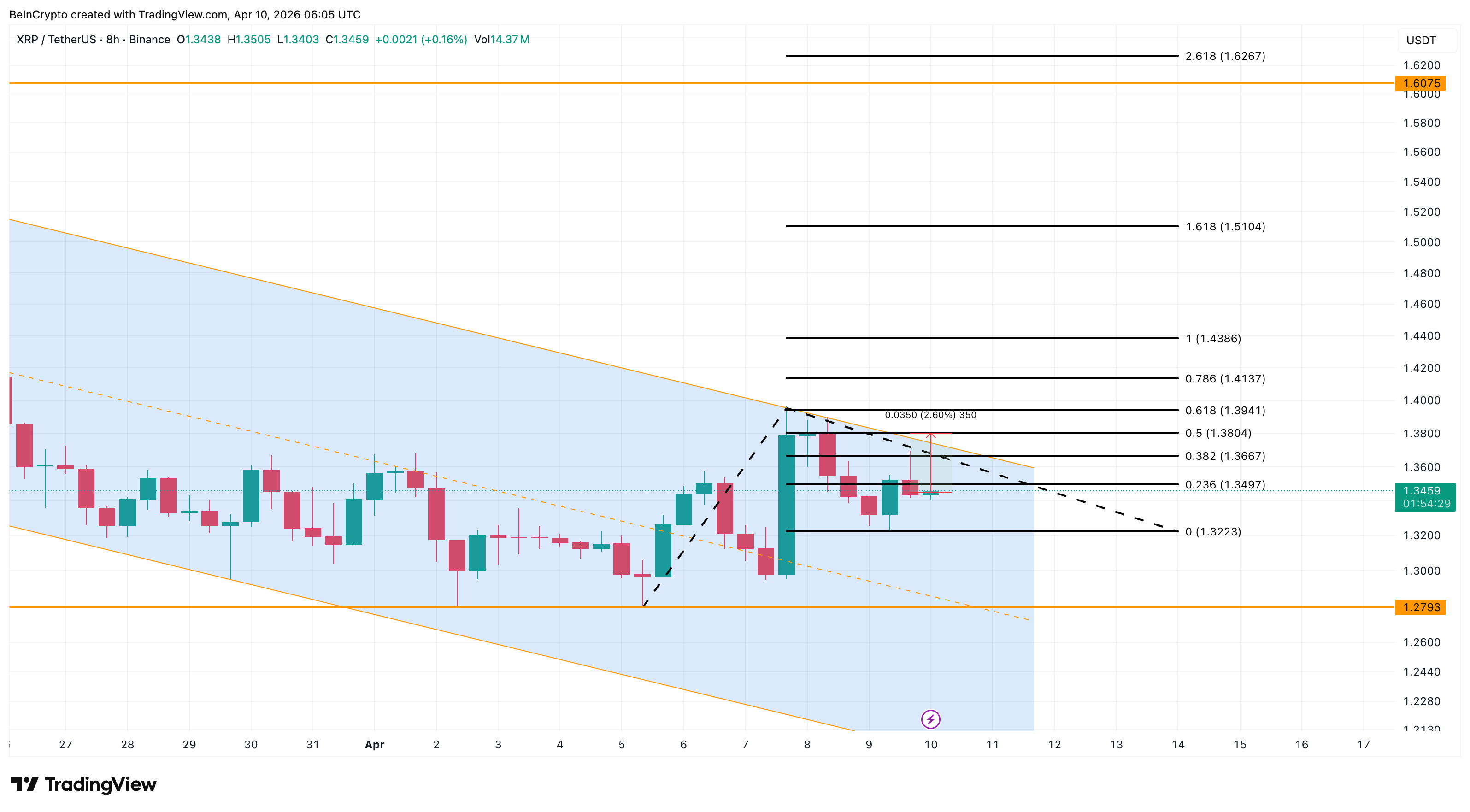
The 30-day freeze has compressed volatility to a breaking point. A close above $1.38 favors the whale thesis and opens a path toward $1.60. A rejection sends XRP back toward $1.28 and turns the freeze into a deeper slide.
The post XRP Price Frozen for a Month? A 130 Million Whale Move May Finally Crack It appeared first on BeInCrypto.


The CIA plans to integrate specialized artificial intelligence into its primary analytics tools to help officers track foreign spies and predict hostile actions from abroad.
Summary
- The CIA plans to embed classified generative AI assistants across its entire analytic infrastructure within two years to help officers identify foreign intelligence trends and draft reports.
- Federal officials are prioritizing these internal AI tools following a government-wide ban on Anthropic technology and an ongoing legal battle over the company’s status as a supply chain risk.
Politico reported that CIA Deputy Director Michael Ellis shared these plans during a Special Competitive Studies Project event in Washington, DC, on Thursday.
He explained that within two years, these “AI co-workers” will be standard across all agency platforms to handle routine tasks.
“Within the next couple of years, we will have AI co-workers built into all of the agency’s analytic platforms — a kind of classified version of generative AI that will help our analysts with basic tasks,” Ellis said.
Security and global competition
These digital assistants are expected to help officers draft judgments and spot patterns in global intelligence, though Ellis clarified that humans will keep control over “key decisions.”
The CIA is forging its own path as the partnership between federal departments and Anthropic hits a breaking point. Following disagreements over the use of the “Claude” AI for surveillance and autonomous weaponry, President Donald Trump ordered federal agencies to stop using the company’s tech in March.
The Department of Defense has since labeled Anthropic a supply chain risk, a move the company is currently challenging in court. While Ellis did not name the firm specifically, he suggested the agency must remain independent of private sector limitations.
“We cannot allow the whims of a single company to constrain our capabilities,” he noted.
The agency is also looking at digital assets as a frontier for national security. Ellis previously mentioned in May that the CIA tracks blockchain data to assist in counterintelligence, viewing cryptocurrency as a vital part of the technological race against China.
The push for better tech is largely driven by a need to maintain an edge over Beijing. Ellis pointed out that the technological lead the U.S. once held has shrunk.
“Five to ten years ago, China was nowhere near America, in terms of technological innovation. That’s just not true today,” he said.

Key Points
-
Over $428M in WLFI collateral deposited on Dolomite sparks concentration worries
-
Platform secures $75M loan using WLFI, moves $40M to Coinbase
-
Token value slides 5.6% in one day, continuing downward trend
-
Experts flag shallow liquidity as potential catalyst for bad debt scenarios
-
Team announces gradual token release plan to maintain market stability
World Liberty Financial has moved to calm market anxiety following heightened attention on its substantial WLFI collateral deployment that prompted liquidation risk discussions throughout decentralized finance communities. The organization defended its lending approach while characterizing concerns as overblown. Yet, declining WLFI valuations and heavy platform concentration maintain pressure on the project.
Massive Collateral Deposit Fuels Borrowing Operations
World Liberty Financial has positioned approximately 5 billion WLFI tokens on Dolomite to serve as loan collateral. Through this mechanism, the organization obtained close to $75 million in stablecoins, primarily USDC and USD1. The magnitude and timing of this operation attracted significant market attention.
Blockchain tracking reveals that more than $40 million subsequently moved to Coinbase Prime from the associated wallet. The transfer happened just before a significant geopolitical development involving U.S. and Iranian relations. This timing sparked speculation regarding strategic motivations and potential vulnerability linked to WLFI holdings.
Platform metrics from Dolomite demonstrate that WLFI currently comprises more than half the protocol’s aggregate supplied capital. The token represents approximately $428.9 million from a total of $825.4 million in deposited assets. Such heavy weighting creates elevated dependency on WLFI performance throughout the lending infrastructure.
Token Valuation Drops as Market Questions Liquidity Depth
WLFI experienced a 5.6% price reduction over a single day as conversations intensified across cryptocurrency channels. The asset has shed 14% of its value during the preceding week under persistent selling activity. This decline heightened apprehension regarding the security of collateralized positions.
Market observers noted that insufficient liquidity depth could obstruct orderly liquidations should WLFI valuations continue declining. Unwinding substantial holdings might prove challenging without incurring significant losses. This dynamic introduces the possibility of uncollectible debt accumulating within Dolomite’s market structure.
Researchers further identified the disconnect between elevated fully diluted valuation and limited actual market depth. Even modest WLFI price deterioration could overwhelm existing liquidation infrastructure. These fundamental vulnerabilities continue fueling the ongoing discourse surrounding WLFI concentration risk.
Platform Leadership Dismisses Concerns and Announces Release Strategy
World Liberty Financial countered liquidation warnings by characterizing them as unfounded speculation and market manipulation. Leadership asserted that adequate collateral margins protect their WLFI borrowing arrangements. The organization further indicated readiness to supplement collateral positions if circumstances warrant.
The initiative also positioned itself as a foundational borrower that enhances yield opportunities for liquidity providers. Leadership therefore presented their activities as advantageous to Dolomite’s overall market health. This stance communicates conviction in WLFI’s sustained importance within the protocol ecosystem.
Simultaneously, World Liberty revealed intentions to introduce a governance proposal addressing token distribution timelines. The forthcoming proposal will establish a staggered release framework instead of immediate full circulation. This methodology seeks to regulate supply dynamics while promoting enduring stability for WLFI markets.

Commodity-linked currencies continue to strengthen, while the US dollar remains under pressure amid easing geopolitical tensions and a shift in investor preference towards riskier assets. Reports of a temporary ceasefire between the US and Iran have helped stabilise sentiment and reduced demand for safe-haven assets, supporting currencies sensitive to the global economic cycle, including the Australian and Canadian dollars.
Another factor weighing on the dollar is expectations around Federal Reserve monetary policy, which remain highly sensitive to incoming macroeconomic data. Lower US Treasury yields and ongoing uncertainty بشأن inflation dynamics are reinforcing cautious market positioning. Against this backdrop, attention is turning to upcoming US data releases, including inflation, consumer sentiment, and business activity indicators, which may reshape interest rate expectations.
AUD/USD
AUD/USD continues its upward move after breaking out of the 0.6840–0.6960 range. The next upside targets are the yearly highs in the 0.7160–0.7180 area. The bullish scenario would be invalidated if the pair falls and holds below 0.7020.
Key events for AUD/USD:
- Today at 15:30 (GMT+3): US Core CPI
- Today at 17:00 (GMT+3): University of Michigan inflation expectations
- Today at 17:00 (GMT+3): University of Michigan consumer sentiment
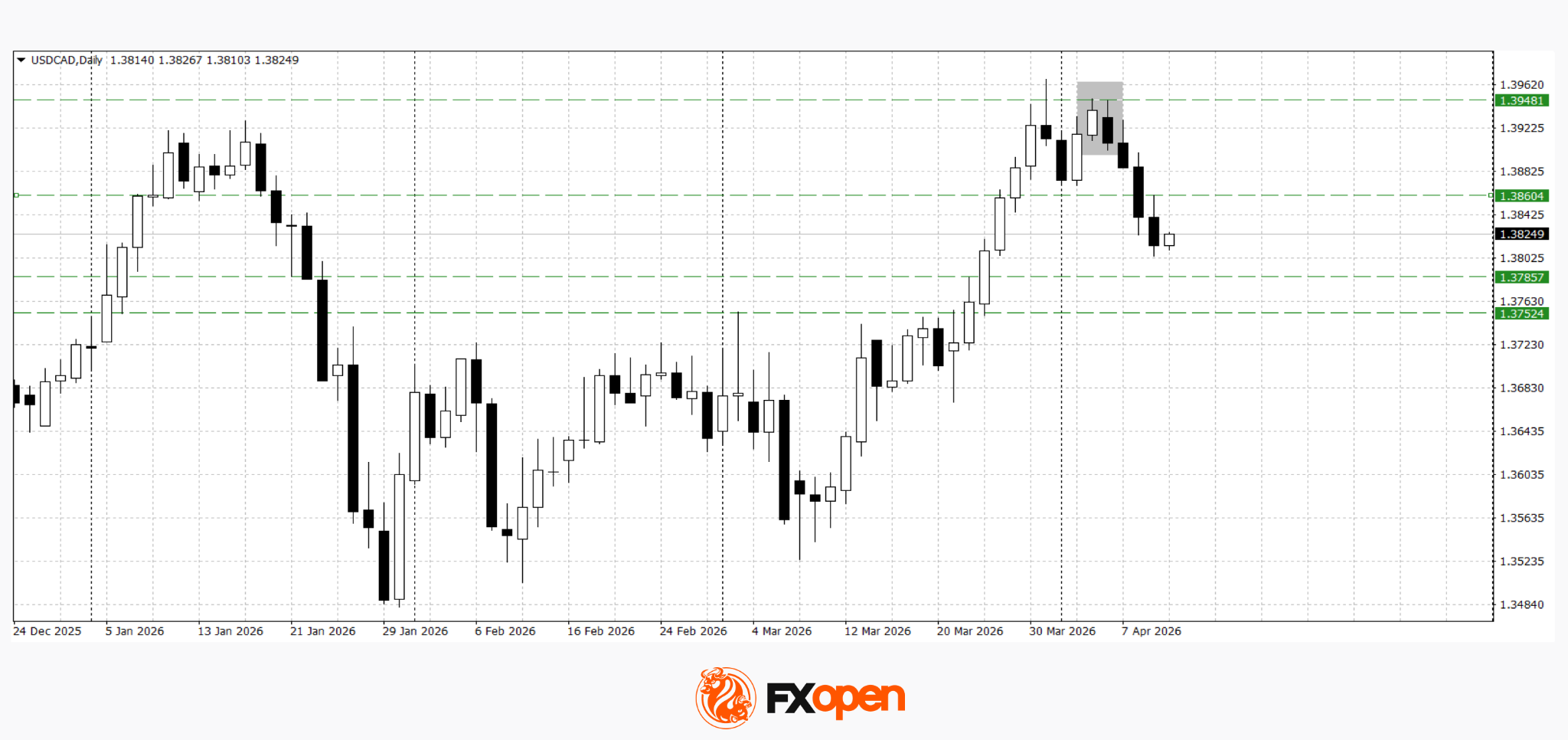
USD/CAD
USD/CAD is trending lower, continuing the move driven by Canadian dollar strength. The downside breakout reflects a shift in favour of commodity currencies, supported by both the broader macro backdrop and expectations ahead of key Canadian data, including the employment report.
Technical analysis suggests a potential decline towards the 1.3750–1.3780 range, as several reversal patterns have formed on the daily timeframe. The bearish outlook would be invalidated if the pair rises and holds above 1.3860.
Key events for USD/CAD:
- Today at 15:30 (GMT+3): Canada unemployment rate
- Today at 15:30 (GMT+3): average hourly wages (permanent employees)
- Today at 22:30 (GMT+3): CFTC net speculative positions in crude oil
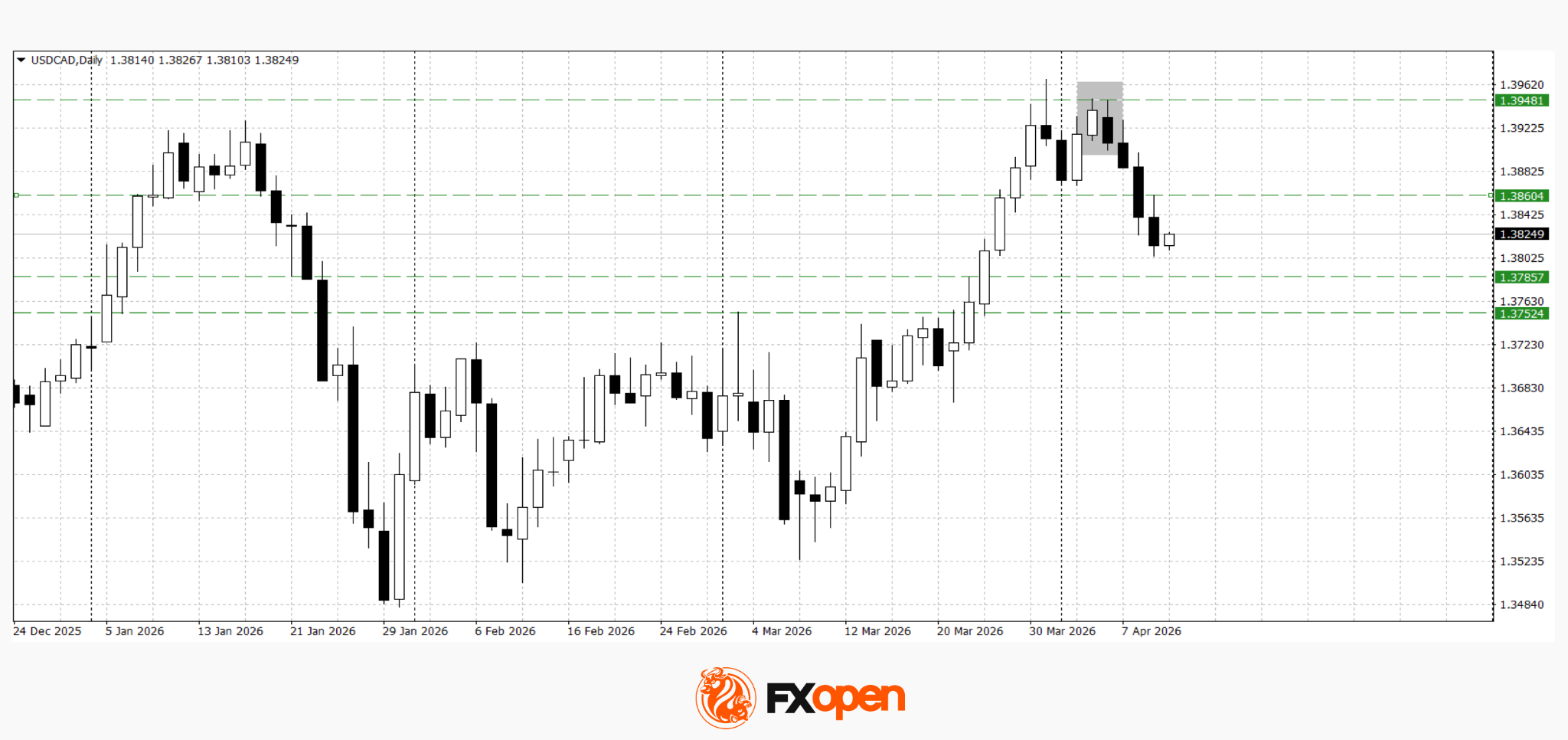
The strength in commodity currencies is being driven by a combination of easing geopolitical risks, a weaker US dollar, and rising demand for risk assets. Breakouts in AUD/USD and USD/CAD reinforce the likelihood of trend continuation; however, upcoming US and Canadian data remain a key source of uncertainty. Depending on the outcome, the current momentum may either extend or shift into a phase of consolidation.
Trade over 50 forex markets 24 hours a day with FXOpen. Take advantage of low commissions, deep liquidity, and spreads from 0.0 pips (additional fees may apply). Open your FXOpen account now or learn more about trading forex with FXOpen.
This article represents the opinion of the Companies operating under the FXOpen brand only. It is not to be construed as an offer, solicitation, or recommendation with respect to products and services provided by the Companies operating under the FXOpen brand, nor is it to be considered financial advice.
Crypto World
Bitcoin Price Builds Its First Breakout Setup of April, but One Metric Dropped Over 50%
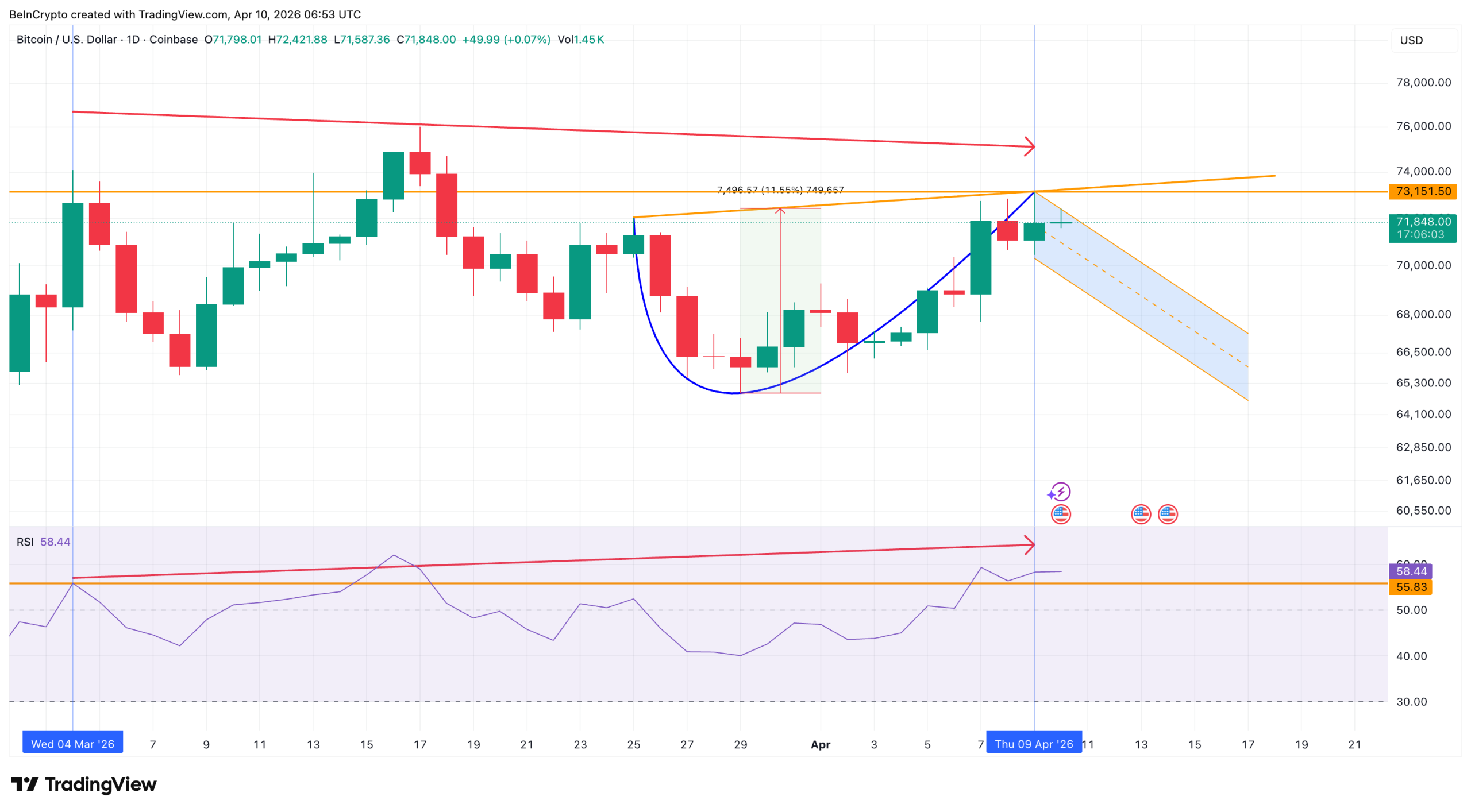
Bitcoin price today trades near $71,800, up roughly 2.9% over the past month. A bullish pattern on Bitcoin’s (BTC) daily chart now points to an 11% breakout target.
Yet the data behind the rally tells a cautious story. Bitcoin open interest has dropped, spot outflows have halved, and long-side conviction is well below earlier levels. The structure is ready. The fuel is not.
Bitcoin Price Builds Breakout Structure as RSI Hints at a Pullback
On the daily chart, the Bitcoin price has formed a clear rounded bottom pattern with a slightly upward-slanting neckline. The cup completed its formation after weeks of gradual recovery from late March lows. Since the April 9 local peak, a consolidation has started that could align with the handle if the pattern continues.
However, momentum tells similar but a more aggressive story. The Relative Strength Index (RSI), a measure of buying and selling pressure, currently sits at 58.44. Between March 4 and April 9, price printed a lower high while RSI printed a higher high. That is a hidden bearish divergence, a pattern that often hints at downtrend continuation.
Want more token insights like this? Sign up for Editor Harsh Notariya’s Daily Crypto Newsletter here.
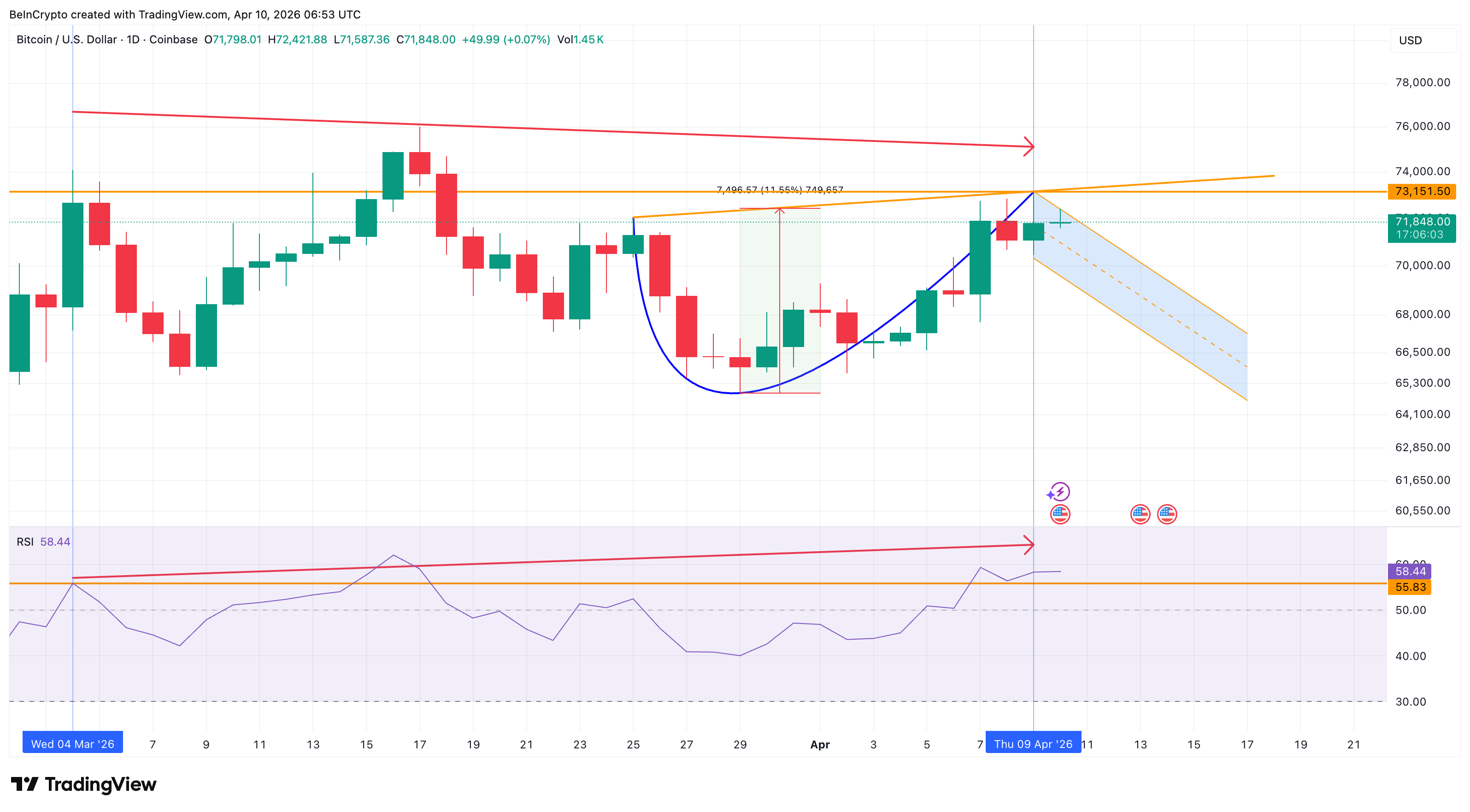
Despite being up 2.9% month on month, BTC remains down 17% year to date. The divergence suggests the recent pullback (consolidation into handle) may have further to run before any Bitcoin breakout attempt. While the structure looks constructive, whether it stalls or accelerates depends on the derivatives and spot side.
Derivatives Cool Off and Spot Flows Weaken by More Than Half
The comparison between April 8 and today reveals how quickly conviction has faded. On April 8, when BTC traded near $72,300, total open interest stood at $27.39 billion. The BTC funding rate, which measures the cost of holding long positions, sat at 0.007%. Aggressive long bias or sentiment was driving the rally.
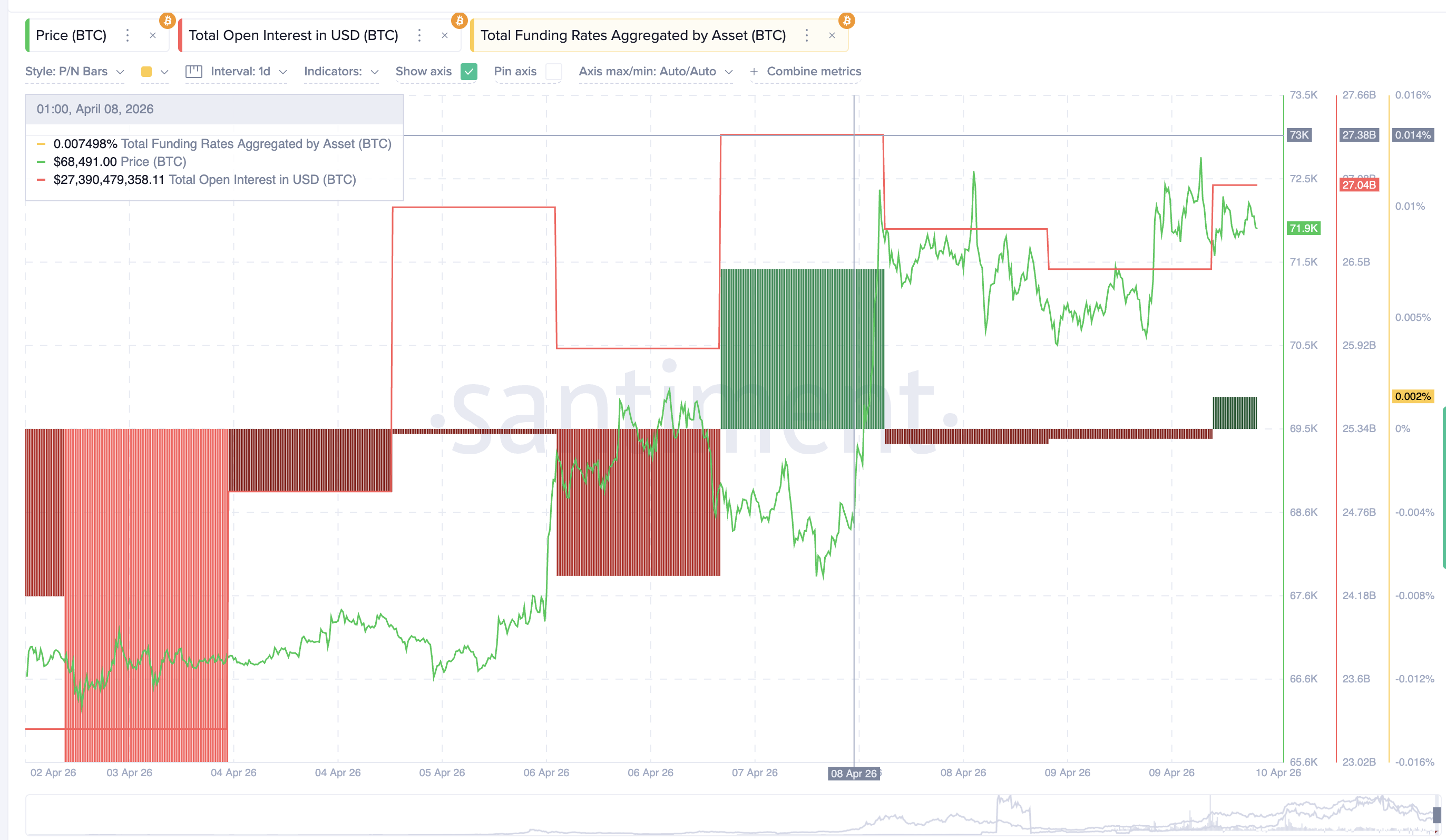
Today, at a similar price near $71,900, open interest has slipped to $27.04 billion. Funding has dropped to just 0.002%. Fewer traders are betting on further upside at these levels. That absence of leverage is a double-edged sword. It means less fuel to push higher, but it also means fewer positions to liquidate if prices drop as the sentiment is still long-biased.
Meanwhile, Bitcoin exchange flows confirm the spot side is weakening too, alongside bullish sentiment. Glassnode data shows the exchange net position change, a metric that tracks exchange flows, peaked at negative 80,352 BTC on March 26. The metric tracks tokens moving in and out of exchanges. That figure has since dropped to negative 36,221 on April 9, a decline of over 50%.
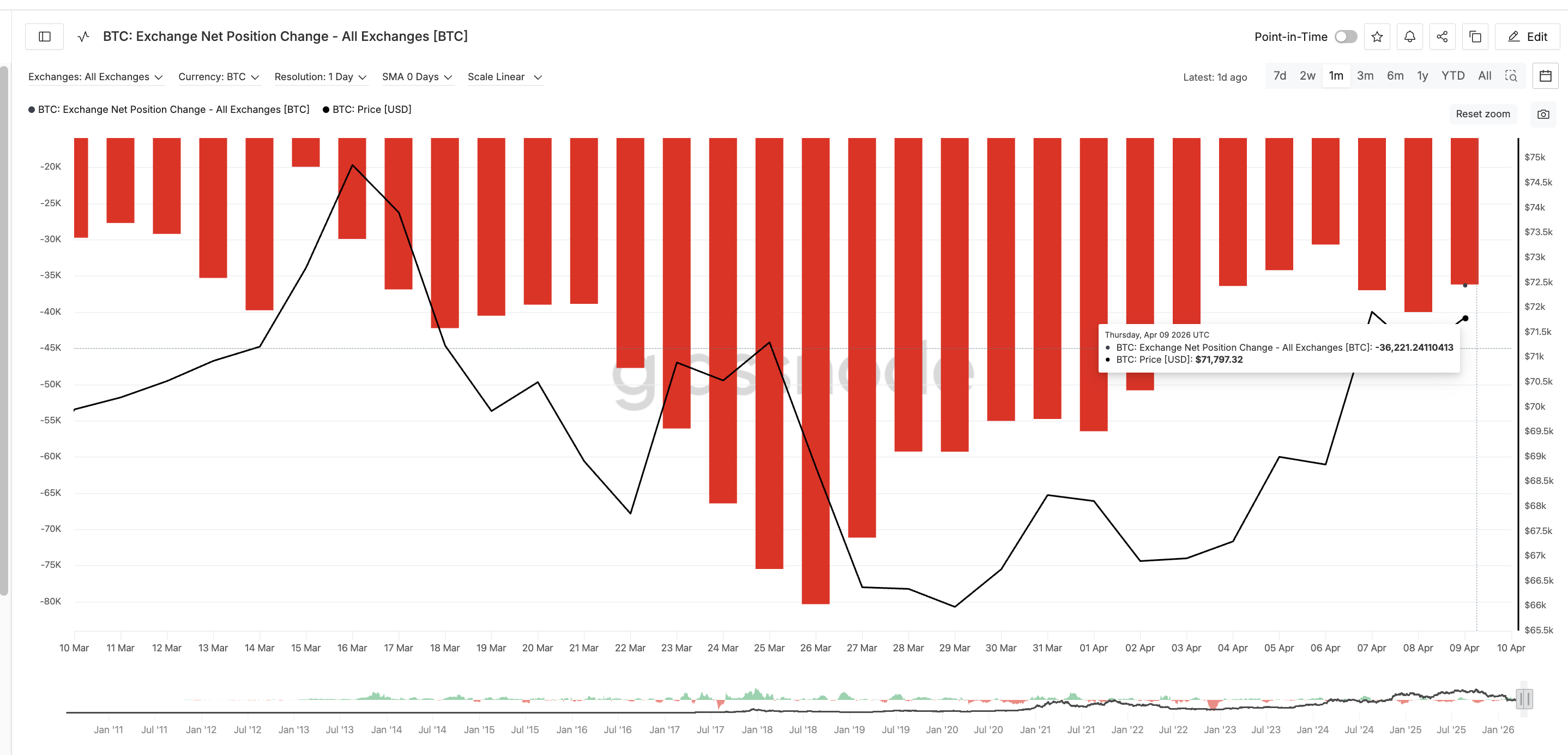
During the March 22 to March 25 rally from $67,860 to $71,303, exchange outflows were at their strongest. Yet as prices approach similar territory now, spot buyers are not showing the same urgency. The breakout structure exists. The question is whether enough conviction remains to push through.
Bitcoin Price Levels Where Conviction Must Show Up
The daily BTC chart with Fibonacci levels maps the exact zone where the pattern resolves. Bitcoin price prediction models center on the $73,151 to $73,240 range. That is where the neckline of the rounded bottom and the 0.618 Fibonacci retracement converge.
A clean daily close above $73,240 would confirm the breakout. The measured move from the pattern projects roughly 11%, which would place the target near $81,720. That level is where fresh conviction from derivatives and spot markets would need to follow through.
Yet with open interest down, funding near flat, and exchange outflows halved, the fuel gap is the primary risk. If Bitcoin price fails to reclaim $73,151, the pullback deepens as the RSI sign is still active. The first Bitcoin support level sits at $70,065. However, below that, $64,920 is the line where the entire bullish structure breaks.
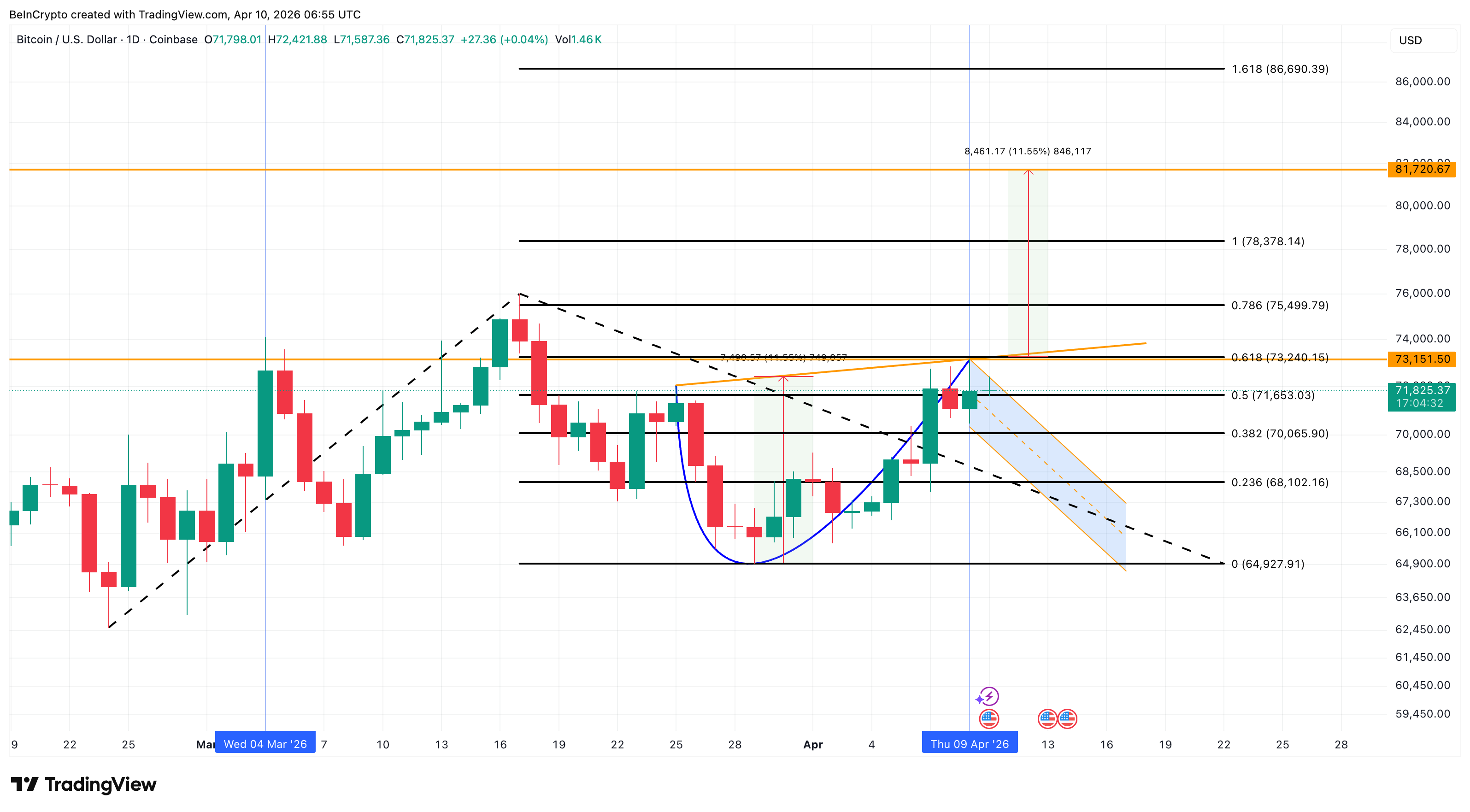
A daily close above $73,240 activates the $81,720 target and aligns structure with momentum. A rejection keeps BTC trapped below its neckline for now. And in the absence of massive leverage and clear directional bias, BTC could then continue trading in a range.
The post Bitcoin Price Builds Its First Breakout Setup of April, but One Metric Dropped Over 50% appeared first on BeInCrypto.
TLDR:
- Ethereum 7-day SMA for total transfer count has crossed 1.3M, matching its mid-February ATH.
- ETH price remains near $2,100, creating a bullish divergence from record-high on-chain activity.
- DeFi protocols, Layer 2 solutions, and smart contracts are driving the surge in transfer volume.
- Rising gas consumption accelerates ETH burns, tightening supply and adding long-term price support.
Ethereum network activity has reached a new all-time high, with the 7-day Simple Moving Average for total transfer count surpassing 1.3 million.
This level was last recorded in mid-February. At the same time, ETH’s price continues to trade near $2,100, well below historical highs.
The contrast between record on-chain usage and subdued price action has drawn growing attention from market watchers who see the gap as a meaningful mid-term signal.
On-Chain Data Confirms Robust Network Utility
The return to all-time high transfer counts reflects a network that is expanding in actual use. Data shows that Ethereum is being actively transacted upon, not simply held as a passive asset. This distinction carries weight when assessing the blockchain’s fundamental health.
DeFi protocols, Layer 2 scaling solutions, and broader smart contract activity are largely behind the surge. Each of these categories contributes meaningfully to the daily volume of transfers recorded on the network. Together, they point to an ecosystem that continues to grow in depth and reach.
On-chain analyst CryptoOnchain shared the data publicly, stating that the ATH in transfer count confirms organic, real-world demand.
The analyst noted that the Ethereum blockchain is being utilized at a peak level across multiple verticals. This kind of activity is widely regarded as a core measure of network health.
Ethereum’s built-in fee-burning mechanism adds another layer to this picture. As transfer volumes rise, gas consumption increases, and more ETH is removed from the circulating supply. This process, by design, produces a steady and structural deflationary effect on the asset over time.
Price-Activity Divergence Draws Attention From Analysts
The most closely watched aspect of the current data is the gap between ETH’s price and its on-chain activity. Transfer counts are at an all-time high, yet the price remains well below its previous peaks. Analysts refer to this setup as a bullish divergence, where fundamentals outpace market valuation.
Historically, price and on-chain utility have tended to converge over time. When network usage expands at a faster pace than price, recoveries have followed in subsequent periods. Analysts are monitoring this current divergence closely as ETH holds near the $2,100 range.
CryptoOnchain further noted that the network’s intrinsic utility is growing faster than its current market valuation. The analyst added that if the high-transfer-count trend continues, a price move toward those fundamentals remains likely in the mid-term. This view is grounded entirely in on-chain data, not speculative projections.
The accelerating burn rate tied to high gas consumption also adds a supply-side dynamic worth tracking. As more ETH is burned through increased activity, the circulating supply continues to tighten. Traders and analysts are watching both the transfer data and supply metrics for continued directional signals.
Crypto World
Zoomex Launches $150,000 BTC Airdrop Campaign, Giving Users a Chance to Earn Their First Bitcoin


As Bitcoin market activity continues to gain momentum and trading opportunities expand, global crypto derivatives exchange Zoomex has officially launched its “April BTC Airdrop Celebration” campaign. With a total reward pool of $150,000, the initiative is designed to make market participation more accessible and help users capture opportunities in the current BTC cycle.
Compared to traditional campaigns that often involve complex rules or high capital requirements, Zoomex places a stronger emphasis on simplicity and execution. The participation process has been streamlined into clear, actionable steps, allowing users to get started with minimal friction.
Lower Barriers to Entry: Helping Users Earn Their First BTC
Unlike many industry campaigns with complicated structures, this initiative follows a “simple and direct” approach, enabling users to participate with minimal learning curve:
- New users can receive rewards upon registration and deposit
- First-time depositors can unlock up to $850 in BTC airdrops
- Additional trading challenges offer ongoing opportunities to earn rewards
By simplifying the process and lowering entry barriers, Zoomex aims to address a common challenge among users—getting started. The campaign is designed to help users move from observation to participation without unnecessary complexity.
Enhanced Rewards: Introducing the BTC Mystery Box Mechanism
In addition to base airdrop rewards, Zoomex has introduced a “BTC Mystery Box” feature, with an additional prize pool of up to $300,000.
Users can unlock mystery boxes by completing tasks or participating in trading activities, with each box offering a chance to receive additional BTC rewards. This element of unpredictability not only enhances engagement but also increases the potential upside for participants.
From a design perspective, the mechanism encourages continued participation while expanding the overall reward experience.
Making Trading Easier to Start: From Complexity to Simplicity
In today’s market, the challenge for many users is not a lack of opportunities, but the absence of a clear and accessible way to begin.
Through this campaign, Zoomex simplifies the core journey—registration, deposit, and trading—into a more intuitive flow. With a unified account system and USDT-based trading, users can start trading without the need for asset transfers or complex configurations.
Fernando, Marketing Director at Zoomex, commented:
“Many users are not unwilling to trade—they’re held back by complicated processes.”
“Instead of adding more features, we focus on removing steps, so users can start their first trade more naturally.”
“Once users complete their first trade, continued engagement tends to follow more organically. That’s the core idea behind how we design both our product and campaigns.”
About ZOOMEX
Founded in 2021, Zoomex is a global cryptocurrency trading platform with over 3 million users across more than 35 countries and regions, offering 700+ trading pairs. Guided by its core values of “Simple × User-Friendly × Fast,” Zoomex is also committed to the principles of fairness, integrity, and transparency, delivering a high-performance, low-barrier, and trustworthy trading experience.
Powered by a high-performance matching engine and transparent asset and order displays, Zoomex ensures consistent trade execution and fully traceable results. This approach reduces information asymmetry and allows users to clearly understand their asset status and every trading outcome. While prioritizing speed and efficiency, the platform continues to optimize product structure and overall user experience with robust risk management in place.
As an official partner of the Haas F1 Team, Zoomex brings the same focus on speed, precision, and reliable rule execution from the racetrack to trading. In addition, Zoomex has established a global exclusive brand ambassador partnership with world-class goalkeeper Emiliano Martínez. His professionalism, discipline, and consistency further reinforce Zoomex’s commitment to fair trading and long-term user trust.
In terms of security and compliance, Zoomex holds regulatory licenses including Canada MSB, U.S. MSB, U.S. NFA, and Australia AUSTRAC, and has successfully passed security audits conducted by blockchain security firm Hacken. Operating within a compliant framework while offering flexible identity verification options and an open trading system, Zoomex is building a trading environment that is simpler, more transparent, more secure, and more accessible for users worldwide.
For more info: ZOOMEX Website | X | Telegram | Discord
The post Zoomex Launches $150,000 BTC Airdrop Campaign, Giving Users a Chance to Earn Their First Bitcoin appeared first on BeInCrypto.

Binance co-founder Changpeng “CZ” Zhao shared a long-range optimism for crypto and blockchain, arguing they will become an invisible layer of everyday infrastructure by 2031. In a recent appearance on Scott Melker’s Wolf of All Streets podcast, Zhao said that while new use cases will continue to emerge, the technology should fade from the conversation as it becomes ubiquitous in daily life. “I’m hoping that we don’t talk about crypto as crypto in five years, just like we don’t talk about the internet anymore,” he said, adding that in five years he expects to be using crypto rather than discussing the technology itself.
Beyond his own timeline, Zhao tied the future of crypto to broader adoption trends, AI-driven acceleration, and national policy choices. The discussion touched on a cascade of forecasts from research firms and industry figures that paint a picture of a rapidly expanding ecosystem where stablecoins, tokenization, and AI-enabled tooling could reshape how finance and data markets operate.
Key takeaways
- Long-run vision: CZ envisions a future where crypto is ubiquitous and no longer discussed as a separate technology, much like the everyday use of the internet.
- Growing adoption and outsized market forecasts: DemandSage cites hundreds of millions of crypto users by the end of the decade, while ARK Invest and others project multi-trillion-dollar outcomes for digital assets in the 2030s.
- Stablecoins and tokenization on the path to scale: Chainalysis and Citi highlight potential surges in stablecoin volumes and cross-border/tokenized post-trade activity amid a broader shift in market infrastructure.
- AI as a catalyst for development: Zhao sees AI accelerating blockchain development and adoption, with crypto playing a key role in AI-enabled ecosystems.
- Policy and geography as competitive levers: Switzerland’s crypto-friendly stance and UAE’s AI-led adoption, alongside US leadership in AI infrastructure, frame a fragmented but converging global landscape.
The optimistic trajectory: 2030 and beyond
The interview sits within a chorus of expectations about crypto’s role in the global economy. DemandSage estimates that 559 million people worldwide will be using crypto in 2026, suggesting a broad base of participants that could fuel further institutional interest and product innovation. Meanwhile, Ark Invest has painted a bold future: a January report argues digital assets could grow into a $28 trillion market by 2030, underscoring a view that the asset class may reach a scale comparable to major financial sectors today.
Other voices add to the optimism. Reeve Collins, co-founder of Tether, has suggested a future where stablecoins become a standard medium of exchange and possibly even a foundation for most currencies by 2030. In parallel, Chainalysis has estimated that stablecoin volumes could reach as much as $1.5 quadrillion by 2035, illustrating a potential trajectory for on-chain liquidity and cross-border settlement. A Citi survey of banks and asset managers last September found that a significant share expect about one-tenth of the global post-trade market turnover to be settled in stablecoins and tokenized securities within five years, signaling a shift in how markets operate at scale.
For investors, these forecasts translate into upside potential across a spectrum of players—from wallet providers and exchanges to tokenization platforms and custodians. Yet they also raise questions about how quickly infrastructure, regulatory clarity, and off-chain data networks can keep pace with a demand signal that is already being built now.
AI as a speed supersonic for blockchain
Beyond macro adoption, Zhao highlighted AI as a key accelerant for blockchain development. He argued that the speed at which developers can write code and deploynew features will accelerate as AI agents become more integrated with crypto tooling. He has previously urged the crypto community to emphasize utility over token incentives, a stance he reiterated as AI-driven capabilities begin to reshape development cycles and product timelines.
The notion that AI could turbocharge blockchain aligns with broader industry observations. A March discussion around AI agent-enabled tokens touched on the tension between rapid innovation and meaningful utility. If AI-assisted approaches can lower friction in building decentralized applications and automating complex on-chain tasks, the resulting productivity gains could help scale networks and improve user experiences at a pace that outstrips traditional software development cycles.
Geopolitics, adoption climates, and who leads the pack
As adoption widens, the geographic and regulatory landscape remains diverse. Signzy ranked Switzerland as the most crypto-friendly country in a January evaluation, while Arkham highlighted Switzerland as a top innovating jurisdiction. The country’s regulatory posture and ecosystem maturity have been cited as favorable for early-stage and mature crypto projects alike, reinforcing the view that policy environments will matter as much as technology in determining which regions become crypto hubs.
Separately, a Microsoft AI report placed the United States at the forefront of AI infrastructure and frontier model development. Yet the study also noted that usage and practical deployment can lag behind in some regions; it singled out the United Arab Emirates as a standout in actual AI usage, underscoring how digitized, resource-rich economies can leapfrog into higher productivity with AI-enabled capabilities. The broader takeaway: national strategy and industrial policy around AI and blockchain will significantly influence who wins in a fast-evolving tech stack.
Industry observers are watching how these dynamics intersect with crypto’s evolution. The United Arab Emirates’ leadership in AI deployment and Switzerland’s crypto-friendly climate illustrate two distinct but complementary paths toward broader adoption: one anchored in public-facing, consumer-ready digital economies and the other in a regulated, institutional-friendly environment that can attract liquidity and innovation. Investors and builders will be looking for policy clarity, interoperability standards, and scalable on-ramp/off-ramp options as barriers to entry continue to shrink in many markets.
As Zhao’s long horizon suggests, the next phase of crypto’s story may be less about headlines and more about the practical integration of crypto rails into everyday infrastructure. With demand signals pointing toward substantial growth and institutional interest likely to intensify, the outcomes will depend on how quickly ecosystems can deliver secure, compliant, and user-friendly experiences at scale.
What remains uncertain, and what readers should watch next, is how quickly policymakers harmonize global standards around stablecoins, tokenized assets, and on-chain data governance; how commercial and technical ecosystems onboard mainstream users; and how AI-enabled tooling will shape the pace and direction of development across different jurisdictions. The coming years will reveal whether the industry can translate these optimistic forecasts into durable, real-world infrastructure that supports real economic activity.
Key Highlights
- SpaceX recorded a deficit approaching $5 billion during 2025, per The Information’s reporting
- Annual sales exceeded $18.5 billion throughout the year
- The deficit encompasses xAI, the AI venture from Elon Musk that SpaceX purchased in February 2025
- The aerospace company submitted confidential IPO documents in March 2026
- SpaceX aims for a public market valuation exceeding $1.75 trillion
Elon Musk’s aerospace venture SpaceX recorded a deficit approaching $5 billion throughout 2025, based on reporting from The Information, which cited individuals with knowledge of the financial data. Reuters was unable to independently confirm these numbers, and SpaceX declined to provide commentary.
The aerospace firm generated sales surpassing $18.5 billion throughout 2025. This represents an increase compared to the $15 billion to $16 billion in sales documented during the previous year, a period when the company logged approximately $8 billion in earnings.
The transition from profitability to deficit marks a dramatic financial shift. During 2024, SpaceX maintained robust earnings performance. The 2025 financial picture presents a contrasting narrative.
A primary driver behind the deficit involves SpaceX’s purchase of xAI, Elon Musk’s artificial intelligence company. The transaction concluded in February 2025, and xAI’s financial performance is now consolidated within SpaceX’s comprehensive results.
xAI was established by Musk during 2023. The company develops the Grok AI conversational platform. Integrating a venture of this magnitude into SpaceX’s accounting would inevitably impact profitability metrics.
SpaceX currently ranks as the planet’s most prolific launch services provider. The firm operates both Falcon 9 and Falcon Heavy launch vehicles, while advancing development of the Starship platform designed for deep-space exploration.
The organization has articulated objectives to enable interplanetary transportation. Additionally, it has revealed intentions to construct and operate artificial intelligence computing facilities in orbital space.
IPO Plans Target Historic $1.75 Trillion Market Cap
SpaceX submitted confidential paperwork for a U.S. public market debut in March 2026. The company seeks a market capitalization surpassing $1.75 trillion should it move forward with the share offering.
This would position it among the most substantial initial public offerings ever recorded if the listing proceeds at that valuation level. No specific timeline for the public market debut has been announced.
Sales Expansion Continues Despite Financial Loss
Notwithstanding the net deficit, sales figures expanded on an annual basis. The $18.5 billion total for 2025 compares positively against the $15 billion to $16 billion documented during 2024.
This revenue expansion demonstrates the underlying business operations are growing. Starlink, SpaceX’s orbital internet connectivity platform, has served as a significant contributor to that revenue stream.
SpaceX maintains tens of millions of Starlink customers worldwide. The network functions throughout more than 100 nations and persistently expands its user base.
The firm’s launch services division maintains robust activity levels. SpaceX executes more orbital missions than any competing commercial entity or governmental space agency globally.
The 2025 deficit primarily stems from the xAI purchase rather than challenges within the core launch and satellite divisions. The Information’s analysis did not separate xAI’s specific impact on the aggregate loss calculation.
SpaceX submitted its IPO documentation under confidential filing procedures, indicating complete financial disclosures have not yet been released through an official public prospectus.

Hong Kong awards first stablecoin licenses to HSBC, Standard Chartered-led group

Prime Video’s 5-Part Sci-Fi Superhero Series Officially Beats ‘Invincible’ at Its Own Game

Girlfriend’s Debt Will Take 26 YEARS To Pay Off


-

 Fashion7 days ago
Weekend Open Thread: Spanx – Corporette.com
-

 Business4 days ago
Three Gulf funds agree to back Paramount’s $81 billion takeover of Warner, WSJ reports
-

 Sports6 days ago
India men’s 4x400m and mixed 4x100m relay teams register big progress | Other Sports News
-

 Business6 days ago
Expert Picks for Every Need
-

 Tech2 days ago
How Long Can You Drive With Expired Registration? What Florida Law Says
-

 Business5 days ago
No Jackpot Winner, Prize to Climb to $231 Million
-

 Fashion4 days ago
Massimo Dutti Offers Inspiration for Your Summer Mood Board
-

 Fashion3 days ago
Let’s Discuss: DEI in 2026
-
Politics7 days ago
Wings Over Scotland | The quality of mercy
-

 Crypto World2 days ago
Bitcoin recovers as US and Iran Agree a Ceasefire Deal
-

 Business5 days ago
Akebia Therapeutics, Inc. (AKBA) Discusses Pipeline Progress and Strategic Focus on Kidney Disease Treatments at R&D Day – Slideshow
-

 Crypto World21 hours ago
Canary Capital Files SEC Registration for PEPE ETF
-

 Fashion7 days ago
Frugal Friday’s Workwear Report: Hammered Metallic Button Sweater Vest
-

 Politics6 days ago
The UK should not pay a penny in slavery reparations
-

 Tech4 days ago
Samsung just gave up on its own Messages app
-

 Tech4 days ago
Haier is betting big that your next TV purchase will be one of these
-

 Fashion7 days ago
Tory Burch’s Spring 2026 Campaign Goes on a Getaway
-

 Fashion7 days ago
Weekly News Update, 4.3.26 – Corporette.com
-

 NewsBeat6 days ago
Kemi Badenoch talks ‘spring cleaning’ Reform defections
-

 Tech4 days ago
Gamer Restores the Original PlayStation Portal From Two Decades Ago
You must be logged in to post a comment Login