
Crypto World
How the US Helped Japan Pull Off a $97 Billion Yen Rescue

Treasury Secretary Scott Bessent tells Senator Elizabeth Warren that the United States never lent Japan a cent. It bought yen instead. Accordingly, Japan owes nothing, so nothing can go unpaid.
Warren had warned that taxpayers would eat the loss if Japan failed to repay. Treasury’s own monthly filings back Bessent on how the yen intervention worked. They also weaken her wider case.
The Fund Can Only Hold Euros and Yen
The Exchange Stabilization Fund is a Treasury reserve the secretary can tap without a new vote in Congress. Its foreign cash comes in just two currencies.
On June 30, the fund held $14.19 billion in euros and $2.57 billion in yen. So selling euros for yen was the only trade on the menu.
A loan creates a debt, bun asset swap does not. The fund simply owns more yen than it did in July.
“Japan owes Treasury nothing. There is therefore no risk that Japan will fail to repay a debt that does not exist,” Bessent wrote in the letter.
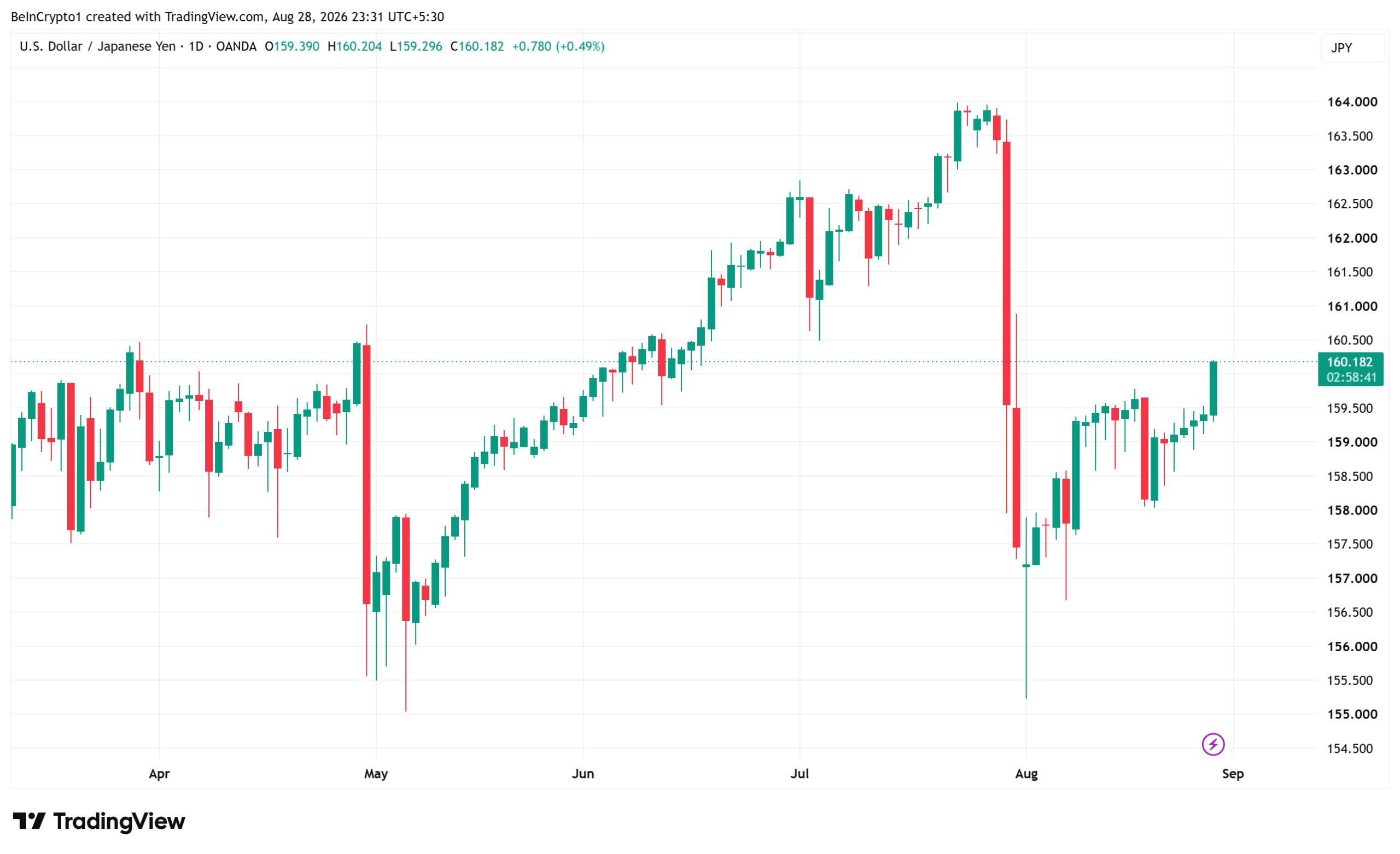
The real risk is price, not default, as the yen traded at 160.17 per dollar as of this writing, weaker than the 157.4 the rescue delivered. This means most of the gain has drained away.

Japan Published Its Yen Intervention Total, America Did Not
Japan published its total on Friday, showing that its operations reached 15.4 trillion yen, roughly $97 billion, between July 30 and August 26.
Warren’s deadline was August 28, and Bessent met this ultimatum, but named no number.
A leaked notepad indicated $5 billion to $10 billion, a figure the Treasury has never confirmed.

For scale, the last US yen purchase came in June 1998. Fed records put it at $833 million, split evenly between the Fed and the Treasury fund.
Notably, however, Senator Warren’s Argentina comparison is shaky, as Treasury filings show Buenos Aires drew $2.5 billion of the $20 billion line and repaid every dollar by December 2025.
“Argentina has both quickly and fully repaid its limited draw on the swap facility with the United States, such that the Exchange Stabilization Fund currently does not hold any pesos,” Bessent revealed in January.
America cared because Japan holds $1.12 trillion of US debt, more than any other country. A yen panic lifts American borrowing costs.
The post How the US Helped Japan Pull Off a $97 Billion Yen Rescue appeared first on BeInCrypto.

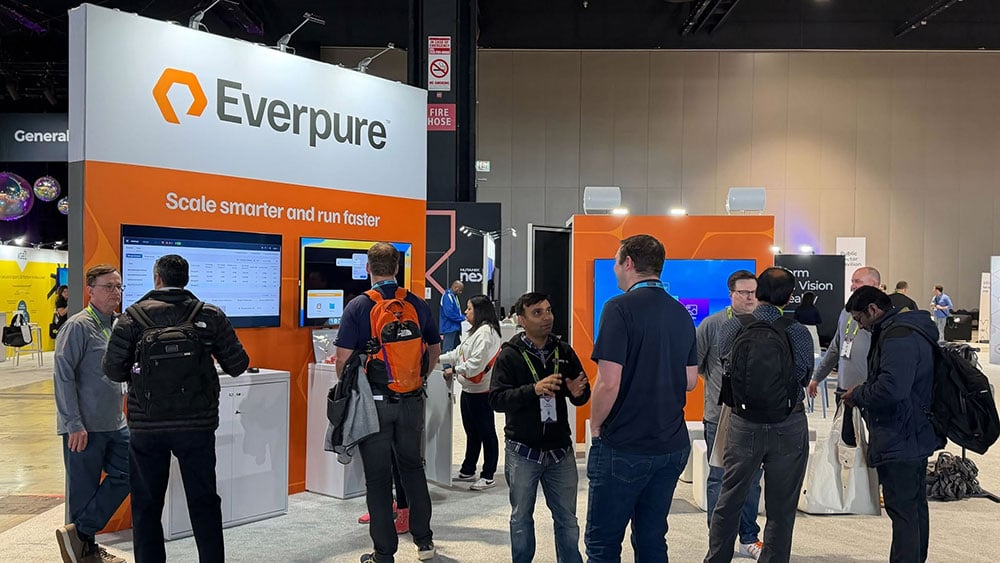
Everpure (P) reported fiscal second quarter results that beat estimates. But Everpure stock slid in Thursday trading, slowing what had been a huge August rally. Everpure earned an adjusted 70 cents per share from sales of $1.19 billion for the quarter ended Aug. 2, the Santa Clara, Calif.-based company said in a news release. Analysts polled by FactSet were forecasting…
Copyright ©2026 Investor’s Business Daily, LLC. All rights reserved. 87990cbe856818d5eddac44c7b1cdeb8
Ethereum price held near $2,500 on Aug. 28 as buyers defended the gains from its mid-August breakout, but an overbought daily reading and a dense band of leveraged positions around $2,550 left ETH facing a key resistance test.
Summary
- Ethereum price traded near $2,500 after rising about 35% from its mid-August consolidation range.
- A 4-hour ascending triangle placed immediate resistance between $2,533 and $2,550.
- Daily RSI reached 77.4, showing strong momentum but an increased risk of a pullback.
- Liquidation clusters near $2,550 and $2,470 could amplify the next move.
Hotter US inflation limits Ethereum’s breakout
According to data from crypto.news, Ethereum (ETH) price opened at $2,442.49 on Aug. 26 before recovering toward $2,500 over the next two days. ETH traded around $2,500 at the time of writing, leaving it close to the upper end of its three-day range.
The recovery followed an initial reaction to the latest US inflation report. The Bureau of Economic Analysis said headline Personal Consumption Expenditures inflation rose 0.2% monthly and 3.7% annually in July.
The annual figure exceeded the 3.6% increase expected by economists polled by Reuters. Core PCE, which excludes food and energy, matched forecasts at 0.2% monthly and 3.3% annually.
The hotter headline figure lifted the market-implied probability of a September Federal Reserve rate increase to 44% from 36%, Reuters reported. Higher rate expectations can weigh on speculative assets because they raise the relative appeal of interest-bearing investments and tighten financial conditions.
ETH nevertheless avoided a deeper reversal after falling toward $2,430 on Aug. 26. Buyers moved back into the market below $2,500, allowing the token to retain most of the advance that began near $1,870 in mid-August.
The rebound has also followed the US Treasury’s decision to expand its long-dated debt buybacks. The Treasury said it will increase the maximum size of liquidity-support operations for 10-to-30-year securities from $2 billion to at least $4 billion per operation, beginning Sept. 9.
However, the program is designed to support Treasury market liquidity rather than directly inject money into crypto markets. Its influence on ETH therefore depends on how bond yields, the dollar, and broader risk appetite respond.
Ethereum price forms an ascending triangle below $2,533
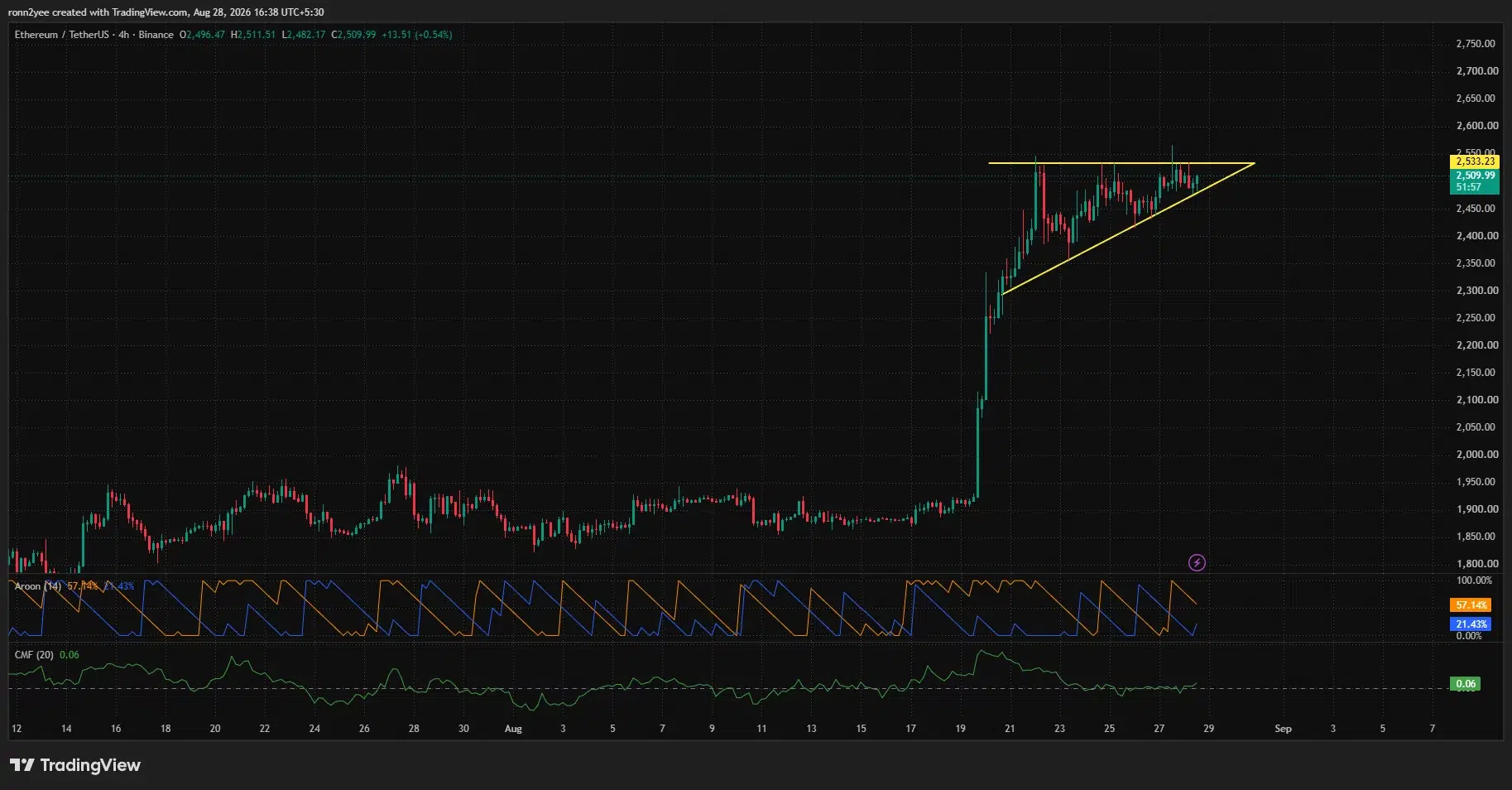
The 4-hour ETH/USDT chart shows Ethereum forming an ascending triangle after its rapid move from below $1,950. Price has repeatedly tested horizontal resistance near $2,533 while producing a sequence of higher lows.
An ascending triangle usually favors buyers when the price closes above its horizontal boundary with increased volume. A confirmed move through $2,533 would also clear the nearby $2,550 resistance area, where ETH has faced several rejections since Aug. 21.
The Aroon Up indicator stood at 57.14%, compared with an Aroon Down reading of 21.43%. The gap suggests that recent highs are more dominant than recent lows, although the Aroon Up reading has declined from earlier levels.
Chaikin Money Flow remained positive at 0.06. The reading points to modest net buying pressure, but it does not show the forceful inflows normally associated with a decisive breakout.
Crypto trader Daan Crypto Trades said in an Aug. 28 X post that ETH had produced a “solid breakout” and established a higher high on the weekly chart. He warned that a return below the former range around $2,300 would weaken the improved market structure.
A 4-hour close above $2,533 would strengthen the triangle setup and place $2,600 in view. Failure to clear the barrier could send ETH back toward the rising trendline, which sits near $2,470 and moves higher over time.
Daily RSI warns Ethereum may be overheated
The daily chart shows ETH trading above the 50% Fibonacci retracement level at $2,453.95. The level is measured from the January high around $3,399 to the June low near $1,509 and now acts as the closest major support.
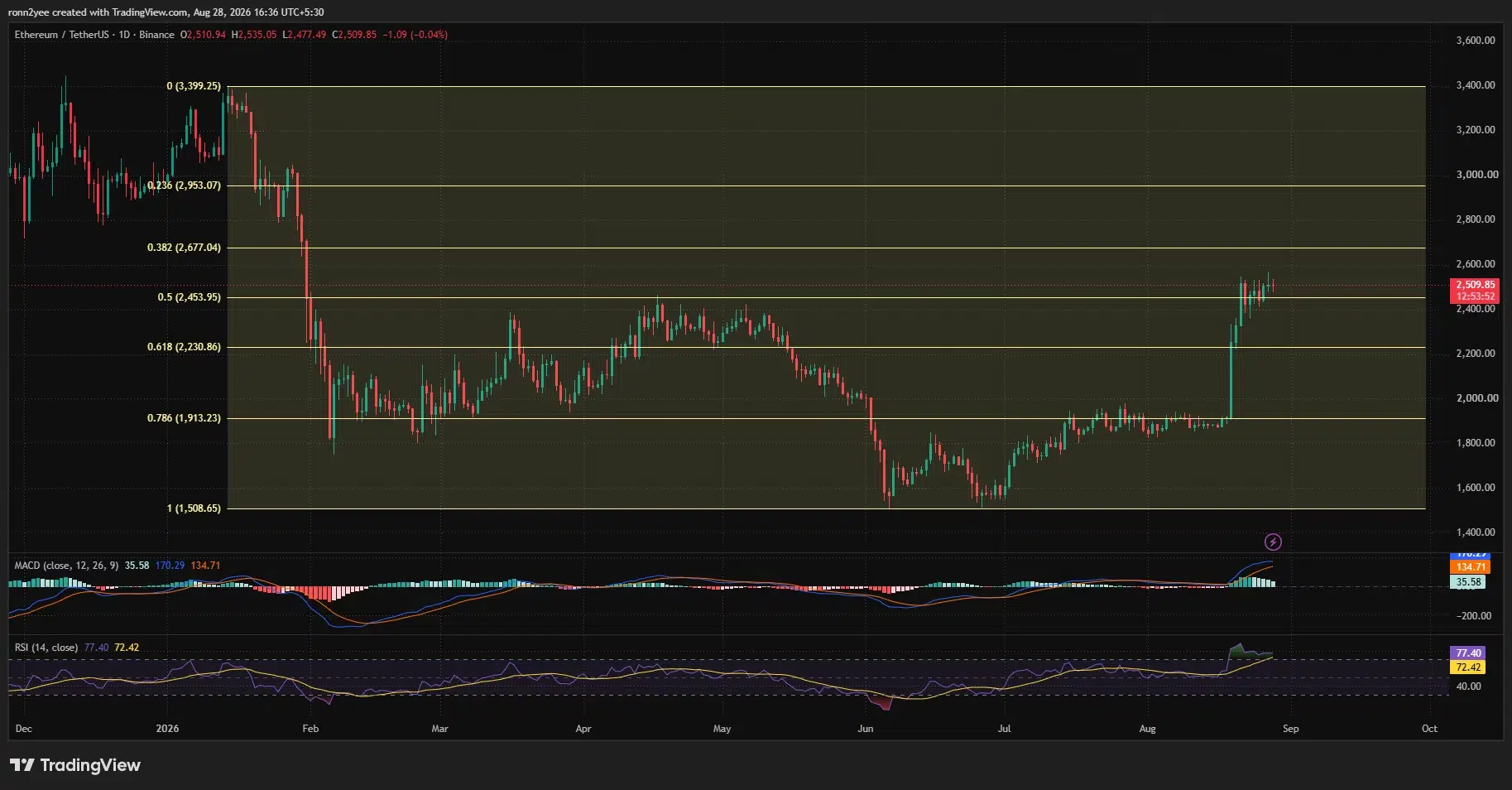
The next Fibonacci barrier sits at $2,677.04. A break above that area could open a path toward the 23.6% retracement at $2,953.07, placing the psychological $3,000 level within reach.
Trader Ted Pillows also identified $2,550 as the immediate resistance zone. In an Aug. 28 post, he said a weekly close above the level could support a move toward $3,000, while repeated rejection could expose the $2,000–$2,100 region.
Momentum indicators remain bullish but stretched. The daily Relative Strength Index stood at 77.4, above the 70 level commonly used to identify overbought conditions. Its RSI moving average was lower at 72.42.
The Moving Average Convergence Divergence indicator remained positive, with the MACD line above its signal line. However, the shrinking positive histogram suggests that upward momentum has started to ease as ETH tests resistance.
An overbought RSI does not guarantee an immediate decline. It instead shows that the advance has moved quickly and leaves the price more vulnerable if buyers fail to produce a breakout.
ETH liquidation map puts $2,550 and $2,470 in focus
The three-day CoinGlass liquidation heatmap shows leveraged positions building on both sides of Ethereum’s price.
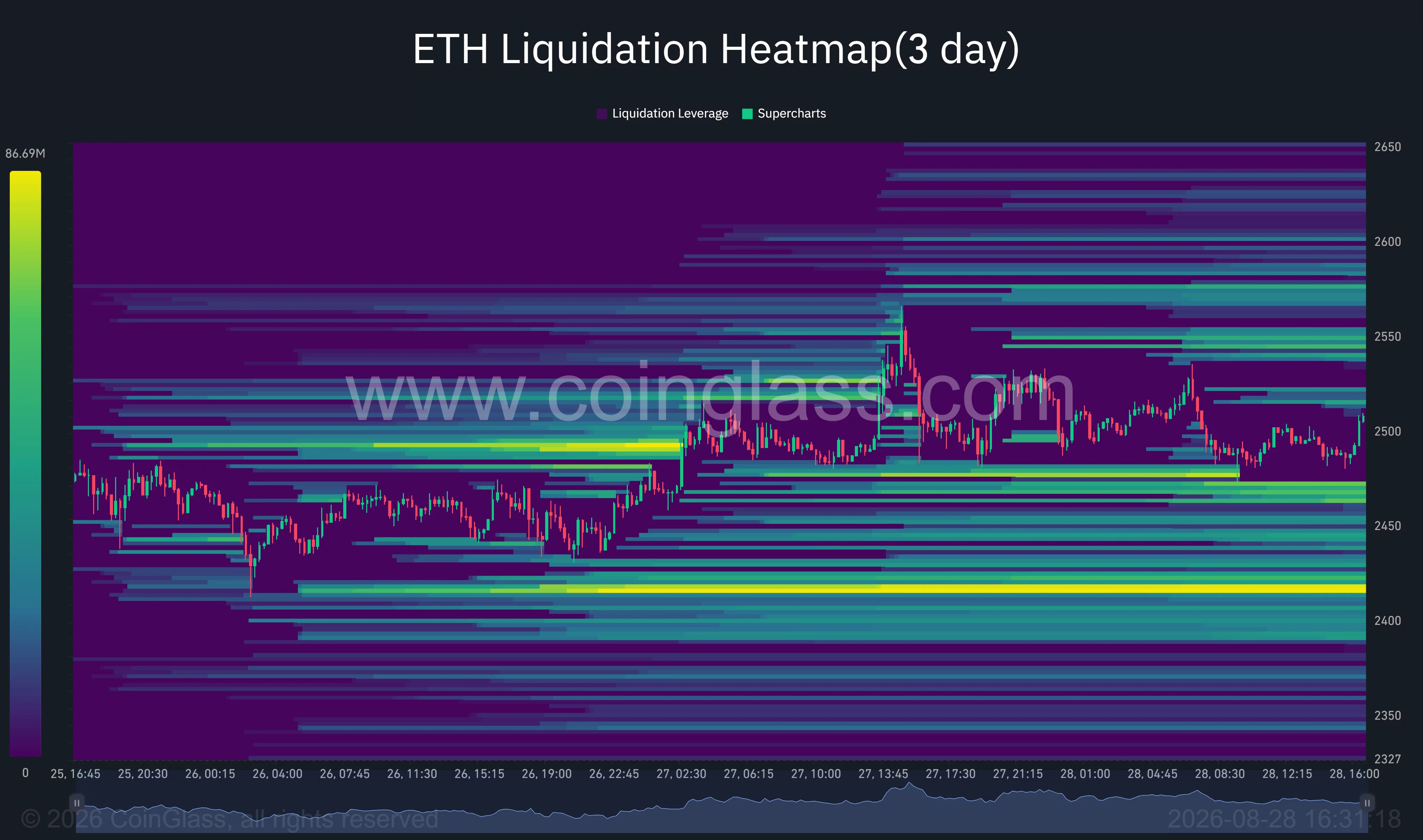
The nearest concentration above ETH lies around $2,540–$2,550, aligning with the horizontal resistance visible on the 4-hour chart. Additional liquidity appears between approximately $2,570 and $2,600.
A move through $2,550 could force short sellers to close positions, adding market buy orders and accelerating a push toward the higher clusters. The technical breakout would still require confirmation because a brief sweep of leveraged positions can reverse quickly.
Below the market, the closest liquidation concentration sits around $2,470–$2,480. A larger and brighter pool appears near $2,410–$2,420, making that region a possible downside target if ETH loses the 50% Fibonacci support at $2,454.
US spot Ethereum exchange-traded funds provide a mixed near-term backdrop. The products recorded about $192 million in net inflows on Aug. 26, but SoSoValue data showed roughly $11.4 million in net outflows during the following session.
Ethereum’s next move, therefore, rests on a narrow technical range. A confirmed close above $2,533–$2,550 would favor an extension toward $2,600 and $2,677, while a loss of $2,454 would expose $2,410 and potentially the former breakout area around $2,300.
Disclosure: This article does not represent investment advice. The content and materials featured on this page are for educational purposes only.

Bitcoin’s push back above $80,000 has done more than lift prices—it’s reignited a broader rebound in crypto-linked equities and refocused investor attention on how digital-asset companies are financed, regulated, and integrated with traditional capital markets. The latest surge arrived alongside a US Treasury plan to increase certain long-dated bond buybacks, a macro tailwind that helped drive risk appetite across financial markets.
This week’s Crypto Biz also highlights three threads investors are watching closely: growing momentum behind stablecoin issuance, the structural funding risks facing institutional Bitcoin holders, and accelerating on-chain activity on Solana tied to real-world assets.
Key takeaways
- Bitcoin’s move above $80,000 pulled crypto stocks higher, with miners and crypto treasury/digital-asset platforms among the biggest weekly gainers, according to CoinMarketCap-tracked market moves and related coverage.
- Bernstein says Circle’s USDC supply grew by roughly $2 billion in seven days, ending a six-month period of stagnant or declining growth and potentially supporting a new 12-month growth cycle.
- Regime Intelligence frames Strategy’s main vulnerability as access to capital markets—not a direct Bitcoin price collapse—given its large obligations and reliance on continued financing conditions.
- Solana recorded a record 4.2 billion on-chain transactions in July, and SOL rallied about 40% afterward; tokenized real-world assets are also growing on-chain.
Bitcoin above $80,000 lifts crypto equities as macro tailwinds return
Bitcoin’s weekly advance pushed it above $80,000, lifting a range of crypto-related shares. Cointelegraph’s market coverage links the move to broader equity-style risk-on behavior, and specifically notes that miners and digital-asset treasury companies posted double-digit gains.
Canaan, MARA Holdings, and Strive were among the standout performers over the past week, while Coinbase and Robinhood also climbed. CoinMarketCap data cited in the original reporting shows Bitcoin extending its weekly gain past 23%, and Ether rising nearly 30% to trade above $2,500.
Macro factors reportedly played a role as well. The rebound coincided with the US Treasury’s plan to double certain long-dated bond buybacks—an effort expected to support bond-market dynamics that can influence broader liquidity and risk appetite. At the same time, regulatory expectations remained a narrative driver: President Trump renewed calls for Congress to pass the CLARITY Act, though the bill was still stalled after lawmakers failed to move it before the August recess. Trump also revived the idea of government Bitcoin purchases, but neither prospect has a guaranteed path forward.
For investors, the practical takeaway is that crypto equities appear increasingly sensitive not just to crypto-specific headlines, but to the conditions that govern traditional markets—particularly financing, yields, and liquidity. When those factors turn, correlations can tighten quickly.
Circle’s USDC momentum becomes a central equity thesis
While much attention usually centers on price action, Bernstein’s latest assessment of Circle focuses on stablecoin growth dynamics—specifically the supply trajectory of USDC. In a Monday research note, the firm argued that a renewed growth cycle for USDC could provide a meaningful tailwind over the next 12 months as supply growth picks up again.
Bernstein reported that USDC supply increased by roughly $2 billion in seven days, ending a six-month stretch where growth was stagnant or declining. The firm maintained an Outperform rating on Circle and a $140 price target, implying approximately 60% upside in its framework. Circle shares, per the original reporting, had risen about 40% over the past month prior to the note.
Beyond the headline increase, Bernstein tied potential future growth to a set of reinforcing drivers: renewed crypto market momentum, regulatory clarity in the US, expanding tokenized capital markets, and broader payments adoption. The report also pointed to early signals of demand from “AI agents,” though the original coverage did not specify where that demand is showing up in measurable metrics.
The stablecoin market share angle is also important. The original reporting states that USDC’s share of adjusted transaction volume rose from roughly 40% in 2025 to over 60% so far in 2026, overtaking Tether’s USDt on that measure. That kind of shift matters because stablecoin activity is increasingly treated as an on-chain indicator of where settlement and payments flows are actually concentrating.
Circle shares have been volatile since its June 2025 IPO, which priced the stock at $31. After an initial surge, shares declined back toward the IPO level by November 2025 as the broader crypto market downturn began. Bernstein’s view effectively suggests that if USDC supply growth and transaction dominance continue, the equity narrative could shift again—from “stablecoin as infrastructure” to “stablecoin as measurable growth engine.”
Strategy’s exposure is more about financing than Bitcoin drawdowns
Institutional Bitcoin holders have long been evaluated through the lens of Bitcoin price sensitivity, but a Regime Intelligence report argues that Strategy’s real vulnerability may lie elsewhere: the ability to access capital markets. According to the report, losing that access could threaten Strategy’s capacity to meet annual obligations—without necessarily being forced to sell BTC immediately.
The context is significant. Strategy holds 840,447 BTC backing roughly $22 billion in debt and preferred claims, as described in the original reporting. The report states that there are no margin calls tied directly to Bitcoin’s price. Its stress tests suggest Bitcoin would need to fall 96% for Strategy’s holdings to no longer cover its convertible notes—placing the most immediate pressure not on a short, moderate drawdown, but on extreme scenarios.
Regime Intelligence also highlighted buffers Strategy already maintains: cash reserves equal to 2.6 times its annual obligations, and a valuation/cost comparison of its BTC holdings in the cited coverage. The original piece further quoted Komodo Platform co-founder Kadan Stadelmann, who argued that Strategy holds far more Bitcoin than its annual cash obligations, leaving it “in a good situation to weather most any storm,” even if equities weaken.
However, the report’s central warning is about the mechanics of funding. If financing conditions deteriorate—particularly alongside a prolonged Bitcoin downturn and pressure on Strategy’s share price and mNAV—raising fresh capital could become harder. In that setting, the company might face a choice between drawing down reserves or selling BTC as part of its operating structure.
The tension here is clear: Strategy may be structurally insulated from simple price shocks, but not immune to liquidity and market access risks. The original reporting notes that Strategy has sold BTC four times since May. Yet CEO Phong Le stated the company accumulated 25 times more BTC over the same period and planned to resume purchases—an important nuance that suggests sales may be functioning more as a financing tool than a strategic retreat.
Solana’s record activity and tokenized RWA growth keep the rally grounded
Solana’s network activity is providing another supporting pillar for the market’s broader rebound. The original reporting cites on-chain data presented by The Kobeissi Letter, stating that Solana processed a record 4.2 billion on-chain transactions in July. That activity preceded a roughly 40% rally, with SOL moving above $100 for the first time since February.
According to the same coverage, transaction counts rose 13.5% from June and 91% from December—adding roughly 2 billion transactions over that period. These metrics matter to traders and builders because they indicate that price momentum is being accompanied by measurable usage, rather than being driven purely by speculation.
Tokenization also figures prominently. The Kobeissi Letter cited RWA.xyz data indicating nearly $4 billion worth of real-world assets are now tokenized on Solana, up 11.8% over the past month. Across tracked networks, distributed RWAs reportedly surpassed $38 billion—again positioning tokenized assets as a key narrative for where capital is expected to move as settlement becomes more on-chain.
The rally reportedly received additional momentum after the US Treasury Department announced plans to double certain long-dated bond buybacks to at least $4 billion per operation. Lower yields and improved liquidity can lift risk appetite broadly, but SOL’s gains still hinge on whether network usage continues to grow—particularly whether RWA adoption expands and attracts more capital and application-level demand.
Going forward, the market will likely watch two things closely: whether the macro-driven risk-on backdrop persists and whether stablecoin supply growth, institutional financing conditions, and on-chain activity metrics continue to align with price performance. The next set of signals may determine whether this rebound stays confined to rallies—or consolidates into a more durable trend.
Bitwise’s Solana Staking ETF has surpassed $1 billion in assets less than ten months after its launch, becoming the first individual Solana ETF to reach the level.
Summary
- BSOL held 9.33 million SOL worth approximately $1.018 billion as of Aug. 26.
- Eric Balchunas said Solana funds have retained most of their $1.7 billion in accumulated inflows.
- Bitwise reported that 96% of BSOL’s assets were staked, with a 5.80% net reward rate.
- SoSoValue tracked $1.22 billion in cumulative inflows across a narrower group of U.S. spot Solana ETFs.
Bitwise Solana ETF crosses $1 billion
Bloomberg senior ETF analyst Eric Balchunas said in an Aug. 27 post on X that the Bitwise Solana Staking ETF had become the first Solana ETF to exceed $1 billion in size.
Balchunas placed the milestone within a Solana fund category that has attracted about $1.7 billion. According to his assessment, the products have returned very little of that capital through sustained redemptions, even though SOL suffered a steep decline during the first half of 2026.
Bitwise’s official fund data confirmed that BSOL had $1.0175 billion in net assets as of Aug. 26. Its portfolio contained 9.33 million SOL with a market value of $1.0176 billion, or about 0.137 SOL for each outstanding share.
At the end of the same session, BSOL reported a net asset value of $14.95 per share and a market price of $15.03. The closing market price placed the shares at a 0.56% premium to their underlying net asset value, while the fund’s 30-day median bid-ask spread stood at 0.10%.
The $1 billion figure refers to assets under management, which change with investor subscriptions, redemptions and SOL’s market price. Cumulative net inflows measure the amount investors have added after subtracting withdrawals, so the two figures should not be treated as interchangeable.
BSOL has dominated Solana ETF demand
Launched on the NYSE Arca on Oct. 28, 2025, BSOL was the first U.S. exchange-traded product to offer 100% direct exposure to SOL, according to Bitwise. The product also incorporates rewards earned from staking its holdings.
Bitwise set the fund’s management fee at 0.20% and waived it for the first three months on the first $1 billion in assets. Its early access to the U.S. market helped BSOL collect about $420 million during its first trading week, according to LSEG data cited by Reuters in November 2025.
First-mover status can have a lasting effect on how ETF assets are divided among issuers. Reuters reported that competing firms, including Grayscale, VanEck, Fidelity and Invesco, adjusted their Solana fund plans after BSOL began trading.
By mid-May, BSOL controlled about 81% of the assets held by the Solana products tracked at the time. As crypto.news previously reported, BSOL held approximately $861 million out of $1.06 billion across the category, although SOL’s falling price reduced the value of the fund’s holdings.
Fresh data showed BSOL continuing to lead the latest round of subscriptions. SoSoValue recorded $33.5 million of net inflows into U.S. spot Solana ETFs on Aug. 24, their largest daily intake of 2026 and their fifth consecutive positive session.
Of the daily total, BSOL received $25 million, while Fidelity’s FSOL added $4.8 million and Grayscale’s GSOL collected $3.7 million. The five-session run beginning Aug. 18 brought $61.8 million into the products, according to SoSoValue.
Trading activity rose with the subscriptions. Combined volume across the tracked funds reached $166.8 million on Aug. 24, the highest level since October 2025, while BSOL generated about $108 million of the total.
On Aug. 27, Bitwise CEO Hunter Horsley reported approximately $100 million in daily inflows across the firm’s U.S. crypto products. Solana vehicles received about $40 million, the largest amount among the asset categories he listed, while BSOL generated more than $126 million in trading volume.
Horsley’s figures were preliminary issuer disclosures and did not provide a separate creation total for every Bitwise fund. Trading volume represents shares exchanged during a session, whereas inflows measure net capital entering a product through share creation and redemption activity.
Investors added BSOL during SOL’s decline
BSOL’s growth has continued even though the value of each share fell during much of 2026. Bitwise’s performance data showed a 39.07% year-to-date NAV loss and a 60.15% decline since inception as of July 30.
An Aug. 7 filing with the U.S. Securities and Exchange Commission showed that investors contributed $267.1 million in net subscriptions during the first six months of 2026. Share issuance increased the fund’s holdings from approximately 5.15 million SOL at the end of 2025 to 8.05 million SOL by June 30.
Falling SOL prices still reduced BSOL’s net assets from $641.3 million to $592.3 million during the period. Its NAV per share dropped from $16.37 to $10.01, producing a negative return of 38.85% for the first half.
As reported earlier in August, the filing recorded $19.2 million in gross staking rewards and about $17.7 million in net investment income after expenses. BSOL also recognized $333.8 million in portfolio losses, consisting of $262.9 million in unrealized depreciation and $70.9 million in realized losses.
A major U.S. bank later approved BSOL shares as collateral for loans with a maximum loan-to-value ratio of 25%, according to Bitwise CEO Hunter Horsley. The arrangement gives eligible investors another use for their ETF shares, although the bank was not identified in the announcement.
Staking adds SOL to the fund’s holdings
BSOL’s structure allows Bitwise to delegate most of its SOL to validators and add the resulting rewards to the fund. The product does not distribute the rewards as a separate cash payment; earned SOL becomes part of the portfolio and affects the value backing each share.
As of Aug. 26, Bitwise reported that 96% of BSOL’s assets were staked, compared with its stated target of 100%. The fund listed a gross staking reward rate of 6.17% and a net rate of 5.80%, calculated as a 90-day average using data from Helius.
Bitwise cautioned that staking rewards can change and are not guaranteed. Its fund disclosures also state that BSOL is not registered as an investment company under the Investment Company Act of 1940 and does not receive all the protections that apply to mutual funds and ETFs registered under that law.
The SEC filing identifies BSOL as an exchange-traded product whose sole asset is SOL. Its main investment objective is to follow the value of the tokens it holds after operating costs and liabilities, while earning additional SOL through staking serves as its secondary objective.
For American investors, the NYSE Arca listing provides SOL exposure through regular brokerage accounts without requiring direct token custody or validator management. Fund investors still face SOL price volatility, management expenses, tracking differences and staking-related operational risks identified in Bitwise’s disclosures.
SOL climbed from an Aug. 26 opening price near $96.60 to an intraday high around $110 on Aug. 27. In recent technical coverage, the daily chart placed initial support near $104.41, while a confirmed break above $110 could expose resistance around $114.88 and $127.83.


Solana’s proposal to double its annual disinflation rate has cleared a governance vote with 67% support, placing the network on course to reduce projected SOL issuance by 18.9 million tokens over six years.
Summary
- 67% of participating SOL backed the faster disinflation schedule, narrowly exceeding the two-thirds requirement.
- 60.7% of eligible stake participated, comfortably meeting the one-third quorum.
- SOL inflation would decline twice as fast but retain its existing 1.5% minimum rate.
- A separate resource-fee proposal failed after receiving 53.9% support.
Solana inflation proposal narrowly clears required vote
Solana’s official governance dashboard showed that SGP-0002, called Double Disinflation, finished voting with 176.29 million SOL in favor, representing 67% of the participating stake.
Another 66.19 million SOL, or 25.16%, opposed the proposal, while 20.63 million SOL, or 7.84%, abstained. Voting participation reached 60.7%, representing 433.49 million SOL and exceeding the one-third quorum required under Solana’s governance rules.
Under the Solana governance process, a proposal passes when at least one-third of network stake participates and two-thirds of all participating stake votes in favor. Abstentions count toward both participation and the total used to calculate support, leaving SGP-0002 only slightly above the required 66.67%.
The result provides a stake-weighted mandate to proceed with faster disinflation. It does not immediately reduce SOL issuance because an SGP establishes the network’s preferred direction, while a Solana Improvement Document specifies the technical changes required to carry it out.
SIMD-0550, written by Helius contributors Lostin and 0xIchigo, would increase the rate at which SOL inflation declines each year from 15% to 30%. Rather than cutting the current inflation rate in half at once, the proposal would make inflation fall twice as fast from its level when the change becomes active.
According to the SIMD-0550 specification, Solana would reach its existing terminal inflation rate of 1.5% in about 2.8 years, compared with 5.7 years under the current schedule. The authors estimate that the change would remove 18.9 million SOL from projected issuance over six years, or about 2.6% of the supply expected under the present schedule.
Faster disinflation still requires a technical rollout
Although the governance dashboard labels SGP-0002 as finalized, SIMD-0550 remained under “Review” in Solana Foundation’s improvement document repository at the time of writing. The document’s feature field also did not identify a completed implementation or an activation schedule.
Before mainnet activation, validator clients must add and support a feature gate called double_disinflation_rate. The technical document says the feature would activate at an epoch boundary, with the faster schedule applying to rewards from the following epoch.
Developers designed the change to keep issuance continuous at activation, according to SIMD-0550. Solana would re-anchor its inflation formula at the activation slot, preventing an immediate drop in the rate or a retroactive change to rewards already earned.
Because inflation rewards affect Solana’s bank capitalization and bank hash, every validator client must calculate the new schedule in the same way. A difference between implementations could cause nodes to arrive at conflicting network states, making the proposal a consensus-level change rather than a simple adjustment to validator settings.
The technical document said the feature gate must remain in client software permanently so nodes replaying Solana’s history can apply the correct inflation rate before and after activation. Rewards from completed epochs would remain unchanged.
Solana previously considered SIMD-0228, which linked emissions to staking participation instead of following a fixed reduction schedule. The proposal failed to reach quorum in March 2025 after validators and other participants raised concerns about staking income, validator economics and the complexity of the model.
SIMD-0550 uses a fixed schedule that does not respond to changes in staking participation. The authors said the design would preserve a predictable inflation path while avoiding a sudden reduction that could place immediate pressure on validator revenue.
Resource-fee proposal fails to reach two-thirds support
Alongside SGP-0002, Solana voters rejected SGP-0003, the Resource and Inclusion Fee proposal, despite 61.14% participation.
The final tally showed 53.9% support, 18.92% opposition, and 27.18% abstentions. Support therefore fell almost 13 percentage points below the two-thirds threshold.
SGP-0003 asked validators and delegators to support SIMD-0553, which would replace Solana’s flat base-fee model with a 2,500-lamport inclusion fee and a separate charge based on the resources requested by each transaction. Validators would receive the inclusion and priority fees, while the protocol would burn the full resource-based portion.
Solana currently charges a base fee of 5,000 lamports per signature, split equally between burning and payment to the block-producing validator, according to the network’s documentation. Priority fees go entirely to validators.
The SIMD-0553 fee model proposed three resource-fee stages. Using May 2026 network activity, its authors estimated daily burns of 1,500 to 1,800 SOL at the first stage, 3,750 to 4,500 SOL at the second, and 7,500 to 9,000 SOL at the final rate. Solana currently burns about 648 SOL per day through its flat fee.
Even at the highest proposed rate, the document estimated that the added burn would equal about 0.5% of supply annually against an inflation rate of roughly 3.8%. SIMD-0553 therefore did not project that the fee model alone would make SOL a net-deflationary asset.
Transaction costs would also have varied according to the requested network resources. The proposal estimated that a simple validator vote could cost 12.3% less, while one zero-priority Pump.fun swap used as an example could face an increase of 3,150%. Applications setting compute limits well above their actual needs would pay more because the fee would use requested resources rather than the amount ultimately consumed.
US-listed Solana products face lower staking income
Opposition to both proposals included Solana Company, a Nasdaq-listed digital asset treasury firm trading under the ticker HSDT. In an Aug. 21 statement, the company said it supported lower issuance and resource-based fees as long-term goals but opposed changing two established economic parameters during Solana’s first formal governance cycle.
As crypto.news previously reported, Solana Company said institutions rely on stable staking yields and predictable transaction costs when preparing forecasts, audited reports and operating budgets.
The company said staking yield represents operating cash flow for some token holders and argued that reopening the established inflation schedule could create uncertainty for institutions evaluating validator operations. It also said variable fees would transfer estimation risk to users and operators before their systems were prepared.
“Institutional adoption is a critical driver of Solana’s growth, and institutions make decisions based on consistent, predictable structures,” Solana Company chairman and CEO Joseph Chee said.
Faster disinflation could also affect US investors holding staking-based Solana products. The Bitwise Solana Staking ETF held 8.18 million SOL valued at about $622 million as of Aug. 9, with 99% of its assets staked and a reported net staking reward rate of 5.84%, according to a recent Bitwise fund report.
Grayscale has separately planned quarterly staking distributions for its Solana Staking ETF. Its filings said shareholder payments would depend on rewards received by the fund, operating costs, management arrangements, and applicable tax treatment.
Network use has climbed while Solana considers the lower issuance path. July transactions reached a record 4.2 billion, rising 13.5% from June and about 91% from December 2025, according to an Aug. 25 network activity report. Blockworks data cited in the report also showed 1.32 billion non-vote transactions between Aug. 17 and Aug. 23, the network’s busiest seven-day period on record.
Federal Reserve Chair Kevin Warsh has put another interest-rate increase on the table after saying inflation remains well above the Fed’s 2% target, sending Bitcoin below $80,000 as traders raised their rate-hike bets.
Summary
- Warsh said 12-month PCE inflation stands at 3.7%, while the six-month rate has reached 4.1%.
- Bitcoin fell nearly 2% to about $79,200 after trading above $80,000 earlier in the day.
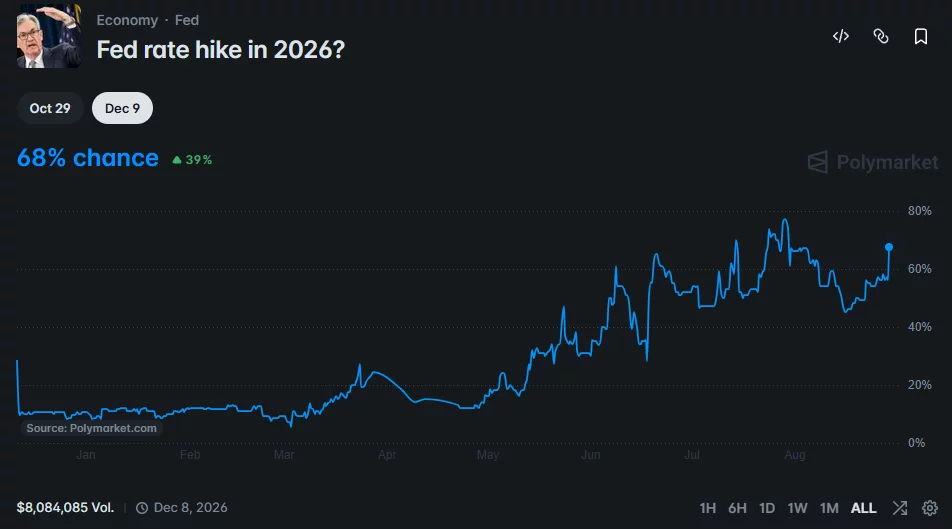
- Polymarket traders raised the probability of a 2026 rate hike to 68% after the speech.
- Nansen analysts said a hawkish message could pressure crowded Bitcoin longs after a $6.4 billion options expiry.
Warsh says inflation must return to 2% faster
The Federal Reserve’s published remarks show that Warsh made price stability the central focus of his first Jackson Hole keynote as chair, describing the 2% PCE inflation goal as a “firm, fixed target.”
Warsh said the Fed’s preferred measure, the 12-month change in the Personal Consumption Expenditures price index, stands at 3.7%. The six-month change has reached 4.1%, while comparable headline and core Consumer Price Index readings also remain elevated.
“So the Fed’s predominant focus right now should be on prices,” Warsh said.
Although the summer PCE and CPI reports came in better than expected, Warsh said the releases did not show that underlying inflation trends had “meaningfully improved.” Progress from the inflation highs reached in 2022 has also been modest during the past two years, he added.
Looking beneath the headline figures, Warsh said 54% of the 199 goods and services in the PCE basket recorded price increases above 3% during the past 12 months. The share was lower than the post-pandemic peak of about 77% but remained far above the 32% average recorded during the two decades before the pandemic.
Over the past six months, 49% of the basket posted annualized price increases above 3%, according to the Fed chair. Commodity prices have also risen recently, leaving policymakers to assess whether the move could add to inflation risks.
“We must be confident that underlying inflation is moving to our objective, clearly and at sufficient speed. Otherwise, we have work to do,” Warsh said.
Warsh did not commit to a specific interest-rate decision, saying he was committed to a policy discipline rather than a predetermined outcome. However, Jake Kennis, senior research analyst at Nansen, told crypto.news that the wording left additional increases available if inflation remains elevated.
Kennis described the speech as clearly hawkish, pointing to Warsh’s statement that he would be “hard pressed to describe broad financial conditions as restrictive.”
“He added the Fed has ‘work to do’ unless inflation moves to 2% ‘clearly and at sufficient speed,’ which is a signal that rate hikes are on the table if elevated inflation persists.”
Strong US economy gives the Fed room to act
Warsh’s inflation warning came alongside an upbeat assessment of the American economy, which the Fed chair said appeared to have strengthened despite pressure in housing and agriculture.
Business investment in equipment and intangible assets has grown by about 9% over four quarters, its fastest pace since 2021, according to the speech. Warsh attributed more than half of this year’s capital-expenditure growth to the artificial intelligence buildout.
S&P 500 company profits have climbed by more than 20% during the past year, while corporate bond and leveraged-loan spreads remain near the lower end of their historical ranges. Strong issuance and comparatively easy bank-lending standards led Warsh to say that credit markets show few signs of policy restraint.
Labor conditions have also remained stable. The unemployment rate stands at 4.1%, while the four-week average of jobless claims remains close to its lowest level in decades, according to Warsh.
At the July meeting, most Federal Open Market Committee members voted to wait for more information before changing rates, even as policymakers agreed that inflation remained too high. Warsh said the committee also expressed a shared readiness to respond if conditions required action.
For American investors, the Fed’s next decision could affect Treasury yields, the dollar and prices across risk assets, including US-listed spot Bitcoin exchange-traded funds. Polymarket contracts cited in the supplied report placed the probability of at least one rate increase during 2026 at 68%, up from less than 50% a week earlier.
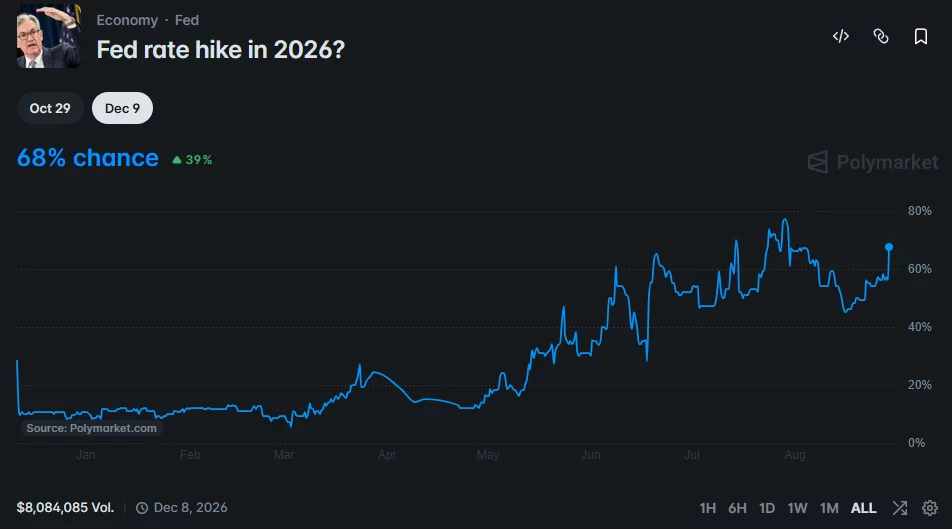
The prediction market placed the chance of a 25-basis-point increase at the September meeting at about 50%, while the probability of no change stood near 51%, with rounding and changing trades allowing the displayed figures to overlap. August CPI and PPI reports due before the meeting will give policymakers more data on whether price pressure is easing.
Bitcoin falls below $80,000 after Warsh’s speech
Following the keynote, Bitcoin fell from an intraday level above $80,000 to about $79,200, leaving the asset down nearly 2% on the day.
The decline interrupted a rally that had carried Bitcoin above $80,000 on Aug. 25 for the first time in almost 15 weeks. As previously reported, BTC had gained about 28% in eight days and tested resistance between $80,000 and $82,000 after US spot ETFs attracted approximately $1.92 billion in weekly inflows.
Before the speech, Nicolai Sondergaard, senior research analyst at Nansen, said Bitcoin’s higher-timeframe trend remained bullish, but several shorter-term measures had become less convincing. He cited crowded long funding, contracting open interest, fading ETF trading volume, and mixed exchange flows.
Sondergaard said the importance of the address would come from its effect on interest rates, the dollar and the Fed’s response to new economic data, rather than a simple hawkish-versus-dovish label.
“A hawkish signal is more dangerous because it hits crowded longs. For upside to stick, we need lower yields, stable dollar liquidity, improving CVD and BTC holding above roughly $80.4k with OI expanding.”
Without those conditions, Sondergaard described the setup before the keynote as a “fragile bullish structure, not a high-conviction breakout.”
Positioning had already become vulnerable before Jackson Hole. Bitcoin previously fell 4.1% from $81,238 to $77,870, while long liquidations reached about $270 million across the crypto market. Bitcoin futures open interest dropped roughly 4.5% from the level recorded around the $81,238 peak.
Bitcoin options expiry clears $6.4 billion overhang
Warsh delivered his speech after approximately $6.4 billion in Bitcoin options expired on Deribit at 08:00 UTC on Aug. 28, clearing a large block of contracts shortly before the market reacted to his comments.
The options expiry included roughly 81,700 contracts, comprising 44,639 calls and 37,061 puts. Calls outnumbered puts at a ratio of 0.83, with the largest concentrations sitting around the $75,000 and $80,000 call strikes.
Lacie Zhang, research analyst at Bitget Wallet, said the positioning showed constructive rather than euphoric confidence. Calls trading at higher premiums than comparable puts suggested that traders were paying for exposure to further gains after Bitcoin’s rally instead of heavily buying downside protection, she added.
“The $6.4 billion notional should not be read as a directional bet, since much of it reflects hedged dealer books and spread positions.”
According to Zhang, strike concentrations mattered more for price pinning and dealer hedging before settlement. With the contracts now expired, she said traders should watch whether open interest returns at higher strike prices and whether call premiums remain elevated across September and December maturities.
“If it does, that would confirm more durable bullish conviction; if skew normalizes quickly, the move was mainly expiry-specific positioning,” Zhang said.


Strive’s SATA preferred stock has generated an estimated amount of funding sufficient to purchase 1,192 Bitcoin this week, according to live market monitoring.
Summary
- SATA has generated an estimated funding capacity for 1,192 BTC through Friday.
- The tracker’s figure represents potential purchasing power, not a confirmed Bitcoin acquisition.
- Strive held 21,356 BTC after purchasing 1,110 coins during the previous week.
- SATA’s return to $100 has allowed Strive to resume issuing preferred shares.
SATA has reopened Strive’s Bitcoin funding channel
BitcoinTreasuries.NET estimated on Aug. 28 that trading in Strive’s Variable Rate Series A Perpetual Preferred Stock, known by its ticker SATA, had generated enough funds to purchase about 1,192 BTC during the week.
The running figure continued to rise after the U.S. market opened on Friday. Within the first two hours of trading, the tracker estimated that SATA had added funding capacity for more than 100 BTC.
BitcoinTreasuries.NET calculates the figure using SATA volume at or above its $100 stated value and an estimated capture rate based on Strive’s previous filings with the U.S. Securities and Exchange Commission. The model attempts to estimate how many new shares Strive may sell through its at-the-market offering program.
Because the tracker relies on market activity rather than a company disclosure, the 1,192 BTC figure does not confirm that Strive has already purchased the coins. Strive has not filed an 8-K detailing any Bitcoin acquisitions made between Aug. 24 and Aug. 28.
At Bitcoin prices of roughly $78,000 to $80,000 during the week, the estimated purchasing capacity would amount to approximately $93 million to $95 million. The final amount could differ because issuance expenses, Bitcoin prices, and the portion of eligible SATA volume captured by Strive can change during each session.
An earlier update from BitcoinTreasuries.NET put Thursday’s running total at 1,084 BTC after SATA recorded about $50 million in daily trading volume. Additional trading on Friday raised the estimate to 1,192 BTC before the end of the session.
The $100 SATA price has allowed issuance to resume
SATA carries a stated value of $100 and pays a variable annual dividend based on that amount. Strive currently maintains the annualized rate at 13%, with payments made every business day when declared by its board.
Strive has said it will not issue new SATA shares below $100 because doing so would raise less than the security’s stated amount and dilute existing preferred holders. Trading at or above par allows the company to sell new shares through its ATM program and direct the net proceeds toward Bitcoin or other permitted corporate uses.
During a June sell-off in Bitcoin-linked securities, SATA fell as low as $79.01, according to BitcoinTreasuries.NET. The decline prevented Strive from using the preferred-stock ATM program on its stated terms for several weeks.
By Aug. 21, SATA had returned to $100.01, reopening the issuance channel. The tracker estimated that the program generated enough capital to purchase about 440 BTC over Aug. 20 and Aug. 21 alone.
The recovery followed a period when SATA gradually approached par. On Aug. 19, crypto.news reported SATA nearing par as Strive director Pierre Rochard purchased 15,900 ASST common shares for $199,386. Rochard paid an average price of $12.54 per share in his first reported direct purchase of Strive common stock.
Strive launched SATA on Nasdaq in November 2025 through an upsized initial public offering of two million shares priced at $80 each. According to the company, demand led it to increase the offering from an initial target of 1.25 million shares.
The preferred stock initially carried a 12% annual dividend, which Strive later increased to 13%. Its $100 liquidation preference places SATA ahead of common shareholders in Strive’s capital structure, while its perpetual design means it has no fixed maturity date.
In June, Strive expanded its available ATM capacity to as much as $2.6 billion for SATA and $2.55 billion for ASST common stock, according to SEC filings. The programs permit Strive’s appointed sales agents to issue shares into the market over time rather than completing one large underwritten offering.
Strive entered the week holding 21,356 BTC
A Form 8-K filed with the SEC on Aug. 24 showed that Strive purchased 1,110 BTC between Aug. 17 and Aug. 21 for about $81.5 million. The company paid an average of approximately $73,409 per coin, including fees and expenses.
The purchases increased Strive’s holdings from 20,246 BTC to 21,356 BTC. BitcoinTreasuries.NET ranked the company as the seventh-largest publicly traded corporate Bitcoin holder, behind Bullish with 22,000 BTC and ahead of SpaceX with 18,712 BTC.
During the same Aug. 17–21 period, the number of SATA shares outstanding rose by 441,313 to 8,270,815, according to the filing. Strive’s Class A common shares increased by 3,646,300 to 79,890,888.
The filing did not divide the purchase funding among SATA issuance, ASST common-stock sales and existing cash. BitcoinTreasuries.NET estimated that SATA activity on Aug. 20 and Aug. 21 could have provided enough money for about 440 BTC, leaving the remainder potentially funded through common shares, cash or a combination of the three.
Strive’s cash and cash equivalents increased by $17.1 million during the same period, reaching $171.9 million after the company completed the 1,110-BTC purchase. Its holding of Strategy’s STRC preferred stock remained unchanged at 505,000 shares, while the position’s reported fair value rose by $707,000 to $48.57 million.
Strive has expanded its Bitcoin holdings rapidly since SATA began trading. The company held 7,525 BTC in November 2025, meaning its disclosed balance had increased by 13,831 BTC, or about 184%, by Aug. 21.
In June, Strive made another large purchase when it acquired 759 BTC for about $50 million at an average price of $65,850. The 759 BTC acquisition lifted its holdings to 19,864 BTC and exceeded Strategy’s purchase of 520 BTC during the same reporting period.
An earlier May filing showed that Strive bought 1,109 BTC for $85.4 million, paying an average of $76,988 per coin. The May Bitcoin purchase raised its holdings to 16,500 BTC and moved the company ahead of Coinbase and Riot Platforms in the public-company rankings at the time.
U.S. investors face separate SATA and ASST risks
For U.S. investors, SATA and ASST provide two different forms of exposure to Strive’s Bitcoin strategy through Nasdaq-listed securities. SATA holders receive preferred dividends when declared, while ASST holders own the company’s common equity and bear the effects of changes in Bitcoin holdings, financing costs, and share issuance.
Strive described SATA in its second-quarter report as the first listed security in U.S. capital markets to pay cash dividends every business day. Chief executive Matthew Cole said the company had become “debt-free, with zero margin requirements, and zero encumbered Bitcoin.”
The SEC filing identifies dilution from additional ASST or SATA issuance as a risk to investors. SATA also creates a continuing preferred dividend obligation because the shares are perpetual and have no scheduled maturity.
Strive’s second-quarter balance sheet listed $702.4 million of SATA preferred equity and a $783 million redemption value as of June 30. The company reported $26.2 million in SATA dividends within its adjusted net loss attributable to common shareholders for the quarter.
Strive recorded a second-quarter GAAP net loss of $257.6 million, with $234 million attributed to lower fair values for its Bitcoin and STRC holdings. As of Aug. 7, the company reported $154.9 million in cash, $48 million of STRC preferred shares, and no outstanding short- or long-term debt.


I don’t expect anything of my friends that I don’t expect of myself.
But lately, I’ve found myself disproportionately annoyed by tiny breaches of friendship etiquette. If I ask a friend to dinner and they say they’re busy without suggesting another date, I feel slighted. If I introduce two friends and they start hanging out without me, I wonder why neither thought to include me. Then I wonder: am I holding my friends to an outdated social code?
Today, it is common to say “let’s catch up soon” without making plans, leave invitations unanswered, and allow one person to become the permanent initiator. My theory: Technology lets us remain constantly in touch while making the obligations of friendship increasingly ambiguous.
When you think about it, an invitation is more than a logistical question, says Dr. Jeff Katzman, a psychiatrist at Silver Hill Hospital in New Canaan, Conn., who extensively studies human relationships. It’s a small relational bid: something close to, “I’d like to spend time with you. Would you like to spend time with me?” When that second part is missing, we’re left with ambiguity, and we fill in the blanks.
“From an attachment perspective, we’re continually looking for signals about whether the people we care about are available and responsive,” says Katzman. “When I reach toward you, is somebody there? We also bring our own histories to these moments.”
Someone who has experienced rejection or exclusion may experience the same unanswered invitation quite differently from someone who has generally experienced other people as reliable. Katzman points out that we do our best to infer other people’s minds from very small pieces of behavior. “A text goes unanswered, and the human mind is remarkably good at writing the rest of the story: ‘She doesn’t really care about me. He doesn’t want to see me. I’m always the one who tries,’” he explains.
I have lost a lot of sleep about the idea of social hygiene and the small acts of reciprocity that keep friendships healthy. I was quite surprised when two of my friends in Lisbon reached out to me on the exact same day when I had said to them separately a few months ago that I might be visiting Lisbon for work on that date. The fact that both of them remembered the exact date and reached out to check if I’m in Portugal is a great example of good social hygiene.
Whenever I make new friends now, I pay close attention. Do they regularly cancel plans at the last minute? Do they have the capacity for investing in a friendship and take on the logistical requirements of keeping an adult friendship alive? It takes roughly 50 hours of time together to move from mere acquaintance to casual friend, 90 hours to go from that stage to simple friend status, and more than 200 hours before you can consider someone your close friend, according to a report published in the Journal of Social and Personal Relationships. Getting to know someone takes a real commitment of time.
I also think about rejection and what we reasonably owe our friends. “Reciprocity is extremely important, but I don’t think reciprocity means symmetry,” says Katzman. Healthy friends don’t need to keep score. “I think of friendship a little like improvisational theater.” One person makes an offer, and the other person receives it and makes an offer back. The contributions don’t have to be identical. They’re building a scene together. One person might initiate more dinners; another might get curious a little more reliably. And at different stages of life—parenting, illness, caregiving, grief, work pressures—one person may carry more of the relationship for a while.
In good improvisation, both people help create the scene. Friendship is similar. We don’t have to say “Yes” to Tuesday night, but somehow, over time, we need to say “Yes” to the relationship. And it’s best if we can let our friends know that, in some way.
“A useful question might be: if I stopped doing all the work of maintaining this friendship, would a friendship still exist?,” asks Dr. Katzman. Sometimes, it may be worth stepping back a bit to see what happens.
When I have done that in the past, a lot of the friendships naturally dissipated, whereas when I look at all the close friendships I have now, it’s the result of mutual effort. It’s pretty similar to playing tennis, where one person hits the ball, and the other person hits it back. Sometimes, one of us drops the ball, but quickly enough it’s picked back up again to continue the game.
At the same time, we should have some humility about how many relationships any person can actively maintain. Former U.S. Surgeon General Dr. Vivek H. Murthy, in his book Together, describes concentric circles of connection: an intimate circle of close friends and confidantes, a larger relational circle of friends and companions, and a much larger collective circle of colleagues, acquaintances, and community. We need all of these kinds of connections, but we can’t maintain hundreds of relationships with the intensity of our closest friendships.
So I took a fountain pen and drew concentric circles in my journal and assigned a circle to every friend, be it close friends or acquaintances. It helped me understand that someone can genuinely value our relationship without having the bandwidth to place us in their innermost circle at a particular point in life. It also helped me assign how much energy I want to spend.
Ultimately, it helped me appreciate my friends for what they are.
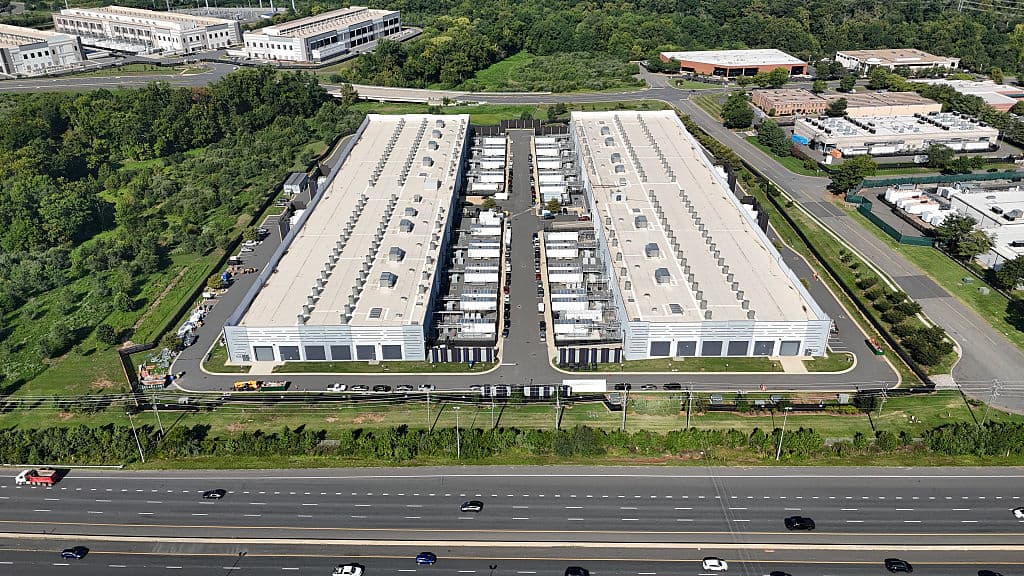
Commitment prior to permitting: Binding community and grid compacts must precede site approvals.
Proportionality: Infrastructure and community asks must scale directly with peak megawatt demand.
Enforceable security: Pledges must be backed by letters of credit, escrow reserves, or parent-company guarantees.
Statewide baseline floors: Establish statewide statutory floors to prevent developers from regulatory arbitrage across county lines.


If you’re still not convinced that creativity and originality are under siege, particularly in the movie business, look no further than the tangled tale of how the wholly joyous Coyote vs. Acme very nearly didn’t make it to a theater near you. As of summer 2018, the picture—a blend of animation and live action, adapted from a 1990 New Yorker article by Ian Frazier inspired by the forever-enduring Looney Tunes shorts—was already in development. In the spring of 2022, live-action filming took place in New Mexico. In November 2023, seeking a tax write-off, Warner Bros. Discovery decided to shelve the film; the company eventually agreed to allow the filmmakers to look for another distributor. After numerous false starts, Ketchup Entertainment acquired the rights to Coyote vs. Acme, which is why you’re now able to see the film in theaters, and eventually via streaming. In a world where entertainment conglomerates are clearly focused only on profits, this seems like a small miracle, which is why you should run—Beep beep!—not walk to see this late-summer delight on the big screen.
The premise is simple yet ingenious: After years of being zonked out by iron wrecking balls, of having slingshots overshoot the mark not by feet but by miles, of having dynamite blow his face off, Wile E. Coyote, a longtime consumer of ACME products, has decided to sue the company that has caused him so much misery. He has used all that ACME stuff for one purpose only: to ensnare the object of his eternal salivation, the tufted blue-and-yellow speed demon known as the Road Runner, both uncatchable and unknowable. But now, it seems, enough is enough, and maybe ACME is the problem. Wile E. enlists the help of a law firm specializing in personal injury cases (it’s called Avery, Jones & Maltese, a nod to three of the Looney Tunes’ chief architects, Tex Avery, Chuck Jones, and Michael Maltese), and it’s headed by Kevin Avery (Will Forte), whose specialty is getting settlements of a hundred bucks here or there from cartoon characters who have had limbs and such blown off—temporarily, thank god—by faulty products.

Coyote vs. Acme is set in a world where cartoons and humans coexist without batting an eye, so it’s business as usual when Wile E. shows up at Avery’s Albuquerque headquarters. Avery is pretty sure he can get his client a few hundred smackers for the defective rocket-powered roller skates our coyote friend has hauled in as Exhibit A. But then Wile E. unfurls, magically, a bundle including every single ACME product that has ever clocked his noggin or blasted him to oblivion: these million and one instruments of pain and suffering spring high into the sky, like magic rocks gone wild. Avery is still reluctant to sue the pants off ACME. But his niece and intern Paige (Lana Condor) persuades him this is one case that could really make a difference for thousands of disadvantaged cartoon characters, many of whom, including Porky Pig, Daffy, and Tweety Bird, show up in sprightly cameos. That’s how Avery finds himself up against ACME’s bulldog lawyer Buddy Crane (John Cena, who, with his square, precise jaw and squinty smirk, looks like a work of vintage hand-drawn animation himself). He also learns that Wile E.’s case isn’t isolated: ACME has long been involved in a nefarious plot to make millions by taking advantage of hapless cartoon characters.
Coyote vs. Acme was directed by Dave Green, whose highest-profile movie to date may have been 2016’s Teenage Mutant Ninja Turtles: Out of the Shadows. But his confidence sings here: to say Coyote vs. Acme benefits from a light touch may seem odd—this is, after all, a movie where heads are clonked with mallets and facial features are rearranged by malfunctioning explosives. But the spirit of Coyote vs. Acme is everything. The script was written by Samy Burch, James Gunn, and Jeremy Slater; the voices of most of the characters—including Bugs Bunny, as a trenchcoat-wearing informant, and Elmer Fudd, as an earnest senator in charge of questioning “Mr. Runner” during a hearing—are provided by voice actor Eric Bauza, who clearly aced his studies at the University of Mel Blanc. Forte makes a fabulous foil for his cartoon costars: he never tries to outdo them, preferring to bow to their lunatic majesty. He knows they’re what we’ve come here for.

Because the Road Runner cartoons—which, along with the other works of genius in the Looney Tunes galaxy, made many of us the warped individuals we are today—were never really about the Road Runner. He’s moving too fast for us to ever get a handle on him; his job is to outsmart the coyote who hopes to catch him and turn him into stew, and he’s simply too good at that job. We know he’s always going to win, which makes him less interesting than his nemesis. Wile E. Coyote, with his conniving yellow eyes, a voiceless beast who communicates by holding up a series of signs scrawled with simple lines of dialogue, is the character we love in spite of ourselves. His untrustworthiness is his greatest quality; when he pretends to be nice, his canine lips turning up in a facsimile of a canine smile, we know it’s an act, and we can wear the joy of not being taken in by his deceptions as a badge of honor. It’s both funny and a little horrible when he goes splat into a slab of rocky desert clay, cutting a Wile E.-shaped hole into nature’s landscape. In Coyote vs. Acme, we almost feel something for him—almost. But in the end, he lets us off the hook; he will not let us fall victim to sentimentality. We’re in on his con, and it’s a pleasurable place to be.
Coyote vs. Acme is all about the little guys fighting, and winning against, a corporate behemoth. Could it be that Chuck Jones and his cohorts, by inventing a do-it-all, know-it-all company that could fulfill our every material desire, dropping off packages almost before we’d even placed an order, had in some cracked way foreseen the rise of Amazon? They probably couldn’t have imagined it, and it’s just as well, because the world they dreamed up—one of slapstick escape, of kerpow explosions that never did any actual harm, of faces and voices that we can summon in our memories as easily as those of our loved ones—is better than anything money can buy. In Coyote vs. Acme, the little guy wins, and we do too. Instead of being handed, in movie form, an exploding cigar that someone else thinks we want, we get the thing we didn’t know we wanted: a movie about a coyote, a bird, and a lawsuit, one that both speaks to our time and allows us, for the space of an hour or two, to escape it.

Houses rammed, stabbings, drive-by shootings – inside the gang warfare turning Middlesbrough into a dystopian nightmare: PAUL BRACCHI

Agricultural Bank of China Limited (ACGBY) Q2 2026 Earnings Call Transcript

Everpure Stock Slides Despite ‘Stellar’ Results. Here’s Why.

Weekend Open Thread – Corporette.com

Weekend Open Thread: Brooks Brothers

London Mayor Sadiq Khan handed a peerage by Keir Starmer alongside 15 other Labour figures… just days before the PM leaves No10

Did You Know?#ai #tom #finance #france #shorts #trendingshorts #animation#viral #money #rich

BITCOIN AND ALTCOINS: BULL FLIP NOW!?!! WTF!!!!!

Dillon Danis Pulls Out Again, Usman Nurmagomedov Talks Money, More | The Craic | 8/28/26
-

 Crypto World3 days ago
SpaceX stock could rise 75% to $240, JPMorgan says
-

 Crypto World1 day ago
Bitcoin’s 22% rally now needs real demand to outlast Treasury liquidity boost
-

 Business6 days ago
Musk’s Tesla, SpaceX Confirm $16.8 Billion ‘Terafab’ Chip Plant as World’s Largest Building in Texas
-

 Crypto World7 days ago
anatomy of crypto’s biggest liquidation event since 2021
-

 Crypto World4 days ago
A $30 Billion AI Fund Implodes, Now the SEC Is Investigating Wall Street’s Role
-

 Crypto World2 days ago
Warsh Jackson Hole keynote puts financial innovation first
-

 Politics7 days ago
6 months on, Irish renters crushed by effects of government housing bill
-

 Crypto World3 days ago
Did Trump Just Move SpaceX Stock With One Truth Social Post?
-

 Business23 hours ago
Salesforce Stock Soars 19% as Blowout Earnings and Agentforce AI Growth Silence Software Skeptics
-

 Business6 days ago
Mystery AI Model ‘Ox Alpha’ Draws Developers With Free Access as Chinese Lab Origins Remain Debated
-
 NewsBeat7 days ago
The ‘Lucky Dip Gang’ causing carnage for clicks: After five thugs were killed speeding in the wrong direction on a motorway, GUY ADAMS investigates a sick new trend… and why police aren’t even allowed to pursue them
-

 Business2 days ago
Walmart takes aim at younger shoppers with new fashion brand
-
 NewsBeat2 days ago
Lindsay Clancy jury braces for closing arguments as judge tells court: ‘You’ve heard all the evidence’ – Live updates
-

 Business4 days ago
Moderna CEO warns China is pouring state money into mRNA technology
-

 Business7 days ago
Will Tesla Stock Be Higher or Lower a Year From Now? Here’s What Wall Street Analysts Are Saying
-

 Business4 days ago
NVIDIA Stock Drops Nearly 2 Percent to $210 on Seventh Losing Day Ahead of Critical AI Earnings
-
 Crypto World5 days ago
$92 Billion Nvidia Earnings Could Make or Break the AI Trade
-

 Business3 days ago
Thailand’s Eastern Economic Corridor Capital City (EECiti): Key Developments and Investment Opportunities
-

 Sports6 days ago
Deshaun Watson fires back at Browns fans after being booed: ‘It’s a disrespectful thing’
-

 Crypto World6 days ago
Google Gemini AI Predicts Ethereum Could Become the Trade Retail Misses in 2026
You must be logged in to post a comment Login